John,
I have a real Industrial-11 console I could check with, if you can
set up a version of the picture with that console.
Michel
----- Original Message -----
From: "John A. Dundas III" <dundas at caltech.edu>
Date: Friday, February 2, 2007 1:53 pm
Subject: Re: PDP-11 GUI console, was Re: Foonly
> At 3:17 PM -0500 2/2/07, Bill Pechter wrote:
> >I'd love to see the Dec DataSystem 570 graphic...
>
> Easy: just run the program, use the Preferences menu item, select
> Console, click on DataSystem 570, whoosh, the console window will
> change.
>
> BTW, someone with a real 570, or an Industrial-11, can make sure I
> got those right. I have only (!) a "regular" one to measure against.
>
> John
>
> If anyone is desperately looking for tapes in that area of interest, let me
> know and I'll make a list of what's there.
An inventory with part numbers and date codes would be useful to find out
what still exists. I need to bug Jeff Moffatt about this as well.
--- Ade Vickers <javickers at solutionengineers.com> w
rote:
> Right at the end of the latest Egg Money advert, i
s
> that a TRS Model 3 or
> Model 4?
>
> This link should be viewable for a while:
>
> http://www.visit4info.com/preview-flash.cfm?vm=0&t
ype=2&adid=41634
>
>
> Also, a previous ad has featured a CBM PET shaped
> "mockuter" (mock
> computer), with the tape deck replaced with an
> oversized trackball:
> http://www.youtube.com/watch?v=M0nZwyua8Ao
>
>
> Cheers,
> Ade.
>
hehe, I saw the first advert only the other
day and wondered what it was. Unfortunately
the writing was too blurred by the disk drives :(
I recall the PET one too. That was showing
around the time of The IT Crowd (UK, Channel 4) on t
errestrial TV. I spotted what looked to
be a real PET in the corner by the entrance
in that.
That was funny, and even more funnier for
computer enthusiasts (I assume we don't call
ourselfs computers geeks/nerds? *ducks*).
Regards,
Andrew D. Burton
aliensrcooluk at yahoo.co.uk
--- Chuck Guzis <cclist at sydex.com> wrote:
> On 4 Feb 2007 at 0:24, Tony Duell wrote:
>
> > Incidentally, I heard a news item a few days ago
> that 'PC World' (a chain
> > of computer shops in the UK) will no longer be
> selling floppy disks once
> > their current stocks run out. Apparently USB
> sticks store more data and
> > are more conveneint (well, the first is true, bu
t
> irrelevant if you only
> > need to store a few kilobytes, the second is
> definitely false if your
> > machine doesn't have a USB port).
>
> This is bad news from a preservation standpoint.
>
**>> snip <<**
>
> Cheers,
> Chuck
Yes, that's bad news for me too.
Whilst my Amiga's are down at present, I do
fully intend to get back to them and develop
more games/software for them.
All my stuff (so far) is only usually around
200-300KB in size. Without floppy disks I'd
have to burn them to CD, or upload them onto
the 'net (and then burn them to CD's using a
laptop - which I haven been meaning to get
for 2 years now, just for that purpose).
Whilst we won't run out of 3.5" disks just yet,
I was wondering how feasible would it be for
someone (probably fairly rich) to make
home-made disks?
Or perhaps someone would spot the hole in the
market and continue to make disks for those
of us that require them? The only problem with
that is of course, would we be buying enough
regularly (200,000 a year?) to make it worth
their time/effort/money?
I have a feeling it ain't looking good....
Regards,
Andrew D. Burton
aliensrcooluk at yahoo.co.uk
>Date: Sun, 04 Feb 2007 14:56:01 -0800
>From: "Chuck Guzis" <cclist at sydex.com>
>Subject: Re: Arty computers
>Didn't the GI CP1600 have an external line that, if activated, would
>inhibit P-counter increment? I don't know if anyone ever used it for
>anything.
>Cheers,
>Chuck
------------------------
My, what a remarkable memory you have: pin 40, /PCIT (Program Counter Inhibit),
also used to output a pulse on execution of an SIN (software interrupt) instruction,
apparently used mainly by the control console.
mike
At 19:45 -0600 1/30/07, cctalk-request at classiccmp.org wrote:
>I've often thought that you can see the beauty of machinery (including
>computers) on many levels. Most classic computers are not particularly
>beautiful to look at, but there can be beauty in how they're assembled (I
>personally think the HP9816 is an interesting construction), there can be
>beauty in the elkectronic design, or the firmware, or... You just have to
>look for it.
Agreed, which leads me to NeXT cube as my nomination. Though the
mainboard design is not a particular standout, chassis design,
appearance, and software all appeal strongly to my aesthetics.
I quail at the thought of suggesting a thread on "performance arty"
computers...
(...or "artless" computers. TRS-80 model 1?)
--
Mark Tapley, Dwarf Engineer
(I haven't cleared my neighborhood)
210-379-4635 Dwarf Phone, 210-522-6025 Office Phone
--- "G Manuel (GMC)" <gmanuel at gmconsulting.net> wro
te:
>
>
> -----Original Message-----
> From: aliensrcooluk at yahoo.co.uk
> [mailto:aliensrcooluk at yahoo.co.uk]
> Sent: Friday, February 02, 2007 6:59 PM
> To: cctalk at classiccmp.org
> Subject: Re: arty computers
>
**>> snip <<**
> >Regards,
> >Andrew D. Burton
> >aliensrcooluk at yahoo.co.uk
>
> >PS. Does anyone know what has happened to
> >the Old Computer Museum? I can't connect to it?
>
> Do you mean www.oldcomputermuseum.com? It works fi
ne
> for me.
>
> Greg
>
Ok, I can connect, but I get redirected to here:
http://www.oldcomputermuseum.com/files/error.html
I'm on dial-up and am from the UK. That shouldn't ma
ke a difference should it???
Does anyone know if the site has been altered/
upgraded recently?
Regards,
Andrew D. Burton
aliensrcooluk at yahoo.co.uk
From: "Ethan Dicks" <ethan.dicks at gmail.com>
>
>Ooh... didn't know that the M4 could run CP/M.
>
I ran "Montezuma" CP/M-80 exclusively on my Model 4P. I did it at first so
I could use Turbo Pascal, but decided pretty quickly that I liked it better
than TRS-DOS.
--------------Original Message:
From: Marvin Johnston <marvin at rain.org>
Subject: CBM 8032 Garbage on Screen
I've got a CBM 8032 that powers up "fine", but the screen is filled with "!" on
every other character position. When some letters are repeated, they can change,
i.e. "nnnn" becomes "onon" which seems like (without checking the ASCII charts)
that the "n" and "!" are ORed to become the "o". Anyone have any ideas what the
problem might be? Most of the schematics I have are buried someplace, so I
thought I would start here.
---------------------
My guess would be a stuck bit D0 in UC4 (even chars) or UC6 (odd chars), a 2114,
notorious for its failure rate.
mike
--- Tony Duell wrote wrote:
> > Interesting. Most people seem to say nice things
> about
> > the Apple ]['s design. I'd love to hear some
> informed
> > bashing ;) . Could you elaborate some about the
> > machine's short comings from your perspective?
>
> Firstly let me emphasise that my first computer was
> a
> TRS-80 Model 1. And
> I thus do have a soft spot for that machine.
> Irrational, probably, but
> there you are. I've got several TRS-80s now (M1, M3,
> M4, CoCo, M100) and
> all have proved _very_ reliable. Odd considering
> other
> people's
> expieneces, but I must have replaced perhaps a dozen
> components _total_
> in all said machines.
I see nothing wrong with that. The Tandy machines
seemed like decent computers for the money. I wouldn't
mind picking up a TRS-80 someday.
> Now, the Apple ][...
> I had a lot of rpboelsm with it randomly crashing.
> In
> the end I took the
> whole thing apart and stuck an ammeter in the 5V
> output of the power
> supply. It turend out that the mainboard (48K RAM) +
> languge caed + 1
> floppy drive drew _more_ than the rated current of
> the
> supply as given in
> the techincal manual If you added more drives, a
> serial card, etc, it
> became ridiculous.
Strange, I haven't noticed any stability problems with
my ][ and ][+ under similar loads. Still, an unstable
machine is unlikely to impress.
> Much has been said about the Apple ][ disk
> controlle,
> and how it's a
> clever design. Well, a minimal-component design
> certainly, but I didn't
> like it. Not having a track0 sensor seemed like a
> Bad
> thing for starters
> (continually banging the head against the stop does
> not improve the
> alignemnt!). The drives are Shugart mechanisms with
> the IMHO poor
> plastic-cam-with-a-spiral-groove head positioner,
> and
> becuase the drives
> are non-standard you can't use any others (unlike
> the
> TRS-80 where you
> can use any 5.25", 3.5" or 3" drives). But for me
> the
> biggest problem was
> that the Apple couldn't read/write disks from other
> machines, unlike the
> TRS-80, which used a WD1771 controller and could
> handle any single-desity
> 5.25" disk (I spent many late nights getting it to
> read the disks from
> the school's RML380Z computers, which also used 1771
> controllers).
What can I say? The Disk II, either you love it or you
hate it. :)
To be fair though, the Apple Disk II system was not
the only game in town. While they weren't common, you
could get a 3rd party 8" MFM floppy system if you
wanted to.
Would you recoil in horror if I told you that some
companies made single sided 40 track 3" (Amdisk) and
double sided 80 track 5.25" (Rana Elite 3) drives for
use with the original Disk II controller? ;)
> I didn't like the Apple ][ I/O system. Memory space
> was tight, but they
> wasted lots of space with those 'soft switches' and
> single-bit inputs. It
> could all have been packed into a few bytes. I am
> pretty sure the 6821 if
> not the 6522 was available when the Apple ][ was
> designed.
Fair enough.
> The first seiral port for the Apple ][ was a
> bit-banger. It was the only
> one I had for some time, and it was almost unusable.
> The TRS-80 used a
> real UART, and worked. Yes, there were better serial
> ports avaiable for
> the Apple later.
Was this an early serial board or were you using the
game port? I've always enjoyed the luxury of a 6551
equiped board (Super Serial Card II).
I think Woz was allergic to peripheral chips in the
beginning. :)
> The Apple text display did have lower case (wich the
> TRS-80 didn't as
> standard), but you couldn't mix text and graphics on
> the same part of the
> screen. Apple gave you the high-res mode, but
> working
> out the addresses
> gave me headaches (all to save a few chips IMHO!).
> And
> colours in the
> high-res mode were essentially obtained as NTSC
> artefacts.
The TRS-80 graphic characters are pretty neat. The
stock Apple character generator was certainly poor in
terms of graphics characters. Heck, it didn't have
lower case characters! Needless to say, soft hires
character generators were a pretty common project. It
would have been nice to have had one in the firmware.
The hires mode is somewhat byzantine and it was indeed
that way to save chips! :) Fortunately, it's not too
bad to work with if you use a lookup table to untangle
the memory map. I have no doubt it has turned off
plenty of people though.
The colors are NTSC artifacts! :) I thought that was a
neat hack. How did they deal with that in PAL land?
> And another oddiity. The whole design of the Apple
> ][
> seems to have been
> to save a chip if at all possible (provided the
> machine still works --
> just).
Bingo! Legend has it that Woz's aesthetic ideal was to
bum a design down to as few chips as possible. Almost
a Madman Muntz I suppose.
Methinks you're not a fan of Clive Sinclair either? :)
And yet the kayboard was encoded in hardware.
> Why? It meant you
> couldn't implelement a lower case keyboard in
> software
> (there are the
> well-known shift key mods where you run a wire from
> the shift keyswitch
> to one of the single-bit inputs on the games
> connector, which shouldn't
> have been necessary).
This is a good point. My guess would be that Woz
designed the Apple II as just a naked board, kind of
like the Apple I. Apple sold you the motherboard and
it was up to you to find a power supply , keyboard,
and housing. Apple did offer the ][ that way early on.
> Of course I like elegant, simple designs (the HP9100
> is a case in point).
> But the Apple ][ seems to have been a case of
> cutting
> too many corners.
> And I had a lot of problems as a reuslt.
>
> -tony
Thanks for your input Tony. While I've never had
reliability problems with my ][/ ][+ I think I
understand where you're coming from. I like the Apple
because I feel it's a machine with interesting
capabilities yet made from a small amount of simple
parts. It's a machine I can both grasp and enjoy.
What's your opinion of the BBC Micro? I've never had
the pleasure of using one, but on paper it sounds a
lot like a fast Apple II with a pair of 6522, 6845,
hardware ACIA, 1770 FDC, and enhanced basic.
Liam Busey
____________________________________________________________________________________
Sucker-punch spam with award-winning protection.
Try the free Yahoo! Mail Beta.
http://advision.webevents.yahoo.com/mailbeta/features_spam.html
On 4 Feb, 2007, at 18:15, cctalk-request at classiccmp.org wrote:
>
> Message: 7
> Date: Sun, 04 Feb 2007 12:52:33 -0500
> From: "Bob Bradlee" <caveguy at sbcglobal.net>
> Subject: Re: Ampex Timeline
> To: "General Discussion: On-Topic and Off-Topic Posts"
> <cctalk at classiccmp.org>
> Message-ID: <200702041754.l14Hsgkx054201 at keith.ezwind.net>
> Content-Type: text/plain; charset="us-ascii"
>
> On Sun, 04 Feb 2007 09:32:29 -0800, Chuck Guzis wrote:
>
>> Another possiblity--the Ampex tape drives wouldn't have been standard
>> at the time; it would have been IBM 729's.
>
> Although there is little online about the earlt Ampex drives
> because they were goverment only.
>
> The following id from the Ampex timeline:
>
> 1950 Ampex introduces the first "dedicated" instrumentation
> recorder, Model 500, built for the U.S. Navy.
>
> 1954 Ampex introduces the first multi-track audio recorder derived
> from multi-track data recording
> technology.
>
> Some food for thought ...
>
> Bob
The machine in question was I understand 1959/60. I don't know the
official
release dates for the digital Ampex drives but ICT used them on the
ICT1301
which was released in 1962, though the tape drives were not immediately
available. These were one inch tape drives (Ampex TM1 I think) and
half inch
drives (Ampex TM4). These used the aluminium spools with three notches
in the hub not the later industry standard expanding hub type spools.
The
one inch tapes were 16 track and the half inch tapes were 10 track. They
used thyrotron valves to fire the pinch rollers. The TM4s also had a
version
used on the Lyons Leo computers of that era, these used the same tape
spools but with a small expanding hub, like a scaled down version of the
7 track and 9 track ones. Professional reel to reel audio equipment used
a quarter inch version of the same spools until recently, or maybe they
still do for all I know about audio recorders.
By the way, as Dr Who has been deemed to be on topic:
ICT 1301 consoles appeared on Dr Who and Blakes 7. I think I saw one in
a James Bond film too, but I have been trying to find which one but
have so
far drawn a blank. In the villains HQ there was a big round room on
two floors
and in the middle were some control panels, the whole place got blown
up as
is normal in a 007 film. Must have been filmed about the time 1301s were
being scrapped 1965 to the early 70s.
Roger Holmes (owner of an ICT 1301 for over 30 years)
the Peanut was a *mostly compatible*, no? I thought
the main hindrance to running pwogwams was the lack of
a 2nd floppy or hard drive...
____________________________________________________________________________________
Be a PS3 game guru.
Get your game face on with the latest PS3 news and previews at Yahoo! Games.
http://videogames.yahoo.com/platform?platform=120121
the Peanut was a *mostly compatible*, no? I thought
the main hindrance to running pwogwams was the lack of
a 2nd floppy or hard drive...
____________________________________________________________________________________
Have a burning question?
Go to www.Answers.yahoo.com and get answers from real people who know.
> From: Liam Busey <buseyl at yahoo.com>
> > But for me the biggest problem was
> > that the Apple couldn't read/write disks from other
> > machines, unlike the
> > TRS-80, which used a WD1771 controller and could
> > handle any single-desity
> > 5.25" disk (I spent many late nights getting it to
> > read the disks from
> > the school's RML380Z computers, which also used 1771
> > controllers).
>
> To be fair though, the Apple Disk II system was not
> the only game in town. While they weren't common, you
> could get a 3rd party 8" MFM floppy system if you
> wanted to.
Lobo Drives made drives for, among others, the Apple II including a neat box
with an 8" floppy drive and an 8" hard disk. They were given to me to sell on
Ebay, and then the guy passed away (same person who gave me all the Poly stuff,
and lots of other things before he died.) I have them set aside until either I
have the time to find out more about how to hook it up, or someone drops by who
knows what they are doing. My suspicion is that the hard drives probably have a
lot of interesting things from Lobo Drives, hence my caution. And I *think* I
have the controller card, but again, I need to research this stuff out.
> On 1 Feb 2007 at 18:18, William Donzelli wrote:
>
>> The nerds would then hack these to say 99 MHz.
>>
>> The ubernerds would hack them to say 1111 MHz...
>
> ...and "who cares" dummies like yours truly would simply hack them to
> say "HI" and "LO"...
>
> Cheers,
> Chuck
I surely can't be the only one to have thought of hex...
Anyone hacked their Z-80 with a analog meter yet? Seems the easiest
(just pull off of the M1 line).
there never was the ability to perform color on the
*classic* (i.e Z80 or 68k based) Trash-80s, wuz there?
I know the 2K wasnt 1st, the award going to the coco
____________________________________________________________________________________
The fish are biting.
Get more visitors on your site using Yahoo! Search Marketing.
http://searchmarketing.yahoo.com/arp/sponsoredsearch_v2.php
--- Chuck Guzis wrote:
> On 4 Feb 2007 at 0:56, Tony Duell wrote:
>
> > And another oddiity. The whole design of the Apple
> ][ seems to have been
> > to save a chip if at all possible (provided the
> machine still works --
> > just). And yet the kayboard was encoded in
> hardware.
> Why? It meant you
> > couldn't implelement a lower case keyboard in
> software (there are the
> > well-known shift key mods where you run a wire
> from
> the shift keyswitch
> > to one of the single-bit inputs on the games
> connector, which shouldn't
> > have been necessary).
>
> Thank you for absolving me of being the first to use
> the term
> "gutless wonder". :)
LOL. That has a certain ring to it.
It gives character. :)
> In a way, I suppose the disk controller was a clever
> design. But it
> locked the CPU into 2MHz operation. The use of a
> simple arithmetic
> checksum for each sector was not perhaps the most
> reliable solution
> either. But the biggest problem is that disk
> reading
> and writing
> required 100% attention from the CPU. On most other
> computers that
> used dedicated LSI controllers, the possibility
> existed for
> overlapped computation/disk access.
Oh yes, that's a huge gotcha with the disk II. It
could make communications software or data logging
interesting.
There were other disk systems for the Apple though
none as ubiquitous.
I like the Disk II. I don't think it was the ultimate
disk system, just a clever/ cheap one (for Apple at
least).
Liam Busey
____________________________________________________________________________________
Looking for earth-friendly autos?
Browse Top Cars by "Green Rating" at Yahoo! Autos' Green Center.
http://autos.yahoo.com/green_center/
My God! I just looked at the PDP11 console on the OSX SimH.
It's beautiful. I use the PDP8 Xwindows emulator by Doug Jones... but I've
always felt the PDP11 needed something similar. I wish I could code enough
to do the full front panel in software for SimH.
Nice work.
Just wish I had a Mac newer than the 68030 in the IIfx downstairs.
Bill
On 2/1/07, John A. Dundas III <dundas at caltech.edu> wrote:
>
> I haven't seen a real one either, but sure appreciate Phil and Doug's
> work on the simulator.
>
> At 2:42 PM -0500 1/31/07, Phil Budne wrote:
> >John (Dundas) went on to build do PDP-11 front pannel blinklights und
> >switches for SIMH, looks like it's available at:
> >
> >http://dundas-mac.caltech.edu/~dundas/retro/simh/index.html
> >
> >Which says it includes Doug's and my work (in V0.9 or later).
>
> 'Tis true. I'm not much of a computer gamer but I do enjoy playing
> the occasional game of Lunar Lander on my Mac.
>
> John
>
Warren says:
> I would
> guess that the intellectual property rights of UNIX ended up with
> Alcatel-Lucent, but, that whole related series of trades, spin-offs and
> mergers has left me a bit confused. In any case, WHOEVER now owns the
> rights to UNIX would probably be interested in the fact that some
> version of their code is being sold without license.
>
Depends on who you listen to- SCO-Caldera think they got it from
Novell, Novell thinks that they still have it from when they bought out
AT&T's share of USL and SCO-Caldera only has rights to use...
At any rate the UNIX trademarks went to The Open Group, nee UNIX
International.
>
>Subject: Re: TRS-80 Model I
> From: Jim Battle <frustum at pacbell.net>
> Date: Sat, 03 Feb 2007 22:56:07 -0600
> To: General Discussion: On-Topic and Off-Topic Posts <cctalk at classiccmp.org>
>
>Let's look at contemporaries (1977 micros). The Sol-20 had 64x16 text,
>and unless you polled the hblank signal and limited yourself to poking
>one character per 50 uS, you'd get snow on the screen. There were
>others that had the snow problem as well (eg, exidy sorcerer). The
>TRS-80 didn't have the snow problem, but it too had a 64x16 text
>display. The PET (which I never used) also had character graphics of
>the most pathetic sort.
It did have the snow problem (more correctly flashing) save for the cpu
was so slow at 1.7mhz that it was less likely too.
It also didn't have lower case, Sol20 aka the VDM-1 video did!
Apple did some neat things but they went in differnt directions at different
prices.
Allison
Please do not reply to me, this is a forwarded email
>from http://oldcomputers.net
------------------------------------------------
Name: shanon barnett - dentalarts at myway.com
Where: cullman, alabama
Date: Tue, Jan 30, 2007 - 11:02:47 PST
I have a mid 70's IBM 3742 Dual Data Station with the
Manuals that came with it also 2 floppies that it
uses. Would like to sale.
------------------------------------------------
____________________________________________________________________________________
Sucker-punch spam with award-winning protection.
Try the free Yahoo! Mail Beta.
http://advision.webevents.yahoo.com/mailbeta/features_spam.html
--- Cameron Kaiser <spectre at floodgap.com> wrote:
> > > The quintessentail 'arty' machine I still say
is
> the
> >
> > Won't we be flamed if we don't acknowledge the
> Kim-1 as the most beautiful
> > of all time?
>
Kim-wahhh??!! (joking)
I don't think anyone has mentioned the C= PET.
You can't leave that out, what with the whole
2001 thing and all that.
Regards,
Andrew D. Burton
aliensrcooluk at yahoo.co.uk
PS. Does anyone know what has happened to
the Old Computer Museum? I can't connect to it?
"William Donzelli" <wdonzelli at gmail.com> wrote:
>> What exactly is it about that machine that makes you say that?
>> How does it differ from any other (similarly well-preserved)
>> PDP-11/70?
>>
>> (FWIW: I don't know either the seller or Jim Willing; I'm just curious).
>
>
> Jim Willing was one of the pioneers in this computer collecting hobby
> (I apply pioneers to those of us that were doing this seriously over
> ten years ago - before this list, and before there even was a hobby).
Cool! I'm a pioneer, having collected these things for close to 25 years.
Well, I'm not sure I would call it collecting in the normal sense of the
word. I want to keep these machines running, useable, and in use.
Guess that's why Magica exists (even though she's not powered on right
now), along with the other machines at the same site.
Johnny
>> Are there any working 7030s anywhere?
> Not a chance. Only a few (<20) were made. CHM has most of one.
http://www.brouhaha.com/~eric/retrocomputing/ibm/stretch/
Nine were built.
There may be a simulator for one in the future.
Did anyone catch this Clive "Max" Maxfield article on IBM
DeveloperNet some months back?
http://www-128.ibm.com/developerworks/power/library/pa-hrrg1
I like his idea of implementing a computer using RS-485 linkup among
the functional units. Is anyone tempted to get their soldering iron
warmed up?
Cheers,
Chuck
> the Mach stuff from BSD
The Mach kernel is from CMU
The BSD layer on top of the original Mach on VAXen and
Sun boxes had USL encumbrances. The BSD used in OS X
is based on FreeBSD, which does not. This should all be
described on the Darwin site.
> Okay... I just checked, and Apple did NOT go to the nicety of
> licensing OS X as a version of UNIX.
Apple has had a Unix source license for a VERY VERY long time.
>
>>> I write this on a Linux machine, and I love the operating system.
>>> Linux is a work-alike of UNIX, developed by Bell Labs (K&R). The
>>> Apple
>>> OS-X is a licensed variant of UNIX. Linux is NOT an offshoot of
>>> Apple.
>>
>> OK, I know this is way OT, but I'd like to see that documented. As
>> far as I know OS X is NOT a licensed UNIX. As a matter of fact, by
>> any
>> definition I'd use, it's not unix period. It just has a really pretty
>> [and incredibly useful] POSIX API.
>
> AFAIK, it's Mach with a POSIX layer and a FreeBSD userland, and of
> course
> Apple's custom stuff bolted on.
>
>
Depends on what you mean- I think I recall the Open Group finally got
Apple to certify it under threat, but Sys10 has never had a AT&T
license AFAIK.
OTOH OSF/1|Tru64|DIGITAL UNIX has a very similar structure, and no one
argues the UNIXness of that beast (except for those who also argue
against AIX).
> Where can one find a copy of the last OS/2 release?
eBay, though it is still going for real money there.
OS/2 software is one of the things that I have been
acquiring for CHM as an example of a non-Windows
software technology from the 90's.
> Hmmm. I supported the Eagles for the 8 years I was at Fujitsu. Don't
> remember anything about issues mixing with CDC on the same cables. Come to
> that, I was at MPI before Fujitsu and don't remember any problems with
> mixing there either. Of course, the Eagle simply ran forever. I visited a
> couple that hadn't been powered down in 5 years - just running along quietly
> in the background.
MANY years ago, I wanted to get rid of a Sun 3 server with two Eagles. Someone
>from Berkeley came down and loaded the 7' rack into the back of his JEEP. It stuck
out from the back so far that the rack fell out about a block from my house (I
heard the crash when it hit the road).
We helped him put it back in and gave him some rope to tie it in place.
Years later, I ran into him, and other than the rack rails having bent back a
few inches from the impact, it ran fine..
Heads were locked, of course..
--- Chuck Guzis <cclist at sydex.com> wrote:
> On 2 Feb 2007 at 23:54, arcarlini at iee.org wrote:
>
>
> > A few days ago I read a claim that floppies are
> used infrequently
> > these days (compared to how often they used to b
e
> used) so the
> > dust and grime that gets sucked through a drive
> has longer to
> > accumulate before being deposited onto the
> occasional floppy
> > that does make it in there (for a BIOS upgrade o
r
> whatever).
>
> Horsepucky.
>
> (I know--I should quit mincing my words and say wh
at
> I *really*
> think :) )
>
> My drives get used a lot--and are scrupulously
> maintained. Modern
> 3.5" DSHD media is garbage. I have far better luc
k
> with DS2D 3.5".
>
> Cheers,
> Chuck
>
Most of the 3.5" drives at work are hardly used.
We only use about 4 computers to transfer
data to/from the analytical machines.
Another one transfers data directly to a PC
via the network.
That leaves about 7 computers that we rarely
(maybe once every 3 months) use the 3.5" floppy
drive on.
Regards,
Andrew D. Burton
aliensrcooluk at yahoo.co.uk
"Bill Pechter" <pechter at gmail.com> skrev:
> Actually, my favorite three DEC boxes are the 11/70, the 8650 Vax and the
> Minc.
>
> Wierd mix... but they're pretty much representative of a lot of the stuff
> from Real Time through timesharing.
Interesting that you should mention just those machines, Bill, as I feel
the same way, except that I haven't touched a Minc yet.
But as it happens, we have two 11/70 machines and two VAX 8650 machines
fully functional here. :)
It don't get much better than that.
Johnny
Guy Sotomayor write:
Not too bad. I was lucky and all of mine worked. Just print out the
manual and make sure everything's configured correctly. I have the
8-drive versions. I put the CDC drives on a separate controller because
apparently there's "issues" with mixing Eagles and CDC drives on the
same chain.
TTFN - Guy
-----------------------
Hmmm. I supported the Eagles for the 8 years I was at Fujitsu. Don't
remember anything about issues mixing with CDC on the same cables. Come to
that, I was at MPI before Fujitsu and don't remember any problems with
mixing there either. Of course, the Eagle simply ran forever. I visited a
couple that hadn't been powered down in 5 years - just running along quietly
in the background.
So, I'm not surprised to see some Eagles still running. To me, it was the
best disk drive ever made. Certainly the most reliable. I got to be good
friends with the designer, Yuji Inoue. He was an incredible engineer.
Sadly, he died about 3 years ago.
And I add my kudos for your beautiful restoration. It is great to see such
a labor of love.
Billy
But I'll have to either steal a PowerPC based Mac -- or get it up under
PearPC... :-)
Bill
On 2/2/07, John A. Dundas III <dundas at caltech.edu> wrote:
>
> At 3:17 PM -0500 2/2/07, Bill Pechter wrote:
> >I'd love to see the Dec DataSystem 570 graphic...
>
> Easy: just run the program, use the Preferences menu item, select
> Console, click on DataSystem 570, whoosh, the console window will
> change.
>
> BTW, someone with a real 570, or an Industrial-11, can make sure I
> got those right. I have only (!) a "regular" one to measure against.
>
> John
>
Patrick Finnegan wrote:
At least with pulls, you know they've probably been tested recently :/
Pat
--
-----------------------
Tested, working and burned in (no infant mortality). My luck with pulls is
far better than with new components. However to be fair, I have never had a
bad microprccessor of any ilk.
Billy
> On Behalf Of Chuck Guzis
> Where can one find a copy of the last OS/2 release? I'd like a copy
> for my archives.
>
> Cheers,
> Chuck
Try here.
http://www.ecomstation.com
It's actually still being worked on by a third party.
Gary
Gordon wrote:
> Al Hartman wrote:
>
>> We only have a limited amount of chips. Once these are gone, I can't get any more.
>
> You could look inside old BT payphones.
>
> Gordon.
Except, this is NEW, OLD STOCK. NOT pulls...
HUGE difference.
Al
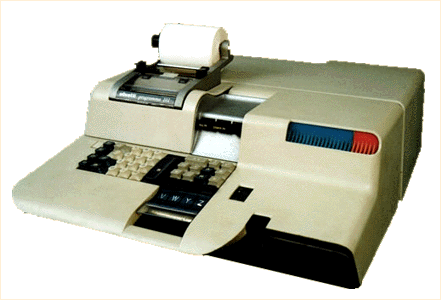
I like the looks of the Olivetti Underwood Programma 101. It even had two blinky lights: green (solid=ready, blinking=busy) and red (error)
http://www.silab.it/frox/p101/boxbig.gif
If I recall correctly it was the first computer(*) I programmed. Back in '72-73, while in Jr. High (btw, not "Middle School").
Several interesting things about the P101:
Introduced in 1965 (same year as PDP-8).
No ICs; all discrete components. The boards were placed component side to component side, designed with one board's components fitting in the spaces between the components of the other board.
Programs were stored on magnetic cards, which Olivetti received patents for (HP had to pay about $900K in royalties for the technology use in the HP9100)
Its approximate 240 bytes of memory used acoustic delay line technology.
Scott Austin
(*) Computer? Programmable Calculator? I'll let someone else debate about this.
____________________________________________________________________________________
Looking for earth-friendly autos?
Browse Top Cars by "Green Rating" at Yahoo! Autos' Green Center.
http://autos.yahoo.com/green_center/
"Model 2000 keyboard
Intro to Model 2000 manual (874-9486)
Tandy 2000 Tech Reference Manual (26-5404)
Tandy TRS-80 Digi Mouse/Clock Controller Board
(26-5144)
Tandy Monitor MonoChrome (26-5111) Model VM-1,
Date Manuf. 3/1984, SN:
RS022001
Tandy Intelligent Modem, DCM-7 (26-1394)
Tandy TRS-80 Personal Computer, Model 2000
(26-5103)
MS DOS Basic floppy disk (1), for the Model 2000
(26-5103) This is the
Tandy disk, not a copy.
The items listed above are all in their original
boxes."
I've been asked to take offers and submit them to the
seller. Therefore e-mail me directly. Colorado
Springs, Colorado.
____________________________________________________________________________________
Looking for earth-friendly autos?
Browse Top Cars by "Green Rating" at Yahoo! Autos' Green Center.
http://autos.yahoo.com/green_center/
------------Original Message:
Date: Thu, 1 Feb 2007 22:11:24 -0500
From: "Ethan Dicks" <ethan.dicks at gmail.com>
<snip>
Long ago, I did hang a pair of Radio Shack 7-segment LEDs off
of a PET User Port with some trivial logic to use the 8th bit to select
digit A vs digit B, then the lower 7 bits of the port went right to the segments.
A small machine-language routine tapped into the 60Hz clock interrupt
refreshed the digits. For a modern machine, I'd recommend some sort
of external latch and multiplexer at least, or perhaps a dedicated LED
driver like the ICL7218 (MAX7218?)
(here's one I made a while back with 16 digits from one parallel port
and two driver chips)
http://www.penguincentral.com/retrocomputing/retrogaming/scoreboard.html
-ethan
------------Comment:
For driving 7seg displays or LEDs, I'd recommend an MC14489; it'll directly
drive 5 mux'ed 7 segment displays (hex or pseudo-alpha), straight binary, or
25 LEDs from a 3 wire DC to 3MHz serial interface. Saves a lot of wiring,
especially if you use multi-digit displays; just the thing for a blinkenlights panel...
mike
OK, go to Ebay and look at item #29007747962. A nice machine, centainly.
I can not help but think this machine was once Jim Willing's - or he
has started selling things off.
Does anyone know anything about the seller guardianrob453? If he is in
touch with Jim Willing, I centainly need to talk to him.
--
Will
Hi Everyone!
I was wondering if any of the CRT gurus here could help me out with a
problem I'm having with my Twinax AS400 term.
When I turn it on, it's fine. However, it's got a power saving feature that
turns off the screen if it goes idle for too long. If this is activated and
I try to wake it up by pressing a key on the keyboard, the screen goes crazy
like it's got a bad refresh rate or something. The only way to fix it is to
power it off and back on, which works every time - the problem with that is,
I lose my twinax session, which can deadlock the machine depending on what
mode I'm running it in.
Any ideas?
Julian
>the "easiest" way to get OS/278 to a DECmate I
>is by copying a boot floppy and putting it in the mail. Can anyone on
>the list assist me with this?
>
I can make them and send them. I have most of the bits for a DECmate I
but not enough to be functional. I did make these images for people
but never heard back if they worked ok.
http://www.pdp8.net/images/images/os8/DECmate_I.shtml
They are also RX02 format which is what their machines seemed to be
set up for. Is yours set for RX02?
I can put these on floppies or if you know of a known good RX01/RX02
image for a DECmate I can use it.
>One of my goals, BTW, is to snarfle off images of my PDP-8
>RX01 and RX02 disks for preservation and sharing. I have a few boxes
>of disks from the 1978-1985 timeframe, up to the time I stopped using
>a PDP-8 on a daily/weekly basis.
>
If your doing that the disks will be free. If you don't have a program
to dump I have one at
ftp://ftp.pdp8.net/software/dumprest/
which can dump RX01 and RX02 over the serial port. The code will
need to be modified to use the serial port on the DECmate. Kermit
source should show that. Mine makes image useable by SIMH which is the
same format they are on my website.
David Gesswein
http://www.pdp8.net/ -- Run an old computer with blinkenlights
Have any PDP-8 stuff you're willing to part with?
--------------Original Message:
Message: 28
Date: Thu, 1 Feb 2007 15:04:25 -0500
From: dave06a at dunfield.com
Subject: Re: Cromemco Unix?
>> Is there any reason of which you are aware that would prevent the
>> use of Cromix on a Z-2?
>I don't see why - All it needs (at least the Z80 version) is the ZPU,
>enough memory (a 256KZ works nicely, or a few 64KZs I think are
>OK as well) and I/O card and disk controller like 16FDC (those are
>the cards that I have) - all the standard Cromemco cards would
>work in a Z2 (I think I've had them all in my Z2 at one point or another,
>although I don't recall if I've ever booted Cromix up on it).
>Dave
------------Reply:
Since they were S-100 systems and could have pretty well any cards installed,
functionally the model doesn't really mean much except for the floppy size and the
number of floppy drives, I/O connectors and card slots.
You might have some problems with older boards. Minimum revision levels:
ZPU: Any
64KZ: Rev J
TU-ART:Rev E
PRI: Rev E
4FDC: Rev C
16FDC: Rev E
IOP: Rev C
Quadart:Rev C
128K is the minimum for one user. Each additional user requires an additional
64K with a maximum of 6 users (although you could have >64 ports if you can
find room for the I/O cards and connectors). Hard disk recommended for any
*real* use.
AFAIK Cromix came in 3 versions with numerous revisions:
11 series is for the Z80; AFAIK latest revision was 11.27
20 series is for the 68000 (slooow, use 30 if possible)
30 series (later changed to 1xx, i.e. 153=30.53) is for 68010 and higher, although
at least the early versions will also run on the 68000.
Note that with some exceptions and depending on the hardware,
20 and 30 series will still run Z80 programs.
Also note that the 30 series has provisions to read & write PC & UNIX format
diskettes.
And of course the languages (BASIC, COBOL, Fortran etc.) were also updated
for the newer CPUs.
mike
I acquired a couple of M4 9914 9-track tapes drives a while ago and
finally got around to trying to do something useful with them.
Never having used one before the first thing I did was just see if it
would mount a tape ok. The first brand new tape I tried was sucked
into the take-up reel ok and wound a few turns, then sucked all of the
way back out, then the drive tried again before giving up with a N T U
(No Take Up) error. I then tried a second brand new tape from a
different vendor and got the same results.
Then I went back into the garage and hefted (it's a workout) the
second 9914 drive into my work area and tried both tapes on the second
drive with the same result.
Then I tried manually threading a tape onto the take-up reel while the
drive was powered off and making sure that winding the take-up reel
caused the supply reel to turn, then powered on the drive and got the
same N T U error again.
I looked in the manual and it said something about the N T U error
occurring due to a lack of tach pulses. Then I looked at the tape
path for what might be the tach sensor and guessed it was probably a
metal roller near the take-up reel. I used a marker to put a dot on
the top of the reel and noticed that it wasn't rotating when the tape
was moving past it.
I tried rotating this roller by hand and I could feel detents while
rotating it and I assume it is attached to some type of rotary
encoder. Now to the point posting this here, my questions are does
anyone know if this roller/encoder needs any lubrication? If so, how?
It felt somewhat stiff when I first tried rotating it and got a
little easier to rotate the more I kept at it. And secondly, this
roller did have a thin rubber coating which had turned to goo. I
cleaned the goo off of the roller. If anyone else has seen this on a
9914 drive (I assume so, it was goo on both of mine) did they do
anything about it? Is there a good way to re-rubber this roller?
After cleaning the goo off of the tach roller and getting it to rotate
a little more freely I did see it rotate when the tape was moving past
it (wasn't sure if it would without the rubber) and now the 9914 will
mount a tape most of the time.
-Glen
I have a HUGE softspot in my heart for the TRS-80 Model I, having purchased a 16k, Level I unit in December of 1978. A unit, I still own today,
I hated the keyboard too, even though I wasn't a typist, mostly because it bounced and I had to load a special keyboard de-bounce program to stop it from bouncing and getting duplicate keystrokes.
As I upgraded the unit over the years into a 48k Level II unit with several disk drives and a Percom (and later LNW) Doubler, I also upgraded the keyboard.
I was able to purchase through Tandy National Parts, the Model III style keyboard that came out on the Model I towards the end of it's run. This also had the added benefit of adding a keypad to the unit.
As to the plastic of the case, I guess in retrospect it was cheesy. But, being a kid at the time... It never bothered me. It was certainly no less cheesy than an Apple II or a VIC 20 or an Atari 400/800.
Some of the TRS-80 clones got it right I think... The LNW-80 (of which I'm a proud recent owner) and the Lobo Max-80 did a good job of making the computer less toy-like and more business like.
The PMC-80 from Dick Smith seemed even more fragile and toy-like, however.
As to the hardware design being none too exciting. I wouldn't know, not being a hardware guy at that level. Though, we had used the Dennis Bathory Kitsz book to hop up my Model I with LowerCase, Internal Speaker, Internal Alpha-Compatible Joystick Interface, High Speed (turbo) mod with tri-color LED to indicate Low, High, and Auto (High on most things, low on Cassette and Floppy access). Also, external reset button and composite video for an amber monitor.
Computers were fun in those days. I remember applying the zaps from 80-Microcomputing to a copy of Newdos 2.1 to speed up the disk stepping and amazing the salesman at my local Radio Shack at how much faster I could make their Model I boot up.
Those were the days...
Al
Phila, PA
In the late 70's and early 80's I think the TRS-80 outsold the Apple II's. Mainly because there were more outlets selling TRS-80's (Radio Shack and Tandy Stores) than there were selling Apple II Computers.
But, I can say as a former New Yorker, and a Computer Consultant at that time, that I saw MANY more Apple II's running VisiCalc than I did TRS-80's.
The Apple II overtook the TRS-80 and by 1984 or so, the Model I/III/IV was pretty well dead and dying as a platform, while the Apple IIe and IIgs had plenty of life left in them.
I loved my TRS-80, but I also lusted after an Apple IIe chock full of Applied Engineering goodies...
I never did get one of those, though I have several IIgs machines and a IIc.
Al
Phila, PA
Just to clarify:
1. These are 40pin DIP Plastic packaged Chips
2. These are CPU chips, not eproms
3. These are not free. We have to pay someone for them. I am doing someone a favor and offering them to people who would most appreciate them.
These are the same chips used on the COSMAC ELF.
If you are repairing an old unit, or building one of the new clones... You might want some of these.
We only have a limited amount of chips. Once these are gone, I can't get any more.
Al
Brad Parker <brad at heeltoe.com> wrote:
> ... has anyone written an emulator for a VS60?
> would it be hard?
Doug Gwyn took my crappy VT11 simulation and extended it to within
episilon of passing all the VS60 diagnostics.
For a start see:
http://www.ultimate.com/phil/xy/
Which shows screen shots of PDP-1 "munching squares" and "spacewar"
on a simulated "Type 30" display, one of PDP-11 Lunar Lander...
Sources are available thru my CVS server, tho I can't be sure I have
checked in Doug's very latest (the vt11.c file in CVS is dated October 2005).
We never managed to get it integrated into SIMH distributions, and I
don't know off hand the last version of SIMH it did build with. The
"display.tar.gz" on the web page is from October 2003(!), and I see
there is a source kit named at
http://www.ultimate.com/phil/xy/kit2.zip from February 2004.
I did a rather "basic" (or "crude" to be less generous) graphics
adaptation layer for X11 (polled) and Win32 (starts a seperate thread
for message handling). John Dundas contributed an implementation of
it for "Carbon" under OSX.
There have been several other attempts to add graphics of various
sorts to SIMH, including VAXstation style raster display support.
John (Dundas) went on to build do PDP-11 front pannel blinklights und
switches for SIMH, looks like it's available at:
http://dundas-mac.caltech.edu/~dundas/retro/simh/index.html
Which says it includes Doug's and my work (in V0.9 or later).
But, back to the original topic, I think SUDS needs a PDP-10
(TOPS-20?) system behind it to do the real work.
I used to pass the PDP-10 hardware design lab on the way to the
Cafeteria at MR-1 (DEC Marlboro(ugh) building one, before the great
three letterization that made it into MRO-1). I loved the "rose"
program I saw sometimes on the displays, but I don't remember what it
looked like anymore... Anyone have the code, or remember what it did?
phil
> Umm, and how rare are VS60s these days?
Essentially unobtainium. They were expensive and rare 25 years ago.
You'd have better luck finding a VT11 or GT40. At least I KNOW people
who have those. I've never known anyone in the 30+ years of dealing
with DEC stuff who had a VS60.
I've been chasing a copy of SUDS for a while. It existed at Stanford,
MIT, and DEC. XKL still uses it.
The DEC version will probably be somewhere on the DEC LCG tapes. There
are bits of it on the ITS tapes that have been released. I'm sure it's
on the ones that haven't.
> I have the Z-80 Cromix running on one of my System-3's, and yes
> I have install disk images up on my site.
I got to meet the original author a few weeks ago. It started out
as a personal project of his, and morphed into a product.
Cleaning out more junk; found some HP boards, probably
>from a tape drive; anybody want 'em for parts? Condition
unknown, one marked defective:
07970-62140 series 1144
07970-60020 series 1047
07970-60040 C-1024-42
07970-61021 B-1037-42
mike
----------------Original Message:
Date: Wed, 31 Jan 2007 19:14:16 -0800
From: Gene Buckle <geneb at simpits.com>
Subject: Cromemco Unix?
To: General Discussion: On-Topic and Off-Topic Posts
<cctalk at classiccmp.org>
Odd Cromemco system:
http://cgi.ebay.com/CROMEMCO-SUPER-MICROCOMPUTER-VINTAGE_W0QQcmdZViewItemQQ…
I've never seen this machine before. I had no idea Cromemco was into Unix.
g.
---------------Reply:
Nothing odd about it; they'd had Cromix, a sort-of-UNIX available on their
Z80 and 68000 systems since around 1980, but by the mid-80s they finally
cried uncle and made UNIX systems available with the x20 series, essentially
the same S-100 boxes as the older ones, i.e. a 120 was essentially an
upgraded System 1, a 220 an upgraded CS-2 (Z-2) and the 320 was the
System 3 (8" FD), all with slightly changed styling, a 68010 or 68020 with a
68881, minimum 2MB, minimum 9 ports and an external DC600 tape drive.
They also brought out a new CS-400/420 tower version with the tape drive built in.
The x00 series were essentially the same systems but running Cromix, although
since they were S-100 systems you could put whatever cards you wanted into
them and run whatever you wanted, even CP/M or CDOS (their CP/M clone),
although with the later CPU boards without a Z80 those programs ran on the
Z80 in the I/O processor.
I believe there was also a 4000 Mammoth running parallel 68030s on the VME
bus, although I don't have one and have never even seen one.
I've got two of the 420s sitting on my verandah gathering snow; wonder what
the cold'll do to the infamous rollers in the tape drives...
I could dig out some old price lists if anyone's interested in the available models.
mike
I'm having a clear-out of a load of old stuff that I'm no longer using
(or in some cases acquired and never used). Of interest to this list:
* MCA SCSI RAID card, Mylex DAC960M, known working about four years
ago. no driver disks, no box, no anti-static bag, no cables, no
nothing.
* VAXstation 3100, not powered on since I acquired it. external SCSI
cable.
* miscellaneous Sun external SCSI boxes which might even have working
disks in 'em.
All free to good homes. New owner to collect in south London, or I can
deliver the MCA card in central London. I won't ship anything.
If you want any of it, please contact me by private email. Anything
not gone by the end of the month will be thrown away.
And somewhat off-topic, if anyone knows where I can get a DVI-to-SCART
converter so I can attach a Mac Mini to a TV, do please let me know.
--
David Cantrell | http://www.cantrell.org.uk/david
fdisk format reinstall, doo-dah, doo-dah;
fdisk format reinstall, it's the Windows way
-------------- Original message ----------------------
From: Gene Buckle <geneb at simpits.com>
> Odd Cromemco system:
>
> http://cgi.ebay.com/CROMEMCO-SUPER-MICROCOMPUTER-VINTAGE_W0QQcmdZViewItemQQ…
> oryZ56084QQihZ010QQitemZ200074941857QQrdZ1
>
> I've never seen this machine before. I had no idea Cromemco was into Unix.
>
> g.
>
>
Yes, they did have sys V in the later years. I have both Cromix
and system V systems here.
Jerry
Jerry Wright
JLC inc
g-wright at att.net
Is there anyone near Fairfield, New Jersey who would be willing
to palletize three lowboy computer cabinets and several boxes of
docs and media onto two pallets and optionally drive them to a
nearby truck freight terminal? I'm willing to compensate for
your time.
Thanks,
De
>It's all in how and who you ask. [...]
yes you are right. I was lucky to talk with the right person in BYTE
when I asked for permission to put up on the www.series80.org web
site the BYTE review of the HP-85. The person was very polite and
helpful and I got the permission with a minimum of hassle.
**vp
ard at p850ug1.demon.co.uk (Tony Duell) wrote:
>>> "William Donzelli" <wdonzelli at gmail.com> wrote:
>>> > Jim Willing was one of the pioneers in this computer collecting
hobby
>>> > (I apply pioneers to those of us that were doing this seriously over
>>> > ten years ago - before this list, and before there even was a
hobby).
>>>
>>> Cool! I'm a pioneer, having collected these things for close to 25
years.
>
> Even longer than me. I started in May 1986 (yes, it'll soon be 21 years
> of computer collecting here ;-))
Started playing with a PDP-11/40 in 1982 or 1983 in a computer club at
that time. We also had some other very odd hardware that we tried to get
working and had fun with. No software, but we had a few peripherials, so
we had to write our own monitor just using the front panel. And of
course we had all the drawings for the machine. And we were always
trying to get someone to donate more stuff to us. And of course, my
school at the time used a PDP-11/70, and at nights I was hanging out at
the nearby university, where they had a whole bunch of DEC-10 machines
on which I could get guest accounts.
By 1986 I got my first two PDP-8 systems home.
Almost wish I was back in those days. So much fun. And some really odd
hardware was still around and possible to get your hands on... I wonder
what happened to the VT05 terminals that we managed to get, and that I
hacked to get rid of the margin bell... :-)
>>> Well, I'm not sure I would call it collecting in the normal sense
of the
>>> word. I want to keep these machines running, useable, and in use.
>
> Just like me again. I keep on saying at HPCC that I am not an HP
> calculator collector. Yes, I have old HP calculators (handhelds and
> desktops), but I use them. I keep them operational, I do program them, I
> do use them for calculators. And I don't try to obtain every cosmetic
> version (that is, with differnt position of the serial number label,
> etc), but I am interested in at least seeing versions with substantially
> different internals (like the 2 very different logic boards that were
used in the HP80 financial calculator).
Still have my HP-41 around, and it's still my all time favourite. I must
admit I have collcted some odd hardware for it over the years that I
don't really use much though... But it's a rather hacked CX with modules
built into it, and some nice stuff around. :-)
> No, I am not intersted in having machines on the shelf in original
> condition. I want to be able to sue them, investigate them, and so on.
We think alike. :-)
Johnny
I quite agree some classic computers have an internal beauty but some
have an external beauty that is almost art-like. My vote goes to the
Coleco ADAM as it's beauty lies both in its internal/external
construction. What is deeper than that I'm not sure...!
Happy computing!
Murray :)
Does anyone have hard copies or scans of these Intel SDK-51/MCS-51 manuals?
121588-002 SDK-51/MCS-51 System Design Kit User's Guide
121589-002 SDK-51 MCS-51 System Design Kit Assembly Manual
121590-003 SDK-51 Monitor Listing Manual
All:
Does anyone know what happened to Hayden Books? I have a robot
book that described a robot built with a KIM-1 and I want to scan it and
post it to 6502.org. I did some Googling and I can't find any current
references for them. Any idea if the imprint was acquired or did they just
pass quietly.
Thanks.
Rich
Rich Cini
Collector of classic computers
Lead engineer, Altair32 Emulator
Web site: <http://highgate.comm.sfu.ca/~rcini/classiccmp/>
http://highgate.comm.sfu.ca/~rcini/classiccmp/
Web site: http://www.altair32.com/
/***************************************************/
>> Anyone know any of the XKL folks?
>>
>> -brad
>>
>That might make a lot of sense, I believe that the main reason for doing the
>XKL-1 was so that they could continue to use their existing CAD tools. If
>this is the case they likely have it working with the X11 software running
>on the XKL-1. Which brings up another problem, I don't believe that X11
>will run on any of the emulators, and I'm not aware of any copies of it in
>the wild.
>
>Here is a question, is any of this on the Panda distribution from Mark
>Crispin? I don't believe so, but then I've also not had time to boot it.
>
>BTW, questions of this level would be better answered on alt.sys.pdp10
XKL is a VERY close-lipped operation. You can try contacting Len Bosack.
I doubt anyone lower than that would be willing to commit to releasing it.
Also, the machine was the TOAD-1.
> And, if I did have one, has anyone written an emulator for a VS60?
> would it be hard?
It's essentially a VT11 on steroids. Hardware rotation/scaling/clipping,
extended display list structure.
http://bitsavers.org/pdf/dec/graphics/EK-VT48-TM-001_VT48TechRef.pdf
VS60 is a VT48 display processor with a display built by Sanders Associates.
xa-2.3.2, the current version of the xa65 assembler package has been released
along with dxa-0.1.2, the current version of its companion disassembler.
xa is a 6502/R65C02/65816 crossassembler in portable C featuring a built-in
preprocessor, rich instruction and pseudo-op expression syntax, and built-in
o65 relocatable object support. 2.3.2 adds:
- character set translation for quoted strings (such as ASCII->PETSCII)
- proper recursive macro evaluation
- groks cpp(1) line tags automatically
- multiple bug fixes
- updated documentation
See the changelog for a complete listing.
dxa-0.1.2 is a portable crossassembler based on Marko Makela's d65 package
featuring intelligent disassembly and multiple output options, including
support for undocumented instructions. 65816 instruction support is pending.
0.1.2 corrects an occasional bug with relative addressing and an output bug
with back-to-back label formatting. dxa should still be considered alpha.
Suggestions and bug reports always welcome. Both programs are released
under the GNU Public License.
http://www.floodgap.com/retrotech/xa/
--
--------------------------------- personal: http://www.armory.com/~spectre/ ---
Cameron Kaiser * Floodgap Systems * www.floodgap.com * ckaiser at floodgap.com
-- Why do we scoff at fortune tellers, yet listen to economists? --------------
At 12:01 -0600 1/31/07, cctalk-request at classiccmp.org wrote:
>First, the obvious - the speed that something sells is a function of
>both price
>and demand AND visibility ...
:-) and other factors...
Marvin, I may have dropped into your SPAM-filtering apparatus at some
point, or vice versa. Have you gotten more than one email from me in
January? I'm hoping there were four.
If so, have you sent me more than one?
Others, my apologies for the intrusion.
--
Mark Tapley, Dwarf Engineer
(I haven't cleared my neighborhood)
210-379-4635 Dwarf Phone, 210-522-6025 Office Phone
All..
My partner and I came across a quantity of New, Old Stock RCA 1802CE Chips.
I know some people on the list have spoken about them as they were used in a few classic computers like the ELF.
If anyone is interested in them, please contact me off list.
I'd prefer to get them into the hands of Classic Computer Enthusiasts before putting them on eBay.
Thanks!
Al Hartman
Phila, PA
I sent this to your other email address, and haven't heard back from
you. Are you still interested in selling the ICE? Please let me know
your asking price.
Regards,
Andrew Giusti
____________________________________________________________________________________
8:00? 8:25? 8:40? Find a flick in no time
with the Yahoo! Search movie showtime shortcut.
http://tools.search.yahoo.com/shortcuts/#news
First, the obvious - the speed that something sells is a function of both price
and demand AND visibility ... just *had* to get that out of the way :). But what
you are asking is not an easy question to answer since there are so many
different variables.
Visibility
I fully agree that VCM makes a really good venue, and Sellam's rant seems to be
having the (unintended) effect of more people listing and viewing the site. One
of the reasons I *really* would like to see a link to VCM from ClassicCmp.org is
that I can easily publicize the ClassicCmp listserver on ebay emails, the "About
Me" page (although it hasn't been added yet) without worrying about the two
faced retaliation by Ebay. Some of you may recall the Ebay notices to put out
the information to all the newsgroups, etc. about Ebay and that helped a LOT to
publicize the site; word of mouth about a good thing was *very* prevalent. This
is also what needs to be done to help publicize the VCM site.
How Long
I've had things on VCM for maybe a year or more that 1) haven't sold, 2) finally
sold, and 3) sold quickly on Ebay. Things like books are relatively easy to
research pricing. There are other research tools to help determine pricing on
relatively common stuff, but things that are less common are basically an
educated guess and are set by how fast you want something to move. It is also
helped/hindered by how well/poorly the listing copy is written.
> From: David Griffith <dgriffi at cs.csubak.edu>
>
> I'm attracted to the idea of listing as much of this as I can at the
> vintage computer marketplace because 1) the people who buy stuff there
> presumably know what they're buying and 2) I can easily list stuff and let
> it be for sale until it's sold. Does anyone here have a ballpark idea of
> how long stuff would sit there until it gets sold?
"J. Peterson" <pdp11 at saccade.com> wrote:
>>> I believe some of the -11 operating systems would do
"interesting" things
>>>with the console lights while they were idle. Could somebody
describe the
>>>patterns used?
>
>
> I seem to recall RSX had a pattern something like
>
> 1000000000000001
> 1100000000000011
> 1110000000000111
> 1111000000001111
> 0111100000011110
> 0011110000111100
> 0001111001111000
> 0000111111110000
> ...
> with the groups of four "on" lights moving through each other.
Correct.
> RSTS (c.
> 1980) simply rotated half a dozen or so "on" lights.
No no no. RSTS/E had a really cool pattern. They had two "snakes"
running around across the data and address lights. That was a real
trick. Appearantly they pulled that off by having the idle loop actually
run in supervisor mode, which wasn't used by RSTS/E at the time, so they
could control the address that way. Rumour have it that they had to drop
that piece at RSTS/E V9 or if it was V10 when they finally started using
supervisor mode more seriously in RSTS/E, but I haven't seen the RSTS/E
idle loop since V8 so I couldn't really say.
> Others have described
> RT11's pattern. I never saw a light pattern on an '11 running Unix -
> perhaps they were never idle? Was the concept of the idle-loop
lightshow
> unique to the PDP-11, or did other systems with data lights implement
them?
I can't remember any idle pattern when running 2.11BSD on an 11/70
anyway. The machine was idle sometimes, so maybe they just didn't
implement anything fun. But I'm not entirely sure my memory is on par
here. They might have had a simple rotating pattern on the panel. It's
been a few years since I last fired up Unix on a PDP-11.
Other machines have probably also done idle patterns, but in the PDP-11
rumour have it that the different OS groups were competing with each
other on who could do the coolest idle pattern. I believe most agreed
that RSTS/E won.
Johnny
What options are there for using a pertec 9-track drive in the PC dos/linux environment? I have a couple available, but no interface cards to speak of.
Thanks,
Kelly
As some of you may know, I have Rlee Peters' collection of stuff, which
seems to be largely composed of documentation. So far, I've been
unloading it on Ebay. The recent discussions about Ebay versus the
vintage computer marketplace got me thinking.
I'm attracted to the idea of listing as much of this as I can at the
vintage computer marketplace because 1) the people who buy stuff there
presumably know what they're buying and 2) I can easily list stuff and let
it be for sale until it's sold. Does anyone here have a ballpark idea of
how long stuff would sit there until it gets sold?
As I picture in my mind's eye the two storage units of stuff, I think I
might have been a little too eager to get it. Oh well. At least I have
some vintage items that I wouldn't otherwise have. I'm keeping about four
cubic feet of stuff. The rest I need to find a home for.
--
David Griffith
dgriffi at cs.csubak.edu
A: Because it fouls the order in which people normally read text.
Q: Why is top-posting such a bad thing?
A: Top-posting.
Q: What is the most annoying thing in e-mail?
I believe some of the -11 operating systems would do "interesting" things
with the console lights while they were idle. Could somebody describe the
patterns used?
Thanks,
Bob Armstrong
Chuck Guzis wrote:
On 30 Jan 2007 at 13:59, Zane H. Healy wrote:
> Remember, a nice SGI system, isn't simply a computer, it's a work of art.
> For the most part the only computers I'd consider to be a work of art are
> some Apple and SGI systems.
A few Cray systems come to mind as being very artsy. While not in
the same league as Apple, I'd call a machine with the innards
immersed in fluorinert pretty unusual in apperance.
Cheers,
Chuck
--------------------------------
Agreed - the Crays were definately art. I really like the Cray 1 with the
seats above the power busses, and the beautiful logic column. And I also
agree on the Apples, especially the models with the clear plastic - lovely
machines.
Billy
Does anyone have pinouts of the following 2 ICs, both of which, I think, were
made by Western Digital, and are in 40 pin DIL packages :
PT1482B (Async/Sync serial transmitter)
PR1472B (Async/Sync serial receiver)
Thanks in advance for any help.
-tony
Tried a private reply. Getting a wierd fail message. Can't troubleshoot the server right now.
-----Original Message-----
From: Kelly Leavitt
Sent: Tue 1/30/2007 1:40 PM
To: Kelly Leavitt; Chuck Guzis
Cc:
Subject: RE: Tandy collectors? 52MB 3.5 "Smart Drive"
I got a failed message initially...
-----Original Message-----
From: Kelly Leavitt
Sent: Tue 1/30/2007 1:38 PM
To: Chuck Guzis
Cc:
Subject: Tandy collectors? 52MB 3.5 "Smart Drive"
> Does anyone want this thing? For shipping and a couple of bucks for
> packaging, it's yours.
I would be interested if no one else has jumped at it. At your convenience. Shipping would be to NJ...
Kelly
Just discovered a circa-1990 Tandy 52MB (Quantum) 3.5" IDE hard drive
and installation manual in my junkpile. The manual refers only to
"type A" and "type B" chassis types, not to specific models.
Does anyone want this thing? For shipping and a couple of bucks for
packaging, it's yours.
Cheers,
Chuck
> wtf does he need *ANOTHER* one of
> those for?
1052's are also used as the tape transport for the tape wizl.
Just got the first 1052 back fitted with a 7/9 track inductive head last week.
> This is a Qualstar-developped board,
> so there might be some mounting problems etc. Would it be relevant to put
> the data/documentation on bitsavers?
If I had any data on the bridge boards, I would. I had posted a request for
data on the NCR bridge, but didn't hear anything back. There is a setup
description for the Qualstar designed one in the back of the 1054 manual.
Descriptions of the SCSI command set supported on the 1054 would be handy as
well.
Has anyone on the list scanned in manuals the Heathkit 4801 EROM Programmer?
I just picked one up and need help on the personality plug (it didn't have
any.) Would also like to get some documentation on it.
Billy
Is there a location on the 'net that is archiving marketing brochures
for antique/classic machines?
For example, I have brochures for Apple 2e, Mac and many other
personal computers from the early 1980's. I am working my way through
scanning the brochures and I would like to make them available to
others.
Any suggestions?
Thanks.
--barry
> I've observed that Pertec-to-SCSI adapters are even harder to find
> than PC interface cards. The PC cards come up about every 2-3 months
> on eBay, but mostly without drivers. I think I've seen exactly one
> SCSI-Pertec protocol converter in the last year--and the minimum bid
> was about $200.
Here's a little secret, since I probably have enough of them now.
Every Qualstar 1054 has a pertec-scsi bridge board in it. Early ones
used NCR, later ones have their own design.
The last couple of 1054's I've picked up on eBay were MUCH less than $200.
> Is there a location on the 'net that is archiving marketing
> brochures for antique/classic machines?
http://www.computerhistory.org/collections/readingRoom/
Lee Courtney
> -----Original Message-----
> From: cctalk-bounces at classiccmp.org
> [mailto:cctalk-bounces at classiccmp.org] On Behalf Of B M
> Sent: Monday, January 29, 2007 7:31 PM
> To: cctalk at classiccmp.org
> Subject: Brochures for classic/antique systems
>
> Is there a location on the 'net that is archiving marketing
> brochures for antique/classic machines?
>
> For example, I have brochures for Apple 2e, Mac and many
> other personal computers from the early 1980's. I am working
> my way through scanning the brochures and I would like to
> make them available to others.
>
> Any suggestions?
>
> Thanks.
>
> --barry
>