After replacing the RAM, the display is now back to normal (there's also a
test switch on the motherboard (S6) that switches the display from blank
spaces to all zeroes.
The one that failed was a National Semi 2102, whereas the others are all
>from another manufacturer. No sign of previous replacement. Interesting.
(I once fixed up a PDP-8/L, chased down several bad chips. Nearly all were
Signetics 7440's).
I may have made a tactical error though - turns out that wet/damp PVA is
electrically conductive! Enough to overcome the 5k pullup resistors. An
unpleasant surprise. So now the keyboard thinks multiple keys are being
pressed and won't work at all. Removing the keyboard to clean underneath it
would be very tedious since every key has two soldered pins...
There was a significant buildup of goop underneath the key scan mux and
demux chips where the pins are close together (0.1"). I gave the bottom half
of the board another good
rinse and will let it dry overnight, maybe a hair dryer too. Or get some
more 91% alcohol to it and a longer low-temp bake. It all worked before my
"cleanup" so I expect it will resume normal operation once the moisture is
out of any remaining goop. I hope ;)
---
This email has been checked for viruses by Avast antivirus software.
https://www.avast.com/antivirus
The DEC VT20 terminal apparently included a PDP-11/05 with a direct mapped
character display and was intended for text editing and typesetting. It
seems to have been followed by the VT21, and then VT71/VT72, all three based
on an LSI-11 (KD11-F). There's a real lack of documentation about these
online, although the VT72 does have a print set.
Apparently the VT20 used the M792-YK as its bootstrap; the Field Guide is
silent regarding the boot device and M792 documentation stops earlier in the
series of variants.
According to the VT72 print set, it used the MRV11-VC (M9942-YC; described
in the Field Guide as a "bootstrap/diagnostic module") for its bootstrap but
is also silent regarding the boot device. In interestingly, the Field Guide
also describes a MRV11-AA (M7942-TB) as a "M7942 with VT52 emulator, VT71
bootstrap".
For async. communications the VT20 used a DL11-B (M7800 (EIA)). the VT72 a
DLV11-F (M8028).
Looking in a DEC "Options and Modules" listing I see VT20 bundles including
Typeset-11 and DECset-11, and it appears that the VT20 could be configured
with two displays & serial lines in a single 11/05.
So . is the boot device in these systems the remote host via the serial
line? What protocol would that have been? Something native to Typeset-11
and DECset-11?
paul
Thanks Bill, I hadn?t seen that particular page. As I mentioned already, the
formerly clear ?stuff? was so deteriorated I could just pull the glass plate
off with gentle fingertip pressure.
I ran a bead of clear silicone around the outside of the clean plate and CRT
face and bonded them back together.
Display looks great!
However, I can now see that every other line, starting with line 2, is
showing a full line of double quotes (0x22) instead of spaces (0x20). I read
the circuit description and schematic, and it appears that bit ?2? is stuck
high on the even-line RAM ? for some reason the designer decided to call the
LSB bit 1 instead of bit 0.
Typing (for example) ?abcdef123? shows the correct text on the blank odd
lines, but on the even lines it echoes as ?cbcfef323?. Confirming that stuck
bit.
Looks like the RAM at location H15 should be the bad one... we?re having a
heat wave and it?s too hot upstairs to work on it until tomorrow morning at
the earliest.
ETA: Now it's tomorrow morning and just cool enough (although 100% humidity,
at least outside) but my replies aren't showing up in the archive - filtered
somehow.
Anyway. I did a bit more Googling and discovered that plain water dissolves
the PVA goop just fine. No need to use a lot of expensive alcohol which
seems to be a less effective solvent anyway!
So I took the board out and scrubbed it in the kitchen sink with running
warm water and an old toothbrush. Rinse with distilled water, now gently
baking in the oven at around 140F to get the water out of the keyboard. Then
onto the RAM replacement.
---
This email has been checked for viruses by Avast antivirus software.
https://www.avast.com/antivirus
I have access to 3 ES45s, a DS15, and an RA8000 in a tall blue Compaq rack
in Athabasca, Alberta. All the in-service disks were removed but all the
spares are available. The box also has the fibre switches used the connect
the RA8000 to the servers and the cables, much of the paper documentation,
and assorted doodads. It would probably work if plugged in but it has been
a year since it was turned off.
Athabasca, Alberta is about 1.000km North of the US Montana border and
10,000km from nowhere but it is summer and the weather is nice so we might
be able to load this great heavy beast on a trailer and haul it up to a
day's drive away if anybody want this stuff. This is rural Alberta so
a day's drive is a l-o-n-g way (like 1,000km?).
I tried to give this away in early 2019 but the deal fell through. If
I don't get a place to send it then I will keep the DS15 and convert the
rest of it into scrap metal.
--
Richard Loken VE6BSV : "...underneath those tuques we wear,
Athabasca, Alberta Canada : our heads are naked!"
** rlloken at telus.net ** : - Arthur Black
Testing 1,2,3... my last couple of posts don't seem to be showing up?
-Charles
---
This email has been checked for viruses by Avast antivirus software.
https://www.avast.com/antivirus
> From: Paul Birkel
> Apparently the VT20 used the M792-YK as its bootstrap; the Field Guide
> is silent regarding the boot device and M792 documentation stops
> earlier in the series of variants.
An M792-YK recently sold on eBait; I didn't get it, but I did manage to get
the seller to put up good photos of the board, so was able to dump the
contents.
I didn't fully disassamble the program, but it was clearly something serial
line related. With the VT20 info, it's now clear what it was for. It should be
pretty easy to fully disassamble, and work out the protocol.
I have the dump of the contents if anyone has a use for them.
Noel
> From: Charles Morris
> my last couple of posts don't seem to be showing up?
I see several posts from you.
To check suspected failures, look in the archive:
http://www.classiccmp.org/pipermail/cctalk/
because just because you're not getting a personal email copy, doesn't mean
it didn't go out to the list.
E.g. you may have the 'Receive your own posts to the list?' option in your
CCTalk subscription disabled.
Noel
>On 8/10/19 8:33 AM, Charles via cctalk wrote:
>> I also scrubbed off the black anti-reflective coating since it was
>> significantly scratched and peeled anyway.
>
>um.. you didn't remove the aquadag from the outside of the crt, did you?
No worries Al, I got my EE in '81 back when CRTs were still in use and I
know how they work ;)
I was referring to the translucent stuff on the (removable) glass implosion
plate itself, designed to reduce light reflection, not the 'dag.
Some say that black sheer pantyhose can be used to recreate the same effect,
or a 3M Privacy Screen.
---
This email has been checked for viruses by Avast antivirus software.
https://www.avast.com/antivirus
I decided just to fire it up and see if anything blew... it issued the
expected beep as it came up.
Set the switch to half-duplex and it does actually echo bell (Ctrl-G) and I
can see the screen moving as I type!
But there is some kind of garbage every other row, although the cursor
moves and the screen will "clear" (except for the 12 rows of garbage).
Power supply is 5.11 volts. So far so good.
Unfortunately the screen rot is even worse than I thought - the PVA layer is
so opaque and bubbled it looked like cottage cheese once removed, and I
can't make out what characters are on the CRT... I took the monitor out
(very easy disassembly). I didn't even have to use a heat gun or a hot wire,
just started at one corner, applied a steady and gentle pull, and it came
off in one sheet with a giant sucking sound.
That oily mess took a while to clean up. I also scrubbed off the black
anti-reflective coating since it was significantly scratched and peeled
anyway.
Now waiting for the bead of clear silicone (around the outside of the plate
only) to cure. I'll make sure it's air tight so no black dust will get in
there by electrostatic attraction.
I can fix the RAM problem once I can see what is actually on the screen! ;)
Also the wire bracket with threaded ends that holds the flyback to the
monitor chassis is missing one end entirely, so I need to fix that (keep the
core halves firmly together).
Looks like I didn't get TOO bad a deal for $200 shipped, especially with
upper-case installed.
---
This email has been checked for viruses by Avast antivirus software.
https://www.avast.com/antivirus
Hey all --
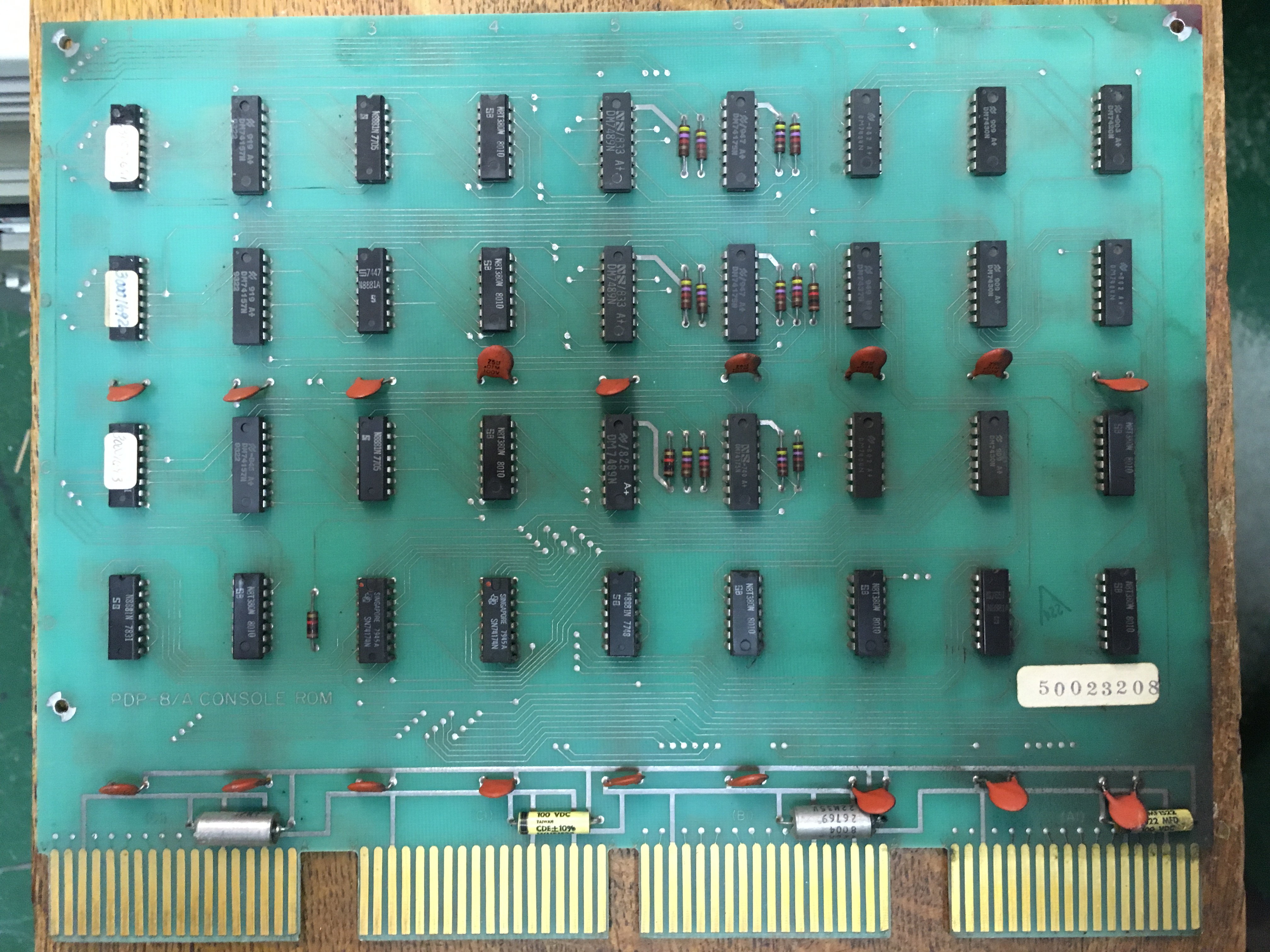
Got a PDP-8/A at VCFW this past weekend. It's an OEM model sans programmer
panel and was apparently used in a CNC application. It contains a board
I'm trying to ID. It says "PDP-8/A CONSOLE ROM" on it and has no other
identifying marks other than a logo on the back. See the pictures here:
http://yahozna.dyndns.org/scratch/pdp-8/8aconsole1.jpghttp://yahozna.dyndns.org/scratch/pdp-8/8aconsole2.jpg
<http://yahozna.dyndns.org/scratch/pdp-8/8aconsole1.jpg>
None of the braintrust at VCF were able to identify this mark. I'd guess
that the board provides a simple ODT interface or something similar. The
three ICs in the upper-left with the handwritten labels are 82S129 256x4
bipolar PROMs. They're not socketed so I haven't read them in yet. The
8/A's gonna need some TLC before I dare power it on...
I'm mostly curious if anyone can ID the logo -- it would be interesting to
know who made this thing.
Thanks!
Josh
I bought an ADM-3A on ebay. The monitor and the circuit board/keyboard are
>from two different terminals - confirmed by hand-engraved serial numbers on
the halves that don't match.
Not to mention the two different case colors (pale blue top, blue bottom)!
But it does have the lower-case option already installed :)
Anyhow, there appears to be some breakdown of the CRT implosion plate
silicone (screen rot). I've read about this problem before, so no real
surprise
It seems to be turning into brown "goop" which has run down onto the circuit
board.
Do I need to remove the goop before powering it up? Or is it nonconductive
and hopefully noncorrosive, so it can wait until I remove the implosion
plate and fix it?
thanks
Charles
---
This email has been checked for viruses by Avast antivirus software.
https://www.avast.com/antivirus
https://mvsevm.fsf.net
Currently, the TOPS-10 guest account (42,42) and the Unix v7 account dmr have no passwords.
Please treat the dmr account respectfully.
I will get to account requests?eventually, probably. TImeliness is not guaranteed. All systems are hosted on Raspberry Pis (the 36-bit ones on a Pi 3B+ and the 16-bit and 32-bit ones on a Pi 2B+) on Debian Buster. Absolutely no guarantee of availability or usability is made.
Adam
I am being offered some sealed Sun memory modules, PN 501-3050. These are
512MB compatible with:
* Compatible with Sun Blade 1000 with 600MHz CPU, 1000 with 750MHz
CPU, 1000 with 900MHz CPU, Blade 1000 Workstation, 2000 Blade 2000 with
900MHz CPU, Blade 2000 with 1.015GHz CPU, Blade 2000 with 1.05GHz CPU, Blade
2000 with 1.2GHz CPU, Blade 2000 Workstation, Fire 12K with CPU 900MHz, Fire
12K with CPU 1.05GHz, Fire 12K with CPU 1.2GHz, Fire 15K with CPU 900MHz,
Fire 15K with CPU 1.05GHz, Fire 15K with CPU 1.2GHz, Sun Fire E20K, Fire
E25K, 280R (A35), 3800, 4800 (750MHz), 4810, 6800, Netra 20 (N28).
Apparently they must be installed in sets of 4. Is anyone interested in
these?
Cindy Croxton
Electronics Plus
1613 Water Street
Kerrville, TX 78028
830-370-3239 cell
sales at elecplus.com
---
This email has been checked for viruses by Avast antivirus software.
https://www.avast.com/antivirus
>
> The same is true for the HP 7970B tape drives, I even have a 9-track 7970B
> that can be switched between 200, 556 and 800 bpi. I only need a 7-track
> head...
>
> Christian
>
The DEC TU20 tape drive is an HP 7975A 200, 556, and 800 BPI transport with
additional electronics to to connect it to the DEC tape drive bus.
--
Michael Thompson
Before VCF West 2019 becomes too much of a pleasant memory ...
We'd like to hear from you! This should take less than two minutes:
http://vcfed.org/vcf-survey
Tell us what we did well and where we need improvement. Or contact me
directly. We're not fussy, and we want to do better at our future events.
Mike
> From: Paul Anderson
> $325??
Well, they did list it with a 'Best Offer'. I figure the third time they get
an offer of US$100 (or whatever the thing is actually worth, I don't track
PDP-8 board values), it might become clear to them that they are way
optimistic on the value.
I once had to wait a year for an eBay seller to come down to a semi-reasonable
price on some RK05 drives... Eventually they gave in.
Noel
>
> thanks a lot for your hint to the DEC controller. I wasn't aware that the
> TM11, TMA11 and TMB11 controllers can handle 9-track as well as 7-track
> NRZI-encoded tape drives. However, all these controllers seem to be very
> rare in the public out there. Not too surprising considering that DEC TU
> and TS tape drives themselves are rare and that 7-track tape drives were
> soon replaced by 9-track tape technology in the early days.
>
> With best regards,
> Pierre
>
The TC58 Magnetic Tape Controller for the PDP-8 and the TC59 for the PDP-9
can be connected to both 7-track and 9-track drives. The TU20 drive on the
PDP-9 at the RICM is a 7-track drive. The only difference between the
7-track and 9-track versions of the TU20 is the tape head. All of the tape
drive electronics is the same for both versions.
--
Michael Thompson
I was referred to this group by dave.g4ugm at gmail.com who thought you
might be able to help me.
I need to punch a half-dozen datacards for an award for a retired
IBMer. Anyone know where I can find a working 026/029/129 within 300
miles of Raleigh, NC?
Many thanks for any pointers.
Chip Davis
chip at aresti.com
+1.919.271.2582
This item:
https://www.ebay.com/itm/133136230586
is poorly titled, so people's searches might not find it; the M8319 is a KL8A
4 channel EIA RS232 or 20mA current loop serial hex I/O card for the PDP-8/A.
Noel
We can at last announce our speaker roster for this year's Vintage
Computer Festival Midwest. I think we've got some strong topics and
great variety this year, and even a little space to give Trixter a
break from the A/V console. Check it out - and don't miss the cool new
speaker bios page - click a speaker's name to read a bit about them:
http://vcfmw.org/talks.html
39 days to go!
-j
Hi folks,
I?ve held onto this collection of manuals for the last 3 years and now they really need to go because I?m having to move house in the next 2-3 months, my landlady is selling up. I thought it was too good to be true being in this house for 7.5 years!
The RSTS manuals are V10 (1990) and there's 3 RSX-11M V4 as well as RSX DECNET. I don?t have the time to scan them myself otherwise I would?ve done ages ago.
I?m heading past Jim Austin?s place in a couple of weeks? time so if nobody else is interested I can drop them off there if he?s up for it.
Cheers,
--
adrian/witchy
Owner of Binary Dinosaurs, the UK's biggest private home computer collection?
t: @binarydinosaurs f: facebook.com/binarydinosaurs
w: www.binarydinosaurs.co.uk
>
> > The hardware is excellent. They have fairly fast processors, and the
> > I/O capacity is great. Reliability is typical IBM.
> >
> > The OS sucks balls. All the balls.
> >
> > Commercially, they were not a success, despite being IBM's first
> > "open" system, in that they invited third party developers. It seems
When I joined HP in mid-1979, the first week I spotted an IBM Series/1
in a small conference room ... with an IBM repairman. The HP engineers
had apparently blown out a memory board somehow while "looking" at it :)
>From the HP 3000 viewpoint, we weren't worried about the Series/1.
Stan
Hello Paul,
thanks a lot for your hint to the DEC controller. I wasn't aware that the TM11, TMA11 and TMB11 controllers can handle 9-track as well as 7-track NRZI-encoded tape drives. However, all these controllers seem to be very rare in the public out there. Not too surprising considering that DEC TU and TS tape drives themselves are rare and that 7-track tape drives were soon replaced by 9-track tape technology in the early days.
With best regards,
Pierre
-----------------------------------------------------------------------------
http://www.digitalheritage.de
Am Dienstag, 6. August 2019, 19:49:14 MESZ hat P Gebhardt <p.gebhardt at ymail.com> Folgendes geschrieben:
Hello Paul,
thanks a lot for your hint to the DEC controller. I wasn't aware that the TM11, TMA11 and TMB11 controllers can handle 9-track as well as 7-track NRZI-encoded tape drives. However, all these controllers seem to be very rare in the public out there. Not too surprising considering that DEC TU and TS tape drives themselves are rare and that 7-track tape drives were soon replaced by 9-track tape technology in the early days.
With best regards,
Pierre
-----------------------------------------------------------------------------
http://www.digitalheritage.de
Am Freitag, 2. August 2019, 07:04:02 MESZ hat Paul Koning via cctech <cctech at classiccmp.org> Folgendes geschrieben:
It may depend more on what kind of tape drive you have.
The DEC TU10 controller handles both? 7 and 9 track tapes.
??? paul
If I am not mistaken the 8600/50 were the last VAXen to feature PDP-11
emulation. After VMS 3.x the functionality was dropped so it was very short
lived on the 8600.
Ray
On Mon, 5 Aug 2019, Boris Gimbarzevsky wrote:
> A mere 579 miles from Kamloops. Unfortunately have to talk to my wife who
> thinks I have too many computers even though I've given away bulk of my DEC
> stuff. Never got a chance to play around on Alpha as it came out during my
> Mac days.
A mere 1,000km, South I assume since you gave the distance in miles but
I don't think you want a 7 foot rack of ES45s in your living room - the
power bill, the heat, and the fan noise would wear on you after a while.
Without looking it up, I imagine I am about 1,000km the other way from
Kamloops. We could meet in the middle, have a beer together, and trade
trailers. :)
--
Richard Loken VE6BSV : "...underneath those tuques we wear,
Athabasca, Alberta Canada : our heads are naked!"
** rlloken at telus.net ** : - Arthur Black
I just received a pile of goodies from BT Federal, the last remaining
bit of Control Data. Part of the goodies included a complete set of
spare CPU boards for a Cyber 960. This means my extra Cy960 is surplus
to my needs - I bought it strictly as a source of spare parts.
So it needs to go. The world is not all DEC and IBM. Play around with
machine that has Seymour's fingerprints all over it. This is an
ex-Florida Light and Power box.
Mind you, this is a serious machine. It sucks a lot of power, and
weighs a lot. 5000 pounds total in three cabinets. Completely over
engineered. See the cray-cyber guys website for more specs.
This is the CPU only - no disks or tapes, but I could include a DI
with it (sort of a channel attached comms box for connecting
terminals, printers, and networks). I think the cray-cyber guys are
working on getting an emulator working for disk and tape.
Software and docs are very available. No goofy license needed.
Anyway, available pretty much immediately. Located in the Hudson Valley of NY.
Serious machine, so serious inquiries only, please (off list).
--
Will
From: Jay West
Sent: Monday, August 05, 2019 10:38 AM
> I used to run a system at Anheuser-Busch in the late 80's, ISTR it was a
> 4331, 4341, or 4381.
The 4331, 4361 and 4341 are slightly more than waist high. The 4381 is a
high-boy cabinet.
Rich
Rich Alderson
Sr. Systems Engineer
Living Computers: Museum + Labs
2245 1st Ave S
Seattle, WA 98134
http://www.LivingComputers.org/
I just picked up an AVA Model 103C Floppy Exerciser. While it has a few
quick
tips silkscreened on the bottom of it, I think it would be helpful to have
the
full manual. I've done a fair bit of googling, but all I've turned up is
several
repair manuals for other equipment, suggesting the 103C as the ideal tool
for
testing and repairing their gear.
Thanks,
Bill Sudbrink
---
This email has been checked for viruses by Avast antivirus software.
https://www.avast.com/antivirus
The clearing continues...
I have several system that are free to anyone who wants them before they
get tossed. Local pick up gets preference but I'll ship if you are
willing to pay for UPS packing and shipping. None of the systems have
been powered on in several years and the DEC and Sun equipment is
incomplete, see notes below. All systems are as is and include base
system only, no monitors, keyboards, etc.
All of the Macs came from a company that did audio/video production
work. I believe these were mostly used to record and edit audio in a
recording studio though some may have been used in their art department
for graphics work. Systems include:
Mac PowerPC 9600/300
Five Mac PowerPC G4s (Couple of the systems have cases modded for rack
mounting)
The DEC equipment is as follows:
MicroVAX 3100 - No idea what is inside or condition. Case has an opening
where it appears a tape or removable drive once was installed but is no
longer there.
DEC Storage Expansion - Believe this went with the MicroVAX above but
not sure, no idea what all is inside or condition.
And finally the Sun:
Sun SparcStation 5 - No idea condition of what is inside, probably
incomplete or missing components but no idea.
All the above are offered free for local pickup or you pay to have them
packed and shipped.
Located in Houston, TX.
Contact me off list if you have any questions or want to arrange pickup.
Best,
David Williams
www.trailingedge.com
Just a heads? up to the group that I am not using this any more; ever since I restored the PLATO terminals for LCM and CHM, I have not touched the 29B. I don?t think that I am going to be having much use for it since I have not been dabbling in vintage hardware. If anyone is interested, it is listed right now; but I am more or less interested in giving it a good home and if someone wants it, just contact me directly and I?ll be happy to try to make that happen (and I can remove the auction if nobody has bid).
https://www.ebay.com/itm/233305501413 <https://www.ebay.com/itm/233305501413>
>
> Date: Fri, 2 Aug 2019 12:40:58 -0700
> From: Kevin Bowling <kevin.bowling at kev009.com>
> Subject: IBM Series/1
>
> Anyone have one of these? I'd like to find a system, but images of
> the OS media would be interesting.
>
> Regards,
> Kevin
>
The RICM has lots of Series/1 systems. They haven't been powered on for
decades.
You are welcome to explore what we have.
http://www.ricomputermuseum.org/Home/equipment/ibm-series1
--
Michael Thompson
Howdy Folks.
I wish I had thought of this a few days ago, but I wasn't sure if I was
going to be making it to the VCF event this weekend. Being that I am, I'd
like to offer to bring any item that you want to purchase to the VCF if
you're going to be there yourself. That way you can save on the shipping.
Also note that I have "show prices", which are higher than my normal prices
to offset the consignment commission. However, if you confirm a purchase
beforehand, you will pay the regular asking price.
The listings on my Virtual Warehouse of Computing Wonders are presently up
to date:
https://docs.google.com/spreadsheets/d/1I53wxarLHlNmlPVf_HJ5oMKuab4zrApI_hi…
Please be reminded that this is not my complete inventory, but merely what
I have presently processed and listed from my warehouse mine. If there's
something you are looking for that I don't have listed, please send a
request by e-mail.
Thanks!
Sellam
Hello vintage fans! This is exactly the kind of problem a growing
show wants to have, but it's a problem nonetheless. The Clarion Inn
hotel attached to our show venue is FULL for Saturday night 9/14.
There may be a few rooms left for Friday 9/13, but that doesn't do you
a whole lot of good if you're staying the weekend.
We have arranged a small room block at the Comfort Suites in Oak Brook
Terrace, a short drive away from our hotel (sadly there was nothing
nearby that was walkable). Room rates are the same ($109/night) and we
have King and Double rooms reserved from Thursday through Sunday
nights.
More information and a booking link can be found here:
http://vcfmw.org/hotel.html
We recommend checking with the host hotel (Clarion Inn, info at the
link) first in case a cancellation freed up a room before booking with
Comfort Suites. And remember - the deadline to book a room is August
24th. They're not going to let us slide!
Looking forward to seeing everyone there in September!
-jt
Good question. There are upgrades up to 4mb, but ones for the 800 most
common range from 64k to 1088k. A pair of really common and several
less common standards have existed for many years. This one conforms
to the Axlon standard, which is among the oldest for the Atari's. It
switches the banks in 32k increments. The other standard was set by
Atari on the introduction of the 130xe; that switches in 16k
increments.
Aside from a ramdisk, what can you do with it?
My primary reason for building the thing is to gain memory for the
Spartados X operating system, which benefits greatly from more memory
(256k is the sweet spot). SDX barely runs on 48k ram and the SIDE
driver does not load. SIDE2 is a cartridge for the machine that grafts
a CF slot on and allows it to act as a hard disk under SDX. This is of
course very useful.
Here's a link to the Spartados X cooperative:
http://sdx.atari8.info/index.php
The Side2 cart, in addition to hosting Spartados X and the CF hard disk
controller and firmware, also hosts a real-time clock, and can carry
several other programs which must be hosted by hardware because of
thier bank-selecting rom design, such as Basic XL, Basic
XE... Spartados is a 256k bank-selected cartridge itself.
Released in 1988 by ICD, Spartados X is a surprisingly rich disk
operating system which adds a host of features not available on other
8-bit machines. IO redirection and batch processing, memory
management, paths of various sorts...
Here's a link to the Side2 cart, which comes with the SDX firmware pre-
loaded:
https://lotharek.pl/productdetail.php?id=55
Being able to load the SIDE driver and access the CF slot as a hard
disk is my primary purpose. The machine will have ample memory to run
real programs while running SDX, which is also very important.
Best,
Jeff
On Fri, 2019-08-02 at 13:06 -0500, Eric Christopherson wrote:
> On Fri, Aug 2, 2019 at 12:39 PM Jeffrey S. Worley via cctalk <
> cctalk at classiccmp.org> wrote:
> > I'm building as many as ten of a 512k Axlon compatible memory board
> > for
> >
> > the Atari 800 (not xl) computer. If you'd like to have one, please
> >
> > message me and let me know so I can reserve one for you.
> >
> >
> >
> > I'm not sure of my cost at the moment, but it is something on the
> > order
> >
> > of $30.00 per board. I'll tot things up when I get around to it,
> > but
> >
> > it will probably come out to less. So for parts and shipping, you
> > can
> >
> > have one. Here's a photo of the completed board:
> >
> >
> >
> > https://atariage.com/forums/topic/256464-designing-an-axlon-compatible-boar…
> >
> >
> >
> > https://atariage.com/forums/topic/256464-designing-an-axlon-compatible-boar…
> >
> >
> >
> > I've got all the parts on order but the boards, for which I'm
> > waiting
> >
> > for a quote. I gather the boards are about $10.00 each but am not
> >
> > counting my chickens quite yet.
> >
> >
> >
> > Best,
> >
> >
> >
> > Technoid Mutant
>
> Hi, Technoid!
>
> I'm certainly interested. I didn't know 512KB was possible in the
> original 800. Other than RAM disks, do you know what sorts of things
> it would let me do?
>
>
I'm building as many as ten of a 512k Axlon compatible memory board for
the Atari 800 (not xl) computer. If you'd like to have one, please
message me and let me know so I can reserve one for you.
I'm not sure of my cost at the moment, but it is something on the order
of $30.00 per board. I'll tot things up when I get around to it, but
it will probably come out to less. So for parts and shipping, you can
have one. Here's a photo of the completed board:
https://atariage.com/forums/topic/256464-designing-an-axlon-compatible-boar…https://atariage.com/forums/topic/256464-designing-an-axlon-compatible-boar…
I've got all the parts on order but the boards, for which I'm waiting
for a quote. I gather the boards are about $10.00 each but am not
counting my chickens quite yet.
Best,
Technoid Mutant
To all,
After several more months of delays - personal and project issues -
Cadetwriter is being released.? [Cadetwriter is the official name of our
general-purpose, Wheelwriter-based Computer Terminal.]? The public
unveiling will be at this weekend's VCF West at the Computer History
Museum in Mountain View, California. Attached is a flyer on the device.
At the show we'll be demonstrating the Cadetwriter connected to:
??? ??? *? IBM 1620 Jr. via USB & proprietary protocol
??? ??? *? ALTAIR 8800 replica (Chris Davis) via RS-232 running OS/8
??? ??? *? PiDP-8/I replica (Oscar Vermeulen) via USB running MITS
Extended 16K BASIC (Bill Gates, Paul Allen, Monte Davidoff)
??? ??? *? Windows laptop via USB and a USB->RS-232 adapter
Our plan for the show is to invite anyone with a computer having an
RS-232 or USB port to try out Cadetwriter with their computer. We're
hoping for a lot of takers
We're finishing getting the documentation written or updated and
everything uploaded to GitHub.? It should all be available next week.
We appreciate your patience.
Thanks,
IBM 1620 Jr. Team
Hello list,
I have been looking for years for a q-bus or unibus-based disk controller that is able to handle 7-track drives (NRZI encoding). So far, I only located one controller type which handles that: Dilog DQ120 or DU120 and I never came across any.
Any other suggestions regarding controller types?Contact me off-list if you are happy to part any 7-track tape controller with me. That would be very much appreciated :)
Best regards,Pierre
-----------------------------------------------------------------------------http://www.digitalheritage.de
I just picked up a VT-320, with no keyboard.
I have some questions:
1) the price on DEC keyboards, at least on eBay, is insane. Does anyone have a VT-320 keyboard they?d be willing to let go cheaply?
2) ?or, failing that, I found a posting of someone who?d done an Arduino-based key code mapper that let him use a PS/2 (or maybe it was an AT) keyboard as a replacement. The link to the actual project was dead, though. Anyone have schematic and source code for such a project?
3) If anyone's got a DB-9-or-25-to-MMP cable you?d sell cheap, I?d be happy to buy it instead or making my own. OK, that?s not really a question. There?s a blank insert where the 25-pin connector usually is; was that a ?feature? of the B2 model? (that?s a question but not much of one)
?aaaaand while I?m here, another question.
4) I have a number of Apple IIs and one III that have sustained some keyboard damage. Where can I get/what is the name of the little plus-shaped keyboard stems for those? If I had a couple dozen that would be most helpful.
Adam
Hi Jeff,
I have hundreds of crystals here for you, and built a crystal tester (Jim Williams app note)
https://www.analog.com/media/en/technical-documentation/application-notes/a…
AN12 - Circuit Techniques for Clock Sources<https://www.analog.com/media/en/technical-documentation/application-notes/a…>
Application Note 12 AN12-3 an12fa Figures 4a and 4b use another comparator based approach. In Figure 4a, the LT1016 comparator is set up with DC
www.analog.com
Brian and I are keen on making a new analog computer, possibly a kit. All new things, like the Analog Devices multipliers, better op amps etc, and possibly a USB, MIDI interface.
Let us know how you come along on your bringup of the EC-1.
The Heath manuals are the best in analog computing, on actual hardware.
Randy
I have an ill NLS MS-230 Miniscope.? Is there anyone on list that might
be interested in getting it running for me?? I'm willing pay for the
privilege.? I'd like to see the unit working, but I have no experience
with analog scopes, and I'd rather just entrust it to someone who can
see it to success.? I did replace the batteries and let it charge for
quite a while.? The red LED lights up on the front when on, but no sign
of a trace, even when fed a known good 1kHz wave.? The CRT does not
appear to be on.
Anyone a fan of these units and might be interested in taking a look?
Jim
--
Jim Brain
brain at jbrain.comwww.jbrain.com
VCF West is this weekend at the Computer History Museum in Mountain
View, California.
All of the details (and online ticket sales) are at
http://vcfed.org/vcfwest.
-Evan K.
Yesterday evening, in the process of refurbishing five very badly
treated Atari 800 computers I had a hunch and subjected a failed Pokey
chip (Atari Part CO12294 Wikki link https://en.wikipedia.org/wiki/POKEY
) to high heat by way of the barrel of my soldering iron until
saliva evaporated from it in about 1 second.
The chip, which did not work before in any of the machines now works
perfectly.
Pokey (see wikki link) is common to all Atari 8-bit computers and
common in many Atari coinop video game systems. These chips are
becoming scarce, so much so there is a sort of replacement being
manufactured
https://hotrodarcade.com/products/pokeyone-atari-pokey-chip-replacement-for…
.
The replacement Pokey only emulates the audio portion of the original
chip, leaving the PotKEY part unimplemented. Pokey gets its name from
Potentiometer Keyboard. It also handles the Atari SIO peripheral
signals, so without those an Atari computer cannot use standard
peripherals like serial disk drives, and other common interfaces.
Thus, for Atari computers a true Pokey is a must.
I stumbled upon a fix for this one and wonder if I reinvented the wheel
or if this information may be of use to the group in treating other
sorts of chips.
Reflowing is a treatment for a lot of hardware these days and generally
regarded as a hack which won't last. As modern hardware, CPU's and
video chips in particular run very hot, I can see how this might be,
but Pokey and most of the stuff we work with don't have this
environmental restriction. Most of our gear runs at 40 degrees
centigrade or lower. So I'm guessing the problem with my disused chip
was oxidation within the package and that cooking the chip a bit
cleaned things up? Any advise or observations would be appreciated.
I tried this on another chip the same evening, an Antic. The Antic DID
work for a second or two, whereas it had before given no signs of life,
but then returned to its failed state.
Best,
Jeff
(Technoid Mutant)
Hi Guys,
I am trying to get my PDP-11/60 up and running,
and I very much like to read the Processor Technical Manual.
It?s ?name? is EK-KD11K-TM and I am looking for a PDF of it.
I do have this manual on a microfiche, but reading a manual
>from the fiche reader screen is not much fun. Maybe I need
to find a municipal service that allows you to copy fiche images
one by one on A4 paper. The city of Venlo had that in the 1990ies,
and I used it to copy the cache manual of the 11/34 from fiche
to paper back then.
Thanks, Henk
In preparation of moving, I dug out a IBM 6150 PC-RT from my basement.
This was my first proper computer as a child, which was donated to me by
a local company that upgraded their CAD system. So it would be
interesting to bring it back to life.
The machine is equipped with an 320 MB ESDI, 10 MBit Baseband Ethernet
adapter and an IBM Megapel graphics adapter.
This baby was quite a sight in 1993 when I got it, with its elegant
console font designed by Knuth.
Now I'm trying to revive the old machine, but there are some hassles:
The hard disk seems to be stuck or the drives electronics are broken, it
does not spin up. As these drives are quite rare, I'm looking for the
SCSI card (Model 6lX700l). Is it right, the PC-RT can boot off SCSI?
While I made images of the install floppies, it seems the AIX base
system 2.0.0. disk #1 is missing. The AIXWindows floppies where not
imaged and seem to be unreadable. Otherwise all VRM/extendes svcs, etc
floppy images are at hand.
So there is a big pile of problems with this box, maybe someone can help
me out with parts and floppy images?
Any help would be greatly appreciated.
Peter
There's an Intergraph 751 system (VAX architecture apparently, including
hard disk, printer, and two rebadged DEC racks full of who knows what) free
to a good home in southern Wisconsin. Appears to be in not-great shape.
Unfortunately, it's been on Craigslist for a while and it sounds like the
owner's really fed up with it and wants it gone ASAP or a realty company
will take possession of it (and who knows what they'll do with it). He
originally said last Saturday, but in an email to me yesterday afternoon he
said it would have to be gone by today (7/29).
Also unfortunately, there have been several people besides myself emailing
the owner trying to arrange a pickup, and he hasn't responded to them. I
personally have no way to move or store it, so I've been trying to relay
what I hear from him to the one person I thought was in the best position
to take it.
The owner gave me his personal email address and phone number, and told me
the name of the realty company in case anyone wants to get it after it's
out of his hands; but I don't think it would be cool to post those details
here. So please let me know personally if you'd like those details.
https://janesville.craigslist.org/sys/d/evansville-intergraph-751/693621784…
--
Eric Christopherson
Hi all,
Someone on one of the Facebook vintage groups found an IBM 5160 with an MDA
display for sale in Australia, except that it's a bit odd in that the
machine had what appears to be an MDA card, the output of which is then
connected via a short external cable to the input on another card, and then
an output that card is what's actually hooked up to the monitor.
The only internal photo of the machine is very poor, unfortunately. I'm
reasonably confident that the "first" card in the "mystery" chain is MDA,
it's full-length and alongside the DE-shell video output has the usual
DB-25 for parallel. The "mystery" card is also full-length, and there's
another full-length card immediately adjacent to it with no external
connectors - that one could easily be RAM, or the hard disk controller etc.
but I suppose it's possible that the mystery item is actually a two-card
set.
Anyway, any guesses as to what it might be? The implication is that the
mystery card adds functionality to the MDA card (reminiscent of 3DFX boards
years later), but of course is operating within the confines of what the
MDA display's capable of.
cheers
Jules
Hi folks,
I recently obtained a Tek 4006 from eBay as a repair/restoration project. It is missing a few keycaps (both SHIFT keycaps, COPY, LINE FEED, and :/*). In addition, one of the key mechanisms has a broken plunger. Last, the little green paddle line power toggle power switch at the back appears to be broken.
Pinging here to see if anybody has spares of these in their collection which they'd be willing to part with? Alternatively, recommendations on compatible key mechanisms/caps, or even 3D models to print some temporary replacements would be appreciated!
cheers,
--FritzM.
Does this mean that, like me scratching a bit at the package to expose
enough nub of broken-off pin to get a blob of solder on to hold a new
leg made of wire can theoretically be extended to shaving off the top
of the package to expose the IC and then tack soldering the severed
wire back onto it?
This would probably require some serious equipment I don't have, but
sounds possible in extremity.
RSVP
YHOSvt.
** TNM **
Dwight said:
"Message: 6
Date: Thu, 25 Jul 2019 05:52:31 +0000
From: dwight <dkelvey at hotmail.com>
To: Pete Rittwage <peter at rittwage.com>, "General Discussion: On-Topic
and Off-Topic Posts" <cctalk at classiccmp.org>
Subject: Re: Resurrecting integrated circuits by cooking them.
Message-ID:
<
BYAPR01MB5608F4C8A3860C2A7D2BC172A3C10 at BYAPR01MB5608.prod.exchangelabs.com
>
Content-Type: text/plain; charset="us-ascii"
"Failure of the POKEY chip were likely bonding wire failures. Voltage
stress failures are not likely to self repair.
I would agree, the fix is likely temporary.
Many early chips used gold wire for bonding but later chips used
aluminum. Which is better is always a question. The pads on the die
were usually aluminum, while the package was often gold. These are
acoustically bonded.
One wonders if one put a capacitor on the lead with a non-lethal
voltage and used such a heating method, it might be able to arc weld
the wire back on. Using the method of heating might enhance the success
as well.
Dwight"
> From: Douglas Taylor
> I'm putting together a MicroPDP-11/23 in a BA23 box. Have the M8189 CPU
> quad width board and the bulkhead cabinet kit .. how the cabling goes
> from the M8189 CPU board to the bulkhead cabinet kit?
I _think_ this might be the cable you need:
https://www.ebay.com/itm/CK-KDF11-CABLE-ONLY-P-N-70-20451-1C/151622708242
but I'm not familiar with the cab kit, so I'm not sure.
> The 10 pin connectors on the CPU board don't seem to be keyed ...
> Is there something that gives the orientation away?
These 10 pin EIA connectors (same in the DLV11-J, KDJ11-B, etc) are keyed,
with a missing pin. DEC cables for these connectors have a plug in the
matching hole.
> From: Glen Slick
> In the photos that I have found of the M8189 console panel there is a
> '1' just above the top right of the 20-pin connector indicating Pin 1.
> A trace can be seen leading from that pin to the baud rate circuitry.
> So that pin would go to Pin 1 of one of the 10-pin connectors on the M8189.
Y'all love to re-invent the wheel, I see:
http://gunkies.org/wiki/DEC_asynchronous_serial_line_pinout#10_pin_header
I should check to see if the KDJ11-B has the same external baud rate
selection support, and if so, update the page to add it.
Oh, that's the other way to tell the orientation, with non-flat-cable cables;
with the loopback jumper on pins 7&9.
Noel
I pulled my Pro380 out of storage after getting a replacement
VR201 monitor. I connected it all together and on powerup I
get the following display:
http://www.dittman.net/pro380/screen.jpg
The tech manual says this is an error from slot 1 (the hard
drive controller) and the error is "Non-existent memory trap
occurred for longer than 20 seconds".
I reseated all the cards. I noticed three ICs are missing on
the hard drive controller but I don't know if they are empty
or someone removed the ICs (I can't remember where I got this
system). I can't find a picture of the controller to compare.
The missing ICs can be seen here:
http://www.dittman.net/pro380/missingics.jpg
These are the installed option cards:
http://www.dittman.net/pro380/cards.jpg
Any ideas?
--
Eric Dittman
I'm putting together a MicroPDP-11/23 in a BA23 box.? Have the M8189 CPU
quad width board and the bulkhead cabinet kit, with two DB25 connectors
and switches to set the baud rate.? On bitsavers the 'MicroPDP11 system
technical manual' shows how to set jumpers on the M8189 to allow this
cabkit set the baud rate, but only briefly mentions the cables needed.
Does anyone here have a anatomically correct MicroPDP-11/23+ in a BA23
box and can tell me how the cabling goes from the M8189 CPU board to the
bulkhead cabinet kit?
Doug
I'm posting a private email (anonymized) and my reply because it's a
significant issue.
>{Note private reply}
>
> > When the scanning process involves destruction of the original work
> > ... But if it's a rare document, or even maybe so rare that it's the
> > last one, then destroying it now just to produce a digital copy
> > inadequate to the aims of cultural preservation - that's a crime.
> > One right up there with genocide
>
>While I agree that making a non-optimal digital copy in such cases, is,
>well, non-optimal (because for _many uses_, the basic information is still
>available, wheras for many important documents, not even that remains),
>there's no way it's "right up there with genocide" - and if you really
>think so, you definitely need to examine your sense of scale, because it's
>seriously defective.
>
> [name removed]
I agree that when historical documents are lost without even any kind of
digital copy made, that's the worst.
However I was pretty careful to preceded that quoted paragraph with conditionals.
Specifically referring to a case where someone has a rare work, that isn't
in danger of falling apart, and there's no good reason why they couldn't
wait till better scanning methods became available, and they destroy it to
produce a crappy quality digital image. Thus ensuring there can never be
a high quality digital copy and the rare physical original is forever gone.
That's criminal. A high level crime against humankind. Where it's done in
bulk to entire collections, it _is_ the cultural equivalent of genocide.
I don't care if you disagree.
Could it be that you are upset because you do this (destroy docs), and don't
like to be accused of being a criminal?
I am sure that the future WON'T take your position on this. They are going
to be sooo pissed, that so many old works were destroyed and all they have
left is crappy quality horrible-looking two-tone scans.
This is _already_ the case with many electronics instrument manuals. There are
so many people who think that the physical manuscript is unimportant, and nothing
matters other than posting a minimally readable smallest-possible-file online,
with the least effort and so it's OK to destroy the original for convenience.
Private reply noted. Still going to repost on the list, as from anon.
Guy
At 07:07 PM 23/07/2019 -0700, you wrote:
>Nonetheless, comparing some small amount of lost information
It's not a 'small amount of lost information', because destroying rare technical works in order
to scan them, or afterwards because "now they are scanned there's no need to keep the paper copy"
is a widespread practice. Very many works in original form are being lost because of this.
>to genocide, which is a real thing that has happened and is still happening in the world today,
> and which has affected people on the list and those they are close to, is more than a bit offensive.
Let me tell you about my wife. She's Cambodian, and very barely lived through the Pol Pot genocide
in Cambodia. Many of her family and relatives didn't make it.
The Khmer Rouge were mostly insane, as a result of the secret US bombing campaign, in which they
napalmed every Cambodian country village they could spot. So virtually all country folk in Cambodia
had lost people close to them to poisonous fire from the sky. (Napalm contains phosphorus, can't be
extinguished, and even if you only get a few spots on you and survive the burning, you die slowly
of phosphorus poisoning.) The countryside people were virtually all uneducated and knew nothing of
the outside world, and had no idea why this was happening. In this context the Khmer Rouge arose,
with the central creed being that Cambodia had to be purged, since all 'foreign influences' equated
to the burning from the sky.
By 'purged' they meant _everything_ and _everyone_ with any trace of foreign influence. That included
all the people in the major cities, since they spoke with foreign (French, Chinese) accents among
other things. It also meant all machines and books. Did you know sewing machines are evil? No?
Well they were to the Khmer Rouge, so they destroyed them all.
As a result my future wife (from Phnom Phen) spent several years on sub-starvation diet, only kept alive
in a camp because she could hand-sew uniforms for the Khmer Rouge. As in needle and thread only. I guess
needles and scissors were not considered 'machines'. Ditto rifles. They weren't big on logical consistency.
The camps were intended as temporary people storage, while they sorted out who to kill. Almost everyone,
though there was a lot of mission drift. They didn't have enough bullets, so the daily killings were
done via simpler, zero cost means. A common method was for three people to kill one. Two held the
victim's arms back, pulling them against a tree trunk. The third sawed through the victim's throat with
the edge of a palm frond. This happened very often, daily.
We met and married here in Australia, had a family etc. Wonderful person. But her past haunted her and
she slowly developed PTSD. Is far from who she once was.
This is why I dislike the practice of destroying things (information and still useful tech-tools) for
reasons that seem sensible to some, but are fundamentally superficial consequences of social fads and groupthink.
It's a mindset - destroying old things, and destroying people, go hand in hand. If you can justify one,
the other maybe too.
>Please be more considerate of this and, as was suggested by the person whose correspondence you posted,
>examine your sense of scale.
My sense of scale is OK I think. There was a major global human genetic bottleneck around 12,000 years ago,
probably caused by the metorite impact that left the Hiawatha crater in Greenland. That one nearly wiped us
out. About 30,000 years ago 'something' caused a mega-tsunami that washed right across the north end of the
southern island of New Zealand, creating the 'buried kauri forests' effect. There was a relatively high-tech
civilization in the Mediteranean area sometime around 300BC, that made the Antikythera Mechanism - that one
required mathematics, accurate astronomy, metalurgy and precision machine tools, plus all the necessary cultural
support. Completely lost. The Umm al Binni lake (in Al Amarah marshes of southern Iraq, approximately 45 km
northwest of the Tigris-Euphrates confluence) is believed to be a Holocene (8,000 BC to present) impact crater.
There are traces in ancient texts of a prior civilization in that area that was apparently completely wiped out.
Just a few of a long list of dramatic natural events in quite recent times, very little known by the public.
Currently humans have achieved a pretty nice level of technological capability. But few understand how fragile
that is, and what kinds of events could crash it back to primitive levels. Very very few are aware of factors
like tech being not easily restartable, since we've used up all the easily mined resources, now running on ores
and energy sources that require existing high tech.
Almost no one is aware of the long-life isotope stocks issue, that could make a technological collapse permanent
for many millions of years, by raising background environmental radiation worldwide to levels untenable for
higher life forms, if our radioactives containment facilities were degraded during even a hundred years of no-tech.
And ALL our existing digital storage media are very ephemeral.
Factors like these, make detailed, robust and widely distributed _paper_ documentation of technological
artifacts *much* more important than most realise.
They are 'safety margin.' Always maintain a good safety margin, in anything life-critical.
Guy
Hello, Havent posted here for a while. I usually post about pdp11 and vax
stuff.
I am big into sgi equipment, I have many deskside coputers and a full onyx
1000 rack. I have just about every machine in the sgi linup and I need to
clear out most of my big sgi stuff. I was big into the nekochan forums, but
sadly since that shut down, supoprt has been limited, and i want to get
this stuff to someone that can use it.
I have a sgi crimson for sale. Possible intermittent power supply issue.
Problem with the IO3 board prevents it from booting
I have an onyx2 for sale in full working order. Its my main machine, im
migrating work to a Octane2.
I also have a loaded origin / onyx2 loaded with hardware, but i havent been
able to get it to post or get to the serial console. Good machine for parts
or to try and fix.
Many octane 2 machines, a couple are fully loaded with 8gb of memory, dual
processors, pci expansion box, etc.
Enough indys to make a jenga tower.
Indigo with keyboard
indigo 2 with matching keyboard.
Might be persuaded to sell the onyx 1000 rack, im not going to part it out,
and needs a forklift to be moved.
2 Sgi tezro's in working order. I picked them both up a year or two ago, i
used them in a headless serial console fassion, i was not able to get my
monitor to sysc with either of them. They both work aside from Battery/RTC
warnings.
I am open to offers, Im not looking to just give them away. Im hoping to
recoup some of my money to move and pay for college.
Open to answer any questions about them
--Devin D.
Charlie at Qei Inc in MA is an old-time DEC dealer from back in the day.
I asked him if he has any PDP stuff left, and he said yes.
He much prefers emails.
He works from pictures and lists of PN or model numbers.
Send your requests to qeiinc at verizon.net.
Large items will need to be picked up.
Items under 25 pounds that are not too fragile can usually be sent UPS.
Be patient; he has a huge warehouse and finding things can be a challenge.
It may take more than a week to get an answer, but he will look into all
requests.
Cindy Croxton
---
This email has been checked for viruses by Avast antivirus software.
https://www.avast.com/antivirus
I'm looking for a scan (or hard copy) of the later revision of the Rockwell
R6500 Programmming Manual which includes coverage of the additional R65C02
instructions. I believe this is Rev 2 dated January 1983.
There are several different scans of the original revision that did not
cover the R65C02, so I don't need those.
I'm not sure whether they also issued a new revision of the Hardware
Manual, but if so, I'd like to get a copy of that as well. As with the
Programming Manual, I already have scans of the original revision.
Best regards,
Eric
Guy Dunphy <guykd at optusnet.com.au> wrote:
> Ditto for a service/schematics manual for the Documation
> TM200 punch card reader. No copy can be found.
I don't know about the TM200, but I have the technical manual
for the Documation M-200 card reader. If that will help you,
I would be happy to scan it for you. It is already on my list
of manuals to scan for Bitsavers. This is the August 1974
update containing the recommended spares list for DEC.
Amazingly, I knew exactly which moving box it was in, and it
took less than five minutes to find that box!
Alan "Pack Rat" Frisbie
At 07:16 PM 22/07/2019 +0200, Mattis Lind wrote:
>> BTW. I have three IBM 026 card punch machines as a future restoration project. But can I find
>> a service manual? No. None online, only one for the later 028. And even if there was a PDF
>Have you seen these:
>http://www.bitsavers.org/pdf/ibm/punchedCard/Keypunch/A24-0520-2_24-26_Keyp…
>http://www.bitsavers.org/pdf/ibm/punchedCard/Keypunch/225-6535-5_24-Base_Ma…
>http://ibm-1401.info/IBM-026-Wiring-228005P.html
Last time I looked, in Sept 2018 I had previously found:
http://www.righto.com/2017/12/repairing-1960s-era-ibm-keypunch.htmlhttps://www.flickr.com/photos/pfsullivan_1056/16296856470http://bitsavers.org/pdf/ibm/punchedCard/Keypunch/029/225-3357-3_29_FE_Main…
Bitsavers has a user manual:
http://www.bitsavers.org/pdf/ibm/punchedCard/Keypunch/A24-0520-2_24-26_Keyp…
And a field manual:
http://www.bitsavers.org/pdf/ibm/punchedCard/Keypunch/225-6535-5_24-Base_Ma…
But no schematics still.
Your first URL is 404'd, though I already had that doc. Seems there's been a tree structure re-org.
Now there's these:
http://www.bitsavers.org/pdf/ibm/punchedCard/Keypunch/024-026/
123-7091-3_24_25_Parts_Catalog_Apr1963.pdf
225-6535-5_24-Base_Machines_FEMM_Dec65.pdf
22-8319-0_24_26_Customer_Engineering_Preliminary_Manual_of_Instruction_1950.pdf
229-3125_24-26_Operators_Guide.pdf
A24-0520-3_24_26_Card_Punch_Reference_Manual_Oct1965.pdf
Downloaded.
Looks like a good complete set, for mechanicals. Still no overall schematic. Maybe it didn't exist?
Gosh it's a scary-complicated machine. I'm not looking forward to finding the gotchas, like obscure
parts buried deep in the guts that have perished rubber bits, complex precision surface-hardened things
that are just plain worn out and unobtainium, etc.
>> I expect it would be the usual terrible quality.
Pleasant surprise! The image quality of all those PDFs is pretty good. But all still a mix of 2-tone
and JPG encoding, with all their various artifacts.
Fortunately at high enough res to preserve all information. High enough even to (mostly) preserve
the ink screening dots in images.
I'd still like to find original paper copies, both as a historical set with the machines, and to
scan-encode-wrap 'my way' for better looking digital versions.
>> Ditto for a service/schematics manual for the Documation TM200 punch card reader. No copy can be found.
>Do you expect the TM200 to be substantially different from the M200? My guess is that they are quite similar.
> Gone down the route of reverese engineering the differences?
The TM200 has extra circuitry (more cards, wiring) than the M200, since it also reads optical mark-sense cards.
Which means if ultimately I'm forced to reverse engineer the diferences, it's going to be a lot of work.
There's no rush and plenty of other projects. I'd rather just wait more to see if a correct manual turns up.
Not to mention that I'd like to find that manual in order to scan it.
Guy
At 11:41 PM 19/07/2019 -0600, you wrote:
>OK. I've done the first of the manuals I have. Thanks for all the helpful
>hints.
>
>I took apart the Rainbow User's Manual's metal spiral spine. I scanned it
>with scansnap and ran it through the indexing function. I think I tweaked
>the settings in a reasonable way.
>
>The results look good to my eye, but I'm not 100% sure, so I thought I'd
>post it here for feedback:
>
>https://people.freebsd.org/~imp/EK-P100E-OM-001_Rainbow_100_Owner's_Manual-Nov-1982.pdf
Congratulations, that is nicely done.
I like the way you took the trouble to keep the purple ink on some page's LED diagrams,
and the cover images.
I'm not fond of that two-tone encoding of B&W text, but that is an artifact of PDF.
(Unless you go to ridiculous bits/pixel formats, ie large file sizes.)
Since PDF does not allow inclusion of images encoded as PNG. And PNG does the best
B&W text image compression, in run-length encoded 4 bits/pixel grayscale. Which preserves
character and line edges very nicely, while still achieving better file compression.
I wish I knew why ISO and Adobe never updated PDF to include PNG images. It's one of the
worst failings in PDF. Just that one alone makes PDF unacceptable.
:) Maybe because trying to type the right one (PDF vs PNG) is really error prone?
When you scanned the pages, what was the raw save format? (If any.)
If it was any format like RGB/24, or indexed 256 color, did you keep the raw files?
>Second, how do I submit this to bitkeepers? I've looked around and don't
>see how. maybe I'm just being blind...
http://www.bitsavers.org/ bitkeepers is something else.
The site's contact email is right down the bottom of the front page. Visual, to stop spambots.
Also Al posts here in cctalk.
Guy
At 10:41 AM 21/07/2019 -0600, you wrote:
On Sun, Jul 21, 2019, 4:16 AM Joseph S. Barrera III via cctalk <cctalk at classiccmp.org> wrote:
>I'd suggest that in 2019 when bits are cheap and high-quality scanners
>nearly as cheap, "crappy quality digital image" is a bit of a straw man.
>Yes, I've seen plenty of barely-readable or practically unreadable scans,
>but they were made years or decades ago.
There are still plenty of bad scans being done today, for various reasons.
The technology of producing a final digital copy continues to improve and has a way to go yet.
*This* is why I strongly oppose destroying rare docs to scan them, now. Better to wait
till non-destructive scanning methods become available.
>What dpi qualifies as not "crappy"? 300dpi? 400? 600?
Points:
1. Both the DPI and bits/pixel affect the visual result. Having shaded pixels on curved edges
makes the eye see a smooth curve, where the same resolution in two-tone (B&W) would look jagged.
Achieving an optimal balance of resolution and shading levels for various types of content and
fineness of detail, vs file size, is a bit of an art.
But ultimately it's a simple test: look at the paper original, and your final result on screen
(at 1:1 final scale.) Does the quality look the same?
Is your copy how the original publisher would have wanted the doc to appear?
People only auto-producing PDFs rarely catch on to this, because PDF ONLY encodes as one of:
two-tone B&W (fax mode), or JPG (or JPEG2000 rarely) or the excreable JBIG2 (Never use this!)
Experiment with PNG encoding, via a tool like Irfanview, which allows flexibly setting PNG
bits/pixel, raw, indexed color or gray scale. PNG is a lossless encoding, and so the only
resolution loss is by your choice while rescaling in post-processing.
2. The resolution you scan at, and the final presentation resolution, won't be the same.
Especially when the pages include elements like screened color or B&W images. To deal with
these properly you MUST scan at a resolution several times higher than the screen dot pitch.
Otherwise there will be moire patterns (beats) between the scan sampling and the screening dots.
Then you post-process to eliminate the screening, and end up with a truly tonal image at the
resolution the eye would perceive when viewing the original screened image.
This avoids any moire patterning, realizes the original publisher's visual intent, and enables
minimizing the final file data size.
B&W text should be encoded with at least 16 gray levels available to edge shading. ie 4 bits/pixel.
B&W tonal images need at least 256 level gray scale, or the eye sees quantization of shades (aka
posterization.)
Colour images need either 24 bit/px, ie 8 bits each for RGB, or if there are a limited number
of flat colours an indexed color scheme may work. 256 colors or less, ie an 8 bit index per pixel.
Typical utilities will generate the color table automatically (which can sometimes ba a pain.)
PDF does not allow any of these kind of user choices.
3. The final page images, don't have a 'dots per inch' dimension. They have only total number of
pixels in H & V. When doing final page image down-scaling and choice of encoding, you have to
make an aesthetic decision on final pixel dimensions.
If your original page was A4 (8.5" wide) and you scanned at 600 DPI, that's 5100 pixels wide.
But you'll likely find that the final copy can be scaled to around 1000 to 1200 pixels wide,
with 4 bits/px (if B&W text), for an on-screen page image indistinguishable from the original.
4. All post processing should be done in 24 bit RGB, at the full scan resolution. Keep staged backups.
NEVER use any indexed color scheme when scaling, rotating, etc. The result is unavoidably bad.
The final two steps should be: rescale to desided X-Y pixel size, THEN down-code to final
color system and file encoding. There's a discussion of this in http://everist.org/temp/On_scanning.htm
In general, 'acceptable' resolution VERY MUCH depends on the content.
>I just scanned my Rainbow 100 User's Manual at 300, 600 and 1200dpi using the scansnap default settings. You see a jump between 300 and 600, but little difference going on up to 1200 for this material. I posted the 300dpi results and even they are acceptable. Some of the diagrams look heavier than the 600dpi version and at high zoom you see pixelated letters, where the 600 doesn't. The 1200 is hard to see any big difference and takes 4x as long to scan. I think I'll be scanning the remaining rainbow docs at 600dpi. The file is 22MB vs 12MB, so that's worth it. The 1200dpi version was almost 70MB which is starting to get a bit large for a 60 sheet document. The sweet spot seems to be 600dpu, at least for this material.
Just wondering if you're aware of the freeware util Irfanview? https://www.irfanview.com/
It's very capable for batch processing large sets of images. Rescaling, changing coding, cropping, etc.
Guy
So, I have a bunch of old DEC Rainbow docs that aren't online. I also have
a snapscan scanner that I use for bills and such.
There's four kinds of docs, and I'm looking for advice:
(1) wire-ring bounded. What's the best way to scan these? The easiest is to
just clip the wire binding and drop it in the scanner. But then what?
(2) Folded with staples. These are booklet format, with stables in the
middle. I could easily remove the staple and scan. but how do I replace the
staple?
(3) Gum bound. These books are bound with some kind of gum / goo on the
spine. Some of these are so old I could just remove it and have no real
degradation of the state. Others have spines that are still in good shape.
(4) Three ring binder. This is easy: remove, scan, replace. Right?
Finally, how do I get the resulting scans into bigkeeper? Any fancy options
I should enable to make the pdfs maximally useful?
Warner
Hi,
This crossed my radar earlier today. I figured that someone on the
CCTalk mailing list might be interested in it.
Link - Vintage 1995 Novell WordPerfect 5.1+ for VMS TK50 Tape Digital
DEC VAX
- https://www.ebay.com/itm/133114102939
Buy It Now for $49.95 ($14.95 S&H) or Make an Offer.
--
Grant. . . .
unix || die
At 08:51 PM 18/07/2019 -0600, you wrote:
>On 7/18/19 3:50 PM, Warner Losh via cctalk wrote:
>> So, I have a bunch of old DEC Rainbow docs that aren't online. I also
>> have a snapscan scanner that I use for bills and such.
>>
>> There's four kinds of docs, and I'm looking for advice:
>
>I always wanted to apply (fiber) optics to this. I wanted something
>that was akin to a (glass) block that I could set on the bed of a
>scanner that would be tall enough that I could open books 90???110?? with
>the to be scanned side sitting on top of the raised / extended scanner
>bed with the book pages laying off to one side. Much like you would see
>if someone was reading the book while laying on their back.
>
>I don't know if anything like this exists or is even possible.
Same thing, much simpler. Called an Edge Scanner. (google) It's just a normal
travelling sensor scanner, but without all the wasted space along one side.
They usually can scan to within a small few mm of the edge of the glass plate,
and there's no side structure beyond the glass plate edge. You just raise
the scanner up on blocks to give sufficient vertical clearance at the side
for your book width. There's still the issue of compressing the book to
ensure the pages lay properly flat on the glass.
For this 'small edge' you pay a lot extra, even though many existing scanners
can be hacked to be edge scanners just by cutting away excess garbage at one side.
The usual corporate calculated feature-limitation bullsh*t.
I have a few related UNFINISHED articles online:
http://everist.org/temp/edge/20150214_hacking_edge.htmhttp://everist.org/temp/On_scanning.htmhttp://everist.org/temp/20140812_disconnecting_the_dots.htm
And threads like this make me hate myself for not having finished those.
Too busy, and they are all halted by dependencies on _other_ unfinished/
unsolved problems.
I have a lot more to say about the wisdom of destroying original publications
to scan them, especially when you are not already an expert at scanning and
the many tradeoffs.
But have to go afk just now.
Guy
OK. I've done the first of the manuals I have. Thanks for all the helpful
hints.
I took apart the Rainbow User's Manual's metal spiral spine. I scanned it
with scansnap and ran it through the indexing function. I think I tweaked
the settings in a reasonable way.
The results look good to my eye, but I'm not 100% sure, so I thought I'd
post it here for feedback:
https://people.freebsd.org/~imp/EK-P100E-OM-001_Rainbow_100_Owner's_Manual-Nov-1982.pdf
I have the manual still apart and can do additional scanning runs easily
enough. The paper is in great shape.
Second, how do I submit this to bitkeepers? I've looked around and don't
see how. maybe I'm just being blind...
Warner
At 04:50 PM 7/18/2019, Warner Losh via cctalk wrote:
>(1) wire-ring bounded. What's the best way to scan these? The easiest is to
>just clip the wire binding and drop it in the scanner. But then what?
Those are going to snag on each other, no? I'd trim the edges off.
>(2) Folded with staples. These are booklet format, with stables in the
>middle. I could easily remove the staple and scan. but how do I replace the
>staple?
Cut along the middle using a paper cutter.
>(3) Gum bound. These books are bound with some kind of gum / goo on the
>spine. Some of these are so old I could just remove it and have no real
>degradation of the state. Others have spines that are still in good shape.
Probably needs a pro paper cutter.
- John
Just a random one... I'm looking for old Zorro II boards made by a company
called Pangolin. It's the QuadMod16 and QuadMod8 which are used with the
Amiga.
If a QuadMod2000 or QuadMod32 showed up I might have slight interest in
that as well.
These are laser projector controllers for light show use.
I have a QM16 now but it might be a "slave" card and the software can't
see it.
--
: Ethan O'Toole
If anyone going to VCFMW needs any (mosyly) DEC items dropped off there
please let me know so I can plan ahead. Trades are sometimes workable for
other DEC equipment, even more so for US and foreign coins and currency.
I plan on arriving Friday afternoon and returning Saturday night.
If anyone wants to stop by and look around, please let me know of tentative
plans so I can plan accordingly and not have too many people tripping over
each other.
Please contact me off list.
Thanks, Paul
If anyone from the UK is coming over to VCFMW and would be willing to bring
me some nice crisp uncirculated currency I will be happy to trade you for
US currency or DEC computer items. I can make up a list over the next few
days. I don't know when the new 50 is coming out, and I'm also interested
in the Steven Hawkins coin, coins from the isles, pre-decimal and other
foreign coins.
Please feel free to contact me off list.
Thanks, Paul
It's well documented that in 1967 or so the AGC code was bloated (amongst other problems) and looked like it was not
going to be ready in time for the landings, so much so that NASA sent in Bill Tindall to MIT to kick heads.
Could they perhaps have given the under-pressure programmers some breathing space - a contingency - by carrying
another set of ropes with the excess (return mission) code on them, whilst still working on the all-in-one set?
That is, fly to the moon with everything required up to P65 etc then once on the surface, exchange the rope modules
for the return software and throw the first rope set out onto the surface to save weight.
Power cycling the AGC in flight was possible and even done later on Apollo 13 and surely they would have done this
in simulations. And they could presumably have left the IMU running and aligned, as sufficient power was available?
Steve
I've been studying scanned documents for the M9312 UNIBUS bootstrap/terminator card because of reasons. They refer to Digital Equipment Corporation Purchase Specifications 23-000A9-01 and 23-000F1-01 for the PROMs, and I'm wondering whether those documents have been preserved anywhere? I'd love to see them.
Ok, about the reasons: My PDP-11/34A has an M9301-YF bootstrap/terminator card, which doesn't have bootstrap code for a couple of the newer devices I'd like to use in the system such as RL02 and emulated TU58. The newer M9312 card looks more flexible for changing out bootstraps than the M9301 series.
I'm working on getting my hands on an M9312, but I don't know yet whether I'll be able to get original PROMs for the specific bootstraps that I want. I haven't identified a trustworthy source for blank old-timey bipolar PROMs yet (and I'm not sure if I have a suitable device programmer for them), and I was thinking about making some sort of PROM emulations that I can swap around like they're going out of style. It would probably be helpful (and definitely interesting) if I could learn details about the original part specifications, such as what speed ratings DEC used. I don't have an M9312 in my hands yet, and I'm not yet sure about how rapidly the card performs its little 4-to-16 bit deserialization stunt.
If 70ns access time parts are sufficient for the M9312's PROMs, then I may design an emulation with a 5V compatible 28 series EEPROM. If they need to be faster, then I may need to do something fancier. Or maybe I'll find the original PROMs that I need and then get distracted and wander off. It may well be easier to design a replacement for the entire M9312 card than trying to emulate the individual 512x4 bipolar PROMs, but since when do I do anything the easy way? I sure wouldn't be playing with 40 year old computers if I was concerned with practicality and ease of use!
--
Mark J. Blair, NF6X <nf6x at nf6x.net>
http://www.nf6x.net/
At 10:29 AM 7/17/2019, Patrick Finnegan via cctalk wrote:
>On Wed, Jul 17, 2019 at 10:17 AM Ethan O'Toole via cctalk <
> There are likely to be similar places around flyover America.
You been poking around my warehouse?
>I'd agree in prinicpal, but if even 0.1% of LGR's 1M youtube followers try
>to show up one day, it'd be a Problem. More people going will create a
>bigger headache for the volunteers helping to deal with the situation and
>might end up in no one getting anything.
YouTube subscriber numbers versus reality; you'd have a hard time
getting 0.00001% of those subscribers to do anything in the real world.
>I've been overwhelmed trying to
>deal with my own collection sometimes; I can't imagine having 10-20x the
>space filled up would be like.
I'm overwhelmed and it's time to purge. The problem isn't a desire
for old computers, the problem is having too much space. You might
like motorcycles or tractors or Beanie Babies, but if you have the
space and the inclination, you can eventually fill your available space.
> There's some threshold where
>instead of "more people getting retrocomputers", it's "This is too much
>stress, so it's all going to a landfill".
Yes, assuming you expended the effort to organize and document,
then organization makes dispersal slightly more easy... but most of
the problem is still there. You want to advertise what you have?
Effort. Put a value on it? More effort. Want to give it away?
Sell it? All that takes time and effort.
Lots of time. Packing, shipping, even just dealing with schedules and
communication and meet-ups and those who don't show up. And yes,
if you're in "flyover America" you have far fewer enthusiasts to attract
for local pickup.
Even sending it all to recycling takes a tremendous amount of effort.
I put some stuff on eBay the other day, some server stuff less than
ten years old plus some other items, like 18 VoIP phones with a
starting bid of 99 cents... the only thing seeing a bid so far
is a NIB toner cartridge for an HP laser printer.
So, to deal with my own hoarding / collecting, I'll strive to make
a list of stuff I haven't touched in 10, 20, 30 years, and I'll
post here to see if anyone is interested. Too much lingering
obligation and future debt, even if it only has to go to recycling.
I've considered taking a truckful to VCF Midwest, but apparently
I'd need to make a big scary sign that says "If you don't take it now,
it's going to recycling" because I can't imagine that I'd be able
to give away half the load.
- John
A friend of mine is an old IBM dealer. His mother started the business, and
they have documentation going back to the beamspring days. He has agreed
that he will pack all the stuff into boxes and pack the boxes on a pallet.
These are not free; he wants an offer, since he has to pay a guy to pack,
cost of boxes, etc. There are several hundred pounds of stuff. Think of a 5
foot wide 6 foot tall cabinet stuffed to the gills, and then multiply that
by at least 4. If interested, let me know.
Cindy Croxton
Electronics Plus
1613 Water Street
Kerrville, TX 78028
830-370-3239 cell
sales at elecplus.com
---
This email has been checked for viruses by Avast antivirus software.
https://www.avast.com/antivirus
>So, to deal with my own hoarding / >collecting, I'll strive to make?>a list of stuff I haven't touched in 10, 20, >30 years, and I'll >post here to see if anyone is interested.? >Too much lingering >obligation and future debt, even if it only >has to go to recycling.This is always a good first step. If people don't know what you have people can't reach out.Just saying ;)-Ali
>It's unfortuante that this wasn't a well >known business/resource before it>was an overflowing burden for the family >to deal with.??Actually it was. They used to sell on eBay all the time. Guy was an old timer, nice enough once you got to know him but he wasn't very friendly or easy to deal with initially specially through eBay (listing with ridiculous S&H, no response to messages, etc).The place was on my list of if "I ever have the time and money" but life caught up to them before I hit the lottery :D.-Ali
For those who saw this item:
https://www.ebay.com/itm/183639487495
but didn't know what it went to (Web searches for "5409818" and "5009817"
didn't turn up anything useful for me), it turns out to be a "Configuration
2" backplane for a PDP-11/05-/10:
http://gunkies.org/wiki/PDP-11/05#Backplane_versions
with slots for one MM11-L memory unit, and 4 SPC slots.
Noel
> From: Ethan Dicks
> Did anyone here get it?
Yeah, me - although I didn't expect to! Because of my work on DEC indicator
panels (this one's a 10-1/2" panel, unusual):
http://ana-3.lcs.mit.edu/~jnc/tech/DECIndicatorPanels.html
I put in what seemed to me a lowish bid, expecting not to get it (I figured
I'd make do with the image from the sale), and was rather surprised that I got
it.
I don't have an RF08, of course, so if anyone actually has an RF08, I'll
happily do a deal to get it to you.
> I did not bid because I have zero parts of an RF08 (and if I ever
> make a modern RF08 emulator, I might as well make one of these to
> match).
Yeah, for the QSIC indicator panels, we built totally new ones, too. We
took advantage of that to change the interface; the DEC originals have a
wire per light, which is kind of klunky. Ours time-multiplexes a single
data line (there are 'clock' and 'latch' lines too); visually, it seems
to look identical to the DEC originals in operation.
Noel
Anyone happen to have the Artsearch software for Microvax? It's my
understanding the the software drove a laserdisc player. A friend has the
laserdiscs but not the software.
--
: Ethan O'Toole
At 03:47 PM 11/07/2019 -0500, you wrote:
>> On 7/10/19 11:32 AM, Will Cooke via cctalk wrote:
>>
>> > https://www.bgmicro.com/4-pack-of-5-25-floppy-diskettes-with-sleeves.aspx
>>
>> They have hub rings, so they are probably 360K
>
>Weren't these 89 cents when this was first posted? Well they're $1.89 now.
>You're altering the market!
So they are! Oops. Sorry!
Maybe they had a rush of orders, and it's not entirely my fault?
Or maybe the 89c price was a typo, and my order alerted them?
They confirmed my order. Fingers crossed they actually ship them, and it doesn't
turn into an argument about honoring transactions. Though probably, a higher postage
cost would be fair. 88 floppies and covers will weigh a bit. (Should have bought 100.)
4 Pack of 5.25" Floppy Diskettes with Sleeves
COM1147 22 $0.89 $19.58
Subtotal: $19.58
Shipping & Handling: $6.95
Tax: $0.00
Order Total: $26.53
That's an easily altered market. I am a lovely butterfly, fear my flapping wings!
Guy
We are looking? to buy RCA? VP3501 keyboard or any of the 3000? data term items please? drop us a line off list (and art material? photos posters etc too to add to display as well as? hardware)
Thanks Ed Sharpe archivist for SMECC
Hi all - Gatwick Airport was closed for many hours. Without getting into
all of the details it became impossible to make it to the museum during my
layover. As it was everything had to be perfect. I went to London for a
few hours instead.
My goal was to see the Elliot 803 at the computer museum in Bletchley so I
could learn more about how it worked, I found some code written for the
802, which would work on the 803, and I thought it might be worth the
experience to see or maybe even operate the actual machine. There is no
simH that I know of for the 802/803 but I have read some attempts at it. I
realize I could not see the whole museum and would be rushed, but given I
was only in London for an extended 17-hour layover, why not try? Peter
Onion Elliott 803 Team leader was going to meet me.
Thanks everyone for their feedback. I am going to try to visit next spring
for a longer period so I can take my time. I also would like by then to
try the same technique I used for the LGP-30 to get that running on simH,
applied to the Elliot 803. I'd have to get my head back into that
project. Complicated.
Bill
I'm currently working on emulating the 4D/20 in MAME, and looking for anyone who might have actual hardware, software or documents that might help.
Right now, most useful would be some high resolution images of the system boards, especially the GR1 graphics boards, or even schematics if they're out there.
Appreciate any information or input at all.
--
Pat.
The right question is : Does theses worth $ 600 as gold scrap ??
Certainly NOT, so ..... This is "If you want that scrap, you pay a
premium ".
A premium for what ? ( or for who ) ??
If anyone wants 87 HP 1000 series mux cards for gold or to play around
with, I'm starting to clean house. The ebay link is below.
https://www.ebay.com/itm/383039137321
> From: Richard Loken
> I have never heard of her before and had no idea.
There are two books from participants in the development of the AGC
software (both of which I highly recommend) which mention her:
Hugh Blair-Smith, "Left Brains for the Right Stuff: Computers, Space, and
History", Sdp Publishing, East Bridgewater, 2015
Don Eyles, "Sunburst and Luminary: An Apollo Memoir",
Fort Point Press, Boston, 2017
The latter has somewhat grumpy note (pg. 342) which points out that she
was only appointed to a management role in early 1970, after the first
landing. It also points out that Hal Laning originated the concepts of
"asynchronous software" and "priority scheduling".
Eldon C. Hall's excellent project history, "Journey to the Moon: The
History of the Apollo Guidance Computer" (which covers both h/w and
s/w) doesn't mention her.
Noel