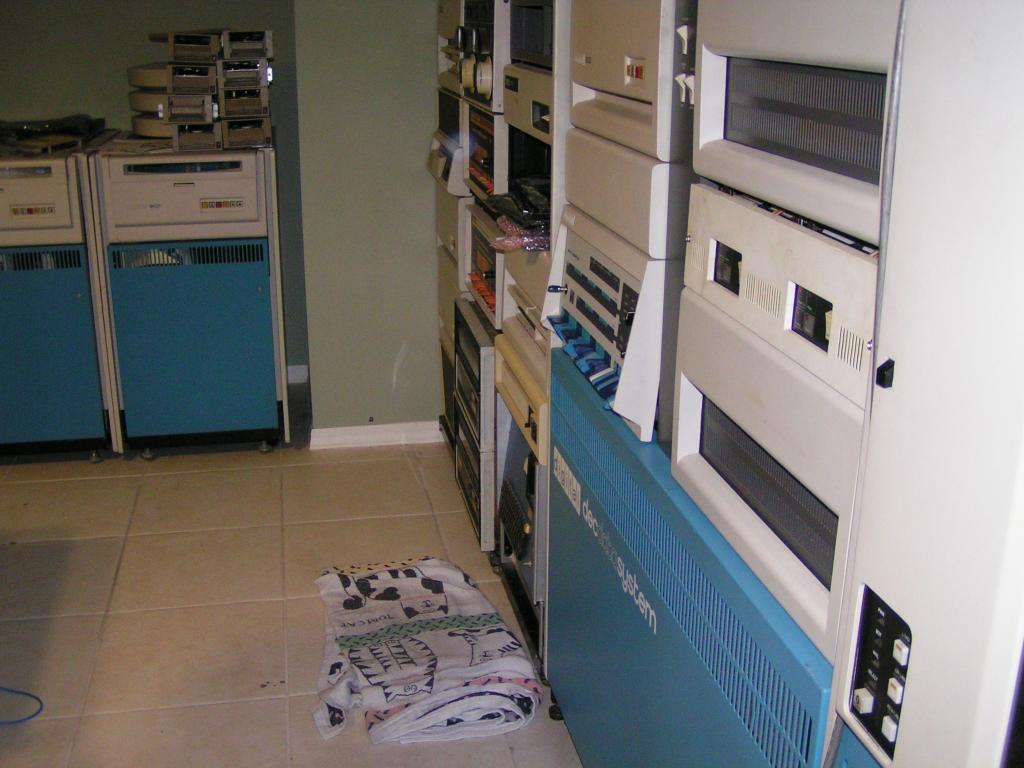
Richard <legalize at xmission.com> wrote:
>In article <4B7AF1F7.8030008 at softjar.se>, Johnny Billquist <bqt at softjar.se> writes:
>> > After searching the net for a while, I think it is an E&S graphic
>> > system. ES340 seems most likely, but ES390 might also be it.
>
> I doubt its an E&S system because its raster based.
That was a bad argument against it... :-)
> AFAIK, all the E&S terminals and DEC peripherals were vector based
> until the PS/390. If this were a PS/390, then it would have the
> characteristic black enclosure for the monitor, keyboard and tablet.
> Also, E&S products were high-end and had hardware line drawing at a
> minimum, whereas this system appears to be a simple memory-mapped
> frame buffer with no additional hardware acceleration.
I think we should keep E&S systems apart from DEC systems. They are not
the same, and mixing them up just confuses the issue.
The system in the video was not something by DEC. However, DEC had
bitmapped graphic systems long before this, but not with the resolution
and depths shown in the video.
> The PS/390 was the first "Picture System" to support raster
> operations. The primary market for these peripherals was the
> molecular design/molecular modeling community and they needed very
> high quality line renderings of their models. Until the antialiasing
> technology for raster graphics introduced on the PS/390 the only way
> to achieve that quality was to use a vector based display. The raster
> display decoupled the display refresh rate from the frame rendering
> rate, allowing very high quality renderings of complex models at the
> cost of interactivity.
Well, the E&S PS/340 also was a raster display system, as an add-on to
the PS/330.
See http://www.bmsc.washington.edu/people/merritt/graphics/ps330/ps330.html
I think it might very well be that which is shown on the video.
Raster operations are another issue. The video is showing a bitmapped
high resolution picture, and it obviously isn't too fast at loading
another high res picture. And that is all we see them doing. No raster
operations of any kind (unless you count the basic setting and clearing
of pixels).
> Similar technology to that used in the PS/390 was used in E&S's first
> workstation the ESV. I worked on the ASIC that performed this process
> in the ESV in the summer of 1989. The workstation was released in Q4
> 1989. All the E&S products were raster from then on, with the
> exception of calligraphic light overlays used in the simulation
> products.
>
> I have a PS/390 base and several ESV workstations in my collection.
Nice.
Johnny
I am looking for a few things:
I recently picked up an iSeries 270 and an AS/400 Model 200. A terminal
and an 8-port Twinax hub were included, but not the cable to connect the
terminal to the hub. The terminal has a "Y" cable with a DA15 and two
female Twinax connectors. The connectors on the hub are also female, so
I think that what I need is an M-M Twinax cable. I'm not sure if a
terminator is required for the un-connected Twinax connector on the "Y"
cable or not (I'm not really very familiar with AS/400s).
I have an AlphaServer 1000A 4/266 which is missing the terminator for
the internal SCSI backplane (because this is missing, the SCSI drives
sometimes stop responding and cause the system to hang). It is also
missing the cable to connect the two sections of the backplane. Does
anybody have either of these?
I have a DEC 3000/300X that no longer boots. The diagnostic LEDs show
"FA", which represents a memory test failure. I think that one of the
SIMM slots is damaged. When I got it, it would only boot after I removed
and re-installed the SIMMs. I tried cleaning the SIMMs and slots with
99% alcohol, so I don't think that dirty contacts are a problem. I think
that replacing the motherboard would fix the problem.
I am also looking for an RS/6000 (preferably one with PCI rather than
MCA). Does anybody have one that they want to get rid of for free or cheap?
Dear Madam/Sir,
My name is Thomas Bervenmark and I work at XaarJet AB in Stockholm, Sweden.
We are looking for a very old vison card "Transtech Parallel, TMB08" with a module TTG-F card mounted on the motherboard.
Is this something you could help us to find?
I am not a list subscriber and so would appreciate
direct email responses rather than replies to the list.
Many thanks for your help in advance.
Best regards,
Thomas Bervenmark
XaarJet AB
__________________________________________
XaarJet AB
Box 516
SE-175 26 Jarfalla, Sweden
Phone: +46-(0)8-580 887 00
Fax: +46-(0)8-580 887 77
Website: http://www.xaar.se/
Xaar is a market-leading manufacturer of innovative digital inkjet printing
technology.
Note: The information contained in this e-mail is intended for the named
recipient(s) only. It may also be privileged and confidential. If you are
not an intended recipient, you must not copy, distribute or take any action
in reliance upon it. No warranties or assurances are made in relation to
safety, content and/or any attachments. No liability is accepted for any
consequences arising from it. No warranties are given by Xaar, and no
liability is accepted by Xaar, in relation to any loss arising from reliance
placed on the information supplied in this email and attachments, other than
those warranties expressly stated in Xaar's Standard Terms and Conditions of
Sale. Xaar's Standard Terms and Conditions of Sale apply at all times. Xaar
plc, registered in England no.3320972, XaarJet ltd, registered in England
no.3375961, Xaar Technology ltd, registered in England no.2469592, Science
Park, Cambridge, CB4 0XR, Tel +44(0)1223423663, Fax +44(0)1223423590
Folks,
Got a PDP 11/04 on the bench here at work with an H777 (54-11599) PSU in
with a sticker on it that says 'pop, bang & smoke'. I've downloaded the
maintenance printset from Manx (yay Manx) but before I even begin I've
noticed a terminal block on the transformer that indicates a jumper between
terminals 1&2 and 3&4 for 115V and an additional jumper between 2&3 for
230V.
This third jumper is missing so have the owners of this PDP just put 230V
across a PSU jumpered for 115V?
Thanks!
--
Adrian
www.binarydinosaurs.co.uk
Patrick Finnegan <pat at computer-refuge.org> wrote:
On Monday 15 February 2010, Johnny Billquist wrote:
>> > The two companies that springs to my mind here are Intergraph, who
>> > did CAD systems based on VAXen. They usually based their systems on
>> > the VAX-11/750, but I don't think there was any technical reason
>> > that an 11/780 shouldn't be possible as well.
>
> FWIW, the VAX-11/780s I have were a part of an intergraph setup at one
> point. I didn't save the drafting-table sized drawing tablets/cad
> terminals that were with it, because of a lack of space...
>
> Alas, the setup they had didn't look like the Intergraph stuff I saw.
Cool. Nice information, thanks.
After searching the net for a while, I think it is an E&S graphic
system. ES340 seems most likely, but ES390 might also be it.
There are information about an older system for the PDP-11 machines by
E&S on the net, which strikes me as very similar, and probably a kind of
predecessor.
Johnny
Hi All.
I just stumbled upon this video of a computer tablet:
http://www.youtube.com/watch?v=aPC_w9yYe5M
They show a VAX-11/780 with RP06 and TU70 (I think) and claim its doing
the graphics. But I'm curious, what terminal and software is used? Does
anyone have a clue?
Regards,
Pontus.
I ordered my board as soon as I got the announcement on Thursday. I received
the board today (Saturday) and took it for a spin - imaged an Apple
16-sector disk and an MSDOS 1.2M disk using a YD-380 as the source drive.
Both worked great - the Apple disk produced a .dsk file that opened and read
in CiderPress and the DOS disk produced a .img file that looked good in
WinImage.
I was tempted to hook it up to an 8" drive using my DBIT adapter but
hesitated based on the discussions here. Would the DBIT adapter provide the
necessary buffering to drive a Shugart 801? I really like the idea of an 8"
drive connected to a netbook.
Jack
Hi all,
a source for a BNC to VGA cable ?
(Yes, I have a soldering iron, but like to buy some ;-))
The other way around (VGA->BNC) is easy to get, but don't find any
BNC->VGA(15 pin)
Cheers & thanks
Forget the 230V bang issue, it IS a 115v PSU from an industrial site! Now we
just have to find out what's gone pop...
---------- Forwarded message ----------
From: Adrian Graham <binarydinosaurs at gmail.com>
Date: 24 February 2010 15:39
Subject: DEC H777 PSU
To: "General Discussion: On-Topic and Off-Topic Posts" <
cctalk at classiccmp.org>
Folks,
Got a PDP 11/04 on the bench here at work with an H777 (54-11599) PSU in
with a sticker on it that says 'pop, bang & smoke'. I've downloaded the
maintenance printset from Manx (yay Manx) but before I even begin I've
noticed a terminal block on the transformer that indicates a jumper between
terminals 1&2 and 3&4 for 115V and an additional jumper between 2&3 for
230V.
This third jumper is missing so have the owners of this PDP just put 230V
across a PSU jumpered for 115V?
Thanks!
--
Adrian
www.binarydinosaurs.co.uk
--
--
adrian/witchy
Owner of Binary Dinosaurs, the UK's biggest home computer collection?
www.binarydinosaurs.co.uk
Curiosity demands that I ask about the DWQVA. The module catalog(ue)
lists it as "2 channel fiber optic interface (IFQ), Qbus to Stealth
bus". What IS the stealth bus?
No, I am not going to buy any of the ones on epay.
I'm trying to find some info on the IBM 3633 Optical Disk Drive. I am
selling things for infoage, and this is among the stuff. I have the drive,
cable, MCA controller card, "IBM Binder Manual," and several blank disks. I
haven't seen any sold on ebay.
Joe
Trial lawyers are part of making case law. Legislators make statutory law. Case law is *usually* very narrowly targeted. Statutory law tends to be where you find the overbroad, overreaching and uninformed regulation of how we live our lives and do our business.
Stakeholders are... us. I'm part of an advocacy group for a particular area of interest that has been very effective in our efforts to educate our legislators regarding our issues. We've been able to get good legislation introduced, heard and passed, and bad legislation killed. Next week, I am meeting (by invitation) with the head of one of the state regulatory agencies that impacts my interest area. She wants to know what I think. I know because she's asked before, and evidently included my input (on behalf of the stakeholder community) in her decision process.
If you include in the concept of 'lobbyists' citizens who show up, unpaid, and speak to the issues with data, not just impassioned rhetoric (although we have some of that, too), then you are not incorrect. But I suspect you are repeating the oft-stated belief that only paid, high-powered lobbyists are really making a difference. My small, not-for-profit advocacy group has beat those people at their own game on more than one occasion. I don't get paid for the time I spend in the state capital, and I pay my own way when I visit D.C. I'm paid back when stupid things don't happen, and even more richly when good things DO happen.
In my experience, at least at the state level, they're listening to the people who are talking: the decisions are made by the people who show up. Yes, sometimes the dragon wins, but in my experience the dragon loses often enough to well-informed and passionate citizen stakeholders that I keep going back. -- Ian
________________________________________
From: cctalk-bounces at classiccmp.org [cctalk-bounces at classiccmp.org] On Behalf Of Ken Seefried [ken at seefried.com]
Sent: Tuesday, February 23, 2010 9:18 PM
To: cctalk at classiccmp.org
Subject: Re: Asbestos: (was: RE: Tubes & Computers of Olden Days)
Dad was an executive and principle engineer at a hazardous waste abatement firm. Lots of asbestos and superfund site cleanups. I got a lot of collateral knowledge.
From: Ian King <IanK at vulcan.com>>The primary metric is the 'friability' of the asbestosPrecisely. Not all asbestos is created equal; much is completely harmless, some is frighteningly damaging. Friability is a fancy way of saying how finely do the asbestos fiber shatter under stress. The finer the particles, the more dangerous.
>I agree that a simple knee-jerk reaction to asbestos is
>silly - but that's how legislators most often write laws.
Well...not exactly (IMO). The legislation followed the trial lawyers making "asbestos" the equivalent of "plutonium" or "cyanide" in the minds of the public and therefore the jury pool. It's really tough to convince a jury that this asbestos is potentially lethal, but that form is harmless, especially when platiff is coughing his lungs up in the corner.
P.S. - I am *not* saying there wasn't a cavalier attitude toward the stuff, and a lot of people were hurt without cause.
>(Unless stakeholders are there to help them understand
>the facts.)If you're refering to the legislators, the the stockholders are lobbyists, and you don't always get the desired outcome.
KJ
Dad was an executive and principle engineer at a hazardous waste abatement firm. Lots of asbestos and superfund site cleanups. I got a lot of collateral knowledge.
From: Ian King <IanK at vulcan.com>>The primary metric is the 'friability' of the asbestosPrecisely. Not all asbestos is created equal; much is completely harmless, some is frighteningly damaging. Friability is a fancy way of saying how finely do the asbestos fiber shatter under stress. The finer the particles, the more dangerous.
>I agree that a simple knee-jerk reaction to asbestos is
>silly - but that's how legislators most often write laws.
Well...not exactly (IMO). The legislation followed the trial lawyers making "asbestos" the equivalent of "plutonium" or "cyanide" in the minds of the public and therefore the jury pool. It's really tough to convince a jury that this asbestos is potentially lethal, but that form is harmless, especially when platiff is coughing his lungs up in the corner.
P.S. - I am *not* saying there wasn't a cavalier attitude toward the stuff, and a lot of people were hurt without cause.
>(Unless stakeholders are there to help them understand
>the facts.)If you're refering to the legislators, the the stockholders are lobbyists, and you don't always get the desired outcome.
KJ
At 12:00 -0600 2/23/10, Randy wrote:
>If you look at one in the microscope, it looks like an LED with some
>sort of phosphor painted over the semiconductor. Is that how these
>things work, its really a high efficency IR LED, with a phosphor
>doubler to bring the wavelength into visible? Just speculating...
There are a few crystals that can double frequency (halve
wavelength, thereby *increasing* the energy per photon). I think
these are used in laser ranging, to bring a powerful IR laser beam up
into the visible so it'll transmit better through the atmosphere.
I think no phosphors can do that. They can bring frequency
*down* (ie absorb an ultraviolet photon, emit 2 visible or one
visible and one IR or some combination). In fact, I don't recall ever
hearing of a device that can do that with non-coherent light (well,
as direct conversion). The problem is trying to gather 2 low-energy
photons into a single high-energy photon. That turns out to be tough
to do in general.
There are phosphors that can be "pumped" by blue or UV light,
then stimulated to re-emit visible light when IR photons hit them. (I
think the Germans made IR goggles this way in WWII.)
--
- Mark 210-379-4635
-----------------------------------------------------------------------
Large Asteroids headed toward planets
inhabited by beings that don't have
technology adequate to stop them:
Think of it as Evolution in Fast-Forward.
On 22 Feb 2010, at 18:00, cctalk-request at classiccmp.org wrote:
>
> Message: 19
> Date: Mon, 22 Feb 2010 11:45:19 +0000
> From: Colin Eby <ceby2 at csc.com>
> Subject: Re: Tubes & Computers of Olden Days
> To: cctalk at classiccmp.org
> Message-ID:
> <OF71E503B7.7C3067C5-ON802576D2.003F9F40-802576D2.00409310 at csc.com>
> Content-Type: text/plain; charset=US-ASCII
>
>
> I'm rather surprised this thread hasn't brought up what has to be the most
> complete, working order, and fully programmable of the remaining tube
> machines. There are a couple of interesting systems in the process of
> restoration, but for my money, the best of the running examples is the
> Science Museum's (London's) Ferranti Pegasus. Unlike the Collosus replica,
> this is an actual relic, and recognizably a programmable computer in the
> modern sense. The Colossus and most of the later small systems are
> pegboard programmed and therefore cannot alter their instructions in
> flight. That Ferranti is demo'd regularly (though I never seem to be around
> on the right day). I'm sure everyone can do their own Googling, but it a
> pretty complete setup. I keep a loving photo of it in my office cubicle.
>
> Thanks,
> Colin Eby
> Technical Architect
> NR Performance Engineering
> CSC
>
I think you were right, and I hope you will be again, but last thing I heard was there had been an incident and it was shut down awaiting a health and safety review. If my memory serves me right some twit reported the blown fuse had asbestos in it. I expect most of the steam boilers in the building do too. We've gone health and safety mad, but when I reported someone had fly tipped a load of asbestos on a country verge the council collected 75% of it and left the rest behind and now some of it has got driven over and is being pulverised into the mud.
Roger Holmes,
Computer Conservation Society and 1301 working party member
On 21 Feb 2010, at 07:45, cctalk-request at classiccmp.org wrote:
>
> Message: 26
> Date: Fri, 19 Feb 2010 18:46:08 +0000
> From: Nigel Bailey <nig.bailey at virgin.net>
> Subject: Re: BBC S.E. news classic computer feature
> To: cctech at classiccmp.org
> Message-ID: <4B7EDC70.7020407 at virgin.net>
> Content-Type: text/plain; charset=ISO-8859-1; format=flowed
>
> Presumeably that's "Flossie"
> I watched the local BBC news, but we're in the Anglia region. Did you
> "youtube" the clip?
I think the BBC would not like me putting their copyright programmes up on U-tube.
I'm looking for a VT100 advanced video option board. Or, failing that, if anyone has a .100 spacing, 50 pin dual row female connector so I can makes one...
The circuit is really simple, it's just a plug-in board that gives the VT100 some extra RAM so it can display 24 lines of text in 132 column mode, and do some extra character attributes. I cooked up plans to build my own based on the schematics in the printset (and using some newer SRAMs), but when I actually pulled the logic board out of the terminal I realized that the header connector it plugs into is a stupid spacing - .1 instead of the usual .156.
-Ian
I have a SawStop Contractor's saw and am pleased with it, even though I have not had the need to test its stopping feature. I did see one demonstrated with a hot dog at a trade show, though. The maker of the electronics (National Semi, IIRC) was doing the demo.
The stop works by slamming a block of aluminum into the blade, so if it fires, you have to replace both the blade and the stop mechanism, which I consider a trivial cost compared to replacing one or more fingers! The electronics do have a POST, but you are right that there is no way to fully test the unit without destroying it. If you do not have a spare brake unit, there is a keyed over-ride.
I think some of the reasoning in having to replace the whole brake unit is that (1) the electronics are a small part of the unit so the added cost is minor, and (2) there is much less chance of someone incorrectly installing the unit. While I would be willing to use a unit re-assembled by Tony, there too many incompetents out there who I would not trust to even plug in the unit correctly, much less reassemble one from parts.
Bob
----- Original Message -----
Message: 6
Date: Sat, 20 Feb 2010 19:19:53 +0000 (GMT)
From: ard at p850ug1.demon.co.uk (Tony Duell)
Subject: Re: Soldering (Was: Re: HP-IB, Amigo/cs80 ... )
To: cctalk at classiccmp.org
Message-ID: <m1Niurz-000J3xC at p850ug1>
Content-Type: text/plain
> This is a pretty cool design for table saws:
>
> http://www.sawstop.com/
>
> "We're passionate about preventing saw accidents.
> That=92s why SawStop=AE saws are equipped with a safety
> system to stop the blade within 5 milliseconds of
> detecting contact with skin."
I am not convinced. My main moan is that you have to replace the complete
safety device if it trips? Why? I am darn sure you could make something
as quick-acting that was resetable.
Due to this, if it trips in the middle of a job and you don't have a
spare one to hand, you are going to find some way to disable it. Which
means you have no protection, but subconciously you will think you do and
won't take as much care.
Also, since you have to replace all the driver electronics every time
(why not just the fuse wire?) how do you know it's going to work? If it
was resetable, you could test it every month or som wy touching the side
of a the blade with a soft metal rod. If it trips, fine, if not, you fix
it. Better than that it not work when you need it. ?Of ocurse even if
you're prepared to waste a safety module every month to do that test, it
doesn't tell you anything. You don;t know the new one you've fitted is
going to work.
-tony
Hi,
Speaking of tubes, television variety or otherwise, does anyone know
if there are any tube-based computers, large or small, still in
existence?
I saw parts of one a few years ago at the Computer History Museum in
Silicon Valley but none that have approached a 'working' unit or
sub-unit!
Murray--
I'm rather surprised this thread hasn't brought up what has to be the most
complete, working order, and fully programmable of the remaining tube
machines. There are a couple of interesting systems in the process of
restoration, but for my money, the best of the running examples is the
Science Museum's (London's) Ferranti Pegasus. Unlike the Collosus replica,
this is an actual relic, and recognizably a programmable computer in the
modern sense. The Colossus and most of the later small systems are
pegboard programmed and therefore cannot alter their instructions in
flight. That Ferranti is demo'd regularly (though I never seem to be around
on the right day). I'm sure everyone can do their own Googling, but it a
pretty complete setup. I keep a loving photo of it in my office cubicle.
Thanks,
Colin Eby
Technical Architect
NR Performance Engineering
CSC
Some of you know that I have been selling some CDC disk packs on Ebay
- ones I pulled out of CyberResources.
I have noticed lately that there are some others selling packs on Ebay
- and they are using the text from my auctions.
My packs are either from Cyber's replacement stock, or are clearly
marked as crashed - the ones on Ebay are not. Consider these other
packs from these sneaky vendors as VERY QUESTIONABLE.
My Ebay name is TOOBER. Currently I have no packs on auction.
--
Will
the was posted to a amiga ircchannel some time ago,
http://www.softpres.org/glossary:kryoflux
Looks interessing, if there will be better drivers and accessable info
for writing or chaning the code on it, drive situation cant be much worse
than what we have with the catweasel.
Regards
--
Jacob Dahl Pind | telefisk.org | fidonet 2:237/38.8
FYI: the Living Computer Museum presentation will be a joint one, including my colleague Rich Alderson. Rich has been an active member of the 36-bit community for many years. -- Ian
________________________________________
From: cctalk-bounces at classiccmp.org [cctalk-bounces at classiccmp.org] On Behalf Of Rob Jarratt [robert.jarratt at ntlworld.com]
Sent: Saturday, February 20, 2010 11:27 AM
To: 'General Discussion: On-Topic and Off-Topic Posts'
Subject: DEC Legacy Event, Windermere, UK, 17th-18th April
I am sending the message below on behalf of the organiser of this event, as
he has been unable to resubscribe to the list:
Greetings,
I hope you don't mind me sending you an update on the DEC Legacy Event the
weekend of 17th & 18th April this year.
There are lots of exciting talks and demonstrations now lined up and lots of
kit to use, with more to come in the weeks ahead.
Please feel free to visit the website http://declegacy.org.uk for updates
and come join us for an interesting and social weekend in the Lakes!
Regards, Mark.
Current highlights are:
Kevin Murrell will be talking about the work at the National Museum of
Computing and the Computer Conservation Society preserving and restoring DEC
hardware. There will also be a video-link back to the museum to demonstrate
some of their 'less portable' DEC equipment, including the Blacknest PDP/11
used for seismic monitoring and their VAX fault tolerant system. He's
bringing along some choice exhibits in their collection including a PDP/8,
DEC Mate III and DEC Professional running RT11.
Colin Butcher is keeping us up to date by presenting technical details of
the new OpenVMS 8.4 release (including Clustering over IP/DECnet over IP,
performance enhancements etc.) as well as facilitate a mini-bootcamp where
participants will get an opportunity to try their hand at installing VMS,
clustering VMS or any other topic which is of suitable interest.
Ian King from the Living Computer Museum is joining from the USA and is
giving a presentation on the restoration of the DEC machines in their
collection. These include a PDP-10 model 2065 running Tops-10, a TOAD-1
running TOPS-20 and a VAX-11/780-5 running OpenVMS 6.2.
Dave Goodwin will be making a presentation on his PhD "Digital Equipment,
its Rise and Fall" answering the research question whether the sale to
Compaq was necessary or could DEC have survived on its own with the
technology it had.
Stephen 'Hoff' Hoffman, founder of HoffmanLabs, OpenVMS coder, publisher and
regular presenter at OpenVMS-related events will be joining us for a
presentation by video-link.
Jim Austin, Professor of Neural Computing, University of York, will be
demonstrating something of interest from his museum of DEC related hardware.
Equipment that will be on show includes:
PDP/8, DECmate III, DEC Professional running RT11, MicroVAX II & Microvax
3100 M80, VAXstation 4000/90, VAXstation VLC, DEC 3000/600 AXP, DEC
AlphaServer 1000A, ALPHAbook 1 Laptop, HP ZX6000, HP RX2600 server... with
more to come!
I am sending the message below on behalf of the organiser of this event, as
he has been unable to resubscribe to the list:
Greetings,
I hope you don't mind me sending you an update on the DEC Legacy Event the
weekend of 17th & 18th April this year.
There are lots of exciting talks and demonstrations now lined up and lots of
kit to use, with more to come in the weeks ahead.
Please feel free to visit the website http://declegacy.org.uk for updates
and come join us for an interesting and social weekend in the Lakes!
Regards, Mark.
Current highlights are:
Kevin Murrell will be talking about the work at the National Museum of
Computing and the Computer Conservation Society preserving and restoring DEC
hardware. There will also be a video-link back to the museum to demonstrate
some of their 'less portable' DEC equipment, including the Blacknest PDP/11
used for seismic monitoring and their VAX fault tolerant system. He's
bringing along some choice exhibits in their collection including a PDP/8,
DEC Mate III and DEC Professional running RT11.
Colin Butcher is keeping us up to date by presenting technical details of
the new OpenVMS 8.4 release (including Clustering over IP/DECnet over IP,
performance enhancements etc.) as well as facilitate a mini-bootcamp where
participants will get an opportunity to try their hand at installing VMS,
clustering VMS or any other topic which is of suitable interest.
Ian King from the Living Computer Museum is joining from the USA and is
giving a presentation on the restoration of the DEC machines in their
collection. These include a PDP-10 model 2065 running Tops-10, a TOAD-1
running TOPS-20 and a VAX-11/780-5 running OpenVMS 6.2.
Dave Goodwin will be making a presentation on his PhD "Digital Equipment,
its Rise and Fall" answering the research question whether the sale to
Compaq was necessary or could DEC have survived on its own with the
technology it had.
Stephen 'Hoff' Hoffman, founder of HoffmanLabs, OpenVMS coder, publisher and
regular presenter at OpenVMS-related events will be joining us for a
presentation by video-link.
Jim Austin, Professor of Neural Computing, University of York, will be
demonstrating something of interest from his museum of DEC related hardware.
Equipment that will be on show includes:
PDP/8, DECmate III, DEC Professional running RT11, MicroVAX II & Microvax
3100 M80, VAXstation 4000/90, VAXstation VLC, DEC 3000/600 AXP, DEC
AlphaServer 1000A, ALPHAbook 1 Laptop, HP ZX6000, HP RX2600 server... with
more to come!
I have now completed the detailed inventory of the museum.
Please see:
www.pdp12.org
for the extensive list. I will be entertaining offers until Sunday,
February the 28th for the entire museum in one lot. Contact me for
details at rkrten at gmail.com. I will make a decision Monday, March
1st.
Cheers,
-RK
--
Robert Krten
From: Ethan Dicks <ethan.dicks at gmail.com>
Subject: Re: Solderless breadboarding (and 68010 vs 68000)
To: "General Discussion: On-Topic and Off-Topic Posts"
<cctalk at classiccmp.org>
<snip>
>> [1] The local pound shop (a similar concept to dollar stores) was selling
>> a camping lamp with 24 white LEDs for a pound.
>I'd buy that for a pound! (and repurpose it, as you have).
-ethan
---------
Check your local Dollar store; I just happen to have a couple of those
24 LED lamps in front of me at this very moment that cost $1.50 ea.
(modding and putting them under the kitchen cabinets).
Lots of neat stuff in Dollar stores; amazing that they can sell a solar
powered/battery backed scientific calculator for $1.00 these days, esp.
considering shipping and several middlemen also making a profit...
Button cells 5/$1, $7 ea. at the Shack...
etc.
Again for 2010, I am crossing the country and am offering to pickup,
haul, and deliver large items for list members. In mid/late April, I
will be leaving New York, to arrive in California near the start of
May, and I will be passing thru Chicago and Denver on the westbound
trio, and likely Minneapolis on the eastbound. If business calls, I
can hit other cities as well.
I will have a van and a trailer, and can take fairly large items, like
6 foot racks. Weight is not much of an issue, with maybe a limit of
1200 pounds or so. Items hauled on my trailer are fully caccooned and
tarped. Loading and unloading are included. I use the hauling to pay
for my expenses on the trip (mostly fuel), so my rates are quite
reasonable. Smaller items are welcome, of course.
Some of my capacity is already taken for both the westbound and
eastbound sections, but there is plenty of room for more. Also, from
Denver to California I will be almost completely empty.
Please inquire off list, please.
--
Will
>
> Gene Buckle wrote:
>> On Thu, 18 Feb 2010, William Donzelli wrote:
>>
>>>
>>> The chances of more tube computers coming out of the woodwork is very,
>>> very slim, but it has happened in the past few years. It is actually
>>> reasonable to think that someone could have an IBM 650 or Bendix G-15
>>> tucked away in a basement or garage.
>>>
>> Here's one that last I heard was in service with the RAF:
>>
>> http://199.254.199.10/BehindTheScenes/lockheed.html
>>
>> The company that owned it was bankrupted by the training market downturn
>> after 9/11. It was sold in 2003.
>>
> I'm pretty sure Colossus is running again at Bletchley Park. I only
> wish I could get over there to see it in person. There are some youtube
> videos available.
> Later,
> Charlie C.
To say it is running again is a little bit misleading. A huge amount of work was done by my fellow members of the Computer Conservation Society, including some of the people who designed Colossus in the first place and it is great to have it but Winston Churchill had the Colossi(?) broken up into small bits and so this is a replica, an extraordinarily correct replica but a replica all the same, therefore it is now running, not running again.
Apparently they had less problems getting the difficult bits working as the plans had been released from UK government archives, than the off the shelf 'commercial' items, plans of which had long since been lost except for the odd hoarder like me and probably you. Also thing like switches were available off the shelf, with a high priority job they had first call on things and selected Spitfire fighter switches which were then being produced in good quantities and good quality.
Roger Holmes
I've recently been restoring an H8/H17 system. Almost all of
the problems involved capacitors, including a bad electrolytic
in the H17 (diskette unit) power supply. I repaired the H17
supply using a dummy load but apparently the H17 was run with
the bad supply before I got it. I say this because some of the
tantalum caps on the logic boards of the Wangco model 82 diskette
drives popped and/or burned when correct power was supplied to
them. I've seen plenty of the "teardrop" tantalums pop, but I've
never seen one of the "black suppository" types (used on these
drives) go. I believe this was the result of bad ripple in the
supply.
Anyway, one of the Wangcos now runs perfectly and the other runs
fine for a while but fails after about an hour of applied power.
The difference between the two is that, on the flaky drive, a cap
in series with an inductor did a slow burn, resulting in the
inductor having a "nice brown toasty" appearance and a small split
in one side that some red resin leaked from. By the way, the only
way I know this is an inductor is that it is labeled "L5". It
looks like a large beige resistor with too many color stripes on it.
Inductors are a weak area in my electronics knowledge. How would
you know for sure that one has failed? Does it fail open?
Other info: When the drive fails, it can not read any data and,
when seeks are attempted on it, it sounds "funny", not the nice
sharp click it makes when operating correctly. The inductor does
not feel hot to the touch when the drive has failed. I'm out of
cool spray. Tonight I will try to apply an ice cube in a plastic
bag to it to see if that gets it out of failure mode.
Finally, assuming it is the problem, what do I need to replace it?
The stripes on it are:
Wide silver (covering one end)
Red
Yellow
Brown
Gold
Thanks,
Bill
On Wed, Feb 17, 2010 at 13:49, Tony Duell <ard at p850ug1.demon.co.uk> wrote:
> The main problem is that those breadboard are terrible. It's not the
> clock speed that matters, it's the swtiching time of the IC. Most modern
> ICs have ouptus that switch so fast that when you combine them with the
> stray capacitances on the breadboard and the relatively high impedance
> power connections, you get power and ground lines bouncing all over the
> place. Without a _good_ 'scope it's impossible to know why your circuit
> doesn't work. If you stick to 4000 series CMOS you'll be alright, but
> modern 74xxx familes are pushing it. Really pushing it.
But if you're just learning high speed don't matter, even with full
computer prototypes. Incidentally, I just saw this:
http://blog.makezine.com/archive/2010/02/building_a_cpm_68k_computer_from_s…
Crazy, but I'm cheering for him! Retrotastic! :-)
Joe.
--
Joachim Thiemann :: http://www.tsp.ece.mcgill.ca/~jthiem
Is there anyone in or near Mountain View, CA who would be willing
to pick up a light PC-tower-sized box and ship it to me? If so,
please contact me off-list.
Thanks,
-Dave
--
Dave McGuire
Port Charlotte, FL
> Message: 12
> Date: Tue, 16 Feb 2010 20:33:58 +0000 (GMT)
> From: ard at p850ug1.demon.co.uk (Tony Duell)
> Subject: Re: HP-IB, Amigo/cs80 was Re: hp 9153 floppy & disk
> To: cctalk at classiccmp.org
> Message-ID: <m1NhU7P-000J43C at p850ug1>
> Content-Type: text/plain
>
> some of them may even end up as products :-( I am sure I've told you
> how
> I once showed a so-called designer who wanted to use a microcontrolelr
> module + input interface modules + ... as part of a control system that
> his problem could be solved using few lengths of wire and otherwise
> unused contacts on his relays and swithces. Hmmm...
>
> -tony
>
I used to work for Volvo, developing the maps for ECUs for engine control.
One of my colleagues wanted a simple indicator showing the injection time,
i.e. for how many milliseconds each engine revolution the injectors were
open, to see how his mapping was working out in practice when test driving.
He asked for help from the electronics lab, who came up with a proposal for
a digital display, all-singing, all-dancing precision device which would
cost $$$$$, come in a nice 19" case and take months to design. He went off
and made his own indicator instead, using a 555, a moving-coil meter and
some passive components. Quite a number of his devices were built for
everybody else in the department, IIRC.
/Jonas
Just wanted to let the European readers of CCtalk know that Ian King and I
will be at the DEC Legacy Event in Windermere in April, and have been invited
to give a presentation on the work we are doing at the Living Computer Museum.
Details on the event are available at http://declegacy.org.uk
We're looking forward to meeting lots of people there.
Rich Alderson
Vintage Computing Sr. Server Engineer
Vulcan, Inc.
505 5th Avenue S, Suite 900
Seattle, WA 98104
mailto:RichA at vulcan.com
mailto:RichA at LivingComputerMuseum.orghttp://www.PDPplanet.org/http://www.LivingComputerMuseum.org/
I've put two Northstar boards on eBay for those who care:
http://cgi.ebay.com/ws/eBayISAPI.dll?ViewItem&item=290404578135http://cgi.ebay.com/ws/eBayISAPI.dll?ViewItem&item=290404577525
And, I've got the following documents that simply need a good home for
the cost of shipping:
* Original PMMI MM-103 Modem Manual
* Copy of Horizon Parallel to Centronics Parallel Cable diagram from
Northstar Computers
* Bunch of Information from Jay Sage on Z-System he sent me.
* Copies of HRAM Original Schematics (Rev A and C)
* Northstar 16K RAM Board original manual (RAM-16-DOC) Rev2
Preferably a home with someone who will ensure they are scanned if not
already.
I also have two COSMAC docs free for cost of shipping:
* Copy of MB-604B RCA COSMAC Microboard Computer CDP18S604B
* Copy of 1802 datasheet (it's a fax, so it's not a great example,
but it's an RCA document, and I could not find a softcopy online)
If you know some of these are available as softcopy, please let me know,
so I don't feel bad if no one takes them and I end up trashing them.
Jim
--
Jim Brain, Brain Innovations (X)
brain at jbrain.com
Dabbling in WWW, Embedded Systems, Old CBM computers, and Good Times!
Home: http://www.jbrain.com
Richard <legalize at xmission.com> wrote:
>
> In article <e1d20d631002151910m2cdf9866u4129242000590de6 at mail.gmail.com>,
> William Donzelli <wdonzelli at gmail.com> writes:
>
>>> The VT102 User Guide on vt100.net shows that you could get a green
>>> antiglare filter: <http://www.vt100.net/docs/vt102-ug/chapter10.html>
>> It is also reasonable to think that DEC did a run of VT100oids with green tub
> es.
>
> I think he's right though. In documentation I've read through, there
> were green and amber models offered for the successive generations but
> I don't recall having read that the VT100 or earlier models had
> anything other than the white phosphor.
I think that is correct.
I've never seen, nor heard of anything but white phosphor VT100s.
*However*, there were clones made by other companies (unfortunately I
don't remember any names here), which looked pretty much exactly like
the VT100, and which did come with green phosphor.
Johnny
On 2/18/10, Jim Brain <brain at jbrain.com> wrote:
> On 2/18/2010 3:58 PM, Ethan Dicks wrote:
>> P.S. - this project revives, yet again, my occasional interest in
>> hacking a COMBOARD into something less "embedded" - I usually get
>> stuck at the same stage - whether to hack in a 5380 SCSI chip or a
>> TTL-based "IDE" interface. COMBOARDs have serial, but no "disk", so
>> they'd need _something_ (they already have between 32K and 2MB of RAM,
>> depending on the model - I have piles of working boards with 128K of
>> DRAM and a COM5025 USART, smaller piles of other models).
>>
> Send me one and I'll hack in an SD interface complete with FAT support
> :-) Heck, I could even put it on the serial port, if you didn't want to
> hack it in.
I'll go see what I can dig out of the bin - I can easily throw the
Fluke 9010A on one and ensure the RAM and ROM test out OK. It's
harder to test out the bus interface, but unless you plan to stick
this on a Unibus, I don't think you care if the 8641s are all 100%
known-good. ;-)
The basic board is 8MHz 68000, 128K of parity DRAM (array of 4164
DIPs) on a 74S409 DRAM controller, 2x 28-pin JEDEC ROM sockets (2764s
at least, if not 27128s), a socketed COM5025 which could be a good
place to tap into the data bus and some select lines, an MC6821 with a
16-pin DIP exporting at least one of the 8-bit ports ("programmers'
interface"), some sort of sub-100Hz timer, IIRC, for heartbeat
interrupts, two 40-pin off-board BERG connectors (one for sync serial,
one for LP05-type printer, driven by the rest of the MC6821), and 12
edge-visible power and status LEDs (mostly serial status indicators).
I'd send you a link to a picture, but I don't seem to have posted one
(and the salad days of Software Results pre-date the Web). It's a
hex-height card that expects to pull +5V, +15V and -15V of of the
Unibus, so you'd have to either plug it into a DEC module block or
hack in power somewhere.
Naturally, I have all the schematics and PAL equations, but they are
in paper format, not electronic. Overall, my recollection is that the
memory space is divided by A23 and A22 into four 4MB quadrants, RAM,
ROM, I/O, and Unibus DMA engine. Retooling PALs could, of course,
alter that. Unfortunately, the PALs are not always socketed (depends
on the age of the board) and it's a six-layer PCB. I know of no
reason PALs couldn't be replaced with 16V8 and 22V10 GALs, but it
hasn't ever been tried.
Still interested?
-ethan
P.S. - the other models are variations on the theme. The older model
has 32K of 2114 SRAMs and two 6309 PROM sockets, newer models (of
which I have only a handful) have 41256 or 44256 DRAMs and Z8530
DUARTs, but are otherwise quite similar architecturally, if you ignore
the specifics of the host bus interface.
On 2/18/10, Henk Gooijen <henk.gooijen at hotmail.com> wrote:
> I have no experience with SCSI chips...
No harder to wire up than a UART or PIA/VIA, but the rest is all
software to create/interpret the SCSI packets.
> but the software to read and write a sector of an IDE disk is simple enough.
I've written low-level driver code for IDE manipulation on a GG2 Bus+
equipped Amiga.
> A TTL-based interface would
> take not much time. 16 bit data (may need buffering) and a few address
> decoding gates is probably all you need to hook up an IDE drive.
Address decoding gates might not even be required - I have full
schematics for this board (I used to make them commercially) and have
the PAL equations for the memory map PALs.
I think it could be as easy as buffers and a PAL swap (plus software).
I just flip-flop between SCSI and IDE and never get started.
-ethan
At 15:26 -0600 2/17/10, Tony wrote:
>What I don;t get is _why_ there's this aversion to soldering.
I get it. Fumes requiring ventilation, molten metal,
temperatures that can sear flesh or melt most plastics, the
appearance if not fact of irreversability (and in fact, it's not hard
to do damage to the circuit board that is hard to repair). Like
bicycling, cooking, and a host of other activities, it's a very
productive and useful skill to have, and seems to those who have the
skill to be trivial to learn - but to those without the skill, it's
intimidating (partly because there is some potential for damage if
it's done wrong).
I think this is a good case where mentoring or tutoring would
*really* help people who have not done it to "get their feet wet",
and have the confidence to do more on their own.
--
- Mark 210-379-4635
-----------------------------------------------------------------------
Large Asteroids headed toward planets
inhabited by beings that don't have
technology adequate to stop them:
Think of it as Evolution in Fast-Forward.
There is a load of printronix printers, and parts coming off service in
St. Louis Mo P300 P600 I suspect, if anyone is interested please email
me, and I'll pass it along. There is at least one QMS board equipped
system involved from what I have been told.
Inventory can be made if interest is there.
Jim
-----Original Message-----
From: e.stiebler <emu at e-bbes.com>
Sent: 10 februari 2010 ?. 02:27
To: On-Topic and Off-Topic Posts <cctalk at classiccmp.org>
Subject: Re: hp 9153 floppy & disk
Tony Duell wrote:
> THe Nighthawk drive interface is strange. Very strange. it has the raw
> data signals of an ST412 drive (but on single-ended TTL lines, not
> differential pairs). It also hasa the strangest positioner interface
> you're likely to see. The positioner is a 2-winding stepper motor. You
> get (at the drive interface) to contrtoll the currents through the
> windings (there's a dual DAC in the drive).You also get soem kind of
> position feedback signal from the drive (there's an ADC in there too).
> There is no intellegence in the drive to control te DACs based on the
> output from the ADC, that is done in the controller (I assume in part by
> the 6809 firmware).
>
> Given there's an undocumented ASIC in the drive too, which has a register
> accessible over the interface, and for whaich I have no data, tryign to
> recreate the drive is going to be a big job.
So, what you're saying is, that I should get myself a microcontroller
with an sd-flash and start programming Amigo/CS80 ?
And simply forget about the box I have here ?
;-)
Cheers
You could use HPDIR with a sbc with hp-ib and a flash drive.
I'm building one with a Kontron SBC.
-Rik
I read a message that you posted at some time or another and got your
email from it
I am in desperate need of some tango pcb info
I have an old copy of tango pcb installed on my comp and some old
layouts I desperately need to access/modify
I have lost my dongle. Can you tell me where I might purchase one?
Or even better: I understand they just shorted some pins on a parallel
port connector, any idea what the pinout is?
My name is Carl Hesse. I am in denver colorado
I would pay reasonably well for pinout info
What this means is that I just need to know which pins are shorted or
"common" on the dongle
any desire to help?
> On 2/17/10, Tony Duell <ard at p850ug1.demon.co.uk> wrote:
>>> >> From trying to teach soldering, the
>>> >> unforgiving nature leads to student frustration.
>> >
>> > I am suprised. I've taught dozens of people to solder over the years, and
>> > every one had success within half an hour.
>
> More particularly, I've taught several people over the past few months
> how to solder at a few workshops. I've had mixed results. All were
> enthusiastic, but not all were, in the old vernacular, "mechanically
> inclined".
A friend of mine was a 3rd grade teacher, and one or two of us would go
in and help them build code practice oscillators. We really didn't have
much trouble with solder joints after we showed them how to preheat the
joint and apply the solder.
The biggest problem at first was getting them to touch the tip to the
joint long enough to heat it to the point the solder would melt when
applied.
The second biggest problem was getting them to realize that the color
codes on the resistors actually meant something as to where they were
inserted :).
On 2/17/10, Tony Duell <ard at p850ug1.demon.co.uk> wrote:
>> From trying to teach soldering, the
>> unforgiving nature leads to student frustration.
>
> I am suprised. I've taught dozens of people to solder over the years, and
> every one had success within half an hour.
More particularly, I've taught several people over the past few months
how to solder at a few workshops. I've had mixed results. All were
enthusiastic, but not all were, in the old vernacular, "mechanically
inclined".
What would probably have helped is an aspect of the workshop that was
specifically soldering instruction, not kit assembly, with easy to
reach and easy to inspect widely spaced joints. What we had at our
disposal was a few joints on 0.1" boards - either a made-in-class PCB
(not my design, or I'd have made the pads bigger which would have
helped) or a factory-made strip-board (Lilypad prototyping board) that
was soldered to after the web of interconnections were cut to route
the signals.
All of the students learned *something* about soldering, but even
after 90 minutes and several attempts, the success rate (good joints)
was probably between 50%-66%. I had to retouch a number of joints to
get the projects working during the class period.
More practice would have obviously been beneficial.
-ethan
I have an LNW-80 Model I. If my memory is correct, this unit will run CP/M.
Can anyone confirm that?
And, if so... Can someone point me to where I can get disk images?
Thanks!
Al
Keansburg, NJ
> That's a pile of random loktals. What I'm talking about is a set of the
> five tubes called for in an All-American-Five design. I might have to
> rewire this thing for regular octals.
14Q7, 14A7, 14B6, 50A5, 35Y4? All easily available at any of the places
that have a broad stock of tubes. e.g. ESRC, Antique Electronic Supply,
etc. One of my specialties is the loctal Zentih Transoceanic (8G005) which
some describe as rare but really they're as common as dirt. I was
surprised that many of the stocks of loctal tubes are recentish (60's,
70's) Eastern European production - I had always thought of loctals
as a Philco thing of the 40's.
The business sense in dealing with something that hasn't been made
in decades (or indeed more than half a century) is contrary to most
business rules of thunb. To have a profitable resale business as a rule
of thumb you have to be able to turn your inventory over several times
a year. Anything not sold after a few months has to be slashed in price
or simply thrown out to make room for the new stuff. The tube resellers
have to work differently - their stock is already decades old. It's not
a business I'm in but I can appreciate some of the challenges. I think
the business world of tubes has seen some tumultousness recently, what
with the US Govt unloading huge stockpiles of many tubes and the de-
nationalization of Eastern European/Russian factories, but may be
stabilizing a bit.
Tim.
Does anyone have experience navigating the DECUS archive at digiater.nl?
Under this directory: http://digiater.nl/openvms/decus/vax000/
is this file: 11spp_87.001
which contains this reference:
11-SP-42 Symposium Tape from the RSTS SIG, Spring 1980, Chicago
Version: Spring 1980
Does the archive contain the contents of this tape? I would rather not
have to download the large 500MB+ ZIPs to find the needle in the
haystack and I am not sure I understand how the "indexing" scheme
works.
I looked in here:
http://digiater.nl/openvms/decus/zips_unix_attributes/
but I cannot match these files with those listed under /vax000/
Any tips or directions would be appreciated.
thanks,
nigel.
www.retroComputingTasmania.com
On Tue Feb 16 11:56:45 CST 2010, Dave McGuire wrote:
> That's it...worked like a champ.
Thank you Dave, that worked for me too; applying your tips might now
allow us to try some of the other layered products (C and COBOL -
although I notice the C TAP has a AUTOIN.COM file for auto-install so
I suppose we invoke that, much like the F77 install).
I used BP2 V2.6, only because I understood that version was intended
for RSTS/E V9.6 - I will try BP2 V2.7 and see if it is stable on V9.6.
I am still to discover which of the TAPs of RSTS/E V9.7 are worth
trying.
One surprise I encountered though on rebooting RSTS/E, BASIC/BP2
throws an error:
$ basic/bp2
?Unable to attach to resident library
?Can't find file or account
I fixed this by executing these two commands (found in BP2INS.CMD):
$ INSTALL/LIBRARY/NOADDRESS B26SHR
$ INSTALL/LIBRARY/NOADDRESS B26SH1
Then $ BASIC/BP2 works again.
So it is usual RSTS/E practice to add the install/library commands to
[0,1]START.COM to "permanently" add the layered product to RSTS/E? I
expected the install process to do this for me.
Sorry, I do not have 11SP42. I think I had it confused in my head with
11SP47 (GCE's Portacalc of course).
Lots of the SIG symposia tapes are a kind of
"best of" collection with contents repeated or improved from year to year.
Is there something specific you need from 11SP42? If so it's probably
on some other DECUS tape I can help you find.
Tim.
> Is there a good source for these things (the TVs and the tubes)
> today? I imagine people threw them away mostly. If these are
> difficult to find and/or maintain, I've considered trying to create a
> replica console television from a newer set, maybe even something
> with an LCD in it. I'd probably prefer an original though.
brian
You can try thrift stores although the ones out here in California tend
not to take them anymore. You can also check with a TV repair place as
they tend to get questions from people about what to do with their old sets.
Chuck Guzis wrote:
>On 12 Feb 2010 at 15:30, Jeff Walther wrote:
>> Anyone have a datasheet for the MCM62940 (MCM62940AFN14) static RAM?
>> It's not strictly off topic, as it's from the 256K level 2 cache of a
>> computer from the mid-90s (NuBus PPC Macintoshes).
> Apparently, the MCM62486 is pin compatible and there are datasheets
> for that online:
> http://pdf.chinaicmart.com/86B/MCM62486BFN11_1159896.pdf
> --Chuck
Thanks you for the information, Chuck. They should be very similar. I
imagine the difference is that the XX486 version has adaptations for the
80486 methods of addressing memory, while the 940 version is more oriented
for the Motorola family of processors. At least, I think I read
something to that effect somewhere--maybe in the description of the
associated tag RAM.
Anyway, I've emailed Brent and hope to pay to ship the whole databook.
If anyone else decides they want to order the 4000 soldered down static
RAMs I referenced (they have 19 batches in stock), I can scan the
datasheet after I have the book--if I can get the scanner working again.
Darned glass fell out because the manufacturer's double sided tape got old
(it's more than 10 years old too). I tried a 3M tape
<http://www.shop3m.com/3m-high-performance-double-coated-tape-9088-fl3znfcqj…>
that looked promising but it didn't hold. I'm going to try again and
heat the tape and give it three days to set. On the first try I didn't
see the information that the adhesive needs to set for three days.
Who knew that one needs to read the datasheet on *adhesive tape* in order
to use it properly?
Jeff Walther
Pontus Pihlgren <pontus at Update.UU.SE> wrote:
> Hi All.
>
> I just stumbled upon this video of a computer tablet:
>
> http://www.youtube.com/watch?v=aPC_w9yYe5M
>
> They show a VAX-11/780 with RP06 and TU70 (I think) and claim its doing
> the graphics. But I'm curious, what terminal and software is used? Does
> anyone have a clue?
Nice stuff.
Interesting to see the speculations of people around here.
The tape drive is a TU77 or TU78, which you should know Pontus... ;-)
My guess would be a TU77 though.
Anyway, no, the graphics is not DEC. And no, it's not a serial
connection. If you ever tried doing bitmap graphics over a serial line
you should all realize that a high resolution picture like that would
take a very long time to download over a serial line, even at 19200. And
by 1986 you didn't have any faster serial ports on a Unibus-machine.
Also, DEC didn't have any high-resolution hardware for Unibus. The
closes was the VS11, VS60 and that kind of stuff. And those don't get
close to the type of resolution, number of colors, or speed of this
thing. DEC did play with a few tablets for the VAX stations by this
time, but hadn't come that far.
So, yes, this is a third party thing.
The two companies that springs to my mind here are Intergraph, who did
CAD systems based on VAXen. They usually based their systems on the
VAX-11/750, but I don't think there was any technical reason that an
11/780 shouldn't be possible as well.
The other is Evans and Sutherland, who specialized in high performance
graphic subsystems. My guess would be that this was some E&S graphic
system, but it's hard to tell, since I never actually saw any of their
stuff in real life. But I think it was/is a whole bunch of cards on the
Unibus, and video cables to a color monitor. And of course input ports
for keyboard and tablet.
There might have been other players around as well.
But I know of no DEC hardware that could produce better than aboout
256x256 on Unibus machines, and only with a very limited palette.
And it's definitely not a VT-whatever. The "best" VT-terminal, in terms
of graphic is the VT340, which have a fair resolution of about 240x800
(roughly from memory), but at most 16 colors, out of a palette of 4096.
But it's also newer than 1986, and don't look like that at all.
Johnny
--
Johnny Billquist || "I'm on a bus
|| on a psychedelic trip
email: bqt at softjar.se || Reading murder books
pdp is alive! || tryin' to stay hip" - B. Idol
Has anyone managed to get any of the Layered Products installed on
RSTS/E V9.X (X >= 6)? Aside from F77 for which there was a declaration
of success here:
http://mailman.trailing-edge.com/pipermail/simh/2008-March/001719.html
I tried with BASIC Plus 2 V2.6 (with RSTS/E 9.6) and can see that the
tape appears to be a BACKUP INSTAL.BCK set, but RESTORE is refusing to
work with the tape (TPC file).
Does anyone happen to have the BP2 installation guide or tips on how
the layered products are generally installed on RSTS/E?
A related question: Can anyone explain what a field-test versions of
RSTS/E means? is it a release candidate (in modern parlance) or a
beta? I see RSTS/E V10 but it is annotated with field-test so I assume
it was not the final shipping version.
thanks.
www.retroComputingTasmania.com
I have several of the DECUS sig tapes as images, and also extracted files.
I think 11SP42 is one of them. Like most of the 70's and 80's post-paper-tape RSTS stuff it's a DOS-11 style magtape.
Will put it up on ftp.trailing-edge.com<ftp://ftp.trailing-edge.com> tonight.
Tim.
Anyone happen to know how the Vax 11/780 and the single-wide corporate peripheral cabinet are joined together? The Vax has good casters, the peripheral cabinet has stupid casters, and they're joined at the hip. Are there hidden bolts or latches, or some kind of joiner panel like on the 11/750?
-Ian
Hi folks,
I arranged to get one of those office machines that do everything. And scanned a box of documents.
This is how it looks when I use it:
http://www.youtube.com/watch?v=70m0ZdcFOuE
If anybody has some money to help me funding my copy machine - please let me know..... It cost me
most of what I could spend at the moment.
I uploaded the documents to:
http://pdp8.hachti.de/newscan/box1
Feel free to take what's needed and archive it. My files will not stay there for forever!
Here's a list of the box1 directory:
************************************
> hachti at sumpf64:~/scanner/ready/box1$ ls *
> ampex:
> 5104036-10 TM-2 Technical Manual for Siemens+Halske April 1965 .pdf
>
> cdc:
> 41247200 Rev. B 9465 Disk Storage Drive Maintenance Manual.pdf 41248800 Rev. D 9465 Disk Storage Drive Schematics.pdf
>
> dartmouth_dtss:
> 20100212100751305.pdf 20100212101335486.pdf
>
> emulex:
> CD1151007 Rev. B CS11_F1 Technical Manual.pdf
>
> facit:
> PE1000 Technical Description, German.pdf UP631001 FACIT PE 1000 Paper Tape Reader Spare Parts.pdf
> UP630201 FACIT PE 1000 Paper Tape Reader Manual.pdf
>
> honeywell:
> BJ67A Rev. 1 Series 600_6000 FORTRAN Addendum A.pdf
> BJ67 Rev. 1 Series 600_6000 FORTRAN Manual.pdf
> BP82 Rev. 0 Series 600_6000 Biomedical (BMD) Statistical Programs Reference Manual.pdf
> BS06 Rev. 1 Series 600_6000 Jovial Language Manual.pdf
> BS11A Rev. 0 Series 600_6000 Algol Addendum A.pdf
> BS11 Rev. 0 Series 600_6000 Algol Manual.pdf
> D43A Rev. 0 Series 600_6000 Time-Sharing Applicatons Library Guide I - Mathematics, Addendum A.pdf
> D43 Rev. 0 Series 600_6000 Time-Sharing Applicatons Library Guide I - Mathematics.pdf
> DA44A Rev. 0 Series 600_6000 Time-Sharing Applications Library Guide II - Statistics, Addendum A.pdf
> DA44 Rev. 0 Series 600_6000 Time-Sharing Applications Library Guide II - Statistics.pdf
> DA45A Rev. 2 Series 600_6000 Time-Sharing Applications Library Guide III - Industry, Addendum A.pdf
> DA45B Rev. 2 Series 600_6000 Time-Sharing Applications Library Guide III - Industry, Addendum B.pdf
> DA45 Rev. 2 Series 600_6000 Time-Sharing Applications Library Guide III - Industry.pdf
> DA64 Rev. 1 Series 600_6000 Time-Sharing Applications Library Guide IV - Business+Finance.pdf
>
> plessey:
> PM-TC11 Drawing Package.pdf
>
> xerox:
> 190572C Rank Xerox extended Algol-60 Language and Operations Reference Manual.pdf
> 191692A Xerox Universal Time-Sharing System (UTS) Users Guide.pdf
> 900907E Xerox Control-Program-Five (CP-V) Time-Sharing Reference Manual.pdf
> 901677A-1(9-71) Xerox FORTRAN Debug Package (FDP) Revision Package.pdf
> 901677A Xerox FORTRAN Debug Package (FDP) Reference Manual.pdf
> 901733C Sigma 9 Computer Reference Manual.pdf
> 901765A Xerox Operating System (XOS) Batch Processing Reference Manual.pdf
> hachti at sumpf64:~/scanner/ready/box1$ du -h
> 41M ./facit
> 396M ./xerox
> 511M ./honeywell
> 123M ./plessey
> 124M ./ampex
> 32M ./emulex
> 146M ./cdc
> 110M ./dartmouth_dtss
> 1,5G .
******************************
Best wishes,
Philipp
--
http://www.hachti.de
>
> From: Al Kossow <aek at bitsavers.org>
> Subject: Re: Docs found: Some docs scanned
> To: General Discussion: On-Topic and Off-Topic Posts
> <cctalk at classiccmp.org>
> Message-ID: <4B7842F7.5080001 at bitsavers.org>
> Content-Type: text/plain; charset=ISO-8859-15; format=flowed
>
> On 2/14/10 10:04 AM, Philipp Hachtmann wrote:
>
>> ampex: 5104036-10 TM-2
>>> Technical Manual for Siemens+Halske April 1965 .pdf
>
>
> That will make the B-205 fans happy.
> The TM-2 manual has been difficult to find.
When it eventually appears on BitSavers it will be interesting to compare with the half inch (TM4) version I have. Could you please tell me (or the list) when it goes up.
Roger Holmes.
At 05:19 PM 2/15/2010 -0500, you wrote:
>On Mon, Feb 15, 2010 at 5:17 PM, Tom Peters <tpeters at mixcom.com> wrote:
> > A friend is selling her laser disc stuff as she's moving out of state soon.
> > Info is below; please pass this along to others and contact Carol directly
> > if you are interested.
>
>Could you at least say out of which state?
>
>-ethan
I do apologize. The posting was originally to a much smaller audience who
could safely assume Southeastern Wisconsin. When owner asked me to post it,
I should have edited it more carefully.
This equipment is in the Milwaukee metro area.
-----
324. [Philosophy] If you see a man approaching you with the obvious intent of
doing you good, you should run for your life. --"Thoreau's Law"
--... ...-- -.. . -. ----. --.- --.- -...
tpeters at nospam.mixcom.com (remove "nospam") N9QQB (amateur radio)
"HEY YOU" (loud shouting) WEB: http://www.mixcom.com/tpeters
43? 7' 17.2" N by 88? 6' 28.9" W, Elevation 815', Grid Square EN53wc
WAN/LAN/Telcom Analyst, Tech Writer, MCP, CCNA, Registered Linux User 385531
A friend is selling her laser disc stuff as she's moving out of state soon.
Info is below; please pass this along to others and contact Carol directly
if you are interested.
LASER DISC PLAYER AND DISC COLLECTION FOR SALE
I have a Pioneer Compact Disc/Laservision Player, CLD-909 w/Digital Sound
which plays compact disc (cd) and both 8" and 12" laser discs.
I have about 50 laser discs - Disney (Snow White, Bambi, Aladdin, Sleeping
Beauty), allot of Monty Python series & movies, classics like Cassablanca,
African Queen, The Marx Brothers, Terminator 2, ET, Unforgiven, Prizi's
Honor, Battle of the Bulge, TWO Looney Tunes anthologies/sets, Airplane,
Jewel of the Nile, Back to the Future, Goonies, Labrynth, Naked Gun 2 1/2,
A Fish Called Wanda, Last of the Mohicans, Cocoon, Untouchables, Moonraker,
Wayne's World, Neighbors, Hunt for the Red October, The Pink Panther;
Planes, Trains & Automobiles; Return of the Jedi, ...
I would like $250 cash for the entire collection & the player. Everything
is in good order, has always been stored properly, so that's a great
price/value.
I am packing for a move so I need to sell this by Feb. 21st/Feb. 22nd.
Thank you!
Carol A. Roen
carol.roen at att.net
-----
177. [Commentary] "Television is a medium because it is neither rare nor well
done." --Fred Friendly, former head of CBS News
--... ...-- -.. . -. ----. --.- --.- -...
tpeters at nospam.mixcom.com (remove "nospam") N9QQB (amateur radio)
"HEY YOU" (loud shouting) WEB: http://www.mixcom.com/tpeters
43? 7' 17.2" N by 88? 6' 28.9" W, Elevation 815', Grid Square EN53wc
WAN/LAN/Telcom Analyst, Tech Writer, MCP, CCNA, Registered Linux User 385531
Rich wrote:
> Tim wrote:
>> PDF's are fundamentally a VECTOR format. A vector format designed around
>> typography where the most natural unit since long before computers has been
>> the point (=1/72 inch).
> Technically, 100/7227 inch, which is to say, there are 72.27 points per inch
> in typography prior to the creation of the Macintosh. (I don't believe that
> Postscript originally used a 1/72 measure, and TeX certainly didn't, so I can't
> just say "non-computerized typography".)
I'm pretty sure when I learned typography the numbers I was taught was that Cicero
was 6 lines to the inch, and that it was a 12 point font. Maybe neither of those numbers
are actually correct. That was all before I had used computers although I think it's
possible that Postscript was a glimmer in someone's eye by that point.
I briefly used an IBM Composer and I'm pretty sure that defined a point = 1/72 inch before
postscript ever did, although it seems likely that it didn't originate the 1/72 measure
either.
Most computer line printers were six lines to the inch, 66 lines to 11 inch page. This
was set by geartrain if nothing else :-). I think the Model 33 is the same.
> If you think *this* mailing list goes off-topic from time to time, you should
> check out the Letpress mailing list, for metal type and ink folks.
Knuth's Metafont book closely brought together for me, for the first time, computers
and typography, and they've been closely linked for me ever since. I could've sword
that I read that a point = 1/72 inch in there but despite some desparate scouring
he uses "point" as base unit with absolutely no attempt to map it into inches.
Tim.
> Thanks for the lesson, but I am quite aware of those points already and
> I was pretty clear when I posted and said that my source documentation
> was a raster image. I'm using PDF for ease of distribution.
> Also, I object to the redefinition of "100% zoom" in Acrobat Reader,
> which was the source of my confusion last night. I was looking for
> confirmation that this is indeed the behavior that PDF viewers have.
I wasn't really trying to be pedantic. If you really want tools that natively and
in the user interface constantly refer back to pixels in the original scan, then
you really have to stick to formats that are innately raster based.
TIFF, PNG, etc.
I maintain my scanned images as PNG's. I used to have a real hatred for
PDF's as a way of showing raster bitmaps but have learned to
respect my enemy in this case :-).
(Incidentally I am still a big fan of SVG despite Adobe's abandonment of
it.)
I think at least some of the TIFF formats can contain tags for how
large each pixel was in the original source. Don't know how standard
vs proprietary these tags are.
Good multi-page PDF viewers are freely available. The free, distributed with
the OS, TIFF viewers by contrast are perhaps even suckier than they were
a decade ago.
Tim.
> When I say 'Zoom 100%', I expect each bit of my image to be displayed
> with no scaling. Well, Acrobat Reader doesn't work that way. AR
> assumes screen resolution, so what was a 400 dpi bitmap at 100% zoom on
> AR gets downsampled to 72dpi for display purposes. To get back to see
> individual pixels you have to zoom to 555% or something nutty like that.
>
> I tried it and it looks like all of my pixels are there. Can anybody
> else confirm this (bad) behavior?
Bad? PDF's are fundamentally a VECTOR format. A vector format designed around typography where the most natural unit since long before computers has been the point (=1/72 inch).
PDF documents, it so happens, can include bitmap images at arbitrary scalings.
Vector formats natively have NO KNOWLEDGE of a pixel and in fact when you include a bitmap image in a PDF (which is kinda bastardized because it does have some actually quite thorough bitmap support) it can be scaled so that a pixel in the bitmap is any arbitrary size in number of points.
If there was any "bad behavior" it may have been... Adobe putting support in PDF's for bitmaps?
Most current display devices just happen to be raster formats showing bitmaps, but my gut feeling is that this shortcoming will be corrected and we will go back to vector display devices Real Soon Now. How soon? In fact I'm going to go use my Tek 4014 right now :-)
Tim.
I can't remember who wanted them but I have the HP DraftMaster MX Plotter User's Guide and theHP DraftMaster Plotter SX Plus, ,RX Plus and MX Plus User's Guide if you still need them. Covers everything from loading paper through serial communications setup to command set and even 8 types of power cords.
Hi guys,
I'm after a program that can convert TIFF files into PDFs. I've seen
Eric Smith's "Tumble" app, which works great... but only for B&W TIFFs.
While I can use Imagemagick to convert the images to B&W, that defeats
the point: there are photos on the scanned pages, and I'd rather like to
keep them as photos, not black splodges.
Also, has anyone come up with a "best practice guide" for manual
scanning? At the moment I'm scanning like this:
B&W text only: 600dpi, black and white, threshold=50%.
Text + photos: 600dpi, greyscale, then despeckle and scale down to
300dpi.
Obviously if there are better ways (in terms of quality and/or speed)
I'd like to know before I scan a ton of testgear manuals...
Also, does anyone know of an app that can take the PDF file, OCR it and
then insert the text as a background layer while leaving the image
alone? I'm pretty sure Acrobat can do this, but like most Adobe
software, the price tag is somewhat... eye-watering. "If you have to ask
how much it costs, you can't afford it."
Thanks,
--
Phil.
classiccmp at philpem.me.uk
http://www.philpem.me.uk/
the issue was definitely normal electrolytic capacitors. The Dell GX-270 desktop computer was one of the victims. We had over 100 of these and Dell replaced nearly every motherboard due to this specific manufacturer's defect. The electrolytic caps used around the cpu would bulge on the top and in some cases burp out electrolyte out of the top. I didn't research the actual cap manufacturer.
best regards, Steve Thatcher
-----Original Message-----
>From: Randy Dawson <rdawson16 at hotmail.com>
>Sent: Feb 14, 2010 10:45 AM
>To: classic computers <cctalk at classiccmp.org>
>Subject: RE: Getting to dislike tantalum caps
>
>
>Dwight,
>
>There was some criminal stuff going on with electrolytes in this era, from the asian manufacturers. Almost everybody associated with the type of electronics that was not 'throw away' remembers this. I had a note from a pro video repair shop, saying that to get a $15,000 pro video camera back in operation would require the replacement of all the tant caps, as they were all destined to fail, and yet another trip to the shop.
>
>Anybody else recall this? There was one chemical manufacturer pinpointed, that was supplying XR7 or whatever electrolyte to all the manufacturers. They shortcut their process and cut costs, and several years of electronic products were affected.
>
>Please pots your analog computer work! Have you read the Electronic Research Associates books out there (IIRC)
>
>Randy
Cameron or others, not sure if you're interested, but it's time to get
rid of the Tandy PC-4 and all the accessories:
http://cgi.ebay.com/ws/eBayISAPI.dll?ViewItem&item=290402539975&ssPageName=…
I'll be putting a Northstar Horizon Z80 card and an Horizon HRAM5 card
up tomorrow, if anyone is interested.
Jim
--
Jim Brain, Brain Innovations (X)
brain at jbrain.com
Dabbling in WWW, Embedded Systems, Old CBM computers, and Good Times!
Home: http://www.jbrain.com
I've been talking with HP about obtaining VMS sources for the 6.2 release, which we're running on our VAX-11/780-5. Interestingly, they tell me that source for the original release is available, but not the 'updates' which I believe is the patches issued for this particular release. Does anyone on the list have any experience with these subsequent update releases? If so, please respond to me privately at iank at vulcan.com. I'd like to understand what is or isn't included and how they interacted with the original release. Thanks -- Ian
I had excellent results asking for the Matrox QRGB-Alpha board, so I am
trying again.
I notice that there is a section in bitsavers with one manual for Codar
boards,
but not the item I am looking for. There is also a Qtimer II Model 120
which
is not the specific manual I am looking for, but might be useful.
Does anyone know where I might be able to locate a Qtimer II Model 102
manual?
Sincerely yours,
Jerome Fine
Is it possible that you still may have the 200 in 0ne manual for the radio
shack 28-249 electronics kit? I've been searching for a while for this &
would like to turn the kit over to one of the grandchildren but I have no
manual. I realize your post is extremely old but it's worth a shot. regards
Glenn
Hi All,
I'm having a clear out of the loft in the face of an imminent house
move and I need to compress the collection a bit.
On offer are:
1 x Panasonic SCSI LT-7010E Magneto-Optical Drive, no media, hence
never tested but ID'd properly when SCSI hooked up.
1 x Syquest SCSI 5.25 Drive plus 2 x SQ400 44MB cartridges. In working
order when last used.
Both in Chester, UK.
Free if collected. I will investigate shipping costs if anyone is
really keen. MO drive is pretty heavy though.
Cheers,
Pete
--
Pete Edwards
"Prediction is very difficult, especially if it's about the future" - Niels Bohr
On 12 Feb 2010, at 18:00, cctalk-request at classiccmp.org wrote:
>
> Message: 11
> Date: Fri, 12 Feb 2010 15:59:49 +0000
> From: Pete Edwards <stimpy.u.idiot at gmail.com>
> Subject: Re: The value of assembler language programmers [was RE:
> Algol vs Fortran was RE: VHDL vs Verilog]
> To: "General Discussion: On-Topic and Off-Topic Posts"
> <cctalk at classiccmp.org>
> Message-ID:
> <11c909eb1002120759u37cef5e6x4d7e5470b6678d56 at mail.gmail.com>
> Content-Type: text/plain; charset=ISO-8859-1
>
> On 12 February 2010 08:00, Dave McGuire <mcguire at neurotica.com> wrote:
>> On Feb 10, 2010, at 3:15 PM, Roger Holmes wrote:
>>>
>>> the BBC web site. Oh and a couple of weeks ago I posted an old video of it
>>> on U-Tube if anyone is interested the URL is
>>> http://www.youtube.com/watch?v=VsBPuUJPvKg or just Google ICT 1301 and
>>> select video. I hope to post a better one later in the year.
>>
>> ?Man oh MAN that's a beautiful machine.
>>
>> ? ? ? ? -Dave
>>
>
> Seconded! That's an awesome piece of kit Roger.
> I *especially* like the Forbidden Planet noises at the end.
> What is that audio signal derived from?
Thanks to all who responded, I think you will like it even more when you see the new layout with 8 decks in a row, four of which worked at last years open day.
The sound is produced by executing a very small loop of three or four instructions many times which contains a (decimal) multiply instruction, the duration of which varies with one of its operands. Zero takes almost no time, 555555555555 takes longest because for each digit it can either count down for 1,2,3,4 or 5 or count up for 6,7,8 and 9. There is an increment in the loop hence the time varies with each iteration. A conditional branch at the end of the loop flips a bit which drives the speaker.
In the demo software being run in the video there is also a small test for the bottom 2 or 3 digits of incremented value being zero which allows it to branch off and drive the peripherals from time to time. This does no seem to affect the sound too much though it is not quite as pure as the original 'ghost' program. From time to time (but not in the video) it does a bubble sort of a block of data read from tape which produces a more recognisable 'computer' type sound.
I once keyed in a short sequence of jumps activated by some of the switches on the front panel. The longer loops worked fine but there seemed to be a problem with the top note. There happened to be a young lady present and she said she could hear it fine, it seems it was simply beyond the frequency range of my old ears. I think it would flip the bit 1000000 / 12 times a second, so dividing by another 2 that would be 41.666 kHz. The machine has a nominal 1MHz clock derived from a 250kHz timing track recorded on the last drum accessed and the shortest instruction is 12 clock cycles.
As another thread is discussing cats, I have to add that the first time I saw my 1301, there was a cat asleep on the main power stabiliser rack which was stuffed full of 6 inch by 4 inch by 4 inch heat sinks for the GET875 transistors used in parallel to regulate the various voltage DC supplies. It was the rack which was stuffed, not the cat by the way, the cat got up later and played with my host's hands as he tried to operate the main control panel.
> From: Russ Bartlett <arcbe2001 at yahoo.com>
>
> I worked on one of these systems? 400 words IAS , magnet drum, and 4 tape decks .Programming was MPL.? We would use a card sorter (off-line) to save on sort time for a tape sort/merge process.
You've got it, though I didn't know they ever shipped them with just 400 words. I knew it was theoretically possible to have just one 'barn door' but that must have been incredibly restrictive, especially on a tape machine where you need I/O buffers for Data Transfer Unit to do what we now call DMA into/from. Yes it could be programmed in MPL (Mnemonic or machine code or TAS (Thirteen hundred Assembly System) or MAC (Manchester Auto Code) and later there was COBOL and ICT's attempt to make COBOL more bearable, RapidWrite.
Do you mind telling me where this 1300 or 1301 was? I don't suppose you know its serial number do you? I am trying to identify as many machines as I can, especially so I can find out how many were made. Mine is number 6 and I have parts of numbers 58, 75 and 166 but I suspect the number nearly reached 200 but the best remaining official ICT record is incomplete, some pages were lost and it was a marketing document, a list of customers in alphabetical order, and probably made before production ceased anyway as marketing would hardly be interested in an obsolete product.
Your 400 words reflects on another thread where someone said "In the mid 60's only large companies had systems with greater than 16K
memory and disc drives. Mag tape 800 and 1600 bpi if you were lucky was the norm." Taking the middle of the mid 60's, 1965, about a quarter of the machines in the UK were 1300 series with between 400 and 2000 words of Immediate Access Store (core), no discs just usually one 12000 word drum. Those lucky enough to have mag tape (which roughly doubled the cost of the computer as well as requiring air conditioning) were 300 bpi, usually 10 track (4 data + 6 CRC) half inch or for a lucky few, 16 track (8 + 8) one inch wide tape. There were of course scientific machines like ATLAS around but only three? were ever built, most actual data processing was done on much more mundane machines like the 1301. The IBM 360 was announced in 1965 but how many actually got their hands on one in the UK that year? If you only had 400 words (4800 digits) of storage, who would waste it hold 19s. As to using PICTURE XX , I only ever wrote one COBOL program (put me off for life) but I think PICTURE XX means two characters, which means 4 digits so exactly the same storage size as PICTURE 9999.
Roger Holmes.
I have two shelves of pen plotter manuals at work, including many HP ones. Are you after the operators manual or the programmers manual i.e. the command set. I have a DraftMaster (MX plus IIRC) here. Maybe I can answer your questions from memory, if not I can look next week.
Roger Holmes
(Author of MacPlot, a pen plotter driver for Mac which was an application in 1984 but became a chooser level driver after Apple contracted us to change it so they could bundle it with MacProject and what became Claris Draw II).
On 12 Feb 2010, at 18:00, cctalk-request at classiccmp.org wrote:
>
> Message: 2
> Date: Thu, 11 Feb 2010 22:24:59 -0500
> From: jthecman at netscape.net
> Subject: Manual Needed
> To: cctech at classiccmp.org
> Message-ID: <8CC79AA1704C4E9-27F8-7F3C at webmail-m063.sysops.aol.com>
> Content-Type: text/plain; charset="us-ascii"; format=flowed
>
> Hello
> Does anyone have a copy of the hp Draftmaster II manual for loan, sale,
> can make a copy of it?
>
> Thanks,
> John K
Message: 12
Date: Fri, 12 Feb 2010 08:44:40 -0800
From: "Chuck Guzis" <cclist at sydex.com>
Subject: Re: Hacking a typewriter into a teletype
To: "General Discussion: On-Topic and Off-Topic Posts"
<cctalk at classiccmp.org>
Message-ID: <4B7514F8.19394.8B6F5 at cclist.sydex.com>
Content-Type: text/plain; charset=US-ASCII
On 12 Feb 2010 at 6:36, Christian Liendo wrote:
> I figured some one on this list would find this useful.
>
> http://numist.net/post/2010/project-typewriter.html
Didn't a number of Brother typewriter models have the capability of
also serving as printers--without modifications? I also wonder if it
might not be better to start with a word-processor type of
typewriter.
Mr. Obvious on the web page stated:
"it also revealed that avr-gcc's code generation is very poorly
optimized"
--Chuck
----------------Reply:
There's a genuine Brother computer>typewriter RO interface
for sale right now ($5) on the Vintage Computer auction site.
And if anyone wants to convert an Olivetti typewriter, I still
have a box full of interfaces for several models from the
days when I was involved in their sales and support.
mike
On Mon, 1 Feb 2010 , ard at p850ug1.demon.co.uk (Tony Duell) wrote:
>
>That sounds more like the Intel 8251 USART. IIRC on that chip you have to
>send the reset command 3 times to ensure it's treated as a command and
>not as data to be loadrd into one of the configuration registers.
>
>-tony
>
Hmm, I must be getting old.
Between about 1983 and about 1990, I wrote a fair amount of software for
a communications board which I designed, and which used an 8088, an
8259, an 8253, 8255s, and, for some reason I cannot remember now, I
think it used 6850s for the serial ports. We started out with all
Motorola peripheral chips but found out that the timer chip wouldn't
work properly together with the Intel bus, so we switched to Intel. I do
have the distinct impression that we kept the 6850s for some reason,
probably price, and, I think, simplicity. We had no need for synchronous
communications so that would have been a reason.
We had an earlier all-Motorola design (6809-based) we got ideas from (I
had never designed any microprocessor circuitry before), and IIRC, I
started out sending a single reset command, which didn't work, and then
I looked at the other design and saw that their software sent 3 resets,
which I then understood the reason for.
I may be wrong, as this was 27 years ago, but it would be easy to test. I
can't, as I have nothing to test on. And Charlie C, had you asked me 27
years ago I could have told you exactly what to do ;-)
Whatever it was I did, it worked well, because we sold a number of those
boards, each of which used 4 serial interfaces. It annoys me that I
can't be sure whether we kept the ACIAs or changed to Intel.
Wh?t I do remember is that the Motorola chips were simple and elegant
compared to the Intel chips.
/Jonas
"Chuck Guzis" <cclist at sydex.com> wrote:
>
>Fur critters, huh? I'm fighting a running battle with some nutria
>that keep invading my pond, but they are definitely not "cute".
>
They are, however, reasonably tasty when properly prepared, so there's a way to deal with that situation.
KJ
Anyone have a datasheet for the MCM62940 (MCM62940AFN14) static RAM? It's
not strictly off topic, as it's from the 256K level 2 cache of a computer
>from the mid-90s (NuBus PPC Macintoshes).
The usual web searches have failed me. I thought I had downloaded it
years ago, but it turns out I only collected the datasheet for the TAG
SRAM and not for the cache chips.
This is particularly interesting because one can get 4000 of the chips
(soldered to boards) for about $50.
<http://eshop.macsales.com/item/Motorola/CACHE256M500PK/>
I have a couple of projects in mind where they might be useful. On the
other hand, they do take up a lot of board real estate (about .75"
square).
Jeff Walther
This message has been forwarded from Usenet. To reply to the
original author, use the email address from the forwarded message.
Date: Fri, 12 Feb 2010 15:18:22 -0500
Groups: comp.sys.dec
From: "Tom Lake" <tlake at twcny.rr.com>
Org: albasani.net
Subject: BASIC-Plus-2
Id: <hl4d6a$4vt$1 at news.albasani.net>
========
I'm running RSTS/E on the SIMH PDP-11 emulator and it works fine. It only has
BASIC-Plus,
though. Is there somewhere I can get a disk or tape image of BASIC-Plus-2? Me
ntec was
swallowed up and the new owners don't want to know from PDP-11.
TIA
Tom Lake
Hi! John Monahan and I are making some S-100 home brew PCB projects. The
S-100 backplane, S-100 prototyping board, and S-100 buffered prototyping
board projects are essentially done. I am gathering up those who would like
any of those boards and when there is sufficient interest I'll make a
manufactured PCB order.
We nearly done with the S-100 IDE and S-100 keyboard projects. Both
projects have been prototyped, manufactured PCBs made, and are demonstrated
working. However, there are a few minor issues we'd like to clear up on
both projects and are considering respins of those PCBs. If anyone is
interested in those projects please let me know so I can make an order. The
PCBs typically are in the $20-$30 range depending on quantity.
There is an S-100 SRAM/EPROM prototype PCB in the build and test phase and
an S-100 Front Panel in design phase. No estimate on when either of those
will be done but it will be quite a while since we are making local
prototype PCBs first before ordering manufactured PCBs.
Thanks and have a nice day!
Andrew Lynch
*************Original Message:
Date: Wed, 10 Feb 2010 01:36:01 -0500
From: Dave McGuire <mcguire at neurotica.com>
Subject: Re: Selling Calcomp 565 plotter
<snippage>
I work at home, and one very large room in my house is my office.
An entire wall of my office, and most of another wall, is a row of
racks:
http://www.neurotica.com/misc/wall-o-pdp.jpg
There's more behind where I was standing when I took the picture,
but you get the idea.
<more snippage>
-Dave
Dave McGuire
Port Charlotte, FL
************Reply:
Is that a prayer rug on the floor? Or just there to mop up spilled bits?
m
*******************************************************************************
>>
>>> *Every* generation of programmers has *always* looked down on their successors
>>> as using tools that waste too much computer time to do too little. Of course,
>>> *my* generation (started programming in 1969 on a 1401) is right. ;-)
>>
>> I certainly agree with you in principle, but I still wonder why even
>> non-GUI application bloat has to be as bad as it is. We used to put
>> 25-40 users on an 8MB VAX before it would start to swap. Now, still
>> using a character based interface (which happens to be ssh vs direct
>> serial connect, but that doesn't affect CLI application size), a
>> program to tell me what processes are active on the system is 8MB by
>> itself, vs a few dozen K bytes (I should go back and dig out one of
>> those programs from the old days and port it to a modern machine to
>> compare library bloat vs application bloat. Fortunately, I have my
>> backups from 25 years ago).
> ICBW, but I think a lot of the bloat is caused by the layer upon layer
> upon layer upon layer of application interface code. My theory is that
> all those layers arose because of inadequate or incompetent design in
> the first place. Then too, I think we have a lot of "features" that are
> rarely used and that we would be better off without, to say nothing of
> all the changes for no apparent reason other than to just be different.
> I also suspect that some of those spurious features are the root cause
> of a lot of the security holes. Too, your "non-GUI" application is
> probably actually running inside a system GUI which only emulates the
> non-GUI user interface you think you're using. :-)
I too started programming in 1969 but on a 7094, though as a schoolboy sending off cards one week to get results the next week. Yes of course we're right :-)
I agree there are far too many levels of interface code, many with bugs in them which sometime get corrected in a different level. Take text on the Mac, there was a simple technology for drawing text in QuickDraw on Lisa, it did proportional fonts, different size text, handle descent, ascent and leading. On Mac they added a Text Editing manager. Then they had to allow for internationalized for non left to right languages, then they added kerning etc then they tried to replace the Text Editing manager with the Multi-Lingual Text Editing manager, then along came Unicode and we got ATSUI (The Apple Type Services for Unicode Imaging) and so it went on, all the old levels are still available, though deprecated and unavailable to 64 bit Apps. Trying to get a Carbon application to get Unicode text to appear at the right size on a non 72dpi screen AND print properly is somewhat of a nightmare.
I would like to discuss Moore's law and how it seems to have broken down in recent years. Processor speeds are still increasing but not at the expected rate, but I wonder if the real problem is RAM speed, which does not seemed to have kept up, and no longer seems to be quoted when you buy a computer, or at least a Mac. Of course on chip and level 2 cache has made tight loops of small pieces of data acceptably fast but real world programs don't do that. Think about rotating a 12 mega pixel image for instance, yes the code is a tight loop but the data isn't. Think about rendering a 3D scene with many textured objects with accurate shadows and per pixel shading and anti-aliasing ready for printing on a A0 (about 34 inch by 44 inch) printer and complex enough not to fit the capabilities of the graphics processor so it has to be done in the main processor cores. The data being processed is far too big to fit in the caches and the output pixel maps are too, though I admit it only processes one pixel at a time. Oh and while you are at it, think about error diffusing the output.
I know on the PowerPC the rotation or a one bit per pixel actually ran quicker if I turned the cache off because for every bit I fetched it loaded the cache with four words of data. Does something similar happen on Intel?
By the way I spent three hours this morning showing a BBC regional news crew my 1962 mainframe, apparently it will be condensed down to three minutes. I don't have a transmission date, it didn't go out today and probably will only shown in the south east area of England but should be on the BBC web site. Oh and a couple of weeks ago I posted an old video of it on U-Tube if anyone is interested the URL is http://www.youtube.com/watch?v=VsBPuUJPvKg or just Google ICT 1301 and select video. I hope to post a better one later in the year.
Roger Holmes
Hey folks...Is there anyone in the western part of New York who
might be willing to help me with the retrieval and temporary storage
of a smallish system? It's a big deskside chassis, would need a
station wagon or pickup truck type of thing. I'd be able to pick it
up within the next 2-3 months.
Anyone?
Thanks,
-Dave
--
Dave McGuire
Port Charlotte, FL
> This is a good point. I was comparing dollars in early 80's dollar amounts
> for the difference between the IBM and DEC offerings. There's significant
> different in the number, .
> ________________________________
> From: Richard <legalize at xmission.com>
<snip>
>
> $5,000 in 1985 is the equivalent of $9876.79 in 2008.[*]
>
> I know we all realize that inflation is eating away at the value of
> currency, but it really has picked up quite a bit in the last decade
> such that even 1985 currency is quite different from today.
Last time I checked we are deflating, not inflating!
$5,000.00 in 2008 has the same buying power as $$4,982.21 in 2009
BTW, $5,000.00 in 1985 has the same buying power as $9,969.19 in 2009
per http://data.bls.gov/cgi-bin/cpicalc.pl
if u trust yr government statistics :-)
Tom
On 2/11/10, Richard <legalize at xmission.com> wrote:
>
>> Ethan Dicks wrote:
>> > For comparison, a "standard package" color IBM PC/AT (5170)
>> > ... was $5K at launch in 1985, IIRC.
>
> $5,000 in 1985 is the equivalent of $9876.79 in 2008.[*]
Interesting to note. It was expensive then, and by extension,
absurdly expensive now. I routinely install enterprise-grade web
servers that are well under $10K (dual-socket, quad core, 48GB of
memory, 1TB internal RAID, quad gigabit NICs, etc).
> I know we all realize that inflation is eating away at the value of
> currency, but it really has picked up quite a bit in the last decade
> such that even 1985 currency is quite different from today.
Fortunately for me, I'm making more than twice as many absolute
dollars as I was in 1985 (when I happened to be in college but also
had a part-time, but "real", job as an electronics tech, software
developer, and VMS System Manager), so economically, at least, I've
made some progress over the past 25 years. ;-)
> That just floors me because in 1986 I took out a $4,000 loan to get an
> Amiga 1000 with dual flopppy drives and a monitor. (I also got the extra
> CHIP ram expansion thingy on the front.)
I also bought an A1000 in 1986. Mine didn't require a loan, but
that's because I got a bare-bones 256K A1000 with no monitor, single
floppy, just mouse and keyboard, for about $800. I later purchased a
Skyles Electric Works CHIP RAM expansion board for under $50, IIRC
(that's still on the machine!) I repurposed a Commodore 1702 monitor
>from my C-64, and eventually slapped in a $50 after-market RGBI
interface that I hacked to do analog RGB - still a bit fuzzy owing to
the limited video bandwidth of the original product, but *much*
cheaper than the going rate for a "proper" analog RBG monitor.
Unfortunately for me, that monitor was stolen in a burglary in 1990,
along with an A500, and a "Wedge" ISA disk interface (fortunately for
me, they dumped the A1000 on the floor but didn't take it with them).
I did happen to get that A1000 while I worked at the aforementioned
job, and am proud that the warranty was voided before the computer
even made it home. We were doing MC68000 embedded product development
there, so there was no way I could help cracking the Amiga case and
showing off the innards to our engineers, which started a session
comparing the guts of the Amiga to our own 68K designs. I still have
one of those boxes that was under development at the time - about the
size of an A2000, able to be stuffed with 2MB of 41256s, and with
enough proprietary slots to support 32 serial ports. It even had an
early-model 3.5" disk drive. No custom chips, though, so very
different from the Amiga once you got outside of the CPU/memory area.
-ethan
In my unending quest to de-clutter my house, I offer up the following
(local pickup only, please, in the Seattle area); unclaimed stuff goes
to RE-PC next week:
- IBM PS/2 Model 70/386 - 4MB ram, one 1.44mb floppy drive, no hard
drive (but sled is present). Powers up and works fine as far as I can tell.
- 2x IBM PC Convertible, one printer + serial port expansion. One with
backlight, one with transflective LCD screen. Two carrying cases with
two different designs. One AC adapter. IBM's first "laptop." Ugliest
thing in the world, and has the most impractical expansion system I've
ever seen. Kinda neat, but I haven't used them in years and I don't
foresee getting any use out of them, so...
- Sun Ultra Enterprise 2 - 512MB ram, 2xUltraSparc IIi processor
(333Mhz, IIRC) no hard drives, but I have sleds.
- DEC VR262 monitor. 19" monochrome. Just traded away my VCB01 so I've
no use whatsoever for this. It works, but probably needs a new
capacitor or two to make it really hum.
- Compaq 15/30GB DLT drive. No idea if it works; bought it years ago
>from Boeing surplus but never actually put it to use as I had intended...
Thanks as always...
Josh
Hi Folks,
I'm currently saving some documention. If it's ok I'll post what I found so far. Bit by bit.
I'd like to hear comments on the stuff and estimates how and if it would be important to save the stuff.
Now and today I have some Honeywell stuff from 1972/73:
Honeywell Series 600/6000:
**************************
Time Sharing Applications Library Guide
Volume I - Mathematics DA43, Rev. 0
Volume II - Time Sharing DA44, Rev. 0
Volume II - Time Sharing, Addendum A DA44A, Rev. 0
Volume III - Industry DA45, Rev. 2
Volume III - Industry, Addendum A DA45A, Rev. 2
Volume III - Industry, Addendum B DA45B, Rev. 2
Volume IV - Industry DA46, Rev. 1
FORTRAN Manual BJ67, Rev. 1
JOVIAL Language Manual BS06
AGOL Manual BS11, Rev. 0
Biomedical (BMD) Statistical Programs BP82, Rev.0
(supercedes CPB-1183A)
DTSS - Dartmouth Time-Sharing System (Dartmouth College, Hanover, New Hampshire):
*********************************************************************************
(good photocopies)
DTSS Software Product Information (Draft copy)
(C) 1973 DTSS, Inc.
DTSS APL, Preliminary Version
By Steve Poulsen, Dartmouth College
(C) 1973 Trustees of Dartmouth College
DTSS - The Dartmouth Time-Sharing System
7/26/72
DTSS User's Guide
September 1972
(C) 1972 Trustees of Dartmouth College
Catalog of Program Library in the Dartmouth Time-Sharing System
- User's guide to the programming library
(C) 1972 Trustees of Dartmouth College
Best wishes,
Philipp :-)
--
http://www.hachti.de
> Date: Tue, 09 Feb 2010 12:28:17 -0700
> From: Ben <bfranchuk at jetnet.ab.ca>
> Chuck Guzis wrote:
>
>> How about GOTO-less CPUs? Do any exist that completely lack a jump
>> instruction of any sort (I'm not counting those where PC is mapped as
>> a general register)?
>
> You must have a jump instruction for a loop.
> Weird programing and computing... different topic.
I'm not sure you would count it as a CPU, but the TI-55 programmable
calculator lacked any type of jump or branch instruction, IIRC. All
programs were purely linear. So, in addition to having considerably
less memory, it was also limited in this way, as compared to a TI-58 or
TI-59.
Jeff Walther
It's a loose-leaf binder, labeled on the spine "IBM 7137 Disk Array Subsystem
Customer and Service Information"...
Anybody want to take this off my hands?
Postage and a little extra would be much appreciated. :-)
I have no use for it, so if I don't find someone who does it pretty soon gets
the binder recycled and the paper gone.
--
Member of the toughest, meanest, deadliest, most unrelenting -- and
ablest -- form of life in this section of space, a critter that can
be killed but can't be tamed. --Robert A. Heinlein, "The Puppet Masters"
-
Information is more dangerous than cannon to a society ruled by lies. --James
M Dakin
I'm looking for "MEMC2 Technical Reference Manual" put out by Advanced
RISC Machines in 1990.
Anyone have it or can make a PDF copy?
Willing to pay a bounty for this if you have it. Please contact me
directly.
Thanks!
--
Sellam Ismail Vintage Computer Festival
------------------------------------------------------------------------------
International Man of Intrigue and Danger http://www.vintage.org
[ Old computing resources for business || Buy/Sell/Trade Vintage Computers ]
[ and academia at www.VintageTech.com || at http://marketplace.vintage.org ]
I am in need of Texas Instruments TIL311 or INNOCOR INL0397-1. I have used
both over the last 30 years and can no longer find them. If you know of a
source I would appreciate the information. Newark Electronics has been my
source over the years. They cannot find a substitute. Also INNOCOR was
bought by JDSU in 2007 (the year I placed my last order with Newark). The
Display Manufacturing was discontinued prior to the purchase by JDSU.
Thanks, Cal