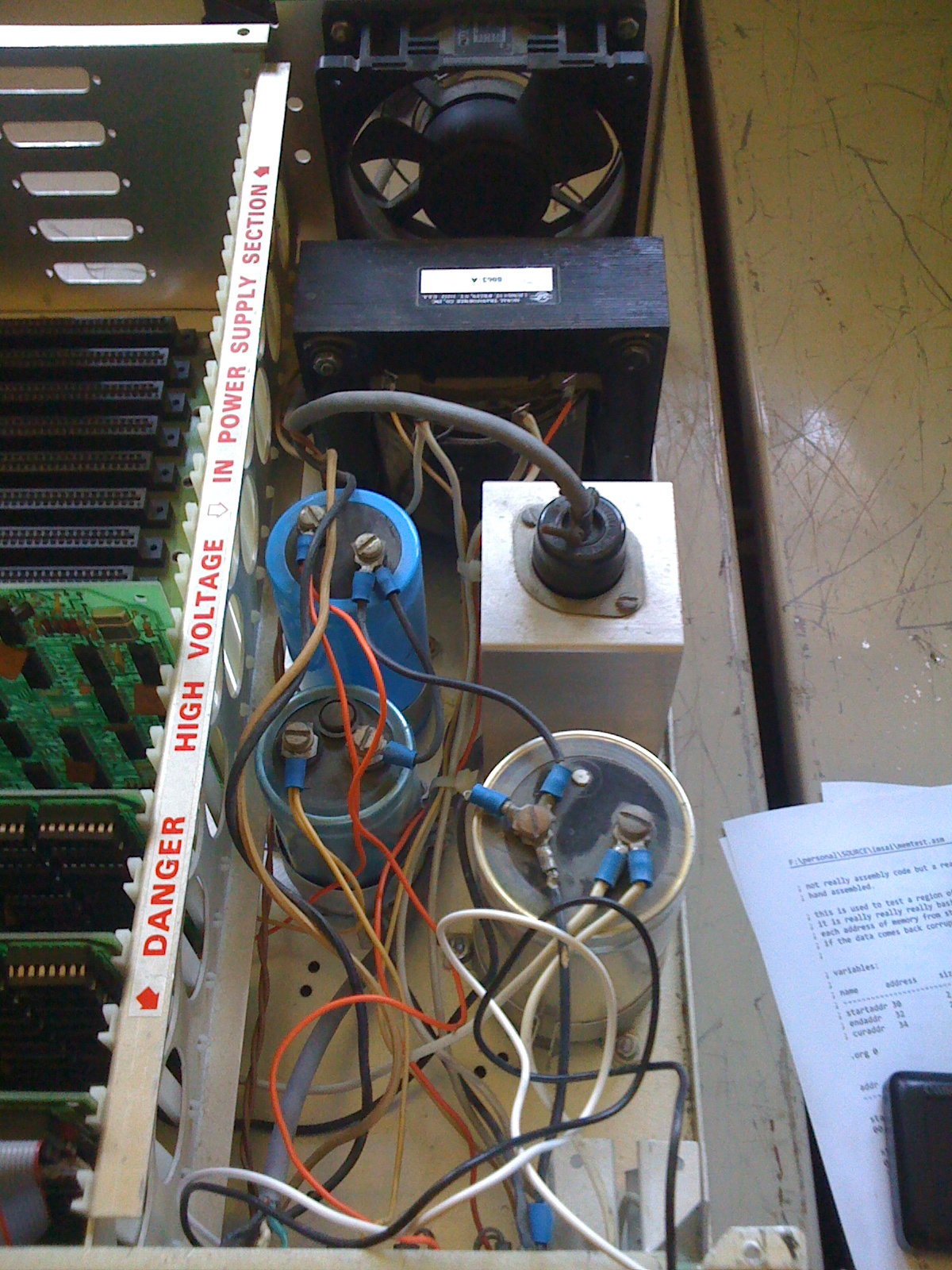
I finally got some terminals (VT525) and DEC MMJ cables for my MicroVAX 3100/85. I tuned it on expecting it to be dead and found a copy of OpenVMS V7.1 is installed on the MicroVAX (well after I tried both serial ports on the terminal and the screen came up at 9600 baud).
I have never owned anything DEC or any computers that didn't have built in video, sound, keyboards so I have a few questions.
What kind of reading material do I need to understand how these systems and software work?
Is there a default login/password for OpenVMS V7.1
Is OpenVMS available for download? Is V 7.1 optimal for this old unit (I think it has the full 128MB but have to check, dual 2GB? drives and built in CDROM).
I assume I can use some old PC or Mac software to login over the coax ethernet (does it do DHCP?) once I get some ethernet cables and I know what the heck I am doing.
What kind of server was a MicroVAX 3100/85 anyway (files, applications, etc)?
What are optimal setting for the VT525 to work with the MicroVAX (serial settings, color, lines, etc).
Figured I would try some completely different systems last year and ended up finding the MicroVAX before it was turned into razorblades. Took me a while to get the other parts needed.
TZ
On 8/23/10, Chuck Guzis <cclist at sydex.com> wrote:
> But I've seen people ditch their desktop 2GHz P4 system for a new
> desktop Core Duo box in the hope that it will make their dialup
> connection faster.
If you know any such people, they can ditch it at me. ;-)
Personally, when I get asked "how can I make my computer go faster?",
I tell people, "type faster. It's waiting on you."
Then there's the old joke:
How do you accelerate a Macintosh?
Toss it out the window and it'll go 9.8m/s^2.
-ethan
When you are cleaning up and restoring a piece of classic computer
hardware, would you correct any minor mistakes made in the original
production?
I have a particular exmaple in mind. In bits on myu bench at the moment
is an HP2623 graphics terminal This was HP's response to the well-knwon
Tektronix terminals, it is, however a raster scanned device. But it has a
little state machine (or parhapes you could call it a very simple
procesosr) to speed up line drawing.
But wanyway...
On the video monitor PCB (HP call it the 'Sweep' PCB), there is a 74LS221
dual monostable chip in the common HP horixontal drive circuit, The first
half of the chip delays the sync pulse (and the delay time is controlled
by the horizontal centering control), the second half is triggered from
that and provides a pulse of known width to the horizontal drive transistor.
But I digress. You don't need to know any of that...
WHile cleaning the dirt off this PCB (HV attracts dust electrostatcally,
of couse), I noticed that the ground pin of this IC never made it through
the board. It's folded under the package, but has been effectively
surface-mount soldered to the pad when the board was wave-soldered. It
works, but I can't beeleive it's as good as a proper through-hole
connection, and it's certian;y not what was intended.
I could trivially desolder the IC, straighten the pin, and solder it back
properly. But should I? What would others do?
-tony
This is off-tipic for 2 main reasons : (1) the device in question is not
even 1 year old yet and (2) it's not a computer. But I suspect many
people here rememebr the MB Big Trak programmable toy tank from the early
1980s, and may even rememebr the Circuit Cellar article that involved
modifying one. So anyway...
You can buy a modrn version of the Big Trak in the UK now. To the user
it's much the same as the origianl version (I will mention differences)
later. Inside it's very different. The cheapest I've found it in a shop
is \pounds 34.00 in Hawkin's Bazaar. I've sene it for a few 10's of pence
cheapr on the web, but then youy have to add shipping.
Anyway, I am sure you know what I did to mine first, even before puttign
the batteryies in and trying it out.Yes, I took it apart. Given that many
people here are like me, I;ll explain how to do that.
1) Remove the battery cover (2 screws) and batteris if you have fitted
them.
2) Next take off the plastic strips joining the front and rear axles.
There are held on by 2 scres each (self-tapping screws with integral
washers). If you have put the optional stickers on, you have to peel them
off to get to these screws.. Then slide off the front and rear wheels.
the centre 9driving) wheels are held on to the gearbox output shaftes hy
a cetnre screw. Take these off next.
3) The next bit is non-obvious and had me puzzles for a minute or so. At
he back of the lower body thre's a gey plastic part the only purpose of
which is to hide a coupleof fixing screws. It's held in place by 4
plastic 'barbs', one each side and 2 along the rear endge. Carefully free
it and slide it out downards.
4) Ondo the tiny screw thus revealed. Ths holds the kybaord bezel in
plaec on top. Carefully unclip the bezel. On the underside of it is a
little pCB carrying the power switch and the IR (?) LED for the trailer
interfae. Undo the fixing screw, free the PCB amd set the bezel aside.
5) Back on the uinderside undo the dozen or so screws that hold the upper
body in palce. Put the Big Trak the right way up and carfully lift off
the upper bod. It's still linked by the flexiprint from the keybaord.
This is not pluged in, it's clamped agianst the control PCB by a plastic
clamp. Undo the 2 screws and lift of the clamp, then lift the kayboard
tail over the pillers. The upper body is not free,
6) Undo the 2 screws holdign the LED holder for the 'photon cannon' in
palce. This alos releases the loudspeaker which is lightly glued in place
under it. Free that too.
7) I should have deoslderesd the battery wires next, otherwise you hve
the lower body hanging on them, which is a bit of a pain. But I didn't.
Anyway, undo th 4 screws on the bottom of the gearbox. Remove the gearbox
complete with the control PCB downwards. The front axle is now free,
don't loose it.
8) It appears that the PCB can be removed by desoldering the motor
connectios (ML+, ML-, MR+. MR-) and then taking out the 4 corner screws.
I have not done this.
9) The gearbox is held together by 5 screws on top (and can be dismantled
with the PCB in palce). Take these out, turn the gearbox over, andlift
off the cover. You can now see all the gearing.
When reasbmbling note that there are several sies of selt-tapping screwn.
Don't get them in the wrong holes...
OK, diffeernces from the origianl version
It runs everyting (logic and motors) off a single 4.5V supply (3 D cells in
series) ratehr than +/-3V (4 D cells) and 9V (pp3) of the original version
The 'photon cannon' is now an LED (blue I susepct) not a filament lamp
The interface to the trailer is another LED (IR?) not a jack socket.
The cotnroller bvoard is totrally redesigned. There are 2 ICs. These are
epxoy-capped chip-on-board devices iwth a difference. They are not on the
main PCB, they are on little daugherboards which are then soldered to the
main PCB. The only think on the daughterboard is the epoxy-capped chip.
So in theory they can be replaced. The larger IC is clearly a
microcontroller (but not the TMS1000 of the origjnal one) in a package
which looks to have the smae footprintas a PLCC device, I am not sure what
the smaller IC is yet. Also on the PCB are a fair number of transsitors,
R's and Cs, etc. Mostly SMD devices.
The gearbox is redeisgned too. It's a lot easier to take apart and
reassmeble than the orignal one.
The magnetic clutch between the 2 motors is still there.
The optical feedback from the gearbox is still there too. In fact there
are now 2 IR light bariers, one for each motor, senmsing slots in the
next-to-last gear in the train. I beelive the origianl version only had
one light barrier.
For a fairly cheap toy it's well made. It can be taken apart and put
together again withut damage. Most of it is held together by self-tapping
screws, but the battery cover (which the average owner has to remvoe and
rrfit serveral times( is held on by machien screws going into tapped
inserts in the lower body. Nice!.
I may well do a Circuit Cellar style modification to mine (that is, a
serial interfce thart simulates keypresses. Or maybe repaec the
microcontroller totally.
-tony
Hello all,
I would like to play^H^H^H^H use some of my vintage portables the way
they were intended. For example, the Radio Shack Model 100 and the HP
110 Portable have 300bps internal modems. I have several other modems
thru which these machines could talk to a *NIX but I do not want to pay
for multiple phone lines in my home. How can I simulate a POTS
connection between these modems? I don't need a dial tone or ringing,
etc., as I can just tell one machine to connect and the other to answer.
Way back I heard that a few modems would work if the tip and ring wires
of the modems were crossed and connected, but most need something more
than that. Is there some simple circuit I could build? Surely I'm not
the first to want to avoid phone bills for such play^H^H^H^H testing.
Jim
Hi.
This week I had the pleasure to visit a Zuse Z23 on display in my city.
The Z23 is a first generation, discrete transistor and diode logic, drum
based machine with a small "cache" of core memory. It is hosted at the
Fraunhofer Institute for Experimental Software Engineering. Here is the
Press release regarding the Zuse machine:
http://www.iese.fraunhofer.de/de/presse/current_releases/PM-2010-16-210610z…
Ohh, if you can't read german (at all we are talking about a german
computer ;-) ) here is the english version:
http://www.iese.fraunhofer.de/press/current_releases/PM-2010-16-210610z23.j…
I took some pictures:
http://www.unixag-kl.fh-kl.de/~jkunz/bilder/Zuse_Z23/
The machine is in very good, but not working condition. I suspect it
would be a huge task to make it operable again, like the PDP-1
restoration. But it could be done. There is a complete set of
documentation, schematics, some spare parts, ... A former user of that
machine from the local university explained the machine and its inner
workings in detail to us. In one word: Fascinating! :-)
BTW: There is a tube based Zuse Z22 in working condition on display in
the ZKM museum in Karlsruhe (Germany). The Z23 is kind of a transistor
reimplementation of the Z22:
http://www.zkm.de/algorithmische-revolution/index.php?module=pagemaster&PAG…
Pictures only in the german version:
http://www.zkm.de/algorithmische-revolution/index.php?module=pagemaster&PAG…
--
\end{Jochen}
\ref{http://www.unixag-kl.fh-kl.de/~jkunz/}
Help...
I thought it would be "easy", just hook it up and let it go. I thought I had the proper load file (xpcsrv20.sys) in the /tftpboot directory. TCPDumps seemed to indicate that I should have a proper file with the last 6 digits of the MAC address. When I did that, I got the dump to indicate that something was transfering, but it looks like to petered out a ways through. It then goes into a silly arp sequence for a router in the 172.31... network while my network here is 192.168.0..
Questions:
1) What files should be in the /tftpboot directory?
2) Can I get access to the configuration through one of the serial ports (which one)?
3) Does anyone have one of these beasts "working" with a Linux host? I like to get it up and running.
I seem to have LOTS of documents on this, but none seem to be of the "step-by step" variety using a Unix (Linux) as the RARP/TFTP host.
I would prefer responses of list, but will read then here if you like.
Yes, these things are a bit old. Nobody really uses terminal servers these days, and while 40 ports is a bit much, I do have a bunch of serial devices I'd like to connect to. It looked like this would be a nice thing to get working.
Thanks,
...Tom Watson
I look back with great fondness in how Stan was such a help in digging up
historical ?facts? that I used in my book?He will truly be missed. All my
blessings.
Murray :)
(I just mentioned this in the thread about Burroughs part numbers, but
am putting it forth in a separate question in case it gets missed by
some readers.)
I have a core memory module from some Burroughs machine. It is a large
plug-in PCB about 16 inches square containing address & inhibit drivers
& such. Mounted to this is a near-same-size daughter-board containing
the sense amplifiers and the folded planar array of cores underneath a
metal shield.
It is organised as 32 KWords, 20 bits wide.
Any suggestions as to what machine this may have come from?
The 20 bits is the raw-memory-word width, one could speculate that some
of those bits were used for ECC and the machine-word-width is smaller,
although I'm not sure off the top of my head whether 4 bits is enough
for ECC on 16 bits (isn't it >log2(n) for 1-bit ECC on n bits?)
Hi,
I seem to remember that it was possible to save a FORTRAN IV program together with the FRTS runtime
system as a runnable .SV core image file. It seems that ADVENT does so...
Any idea?
(minor question: How does something like "R PROG ARGS" work?)
Regards,
Philipp
--
http://www.hachti.de
----------------------Original Message:
Date: Fri, 27 Aug 2010 00:30:24 -0700
From: Paxton Hoag <innfoclassics at gmail.com>
Subject: Re: Burroughs core memory module <-> machine
To: "General Discussion: On-Topic and Off-Topic Posts"
<cctalk at classiccmp.org>
Message-ID:
<AANLkTik=GrMyH34cMQahxmPcSYoraFQ5+7bS=e2a=7dD at mail.gmail.com>
Content-Type: text/plain; charset=ISO-8859-1
> I have a core memory module from some Burroughs machine. It is a large
> plug-in PCB about 16 inches square containing address & inhibit drivers &
> such. Mounted to this is a near-same-size daughter-board containing the
> sense amplifiers and the folded planar array of cores underneath a metal
> shield.
>
> It is organised as 32 KWords, 20 bits wide.
>
> Any suggestions as to what machine this may have come from?
>
Burroughs made several successful solid state accounting machines
before branching to full computers. Some of these had core memory and
were made in the 1970s.
...
Paxton
------------------------Reply:
Indeed, specifically a few models in the E series, but those memories were
*much* smaller; I think I still have one somewhere.
In the transition from mechanical base10 systems to solid state binary
systems some early E models used an interesting device called a "core
counter" which was effectively a non-volatile IC-sized solid state magnetic
divide-by-ten counter that emitted a pulse for every ten pulses in, a
logically direct replacement for the mechanical cams and 10-position gears
that most adding and accounting machines had been built around up till then.
32K x 20 sounds like it'd be out of a Medium or Large system (B2xxx or
greater).
On 8/25/10, MikeS <dm561 at torfree.net> wrote:
> Are you sure that they're PROMs?
>
> They might be Burroughs numbers, but not PROMs (at least not the ones I
> looked up).
>
> For instance:
>
> 1447 3581 7438 4x2 NAND gate
> 1447 3540 7410 3x3 NAND gate
> 1447 3797 9322 4x2to1 MUX
> 2600 1495 7404 6xINV
Hey! I think I've got a tackle box full of stuff like this. One
drawer is marked "3581 '38" for example.
I picked up the tacklebox and the chips from a vendor at Dayton some years ago.
It's loaded with the following part numbers (dates listed are representative):
1447-3532 SN7404N 7909 (Nat'l Semi/Signetics/TI)
1447-3524 SN7408N 7650 (Nat'l Semi/Signetics/ITT/TI)
1447-3540 7410F 7915 (Nat'l Semi/Signetics/ITT)
1447-3565 7420 7907 (Signetics/ITT/TI)
1447-3607 SN7474N 7836 (TI/Fairchild/Signetics)
1447-3615 74107N 7912 (Nat'l Semi/Fairchild/Signetics)
1447-3557 74H11N 7738 (Nat'l Semi/ITT/Signetics)
1447-3581 7438N 7838 (Nat'l Semi/ITT/Signetics)
1447-3797 SN74157 7827 (Nat'l Semi/ITT/TI)
1447-3771 SN74161N 7701 (Nat'l Semi/TI/AMD)
1447-3755 74195 7644 (Signetics/TI/AMD)
1447-3722 74155 7709 (Signetics/TI)
1447-3714 SN74153 7832 (Nat'l Semi/Signetics/TI)
... plus a mish-mash in a bin marked "misc"... part numbers include 1447-*
* == 3599, 3706, 3623, 3698, 3789, 3649 and several more
Until this thread, I had no idea the 1447-* numbers were Burroughs.
Is anyone restoring such equipment and looking for spares? My own
interest are such that if I used these anywhere, it'd be to replace
parts gone bad in DEC M-series modules for my PDP-8/i and PDP-8/Ls.
In particular, I'm always hunting for 7474s since those seem to be
favored to fail in the gear I have (along with 7440s, statistically).
Is there a list of these part numbers? The ones I gave happen to be
listed with both the 1447-* numbers _and_ 74-series TTL numbers. The
misc drawer has numerous ones with only 1447-* numbers, and I'd like
to know what's what.
Cheers,
-ethan
"Chuck Guzis" <cclist at sydex.com> wrote:
> For a really nice VGA display, check out the PICASO from SparkFun.
> Coupled with a low-end microcontroller, that should give you pretty
> much everything that you need, save for the differential receivers.
...and quite a lot I don't need, like colo(u)r and graphical "primitives" which aren't (drawing rectangles and circles,...), at a somewhat steep price.
> Google "VGA microcontroller" for other ideas.
I'll go looking for "BAS" (VBS) "Microcontroller", too, since that's probably the way I'm wanting to go in the long run (using a cheap portable TV as display), if the controller turns out to be intact after all.
Thanks,
Arno Kletzander
--
GRATIS f?r alle GMX-Mitglieder: Die maxdome Movie-FLAT!
Jetzt freischalten unter http://portal.gmx.net/de/go/maxdome01
Folks,
Does anyone on the list have any of the following DEC PDP-11 printer interface
boards squirreled away?
M8585 LP20 Translation RAM Module
M8586 LP20 Line Printer Control Module
M8587 LP20 Line Printer Data Paths Module
or
M8571 LP20 Line Printer Data Paths Module
Please contact me if you have one or more of these.
Thanks,
Rich
Rich Alderson
Vintage Computing Sr. Server Engineer
Vulcan, Inc.
505 5th Avenue S, Suite 900
Seattle, WA 98104
mailto:RichA at vulcan.com
mailto:RichA at LivingComputerMuseum.orghttp://www.PDPplanet.org/http://www.LivingComputerMuseum.org/
--------------Original Message
Date: Wed, 25 Aug 2010 21:06:37 +0200
From: "Rik Bos" <hp-fix at xs4all.nl>
Subject: PROMS but from what ?
I aquired a lot of small DIL14/16 PROMS ceramic package with a 8 digit
number on it some of the numbers are :
2584 0821
2574 6975
2571 5418
2600 1529
1447 3581
1447 3540
2600 1495
1447 3797
2600 1487
2603 2623
2625 5562
2554 0888
2600 1495
I can't find any reference about them, so if some one recognizes the numbers
or can use them let me know (I've a few hundreds of them)
If no one wants them I'm going to archive them in the big metal bin.
-Rik
-------------------Reply:
Are you sure that they're PROMs?
They might be Burroughs numbers, but not PROMs (at least not the ones I
looked up).
For instance:
1447 3581 7438 4x2 NAND gate
1447 3540 7410 3x3 NAND gate
1447 3797 9322 4x2to1 MUX
2600 1495 7404 6xINV
mike
---------------------Original Message:
Date: Thu, 26 Aug 2010 01:09:00 -0400
From: Ethan Dicks <ethan.dicks at gmail.com>
Subject: Burroughs parts? (was Re: PROMS but from what ?)
On 8/25/10, MikeS <dm561 at torfree.net> wrote:
> Are you sure that they're PROMs?
>
> They might be Burroughs numbers, but not PROMs (at least not the ones I
> looked up).
>
> For instance:
>
> 1447 3581 7438 4x2 NAND gate
> 1447 3540 7410 3x3 NAND gate
> 1447 3797 9322 4x2to1 MUX
> 2600 1495 7404 6xINV
Hey! I think I've got a tackle box full of stuff like this. One
drawer is marked "3581 '38" for example.
I picked up the tacklebox and the chips from a vendor at Dayton some years
ago.
It's loaded with the following part numbers (dates listed are
representative):
1447-3532 SN7404N 7909 (Nat'l Semi/Signetics/TI)
1447-3524 SN7408N 7650 (Nat'l Semi/Signetics/ITT/TI)
1447-3540 7410F 7915 (Nat'l Semi/Signetics/ITT)
1447-3565 7420 7907 (Signetics/ITT/TI)
1447-3607 SN7474N 7836 (TI/Fairchild/Signetics)
1447-3615 74107N 7912 (Nat'l Semi/Fairchild/Signetics)
1447-3557 74H11N 7738 (Nat'l Semi/ITT/Signetics)
1447-3581 7438N 7838 (Nat'l Semi/ITT/Signetics)
1447-3797 SN74157 7827 (Nat'l Semi/ITT/TI)
1447-3771 SN74161N 7701 (Nat'l Semi/TI/AMD)
1447-3755 74195 7644 (Signetics/TI/AMD)
1447-3722 74155 7709 (Signetics/TI)
1447-3714 SN74153 7832 (Nat'l Semi/Signetics/TI)
... plus a mish-mash in a bin marked "misc"... part numbers include 1447-*
* == 3599, 3706, 3623, 3698, 3789, 3649 and several more
Until this thread, I had no idea the 1447-* numbers were Burroughs.
Is anyone restoring such equipment and looking for spares? My own
interest are such that if I used these anywhere, it'd be to replace
parts gone bad in DEC M-series modules for my PDP-8/i and PDP-8/Ls.
In particular, I'm always hunting for 7474s since those seem to be
favored to fail in the gear I have (along with 7440s, statistically).
Is there a list of these part numbers? The ones I gave happen to be
listed with both the 1447-* numbers _and_ 74-series TTL numbers. The
misc drawer has numerous ones with only 1447-* numbers, and I'd like
to know what's what.
Cheers,
-ethan
---------------------------Reply:
Have a look at the cross-reference on Bitsavers:
http://www.bitsavers.org/pdf/burroughs/icData/
and if there are any that you can't find, send me a PM and I'll see what I
can find; I have another list or two but no idea where they came from, as
well as some dead-tree stuff from my days at BBM.
mike
Eric writes:
> Tony Duell wrote:
>> I could trivially desolder the IC, straighten the pin, and solder it
back
>> properly. But should I? What would others do?
> Had we found any problem analogous to that in the PDP-1 restoration,
> where the machine operated correctly despite a manufacturing defect, I'm
> sure we would have had a debate on whether to fix it. I think my own
> opinion in that case would be that we should leave it alone, but tag the
> module (paper tag attached with a short loop of string) and document the
> issue in the system logbook.
> For something that isn't considered a museum artifact, I'd be more
> inclined to fix it.
Whatever happened to "if it ain't broke, don't fix it"?
The ability of a robust assembly and QA process to result in working systems,
despite small manufacturing errors, is remarkable. If the board passed QC
and was released into the wild and is still working decades later, that
is a fact worth noting but I see zero reason to correct it. I don't doubt
anyone's soldering skill but there is still a small and nonzero chance
that any attempted "fix" would result in hassles.
When I was in college decades ago, I got to help a civil engineer who
had tried to build a Heathkit maybe 10 years before that but never got it
working. I looked inside, found a few diodes he had reversed, and said that
was the reason. He looked at me incredulously: "You mean a couple of
incorrectly assembled parts will stop
the whole receiver from working?". Yep. "If we designed bridges that way,
there wouldn't be a single bridge standing in the world!"
Tim.
----------------------Original Message:
Date: Thu, 26 Aug 2010 11:38:45 +0200
From: "Rik Bos" <hp-fix at xs4all.nl>
Subject: RE: PROMS but from what ?
<snip>
> I aquired a lot of small DIL14/16 PROMS ceramic package with
> a 8 digit number on it some of the numbers are :
> 2584 0821
...
> -Rik
>
> -------------------Reply:
>
> Are you sure that they're PROMs?
>
> They might be Burroughs numbers, but not PROMs (at least not
> the ones I looked up).
>
> For instance:
>
> 1447 3581 7438 4x2 NAND gate
> 1447 3540 7410 3x3 NAND gate
> 1447 3797 9322 4x2to1 MUX
> 2600 1495 7404 6xINV
>
> mike
>
>
>
Mike,
Thanks, to be honest no I'm not sure.
I was told it were proms and some of the ic's did have labels on them.
When I removed on it was a 74S571J which is a 2K prom.
Do you have a xref list for Burroughs parts or know where I can find one
If any one needs one or more of those let me know.
-Rik
-------------------------Reply:
As Al mentioned, there is a partial list at bitsavers:
http://www.bitsavers.org/pdf/burroughs/icData/
There may also be more in some of the other manuals, and I have info on some
more as well as a "parts catalogue" that I can't put my fingers on at the
moment.
If you do have some PROMs, I'd think that there's a good chance that they're
already programmed and therefore not very useful (but worth checking JIC).
mike
Date: Wed, 25 Aug 2010 20:54:39 -0400
From: "Jerome H. Fine" <jhfinedp3k at compsys.to>
Subject: Re: speeding up computers (was Re: Terminals...)
To: General Discussion: On-Topic and Off-Topic Posts <cctalk at classiccmp.org>
Message-ID: <4C75BB4F.7050409 at compsys.to>
I have migrated from Netscape 4 email, all the way to Thunderbird3, and
never had a problem with moving the mailfiles. I don't know the details,
but the mailfile format hasn't changed.
I've recently opened some mailfolder from Netscape 4 directly in TBird
2 without a hitch.
I'd suggest going to 2.0.0.24 (or whatever is the most recent version
of the 2 series). I tried TBird3 here at work, and didn't like it for
the way I use it at work. The message folder search function to be specific.
But TBird3 works good for me at home...
--
--- Dave Woyciesjes
--- ICQ# 905818
--- AIM - woyciesjes
--- CompTIA A+ Certified IT Tech - http://certification.comptia.org/
--- HDI Certified Support Center Analyst - http://www.ThinkHDI.com/
Registered Linux user number 464583
"From there to here,
From here to there,
Funny things
are everywhere."
--- Dr. Seuss
-----------------Original Message:
Date: Wed, 25 Aug 2010 23:16:11 -0700
From: Brent Hilpert <hilpert at cs.ubc.ca>
Subject: Re: Simulated telephone
On 2010 Aug 25, at 9:02 PM, Fred Cisin wrote:
> On Tue, 24 Aug 2010, Brent Hilpert wrote:
>> If both modems in a given connection are older ('80s), lower-speed
>> (300-1200/2400) it will likely work by simply connecting them together
>> and commanding one off-hook in answer mode (ATA ?), then the other
>> off-hook in originate mode (ATD ? ATH1 ?). I have successfully done
>> this with particular modems up to 14.4Kbps but might be forgetting the
>> commands.
>
> Many of my older modems are from BEFORE "Hayes Compatible" became the
> standard for giving commands to the modem.
Well, I was thinking of adding in that if you have a really old modem
you might have to flip the originate/answer switch appropriately if it
has one, but I think the OP indicated he was dealing with later stuff.
(I have a couple of pre-'smart' modems, too.)
--------------------Reply:
I was going to make the same point; the M100 he mentioned as an example
*does* indeed have an originate/answer switch (as well as a direct
connect/acoustic coupler switch).
I usually don't have any problem just connecting modems together without any
fancy line simulators, etc.
mike
Folks,
OK, this is my DEC collection minus the machines I'm keeping, MINC
shipping is going to be interesting should anyone want it, see also
the DECwriter III. I should keep the DECmate III too really.
Most of these machines I used at work in the 80s/90s and rescued them
when I was made redundant in 2001, Grey Wall included. I'd hate to
recycle this as I've dragged the entire thing around the country and
would like to see it go to someone who hates reading docs online like
me :) Will I even pick up my VAX programming skills again and need to
know the params for the $QIOW routine :/
Anyhoo. This is listed as I went by them on the racks and is by no
means complete...
VR319 monitor
Alpha 3000-400 w/PMAGB
SZ12
VAX 3100 M38, bits of
SZ12
SZ12
DECpc AXP150
Alpha 2000-300
RZ55
RZ55
DECpc XL590
Alpha 3000-400 w/PMAGB
DECstation 5000-240
VR262 for DECstations, mono, 17"
DECmate III
DECwriter IV/LA100
DECwriter III/LA180
MINC-11 w/RX02
MicroVAX 3100-30
MicroVAX 3100-40 (might be a 20)
DECserver 250
SZ12
DEMSB-A multi-protocol router x2, 1 1-port and 1 4-port
Infoserver 150VXT (bought to netboot the VXT2000s)
MicroVAX 3100-30
DECstation 3100
MicroVAX 3100-20 (might be a 40)
MDS Fiche set x2 with reader
Grey wall, VMS 5.0 and 5.5 updates, some still sealed?!
VXT2000 (might be 2)
RWZ52 worm drive
DEChub90 in DEHUX with 3x DECrepeater 90T-16
DNSES-AA, NOS
DECnet/SNA x2 NOS boxed
Alpha 3000-400 motherboard, boxed
DESPR single port repeater
VT420 boxed
DECmate II or II
DECserver 200/M
3000-300 x3
BA350 in pedestal
BA356-JA on its own, single port 16bit pm, RZ74-VW
DECserver 300-16
VT1200, no monitor
R215F DSSI expansion, narrow box
MicroVAX II, BA213 'world' box
Alpha 2000 4/233, dual CPU
VAX 4000-505A (nice machine! Spare PSUs)
VAX 3400
R400X DSSI expansion x2
MicroVAX 2000 x2
cables, boards, 3000-300PSU, *stuff*
VT420
VAX 4000-200
CDDS boxes from mid 90s to late 90s
Cables, boards, docs.
Yes, I'm a hoarder.
--
adrian/witchy
Owner of Binary Dinosaurs, the UK's biggest home? computer collection?
www.binarydinosaurs.co.uk
Hello listmembers,
some of you will perhaps remember me being stuck with a problem regarding a Fujitsu FANUC "mate TG" CNC controller (rebadged as "Siemens Sinumerik"), of which I have the main unit but not the monitor. Thanks to a very nice guy living nearby, I was provided with some new information about the interface, which is rather uncommon in itself. I had already guessed that there is a significant amount of smarts in the monitor; the newly acquired documentation confirms this. The silicon brain (CRT controller) of the thing is called LSI HD46505.
Integrated with a 12" monochrome CRT display, it features capabilities for a text mode with 64 columns * 24 lines (character size 7*9 dots in an 8*16 character cell), a magnified text mode with 16 columns * 14 lines (21*27 dots in a 32*27 cell) and a b&W bitmapped mode with a resolution of 512*384 dots. Text and graphics can be displayed alone or in combination. The supported character set seems to be a subset of ASCII from 0x20 to 0x5f.
Text and raster graphics operations in absolute addressing are controlled by a unidirectional 12 bit parallel interface with strobe (AB0 - AB2, DB0-DB8, WP) in differential signalling, furthermore there are four more differential signals called +HP2, -HP2, +VP2, -VP2 that allow some kind of incremental (relative) graphics cursor positioning by pulse trains. The signalling diagrams indicate a minimum cycle time of 20 us for the parallel interface and 110 us for the counter channels.
Does this ring any bells with anyone? Are there similar monitors out there that might be converted with little effort? Otherwise, the registers and instructions are described in enough detail so that making a replacement or some sort of emulation at least seems possible. What sort of hard- and/or software would one be looking at to accomplish this?
I have some hazy memory of seeing a demonstration of a Pong game programmed in LabView(!) running on an FPGA based device which would directly generate VGA output, but that was a very expensive unit. For now I'm just looking for a cheap and simple way to give me some idea of what, if anything, the controller is trying to display.
As I think the data will be coming in bursts (only e.g. when a new screen mask is displayed), a microcontroller with a suitable amount of buffer memory might be sufficient to translate the interface signals into serial data and send them to a PC, which would then generate and display the image.
Thanks for your input, yours sincerely
Arno Kletzander
--
GRATIS f?r alle GMX-Mitglieder: Die maxdome Movie-FLAT!
Jetzt freischalten unter http://portal.gmx.net/de/go/maxdome01
I aquired a lot of small DIL14/16 PROMS ceramic package with a 8 digit
number on it some of the numbers are :
2584 0821
2574 6975
2571 5418
2600 1529
1447 3581
1447 3540
2600 1495
1447 3797
2600 1487
2603 2623
2625 5562
2554 0888
2600 1495
I can't find any reference about them, so if some one recognizes the numbers
or can use them let me know (I've a few hundreds of them)
If no one wants them I'm going to archive them in the big metal bin.
-Rik
Hello guys,
thanks for your quick replies!
"Chuck Guzis" <cclist at sydex.com> wrote:
> why not post a note to this guy:
> http://cncfanuc.blogspot.com/2009/04/fanuc-ac-servo-drive-system-
> failure.html
> Who seems to have a lot of information on his hands?
You're joking, right? I don't even get what this guy is writing about in most of his half-finished malformed sentences. Even if he was willing to help, it might be quite a challenge to get anything useful out of him.
> But you're going to need a fair level of detail on what actually goes
> on over those 12 lines before you can get something going.
That's provided in that latest manual I got, down to bit-level detail, e.g.:
"Mode selection:"
A A A D D D D D D D D D
B B B B B B B B B B B B
2 1 0 8 7 6 5 4 3 2 1 0
-----------------------
0 0 1 1 x x 0 1 1 x x x Set bit mode*
0 0 1 1 x x 0 1 0 x x x Clear bit mode*
0 0 1 1 x x 1 1 1 x x x Enable drawing by +/- H/V inputs*
0 0 1 1 x x 1 0 1 x x x Clear screen (takes approx. 40 ms)
Operations marked * are latching and clear upon next selection."
Pages and pages of such codes.
> If you want a dedicated unit, an FPGA might still be your best bet,
> if you have the skills (VHDL or Verilog).
No, I never learnt either of the above. OTOH, some LabView programming once again would be a nice change, and there is that FPGA toolkit for it that we were shown then.
> Alternatively, many faster
> microcontrollers can directly generate video using nothing but
> software.
Hey, that also sounds seriously interesting. Might be the cheapest and simplest approach since b&w doesn't need much of a DAC or anything. Alas the raster size doesn't map nicely to TV standards...
I'm also still all ears for comments on the "uC preprocesses, PC displays" idea.
Dave McGuire <mcguire at neurotica.com> wrote:
> I have a vague memory of doing a hack to an IBM PC CGA card that
> enabled interlacing for a huge improvement in the readability of
> character-based output. It involved running a wire, and *I think*
> replacing the 6845 with a 46505. Does anyone else know about this?
This mode is not used here, the manual states that this display is non-interlacing.
Yours sincerely,
Arno Kletzander
--
GRATIS f?r alle GMX-Mitglieder: Die maxdome Movie-FLAT!
Jetzt freischalten unter http://portal.gmx.net/de/go/maxdome01
Googling online. Also have a share certificate. Did you find out any
info. On GRI? Just want to know if I'm a millionaire and have been
living life as a peasant
Sent from my iPod
I recently got my hands on a NEC Advanced Personal Computer. From what
I read, it's a MS-DOS and CP/M capable machine. It's got dual 8" drives
and about the size of a terminal.
With that said, anyone have any more information on this system?
Anything to boot it perhaps, and of course, the unit I have didn't come
with a keyboard, and the connector appears to be some type of centronics
connector. Any suggestions on where to find such a beast?
---------------Original Message:
Date: Mon, 23 Aug 2010 12:30:39 -0700
From: "Chuck Guzis" <cclist at sydex.com>
Subject: Re: Terminals...
In general, the public is still working on the "newer is better"
theory. Why anyone would want to sit at home and type on a laptop
keyboard is beyond me.
--Chuck
-----------------
You've got the best of both worlds; put it beside your desk, plug in your
desktop LCD and adapter for your wireless kbd & mouse and you've got a
convenient desktop; unplug it and take it on the road. What's wrong with
that?
m
Hi folks,
we'll have an event here in Kiel on Friday night ("Museumsnacht") where
my bosses decided (to be fair... I steered into that direction as best I
could) to present a snippet of the Kiel collection. I'll be standing
around in a corner with a pdp8/e. Equipped with 2 RK05, TU56, VT05,
PC04, and CalComp 565 (0.1mm/step variant).
I'm still looking for funny stuff to present. I'm running short on time
and would be very happy to get some hints to nice graphic programs and
other toys. I have some BASIC games from the net. That's not too much.
There *must* be funny software involving the plotter somewhere out in
the world!
The best would be something that allows me to create little souvenirs
for the more interested people. And something that draws complex stuff
and takes long time.
I have no clue about BASIC plotter support. I can use PAL sources (if
there's no need for extra plotter code), BASIC, and FORTRAN IV. I have
the plotter routines installed and working. Everything is installed and
working.
BTW the local VT05 didn't come up today. No high voltage. I looked
around a bit and gave it up. But I needed the VT05 to blindly command
the 8/e while doing file transfers from my notebook. And after some two
hours - it started. And is running stable since then - with better image
than before. I really hope that this isn't the "clear mind before dead"...
Best wishes,
Philipp :-)
Kind folks,
I'm pretty sure that some here restore and use vintage computers at
least in part in order to be able to play vintage computer games, which
is the only thing that makes this post on topic at all. After a bit of
research on the web, I find that I'm at least 5 or 6 years behind the
times based on some forum discussions of something I just became aware
of just yesterday! What triggered all this was that our daughter showed
up at the house with this little game controller which she says was
bought at WalMart for about USD $20.00. It says "namco" on the front,
"PLUG it in & PLAY TV GAMES" on the back. Says 6VDC on the back too, so
probably 4 AA batteries. It came with batteries, and I haven't opened
it up to explore the insides at all - yet. On the bottom next to the
list of games are copyright dates from 1960 to 1983, the best I can
tell. There is also a copyright notice on the bottom dated 2004 for
JAKKS Pacific, Inc. and a reference to www.jakkstvgames.com.
This little gadget has a joystick, a few pushbutton switches, and
composite video and a sound output. It allows one to play vintage Ms.
Pac-Man, Galaga, Pole Position, Mappy, and Xavious by connecting it to a
standard TV's video and audio inputs. I mention this here because I
just thought it was really cool to be able to play these vintage games,
and some might be in the same uninformed group with me. :-) FWIW, my
daughter says there are a number of other similar units with different
games, and the web seems to confirm this.
Wanting to see if the web site is WOT approved, I googled
jakkstvgames.com and it seems to only be referred to by other web sites.
I finally got brave and typed it in to the Firefox URL entry and was
rewarded with "403 Forbidden" and "You don't have permission to access /
on this server." Sounds pretty scary to me.
BTW, I have absolutely no connection with this company - whatever it is
- Jakks Pacific? It says it is made in China, of course. The thing is
plastic, but seems to be remarkably well made for something that only
costs 20 bucks. Of course the possibility of hacking it for other
purposes never crossed my mind. ;-)
Later,
Charlie C.
I have a 5V Apple III that won't boot and could use some troubleshooting
advice. When I power it up, the LED at CR7 on the motherboard and the
keyboard lamp both light up and I get a brief flash on the internal
floppy light and nothing else. No video or activity of any kind. When
I hit CTRL-RESET, I do get the expected clicks from the internal
speaker, so I know there's some life there.
I've swapped out the floppy drive and cables, and the power supply with
known good units, and reseated all the socketed ICs and get the same
results.
There are no expansion cards or other peripherals attached to the machine.
Can anyone suggest a starting point for tracking this down?
Thanks.
- Mike
---------------Original Message:
Date: Tue, 24 Aug 2010 07:38:46 -0700
From: "Chuck Guzis" <cclist at sydex.com>
Subject: Re: speeding up computers (was Re: Terminals...)
>XPLite gets a big <shrug> from me. It fronts XP's control panel's
>add/remove Windows components and settings, deletes update rollback
>and temp files mostly. All of which can be accomplished manually.
>What I wish it would do: Automate moving key files to other
>partitions and prune the registry of unnecessary entries.
>--Chuck
---------------Reply:
Some good tips here:
http://technical-issues-tips.blogspot.com/2007/08/tips-reduce-size-of-windo…
Back up first and use at your own risk of course.
m
Dennis writes:
> Stumbled across a reference to what looks like two old DEC products -
> QS-HG1A9-NZ PRIME TO VAX TAPE UTILITIES
> QS-HG0A9-NZ PRIME TO VAX CONV UTILITIES
> while poking at MANX. I would very much like to find documentation
> and/or the actual software. Anyone have further info?
Nearby DEC part numbers seem to fall under QS-HFKA9-NZ
"Migration Assistance Service". E.g.
QS-HFKA9-NZ MIGRATION ASSISTANCE SERVICE
QS-HFLA9-NZ SYSTEM/36 MIGRATION UTILITIES
QS-HFMA9-NZ CDC/FORTRAN CONVERSION FILTER
QS-HFNA9-NZ CDC/FORTRAN CONVERSION TOOL
QS-HFPA9-NZ DG/COBOL CONVERSION FILTER
QS-HFQA9-NZ HP/FORTRAN CONVERSION FILTER
QS-HFRA9-NZ HP/BASIC CONVERSION FILTER
QS-HFSA9-NZ HP VPLUS DECFORMS CONV FILTER
QS-HFTA9-NZ HP IMAGE TO RDB CONV FILTER
QS-HFUA9-NZ HP IMAGE TO RMS CONV FILTER
QS-HFVA9-NZ HP/3000 TO VAX/VMS CONV UTILT
QS-HFWA9-NZ WPP-WANG COBOL CONV FILTER
QS-HFXA9-NZ WDE WANG DOCUM CONV TOOL
QS-HFYA9-NZ VSTAPE WANG DOCUM CONV TOOL
QS-HG0A9-NZ PRIME TO VAX CONV UTILITIES
QS-HG1A9-NZ PRIME TO VAX TAPE UTILITIES
QS-HG2A9-NZ PDP-11 BASIC CONV FILTER
QS-HG3A9-NZ PDP-11 MACRO CONV FILTER
QS-HG4A9-NZ HP/COBOL CONV FILTER
It seems extremely likely that these were tools developed as
part of migration assistance services, but companies have
always struggled with the line between a "product" and a "service"
so it wouldn't be surprising to see in-house tools get turned into
products with part numbers etc.
Tim.
--------------Original Message:
Date: Mon, 23 Aug 2010 18:02:45 -0400
From: Dave McGuire <mcguire at neurotica.com>
Subject: Re: speeding up computers (was Re: Terminals...)
To: General Discussion: On-Topic and Off-Topic Posts
<cctalk at classiccmp.org>
Message-ID: <4C72F005.9060602 at neurotica.com>
Content-Type: text/plain; charset=ISO-8859-1
On 8/23/10 5:55 PM, Doc Shipley wrote:
>> Microsoft is not the only company whose design policies are predicated
>> on an assumption of Moore's law. But it is one of the most obvious.
>
> It's very odd to me that Apple's OS X needs at least as much CPU, RAM,
> and disk as current Windows, but nobody beats on it for being bloated.
It's not slow. =)
-Dave
---------
Well, you did show remarkable restraint up to this point...
;-)
m
Stumbled across a reference to what looks like two old DEC products -
QS-HG1A9-NZ PRIME TO VAX TAPE UTILITIES
QS-HG0A9-NZ PRIME TO VAX CONV UTILITIES
while poking at MANX. I would very much like to find documentation
and/or the actual software. Anyone have further info?
De
Folks,
First off, apologies to those who've asked me about the DSSI drive
sleds etc I mentioned a while back, fret not, I still have them.
Reason for the above not happening - my landlord wants his house back.
This is a problem because I really fell on my feet when I found this
place and managed to squirrel away my entire collection. 3.5 years
later this town is home, my girlfriend is here, my friends are here so
I don't want to up sticks and move the whole lot again. Also there's
now no way I can afford a house with this much garage space.
So. As much as it pains me I have to come to the realisation that I'll
never actively use 90% of my DEC stuff, my CBM PET stuff, IBM PC
compatibles or the 'middling' Apple stuff like LCs, Mac IIs, Quadras
etc
I haven't extensively catalogued anything for years, but given that I
only have a month and a bit it's time to get my skates on.
I'm guessing nobody will be interested in my SUN and Cisco kit, or
Research Machines early PCs.
Over the weekend I'll catalogue the big DEC and Apple stuff and post it here.
Any advice or offers of collecting stuff from me gratefully received.
I can ship big things from work on receipt of money, even on pallets.
Cheers,
--
adrian/witchy
Owner of Binary Dinosaurs, the UK's biggest home?computer collection?
www.binarydinosaurs.co.uk
Dave McGuire <mcguire at neurotica.com> wrote:
> On 8/11/10 11:21 PM, William Donzelli wrote:
>>> >> Of course, shipping for, say a hundred VT520s is significantly higher than for those modern replacements - even when you add in the (now LCD) screen. Oh that's right, you can just go down to Best Buy (which rarely is) to buy the screens....
>> >
>> > I doubt shipping costs would be so much of an issue - VT520s, if they
>> > are anything like VT420s, are not very heavy. If company X needs
>> > several hundred dumb terminals spread around in their system, I bet
>> > they would have enough of their own shipping going on, and the VTs
>> > could hang on the sides of the trucks for free.
>> >
>>> >> That's not to say I don't have a personal preference for the originals - I have mostly VT420s at home, and we're refurbishing a bunch of VT100s and VT52s here at work. -- Ian
>> >
>> > OK, I will say it - VT420s suck.
>
> What don't you like about VT420s? They're my favorite of the line,
> followed closely by VT320 then VT220. I don't like VT520s at all.
I like the VT5xx series, just as I like all other VT-terminals. However,
I've had problems with power supplies of VT320, and VT340 terminals, and
have had problems with the displays going weak on VT420 terminals.
In a way, I think the VT525 is pretty optimal. External screen with VGA
connection, so I can use any PC screen, including flat screens. The fact
that the VT5xx terminals use a PC keyboard connection sucks some, but I
can live with that, since I atleast have proper DEC layout keyboards
anyway. And color, in addition to that. The only thing missing is ReGIS
and SIXBIT graphics.
But, to make a comment on the original topic here - I don't really think
that new VT terminals are more expensive than buying a PC. Yes, the
initial cost is larger, but I definitely expect a VT520 to last way
longer than a PC, and buying two or three PCs, and additionally to have
to service, update, install, and work on the machines will make them
cost way more than a new VT520 within just a year or two.
Johnny
--
Johnny Billquist || "I'm on a bus
|| on a psychedelic trip
email: bqt at softjar.se || Reading murder books
pdp is alive! || tryin' to stay hip" - B. Idol
So I picked up both a MicroVAX 2000 with 120mb MFM drive and MMJ terminal
adapter and a VAXstation 2000 with 40mb ST-251, keyboard, mouse, and some
little breakout box for the latter two.
Both systems power up and the drives don't make any nasty noises (though
both are blank so they won't be booting anything until I get VMS on them)
but in both cases I have no way to communicate with them. The MicroVAX I
can't talk to simply because I lack an MMJ cable but the more interesting
VAXstation with it's 4-bit framebuffer simply because I don't see how on
earth you connect up a monitor to it. The keyboard and mouse break out box
connect to the monitor port but the box itself has no connections for a
monitor to be plugged in.
How did this work and what types of monitor were compatible? I might have
access to a VR201 if I want to pay shipping from MA to western canada.
--------------Original Message:
Date: Sun, 22 Aug 2010 12:21:49 -0700
From: John Robertson <pinball at telus.net>
Subject: Re: 1970s TTL specs and prices
MikeS wrote:
<snippage>
> ----------------
> FWIW, approx. Canadian 100-1000 prices in 1977:
> Gates: .28
> F-F's etc: .48
> SRs, adders, etc: 1.50
>
> 16Kx1 SRAM: $113.74
>
> mike
>
I do have an Electrosonic catalog (Canada) from the mid 1960s. It is
very handy as it covers things like CDS cells, Germanium items (ratings,
etc) and other odds and ends of industrial electronics where there are
no other sources of information.
John :-#)#
-----------------------------------
Umm, that's where I got the prices; as a matter of fact I used to work
for Electrosonic in the 60s in industrial sales, still around after all
these years...
mike
Kind folks,
I was just wondering if anyone else is able to view the 3 movies near
the bottom of http://pdp-1.computerhistory.org/pdp-1/index.php?f=theme&s=2
For me, each one runs for a bit and then just stops. Windows task
manager shows no internet activity at that point. If I bring up some
other page and then go back there, the video gets a bit further each
time before seizing up again. Perhaps if I had infinite patience I
could eventually see them all the way through. Any idea what might
cause this?
Thanks,
Charlie C.
Hi,
Does anyone have an image of an Digital Equipment Corporation van? A
friend and DEC fan wants his new white van to look as much as possible
as original DEC vans. There seems to be an image of a large number of
vans parked for a corporate building in some DEC brochure.
Fred Jan
Hi,
I have an Intel SDK-85 System Design Kit here (single board computer)
which doesn't want to turn on. After some debugging, I'm fairly
confident it's the ROM that's dead, but I can't find an image for it on
the Internet.
If someone has a copy of the ROM image, or is willing to dump it, I
would greatly appreciate it.
Thanks,
Alexis.
Message: 13
Date: Sat, 21 Aug 2010 12:49:19 -0700 (PDT)
From: Fred Cisin <cisin at xenosoft.com>
Subject: Re: Origin of the term minicomputer (was Re: PDP-1 as
minicomputer
To: "General Discussion: On-Topic and Off-Topic Posts"
<cctalk at classiccmp.org>
Message-ID: <20100821124828.V87695 at shell.lmi.net>
Content-Type: TEXT/PLAIN; charset=US-ASCII
On Sat, 21 Aug 2010, William Donzelli wrote:
>> Pretty much, yes. I suppose the "youngest" mini architecture is the
>> RS/6000, since it originally was made of multiple gate arrays (seven
>> maybe?).
>ISTR the RS/6000 (68000?) being called a microcomputer. But it was out of
>my price range.
-----------
Gee, I just offered a nice classic RS/6000-520 that you coulda had for free
;-)
Lots o' 40-bit memory, 32 ports, SCSI HD & tape; really hated to see it go
to the dump.
m
Date: Sat, 21 Aug 2010 11:24:47 -0700
From: Brent Hilpert <hilpert at cs.ubc.ca>
Subject: Re: 1970s TTL specs and prices
To: "General Discussion: On-Topic and Off-Topic Posts"
<cctalk at classiccmp.org>
Message-ID: <17dbd76df89836d82320a900dd3576a1 at cs.ubc.ca>
Content-Type: text/plain; charset=US-ASCII; format=flowed
On 2010 Aug 20, at 11:23 AM, Tom Gardner wrote:
> For some Computer History Museum work I need information on 7400
> series Flip
> Flops (S and Normal, DIPs) circa 1973 (anything 1970-75). Anyone have
> any
> maximum clock speed and OEM volume pricing information on parts such
> as 7473
> thru 79 or 74106-116?
>
> I must be getting old because I remember the 7474 well but I thru out
> my
> Yellow books years ago :-)
Well, just to add to the list, I have the 1969, 1973 and 1981 TTL
databooks from TI, as well as a 1965 TI component catalog listing some
TTL devices (also various from Fairchild, National and Moto).
As with others though, I haven't managed to dig up any prices.
...
----------------
FWIW, approx. Canadian 100-1000 prices in 1977:
Gates: .28
F-F's etc: .48
SRs, adders, etc: 1.50
16Kx1 SRAM: $113.74
mike
---------------Original Message:
Date: Sun, 22 Aug 2010 12:51:32 -0400
From: Dave McGuire <mcguire at neurotica.com>
Subject: Re: Terminals...
On 8/22/10 9:52 AM, dwight elvey wrote:
> There was a RACAL that I liked a lot as well ( can't recall the name
> but I do recall almost being killed by one that I was tuning the
> IF strip ).
Mmm, just mentioning RACAL reminds me of (what was) my RA6790/GM.
Sadly I had to sell it to pay the mortgage a couple of years ago, plus I
felt kinda guilty having such a great receiver but not having much time
to use it.
Its CPU is a Mostek F8 as I recall, at least on the earlier ones (and
mine).
-Dave
---------------
Speaking of Racal, I still have a Technical Manual for a model 9521
'Computing Counter'; is there a group/forum/site out there somewhere that
would be interested (if it isn't already out there)?
mike
As I have a webpage
(www.retroComputingTasmania.com<http://www.retrocomputingtasmania.com/>)
describing my attempts to resurrect an PDP 11/93 I was contacted by a
company from Resita, Romania who have just decommissioned an 11/93 in
operation since 1993; it includes 5 DEC VT terminals and a non-functioning
line printer.
They describe it as a "PDP 11/93 193 QZ-D3, model HB9642- JB"
They are inviting offers for this system, in their words "...for a fair
price proposal.".
Cellphone quality pictures sent to me are linked here:
http://imgur.com/Hj6fRhttp://imgur.com/CJU3qhttp://imgur.com/docPG
For my curiosity can anyone tell me what the cabinet on the right is likely
to contain? is it disk expansion?
Contact me off-list if you want to see the original emails.
Please contact Zoltan Korka (zkorka AtThisDomain resitareductoare.com)
www.resitareductoare.com
Anyone want to give this a home before I recycle it?
Original Mac LC - 68020, MacOS 6-7.5. Doesn't boot, but that might be
the dead battery. I've checked; all my spares are dead, too.
40MB SCSI hard disk & I suspect 2MB RAM / 256KB VRAM.
http://lowendmac.com/lc/macintosh-lc.html
I might even deliver if it's inside the greater London area. Ask me nicely!
Keyboard & mouse can be supplied with it. You've very welcome to a
monitor too, but if you want one of them, you'll have to collect it.
--
Liam Proven ? Info & profile: http://www.google.com/profiles/lproven
Email: lproven at cix.co.uk ? GMail/GoogleTalk/Orkut: lproven at gmail.com
Tel: +44 20-8685-0498 ? Cell: +44 7939-087884 ? Fax: + 44 870-9151419
AIM/Yahoo/Skype: liamproven ? MSN: lproven at hotmail.com ? ICQ: 73187508
It?s my understanding, and I stand to be corrected, that mini,
hyphenated or otherwise, simply meant a small computer system that
preceded the microcomputer era. Granted this, the term means
different-things-to-different-people, the consensus seems to be that
the term mini means smaller than a mainframe and matches comparable
words from the 60?s, i.e., mini-skirt, et al. As a(n) historian I
treat it as a cultural phenomena rather than just a purely technical
or technological definition. Whether purists agree is indeed
debatable!
Murray--
Snagged a Wavetek 1901C last week. This is a 12" oscilloscope display
(X/Y+intensity input), I was hoping to use it as a point-plotting/vector
display for a couple of little computer projects of mine. (Or maybe
just hooking an Asteroids board up to it... :). It's in pretty good
shape (has more screen burn than I think I've ever seen in a few spots,
though.) I fixed a couple of cold solder joints and it's now mostly
working, except something appears to be going slightly wrong in the Y
deflection or amplification (it's getting clipped/distorted depending on
the gain and input intensity).
Anyone have a service manual or schematic for this thing or know good
sources for such things?
Thanks as always...
Josh
At 03:59 PM 7/24/2010, Liam Proven wrote:
>The next jump will be more interesting: 32-bit OSs basically can't
>usefully handle >4GB of RAM, nor can the main ones handle >2GB drives.
>Both are becoming common.
Sure you meant "terabyte" not "gigabyte". The 2 TB drives are certainly
more popular and common because they're getting close to $100.
- John
gopher://gopher.thurman.org.uk/1/advent/
No explanation or even instructions should be needed.
--
------------------------------------ personal: http://www.cameronkaiser.com/ --
Cameron Kaiser * Floodgap Systems * www.floodgap.com * ckaiser at floodgap.com
-- A battle avoided cannot be lost. -- Sun Tzu --------------------------------
This is a bit off topic, I guess, and a repeat, but ClassicCmp is still
probably the best place to ask.
My company runs a bunch of HP83000 mainframes (F330 models) in
product testing. We're tied to Agilent SmarTest v5.x-6.03 running on
HP/UX v10.20 for test vectors.
SmarTest interfaces with the test frame via an Agilent-branded fiber
optic PCI adapter. The card is marked E2777B, p/n A3850-0583. It's a
buffered serial adapter on a PCI bridge and that's all we know about it.
SmarTest will run on HP/UX 11i, but the interface drivers will not
load. We don't have source to the drivers in question, the card itself
is, as far as we can discover, entirely undocumented, and neither HP nor
Agilent has any interest in maintenance or further development.
My company will pay a fair boatload of cash for an 11i-compatible
driver. If you're interested and have the background & skills to tackle
this, contact me off-list.
Doc Shipley
> Date: Wed, 18 Aug 2010 09:25:34 -0700
> From: Al Kossow <aek at bitsavers.org>
> Subject: Origin of the term minicomputer (was Re: PDP-1 as
> minicomputer [was RE: OT - sort of])
> To: General Discussion: On-Topic and Off-Topic Posts
> <cctalk at classiccmp.org>
> Message-ID: <4C6C097E.8060908 at bitsavers.org>
> Content-Type: text/plain; charset=ISO-8859-1; format=flowed
>
>
>
> >> But it all depends on how you define "minicomputer" as to what
> >> specifically falls in the category.
> >
> > Who originally created the term? marketing??
> >
>
> The earliest use of the term as we use it today was an ad in
> Datamation announcing the (Varian) Data 520i in April, 1968.
>
<snip>
Apparently as early as May 1987 the term minicomputer was used in the WHITE
HOUSE executive offices and quoted in several newspapers, along the lines,
"Without a minicomputer one really can't tell ..."
Given the lack of technical expertise in Washington, this suggests a much
earlier origin of the word.
Tom
How about Series/1?
The Series/1 was the first entry by IBM into the minicomputer market as such.
I just happen to have one sitting in my Basement. Brought it home around 1992 but never got it up and running. Should have added a 110 Volt 30 AMP Circuit but didn't. Its a 4952/4953 Half Rack W/a 9Meg HD setup for 110 Volts. Plus I have a external Floppy drive that used to work. I had an IBM Guy convert a 4955 Model E to 110 volt but I also have to original 4952. I plan on firing up the individual components through my Lab-Volt with a variable 120 Volt 3.5 Ampere Output if that will work without blowing something. "Any Thoughts Anyone???"
Anyone out there running a tape drive setup that could read 6250 10" reels. I have about a Dozen, mostly backup tapes from the Working system. One is an IBM Diagnostic Tape. Maybe I can get in running. Going out west for a couple of weeks to Pan out some Gold flakes. A couple of Ounces will give me some cash to work with. Been retired since 1996 so Income is sparse.
Bob in Wisconsin
So far I've gotten only four P112 kits preordered. I need at least 35 of
them preordered to get the thing rolling. Paypal will only allow me to do
refunds and get the fees back within 60 days of a payment. 60 days after
the first preorder is October 11. Because of that, I'm moving the
preorder cutoff date to October 11. If I can't get enough preorders, all
money will be refunded.
--
David Griffith
dgriffi at cs.csubak.edu
A: Because it fouls the order in which people normally read text.
Q: Why is top-posting such a bad thing?
A: Top-posting.
Q: What is the most annoying thing in e-mail?
The earliest use of the term "minicomputer" is about 1968 (Google news,
other sources).
FWIW, I also think relatively small physical size was a necessary condition
for a computer to be characterized as a minicomputer at least thru the mid
70s.
IMHO the IBM 1130 introduced in 1965 is an early if not the first
minicomputer. To quote the 1965 IBM announcement:
"The desk-sized 1130 is designed for individual use by engineers, scientists
and mathematicians. But with its range of peripheral units, the 1130 also
will be used in such fields as publishing, construction, finance,
manufacturing and distribution."
Tom
> Message: 3
> Date: Tue, 17 Aug 2010 11:24:50 -0700
> From: Rich Alderson <RichA at vulcan.com>
> Subject: PDP-1 as minicomputer [was RE: OT - sort of]
> To: "'General Discussion: On-Topic and Off-Topic Posts'"
> <cctalk at classiccmp.org>
> Message-ID:
> <CC28F43ED4708D489ABCF68D06D7F556040A5CC9EA at 505DENALI.corp.vnw.com>
> Content-Type: text/plain; charset="us-ascii"
>
> From: Tony Duell
> Sent: Friday, August 13, 2010 11:19 AM
>
> >> Yep, that makes a lot more sense. In 1960 I suppose about the only
> >> thing to play a computer game on would have been either a mini or a
> >> mainframe - actually I think it would have had to be a mainframe.
<snip>
> Arguing that anything before the PDP-8 was a "minicomputer" is
> revisionism.
> IMAO.
>
>
> Rich Alderson
<snip>
For the cost of postage, a KA640-CL 'Mayfair II' processor board
(M7624) & 2 M7609 memoryboards.
It's a pull from a working machine.
Items are in The Netherlands.
Contact me off list if interested.
--
Dit is een HTML vrije email / This is an HTML free email.
Tony,
At 19:37 -0500 8/13/10, Alexandre wrote:
> I think I still have an image of the old site on my desktop, mail me if
>you want that
Alexandre's link,
http://web.archive.org/web/20080621113020/http://www.willem.org/
points to a page which my machine loads only glacially, apparently
because the server isn't responding fast.
Meantime, my Googling for "willem programmer" produced this page:
http://www.sivava.com/
which describes a commercially available EPROM programmer. Packages
start at US$39. Many adaptors are available, prices $3 - $70. Driver
software appears to be Windows only (9x - XP). The programmer looks
like a single free-standing circuit board, ~9 IC's plus a lot of
sockets including a DIP ZIF socket. USB power, "DB25" data cable (!).
Ah, reading further, there's an AC/DC power adaptor as well, so I
guess you don't need a PC with both USB and Serial.
I think the two pages are talking about the same thing, or at least
different versions of the same thing. I'm not sure about that.
Hope this helps!
--
- Mark 210-379-4635
-----------------------------------------------------------------------
Large Asteroids headed toward planets
inhabited by beings that don't have
technology adequate to stop them:
Think of it as Evolution in Fast-Forward.
Date: Tue, 17 Aug 2010 11:52:47 -0600
From: Richard <legalize at xmission.com>
Subject: Re: Onyx2 cube
In article <BLU139-W25029DA6E84E88C266FB0AC99C0 at phx.gbl>,
Dan Gahlinger <dgahling at hotmail.com> writes:
> I have one sitting here for $75 plus shipping if anyone wants it.
> or pickup if you liike
>
> in toronto
Yeah. Shipping from Toronto is a lot more expensive than driving up
to the University and loading it in the back of my car :-).
----------------
Well, for you maybe; unfortunately I'm not interested ;-)
mike
(in Toronto)
I found some appropriate C&K switches (7101 and 7205) in a bin at the local surplus electronics scrap place, $1 each - so I have a usable front panel. This is good because I really didn't want to cannibalize another perfectly good front panel. I also got a jarring reminder when installing them that my soldering skills have degraded over time. Thank god for solder-wyck :)
I cleaned up the backplane and all edge connectors with progold, tested out the power supplies, and the machine sprang to life. It would appear that all the bulbs except the LSbit in the address row work, which is good as the bulbs seem pretty unobtanium. I'll keep digging to find a source of spares for the 2176D. The bulbs have no markings on them, but they are fed via an 11v supply. It looks like they are tied to ground via a 1K resistor which I'm guessing is a warming circuit. I do find it rather odd that they are soldered in place instead of socketed, and since the bulbs have no metal at all - just two very thin leads coming right out of the glass - they seem pretty fragile.
I can deposit and examine correctly to all 4 cpu registers, but memory is a different story. There are a few spots in memory that I tested (at 100o for the one 8K stack and at 20000o for the other 8K stack) where I can deposit and read back as expected. However, there are a fair number of spots where if I deposit a value, the machine goes into run mode when I hit the deposit switch. Doesn't that sound more like a cpu card issue than memory or front panel?
Next task is to try and decipher the documentation for the backplane and the J & P connectors, so I can tell from the schematics where things are supposed to be and where they go. The fun begins!
Best,
J
I have a Biomation K100D along with its parts buddy available for pickup at 85704 (or 85003 in the near future). The unit worked the last time I used it and has a TTL probe set (K100/32). The parts buddy has a sick power supply. Shipping is sort of out of the question...
On ASun, 15 Aug 2010 02:08:47 -0700, jim s <jws at jwsss.com> wrote:
> I know this may be a long stretch, but one almost never sees logic
> analyzer pods on ebay, usually someone with the box who is way too proud
> of it.
>
> Here is an auction for some K100D pods, and if you look at the other
> auctions there are others, I think.
>
> Thought I'd pass it along for those interested, since older logic
> analyzers are pretty useful for the people on the list.
[...]
The probe sets for this model are easy to build. I put together a set when I picked up my first box and used it with PICK micros when I was inflicted with that madness. Subsequently I was given the set that accompanies the above unit(s).
CRC
Dear Marcus,
You talk about our product ..thank you !
But it will be better to contact us , and i can explain to you why our
products are expensives ..
Do you know really the price ?
Do you remember also what was the price of the product we are replacing when
they had been sold ?
As examples :(and i can give to you a lot..)
-The RD54 from DEC was a Maxtor XT2190 with DEC format.
DEC price list , as formatted unit , was 9200 USD , 20 years ago !!!
-The Shugart SA850 , 8 inches floppy drive ,price list through their
resellers..2800 USD...30 years ago !!
A lot of industries and "others" are still using them for differents reasons
and they need to be replace as simple they want without changing any
software , nothing !! just to unplug the drive ..and plug emulator , and
then start again !!..
We also offer to copy "bit per bit" their data and format , because often
they are no more able to do the format..
You can conatct me at glb at datex.fr
Best regards.
Guy LE BOUGEANT.
President.
While not normally of interest, I wanted to let folks know that a friend of mine (and fellow classiccmp'er) was at DefCon again this year. He's been going and taking various classic computers to show off (and get hacked).
I received a call from him a week or so before DefCon asking if there was something "interesting" he could take as he didn't want to take the same stuff as last year. I offered up my large PDP-11/40 (3 racks worth...he added a tape drive). It was a hit. He had booted BSD 2.9 and gave out a guest password. He parted with "If you want 'root' you'll have to do that yourself". It was after all a hackers convention. 5 minutes later someone came up with a note with the password on it (they used his ancient Sparc to do a dictionary attack).
Pictures of the machines are on Wired site here: http://www.wired.com/threatlevel/2010/08/gallery-defcon-18/13/
DefCon's gallery is here: https://pics.defcon.org//showphoto.php?photo=743&title=retro-computing-1&ca…
TTFN - Guy
Allan Frogger in Central California writes:
"" I have DS5 diskpacks (5 MB) and DS80 diskpacks (80MB) (heavy copper, 12"? platters, in polycarbonate shells) for a TI 990 computer, as well as extra terminals with screen and keyboards.
I also have reel tapes for TI and many 8" floppies, many in original boxes - they are all functional as I used them on my TI990 system before I moved. ""
See pictures here:
http://popbottlecaps.com/temp/ti-990.html
Contact Allen at <allanfrogger at yahoo.com> if interested
I figured some people on this list would want to play with this.
>From the gopher-project mailing list.
----- Forwarded message from N. Theodore Matavka -----
From: "N. Theodore Matavka" <... at gmail.com>
To: gopher-project at lists.alioth.debian.org
Subject: [gopher] OT: Anyone interested in text editor programming?
Hello, world!
I know this is a Gopher mailing list, but I know that there are some
budding developers among you. Recently, I have rescued some software
>from the bit bucket, and I am asking, if it is not too much, if there
are any among you interested in bringing a great old editor back to
the forefront.
I am talking about TECO: the famously cryptic Text Editor and
Corrector, now made far less cryptic due to the addition of a GUI. If
you have ever done any amount of work on HP or DEC minis, you must
know what I'm talking about. If not, here's a quick rundown:
TECO was the first-ever programmer's editor to be written, in the
tradition of vi and emacs. In fact, emacs is a direct descendant of
TECO, having originally been called Editor Macros. It is included as
system standard on all manner of VAXen and PDP-10s. Its one main
drawback was that the buffer of text that was being worked on was not
visible except on-demand, and one could completely mangle a document
with just a few keystrokes, until someone managed to write a version
of TECO that displayed the text buffer all the time.
Video TECO is an attempt to re-create this great old editor in a
version that any Tom, Dick, or Harry would understand. It was written
by Paul Cantrell ten years ago; the files had been lost, until I
discovered a snapshot of the source hiding in my e-mail inbox. I've
even found a patch to make it run on Linux. So I've re-released it
under the Sleepycat Licence, and I am currently enlisting developers
to help me add new features and squash bugs.
I've got plenty of documentation from DEC and HP as to how to work
this editor; I've been using it for quite a while in its old version,
and would surely appreciate video TECO. A version of video TECO
already exists on VAX, and it is only by luck that I managed to find
this version for PC.
I have just put the files on SourceForge, and they are available at:
https://sourceforge.net/projects/newteco/. Please assist me in this
great endeavour.
Cordially,
Nick Matavka.
_______________________________________________
Gopher-Project mailing list
Gopher-Project at lists.alioth.debian.orghttp://lists.alioth.debian.org/mailman/listinfo/gopher-project
----- End of forwarded message from N. Theodore Matavka -----
--
------------------------------------ personal: http://www.cameronkaiser.com/ --
Cameron Kaiser * Floodgap Systems * www.floodgap.com * ckaiser at floodgap.com
-- There are 10 kinds of people: those who read binary, and those who don't. --
curt at atarimuseum.com> wrote:
> Been happening a lot lately, I'm even seeing common PC mags from
> the 80's being offered for higher then they should prices...
I was checking some pricing for the original PE Altair issues, and my
eyes started to water when I saw them for about $1600 or so. I didn't
check to see the number of bidders, but there were another batch of
auctions after that where they were selling for $600 - $800 or so.
Marvin
I just acquired a nice DECMate II but it lacks monitor and cable. Can anyone
help me with a VR201 monitor (shared with Rainbow and DEC Pro series) and/or
the special DA-15 cable which provides both video and keyboard connection to
the main box.
Please reply directly offlist.
Thanks,
Jack
Dave McGuire <mcguire at neurotica.com> wrote:
> Not at all, I just wanted to know what he didn't like about them. The
> only thing I dislike about VT420s is the non-removable power cables.
Huh? My VT420s have removable power cords...
William Donzelli <wdonzelli at gmail.com> wrote:
> I do not like the VT420 due to MMJ, the relatively low reliability,
> and that CRAP power switch on the front. The keyboards are nothing to
> write home about either, but DEC keyboards rarely are.
Interesting, how different peoples view can be.
The VT420 have both DB25 and MMJ, so I can't see how that could annoy
anyone. (As do all DEC terminals from the VT220 onwards.)
However, MMJ is actually very nice. Too bad it didn't catch on outside
of DEC. But I try to use it for everything I can at home.
The power switch I can agree on. I don't fancy that slider.
Keyboards... I know people have very different opinions on those, but I
think the LK201 and LK402 keyboards are wonderful. I really dislike IBM
PC keyboards. Way too long key presses, and to much klickety klack. And
all the copies of them are even worse.
The VT100 keyboard is not a favorite, though. That one also have too
much travel when pressing a key.
No, I can't honestly think of a keyboard I like better than the LK201
and LK401.
And I really think they layout is way better than what IBM dreamt up.
The reliability of the VT420 seems to be pretty decent. I've had many
more VT320 fail on me. But we have to remember that we're talking about
20+ year old equipment now...
Johnny
--
Johnny Billquist || "I'm on a bus
|| on a psychedelic trip
email: bqt at softjar.se || Reading murder books
pdp is alive! || tryin' to stay hip" - B. Idol
I know this may be a long stretch, but one almost never sees logic
analyzer pods on ebay, usually someone with the box who is way too proud
of it.
Here is an auction for some K100D pods, and if you look at the other
auctions there are others, I think.
Thought I'd pass it along for those interested, since older logic
analyzers are pretty useful for the people on the list.
130410451946
They are also "Buy it now" so first come first served if the price isn't
too high for you.
Jim
Hi all --
So the recent discussion of static RAM and the power consumption thereof
has lead me to figure out what the approximate rating for my IMSAI's
power supply is, before I inadvertently overload it. I have an IMSAI
manual that describes the PS-28U as having a rating of 28A on the 7V
supply, and 4.5 on the +/-13.5V supplies. Unfortunately, the PS-28U
does not appear to be the supply I have fitted in my IMSAI, based on the
component descriptions, schematics, and pictures in the manual. I'm
unable to find schematics or a manual for any other IMSAI 8080 power
supply other than the PS-28U.
I have a picture of my IMSAI's power supply at:
http://yahozna.dyndns.org/scratch/imsai/IMG_0244.JPG. It contains a
17,000uF, a 12,000uF, and a 95,000uF capacitor. (And a very large
transformer as well.) Any IMSAI experts out there familiar with this
particular variant?
(And thanks again for all the help with the static RAM. I have been
offered some 2147s locally and with those, hopefully I'll be able to get
the 32K board running again...)
Thanks,
Josh
Jay writes:
> My jwest at classiccmp.org email address went unopened though, and I've
> just started plowing through 22K (that's a count, not a size) of email.
In the case of mailing lists I run, the spam making it through to the
moderator and admin addresses (me in several instances) was truly out
of control. See below for solution.
> I'd like to update the classiccmp server (OS, apache, mysql, & mailman)
> soon. To aid in that transition, I will probably temporarily migrate
> all the sites & list to one of our clusters, load the classiccmp
> server from scratch, and then migrate everything back. I'll
> keep the list posted when I start down that path.
Having recently migrated all the stuff on *.trailing-edge.com to a 2010
era server (as opposed to the 2000 era server it was on - previous
to that it had been on an Alpha with VMS, and previous to that it
had been on a VAX with VMS) with
fresh installs of all the software I was pleasantly
surprised with the advances that have been made in apache and mailman
configuration over time especially with respect to virtual domains etc.
In particular the Ubuntu distribution was very straightforward to deal with...
after I had adopted to the more modern configuration techniques.
And spamassassin can be better integrated with postfix and mailman than
in the past, to the point where the obvious spams never have to make it
to a moderator's mailbox or turn up as a bogus request to the admin
address.
I'm not sure you need to stage through an intermediate platform, BTW.
Just bite the bullet and go to the final platform. Unless you really
enjoy installing and configuring everything twice. Although I was
pleasantly surprised with the new Apache etc. configuration methods
I still wouldn't want to do it twice.
Tim.
Hi all --
I finally have procured enough hardware to get my IMSAI 8080 running
again, albeit in a very barebones state. I currently have only 16K of
working (and compatible) memory and am trying to get an additional 32K
static RAM board working again (It's an IMS board, see:
http://www.s100computers.com/Hardware%20Folder/IMS/32K%20Static%20RAM/32K%2…)
Mine is missing a number of memory chips; these are 5257 4Kx1 (I believe
>from my research the TMS4044 is equivalent). Can anyone suggest a
reputable place to pick up half a dozen or so of these for a reasonable
price? There are a few on ebay for $6 each, which seems a little steep
(but perhaps my expectations are out of order...)
I'm also looking for a manual for a PSS RAM65. I believe this is a 16K
DRAM board. It's the only S-100 board in my collection that I haven't
managed to find a manual or schematic for...
Once I get the memory situation resolved I hope to get a floppy disk
system working. I currently have a Tarbell 1011D in unknown condition
-- is this a decent card to work with (and can it be made to work with
5.25" drives?), or would I be better off finding something else?
Thanks as always,
Josh
Dave McGuire <mcguire at neurotica.com> wrote:
> On 8/13/10 4:27 AM, Johnny Billquist wrote:
>>> >> Not at all, I just wanted to know what he didn't like about them. The
>>> >> only thing I dislike about VT420s is the non-removable power cables.
>> >
>> > Huh? My VT420s have removable power cords...
>
> Mine do not. This is interesting. I know there was a variation of
> the VT320 (yes 320) that had a removable power cord, but they're not
> terribly common. Apparently there's a removable-cord version of the
> VT420 as well. Interesting!
Hmm. Unfortunately I don't have any VT320 around anymore, since all of
them have broken down (flybacks mostly). But I've had atleast five of
them over time, and all have had removable cords.
I wonder if this might be more of a european thing. Since different
countries in Europe use different power plugs, it makes sense to have
the power cord detachable. There is more or less a standard format plug
that goes into any kind of computer equipment, but the wall plug differs
between countries. So you usually don't use a fixed power cord, but
instead the standard equipment power connector on your equipment, and
then ship whatever power cord is used in that country.
>> > The VT420 have both DB25 and MMJ, so I can't see how that could annoy
>> > anyone. (As do all DEC terminals from the VT220 onwards.)
>
> Now waitaminute. I am staring at the back of both a VT420 and VT320
> right now, on the table opposite my desk. Neither of them have DB25s,
> only MMJs. The VT420 has what looks like a knock-out that's about the
> right size for a DB25.
>
> Apparently versions with and without DB25s exist as well!
Apparently so. :-)
> That same (rare-to-me) VT320 I mentioned above that has a removable
> power cord also has a DB25. Out of a few hundred VT320s that have gone
> through my hands, it's the only one I've ever seen that has either a
> removable power cord or a DB25. I've never seen a VT420 with either of
> those, and until now, I haven't even heard of their existence.
Well, I have four VT420 at home right now, and they all have both a DB25
and detachable power cord. Since I was feeling creative tonight, I even
took pictures of the back side of all terminals I have at home.
So here is a link to where you can see the backside of:
VT-330, VT-420, VT-510, VT-520 and VT-525. All of them have DB25 and all
of them have detachable power cords.
http://www.update.uu.se/~bqt/vt
(Argh, I just realized I missed the VT-240 I have, but oh well...)
William Donzelli <wdonzelli at gmail.com> wrote:
>> > Huh? My VT420s have removable power cords...
>
> Some do, some do not.
Yup. I just learned. All I've ever seen have been with detachable cords.
But as I wrote above, I bet this is a european thing.
>> > The VT420 have both DB25 and MMJ,
>
> Some do, some do not. Of the fifty or so I had recently, I think only
> one had the DB25 in addition to MMJ.
All mine do, and I have four right here.
>> > However, MMJ is actually very nice. Too bad it didn't catch on outside of
>> > DEC. But I try to use it for everything I can at home.
>
> MMJ "fixed" a problem that really was no big deal - people confusing
> RJ45 serial with ethernet. I think the real reason was to lock people
> into MMJ by doing the old lets-violate-the-standard trick. In my book,
> DEC is guilty as anyone else here.
Huh? That is totally backwards in more than one way.
Yes, MMJ "fixed" one thing. It has nothing to do with ethernet, but all
to do with people (and companies) who couldn't figure out how to wire a
DB25. Almost all companies got the gender wrong on their equipment. In
addition to that, many couldn't figure out what a DTE and DCE was.
Now, that is called standard violation. Causing people to have cables
they think they can connect, but which don't work. DEC is one of the two
companies that did get it right (the other one being HP). To this day,
it totally amaze me how so many companies couldn't get this right. And
>from that perspective it don't surprise me when people around here don't
get it either (there was a long thread not long ago, which I declined to
even participate in). RS-232 is so simple that it's hard to get wrong.
There is only two things you can mess up with. Connector gender, and DTE
vs DCE. How can people find that so difficult???
And if people and companies had actually stayed with the standard, you
wouldn't even had been able to mix those to parameters up.
A DTE *should* have a *male* DB25. A DCE *should* have a female DB25. A
male-male cable should be crossed, a female-female cable should be
crossed, a male-female cable should be straight. There is nothing more
to it.
All terminals and computers are DTEs. Modems are DCEs. But it you
absolutely wanted to, feel free to wire a modem up as a DTE. It will
work just fine, just as long as you fit the right DB25 to it, and wire
it up accordingly.
But no. Companies just loved putting female DB25 on their terminals, and
wire them up as DTEs. Or put male DB25 on their computers, and wire them
up as DCEs. *Idiots*
That is called violating the standards.
And to make matters ridiculously worse, we have IBM. Who simply put just
raped the RS-232 standard by using a DE9, moving one or two pins in a
totally non-logical way, changing the gender, *and* sortof wiring it as
a DCE.
They should be taken out to the back and shot. IBM have caused more
damage to the computer world than all other companies put together.
Here is a simple tip for the next time you wire a RS-232 up. Measure pin
2 and 3 on the equipment. One should at around -12V, while the other is
around 0. Do this on both sides. Then wire the -12V from one side to the
0V on the other for both 2 and 3. And run pin 7 straight through.
And that's it. You now have a correct RS-232 cable, albeit just the data
leads. You can wire the rest up if it amuse you. The most important ones
are DCD, DTR, DSR, RTS, CTS. For a DTE-DTE, you should wire CTS to RTS
and DCD+DSR to DTR. Very simple. And if I remember right, we're talking
about pines 4,5,6,8 and 20. But I'd usually check the RS-232 DB25
connector layout before I try to wire a full cable up. Most of the time
I'm happy with just 2,3 and 7 anyway, since I don't do hardware flow
control (another RS-232 standards violation, by the way, and which DEC
did not do). But having the DSR signal is useful to detect if someone
gets disconnected.
What DEC did with MMJ was in no way violating any standard. Noone in his
right mind would think that an MMJ was an RS-232. So what standard did
they violate (if I may ask?). Hmm, I seem to remember that the
signalling in the MMJ is even called DEC-423, but I might be remembering
wrong. It is pretty much compatible with RS-423 anyway (might be
equivalent), and you can usually get away with connecting that directly
with RS-232, but they are not really the same thing. (Hmm, looking at
RS-423, it would appear that DEC-423 is a superset, since DEC-423 don't
actually use a common ground for everything, but use one ground for all
transmitted signals, and one ground for all received signals).
So, the signalling in the MMJ connector is only claimed to be
communicating using DEC-423. How would that violate any standard? If DEC
had said that it was an RS-232 port, then they would have violated the
RS-232 standard. (I guess I'm confused at your definition of violating a
standard.)
What MMJ solved was that they removed the gender issues, and they
simplified the DTE/DCE issues. Your cable is either straight or crossed
(either flat or turned 180? looking from one end to the other). They
also simplified the assembly of the cables compared to RS-232. The fact
that MMJ
Ethernet vs. RS-232 on a RJ45? Give me a break. None of that even
existed when the MMJ came about. And the idea of putting RS-252 on an
RJ45 is something I'd call violating a standard, if anything. But it
comes with the one-connector-for-everything that some people are so fond
of. So you also have telephony on RJ45, to make life really
interesting... And all running through one patch panel.
>> > The reliability of the VT420 seems to be pretty decent. I've had many more
>> > VT320 fail on me. But we have to remember that we're talking about 20+ year
>> > old equipment now...
>
> Yes, but these were built well towards the end of the monochrome CRT era.
I don't know. When was the end of the monochrome CRT era? Has it ended yet?
Dave McGuire <mcguire at neurotica.com> wrote:
> On 8/13/10 5:51 PM, Johnny Billquist wrote:
>>> >> AFAIK the VT420 supports Sixel, but not ReGIS.
>> >
>> > No. The last graphic terminal was the VT340.
>> > The VT420 don't support any graphics, unless you count the user defined
>> > font as graphics.
>> >
>> > Graphics implies either SIXEL, ReGIS or both. Actually, I've never seen
>> > any terminal that supports sixel but not ReGIS, however, several
>> > printers is of that inclination.
>> >
>> > (Although I'm sure someone will now recall some terminal that do sixel
>> > but not ReGIS just because I wrote the above... :-) ).
>
> I've never *used* Sixel graphics on a VT420, but the manual clearly
> states that it supports the Sixel format.
>
> (flip flip)
>
> Ok, I just went back and re-read it. It "supports Sixel format" as a
> way to encode user-definable character sets. So you're right I suppose,
> it ALMOST supports Sixel graphics! ;)
I said "unless you count the used defined font". :-)
All that said, I know some crazy person wrote a GIF viewer for the
VT320, using the user defined font to pull it off.
Dave McGuire <mcguire at neurotica.com> wrote:
On 8/13/10 8:49 PM, William Donzelli wrote:
>>> >> However, MMJ is actually very nice. Too bad it didn't catch on outside of
>>> >> DEC. But I try to use it for everything I can at home.
>> >
>> > MMJ "fixed" a problem that really was no big deal - people confusing
>> > RJ45 serial with ethernet.
>
> Huh? I don't see how that can be. The 802.3i standard which defined
> 10baseT Ethernet on RJ45 connectors came out in 1990, while the first
> terminal to implement MMJ was the VT320, which predates that by three years.
Ouch. You're right. For some reason I was thinking that the VT220 also
had MMJ, but it didn't. That only came with the VT320...
But I can't see the relevance of MMJ vs. RJ45 either, for various
reasons mentioned above.
Johnny
--
Johnny Billquist || "I'm on a bus
|| on a psychedelic trip
email: bqt at softjar.se || Reading murder books
pdp is alive! || tryin' to stay hip" - B. Idol
I have an Osborne 1 Microcomputer with software available, as described
below, for free or just pay shipping if it needs to be shipped. I was
informed I could post a listing on the Classiccmp site by just sending this
email.
I need to find an interested home for it! Thanks in advance for your help
if you can.
Osborne 1 computer + software pay shipping only
Osborne 1 Computer, 1981, the "first commercially successful portable
microcomputer" (Wikipedia). We are the second owners. Last we checked,
several years ago, it runs perfectly.
Software included:
CP/M tm V2.2 System & Utility copyright 1981 by Digital Research
Wordstar/Mailmerge Version 2.26 copyright 1981 by MicroPro Int.
CBasic/MBasic copyright 1981 by Microsoft
Supercalc v1.12 copyright 1982 by Sorcim Corp.
Personal Pearl copyright 1982 Relational Systems version 1.02 (all 7
diskettes, Disk 2 Design Reports, Disk 3 Install Forms and Reports, Disk 4
Enter Data, Disk 5 Produce Reports, Disk 6 File Maintenance, Disk 7 Startup
Disk)
AMCALL copyright MicroCALL Services version 2.06
~ Amy (Longmont, Colorado)
I'm playing around with an old gizmo that calls for mps-u05 and mps-u55
transistors. They're obsolete, but easy enough to find on Ebay. I would
rather use something more modern, particularly because these are in a
power supply. Can someone suggest substitutes in a TO-220 case? I'm not
coming up with anything satisfying with Mouser's select-o-matic.
--
David Griffith
dgriffi at cs.csubak.edu
A: Because it fouls the order in which people normally read text.
Q: Why is top-posting such a bad thing?
A: Top-posting.
Q: What is the most annoying thing in e-mail?
Use alkaline or silver oxide. Any small error in exposure caused by the
difference in voltage is compensated for by the exposure latitude of the
film. I had my OM-1 modified with the Schottky diode setup, works
perfectly. I believe it would probably work just as well without the
diode.
And as far as the diode goes, I have heard one person claim that it is
entirely pointless because the voltage drop over the diode varies so
much with the ambient temperature that the compensating effect is
essentially nullified.
Don't waste your money on any fancy adapters, or expensive zinc-air
batteries either. Alkalines work perfectly well enough.
/Jonas
On 8/13/2010, somebody and Tony Duell wrote:
>> battery: that's a problem with my Minolta SRT series SLRs, where the
>
>I think that's unlikey. The voltage is not too critical (it needs to be
>between 3-ish ance 5V, I think). I have had success using a couple of AA
>cells in series (normal 1.5V Duracells) as a replaemeent for a backup
>coil cell in some systems. No, they don't last as long (shelf life is
>lower), but they are avaialble _anywhere_.
>
>> excellent TTL metering doesn't work anymore because it was designed to
>> be powered by mercury cells that I can't buy anymore.
>
>
>While you can, alas, no longer get mercury batteries, there are plenty of
>work-arounds for this. If the STT101 I've just picked up from my pile of
>odd cameras is anythign to go by, it takes a single PX13/PX625 cell.
>There is an alkaline equivelent that's the same size, but highter
>voltage, and I susepct, alas, the Mimnolta meter woudl care about that.
>Often connecting a single shottky diode in sereis with the cell will do
>the teick, if there's space inside the camera (sorry, I've not pulled the
>bottm plate to check), then it's easy to add it. If there isn't space,
>then there's a fairly expensive adapterwhich takes a smaller alkanline
>cell and includes a series diode. Or you could make soemthing like that.
>Or a new battrey cover containing contacts with wires leading to an
>external PSU of the right voltage.
>
Sorry about being so unclear, I thought you might be a member of the
group in question.
Actually, it is quite the opposite, he keeps saying that you shouldn't
take a lens apart without having sophisticated equipment to collimate
the lens when putting it together again, as well as considerable
experience using the equipment, unless you want to have a clean but
expensive paperweight. He thinks that if you just put it back together
again the optical performance will be terrible.
I wouldn't know, I haven't tried. I'm not sure I believe that
companies like Minolta who made thousands of lenses wouldn't have
worked out a way to make the optical elements self-aligning or
something. It sounds like a lot of expense for a manufacturing process
for consumer items. Anyway he claims to have years of experience
designing stuff for spy satellites or something, however that might
relate to commercial camera manufacturing.
/Jonas
On 8/13/2010, ard at p850ug1.demon.co.uk (Tony Duell) wrote:
>
>Well, if he's suggesting spaying soemthing into the lens (yes, I have
>seen that suggested!), I certainly disapprove. If he;'s suggesting
>removing the optical elemenets and applyuing solvent/lubricantmix to the
>mount, then that's slightly better, but IMHO that's a method used by
>people who can't handle tools and small parts properly, and if you're not
>careful, it simply shifts the gummy lubricant, etc, elsewhere where it
>will cause toruble lateer. I really do prefer to clean each part separately.
>
>-tony
>
Dave McGuire <mcguire at neurotica.com> wrote:
> On 8/12/10 9:39 PM, Richard wrote:
>>> >> DEC's terminal business was a shell of its former self back when the
>>> >> VT420 was introduced, so it may be true.
>> >
>> > Maybe I'm thinking of the 240 instead? Does the 420 do graphics?
>
> AFAIK the VT420 supports Sixel, but not ReGIS.
No. The last graphic terminal was the VT340.
The VT420 don't support any graphics, unless you count the user defined
font as graphics.
Graphics implies either SIXEL, ReGIS or both. Actually, I've never seen
any terminal that supports sixel but not ReGIS, however, several
printers is of that inclination.
(Although I'm sure someone will now recall some terminal that do sixel
but not ReGIS just because I wrote the above... :-) ).
Johnny
--
Johnny Billquist || "I'm on a bus
|| on a psychedelic trip
email: bqt at softjar.se || Reading murder books
pdp is alive! || tryin' to stay hip" - B. Idol
part # is CDINT339
it allows you to plug in a SCSI device, and use your (parallel port) printer at the same time.
Are drivers required? I remember Mike Brutman had one or something similar. He used it to drive a zip drive on a Peanut IIRC.
Can anyone inform? Thank you kindly.
The possibilities this item opens up are truly infinite. I can barely contain myself.
G'Day,
I have accumulated a CAMAC crate that, despite my best intentions, I
am never going to use. I have a whole load of cards for it. If anyone
is interested I'll produce a list of cards. The crate and cards have
spent some time at CERN and looking at the stickers on it, at other
laboratories around the UK.
As usual, I am happy to deliver in the UK if it is not too far from
where I may be passing - which can be a lot of the UK. Otherwise it is
collect from Cheltenham. I may consider posting if anyone is serious
enough - weighs well in excess of 20kg, and quite possibly 30+kg.
Thanks.
Simon
--
------------------------------------------------------------------------
"Well, an engineer is not concerned with the truth; that is left to
philosophers and theologians: the prime concern of an engineer is
the utility of the final product."
Lectures on the Electrical Properties of Materials, L.Solymar, D.Walsh
G'Day,
I am in the process of cleaning out my collection of systems pending a
move to Australia.
I have the following SUN systems I would like to pass onto collectors:
SUN E450 (unsure if it has memory, no disks, I was given a SCSI
controller for it but I think the controller is HVD).
SUN SPARCstation 2. It has memory (I forget what amount). 2 x 200MB
Disks, NVRAM hack with external battery.
SUN 411 disk enclosure with disk. I forget what size the disk is.
I am also parting out a SUN IPC if anyone wants parts - power supply
went (was swapped into a machine that I want to take with me.)
I also have a couple of 50 pin SE SCSI HDD with capacities in the
range of a couple of hundred MBs.
Collect from Cheltenham UK or anywhere I might pass in the UK - which
for work means a lot of the UK. I am also happy to ship anything
except the E450.
Thanks.
Simon
--
------------------------------------------------------------------------
"Well, an engineer is not concerned with the truth; that is left to
philosophers and theologians: the prime concern of an engineer is
the utility of the final product."
Lectures on the Electrical Properties of Materials, L.Solymar, D.Walsh
Concerning dismantling lenses in order to clean helicoids, diaphragm
blades etc. you might be interested in Chuck Cole's opinions as
expressed in the ManualMinoltaFree Yahoo group. Somehow I imagine you
might disagree with him, or else you might explain your method of
dealing with the issues he feels so strongly about...
/Jonas
On Sun, 8 Aug 2010 18:54:37 +0100 (BST), ard at p850ug1.demon.co.uk (Tony
Duell) wrote:
>
>Fortuately all that goers wrong with the lenses for my cameras is that
>the grease goes rock-hard in the focussing helical threads (a pain to
>clean out, but possible), and occasionally oil migrates onto the
>diaphagm blades and causes them to stick (ditto). No electronics to go
>wrong, of course...
>
>-tony
>
Date: Wed, 11 Aug 2010 14:35:44 -0400
From: Dave McGuire <mcguire at neurotica.com>
Subject: Re: GET LAMP is here
On 8/11/10 3:12 PM, MikeS wrote:
> Give it up. No point in arguing with folks who have a need to tell us at
> every opportunity that they're smarter, better, whatever, than all those
> Windows lusers out there; just smile tolerantly and ignore them.
Oh, never once have I asserted that. Again the fanboys choose to
twist my words in an effort to marginalize any statement disparaging
Windows. This isn't about ME, it's about Microsoft fanboys who pipe up
and deny the existence of the troubles that damn near everyone has with
that product line. This doesn't make ME any better, either in reality
or in my own mind. So, envision yourself as someone who has personally
cared very much for cars and car technology all your life, has seen such
fads come and go, and has a fiscal and professional responsibility to
use and sell what works. Now, if you knew of a group of near-religious
devotees to a particular brand of car that was widely known to regularly
catch fire while driving down the street in nearly all situations, so
blind in their devotion that they loudly assert that these failures
don't exist when the whole world sees them, how would you react?
I poke fun at the Microsoft-can-do-no-wrong crowd (which I was doing
at the start of this thread, because Will Donzelli amusingly suggested
that UNIX guys don't get laid) because they're very entertaining when
they keep pointing at the blue sky screaming that it's red, over and
over and over again, ad infinitum, ad nausem.
So, no, this is not about me, and I'm sorry, I'm not going to allow
you to label it as such.
I'm trying to explain myself here, not justify my position...I have no
need to do the latter, while doing the former seems necessary when
people try to dismiss an argument by restating it incorrectly.
In the interest of on-topicness (topicicity?) I will drop this thread
if you guys will. I like and respect most everyone here, and I don't
really enjoy pooping in my own yard. I regret that this has gone this
far, but I could not let certain statements stand.
-Dave
------------
<snip>
>Again the fanboys choose to twist my words in an effort to marginalize any
>statement disparaging Windows.
<snip>
You really are tooooo funny...
You talk about "fanboys" (presumably a derogatory term that includes Richard
and me) twisting your words?
I think Richard (and I) just said that we're getting a little tired of your
endless "Windows is crap" remarks; I didn't hear anyone say that Microsoft
can do no wrong, that there aren't any problems with the product line (as
there are with pretty well any software), or even that the sky is blue (or
red).
To use your analogy, if for whatever reason I owned one of those cars you
mentioned and had perhaps even made the necessary modifications to prevent
it from catching fire, I'd also get pretty tired of your telling me what a
PoS it is every time you saw me driving it.
What I do read over and over again, ad infinitum, ad nauseam, are your
puerile criticisms of MS and dismissive insults of anyone who suggests that
their products are perhaps not the complete and total PoS that you keep
insisting, not to mention your recurring mention of those 'converts' whom
you've shown the true and only way to the light... ;-) Now that *does* sound
like a fanboy...
>This isn't about ME...
Yeah, actually it is, at least it's about these tiresome posts and insults
of yours.
But it's all in fun, right?
mike
For those who want to have a laugh
ebay item 300449402961
I'm still wondering if it is a type or not.
Ed
--
Dit is een HTML vrije email / This is an HTML free email.
Not really classic in this model, however:
I have an AS/400e 9401-150 server and associated hardware that needs a
new home. I obtained it last year and do not have the bandwidth to do
anything with it.
I have not powered the server up, but I was told it works. The front
appears to have taken a hit in the lower left (dented grate behind and
screw mount snapped--reglued) and the face shows some scrapes. The back
half-round cover is missing. I believe the previous owner obtained it
2nd hand for dev work. 2-32 meg mem modules, 2-4.x gig drives (59H7001)
se scsi, CD, QIC 4/8 DL SLR5 tape drive, 90H9241 twinax card.
IBM 3477 InfoWindow terminal w/ 122 key kb. Found that the power button
needs to be pressed down a bit when released (for ON) to have it catch.
IBM 3197 terminal sans keyboard--never got it. Term powers up with 0A00
and 'k' on the bottom center.
Two lexmark 4028 AS1 laser printers. I have a note on one from last
year that the pickup roller is toast. The other says OK, but I will
check again.
Box of cables. Mostly T adapters or 9 and 15 pin D-subs, one twinax
cable, one MAU (really), two terms, one 8-port fan-out (21F5093), and
second 8-port fanout (mod# ?), plus a few baluns and odd pieces. There
are plenty of Ts, but you will probably need more cable to hook up more
than one or two devices.
A few misc docs.
CD/Floppies: V4 OS, Client Access for 95/NT, LanStreamer PCI diags
Images: www.flickr.com/photos/31439100 at N05/sets/72157624713623016/
I don't want to part it out if I can help it--goes as one group. I'll
keep the printer with the toasted roller for parts if it isn't wanted.
Metro-west Boston, MA. Pick-up, or I'll deliver inside the 495 area on
my schedule. I will store for a while, if you are really going to
collect it, or relay it.
--Jim jtp at chinalake.com
You've asked me again and again "When will you have more P112 kits?".
The answer is "very soon". I'm now taking pre-orders. The kits are $150
for shipping in the US and $160 outside the US. You can place your order
at using Paypal http://661.org/p112. If you'd rather not use Paypal,
email me and we'll get something worked out.
--
David Griffith
dgriffi at cs.csubak.edu
A: Because it fouls the order in which people normally read text.
Q: Why is top-posting such a bad thing?
A: Top-posting.
Q: What is the most annoying thing in e-mail?
I've got several HP 9825A calculator/computers that I don't need. In
checking out the first one, I get an error code 30 which according to
the quick reference means special function not defined. Anyone know what
this actually means?
As soon as I get them checked out and to a known condition, I'll go
ahead and put them up on the VCGM, and start them at around $50 - $75
depending on condition. I've just got WAY too much stuff around here,
and I don't expect to ever really want to play with these.
BTW, I only get the digest, so I'll see any response(s) on the next digest.
Thanks!
Marvin
> Truely boat anchors, but well built boat anchors.
There is a variant called 3277 mod 1. It is a small 3270 terminal,
with a squished very rectangular tube that can only display 12 lines
of text. These were used as consoles on S/3, and are very rare today.
Save them if you get them!
--
Will