On Fri Oct 1 16:39:32 CDT 2010, Tony Duell (ard at p850ug1.demon.co.uk)
submitted the following words of wisdom:
>>
>> Ok, can't resist. I'm just so happy to have this machine!
>>
>> Mark
>>
>> http://www.facebook.com/photo.php?pid=5153811&l=e3d7fbce9f&id=734972117
>> http://www.facebook.com/photo.php?pid=5153808&l=e4aaef5843&id=734972117
>
> What is it with classic computer people and cats :-)
>
> -tony
Have you played the card game called "Chez Geek"? If you have, and you
didn't know it before, you would have learned that cats are an
essential companion to any geek who is really serious about his or her
geekhood.
/Jonas
> I just sold 30# of aluminum heatsink approx 8" wide x 4" high x 5' long for
> $40.00. 9 other identical pieces were scrapped out for about $15.00 each. My
> understanding is that they were in the $100.00 + catagory when new.
And that sounds like it was for stock extrusions. If you add all sorts
of machining so the heatsink actually touches the processor, you can
add a bunch more on to the price.
Fans are cheap and effective.
And the last place *anyone* wants to go is liquid cooling.
--
Will
Hello
Does anyone have any information on a VTEK Braille Display Processor
computer? I have one but can not find anything of help using google,
bing, or yahoo to search. The one I have is a model BDP-ACT II. Any
help would be great.
Thanks
JK
More old stuff I don't need but you might :)
Large paperback textbook, "Assembler Language Programming
Systems/360 and 370" by Sharon K. Tuggle, 1975, 511 pages.
$5 plus actual Media Mail shipping.
thanks
Charles
Hi guys,
Does anyone happen to have a copy of "Programming Psion Computers" by
Leigh Edwards (published by EMCC Software) sitting on the bookshelf?
I've just bought a copy, complete with CD.... but the good ol' Royal
Mail have managed to snap the CD clean in two. An ISO image or CD-R copy
would be most useful...
The publisher has gone bust, and I haven't managed to find any trace of
the author either :(
Thanks,
--
Phil.
classiccmp at philpem.me.uk
http://www.philpem.me.uk/
Hi guys,
Does anyone happen to have a copy of "Programming Psion Computers" by
Leigh Edwards (published by EMCC Software) sitting on the bookshelf?
I've just bought a copy, complete with CD.... but the good ol' Royal
Mail have managed to snap the CD clean in two. An ISO image or CD-R copy
would be most useful...
The publisher has gone bust, and I haven't managed to find any trace of
the author either :(
Thanks,
--
Phil.
philpem at philpem.me.uk
http://www.philpem.me.uk/
Found in the junkbox:
An unused 5.25" floppy from Amish Software "Bonus Disk: Amish
Bundling includes Amish Launch and Amish Desk Utilities for
Windows" (1991).
Another with Creative Labs' "Game Blaster Demo & Intelligent
Organ" (1989).
Price - Almost free (for postage) ;)
thanks
Charles
Short story: Anyone have the ability to dump an Intel D8749
microcontroller's internal EEPROM for me?
Long story: I picked up a neat-o keen display unit. (See
http://yahozna.dyndns.org/scratch/avtron/IMG_0477.JPG for a picture) It
uses two *huge* Panaplex displays (Babcock SP-431's) showing 4 7-segment
digits (with 2" digit height) each.
It's made by Avtron, an industrial automation hardware company -- I got
in touch with their support department and they helped me identify the
display (it's a "K885 Extrabrite display" designed to be used with their
K885 "Speed / Draw" systems). Alas, they can't provide any interface
specifications (which is about what I expected), so all I know is that
it uses some sort of two-pin serial interface (with connectors labeled
"High" and "Low")
I was thinking that if I could get a dump of the microcontroller ROM, I
might be able to either (a) decipher the protocol enough to allow
another microcontroller/PC to control the display, or (b) decipher the
hardware enough to figure out how to write a replacement EEPROM for the
onboard microcontroller... I think this thing would make a *really* cool
clock...
- Josh
In case anyone on the list won this ebay auction:
http://cgi.ebay.com/ws/eBayISAPI.dll?ViewItem&item=360303684042&ssPageName=…
and doesn't know what that little thin rectangular
board with the caps, resistors and coax on it is,
it is an original Software Tech Music System board.
The docs and software for it are on Jim Battle's
Sol website. Not much to it electronically, but I
really wanted an original. Rats!
Hi guys,
I've managed to get my grubby paws on a Seagate ST22R RLL controller,
and a matching ST-277R-1 hard drive (half-height 5.25in, 60MB ish). As
part of my "pre-installation research", I Googled the part number of the
one apparently-non-Seagate-custom part on the ST22R -- an Adaptec
AIC-010 RLL controller. Turns out the datasheet for this part is on
Bitsavers too.
The datasheet provides a decent overview of the on-disc format
(specifically: it's a tweaked variant of the IBM floppy disc low-level
format, sitting on top of (2,7)RLL). What it doesn't really cover is the
32-bit error-correction code and its polynomial. There is a slightly
oblique reference to Fire codes, there are two polynomials (forward and
reverse), and data is loaded in shift-register style.
Does anyone know what sort of error-correction codes were used on the
AIC-010 and AIC-100 controller chips, or the polynomials used?
Thanks,
--
Phil.
classiccmp at philpem.me.uk
http://www.philpem.me.uk/
On Thu, Sep 30, 2010 at 10:37 PM, Zane H. Healy <healyzh at aracnet.com> wrote:
> At 9:44 PM -0700 9/30/10, Mark Davidson wrote:
>>
>> Ok, can't resist. ?I'm just so happy to have this machine!
>
> I don't blame you, I'm not into HP systems, but that's a seriously cool
> sounding system. ?I'd love to try MPE.
I have a special spot in my heart for HP3000 systems. MPE is a
seriously cool OS, and I attended UTC, home of the HP3000 mailing
list. My mother also worked at the university for 20+ years. I grew
up spending summers on the campus, in the library and in their
computer center, using their 3000 (and their 1000).
Mark
So now that I know that my recently restored Apple II is going to turn into dust in the not too distant future, how can It best be demonstrated to illustrate why it was so awesome back in '78? For example, with an Altair, you can either load Billy's Micro Soft Basic or play "Fool on the Hill" through your AM radio. But what application do you run on an Apple II that epitomizes Steve and The Woz's gift to man kind?
-Mardy
Hi all --
My club (MARCH) is scheduled to exhibit at the inaugural Maker Faire
NYC. I'm starting to have second thoughts because we don't "make"
anything, we just make old things work again. Who here has been to a
Maker Faire event, and if so, would a vintage computers exhibit be well
received by the audience?
> Try pricing a big-ass hunk of extruded heatsink some day.
>
> --
> Will
I'm sure this somehow relates to the Apple Mouse, but it will need to be
explained to me so I can understand.
I just sold 30# of aluminum heatsink approx 8" wide x 4" high x 5' long
for $40.00. 9 other identical pieces were scrapped out for about $15.00
each. My understanding is that they were in the $100.00 + catagory when new.
Marvin
I'm cleaning out the closet and found my V6.1 SPSS for Windows (24
Jan 1995) on eight 3.5" floppy disks "Graduate Pack for student
home use only", purchased in 1996.
Anyone want it for $5 plus postage from zip 65775?
I havea shaft encoder here in a classic (well, it's over 10 years old
:-)) printer. And it seems to have failed in that I am getting no signal
at all on either output line (they should be quadrature signals, of
couse). They test as floating..
I've taken in apart (of course, what have I got to lose...) and the PCB
cotnains a Sharp IS501 OPIC device along with a couple of resistors
conencted to it, a supply decoupling capacitor and a limiting resistor
for the IR LED. THe latter seems to be working (dropping about 1.5V).
but no outputs.
The IS501 is a 6 pin stagered-DIP transparent package. The 6 pins are +5V,
gorund, the 2 outputs and the 2 (sensitivity?) resistors.
So not much I can so other than replace the chip. A qucik web search
turns up nothing useful (and no data sheets).
Anyone ever come across anything like this before, knows a substitute, etc?
-tony
Dallas Hemphill has:
2 HP-9816 systems
2 HP-9121 disk drives
2 keyboards
2 6-pen plotters
1 2225A printer
cables, operating system, software, and lots of manuals, from about 1983.
contact Dallas if interested:
dallashemphill at hotmail.com
--------------------------------------------------------------------------
I apologize if you received more than one email - Yahoo "Classic" does this.
--------------------------------------------------------------------------
While reorganizing my parts cabinet, I came across three unused
AMD '186 CPUs from the early 1980's, still in original antistatic
plastic box. One 80L186-16, one 80C186-25, and the small one is
also an 80C186-25.
http://s1181.photobucket.com/albums/x426/DrCharlesMorris/?action=view&curre…
$10 shipped in US; $10 plus actual postage internationally.
thanks
Charles
Following up on this thread from last July:
I found the 1989 mc magazine article on the 68K ISA coprocessor board. I
have the article and have gone through it. Instead of an PC/XT ISA
coprocessor, I've decided to pursue an S-100 68K CPU board based on the one
in the "68000 Microcomputer Systems: Designing and Troubleshooting".
Thanks!
Andrew Lynch
> -----Original Message-----
> From: Andrew Lynch [mailto:lynchaj at yahoo.com]
> Sent: Saturday, July 10, 2010 5:49 PM
> To: 'cctalk at classiccmp.org'
> Subject: 68K ISA project
>
> Hi! Just out of curiosity does anyone know of any home brew ISA bus 68K
> boards?
>
> I've seen numerous home brew 68K projects of varying styles but none meant
> to plug into the PC/AT ISA bus. I tried Google but nothing obvious turned
> up. Ideas/URLs appreciated.
>
> Thanks and have a nice day!
>
> Andrew Lynch
>
> PS, something like this but with more detail
>
> http://john.ccac.rwth-aachen.de:8000/as/pcpar.html
While refreshing my memory of the bits and pieces of sundry I picked up
with an IBM System/34 several years ago I rediscovered a pair of boards
in-box that are marked AT&T MERLIN. They appear completely unused,
bubble-wrapped in apparent original packaging.
I don't know anything about the system, so if you want me to be able to
identify _which_ boards they are, you'll need to give me some hints :)
Shipping costs only, from 50441.
- JP
All,
I'm trying to scan some documentation on "IBM PC" sized 3-hole paper. For
some reason the scanner is prone to pulling multiple sheets through when
doing the reverse sides. Doesn't seem to have this issue when doing the
facing side. I haven't seen this with US letter size paper, either.
Wondering if anyone has any tips for avoiding this?
The scanner is a Umax Astra 2400S w/ Umax sheet feeder.
Steve
--
> Date: Tue, 21 Sep 2010 11:15:35 -0700 (PDT)
> From: Fred Cisin <cisin at xenosoft.com>
> Somehow, the absolute basics of even working with threaded fasteners have
> fallen from the educational system, and people are re-inventing basic
> normal techniques.
>
>
> When is the demo on how to suck eggs?
My experience is that most folks don't know what one means when one uses
an expression about sucking eggs. I thought everyone knew the, "Don't
teach your grandmother..." expression, but apparently familiarity with it
is kind of rare. At least around here.
Jeff Walther
Ok, as NICE as a pair of 3278 or 3279's would look in my herc setup - those aren't likely to be reasonably found. So I was looking for one or two 3179 terms to act as CMS or TSO user terminals. Anyone have some in working condition that they'd like to trade off?
J
http://library.rider.edu/special_collections/typewriters/ibm1.jpg
I am currently minding one of these on its journey to a local museum,
but it is missing the enter/return key cap [*], if anyone has a spare
please I would be willing to pay postage.
The console I have was once used with the local Elliott Brothers
Elliott 503 computer.
thanks.
[*] large square key cap seen at the right hand side of the keyboard.
>
> I think the problem is that many modern motherboards don't have the pins
> of the second drive select and MotorOn signal wired up. Whether the
> signals exist on accessible pins of an I/O chip I don't know (if they do,
> it may be possible to add jumper wires, but some people are afraid of
> soldering to motherboards).
>
Quite likely they don't. The first time I ran into a motherboard like this,
I was fortunate enough that the manufacturer provided a schematic online. I
looked at it and at the data sheet for the SuperIO chip that the motherboard
uses, and I found out that that SuperIO chip does not have enough pins to
run two floppy drives and also drive all the fans and other stuff on that
motherboard. IIRC, the SuperIO is configurable and does have the option of
bringing the signals for the second floppy drive out to pins, but if you did
that, some other functions that the motherboard needs more could not be
brought out to pins.
--Tim
Ok, apparently my PC knowledge is dated ;)
I've been working on rebuilding my Hercules setup (vm/360 with CMS and MVS/JES2). This is currently a token ring setup with a 3179 terminal going to a 3174 establishment controller. The 3174 connects to an IBM 8228 MAU. Also connected to the MAU is a token ring card in a PC running Linux/Hercules. I'm changing it to a FreeBSD PC that dualboots with FreeBSD (for hercules) and DRDOS (for PUTR which I'll use a 5.25 floppy for, and for running PromLink to attach to my Data I/O, and several other classiccmp related items that require DOS). Long story short, it will be a more "general purpose (classiccmp)" PC. I'm getting rid of the token ring card in the PC (FreeBSD dropped Olicom support, the only token ring card previously supported). So the PC running hercules will connect to an IBM 8271 ethernet switch, which connects to an IBM 2210-24M token ring/ethernet router. That will connect to the MAU and back to the 3174 and 3179.
Much to my chagrin, I've become aware when I started rebuilding that PC last night with a modern mainboard that most mainboards these days that have a FDC connector (many don't even have one) which only supports ONE floppy drive. I really need to have both 5.25 and 3.5 floppy drives, and they need to be recognized by DOS (which rules out any cards that have special drivers). I can't find a PCI floppy controller, and even if I could I'm worried DRDOS won't recognize it.
So, the only idea I can think of is would it be possible to put a small switch on the front panel that allows me to switch between 3.5 floppy and 5.25 floppy? I realize I'd have to reboot and change BIOS settings each time, but at least I would have to derack the PC and open the case and move cables. Any ideas if that is feasible or anyone have some other ideas?
Jay
I thought a video might be easier for you all to see the issue I am
having with restoring my Xerox Alto.
The issue I am having is the Diablo Disk drive does not power on fully
(I am measuring +15 and -15V on the drive, but +5V is only measuring at
around 2.5V. The lamps on the front of the drive do not light-up, and
the LOAD/RUN button does nothing, hence the door lock does not unlock.
Here is a link to the video: http://www.youtube.com/watch?v=mx80CvjuvyE
I have visually inspected all PCB boards and components, nothing seem to
be damaged. Also, the power supplies seem to be outputting power
properly (as seen via the RED voltage LEDS in the Alto card cage.
Any recommendations on how to troubleshoot the disk drive further?
Hi! I've received permission from the author of "68000 Microcomputer
Systems Designing and Troubleshooting" to include the S-100 68K CPU board as
part of the N8VEM home brew computing project for educational purposes.
This is a classic text found in many computer science and engineering
courses in the 1980's and 1990's. It is possible some here recall the book
>from their own college and/or professional experiences.
http://www.amazon.com/68000-Microcomputer-Systems-Designing-Troubleshooting/
dp/0138113998/ref=sr_1_1?s=gateway
<http://www.amazon.com/68000-Microcomputer-Systems-Designing-Troubleshooting
/dp/0138113998/ref=sr_1_1?s=gateway&ie=UTF8&qid=1285587152&sr=8-1>
&ie=UTF8&qid=1285587152&sr=8-1
As part of that effort, I am capturing the schematic and PCB layout from the
book as closely as possible. The intent is to replicate the authors'
original board. There is a draft schematic and PCB layout on the N8VEM wiki
here:
http://n8vem-sbc.pbworks.com/browse/#view=ViewFolder
<http://n8vem-sbc.pbworks.com/browse/#view=ViewFolder¶m=S-100%252068K%25
20CPU> ¶m=S-100%252068K%2520CPU
If anyone is interested in helping with this project please contact me. In
particular, I am looking for volunteers to review the schematic and compare
it against the schematic and PCB layout in the book. Due to the complexity
of this board quality assurance is extremely important. Actually if anyone
has one of these boards or experience with them I would be very interested
in hearing from you.
The plan is to make a limited run of manufactured prototype PCBs to do an
initial build and test of the board. If you are an experienced builder and
interested in participating in the initial build and test please contact me.
The corrections/updates from the prototype board will be incorporated into a
board to be made available for all the N8VEM builders as part of the S-100
project.
Thanks and have a nice day!
Andrew Lynch
Hello
I will in Kansas City Mo on October 22 to load up some tape drives,
CPU, large printers, and other items located there in a warehouse. If
anyone can spare some time (even 30 minutes) to come by and help load
the UHAUL rental truck on Saturday the 23rd it really needed. I hope to
start loading the smaller items on Friday after I fly in and pick up
the 26' box tuck. All the large and heavy stuff will be loaded on
Saturday. If you help load email me and I will get the address of the
warehouse and a contact phone number.
Thanks in advance,
John Keys
I have a friend who has tried on several occasions to join this list. Can
someone tell me how long it is now taking to process new membership
requests?
Thanks
Rob
I have the Capture and Layout course
all the product doc, libraries and footprints bookset, about a foot and a half of manuals.
Probably will fit in 2-3 of those anything fits it ships boxes.
Randy
>> hole before drilling the full size hole", or "don't tighten any of
>> the
>
> Use a centre punch. Or a Slocombe drill. And drill a pilot hole. And
> rememebr the drill tip angles are different for different materials.
>
And remember that most ordinary twist drills aren't meant for enlarging
existing holes because their centre isn't then supported, and unless
everything is held rigidly (and often not even then) will tend to produce
some sort of curve of constant width other than the desired circle.
Folks,
Today I discovered I had more RM Nimbus machines than I actually need,
as well as a few Acorn Archimedes. Any interest?
The RMs are mostly PC-1 which is a pretty well specced 80186-based
machine but there's also an AX/2, VX/2 and a microchannel M-series.
Not strictly home based machines so I guess I should pass them onto
someone!
Cheers,
--
adrian/witchy
Owner of Binary Dinosaurs, the UK's biggest home? computer collection?
www.binarydinosaurs.co.uk
It appears as though my wireless router hub thingy has died. I need a
new one. But here's the thing. I wan't to setup a smoothwall machine
using some old hardware I have around. And since I'll have this, I
don't need (or want) the router feature that's seems to be supplied
with all these consumer grade wireless access points.
What I really want is a wireless access point that simply puts
everyone on the wired network, if that's possible. Ideally, I'd like
to handle DHCP through the smoothwall box, although I'm willing to do
static IP on the wireless devices if i need to.
Worst case, I guess I could just continue the way I always have,
having the wireless access point handle DHCP for the wireless devices
and turning off the firewall features so that everything passes
through.
Of course, maybe I want that extra layer of security since WEP is so
bad. But I know there's new wireless security standards tor replace
WEP.
Can I get away with just a wireless network board in the smoothwall
machine and use that as the access point? I suspect range would
suffer.
As you can tell, I'm not up on any of this. I know enough to assemble
a network that works. But network design and security isn't my thing.
brian
It is amazing how many people MISSED THE DAMN POINT.
The original posted "trick" involves a situation where there are *no*
threads left in the wood. By backing the screw out with a little
pressure, eventually the wood will give at the point where the
original threads were, due to how the fibers of the wood remain (not
crushed, but cut). All this happens at a scale pretty much too small
for the unaided eye.
MInd you, the new wood screw will hold, but not well, because there
just is not much good fiber left. This trick does not really work with
metal - no fibers, obviously.
This is *not* the same "everyone knows it" trick about backing out a
screw to find the thread.
--
Will
I'm restoring a couple of RK05s which I haven't used for a few years. The rocker switches have lost their springiness and the contacts are a bit hit and miss. I don't really fancy trying any disassembly as I think this is likely to be fatal. Any recommendations for the best approach and materials (available in UK)?
Thanks
Bob
At 12:31 PM 9/24/2010, William Donzelli wrote:
>It is amazing how many people MISSED THE DAMN POINT.
So the trick is how to make a wood screw hold just long enough to
make it look like everything is OK, so you can sell the item? :-)
- John
At 01:10 PM 9/24/2010, Brian Lanning wrote:
>It appears as though my wireless router hub thingy has died. I need a
>new one. But here's the thing. I wan't to setup a smoothwall machine
>using some old hardware I have around. And since I'll have this, I
>don't need (or want) the router feature that's seems to be supplied
>with all these consumer grade wireless access points.
There are consumer devices that only act as access points, such
as the Netgear WG602. It accepts DHCP from another device and
lets wireless devices connect to your existing network.
I've heard of some who take router-and-AP devices, assign them
to your desired subnet and on a static IP outside of the range
assigned by your actual router, turn off DHCP serving, and
don't connect anything to the WAN port, just patch it to the LAN side,
(using a cross-over if it wasn't auto-sensing.)
http://kb.netgear.com/app/answers/detail/a_id/1080http://www.dslreports.com/faq/11233
So yes, you could use a $35 WGR614 from Walmaret instead.
- John
At 19:25 -0500 9/22/10, ard wrote:
>It's coming to the point where I am going to have to make my own portable
>DMM to get one that I like...
DMM designed by ARD? I'd buy one. I'd even buy a kit. I'd still keep
my old Archerkit, though, for nostalgia.
--
- Mark 210-379-4635
-----------------------------------------------------------------------
Large Asteroids headed toward planets
inhabited by beings that don't have
technology adequate to stop them:
Think of it as Evolution in Fast-Forward.
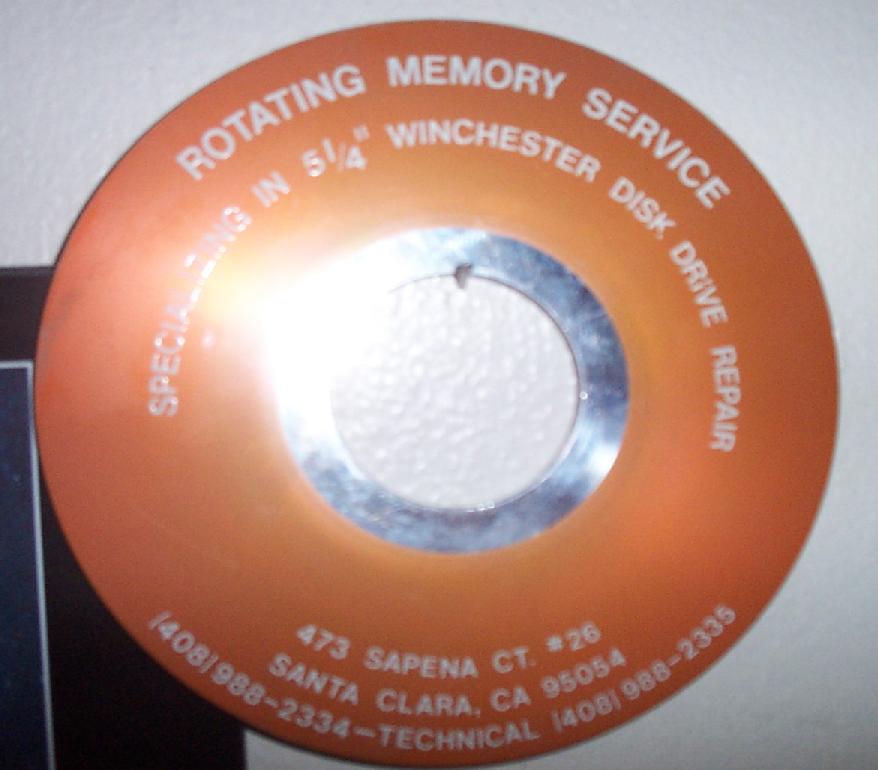
I found a fun little "business card" in the form of a 5.25" disk platter
with a business name silk-screened on it. See
http://661.org/images/disk-ad.jpg
--
David Griffith
dgriffi at cs.csubak.edu
A: Because it fouls the order in which people normally read text.
Q: Why is top-posting such a bad thing?
A: Top-posting.
Q: What is the most annoying thing in e-mail?
This is the 84th entry in this thread, and it hasn't been on topic for at
least half that. Can the next contributor please change the subject line?
> > Do I? I've got projects that I've been working on for at least 10
> years :-)
>
> Yes, you do!
> I've got stuff in the back of my refrigerator much older than that.
Ahh.. evolution experiments, does it walk and talk yet ??
> I've got projects that I've NOT been working on for almost half a
> century :-)
Woow, I don't have those.. I'm married ;-)
My favorite use for the 555 that I ever saw, was in a homebrew paper tape reader in Byte or PE in the mid-70's.
The timing function wasn't used at all; only the Schmitt trigger function used. Default 555 Schmitt trigger action is at 1/3Vcc and 2/3Vcc; just brilliant!
Tim.
Hi,
I was planning to convert all my RSX-11 & RT-11 RL02 disks
to SIMH container files. And for that purpose I was planning
to use 11/73, which did have BSD2.11 on it.
'Did' indeed, as the disk has gone to heaven.
So' my question is if there is a kind soul who can provide
me with a (copy) of the install tape.
Postage and such can be paid for.
Thanks,
Ed
--
Dit is een HTML vrije email / This is an HTML free email.
Personally I enjoy a big Simpson 260-dash-whatever.
The Triplett 630 is in the same league.
Both have been in production (in one variant or another) since before WWII.
The RCA Senior Voltohmysts I love for their fashion sense but unless I need VTVM class input impedances, I'd prefer the Simpson or Triplett.
In terms of used Flukes, I highly recommend any used 77-series unit. You can critique the designs because of what you saw as failings of your Fluke 85, but believe me, the LCD display on any Fluke LCD DMM will be far more durable than the faceplate on my Simpson 260 or Triplett 630.
At the very low end, in the $3 to $5 range there are "disposable" DMM's available at discount stores here in the US. They are not a joy to use but they do mostly work.
Tim.
I know that there has been a tremendous amount of talk about removing yellowing from vintage equipment, but going forward, does anyone have any suggestions for helping prevent yellowing of equipment on display, short of keeping them in a dark cave? I have a couple of Apple II's that are in excellent condition with minimal yellowing and would like to put them on display without having to worry about damage to the plastic.
-Mardy
On Wed, Sep 22, 2010 at 11:53:45AM -0500, John Foust wrote:
> At 11:09 AM 9/22/2010, Dave McGuire wrote:
> > Umm, yeah, I suppose, but...for what purpose? Eggsperimentation?
>
>
> Decorations? Magic tricks? Cascarones?
Easter eggs. And not the software kind.
>
> - John
- Diane
--
- db at FreeBSD.org db at db.nethttp://www.db.net/~db
> > When is the demo on how to suck eggs?
>
> Too dangerous due to risk of choking, lacerations from
> broken shells, salmonella etc. etc.
And if you're in a combat zone, perhaps you'd get a Purple Heart. True story as related in Reader's Digest Humor in Uniform section: An Army cook in Vietnam got an egg shell fragment in his eye while making scrambled eggs. The albumin stuck it to his eyeball so he had to see the unit medic to get it removed. Some time later, he was notified that he was receiving a Purple Heart. The reason cited was "shell fragment in eye." Apparently, someone was just glancing through through the undoubtedly numerous medical treatment records to discern who to present the medals to and found his record with its deceptive entry.
MARCH's booth for Maker Faire this weekend will be indoors at the main
venue (New York Hall of Science). Our maker # is 3641 if any cctalkers
are looking for us. I'm told we will be inside a modern computer lab.
Saturday night we'll be eating/drinking; all are welcome to join us.
... Well, actually, they arrived at the beginning of last week and I
didn't finish checking them against the netlist until today. My excuse
is that my notes are all on Cougar (my laptop), which is currently
refusing to boot without segfaulting in the kernel. Rather than deal
with ASUS support, I replaced it -- the replacement (an MSI U230 named
Ryoko) is far better behaved :)
Scanned images:
Top: http://www.discferret.com/images/discferret-pcb-top.jpg
Bottom: http://www.discferret.com/images/discferret-pcb-bot.jpg
They seem to have come out OK. The solder mask is a little discoloured
around some of the thinner tracks, but that's a cosmetic issue. It still
resists solder, thus it's OK :)
For the pathologically curious:
Substrate -- FR4 fiberglass, 1.6mm
Track layers -- two copper, 1oz
Layer stacking -- BOTTOM COPPER, FR4, TOP COPPER, TOP OVERLAY
Surface finish -- looks like lead-free HASL or roller-tin. It's
certainly not immersion tin or silver, the pads have roller marks on them.
It turns out I hammed the entry of the order, and managed to order two
sets of three boards, leaving me with six PCBs in total, and an
additional 130 Euro bill. Ick.
I'm still short of some parts (notably: the USB ESD suppressor chip,
some pin headers, 7-pin SIL resistor packs and 10nF 0603 decoupling
capacitors). A trip to the Farnell trade counter is being meticulously
planned, as long as I can get someone to hang around the house and wait
for my Rapid order to arrive (mouse microswitches... Logitech should be
shot for using those nasty Omron things).
Thanks,
--
Phil.
classiccmp at philpem.me.uk
http://www.philpem.me.uk/
When I was maintaining Alto Is, I put a warning sign on the machines that
stated "Avoid VD --- Venereal Disks! If your disk doesn't load, do NOT try
another machine"...
For the most part the drives were OK, but if they did fail, then the
contagion could be spread. I certainly had my share of disk crashes.
There's a reason the Alto file system had the scavanger and was designed to
be recovered...
Hi guys,
Pushing the boundaries of the Ten Year Rule here, but I think the
"coolness factor" might apply here, so please don't get the pitchforks
and flaming torches out just yet... :)
I just got back from the Barnsley Hamfest, with a new toy in tow: a
Psion Workabout MX, 2MB version, with IrDA, TTL, RS232 and LIF ports, a
256K flash SSD and a 1MB SRAM SSD. Batteries were -- predictably --
shot, but on installing a fresh pair of AAs, it booted to SIBO. Seems
the SSDs are blank, and aside from a few small screen scratches the
machine is in pretty good nick.
Thing is, I'd like to see it do something useful. This dictates that I
write some code for it... I've managed to find a copy of the old Psion
Sibo SDK and some PDF documentation on an FTP site, but this doesn't
include the C compiler required to compile the code: TopSpeed C.
As near as I can tell, this was a 16-bit 8086 C compiler which generated
code under (and for) MS-DOS type platforms. The Psion documentation
references Topspeed Compiler v3.10 and Environment v3.10.002, but I
suspect other versions may also work. Psion suggest it was released by
Clarion, but every other reference I can find suggests it was sold be a
company called "JPI".
Does anyone happen to have a spare copy of Topspeed C kicking around?
Thanks,
--
Phil.
classiccmp at philpem.me.uk
http://www.philpem.me.uk/
Probably a stretch but wondering if anyone has any info (manual, pinouts,
service documentation) for a GNT model 3601 8-bit (1") paper tape punch.
It was probably better known in the CNC / automated machining world than
in computing but my hope is to resurrect it as a backup punch for copying
tapes I use with my ASR-33 and thereby save wear on the -33's punch.
The unit has serial and parallel interfaces on DB25 connectors but I do
not have any pinout information for those. The serial one I can probably
figure out.
Unfortunately, the unit is a little more sick than "works OK" seemed
to imply from the eBay seller. It has what I believe to be a power
supply problem because as soon as you try to punch all eight holes with
the front panel test button, the power LED dims and the punch jams,
apparently from lack of umph to complete the mission. It could also be
jamming to start with and that causes the power drop I suppose.
In any case, looking for any docs before I open it up and start digging
around. I have written to GNT without a reply so far.
Chris
--
Chris Elmquist
mailto:chrise at pobox.com
I had to do it, please understand =) I am just grateful I was able to
share it with everyone at the Midwest Vintage Computer Festival.
I live in a 2 bedroom condo with my family of 5, and the Alto already
takes up plenty of the living room. Plus with my main initiative being
repairing the Alto, I will need some finances to fund the project.
Jim, I know you expressed much interest in the panel, if it fails to
sell at the starting bid I will ensure we work out a swap as previously
talked about =)
If anyone is interested in the auction link, here it is:
http://cgi.ebay.com/ws/eBayISAPI.dll?ViewItem&item=270638335277
Richard <legalize at xmission.com> wrote:
> In article <AANLkTikXa9qgOFhFazHp-MguLeJXzbO7L5AXxbJGZSRU at mail.gmail.com>, Ethan Dicks <ethan.dicks at gmail.com> writes:
>> > I haven't seen a VT525 in the wild, but now I know what to do to show
>> > it off if I do get one (but now I'm also wondering what it would take
>> > to get what you have working on a Tektronix 4105 since I have a couple
>> > of those).
>
> It shouldn't take much with a proper termcap/terminfo entry for the
> 4105. If you need escape codes, consult the 4105 programmer's
> reference on bitsavers:
> <http://bitsavers.org/pdf/tektronix/410x/070-4526-01_4105_PgmrRef_Sep83.pdf>
Whoa! I know you mean well, Richard, but you are making huge assumptions
here, which are very wrong.
First of all, you assume that termcap can actually do this stuff, which
it cannot. Termcap have no clue about user defined fonts. Termcap is
rather limited in some ways. There are plenty of things I can do with a
terminal that cannot be done properly within termcap.
But even adding the word "termcap" here, is making a big assumption
about my software. In fact, my software is not using termcap, so adding
information to the termcap database would not help at all. Even assuming
this is a Unix system is making a mistake. It is, in fact not.
And, when all that is said and done, do you really think that the
tektronix terminals aren't already in the termcap database? In fact,
they are... (as are just about any terminal you ever never heard of)
And to make a long story short - the software I'm talking about is my
Z-machine implementation, written in MACRO-11 for RSX, RT-11 and RSTS/E.
It can (should) handle all V1 to V8 games, but it do not handle sound,
nor full graphic games. All the rest should be fine, and it should work
with most any terminal, although some fancy stuff is not possible with
simple terminals. If anyone wants to take it for a test drive, just
telnet mim.update.uu.se, log in as guest/guest, and when you have logged
in, type ZEM <game>, or ZEM /LI (to list which games there are).
And this is a publicly available RSX system.
Johnny
havent seen this one posted here a video of a quantium link session ,
september 1989.
http://blip.tv/file/4138357
--
Jacob Dahl Pind | telefisk.org | fidonet 2:237/38.8
I have an old Seagate ST-277R (62 MB) drive with ST21/22 controller.
It is recognized by MSDOS and Win98 in an AMD K6/300 system and can
read and write files. I'm running Defrag on it now.
Someone on the list had expressed interest but I don't have your email
any more - if you still want it (cheap!) please contact me offlist.
thanks
Charles
AROS isn't anywhere near done enough to sell as part of a commercial product.
I think there are a few garage type companies selling AROS compatible systems
with AROS pre-loaded, but they intend only to sell to folks who know what
they're buying. I.E.: An unfinished alpha-state OS.
This makes me think this whole thing is doomed to failure if it's real at all.
Mainly because nobody involved has any business sense.
Well, if you ever find the plans, you can go back to '93 and make sure
that they remail available.
Hmmm. It seems that you haven't done so, and therefore never will. :-(
there still might be one in a parallel universe :)
In the time-wasting sense:
The Integer Basic games that came on cassette and had an Apple I heritage, ESPECIALLY Apple Trek but to a lesser extent Breakout and Pong too
Beagle Bag, or Applesoft Basic and any Beagle Bros catalog, or just a Peeks and Pokes chart.
Lemonade
Sabotage
None are killer apps
But all are excellent fun
Tim.
> Date: Mon, 20 Sep 2010 13:32:25 -0700
> From: "Chuck Guzis" <cclist at sydex.com>
> Subject: Re: How to prevent yellowing of equipment on display
> On 20 Sep 2010 at 16:03, Dan Roganti wrote:
>
>> I'm still looking for the plans to that super-electromagnet stargate
>> traveling time machine that was online about '93 - if it's in your
>> archive.
>
> Not mine, but I heard that they'd dropped it because of
> unavailability of flux capacitors and ZPMs.
>
> --Chuck
---------------
Flux capacitors are no problem:
http://www.thinkgeek.com/geektoys/plush/9fc6/
Alas, temporarily out of stock, so you might have to DIY:
http://www.instructables.com/id/Flux-Capacitor/
mike
I am looking for the special cable that connects mouse and keyboard to a
DECstation 5000-240. Unfortunately I don't even know a part number. Can
anyone tell me what part number to look for? Better still, anyone have one
going spare?
Regards
Rob
Items located in Rockville, MD, 20850.
Almost free: $2 (two) dollars per item, local pickup only at this time,
no photos.
Special offer intended especially for anyone having a hard time due to
economy.
I'm needing to make space fast and clear out items without hassle of
ebay, ads, photos, etc..
1.California Computer Systems S-100 chassis, with 12-slot passive terminated
backplane, power supply, fan, filter. The chassis functions
perfectly, has been thoroughly cleaned,
and the PSU caps have been reformed. Cosmetically, the chassis
is decent: has dings, scratches,
some minor bends in sheet metal.
2. Fluke 8520A/AS-1 rackmount digital multimeter with GPIB. Perfect
cosmetic and functional condition.
3. Digital BA23 floor pedestal enclosure, complete with front + rear
covers. Very decent shape. No yellowing (painted).
4. Digital LA100 Letterprinter w/ ribbons. Tested working. Mild
yellowing of plastic but not disagreeable.
5. Digital LA75 Plus Companion Printer (LA75S-A2) w/ parallel + MMJ.
Professionally refurbished
and assumed working (but untested). Clean and nice cosmetic
shape. No yellowing.
6. Wyse 60 terminal with keyboard and spare analog board. Terminal
unit is in excellent shape all around, as is
spare analog board. Keyboard works but 3 of the keycaps broke
when it slid off my desk. No yellowing.
7. HP PA-RISC Model 712/60 computer with floppy, hard drive, new
keyboard and new mouse. Currently
loaded with the NEXT operating system. I have the original hard
disk with HPUX on it. You can have
one OR the other. Computer is in perfect cosmetic and working
condition.
My handle on ebay is MdntTrain if anyone wishes to verify my character
and reputation.
Email me if interested in any or all. I will select who the items go to.
Thank you,
John Singleton
js at cimmeri.com
I had this idea once and so I gutted a Tektronix inkjet printer --- what I
have is a set of driver boards and the inkjets.
This is part number 070-8072-00 and others.
If you'd like them, all I ask is that you pay postage / shipping.
Don't know if this interests anyone, but I spotted this in the local
Craigslist:
http://eugene.craigslist.org/sys/1963898368.html
On the same day's postings, I note that the UofO is surplusing an LSI
ADM-31 terminal for $50.
--Chuck
cctalk-request at classiccmp.org wrote:
> On 9/17/10, Johnny Billquist <bqt at softjar.se> wrote:
>> > So, in the end, implementing the ANSI color codes was the only
>> > reasonable way to get colored output on the VT525, and it is nice to
>> > have... I like playing Beyond Zork with color and primitive graphics on
>> > my PDP11... :-)
>
> Ooh! Now you have my attention. Long ago, I grabbed the ITF
> Z-machine source code and got it working under VMS 4.x (it was trivial
> once I had a working curses library), so I was able to run an number
> of v3 games on our 11/750, but now that there are many more Z-machine
> choices, I haven't gone back to fiddle with newer game file types.
:-)
I suspect you'd also have to work on whatever Z-machine implementation
you use to actually make it use both ANSI color control, and also user
defined fonts. And then, of course, you need a font.
> I haven't seen a VT525 in the wild, but now I know what to do to show
> it off if I do get one (but now I'm also wondering what it would take
> to get what you have working on a Tektronix 4105 since I have a couple
> of those).
I don't think you want to go down that path. :-)
I did say "primitive" graphics. Beyond Zork uses font 3 to play with
some crude graphics. Basically mapping, and some bar charts and nice
framing.
And, of course, it uses color if possible.
But if you are interested, I can send you my Z-machine font definitions
for the VT200, VT200, VT400 and VT500 terminals, so you don't have to
define those yourself.
As for playing, if you just have a VT525, it's easy to test, by just
logging in to Mim.Update.UU.SE, and play any Infocom game on that
machine. My Z-machine for the PDP-11 do handle the font and color stuff
for the VT terminals (of course). :-)
Johnny
Sridhar Ayengar <ploopster at gmail.com> wrote:
> Richard wrote:
>> > In article<744DB5469BEB4131832EC66D4BA961F6 at dell8300>,
>> > "Teo Zenios"<teoz at neo.rr.com> writes:
>> >
>>> >> How well would a VT525 work with a MicroVAX 3100 series model 80?
>> >
>> > <http://vt100.net/vt_history> says the VT525 is a color multi-session
>> > terminal. So that's a fairly decent model for the 500 series.
>> >
>> > Judging from the programmer's manual, you can select from a palette of
>> > 16 colors.
>> > <http://www.vt100.net/docs/vt520-rm/ek-vt520-rm.pdf>
>
> Unfortunately, it uses the later ANSI color stuff rather than the
> control codes used previously with the VT340/VT241.
Sorry, I've been out of town some, and have not had time to make
comments for a while.
As for the previous stuff on modem signals and so on, I was caught in a
small lie, yes. Properly, it isn't right to hook to DTEs together with a
crossed cable. But I'm willing to cheat on that one. I'll let the rest
of the RS-232 stuff rest unless we really want to revive that thread...
As for the VT525, yes, it is correct that it's just a base unit with no
screen or keyboard. It has a normal VGA connector for any VGA screen on
the back, along with two MMJ connectors and two DB-25 connectors (unless
my memory fails me).
As for colors, well... The VT241 and VT340 have no way at all to select
colors for text. You can, however, select that different attributes,
such as bold and so on, instead be rendered in other colors. And the
VT525 can do that as well. So it is as compatible with the older
terminals as much as is possible.
But, people might say, I have seen output in different colors on the
VT340...
Yes, you can do output in all colors on those older terminals. The
problem is, you need to switch to REGIS to do that. Ie, you do that when
playing around in graphic mode, which the VT525 don't have, so there is
no way it could do this in a way that would be compatible with the older
color VT terminals, with less than implementing the full REGIS stuff.
So, in the end, implementing the ANSI color codes was the only
reasonable way to get colored output on the VT525, and it is nice to
have... I like playing Beyond Zork with color and primitive graphics on
my PDP11... :-)
Johnny
Old computers. A running network. Friends. Dinner. Community. New
innovations in old gear. Aching backs. A lot of laughs. A little
bit of capacitor smoke in the air. Alas, another VCF has passed - but
what a time it was! While the seeds of plans for next year sprout,
our first priority is to collect documents of this event. If you took
pictures or video and have them hosted somewhere, and would like them
up on the vcfmw page, please send me a link and I'll post it ASAP.
You'll find them here:
http://vcfmw.org
I feel I can speak on behalf of the other vcfmw organizers and the
Chicago-area retrocomputing community at large when I issue a big
THANK YOU to all who attended, whether it was from our own backyard or
>from out across the plains. You are what made the show work - without
your enthusiasm, knowledge and spirit we'd have been a lonely bunch in
the basement.
There are a few shirts remaining, if anyone wants one for posterity.
I will count them up and post a list soon. I do know we're sold out
of "XL" and have a number of "L" left, along with a few M and XXL.
There are mostly black ones with a few blue (which proved more popular
than expected.) The front design is here (the back is just the URL:)
http://picasaweb.google.com/Silent700/VCFMW50OfficialGraphics#5512512730455…
Again, thanks to all who attended, helped out and made it an awesome
night. It's events like this that keep the hobby alive and strong.
-j
--
I recently acquired a couple of MicroVAX 2000s. One of them has this board
in it:
http://cid-fc758a5a91b91301.office.live.com/self.aspx/Public/MV2000Board-1.j
pg
I don't know what this board is but it connects by two ribbon cables to
connectors on the main board. Can anyone tell me what it is?
Also one of the machines has faulty memory. I have removed the memory option
and I am trying to identify it, but the marking says "2/4 MB MEMORY OPTION".
Anyone know how to tell which one it is?
Thanks
Rob
I have just acquired a MicroVAX 2000 which I found to contain an RD54. If I
try booting the machine from the disk you hear a whine, when the whine stops
you can hear the heads move, then when the heads stop moving you hear the
whine again. Is this a terminally sick disk?
Thanks
Rob
In cleaning my house I have discovered a complete and unused photocopy
of the Teletype 33 service manual (Bulletin 310B Vol. 1 & 2) and 33
parts list (Bulletin 1184B). It weighs 9 lbs boxed.
Also a new photocopy of the DEC PDP-8/L "Maintenance Manual Vol. 1
Oct. 1968". Chapters 1-5 plus readable schematics (8.5x11"). Shipping
wt. 2 lbs.
First reasonable offer gets one or both... shipping is inexpensive by
Media Mail, from zip 65775.
thanks
Charles
I am at the hotel and about to start inspecting the show area. Soon
we shall commence storming the Heron Point Building with never-before
witnessed piles of ccmp and related ephemera. Everything that could
have been done has been done, and that which should have been done and
was not must wait for next year. We accept this and proceed.
Twitterized folks can get updates by following @vcfmidwest.
A uStream broadcast will begin sometime tomorrow morning, depending on
factors of technology, polar alignment, sunspots and when I get up.
View it here:
http://www.ustream.tv/channel/chiclassiccomp
Onward to non-fail and glory! Bring on the junk!
--
S.7k
chiclassiccomp.org
Argggh!
Went with the spousal unit to a local arts fair and what did one vendor
sell? Right, "obsolete" chips. I immediately spotted a LSI-11 chip set.
And what about the EPROM bracelet?
Some gold NASA stuff as well.
Sad, very sad.
At 12:00 -0500 9/17/10, Bill M. wrote:
>The Perq was the result of a visit (sabbatical?) at Xerox PARC
>by one of the principals of Three Rivers Computer, much like
>the way Lilith originated from Wirth's experiences there.... --Bill
Ah, hah! Do I correctly surmise that the correct pronunciation of
"Perq" is /park/ = [pahrk] (cf dictionary.com "park") and not /p3rk/
= [purk] (cf dictionary.com, "perk") ?
--
- Mark 210-379-4635
-----------------------------------------------------------------------
Large Asteroids headed toward planets
inhabited by beings that don't have
technology adequate to stop them:
Think of it as Evolution in Fast-Forward.
I spotted some 3 1/2" form factor drives that I think may be SCSI
drives of the narrow "SCA" persuasion. I noted them mainly because they
have a small looking black plastic connector similar to a centronics
connector, with what appears to be a central male bar with contacts on it.
It rang a bell about the discussion about such connectors in some
Sparcbook laptops.
Though the form factor is totally useless, it would be interesting if
the bus was the same, and one could fab up a cable out of a dead
sparcbook to such a drive. Just thinking.
I have to grab the drives tomorrow and see what they are. No idea at
all about whether they work, but they have been around for a long time.
Also I have a line on a huge amount of recent junk, and am listing it on
epay. It is way too new (except for technically some 2001 dual xeon
dell serverboards).
contact me off line for some quantum high capacity tape drives if
interested. There are 17 to be had, and a deal on them.
Jim
Hi all,
I wanted to sell a big blinkenlight panel, because I realized I will
never find the time for again another project ... Auction number
170539265245 shows a few pictures (auction is ended).
I would like to add more info before re-listing the front panel.
thanks,
- Henk.
Does anyone have a good feel for the current market value of a Bell &
Howell II+? Model is A2S1016B, serial #A2S3-000985 with disk drive,
paddles, manuals, cassette player, cassettes and floppies. Unknown
working condition. Installed boards are ROM Card, Disk II Interface, plus
a Sup "R" Mod II.
This isn't mine, but the owner contacted me asking what it might be
worth. I haven't paid any attention to Ebay prices on these, but it looks
like a generic Apple II+ might fetch $150 or more.
Mike Loewen mloewen at cpumagic.scol.pa.us
Old Technology http://sturgeon.css.psu.edu/~mloewen/Oldtech/
Probably not too useful a remark, but I remember from years ago when we had
some Xerox Altos at the Stanford computer science department that the disk
drives were very prone to head crashes. We were instructed to never attempt
to remove the disk pack under penalty of flogging (or some less colorful
words). So, I hope once Nick gets the voltage problem fixed, he's not
disappointed to find out that disk doesn't work anyway. :-/
Hi, All,
I've been trying to dust off a MicroVAX 2000 for VCFmw, and so far,
all I've accomplished is literally getting the dust off.
This unit was one I tried to install the SCSI-enabled patched boot
ROMs in some time back. I _thought_ I had arranged the original ROMs
in the same pattern, but it's possible with all the swapping, I got
some mixed up. I have checked (and re-downloaded) all the ROMs I have
- one factory set (23-092E7-00 through 23-095E7-00) and one patched
set. Cross-checking with the Technical Reference manual
(EK-VTTAA-TM-001) from Bitsavers, I have verified that all ROMs have
reasonable contents in the first few bytes (there are three signature
bytes, among other things). No matter which set I have installed, I
cannot get the console to respond with the self-test info.
Does anyone have a photograph of a KA410 board where the labels on the
ROMs can be read? Alternately, does anyone have any docs with part
numbers? I'm reasonably certain that the underlying hardware is
functional and that I just need to re-install the ROMs correctly.
Yes, I could try the lucky-dip method, but one of the ROMs is rather
difficult to pull (owing to the memory interface connectors), and I'd
rather not break a pin off while sequencing through a dozen chip
swaps. I'd like to _know_ what goes where before I proceed
(especially if I am wrong and I _do_ have a hardware fault).
I don't have any video cables handy, but in case it does come down to
testing with a tube vs a console terminal, I have a four-plane video
interface in addition to the mono frame buffer all KA410s come with.
I had just thought that it would be easy enough to use a BCC08 console
cable and go from there (it's worked before).
Thanks for any tips or pointers,
-ethan
P.S. - I've been delving into the guts of the machine deeply enough
that I'm musing about what it would take to make a 16MB memory board
that didn't respond in the lower 2MB (to work with the on-board
memory). Static would be easy to interface, but the KA410 _does_
generate and pass along refresh signals, so something with 30-pin or
72-pin SIMMs shouldn't be that hard to whip up. I'm only considering
it because my largest memory board is 4MB, and the current prices for
an MS400-CA (12MB DEC board) are more than I'm personally willing to
pay - I'll do without first (which is what I'm already doing ;-)
P.P.S - this would probably all be moot if I had a SCSI-based MicroVAX
slab of some sort, but I just haven't been in the right place at the
right time. Perhaps some DEC gear will make an appearance at the
VCF...
Hi, All,
I'm going through a box of older ICs and ran across a few X2864s. I
know they are 64Kbit JEDEC EEPROMs, but what I don't know is if there
are any odd issues with them. I found a datasheet that's mostly in
Japanese - I do happen to read some Japanese, but I'm far from fluent.
I'm mostly curious about in-circuit programming. I know a lot of
newer hobby-type projects use different families of EEPROMs and that
some devices can only program certain ones. What I don't know is how
that relates to something as old as the X2864. I can probably program
these in a standalone device programmer and potentially have to build
a pin-swabber socket for a 2364 (or even 2332 for a PET), but I'd like
to know if I'm opening a can of worms before I begin.
Thanks for any warnings of pitfalls ahead.
-ethan
On , 15 Sep 2010 20:30:26 +0100 (BST), ard at p850ug1.demon.co.uk (Tony
Duell) wrote:
>Subject: Re: Mass spectrometers etc
>To: cctalk at classiccmp.org
>Message-ID: <m1Ovxgb-000J4BC at p850ug1>
>Content-Type: text/plain
>
>> You need to find a diffussion pump. These will get you down to
>
The French guy used a rotary vane pump and a molecular pump, which you
could probably make yourself at home (he did). The rotary vane pump
shouldn't give you any problems, and for the molecular pump you only
need an old motor capable of 24000 rpm without breaking up, and some
careful machining :-)
A spot of high vacuum grease, a few seals etc and you are all set. The
finished set up isn't particularly large either. No oil in the
molecular pump either...
/Jonas
>Indeed I do (My father spoet most of his working days on high vacuum
>systems., I think I'd head ofa 'diff pump' before I even went to school...
>
>OIl, from choice. Mercury vapour, even inside a vacuum system (and some
>will, alas, end up in the backing rotary pump) is not something I
>particualrly keen on....
>
>There is the minor problem of 'where the heck do I set up a vacuum
>system, along with all the other things I am working on' :-)
>
>-tony
>
Hello all,
I bought one of the HP 9825's that Marvin recently posted here about (via VCM
auction). It's a 9825T and seems to work perfectly, along with an HPIB
interface I bought off Ebay. Of course the case needs cleaning and there is a
penny-sized chip from the corner of the bezel, so I've got the whole thing
disassembled, and am now in the process of rebuilding the chipped bezel corner
with JB-weld. Next step is to repaint the case, then replace the at-risk PSU
caps, refurbish the tape drive, clean the keyboard, etc. The unit is
beautifully engineered, by the way.
Some questions for the group:
1) Does anyone have a suggestion for the best paint to match the original
color? If I can find a close match, I'll just tape over the legends on the
bezel, and paint around them. If I can't get a good match, I still may do the
same thing, or I'll just paint the whole thing, and then print out some decals
on a color printer to match the original legends. Or, if anyone here has a
better suggestion, I'd love to hear. Any suggestion for type of paint? I found
a can of Rustoleum brand almond-color satin finish enamel spray-paint. Is that
a good choice, other than wrong color? I also just bought an HP 87 on Ebay as
well, so I'm hoping that whatever I learn here, I can apply to refurbishing the
87 as well.
2) While the unit is completely disassembled, are there any hacks, mods,
upgrades, etc. that I may want to know about before I put everything back
together?
3) I would like to use this in my home lab, so I was hoping to find a way to
store programs without using the tape drive or a disc drive. Is anyone there
moving data between the 9825 and a PC? Can some of the utilities on hp9845.net
be used to interface with the 9825 as well?
This would be icing on the cake, since it would be shame to let such a nice
machine go unused. However, I do have the Prologix GPIB interface with
PyVISA/Scipy/Numpy,
Thanks for any input,
Dave
I've got a chinese converter(from ebay, recommended by a few here) that
will take 15khz RGB video with composite sync and spit out VGA at ~32khz
so a regular monitor can be used to display the signal.
http://cgi.ebay.com/RGBS-CGA-EGA-YUV-VGA-converter-1-output-arcade-game-/25…
The seller claims (and spec sheet does indeed look this way) that the
RGBHV input must be 30khz+, but the RGBS input supports down to 14.5khz.
I'm attempting to use this with my amiga, which sends out separate H and
V SYNC signals but at 15.7khz.
I found this schematic
http://www.epanorama.net/circuits/vga2rgbs.html
The simple VGA to RGB+CSYNC adapter TTL (which appears the same as the
"Separate Sync to Composite Sync Adapter")
I intend to build this, and see if this does the trick for me.
This sound like a reasonable plan?
Anyone happen to have a few 74HCT86's lying around? I can order them
online but because they are under $0.50 a piece, and I'll likely have to
pay a minimum order size fee plus S&H. Seems a waste for a dollar's
worth of items.
Thanks
Keith in Pittsburgh, PA, USA
On Fri, 10 Sep 2010 20:02:09 +0100 (BST), ard at p850ug1.demon.co.uk (Tony
Duell) wrote:
>
>Oh, I have one, but it's only a little 1cm radius one, designed mainly
>for detecting the helium peak when looking for leaks. What I don't have is
>a suitable vacuum pump (yet...)
>
You might be interested in this site (sorry it's a Web site with
pictures and so on, some of it will probably be readable using Lynx, and
it's in French to boot, I'm sure it would interest you however):
http://paillard.claude.free.fr/
He makes his own triode valves (or tubes, for those of us who speak the
other language known as English ;-) ) and in order to do that he has
designed and built among other things his own high vacuum pumps. I'm
sure you would be able to make one like his.
/Jonas