All,
I've added a VCB02 card to my MicroVax 2. Right now the VAX is setup with
the following layout...
Slot 1 KA630-A CPU M7606AF
Slot 2 8M RAM M7609-AM
Slot 3 8M RAM M7609-AP
Slot 4 CMD SCSI MSCP encapsulating (top half) empty bottom
Slot 5 M7516-YM (ethernet, top) M7546 for TK-50 (bottom)
Slot 6 VCB02
Slot 7 VCB02 Memory
Slot 8 VCB02 Memory
Per the docs on bitsavers, the VCB02 can go in any QBUS slot 5-8, but the
layouts in the manual are different than what I have setup.
With the VCB02 in there POST takes longer, but the console still comes out
on the serial port. The VCB02 shows 3 red LEDs.
I assume I need to set the addressing on the card, but I have 0 clue what
to do.
--
-Jon
Jonathan Katz, Indianapolis, IN.
I am looking for a bbs/fideonet database for Australia
that lists the nodes that existed in the past
so I can see if there were node around my location
?
---
tom_a_sparks "It's a nerdy thing I like to do"
Child of the Internet born 1983
PGP ID: A7EF6006
Please use ISO approved file formats excluding Office Open XML - http://www.gnu.org/philosophy/no-word-attachments.html
Ubuntu wiki page https://wiki.ubuntu.com/tomsparks
This has been relisted several times already, and I imagine the owner is likely to scrap it if it doesn't sell.
http://www.ebay.com/itm/s/380869476221
--Bill
Some time back (too long ago to remember, which lately means > 2
months) I purchased a set of slides marked "(C) Digital Equipment
Corp." They were stuffed in a drawer and forgotten until recently,
when I dug out my slide scanner for a different job. Thanks to
inertia, the scanner stayed where it was and I scanned in the DEC
slides as well. Nothing cohesive here and completely lacking context
but I thought the DECfans among us might find them interesting. They
appear to be part of some sort of training materials:
http://silent700.blogspot.com/2014/03/and-some-more-slides.html
Enjoy!
-jht
--
silent700.blogspot.com
Retrocomputing and collecting in the Chicago area:
http://chiclassiccomp.org
I have five DEC 3000 series machines that came along with a batch of other items. They do not interest me, and I think that their present monetary value per unit weight is low. Model numbers vary, installed cards vary, and I haven't opened them up or studied them carefully. Paint is scratched up and on some of them the vinyl feet have turned to sticky goo. I want them gone, but I'd prefer not to scrap them. These are just the main boxes, with no keyboards, monitors or cables. One of them looks like it has some sort of fiber optic interface card installed. Some look like they have graphic boards installed, some don't. At least one of them appears to have a CD ROM drive.
Does anybody want them? I'm not interested in packing or shipping them. I'll give them away free if you come pick them up at my home in Riverside on a weekend (note, rough dirt road... truck recommended), or sell them for $4 each if I need to load them back up in my truck and bring them to my workplace in Irvine for a weekday pickup. :)
--
Mark J. Blair, NF6X <nf6x at nf6x.net>
http://www.nf6x.net/
Servicing a DECstation 5000, I found this old CAD, Matra Euclide-IS.
I managed to make it start: it use a proprietary DB to store objects.
The problem is this: I can retrieve stored objects (the equivalent of
drawings), but haven't figured out how to display them :P
Menus are not so obvious.
I mean that it loads the drawing with no errors, and I saw only the axes
on the graphic screen.
Tried to recalculate, changed view...
Created a drawing by myself: saved it.
On reopening, it happens the same.
I checked the database, and objects are there...
I'm missing something: did you ever use it?
Thanks!
From: Philipp Hachtmann <hachti at hachti.de>
>No more bus driver discussion, PLEASE!
>Throwing up this bus driver thing again and again
>discourages people.
--- Philipp, I hope you will permit me to answer criticism. I think that if we keep it cordial and constructive, it will serve the useful purpose of answering concerns about Omnibus interfacing. I can show that, in fact, the interface approach being used is completely compatible with DEC Omnibus interface practice.
From: Eric Smith <spacewar at gmail.com>:
>Now consider the same question if the vendor explicitly claimed that it did
>meet the specification, and put on their web site a well-intentioned but
>flawed analysis of that claim. Would you complain about someone that
>pointed out the flaw in the analysis?
--- Hi Eric,
As I pointed out before, I didn't claim in the article that the receivers meet "Omnibus specifications", only that I judged it to be close enough. (The transmitters easily exceed DEC practice.) I apologize if the way I originally presented it was confusing. One of the problems with establishing compatibility with Omnibus specifications is that no comprehensive Omnibus specs have turned up so far. Instead, we have to look at actual DEC design practice.
Since you raised concerns about it, I have rewritten the section to clarify the matter. In doing so, I did additional research which revealed that DEC used various ordinary TTL gates as Omnibus receivers on many occasions. There is a list of twelve citations, involving 58 Omnibus connections, which documents this practice. TTL gates used include 74H87, 74H04, 74153, 7404, 7412, 7439, 7410, 7430, 7474, and 74H11.
These were employed for timing signals, control signals and for data buses. This list is by no means comprehensive, since I only spent a short time searching schematics. No doubt, we could find many other instances. You can see the full table at: http://tronola.com/html/ram_for_pdp-8e.html#Secret
The conclusion from this table is that DEC certainly regarded standard TTL input specs as adequate for an Omnibus receiver. Moreover, the specs on the Omnibus interfaces of the 32K RAM board are as good or better than the cited DEC instances. Since quite a few of these instances involve critical signals of CPU cards, we can say that virtually all PDP-8/e, f and m systems have receivers with standard TTL interface characteristics. Thus, there is no reason to suspect that there will be any limitations in using this design, relative to existing DEC hardware.
I appreciate your giving me an opportunity to clarify things and to hopefully lay to rest, any concerns about the interfaces.
Steve Lafferty
Yes I would be very interested in any Targa related files being placed up for download, thank you Kelly.
I also have been searching for Topas or any of the old utilities listed in the software manual
Cheers
Ryan May
Hello, all,
This morning I did some looking at my RK8E boards, and it appears that
it has been ECO'd to make a change to the clock generation logic for the
Current Address Counter.
This ECO supposedly helped with the issue, but apparently it isn't good
enough for this RK8E to work properly in my 8/e.
I tacked in an extra probe wire to the least significant bit of the
Current Address Counter on the RK8E.
I put things back together, and toggled in my little test program that
loads the Current Address Counter with 0, then loops on itself to
generate scope traces.
When I ran the program, it was instantly obvious that the counter is
indeed incrementing due to the transient in the clock signal.
The LSB of the counter goes to logic 0 for a short time (as a result of
the load operation), then pops up to logic 1 due to the transient
causing a count cycle on the 74161 counter.
You can view the traces here:
http://pail.bensene.com/RK8ECounter.jpg
The top trace is the LOAD signal into the counter, the middle trace is
the CLK signal into the counter, and the bottom trace is the LSB of the
counter.
It's clear that when the CLK signal goes high (the clock triggers on the
positive edge) after the transient, the counter counts up one, causing
the LSB to go to 1.
As David Humphries mentioned, it appears to be a design flaw in this
clock generation circuitry that, depending on small timing variances in
different machines, causes this transient to be generated, messing up
the operation of the RK8E.
A couple of different signals from the master timing of the PDP 8/e are
used to generate this clock signal, and it could be that one of these
signals on my machine is slightly off due to variances in propagation
times in gates and flip flop timing chains that manifests this weakness
in the RK8E Current Address Counter clock circuitry.
The machine where the RK8E was tested as good may have had slightly
different timing that either rendered the transient too short to trigger
a count, or eliminated it completely.
The next step is to try to figure out what I need to modify to make this
transient either go away or such that it is no longer effective in
triggering the Current Address Counter to count up before DMA operations
begin.
Suggestions as to how to clear this up are warmly welcomed.
Thanks to all,
Rick Bensene
Hi folks!
I grabbed my first Osborne I today :)
I powered it and it showed a crisp and vivid monitor :D
I had a bunch of disks, but none of them worked (boot error).
So I tried them elsewhere: they were all Double Density (so I have DD
drives) but almost unreadable: the surface is dirty and covered with
spots, may be fungi :(
I dowloaded some IMD images and gave it a try...
It booted with the Osborne logo and then the screen was slowly filled
with junk, mainly "@". The Osborne stopped responding: I pressed the
Reset button...
Continuous beep on reboot, screen filled with random chars.
I powered off, waited some minutes: no changes, no boot.
Beep and screen junk, the floppy drives lights dance rhythmically :p
I'll able to open it only the next week (the work table is full), but
I'd like to figure out what's happened.
Ram? Rom?
Thanks!
Hi folks,
I have or don't have a problem with one of the OmniUSB board. I just don't know.
So is there anybody who has tried to use a board in a pdp8/a? Or is there
someone with a board and a pdp8/a at hands to give it a try?
This is the story: I distributed most of the OmniUSB boards last year. And did
not get very much feedback from the people who bought them. I know only of one
party having successfully used the board. All boards have been checked with a
special CPLD firmware and a checkout program on the pdp8 which together provide
complete test coverage for all signal ways going to the pdp8 and back. Even the
DIP switches were tested individually. So I strongly assume that all boards I
shipped are working fine. But.... A few weeks ago I got informed of a board just
not doing anything in a pdp8/a. I gave hints how to use it etc. Then I asked to
send the board back to me to check what is wrong with it. The board arrived and
I put it into my development 8/e - works perfectly. I also did my checkout
routines - everything seems to be perfectly fine. Now I have no idea what could
be wrong. Something with the 8/a? Or a general 8/a issue? The 8/a has the same
CPU as the 8/e afaik. Could there be some subtle differences between 8/a and /e?
Following some detailed info about how OmniUSB talks to the Omnibus:
These are the signals from and to the Omnibus:
> -- Omnibus connections
> io_pause : in std_logic;
> ts3 : in std_logic;
> tp3_n : in std_logic;
> sw_n : in std_logic;
> initialize_n : in std_logic;
> md : in std_logic_vector (3 to 11);
> DATA_R : in std_logic_vector(4 to 11);
> DATA_D : out std_logic_vector(4 to 11);
> internal_io_d : out std_logic;
> c0_d : out std_logic;
> c1_d : out std_logic;
> skip_d : out std_logic;
> int_rqst_d : out std_logic;
The most operations are enabled by a signal named io_active which is:
> io_active <= io_pause and ts3;
e.g.
> if (match_rx = '1' or match_tx = '1') and io_active = '1' then
> internal_io_d <= '1';
> end if;
for driving the internal_io Omnibus line
Might this be a problem? Is there anything different with 8/a bus timing? Is the
TS3 signal unavailable? Is the io_pause signal unavailable?
I appreciate any hint.
Kind regards
Philipp
> Message: 9
> Date: Fri, 21 Mar 2014 10:06:59 -0600
> From: Roe Peterson <roe at liveblockauctions.com>
> To: General Discussion: On-Topic Posts Only <cctech at classiccmp.org>;
> Subject: Re: PDP-8a Restoration/RL01 issues
> Message-ID: <532C63A3.9040302 at liveblockauctions.com>
> Content-Type: text/plain; charset="ISO-8859-1"; format=flowed
>
> On 03/21/2014 09:55 AM, Ethan Dicks wrote:
>> On Thu, Mar 20, 2014 at 4:47 PM, Anders Sandahl <anders at abc80.net> wrote:
>>> Ok, I got the parts and putted the things together.
>
> It might be a good idea to cover the window on the eprom in your third
> photo...
>
I'll fix that.
/Anders
We have 18 paid units for the group buy, which is enough for the buy to
proceed. There are still several folks who expressed interest, but have
not paid.
If you want one of these, now is the time! Here are the details again, in
case you missed them:
The 32K RAM kit is for an Omnibus card that should work in the PDP-8/e, 8/f,
8/m, and 8/a:
- Complete kit, including battery, PCB and parts. Soldering required.
Includes IC sockets for the RAM kit, but not for the prototype area.
- The amount is $95, including shipping. If you are outside the USA,
please add $20 for shipping.
- Please make Paypal payment to this email address. It will show my
wife's name, Hildebrand. (My initials are vrs, and that email is just
my initials at msn.com.)
- Ordering for this project will close March 31, 2014.
- The kits are expected to ship by May 8th. (Long PCB turn time is used to
keep the price down.)
- Please allow up to 10-days for delivery.
Some features of the kit:
- Battery backup with long life.
- Inhibit on power fail to prevent memory corruption.
- Easy to build, with all through-hole parts.
- Provides full 32K memory in a single card slot.
- Cooperation with any mix of core memory or ROM boards.
- Compatibility with the Omnibus.
- Most of the full Omnibus board area is laid out for prototyping.
- High quality board with gold fingers, plated holes, silk screen and
solder-mask.
You can read Steve's article about the prototype here:
http://www.tronola.com/html/ram_for_pdp-8e.html
Thanks,
Vince
Apparently there's a project to revive it.
http://www.geekdot.com/helios-ng
Source on OSnews:
http://www.osnews.com/comments/27631
The first comment is a nice little paean to the Atari Abaq which
people might enjoy - with a link to a Youtube video of boot-up.
--
Liam Proven * Profile: http://lproven.livejournal.com/profile
Email: lproven at cix.co.uk * GMail/G+/Twitter/Flickr/Facebook: lproven
MSN: lproven at hotmail.com * Skype/AIM/Yahoo/LinkedIn: liamproven
Tel: +44 20-8685-0498 * Cell: +44 7939-087884
I did a comparison of the bus input receiver on the 26S10 vs 8641 a while back.
Here is the plot: http://ak6dn.dyndns.org/stuff/26S10vs8641.jpg
As you can see, there is about a 0.5V difference in the receiver threshold.
May make a difference in some configurations, probably not in most.
Also the 26S10 is a faster device on the bus transmitter output.
This may cause undesired reflections/ringing under some bus loading conditions.
Ideally the transition time should be longer than the electrical length of the bus.
With a 26S10 the maximum unibus length would be much shorter than with a legacy 8641.
Again, may make a difference in some configurations, probably not in most.
Don
-----Original Message-----
>From: Vincent Slyngstad <vrs at msn.com>
>Sent: Mar 19, 2014 12:07 PM
>To: "General Discussion: On-Topic and Off-Topic Posts" <cctalk at classiccmp.org>
>Subject: Re: DEC Unibus Interface ICs
>
>From: Paul Birkel: Monday, March 17, 2014 12:13 PM
>> Unibus Handbook Figure 1-30 does specify the RC-equivalent input for this
>> IC but I have not as yet tried to cross-walk it against well-known
>> SN74xx-series chips. I imagine that I'm the umpteenth person to encounter
>> this problem, so before I try to rediscover fire I'm hoping that someone
>> else could share their torch of knowledge :->?
>
>I remain a fan of the AM26S10 for this, though like everything else, it fails
>to meet the detailed specifications.
>
> Vince
Hi,
The QBus field guide is pretty specific when it comes to the M7609, but rather terse when it comes to the M7621 description. Reading through the KA630 and 650 CPU module user's guides, it seems both CPU's communicate with RAM via CD and the 50 pin ribbon cable.
Is the main difference between the uVax memory boards just access speed, or are they matched by design to the various CPU's?
ie. can an 8Mb board from a KA650 CPU be used with a KA630 CPU?
thanks
--
alex
Hey,
A friend of mine has had an unassembled Heathkit H89 in original packaging.
He wants to know if it is worth any more or less because it was never
assembled. If anyone could help, we'd appreciate it!
Thanks
Joe.
All,
Many of you know I took in Pat's E10K. Sadly, I just don't have the time or
physical power requirements to get it going. I need to find it a good home.
Here is what I know...
64 400Mhz CPU x 64G of RAM E10K. Comes with an assortment of PCI-based and
sbus-based IO boards. Has S1 boot drives. It has 2x U5 SSPs that have the
SSP software and run and boot. It comes with several spares including power
supplies, system control boards and system boards. It's crammed with
various IO boards of the FCAL, ethernet and SCSI varieties.
It's located in Indianapolis, IN 46219 in my garage. You'll need a truck
with a lift to pick it up.
--
-Jon
Jonathan Katz, Indianapolis, IN.
Well, new to me, anyway.
http://www.1000bit.it/
You're meant to read that in binary - in other words, it's about
eight-bit home micros, mainly.
An eBayer looking at my DEC tapes asked me if I had any fliers or
commercial literature for them, which sadly I don't.
--
Liam Proven * Profile: http://lproven.livejournal.com/profile
Email: lproven at cix.co.uk * GMail/G+/Twitter/Flickr/Facebook: lproven
MSN: lproven at hotmail.com * Skype/AIM/Yahoo/LinkedIn: liamproven
Tel: +44 20-8685-0498 * Cell: +44 7939-087884
Hello,
I'm looking for any technical reference material on the ICS11614 aka
Gravis GF1 chip on the original GUS series of sound cards. Specifically
I'm after pin map, AC and DC electrical characteristics (basically the
Datasheet) and a register level reference such as a programmers
technical reference manual. If anyone can point me in the right
direction, I would greatly appreciate it!
Thanks,
-Alan
WTS Data General AVIION 3600R, USED, qty 1, CALL, Data General AVIION 3600R
System Made in the USA.
I have this whole cabinet full of boards and hard drives. Anyone interested
let me know soon before it goes to La La land.
Jim Firlik
Techway Services
Phone: 855-832-4929 x201
Jim at techwayservices.com
NOT affiliated with seller. If someone wants this, give him a call or
email.
Cindy Croxton
Electronics Plus
Hey all --
Got myself a Zilog S8000 Model 31 in operable condition. It's a bit of
a mongrel (I'll get into that later) and of course the drives have been
wiped. I know this is a long shot, but does anyone happen to have any
media for this thing, in any format? There doesn't appear to be much out
on the 'net about this thing so I'm guessing that software is going to
be hard to come by, but I have to try, right?
I'm also looking for an ECC controller for this thing -- when I got it
it had several random (and possibly mutually incompatible) boards
installed in random slots. I have one 1mb ECC board (no controller),
one 1mb parity memory board (that I have no documentation for -- nothing
on Bitsavers matches this thing) and one 128K parity board that appears
to have been upgraded to 512K (4 rows of 18 64kbit DRAMs).
There's also an "I/O Processor" board (with its own Z8001 cpu) which I
have no information on.
I'll be dumping the EPROMs from this once I get my stuff unpacked from
my recent move, I can also take pictures of stuff if anyone's interested...
Thanks as always,
Josh
>For new designs, or rewiring old ones (dead-bug?), is there a generally
>agreed logical substitute for the 8640?
--- The DEC8640 is recognized as the National Semiconductor DS8640, long obsolete of course.
It is listed as being available here:
http://octopart.com/partsearch#!?q=ds8640
Most sources there quote by RFQ (which I have found does work) but one, Quest, has it for $15.
Steve Lafferty
The DEC PDP-11 Unibus Handbook identifies three standard ICs for use when
connecting to Unibus lines:
Bus Receiver - 8640 Quad NOR
Bus Transceiver - 8641 Quad
Bus Driver - 8861 Quad NAND
It seems to be generally agreed that the 8861 driver/transmitter can be
substituted by the 7439 Quad 2 Input NAND Buffer O.C.
There seems to be no recognized physical substitute for the 8640, at least
in part because it uses the 1 & 8 pins rather than 7 & 14 pins for GND/VCC,
respectively (see Figure 1-25). Is that correct? What have folks been doing
when needing to physically replace one of these -- substitute from a
sacrificial module?
For new designs, or rewiring old ones (dead-bug?), is there a generally
agreed logical substitute for the 8640?
Unibus Handbook Figure 1-30 does specify the RC-equivalent input for this
IC but I have not as yet tried to cross-walk it against well-known
SN74xx-series chips. I imagine that I'm the umpteenth person to encounter
this problem, so before I try to rediscover fire I'm hoping that someone
else could share their torch of knowledge :->?
-----
paul
I'll keep it short.
Stuff that might interested CCmp types...
TEAC 5.25" HD (1.2MB) floppy drive
http://www.ebay.co.uk/itm/271428687740
Set of 4 x 1600bp 9-track tapes: VAX software & others
http://www.ebay.co.uk/itm/271429544913
Set of 3 DEC Compactape TK50 cartridges in original packaging with blank labels
http://www.ebay.co.uk/itm/271429550658
Set of 7 3M Compactape TK50 cartridges in original packaging (used)
http://www.ebay.co.uk/itm/271429552762
N.B. I have 3 sets of 7 - if it sells, I'll be relisting the last item as-is.
Perfectly happy to split if you only want 1 or 2 items.
--
Liam Proven * Profile: http://lproven.livejournal.com/profile
Email: lproven at cix.co.uk * GMail/G+/Twitter/Flickr/Facebook: lproven
MSN: lproven at hotmail.com * Skype/AIM/Yahoo/LinkedIn: liamproven
Tel: +44 20-8685-0498 * Cell: +44 7939-087884
The RQDX2 controller (MFM and floppy) received the scatter/gather list as
part of the MSCP command - thus offloading the scattering and gathering to
the device.
On 3/19/14, 11:00 , "cctech-request at classiccmp.org"
<cctech-request at classiccmp.org> wrote:
>On Tue, Mar 18, 2014 at 9:11 AM, Ethan Dicks <ethan.dicks at gmail.com>
>wrote:
>>
>>That is essentially it. Between maxxing out at 4GB of RAM and how
>>slow the KD32 was, ISTR they didn't last long after the MicroVAX
>>II/VAXstation II came out a few years later.
>>
>
>(We all know you mean 4MB, not 4GB).
>
>http://ifctfvax.harhan.org/Quasijarus/vaxhw/overview.html
>
>Q22-bus MicroVAXen
>KA610 aka KD32 was the first Q22-bus MicroVAX made. It is also the
>worst VAX ever made. This is because it violates the two-layer bus
>structure requirement (see above). KA610 aka KD32 is the only Q22-bus
>MicroVAX on which there is no bus adapter or any other kind of nexus
>standing between the CPU and the Q22-bus devices. KA610 aka KD32 uses
>the Q22-bus as its VAX main bus and Q22-bus memory as main memory.
>Among other horrible things, this means that the main memory is
>limited to 4 MB and that no scatter-gather DMA is possible.
Well, I'm embarrassed. The Teac units are indeed 35-track drives with
deathly slow seek rates. Just finished formatting, reading and writing a
couple of diskettes under IMD.
I had already tried slowing down the step rate as far as 10ms, but never
went any further since I had never encountered a drive any slower than
that. This is a lesson I won't forget!
Thanks again to all.
Steve
--
----- Original Message -----
> Date: Tue, 18 Mar 2014 07:14:36 -0400 (EDT)
> From: Steven Hirsch <snhirsch at gmail.com>
>
> On Mon, 17 Mar 2014, MikeS wrote:
>> Any chance it has a jumper setting that puts it into double-step mode and
>> emulates a 'normal' 40 track drive (albeit with a narrow head)? AFAIK RPM
>> and
>> current would be the same.
>
> Could be, but that doesn't explain why it seems to single-step when a
> train of pulses arrive at the max rate, yet double-step when they arrive
> individually.
>
> I really hate to write off these two drives. They are incredibly clean
> units, probably NOS and were top of the line in their day.
>
> Steve
----- Reply: -----
Then maybe the step rate is just too fast for those drives? Some systems did
have an option to set the step rate depending on the drive type.
Are the rails immaculately clean, i.e. no unusual friction? Maybe try
exercising one of the drives for a bit to see if that helps...
----- Original Message -----
> Date: Sun, 16 Mar 2014 13:19:10 -0700
> From: Chuck Guzis <cclist at sydex.com>
>
> On 03/16/2014 12:42 PM, Steven Hirsch wrote:
>
>> Question remains: Why is it doing this? Are both drives defective?
>
> I doubt it--lots of Tandy enthusiasts have used these drives for years.
>
> I'll think on it, but do you have the termination pack installed if this
> is the only drive on the cable? Sometimes you get odd effects if the
> terminator is omitted.
>
> --Chuck
------ Reply:-----
Any chance it has a jumper setting that puts it into double-step mode and
emulates a 'normal' 40 track drive (albeit with a narrow head)?
AFAIK RPM and current would be the same.
Greetings,
This is not a very easy message to write. After about 13+ years of running
AlphaServers, I will be decommissioning them within two weeks. As sometimes it
takes a while to find new owners for these machines, I'm sending this message
in advance to gauge interest in taking them. They are:
DEC AlphaServer 1200: (1) 533 MHz 21164A-2 CPU (until recently, it had two of
these. One is now showing a fan error. Perhaps, if you replaced the fan, it
still might work, if the board is OK), 1 GB ECC RAM, (2) 9.1 GB disks (one is
DEC OEM :]), (2) 18.2 GB disks, (3) 36.4 GB disks, (2) DEC DE500-XA 100 Mbit ethernet adapters, ARC Logic 2000PV VGA adapter (2 MB RAM?), QLogic 1020 Fast Wide SCSI HBA, Mylex RAID DAC960P/PD controller with 8 MB RAM.
DEC AlphaServer 4100: (4) 467 MHz 21164A-2 CPUs (one of these is dying, but I
have a replacement for it), 1 GB ECC RAM, (2) 9.1 GB disks (one is also DEC
OEM :]), (2) 18.2 GB disks, (3) 36.4 GB disks, (2) DEC DE500-[A,B]A 100 Mbit
ethernet adapters, S3 Trio32/64 VGA adapter (1 MB RAM?), QLogic 1020 Fast Wide
SCSI HBA, Mylex RAID DAC960P/PD controller with 8 MB RAM, (2) 9.1 GB disks
configured RAID1, (4) 9.1 GB disks configured RAID5, another (4) 9.1 GB disks
configured RAID5, (3) 9.1 GB disks configure RAID5. That makes (3)
StorageWorks arrays in the pedestal.
Pictures of the machines are available upon request. There's probably some other goodies in the box at the colo. I can't remember what's inside. Definitely, I have (3) DS 1287 TOY (time of year) chips. These are not very easy to find.
These machines are available to (in order of priority):
1) NetBSD/alpha port maintainers;
2) NetBSD/alpha developers;
3) pkgsrc developers (any platform/any OS);
4) NetBSD developers;
5) Developers from any other open source OS;
6) The general public;
First person(s) in those categories showing interest gets them. You don't have
to take both; you can just take one if for some reason you don't want both.
I'm not parting them out, though. They've available for pickup in Troy, MI,
UNITED STATES, and I can coordinate with the colo for you. The colo will also
ship these machines for me, if you are willing to pay the shipping. In that
case, they're not limited to any particular geographic area.
The members of this list have 14 days to declare interest/work out the
logistics of procuring these machines. Any other ideas for finding new owners
is also welcome.
Best regards,
rodent@
Has anyone had any success using SCSI to CF adapters on Sun SPARCs? I
was thinking about something like a Stratos Technology CF Aztecmonster
for my SPARC Classic. Any other better suggestions?
Thanks!
-Kurt
Greetings,
This is not a very easy message to write. After about 13+ years of running
AlphaServers, I will be decommissioning them in two weeks. As sometimes it
takes a while to find new owners for these machines, I'm sending this message
in advance to gauge interest in taking them. They are:
DEC AlphaServer 1200: (1) 533 MHz 21164A-2 CPU (until recently, it had two of
these. One is now showing a fan error. Perhaps, if you replaced the fan, it
still might work, if the board is OK), 1 GB ECC RAM, (2) 9.1 GB disks (one is
DEC OEM :]), (2) 18.2 GB disks, (3) 36.4 GB disks, (2) DEC DE500-XA 100 Mbit ethernet adapters, ARC Logic 2000PV VGA adapter (2 MB RAM?), QLogic 1020 Fast Wide SCSI HBA, Mylex RAID DAC960P/PD controller with 8 MB RAM.
DEC AlphaServer 4100: (4) 467 MHz 21164A-2 CPUs (one of these is dying, but I
have a replacement for it), 1 GB ECC RAM, (2) 9.1 GB disks (one is also DEC
OEM :]), (2) 18.2 GB disks, (3) 36.4 GB disks, (2) DEC DE500-[A,B]A 100 Mbit
ethernet adapters, S3 Trio32/64 VGA adapter (1 MB RAM?), QLogic 1020 Fast Wide
SCSI HBA, Mylex RAID DAC960P/PD controller with 8 MB RAM, (2) 9.1 GB disks
configured RAID1, (4) 9.1 GB disks configured RAID5, another (4) 9.1 GB disks
configured RAID5, (3) 9.1 GB disks configure RAID5. That makes (3)
StorageWorks arrays in the pedestal.
Pictures of the machines are available upon request. There's probably some other goodies in the box at the colo. I can't remember what's inside. Definitely, I have (3) DS 1287 TOY (time of year) chips. These are not very easy to find.
These machines are available to (in order of priority):
1) NetBSD/alpha port maintainers;
2) NetBSD/alpha developers;
3) pkgsrc developers (any platform);
4) NetBSD developers;
5) Developers of any other open source project;
6) The general public;
First person(s) in those categories showing interest gets them. You don't have
to take both; you can just take one if for some reason you don't want both.
I'm not parting them out, though. They've available for pickup in Troy, MI,
UNITED STATES, and I can coordinate with the colo for you. The colo will also
ship these machines for me, if you are willing to pay the shipping. In that
case, they're not limited to any particular geographic area.
The members of these lists have 14 days to declare interest/work out the
logistics of procuring these machines. Any other ideas for finding new owners
is also welcome.
Best regards,
rodent@
> From: "Kurt M. Nowak" <kurt.m.nowak at gmail.com>
> Subject: SCSI to CF adapter on Sun
> Message-ID: <5325D3DD.1050001 at gmail.com>
> Content-Type: text/plain; charset=ISO-8859-1; format=flowed
>
> Has anyone had any success using SCSI to CF adapters on Sun SPARCs? I
> was thinking about something like a Stratos Technology CF Aztecmonster
> for my SPARC Classic. Any other better suggestions?
>
> Thanks!
>
> -Kurt
>
I'm currently working on testing some of these out for my Sun's (back to
Sun 2/120 and Sun 3/110...)
Right now I just got the SCSI2IDE board I built working (thanks to an AHCS
member... Go Alan! :-) )
( http://n8vem-sbc.pbworks.com/w/page/57640284/SCSI2IDE ) and once I get a
working console cable
connected where I can watch it's behavior I'm going to begin testing it
with my Sun's.
I've also got a SCSI to SD card on order (hopefully will arrive by the end
of the month)
(http://www.codesrc.com/mediawiki/index.php?title=SCSI2SD#Overview) that
I'll also be testing.
So those are 2 options that seem less expensive than some of the others. I
like the SCSI2IDE idea
better (but I'm hearing that card is not going to be fast) since it would
give me the option of either using
Disk on Modules (DOM) for IDE, CF->IDE adapters or SD->IDE adapters (all of
which I have that work).
It would give the most options. SCSI2SD though should be good as well,
just not as many options for
the actual storage.
Earl
i am looking for the fabled Windows NT ATVista targa graphics card drivers/software. I have been reading old articles and it was claimed an expensive solution existed to capture frames from the card under Windows NT. I would even use a dos capture program if it could run in a dosbox under windows (the version I have off the demo disk seems to lock up if in windows)
Heck even one for Windows 3.x or 9x would be great. Any ideas where to start? I can't even find the ATVWin.exe or tiga graphics drivers anymore, sheesh.
Thank You
Ryan
Hello all,
we at https://hack42.nl just bought a very cool looking terminal, a
Lexicon Videotype like this one:
http://aheckofa.com/FoolMeOnce/MiscScans/EarlyVideoWP400.png
but it is only the terminal. We think it is missing some cpu box,
because it has a 96pin connector on the back.
does someone have information on this thing?
--
Met vriendelijke Groet,
Simon Claessen
drukknop.nl
Hello all,
we've got a couple of those and have not find the time to power them up.
are there things to look after before you do that, besides the elcos and
caps in general? are there docs around. found something for a 9100, but
is is totally different.
--
Met vriendelijke Groet,
Simon Claessen
drukknop.nl
I'm hoping someone can shed light on this. I picked up a couple of NOS
Teac FD-50A-03 floppy drives with DEC badges on the front and have been
trying to use them in various older systems with little success.
Yesterday I sat down with ImageDisk on my duplicating machine and started
digging deeper. These things are behaving very oddly. From what I read
on the web, the FD-50A-03 is a single-sided, 96tpi drive that supports
250KB/sec data rate and spins at a conventional 360rpm. This seems
nominally to be true, but...
I created a reference diskette by formatting single-sided on a known good
1.2M drive at 300K/sec (to account for its 300rpm operation). This should
be the correct layout for the Teac drive. Here's where things get weird:
- If I configure IMD to treat this as an 80-track drive and tell it to
read the reference diskette single-stepped, it can read even numbered
tracks only. The odd number tracks all throw read errors.
- If I put IMD into alignment mode and select a track at even decade using
the 0-9 command, it properly seeks to that track and reads it with no
errors! Since this works for, e.g. 4-7, the drive clearly is a 96tpi
unit. BUT, if I single step in either direction from an even track using
+/-, it tells me it's seeing data from a track that's _two_ steps away and
reads as if it was slightly out of alignment. If I try to move back to
the even decade, that is now off as well. Moving back to zero and trying
a seek to that same track gets me back to a good read!
- If I take a new, bulk-erased diskette and try to format it 80-track
single-stepped, it starts banging into the limit stop at slightly past
track 40 - almost as if it were actually double-stepping.
So, question is: What in blazes is this thing doing and why? Both drives
behave the same way. If they're both defective, it's a rather odd defect.
Steve
--
On 15/03/2014, Philip Belben <philip at axeside.co.uk> wrote:
> Late in 2012 finally gave in and bought a pocket-sized tablet PC (for
> which read "smartphone" - in fact a Samsung Note)...
[on folding keyboards]
> The trouble is, it would probably use bluetooth, and there is little to
> beat a bluetooth keyboard for creating security holes! OTOH, phones
> usually have a jack socket for speakers, handsets, etc.
These days, they also tend to have USB OTG ports; buy an OTG-to-host
funnyplug and a USB keyboard, and you might just have what you need.
USB keyboards are available in a huge range of sizes, including
pocket-sized. And they won't run out of batteries just as you're about
to commit your masterpiece to the screen. :) And given that you
already have a Samsung Note, it could cost as little as a tenner for
the keyboard and OTG-to-host widget.
Alternatively, there are still no-name laptops emerging from China
with WM8850 processors, 7" screens, real keyboards and price tags of
about sixty quid on ebay.
When I was storing many RK05 carts, long ago, I
had a 7 foot high steel shelving unit. For what
ever reason, it was supplied with holes drilled
in all the shelves, a few inches apart, in a neat
row about 2 inches from the front of the shelf,
and in another row across the back. I used cheap
paneling to close off the back of the space
between two of the shelves, and the sides, to
keep the dust out. Threaded rods through the
holes at front and back left gaps about the right
size for the packs to be stored on edge. I even
constructed a cover out of 3/8" plywood, with a 3
inch lip around it to accommodate the fact that
the shelves were about 2 inches too shallow.
Don't have shelving like that? You'll have to
come up with something else. Maybe wood shelving with 3/8" dowels between them.
-T
At 04:01 AM 3/16/2014, you wrote:
>Does anyone have recommendations for affordable/DIY space-saving
>storage for disk cartridges?
>
>I have ~30 or so RK05, RL01, & RL02 disk cartridges that take too much
>floor space in my workshop. I store them vertically, like vinyl
>records, but the floor isn't the best place for them. :P
>
>Does anyone have a design/photo of a DIY shelf for safely storing
>their disk cartridges, using the least "floor space" possible?
>
>
>Thanks,
>
>Bob
780 . [Prosperity] Nothing is harder to direct
than a man in prosperity; nothing more easily
managed that one is adversity. --Plutarch
a50mhzham at gmail.com ? N9QQB (amateur radio)
"HEY YOU" (loud shouting) ? Second Tops (Set Dancing) ? FIND ME ON FACEBOOK
43? 7' 17.2" N by 88? 6' 28.9" W ? Elevation 815' ? Grid Square EN53wc
LAN/Telecom Analyst ? Open-source Dude ? Musician
? Registered Linux User 385531
Does anyone have recommendations for affordable/DIY space-saving
storage for disk cartridges?
I have ~30 or so RK05, RL01, & RL02 disk cartridges that take too much
floor space in my workshop. I store them vertically, like vinyl
records, but the floor isn't the best place for them. :P
Does anyone have a design/photo of a DIY shelf for safely storing
their disk cartridges, using the least "floor space" possible?
Thanks,
Bob
I have about 35 Quarter Inch Cartridge tapes (QIC) tapes that are free
for the taking. Most are 3M DC 6150s and DC 600s (150MB and 60MB).
They are in the Portland Oregon area and I would prefer not to ship.
Contact Dennis at: drac7ft at gmail dot com
I know its not ClassicCmp, But I recently switched back to iOS from
Droid. Had the droid just over the 14 day return limit at verizon. Used
it for a couple days found out I like my iOS Better
Its a Motorola Droid Ultra 16GB in White, Running Android 4.4 Kit Kat-
Fully Unlocked, works on verizon and all the GSM Providers out
there. It has its original box and is in mint condition.
Id like $300 for it.
Thanks
Steve
Hello all,
got a scriber in my lap this week, but no userguide. can someone explain
to me how to change the fontsize? also the lcd does not show any info,
so i have no idea what the keypresses on functionkeys do.
--
Met vriendelijke Groet,
Simon Claessen
drukknop.nl
Hi Kyle,
>Does anyone have any interest in a modern 4004 or 4040 development system?
>I posted to the Vintage Computer Forum but didn't get a lot of interest
>there. It would be similar in functionality to an Intel Intellec 4, but
>will be smaller and will use a keypad with a hex display.
>
>I've got some rudimentary plans thus far, but don't really have an interest
>in continuing if there's not a community interest.
--- I for one, am certainly interested! With the 4004 being arguably the first microprocessor, it is truly the grand-daddy of personal computing!
Steve
Tandy made a battery powered portable floppy disk drive for their model 100, 102, and 200 portable computer systems, called the PDD and PDD2.
I need the Utility "boot disk" for the PDD - the first version - not the PDD2 second version.
If anyone can send me a disk or even an image, I would appreciate it.
Thanks-
Steve.
Sent from iPhone.
> Date: Wed, 12 Mar 2014 13:09:30 -0400
> From: allison <ajp166 at verizon.net>
> To: cctech at classiccmp.org
> Subject: Re: PDP-8a Restoration/RL01 issues
> Message-ID: <532094CA.2020704 at verizon.net>
> Content-Type: text/plain; charset=ISO-8859-1
>
> On 03/12/2014 12:22 PM, Ethan Dicks wrote:v
>> On Tue, Mar 11, 2014 at 7:03 AM, <anders at abc80.net> wrote:
>>> I have traced the problem back to the RL8A. The 8,2MHz oscillator is not
>>> working... unfortunately I was not
>>> able to find a though hole mounted one, just a SMD part...
>> I did a quick search and didn't see an obvious source of through-hole
>> oscillators at the right frequency (and it is a bit unusual), even
>> from US vendors.
>>
>> One solution could be to mount an SMD oscillator in a 14-pin DIP
>> machined-pin socket frame (with 10 pins removed) either on a small PCB
>> or with flying leads and a spot of glue.
>>
>> -ethan
>>
> Most of the SMD parts are 3.3v..
> There are though hole out there, likely you will need a programable part
> to get 8.2mhz. Check Silicon Labs for parts, digikey and mouser.
>
> Allison
>
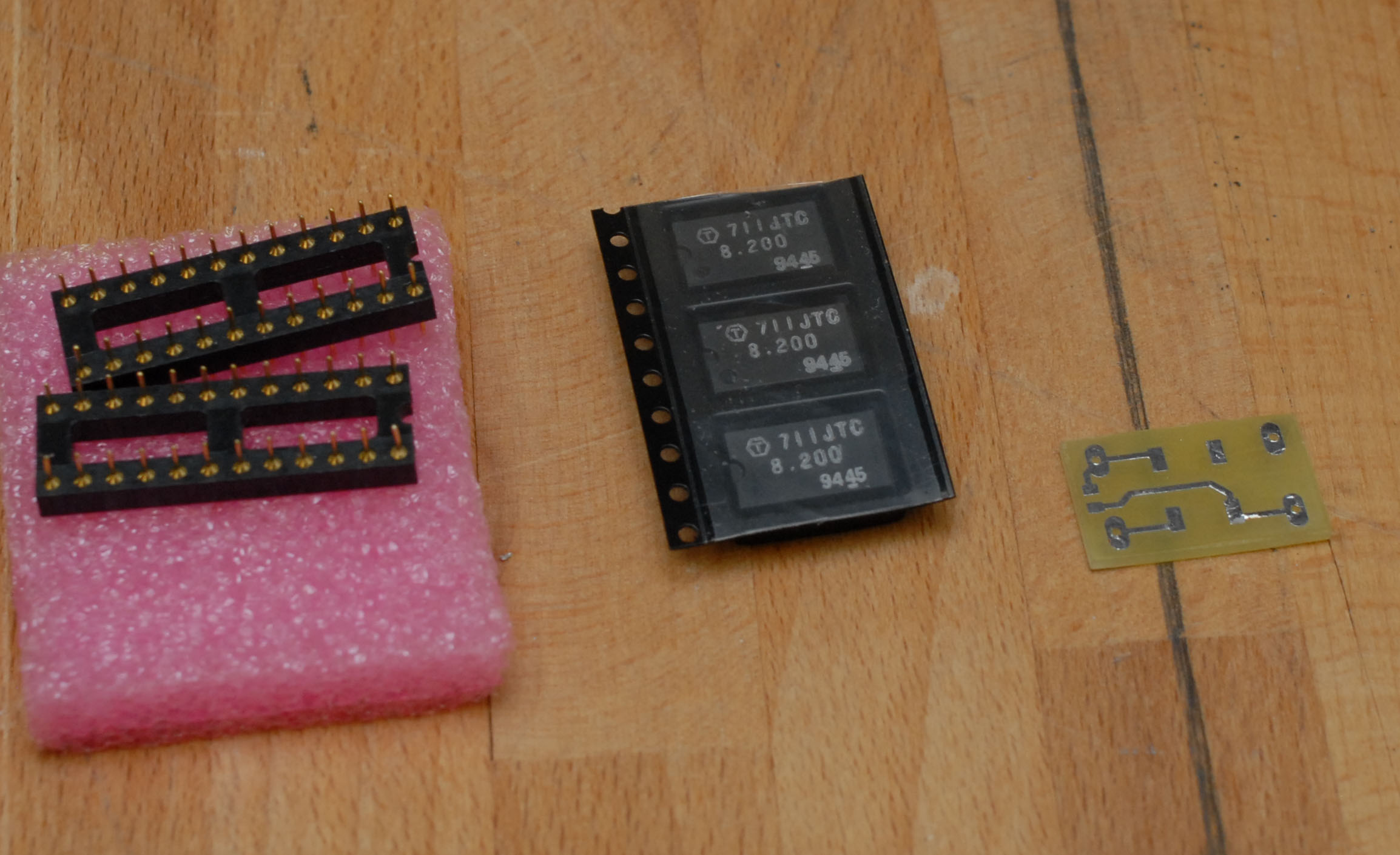
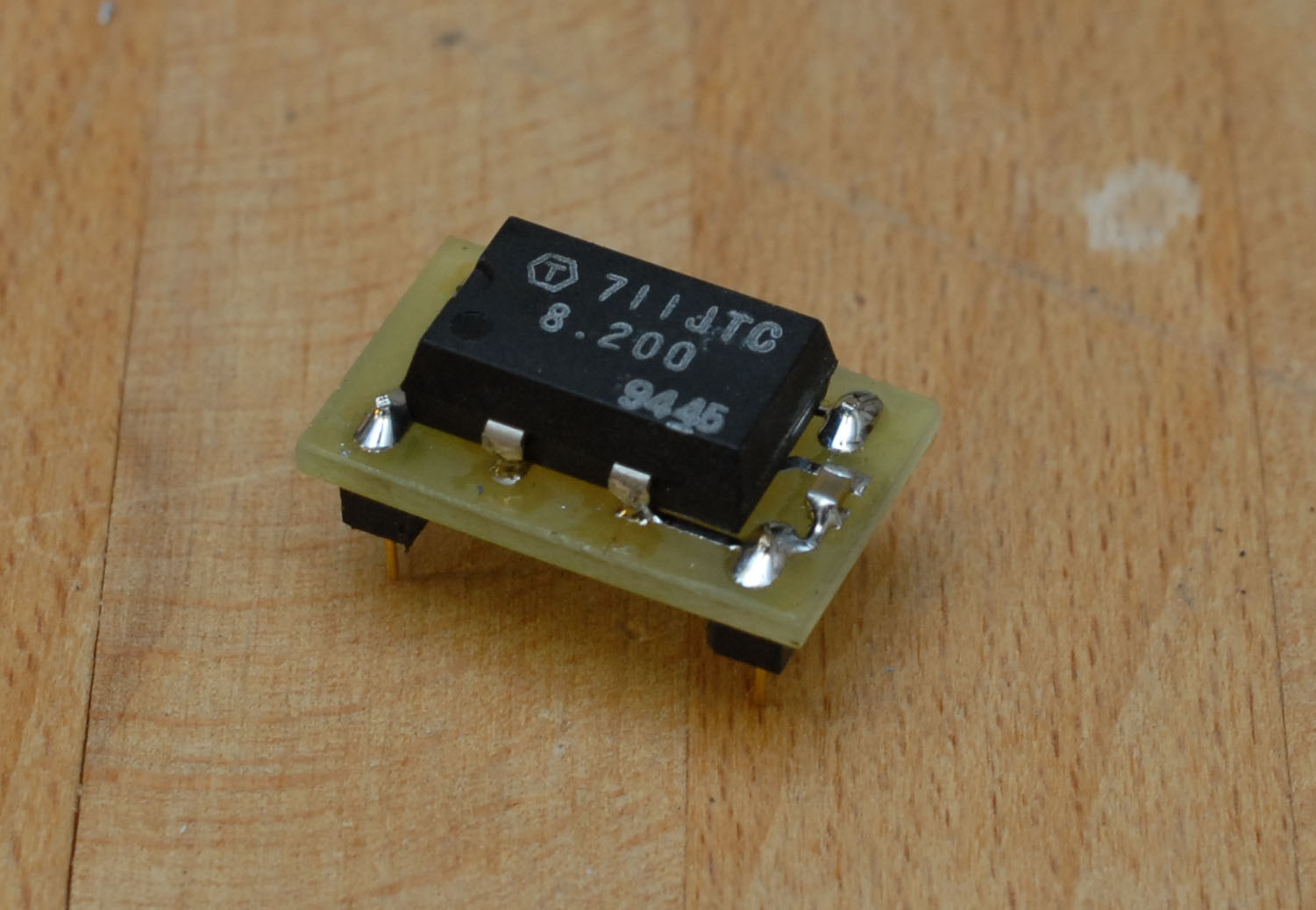
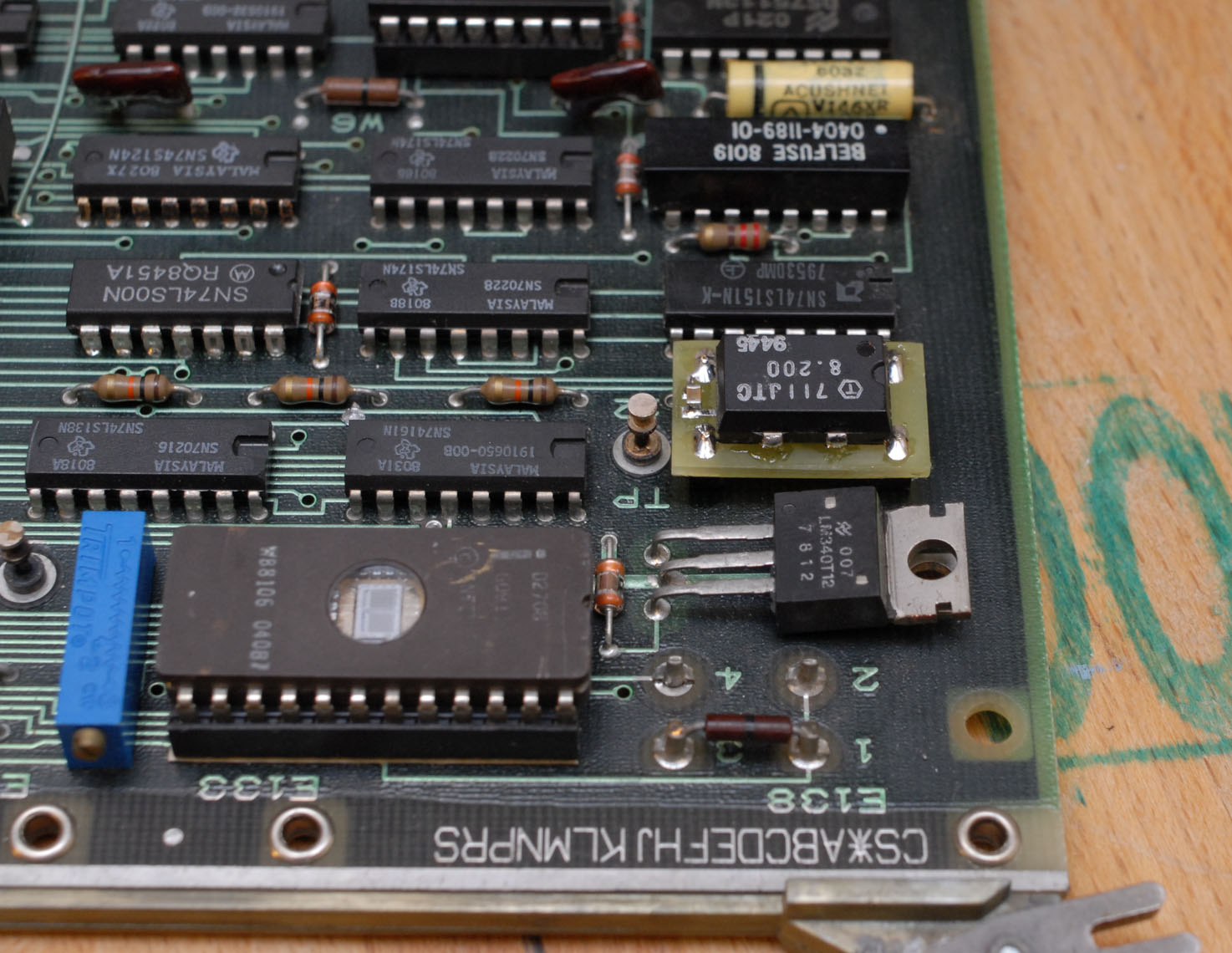
I bought this one on ebay (I'm still waiting for it to arrive):
http://www.ebay.com/itm/250975975234
Datasheet:
http://pdf1.alldatasheet.com/datasheet-pdf/view/161645/EPSONTOYOCOM/TCO-711…
I'm not very good at Japanese(?), but it seams like it is a 5V
component with TTL compatible outputs. I have drawn a small adapter
PCB that I will try to make this weekend. I'll post pictures of it if
anybody is interested.
/Anders
I would have an interest!
I have an original Intellec 4, and have just constructed Martin
Eberhard's superb 1702A EPROM programmer so I can backup the roms. I've
never powered up the unit, but would be happy to provide detailed
pictures etc.
- Gary
Can anyone recommend a reliable source of Commodore SID audio chips? I'm
not hugely picky about the version. Not afraid of the cost of a pair on
eBay, but the sellers all look relatively sketchy.
KJ
From: dwight <dkelvey at hotmail.com>
> What is that controller chip on the early Winchester
> controller boards. That was a 64 pin part.
> G??X300 or something.
Scientic Microsystems (later Signetics) 8X300. It was 50-pin.
Hi cctalkers,
Up for offer is a slightly worn but completely working Commodore SX 64
Executive 'Portable'. This thing is really neat, the drive and monitor are
integrated, making it luggable. I have fixed the keyboard membrane that is
a typical problem with these, the keys all work. Floppy drive works, I'll
include a stack of 5 1/4 floppies with it, one is the xmas demo (it was a
hit here at my office, kinda like a vintage digital snow globe) and the
Uridium video game. I'll also include the SX64 JiffyDOS rom upgrades that I
never got around to installing (~$40 upgrade). This will speed up the drive
access when installed. Also have the original manual and some other stuff
that'll go in the lot. Asking $250, I'm willing to ship, buyer pays
shipping, figure $30-$40 for shipping, I will pack this up and get you a
shipping quote before paying. Paypal, money order, or personal check
accepted (I will wait to ship until check clears).
You can see photos of the C64-SX on my craigslist post here:
http://sfbay.craigslist.org/sby/sys/4371664679.html
I've also some other items:
- Original Commodore C2N Cassette recorder, I think only for use w/ C64,
has special cable interface. Untested, case could use a good cleaning.
$5+shipping.
- Commodore 1541 Floppy Drive, the disc eject mechanism is not working, but
was able to write floppies on this with a PC some time ago (3 years), and
the floppies read on the C64sx mentioned above. $5+shipping, this thing is
solid so may not be a cheap ship.
- 64NIC+ from the Cincinnati Commodore Comp Club in a clear cartridge case.
This was a lot of fun, getting the Commodore onto the Internet and doing
things like Twitter. Working, will include some printouts on how to use
and network utilities floppy from 4 years ago (Twitter client no longer
works due to protocol changes and I haven't looked to get newer versions of
the network tools. $50 obo+shipping.
If you're in the South SF Bay Area, we can coordinate to check the stuff
out and pick up in person.
I love this stuff, but priorities have changed, so I'm hoping this goes
onto other folks that can also appreciate it.
Please email me if you have questions or would like pictures, thanks!
--
Louis Florit - :(){ :|:& };:
I've seen rumours that you can convert a PDP-11 RK05 disk into a PDP-8
style by swapping out the sector hub on the bottom.
Is this:
1. True, I've done it, or,
2 It oughta work, or,
3 No way.
Thanks,
Marc
I'm picking up a Data General Nova 3 system with a removable-pack hard disk drive this weekend, and I would like to learn whether there are any shipping locks that should be engaged before I move the drive.
I have some limited experience with DEC RL02 disk drives, which use the same style of removable cartridge and look very similar overall. The RL02 drives have a little metal plate which is supposed to be rotated to lock the heads in the parked position before moving the drive. It seems logical to me that the Data General drives may have a similar locking mechanism.
I have posted a few pictures of the system over in a VCF thread:
http://www.vintage-computer.com/vcforum/showthread.php?41477-Transporting-a…
I'm pretty much rescuing the system the way a crazy cat lady takes in stray kittens. If somebody in the Los Angeles area is really lusting for a Nova 3 system, I'm willing to put you in contact with the seller so you can make him a better offer. I have way too many projects already... ;)
The same seller also has a PDP-11/03 in a DEC cabinet along with an RX02 that I'm picking up as part of the package. Same offer applies: If somebody wants it more than I do, I'm willing to step aside and hook you up with the seller.
My offer to the seller is pretty low, and I've told him how much more money he might make if he's willing to go to the effort of listing it on eBay, dealing with packing and shipping, etc. (i.e., I'm really not trying to take advantage of him). He accepted my offer because he wants them gone, and he wants them to go to somebody who will appreciate them and not tear them apart for parts and scrap value. So, somebody who lusts after one of these systems probably wouldn't need to sell too many kidneys to outbid me on them. :)
--
Mark J. Blair, NF6X <nf6x at nf6x.net>
http://www.nf6x.net/
Hello, all,
I'm looking for a DEC M8830 DK8-EA (Line Frequency) or DK8-EC (Crystal
Controlled) Real Time Clock board to add to my PDP 8/e.
Anyone out there have a surplus one of these, in known working
condition, that they would be willing to sell(at a reasonable price) or
trade?
Trading stock is varied, and too diverse to list here. If you are
interested in a trade, we can figure out your interests, and see if I've
got something that works in trade.
Please respond by private Email rather than to the list.
Thanks,
Rick Bensene
Just in case anyone's STILL not aware: the Vintage Computer Festival
East "9.1" is only a little more than three weeks from now!!!
You'd be nuts to miss the show this year. It is the largest one ever: 36
exhibits, more than a dozen lectures, consignment/vendors, museum tours,
and a chance to win an oscilloscope from Tektronix.
People are attending from three continents, all over the U.S., and quite
possibly from other planets ... even Altair. :)
All of the details are at http://www.vintage.org/2014/east/ and we're
social at http://www.facebook.com/vcfeast.
If I can't convince you to attend, then maybe Gordon Bell can! Said he:
"As a speaker at the first September 1998 VCF, I have been delighted to
see it grow and flourish. The Vintage Computer Festival is an important
institution for computing history simply by getting everyone together
for collecting, sharing, and trading all form of bits. Having a forum,
gathering, and market for old stuff a.k.a. vintage computers and the
software that made them live is an essential way to preserve and expand
the history of computing -- for some of us, the greatest invention."
So, cctalk'ers ...BE THERE or be out of alignment. :)
> Date: Sun, 9 Mar 2014 09:20:00 -0700
> From: "Ian S. King" <isking at uw.edu>
> To: cctalk at classiccmp.org
> Subject: Re: cctalk Digest, Vol 127, Issue 13
> Message-ID:
> <CAKtEJ03PodBWHzvwax32bvvzW+DQpfAJi5JevnEMiC=azEp8=g at mail.gmail.com>
> Content-Type: text/plain; charset=ISO-8859-1
>
>>
>> Date: Sat, 08 Mar 2014 12:29:41 +0000
>> From: anders at abc80.net
>> To: cctech at classiccmp.org
>> Subject: Re: PDP-8a Restoration/RL01 issues
>> Message-ID:
>> <20140308122941.Horde.9d9EcJ0ZUHxRqnL8YaU7-g5 at blue.abc80.net>
>> Content-Type: text/plain; charset=UTF-8; format=flowed; DelSp=Yes
>>
>> Just a small update about what I have found so far.
>>
>> 1. The "FAULT" lamp on one of the drives was broken.
>> 2. The solenoid on the other was jammed. This means that both drives
>> behaves the same.
>> 3. There is no clock present from the controller.
>>
>> Have to fix the controller first.
>>
>> /Anders
>
>
> Re: PDP-8a Restoration/RL01 issues
>
> Be sure you have the Berg connector on the controller oriented
> correctly. You won't break anything if you don't, but the clock won't
> get to the drive, as you're seeing. -- Ian
>
> --
> Ian S. King, MSCS ('06, Washington)
> Ph.D. Student
> The Information School
> University of Washington
>
> Madness takes its toll - please have exact change.
>
I have traced the problem back to the RL8A. The 8,2MHz oscillator is
not working. I cut the leg on the next IC after the crystal
oscillator, a 74LS00 to make sure that nothing after the integrated
oscillator was holding the clock down. I'm now waiting on a new
oscillator, unfortunately I was not able to find a though hole mounted
one, just a SMD part...
/Anders
>
> From: Jules Richardson <jules.richardson99 at gmail.com>
> Date: Fri, 07 Mar 2014 14:53:28 -0600
> Subject: Re: Vintage Sun systems available
> On 03/07/2014 12:27 PM, Lyle Bickley wrote:
>
>> 1. Sun 386i. Looks clean - opened it up
>>
>
> You didn't happen to take a photo of the Roadrunner image on the inside of
> the case, did you? I was looking for an example online the other week and
> couldn't find one anywhere, which was surprising.
>
> cheers
>
> Jules
>
You didn't look here:
https://sites.google.com/site/mthompsonorg/Home/sun-microsystems/sun-386i-d…
Hi all,
Does anyone have any interest in a modern 4004 or 4040 development system?
I posted to the Vintage Computer Forum but didn't get a lot of interest
there. It would be similar in functionality to an Intel Intellec 4, but
will be smaller and will use a keypad with a hex display.
I've got some rudimentary plans thus far, but don't really have an interest
in continuing if there's not a community interest.
Thanks,
Kyle
David,
So where does one look for a VAX4000/600+ that is not on eBay (but,
hopefully, in the UK)?
Regards
Rob
On 11 March 2014 23:34, Robert Jarratt <robert.jarratt at ntlworld.com> wrote:
> ------------------------------
> From: David Riley <fraveydank at gmail.com>
> Sent: 11/03/2014 19:47
> To: General Discussion: On-Topic and Off-Topic Posts<cctalk at classiccmp.org>
> Subject: Re: You have got to be kidding me
>
> On Mar 11, 2014, at 3:04 PM, Benjamin Huntsman <
> BHuntsman at mail2.cu-portland.edu> wrote:
>
> > A VAXstation just sold on eBay for $2,021.51.
> > I may be off my rocker, but that seems a bit high... :)
> >
> >
> http://www.ebay.com/itm/DEC-Vaxstation-4000-90-VS49K-AB-CPU-KA49-May-Work-P…
>
> This has been bandied about on this list before. The 4000/90 is an item
> on some important US DoD contract, so that specific model goes for a
> premium because resellers know they pretty much have a guaranteed sale
> for it. It's a shame for the rest of us, since the 4000/90 is a pretty
> nice machine, but you can get a machine with equivalent performance in
> the VAX4000/600+ range (those are the deskside towers, not to be confused
> with VS4000). If you know where to look (not eBay), you can often get
> those a LOT cheaper.
>
> VS4000/96 machines go for about twice what the 4000/90 machines do on
> eBay.
>
>
> - Dave
>
>
>
This is just a little test so that the infamous PCjr can serve (most) of
its own web site:
http://67.185.176.54:8080/
That link has the main page, and it should look like my normal PCjr web
site. This next link has some fun server status like memory available,
DOS version, BIOS date, etc.:
http://67.185.176.54:8080/proc/
You might find the TCP/IP statistics interesting. It's been running
over 24 hours now.
There are one or two links that are broken because I did not get all of
the content moved over. Otherwise, it should work if you try it. The
speed might not be great as it is a 4.77Mhz machine and multiple people
can make requests at the same time, so be patient - it will catch up.
Please, no saturation bombing - it is very easy to DoS this particular
DOS machine.
-Mike
Vintage 1GB narrow SCSI hard disk (DEC DSP3015) - formatted, tested & working
http://www.ebay.co.uk/itm/271422359680
I have other auctions running for a working, upgraded Quadra 650,
original (not chicklet) Apple wireless keyboard & mouse and more. I
though the hard disk would be the most interesting to CCmp, though.
--
Liam Proven * Profile: http://lproven.livejournal.com/profile
Email: lproven at cix.co.uk * GMail/G+/Twitter/Flickr/Facebook: lproven
MSN: lproven at hotmail.com * Skype/AIM/Yahoo/LinkedIn: liamproven
Tel: +44 20-8685-0498 * Cell: +44 7939-087884
Unfortuantely, i'm looking to have to sell off a peice or two of equipment
to fundraise a bit.
I need to get rid of this stuff quick, preferably today or tomorrow. Paypal
or cash in person accepted.
The equipment is in Bel Air, MD.
NeXT system (complete mono slab monitor and all) - $250
Sun IPX/LX/Classics varios configurations ad requested - make offers
One each SLC and ELC available.
old in box TI-99/4a unused/untested - broke the seal on the inner packaging
to make sure all manuals were there. - offers requested.
IBM RS/6000 B50 - probably annyoing/tricky to ship. $50 - 512MB ram and
2x9.1GB drives mounted and ready to go.
NeXTstation color is available now, but will be pricier due to soundboxes/y
cables/etc required to make use of that. Parts available but in extremely
limted quantities.
And other various odds and ends such as 13W3 cables, scsi cables, etc.
This is a sampling of what's available - i'll add more if i can think of
what's worth listing. Inquiries for anything else in my collection you
might be interested in or wonder if i have - let me know.
Something new, as well
Dual Quad Xeon HP DL380 G5 with 10GB ram and 0 HDDs - $200
--
Gary G. Sparkes Jr.
KB3HAG
Can anyone tell me how to write a .DSK (JV3) image of Super Utility 4 for
TRS-80 Model IV to a real diskette?
The image boots in my xtrs80 emulator, but it cannot copy itself. If I
boot either TRSDOS 1.3 or LDOS 6, they do not recognize the image file as
a valid disk.
Sort of a Catch-22, yet I understand it is possible.
Terry (Tez) appears to have done so based on his web site writeup, but
it's unclear how the techniques mentioned (ImageDisk) apply to a
non-standard JV3 image.
I have the feeling the solution is obvious, for some definition of
"obvious", but I'm not seeing it.
Steve
--
Hi there,
I am looking for photographs or replacement parts for a Unitron U2000/Linden
Series One keyboard. It was working however in doing some testing with it I
think it blew the controller chip, which is a 2732 EPROM. I've changed all
the other chips with no success. Was hoping to find a reference photo just
to make sure I haven't messed anything up, or if possible a dump of the
controller ROM. Not urgent but hoping to get this running again someday
soon. Basically right now nothing works except CTRL-RESET
Thanks!!
Brad
> So I put in the RL8A disk controller (M8433) and connected the cable
> to one of the drives at a time. Also connected the terminator on the
> drive.
What type of cable are you using?
I have seen two different styles of cable -
1.) Controller-to-drive.
Cable goes directly from controller into the drive itself with no bulkhead connector.
(RL connector on one end, berg connector on the other end)
2.) Controller to bulkhead adapter, then standard RL cable from bulkhead adapter to drive.
Ribbon cable goes from controller to an intermediate (bulkhead) connector.
(Bulkhead piece has a berg connector on one side, and an RL connector on the other.)
If memory serves, and you are using the bulkhead style intermediate connector,
an incorrectly pinned ribbon cable could produce similar results.
I don't recall if the ribbon cable is pinned straight through, or if one of the connectors is flipped.
Just a thought.
T
>
> Date: Sat, 08 Mar 2014 12:29:41 +0000
> From: anders at abc80.net
> To: cctech at classiccmp.org
> Subject: Re: PDP-8a Restoration/RL01 issues
> Message-ID:
> <20140308122941.Horde.9d9EcJ0ZUHxRqnL8YaU7-g5 at blue.abc80.net>
> Content-Type: text/plain; charset=UTF-8; format=flowed; DelSp=Yes
>
> Just a small update about what I have found so far.
>
> 1. The "FAULT" lamp on one of the drives was broken.
> 2. The solenoid on the other was jammed. This means that both drives
> behaves the same.
> 3. There is no clock present from the controller.
>
> Have to fix the controller first.
>
> /Anders
Re: PDP-8a Restoration/RL01 issues
Be sure you have the Berg connector on the controller oriented
correctly. You won't break anything if you don't, but the clock won't
get to the drive, as you're seeing. -- Ian
--
Ian S. King, MSCS ('06, Washington)
Ph.D. Student
The Information School
University of Washington
Madness takes its toll - please have exact change.
Hi!
I managed to netboot NetBSD 6.1.3 in my HP 9000/375.
Its external HD shows major failure (PCB, I suspect), so no local disk
by now :(
After some repairs, the 9121D passes all tests (confidence, and the ones
performed setting HPIB address and shorting the J7 test pin).
But when I connect it to the 375, I don't see the 9121 in the initial hw
list and I've not been able to figure out how to address it with NetBSD.
1) The SCSI/HP-IB and the HP-IB ports are equivalent?
2) The 9121 must be set to some "special" HP-IB address?
3) On the processor card, under the SCSI/HP-IB port, there's a 50pin
connector, which looks like a SCSI-50. Can I connect there a standard
SCSI disk?
Thanks!
--
Retromuseum:
http://www.supervinx.com/Retrocomputer
You can reach me at:
http://www.youtube.com/supervinxhttp://www.myspace.com/supervinxhttp://www.facebook.com/supervinx
Just a small update about what I have found so far.
1. The "FAULT" lamp on one of the drives was broken.
2. The solenoid on the other was jammed. This means that both drives
behaves the same.
3. There is no clock present from the controller.
Have to fix the controller first.
/Anders
A few days ago I was doing my usual scan of Weirdstuff's inventory and
came across the following vintage Sun system:
1. Sun 386i. Looks clean - opened it up - memory and HDD controller
present - no SCSI HDD.
2. Multiple Sun-4 systems, part number 600-2157-01, Model 247. OEMed and
labeled "CADNET IX". I did not open them up - but look quite clean from
the outside.
If you are interested in any of these systems, email me privately and
I'll give you the contact at Weirdstuff.
Note: My only relationship with Weirdstuff is as a client and I do not
receive compensation for any item I mention on this list. I do this to
preserve vintage systems from being scrapped.
Regards,
Lyle
--
Bickley Consulting West Inc.
http://bickleywest.com
"Black holes are where God is dividing by zero"
>> ?
>> So I put in the RL8A disk controller (M8433) and connected the cable ?
>> to one of the drives at a time. Also connected the terminator on the ?
>> drive.
>> ?
>> The first drive that I tested turned on the "READY" light, then ?
>> nothing more happened. I was able to open the drive immediately.
>
> That does not sound right. You do mean 'ready' -- the one with the drive?
> number on it? ?A Drive should only be 'Ready' when it's spun up to speed,?
> the heads have loaded, and the head servo has locked.?
Yes, the white indicator with either a "0" or a "1" on it! It didn't
feel right.
>> ?
>> How much of this depends on a working controller (RL8A)?
>
> Just about all of it. The drive needs a clock signl from the controller?
> even to do things like check the motor is n't truning (which is necessary?
> before the cover unlocks). If the clock is missing, the 'Fault' light?
> comes on, but of course there are many other causes for this.
>
About the cover, when should it be unlocked? Is it open when the power
is off (I suspect that it should be locked)?
The thing is that the cover is always unlocked on one of the drives,
on the other drive it seams like it's locked when the power is off.
> It's been some yers since I've been isnde an RL, but I would start by?
> checkign all the indicator bubls (you do not want to be getting false?
> information becuase of a burned-out bulb!). Then, IIRC, the 'Fault' lamp?
> is drven by the logic OR of a lot of signals (I seem to revcall active?
> low signals and a '30 NADN gate here). If the Fault light is on, then see?
> whic signal(s) is asserted, and trace back from there.
I will check the bulbs and then check what errors that have been asserted.
/Anders
Do you remember the realcons interface based on Henk Gooijens core-I/O board
a few years ago? If so, read on!
I have rewritten Henk's realcons software (and Henk made a new eeprom for me)
for SIMH v4.0 and named it OPCON (OPerator Console).
The original software was based on counters who's settings needed to be
tested based on the cpu processing speed, OPCON uses SIMH's event timer
queue to control the updates send to the external console and is therefor
not depending on the cpu speed.
OPCON is also more in line with SIMH's command structure, so one can
use 'attach oc connect=ser0' for example to a) active the
device, and b) to specify which serial port to use. Speed is always
9600-8N1. Try 'help oc' or 'help set oc'.
With 100 updates per second the console does show the data and does
interact pretty well with the simulator.
I have had the simulator running for several hours continuously, and no
crashes did appear until now.
Currently tested only on Unix/Linux, not on windows, although it should
work.
For now, the modified SIMH files and the software can be downloaded
at www.groenenberg.net/download/OPCON. The zip file can be used as
a drop-in replacement of your own source code set you pull from github.
Some pics can be found using the same link, and 2 small video's are
OPCON for the 11/45 : http://youtu.be/qfLkMfLMZVE
OPCON for the 11/70 : http://youtu.be/MpuCwFmOEms
Looking forward to receive suggestions and to hear about problems
or possible code fixes.
Enjoy,
Ed
--
Dit is een HTML vrije email / This is an HTML free email.
Zeg NEE tegen de 'slimme' meter.
I have a few DEC RL02 drives, and a Data General drive that uses a pack that appears physically identical to the RL02 packs other than a different sector pulse ring. I haven't begun the process of bringing any of them up yet, but I've removed the air filter from the Data General drive to look at it. It looks like a standard style of HEPA filter, with filter media zigzagged around wavy aluminum spacer plates and then mounted in a plastic box. It looks quite gray on the input side, and he label suggests it was last replaced in the mid to late 1980s. I assume that NOS filters for these drives aren't just laying about in piles, and even if they are, a time will come when there aren't any spares to be found. Thus, I'm interested in what it would take to overhaul existing filters and/or fabricate new ones from scratch.
First of all, I assume that it's not practical to clean the existing filter media very thoroughly. If I'm mistaken, then I'd like to know that.
It seems to me that I should be able to rebuild a filter like the one in my DG drive assuming that A) I can get it apart without breaking the housing (may not be possible if the edges of the media is strongly glued to the housing?), and B) I can obtain suitable bulk HEPA filter cloth to use. Even if the housing can't be disassembled nondestructively, I might be able to reuse the aluminum spacer plates at least.
By the same token, it should be possible to construct new filters from scratch as long as the bulk HEPA filter cloth is available.
So, what have other folks already done in this area? Are there suppliers of bulk HEPA filter cloth who would sell in the small quantities that a hobbyist would need? Maybe suitable filter media can be harvested from off-the-shelf items like automotive air filters?
--
Mark J. Blair, NF6X <nf6x at nf6x.net>
http://www.nf6x.net/
For those who might be interested...
These are not what I would call classic micros but they do represent a bit
of home computing history. They are now part of my collection and I've
introduced them as such in the link below:
http://www.classic-computers.org.nz/collection/c16-and-plus-4.htm
Terry (Tez)
Subject:
Re: Pack cleaning (was: Re: Convert PDP-11 RK05 disk pack to PDP8)
From:
Kyle Owen <kylevowen at gmail.com>
Date:
Wed, 5 Mar 2014 18:39:43 -0600
To:
"General Discussion: On-Topic and Off-Topic Posts" <cctalk at classiccmp.org>
<<In fact, a while back, I fixed an MFM hard drive from an IBM PC/AT in the cleanroom. Completely dismantled the platters from the spindle, put it back together, and got several more months of service out of it, until it wouldn't spin up on its own (had to kick-start it). >>
Kyle, that's really neat. Would you tell more about how you got the platters out? Were you able to lift the heads off the platters before retracting them, or were you simply able to slide the heads across the platters, and off the platters?
Thank you,
John S.
> Date: Wed, 5 Mar 2014 20:37:57 -0500
> From: David Gesswein <djg at pdp8online.com>
> To: cctech at classiccmp.org
> Subject: Re: PDP-8a Restoration/RL01 issues
> Message-ID: <20140306013757.GA8832 at hugin2.pdp8online.com>
> Content-Type: text/plain; charset=us-ascii
>
> On Wed, Mar 05, 2014 at 09:32:02AM +0000, anders at abc80.net wrote:
>
>> How much of this depends on a working controller (RL8A)?
>>
> I haven't gotten to getting my drives working so can't give first hand
> info. From previous postings the drive needs the clock from the controller.
>
Ok, I see. I have now found the 8,2MHz clock generator on the
RL8A-controller, to check that must be a good start. Then the line
driver circuitry so the clock shows up in the drive.
>
>> For a start i would like to run the controller diskless controller
>> test, AJRLAAO. Then the AJRLBAO/AJRLCAO drive test. I have searched
>> the net after those but haven't found any sources. I wander if
>> anybody have those and the documents on them?
>>
> No good scans appear to be available. January posting with link to
> photos from my fiche viewer. I have the full set but no easy way to
> scan. I can take more pictures this weekend if you find you need them.
> http://www.classiccmp.org/pipermail/cctalk/2014-January/155010.html
>
> My fiche are for newer revisions than the binaries I have. You can
> download .bn tape image by clicking on the more link on this page for the .dg
> http://www.pdp8online.com/pdp8cgi/os8_html?act=dir;fn=images/os8/diagpack2.…
>
Thanks, I will try to run the diskless test during the weekend and
I'll see what that might give.
>> Then what else should I do?
>>
>> From my RK05 work clean drive and heads and inspect/clean pack. Hopefully
> people more familiar with RL01 will chime in. Do RL drives have bad foam
> that needs replacing?
>
> If you get the system up and the pack have interesting contents I would like
> to get a dump at some time. I started working on a dump/restore for RL
> packs but it hasn't gotten tested since I didn't have a working system
> and the person I was working with didn't try it. I should be able to get
> it running after VCF in early April.
> http://www.pdp8online.com/ftp/software/dumprest/
Now I got some more things to try and this will probably help me to
get a bit further. When I get the system up I'll try to make the
content availabe if possible.
/Anders
> Date: Thu, 6 Mar 2014 01:05:54 -0500
> From: Ethan Dicks <ethan.dicks at gmail.com>
> To: "General Discussion: On-Topic and Off-Topic Posts"
> <cctalk at classiccmp.org>
> Subject: Re: PDP-8a Restoration/RL01 issues
> Message-ID:
> <CAALmimmGTKGksHJiqbo+TQV12pw2J7QEbEPZexc+bPCG+4-_Eg at mail.gmail.com>
> Content-Type: text/plain; charset=ISO-8859-1
>
> On Wed, Mar 5, 2014 at 8:37 PM, David Gesswein <djg at pdp8online.com> wrote:
>> Hopefully
>> people more familiar with RL01 will chime in. Do RL drives have bad foam
>> that needs replacing?
>
> I don't remember any major foam issues, certainly nothing like the
> RK05. There is usually some coarse foam at the front of the drive, in
> front of the HEPA filter, but that's quickly removed and cleaned. The
> insides are foam-free IIRC. Lots of hard surfaces to wipe down for
> dust, though. I'd certainly do that, including swabbing the tubes
> behind the HEPA filter if the drive has been stored for a long time
> and you see dust in the pack area (less crud for the HEPA filter to
> suck up).
Yes, those drives needs a cleaning for sure. They where actually much
cleaner inside than I expected.
>
>> If you get the system up and the pack have interesting contents I would like
>> to get a dump at some time.
>
> One does not require a PDP-8 and RL8A to back up an RL01 or RL02 pack.
> Any machine can make a block-for-block image copy. It's one command
> on VAX/VMS ($ BACKUP/PHYSICAL). If you have another system and
> interface, that might be easier than dealing with a medium that's 2.5
> times the max size of an OS/8 device.
>
> -ethan
Intressing, but I don't have any more modern DEC running. I have a
micro PDP11/73 with an RL controller though, but that have not been
running for ten years at least.
/Anders
Hi,
My restoration project continues, after fixing power supply and some
issues with the DKC8A (Option #1) the machine now passes the CPU test
and the memory test (machine is now equipped 32k core). The setup of
the machine is minimal:
- PDP8A CPU, KK8A, M8315
- Option #2, KM8A, M8317
- Option #1, DKC8A, M8316
- Core memory DATARAM Corp. 16k*12 (field 4-7)
- MM8AB, 16k core (field 0-3)
So I started on the RL01 drives. Since I never had used those, I don't
now how they should work. I'm learning those things from the manuals...
So I put in the RL8A disk controller (M8433) and connected the cable
to one of the drives at a time. Also connected the terminator on the
drive.
The first drive that I tested turned on the "READY" light, then
nothing more happened. I was able to open the drive immediately.
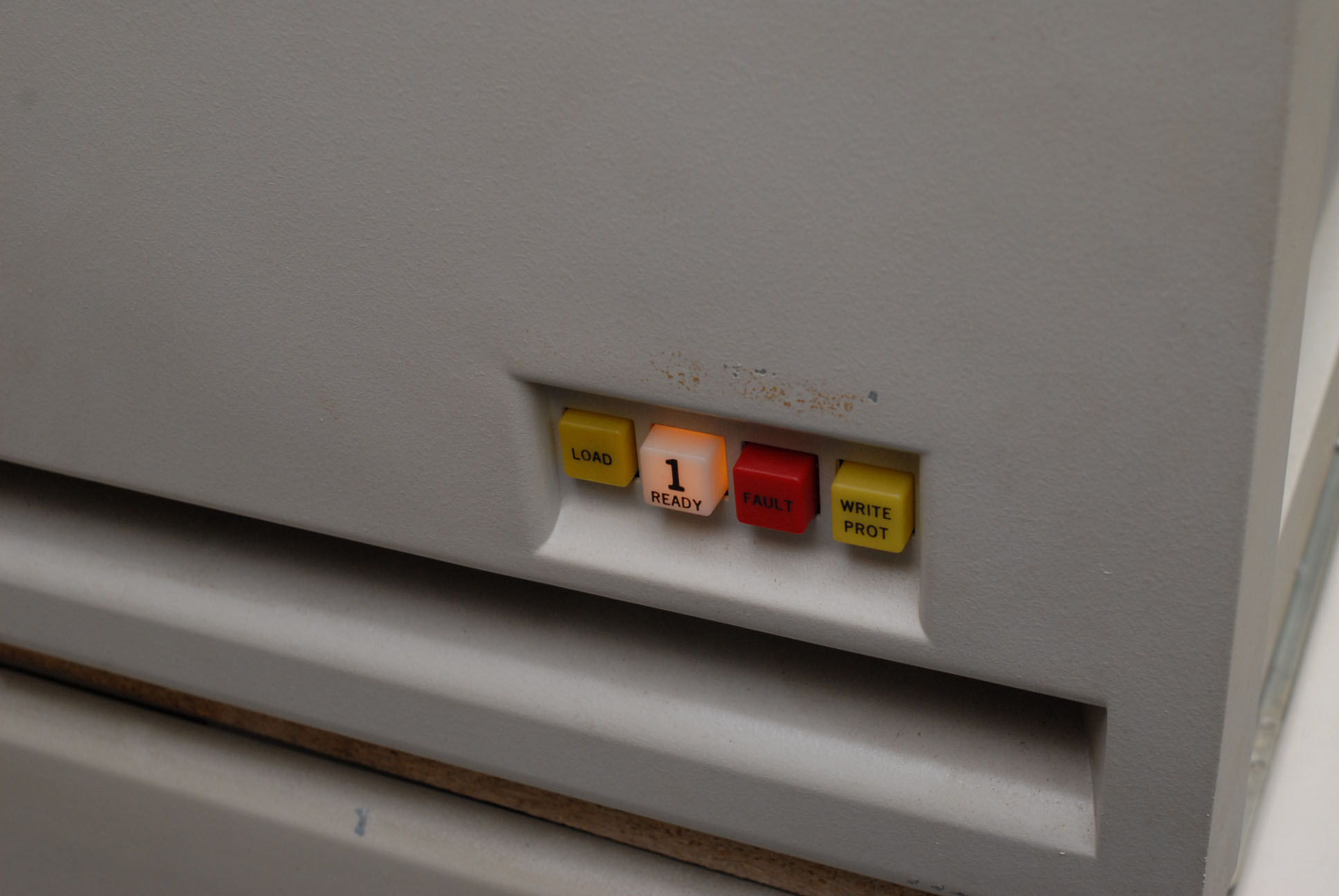
The other drive that I tested turned on the "READY" and the "FAULT"
light, then nothing more happened. I was able to open the drive
immediately. I opened this drive up (unscrewed the lid) and noticed
that the spindle motor rotated slowly for 10 seconds when i powered up
the drive with a cartridge in it. I also measured the voltage on the
power lines and got this:
5V: 5,1V
8V: 7,7V
-8V: -7,9V
Ureg: 15,5V
-Unreg: -15,2V
Which should be fine according to the "Rl01/Rl02 Technical Manual,
Volume 11-Service Procedures"
What I have read in the manuals is that the drives should behave like this:
1. Power on, no lights should come on.
2. After a while the load light should illuminate. Now it should be
possible to open the lid and load a cartridge (and place the
protection on the top).
3. Close the lid and press "LOAD". Load should now go out.
4. The drive should spin up and read the servo data. When done the
"READY" should illuminate.
How much of this depends on a working controller (RL8A)?
For a start i would like to run the controller diskless controller
test, AJRLAAO. Then the AJRLBAO/AJRLCAO drive test. I have searched
the net after those but haven't found any sources. I wander if anybody
have those and the documents on them?
Then what else should I do?
/Anders
> Date: Wed, 5 Mar 2014 18:41:30 -0600
> From: Kyle Owen <kylevowen at gmail.com>
> On Wed, Mar 5, 2014 at 3:42 PM, Paul Koning <paulkoning at comcast.net> wrote:
>
>>
>> On Mar 5, 2014, at 3:08 PM, Tony Duell <ard at p850ug1.demon.co.uk> wrote:
>> > ...
>> > You don't ahve to mechanically balance it as well. Of course just
>> > centring the disk accurately is non-trivial...
>>
>> What's the required accuracy? With some patience and an inexpensive dial
>> indicator, centering to .001 inch (25 micrometers) is doable; lathe
>> operators do it all the time with their 4 jaw chucks.
>
>
> What about using an inspection microscope over the disk surface to visually
> align it? I imagine you could get a bit more precision this way, perhaps.
>
> Kyle
For ~$50+ (U.S.) you could get a 0.0001-inch capable test indicator
off of eBay. Or spend ~$300 for a Starrett (or equal). (Plus the
cost of an indicator holder.)
Bob
Hey all,
I am not sure if this is the right place to ask (please flame gently if
not), but: I have an old Kodak LifeSciences SCSI CD Library (model CDL-144)
and haven't been able to find out very much about it. The robot component
responds to the standard SCSI changer commands (as issued by, for example,
mtx-1.2.18, but not mtx-1.3, AFAICT) and the drives of course open and
close in response to the standard eject command, but I have not been able
to figure out how to do useful things like open the mail slot, set the
password, or dump (or update, if only I had an image!) the firmware over
the SCSI bus. The only manual I've ever found online is just the "getting
started" guide and points to kodak.com for more, but of course that's no
longer around and even the wayback machine hasn't been that useful... thus
this plea for anyone who knows anything about the device to share, even if
off list.
Thanks much in advance,
--nwf;
Hi all,
Does anyone have any documentation for this Data Systems 68 6847 video
board? I should have most of the parts to build it up. I'm going to get a
good, high-quality scan of the PCB, front and back, before I do that though.
http://i.imgur.com/JLJqsdx.jpghttp://i.imgur.com/vmE916Z.jpg
Looks related to the 6845 variant, but I imagine this 6847 board has more
graphical capability.
http://www.swtpc.com/mholley/DS68/VDB_Index.htm
Thanks,
Kyle
On Steve's SU4 copying saga, it sounds like Steve had the
copy-protected, self-booting SU4, while Terry has a non-copy-protected
one. Both existed.
I have the non-copy-protected version available for download on
http://tim-mann.org/misosys.html#down, as a /cmd file that you would
have to import onto a TRSDOS or LDOS 6 disk, say with an emulator
utility. Once you import it, this is the easiest version of SU4 to
deal with.
I also have a copy of a preliminary version of the self-booting SU4
(from Kim Watt's personal collection). I've never seen the final
released version. My notes say that I successfully copied this version
to DMK (using a Catweasel and cw2dmk) and it worked in xtrs. My notes
also say that it was not representable as JV3. So a copy-protected SU4
that works as a jv3 but can't be copied to dmk by jv2dmk sounds like a
really odd duck. I would be interested in a copy of that jv3 to see
what it is and why jv2dmk doesn't work on it -- would also like to
know where it came from.
--Tim
Hi!
I know it shouldn't be done :)
I don't have any installation media for HP-UX 9.x or older.
I have a disk image with HP-UX 9.03 installed, coming from an HP
9000/425t, and it worked (after minor tweaks) on my HP 9000/375.
Now I'm recompiling the kernel, since some drivers are missing.
I'm lucky, that image has a C and a Fortran77 compiler installed.
Do you know if some HP-UX 9.x (or earlier) images can be found?
I'd accept also DDS-x or QIC tape images...
Thanks!
Hey all --
Recently got myself a system equipped with a Memorex 214 hard drive. The
system's going to be shipped to me eventually, and I'd like to take
precautions to avoid damage during transit. The 214 looks to be an 8"
drive, so it almost certainly requires a special procedure to lock the
heads and/or spindle. Does anyone know what the procedure is for this
drive? (I need something simple and clear enough for the seller to deal
with...) I found the 112/114 manuals on Bitsavers, but I don't know if
these are similar enough to the 214 to be relevant. I can't find much on
these drives at all.
(I'm also assuming the official procedure will require getting the heads to
a safe "parked" position, which is not likely to be possible given the
state of the machine (i.e. unknown running condition). Am I making things
worse by locking the heads at some random position?)
Thanks in advance,
Josh
On 03/04/2014 10:58 AM, cctalk-request at classiccmp.org wrote:
> I need to buy a JTAG cable for programming a Spartan 3 and a Spartan 6 FPGA.
> I already have this one:
I got a Digilent at work, and had a lot of trouble getting
the drivers installed and working on Linux.
Later, for home, I got what claims to be an official Xilinx
Platform Cable USB on eBay, from a Chinese supplier.
It was much easier to get it running, and it has programmed
everything I've tried it on. I make a number of boards
that use Xilinx CPLDs and FPGAs, from the original 5V
Spartan and 9500 to the Spartan 3A and 3AN, 9500XL
and Collrunner II, and it has programmed all of them
perfectly.
I have no idea whether these are really unauthorized clones
or official Xilinx products, but I can say they work, and
are relatively cheap - cheaper than the Digilent.
Jon