I thought I'd seen a call for a keyboard for some terminal in the recent
past. This one may be of interest on its own, or may be a good starting
point for building up a keyboard for a system.
Texas-Instruments-914-Keyboard-943632-1B-Vintage
http://www.ebay.com/itm/221811058146
Hello Folks,
I have an Ultra 10 "Creator 3D" with everything but the CPU. I have:
- case
- motherboard
- DIMMs
- IDE CDROM
- CPU daughtercard (without CPU or CPU positioner)
- CPU heatsink and backing plate
I need to get this system working again. Please don't ask why only the CPU (and
the positioner) are missing.
What is the simplest way to get this Ultra 10 running again? What CPUs are
compatible, and how can I get a positioner?
Or if someone has a Ultra 10 s/he'd like to sell to me, please make me an offer.
cheers,
Rob
P.S. by "positioner" I mean the springy little plastic thing that drops into the
4 holes at each corner of the socket and causes the CPU contacts to be correctly
positioned over the daughtercard contacts.
Hi list,
I'm implementing my own CP/M-80 work-alike using the FAT16 file system.
So far it's working nicely but there's a curious problem with Microsoft
BASIC. MBASIC51.COM will load files fine, but MBASIC52.COM won't,
behaving like the files are 0 bytes long. It calls the open-file routine
and that's it.
I'm just curious about the differences between version 5.1 and 5.2. I'm
assuming I'm not returning correct information in the FCB, but I'm
unable to figure out what that might be.
Here's a video of it: https://www.youtube.com/watch?v=XT4dBda2CKw
Cheers,
Alexis K.
>
> The processor and core memory in the PDP-12 are working very well now, so
> we spend some time with the TC12 LINCtape controller. The TC12 is very
> intelligent compared to the more modern TC01/TC02/TC08, and the lobotomized
> TD8E DECtape controllers. The TC12 designers included lots of back-doors to
> make diagnostics more effective. You can even emulate the data coming from
> the TU56 to see if the TC12 processes it correctly.
>
> The MAINDEC-12-D0GA-A Tape Quickie ran OK and just tests that the TC12
> registers can be written and read back.
>
> The MAINDEC-12-D3AD-D-D Tape Control Test Part 1 of 2 ran for a long time
> and then displayed "LGP GP=GPC PRESET". It pointed to an M216 module that
> uses the SN7474 ICs that have caused lots of trouble on other modules. It
> tested OK, so we put it back in. We will consider replacing it anyway if we
> see further problems.
>
> The MAINDEC-12-D3GA-D-D Tape Control Test Part 2 of 2 ran OK as long as
> you held the MARK switch on the console down. The MARK switch on the
> console allows a program to turn on the MARK Track flip-flop in the TC12.
> This is not documented in the manual, but was a hand written note in the
> margin.
>
> The MAINDEC-12-D3FB-PB Tape Data Test ran for a long time writing patterns
> to tape and verifying that they were written correctly. This means that
> lots of the TC12 LINCtape controller is working, as well as the TU56 tape
> drive. It eventually failed when it tried to verify the block numbers. We
> are not sure that the scratch LINK tape that we used is good, so that may
> be a contributing factor. Maybe we can get the MARK-12 program working and
> we can reformat the scratch tape. We have just a few LINC tapes and need to
> image all of them before we write on them.
>
> Two more lights on the front panel stopped working. We tested the SN7400
> ICs that send the signal from the registers to the front panel, and they
> are OK. The bulbs are OK, so the transistor that turns on the bulb probably
> failed. We already replaced one for the LINC light, so we know the
> procedure.
>
> We are getting close to the point where we will need the VR14 display
> working to continue our work. Getting the display working will be quite a
> project. The PVA between the CRT and the shield has degraded and is nearly
> opaque. We will need to remove the outer CRT glass shield and remove the
> degraded PVA. Most restorers just put double-sided tape between the shield
> and the CRT so that it will have the right dimensions in the clamp. We are
> considering replacing the PVA to make is safer. That will be quite a
> project.
>
> Warren modified the current-loop to RS-232 adapter that he made so it will
> run at higher speeds. We needed to remove "C1" from the W076 console module
> so we could run baud rates faster than 110. After testing, it looks like
> 1200 baud is the best compromise between reliability and performance. Now
> we can load diags 10x faster. Very nice!
>
We scanned some of the PDP-12 diags, and Al put them on Bitsavers. We will
scan more this week and send them to Al.
--
Michael Thompson
Well, hopefully things will end well and things will find the highest
and best use.
Ed# _www.smecc.org_ (http://www.smecc.org)
In a message dated 6/28/2015 12:04:35 A.M. US Mountain Standard Time,
scaron at umich.edu writes:
Yeah, I figured something like this would have happened eventually; running
a computer museum is pretty far out of Goodwill's charter. That is what
happens when you give your old stuff to Goodwill; they sell it. Hopefully
some of the cooler stuff gets back to the original owner, and there's
always the proverbial "guy with deep pockets" but I would be disappointed
had I been a donor or volunteer. It's sort of disappointing to see how the
whole thing was handled.
Best,
Sean
On Sat, Jun 27, 2015 at 3:01 AM, <COURYHOUSE at aol.com> wrote:
> maybe someone has a copy on disc
> if so lets get it
>
> thrift shop = computer museum?
> >>????
>
>
> In a message dated 6/26/2015 11:58:28 P.M. US Mountain Standard Time,
> jws at jwsss.com writes:
>
>
> On 6/26/2015 11:46 PM, Pontus Pihlgren wrote:
> > I had a private conversation with Stephen(who started the
> > nekochan thread) and he said that some things have gone back to
> > donors and that they will keep some select items. The 8/s is one
> > of the machines that they are keeping.
> >
> > I get the imprwssion that it's a rather controlled an
> > responsible shutdown.
> >
> > /P
> If they are retaining the PDP 8/S they just dumped the original history
> of the restoration in the auction I posted. not so good.
>
> I would be open to suggestions that his is not a unique artifact, given
> the appearance of the cover. But that speculation is contradicted by
> the fact that the pages are all in individual slip covers. Again if the
> 8/s went somewhere this should have gone with it.
>
> http://www.ebay.com/itm/221805321988
>
>
> thanks
> Jim
>
>
>
>
>
> Date: Sat, 27 Jun 2015 03:01:58 -0400
> From: COURYHOUSE at aol.com
> Subject: Re: Austin Goodwill computer works
>
> maybe someone has a copy on disc
> if so lets get it
>
> thrift shop = computer museum?
> >>????
>
>
When the RICM started working on their first PDP-8/S I was sent a copy of
the a Word document of the Goodwill PDP-8/S Restoration Log to use as a
starting point.
--
Michael Thompson
maybe someone has a copy on disc
if so lets get it
thrift shop = computer museum?
>>????
In a message dated 6/26/2015 11:58:28 P.M. US Mountain Standard Time,
jws at jwsss.com writes:
On 6/26/2015 11:46 PM, Pontus Pihlgren wrote:
> I had a private conversation with Stephen(who started the
> nekochan thread) and he said that some things have gone back to
> donors and that they will keep some select items. The 8/s is one
> of the machines that they are keeping.
>
> I get the imprwssion that it's a rather controlled an
> responsible shutdown.
>
> /P
If they are retaining the PDP 8/S they just dumped the original history
of the restoration in the auction I posted. not so good.
I would be open to suggestions that his is not a unique artifact, given
the appearance of the cover. But that speculation is contradicted by
the fact that the pages are all in individual slip covers. Again if the
8/s went somewhere this should have gone with it.
http://www.ebay.com/itm/221805321988
thanks
Jim
Does anyone have access to the museum that was at Austin Goodwill? It
seems to be going out on ebay as we speak. Also there is a bidder for
the good stuff that has vacuumed up 90% of the stuff, so I'm smelling
some sort of thing going one.
They have a PDP8/S and they just sold off a significant artifact related
to that, which is what has me wondering. I'm going to call and see if
anyone has a story that way, but wondered if anyone here has any info too.
There are a lot of nice things going out which could have explanations
as being recent donations, but not the 8/s artifact. It seems to be
custom related to the 8/s.
thanks
Jim
We're just about at the two-month point to the Vintage Computer
Festival Midwest, so now we need to get people their tables and
speaking slots. If you need one or both of those, there's a fancy(?)
new form for you to fill out here:
http://vcfmw.org/signup.html
If you already talked to/emailed me about a table, please take a
moment to fill out the form anyway. This will be a huge help in
getting all of our info in one place.
If you're normally on the ECCC/Commodore side, please use this form
also. VCF is handling reservations for both sides of the show this
year.
If I don't hear from you via this form, it may be difficult or
impossible to place you at the show. We have a new venue this year
and (we hope) much greater attendance. This equals a less predictable
room layout.
Thank you and we'll see you in August!
-j
Some answers to recent FAQs:
- Speaking topics are pretty flexible - we have generally had mostly
product/software announcements and demos in the past and we'd like to
diversify a bit (while still including those, of course.) Your
restoration saga, tales from the computer revolution, something you're
an expert on/at, personal experience in early industry or hobbyist
clubs, how you're inspiring the next generation, your 'leet hardware
hacks...whatever you have, let us know!
- Speaking slots are generally 30 minutes long but if you have a
particularly juicy topic, we can work to find extra time.
- Talks will be videoed and put on YouTube, unless you ask us not to
- Tables are a mix of 6' or 8' by ~30". If you have a precise amount
on linear table inches in mind, let us know in the topic box and we'll
get in touch and/or reserve a specific size.
- Hotel rooms are still available at the block rate. Use the link on
the main page. If the show rate is not shown, perhaps our block was
filled. Contact me and I will get it extended, if possible (we've had
to do it twice already.)
On Jun 19, 2015, at 10:55 PM, Toby Thain <toby at telegraphics.com.au> wrote:
> On 2015-06-19 11:21 PM, Christian Gauger-Cosgrove wrote:
>> On 19 June 2015 at 22:38, William Donzelli <wdonzelli at gmail.com> wrote:
>>> Let him play Minecraft. Start with simple redstone contraptions, then
>>> move to command blocks.
>>>
>> I'm not ashamed to admit I (24 y/o) play Minecraft now and again (with
>> friends on their own private servers). I'd suggest anyone serious
>> about trying to get someone "into" logic and programming with
>> Minecraft ...
>
> ... NOT do that.
>
> Sorry, had to be said.
>
> Minecraft has nothing to do with logic or electronics and would just be an unnecessarily obtuse way of approaching it.
>
> For an adult with too much time on their hands? Sure...
>
> ?Toby
?minecraft physics? is already a derogatory term around the house. And, whether I encourage it or not, he?s already into building complicated redstone sequencers. I?m hoping at least to expand his horizons into real-world projects.
Minecraft computing has the asset that his ?logic? is easy to interface to the ?real? (ack, spit!) world, so that makes me realize that a stepper motor or something similar (suggested in the original thread) is a pretty good idea to add to the stack at some point.
Generally speaking, I?m with you, Toby, but we are already there trying to get back?.
From: Ethan Dicks <ethan.dicks at gmail.com>
>I just picked up a couple of AT&T terminals, a 730+ and a 5620 "Blit"
>terminal.
Some people have *all* the luck.
>I read on one of the several FAQs that I can use an AT&T 4410 terminal
>keyboard with the 730+.
It's been a long time, but I'm pretty sure the keyboard is the same across
the AT&T 600 & 700 series terminal lines. I'm pretty sure the 4410 is the
same.
>I've found the trove of old Blit apps, etc. and see how tortuous the
>path is to get layers working, etc.,
Not sure if anyone has tried to build it in a decade or so, but it did at
one time build on BSD 4.x. Obviously SVr3 and SVr4 are easier. No idea
about Linux, but I suspect it would be painful.
>but for now, I've got a couple
>old terminals that are entirely unlike any of the DEC terminals >I have,
so that by itself is cool.
Rub it in :-)
KJ
the buyer also trafficked in these areas
Computers/Tablets & Networking > Vintage Computers & Mainframes 1 Seller 1
<1h Video Games & Consoles > Other Video Games & Consoles 1 Seller 1 <1h
Computers/Tablets & Networking > Keyboards & Keypads 1 Seller 1 <1h
Musical Instruments & Gear > Parts & Accessories 1 Seller 1 <1h Video Games &
Consoles > Video Game Consoles 1 Seller 1 <1h Computers/Tablets & Networking
> Other Vintage Computing 1 Seller 1 <1h Computers/Tablets & Networking >
Vintage Manuals & Merchandise 1 Seller 1 1d 16h Toys & Hobbies > Space
Toys 1 Seller 2 <1h Consumer Electronics > iPods & MP3 Players 1 Seller 1
<1h Consumer Electronics > iPods & MP3 Players 1 Seller 1 <1h Consumer
Electronics > iPods & MP3 Players 1 Seller 1 <1h Consumer Electronics > iPods
& MP3 Players 1 Seller 1 <1h Consumer Electronics > iPods & MP3 Players 1
Seller 1 <1h Consumer Electronics > iPods & MP3 Players 1 Seller 1 <1h
Consumer Electronics > iPods & MP3 Players 1 Seller 1 <1h Consumer
Electronics > iPods & MP3 Players 1 Seller 1 <1h Video Games & Consoles > Video
Game Consoles 1 Seller 1 <1h Computers/Tablets & Networking > Mice,
Trackballs & Touchpads 1 Seller 1 <1h Toys & Hobbies > Electronic Learning Toys 1
Seller 1 <1h Consumer Electronics > Internet & Media Streamers 1 Seller 1
<1h Computers/Tablets & Networking > Vintage Parts & Accessories 1 Seller
1 <1h Musical Instruments & Gear > Signal Processors/Rack Effects 1
Seller 1 <1h Health & Beauty > Other Mobility & Disability 1 Seller 1 <1h
Business & Industrial > Point of Sale Equipment 1 Seller 1 <1h
Computers/Tablets & Networking > Vintage Computers & Mainframes 1 Seller 3 8h
Computers/Tablets & Networking > Graphics Tablets/Boards & Pens 1 Seller 1 <1h
Computers/Tablets & Networking > Other Computer Software 1 Seller 1 <1h
Computers/Tablets & Networking > Scanners 1 Seller 1 <1h Consumer Electronics >
Vintage Calculators 1 Seller 1 <1h Video Games & Consoles > Controllers &
Attachments
In a message dated 6/26/2015 2:45:35 P.M. US Mountain Standard Time,
jws at jwsss.com writes:
That is pretty sad to hear.
The item is the notebook / diary detailing the restoration of their
PDP8/s (or I think it is of theirs). Undoubtedly donated by someone who
may have thought it would remain there. I suspect unless the items are
going to organizations, they will show up soon on ebay.
The buyer in this case showed he had done 90% of his recent business all
over items from there, and if you look at their queue it is easy to see
why.
http://www.ebay.com/itm/221805321988
<https://www.google.com/url?q=http%3A%2F%2Fwww.ebay.com%2Fitm%2F221805321988
&usd=2&usg=AFQjCNH-hrxHjmQnJE9doH0QtvgjGgzvmg>
I just hope it's not one of the psychos on ebay that one has to deal
with with a lot of items, but it probably is. I'm going to go back thru
the AGCW feedback given to see what else they got, but I suspect its not
a collector.
Any word where such items as the PDP8/s and such stand? If the recent
example of the Apple 1 donation is any indication the people that are
doing the selling are probably not getting the best for their dispersion
of the collection. In the Apple case 200k is way under what it probably
could have fetched, and whoever got it (and probably whoever sold it)
make out like banditos.
thanks
Jim
On 6/26/2015 12:27 PM, Brendan Shanks wrote:
> Yep they started selling/giving away their collection few months ago:
> http://forums.nekochan.net/viewtopic.php?t=16729439
>
> Brendan
>
> On Fri, Jun 26, 2015 at 11:58 AM, jwsmobile <jws at jwsss.com
> <mailto:jws at jwsss.com>> wrote:
>
>
> Does anyone have access to the museum that was at Austin Goodwill?
> It seems to be going out on ebay as we speak. Also there is a
> bidder for the good stuff that has vacuumed up 90% of the stuff,
> so I'm smelling some sort of thing going one.
>
> They have a PDP8/S and they just sold off a significant artifact
> related to that, which is what has me wondering. I'm going to call
> and see if anyone has a story that way, but wondered if anyone
> here has any info too.
>
> There are a lot of nice things going out which could have
> explanations as being recent donations, but not the 8/s artifact.
> It seems to be custom related to the 8/s.
>
> thanks
> Jim
>
>
[huge snippage for brevity, apologies for rubbish formatting]
I'm not 100% sure I'm right in what follows (it's been a long time) but improvements are welcome. It builds on much of what has already been said.
Termination has been covered by various contributors - termination reduces (but may not completely eliminate) reflections.
Reflections in a single segment setup (two boxes, one cable) are relatively simple to cope with in a setup from the Qbus era where things aren't particularly fast.
In a three box (two cable) setup my recollection is that the configuration rules require the cables to be of significantly different lengths, and the reason for this is to ensure that the two sets of reflections are timed signifcantly differently and canot make Bad Things happen by arriving at the same time as each other.
Consider the middle box (of 3) is driving a bus transition. Signals will propagate from the middle box to each of the ends. When the moving rope er sorry voltage transition reaches the end of the cable, it will be reflected to some extent. If the cable segments are both the same length(ish), the reflections will come back to the middle box at round about the same time, superimpose on each other, and potentially cause confusion. (Does that sound plausible?)
If the cable segments are of significantly different lengths then the reflections will arrive back at the middle at significantly different times and the reflections will be more manageable - less risk of Bad Things happening when they superpose.
Or something along those lines.
Anyway, hopefully the "different cable lengths so the reflection timings are different" will ring a few bells even if it's not actually right.
Have a lot of fun
John Wallace
>From my local paper:
The last flying Vulcan bomber will be flying over the (non flying) Vulcan at Southend Airport on Sunday. It doesn't get much better than TWO Vulcans together - it's unique in fact - the Southend Vulcan bomber will be overflown by XH558 (the last flying Vulcan) in a tribute to the V-Force in a mini-flying display THIS Sunday! The local Vulcan will be open for visitors and cockpit tours all day.
> On 2015-06-26 12:47 AM, Robert Ollerton wrote:
> Im pretty sure there is a book on this, perhaps from the Smithsonian
> Air and Space Museum.
As it so happens, within arm's reach of where I'm sitting I have what is
probably the book you refer to:
Gary R. Pape, John M. Campbell, "Northrop Flying Wings: A History of
Jack Northrop's Visionary Aircraft", Shiffer, 1995
It's a large-format book on glossy paper with tons of illusrations; it covers
the prototypes as well as the bombers, and in great detail. Highly
recommended.
> Much later, Jack was given a vip tour of the secret B2 factory and
> presented with a model of the design in Lancaster CA before his death.
Yes, a famous story in the aviation world. Somebody had a lot of class.
The book has a picture of Jack with the B-2 design team.
{Hope I got the attribution right here: I didn't get the intermediate
messages, so I'm picking this out of a later reply.}
>> On 2015-06-19 3:05 PM, geneb wrote:
>> it's my understanding that the program was cancelled because at the
>> time, the USAAF (USAF?) mandated stall testing as part of their
>> development programs. Without serious flight control computers,
>> stalling a flying wing just ends up in a freshly planted aluminum tree.
Umm, not quite. See pp. 160-161; they did deliberately stall a YB-49 as part
of the flight test program; it was pretty benign unless the CG was way aft,
in which case it became a handful.
The Air Force did lose one during flight testing, it is thought perhaps as
the result of a spin; it is further thought that perhaps Northrop's guidance
on how to handle spins in this very unusual flying device wasn't given to the
test pilots - one of whom was Glen Edwards, who the Edwards AFB is named
after.
The book isn't clear on why the wings were dropped; it seems to have been a
combination of DoD budget limitations, cost over-runs in the wing program,
the loss of the two YB-49 prototypes in accidents, etc.
Noel
> From: tony duell
>> So every other wire on the 40-conductor flat cables should be ground -
>> that's even better than the classic BC11A, where almost every other
>> line is, from what I can see, simply left floating (which is better
>> than nothing, but not as good as grounding them, is my understanding).
> I am surprised. DEC didn't waste copper like that. It's been a long
> time since I worked on a BC11A, but I thought alternate wires were
> grounded. Maybe a track right along the edge of the PCB where the cable
> comes off (so you can't see it).
You're right, the alternates are grounded (ohmmeter shows it). I cannot see
how they did it; I think there must be a comb-shaped trace along the top of
the card, where it's hidden once the Flexprint cable is soldered down. The
intermediate ground conductor on one trace, on one end, _is_ connected to
ground, so the rest could pick it up via a comb-shaped trace.
>> I would have assumed that it's the _change_ from one impedance level
>> to another that's the issue (you can get a reflection off the
>> junction), so whether one's using long or short cables between a pair
>> of M9014's, it shouldn't be _that_ big a deal (modulo propagation
>> delays, which _are_ an issue with length).
> Well, Unibus is terminated into 180 Ohms and 390 Ohms, isn't it?
Yes.
> The thevenin equivalent is thus around 123 Ohms.
DEC spec for UNIBUS is 120 +/- 18 ohms.
> Most ribbon cables have a characteristic impedance when used with
> alternate wires grounded of around 100 Ohms (I seem to remember that is
> certainly right for the twist-n-flat ones).
What's the number for the regular flat? (I have a ton of the latter, but none
of the twisted kind. And speaking of the twisted kind, I've always wondered
what kind of machine they used to produce it - the mind reels!)
By definition, regular flat must work 'OK', because DEC created these cards,
and specified the use of ordinary BC05L-xx cables, so whatever its number
is, it must be acceptable! :-)
> That's a small mismatch, but I don't think it is going to cause big
> problems.
BTW, is my understanding that the issue is the _junction_ of the two
different impedences, and not so much the length of the section with a
different impedance, correct? (The sound-based mental model I'm using is two
different diameters of pipe - going from a larger cross-section to a smaller
could produce echos - aka reflections - from the junction, but after that, it
should be OK.)
Noel
I subscribe to both lists. From examining the mail headers,
here is a mail filtering algorithm that seems to deal with
duplicate posts showing up from the other group.
Create a cctalk and cctech saved mail folder
in this order:
put msgs with "To" header of either cctalk or classiccmp into cctalk
put msgs with "To" header of cctech into cctech
if "To" == cctalk and "Reply-To" == cctech, delete the message
if "To" == cctech and "Reply-To" == cctalk, delete the message
there are a couple stragglers for the case where "To" == classiccmp
but this got the bulk of the dups.
Hello,
I recently acquired a Persci 2142 dual disk drive with two S-100 controller
cards. The 2142 is a Persci slim-line case that fits the internal Persci
299 drives but also included were to Persci S-100 cards. The only thing
that makes sense is that one or both of these are the Persci 1170
controller card (set) but I have not been able to find a picture of such a
card anywhere. There is an 1170 card picture at the Computer History
Museum but it suspiciously looks like a Vector S-100 prototype board with
components on it (and not the right amount compare to my cards). That page
is here: http://www.computerhistory.org/collections/catalog/102712583
I have pictures in my latest post of the front and back of both cards along
with the Persci 299 drive mechanism and the complete 2142 unit. If anyone
knows what a Persci 1170 controller looks like, I'd love to know if that's
what I have. Is it both cards? I am assuming so because there's a
marketing brochure out there with a description of the 1170 controller and
the Z80 CPU, as described, is on the second card (not the main card) as is
the memory.
Pictures of what I have are here:
http://vintagecomputer.ca/persci-drive-is-a-299-what-are-the-controller-boa…
I can try to read the EPROMS on the second board (they are B2716s) but the
first board has a 2708 and I've nothing that will read it. Maybe that will
give a clue? I would assume that's where Persci DOS is?
I will be taking the 299 drive mechanism apart and refurbishing this drive
as I did the Persci 270 in my Processor Technology Helios II (big thanks to
Martin Eberhard for his awesome guide and his help!). Hopefully it's close
enough to the 299 that the guide will still be useful. I have yet to check
if the glass gauge is intact in this drive or all of this will be for
nothing. I'll do that when I take it apart. Should be a fun project.
If you have any info, please let me know. It would be much appreciated.
Santo
>From memory, so please forgive a mistake or two: The TB-49 Wings would Yaw
(side to side motion) while in flight, sometimes just enough to make the
crew seasick, sometimes enough to be dangerous when in formation with other
aircraft and always unable to stay on track to be a useful bomber. I
recall someone saying the yaw was several wing spans in length in each
direction. The autopilots of the time couldn't dampen it fast enough let
alone keep it under control. Jack Northrup and his team knew they would
have to wait for something both programmable, more data inputs and faster.
there were about 4 or 6 piston engined, and 4 or 6 jet engine versions.
Stored on the ramp at Ontario California airport for many years and then
sold for salvage, I think in the late 60s or mid 70s. Jack Northrup
continued to be enthusiastic about the tail-less design even in
retirement. Much later, Jack was given a vip tour of the secret B2 factory
and presented with a model of the design in Lancaster CA before his
death. Im pretty sure there is a book on this, perhaps from the
Smithsonian Air and Space Museum.
On Fri, Jun 19, 2015 at 2:40 PM, Brent Hilpert <hilpert at cs.ubc.ca> wrote:
> On 2015-Jun-19, at 9:07 AM, Christian Gauger-Cosgrove wrote:
> >
> > Bringing this topic full circle, does anyone know if any minicomputers
> > (DEC PDP-8s or 11s, DG Nov?, HP 21XXs, et cetera) were ever used on
> > aircraft? Not transported by one, but I mean setup and used on one.
>
>
> On 2015-Jun-19, at 12:09 PM, Toby Thain wrote:
> > On 2015-06-19 3:05 PM, geneb wrote:
> >> On Fri, 19 Jun 2015, Toby Thain wrote:
> >>>
> >>> "in 1949 the Air Force ordered all the flying wings destroyed, all
> >>> the jigs and tools destroyed, every trace of the flying wing
> >>> eradicated. A few years later even the engineering drawings were all
> >>> destroyed by new Northrop management."
> >>>
> >> I don't know why they went to those lengths, but it's my understanding
> >> that the program was cancelled because at the time, the USAAF (USAF?)
> >> mandated stall testing as part of their development programs. Without
> >> serious flight control computers, stalling a flying wing just ends up in
> >> a freshly planted aluminum tree. Even WITH good computers, stalling a
> >> flying wing is a Bad Idea(tm). AFAIK, the B-2 has never been stalled
> >> (on purpose), even during development.
> >
> > Thanks. I knew there must be more to it... I wonder if the cited book
> covers this angle.
>
>
>
> To tie these two lines of question together (and bring it back very much
> on-topic), the BINAC (amongst the first stored-program computers, 1949)
> was supplied to Northrop for research into airborne flight control (quick
> web search says part of the Snark missile project),
>
> I'm not suggesting the BINAC and YB-49 (the flying wing) were connected,
> but it's interesting they were contemporary projects both at Northrop, and
> computer control was just what the flying wing needed.
>
>
Hi, All,
I just picked up a couple of AT&T terminals, a 730+ and a 5620 "Blit"
terminal. The 730+ powers on, passes self-test and probably would
work great if I had a keyboard for it. The 5620 lights the CRT but
doesn't appear to work outside of presenting a huge green dot the size
of the raster. It also lacks a keyboard. I have hopes that it's
something simple like wonky internal connectors that need to be
reseated (vs bad components).
I read on one of the several FAQs that I can use an AT&T 4410 terminal
keyboard with the 730+. The box has an 8p8c jack. Additionally, from
the same source, I got a 3B1/7300 keyboard and mouse. It happens to
have an 8-pin 0.1" female connector in a barbed-lock housing. Outside
of the connector, the key layout is superficially the same as a
picture I saw of a 730+/4410 keyboard. What I'm curious about is if
they are electrically compatible - i.e., could one make an 8p8c->2x4
pin header pin swabber and have the 3B1 keyboard work on the 730+? I
won't shocked if they are entirely different, but there are enough
superficial similarities that I'm minded to at least ask.
I've found the trove of old Blit apps, etc. and see how tortuous the
path is to get layers working, etc., but for now, I've got a couple
old terminals that are entirely unlike any of the DEC terminals I
have, so that by itself is cool.
Thanks for any deep knowledge of these guys that isn't already covered
on the FAQs.
-ethan
Dear sirs,
Imagedisk is my savior, and I image all kind of disks I know with it :)
But now I got a pair of TRS-80 model III single-sided disks. How do I
image it using imagedisk? Can I use a double-sided floppy drive to image it?
Or do I need to put the single-sided drive on my PC? Please, help! :)
Thanks
Alexandre
---
Enviado do meu Apple IIGS (pq eu sou chique)
Meu site: http://www.tabalabs.com.br
Meu blog: http://tabajara-labs.blogspot.com
My soon to arrive HP 2112 has a 2102A memory controller and 3x 2102A cards
of 8k memory each. I suppose I could add more 2102As to fill it up the 5
remaining slots and bring it up to 64k. But the recently posted IO manual
says it can support way more - up to 1.28M. I'm not sure yet how the HP 1000
memory works. Can I put larger (>8k) capacity HP 1000 memory boards in there
to expand memory beyond 64k? Do I need to replace the memory controller with
one that matches the larger capacity cards then?
Marc
> From: Paul Koning
>> Right, but the very similar QBUS does have terminations (of a sort -
>> the rules for when you need terminations on QBUS extensions are so
>> complex that I don't really grok them yet) 'in the middle'
> That doesn't seem likely. ... the definition of 'termination' is
> something that you learn in EE 101 and are unlikely to forget.
I agree with your sentiments, _but_ all I know is that if you look at,
e.g. the 1982 'microcomputers and memories' handbook, pg. 251, you'l see a
three-backplane system, with terminations at the start _and_ end of the first
backplane (and also at the end of the third backplane).
I've seen other similar diagrams elsewhere, that's merely the first one I ran
across in a quick search for this post. Like I said, I cheerfully admit that I
don't really fully understand what's going on there in the analog domain, but
I've seen this in more than one place in the DEC QBUS multi-backplane
configuration instructions.
Noel
> From: John Wilson
> I chose the digital version of EE as my major precisely because I knew
> I'd flunk Fields and Waves. Transmission lines are black magic as far
> as I'm concerned!
I too have a hard time with analog in general, but transmission lines I seem
to be OK with.
The way I think about them is to model them as pipes, and the signal as a
sound (single pulse) sent down the pipe. Proper termination is like a piece
of cotton at the end of the pipe, it sucks up the sound and you don't get a
reflection. If you just cap off the end of the pipe (i.e. no termination),
the sound bounces, and you get an echo.
So if you have a small un-terminated branch, part of the pulse bounces off
the end, and comes back out, and then propogates both ways, so the original
pulse gets a messy trailer tacked on the back of it. Etc, etc.
I dunno how accurate this model of mine is, but it seems to work OK! :-)
Noel
> From: tony duell
> There are 3 40 pin Berg headers, one row of each appears to be ground
Ah, hadn't noticed that! But then again, I hadn't looked at them closely
yet! :-) Yes, they do connect to ground - all the UNIBUS ground pins are
ganged together, and connected to the A-row Berg pins on all 3 connectors.
So every other wire on the 40-conductor flat cables should be ground - that's
even better than the classic BC11A, where almost every other line is, from
what I can see, simply left floating (which is better than nothing, but not
as good as grounding them, is my understanding).
>> I was wondering if maybe the M9015 was an M9014 with termination
>> resistors, or something (the way the QBUS versions come with and with
>> termination)
> I would be very surprised. Unibus is normally terminated at the ends
> and not in the middle.
Right, but the very similar QBUS does have terminations (of a sort - the
rules for when you need terminations on QBUS extensions are so complex that I
don't really grok them yet) 'in the middle', so...
I just couldn't find out _anything_ about M9015's, so I was just guessing in
the dark. Real data gratefully received.
> From: John Wilson
> I was kind of assuming that there's some impedance-matching (etc.)
> problem with using ribbon cables for more than one hop.
Hmm. Well, I dunno; that may be beyond my (minimal :-) level of analog
expertise. I would have assumed that it's the _change_ from one impedance
level to another that's the issue (you can get a reflection off the
junction), so whether one's using long or short cables between a pair of
M9014's, it shouldn't be _that_ big a deal (modulo propagation delays, which
_are_ an issue with length). Perhaps someone else can opine?
But I hope we can do fairly long runs with the 40-conductor (aka BC05L-xx),
that could save us when we run out of BC11A's, if that strange Flexprint flat
white cable the BC11A uses is no longer available.
Noel
PS: From what I can see so far (done half the pins), the M9014 and M9042
do have an identical pinout on the Berg connectors.
> From: Alan Perry
> FYI, in my 750, the UNIBUS expansion has a L0010 in the main cabinet
> and a M9014 in the expansion cabinet.
> From: tony duell
> If it's any help I pulled an M9014 out of the Unibus Out slot of my
> 11/730. There's currently an M9302 in there.
Very interesting! Thanks for the data. This seems to indicate that the M9014
could function as either end of the cable.
I was wondering if maybe the M9015 was an M9014 with termination resistors,
or something (the way the QBUS versions come with and with termination), so
I tried to find a picture of one, but... I can't even find a picture! Has
anyone even seen an M9015?
>> I see 'three' different kinds of 'UNIBUS to cables' cards listed:
>> M9014 UNIBUS to 3 H854s
>> M9015 3 H854s to UNIBUS
>> M9031 UNIBUS to 3 3M cables for 11/74
>> M9042 UNIBUS to 3 H854, Dual
So I have compared an M9014 and an M9042; the former is a 'normal' height dual
module, the latter is a 'short' dual module. I suspect that they have the same
pinout on the Berg headers; I tried a couple of UNIBUS signals, and they led
to the same pin on the Bergs on the two different units.
If and when I get energetic I will make a complete pinout list for the two
units (I haven't been able to find any documentation on any of them online).
Some day I'll even try joining a BA11 to an -11 with a pair of M9014's, and
see if it does indeed work.
Also, does anyone out there with an 11/70 know what the M9031 is used for?
(I.e. does your system have one/more, and if so, where are they?)
Noel
Good info David. Thanks once more.
-------------
"J. David Bryan" <jdbryan at acm.org> said:
Subject: Re: HP 2113e Battery resistor
>I might put NiMH batteries instead....
That may not be advisable, given the continuous constant-current trickle
charger in the CPU power supply. The Panasonic "Nickel Metal Hydride
Technical Handbook" recommends charging for no more than 10-20 hours,
saying:
"The overcharging of nickel-metal hydride batteries, even by trickle
charging, causes a deterioration in the characteristics of the
batteries. To prevent overcharging by trickle charging or any other
charging method, the provision of a timer to regulate the total
charging time is recommended."
Panasonic's "Nickel Cadmium Batteries Technical Handbook," on the other
hand, says explicitly that continuous trickle charging for Ni-Cds is a
recommended charging method.
-- Dave
------------
Great save!
By the Way Evan I like the photo of that self contained Syston Donner
Analogue computer in your book!
Ed# _www.smecc.org_ (http://www.smecc.org)
In a message dated 6/22/2015 1:01:29 P.M. US Mountain Standard Time,
evan at snarc.net writes:
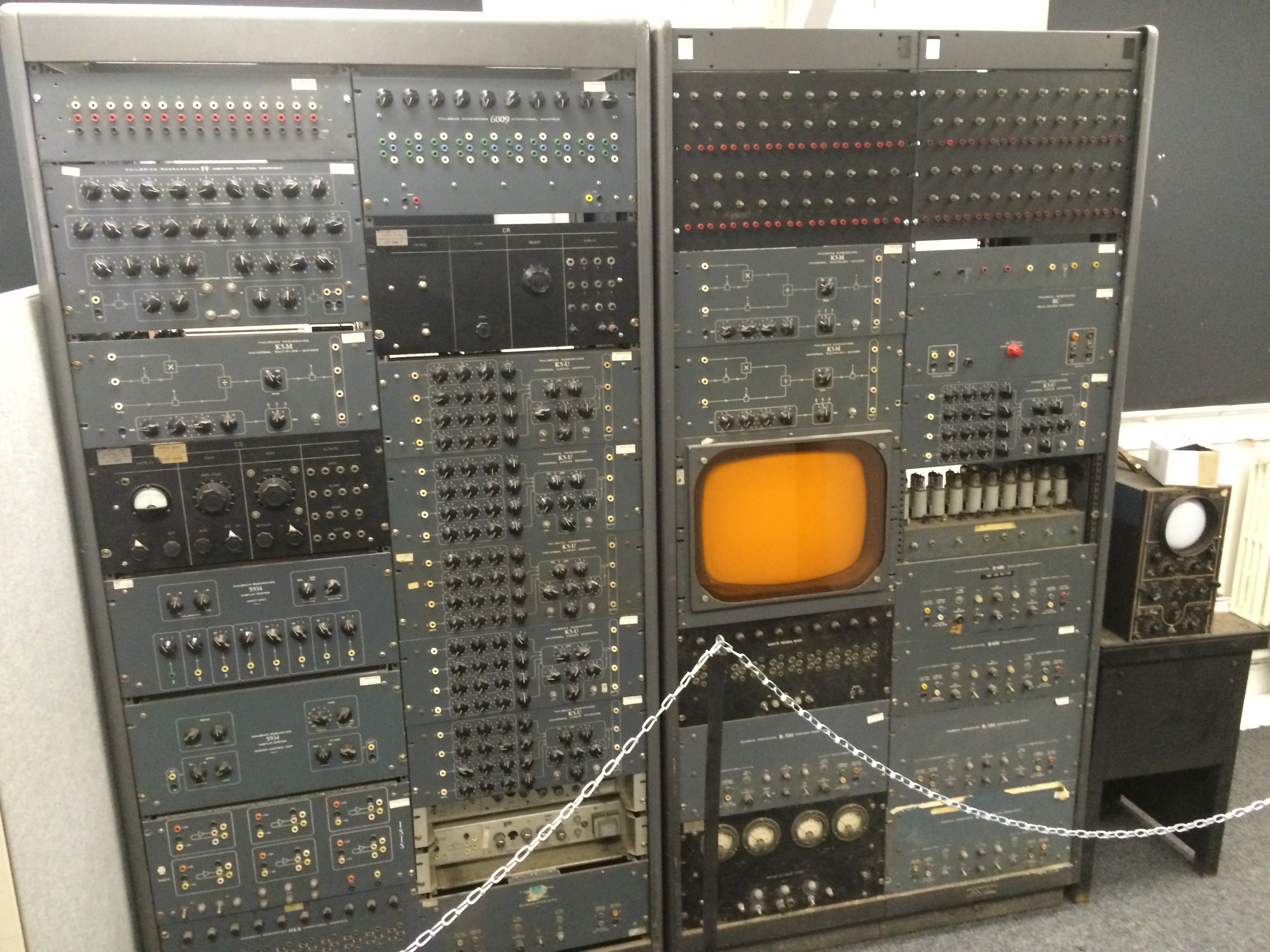
Here's a new picture of "George" -- aka the Philbrick analog computer
that MARCH rescued two months ago. It was used at M.I.T. from 1958-1970.
http://snarc.net/george.jpg
Hi all,
I could acquire *four* rotten PC05 Papertape Reader/Punches for PDP-11.
I'm now restoring them.
One of these is strange:
Normally, the feed hole (between data hole 3 and 4) is used to clock in
bits from the data holes.
But this very special PC05 does not have a phototransistor for the feed
hole, so the data clock signal must be generated by the stepper motor
driver.
Maybe it's a very old model: the READER CONTROL module is M705, not the
usual M7050. And there's no doc for it.
Does anybody has a FPMS with schematics for the M705 modul? Perhaps as
part of some PDP-8 doc?
Thanks,
Joerg
hp drives yes...
data printer no... correct name is data products
and a neat printer if you were just printing the first 20 col zone
I remember something about this model banging it out at 800 or 1000
lpm
at full 80 col it was 300 LPM
( This was the first formal sale our computer company had was to sell
a used one of these
to a consultant / programmer that did stuff on apple II systems ... I t
had one bad hammer coil and he moved it to col. 80 and swapped
the good one into the mid field he used the thing for years... we
were to later have one of these that came in with a HP 2000 system and it
served us well until replaced by a 600 LPM Data Products line printer
as we wanted to print wider than 80 col.
OK another odd thing - note tapes but lack of tape drives.
If only we could see what was in the rest of the room!
Ed Sharpe archivist for SMECC _www.smecc.org_ (http://www.smecc.org)
In a message dated 6/22/2015 1:49:38 P.M. US Mountain Standard Time,
jws at jwsss.com writes:
On 6/22/2015 9:16 AM, Douglas Taylor wrote:
> I saw this newpaper photo on ebay, item 191606970872, where these 2
> big wigs are proudly standing in front of their computer system
> looking over some printout.
>
> The actual computers in the picture don't look familiar to me, can
> anyone ID them?
>
> Doug
The printers look like Data Printer 80 column printers. Can't tell
about the systems, but they appear to have what look like analog meters
on the panels, which is interesting.
Back in the late '70s, I played a game called -0empire- on a PLATO
system hosted, IIRC, at UIUC. Reading
http://www.daleske.com/plato/empire.php, the best match to my memory is
Empire IV (IIRC, the 0 prefix indicates that the lesson was installed
system-wide, rather than being a relatively meaningless part of the
name), and http://www.daleske.com/plato/empire-control.php says, inter
alia, "You are welcome to look at the source code under Open Source
Commons.".
However, it appears my search-fu is too weak to _find_ that source
code. So my question for the collective wisdom here is, anyone know
where I might be able to find it?
/~\ The ASCII Mouse
\ / Ribbon Campaign
X Against HTML mouse at rodents-montreal.org
/ \ Email! 7D C8 61 52 5D E7 2D 39 4E F1 31 3E E8 B3 27 4B
I saw this newpaper photo on ebay, item 191606970872, where these 2 big
wigs are proudly standing in front of their computer system looking over
some printout.
The actual computers in the picture don't look familiar to me, can
anyone ID them?
Doug
yea know about friden.. but that tape drive and all the massive
cabinets next to guy and friden???
In a message dated 6/24/2015 1:26:17 A.M. US Mountain Standard Time,
nico at farumdata.dk writes:
Hi ED
I only know Friden as the makers of the Flexowriter. It was something like
a
Teletype, but with many more characters. It was used heavily in the
typesetting industry
/Nico
----- Original Message -----
From: <COURYHOUSE at aol.com>
To: <cctalk at classiccmp.org>; <General at classiccmp.org>;
<Discussion at classiccmp.org>; <On-Topiccctalk at classiccmp.org>
Sent: Wednesday, June 24, 2015 10:13 AM
Subject: Computers ... ARMY COMPUTERS! early & beastly with Friden What is
it?
>
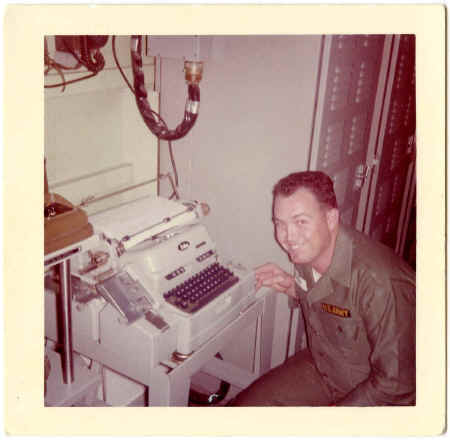
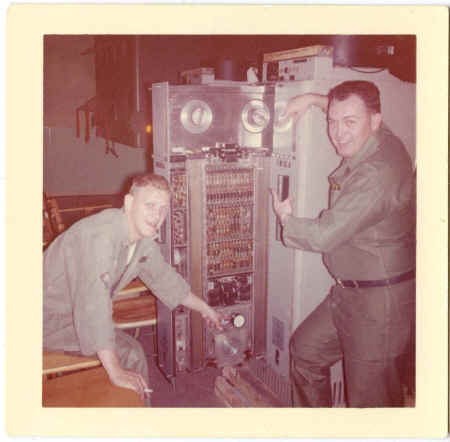
> Computers ARMY COMPUTERS! early & beastly with Friden What is it? I
> had
> a chance to buy these photos so I did! Be fun to find the people and
> talk to them! What ever this thing is I guess I need to devote a
> page on
> it! Ed# _www.smecc.org_ (http://www.smecc.org/)
>
> http://www.smecc.org/teleprinters/milita1dgdddf_small.jpg
>
> http://www.smecc.org/teleprinters/milita2_small.jpg
--
I am using the free version of SPAMfighter.
SPAMfighter has removed 1412 of my spam emails to date.
Get the free SPAMfighter here: http://www.spamfighter.com/len
Do you have a slow PC? Try a Free scan
http://www.spamfighter.com/SLOW-PCfighter?cid=sigen
you re ink the old ribbon... used to do that with tty ribbons.... the
14 inch line printer width...... messy but doable....
I remember having to make a dried ribbon a bit juicer one time strung
it between to poles in the parkinlot and sprayed I think it was a litte
wd-40 on it.... an rolled her back up!
I was lucky when I had computer business... printer would come in
with extra ribbons I would keep a few for shelf stock... in 13
years never had to buy any....
It was the absolute filters I always had to be buying new! only
once did I get a drive with a couple extra new ones
Ed# _www.smecc.org_ (http://www.smecc.org)
In a message dated 6/24/2015 1:20:05 A.M. US Mountain Standard Time,
pontus at Update.UU.SE writes:
On Tue, Jun 23, 2015 at 10:14:00PM -0700, jwsmobile wrote:
> The only reference I could find that separated them are to google
> for the printer ribbons. I find a lot of the companies who list
> ribbons don't purge their databases of even the most ridiculously
> old products, and they list models.
>
I just experienced the same thing with my newly found DATASAAB D16.
Google turns up three worthwhile mentions and whole host of ribbon
resalers.
I kind of assumed that the printer ribbon was the same as something else
and still awailable. Assuming I am wrong, what should I do to get a
printer ribbon with fresh ink?
/P
the only one that did the hi speed reduced cols was that table top
80 col one for dataproduicts that I know of. our larger ones did not.
by the way that small dataproducts also had a floor pedestal that made
it a tall tower and you could open door for paper box...
http://www.smecc.org/hewlett_packard/hewlet10.gif you can one of ours
here.... form eons ago
this photo was all stuff for parts sale we have rooms for off
this stuff.... wish we have more of it left
ed sharpe
In a message dated 6/23/2015 10:13:56 P.M. US Mountain Standard Time,
jws at jwsss.com writes:
Also I don't recall the Data Products ever scaling as fast by
restricting columns. At least our 2230, 2260 and 2290 UC only and 96
character set printers didn't. Got the same speed regardless of the
columns on those Data Products printers. They were drum, as were the
Data Printers, but apparently the hammer logic vs. the line feed was not
coupled as far a speeding up with fewer columns.
Thanks
jim
Thanks David. My go to place for batteries is http://www.all-battery.com/.
They are in the Valley, very cost effective, associated with Tenergy I
believe. I receive my batteries in one or two days usually. Always had very
good luck with them, and they have all possible cells in all possible grades
and finishes, from cheap Chinese to premium brand name, complete with data
sheets.
I might put NiMH batteries instead, but they have the original format NiCd:
http://www.all-battery.com/ni-cdbatteries.aspx
They also have Li-Ion that I use to restore battery packs for older
portables (usually doubling the capacity while I am at it).
Marc
-------------------------------------------
"J. David Bryan" <jdbryan at acm.org> said
> Now if I can find similar cells I will be able to reconstruct the pack
> inside the same shell.
Ni-Cds are still available from Allied Electronics, Mouser Electronics, and
others, although they are declining in availability compared to a few years
ago.
------------------------------------------
Some years ago, I wrote about a clone of the Beeprog (made by Elnec) I
bought here locally in Brazil.
Now, seems chinese are cloning the Beeprog PLUS (!!!)
I got a Beeprog+ in the used market here in Brazil. Asked for Elnec
warranty, since the programmer was manufactured in (month)11(year)2012. It
all went well up to the serial number.
It was made past the stop manufacture date. It stopped manufacturing in
07/2012.
Seems I got another hot potato on my hand :'(
Pay atention on that!
---
Enviado do meu Apple IIGS (pq eu sou chique)
Meu site: http://www.tabalabs.com.br
Meu blog: http://tabajara-labs.blogspot.com
well how many transistors does our table top straight pdp-8 have?!
In a message dated 6/23/2015 4:26:38 P.M. US Mountain Standard Time,
cclist at sydex.com writes:
On 06/23/2015 04:11 PM, drlegendre . wrote:
> When it's done, I hope he mounts it all on a black rectangular table with
> 20 shiny metal legs on each the opposing longer sides.
I seem to remember that the Packard-Bell PB250 used only about 400
transistors. (Magnetostrictive delay line memory). Lotsa diodes.
So not totally out of the question, even today.
--Chuck
Hi Guys
I am off to Friedrichshafen for a few days and will be
back on 1-JUL-2015.
The next two batches of front panels will be:
8/e Type A
1. Old switch position markings (1 and 6 vertical)
2. Line around switch Area
3. Vertical lines between groups of three lamps
4. Holes for switch shaft and lock predrilled
8/e Type B
1. New switch position markings (1 and 6 angled)
2. Line around switch Area
3. Vertical lines between groups of three lamps
4. Holes for switch shaft and lock predrilled
Price as before
$95.00 + $15.00 Shipping
Rod Smallwood
Hi list,
the subject sais it all: While seeking for information on the RP11-C on the web (I saved a RP03 from being scrapped 3 years ago), I came across a hint, that there was also a RP11-E controller. At least using google, there is practically not a single information/document on the RP11-E other than its existence in the past. Is the difference maybe just a different input voltage specification (110V vs. 220V)?
Who knows anything on the difference between the C- and the E-type, Google doesn't? :)
I'd be happy on any hints.
Kind regards,
Pierre
-------------------------------------------------------------------------------
Pierre's collection of classic computers moved to: http://www.digitalheritage.de
Aw, chucks.
After reading the other day about someone who was talking about VMS and
the wish for DHCP, I actually decided that it was time that BQTCP/IP
also got DHCP.
So, without further ado - I cut a new release. One bugfix for a bug in
the TCP state machine, which could get stuck, but otherwise the big
reason is that DHCP is now implemented.
Read the documentation, or ask me questions. The IPGEN procedure will
create installation files for use with DHCP, but if you are upgrading
>from a previous version, you might want to make comparisons with the new
command files, and merge any new stuff in, if you want to use DHCP.
If you don't care about DHCP, then nothing needs to change in the
current configs.
DHCP tries to be clever, and handle some different options, but there
are parts that I do not use myself, that I have not tested, or sometimes
implemented. In such cases you might see some messages on the console.
Pass such information on to me, and I can improve things.
DHCP is written in PDP-11 C. If you do not have that compiler, you will
not be able to recompile the code. Sources are provided, along with a
binary that runs, and do not depend on any shared libraries.
The DHCP code also makes use of some functions and interfaces to the IP
stack and the interface drivers that others might find useful to
reference to if they are interested in doing low level stuff with
TCP/IP. (Such as reading/writing interface configs and routing tables.)
As usual, the distribution is available from:
ftp://madame.update.uu.se/bqtcp.dsk
ftp://madame.update.uu.se/bqtcp.tap
ftp://ftp.update.uu.se/pub/pdp11/rsx/tcpip/tcpip.dsk
The documentation is also available through ftp on Madame, or also at
http://madame.update.uu.se/tcpipdoc
I hope people will find this latest release useful, and my next project
right now is telnet (this time really...).
Johnny
On 2015-06-08 19:03, Johnny Billquist wrote:
> About three months since I last announced anything. There have been
> various development since, and I figured I should encourage people who
> are using BQTCP/IP for RSX to upgrade to the latest release.
>
> A short list of changes:
> ICMP:
> . ICMP packets accidentally lost the source IP address informaton when
> returning information to a program. - Fixed.
>
> TCP:
> . User timers on TCP sockets could erroneously stop. - Fixed.
> . User timers now reset on completed reads, so that you do
> not get a timeout if you are constantly completing reads.
> . Sockets in Fin-Wait-2 could sometimes get stuck in that state.
> - Fixed.
> . If a TCP session got an RST, it could get into a bad state. - Fixed.
> . Added the ability to send URGENT data in TCP. (Receive ignores any
> URGENT flags.)
> . Added a special I/O function to read from TCP without formatting.
>
> DNS:
> . Improved stability of DNS client daemon code.
>
> FTP:
> . FTP client and server performance improved.
> . FTP server logging added.
> . Improvements in FTP server and client for handling files with implicit
> CFLF.
> . Implemented primitive handling of Unix file paths implemented in FTP
> server. This allows most web browsers to access FTP repositories
> under RSX.
>
> I also did some performance testing using FTP.
>
> FTP from a modern Unix system of BQTCP.DSK in binary mode to both RSX
> and 2.11BSD, running under simh on the same physical machine:
> 2.11BSD: 210s
> RSX: 141s
>
> From RSX (E11) to the same machines:
> 2.11BSD: 240s
> RSX: 137s
>
> I honestly do not know why transfer from RSX to 2.11BSD took longer than
> from Unix, but transfer from RSX to RSX was faster compared to Unix to
> RSX. I would have expected both to be slower or faster. But the numbers
> are interesting, and show that the RSX TCP implementation is doing
> fairly well, even through it goes through the DECnet ethernet driver, as
> compared to 2.11BSD which runs TCP/IP more "native".
>
> As usual, the distribution is available from:
> ftp://madame.update.uu.se/bqtcp.dsk
> ftp://madame.update.uu.se/bqtcp.tap
> ftp://ftp.update.uu.se/pub/pdp11/rsx/tcpip/tcpip.dsk
>
> The documentation is also available through ftp on Madame, or also at
> http://madame.update.uu.se/tcpipdoc
>
> I hope people will find this latest release useful, and my next project
> right now is telnet.
>
> Johnny
>
> On 2015-01-16 04:47, Johnny Billquist wrote:
>> There have been lots of positive comments, and obviously some people
>> have even tested using the software.
>>
>> Of course, a bug was also found. A really weird corner case with
>> severely loading the network stack and having a socket in listen state
>> programatically could trigger a corruption of kernel memory.
>>
>> So I've cut a new release with the bug fixed.
>>
>> While I'm at it I also realize that I forgot to mention that included in
>> the distribution is also a simple IRC client as well as a simple IRC
>> robot.
>>
>> I've also taken a little time to slightly improve the documentation, and
>> the documentation is now also available directly by ftp from
>> Madame.Update.UU.SE, so you do not need to get the whole distribution
>> and unpack it to just read something.
>>
>> So - same as before. Disk image and tape image are available at
>> Madame.Update.UU.SE. Use anonymous ftp.
>> Disk image is also available at
>> ftp://ftp.update.uu.se/pub/pdp11/rsx/tcpip.
>> The disk image is a virtual RL02 disk. Can be used with any emulator, or
>> also directly inside RSX if you have virtual devices available.
>>
>> Happy hacking.
>>
>> Johnny
>>
>>
>> On 2015-01-14 00:40, Johnny Billquist wrote:
>>> Well, it's been a long time project, but I'm happy to finally announce a
>>> more public initial release of TCP/IP for RSX-11M-PLUS.
>>>
>>> This is the result of over 20 years of development. Needless to say,
>>> I've been doing a lot of things over the years, and this code have been
>>> through four reimplementations over the years.
>>> What I now release is something that I believe is a nice and useful
>>> piece of software. I am aware of the fact that most people do not use
>>> these machines any longer, but if someone actually wants to talk to me
>>> about support for this or other RSX software, let me know.
>>>
>>> Also, feel free to spread this information to anyone who might be
>>> interested, anywhere.
>>>
>>> So - what is in this release?
>>> It is a complete implementation of ARP, IP, UDP, and TCP for
>>> RSX-11M-PLUS. It has been tested on RSX-11M-PLUS V4.6, but should work
>>> on any V4 release. There might be some small tweaks or fixes required,
>>> but nothing major.
>>> It do require a system with split I/D-space, or else at least the TCP
>>> part will not fit.
>>> For Unibus machines, it should be possible to run without any additional
>>> software except what is in a base RSX distribution.
>>> For Q-bus machines, DECnet is required for ethernet networking.
>>> The TCP/IP stack can co-exist with DECnet.
>>> Some utilities also utilize RMS for file access.
>>>
>>> A bunch of tools, utilities and libraries are also included. These
>>> include:
>>> . IFCONFIG network configuration tool.
>>> . NETSTAT network information tool.
>>> . PING
>>> . TRACEROUTE
>>>
>>> . DNS client
>>> . FTP daemon
>>> . FTP client
>>> . HTTP server
>>> . TELNET client (rudimentary)
>>> . TFTP client
>>> . TFTP server
>>> . INET server that can do SINK, ECHO, DAYTIME, QUOTE, and IDENT
>>> . NTP client
>>> . LPR client that sits in the queue manager (rudimentary)
>>>
>>> . FORTRAN-77 library
>>> . BASIC+2 library
>>> . PDP-11 C library
>>>
>>> The implementation fulfills most of the requirements put forth in RFC
>>> 1122. There are a few limitations because of restrictions in the PDP-11,
>>> but none of them should really cause any problems.
>>>
>>> Documentation is still on the thin side, but example configs are also
>>> provided, along with installation scripts.
>>>
>>> A bunch of test programs and example programs are also included, as well
>>> as the sources of all tools and libraries.
>>>
>>> The TCP/IP stack itself only comes in binary form.
>>>
>>> All tools are also included precompiled in the distribution, so an
>>> installation only have to build the stack itself for your system, and
>>> then you should be ready to go.
>>>
>>> The API only have a slight resemblance to the Unix sockets API. However,
>>> if someone sits down to write code to use TCP/IP under RSX, I'm sure
>>> they will discover that it is extremely easy to use the libraries, or
>>> the basic functions.
>>>
>>> The TCP/IP implementation is mostly written as device drivers. This also
>>> have some other interesting implications, such as it is possible to
>>> access TCP as a normal file. You can, for instance do something similar
>>> to the Unix netcat command by issuing the MCR command:
>>>
>>> > PIP TI:=TC:"foo.com";4711
>>>
>>> which would open a connection to foo.com, on port 4711, and any data
>>> sent from that machine will be shown on the terminal.
>>>
>>> The resources used by TCP/IP are modest. A memory area (size selectable
>>> at generation/startup) is used internally. The amount of memory in the
>>> private pool limits the amount of data that can be buffered. Normal pool
>>> is used in a small quantity for each TCP port that is open.
>>>
>>> People are welcome to play around with this, and make improvements.
>>> Contributions of code is most welcome.
>>>
>>> There are still lots of things to do. The programs marked as rudimentary
>>> should be rewritten.
>>> The most obvious thing still missing is a telnet daemon, which probably
>>> is my next step.
>>>
>>> However, the reason for now announcing the release is that it can
>>> finally be distributed natively from an RSX host.
>>>
>>> The main locations to download the TCP/IP for RSX are:
>>>
>>> Madame.Update.UU.SE (anonymous ftp).
>>>
>>> This is one of my development systems for this software. It runs under
>>> E11, and if things are down, I blame E11. :-)
>>> When connected, you are already in the right directory. There is both an
>>> RL02 disk image there, which can be downloaded by anyone. If you happen
>>> to have an RSX system which you are conneting from, you can also try
>>> getting the BQTCP.TAP tape image. Such an image will not transport
>>> cleanly to a non-RSX system, however. Sorry.
>>>
>>> ftp.Update.UU.SE (anonymous ftp) - /pub/pdp11/rsx/tcpip
>>> The disk image is normally duplicated to ftp.update.uu.se as well, so
>>> the same file can be found there.
>>>
>>> I hope some people will find this useful/amusing. :-)
>>>
>>> Johnny Billquist
>>>
>>
>>
>
> _______________________________________________
> Simh mailing list
> Simh at trailing-edge.com
> http://mailman.trailing-edge.com/mailman/listinfo/simh
whenever I see video from there is to full of 50s cars! Neat! Ed#
In a message dated 6/23/2015 4:24:37 A.M. US Mountain Standard Time,
billdegnan at gmail.com writes:
I don't know, but there could be some WOW stuff there. I have to admit,
the day I heard Barak Obama said the US was going to free up restrictions
with Cuba I thought about the cars....and the COMPUTERS!...UNIVAC? IBM
701? Anything could be there.
On Tue, Jun 23, 2015 at 6:46 AM, Paul Birkel <pbirkel at gmail.com> wrote:
> I wonder to what Soviet equipment they would have upgraded?
>
> On Mon, Jun 22, 2015 at 5:06 PM, william degnan <billdegnan at gmail.com>
> wrote:
>
> >
> >
>
http://millennialmainframer.com/2014/12/ibm-still-waiting-cuba-pay-mainfram…
> >
> > Who's up for it?
> >
> > B
> >
>
And I opened the pack up, and you are 100% right! It's just a plastic shell
containing 10 big C-size cells, 3.5 A.hr each, indeed from the time period
it must be NiCd! Now if I can find similar cells I will be able to
reconstruct the pack inside the same shell. It will even look like the
original. Thanks again.
Marc
------------------------------
"J. David Bryan" <jdbryan at acm.org> said
> On this machine the battery connectors are just two pronged, + and -,
> so no thermistor connection apparently.
That marks it as an "A-version" power supply.
> I just need to find new small 12V lead batteries that fit.
Note that the "A" supply used a 12 Volt nickel-cadmium battery pack (per
page IXA-1 of the M/E/F-Series ERD), and the charger is a constant-current
supply. The pack is not broken down in the parts list but presumably would
have contained ten 1.2-Volt cells.
The "B" supply used a 14 Volt lead-acid battery pack (ERD IXB-5), so seven
2.0-Volt cells, and the charger is a constant-voltage supply.
If you use lead-acid batteries with the "A" power supply, you may wind up
overcharging them and shortening their life.
-- Dave
------------------------------
[also posted to comp.graphics.x today]
Hello Folks,
I'm trying to get an application that currently uses a local display on an
ancient DEC Alpha workstation with a (for the time) mid-to-high-end graphics
controller (ZLX-E2) to instead use an X-server running under MS-Windows.
The application is complaining that it cannot find a "4/5-bit visual". It almost
certainly wants to use this visual for an overlay, as the application displays
moving objects superimposed on a map.
On the original hardware, xdpyinfo tells me:
> [...]
> supported pixmap formats:
> [...]
> depth 4, bits_per_pixel 8, scanline_pad 32
> [...]
> screen #0:
> [...]
> depths (4): 8, 12, 24, 4
> [...]
> number of visuals: 21
> [lots of other visuals here, but no 4-plane except for the following]
> visual:
> visual id: 0x36
> class: PseudoColor
> depth: 4 planes
> available colormap entries: 16
> red, green, blue masks: 0x0, 0x0, 0x0
> significant bits in color specification: 4 bits
and "xprop -root" tells me:
> [...]
> SERVER_OVERLAY_VISUALS(SERVER_OVERLAY_VISUALS) = 0x36, 0x1, 0x0, 0x1
As you can see, there seems to be exactly one overlay, whose visual id (0x36)
corresponds to the single 4-plane visual listed by xdpyinfo.
When I use the above commands to retrieve the capabilities of the MS-Windows
X-server (Exceed, in this case), xdpyinfo does not list a 4-plane visual at all.
"xprop" lists lots of overlays, 24 in total, all of them 8-plane visuals.
The MS-Windows box is running Windows-7 (64bit) and has a Nvidia Quadro 400 GPU.
I used the "Nvidia Control Panel" to set "Enable overlay" to "on" in the "Manage
3D settings" section. Also, in the Exceed X-server configuration I enabled
"OpenGL", and within that enabled "Overlay Support" and "GLX 1.3 Support".
I conclude that the MS-Windows SW/HW system (X-server, MS-Win GPU driver, GPU)
cannot offer 4-plane visuals. However, I don't know what system component(s)
is/are the cause the problem.
I have tested VcXsrv, Reflection-X, Exceed (with 3D option), X-Win32 and even
the ancient DEC Pathworks X-server eXcursion with no success. I'm working on
getting an evaluation copy of PTC's MKSTools X/Server. Of the X-servers I've
tested, Exceed seems to offer the most configuration parameters.
I'm not even sure the Quadro 400 can handle 4bpp "visuals", or whatever
MS-Windows calls them. In fact, I wonder if any modern hardware offers 4bpp
capability. On my Linux box with a GeForce GT 430 I don't have any 4-plane
visuals, and xprop doesn't mention any overlays either.
I'm somewhat confused about where overlays fit into the X scheme. I have seen
lots of references to overlays in an OpenGL context, however the Alpha seems not
to have any OpenGL capability: GLX is not in the list of extentions printed by
xdpyinfo. Can someone clear this up for me?
Am I correct to assume that the GPU must support 4bpp in order for it even to be
possible for the X-server to propagate a 4-plane visual to a client? If yes, how
can I determine if a GPU supports 4bpp? Nvidia is very sparing with the
information in their specs for the Quadro 400 GPU.
Assuming I can find a GPU that supports/offers 4bpp, does anyone know an
X-server product/project that can provide 4-plane overlays?
thanks,
Rob
> From: tony duell
> a 'Unibus Out', you can plug a Unibus cable in there to link to an
> expansion box. The official way involved special dual-height cards at
> each end with 3 40-way Berg-type cables linking them.
So I'm trying to look into this (BC11 cables being unobtainium these days, at
least at prices which are less their weight in gold).
I see 'three' different kinds of 'UNIBUS to cables' cards listed:
M9014 UNIBUS to 3 H854s
M9015 3 H854s to UNIBUS
M9031 UNIBUS to 3 3M cables for 11/74
M9042 UNIBUS to 3 H854, Dual
I assume the M9014/M9015 are a pair, one used at the start of the cable, and
one at the end?
Does anyone know the difference between these three, and is my guess about the
M9014/M9015 being a pair correct? (I did look for documentation to answer
these, but couldn't find any - although maybe I didn't look in the right places.)
Noel
Hi there!
Anyone remember much about Tru64 + LSM? It's been a while since I've done much with Tru64, and I never used LSM before.
I got some new 36GB disks and am doing a fresh install, and wanted to mirror them with LSM, as the SCSI controller is not a RAID card.
Initially, the installer picked really stupid defaults, choosing to use only about 3GB of the 36GB available. I was hoping to do something like have the LSM be in total control of the disk, with all filesystems and swap being on LSM volumes. The LSM documentation says this would be called a "sliced" disk. I'm a little rusty on my disklabel specifics, but the Tru64 docs seem to suggest that the 'a' slice is usually used for the / filesystem, 'c' is the whole disk, and g or h is usually used for the LSM private data.
So, my questions are:
1. Is it possible to install to and boot from an LSM sliced disk (as opposed to an LSM "simple" disk)?
2. Is it possible to have swap be on an LSM volume, or does it have to be on a slice (like dsk0b or something)
3. Is the 'a' slice strictly required for anything?
4. Would the best (or a good) way to go be to do something like a & b unused, c whole disk, g all the space except 2MB, and h 2MB for LSM data?
Thanks and sorry for the stupid questions!
-Ben
> From: John Wilson
> I've seen M9014s only at the far end of the UBAs on a KS10, so it
> wasn't taking the place of a BC11.
??? If it wasn't take the place of a BC11 (i.e. proving a path for the UNIBUS
out), what was it doing?
> it'd certainly be easy to make replacements for the M9014 and/or M9015.
Indeed. Probably more feasible than trying to make more BC11's. Which is
another aspect of my interest in these things.
Noel
----- Original Message -----
From: "William Donzelli" <wdonzelli at gmail.com>
To: "General Discussion: On-Topic and Off-Topic
Posts" <cctalk at classiccmp.org>
Sent: Friday, June 19, 2015 8:43 PM
Subject: Re: XH558 - was Re: using new technology
etc
>> Don't forget Cromemco:
>
> I think we can forget Cromemco.
>
> The original poster wanted examples of minis
> "setup and used on one".
> I doubt a Cromemco would survive long in flight
> service. This is why I
> also pointed out "combat service", as opposed to
> being part of a test
> set in an air and power conditioned hangar.
>
> Military aircraft (and marine) service is
> *really* hard on equipment.
>
> --
> Will
----- Reply-----
Well, regarding marine service, from one of many
histories of Cromemco, e.g.:
http://infolab.stanford.edu/pub/voy/museum/pictures/display/3-5-CROMEMCO.ht…
"The Z-2 line was the first commercially marketed
microcomputer certified for use by the U.S. Navy
for use aboard ships without major modification."
Memory's not what it used to be and I could be
misremembering, but I'm pretty certain that some
Z-2s were installed in military aircraft for data
collection (admittedly not in combat service);
ISTR one of those appearing on eBay a few years
ago, bristling with many-conductor cables and
military-style Cannon connectors.
I'll dig through the literature to see if I can
find an official reference.
m.
Thanks a lot for the detailed answer Glen. I have looked in more detail into
my machine and its rear connectors. It's a 21MX (2112A), and it has two
battery holders at the back. The old batteries even came with it (!). On
this machine the battery connectors are just two pronged, + and -, so no
thermistor connection apparently. At first glance I thought two other 9 pin
connectors were similar to the ones you described and needed to be wired up
with the thermistors. But they apparently are totally different things,
labeled POWER CONT IN and POWER CONT OUT. After a bit of bitsaver hunting, I
gather these are for power control interconnection with optional I/O racks
extensions. So I think I am thermistor free. I just need to find new small
12V lead batteries that fit. They are an odd "construction brick" form
factor, standard modern gel batteries are too tall.
Marc
------------------------------
Glen Slick <glen.slick at gmail.com> said:
Subject: Re: HP 2113e Battery resistor
I have only looked at the "B" version of the power supply as that is
what I have in my 2117F. (Now that I think of it I'm not sure what
version of the power supply I have in my 2113B). The details for that
are covered in the 5061-1356 section of the 92851-90001_Jun79_9.pdf
manual referenced below starting on page 84 of the PDF.
As described in section 3-9 on page 105 of the PDF the Power Fail
Recovery System (PFRS) option consists of the Battery Charger Board
(A3A3) and the Battery Backup Board (A3A4) which are mounted
internally in the power supply, and the external mounted
Battery/Status Assembly. If the PFRS option is not present the Jumper
Board (A3A4) is installed internally in the power supply instead of
the Battery Charger Board (A3A3) and the Battery Backup Board (A3A4).
If you open up your system far enough to remove the lid on the power
supply you can visually inspect the installed boards to determine
whether or not the PFRS option is installed in the power supply.
The battery pack over-temperature thermistor is integrated into the
battery pack. It ends up being connected to the TEMP1 and TEMP2
signals shown on the Battery Charger Board (A3A3) schematic Sheet 6 on
page 136 of the PDF. If the PFRS option is not installed the Battery
Charger Board (A3A3) is not present and there is nothing that would
connect to the battery pack thermistor so it is not necessary for the
operation of the power supply.
If the PFRS option is installed but the thermistor or resistor
equivalent is not connected the CPU will power on but will not be
functional. I think all of the front panel lights turn on and none of
the switches have any effect. It's been a long time since I looked at
that in detail to figure out what was going on. I think some of the
voltages are at the correct level, but maybe the memory voltages are
not, and some of the power supply status signals (PSU?, PON?) indicate
the power supply is not ready and that holds the system in the
inactive state.
-Glen
------------------------------
The LINK indicator light on the front panel of the PDP-12 failed two weeks
ago. The indicator light bulb failed, briefly shorted, and destroyed the
transistor that turns the indicator on. An new transistor and bulb, and all
is well.
We have been chasing a transient problem in the PDP-12 core memory for a
few weeks. We checked the timing last week, and it was OK. This time we
checked the core voltage and it was a little low. We increased the core
memory power supply voltage until the checkerboard starting working without
errors. Next time we will explore the high and low limits of the core
voltage to find a reasonable center voltage for both core stacks.
The next step is to run all of the processor diagnostics and make sure that
everything is works. If the diags run OK, it is time to fix the TU56 tape
drive and see if the drive and controller work.
We visited the RCS/RI crew today to look at their LINC-8 and both PDP-12s.
Both PDP-12s are earlier than ours. One has floating-point and an RK05. The
other has a really interesting RAM buffered AD converter.
--
Michael Thompson
>> And I have not found the equivalent of our "Builder Logs Thread" on the
>> Vintage Computer Forums which I just "discovered".
>Maybe Erik would consider adding a category on VCF for build logs?
That's a good suggestion. On the R2 group, the Builders Log section was
actually added after I suggested it. It is now the most viewed section. But
on VCF (that's how you call it?), I think I am way too new to make such a
proposal and have it taken seriously... And I don't have yet a good sense of
the VCF constituents and interests to understand if this proposal would have
any traction either. Someone else would have to ask for me...
Where do people that do "heavy duty" or longer lived restoration projects
(mainframes, minis, pre-1970 machines) gather on the web? Here I guess :-)?
I am looking for any information on a National Semiconductor RAM board that I think goes in
a VAX 11/730. My 11/730 (which admittedly I have not run) has 2 DEC MS730 boards and 2 of these
NatSemi boards, I found another one while unpacking stuff today.
It's a hex height DEC-type board with the ejector handles. Connections to fingers on A and B as you
might expect, also the grant continuity strapping on C and D, grounds on D (only) and a couple of signals
on C (I've not figured out what yet).
The only identification I can find on it is in the etch :
PWB 551109464-002 B
PWA 980109464
(I assume the first is the part number for the bare PCB, the second for the stuffed board)
There seems to be one RAM too many!. The main RAM array is 4 rows each of 32 4164-like DRAMs.
There is a second block of 28 such DRAMs, presumably 7 bits for each row of the main array to
provide the ECC bits. And then a further single RAM off to one side. The DEC MS730 doesn't seem
to have this, and I wonder what on earth it is for.
Rest of the board is TTL drivers, etc. There are 2 LEDs, one green, one yellow. And a momentary pushbutton
switch. I have no idea of the functions of those.
Does anyone recognise this board?
A related point, I am thinking of removing the TSU05 from my 11/730 and putting an expansion
box in place of the tape drive in the rack. In which case I can install this memory board. Is 5MBytes
(the maximum an 11/730 can take) worth having over 4MBytes?
-tony
I like to do build logs for my more complex and long lived restorations or
builds, so people can inspire themselves from what I do, and give advice
(and encouragement, that helps too!).
In one of my many other hobbies (hum, R2-D2 robot replica building, yes,
there is such a thing), everyone puts their build log as a thread on a
Forum. Very easy to search and follow. Members of the forum also have a
place to store files. The best build logs get a lot of hits.
Do you have an equivalent for classic computer restorations? I see some
people have their own blog on regular blog sites. But I dislike the format -
it's posted reverse latest first, you can only see the latest posts at once.
Not anywhere as good as a thread.
Or people have their own website, which is a bit of a pain as you have to
discover them one by one - and spend time making a web site.
And I have not found the equivalent of our "Builder Logs Thread" on the
Vintage Computer Forums which I just "discovered".
Any other/better/smarter solutions you can point me to?
- Marc
At 12:30 PM 6/16/2015, Mattis Lind wrote:
>I have compiled a list of them, mostly for my self, so that I somewhat easier would find what I look for.
That is a nice list, and includes many that are not among my ~80 (which does not include my ~60 vacuum tube manuals). Could you post the original spreadsheet somewhere? It would be a reference that would be much easier to use than the online version.
Dale H. Cook, Roanoke/Lynchburg, VA
Osborne 1 / Kaypro 4-84 / Kaypro 1 / Amstrad PPC-640
http://plymouthcolony.net/starcity/radios/index.html
Hi Guys
The combination of shipments going out and resposes to the
survay (thanks everybody)
have shown up some diffences between 8/e's.
The first and most important one is the change of markings for the
selector switch where they must have changed switch type at some point.
Its the case that you will have one or the other. I can get another
screen made up with the angled markings at switch positions 1 and 6.
When you order you can then specify which one you require.
The other two are cosmetic and have no impact on operation. Firstly
there is sometimes a line around the area where the selector switch is
located.
Secondly vertical lines dividing up the lamps into groups of three are
sometimes present.
I can't yet work out if there's any pattern to where they do and dont
appear. (not enough data)
The easiest way to fix this is to either add the markings to all the
panels or none of them.
Comments please....
Rod
Ah thanks, this is what these are for, thermistors. They are supposed to
monitor the temperature somewhere I suppose? Attached to the batteries? The
power supplies? The computer won't start without these I understand? Sorry I
am a bit of a newbee with HP 1000's. Have not tried to power mine quite yet.
Marc
>Glen Slick <glen.slick at gmail.com> said
>The Temperature Sense Thermistor RT1, normaly 815 ohms, is wired
>across the two outside pins of the middle row, pins 4 and 6.
>http://www.bitsavers.org/pdf/hp/1000/1000_MEF_EngrRef/92851-90001_Jun79_9.p
df
>Description page 111
>Schematic page 168
{Re-send, since apparently a lot of mail to CCTalk yesterday went into the bit
bucket...}
I guess I've struck out here? That's such bad luck; other things, there are
multiple copies out there, but apparently none at all of this one...
Oh well, I guess I'll start with the DZQ11 TM, and with an ohm-meter try and
trace out the initialization circuitry (which is clearly broken) at least.
Noel
Yes, that is the one we have here at the museum!
yea pretty easy ( compared to a teletype) but we just
like to have manuals or copies of them for everything
we have here in the various collection areas.
Ed# _www.smecc.org_ (http://www.smecc.org)
In a message dated 6/20/2015 9:39:45 A.M. US Mountain Standard Time,
tony.aiuto at gmail.com writes:
Like this one?
http://www.ebay.com/itm/Wright-Punch-Model-2600-/331580084313
I'm not sure it really needs a manual. I repaired one with a careful
disassemble and cleaning. On mine, the cord linking the tension spring to
the mechanism had broken. A trip to the hardware store found something
similar. It took a few tries to get the right length and tension, but it
works now.
On Fri, Jun 19, 2015 at 8:27 PM, Dennis Boone <drb at msu.edu> wrote:
> Does anyone have routine maintenance information (e.g. user or service
> manuals) for the Wright Line manual punches? My newly acquired unit
> seems to need a little lubrication. I'll guess if I have to, but...
>
> This is the variety with the large grey wheel on the side to select the
> desired character, and a sort of "wheelhouse" in the middle to hide the
> cams, ribbon mechanism, etc. There's no model number sticker on it.
>
> Thanks!
>
> De
>
> On Jun 19, 2015, at 19:19 , Tapley, Mark <mtapley at swri.edu> wrote:
> He has a Raspberry Pi, which he pretty much contempts in favor of his laptop, which will play the modern version of MineCraft :-P, but presumably hooking those together might be fun.
I suspect that boards like the Raspberry Pi, Arduino, etc. might get a lot more interesting if they can affect the real world. See if a servo motor adds some appeal.
--
Mark J. Blair, NF6X <nf6x at nf6x.net>
http://www.nf6x.net/
Like this one? http://www.ebay.com/itm/Wright-Punch-Model-2600-/331580084313
I'm not sure it really needs a manual. I repaired one with a careful
disassemble and cleaning. On mine, the cord linking the tension spring to
the mechanism had broken. A trip to the hardware store found something
similar. It took a few tries to get the right length and tension, but it
works now.
On Fri, Jun 19, 2015 at 8:27 PM, Dennis Boone <drb at msu.edu> wrote:
> Does anyone have routine maintenance information (e.g. user or service
> manuals) for the Wright Line manual punches? My newly acquired unit
> seems to need a little lubrication. I'll guess if I have to, but...
>
> This is the variety with the large grey wheel on the side to select the
> desired character, and a sort of "wheelhouse" in the middle to hide the
> cams, ribbon mechanism, etc. There's no model number sticker on it.
>
> Thanks!
>
> De
>
> Is there a reason to prefer 7400 series over CD4000 series logic?
If you can find real TTL, yes, I would say so. It's less
static-sensitive and it's more tolerant to things like hooking two
outputs together by mistake.
But note that there are many chips that have more or less TTL
interfaces (TTL voltages, TTLish numbers, and in some cases switching
thresholds) but are actually CMOS - the 74ALS series comes to mind.
Of course, if someone somehow builds CMOS chips with TTL's ESD
tolerance, short-circuit tolerance, etc, then great. But that's not
what I've seen.
/~\ The ASCII Mouse
\ / Ribbon Campaign
X Against HTML mouse at rodents-montreal.org
/ \ Email! 7D C8 61 52 5D E7 2D 39 4E F1 31 3E E8 B3 27 4B
I managed to rescue few tapes containg installation sw+c compilers, fortran
and forge. While I was trying to make a backup all cartriges broke st some
stage due to too old belts. The magnetic tape of 2 of 4 cartriges seems ok.
So I'm looking for somone within EU who has experience in this to try to
save whatever is possible.
Regards,
Plamen
On 6/19/2015 8:21 PM, Christian Gauger-Cosgrove wrote:
> On 19 June 2015 at 22:38, William Donzelli<wdonzelli at gmail.com> wrote:
>> >Let him play Minecraft. Start with simple redstone contraptions, then
>> >move to command blocks.
>> >
> I'm not ashamed to admit I (24 y/o) play Minecraft now and again (with
> friends on their own private servers).
When I visited ALR, a company in Irvine that evolved into making PC type
servers and were absorbed into Gateway (name still is used) had a lab
with a lot of hardware stations, and for the time good networking. At
about noon or so one one of my visits for Sun Microsystems, about a
dozen of the engineers showed up and proceeded to pull out hardware and
cables, and displays at various stations and hooked them all up pretty
quickly. This was in about 92 or 93, I'd guess.
They converted the lab into a big Doom game for about an hour.
I also found out the best time to round up and have casual consultations
with them about things I wondered about with some systems.
Thanks
jim
Just a heads up that both units are now pending a sale. If one or either
completely fall through I'll bump this back up here on the list. Thanks to
all who inquired.
-John
It?s Droste Week on RetroBattlestations! Inspired by a couple of different posts, I thought it would be fun to do a challenge where people don?t just post a picture of their computer, but they display the picture of their computer *on* their computer and post that! It?s going quite well and I really enjoy reading about the hoops people are having to jump through to get pictures converted and transferred and displayed.
There have been photos of monochrome computers with high resolution, low resolution block graphics, ASCII art on CP/M computers, and even a mechanical typewriter! What can you come up with?
http://retrobattlestations.com
--
Follow me on twitter: @FozzTexx
Check out my blog: http://insentricity.com
Oh butts I sent that before I proofread.
I'm in the Pacific Northwest, about three or four hours east of Vancouver
BC. I have access to freight services should you take that route but for
your wallet I'd strongly recommend some sort of local or negotiated pickup.
;0
>>Are the readers in question these ones in Canada?
>>http://www.vintage-computer.com/vcforum/showthread.php?45888-FS-Documation
-M1000-Card-Readers
Yes, that's me and those are the readers.
>>>I'm also working on getting a cable made to hook up to the M843 CR8-E
>>>punched card reader interface for the PDP-8/E, but that's a project for
>>>another day (year?).
That bloody EDAC connector is not cheap. I ended up sourcing one for like
$60. On the other hand you can hunt around for scrap 50 conductor telco
cable and you're all set for cabling. You can usually get it for its weight
in copper from a scrapyard.
-John
When repairing machines it is some times hard to find the data sheet for a
particular component.
Sometimes google hasn't been able to find the the data sheet for me.
My father worked in the electronics business for his entire career and kept
a lot of the data books that he received.
I have compiled a list of them, mostly for my self, so that I somewhat
easier would find what I look for.
I publish it here. If you have searched everywhere (bitsavers , google
etc) and not got a decent hit and think that one of the data books in my
fathers archive would help I might be able to assist. No - I am not going
to scan entire books. But a few pages is OK. The latency might be high
since the archive is located 100 km away.
https://docs.google.com/spreadsheets/d/1fTfBDLxl40e2iNrbwLv1ZGgIaXvz_toyvfc…
I will add more to the list as time passes. There are quite a big bunch of
data books left to do an inventory on.
/Mattis
Good Morning All Panel Fans!!
According to the shippers the first consignments of PDP-8/e front panels
were delivered in the US yesterday,
Confirmations and comments to me please.
Rod Smallwood
ok the m 200 and 600? tend to have gooey rollers... thus the reason
I ask...
In a message dated 6/17/2015 7:27:16 P.M. US Mountain Standard Time,
mloewen at cpumagic.scol.pa.us writes:
I haven't replaced the rubber rollers on my M1000, yet. They're still
in good shape.
On Wed, 17 Jun 2015, COURYHOUSE at aol.com wrote:
> Mike where did you get new rubber roller things for the card
> reader?
> Thanks for the link on the interface. Ed# _www.smecc.org_
> (http://www.smecc.org)
>
>
>
> In a message dated 6/17/2015 7:21:15 P.M. US Mountain Standard Time,
> mloewen at cpumagic.scol.pa.us writes:
>
> On Wed, 17 Jun 2015, Kyle Owen wrote:
>
>> On Wed, Jun 17, 2015 at 7:14 PM, John Ball <ball.of.john at gmail.com>
> wrote:
>>
>>> About six months ago I struck a deal with a place down in California
for
>>> four Documation M1000's that I've been able to tell so far they all
> work
>>> but
>>> I really don't have space for more than one.
>>
>>
>> If anyone here does get one, I've got a simple Arduino UNO program that
>> interfaces to the parallel output and sends fully decoded information
> over
>> USB at quite high speeds. The M-1000-L is a great reader, very
reliable,
>> and easy to work on too (I did a little routine maintenance, but mine
was
>> in 100% working shape when I got it).
>>
>> Here's a video: https://www.youtube.com/watch?v=N27Mr199I7g
>
> There's also Brian Knittel's USB interface for the Documation readers:
>
> http://media.ibm1130.org/sim/cardread.zip
>
> I built one, and it works well.
>
>
> Mike Loewen mloewen at cpumagic.scol.pa.us
> Old Technology http://q7.neurotica.com/Oldtech/
>
>
Mike Loewen mloewen at cpumagic.scol.pa.us
Old Technology http://q7.neurotica.com/Oldtech/
Mike where did you get new rubber roller things for the card
reader?
Thanks for the link on the interface. Ed# _www.smecc.org_
(http://www.smecc.org)
In a message dated 6/17/2015 7:21:15 P.M. US Mountain Standard Time,
mloewen at cpumagic.scol.pa.us writes:
On Wed, 17 Jun 2015, Kyle Owen wrote:
> On Wed, Jun 17, 2015 at 7:14 PM, John Ball <ball.of.john at gmail.com>
wrote:
>
>> About six months ago I struck a deal with a place down in California for
>> four Documation M1000's that I've been able to tell so far they all
work
>> but
>> I really don't have space for more than one.
>
>
> If anyone here does get one, I've got a simple Arduino UNO program that
> interfaces to the parallel output and sends fully decoded information
over
> USB at quite high speeds. The M-1000-L is a great reader, very reliable,
> and easy to work on too (I did a little routine maintenance, but mine was
> in 100% working shape when I got it).
>
> Here's a video: https://www.youtube.com/watch?v=N27Mr199I7g
There's also Brian Knittel's USB interface for the Documation readers:
http://media.ibm1130.org/sim/cardread.zip
I built one, and it works well.
Mike Loewen mloewen at cpumagic.scol.pa.us
Old Technology http://q7.neurotica.com/Oldtech/
> From: Mark J. Blair
> I could replace an M1 Carbine trigger spring on the spot, or a HMMWV
> taillamp housing ... Should I criticize you for not having SAE grade 8
> hardware on hand, or Bristo wrenches
I think Tony's point was that someone who's into vintage computers ought to
have a stock of suitable parts for them.
So unless he's into older guns, or cars, were he not to have things like SAE
8 hardware around, that would be understandable - he doesn't do them.
Having said that, _I_ don't have 2N3904s nor NE555s around either! I do have
a modest number of parts (e.g. 4164's, 40-ping Berg shells, .250 tab
hardware, etc, etc) - a large enough collection that I just had to
re-organize and add more parts holders (although that was mostly because I
went berserk at the local Radio Shack in the 80% off sale). But it takes a
long time to build up a really comprehensive collection of parts.
It's funny, I was thinking of this exact topic last night - wondering if I
could find someone who's selling off a large cabinet full of mixed spares! (I
was thinking of the experience of one list member, who lucked into such.) I
could certainly use it!
Noel
> From: Pontus Pihlgren
> How was alignment packs produced?
On a special rig, I'm pretty sure. I don't know how the RK06 alignment pack
works, but I am familiar with the RK05 (our machine had them, and we had to
realign one after a head crash), and I assume it's probably similar; it had to
have been created on a special rig (the exact nature of which I don't know,
but I know a normal drive couldn't write it).
For the RK05, the alignment pack has alignment tracks with alternating
sectors written a couple of thousandths of an inch offset from the track's
nominal center line; when one watches the head's output on a 'scope (at a
timebase sufficient to show pairs of sectors), if the output for both sectors
in a pair is at the same amplitude, the head is correctly aligned. If not,
it's easy to see on the 'scope - one has higher output than the other.
Noel
I know I keep pushing the boundary of vintage lately but I wanted to report
to those who care that I finally got my hands on a 1993 Compaq 5/60M - this
is "a if not the" first desktop computer with a Pentium processor installed
stock. it was the 1993 "dream machine - $9000+ It had an EISA bus and
was otherwise a 486 system with a Pentium controller card, not on the
motherboard. Pentium computers' contribution to the WWW era vintage is
extremely significant.
Pentium killed the minicomputer, or at a minimum merged into it, if you ask
me. The interplay between DEC/Compaq/HP/Intel 1992-1995 culminating into
the launch of Pentium processor systems is vital to understanding the WWW
era of computing. How these companies worked or did not work together and
how the Pentium vs. the Alpha processor came to be...a good tale of woe and
$$.
For those interested: Compaq 5/60:
http://vintagecomputer.net/browse_thread.cfm?id=612
I have a bunch of articles to post on my site related to the first Pentium
desktops which I will do asap.
Bill
P.S. while we're on this off-sh topic I also posted some photos of a
Digital 486 laptop, DEC had a 486 laptop before it was absorbed by Compaq.
1994. Not really noteworthy other than the Digital name
http://vintagecomputer.net/browse_thread.cfm?id=613
P.S.S. and related to Pentium and DEC ... here is one of DEC's early (but
not the first) Pentium machine
http://vintagecomputer.net/browse_thread.cfm?id=585
Somebody said something recently about wanting an RRD-42 or two. I just
found two of them in my pile of obselete electronics and I don't need them.
I also found two RRD-40s but my VAX3000/30 is fond of those. I did not
find any RRD-45s which my AS4100 has a taste for.
Speak up if you are looking for an RRD-42, I can also throw in the spiffy
little CD carrier.
--
Richard Loken VE6BSV, Unix System Administrator : "Anybody can be a father
Athabasca University : but you have to earn
Athabasca, Alberta Canada : the title of 'daddy'"
** richardlo at admin.athabascau.ca ** : - Lynn Johnston
> From: Dave G4UGM
> I found it easier to think of it in DC terms. So the Cap charges
> through R5 + R3 and R9 + R8.
> As the Cap charges the voltage on the base of Q1 rises until it turns
> on, which then turns on Q2.
> At this point the cap is then charged (or discharged) in the reverse
> direction via Q2, D5 and R4 until Q1 turns off.....
I'm clearly never going to be any good at analog stuff! ;-) Even with what
looks (on the surface) to be a wonderfully clear explanation of how the
circuit works, I still can't really grok how it operates!
I mean, I can tell from the polarity on the cap that the collector of Q2 must
be at a higher voltage than the base of Q1, but I am utterly failing to
understand how the cap discharges through Q2. And as the cap charges (i.e.
the voltage across it increases), how does the voltage on the base of Q1
increase - surely it must be decreasing (since it's tied to the negative side
of the cap, which is experiencing a voltage increase across itself)?
Like I said, I apparently don't have the gene for analog... :-)
Noel
> From: Pontus Pihlgren
> One computer I could imagine would sparc interest is a new PDP-6.
Umm, perhaps not the best choice! The original PDP-6 was known for being, ah,
flaky. There's a reason DEC sold less of them than any other DEC machine!
(Nothing wrong with the _architecture_, mind - the KA-10, which is basically
identical, was _very_ successful. It was purely the implementation.)
Noel
>
> Date: Mon, 15 Jun 2015 19:42:42 -0400
> From: Michael Thompson <michael.99.thompson at gmail.com>
> To: cctech <cctech at classiccmp.org>
>
> The M452 creates a 220 Hz clock for the TTY transmitter and a 880 Hz clock
> for the TTY receiver.
> The M405 for the DP12-B serial port generated a clock that is 16x the baud
> rate which is then divided by an M216 module.
>
> Michael Thompson
>
>
Just to prolong this discussion...
The PDP-12 came to us with an M452 for the 110 baud TTY console and a
home-made adjustable baud rate module for the second serial port. The
adjustable baud rate generator was made by the original user of the system
in the early 80s, and is just a crystal, rotary switch and a Fairchild
4702. I ordered a replacement Intersil IM4702 so we can repair the module.
The original owner doesn't remember ever having an M405 for the second
serial port.
--
Michael Thompson
I am humbled (yes, it is possible!) .... got a very nice email from
Homebrew Computer Club moderator / SOL-20 co-developer / Osborne 1 chief
engineer (and many more):
"This book presents the history of personal, portable computing from the
abacus to the present day in a remarkably thorough, accessible fashion.
Not only the winners are described but the also-rans and
almost-made-its. Koblentz has done an admirable job of research and
description in covering the field.
I've always been careful to claim that my Osborne-1 design was only the
"first commercially-successful portable computer" because I knew that a
book like this would be forthcoming to show the time lines, descriptions
and designers of earlier efforts. By nature a survey of the field, it is
thoroughly researched and can provide pointers to more in-depth
investigations."
Evan again: still just eight bucks in PDF edition.
http://www.abacustosmartphone.com.
Also: This is version "1.0"; all first-batch readers will also get the
PDF of version 1.x for free when it's ready.
As long as we're talking philosophy, what do y'all think about emulating the TU58 drive, vs. emulating the TU58 *tape*?
I cannot properly express my opinion of that tape cartridge design even if I violate list rules about use of profanity. But the drive itself isn't all that bad, aside from not having enough motors to manipulate a well-designed tape cartridge mechanism.
Emulating the whole tape drive is pretty easy since it helpfully interfaces over a plain old asynchronous serial port. But replacing the whole drive with an emulator, or worse yet tethering its computer to a modern computer, leaves a bit of an empty feeling if one likes their vintage machines to be original. There's something missing when you don't hear the drive whirring, and the system boot completes within a modern attention span.
But what about emulating the tape cartridge, instead? Imagine a gizmo in the form factor of a TU58 cartridge, containing a wheel for the capstan roller to engage, but connected to an encoder instead of the ******* ************ ***** ** **** belt drive of an original cartridge? Where the tape would normally be exposed, there is instead a magnetic head which rests against the tape drive head like in one of those gizmos for injecting line level audio into an audio cassette drive. It might need an external power source, but for the sake of argument, let's pretend that a suitable rechargeable battery can be embedded. Maybe it has an SD card slot on the rear, or maybe it looks just like a real TU58 cartridge when inserted, and you swap the whole thing to change tapes (this is open for discussion).
Would this be more or less acceptable in terms of keeping the system as close to original as possible, vs. unplugging the original drive and plugging in a drive emulator?
No, I'm not going to build the thing. I'll just build my TU58 drive emulator to fit in the cartridge slot but plug into the computer in place of the original drive, with the cables snaked through the original drive mechanism. And I'll feel a little bit dirty, but the thing will work reliably and will be easy to implement. I'm just curious about the philosophical implications of my silly cartridge emulator idea.
--
Mark J. Blair, NF6X <nf6x at nf6x.net>
http://www.nf6x.net/
> From: wulfman
> 2.47 per each ic is kinda expensive
US$170 / 420 ICs = US$.40 per IC? (I suspect you swapped the numerator and
demoninator: 420 / 170 = 2.47.)
Seems not too unreasonable. I did order one, we'll see what it looks like
(thanks to the OP for the tip).
> i have 10s of thousands of each 74 series part there was ever made been
> collecting on ebay for 15 years
Want to get rid of some of the excess? :-)
Noel
> From: tony duell
> One method that works for me is that if you are buying a fairly cheap
> part, buy 10 of them and put the rest in stock. Or more than 10 if it
> is something really common.
I suspect a lot of us do that - that's why I have tubes of 4164's, etc, for
instance. It makes a lot of sense, because it's trivial to implement - it's
just as much work to order 10 of something, as 1.
But that model isn't really the best, because a lot of the time one winds up
needing something one doesn't already have. Which is why it's better to lay
in a diversified stock up front. E.g. in wood screws (I do a lot of work in
wood, mostly furniture), I have a fairly comprehensive collection; from #6
through #12, all the available lengths (not the very longest ones, though),
counter-sunk and round-headed, with both slot and Phillips drive.
But doing so in IC's - oi vey! Just in TTL alone, there are dozens of common
parts (hundreds, if you count the more obscure ones), and then you get into
the whole 74, 74S, 74LS, 74ALS, 74L, 74H, 74F, yadda-yadda. Of course, most
of the variants one would never need, but one can't get by with just, e.g.
LS; e.g. if I ever get my wish and wind up with a PDP-11/45, that's mostly S,
IIRC.
I wish there was some _easy_ way to lay in a stock of the most common TTL
IC's - e.g. some kind of kit one could buy - but alas, I don't know of any.
(Hence my dream of finding and acquiring someone else's collection! :-)
Suggestions for the source of such a good diversified 'starter kit' welcome...
Noel
Has anybody ever made a UNIBUS repeater with a high speed serial link between the bus segments yet? I'm curious because my VAX-11/730 backplane is full, and it would be nice to be able to experiment with additional hardware without needing to pull out one of the existing boards, i.e., adding a TK50 interface without removing the DEUNA, adding a SCSI card to boot from a scsi2sd without pulling the integrated drive controller, etc. There's a blank spot in the TU80 cabinet that looks like it may be tall enough for an expansion chassis, but the thought of adding more big ribbon cables to the belly plate area and then routing them between racks doesn't appeal to me. Running something like a CAT5 cable between the two racks would be a lot easier. Another application would be for placing a small remote UNIBUS backplane on the test bench for easy access, and cabling it to a VAX or PDP-11 elsewhere in the room.
This should be quite possible with modern hardware, but I'm curious about whether something similar has been done before.
--
Mark J. Blair, NF6X <nf6x at nf6x.net>
http://www.nf6x.net/
>
> Date: Mon, 15 Jun 2015 05:01:36 +0000
> From: tony duell <ard at p850ug1.demon.co.uk>
> Subject: RE: PDP-12 Restoration at the RICM (tony duell)
> >
> > Tony, thank you for your offer to supply replacement M452 Variable Clock
> > modules for the console. We already have one jumpered for 110 baud for
> the
> > Teletype. The other two M452 modules should be jumpered for 9600 baud and
> > 38400 baud. The second serial port uses a M405 Crystal Clock module with
> a
>
> Do you want 3 separate modules, or one switchable, or what?
>
> > different pinout and clock outputs than the M452. We don't have any of
> > these modules, so the three that we need should be jumpered for 110 baud,
> > 9600 baud, and 38400 baud. The shipping address for the RICM is on the
> WWW
> > page.
>
> Hang on. I thought the M405 was just a crystal oscillator without a
> divider. Are
> you sure there is no extra division on other modules? 110Hz is very slow
> for
> a crystal oscillator, after all.
>
> -tony
>
The M452 creates a 110 Hz clock for the TTY transmitter and a 880 Hz clock
for the TTY receiver.
The M405 for the DP12-B serial port generated a clock that is 16x the baud
rate which is then divided by an M216 module.
Michael Thompson
> From: Dave G4UGM
> Trouble is that although smaller SD cards were available they were way
> more expensive (being discontinued and therefore rare and valuable)..
One wonders why some manufacturer didn't realize there was money to be made
in smaller cards (now less competition, but still enough demand to drive the
prices up) and keep making them.
Noel
For a while now, folks have been asking me about UA11s. I've been putting them off because I'm sure I have some boards but can't find them until I unpack the "basement" of my new shop. I figured that I'd have done that by now but it's *still* not done. :-(
So, in the name of customer service, I'm going to fab another round of UA11 boards (just the boards, you'll have to source all of the parts yourselves). So that I know how big an order to place, can folks contact me (off list please: ggs at shiresoft.com) on if you'd like a board (or two or ??). I just want to have a rough idea of what the demand is (ie should I order 10, 25, 100?).
Thanks.
TTFN - Guy
>
>
> I'm having trouble with the password reset procedure (but will resolve it by
> the end of this message). When I run AUTHORIZE, I get this:
>
[snip]
> $ set noon
> set noon
> $ spawn /nowait sys$system:startup.com
> spawn /nowait sys$system:startup.com
> %DCL-S-SPAWNED, process SYSTEM_1 spawned
> $
> %DCL-W-NOLBLS, label ignored - use only within command procedures
> \SYS$SYSTEM:\
> %DCL-W-PARMDEL, invalid parameter delimiter - check use of special characters
> \.COM\
Did I say that?
I meant:
$ spawn /nowait @sys$system:startup.com
(sorry)
Regards,
Peter Coghlan.
Hello list!
I try to autoboot my Vaxstation 4000/60.
The reason is that i want to drive the vax headless.
I have set Disk DKA300 as boot hdd in console mode.
I SET HALT 2 ( reboot).
In this configutarion the system starts into SYSBOOT>.
There i have to give the command CONTINUE to boot VMS.
Is there any way to overide then CONTINUE command?
Marco
* Deutsch - erkannt
* Englisch
* Deutsch
* Englisch
* Deutsch
<javascript:void(0);><#>
> From: Rod Smallwood
> I can tell you what they were called internally at DEC.
> ...
> They were called Toggles or Toggle switches and their use was called
> 'Toggling' hence 'To toggle in the bootstrap'
Maybe because on the older machines (e.g. PDP-1) they really were toggle
switches?
> From: Kyle Owen
> I hear them referred to as handles.
That would work.
Still, it would be nice to find a front panel mechanical drawing and see what
they are called on the BoM. (I tried to find one for the 11/20 front panel,
and although I found the tech manual for it, I couldn't the print set for the
front panel.)
Noel
I know that others have discussed the issue, but can someone tell me
concisely how to avoid multiple copies of the same message on cctalk?
Overnight, 54 new messages arrived in my inbox. The problem was that
I'd seem a large number of them a day or two before.
What's the trick to keeping things simple, people?
--Chuck
>
> Date: Sun, 14 Jun 2015 15:25:08 +0000
> From: tony duell <ard at p850ug1.demon.co.uk>
> To: "General Discussion: On-Topic Posts" <cctech at classiccmp.org>
> Subject: RE: PDP-12 Restoration at the RICM
>
> > Warren made an Arduino based programmable baud rate generator that works
> > for both serial ports. After some debugging, it works nicely.
>
> I am sorry, but I find that obscene!. To use more components than the rest
> of the machine
> (probably) just for the baud rate clock is ridiculous. IMHO if you are
> going to modify a
> vintage machine, particularly one as rare as a PDP12, you should use the
> components
> that were available at the time. It's not as if a programmable buad rate
> generator is hard
> to make from TTL either. In fact given the Arduino thing needed 'some
> debugging' it might
> well have taken less time to do it in hardware.
>
> -tony
>
Tony, thank you for your offer to supply replacement M452 Variable Clock
modules for the console. We already have one jumpered for 110 baud for the
Teletype. The other two M452 modules should be jumpered for 9600 baud and
38400 baud. The second serial port uses a M405 Crystal Clock module with a
different pinout and clock outputs than the M452. We don't have any of
these modules, so the three that we need should be jumpered for 110 baud,
9600 baud, and 38400 baud. The shipping address for the RICM is on the WWW
page.
--
Michael Thompson