*I found a handful or two of 54-20410-01 and a bunch of 54-20352-01, but
have conflicting info on what systems they are from. Does anyone have any
info on them or need any?*
*I'm also looking for a list of DEC simms. A fellow list member was kind
enough to send me the following link.*
*http://www.chrisjdoran.plus.com/simms.html
<http://www.chrisjdoran.plus.com/simms.html>*
*Any info would be useful.*
*Thanks, Paul*
Hi all --
I picked up a nice IASIS ia-7301 (see:
http://www.old-computers.com/museum/computer.asp?c=544&) recently. It came
with the binder and the computer but none of the paper bits. Does anyone
have the manual scanned (or is there anyone who might have a copy to
scan)? I'd like to print a copy to put in there. My searches on the 'net
have come up empty.
Thanks as always,
Josh
Trying to clear off more shelves. I have one of each of the following. I
hope the descriptions are right.
B2021-FA AlphaServer 2100 128MB
B3005-AA 4100
54-19463-01 3100 KN01
54-22703 443 motherboard
54-23600 Prioris HX ME
Please contact me offline if you have any questions or interest.
I have a lot of 3100, 5000, and 3000 boxes and more parts to go through yet.
Thanks, Paul
Hi,
Did anyone manage to connect to tweenex,org through ssh now that telnet
port is closed ?
I received an mail that says :
TELNET access to twenex.org has been changed to only support SSH via the
SSH passthru user twenex at sdf.org.
without saying which password should be used ...
Thanks
--
??phane tsacas
Hello friends. I need a translation from a German manual describing serial port parameters. I used google translate but it doesn't quite give me the warm and fuzzy. Anyone here speak German? Here is what it says:
Betriebsart: Asynchron 16
Zeichenl?nge: 7 bit (mit Sperrschritt)
Parity: gerade
L?nge Sperrschritt: 1 bit
Google says:
Operating mode: Asynchronous 16
Character length: 7 bit (with blocking step)
Parity: straight
Length of blocking step: 1 bit
First, anyone have any idea what Asynchronous 16 means? (async I get, but "16"?)
7 bit with blocking step. Could this mean 7 bit with stop bit?
Parity: straight. Could this mean odd or even?
Length of blocking step. Could this be number of stop bits?
I am attempting to translate some pages in this manual and would like to get this right (for others who may find this info useful).
Thank you!!! (or should I say Danke?!)
73 Eugene W2HX
PS. This is for an HF antenna coupler that can be controlled over a serial port.
Unlikely, I know, but i am looking for Unisoft UNIX fo a COLEX system
I have a Colex 850 CP/M system, with a lose STD-68000 card and some more memory cards.
This should support the Unisoft UNIX that once was available for this system.
Anyone has a copy of this Unisoft version ?
Jos
Not exactly. The TL-5242 is more than 3 times the price and chemistry difference.
I assume you do not desire to replace the Lithium Coin Cell ? or can?t find?
Tadrian TL-5242-W Lithium battery
https://www.mouser.com/ProductDetail/Tadiran-Batteries/TL5242W?qs=Yk42LiOZU…
Data sheet
https://www.mouser.com/ds/2/474/TL-5242-W-1214138.pdf
BR2335 Lithium Coin Cell w/solder terminals (BR2335-T3L)
After Panasonic purchased Sanyo, a decade ago,
they control about 70% of the global lithium coin cell market.
https://industrial.panasonic.com/ww/products/batteries/primary-batteries/li…
Panasonic refers to your solder terminal profile as ?Type G?, 3-pin mount.
They have designated a suffix for each style, in this case GUFN or GUN.
==
Panasonic BR 2330 ?Type G?. Suffix: GUFN (yellow insulator) and GUN (no insulator)
Size and mounting identical. 255 mAh rating.
The GUFN at Mouser for $2.05 each (not currently in stock)
https://www.mouser.com/ProductDetail/Panasonic-Battery/BR-2330-GUFN?qs=rqxQ…
Panasonic Data Sheet
https://industrial.panasonic.com/cdbs/www-data/pdf2/AAA4000/AAA4000D95.pdf
Ray-O-Vac BR 2335-T3L Lithium Coin Cell, 300 mAh
Data sheet
http://farnell.com//datasheets/1728610.pdf?_ga=2.53046696.1289741559.153343…
Where to BUY ?
Solder Tab lithium batteries are used in MILLIONS of Mobile devices
(Toll Road transponders, various auto/truck dongles, etc.).
Electronics Distributors: Digi-Key, Mouser, Future, Allied, and Newark/Farnell stock these lithium coin cells.
In addition, Batteries Plus retail stores (across North America) have Solder Tab Welders ?on premise? and can create the coin cell you desire (Just In Time needs).
This consumer convenience is higher in cost.
Lithium Coin cells are PROHIBITED from domestic Air Shipment (USPS Priority Mail) ?
SO shipping costs can be higher and require longer time. I order my needs 2 or 3 times each year, of the most popular profiles.
Panasonic Lithium Battery Catalog (circa 2015)
https://industrial.panasonic.com/ww/system/files/data/download/catalog/id_l…
greg
==
Does anybody know if external 3.6 VDC batteries, like the TL5242,
are the counterpart for on board 3.0 VDC batteries, like the BR2335-T3L?
I had been told for decades that there was a flight simulator that used a Singer System Ten and that United Airlines operated it outside Chicago for some unreasonably long time.
This was "Urban Legend you wouldn't believe it but that's what the bosses wanted" stuff back in the 1990's. Using a business computer (especially one that looked like an overgrown Frieden calculators from the 1960's) to run a flight simulator always seemed odd to me, to the point of making the story not quite believable.
Other Singer-Link flight simulators that I knew of, used GP4's or Sigma-5's and then the Sigma-5 clones.
Tim N3QE
http://www.ctonlineauctions.com/detail.asp?id=746466
>From the pictures it looks to be a fairly complete system with Kennedy tape drive.
Has a System industries controller but doesn't appear to have a disk drive.
I'd love to have it, but my wife would kill me if i brought something that big home.
I hope someone in the Riverside area on this list ( Mark Blair ? ) can acquire it.
I have no affiliation with the seller.
Wayne
Vintage techie guys and girls,
Do any of you know where I could get hold of IBM 3850 Mass storage and IBM
2321 Data cell media? 1960s-1970s.
See:
https://en.wikipedia.org/wiki/IBM_3850https://en.wikipedia.org/wiki/IBM_2321_Data_Cell
If you do, I would like to get hold of one of each.
Many thanks,
Peter
|| | | | | | | | |
Peter Van Peborgh
62 St Mary's Rise
Writhlington Radstock
Somerset BA3 3PD
UK
01761 439 234
|| | | | | | | | |
Another open-reel tape query for the experts.
I recall that new tapes would often come with a strip of (usually blue)
silicone-ish tape to retain the end of the tape. I've got a couple of
strips here and I'll swear that I've seen the stuff in other
applications, but memory fails me.
It's not sticky in itself, but sticks quite nicely to mylar tape.
Easily removed and indefinitely reusable.
I think I've seen it in kids' toys of the era, where various patterned
pieces were cut from the stuff and assembled on something akin to a
whiteboard.
Does this ring any bells with anyone? Do you know what the stuff is and
where I can get some?
Thanks for any help,
Chuck
Chuck writes:
> I'd probably start with the US Commerce Department. In their industrial
> report summaries, the product code is "36950 11"
> e.g.: https://tinyurl.com/y8ks3mdd for 1987-88
Wow, Chuck, that is fascinating info that I had no idea was so easily accessed. Thank you! It looks like the tape production in the 80's was 30M to 40M reels per year so my guess at 100M was high but not too far off.
I super like some of the product codes just on those pages. E.g. 35711 22 is Analog Computers, and 35751 75 is Teleprinters under 20 characters per second (e.g. Model 33's which saw a steep decline through the 1980's. I'm guessing they would've peaked in the early 70's.).
Tim N3QE
> can I appeal to anyone who has, or can point me at, documentation for
> the connection of the PC04 to _other_ PDP-8 models please lend a hand -
> _especially_ if you have paper documentation which is not available
> online?
The other thing I'm looking for is anything about the earlier version of the
reader, the one that used the stepper motor to strobe the data, instead of the
feed holes. I've seen references to this in the DEC documentation, but other
than that, I have nothing on it.
Noel
Hi, I need CP/M, either floppy or cart based, for my Exidy Sorcerer.
I want to format and use the floppy drives - I have the S-100 expansion and interface card.
I?ll make copies and return your disk if you have one.
Thanks-
Steve.
Where do you patch the ZRQCH0 binary to use different geometries
for non-DEC drives with a RQDX3?
As it seems it should be possible, but noone has told how to do this ;-)
Christian
Australian COMPUTER MUSEUM -- Dispersal Days -- Villawood NSW.
We have been told that BULLDOZERS will demolish our Villawood storage space in 2 weeks.
We have yet to find a suitable/affordable alternate space so ... "OPEN DOOR DAYS"
The old fruit shop at 888 Woodville Road, VILLAWWOOD, will be open for anyone
who cares to come and take anything away and help preserve our computing heritage.
Hours: Sat 28th/Sun29th 9am to 9pm, then Monday-Friday 10am to 10pm, repeat the next week.
Off-street parking, easiest access is from south (Hume Hwy), see Google Maps.
Bring your Car, Van or Ute and enough muscle to help empty our shed.
Please tell your friends and/or work colleagues.
--
<b>John GEREMIN, Honorary Treasurer, 0427 10 20 60.</b>
Australian Computer Museum Society Inc.
PO Box 4005, Homebush, NSW, 2140.
---
This email has been checked for viruses by Avast antivirus software.
https://www.avast.com/antivirus
Hi, I need CP/M, either floppy or cart based, for my Exidy Sorcerer.
I want to format and use the floppy drives - I have the S-100 expansion and interface card.
I?ll make a copy and return your disk if you have one.
Thanks-
Steve.
I found over a full box of fan fold paper for an MX-80
that was hiding all these years. It's here in Ottawa Canada so
if you want it and can arrange pick up it's yours. Otherwise it's
scrap paper. This isn't worth the shipping!
Diane
--
- db at FreeBSD.org db at db.nethttp://www.db.net/~db
Bitsavers has preserved a couple of key marketing studies that help me understand the wide world of disk storage in the 70's and 80's. For example http://www.bitsavers.org/pdf/dec/competitiveAnalysis/Engineering_Strategy_R… has numbers both for DEC and world disk market. DEC sales were a substantial chunk of the world market of disk sales and the document seems to understand the up and coming world of small disks while also having good numbers on the mainframe disk world.
I wonder if we have any documentation (probably internal numbers but maybe also including guessing at competition) of, say, reels of half inch magtape sales sold in the past. Chances are this would be a 3M or competitor's document since the bulk of magtape media sales were not normally done through DEC or IBM etc.
For example I might guess that by the 1980's there were 5 reels of 2400foot half inch magtape for every person in America and tapes were reused up to 10 years. That would imply that 100 million reels of tape were sold a year. But that's just a guess and maybe I'm off by an order of magnitude one way or the other.
So if you know of any documents to help me get a comprehension of the scale of computer tape manufacturing in the 1970's and 1980's, please let me know! It might be a 3M press release bragging about opening a new plant and what it's capable of, for example.
Tim N3QE
> From: Al Kossow
> is it roytron/Roytron500_1966.pdf ?
That sure looks like it! The illustration on pg 5-16 of the DEC PC054/PC05
manual looks just like the thing illustated on the cover of that.
I wonder why it didn't turn up in the Web searches? Probably because this
doesn't include the term 'maintenance manual'?
I'll add the link to the article.
Thanks!
Noel
So, for needs of my own I've been studying up on the PC04 and PC05, and also
the differences between them (which cables they use, etc, etc).
I decided I should write up what I've learned, since there's no simple source
for all this stuff; the remaining documentation is kind of spotty (lots of
things are no longer extant, or at least not available online), and I've
gathered data from far and wide. So I have most of it now written up,
available here:
http://gunkies.org/wiki/PC04/PC05_Paper-Tape_Reader/Punch
(and feedback, comments, corrections, etc would be most gratefully received),
but one area which I wasn't able to cover as definitively as I'd have liked is
the PDP-8 connectivity (cabling, etc). I was able to glean a few details from
the PC04'05 Manual (DEC-00-PC0A-D), but the details of the cables, etc for all
PDP-8 models _other_ than the PDP-8/E I couldn't locate.
So, can I appeal to anyone who has, or can point me at, documentation for the
connection of the PC04 to _other_ PDP-8 models please lend a hand -
_especially_ if you have paper documentation which is not available online?
And speaking of online documentation, it turns out (to my initial surprise,
but it makes sense) is that the M7810.is _not_ the first PC11! There was an
earlier one, the M781 card, which (like the KL11->DL11) is program compatible,
but is a dual card which one uses with an M105 and an M7821.
So I have access to a set of prints for that, and will scan them and make them
available at some point - but if anyone has any use for it, please let me
know, and I will accelerate that.
If uses BC08F cables, the details of which _aren't_ included in the drawing
set (grrr!), so again, if anyone has that info, I'd appreciate a copy.
Finally, speaking of missing stuff, several DEC manuals refer to the "Roytron
Model 500 Maintenance Manual" (alternative title "Royal-McBee Model 500
Maintenance Manual"), which again I couldn't find. Does anyone have a copy
of this?
Thanks!
Noel
XT boards
IBM 1501994 Async card
83X9262 or 3
qty 3) 110-6135952-01 serial/ parallel
6236194 JB125540 has DB25
Sysgen PSA 1030 30-02131
Seagate 20917 Everex EV138 memory
30150986? B/W Parallel
WDXT-GEN 61-000222-08
AT boards
qty 2) Interlan NT 600A-3
DET 55X3543
AST 20297
AST Premion 386 Cache mem ME/2MB
181-7043-3E 85-3408-01
181-7044-3E 85-3331-01?
AT&T TARGA-1.0
Verticom GPG assy? 3 board set
DC4030VL-1 IDE/floppy/mem
WD1988 1006V? drive cont
TMC-1680Future Domain a flop/ SCSI
EV346 drive cont
3COM ETHERLINKS III
3COM ETHERLINKS 16
If you have any questions or interest, please contact me off list.
I would prefer to sell by the lot. Sorry for any typos,
Thanks, Paul
Chuck Guzis <cclist at sydex.com> wrote:
> I'm looking for a small quantity of 10.5" half-inch reel tape seal
> belts. These are the things that almost everybody with a large
> collection of tapes used to hang their half-inch tapes in racks made for
> the purpose.
> I can't seem to find anyone who is sitting on a pile of these.
You just found someone.
What color(s) would you like?
The only catch is that I am moving from Los Angeles to Oregon, and
they are on a moving van. Seriously. They just finished loading,
and the truck is still sitting in front of my house while the crew
cleans up. They also loaded three tape racks and about 500 tapes.
I won't be following them to Oregon until September, and it may be
a few weeks before I can find and unpack one of the boxes (over 800).
E-Mail me after Labor Day and I'll see what I can dig out for you.
Be warned that I may not have my email server up and running right
away.
Long-distance moves can be "interesting" (and expensive) for someone
who is: A vintage computer enthusiast, an home shop machinist, and
a book fanatic, with a wife who shares my book "problem". :-)
Examples include: A Century Data T302-RM disk drive, multiple DEC
H960 racks with TU56 DECtape drive, 9-track tape drives, etc.,
a Bridgeport CNC milling machine, two lathes, and lots more shop
equipment. They ran out of axle weight capacity before they ran
out of space in the semi-trailer.
Alan "Packrat" Frisbie
I'm still sorting and found a few IBM83X9648 boards and 8 or so Novell
816-312 also numbered 738-154-001. AT and XT boards next.
If you are interested or have questions, please contact me off list.
Thanks, Paul
Does anybody know if external 3.6 VDC batteries, like the TL5242, are
the counterpart for on board 3.0 VDC batteries, like the BR2335-T3L?
--
Grant. . . .
unix || die
I will send these out free for cost of shipping.
These two really should go to people who *own* the machines covered.
VAX11/780 Hardware Handbook 1978(!)
PDP11/45 processor handbook 1971(!)
IBM DOS Technical Reference (the 3 ring binder + box)
Greenleaf Software Comm Library (3 ring binder + box)
I don't think any of these will be a problem mailing to U.S.
P.S. I am still waiting on confirmations for the two Livingston PM-11's
Diane
--
- db at FreeBSD.org db at db.nethttp://www.db.net/~db
Going through my stuff here, I've found an Archive 4584 DDS1 autoloader.
I believe this drive was used on earlier Sun systems.
The feed rollers have turned to goo, unfortunately. I've cleaned them
off and can probably refurb them, but I need a service manual to figure
out how to disassemble the unit--it looks like a bit of a nightmare.
Alternatively, if someone wants to take a crack at the thing, you can
have it for shipping. Heaven knows, I've got my fill of DDS drives.
--Chuck
I've had a fondness for the Radio Shack TRS-80 PT-210 portable printing
terminal for a long time. Unfortunately, I've been unable to find an
RS-232 interface module for it. A couple years ago I found a hardcopy of
the service manual and used it to enter schematics and lay out a board for
it. I scanned it and that's the one that's circulating on the web. The
schematics and foil patterns in the service manual seem to be slightly
wrong, so I've been on the lookout for one on eBay. I found one and won
it just now and will use it to verify my design. I should have blank
boards ready for sale in a month or two.
If the other bidder is here, please email me with a screenshot showing
that you bid. I'll send you a blank board free of charge when I get
boards made.
--
David Griffith
dave at 661.org
A: Because it fouls the order in which people normally read text.
Q: Why is top-posting such a bad thing?
A: Top-posting.
Q: What is the most annoying thing in e-mail?
Hello,
maybe you have also a dump for a 4000-100A ?
I have a motherboard which seems to have problems to Bcache or Pcache, and
another one which I took as replacement, which has a very old version.
I wonder if there's a way to dump the firmware in some way from the
non-working one, then update the other...
Of course I would avoid to desolder and resolder the flash Roms...
Andrea
I'm looking for a small quantity of 10.5" half-inch reel tape seal
belts. These are the things that almost everybody with a large
collection of tapes used to hang their half-inch tapes in racks made for
the purpose.
At one time, like tape write rings, these things were as common as
cockroaches. Countless millions manufactured.
I can't seem to find anyone who is sitting on a pile of these. Not even
eBay. Mind you, I don't want the tapes themselves, just the belts. My
issue is that I'm getting sent tapes without cases or belts more
frequently. I suspect that in many situations, the belts have just been
discarded, as they break and become brittle with age.
I can remember discarding the hard plastic cases when refitting tapes
for the auto-thread drives. We'd fill up dumpsters with the things.
If someone is sitting a pile of the old cases, those would do in a pinch.
Any ideas or leads welcome.
Thanks,
Chuck
Hello Folks!
I have nothing to list for this week because I'm preparing for the big
show, the VCF West XIII this coming weekend in Mountain View, California.
I'll be bringing a lot of items, some already listed in my VWoCW and some
new unlisted items.
Examples of unlisted items I plan to bring along:
MSI/88e 8088-based portable handheld computer with barcode scanning wand -
$150
Integrated Computer Systems Portable Microprocessor Training Lab - $250
Zenith ZFL-184 SuperSport laptop with original Zenith soft shell carrying
case - $70
Heathkit H88 - $275
Heathkit H89 - $250
Heathkit H19 - $150
Otrona Attache - $475
Zilog Z-80 Development System with external Zilog dual 8" drive subsystem -
$2,000
I also have a series of Commodore PETs, as follows:
2001-8N
2001-16N
2001-32M
4016-12
4016-N
4032-12
4032-N
8032
8032-32B
Note: I am only bringing along pre-sold PETs due to space constraints.
If you're interested in any of the above items, or any item in my VWOCW,
I'll give you a 10% off VCF special if you are prepared to pick up at the
VCF. Remember, these are asking prices, I am open to reasonable offers!
Please contact me *ASAP* if you're interested in taking advantage of the
10% off VCF special. Any items I bring that aren't pre-sold will go up for
sale to the public at the VCF on Saturday morning.
You can shop for more items here (as above, 10% off applies if you
pre-arrange a sale):
https://docs.google.com/spreadsheets/d/1I53wxarLHlNmlPVf_HJ5oMKuab4zrApI_hi…
Thanks!
Sellam
I am wondering if anyone relatively near Southeast Iowa might have a
working 170kB 5.25" IEEE drive I can borrow for a few weeks.
I know it's a long shot, and you'd think I'd have one sitting here, but
all my boat anchor PET drives in my stack are 8050 units.
I am hoping to add some functionality to ZoomFloppy to support these
drives. I've tried approximating the 4040 with an MSD drive using the
IEEE connection, with no success.
While I am happy to buy a unit for a reasonable price, and I'll check
online for items for sale, that would most likely involve shipping, and
the PET drives are ill-suited to ship (financially, and for the health
of the unit)
It's not a show stopper, as VCF-MW is coming up soon, and I no doubt can
borrow a unit from someone then or maybe even fix the code that weekend
with a loaner unit.? Still, if I can create some success before hand, so
much the better.
Jim
--
Jim Brain
brain at jbrain.comwww.jbrain.com
When I posted the Sun keyboards, I did not realize that
1) The checkout would not work correctly for TX residents, and
2) The search box was not working.
My apologies for all those who tried to buy a keyboard, and could not.
Please try again?
Cindy Croxton
Electronics Plus
1613 Water Street
Kerrville, TX 78028
830-370-3239 cell
sales at elecplus.com
---
This email has been checked for viruses by Avast antivirus software.
https://www.avast.com/antivirus
The building housing the Australian Computer Museum is scheduled to be
demolished in 2 weeks. Anyone in Sydney (or nearby) is invited to HELP
preserve the collection by providing storage (for doco or big or small
items) until we get a proper home. Please email INFO at ACMS.ORG.AU for
more details, or call John 0427 10 20 60 in Australia.
--
<b>John GEREMIN, Honorary Treasurer, 0427 10 20 60.</b>
Australian Computer Museum Society Inc.
PO Box 4005, Homebush, NSW, 2140.
---
This email has been checked for viruses by Avast antivirus software.
https://www.avast.com/antivirus
Agree about Varian trademark.
In 1937 the Varian brothers developed the Klystron tube.
In 1965 Eitel-McCullough (EIMAC) merged with Varian Associates, but in 1995 the EIMAC division was ?spun off? (now part of CPI).
In 1999, the company was reorganized into three distinct businesses:
Varian Medical Systems Inc., Varian Semiconductor Equipment Associates Inc., and Varian, Inc.
==
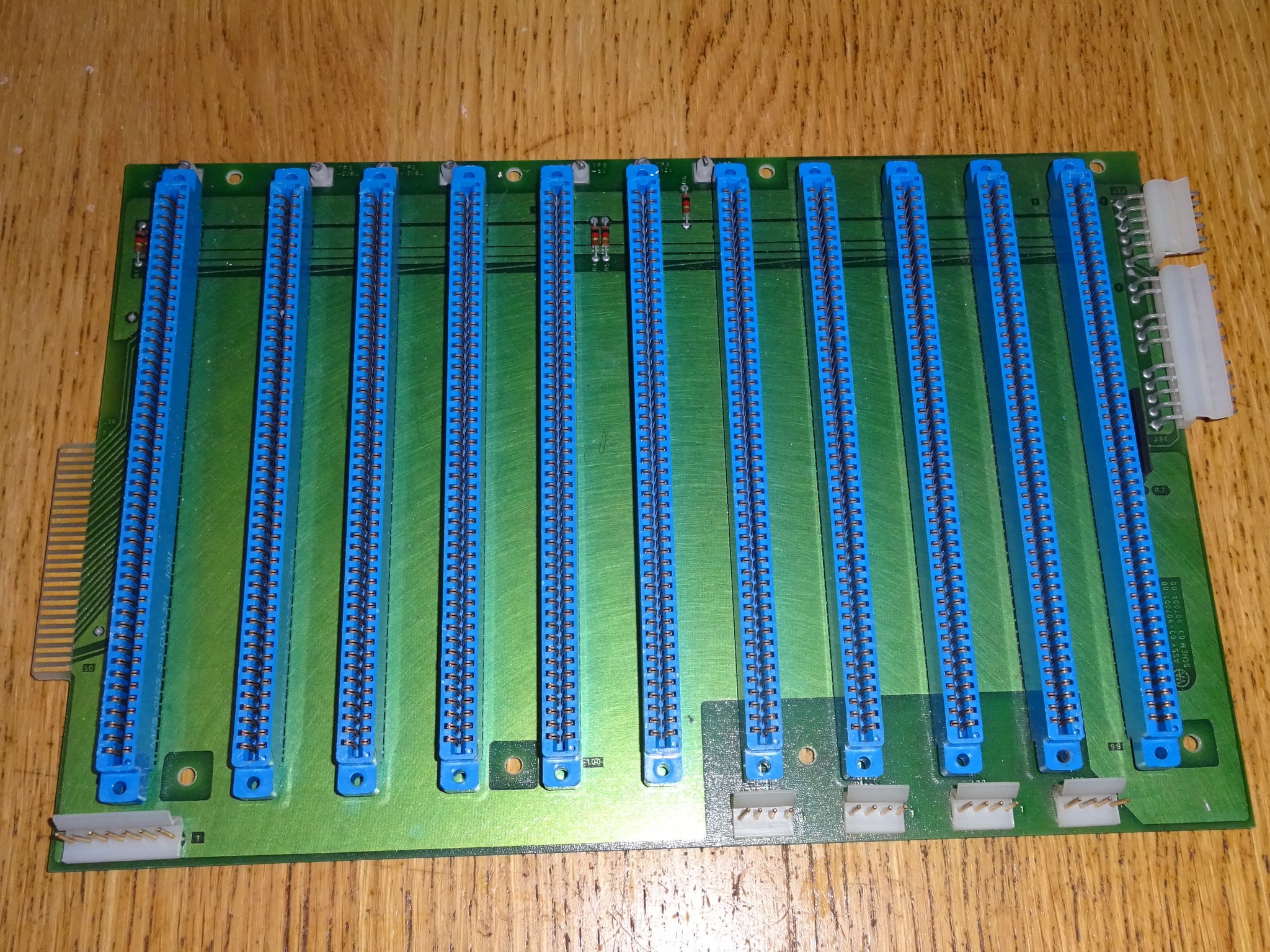
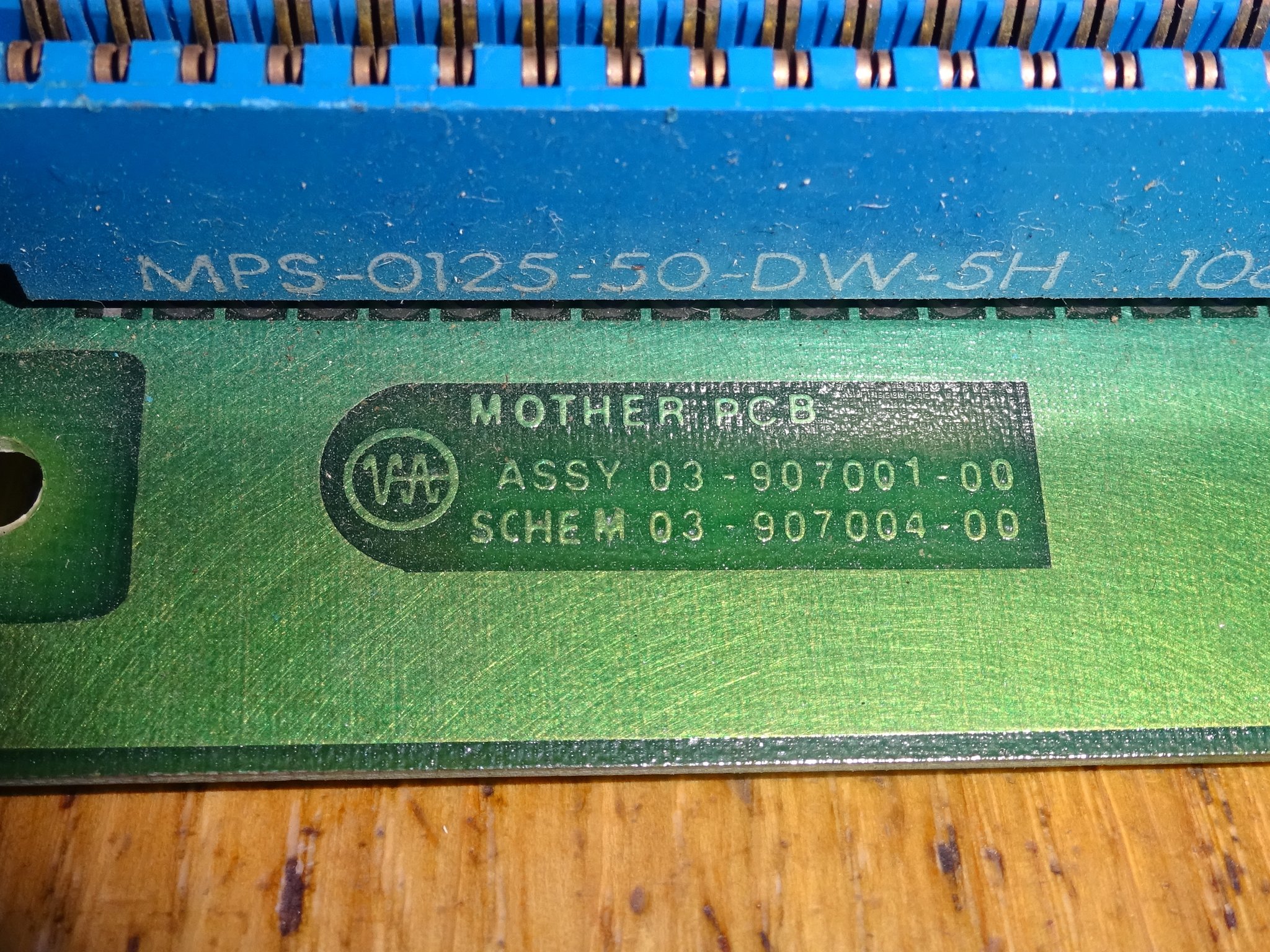
The Card Edge connectors on motherboard are Sullins Connector Solutions, Inc.
http://sullinscorp.com/catalog/
MPS-0125-50-DW-5H
Edge Card Catalog
http://www.sullinscorp.com/pdfs/edgcards-catalog.pdf
Card Edge Connector, 100 Contact(s), 2 Row(s), Straight, 0.125 inch Pitch,
.025? Square Wire Wrap - .610? Insulator Height, Blue Insulator,
Raised with .125? Clearance Holes, .190? Contact Length for .025? Square.
===
For reference purposes, S-100 motherboards use Sullins EBA50DCSD .
https://www.digikey.com/product-detail/en/sullins-connector-solutions/EBA50…
Greg
chicago
Sent from iPad Air
More DEC items available. If you have any interest or questions please
contact me off list.
L4000 KA670 4000/300 I might need one to fill a box. 3 or so boxes also.
L4001-Bx X= chip manufacturer MS670
L4001-Cx
L4004-Cx MS690
L4004-DF
M7606 KA630 Microvax II
M7607 MS630-A 1MG
M7608 MS630-B 2MG
M7620 MVAX CPU
M7621 MS650-A 8MB
M7622 MS650-B 16MB
M8637-Cx 2MG
M8637-Ex 2MG
I hope there aren't too many typos in here and the info is correct.
Thanks, Paul
All,
pursuant to the modem discussion the last couple of weeks, i searched briefly and came up with:
Global Village Teleport 56kbps fax/modem
in original box (opened and inspected, not tested), includes power supply and software on CD (for Mac OS 8).
Cable connects to the Mac serial port (round DIN connector)
For cost of shipping; I?ll add some bubble-wrap to the box to kee things from rattling inside and if you are concerned about the original box I?ll add another layer outside.
- Mark
210-522-6025 office 210-379-4635 cell
---------- Forwarded message ----------
Date: Mon, 30 Jul 2018 20:00:50 +0000
From: "[utf-8] Computer History Museum" <marcom at computerhistory.org>
Subject:
=?utf-8?Q?Up=20Next=20=E2=94=82General=20Magic=20Film=20Screening=20&=20Pane
l=20Discussion=2C=208=2F3?=
Film Screening?????? and Panel Discussion with Marc Porat, Andy Hertzfeld, Megan Smith, and Michael Stern
https://www.facebook.com/computerhistory/https://twitter.com/computerhistoryhttps://www.instagram.com/computerhistory/http://www.computerhistory.org/atchm/
** Friday Nights @CHM
------------------------------------------------------------
** General Magic
------------------------------------------------------------
** Film Screening and Panel Discussion with Marc Porat, Andy Hertzfeld, Megan Smith & Michael Stern
------------------------------------------------------------
>From the smartphones that sit in our pockets to an array of technologies we take for granted today, many of the ideas that now dominate the tech industry and our day-to-day lives were born in 1989 at a Silicon Valley startup most of us have never heard of General Magic.
Extraordinary creativity, remarkable breakthroughs, fierce competition, hubris and heartbreaking betrayal dominated behind the scenes of General Magic. While some never recovered from the failure that accompanied its downfall and bankruptcy, others went on to soar. The lessons learned at General Magic were instrumental in the creation of the iPod, iPhone, Android, eBay, even in the corridors of President Obama???s White House. And although General Magic died, the concepts and the people who worked there went on to change how the world connects today.
Described by Forbes as ???The most important dead company in Silicon Valley??? and combining rare archive footage with contemporary stories of the General Magicians today, this documentary tracks the progress of anytime, anywhere communication from a thing of sci-fi fiction to our modern day reality.
Join us for a special screening of this fascinating documentary followed by a panel discussion with former "magicians" Marc Porat, Andy Hertzfeld, Michael Stern, and Megan Smith.
Exhibits are free to all event attendees.
Join us for Friday Nights @CHM before and after the program! Enjoy food and drinks from Catered Too and extended exhibit hours from 5 to 9 p.m.
Learn More (http://www.computerhistory.org/events/upcoming/#general-magic) or Register Now (http://connect.computerhistory.org/pages/events/2018-08-general-magic)
** When
Friday, August 3, 2018
5 p.m.
Friday Nights @CHM Begins
6:30 p.m.
Program Check-in
7 p.m.
Screening
8:30 p.m.
Panel Discussion
9 p.m.
Program & Friday Nights @CHM End
Where
Computer History Museum (http://www.computerhistory.org/directions/)
Speakers
Andy Hertzfeld
Marc Porat
Megan Smith
Michael Stern
Register Now (http://connect.computerhistory.org/pages/events/2018-08-general-magic)
------------------------------------------------------------
https://www.youtube.com/watch?time_continue=1&v=uTdyb-RWNKo
Watch the General Magic trailer!
============================================================
** CHM (http://www.computerhistory.org/)
** CALENDAR (http://www.computerhistory.org/events/upcoming/)
** VISIT (http://www.computerhistory.org/planvisit/)
** MEMBERSHIP (http://www.computerhistory.org/membership/)
** SUBSCRIBE (https://connect.computerhistory.org/)
Want to change how you receive these emails?
You can ** update your preferences (https://computerhistory.us13.list-manage.com/profile?u=20bc634cf3d929f8435a…)
or ** unsubscribe from this list (https://computerhistory.us13.list-manage.com/unsubscribe?u=20bc634cf3d929f8…)
Christian,
I absolutly agree with David s post.
Back in the ' '70 when I was maintaining 3 x HP 2116 B running 24/24 7/7 FOR around 10 YEARS,
the ONLY memory related problem that I got was traced to a faulty transistor !!
( But I do not recall exactly, may be it was on a Driver Inhbit Card )
Anyway, from this only one case , not statisticaly signifiant ;-) the problem was a Tx, not a C.I.
Wish you the same ...
I have Skunkware 7 (1997) and Skunkware 98 (1998) if they will do. What is
your desire?
On 7/25/18 6:53 PM, David Griffith via cctalk wrote:
>
> Does anyone have any Skunkware ISOs from around 1995 to 1998?
>
Anyone familiar with the SPF file manager on Microware OS-9?
I have an MVME162 processor and for no good reason, other than an
intellectual exercise, I've decided to try and get OS-9 68000 running on
it. Mostly this has been a pretty simple exercise, since the necessary ROM
images are on the Internet, however, the one thing that I can't seem to
make work is SLIP (or PPP for that matter).
I have the MVME board connected via an RS232 connection to a Raspberry PI.
PPP doesn't work at all but SLIP works partially. I can PING from the PI to
the MVME and from the MVME to the PI. I can send TCP traffic in both
directions. I can send UDP traffic in both directions. When I try to start
a telnet session from the PI to the MVME, it seems like the session is
established:
Trying 192.168.2.2...
Connected to 192.168.2.2.
Escape character is '^]'.
But I never see the login prompt on the PI. Pretty much the same thing
applies to other telnet clients including Windows, NetBSD VAX and 211BSD on
my PDP-11. Furthermore, I see that the connection handler in OS-9,
telnetdc, is started and also login is started
20 0 0.0 128 48.00k 0 e 0.03 0:00 telnetdc <pks01
21 20 0.0 128 24.00k 0 e 0.02 0:00 login <>>>pks01
40 0 0.0 128 52.00k 0 s 0.12 25:42 telnetd <>>>nil
but I never get a login prompt at the PI.
Any suggestions?
I am excited about this!! Tim Paterson, of Seattle Computer Products, is
speaking at Vintage Computer Festival XIII next weekend (August 4-5).
The event as always is at the Computer History Museum in Mountain View,
California.
Tim created QDOS - Quick & Dirty Operating System -- which was the basis
for Microsoft's MS-DOS. Tim rarely (if ever?) gives historical lectures,
so this is a coup for the hobby.
Everything you need to know about VCF West -- online ticketing, all the
other speakers, exhibits, consignment, etc. -- is on the VCF web site at
http://vcfed.org/wp/festivals/vintage-computer-festival-west/.
________________________________
Evan Koblentz, director
Vintage Computer Federation
a 501(c)3 educational non-profit
evan at vcfed.org
(646) 546-9999
www.vcfed.orgfacebook.com/vcfederationtwitter.com/vcfederation
Sorting a? previously undiscovered? ?briefcase of? Jack Aldridge the? ? Electrodata /Burroughs? maint? engineer. All these? years turns? out there were? 2!
And? I? thought? one of my assistants? was just moving? it? from one? shelf to another...
?
? found his? b-205? training? certificate!? Yea!? the? 50s!
many may many other? ?goodies....
?
and? ?a small? group of? duplicate? ?pristine? B200 or? ?220? instruction? cards
anyone? ?got? a? cpu in captivity?
?
Back to? sorting...
?
Ed#
I found four of these while sorting through non-DEC boards. I will try to
go through more this week. I have a lot of memory including Q-bus, Unibus,
and Vax.
Please contact me off list if you are interested or have any questions.
Shipping from 61853.
Thanks, Paul
All,
I'm looking for any or all of the following Data I/O Socket Adapters:
351A-070 (8741, 8748, etc)
351A-071 (8751)
351A-072 (8755A)
Thanks,
Jonathan
DRIVE 95 a third party add on disc drive for HP95 LX Palmtop? for sale or trade NOS untested from SMECC MUSEUM
?
Found the? 2? that? ?I had? left over? from the? ?computer business I had in AZ ...? it is NOS? but? untested.? I will keep one? for the museums? collection? at? SMECC? ?the other will be? SOLD? or? TRADED? ?for the museum's? advantage. Will? to listing to? offers? before? I? consider? ?EBAY.
?
See? ?www.smecc.org? for? ?areas for possible trades? we? ?save... it is not? just? computers.
?
Money offers? considered? too.
?
Drop us a not? off-list? with subject of?
DRIVE? 95 OFFER
in the? subject? line.
?
Thanks? Ed Sharpe archivist? for SMECC
hi
yesterday I was shocked by a couple of videos on Youtube where guys
pointed out their negative experiences with CD ROM and DVD RAM as
media for their own backup.
They complained their data completely lost after 5 years of storage in
CD ROMs, pointing out that their CDs were perfectly conserved and kept
clean without scratches, but all the data is gone lost since the media
is unreadable.
This is what they said in the video.
I have a lot of backup here stored in CDs, and I have recently bought
an SCSI DVDRAM unit to create new backups in caddies DVD-RAMs (of
4.2Gbyte each)
what is your experience?
Ok, so I've got the computer almost running now. I now need to fix both
sense amplifier cards. One (0..4k) sometimes reads a one for bit 3 after
the machine has warmed up. The other (4..8k) has a stuck one for bit 7.
Swapping these cards make the errors move to the other core bank
respectively.
I have the newer cards, 02116-6298, not the older 02115-6001
The latter has CA3028A used as sense amplifiers. My card uses HP
1820-0183 (metal can IC from RCA). I guess that it is also a CA3028A or
maybe a CA3053. Can anyone confirm this?
Next, the manual on bitsavers (02116-9153_2116B_Vol2_Oct70, and the same
as found on the hpmuseum site) not only contains some errors (see my other
post about the front panel lamps). It has also some badly scanned pages
with parts missing, notably page 5-50 (PDF page 350) lacks the right part
of the page. Is there a better scan available? My 1968 copy does not list
the 02116-6298.
Christian
Does anyone have any Skunkware ISOs from around 1995 to 1998?
--
David Griffith
dave at 661.org
A: Because it fouls the order in which people normally read text.
Q: Why is top-posting such a bad thing?
A: Top-posting.
Q: What is the most annoying thing in e-mail?
Dear friends,
I'm trying to find a nice and stuffed 16702A or B to buy, shipped to Brazil
or NV, USA. B preffered but I can use the A.
I'd rather have it already stuffed (a pair of LA cards, oscilloscope and
who know, pattern generator)
Anyone willing to part with one? I can do paypal
Thanks,
Alexandre
I had a nice talk with an old friend earlier today, and we talked about how
some companies were so proud of their products that they never put their
name on it. Sometimes a logo, sometimes only a part number.
Bitsaver is great- I don't don't know what any of us would do without it.
But There are a lot of items that, at least I, can't turn up there or on
Google.
While looking for the ABLE (ACT) board that Mattis was talking about (and I
found it for a list member who has first dibs on it) I came across:
Computer Consoles 343d01533
Computer interface Tech -looks like a DZ11 clone
CMD CDU-700/T witch I think can be upgraded to a M/T SCSI Unibus
Simpact Assoc inc ICP-1600
DPD might have been bought out by CDA Computer design and
Applicationd.which might be a subsidiary of Analogic.
MM3000,
40199 2mg,
FPPC
Some of these I've heard of, some not.
I have a few hundred DEC compatibles, and I'm tired of going through them.
Duel, quad, hex, and 780. A lot of Emulex, dilog, ADAC, Data Translations.
Please contact me off list if you are interested in any. Pics would be
nice.
Thanks, Paul
Chuck Guzis <cclist at sydex.com> wrote:
> In WWII radio equipment, MGs in a unitzed form called
> "dynamotors" were used to supply the high-voltage anode voltage
> for the tubes.
And long after WWII! In the 1960s, I had a Motorola 140D (140
for the power, "D" standing for Dynamoter) mobile radio (6 meter
ham band) in my car. Everytime I keyed the mike, the dynamoter
would instantly spin up with a loud whine. Such radios were
normally housed in the trunk of the car and required heavy wire
to carry the 12 volt battery current for the dynamoter.
My Monarch 10EE lathe originally came with a big motor-generator
to power the variable-speed DC motor. Later versions use
thyratrons, while even later ones were solid state, but they all
continued to use DC motors. The variable-speed DC drive was
very similar (identical?) to elevator drives, known as the
Ward-Leonard system.
To bring this back to the RK05, someone asked if anyone had a
copy of the RK05 IPB. If you still need it, let me know and
I'll dig it out. I haven't packed it for my move yet, but
the drives are.
Alan
> From: Ethan Dicks
> I just saw that this specific part had a min order.
They have a min $10 order on _every_ part, and also a min of $25 on the total
order.
Noel
> From: Fritz Mueller
> If these are what you are talking about, I ordered up a bunch a couple
> years ago when I rebuilt the power harness for my 11/45, and can attest
> they are the right thing:
Yeah, those are the ones.
Note that ConnectorPeople has a relatively large minimum order. Quest has the
male connectors (i.e. female pins), but not the females.
Noel
> From: Mattis Lind
> Unfortunately the mate-n-lok which has 8 position and is used for
> current loop connectors and H74x plug regulator does not seems to be
> available anymore. But it would be nice to be corrected here.
According to one dealer Web-site, what I think are those connector shells are
now out of production.
However, as I indicated, I have located several places that still have some,
and I have ordered some to verify that they are the right thing. If they are
(they should be here at the end of the week), I will send another message with
part numbers, sources, etc.
Noel
>Of course there are. Since both SD cards >and ?SD cards have identical
>electrical and protocol interfaces, those >adapters are just passive pieces
>of plastic and wires. In fact, a lot of ?SD >cards sold these days come
I believe Chuck is looking for the other way SD to micros i.e. a size reducer.
-Alo
hi
any chance someone has worked with the Motorola IDP m68EC0x0 board and
has the manual of the 68EC020IDP CPU module?
let me know
p.s.
have you ever seen the IDP-net card? any information on the IDP bus
timing? (i'd like to develop my own net-card for the IDP bus, but I
need the timing spec)
So, it turns out the power connectors (plastic female shell with metal male
pins, etc) widely used in UNIBUS PDP-11's (e.g. to provide power to
backplanes, etc) are still available, if anyone else wants any. (No doubt some
of you already knew this; this is for those, like me, who didn't! :-)
The 3-pin ones are used for the remote power on/off cables (used extensively
in DEC gear, not just UNIBUS PDP-11's).
They are 'Commercial Mate-n-Lok', now made by TE Connectivity, who bought AMP.
Here are the current part numbers:
1-480305-0 3-pin female shell
1-480276-0 6-pin female shell
1-480277-0 9-pin female shell
1-480324-0 15-pin female shell
60620-1 14-20AWG male pin
The 6- and 15-pin are for the backplane power connecters; the 9-pin were used
to power backplanes in older machines (e.g. PDP-11/10). There's also a pin for
smaller gauge wires, e.g. for the power control cables, but I don't have the
number right here.
I have checked, and these do plug into old DEC gear properly.
I got mine from Digikey; their page for the line is here:
https://www.digikey.com/products/en?FV=ffec0ef5
Go to the bottom, where it says 'Housings', and click on that, and they will
all show up. (There are cross-links to the pins when you click on a particular
shell.)
Noel
PS: I'm also tracking down the 8-pin connectors used in the H744/H745/etc
regulator 'bricks'; an update on them in a day or so.
Hi,
I need to replace several broken lamps from our HP-2116B front panel. The
old/original ones are CM-345 or OL-345. This makes sense, they are rated
6V 40mA 10000 hours.
BUT:
The maintenance manual says something different and is even wrong and
inconsistent.
HP part number is 2140-0035, description "Lamp, Incadescent, 6.3V, 0.75A"
This can't be true. 92*0.75A would be 400W alone for the front panel
lights...
The manufacturer code is 71744 (Chicago Miniature Lamp Works), mfg part
number 1775. That is indeed a 6.3V lamp, but 0.075A (better!). Problem:
that is a midget _screw_ base lamp, so wrong socket and only rated for
1000h. The panel and switches need a midget flanged base lamp. Who wrote
that manual? Was he drunk? ;-)
Christian
Just spotted this auction on eBay US Item: 263824036905
Location is: Glenview, Illinois
Not cheap, but the seller is open for offers.
Not affiliated with the seller.
Hi
Are you still looking to purchase STC executel, I have just found my old one in the cupboard under my bed and could sell.
Please email me if interested
Regards
Peter
Sent from my iPhone
> From: Mattis Lind
> I will take a picture of the boards in more detail so we can figure out
> what they are doing later on.
Thanks, that would be really useful.
> My understanding is that slot 1AB and slot 26 AB is tied to each
> other. So if there would be no expansion unibus there should be a M930
> in each of these slots. The same goes for slots 27AB and 28AB.
Right, that's my understanding too.
There's a diagram in the "PDP-11/45 Maintenance Reference Manual" (October,
'73 edition, on pg. 60 - pg. 66 of the PDF), which gives:
- slot 1 - UNIBUS A termination
- slot 26 - UNIBUS A cable
- slot 27 - UNIBUS B cable
- slot 28 - UNIBUS B termination
and my read is that the slot 26 cable is 'out to any UNIBUS memory, etc',
while the slot 27 cable is 'in from the other machine in the dual-processor
system'.
(There's an interesting discussion in, IIRC, an RH11-AB - the dual-UNIBUS
controller for the MASSBUS - tutorial manual which talks about the M9300,
which is a terminator which can produce an NPG in response to an NPR; that is
used when people want to attach the RH11-AB's second UNIBUS to the UNIBUS B,
when there's no CPU on it. So the M9300 would go in slot 27, and the cable out
to the RH11 in slot 28.)
> I cannot see how a device in slot 26AB or 27AB would be able to
> intercept MSYN here.
Not _in_ slot 26 or 27, it's in the cable _between_ them! :-)
Look at the common case, where UNIBUS A and B are connected: MSYN comes out
of the CPU in slot 26, is jumpered across to slot 27 by the M9200, is carried
across the backplane to slot 28, and then out (on either a BC11 or an M920).
That dual-card thingy that comes with the Cache/45 would allow (if my surmise
about what's going on is correct :-) the Cache/45 to place itself _between_ the
MYSN out of the CPU (in slot 26) and the 'MSYN out to the rest of the system'
(in slot 27).
That does mean no separate UNIBUS A and B. But if my supposition as to how the
Cache/45 works (that it fills itself by snooping on UNIBUS B in the MS11
controller slot) is correct, UNIBUS A and B would have to be connected
together _anyway_, for that to work.
(I _can_ imagine how to do it all without joining the two UNIBI together, but
I will skip that for now.)
Noel
> From: Mattis Lind
> Here is how it is connected:
Thanks for that - very informative!
> The sandwiched dual boards are sitting in 27 / 26 AB. The board in 27AB
> was empty (quick glance), while the board in 26AB has a few TTL chips
> on it. Slot 26AB is the Unibus A slot, Slot 27 AB should be a
> terminator on Unibus B.
I'm more interested in _what_ the two boards are doing! :-)
It seems they must be jumpering UNIBUS A and UNIBUS B together. (Which I
didn't expect, but maybe... will have to ponder.)
As to what _else_ it is doing, and why it has the cable to the main card... I
think that it must intercept MSYN from the processor and only let it pass if
there's no hit in the cache.
(To explain why it would need to do that... normally with the MS11, there's a
static partitioning between FastBus memory and UNIBUS A memory. So when the
CPU goes to do a memory cycle, it can put the address out on both the UNIBUS
and FastBus, with the certainty that it will only get a reply on one. But with
the cache, if there's a hit, it would in theory get a reply on both, which
might confuse it. Or if it takes the cache copy, and terminates the UNIBUS
cycle, that might confuse the memory.)
Or maybe I'm confused, because now that I think about it, UNIBUS A goes
straight from the CPU to the UNIBUS A out slot, so the Able board couldn't
intercept MSYN? I guess I need to understand the fine details of the UNIBUS A
and B stuff, maybe it will make sense at that point.
Oh, wait a moment: slot 26 is UNIBUS A out, slot 27 is 'UNIBUS B in', and slot
28 is UNIBUS B 'termination'. (27 is 'in' because when the M9200 is installed
in 26/27 to join the two UNIBI together, obviously one has to connect an 'out'
to an 'in'... and then 28 is not 'UNIBUS B termination', it's 'UNIBUS out' to
the rest of the system.
OK, so that works - MSYN coming out of slot 26 is intercepted by the dual
double-card, and is only allowed to pass on cache miss. Yeah, that sounds like
it should work.
> The hex ABLE/ ACT board sits in slot 21 which is the memory controller
> board for the MS11.
One of two; the other is slot 16.
> From: Paul Birkel
> I wonder whether this CACHE/45 can coexist with MS11 memory on the
> Fastbus itself
According to that marketing thing you found, "User may optimize hit ratio by
upper/lower limit switch settings", so one would have to configure the
Cache/45 to not cache the block that the 'other' MS11 controller thinks it
owns... otherwise both might respond to requests for addresses in that
range.... :-)
Noel
Hi
I'm trying to assist Jeff with HxC to create a Gotek that can work with the North* hard sectored disk. It has been problematic because of timing constraints. Jeff has been working with several in the US but it is difficult to see what factors are important, working remotely.
Jeff is in Paris, France. It would be great if he could get hands on access to one of these machines for a month or so, that was operational.
Dwight
Has printerworks gone under?
Their website is unresponsive.
Does anybody have scans of their CX and SX "catalogs"?
--
Grumpy Ol' Fred cisin at xenosoft.com
Hello!
I have two RK05J-AA as part of a system that I guess has been imported used
form the US. A DC-10 simulator.
The only difference is the pulley, the motor position and a 230 / 115 V
jumper inside.
Is there anyone in 60Hz land that has the opposite problem and want to
trade two spindle pulleys?
The good thing for me that I would guess that it possible to use a lathe to
get the diameter down to the correct 50Hz diameter. On the other hand going
>from 50Hz to 60 Hz is tougher...
Then there is a PC05 that has the wrong number of grooves on the motor
pulley. Apparently it should be 16 instead of 20.
Now in 50Hz land the only difference is that the punch would be slower than
it should be. Using a 50Hz punch in 60Hz area might get you into problems,
so maybe there is someone here as well that want to do a trade?
/Mattis
> From: Paul Birkel
> Unfortunately there's not much documentation for the MS11.
??? We're actually pretty well off, there; we have:
- MS11 Maintenance Manual (DEC-11-HMSAA-D-D)
- MS11 MOS Memory Troubleshooting Guide (DEC-11-HMSTS-A-D)
- MS11-B Engineering Drawings
About all we're missing are the MS11-A/C data board engineering drawings.
(The control board is in the MS11-B prints.)
> From: Mattis Lind
> This could mean that 16 bit data is in the L chips while the faster
> chips are used for a 10 bit cache tag.
Sounds plausible.
> And of course those two I/O connectors don't belong on a cache.
> ...
> Those IO connectors are connected to two double height boards in 26 /27
> AB. They are also made by ACT and contain a few TTL chips.
If the board is a cache, how does it get filled? It would have to listen to
the UNIBUS the memory is on. So I'm guessing that's that those connectors and
boards are for.
Note that there has to be a signal from FastBus (anyone know the correct
capitalization for that?) which tells the CPU if the MS11 has a given address
or not (given the way the MS11 can be configured as to size and address), so
the cache board could use that line to tell the CPU whether or not the
location in question is in the cache.
Noel
Is there ANY interest in Courier 56K V.92 modems?
Laserjet IIP printers?
Parallel port and/or SCSI flatbed scanners? (home office, NOT
professional)
Oversized PC cases with MANY drive bays?
Generic 386? PCs?
Is it worth even hauling that kinda stuff to VCF?
How feasable is it to compile and run SDL for SunOS? My main reason for
doing this is to play Z-machine games on Sparcstations using Frotz
(https://gitlab.com/DavidGriffith/frotz) using the SDL interface to play
V6 games.
--
David Griffith
dave at 661.org
A: Because it fouls the order in which people normally read text.
Q: Why is top-posting such a bad thing?
A: Top-posting.
Q: What is the most annoying thing in e-mail?
Does somebody know how to set the IACK and BG backplane jumpers for the MVME188 CPU? Remove them all? Leave them in behind the memory and/or cpu board(s)? Something else? All the documentation I can find are for the normal VME SBCs, which the 188 isn't.
Thanks!
ok
bear.
--
until further notice
> Message: 1
> Date: Sun, 22 Jul 2018 09:22:25 -0400 (EDT)
> From: jnc at mercury.lcs.mit.edu (Noel Chiappa)
> To: cctalk at classiccmp.org
> Cc: jnc at mercury.lcs.mit.edu
> Subject: Re: Strange third party board in PDP-11/45
> Message-ID: <20180722132225.49A0B18C096 at mercury.lcs.mit.edu>
>
> > From: Paul Birkel
>
> > ABLE Computer Technology. Their first product was PN 10001 ... the
> > A.C.T. Univerter
>
> This board is not shown in any of the Able brochures we have:
>
> http://bitsavers.trailing-edge.com/pdf/able/brochures/
>
> However, Able info is _very_ thin on the ground, now...
>
> Noel
There was a Univerter and Qniverter (sp) which were used to
translate from unibus to qbus.Very useful boards and used one
to translate from vax730, vms 4.3 to a qbus expansion box, so
I could use an RQDX3 and RD53 as vms boot. Just set up the
dipswitches and it works automagically at power on.
May have docs somewhere, but not sure where...
Chris
I have been recovering dozens of old Tektronix 4050 series tapes and found
one with Fast Graphics software for the 4051. This software program jumped
into 6800 assembly code and retrieved three bytes per vector from a tape
file. Apparently this tape is a duplicate - and it appears that all the
files bigger than 1KB have corrupt data.
Apparently from the 4014 programmers guide - they had a set of demo picture
files including a list with R2-D2.
I have found Jos Dreesen's ftp tar file with some 4014 pictures - but I'm
looking for an R2-D2 picture file that is on the tape I have but corrupt.
I also discovered that Tektronix made a 4052/4054 R12 Graphics Enhancement
ROM pack which included the Fast Graphics program in ROM. I would love to
find one of those ROM packs - hint/hint :)
I did recover one of the shorter picture files of Snoopy - but since I
don't have a 4051, I can't run the Fast Graphics program on my 4052 or
4054. One of my buddies threw a C program together to convert the data
file into Tek 4050 PRINT statements.
I've posted the SNOOPY basic program and screenshots of running it on vcfed
in a new thread:
http://www.vcfed.org/forum/showthread.php?64726-Tektronix-4051-4052-4052A-4…
I'm also still looking for a 4051/4052 Display Board. Mike Haas posted
pictures here in Oct 2016 of lots of Tektronix boards including a Display
Board - but I don't have any direct contact info for him.
Monty
Greetings to the List -
Carlo, I have been using IDE68K out of Norway for about five years
and it is excellent: http://home.kpn.nl/pj.fondse/ide68k/
It includes the 68020 instructions such as bit instructions etc -
also floating point.
I only use the assembler and download S-records to the MVME177-005
boards that I use.
I have never found any bugs etc.
Best,
Jack
At 12:46 PM 7/20/2018, Carlo Pisani via cctalk wrote:
>hi
>does anyone happen to use Avocet Development Tools for m68k?
>how good/bad is it?
----------------------------------------------------------------------------------
Jack Harper, President
Secure Outcomes Inc
2942 Evergreen Parkway, Suite 300
Evergreen, Colorado 80439 USA
303.670.8375
303.670.3750 (fax)
http://www.secureoutcomes.net for Product Info.
>
> I have a lot of backup here stored in CDs, and I have recently bought
> an SCSI DVDRAM unit to create new backups in caddies DVD-RAMs (of
> 4.2Gbyte each)
what is your experience?
I recently disposed of a couple hundred DVD and CD backups I'd made. As
mentioned in a previous comment, it's simply too impractical to store
terabytes of information in 4.7GB segments, plus they take up a LOT of
space. HDDs aren't the most reliable, but this is what I use now for that
reason. I make sure to keep the previous backup in case something happens.
I'll only use optical backups now with the most important data.
Backblaze has some interesting stats regarding HDD reliability (they are a
data center using thousands of drives running constantly):
https://www.backblaze.com/blog/hard-drive-stats-for-q1-2018/
As noted previously, beyond storage conditions, disc longevity depends on
the types of dyes used in the discs. Gold is supposed to be best. Early on,
they experimented with a wide variety of dye types, and the silver dyes
were least reliable, oxidizing in only about 10 years.
The thing is, no media format is going to last forever. The only really
reliable way of keeping data around is multiple backups and data migration.
Basically, for your really important stuff, you'll want a couple of
backups, stored in different geographical locations (one local, one on
cloud works, too). You'll want to periodically refresh the backups by
migrating the data onto fresh media.
In the preservation business, the ideal is to refresh after the cost of
storage media is 1/2 of the initial investment. So, if you paid $1 a GB for
the initial storage media, you'll want to migrate once the new format is
$0.50 a GB, and then again when it is $0.25 and so on. This way, the total
cost is double what you initially invested.
Of course, while the cost per GB might drop steadily, the total amount on a
particular media format will increase as well, such that the $150 HDD you
bought 5 years ago will have twice the storage for...$150. Definitely open
to other suggestions.
> #30 "PMI on KDJ11-B and MSV11-J"
So it turns out there are _two_ uNote sets, with overlapping numbers! (A fact
about which I was previously unaware!)
I have two PDF files of the collections; micronoteReprints.pdf (the first
set), and oemMicronotes.pdf (the second).
Note! There's an index to the first set at the back of the second, and it
lists 111; but the ToC for the first one only lists 85! But they are in fact
all there (and more; the ones there go up through 115).
Noel
> From: Charles Dickman
> an 11/84 with the UNIBUS adapter and PMI memory does not have a Qbus.
> ... the KDJ11-B (M8190) bus protocols change when a KTJ11 (UNIBUS
> adapter) is present and so what would be expected to be Qbus isn't.
Ah, excellent point.
Looking at the description of the CPU/UBA adapter in the KDJ11-B User Manual
(EK-KDJ1B-UG-001, pp. 7-6 to 7-9), the answer is not certain; it all depends
on implementation details on the CPU card which aren't described.
E.g. the DMA cycle _might_ work, it all depends on what happens at step 8
when, instead of PBSY being asserted, BSYNC is asserted. The _memory_ will be
fine (since in an -11/83, this kind of thing is expected)... but the _CPU_,
who knows.
Interrupt cycles are more problematic; the assertion of the interrupt level
on the BDAL lines (step 1a) will probably pass, but step 6 (assertion of
BSACK) may be an issue, since the device will want to assert BRPLY instead
(BSACK is not used in a QBUS interrupt), and the CPU may not do the right
thing.
> I think there was a DEC Micronote that explained the protocol
> modifications involved.
I don't think so; #30 "PMI on KDJ11-B and MSV11-J" describes the _basic_
PMI, but the interaction with the UBA isn't described there. But the
KDJ11-B User Manual has it in some detail.
Noel
hi
I am looking for a ps/2 keyboard with a 3 buttons trackball
I am currently using a Cherry's kb, but it has a built-in 2 buttons
trackball and the software I need to use requires the third button to
select items
what do you suggest, guys?
So what does it take to get OS/9 running on a Radio Shack Color Computer?
I have a Color Computer 2 (? 64k and non-chicklet keyboard) and have
always wanted to get it working with a disk OS. What do I need? I see
a reproduction floppy disk controller on ebay. I would rather skip
that and go straight to some kind of sold state memory.
Suggestions or pointer to active groups?
On Sun, Jul 22, 2018 at 5:31 PM, W2HX via cctalk <cctalk at classiccmp.org> wrote:
> Not mine, just thought it might interest some here
> https://www.ebay.com/itm/202376723756
-chuck
> We're actually pretty well off, there; we have:
> - MS11 Maintenance Manual (DEC-11-HMSAA-D-D)
> - MS11 MOS Memory Troubleshooting Guide (DEC-11-HMSTS-A-D)
> - MS11-B Engineering Drawings
There's also a little bit about the MS11-C (not covered in the documents
above) in EK-11045-MM-007.
There is a later rev of the MS11 manuals, which does cover the MS11-C; Chuck
McManis had both of them:
EK-MS11A-MM-006 MS11-A,B,C memory systems maintenance manual
EK-MS11A-OP-001 MS11-A,B,C memory systems users's manual
but when I contacted him about them a while back, he wasn't sure if he still
had them, or if he'd given them to Al K to scan and put up (he was on the road
at the time, so couldn't check if he still had them).
Al, are they in your queue somewhere? (No rush to do them, if so; I just want
to make sure we know where they are.)
> If the board is a cache, how does it get filled? It would have to listen
> to the UNIBUS the memory is on. ... Note that there has to be a signal
> from FastBus ... which tells the CPU if the MS11 has a given address or
> not ... so the cache board could use that line to tell the CPU whether
> or not the location in question is in the cache.
Studying the MS11 Maint Manual, the MS11 controller has access to the full
address and data from both the CPU (FastBus) and UNIBUS B. (The FastBus
actually has two uni-directional data busses; in and out.) So all that info,
this hypothetical cache board can get from the slot it is plugged into
(assuming the cache is plugged into one of the controller slots), over its
connector pins.
The connectors on the back of the card, and two small boards, must be for
listening to UNIBUS A (in configurations in which the two UNIBI aren't joined
together)? (I'm too lazy to check the slot numbers are see what they actually
are.)
And there is indeed a signal which the MS11 uses to tell the CPU it has the
location the CPU is asking for, so it's theoretically possible to build a cache
card that plugs into a FastBus slot.
Noel
The PDP-11/84 uses the M8190 CPU that is also used in a PDP-11/83. The 11/83 and 11/84 use PMI
Memory but the 11/83 also can use Q22 memory. With the 11/83 the position of the memory board (assuming
one is using the MSV11-JD or JE) above the CPU uses PMI and below the CPU in the backplane uses
Q22. In the 11/84 the CPU is above the MSV11-JE memory but the CPU only uses PMI to talk to memory.
diagrams in the Unibus processor handbook indicate that the M8191 Unibus map board only communicates
through the PMI bus to both memory and to the CPU.
Now my question is, there are 3 Bus slots in the 11/84 above the Unibus map board, would it be possible
to put a dual width Q22 I/O board in the second memory slot (not the PMI side of the slot) and have it
able to DMA into the MSV11-JE?
If so then something like an Emulex UC07 and a SCSI2SD card could make a cost effective disk solution,
since Unibus SCSI controllers are so expensive.
Mark
Good arvo all;
A family member recently purchased a rather large CNC which uses a
Micon16-II system (as well as a Fanuc 15M) to drive it. Unfortunately the
battery for the RAM died during storage prior to him getting it and all of
the ladder logic is gone.
We'd really love to try and find some kind of technical manual for the
16-II, or anything really, to assist in talking with the machine and
interrogating it's state. We have a copy of the missing ladder logic in
paper form so we're not totally out of luck, but the ability to enter it
in segments rather in one 40 hour slog might be nice.
If anyone has anything easily sharable we'd very much appreciate the
assistance;
Thank you.
- JP
Anyone got pinout/spec information for a MOS MCS2529? In particular, I'm
curious about operating voltage. I acquired a Melcor SC-635 calculator
yesterday and there seems to be some uncertainty about the output voltage
of its (rechargeable) battery pack; some places say 2.4V, i.e. the pack is
a pair of 1.2V cells, but others say 9V.
2.4V seems a little low to me for typical logic, but on the other hand I've
seen a period ad which says that the external PSU was 9V - and so the
rechargeable battery must have been somewhat less than that.
cheers
Jules
> From: Mark Matlock
> With the 11/83 the position of the memory board ... above the CPU uses
> PMI
Yes, through the C-D interconnect; described in detail here:
http://gunkies.org/wiki/CD_interconnect#Use_by_PMI
The 'above' is because the CD interconnect is not a true bus, it only
interconnected pairs of slots.
> In the 11/84 the CPU is above the MSV11-JE memory
The PMI is still on the CD connector in this machine, but the PMI is wired as
a true bus on the backplane, allowing that ordering.
> there are 3 Bus slots in the 11/84 above the Unibus map board, would it
> be possible to put a dual width Q22 I/O board in the second memory slot
> (not the PMI side of the slot) and have it able to DMA into the
> MSV11-JE?
It is speculated that this should be possible, but there are jumpers on the
backplane you'd need to pull. See the writeup here:
http://gunkies.org/wiki/PDP-11/84#QBUS_slots
Noel
> I also have a few boxes of old books and IBM slip-case manuals (techRef,
> etc.), 3" and 3.25" drives, at least one bundle of hard sector disks, half
> a dozen HP "pinch to close shutter" 3.5" disks, a Shugart 3.5" from before
> they HAD shutters, a Sony 600RPM 3.5" (if I can find it), . . .
> ('course all of THAT will look like Generic PC Crap to people unfamiliar,
> . . . )
>
> I'm not healthy enough (last year I had another TURP surgery, instead of
> VCF, eclipse, and Concourse D'Lemons) to dig out the 8" drives, or to
> really load up, so, it's gonna be a much lesser quantity of what I can
> manage.
>
> --
> Grumpy Ol' Fred cisin at xenosoft.com <http://www.classiccmp.org/mailman/listinfo/cctalk>
If you turn it up, I might be interested in getting that Sony 600 RPM drive, but I won't be at VCF East. I need one to replace the broken one in my HP logic analyzer.
Let me know price/shipping if it turns up.
Joe Zatarski
Mark E. Rorvig , Denton, associate professor of library and information sciences, 1995-2002. Rorvig was nationally recognized as a pioneer in the field of information retrieval. From 1990 to 1995, while serving as an adjunct professor at UNT, he worked as a computer engineer for NASA at the Lyndon B. Johnson Space Center in Houston. His research focused on deciphering large amounts of information and finding new ways to piece it together. He produced four U.S. patents on information retrieval algorithms. Rorvig earned a bachelor's degree in English at Seattle University, a master's in library service from Columbia University and a doctorate in information studies from the University of California at Berkeley. At UNT, he led the master's program in information systems.any? ? one? know? him?
I took? some? photos? for a? book he? did on microcomputers in libraries? and? took an into? to dp? class? from him? when I started? ?Computer Exchange in? AZ? ? ?I had? talked? ?into? course years? before? ?from someone else? but thought hey? good? to take it now things have changed and I am going into the biz!
?
I talked to? him again? years? ago and? thanked? him? for admitting me? to an already? full class...but in looking him? up? to? get some data? from him? find? he? had? passed but? ?almost nothing out there....in the? way? of? info except? ?for the? brief? info in? google.? I? remember? ?during that? class period? I? got? first? pdp-8? m or? f ?? ?and? brought it into class and? showed? the students? how? I would? toggle it....
?
Funny? this is when I? got? to first? play on the HP2000 F I later to own? surplus? form the college that? shaped? my entire? future? business? ( still have it under glass at? SMECC)
?
?
Having that? PDP 8 was? great? as a tty? tester!? Sold? many ttys? in the? early? days....
?
thanks? ed sharpe archivist for smecc
?
s?ndag 22 juli 2018 skrev Paul Birkel <pbirkel at gmail.com>:
> 26 bits (or 13 bits) doesn't make any sense on a 16-bit machine; makes
> more sense as a high-speed I/O buffer.
One can note that it is actually two different types of 1k chips. 16 chips
are 94L415 and 10 chips are 93415. As far as I understand the L is the
slower variant.
This could mean that 16 bit data is in the L chips while the faster chips
are used for a 10 bit cache tag. Maybe 8 address bits plus some valid bit
and possibly a dirty bit?
The switch is marked ON/OFF which could simply cache on/off. The
handwritten label on the board says that it is not in use and should sit in
slot 21.
And of course those two I/O connectors don't belong on a cache.
Those IO connectors are connected to two double height boards in 26 /27 AB.
They are also made by ACT and contain a few TTL chips.
So it pulls out some signals out of both Unibuses but 20 + 10 signals at
most it not much of a complete bus so I wonder what kind of signals go
there.
> While odd to use slot 21 (Fastbus) for something other than memory I don't
> know why a fast memory-mapped I/O channel couldn't go there.
> Also note all of the signals employed on tabs C-D-E-F?
> It may not even employ the Fastbus; just talk to Unibus B.
> Unfortunately there's not much documentation for the MS11.
> It seems likely that A-B isn't anything like the usual Unibus signals, and
> who knows where the Fastbus signals are routed.
> On my backplane D-E are essentially unused whereas A-B-F are busiest.
>
> I see the marking "copyrighted 1976", which is rather earlier than the ACT
> / ABLE documentation online.
>
> From Bitsavers see the ABLE documents for the SCAT/45:
> Able_Computer_Product_Summary.pdf - page 3
> Able_Computer_Product_Brochures_1982.pdf - pages 16-17
>
> The PN 10003 doesn't seem to match anything documented from ACT, however
> it's consistent with them.
> The original QBus Univerter is PN 10001, and is dated 1976.
There are some documentation to get with the machine so the manual for the
board might turn up.
>
> What are the pair of DIP24 ICs on the lower-left?
Fairchild 9308 Dual 4 bit latches.
>
> -----Original Message-----
> From: cctalk [mailto:cctalk-bounces at classiccmp.org] On Behalf Of Paul
> Anderson via cctalk
> Sent: Saturday, July 21, 2018 6:54 PM
> To: Mattis Lind; General Discussion: On-Topic and Off-Topic Posts
> Subject: Re: Strange third party board in PDP-11/45
>
> I think it's Applied Computer Technologies, and I think they made cache
> and several other options. They were popular back in the day. I have a
> bunch of their boards here.
>
> Paul
>
> On Sat, Jul 21, 2018 at 1:37 PM, Mattis Lind via cctalk <
> cctalk at classiccmp.org> wrote:
>
> > This board was sitting in slot 21 of the backplane in a 11/45
> >
> > https://i.imgur.com/ZYWZQCo.jpg
> >
> > What kind of board is this?
> >
> > It has 26 bipolar RAMS. Fairchild 93415 1kbit SRAM.
> >
> > The manufacturer might be ACT whatever that is.
> >
> > My guess is that it is some kind of cache board? It is connected to both
> > unibuses in the machine.
> >
> > Better ideas? Documentation?
> >
> > /Mattis
> >
>
>
> From: Paul Birkel
> ABLE Computer Technology. Their first product was PN 10001 ... the
> A.C.T. Univerter
This board is not shown in any of the Able brochures we have:
http://bitsavers.trailing-edge.com/pdf/able/brochures/
However, Able info is _very_ thin on the ground, now...
Noel
This board was sitting in slot 21 of the backplane in a 11/45
https://i.imgur.com/ZYWZQCo.jpg
What kind of board is this?
It has 26 bipolar RAMS. Fairchild 93415 1kbit SRAM.
The manufacturer might be ACT whatever that is.
My guess is that it is some kind of cache board? It is connected to both
unibuses in the machine.
Better ideas? Documentation?
/Mattis
Bill,
I?m not familiar with the program they mention for the AIM65, but in Section 9
of the User?s manual on bitsavers is a good description of how to set up cassette
recorders with the AIM65. If the recorder has a pause input the AIM65 can
control the tape both during read and write. If two cassette tapes were available
It could read assembly source code from one and write object to the other. (When
the computer came with 1K Ram expandable to 4K you did stuff like that.
On page 9-13 they do have two short test programs ?SYN Write? and ?SYN Read?
that can be used to adjust record and playback volume as well as the VR1 pot
on the AIM.
If they are just looking for ways to save and load programs the best way was to utilize
Teletype interface that is described on page 9-26. The described interface is for the
current loop that ASR33?s had but that is pretty easy to change to RS232 with some
external chips. With that interface 240 characters per second could be read or written.
If you upgraded the RAM a bit with an external board the AIM was quite a nice 6502
development tool. I built a number of things with it.
1. Instrument to measure the stability of vegetable oils. (See ?Oil Stability Index?)
This analytical method is still used today but with more modern systems. It used
a ICL7109 12 bit A/D, 16 relays, a pen plotter, and a home built conductivity circuit
with 32KB Ram with software burned to 2532 EPROMs. We wrote the source
on a PDP-11/24 and loaded it into the AIM65 for local assembly and store to RAM.
We used 2K Byte battery backed up RAM (MK48Z02B-25) on the AIM till debugged
then burned an EPROM.
2. A data acquisition system for a Perkin Elmer AA / Graphite Furnace.
3. A converter to change 66.67 baud 6 bit ticker tape code to 9600 baud ASCII.
(see https://en.wikipedia.org/wiki/Ticker_tape <https://en.wikipedia.org/wiki/Ticker_tape> ) Believe or not there was one
commodity exchange still transmitting their data in this format in the 1980s and
Our PDP-11/44?s DZ11 interface could do 50,75,110 and higher baud but could read
this data. This used a 6522 to generate 16 times the 66.67 baud and was fed to
a UART to read it. 64 byte program, and 64 byte look-up table.
4. A remote monitor that provided video output, and RS232 data recording from
9 digital temperature meters. The meters were read by counting their clock
pulses during the down slope of the dual slope meter allowing each meter
to be read with three wires (Ground, Clock, Gate) that were switched with 74150
Chips.
So I have found memories of the AIM65 and the last time I had it set up about 2
years ago it still ran fine.
Mark
Date: Sat, 21 Jul 2018 11:27:36 -0400
From: Bill Degnan <billdegnan at gmail.com>
To: cctech <cctech at classiccmp.org>
Subject: AIM 65 Cassette Test Program
Hi all...I got the following through my web site. Does anyone have a good
known-working test program for an AIM 65 cassette that I can attempt and or
send in response? I still have to set mine up and attempt to reproduce,
but someone here likely has more experience, it has been at least 5 years
since I powered mine on. Also, the article this guy references from MICRO
April 1979 volume 11 is not present in my copy of MICRO, he may be mistaken
in his reference. I don't know what cassette program he is referencing. I
do know that the cassette test program that comes in the Rockwell AIM 65
manual is in error, but I don't have the corrections. I also know that one
needs the correct (optional otherwise) power lines when using cassette.
Bill
VintageComputer.net Inquiry -
I am one of the founders of the Computer Museum in Basel (CMBB/CMGB).
We have 2 AIM 65 units that seem functional. However, we're
experiencing problems with the cassette drive when trying to read back.
We tried to record using cassette recorders and also a modern PC
through line in and the audio signals are clearly recognizable
(from pin M). A connection to pin L and using the corrected program
to test readback from "micro_11_apr_1979_text_syn_read_program_AIM65.pdf"
only displays the "N" on either AIM 65 system. The cassette interface
potentiometers are sealed in one of the units by the manufacturer and
have never been changed as far as we can tell. Is there anything we
could try to get reading from tape to work? We are running our of
ideas. Is there any way to visualize the incoming signal through a
small program other than the one from the magazine?
Hi Gang,
I have a Kenwood communicator, I can't imagine many of these were sold in
the UK, I have the box, manual, warranty card, data cable. It runs of four
double As. Quite a weirdly niche gadget, if not strictly computers.
Does anyone have an idea of what a good condition one of these is to buy? I
doubt I've made base rate inflation with it mind.
I'll email photos for anyone interested in seeing either an SSTV image or
the device itself. And yes, you'll need an amateur radio license to use it.
Henry
Hi all...I got the following through my web site. Does anyone have a good
known-working test program for an AIM 65 cassette that I can attempt and or
send in response? I still have to set mine up and attempt to reproduce,
but someone here likely has more experience, it has been at least 5 years
since I powered mine on. Also, the article this guy references from MICRO
April 1979 volume 11 is not present in my copy of MICRO, he may be mistaken
in his reference. I don't know what cassette program he is referencing. I
do know that the cassette test program that comes in the Rockwell AIM 65
manual is in error, but I don't have the corrections. I also know that one
needs the correct (optional otherwise) power lines when using cassette.
Bill
VintageComputer.net Inquiry -
I am one of the founders of the Computer Museum in Basel (CMBB/CMGB).
We have 2 AIM 65 units that seem functional. However, we're
experiencing problems with the cassette drive when trying to read back.
We tried to record using cassette recorders and also a modern PC
through line in and the audio signals are clearly recognizable
(from pin M). A connection to pin L and using the corrected program
to test readback from "micro_11_apr_1979_text_syn_read_program_AIM65.pdf"
only displays the "N" on either AIM 65 system. The cassette interface
potentiometers are sealed in one of the units by the manufacturer and
have never been changed as far as we can tell. Is there anything we
could try to get reading from tape to work? We are running our of
ideas. Is there any way to visualize the incoming signal through a
small program other than the one from the magazine?
https://www.ebay.com/itm/292646012304
local pickup only
the reserve is >$1500
I would guess the CDC Winchesters are toast if they haven't had their heads locked
Any interest in a Tek 4113 terminal (minus display)? I have one collecting
dust here and would like to trade for older Tek restoration help / other
pdp11 stuff. The keyboard is damaged but otherwise it's just old and
dirty, haven't opened it up. Located in western Pennsylvania.
thx
jake
> From: Liam Proven
> one of the questions was about "the early days of the old-time
> internet, if you're old and you've been online forever."
> It was about Myspace.
Yikes.
Send them this:
http://www.chiappa.net/~jnc/tech/sflovers/
Noel
I asked this in the GOTEK thread but I think it got lost in the chatter.
Does any of this apply to the equivalent devices with the board
labeled SMUFDDV4 at 1104?
I have a few of them and would love to make them work with
non-PCs as well.
bill
Anyone familiar with these PCMs? I got a CMI 1640 and little help needed. Here's photos: https://drive.google.com/drive/folders/1w74AYe6lRSn9gJhyKVlBYAq5zRDWybSw?us…
What this 370 clone is exactly? If I have understood right, Steven Ippolito's IPL Systems Inc developed the original machine and CMI (Cambridge Memories Inc) made them. Also these sold as Omega/480 and Olivetti 5300 series. Later CMI made their own versions and I believe this one of those. But I haven't found model 1640. So is this 1641..? What is difference between CMI and others? Microcode?
I got belong with the machine a couple manuals, Maintenance and Theory of Operation. Unfortunately original microcode disk is missing (and 8" drive...), so that would be needed if I ever want to fire this thing up. Any ideas where I could find a one?
All ideas & info are welcome!
- Johannes Thelen
johannesthelen at gmail.com
Finland
Before microcomputers blog (Finnish) http://ennenmikrotietokoneita.blogspot.fi/
Does anyone have any experience with the GoTEK SFR1M44-U100 floppy drive
emulator that reads ""images from a USB flash drive?
Good?
Bad?
Indifferent?
Run for the hills?
--
Grant. . . .
unix || die
Hello,
I recently received the following request:
> I just recently found a (9 or 7 track?) tape of mine made on an
> HP2000 (probably C, maybe F) in 1977 from a DUMP of two accounts.
> I've had it for 40 years with nothing to process it. Now I have
> simh to process it on, but nothing to read it with.
Does anyone have experience and the ability to read such a tape?
Cheers,
Dan
I'm trying to model the PDP-1 DEC system models, first with SPICE
(ngspice on Linux), then with VHDL.
I'm struggling to understand the properties of various transformers in
the system module circuits, most importantly (at least, the ones I see
in schematics I want to model)
2 winding T2003 (used in the 1304 delay, 1410 pulse generator, 1540
sense amp, 1607 pulse amplifier)
2 winding T2026 (used in the 1410)
4 winding T2029 (used in the 1201 flip-flop)
3 winding T2033 (used in 1204 flip-flop)
2 winding T2048 (used in the 1607 pulse amplifier, but the maintenance
manual suggests this might be substituted with a T2010?)
The maintenance manual also suggests uses for T2006, T2012, T2017,
T2018, T2019, T2020, T2021, T2023, T2024 are used in modules I don't
have schematics for yet.
Is there any source for information about these? Basic specs? I don't
even know what the turns ratios are for these parts, much less
plausible inductances, so my spice models misbehave pretty badly.
I've also posted a question on Reddit about this
https://www.reddit.com/r/AskElectronics/comments/8zsyuq/reverse_engineering…
--Joe
360 Technologies is (was) and old HP reseller.
I just tried buying a 9145 from them, and didn't hear anything back.
Called them, and they are in the middle of selling off what they haven't scrapped.
Mike is going to let me know more of what will be available and by whom next week.
Hi Folks.
Here are the new items for July 17, 2018:
IBM PS/2 Model P70 386
Morrow Designs Micro Decision 1
ACCTON EtherCombo-32 Ethernet Card
Inmac SP-16 Serial-To-Parallel Converter
Apricorn EZ-GIG Hard Drive Update Kit
HP Series 80 Data Communications Pac
HP Series 80 BASIC Training Pac
HippoConcept
The following are all DEC manuals and handbooks:
Autoconf manual
A Practical Guide to Word Processing and Office Management Systems
Communications Handbook
dBase III v1.0
DECmate II Handbook
DECSYSTEM-20 Technical Summary
Digital's Office Solutions: ALL-IN-1 Handbook
Distributed Systems Handbook
Emulex Controller Handbook: Communications and Periperhals
Introduction to BASIC
Introduction to Local Area Networks
IDEAS Education Software Referral Catalog
IDEAS: Index and Description of Educational Application Software: 4th
edition
Guide to Small Business Computing
Guide to Personal Computing
Introduction to Computer-Based Education
Large Systems Software Referrral Catalog: 4th Edition
Letterprinter 100 Installation Guide
Letterprinter 100 Operator Guide
Letterprinter 100 Programmer Reference Manual
Logistics Management: Concepts and Techniques
Maintenance Aids Handbook
MBASIC VT180 BASIC-80 Reference Manual
MBASIC VT180 Getting Started with MBASIC VT180
Microcomputers and Memories
Microsoft Multiplan Manual
Network Management I Student Guide
Networking: The Competitive Edge
Office Information Systems Guidebook
Overview of DIGITAL Networking Products
PDP-11 Architecture Handbook
PDP-11 Microcomputer Interfaces Handbook
PDP-11/04/34/34A Maintenance Card
Peripherals Handbook
Professional Handbook
Rainbow Handbook
RSTS/E PDP-11 Operating System
RSX-11 Handbook
Spares Kit Handbook
Terminals & Printers Handbook
The DECmate Family Handbook
The Guide to Team Computing
ULTRIX Software Guidebook: A Reference to UNIX Software
ULTRIX-32 Reference: Volume 1
ULTRIX-32 Software Development: Volume 2
UNIX Software Guidebook
VAX Architecture Handbook
VAX Hardware Handbook
VAX Software Handbook
VAX Software Tools: Languages
VAXcluster Technical Summary
VAX/VMS Software: Information Management Handbook
VAX/VMS Software: VMS System Software Handbook
VAX/VMS Technical Summary Version 4
VEDIT User's Manual
The index of links to the specific items above is, as always, here:
https://docs.google.com/spreadsheets...72371&range=A1
<https://docs.google.com/spreadsheets/d/1I53wxarLHlNmlPVf_HJ5oMKuab4zrApI_hi…>
For the month of July 2018 I'm offering 10% off for new buyers, and 15% off
for past buyers.
Thanks!
Sellam
Hi, all, if anyone has any broken MSV11-J boards, I recently fixed one for a
list member, and if anyone else has a broken one they'd like me to take a
gander at, please let me know. (No charge!)
I won't be able to fix _all_ problems (we don't have prints, or replacements
for the custom gate arrays), but if it's just a failed DRAM chip, that I can
isolate and repair.
Noel
Excellent!
Godspeed!
Jack
><snip>
> > On Jul 14, 2018, at 14:14, Daniel Seagraves via cctalk <
> > cctalk at classiccmp.org> wrote:
> > >
> > > Got the call yesterday. Transplant operation was a success. Still at the
> > hospital recovering. Will update when able.
> > >
> >
> >
----------------------------------------------------------------------------------
Jack Harper, President
Secure Outcomes Inc
2942 Evergreen Parkway, Suite 300
Evergreen, Colorado 80439 USA
303.670.8375
303.670.3750 (fax)
http://www.secureoutcomes.net for Product Info.
> From: Jerry Weiss
> See http://simh.trailing-edge.com/semi/j11.html for information on the
> design of the J11.
Thanks for that pointer; I don't think I've ever seen that - quite
interesting.
Alas, it didn't have the cache info - but now that I've though about it
overnight, I'm pretty sure the reason for the two bits that do the same thing
is for -11/70 compatability.
> I've always assumed the differences in controls in the CCR as necessary
> to support diagnostics of memory and the cache itself.
Yes, the DCJ11 cache is quite interesting, the way the functionality is
partitioned between the chip itself, and external circuitry; the actual cache
data is stored externally, along with the tags, parity, etc, and also the CPU
and DMA comparators.
The KDB11-A and -B differ a bit in their cache; both are single-associative
(i.e. only one cache cell for each word), but the -B has duplicate tag arrays,
one for the CPU's use, one for DMA devices - apparently so that contention
between the two for access to the tags doesn't slow things down (since the tag
stores are memory arrays, they need to do an address-input before any tag can
be checked).
> In addition to above, there is a bypass cache bit in the PDR (section
> 1.5.6.2) for finer control.
Yes, I only found that out last night (or maybe I saw it on a previous scan
of the manual, but its importance didn't register). The -11/70 doesn't have
that! Very useful for my application (a memory tester program)...
Noel
hi
is there any chance someone has a working gcc-ada compiler? for
- Linux/MIPS (big endian, MIPS3, MIPS4 or MIPS32)
- Linux/HPPA2
I have successfully compiled gcc-ada for SGI_IRIX (MIPS4/BE)
but ... every attempt to create a cross-compiler(1) fails
on HPPA I have never seen an Ada compiler
(1)
host = Irix-MIPS4/BE
target = Linux/MIPS32/BE
Anyone know a source for replacement hard molded wheels that would fit a
MicroVax 4000 low profile cabinet base??? I'm missing two and the other
two may as well be gone given how functional they are.??? Mounting
hardware is still intact, it's just the wheels that I need..
Steve Shumaker
> From: Jon Elson
> I THINK the 370/145 used the same drive.
The "IBM's 360 and Early 370 Systems" book doesn't say so explicitly (it just
says Minnow - the one with the solenoids - was a"incorporated in .. the
System/370 processors", pg. 517), but given that the follow-on drive
(Figaro/Igar) didn't start shipping until 1973 (pg. 519), and the /145 started
shipping in 1971, it pretty much had to have had a Minnow.
Noel
Anyone know where the Step/Direction version of the FDD interface
originated.
So far as near as I can tell the earliest FDDs (IBM 23FD Minnow and Memorex
650/651) used Step In/Step Out. The IBM 33FD Igar used direct control of the
motor.
The earliest Step/Direction FDD I can find is the Shugart 800 which first
shipped in September 1973.
Tom
Man, these things are annoying.
All of the bands are bad, and they leave residue on the spools.
There are no EOT BOT holes on the HP tape, and the drive locks
the cartridge until you 'unload' it, which spins to the EOT soft
region. Well, guess what, they leave the tape in a position where
the residue ends up near the last block on the track, so it will
read track 1 (4mb), or maybe 1-3 (12mb), then fail when it hits
the gunk.
You DON'T want to bake that gunk on! It is possible to remove it
but DO NOT EVER USE ALCOHOL ON A QIC TAPE! It instantly takes off
the binder. Water-based cleaner (like whiteboard cleaner) seems to
work but it is extremely difficult to work with the tape and not
damage it.
My sympathies to anyone having to deal with recovery of this media.
Hello all - I have created a mailing list for VCF Midwest news and
announcements. You may already get your show news here or on the
forums, but it will be useful to us in the future to have as many
interested people as possible listed in one place. So, if you'd care
to take a moment to drop an email (name optional) in the bucket, it
would be most helpful. Mail volume will be low and of course, we will
not sell or share your email with anyone. Here is the link:
http://eepurl.com/dyuzub
(Many of you may find yourselves already on the list - that is either
because you've attended before, signed the paper sign-in sheet at the
show, or have otherwise made yourselves known. The list site will
tell you whether you're already signed up).
Thank you and hope to see you in September,
-j
I've discovered a SuperBrain manual and two floppy disks in my basement.
Anyone want them? Free to a good home.
Diane
--
- db at FreeBSD.org db at db.nethttp://www.db.net/~db
Hi folks,
Tonight I got my imaging PC to successfully read some of the 8? disks from my CPT8500 word processor using one of its own Tandon TM848-01 drives, sadly it seems the boot disk is toast but I?ve been able to dump some of the data disks as well as the Utilities. Since I have a box of unused disks I thought I?d try writing back an image but got a lot of CRC errors. Closer inspection of the disk itself shows this - http://www.binarydinosaurs.co.uk/8inchFloppyImaging-7.jpg <http://www.binarydinosaurs.co.uk/8inchFloppyImaging-7.jpg> - which looks like damp.
Is it actually the magnetic coating breaking down? Dare I attempt cleaning?
Just for another test I tried reading some of my DEC diagnostic floppies since I hoped they were RX01 format, but they error constantly so they must be RX02s.
Still, it was good to see the drive spring into life :)
--
adrian/witchy
Owner of Binary Dinosaurs, the UK's biggest home computer collection?
t: @binarydinosaurs f: facebook.com/binarydinosaurs
w: www.binarydinosaurs.co.uk
The two main issues with the CHWiki (non-logged in users not seeing the most
recent versions of pages, and image uploads not working) have been dealt with.
Noel
On Sun, Jun 17, 2018, at 5:52 PM, Seth Morabito wrote:
> I'm trying desperately to remember an anecdote I remember reading not
> too long ago about programming ITS using DDT.
> [...]
Replying to myself here, because I found it! Thanks to Rainer Joswig on Twitter for posting it.
I will quote it here:
"By way of Joe Marshall in comp.lang.lisp:
Here's an anecdote I heard once about Minsky. He was showing a student how to use ITS to write a program. ITS was an unusual operating system in that the 'shell' was the DDT debugger. You ran programs by loading them into memory and jumping to the entry point. But you can also just start writing assembly code directly into memory from the DDT prompt. Minsky started with the null program. Obviously, it needs an entry point, so he defined a label for that. He then told the debugger to jump to that label. This immediately raised an error of there being no code at the jump target. So he wrote a few lines of code and restarted the jump instruction. This time it succeeded and the first few instructions were executed. When the debugger again halted, he looked at the register contents and wrote a few more lines. Again proceeding from where he left off he watched the program run the few more instructions. He developed the entire program by 'debugging' the null program."
-Seth
--
Seth Morabito
web at loomcom.com
https://www.elecshopper.com/model-m-keyboards/?___store=rwd
I know there are no products under some categories, and no stock under
others, but does this help to make it easier to find things? Click on the
links to see the products.
Cindy Croxton
Electronics Plus
1613 Water Street
Kerrville, TX 78028
830-370-3239 cell
sales at elecplus.com
---
This email has been checked for viruses by Avast antivirus software.
https://www.avast.com/antivirus
Trying to identify the S100 serial board in my Imsai 8080.
https://imgur.com/eZyOVT5
I assume it was a kit. There are wires from behind one of the ICs that go
to DB25 on the rear, along with other DB25s with a few pins (maybe
cassette input.)
Any help appreciated.
--
: Ethan O'Toole
Hello Everybody!
I hope you're enjoying your summer. I have added more items to my online
Virtual Warehouse, as follows:
Atari XF551 external 5.25" floppy disk drive
Atari 410 Program Recorder
Atari 410-P Program Recorder
Data Pacific TR-1 Translator One
Blue Chip BCD/5.25 floppy drive
Panasonic KX-P412 AppleTalk Interface Board
Pacific Bell [Cidco DETI] eMessage e-mail terminal
Gandalf Data XpressConnect 5242i ISDN router
Monster Cable MacCable LocalTalk Connector
Telephone Talk PhoneNet adaptor
Sinclair ZX81
Timex-Sinclair 1000
Sinclair 16K RAM
Timex-Sinclair 1016
Timex-Sinclair Command Stick
Byte-Back Co. Modem
Sinclair power supply
Timex-Sinclair 2020 AC Adaptor
Macintosh Performa 475
Macintosh 12" RGB Display
Farallon MacRecorder Sound System
Nuvotech TurboNet ST
Macintosh Performa 475
Votrax International PC Dial/Log
MediaVision Pro Movie Spectrum Video Capture and Display System
Radeon 9700 Atlantis Pro
Microsoft SideWinder 3D Pro
Mouse Systems PenMate
Lotus Information Network FM Receiver
IntelliTools IntelliKeys touch tablet keyboard
Tandy CCR-82 Cassette Recorder
Micropolis 1022-1 floppy disk drive
Micropolis 1042 I floppy disk drive
Micropolis 1043 II floppy disk drive
Lexisoft, Inc. Spellbinder and Electric Webster
Micropolis 1040/1050 S-100 Floppy Disk Subsystems User's Manual
Micropolis Maintenance Manual Floppy Disk Subsystem
Colorado Memory Systems QIC-02
Everex Systems Inc. EV-940 modem
Hayes SmartModem 1200B
Hayes JT Fax 9600B modem
Hayes B0014800-A modem
Practical Peripherals PM2400
Adaptec AHA-1510A SCSI Adapter
Future Domain Corp TMC-850IBM
Video Seven VEGA Enhanced Graphics Adaptor
Ven-Tel MD212-3E modem
Racal-Vadic VI1222 modem
Racal-Vadic VA3467 modem
The index of links to the specific items above is, as always, here:
https://docs.google.com/spreadsheets/d/1I53wxarLHlNmlPVf_HJ5oMKuab4zrApI_hi…
Check the News and FAQ tabs for news and information. Right now I'm
offering 10% off for the month of July from new buyers ONLY! But for past
buyers, you get 15% off! ;)
Thanks!
Sellam
So, if one looks up the Cache Control Register in, say, the KDJ11-A
(EK-KDJ1A-UG-002), one sees (in section 1.6.2.1) that there are _three_ ways
to disable the cache: bits 2, 3 ('force miss'), and 9 ('bypass cache').
Looking at the DCJ11 manual (EK-DCJ11-UG-PRE) doesn't provide any additional
insight.
(The 9 bit one is slightly different than the other two, because it causes
cache contents to be invalidated as the code runs, whereas the other two
don't.)
What is going on here, does anyone know? I'm _guessing_ that this is for
compatability with the -11/70, where the cache is divided in two ('two-way set
associative'), and either half can be disabled separately (using the 2 and
3 bits in its CCR).
I suppose only someone who worked on the DCJ11 would know; but I have no idea
how to track down such a person.
Noel
hi
I am trying to build gcc v4.7 on a remote IRIX machine (not my
property, thus I can't access it 24h/7) with these (1) gnu-files,
patch, and scrips (you can see how things are configured for
compilation)
I am stopped at the ppl v0.11 stage with the following error that I am
not able to understand neither to solve
any hint?
thanks
/usr/nekoware/gcc-4.7/lib/gcc/mips-sgi-irix6.5/4.7.1/../../../../include/c++/4.7.1/cmath:
In function 'typename
__gnu_cxx::__enable_if<std::__is_arithmetic<_Tp>::__value,
int>::__type std::fpclassify(_Tp)':
/usr/nekoware/gcc-4.7/lib/gcc/mips-sgi-irix6.5/4.7.1/../../../../include/c++/4.7.1/cmath:814:35:
error: 'FP_NAN' was not declared in this scope
/usr/nekoware/gcc-4.7/lib/gcc/mips-sgi-irix6.5/4.7.1/../../../../include/c++/4.7.1/cmath:814:43:
error: 'FP_INFINITE' was not declared in this scope
/usr/nekoware/gcc-4.7/lib/gcc/mips-sgi-irix6.5/4.7.1/../../../../include/c++/4.7.1/cmath:814:56:
error: 'FP_NORMAL' was not declared in this scope
/usr/nekoware/gcc-4.7/lib/gcc/mips-sgi-irix6.5/4.7.1/../../../../include/c++/4.7.1/cmath:815:7:
error: 'FP_SUBNORMAL' was not declared in this scope
/usr/nekoware/gcc-4.7/lib/gcc/mips-sgi-irix6.5/4.7.1/../../../../include/c++/4.7.1/cmath:815:21:
error: 'FP_ZERO' was not declared in this scope
gmake[3]: *** [Box.lo] Error 1
gmake[3]: Leaving directory
`/root/ghdl-for-irix/prereq/new-gcc-v4.7/ppl-0.11-build/src'
gmake[2]: *** [all] Error 2
gmake[2]: Leaving directory
`/root/ghdl-for-irix/prereq/new-gcc-v4.7/ppl-0.11-build/src'
gmake[1]: *** [all-recursive] Error 1
gmake[1]: Leaving directory
`/root/ghdl-for-irix/prereq/new-gcc-v4.7/ppl-0.11-build'
gmake: *** [all] Error 2
(1) http://www.downthebunker.xyz/wonderland/chunk_of/stuff/public/retrocomputin…
Collected stuff for over 10 years. Moving from 2300 sq. ft. to 1400. It
had to go. Praise the computer gods I found someone that wanted it all.
115 boxes of manuals and documents.
26 boxes of coffee mugs
73 703 boxes of stuff.
106 loose big items.
Filled the floor space of a 26' truck.
It can be viewed at http://www.ibmjunkman.com/junk/
Best viewed on a PC with decent speed connection.
Sample stuff: 360 Mod 20 panel, mod 30 panel, mod 65 panel, s/3 panel. Disk
pack and HDA up the ying yang. 3850 data carts, 2321 data cell, 7340
Hypertape cartridge, a Russian equivalent, desktop chachki (tchotchke), 360
mod 70 desktop model used in 1964 World's Fair, etc, etc.
Someone working on simulating the scsi DIO board in MAME asked me about the scsi loopback
test plug. Anyone ever seen one? Is it just wires or are there active parts doing the loopback?
>eBay is redirecting you because the --->auction is ended, This is a new
>"feature."
Yeah, I hate it when ebay gets creative. It usually ends up screwing the customers/buyers.?
-Ali
https://www.ebay.com/itm//163128936661
ok, I'm guessing this is an SMS floppy controller
why is someone willing to pay $50+ for it in the condition its in?
So, it appears that the KDJ11 (definitely the -A, and probably all of them)
cannot execute code from the PARs - one gets a NXM trap. (Definitely the
kernel I PARs, I haven't checked all 6 sets, but I can't see why they others
would be any different.) Has anyone else run into this, so I can be sure I'm
not confused?
This is a mild pain, because it's nice to be able to put short 'scope loops in
them, either to debug a memory card when you don't have any working memory
plugged in, or when you don't want the bus 'contaminated' with instruction
fetch cycles, etc.
Noel
up for sale is an Ethernet 10/100Mbps Card for Indigo2/MaxImpact
Brand New, Original, Never opened, Never Used!
Comes with manual and drivers, still enclosed within cellophane!
Phobos G160 are very rare nowadays
looking for 170 Euro + S/H
I can also give you a second hand (tested, working) SolidImpact GfX
for 30 euro, thus 200 Euro both, combined shipping to save your money
Located in Italy
(my parent's house)
Hi Who has experience with the TMS1000 in a lot of games. Want to dump
ram electronically (by 'test mode' ?) not decapping. Must be some new
software out there that can do this now, or am I daydreaming.
Thanks
Charles Harris
> it is not board-dependent - two different boards give incorrect read
> data for the same write values!! ... I wonder if the board is storing
> wrong values a _lot_, and the ECC is normally catching them?
Anyone have any idea what might be going on here?
I ask because I'm fixing to repair a broken MSV11-J for a list member, and the
combo of ECC and this might make it hard to track the problem down. (If only
one chip is dead, the ECC _should_ be able to 'paper over it'. So there are
probably two? But if I turn off ECC, to be able to find the bad chip, will I
get deceived by this other problem?)
Noel
> none of the other values used in that seemed to have a problem; but of
> course the program didn't include all 2^16 patterns. I suppose I should
> whip up a small program to try other values, and see if anything else
> does this...
And it does! Quite a few values come back wrong, when ECC is disabled - I'm going
to guess about 25% of the time. (Out of 0-020, 4 were wrong.)
And it is not board-dependent - two different boards give incorrect read data
for the same write values!! And the ones that were OK were OK on both. (And it
doesn't appear, from a bit of spot-testing, to be address-dependent.)
This is _very_ strange. There's nothing in the manual about 'disabling ECC
causes incorrect data to be returned' that I could see.
I wonder if the board is storing wrong values a _lot_, and the ECC is normally
catching them? (Maybe DEC did it this way to test the ECC hardware all the
time, and quickly catch failing ECC? But why doesn't the manual mention that?)
One thing I noticed is that while I was doing the 'which bit goes in which
chip' stuff, on some of the data lines, there was a lot of grup - some of it
fairly long pulses, and some spikes that looked like they might be hazard
outputs. I wonder if they are part of the cause?
I guess the next step is to set up a loop which stores one of the values which
always gives a bad output, and see what the board is actually writing into the
chip...
Very, very strange!
Noel
> I first have to tweak my 'scope loop program, to turn on memory mapping
So while doing that I just discovered what I _think_ (maybe I'm just not being
smart enough to see that it's somehow 'doing the right thing') is the wierdest
hardware bug I've ever seen.
Plug in an MSV11-J, disable ECC (store an '04' into the CSR), and then store
'0172344' into any location. Now read it back!
And it's not a bad RAM chip, which turning off the ECC is letting show
through, because I tried several boards, and they all do the exact same
thing. So either they've all got the same bad chip, or... :-)
I found this when my modified 'scope loop program (above) blew out, but none
of the other values used in that seemed to have a problem; but of course the
program didn't include all 2^16 patterns. I suppose I should whip up a small
program to try other values, and see if anything else does this...
Noel
> From: Glen Slick
> What signal were you probing on the M8186 KDF11-A board?
BDOUT; I'm triggering on that, and without any prints it wouldn't be easy to
find on the MSV11-J. Picking it up off the KDF11-A was the easy way to go.
> If you run the XXDP VMJAB0 diagnostic and there are failures, does it
> tell you which data bit and/or ECC bit positions have failures? I
> suppose it must, otherwise there wouldn't have been much point in the
> bit mapping exercise.
I dunno; I don't have it. There's also the built-in memory tester in the
bootstrap code in the EEPROM on the KDJ11-B, and according to EK-KDJ1B-UG-001
(pp. 4-24, -26) that prints the address and bad data when an error is
detected.
I have my own little memory diagnostic that I wrote which I tend to use (since
I know exactly what it's doing). I'll probably whip up a modified version to
check the ECC bits in the MSV11-J (in diagnostic mode, they can be
read/written).
The MSV11-J does have this feature where you can leave the ECC enabled on the
low 32KB (or optionally, the second 32KB) even when ECC is turned off for most
of the memory; that's so a diagnostic can live in that memory while testing
the rest. I think I'm probably going to ignore that, and plug in a small
memory card for the diagnostic to live in, since the MSV11-J can be set to
start at any 16KB boundary. That way I can test the entire MSV11-J without any
fancy dancing.
Noel
> From: Tor Arntsen
> So, here's how to see the updated page while not logged in:
Thanks for posting the 'fix'; the problem, and that workaround, are described
on the 'News' sidebar on the Main Page, but of course people going straight
to a URL won't see that - and since I'm always logged in, I often forget that
un-logged in visitors have this issue.
Maybe I should try and edit the CSS or something to include a note with
every page? (Any pointers on how to do that gratefully accepted! :-)
> Hopefully Tore S. or someone can figure out what's wrong with this
> Mediawiki version.
Alas, only Tore has the access needed to fix it (and the other current major
problem).
Noel
>> I'll add the info to the MSV11-J page on the CHWiki, once I have it.
> Alas, it's down at the moment ... but once it's back, I'll get them
> right up.
It's back, and I've added the chip info for the low 1MB bank:
http://gunkies.org/wiki/MSV11-J_QBUS_memory#Technical_information
I'll do the other bank 'soon' (I first have to tweak my 'scope loop program,
to turn on memory mapping, to get to the high bank). Here's my test rig, BTW:
http://ana-3.lcs.mit.edu/~jnc/tech/pdp11/jpg/MSV11JTester.jpg
Simple, but it did the job!
Noel
Hello,
Long story short, a while ago I cloned the hd of a Fuel I got given (6.5.16, original installation from an iconic car designer, Bertone), and all was ok. The original hd was then left in place but unpowered, the cloned was upgraded to 6.5.22 to maintain the classic applications. Fast forward to the present :
Had the smart idea to install an Audigy 2 zs pro ( the kind with the external box, and that takes current using a molex from the computer psu - I used the rail going also to the boot hd ), and the Fuel started acting weird ... not turning on unless pressing more than once the power button, one of the front fans speeding up and down and even stopping, Display Expander I/O errors ( I should note that from the moment I got the Fuel I had to disable env since the I2C on the V10 board is acting crazy ).
I managed to boot / use it a couple of times... then it didn't go past the Prom.
Removed the Audigy , after a while ( and 2 times left disconnected from the wall outlet for a bit ) it sort of restarted to power on consistently on pressing the button, but it always ended stopping at the prom splashscreen
Invoking a manual boot resulted in this
https://snag.gy/eMHafJ.jpg
after going in circles for a bit, had the brilliant idea of doing this from the prom sash :
https://snag.gy/eTzqEP.jpg
thus getting more puzzled... the boot drive appeared readable, so why the scsi hard errors.
Then I simply reconnected the original hd, and from that one boots with no issues... result, probably the last or both shutdowns while the Audigy was plugged were not so clean.
Ideally I would prefer not to clone + upgrade + readd programs again, and I think that repairing the damaged installation would be better especially in case it happens again in the future. I've tried to ask around, but I've not got any hint, and if there was something in an old neko thread... well, we all know that those are unavailable.
Bottom line, anyone ever got in this situation and has some tips on what to do ?
Thanks in advance,
Alessandro
hi guys
I am looking for instructions about *HowTo* compile a modern version
of GNAT on IRIX >= 6.5.20
2016-12-10 =dev-lang/gnat-gcc-4.9.3 - success - Linux/PPC32BE
2016-12-13 =dev-lang/gnat-gcc-4.3.5 - success - Linux/PPC32BE
2017-08-24 =dev-lang/gnat-gcc-4.3.5 - failure - Linux/PPC32BE
2018-03-24 =dev-lang/gnat-gcc-4.3.5 - success - Linux/PPC32BE
2018-03-25 =dev-lang/gnat-gpl-4.3.5 - failure - Linux/PPC32BE
2018-03-27 =dev-lang/gnat-gpl-4.3.5 - failure - Linux/PPC32BE
2018-03-28 =dev-lang/gnat-gpl-4.3.5 - failure - Linux/PPC32BE
2018-04-05 =dev-lang/gnat-gcc-4.3.5 - success - Linux/PPC32BE
I have successfully done it on Linux/PPC32-be (Apple PowerMac G4),
but:
- it was very very difficult
- the recipe for Linux doesn't work for Irix
anyone?
thanks
> I'm going to need this info real soon ... so I'll probably start on
> this later today if nobody has the info.
> ...
> write a two-instruction loop .. which writes a word with only a single
> '1' bit, hook up a 'scope ... to a DRAM input, and walk the bit through
> ... just disable ECC, and write all 0's to all the ECC bits
> ...
> I think that ... it'll go reasonably quickly, actually; the more bits
> I ID, the fewer values I'll have to try on each succeding DRAM chip.
That was pretty easy; thanks for knocking my brain into gear! :-) The first
couple of bits I had to fish around, but pretty quickly it became apparent
there was a system, and for the rest it was just 'confirm that this chip does
indeed hold that bit'.
I now have the chip<->bit table for the even words, and most of the ECC bits
for them (there are two that have resistor headers next to them, so I can't
easily get a DIP clip on them to see which is which), but I'm getting bored,
I'll do the odd ones tomorrow.
Probably they'll be very similar (the array looks like a mirror image of the
one for the evens). Also, I was using a 1MB card, so I only had the low bank
to worry about; so then I'll have to do the high bank - again, probably pretty
easy, from here.
The blasted card doesn't have the usual DEC Exx chip numbers, though! I had
to make up my own for it...
> I'll add the info to the MSV11-J page on the CHWiki, once I have it.
Alas, it's down at the moment (the server is actually up, but its DNS entry
has gone away again), but once it's back, I'll get them right up.
Noel
I realize it's been a while since this happened:
http://e4aws.silverdr.com/hacks/6500_1/
But, I have pulled my hacked reader out from mothballs to read a CPU
someone is sending, so I thought I would inquire if others have 6500/1
units that want read.
Jim
--
Jim Brain
brain at jbrain.comwww.jbrain.com
I have a machine that I'm just now bringing up. I have some boot software but it is TSS/A that is the accounting multi-user package. I'd really like the TSS/B floppies instead. I'd settle for images.
Dwight
---------- Forwarded message ---------
From: Pete Lancashire <pete at petelancashire.com>
Date: Tue, Jul 3, 2018, 2:18 PM
Subject: Re: Looking for Tektronix 4051 or 4052 Display Board
To: Monty McGraw <mmcgraw74 at gmail.com>
Yeah the two display boards went to Europe.
If anybody needs three perfectly good 11 inch CRTs, deflection yolks
excetera come to Portland Oregon and they're yours or have somebody pick
them up for you they're in the scrap pile and scrap is going in about a
month. Each CRT contains about $35 worth of gold.
On Tue, Jul 3, 2018, 2:12 PM Monty McGraw <mmcgraw74 at gmail.com> wrote:
> Pete,
>
> I'm in Texas near Houston.
>
> The Display Board is the vertical board to the left of the CRT. It has
> several cables at the bottom to pin headers and the cable to the neck of
> the CRT.
> It also has connectors to the power transistors that simply unplug when
> you remove the Display Board.
>
> Here is a picture of a display board:
> https://drive.google.com/file/d/0Bxd4qJinVzkNOFZacFZSYVJwaHc/view?usp=shari…
>
> Monty
>
> On Tue, Jul 3, 2018 at 4:01 PM, Pete Lancashire <pete at petelancashire.com>
> wrote:
>
>> Is 206 Washington ? I have the remains of a 4051 4052 and 4010 terminal
>> sitting outside in the scrap pile. Parts have gone to Europe but they're
>> still pieces left over
>>
>>
>> They were about 25 miles west of Portland Oregon.
>>
>>
>>
>> On Tue, Jul 3, 2018, 1:35 PM Ian Finder via cctalk <cctalk at classiccmp.org>
>> wrote:
>>
>>> These systems are rare enough that it's probably worth fixing instead of
>>> treating the board as a simple FRU. There are schematics on bitsavers for
>>> that board, and they are complete.
>>>
>>> On Tue, Jul 3, 2018 at 1:21 PM, Monty McGraw via cctalk <
>>> cctalk at classiccmp.org> wrote:
>>>
>>> > I've been repairing my Tektronix 4052.
>>> >
>>> > I've got the digital logic working - but the text and graphics are
>>> messed
>>> > up.
>>> >
>>> > I posted photos of the screens in my Tektronix 4052 troubleshooting
>>> thread
>>> > on vcfed.
>>> >
>>> > With a scope on the final X amplifier stage - it is oscillating - so I
>>> see
>>> > weird horizontal strokes instead of dots for text. I know from the
>>> service
>>> > manual that this circuit includes a feedback loop, and with the scope
>>> I see
>>> > oscillation all around the loop - so I haven't found the source.
>>> >
>>> > Does anyone have a spare Tektronix 4052 (or 4051) Display Board that I
>>> > could buy?
>>> >
>>> > Thanks,
>>> > Monty
>>> >
>>>
>>>
>>>
>>> --
>>> Ian Finder
>>> (206) 395-MIPS
>>> ian.finder at gmail.com
>>>
>>>
>
I believe that Mike Douglas has a utility program that you can get into a Northstar Horizon, and then it can receive a .DSK image sent from the terminal and it will write the disk for you in the Horizon.
It?s called PCtoFlop and I think he has it in his archive here:
http://deramp.com/downloads/north_star/ <http://deramp.com/downloads/north_star/>
Good luck!
smp
- - -
Stephen Pereira
Bedford, NH 03110
KB1SXE
> ------------------------------
>
> Message: 14
> Date: Tue, 3 Jul 2018 00:16:45 +0000
> From: dwight <dkelvey at hotmail.com>
> To: Fred Cisin <cisin at xenosoft.com>, "General Discussion: On-Topic and
> Off-Topic Posts" <cctalk at classiccmp.org>
> Subject: Re: Looking for North star software
> Message-ID:
> <MWHPR14MB160074267AEE4604C5918AE5A3420 at MWHPR14MB1600.namprd14.prod.outlook.com>
>
> Content-Type: text/plain; charset="us-ascii"
>
> I was thinking someone has already done this. If no, as you say, it is not an impossible task.
>
> The TSS/B is suppose to be their scientific package. It at least has BASIC in it. I have another disk marked CP/M in the same box. I should be able to put something together under CP/M.
>
> It is a North Star Horizon. There seems to be some images out there so I don't know how they are being captured.
>
> Dwight
>
>
I've been repairing my Tektronix 4052.
I've got the digital logic working - but the text and graphics are messed
up.
I posted photos of the screens in my Tektronix 4052 troubleshooting thread
on vcfed.
With a scope on the final X amplifier stage - it is oscillating - so I see
weird horizontal strokes instead of dots for text. I know from the service
manual that this circuit includes a feedback loop, and with the scope I see
oscillation all around the loop - so I haven't found the source.
Does anyone have a spare Tektronix 4052 (or 4051) Display Board that I
could buy?
Thanks,
Monty
The Moravian Galley in Brno has an exhibition on "Computer Art 1968".
The only actual computer is a very well-preserved German LGP-30. I
took a few photos of it yesterday... and got told off for handling the
paper tape, which only has some diagnostics on it: blocks of "lace"
alternating with unpunched blocks.
https://www.flickr.com/photos/lproven/albums/72157696907302261
It was used by Zde?ek S?kora in his early abstract art.
https://en.wikipedia.org/wiki/Zden%C4%9Bk_S%C3%BDkora
--
Liam Proven - Profile: https://about.me/liamproven
Email: lproven at cix.co.uk - Google Mail/Hangouts/Plus: lproven at gmail.com
Twitter/Facebook/Flickr: lproven - Skype/LinkedIn: liamproven
UK: +44 7939-087884 - ?R (+ WhatsApp/Telegram/Signal): +420 702 829 053
> From: Glen Slick
> There are 88 41256 256Kx1 DRAMs on a 2MB MSV11-J. Each 512KB bank has
> 22 256Kx1 DRAMs organized as 16 data bits plus 6 ECC bits.
Umm, I think the internal organization is paired banks (one for even word
addresses, one for odd); the manual talks about doing double-word reads
(although only one word gets transferred over the bus at a time, but the
PMI has some optimization for double-word cycles, IIRC).
> If someone was sufficiently motivated I suppose they could probe each
> of the 88 DRAMs while writing various bit patterns of data to various
> memory locations and work out the mapping that way. ... I'm not sure
> which would be more work, probing one or a small number of DRAMs at a
> time
Oh, that's an improvement on what I was thinking of as a fall-back, if nobody
has the info (which was to tie the outputs of individual DRAM chips high or
low - depending on how they implement their output stages - through a
suitably-sized resistor, and look to see what effect it had on writing and
then reading - all 0's or 1's, depending on the tie - still a lot less work
than pulling chips :-). Dunno why it wasn't obvious this would be easier! :-)
I would/will just write a two-instruction loop (in the PARs) which writes a
word with only a single '1' bit, hook up a 'scope (I'm too lazy to hook up a
logic analyzer :-) to a DRAM input, and walk the bit through the odd and even
words until I see it on the 'scope.
I thought about doing the ECC bits first, using the maintenance mode (to walk
a '1' through the ECC bits), to avoid getting confused by 1's being written to
them during the above process, but that would be a lot more work, since I'd
have to look at all the chips in the array to find the one that's getting the
'1' ECC bit.
It'll probably be a lot easier to just disable ECC, and write all 0's to all
the ECC bits while doing the data bit discovery (above); once those are done,
the remaining chips are known to be ECC, and I can walk a '1' through the ECC
bits to work them out.
> From a brief look at the manual it might be possible to use diagnostic
> modes to write specific ECC bit patterns and work out the ECC bit
> mappings as well.
Yup, that was my take too. Although I'm having to re-read the manual a few
times to fully grok how all the various mode bits interact!
> Might be very tedious, so might need lots of motivation.
I think that using the procedure above, it'll go reasonably quickly,
actually; the more bits I ID, the fewer values I'll have to try on each
succeding DRAM chip.
> If I ever get really bored some day maybe I'd take a look and try to
> see just how tedious it might be.
I'm going to need this info real soon (to hopefully fix a broken MSV11-J),
so I'll probably start on this later today if nobody has the info.
I'll add the info to the MSV11-J page on the CHWiki, once I have it.
Noel
Time to reveal a personal project related to vintage computing and
unrelated to my role at VCFed.
In the past two years, while getting neck-deep in the historic Lego 9700
"Technic Control Center" set, I learned that there is a TON of
information about this set (and about various related sets) -- but most
of that information is missing from the web or at best scattered.
What these programmable robotic sets all have in common is they're all
>from the 10 years BEFORE the modern Mindstorms series, and they run on
vintage computers!
I decided a few months ago to make a web site about it. I call the site
www.mindsbeforethestorm.com. The site is under construction but you can
visit now and see where it is going.
I'm asking for contributions to the project.
I make a very modest living through my work as a freelance tech
journalist and additionally through VCFed fundraising. Many of you will
also recall that a personal fundraiser is what enabled publishing of my
computer history book in 2015. That was a positive experience.
I do not plan to sell anything on this new site, only to offer helpful
information that isn't currently available or is very difficult to find.
As such, I cannot promise any Kickstarter-style rewards: I don't have
any ideas about what a good reward for this might be (open to
suggestions). Instead, I appeal to your altruism: fund this project
because it is a good thing.
Please visit my new site. If you think it exemplifies how the web should
be used, if you'd like to see it get finished, and if you would like me
to continue to be able to pay my rent and eat food, then please make a
contribution via https://fundrazr.com/61N3ef?ref=ab_74VRia.
Thanks,
-Evan
Hi, I'm looking for engineering info on the MSV11-J. I was unable to find any
prints online, or even a technical manual. (I have the User Manual, but it doesn't
have much detail.)
The main issue I'm after is working out which bits go into which chips. I
have some other QBUS memory boards with no documentation where I created the
mapping by just pulling chips, e.g.:
http://gunkies.org/wiki/Q-RAM_11
but, alas, on all the MSV11-J's I've seen, the DRAM chips are not socketed -
unlike QBUS memory boards by almost all the other manufacturers (e.g. National
Semiconductor, Camintonn, etc - in fact, pretty much everyone _except_ DEC).
Anyway, if anyone _does_ have an MSV11-J with the chips in sockets, I'd
_really_ appreciate hearing from them!
I'm not sure it's going to be possible to work it out from looking at board
traces, since the MSV11-J is ECC memory, and I expect all the data lines just
disappear into the two huge gate array chips.
Anyway, I would appreciate hearing from anyone with anything on the MSV11-J.
Noel
hi,
In 1990s Tektronix produced digital video X terminal and introduced
X server software based on VxWorks v5 (Windriver). Later they
introduced a new line of terminals, at some point a company called NCD
bought the Tektronix X11-terminals division and started to produce
their own line, called NCD-terminals with a software called
"NCD-bridge"
Anyway, both the 200-series and the 400-series of the Tektronix X11
terminals boot from a directory on a server via NFS or TFTP, either
way, you need to create a directory for the terminal to boot from, and
install a number of files.
These files are provided as "Tektronix XpressWare version 8.0 (or
later)". The 200-series can bootstrap from v7 ( one of the member of
my team owns an original CD), but the 200-series needs the v8 or later
(we don't have).
Unofficially, you might look for NCD, the Company who bought the
X-terminals division from Tektronix; they had (note the past tense)
some software in the form of patches, accessible by anonymous ftp.
There aren't any complete releases, but there were archives which
contains much that is useful to be found in the ftp, in particular
patches containing bits of version 8.1 of XpressWare; enough to form
the basis of a working installation.
Unfortunately, the archive is gone, no more available.
Let me know if you have the software or if you know where/how to find
it, otherwise, X11-terminals like X400 can't be functional.
Thanks
> From: Bill Gunshannon
> Anybody have any PMI memory modules they might let go for less than my
> first born male child?
The DEC PMI memories are the MSV11-J and (I think) the MSV11-R. The latter is
rare, but the -J's can be found. VARx sold me some -JE's a couple of years
back for a good deal less than their listing price:
http://www.varx.com/CAT/MEMORY-DEC_MSVXX.HTML
The other possibility is that Clearpoint made some PMI memories, which one can
occasionally find on eBait, etc: the QED1 (aka QED-F) and DCME-Q4E (they look
the same, so I'm not sure if they are actually different, or if the names were
just changed for marketing reasons).
Alas, I know of no documentation on either. (If anyone has any, _please_ share
it!) I am slowly trying to work out how to configure them (they can be
configured to run PMI or normal QBUS); contact me privately for what little I
have so far.
Noel
> From: Pete Turnbull
> Bill would want the -JD (2MB) version (the -JE version is 4MB so too
> big).
Err, the -JD is 1MB, and the -JE is 2MB (see e.g. EK-MSV1J-UG-001, pg. 1-3).
Noel
> From: Paul Birkel
> Same thing in this case.
The CPU looks to see a PMI signal that is generated by the KTJ11 - no signal
-> 11/83.
My impression is that except for the speed of the J11 (and the crystal), and
whether or not it came with the FPJ11, all four of the M8190 board variants
are otherwise identical. Whether it's a /73, /83 or /84 depends entirely on
whether it has/sees PMI memory and the KTJ11-B UNIBUS converter (and the
correct backplane, for the latter, of course).
> The 11/84 is an 11/83 extended by a Unibus interface to support legacy
> peripherals.
It has a special backplane which is mostly UNIBUS slots, with a few QBUS/PMI
slots on the front, and a 'special' slot in the middle into which the UNIBUS
adapter goes.
Noel
I missed the recent M8198+CIS chip auction on eBay, and subsequently
found myself with a new (for me) 11/23+. Does anyone have a CIS chip
they're interested in parting with? Contact me directly.
KJ
A couple of boards from an unknown computer came in and i am trying to get
them to a good home and not be scrapped. I was curious if anyone here knew
what they were out of. They were in the box with some small core memory
boards. If someone here wants to make an offer ill gladly take the ebay
listing down.
eBay http://www.ebay.com/itm/273330177351
It's almost time for Vintage Computer Festival West XIII! The show is
August 4-5 at the Computer History Museum in Mountain View, California.
You?ll find dozens of hands-on exhibits, incredible lectures, a huge
consignment sale, and much more -- plus the museum's own tours and
hands-on demos.
There is still time to register your exhibit, but it's tight! Go to
http://vcfed.org/wp/festivals/vintage-computer-festival-west/vcf-west-exhib…
ASAP to sign up. We also need more volunteers! Email erik at vcfed.org if
you can be a helper.
________________________________
Evan Koblentz, director
Vintage Computer Federation
a 501(c)3 educational non-profit
evan at vcfed.org
(646) 546-9999
www.vcfed.orgfacebook.com/vcfederationtwitter.com/vcfederation
> From: Paul Koning
> I believe the original concept was just a probe that would poke through
> the cable to contact the center connector. The drill came because the
> cable was too tough to penetrate without it.
No, the original 3 Mbit Ethernet also used a 'drill' (actually, a cylindrical
cutter which screwed into the thread of the tap housing; threading which was
then used to screw in the transceiver).
Anyway, there has to be a hole cut _through_ the cylindrical ground layer
(foil, or woven wire) around the center conductor. If you just stuck a probe
into the cable to the center conductor, it would short it out.
Noel
On Thu, Jun 28, 2018 at 8:26 PM, Bill Degnan via cctech <
cctech at classiccmp.org> wrote:
> I have always pointed my grant continuity cards in the same direction as a
> NPG card, with the traces to the left/facing the last slot of the
> backplane. I am 99% sure this is right but I was asked and I just want to
> be 100%...am I right? In particular the traces point away from the CPU
> cards, at least on an 11/40 and 11/05. Please just tell me I am not losing
> it.
>
If your system works properly, the grant cards are in the right way. If the
grant cards are installed wrong, or missing, it will cause serious
problems, and you're unlikely to be able to boot anything.
I don?t recall if I had any 3880 documents. I will ask how they would like to handle this type of request. There are many duplicates and they will need time to catalog the documents.
> the AMP coring tool ... doesn't screw in though ... I don't know if this
> is consistent with the original 3 mbit Ethernet, as I've never worked
> with that.
I was speaking of the gear used on the 3 Mbit. I don't recall the 10 Mbit
stuff at all.... I have this vague memory that the 3 Mbit cutter also had a
shoulder stop that prevented one going too deep.
Noel
Hi folks,
I know there's not much 6800 activity here, but I figure this would be worth a try.
Has anyone here ever seen or ever had fig-FORTH for the 6800 working?
I have a SWTPC replica system from Bob Applegate / Corsham Technologies, and I love it. It came with a complete 64K RAM, as well as the SWIBUG monitor, and the monitor code has been extended by Bob/Corsham to interface with an SD Card sub-system for floppy disk emulation. This provides the original terminal access to the machine with the simple system monitor, and also the FLEX OS for running programs. It is a blast to use.
Recently, I took a look around and found the fig-FORTH listing as originally published back in 1979, and also a Source Forge site that holds an electronic copy:
https://sourceforge.net/projects/asm...th_6800-stuff/ <https://sourceforge.net/projects/asm68c/files/fig-forth_6800-stuff/>
I've managed to get the source code to assemble with a cross-assembler supplied by Bob/Corsham. It does not produce an exact copy of the original code, because the code uses the JMP instruction pretty much exclusively, and the assembler substitutes a relative BRA instruction sometimes. So my code ends up being several bytes shorter because of saving one byte each time a JMP is replaced by a BRA. That said, it appears to me that the code matches up with the original listing otherwise.
So my problem is this: When I run the code on my system, fig-FORTH seems to sign on, and will accept input from the keyboard (double echos of each key typed) but it then does not proceed to interpret the command entered. The interesting thing I see by winding my way around in the code is that it has already properly performed a bunch of setup and produces the initial "Forth-68" sign on, and that has required it to already be using many of the Forth commands that were defined by machine language. This indicates to me that some of the command interpretation is working. The I/O from/to the terminal is by calls to the system monitor I/O routines, and that seems to be also working, despite the double echos of the typed characters. It just does not proceed to interpret what is typed in at all.
Of course, I have no idea if this code ever worked properly, or if I am encountering early buggy code. So I'm looking to see if anyone else has ever seen the fig-FORTH working on a 6800 system? Any pointers to good working code?
Thanks for listening!
smp
- - -
Stephen Pereira
Bedford, NH 03110
KB1SXE
hi
I have for sale, qty=1, SGI Silicon Graphics Phobos G160 for Indigo2 Impact
brand new, still closed in the box, unopened!
located in Italy (in my parent's house)
I will be happy to give it a new home
Folks,
Well I seem to be running around in circles. As it takes most of a weekend
to back up the P390 because of various things, I decided there must be a
quicker way. And there is!
1. Set up SD card in SCSI2SD as a single disk physical rather than
split to match the config on the RAID array. I still have the same number of
partitions but they are all on one LUN.
2. SD card can now all be seen by windows but as most partitions a HPFS
I can't mount them but I can use MS's DISK2VHD to image the card.
3. Install OS/2 in a VirtualBox and I can now mount the HPFS partitions
4. ZIP up drives and FTP to NAS box. Both are on same gigabit LAN so
its fast.
So I can now back up the server in a morning. Just need to script it and
test restore.
Dave.
From: Dave Wade <dave.g4ugm at gmail.com>
Sent: 26 May 2018 21:16
To: 'General Discussion: On-Topic and Off-Topic Posts'
<cctalk at classiccmp.org>
Subject: RE: Restoring a PC Server 500 P/390
Folks,
Well in case any one has the slightest bit of interest, I have now plugged
the RAID card back in and after replacing on of the drive carriers I can get
five of the six drives to spin up. Its now copying stuff to my Buffalo NAS
but as its 10Mbit LAN its not terribly fast. I think the NAS isn't very fast
either. It looks like zipping up the files and FTPing the ZIP files might be
the quickest way to go.
Dave
From: Dave Wade <dave.g4ugm at gmail.com <mailto:dave.g4ugm at gmail.com> >
Sent: 18 May 2018 22:31
To: 'Benjamin Huntsman' <BHuntsman at mail2.cu-portland.edu
<mailto:BHuntsman at mail2.cu-portland.edu> >; 'General Discussion: On-Topic
and Off-Topic Posts' <cctalk at classiccmp.org <mailto:cctalk at classiccmp.org> >
Subject: RE: Restoring a PC Server 500 P/390
I thought I had captioned that picture. It's the original RAID controller
which I am not using. If I plug it in it starts the disks in the RAID array
which takes ages, and steals the hard disk BIOS vector which I need for the
SCSI card that's running the system.
I didn't want to remove it fully as I need to label the cables feeding it.
One feeds the top drive bays, and the other the bottom so if I ever need to
put it back it I need to know which is which.
If I get some free time I will have a go at starting the disks in it and
repairing the RAID array, and perhaps copy the disks that are installed.
Dave
From: Benjamin Huntsman <BHuntsman at mail2.cu-portland.edu
<mailto:BHuntsman at mail2.cu-portland.edu> >
Sent: 18 May 2018 21:49
To: Dave Wade <dave.g4ugm at gmail.com <mailto:dave.g4ugm at gmail.com> >; General
Discussion: On-Topic and Off-Topic Posts <cctalk at classiccmp.org
<mailto:cctalk at classiccmp.org> >
Subject: Re: Restoring a PC Server 500 P/390
I gotta ask, what's the deal with the dangling card? That cracked me up!
Thanks for posting some pics!
_____
From: cctalk <cctalk-bounces at classiccmp.org
<mailto:cctalk-bounces at classiccmp.org> > on behalf of Dave Wade via cctalk
<cctalk at classiccmp.org <mailto:cctalk at classiccmp.org> >
Sent: Friday, May 18, 2018 1:46 PM
To: 'Guy Sotomayor Jr'; 'General Discussion: On-Topic and Off-Topic Posts'
Subject: RE: Restoring a PC Server 500 P/390
> -----Original Message-----
> From: Guy Sotomayor Jr <ggs at shiresoft.com <mailto:ggs at shiresoft.com> >
> Sent: 15 May 2018 21:39
> To: Dave Wade <dave.g4ugm at gmail.com <mailto:dave.g4ugm at gmail.com> >;
General Discussion: On-Topic
> and Off-Topic Posts <cctalk at classiccmp.org <mailto:cctalk at classiccmp.org>
>
> Subject: Re: Restoring a PC Server 500 P/390
>
>
>
> > On May 15, 2018, at 1:29 PM, Dave Wade via cctalk <cctalk at classiccmp.org
<mailto:cctalk at classiccmp.org> >
> wrote:
> >
> >
> > That's, in effect, what I did. Whilst there were Microchannel IDE
Controllers
> I have never seen one. There are no IDE interfaces on the "Planar" so
every
> thing must be on the MCA bus.
> > So I bought a BusLogic BT646 SCSI card on E-Bay. I also bought an
Adaptec
> card as a spare. I think I struck lucky with the BT646. It is a simple
SCSI/2 card,
> no raid but it does have a BIOS with support for two bootable drives and a
> >4GB drive option.
> > OS/2 has drivers for it so it works out of the box. The OS/2 boot disks
find
> the drive and install the proper drivers.
> > To compensate for the slower "narrow" drives I bought a SCSI2SD card
that
> puts an SD card on the bus. OS/2 just sees it as a up two four drives
> depending on how I configure it. At present I have two 4gb drives. The
card
> in it is 32gb so I can add 2 x 12gb drives or 1 x 24gb or some other mix.
The CD
> ROM sites on the same bus. I haven't tried the tape drive yet..
> >
>
Well I found an XGA2 card in the pile of bits so now I have 1024x768 display
resolution. I have swapped the CDROM for a SCSI DVD drive.
I managed to boot MTS and there are a few pics here:-
https://flic.kr/s/aHsmc1pkB1
<https://flic.kr/s/aHsmc1pkB1>
<https://flic.kr/s/aHsmc1pkB1> P390
flic.kr
Explore this photo album by Dave G4UGM on Flickr!
next job is to tidy up and re-assemble the case..
Dave
> Some time ago I acquired a PCI P/390 card (along with the various LIC
files). I
> went down the same path as you to build a P/390 system with OS/2 but I
> kept running into problems with OS/2 versions and supported hardware.
>
> I finally gave up and acquired a PCI based RS/6000 that I'll install AIX
on and
> have an R/390. ;-) I haven't had the time yet to make any progress on
it.
>
> But it's good to know that you've managed to do this if I decide to go
back
> and attempt the PC route again.
>
> TTFN - Guy
With the demise of Weirdstuff, I decided to visit Outback Equipment in
Gilroy this week. Jim Schuetz, formerly a partner at Weirdstuff is now
the Business Development Manager at Outback.
While there, I looked over the following DEC gear (includes several
non-DEC QBus cards that I'm not listing - as I have no idea what they
are). Here's the DEC gear available:
PDP 11/23 Plus (BC)
PDP 11/73A (BC)
PDP 11/23 Plus (BE) marked "Bad"
(3) QBus Zip Drive controllers
(1) M8043 DLVJ1-M (formerly DLV11-J)
(2) M8190 (AB) KDJ11
(1) M9081 (LF?)
(1) M7551 (AH?) MSV11-QA
(1) M8029 RXV21
There's more "stuff" that you can see from the pictures below. All the
PDP-11 "boxes" and boards look to be good cosmetically.
Photos here:
https://photos.google.com/share/AF1QipMAvVBdhz20-z7l6W9JXhBB0k3ggw0HWveHctE…
Jim would like to sell the above as a lot.
His contact info is:
jim at outbackequipment.com
Phone: 408-886-3733
Cheers,
Lyle
--
73 AF6WS
Bickley Consulting West Inc.
http://bickleywest.com
"Black holes are where God is dividing by zero"
Anyone live near this Hotel?? I am just getting home and am just now
seeing this.? Evidently, this is a rescue attempt, but I don't have a
bunch of detail as yet.
Jim
Hi Jim
I sent the below email to Peter yesterday. Have not heard from him.
It would be a pity if neither of you can arrange to get hold of this
stuff. Can you maybe provide backup if Peter can't make it?
W
Hi Peter
TRS-80 bits will be at the Watson Hotel. 440 57th Str. Hell's
Kitchen, NY 10019.
Fellow is called Marius Killian and he's there today and tomorrow
(24th and 25th). Sorry about short notice but I only came home last night.
Please make plan to pick up, or for hotel to hold for you. Let me know.
W
(x11 terminal) C3253A HP Envizex P-Series
Up for sale is a X-Terminal made by Hewlett Packard in 1995.
Tested, in perfect working conditions!!!
cpu: i960 @ 33Mhz (it's the fastest available on Envizex v1)
ram: 48MB (builtin + 16+16+8, the first two sims need to be equal)
rom: none (sorry, It doesn't have any font-rom, it loads fonts from tftp/NFS)
vram: 2MB
lan: 10Mbps BASET RJ45 (it also comes with an AUI port on the back)
kb/mouse: common PS/2 (F12 is a special key, but Envizex works on
common keyboards, HIL keyboards are also supported)
Media: floppy 3.5",1.44MB
Software included!
It comes with all the documentation, configuration-scripts, and
startup for Linux (sorry, I don't have HPUXv10.20/v11, I can't
test/adapt scrips).
The machine is perfectly working, it supports the X Display Manager
Control Protocol (XDMCP), you just need to power on your hardwired
terminal and be greeted with a login prompt. This purpose is easy to
be accomplished on HP terminals, especially if you use NFS instead of
tftpboot.
HP-net-stations can boot using either Network File System or Trivial
FTP, with NFS being the preferred method it's simpler.
During the final phase of startup, the bootup screen disappears and
the X station loads bin/modules.ld, which tells what can be optionally
loaded (but not executed), and then starts the X session by executing
the application that was specified by the user on config/autoexec.cfg
It supports all of the following:
XDM login
VUE
CDE Lite (its panel appears similar to the one you can see on HPUX)
mwm (simple windows manager)
twm (simple windows manager)
If you see one of first three login screens in the above list, you
just need to enter your login account and password.
80 euro + s/h
located in Switzerland