I think I should pass on my experience as a warning to others.
I googled around for a particular PDP-11 board I needed and tamayatech.com
was a hit, with "buy now" option and condition: refurbished. Seemed
convincing and the price was in the sane ballpark. So I bought it, paid
through their ecommerce routine, etc.
Sent a mail thanking them and asking if it would be despatched soon as I
had work time off in the coming week.. No reply.
Waited a week and telephoned their phone number from the purchase
confirmation email. No answer. Left message.
Several (well over ten) repeated email and phone contact attempts through
the last months (this began early November) to no avail. There has been
absolutely no response. So my conclusion: it looks as though they took my
credit card and never shipped it, then just ignored me. I hope the fellow's
okay but feel quite thoroughly ripped off.
So 'buyer' beware.
Interestingly their SEO is rather well maintained and punching DEC part
numbers into Google, etc. often results in a hit to their site. So they're
at least keeping that part of the business updated.
Anybody else with similar experience? Any way to rectify the situation?
thx
jake
Long-time HP3000 programmer/user/evangelist, and friend, Chuck Shimada
passed away yesterday, 12/26.
Many list members will have seen Chuck at Interex and SCRUG conventions,
running the tech side, or as part of the convention staff. He was a major
force in the creation of the early "swap tapes" for contributed software.
The science fiction fans on the list may have also seen him running tech at
many science fiction conventions.
>From a facebook post by Michael Donohue:
I am very saddened to report that Chuck Shimada passed away this morning,
Dec 26, 2021. He had been doing okay but was not feeling great Dec 24/25.
I spoke to him Dec 24 and we had a nice conversation.
He had some episode in his sleep, the nurse found him this morning alive
but unresponsive with weak pulse and he passed away a few hours later. So
he likely did pass without conscious discomfort.
//
Hi cctalk,
Ever since CuriousMarc put out his YouTube horror film last April
about a killer
HP 9825T power supply
<https://www.youtube.com/watch?v=b-eN93L6yX8&list=PL-_93BVApb58Hy846J52DT8Fe…>,
I've been worrying about how my own comparably-aged systems might avoid a
similar fate, at least until I have the wherewithal to do a Jerry Walker
<https://www.youtube.com/channel/UCGkakWu37P6CuzIZbTlCmvg>-esque
high-quality PSU refurbishment.
In the end, borrowing a tactic from Commodore fans, I made a circuit that
sits between a DC power supply and a load and cuts off the power if it
senses an overvoltage or an undervoltage condition. I'm happy to share it
with you now, with the usual anxiety amateurs feel when an audience
includes some professionals. I hope at least some elements of the design
can be useful! Here it is: https://github.com/stepleton/voltmitten/
(There are two reasons for the name "Voltmitten". One is that the gizmo is
shaped a bit like a hand. The other is to remind you that it wasn't really
designed by the most serious practitioner.)
You can see my cute mock video advert for Voltmitten here:
https://youtu.be/hSaAHBhTh_A
I hope it's an adequate homage to Marc's inspiring videos. Most of the
effort here went into a brief gag view of a carefully rotoscoped
<https://twitter.com/tstepleton/status/1475093211983097860> Bob Stern aka
"Mr. Fancy Pants", which may not have been the best use of time but is at
least a result I can feel proud of :-)
With best wishes for a bright 2022,
--Tom
I have a PDP-11/44 system in the DEC 41" high cabinet.
It is designed to be tilted up for service, aided and
supported by two gas struts, one on each side.
Unfortunately, after all these years, the struts have
failed and do not provide any assistance. That box is
heavy!
Does anyone know where I can get replacement gas struts?
Thanks,
Alan Frisbie
Does anyone on this list know of a company or individual that does work
(maintenance or anything) on these older 3065 test systems. The internal
brain and drives are all HP 1000 stuff. A900 control unit and HP-IB
drives. I have a user that needs help installing a drive and software on
one. If anyone knows of anyone that can assist, let me know and I'll
forward the info
Thanks
Jesse / Cypress Technology Inc
Rob Jarratt <robert.jarratt at ntlworld.com> wrote:
> I am looking for the service guide for the RF30 DSSI disk. It is not on Manx
> and not on BitSavers. Does anyone know of a copy? The part number is
> apparently EK-RF30D-SV.
If anyone finds one, I would greatly appreciate a copy also.
Thanks,
Alan Frisbie
Well, DSL Extreme is getting out of the T1 business, leaving me high and dry
(they've really gone to hell since GTT bought them out) since they don't offer
a static IP option on any of their lines anymore. I'll be working around that
problem for the next couple months while we move ...
Anyway, I have a spare Ubigate iBG-1000 T1 router here set up by the tech, but
no password to access it. It appears to be an embedded PowerPC system, around
603 level. I have some possible reset instructions and can access its serial
console, but was wondering if anyone out there has the administration manual
for it. It might be fun to repurpose it.
--
------------------------------------ personal: http://www.cameronkaiser.com/ --
Cameron Kaiser * Floodgap Systems * www.floodgap.com * ckaiser at floodgap.com
-- PowerPC inside! ------------------------------------------------------------
I just unpacked the rack with my TU56 DECtape drive and discovered that
the movers managed to break the takeup reels. This, despite many layers
of foam padding, stretch film, and warning signs. On the other hand,
this was the only item that suffered any damage at all. Not too bad for
three moving van loads!
Can anyone help me with an empty DECtape reel or two?
Thanks,
Alan Frisbie
On Wed, 2021-12-15 at 12:00 -0600, cctalk-request at classiccmp.org wrote:
> Not sure who needs to know.
> Perhaps they are useful for emulation crash analysis, or for
> educational
> purposes.
> You also see the highly optimizing BLISS32 compiler at work.
First thing that popped into my mind was "fix the huge DCL security
hole finally for VAX." I don't think it has been done yet. Be a lot of
reading after OCR though, too bad it wasn't text files. Also I have no
clue how to program BLISS32 or even MACRO-32, so mostly a pipe dream.
Hi all,
the german Engeneer Tillman Reh has build an Zilog Z280 SBC card with
Eurocard Bus connector:
http://oldcomputers.dyndns.org/public/pub/rechner/zilog/z280/index.html
The Software is open and Tillman allows the PCB to be reproduced from
his original Gerber files on request.
Unfortunately some parts for those cards are almost unobtanium in the
meantime, the Zigzag DRAMs, the COM8117 Uart, the LT1134 Driver chip
and also the SMC FD37C65CLJP FDC are difficult to source.
I have two such cards and I got all the necessary parts, but I have
friends that are also interested in such a card to run CP/M 3 or UZI280
on that Z280 (The Z800!) 16 Bit CPU.
There are many other FDCs that should be compatible, the WD37C65 for
example. This was used in many PC related Floppy controllers..but they
are in fact not compatible. The use of the SMC37C65CLJ P seems to be
necesary for this board, for reasons that are unclear.
While copying data to the disc there happens a timeout on the earlier
FDC varaints, I have read somewhere that reading the status register
gives unexpected results, they have tried to fix this already in the
90ies by inserting some delays, w/o success.
Has someone here Errata Sheets for those SMC FD37C65B (not working) and
FDC37C65C (working) variants of that FDC Chip, so that one can see what
they may have changed between the releases?
Here are some part of the BIOS:
; I/O-Page mu~ bereits auf BOARDP gesetzt sein. Ver{ndert ABHL.
FdcCom::
if loader
ld hl,CList
else
ld hl,(CmdAdr) ; Zeiger auf Befehlsliste
endif
FdcCo1::in a,(FdcSta) ; (Einsprung mit Zeiger in HL)
rla
jr nc,FdcCo1 ; warten bis FDC-RQM (Request for Master)
rla
jr c,FdcErr ; bei falscher Datenrichtung: DIO-Error
nop
nop
nop
ld a,(hl)
out (FdcDat),a ; Befehls/Datenbyte an FDC ausgeben
inc hl ; Zeiger auf naechstes Byte
djnz FdcCo1 ; alle Befehlsbytes ausgeben
ret
; DIO-Error (Datenrichtungsfehler im FDC) : Stoppen des Systems
;*** evtl. Fehler korrigieren und weiterarbeiten?
; (Ist Fehler ueberhaupt korrigierbar?)
FdcErr: ld hl,DioMsg
call PMsg ; "DIO-Error" ausgeben
di
halt ; sicherheitshalber nicht weiter arbeiten
It seems that the FDC Status register requests a data transfer in the
wrong direction on the B-Release Chips... It is this "DIO-Error" that
happens after a few write operations, but formating the disk is possible.
Kind Regards,
Holm
--
Technik Service u. Handel Tiffe, www.tsht.de, Holm Tiffe,
Goethestrasse 15, 09569 Oederan, USt-Id: DE253710583
info at tsht.de Fax +49 37292 709779 Tel +49 37292 709778 Mobil: 0172 8790 741
I will be in Switzerland/Germany near Davos Feb 5-15 and I was curious what
kinds of museums and sights were worth planning to see during this time of
the year in that area? Is there an orchestra concert show season there?
Any recommendations for resources for travelers that are not overly
commercial, in English, would be appreciated.
On the inside of an old painting of my great great great grandfather from
around 1830 was a piece of paper with a note written by his granddaughter
many years later about someone called "Count von Burlowe" (spelling?) about
a partnership to found or make commercial a health resort called "Bad
Krautzma", but I believe she was way off spelling-wise. It's written in
19th century US cursive, hard to read. So I am interested in learning a
bit about my heritage too.
Thanks
BIll Degnan
Landenberg, PA USA
Are you still in need of any HP1000 RTE equipment? I have a lot of boards, chassis?, tape drives, etc. If not and if you know of someone who would be interested in this equipment please let me know?Kind Regards?Joe
Sent from my iPhone
Since they're vintage...
A friend is selling two HP 3000/928LX computers. I don't know what he
wants for them. For people interested in the HP 3000, this would be a nice
buy.
Size-wise, they're between a PC and a 2-drawer file cabinet in size.
They'll be network capable (may require a transceiver, but likely comes
with, and they're generally about $10 otherwise).
The following describes one, but there are two...
----
1. HPe3000 928LX.
2. 128mb main memory.
3. (2) 4gb internal disk drives.
4. DDS-2 internal tape drive.(two in one system and one in the other)
5. MPE/iX 7.5 Operating System with 8 user license.
6. System Consoles with keyboards.
7. SE SCSI Interface Card
8. External Disk drive mini cabinet with SCSI drives
Bonus: Backup and systems DDS tapes, Manuals, extra 4gb SCSI disks, and
Misc. Documentation
Lots of software.
Both systems were operating when shut down recently. Buy as is with no
guarantee..
Make an offer. Buyer to arrange packing and shipping.
Location: At my home office in Carrollton, TX
Contact Paul Edwards, pedwards at gte.net
I have two power supplies that I no longer need.
1. Power One model SPM5A2M6G1K: 115 VAC 30 A or 230 VAC 15 A 50-60 Hz
input, outputs 48 V 5 A, 5 V 10 A, 2 x 12 V 10 A, 5 V 150 A.
? ? 13" x 5" x 8 ", 17 lb
2. Lambda LM 124 FM lab supply: 115 VAC 50-60 Hz input, outputs 0-40 V,
0-1.5 A
? ? 17" x 4" x 5", 13 lb
Yours if you send me a PDF of a shipping label. I can send photos (but
they're too big to fit in classiccmp.org mailings).
Local pickup OK.
Van Snyder
La Crescenta, CA
Hi all,
where do you guys go for assembly of your boards, when you replace old
stuff?
Not too many places like THT anymore, and getting ridiculously expensive
lately.
Any recommendations?
I'll be following your progress with interest, I just installed Coax into the walls of my computer playhouse so I can ARCNet with my S-100 system. I have an ARCNet packet sniffer that can be loaned out if you would find it helpful.
- Jonathan
On Sunday, December 12, 2021, 11:00:03 AM MST, <cctalk-request at classiccmp.org> wrote:
Send cctalk mailing list submissions to
??? cctalk at classiccmp.org
To subscribe or unsubscribe via the World Wide Web, visit
??? http://www.classiccmp.org/mailman/listinfo/cctalk
or, via email, send a message with subject or body 'help' to
??? cctalk-request at classiccmp.org
You can reach the person managing the list at
??? cctalk-owner at classiccmp.org
When replying, please edit your Subject line so it is more specific
than "Re: Contents of cctalk digest..."
Today's Topics:
? 1. Cheap PDP-8 boards on eBait (Noel Chiappa)
? 2. ISO: DEC PDP-8 Data Multiplexer (DM01, etc.) (Josh Dersch)
? 3. Re: Cheap PDP-8 boards on eBait (Ethan Dicks)
? 4. Wanted: IBM PC compatible 8 or 16 bit Arcnet cards
? ? ? (Michael Brutman)
? 5. Re: Wanted: IBM PC compatible 8 or 16 bit Arcnet cards (ED SHARPE)
? 6. Re: Wanted: IBM PC compatible 8 or 16 bit Arcnet cards
? ? ? (devin davison)
----------------------------------------------------------------------
Message: 1
Date: Sat, 11 Dec 2021 13:21:25 -0500 (EST)
From: jnc at mercury.lcs.mit.edu (Noel Chiappa)
To: cctalk at classiccmp.org
Cc: jnc at mercury.lcs.mit.edu
Subject: Cheap PDP-8 boards on eBait
Message-ID: <20211211182125.6B73B18C077 at mercury.lcs.mit.edu>
This guy:
? https://www.ebay.com/sch/m.html?_ssn=jariadkin-0&_sop=10
has a couple of PDP-8 boards for sale that at the moment are going _really_ cheap.
? ? Noel
------------------------------
Message: 2
Date: Sat, 11 Dec 2021 10:30:43 -0800
From: Josh Dersch <derschjo at gmail.com>
To: "General Discussion: On-Topic and Off-Topic Posts"
??? <cctalk at classiccmp.org>
Subject: ISO: DEC PDP-8 Data Multiplexer (DM01, etc.)
Message-ID:
??? <CADBZjLaOMYSonVTW+3_=_VFyMHsGwvPuJ_dbUW7rZ3XULBiEMQ at mail.gmail.com>
Content-Type: text/plain; charset="UTF-8"
Hey all --
Got the TC01 working the other night, after a couple weeks of debugging
(*).? I'd like to be able to have both it and the RF08 that I'm working on
connected to the 8/I and running at the same time, so I'm looking for a
DM01 Data Multiplexer.? If anyone has any leads, do let me know.
Thanks as always,
- Josh
(*) Total TC01 fault count (so far):
- Bad transistor in TU55 motor brake control (W040)
- Bad jumper solder joints in TU55 (W990)
- Timing of UTS and U+M one-shots (R303) way out of adjustment (U+M
one-shot was at 2 seconds or so...)
- Bad tape data relay (G851)
- Bad IOT decoder transistor (W103)
- Missing Diode (W113) and weak diode in Write enable selection logic
- Timing of write clock way, way out of adjustment (90Khz vs. 125Khz
expected.)
- 24 dead maintenance panel bulbs
- 2 dead TU55 bulbs (yet to be replaced)
------------------------------
Message: 3
Date: Sat, 11 Dec 2021 16:31:45 -0500
From: Ethan Dicks <ethan.dicks at gmail.com>
To: Noel Chiappa <jnc at mercury.lcs.mit.edu>,? "General Discussion:
??? On-Topic and Off-Topic Posts" <cctalk at classiccmp.org>
Subject: Re: Cheap PDP-8 boards on eBait
Message-ID:
??? <CAALmimkQcWu67RQZknQuy11akoCPOihoDtAeOOPuQX9vzHjitw at mail.gmail.com>
Content-Type: text/plain; charset="UTF-8"
On Sat, Dec 11, 2021 at 1:21 PM Noel Chiappa via cctalk
<cctalk at classiccmp.org> wrote:
> This guy:
>
>? https://www.ebay.com/sch/m.html?_ssn=jariadkin-0&_sop=10
>
> has a couple of PDP-8 boards for sale that at the moment are going _really_ cheap.
Tap handles and DEC boards?? Odd mix.
I took a risk and bid.? I have an -8/e and -8/m to fix.
Thanks!
-ethan
------------------------------
Message: 4
Date: Sat, 11 Dec 2021 20:00:57 -0800
From: Michael Brutman <mbbrutman at brutman.com>
To: "General Discussion: On-Topic and Off-Topic Posts"
??? <cctalk at classiccmp.org>
Subject: Wanted: IBM PC compatible 8 or 16 bit Arcnet cards
Message-ID:
??? <CA+bZ4SBQWkvsqM79EUc8QNmEZFKjgEyvp5x69_y5=vs8rAt5Fg at mail.gmail.com>
Content-Type: text/plain; charset="UTF-8"
I'm using debug logs to try to debug flow control issues when using mTCP
and a packet driver that presents itself as Ethernet but actually uses
ARCNET.? I've gotten to the point where I just want to have an Arcnet in
the house.? Especially since I might just modify mTCP to work with Arcnet
packet drivers and cards directly.
Before I get too serious with eBay, does anybody want to rehome some Arcnet
hardware?
-Mike
------------------------------
Message: 5
Date: Sun, 12 Dec 2021 04:19:06 +0000 (UTC)
From: ED SHARPE <couryhouse at aol.com>
To: cctalk at classiccmp.org, cctalk at classiccmp.org
Subject: Re: Wanted: IBM PC compatible 8 or 16 bit Arcnet cards
Message-ID: <1961633108.407863.1639282746182 at mail.yahoo.com>
Content-Type: text/plain; charset=UTF-8
I remember? you? could? get? arcnet? ?for? HP? 150? also? ?Ed#?
In a message dated 12/11/2021 9:01:15 PM US Mountain Standard Time, cctalk at classiccmp.org writes:?
I'm using debug logs to try to debug flow control issues when using mTCPand a packet driver that presents itself as Ethernet but actually usesARCNET.? I've gotten to the point where I just want to have an Arcnet inthe house.? Especially since I might just modify mTCP to work with Arcnetpacket drivers and cards directly.?Before I get too serious with eBay, does anybody want to rehome some Arcnethardware???-Mike
------------------------------
Message: 6
Date: Sun, 12 Dec 2021 05:05:28 -0500
From: devin davison <lyokoboy0 at gmail.com>
To: Michael Brutman <mbbrutman at brutman.com>,? "General Discussion:
??? On-Topic and Off-Topic Posts" <cctalk at classiccmp.org>
Subject: Re: Wanted: IBM PC compatible 8 or 16 bit Arcnet cards
Message-ID:
??? <CAOpB=UMtSmRP8udanC31qUArs8V=djHg5bF9yWF-ZuvAW=yC1Q at mail.gmail.com>
Content-Type: text/plain; charset="UTF-8"
Greetings,
I had quite a few arcnet cards laying around a while back, I had picked up
a ton of them from the back storage of a datacenter that was clearing out
surplus equipment. I am uncertain of how many I still have in storage. How
many do you need?
If you are able to wait a couple days, I can check how many I have
remaining in storage, and I can ship them to you once found.
--Devin D.
On Sat, Dec 11, 2021 at 11:01 PM Michael Brutman via cctalk <
cctalk at classiccmp.org> wrote:
> I'm using debug logs to try to debug flow control issues when using mTCP
> and a packet driver that presents itself as Ethernet but actually uses
> ARCNET.? I've gotten to the point where I just want to have an Arcnet in
> the house.? Especially since I might just modify mTCP to work with Arcnet
> packet drivers and cards directly.
>
> Before I get too serious with eBay, does anybody want to rehome some Arcnet
> hardware?
>
>
> -Mike
>
End of cctalk Digest, Vol 87, Issue 12
**************************************
Hello,
This site used to have a lot of very useful and rare information on
Tru64 troubleshooting and Google still has the links to the articles
but the content itself is inaccessible:
http://www.blacksheepnetworks.com/security/resources/tru64/
Has anyone by any chance archived the content of this site while
it was still alive? archive.org did not, unfortunately.
Thank you!
Kind regards,
Sab
May be some errors In ocr..The Second Meeting of the Committee to Study Developments in Electronic Computing Machines and Their Application, September 22, 1955 The second meeting of the Committee was held on Sept ember 22, 1955, at 2 P.M. in the Board room at the Dominion Bureau of Statistics.Messrs. J.T. Marshall (Chairman);B.G. Ballard; H. Freedman; C.J. Gardner; R.W. James ; N. Keyfitz; J.A. Kidd; E.0. Landry; C. Scott; and R. Ziola (Secretary ) Present were: The Chairman pointed out that minutesof the first meeting of this Committee had been distribut ed to all membersand called for comments and correctionsS. were adopted 8s presented The minut es The Chairman referred to the Treasury Board letter T.B.486770 which gave approval to the setting up of this Committee and expressed appreciation to Messrs. E.0. Landry and D.. atters for their assistance in connection with the Committee's submission e rea.suryboard. During the sumer months officials representing three manufacturers of electronic eqipment met with members of the Commit tee to discuss some aspects of the equipment afactured. These included: 2. orfieials from Burroughs who explained the operating princ iples of the B.101 at a meeting held at the Dominion Bureau of Statistics on June 22, 1955. 2. Officials of .C.A. who explained the operating principles of BIZMAC at a eeting beld at the Jackson Building on July 7, 1955. S.0fficials from IEM ho presented a short movie on "Direct line to decisions ", dealing with the type 650 and 700 series of machinesat a meeting held at the C.h.?. Hess on August 12, 1955. n referring to letters received since the first meeting,the Chairman pointed u that since they dealt with same of the topics includedon the agenda it might be CaairabLeto considerthen when the se topics were under discus sion.?
Sent from the all new AOL app for Android
I'm using debug logs to try to debug flow control issues when using mTCP
and a packet driver that presents itself as Ethernet but actually uses
ARCNET. I've gotten to the point where I just want to have an Arcnet in
the house. Especially since I might just modify mTCP to work with Arcnet
packet drivers and cards directly.
Before I get too serious with eBay, does anybody want to rehome some Arcnet
hardware?
-Mike
Hey all --
Got the TC01 working the other night, after a couple weeks of debugging
(*). I'd like to be able to have both it and the RF08 that I'm working on
connected to the 8/I and running at the same time, so I'm looking for a
DM01 Data Multiplexer. If anyone has any leads, do let me know.
Thanks as always,
- Josh
(*) Total TC01 fault count (so far):
- Bad transistor in TU55 motor brake control (W040)
- Bad jumper solder joints in TU55 (W990)
- Timing of UTS and U+M one-shots (R303) way out of adjustment (U+M
one-shot was at 2 seconds or so...)
- Bad tape data relay (G851)
- Bad IOT decoder transistor (W103)
- Missing Diode (W113) and weak diode in Write enable selection logic
- Timing of write clock way, way out of adjustment (90Khz vs. 125Khz
expected.)
- 24 dead maintenance panel bulbs
- 2 dead TU55 bulbs (yet to be replaced)
About the software:
I bought a couple of that seller's cards; one each of 284088568161 & 284088570014.
Asked him about the software. Here's his reply.
========
Regarding your question about the Analyzer software, if I recall correctly it comes bundled in the "NI-488.2" software package. I believe the version in my screenshot in the eBay listing was v17.6 for Win7 SP1 x86, but it should still be fully supported in the newest v21.0 package for x86 or x64 systems.
https://www.ni.com/en-us/support/downloads/drivers/download.ni-488-2.html
LabVIEW version compatibility matrix:
https://www.ni.com/en-us/support/documentation/compatibility/17/ni-488-2-an…
========
All new to me.
Now to hunt manuals for the cards.
Guy
At 12:33 PM 9/12/2021 -0800, you wrote:
>On Wed, Dec 8, 2021 at 10:50 PM Rodney Brown via cctalk
><cctalk at classiccmp.org> wrote:
>>
>> NI National Instruments PCI-GPIB+ Analyzer PCI IEEE488.2 Interface Card
>>
>> While a photo shows the Windows NI Analyzer software in use, the item
>> doesn't mention it.
>>
>> If NI will provide the analyzer software, these could be used to capture
>> HP-IB traffic to characterize the attached devices, timings etc.
>>
>
>Has anyone recently installed and used the NI GPIB Analyzer software?
>Is that something that must be obtained and installed separately, or
>is it included as an optional component of the standard NI-488.2
>download and installation?
>
>I suppose I could try downloading and installing the 1.19 GB current
>21.0.0 version of the NI-488.2 software to take a look. The current
>21.0.0 version of NI-VISA is another 1.11 GB download.
>
> From: Steven Malikoff
> Was there ever an indicator panel for the RC11? .. I have a set of RC11
> modules .. No backplane though. I've not found any docs for these, I suppose
> they're probably on bitsavers and have overlooked them.
Looking at the manual and engineering drawings (at BitSavers, as you guessed), no lights.
I've added links to those to the CHWiki RC11 page:
https://gunkies.org/wiki/RC11_disk_controller
The engineering drawings have the wirelist for the backplane, so it would be
possible to wire a new one. (I'm in the process of doing that for my KE11-A.)
Not sure it would be much use without an RS64 drive, though.
Noel
> From: Tony Duell
> I have _two_. But alas nothing to connect them to.
Well, there are still a good flock of machines with IBM channels around, but
_you_ don't have one (I can't blame you :-). I wonder if any of the people
with IBM channel machines have any need to connect to an -11?
Speaking of extant dinosaurs, I wonder if any RF11's still exist?
Noel
Many years ago, a friend gave me an Overland T490 tape drive which has
some kind of autoloader attached which takes ten tapes. I was told it
came out of a Tandem system. The tapes are square cartridges similar
but different to a DEC TK50. I can't find very much information about
the drive on the web but there are some hints that it might be compatible
with an IBM 3480. It powers up nicely and the fan works and after a
short pause, a green LED illuminates. There are only two buttons on
the front, "unload" and "format".
There are two DD50 connectors on the back. One had a terminator plugged
into it labelled "SCSI differential". The other had a ridiculously long
cable with DD50 plugs on it connected, lending further credence that
this is a differential (pre-LVD I expect) SCSI device.
I would like to get this drive working with my Alpha or VAX VMS systems
but I have never had any luck getting them to talk to it. Recently,
I tried a using a DD50-HD68 cable I found somewhere to connect it to
a differential SCSI card in my Alphaserver 800 but I could not get VMS
to see the drive. Not knowing what SCSI id the drive is likely to be
using makes it hard to know where to start looking for it.
There are no switches on the outside of the drive which could be used
to set the SCSI id so I opened it up to see if I could find any hints
inside. I didn't see anything that looked like it could be used to
set the SCSI id inside either. What I did find is that the interface
board had a connector labelled "SCSI differential" which had two short
lengths of ribbon cables plugged into it leading to the two DD50
connectors on the rear panel and another connector labelled
"SCSI single ended" with nothing attached. There were also two ten way
jumper packs which were labelled "DI" and "SE" on each side.
So, not having any luck with differential so far, I tried moving the
two jumper packs from "DI" to "SE" and moving the ribbon cable to the
"SCSI single ended" socket. I used a short, known good DD50-DD50 SCSI
cable to connect the drive to my VAX 4000-100A and replaced the
differential terminator with a known good single-ended terminator.
VMS didn't see the drive. VMS has a utility called scsi_info which can
be used to send a SCSI inquiry command and read mode pages etc. Trying it
against each unused SCSI id results in "device timeout" every time. The
system disk is on the same SCSI bus before the tape drive and a SCSI
scanner can be connected after it on the bus. Both devices work fine so
the SCSI bus cabling and termination is in good shape on both sides of
the tape drive. I've tried moving the system disk SCSI id from 0 to 1,
changing the initiator SCSI id from 6 to 7 and replacing the scanner with
a terminator in case there is any sort of SCSI id conflict but scsi_info
still doesn't show up anything that could be the tape drive.
Does anyone have any information about this drive, particularly
whether it should behave like a standard SCSI tape drive and what
SCSI id and/or lun it is expected to use or if there is some trick
required to get it to start talking? Maybe it doesn't like SCSI
inquiry commands?
Extra bonus points awarded for details on how to control the autoloader.
Maybe I did some damage to it when I was trying to get it to work when
I first got it?
Regards,
Peter Coghlan.
> From: Jay Jaeger
> Also, if someone (else, presumably) does up a replica of the indicator
> panel board (perhaps with the option to use LEDs, with some resistor
> packs that could be bypassed for lamps
Two points.
First,there's the question 'are you trying to produce something that just
_looks_ alike, or do you want something that's electrically compatible (i.e.
can be swapped in in place of an original'?
If the latter, it might be going to take a little work; it might not be just
'wire up some LEDs and go'. If you look at the indicator panel prints (pg.
190 of the RF11 prints), the incoming lines are tied to the base of a
transistor; its emitter is tied to ground, and the light bulb is wired
between the collector and +6.5V. This means, I think (I'm basicaly a software
guy :-), that one turns the bulb on by putting a voltage on the input, which
turns the transistor on, and current flows through the bulb to ground. (If I
have that wrong, will someone please orrect me?)
Given that the way TTL works is that 'logic' outputs actually sink currect
when their output is '0' (i.e. current goes _in_ the 'output' pin), it might
take a little work to make the right thing happen. Although maybe not;
looking at the RK11-C prints, it seem to drive the indicator panel straight
>from the output of normal gates. I _think_ what happens is that when a gate's
output is '1', the output's voltage floats high, and that's enough to turn on
the transistor (above) driving the bulb. (Ditto the request for correction!)
But the real issue with 'electrically compatible indicator panels' is the
wiring. In the originals, the flat cables that drive them are soldered directly
to the indicator panel board, and also to the paddle boards. So the _only_
standard interface location is the paddle boards.
I suppose one could put Berg headers on both the indicator panel board and
the paddle boards, and use a standard IDC cable betweenthe two...
Mention of the paddle board interface brings me to the second point: even if
one did produce electrically-compatible indicator panels - where are you
going to use them in a PDP-11 system? Not in the CPUs - those all had their
own front panels. The only PDP-11 devices which used indicator panels which I
know of were:
- the DX11 (I don't think anyone's got one of those)
- the RF11 (ditto - although Guy was discussing emulating one at one point)
- the RP11 (but the indicator panel is built into the controller rack there,
so if one has an RP11, one already has the indicator panel)
- the RK11-C (and several people who have those already have indicator panels)
I agree, the indicator panels look cool - but where are you going to use one
in a historical PDP-11 system?
Sure, one could use either a electrically-compatible or
non-electrically-compatible indicator panel anywhere you want, plugging into
some non-historical hardware, but.. (The non-electrically-compatible
indicator panel Dave did for the QSIC is initially being used in something
which emulates an RK11 and/or RP11, so there's some rationale for it.)
Noel
https://www.ebay.com.au/sch/m.html?_ssn=techparts2020&_nkw=%22PCI-GPIB%2B%22
NI National Instruments PCI-GPIB+ Analyzer PCI IEEE488.2 Interface Card
(~USD140)
Ebay item #
284088568161 Copyright 1998???? 183619B-01
284088565868 Copyright 2001???? 183619C-01
284088570014 Copyright 2005 ASSY192125D-01
While a photo shows the Windows NI Analyzer software in use, the item
doesn't mention it.
If NI will provide the analyzer software, these could be used to capture
HP-IB traffic to characterize the attached devices, timings etc.
The HPDrive project mentions the analyzer cards as being supported
https://www.hp9845.net/9845/projects/hpdrive/#hpdrive
> From the blog of someone who got a KB11-A working
It's Fritz Mueller's blog; at about the top of this page:
https://fritzm.github.io/category/pdp-116.html
he's just turned the machine on for the first time, and you can
follow as he chases, finds and fixes CPU problems. The KB11-C/D
of the -11/70 is _very_ similar to the KB11-A he was dealing with
(they are _basically_ the same CPU, with a cache, and other stuff
added on the other side from the CPU, on the KB11-C/D), so there
are probably some good lessons to be learned.
> dunno if Guy Steele
Ooops; sorry, Guy - the brain is starting to drop bits.
> if the particular machine the system is being built for has an FP11).
> Perhaps the later BSD versions look for the FP11 on startup, and adjust
> their behaviour appropriately, but I'm not familiar with them.
The way user code deals with the existence/non-existence of the FP11 is
pretty simple.
In C (other languages probably do something similar, but I only know about
C),one gives the '-f' flag to 'cc', and when 'cc' invokes the linker, on
machines which don't have floating point support, it uses fcrt0:
https://minnie.tuhs.org/cgi-bin/utree.pl?file=V6/usr/source/s4/fcrt0.s
as the machine language startup (the thing that calls main()) instead of
crt0. The difference is that fcrt0 sets the UNIX 'illegal instruction'
signal, in that process, to go to a handler which emulates the FP11
instructions.
In V6, as distributed, the binary of all applications which use floating
point are linked this way, so they will all run OK 'as is' on a machine with
no floating point (including those which don't suppport any kind of FP11,
such as the -11/40). When run on a machine with an FP11, there are no illegal
instruction traps, and that emulator code is just never used.
I'm not sure what the deal with BSD is, for machines without an FP11; fcrt0.s
is still included in BSD2.9, so maybe it's still using this approach. I have
this vague recollection that at some point, floating point instruction
emulation was added to the kernel, removing all the signal overhead, but that
might be a bogus recollection.
Noel
Would anyone like to make an offer on this AF01? It's a multi-channel
A/D converter for old pdp8 and pdp12's. I really don't think I need it,
I just pulled it out of my closet, and I don't want to put it back in.
Copy me off list. Complete, multiple MUX channels (16 A121's) the A704
and the op amp (A200)
Hi!
Some time ago, I got my hands on a DECtape II, though no tapes.
That'll change after a long time and in a few days, even multiple
tapes will come in.
With that drive, I started some first tests. It's PSU seems to be
all fine, providing stable 5 and 12 V.
It's board's wire wrapping is in factory settings, so baud rate etc.
is all known.
However, when I checked the two drives capstans, they're old. One
has a crack, and as things go, they feel partially either hard or
gooey. Are there recommendations to exchange these for new ones? I
also noticed that one of the two motors rotates quite freely
(both unconnected from the board, so I'm sure they're not magnetically
braked) while the other ... can be turned without any unreasonable
torque, but it won't continue to spin at all.
Also, when the tapes arrive, are there recommendations in case their
drive belts are gone?
And a final question: There are three firmware versions archived for
the TU58 control board. It's a known version:
jbglaw at charon:~/customers/Glaw/VAX/DECtape II$ md5sum *.bin | sort
0e5f30a960e72c9d64174a4da8f48f50 23-294E2-00.bin
5e059396f779aef9cd80bc75a36c90b2 23-089E2-00.bin
5e059396f779aef9cd80bc75a36c90b2 jbglaw-DECtapeII-ROM.bin
a407fbb5aaa4823a92dd2bc374d1d3ae 23-389E2-00.bin
I guess I got the oldest version? Were there board changes, or could I
put in a compatible 2Kx8 ROM with any of these versions? I guess any
firmware will probably work "good enough", but if I'd avoid known
problems (are the differences known?), I'd rather avoid them.
But after all, I'm quite happy that all the bits'n'pieces will come
together in a few days. Yay!
MfG, JBG
--
> From: Rod Smallwood
> Let me see what artwork I have
I'm curious as to what you'd be able to find. Like I said, I'm pretty sure
DEC never did an RK11-C inlay; the engineering drawings for the 19" indicator
panel (included in the RF11 engineering drawings:
http://www.bitsavers.org/pdf/dec/unibus/RF11_EngrDrws_Oct70.pdf
on pp. 187-188) list many inlays, but not an RK11 one. Also, I've looked
through the RK11-C manual:
http://www.bitsavers.org/pdf/dec/unibus/RK11-C_manual1971.pdf
but it contains no mention of an indicator panel, which it surely would if
there was one.
> From: Henk Gooijen
> I have *two* DX11 front panels with the 144 lamps & 4 'paddle'
> connections boards. ... Given you have 144 lamps panel with the RK11-C
> front, what would you do to light up the lamps?
Uhhh... plug the paddle boards on the end of the flat cables from the
indicator panel into the pre-wired slots in the RK11-C backplane (see the
RK11-C engineering drawings:
http://www.bitsavers.org/pdf/dec/unibus/RK11-C_schemFeb1971.pdf
pg. 36)? :-)
Hence my comment that to make use of the _inlay_ I proposed to produce, one
had to have an RK11-C _and_ a spare DEC indicator panel...
Noel
Eric,
I would qualify that statement and say - I'm the Tek computer Monty :)
I have a Tektronix 4052 and 4054A, plus two Tektronix 4041 (68000 based
GPIB controller) computers :)
Both the 4052 and 4054A also have Tektronix 401x terminal emulation at up
to 9600 baud, so I don't have a use for the Siemens terminal.
Monty
On Wed, Dec 8, 2021 at 12:58 PM Eric Moore <mooreericnyc at gmail.com> wrote:
> Holy shit Monty, you are the tek terminal Monty.
>
> I just posted on facebook in the tek 4051 basic group, do you know anyone
> with a tek 41XX or 42XX terminal?
>
> -Eric
>
>
> On Wed, Dec 8, 2021, 12:51 PM Monty McGraw via cctalk <
> cctalk at classiccmp.org> wrote:
>
>> I have this terminal in my garage - sitting on its custom stand.
>>
>> I purchased it years ago, but don't have a use for it.
>>
>> Here is my photo of it:
>>
>> https://drive.google.com/file/d/1SV4-Xx7XLHIoA898ZPRC74wZv2e8YsVK/view?usp=…
>>
>> I'm near Houston Texas.
>>
>> It is too big and heavy to ship.
>>
>> Monty McGraw
>>
>
> From: Marc Howard
> I've got an 11/40 I'm going to start working on. Problem is that there
> are two power supplies (H742 and H7420) that came with it but neither
> was mounted in the rack.
-11/40's in general only have one of those large H742x suppplies in a rack.
The documentation and prints all show only a single one - in fact, the 11/40
power harness (which is specific to the KD11-A backplane, at the CPU end) can
only attach to one. The KB11 machines (-11/45 and /70) use two, but their
harness has provision for two.
I don't know of a DEC document that lists the difference between the H742 and
H7420, but my CHWiki page for them:
https://gunkies.org/wiki/H742_Power_Supply
gives what I think is a pretty good list; any errors or missing details would
be appreciated.
> Also how is the power cabling routed (I think I'm missing this part)?
That's going to be a hassle, replacing the main harness! Especially since
production of the 8-pin MATE-N-LOK connector shells used to interface to the
H744/etc 'bricks' - part numbers here:
https://gunkies.org/wiki/DEC_standard_modular_regulators
are out of production, although some vendors have residual stocks. Hoard them
while they last!
The "PDP-11/40, -11/35 (21 inch chassis) system manual" (EK-11040-TM-002):
http://www.bitsavers.org/pdf/dec/pdp11/1140/1140_SystemManual.pdf
has pretty good coverage of the harness; the back end of Chapter 6 covers it
in detail. That's a lot easier to understand than the FMPS:
http://www.bitsavers.org/pdf/dec/pdp11/1140/PDP-1140_System_Engr_Drawings_R…
so read that before you tackle the prints.
Note that there are two different kinds of harness, depending on whether the
machine has MM11-L (-15V) or MM11-U (+20V) core memory. Unless you're
planning on using one of those, you can probably ignore that, though.
Any questions, ask here right off; we have a lot of expertise! :-) ('My'
first -11 - as in, one I was in charge of - was a -11/40. Fond mempries!)
Noel
Marc: Do you have the 11/40-specific wiring harness? Assuming that you do it's a bit tricky -- not so much mounting a given supply (aside from the fact that they are heavy and awkward to work with even when minimally populated), but because there is a very tight tolerance between them to thread the wiring harness. I've determined the hard way that you really need to install the lower one first, then the harness, then the upper one. At least for me it wasn't practical/possible to install the harness after-the-fact. There's also a bit of work involved in threading both of the AC power cables plus the pair of power-control cables (assuming that you're using a DEC power controller) via the right-side vertical rack channel -- which also interact with the power harness placement. Once everything is cabled-in-place the result is maximally compact, but getting there is not simple. Yes, the power cable wiring isn't well-described anywhere IMO. You have to stare at the puzzle-pieces for a while and "dry fit". Harness shape/stiffness helps eyeball how to fit the pieces together, but the importance of the rack vertical side-channel in making everything fit is not, IMO, made at all clear anywhere in the various documentation -- although it can be inferred from careful examination of a few graphics in various documents. The 11/40, the 11/45-50-55, and the 11/70 share the same design in this respect so documentation for one will serve you well in any of these cases.
If you can tackle the task *before* installing the BA11 chassis you'll find it easier.
If you're not using a standard DEC rack or don't have an equivalent vertical side-channel to work with then IMO you'll need to get very creative ... and the 11/40-specifics wiring harness may not work at all and you'll need to build your own. Fortunately I didn't need to explore that path ...
Good luck!
-----Original Message-----
From: cctech <cctech-bounces at classiccmp.org> On Behalf Of Marc Howard via cctech
Sent: Saturday, December 4, 2021 10:28 PM
To: General Discussion: On-Topic Posts Only <cctech at classiccmp.org>
Subject: Need picture of power supply mounted in 11/40 cabinet
Hi,
I've got an 11/40 I'm going to start working on. Problem is that there are two power supplies (H742 and H7420) that came with it but neither was mounted in the rack.
Could someone post/send/etc. photos of how the power supply mounts in the rack? Also how is the power cabling routed (I think I'm missing this part)?
Thanks,
Marc Howard
Power Supplies, due to their Weight, are placed at the bottom of Racks (prevent tip overs / weight distribution).
https://avitech.com.au/?page_id=366
The PDP-11/70 Maintenance and Installation Manual (EK-11070-MM-002) explains that the basic PDP-11/70 system components are located in a double cabinet as shown in Figure 1-1 of that manual.
https://i0.wp.com/avitech.com.au/wp-content/uploads/2016/05/major-assemblie…
greg
> Date: Sat, 4 Dec 2021 19:28:01 -0800
> From: Marc Howard <cramcram at gmail.com>
> To: "General Discussion: On-Topic Posts Only" <cctech at classiccmp.org>
> Subject: Need picture of power supply mounted in 11/40 cabinet
Let me get this out before the list gets shut down _again_...
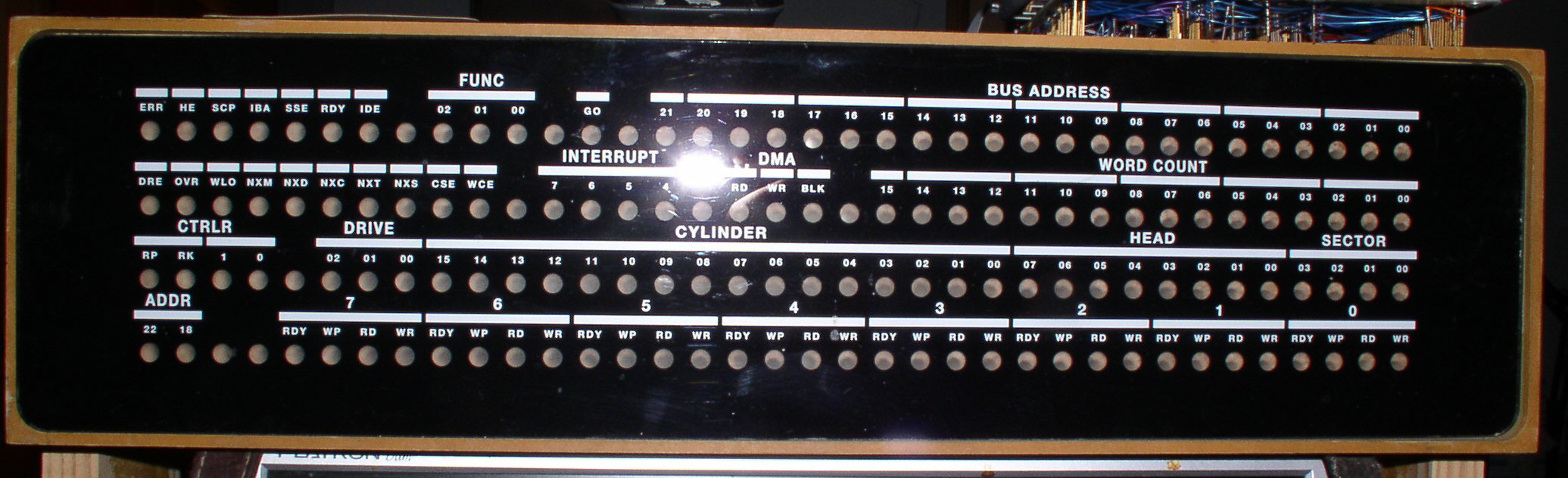
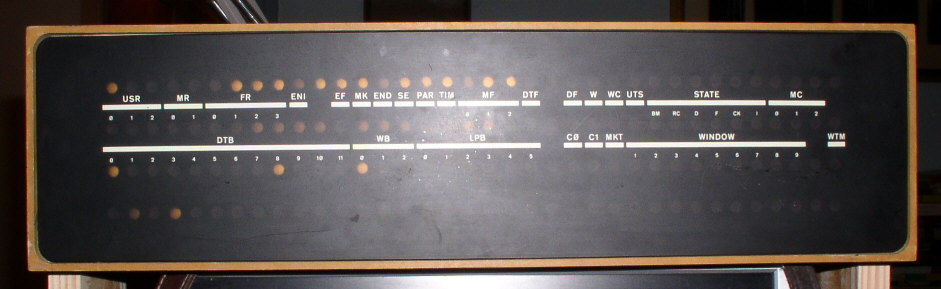
There is discussion of doing a run of indicator panel inlays:
http://ana-3.lcs.mit.edu/~jnc/tech/DECIndicatorPanels.html
for the RK11-C (which is wired for an indicator panel, although as far as
I know, DEC never did the inlay).
If you're interested... you will need a standard DEC indicator panel light
panel (with flat cables with plug-in-cards on the ends). (I don't have any
insight on how to get one of those. It shouldn't be _too_ hard to make
replicas, but I'll leave that topic for the moment.)
All I am proposing to do is create the silk-screened inlay that turns a DEC
indicator panel into an RK11-C indicator panel (starting with a functional
indicator penel without the inlay).
All DEC indicator panels use the same actual light panel and flat
cables/plug-in-cards (which have one conductor per light in the light panel);
which light comes on is set by the way the backplane slots the
cables/plug-in-cards plug into are wired.
So from the prints, which give the wiring to the indicator panel slots, I
managed to work out what an RK11-C panel would look like, roughly (captions
are made up, but the light locations are accurate):
http://ana-3.lcs.mit.edu/~jnc/tech/pdp11/RK11-C_inlay.txt
Starting with that, Dave Bridgham managed to whip up a rough approcimation of
what the inlay would look like:
http://pdp10.froghouse.org/qsic/inlay-rk11-c.pdf
We had put a certain amount of work into identifying a font which looks like
the one DEC used, back when; I worked with a member the UK to produce a bunch
of blank inlays (right size/shape, with the black paint on the back with the
holes for the lights). Dave then found someone who could print the white
lettering on the front, and this is what the result looked like, on an
'RK11-F' (the QSIC with RK emulation microcode) panel:
http://ana-3.lcs.mit.edu/~jnc/tech/QSIC/jpg/RK11F-F.jpg
You can compare with an original DEC inlay (TC08, IIRC) here:
http://ana-3.lcs.mit.edu/~jnc/tech/QSIC/jpg/DasBlinken2F.jpg
That's on the same light panel, just the inlay is changed. (The lights in the
lower one are from the light panel Dave produced for use with the QSIC; it's
totally incompatible, electrically, with the DEC originals; 4 wires, IIRC, run
the whole thing (data, clock, latch and a ground), as opposed to the 'wire per
light' of the DEC originals. Looks _just_ like the originals (which Tech Sq
used to have a lot of, BITD), though.
Anyway, if anyone is interested, the next step would be to find out who all
wants an RK11-C inlay, and work out _exactly_ what would be printed on it.
Noel
>
>
> From: Josh Dersch <derschjo at gmail.com>
> Subject: Source for DEC TC01 (and similar) bulbs?
>
> The Search Scope loop diagnostic shows block numbers going by in both
> directions so a lot of the drive and controller are working, but there's
> some glitchiness in bits 2, 5, 8, and 11 of the data so I need to trace
> that down; I hope it's not the tape head.
>
> - Josh
>
So what do bits 2, 5, 8, & 11 have in common? All bits come from the same
track on the tape head, and share some of the path to the Data Buffer.
If you wrote this tape on this system, I would try reading a tape that was
written on another machine to make sure that the problem didn't originate
with writing.
Check for a bad connection where the tape head cable connects to the G851
module in the TU55, where the G851 plugs into the TU55 backplane, and where
the data cable plugs into the TU55 backplane, and possibly the K2 relay on
the G851.
In the TC01 you could swap the G888 module in slot C22, the S205 module in
slot D05, the S205 module in slot E06, the S603 module in slot C02, or the
R123 module in slot E08, with another one to see if the glitch moves to
another bit.
--
Michael Thompson
I remember seeing this somewhere. I have done a fair amount of googling
with no luck.
I'm looking for a hand tool with a plyer like grip at the top of a shaft.
At the bottom of the
shaft there is a "foot" that, when you squeeze the grip, scissors open. The
idea being
that you slide the foot down between a daughter card and the motherboard it
is stuck in
and when you squeeze the grip, it lifts the card out of the slot. Anybody
know what this
tool is called and/or where to get one?
Thanks,
Bill S.
--
This email has been checked for viruses by Avast antivirus software.
https://www.avast.com/antivirus
On Mon, Dec 6, 2021 at 9:42 AM David Bridgham via cctalk
<cctalk at classiccmp.org> wrote:
> The inlays are mostly not done with any tools I have. I do the graphics
> with Inkscape. Rod made up the blanks with silk screening. Then I have
> the white printing done at a printshop I found who has a large, flatbed
> printer that can print white ink. I do have some ideas about how I
> might try to make up blanks with a laser etcher I have access to but at
> the moment we have an ample supply.
Cool.
> Also, I've experimented with making my own bezels out of PVC board from
> Home Depot using a CNC router. In the pictures below, the yellowed
> bezels are old DEC bezels while the white ones are ones I made. I
> figured that if we ever get the QSIC shipping and people want indicator
> panels (I hope they'll want indicator panels), I'd rather not depend on
> them ripping apart old DEC bezels to make this work.
Yes. I'd rather not demolish my only indicator panel. I was planning
on demolishing a blank (I have a few short blanks, but most people do
not)
> Anyway, I'd be most happy to have another person with more tools to help
> build bits and pieces of this stuff. I've noticed that as I gained
> access to different tools, I came up with different ideas about how to
> make things. I didn't think the laser etcher was all that useful until
> I started using it.
I have a small 40W laser etcher that I essentially haven't used since
I have had access to large-format 80-120W laser cutters.
As for tools, I can rent a 4'x8' Shopbot router at our local
Makerspace that can turn out the light blocking bar or, from your
file, the frame. We also have a local company (IC3D) that makes
cubic-meter 3D Printers and makes their own filament from pellets,
keeping costs down. The founders are friends of mine and I've helped
repair sensors on their manufacturing line. If I had an STL, I could
get a bid on what it would take to 3D print one. It wouldn't be as
smooth as a machined PVC foam milled one, but it would be strong.
With a little post processing, a 3D Printed frame may give an adequate
look. Just a possibility. I haven't worked with PVC foam much but I
understand the principle.
> Now I want to use it for everything. Turns out it
> can't quite handle 3/8" Delrin; it just melts it and makes a mess.
That sounds like a power problem. Normally, Delrin lasers quite
nicely, at least at 80W. Thick stuff is hard in any printer because
of lenses, beam diffusion, etc. We sometimes have problems with 1/2"
material of any kind in ours. I've done some stuff in 2 passes, one
high, one low (refocusing/repositioning Z axis between job runs). We
also have multiple lenses for different focal points. One is only
good for etching/surface work, and one is good for cutting 3/8" and
thicker materials. We usually use the middle one since 99% of what
goes into our laser is 3-6mm stock.
> Speaking of help, if anyone wants to review the QSIC design, I'd welcome
> that. This is by far the most complex circuit board I've ever designed.
I could take a look at it, I have some background in making Qbus and
Unibus interfaces, but how useful I'd be depends on what kind of
feedback you are looking for.
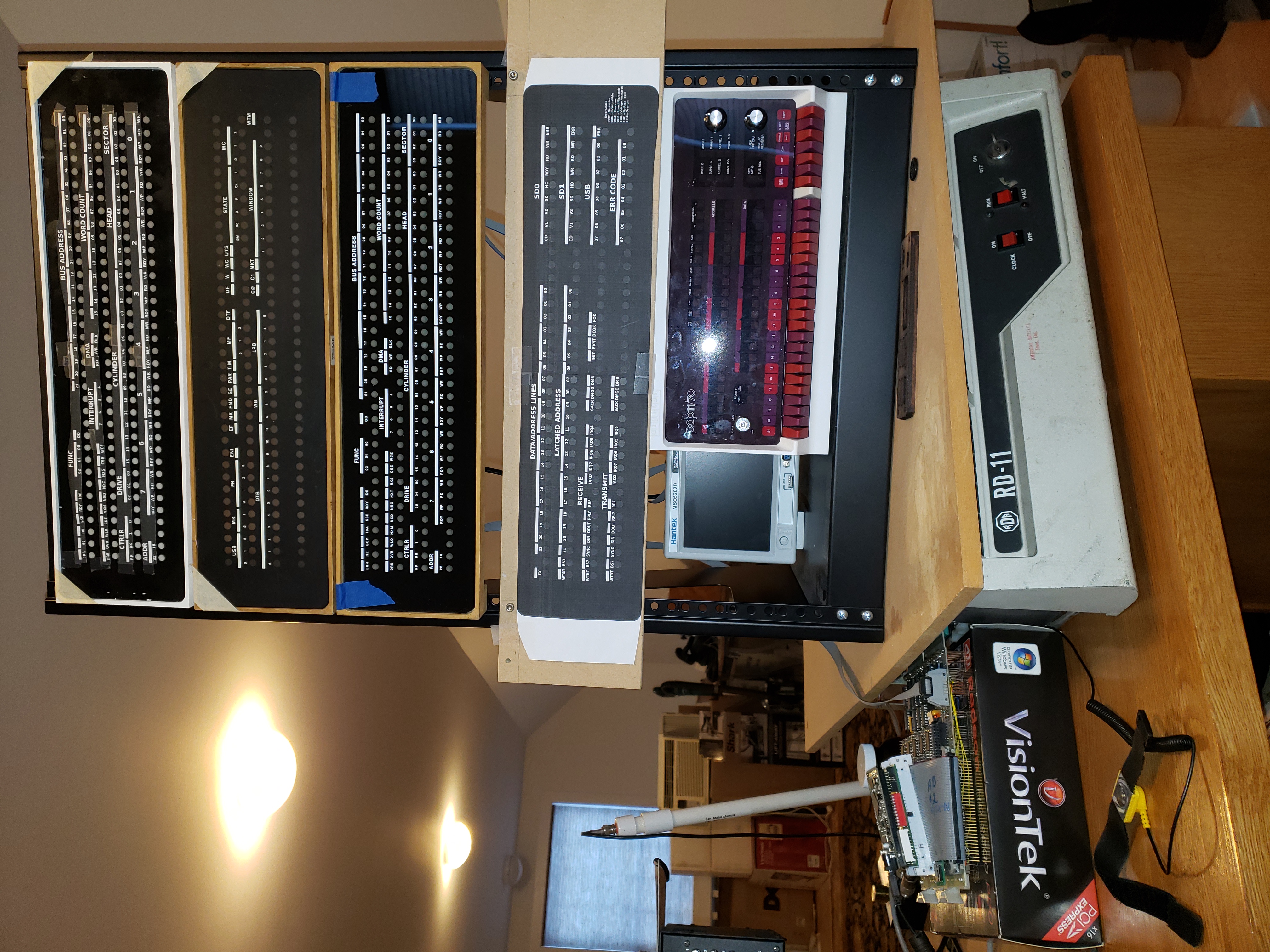
> Back to indicator panels, here's a picture showing a bit of the
> evolution of my indicator panels...
>
> http://pdp10.froghouse.org/qsic/indicator-panel-stack.jpg
>
> ... The only real thing I'd like to
> change is the gloss. Somehow, DEC's inlay is as flat as flat can be.
I did notice that. I have no idea what to recommend. AFAIK, DEC just
used an acrylic with a specific surface texture. The only stuff I can
get is like what you have - smooth as window glass.
Cheers,
-ethan
On Sun, 2021-12-05 at 12:00 -0600, Brie wrote:
>
> He may as well have just come out and said, ?It triggers me and I
> don?t like having to acknowledge that women exist in the field of
> computer history.?
>
> ? Brie
Sorry to go off topic, but I have friends and family who are veterans
or otherwise have had horrible experiences. They get triggered. What
this sentence is describing is someone getting mildly annoyed.
Does anyone recognize the (presumably) DEC power supply on the front half of
the rack-bottom in the 11/44 listing at:
https://www.ebay.com/itm/363640137050
Blurry photo, but it looks like there are a 4x3, a 3x3, and a 3x5 Molex
connector, and two brown mini-modules protruding from the right side.
If so, then what purpose did it likely serve?
It appears that the 6U immediately below the 11/44 was likely occupied by an
RX02 given the presence of an M8256 in the 11/44 backplane (and skinny
mounting rails, although I thought those were usually at the bottom of the
RX02), and that included its own power supply (which wasn't very beefy
either, nor did it need to be).
What went into the 6U immediately above the power supply is unclear; there
is a HEX Wespercorp TC130 Tape Controller as well as three unknown QUAD
modules in the 11/44 backplane. Perhaps there was a horizontal autoload
tape drive mounted there that required a separate power supply?
Curious!
paul