At 07:50 PM 11/30/2010, Ethan Dicks wrote:
>In 7.3, I'm sure that's now true. I'm pretty sure I remember some
>COBOL and BASIC back in the 4.x and 5.x days, but I can't promise that
>my memory is 100% correct.
I think that's highly unlikely, particularly with COBOL since emulated
code wasn't something DEC wanted in the distribution. (and COBOL in the
4.x days used a number of instructions that weren't implemented in
MicroVaxen.) DEC didn't want clearly poorly performing software to be
in the kit.
That's the argument that allowed TECO32 to become part of the VMS
distribution.
-Rick
I canse anyone has not heard this...
I have been informed that Professor Sir Maurice Wilkes (designer of
EDSAC, etc) passed away yesterday (29th November 2010).
:-(
-tony
Anyone want a 17" SGI monitor? It's a Sony GDM-17E21 in "granite", as
used on an Indy or O2. Has HD15 and 5xBNC connectors. It's off the O2
on my desk, but I now have a set of flat screens and no room to keep
this CRT monitor. Collection is free from York UK -- sorry, but it's
impractical to ship.
--
Pete Peter Turnbull
Network Manager
University of York
I am looking for any of the following SCSI hard drives please:
Micropolis 1578-15 50-pin SCSI 5-inch full-height 332MB
Micropolis 1684-07M 50-pin SCSI 5-inch half-height 340MB
or any Unisys branded SCSI drives.
Some appear on eBay but the seller prices exceed my budget, especially
once shipping costs to Australia are included, so looking for someone
who might have some of these drives that they would like to part with
for a modest price+postage costs.
thanks.
I know I posted this a few days ago, but I find it hard to believe that
there are no Alpha Micro collectors on the list. Here is an opportunity
to make some money by parting with your working Alpha Micro for
no more than 60 days. Then you can have it back with ours (whatever
you can salvage for parts, I think the MB is bad, but the rest works).
Still no takers. I am told that AM6000, AM7000, AM8000 or Eagle 450
or Eagle 500 will work fine. Email me at fire at dls dot net.
Bradley Slavik
Oops, this was supposed to go to the whole list -- Ian
>
> > -----Original Message-----
> > From: tuhs-bounces at minnie.tuhs.org [mailto:tuhs-
> > bounces at minnie.tuhs.org] On Behalf Of Norman Wilson
> > Sent: Thursday, November 18, 2010 10:58 AM
> > To: tuhs at tuhs.org
> > Subject: Re: [TUHS] pdp11 question
> >
> > Just to loop things around a bit:
> >
> > Some of the larger VAXes used small PDP-11s (and their
> > bastard offspring) as console processors.
> >
> > This started with the very first VAX, the 11/780, which
> > used an 11/23 as a console. The console ran a stripped-down
> > system, possibly based on RT-11 or RSX-11, I forget (and
> > am typing this on a train in the Outer Mongolia part of
> > Texas where it's hard to look up references).
> >
>
> It is an 11/03, according to the Console Interface Technical
> Description manual and the part number of the processor board. The
> system looks to me to be RT-11 based. I know that I could read/write
> the floppies on an 11/03 running RT-11, which was how I recreated live
> media from disk images.
>
> > I don't know the whole list of what was used as a console
> > for different VAXes, but I do remember that the Nautilus
> > series (8500-8550-8700-8800) used either a Pro/350 or a
> > Pro/380, running P/OS, which was slightly more satisfactory
> > than the rude English non-computer expansion of PoS might
> > imply, but only slightly. Especially for those of us who
> > wrote code to fit into UNIX on the VAX and talk to the
> > console processor.
> >
> [snip]
>
> Another DEC machine to use an embedded computer as a console is the KL-
> 10 processor. It uses an 11/40 running a modified version of RSX-11
> called RSX-20F. Given that the KL was introduced in 1975, it predates
> the 11/780 in using this approach. -- Ian
Hi,
Does anyone happen to have the schematic of one of the SCSI->MFM/RLL
boards ? I have the Adaptec ACB-4000 and Xebec S1410A board documents
>from bitsavers but thy only have the schematics for the computer end.
All the talk of interfacing to SCSI has got me wanting to have a go :)
I'm just want to look and see how it was done in the olden
days....failing that I guess I'm gonna have to start tracing tracks.....
Cheers.
Phill.
--
Phill Harvey-Smith, Programmer, Hardware hacker, and general eccentric !
"You can twist perceptions, but reality won't budge" -- Rush.
Hi guys,
As you might have gathered from my other thread, I'm toying with the
idea of building a replacement controller card for my two dead
double-sided Amstrad disc drives. Ideally I'd like to use as many
"standard" parts as possible to ease debugging and future repair. I'll
probably use a GAL to handle head-stepping and the write protect
lockout, and LSTTL for the bus interface.
I'm also planning on adding an overvoltage crowbar (or maybe some form
of a MOSFET OVP switch) on the 5V rail to protect against the common
killer of these drives: plugging them into a PC PSU (the power plug is a
Berg floppy power connector, but with a mirrored pinout).
I've got my hands on a couple of Texas Instruments MC3470A floppy disc
read amplifier ICs, and the Apple Disk II schematics suggest how this
can be tied to a drive mechanism. What I'd like to do is look at a few
other drives which use this chip to make sure I understand everything
correctly (a double-sided drive with a single 3470A would be handy). If
I'm being honest, the TI datasheet for the chip is utter crap...
So does anyone know of any other FDDs -- besides the Disk II -- which
used the MC3470A as the head amplifier, or maybe a few applicable
application notes?
Thanks,
--
Phil.
classiccmp at philpem.me.uk
http://www.philpem.me.uk/
I've been reading William Blair's 1807 article on cryptography,
called "Ciper":
http://www.jdege.us/crypto/blair-cipher.pdf
Around PDF page 16, near the bottom of the first column, he proposes
a code that represents letters of the alphabet, using the symbols a
and b. What's interesting is that this is nothing more than a binary
code, with A being aaaaa, H being aabbb and so on to Z being babbb.
Is this the first mention of using a binary code to represent letters
of the (Roman) alphabet?
For the time, a remarkable document.
--Chuck
Hello All!
See below. Please respond to original sender.
Reply-to: <zzpeter at inbox.com>
---------- Forwarded message ----------
Date: Mon, 29 Nov 2010 05:20:22 -0800
From: peter ... <zzpeter at inbox.com>
To: donate at vintage.org
Subject: Re: old computers available
Hi,
I have a pyramid technologies computer,
and also a Vax 11/750
(with many manuals, spare circuit boards, cables , monitors,
tapes and misc parts)... which sadly I am unable to keep
in storage any longer.
Hence I am looking for a person or organisation to donate
them to...
The catch... I am in Brisbane (Australia), do you have a
branch in Australia, or know of any group, or person in
Australia that would be interested in taking care of these
machines?
Regards,
Peter
--- EOM
--
Sellam Ismail Vintage Computer Festival
------------------------------------------------------------------------------
International Man of Intrigue and Danger http://www.vintage.org
[ Old computing resources for business || Buy/Sell/Trade Vintage Computers ]
[ and academia at www.VintageTech.com || at http://marketplace.vintage.org ]
Ok, so I have been doing research, and this affects everyone here who
collects SGI, apple, and anything using scsi. in the near future, the supply
of smaller SCSI drives will eventually dry up, due to failure from age and
lack of supply, as I believe they are no longer manufactured, unless for the
industrial/server market. I could be wrong on that part, but I take it as
such because my searching for them brings up nothing new. what does that
mean for collectors? it means that your neat little apple or SGI or etc will
run, until the scsi disk dies, then we will be left cannibalizing machines
for disks, paying ridiculous prices for leftover scsi disks, which will
skyrocket because of the small supply.
So what is our option? I have seen SCSI to IDE adapters around, but they go
up into the $100's to $200's, say you have a minimum 10 machines, that
leaves you somewhere between $1,000 and $2,000 total, before the disk or
devices. If we could design a simple SCSI to IDE interface, we could be set
for a good long while on storage for these devices for a decent amount of
time. There are all sorts of adapters to IDE, there is CF to IDE, SD to IDE,
SD to CF which could be placed in a CF to IDE adapter if need be, i'm sure
one could also rig up a USB drive to SCSI if one tried, but I could be
wrong.
Having said that, I know nothing about programming microcontrollers or
simple processors, but I have seen people on the board who do. I'm sure if
we can find a chip capable, and lay out a schematic, source code, and
possibly a board layout, members could source their own boards and
components to build their own devices at home (given they have a chip
programmer), so no one person has to take on the responsibility of supplying
parts, kits, finished devices unless they so choose to. This is just an
idea, if nothing becomes of it, no big deal, just putting it out there....
-Joe
A primary partition on C drive of one of my computers is gone. FDISK says
that there is no partition on that drive.
Is there any way to undo this without losing the information on that drive?
I will of course need to do this from DOS...
CC-folks,
What may be the earliest substantial surviving intel 8008 code (circa
1972) has been rescued from eight 1702 PROMs (thanks Dwight Elvey)
and disassembled (thanks James Markevitch) and is now online for comment at:
http://www.digibarn.com/stories/bill-pentz-story/8008-listing.html
The team working on this is making their best guess that this was the
particular code that controlled the Tektronix 4023 color raster
display which in turn had boards in a card cage that controlled the
other peripherals. Original SacState project initiator and leader
Bill Pentz donated the surviving version of this system (consisting
of boards and some documentation) a couple of years ago. One board
contained the 1702s and we had no idea if there was anything still
left in them. Surprise surprise there was!
The full system and its story is described at:
http://www.digibarn.com/stories/bill-pentz-story/index.html
with a 3D graphical reconstruction of what it might have looked like
(it drove a Diablo hard disk pack, ASR-33, serial interface,
keyboard, Tek 4023).
The history, the claims...
So far with many folks weighing in, this might indeed be the "first"
complete microcomputer system, with peripherals, a primitive OS,
language and etc. It was built by Cal State Sacramento working with
Tektronix and Intel, starting in the spring of '72 and getting stuff
operational over the summer and fall of that year. As best as project
leader Bill Pentz can recollect this system was processing 50,000
patient medical records and plotting color charts on the Tek by
spring of '73. It also ran IBM BAL (370 mainframe assembly language
programs) in emulation. We are still looking for someone who can
peruse their backs issues of Popular Electronics from '73 and '74 to
look for a brief mention of this project (anyone got a set?).
So feel free to comment on the code. Note that for one eROMs there
was either a bent pin or bad line -> bit 5 missing so its guesswork there.
bruce
I was cleaning up the estate of an MIT prof, and came across some
Philco transistors with odd markings that I suspect were made for IBM.
Generally, TI made the transistors for IBM, but I have seen a few SMS
cards with Philcos on them. Philco transistors look a bit like bullets
- about 1/2 inch long, and maybe 3/16 inch diameter, metal with a
rounded top. Often the leads are insulated, as the spacing is very
tight.
I do not have any SMS cards with Philco transistors. Does anyone (CHM
1401 crowd?) have any they could inspect for me? I would like to know
the numbers printed on the case.
--
Will
SCSI to IDE
joe lobocki jlobocki
<mailto:cctalk%40classiccmp.org?Subject=Re%3A%20SCSI%20to%20IDE&In-Reply-To=
%3CAANLkTinO5OZGqmp_tiokWNnqYD_e7AAwKDE7ALoG2_8%2B%40mail.gmail.com%3E> at
gmail.com
Fri Nov 26 10:48:01 CST 2010
* Previous message: AT
<http://classiccmp.org/pipermail/cctalk/2010-November/294377.html> &T 3B1
Unix PC Boot ROMs
* Next message: SCSI to IDE
<http://classiccmp.org/pipermail/cctalk/2010-November/294385.html>
* Messages sorted by: [ date ]
<http://classiccmp.org/pipermail/cctalk/2010-November/date.html#294382> [
thread ]
<http://classiccmp.org/pipermail/cctalk/2010-November/thread.html#294382> [
<http://classiccmp.org/pipermail/cctalk/2010-November/subject.html#294382>
subject ] [ author ]
<http://classiccmp.org/pipermail/cctalk/2010-November/author.html#294382>
_____
Ok, so I have been doing research, and this affects everyone here who
collects SGI, apple, and anything using scsi. in the near future, the supply
of smaller SCSI drives will eventually dry up, due to failure from age and
lack of supply, as I believe they are no longer manufactured, unless for the
industrial/server market. I could be wrong on that part, but I take it as
such because my searching for them brings up nothing new. what does that
mean for collectors? it means that your neat little apple or SGI or etc will
run, until the scsi disk dies, then we will be left cannibalizing machines
for disks, paying ridiculous prices for leftover scsi disks, which will
skyrocket because of the small supply.
So what is our option? I have seen SCSI to IDE adapters around, but they go
up into the $100's to $200's, say you have a minimum 10 machines, that
leaves you somewhere between $1,000 and $2,000 total, before the disk or
devices. If we could design a simple SCSI to IDE interface, we could be set
for a good long while on storage for these devices for a decent amount of
time. There are all sorts of adapters to IDE, there is CF to IDE, SD to IDE,
SD to CF which could be placed in a CF to IDE adapter if need be, i'm sure
one could also rig up a USB drive to SCSI if one tried, but I could be
wrong.
Having said that, I know nothing about programming microcontrollers or
simple processors, but I have seen people on the board who do. I'm sure if
we can find a chip capable, and lay out a schematic, source code, and
possibly a board layout, members could source their own boards and
components to build their own devices at home (given they have a chip
programmer), so no one person has to take on the responsibility of supplying
parts, kits, finished devices unless they so choose to. This is just an
idea, if nothing becomes of it, no big deal, just putting it out there....
-Joe
_____
* Previous message: AT
<http://classiccmp.org/pipermail/cctalk/2010-November/294377.html> &T 3B1
Unix PC Boot ROMs
* Next message: SCSI to IDE
<http://classiccmp.org/pipermail/cctalk/2010-November/294385.html>
* Messages sorted by: [ date ]
<http://classiccmp.org/pipermail/cctalk/2010-November/date.html#294382> [
thread ]
<http://classiccmp.org/pipermail/cctalk/2010-November/thread.html#294382> [
<http://classiccmp.org/pipermail/cctalk/2010-November/subject.html#294382>
subject ] [ author ]
<http://classiccmp.org/pipermail/cctalk/2010-November/author.html#294382>
_____
More information <http://www.classiccmp.org/mailman/listinfo/cctalk> about
the cctalk mailing list
_____
-----REPLY-----
Hi! I am willing to make a PCB and offer it as part of the N8VEM home brew
computer project. If someone would send me a design I will be glad to make
a schematic, PCB layout, and get a small number of prototype boards. This
could be a simple circuit comprised of a Z80 with three 8255 PPIs, RAM and
ROM (one 8255 for IDE, two 8255s for SCSI-2) or a more complex
microcontroller scheme.
Please contact me if interested. Thanks and have a nice day!
Andrew Lynch
Now that I have access to the main unit the plot thickens. All of the
outputs of the potted brick go to full-wave bridge rectifiers in the main
unit such that you get a plus and minus voltage reference to the CT ( center
tap ). That big potted POS is nothing more than a big friggin transformer !
The main output leads ( 1 2 and 3 ) have 28 VAC coming out of them. I put a
Variac on the " transformer " and turned it up very slowly. At not much
voltage it gets very HOT ( I suspect shorted windings or a whole shorted
primary on the input side. The 28 VAC output figure came from estimating
proportionally what the output voltage would be with a full 115 VAC on the
input primary. I own this puppy now !!
Best regards, Steven
> As somebody elase said, I think you have to read the data regiater too.
Ok, I improved my test program to read the data reg and also give some visual feedback:
LDAA #$10 ; like in JBUG
STAA $8008 ; ACIA control
STAA $8022 ; enable 1 digit leds
LOOP LDAA #$7F
STAA $8020 ; clear display
READ LDAA $8008 ; ACIA status
ASRA
BCC READ ; data ready?
LDAB $8009 ; ACIA data
STAA $8020 ; display status
LDX #$0100 ; delay
DELAY DEX
BNE DELAY
CMPB #'G ; EOT?
BNE LOOP
SWI
The idea is to light a digit for a brief period when a byte is read and have
the segments show the status register. Also it should exit if it received
the "G". Ok, the G may be *in* a data block but I hardly ever found a G anyway.
At least it allows me to tune the volume until I receive something. But it looks
random and looking at the leds, like half of the bytes read are framing errors.
Obviously, I varied what I could think of (delay, "G", ...) used several
recorders (2PCs with audacity, a real cassette deck and two audio cables)
> I assume you have the manual for this evaluation kit. It's on bitsavers
> if you don't. It explains how the cassette interface circuitry works in
> some detail, and is well worth reading.
Yes, I have the manual and read it through.
> I asusme you intiialising the 6850 correctly, and that you're settign
> that 4053 analoge switch properly,. If not, it can never work.
I'm initialising it by writing $10 in the control reg, which I copied from
the JBUG listing.
I don't find any reference of a "4053" or similar in the docs of the kit.
> Do you have a (real [1]) tape recorder? If so, try saving something.
> Listen to the recording, does it sound like the typical 'burble'? And try
> loading it. Point being if there's something wrong with how you're playing
> the audio files you could have problems.
Yes, dug up my Realistic cassette recorder that came with my TRS-80 but it
didn't help.
The samples I'm trying to load are recorded with the kit itself. They sound
typical and I was able to decode them to binary. As a test, I decoded the
jbug rom and compared it to the file from bitsavers. It matched! (except for 4
bytes near the end which are zero on bitsavers an are actually different on
my rom). That made me conclude that the 'punch' function is working and the
samples I'm using are good. I would like to test with a known-good audio
file but I can't find any...
I must point out that the kit is expanded and I haven't figured out what it is
exactly. The wirewrap area on the processor board has two extra ACIAs and a
crystal. I understand the original was a 614.4, this seemed to be replaced
by 1MHz and the 614.4 used for the other ACIAs. Anyway, I already swapped
them (which did make me type less double characters since I guess the keyboard
scan delay is chosen for the original clock speed). The kit came with a Philips
Mini-DCR and the cables seem to be made to connect that on the J1 I/O connector.
I could go the route of restoring that, but it seems more challenging and
it wouldn't allow me to transfer data with the outside world.
But I'd like to get at least to the point that I can load and run a program without
having to type it in...
I also read that the kit allows to connect RS-232, that would be ideal but I don't
see how that's possible without adding components and wiring.
Wim.
Here's another idea that'll get me a place in the Loony Bin.
A little while ago I picked up a couple of Amstrad EME232 double-sided
3-inch floppy drives. Out of the three I have, two have had their
read-write ASIC zapped by someone (in one case myself, in another an
ebay seller) plugging them into a PC power supply to "test". Net result:
the ASIC goes completely deaf.
Let's assume for a minute that the heads in the EME232 drives are
undamaged. That means all the issues are related to defective circuitry
on the PCB. So, how about this for an idea: move the controller chip and
surrounding circuitry (or even the whole board) to the EME232, then wire
it into the existing drive mechanics.
This would -- in theory -- allow the two dead 232s (and possibly the
EME156 single-head drive) to be resurrected.
Anyone care to comment on this idea and its possibility or absurdity?
The other option would be to get a new read-write ASIC for the Amstrad
drives, but those seem to be like hen's teeth. Part number is M51017AP
(made by Panasonic but if memory serves they're not marked with a logo
or manufacturer designation) if anyone wants to check.. :)
Thanks,
--
Phil.
classiccmp at philpem.me.uk
http://www.philpem.me.uk/
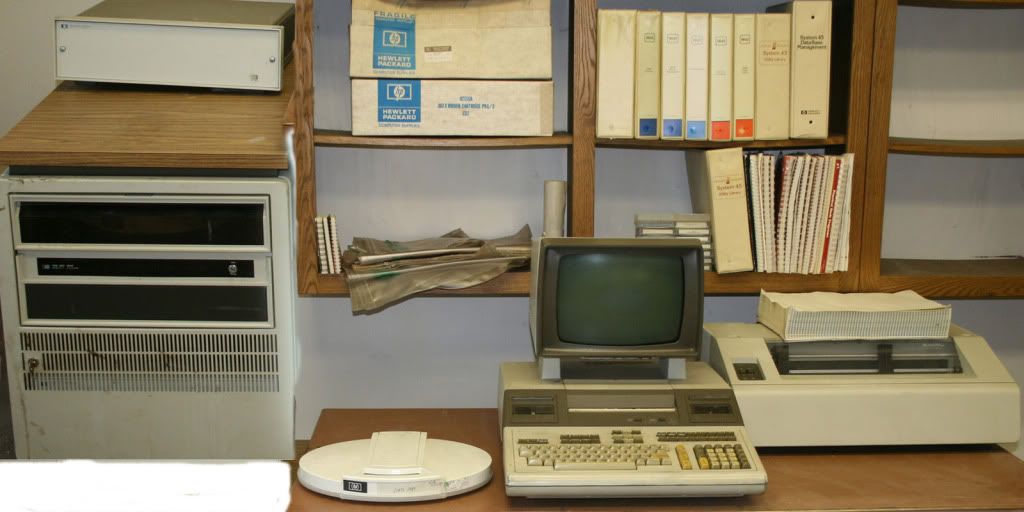
There is an HP9845B computer with a large hard drive available for pickup in northern Maine.
***Contact the owner (Terry Helms) directly at: mainehiker at gmail.com; ***
Please don't email me, I just told you everything I know about it :)
Here is the picture he sent me.
http://i1181.photobucket.com/albums/x426/DrCharlesMorris/IMG_4102HP9845Bcom…
Hope someone in New England can rescue this interesting looking system.
thanks
Charles
Well, I've unpacked the AViiON and the Microdata 1600 inside, but it
looks like I won't be able to look at them for at least a week or two.
My lady and I are leaving in moments for YET ANOTHER trip up north
(we've been home for less than a week!) due to someone's passing.
I love driving, but enough is enough. My cats will never forgive me.
Maybe some new goodies will come my way on this trip like last time.
I'll be going up 95, then into West ("By God!") Virginia and staying
there for several days, perhaps a week. I'll be driving a mostly-empty
car. ;)
-Dave
--
Dave McGuire
Port Charlotte, FL
Hi guys,
Here's a treat for the 3B1 owners in the audience: images of the two
Boot PROMs...
<http://www.philpem.me.uk/code/3b1emu/3b1_roms.zip>
Thanks are due to Michael Lee for providing the ROMs, and to Steven
Hirsch for scanning the 3B1 TechRef, which started me out on this nutty
little "write a 3B1 emulator" project...
Enjoy!
--
Phil.
classiccmp at philpem.me.uk
http://www.philpem.me.uk/
Anyone out there who wants a portable TRS-80? I was given an option on
a pristine one, probably literally only used by clean nuns.
No software, but it appears to try to boot. SE Wisconsin, USA.
- John
The latest arrival in the Great Midwestern Micro Hoard comes from deep
within the Balkans, liberated through the heroic act of paying a local
collector to ship it to me:
Here's a short blog entry with links to the obligatory big load o'pics:
http://silent700.blogspot.com/2010/11/new-acquisition-pravetz-82.html
I haven't fired it up yet. The seller also sent me a collection disk
images of native software (though much of it looks like translated US
titles) that, as time allows, I hope to write to disk and try out on
the proper hardware.
--
jht
My MicroVAX 3400 will not power up. I think it is because the right hand
H7868 PSU has failed, the green LED on it does not light up, while on the
left hand H7868 it the green LED does come on. I have no real electronics
expertise, very limited diagnostic equipment (just a multimeter really) and
I know that fiddling with PSUs is one of the more dangerous things you can
do with a computer. That said, I am willing to have a go at repairing it,
but have no idea what might be wrong. All I can say is that it worked a few
weeks ago when I last powered it on, but when I came to power it on tonight
it was just dead, no pops, bangs or smoke, just silence.
Can anyone give me some idea where to begin?
Thanks
Rob
> The first was a Data General Aviion AV300 workstation. This is one
> of the few machines built around the Motorola 88K CPU. It came with its
> original keyboard, mouse, monitor, and a full set of DG-UX manuals. I
> don't yet know if it's functional, but according to my friend it was
> running a few years ago.
Ack, I'm really jealous over this one :) It'll be interesting to hear
if the presumably dead nvram battery matters -- I think some people are
looking for dumps from working units.
John Finigan
I've been trying to execute the TECO commands in Alice's PDP-10
<http://www.hactrn.net/sra/alice/alices.pdp10> and I keep getting an
error saying "?IFC Illegal character "^" after F". The two command
sequences given have the same form:
[1:i*^Yu14<q1&377.f"nir'q1/400.u1>^[[8
.-z(1702117120m81869946983m8w660873337m8w1466458484m8
)+z,.f^@fx*[0:ft^]0^[w^\
and
[1:i*^Yu16<q1&77.+32iq1f"l#-1/100.#-1&7777777777.'"#/100.'u1r>6c^[[6
.(675041640067.m6w416300715765.m6w004445675045.m6
455445440046.m6w576200535144.m6w370000000000.m6),.fx*[0:ft^]0^[w^\
I'm using tecoc.exe from <http://almy.us/files/tecow32.zip>.
>From my reading of the documentation for TECO, the f command is for
flow control and should be one of:
F' Flow to end of conditional
F< Flow to strt of conditional
F> Flow to end of conditional
F| Flow to else part of conditional
I'm guessing that the commands come from some sort of PDP-10 dialect of
TECO and these commands do something else in that dialect.
: is listed as modifying the next command, so is :i*....* an old way
of modifying the insert command to use *'s as the delimiter for the
text?
Would I be better off pasting these commands into the TECO on
pdpplanet?
--
"The Direct3D Graphics Pipeline" -- DirectX 9 draft available for download
<http://legalizeadulthood.wordpress.com/the-direct3d-graphics-pipeline/>
Legalize Adulthood! <http://legalizeadulthood.wordpress.com>
Hi
I wonder if anyone knows what happened to Wilber Williams computer
museum in Queensland:
http://www.gizmodo.com.au/2010/07/can-you-help-save-the-uq-museum-of-it/
I ask for a rather selfish reason, I would like a copy of the file:
http://www.computer.museum.uq.edu.au/pdf/DEC-15-H2BB-D PDP-15 Systems Maintenance Manual Volume 1.pdf
Bitsaver has it, but only as a black and white version. I was hoping
that the UQ museum would have at least a gray scale version.
Hopefully there might be a mirror around?
Kind Regards,
Pontus.
At 20:20 -0600 11/23/10, Bob wrote:
>There is a story I have heard that there was a WWII POW camp in
>Texas?for captured German pilots. The captured pilots were trucked
>from the ship in port to the camp. ?They thought that they were
>being driven around in circles to break them, because they could not
>believe that someone could drive so long and still be in the same
>country, let alone state.
There was a POW camp; my wife's grandfather worked there. I can't
confirm the story about the truck ride, but it would be about a 4-5
hour drive (today) from Houston to where the camp was; longer in
1943-5.
--
- Mark 210-379-4635
-----------------------------------------------------------------------
Large Asteroids headed toward planets
inhabited by beings that don't have
technology adequate to stop them:
Think of it as Evolution in Fast-Forward.
A client needs an alpha micro, preferably AM-7000 until the end of
the year.
Anyone have one working that they want to rent and have returned in
January?
Please email me at fire at dls.net
Bradley Slavik
I'm trying to identify and find some early if not first specific production
DRAM chips for a project at the Computer History Museum. I've poked quite a
bit about on the web and found lots of good generic information but not much
about specific pioneering devices after the Mostek 16 KiB circa 1976. In
particular I'm interested in the first and/or early vendors of the following
parts
1) 256 Kib DRAM circa 1983 probably from Japanese vendors
2) 16 Mib DRAM circ 1989 IC Master unknown vendors
3) 1 GiB DRAM circa 2000, probably Micron.
I'm looking for a shipment date, photo, chip size and price information.
However, just a vendor name and part number would be a great starting place.
If any of u have or know of some one who has old IC Master's of the
appropriate era that would be a great place to get vendor, part number and
other information.
Any help would be appreciated.
Tom
/
/> I ought to have pointed out that most times doing what i do wastes a
> little time, and in fact it owuld heen fine just to plug the board in and
> power up. But this is amply compensted for by the time saved when thigns
> go very wrong.
Yeah and when you've gone through all the steps, learned what all the chips
are for, plugged them in one by one and finally the whole thing does actually
work, the satisfaction is much bigger.
> Do I conclude from this that the first byte read --- in fact all bytes
> read -- are always 0?
Exactly. And I just figured that they all are framing errors. Here's my test
program that should exit when it reads a byte that has no framing error:
LDAA #%00010000 ; like in jbug (8bit, np, 2stop, no divide)
STAA $8008 ; acia control reg
READ LDAA $8008 ; acia status reg
ASRA
BCC READ ; branch unless data ready
BITA #%00001000 ; check framing error
BNE READ ; branch if framing error
SWI
It never exists no matter what audio file. The only thing that does work is
that the data ready bit stays cleared as long as there is no audio at all.
So it at least reacts to the fact that there is audio or not.
> I assume this ACIA is a 6850. What does the data input do when you play
> the audio file? Where does the Rx Clock signal come from, and is it correct?
Yes, it's a 6850. I measured with a volt meter, I don't have a scope (yet).
RxD and RxC are high when no audio and they both drop to around 2V when audio is
supplied, so I guess there's at least some signal. Also RTS is low as it should.
Something weird that I don't understand is that simply adjusting the audio volume,
the apparent voltage measured on the RxD changes more or less proportionally...
this is supposed to be digital and FM ?
Wim.
Dave writes:
> On 11/22/10 4:12 PM, Tony Duell wrote:
>>> I have a S100 board that is said to be a math processor board
>>> that has a single 2901 on it. I have the manual as well.
>>
>> I find that strange. A single 4 bit slice is not that useful. I asusme
>> there arten;t 2903s as well :-)
> Well, 2901s were fairly expensive chips in those days, and it's
> certainly possible to do wider-than-four-bit math in a four-bit CPU. :)
>> Althoguh AFAIK DEC never used them in a PDP11 CPU. There were, of
>> course, used i nteh floating point processors for some PDP11s, and in the
>> VAX11/730
> And the KS10 as well. I wonder if there are any others; I don't
> think so offhand.
> One of my favorite uses of Am2901s is in the FPF11 floating-point
> processor. For the non-PDP11-savvy, the FPF11 is a strange board that
> can be used in both Qbus and Unibus systems by changing jumpers near the
> card-edge connectors. It uses a 40-pin ribbon cable to plug into a
> microm DIP socket in an F11-based PDP-11 (11/23 or 11/24).
Off the top of my head... DEC also has 2901's in the CI780, and the UDA50, and probably
A bunch of other peripherals/interconnects/host adapters I cannot recall at the moment.
Tim.
A while back, part of an AMD 2900 development
system showed up on eBay. My copies of the software
surfaced today, so the .imd images are up under
http://bitsavers.org/bits/AMD
They are CP/M 1.4, as I recall.
Hi all,
I suspect some folk here have done this before.... :-)
My desktop CRT (over 10 years, but not what I'd consider vintage!) has been
ailing for some time, with the picture getting darker and darker despite
having the brightness at 100%. It's still good for high-contrast stuff such as
black text on white background, but forget trying to pull details out of most
photos, for instance.
Heater voltage seems good at 6.4VDC / 350mA (it's derived from the PSU in this
monitor rather than the flyback section), but I'm considering boosting it a
little and see if it improves things, obviously shortening the life of the
tube in the process.
Question is, what's a sensible amount to over-run things by? Say I aimed for
around 10%, is that too much and going to kill the heaters in next to no time,
or so little that unlikely to really make any useful difference?
cheers
Jules
>Message: 14
>Date: Mon, 22 Nov 2010 15:41:05 -0800 (PST)
>From: Fred Cisin <cisin at xenosoft.com>
>Subject: RE: possible ic source
>
>On Mon, 22 Nov 2010, John Foust wrote:
>> Even today, Google Maps says the difference in Chicago's favor is
>> 13 hours 9 minutes versus 13 hours 32 minutes, but I bet you can drive
>> at a higher speed from El Paso than you can from Chicago.
>
>In the mid 20th century, Texans would brag, "You can ride a train all day
>and still be in Texas"
>Pennsylvania: We used to have a slow train, also.
>Alaska (1958): ?Quit bragging, or we'll cut Alaska in half, and then Texas
>will be the THIRD largest state.
>
There is a story I have heard that there was a WWII POW camp in Texas?for captured German pilots. The captured pilots were trucked from the ship in port to the camp. ?They thought that they were being driven around in circles to break them, because they could not believe that someone could drive so long and still be in the same country, let alone state.
Bob
Hallo
Do you have HP64000 5 1/4 diskettes with Assembler / Lindker 6809 and
also Emulator software 6809 ?
Do you send such dikettes ?
I there any other way to get HP64000 compatible disks ?
thanks in advance
schoch alfred
medatec austria
/
/> I ought to have pointed out that most times doing what i do wastes a
> little time, and in fact it owuld heen fine just to plug the board in and
> power up. But this is amply compensted for by the time saved when thigns
> go very wrong.
Yeah and when you've gone through all the steps, learned what all the chips
are for, plugged them in one by one and finally the whole thing does actually
work, the satisfaction is much bigger.
> Do I conclude from this that the first byte read --- in fact all bytes
> read -- are always 0?
Exactly. And I just figured that they all are framing errors. Here's my test
program that should exit when it reads a byte that has no framing error:
LDAA #%00010000 ; like in jbug (8bit, np, 2stop, no divide)
STAA $8008 ; acia control reg
READ LDAA $8008 ; acia status reg
ASRA
BCC READ ; branch unless data ready
BITA #%00001000 ; check framing error
BNE READ ; branch if framing error
SWI
It never exists no matter what audio file. The only thing that does work is
that the data ready bit stays cleared as long as there is no audio at all.
So it at least reacts to the fact that there is audio or not.
> I assume this ACIA is a 6850. What does the data input do when you play
> the audio file? Where does the Rx Clock signal come from, and is it correct?
Yes, it's a 6850. I measured with a volt meter, I don't have a scope (yet).
RxD and RxC are high when no audio and they both drop to around 2V when audio is
supplied, so I guess there's at least some signal. Also RTS is low as it should.
Something weird that I don't understand is that simply adjusting the audio volume,
the apparent voltage measured on the RxD changes more or less proportionally...
this is supposed to be digital and FM ?
Wim.
At 10:41 AM 11/22/2010, Rich Alderson wrote:
> He received a telegram from the
>home office asking him to visit a customer in Texarkana who was having trouble
>with one of their products. He telegraphed back that they should send someone
>from Chicago, since they were much closer to the customer.
Even today, Google Maps says the difference in Chicago's favor is
13 hours 9 minutes versus 13 hours 32 minutes, but I bet you can drive
at a higher speed from El Paso than you can from Chicago.
- John
A friend just called to tell me he was wandering through Tanner
Electronics' store in Texas, and had spotted some bins of ics sorted by
type, including a variety of floppy controller chips. I've added
them to my mental list of possible sources of older ics, and figured
others might be interested as well.
De
> From: Al Kossow <aek at bitsavers.org>
>
> A while back, part of an AMD 2900 development
> system showed up on eBay. My copies of the software
> surfaced today, so the .imd images are up under
> http://bitsavers.org/bits/AMD
>
> They are CP/M 1.4, as I recall.
Thank you. Might be extremely useful some time if I get around to using my similar system. On the other hand I might sell it, in which case having the image available on BitSavers has got to make the system more viable for someone. Just too busy with my 1301 in the summer and with my 1301 gate level simulator in the winter at the moment. Perhaps I should do a 2900 based computer with the 1301 architecture. Maybe an ICL 1900 and/or an Elliott 920.. The 920 ATC actually was 2900 based but I doubt the microcode has survived, though the early 920s would be simple as they only had 16 instructions - before they ballooned for CISC and then were reduced again for RISC. I suppose with a writable control store I could do anything from a Babbage Analytical engine or a Turing machine to the latest systems, though maybe not at full speed. Some of the more interesting machines (to me) like the ICT 1302 would be impossible because alas no full documentation of the instruction set survives. I have marketing information on it which amazingly actually lists some of the extra instructions but its far from complete and omits most of the actual function codes. Maybe I should ask the designer of the 1301 if he knows what his successors did.
Enough rambling, at least it was on topic.
Roger Holmes.
Technical Director, Microspot Ltd
Developers of CAD and Graphic software for the Apple Macintosh
Paxton writes:
> I really tried to search out used computer places in Vancouver BC with
> vintage equipment when I visit.
If you build a wayback machine that will take you to the 1990's, the UBC
SERF sales were way above excellent. Everything from mass spectrometers
to near-complete working -11 and -8 systems.
I'm told they don't happen anymore :-(.
Tim.