Anyone have a use for this? It is a memory expansion board of some kind
>from a Netserver LX PRO.
It has sixteen 72 pin SIMM slots. Not populated.
HP D4262-60009
Free for cost of shipping from 78759
Jeff Walther
Forwarded from the Greenkeys list.
Looks like an interesting piece of test gear:
http://cgi.ebay.ca/ws/eBayISAPI.dll?ViewItem&item=370462778137
- John
From: "George B. Hutchison" <w7tty at olypen.com>
To: "Don Robert House" <Packard42 at gmail.com>,
<dhunter at islandregister.com>
References: <4D001215.31954.3F92DD3 at dhunter.islandregister.com>
<77B62C3F-03B0-47FD-8BC6-BFC1BF51B8DA at gmail.com>
Date: Wed, 8 Dec 2010 22:14:21 -0800
MIME-Version: 1.0
X-Priority: 3
X-MSMail-Priority: Normal
X-Mailer: Microsoft Outlook Express 6.00.2900.2180
X-MimeOLE: Produced By Microsoft MimeOLE V6.00.2900.2180
X-osmtp-outbound-sender: w7tty at olypen.com
X-osmtp-host: 65.243.191.51
X-osmtp-virus: clean
Cc: greenkeys at mailman.qth.net
Subject: Re: [GreenKeys] ATLANTIC RESEARCH DATA TECH DTS-1-M470/483
X-BeenThere: greenkeys at mailman.qth.net
X-Mailman-Version: 2.1.9
Precedence: list
List-Id: "Discussion of older radio teletype \(RTTY\) gear "
<greenkeys.mailman.qth.net>
List-Unsubscribe: <http://mailman.qth.net/mailman/listinfo/greenkeys>,
<mailto:greenkeys-request at mailman.qth.net?subject=unsubscribe>
List-Archive: <http://mailman.qth.net/pipermail/greenkeys>
List-Post: <mailto:greenkeys at mailman.qth.net>
List-Help: <mailto:greenkeys-request at mailman.qth.net?subject=help>
List-Subscribe: <http://mailman.qth.net/mailman/listinfo/greenkeys>,
<mailto:greenkeys-request at mailman.qth.net?subject=subscribe>
Content-Type: text/plain; charset="us-ascii"
Content-Transfer-Encoding: 7bit
Sender: greenkeys-bounces at mailman.qth.net
Errors-To: greenkeys-bounces at mailman.qth.net
X-Spam-Status: No, score=-2.6
X-Spam-Score: -25
X-Spam-Bar: --
X-Spam-Flag: NO
That unit was one of the standard pieces of test equipment issued to all RCA
Service Company Data Comm Techs.
When RCA succumbed to GE, a lot of them just disappeared.
I still have mine and it still works like a champ.
If the manual didn't come with that one let me know and I'll haul my manual
down to UPS and have it scanned into a .pdf.
You can either use it as a loop keyer, or, if you need loop power, it will
provide that as well.
You can send distorted signals up to 44 per cent switched bias, and can
measure incoming bias and distortion as well.
I never left home without mine.
There is a built-in FOX generator that will do baudot, ASCII,
Teletypesetter, and EBCDIC. And you got a very good deal.
A friend of mine traded a new, unfired .45 ACP Match Grade pistol for one,
and both parties thought they got the better end of the deal.
The Beer Cooler Accessory was extra, but otherwise they were a repairman's
dream.
W7TTY
Hi all --
Got myself a Friden 1162 desktop calculator. This is from about 1968-69
and has a neat-O keen CRT display and uses a magnetorestrictive delay
line memory. Kinda cool.
Mine has taken a fair amount of abuse over the years, and is currently
not working properly -- at the moment it powers up (with nominal
voltages, etc) and displays a normal display of all zeros, but as soon
as a key is depressed, the screen goes blank and never returns.
The 1162 has a rather interesting keyboard encoding mechanism (you can
see a decent overview of the device & the keyboard mechanism here:
http://www.oldcalculatormuseum.com/friden1162.html) Close investigation
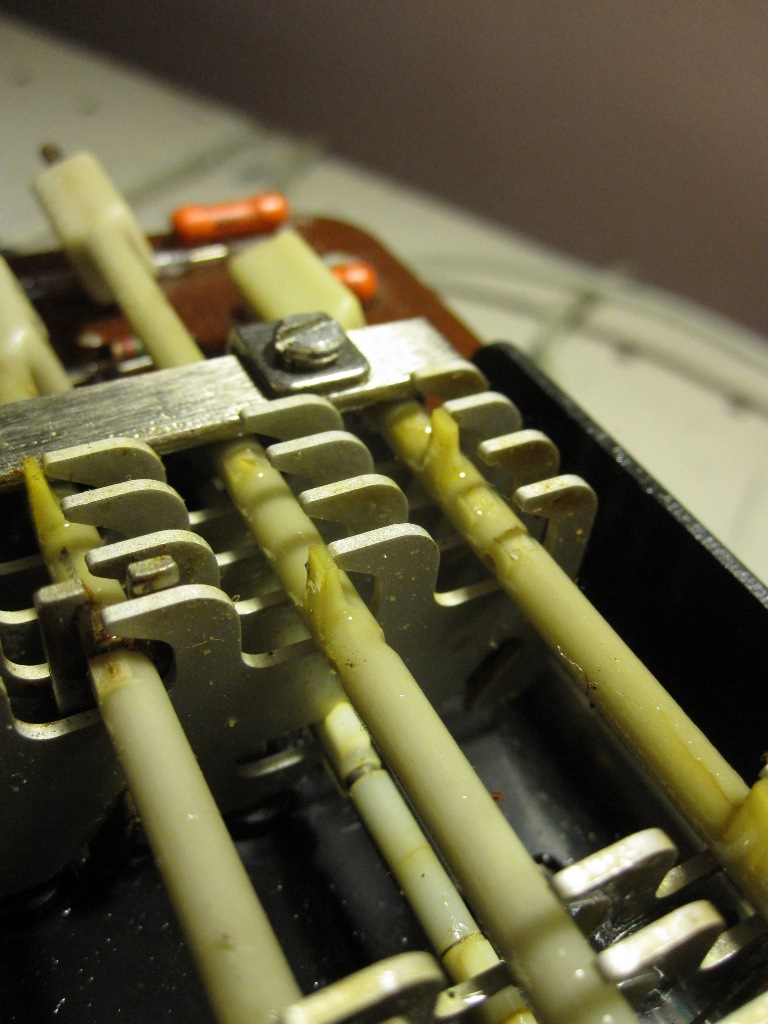
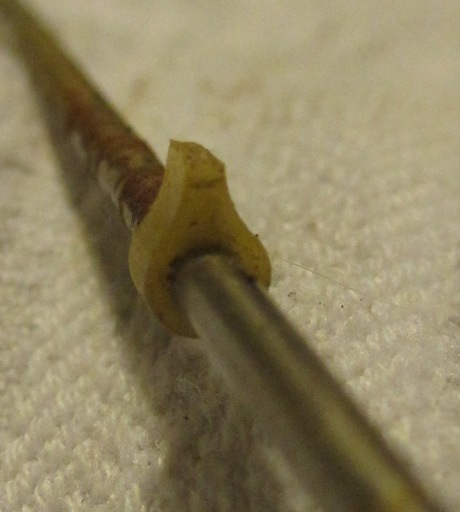
of the keyboard mechanism on my specimen reveals that a few of the
plastic "fingers" that are positioned on the rods that move the magnets
to/away from the reed switches have snapped off.
I have a close up picture of what the fingers are supposed to look like at:
http://yahozna.dyndns.org/scratch/friden/normal-finger.JPG
And a picture of one of the broken ones at:
http://yahozna.dyndns.org/scratch/friden/broken-finger.JPG
The broken fingers no longer make contact with the mechanism, and so a
couple of the reed switches do not get activated properly. I'm guessing
that this is at least part of the reason the machine is acting the way
that it is (that it's getting unexpected scancodes from the keyboard and
going off into the weeds...)
I need to figure out how to "recap" these fingers. I don't have a lot
of experience repairing plastic stuff like this, anyone have any
suggestions?
Thanks!
Josh
I still have some parts for the original LaserJet. If I recall
correctly, the engine was made by Canon and was also used in printers by
other manufacturers like QMS and Canon. I installed & maintained quite
a few of them.
As far as collecting printers, I still have a few that are small enough
to hold onto. I have a Kleinschmidt drum printer (1960's?) and an
Axiohm aluminized-thermal printer from the late 70's. I had to give up
all my Teletype's (ASR-33 and an older model) as well as a chain
printer, Printronix line printer, and a wet-process "laser" printer from
the early 70's (?) I think it was a Xerox. Just took up too much space.
They are all a part of history; I hope someone out there is holding onto
them.
Clay
---------------------------------------------------
Owned by a coworker of mine who says it still works fine.
He doesn't want to throw it out if there is someone
interested in preserving it. Somehow, I've never been
interested in adding printers to my collection. In the
"nostalgia era" of my computer experience, what I collect,
printers were noisy, messy and not worth the bother.
Anyway, if you want it and can arrange to pick it up fairly
quickly, let me know.
Bill
I was given a ZIP file that unpacks to two directories under MacOSX:
Diagnostic1
MacUser
All files are in pre-OSX "forked" format. I copied both resulting
subtrees to a netatalk server and tried to access them from a 68k mac. For
some reason, the second of these is visible under MacOS 7.x (tried several
values of 'x')!
The MacUser directory is fine - both data and resource forks are as
expected. However, no matter what I've tried 'Diagnostic1' simply does
not show up in the finder. I'm sure it's something basic, but I'm not
much of an ancient Mac guru.
Any ideas?
Steve
--
For some Computer History Museum work I need information on 7400 series Flip
Flops (S and Normal, DIPs) circa 1973 (anything 1970-75). Anyone have any
maximum clock speed and OEM volume pricing information on parts such as 7473
thru 79 or 74106-116?
I must be getting old because I remember the 7474 well but I thru out my
Yellow books years ago :-)
Thanks
Tom
I was contacted many months ago by folks in York PA about a large
TRS-80 Model II collection they need to get rid of.
This includes several CPUs, hard drives, software, manuals and so on.
Someone was supposed to collect this but has failed to do so and now
the gear is in jeopardy of being scrapped VERY soon.
If you can save all or part of this haul please contact me ASAP so I
can put you in touch with the owner.
This stuff should have been gone by the beginning of last month so
time is critical to save it.
--
Erik Klein
www.vintage-computer.comwww.vintage-computer.com/vcforum - The Vintage Computer Forums
marketplace.vintage-computer.com - The Vintage Computer and Gaming Marketplace
Hi! I made this offer at Vintage-Computer.com forums and got some response
so am also making the same offer on CCTALK. The following link is the
design I referring to:
http://n8vem-sbc.pbworks.com/w/browse/#view=ViewFolder¶m=SCSI2IDE
I am trying to decide what to do with the SCSI to IDE/SD project. I think it
would be a good and helpful thing to have but recognize it may be too
specific or overcome by events. If you are interested in buying a prototype
board please contact me at
mailto:LYNCHAJ at YAHOO.COM?subject=SCSI2IDE
If there are 5 people interested I can get a batch of five PCBs made for
$150 or $30 each. If there are 10 I think I can get the prototype board cost
reduced to around $20 each.
Please note if you buy a prototype board you don't have to actually build
and test it. You can buy a board and have it sent to a volunteer builder for
build and test.
If the SCSI2IDE project is to succeed we have to get past the prototype
board phase and into the hands of builders for coding. Obviously with
prototype boards there are no assurances and you can expect there will be
problems. We have to find those and fix them before a manufactured PCB is
even a possibility.
Thanks and have a nice day!
Andrew Lynch
Does anyone have experience or notes on the absolute minimum hardware to
do parallel narrow (and slow) SCSI.
Back in the early days, we were doing non arbitrated buses, and they are
now essentially unsupported, and there are some more bits related to
Attention that possibly has to be responded to quickly to keep from
upsetting initiator stacks. However I would think a small circuit
external to a small processor such as a PIC or AVR would allow one to
fool most initiators, and do a simple device with SCSI on one side, and
either ethernet or USB on the other, or even an SD ram part.
The reset signal has some real constraints about getting the drivers off
the bus really quickly, and that is one signal that can't be handled in
software unless you have really fast response. Also there are some
state transitions related to Reset that I think might have some issues.
You would of course need to latch that a reset occurred and when your
slow device got around to polling it it could handle that.
Also when the states are decoded would not be too hard to record and latch.
I just wonder if this would be less than the simple target circuits out
there and would be very difficult to implement.
The messaging and selection added some logic I have not studied in a
long time such that there were some transitions that could not be easily
handled either.
Jim
I recently acquired an HP 87 that I was able to repair, all except for a
few sticking keys. From digging through the archives at this site and
the HP-80 Series sites it seems the only way people have found to fix
these is to cannibalize the plungers from other similar keyboards. Has
anyone figured out a way to repair these cracked key plungers yet? I
have tried a few things like gluing and wrapping and melting, etc, with
little success. Does anyone know a source for these plungers? The HP
part number 1535-4043 still comes up on HP parts site with no stock.
Clay
The IMI 5012H is I am told a clone of the Shugart ST-512, which is a type 1
drive, can anyone confirm this? I am, working to resurrect an IBM AT.
Silly me I disconnected the battery and lost the configuration settings. I
attempted to run setup, but when I declare the drive to be type 1 (or 2),
the system returns a 1780 error code (drive seek error)...which makes me
wonder if this is not really a drive type=1.
Thanks
Bill Degnan
On Wed, Dec 1, 2010 at 9:42 PM, Chuck Guzis <cclist at sydex.com> wrote:
> The Microsoft issue, I recall was with dead code elimination. ?The C
> expression
>
> ? ? ? ?while( C != 0);
>
> could normally be eliminated if C was 0...
I have used the following in embedded code to tight-loop the CPU in
certain circumstances, intentionally requiring a reset of the
processor to escape...
for (;;)
;
I suppose a good optimizer would know that you really meant to do that
and should produce something resembling the following
$1: JMP $1
...but I certainly wouldn't want that statement optimized out entirely.
> The beauty of a good optimizer is that it allows one to write legible
> code that still turns in good performance.
Indeed.
The horror of a bad optimizer (and I _have_ seen this) is that it
introduces bugs that vanish when the optimizer is turned off.
-ethan
I should add that these readings were taken while the machine was waiting
for me to insert a disk (according to the screen icon). Actually a disk was
already inserted. I also looked for any change in voltage on any of the
pins when I clicked the icon to activate the drive. There was no change in
any of the readings.
Terry
----- Original Message -----
From: "terry stewart" <terry at webweavers.co.nz>
To: "General Discussion: On-Topic and Off-Topic Posts"
<cctalk at classiccmp.org>
Sent: Wednesday, December 08, 2010 6:48 AM
Subject: Re: apple Lisa2. Any advice on non-working floppy drives?
> Hi Tony and others. Progress and pin readings from the Lisa 2 project...
>
> I've cleaned a couple of the 400k Drives thouroughly just in case the
> machine was struggling with the mechanisms. No change. The drives still
> sit there on boot in stubborn silence, although the LEDs inside are lit.
> No sound or attempt at disk ejection when there is a disk present.
>
> I did some measurements on the Lisa Lite board input connector, and here's
> what I found. I used the circuit diagram at
> http://www.freeinfosociety.com/electronics/schemview.php?id=1417 . The
> signals in brackets represent the corresponding pins on the sony floppy
> drive. A disk was in the drive at the time.
>
> PH0 (CA0) - 0.2v but rises to 3.5v momentarily when the machine is first
> switched on
> PH1 (CA1) - 0,2v normally but every 4-5 seconds this pulses to 3.5v
> PH2 (CA2) - Same as PH1
> PH3 (LSTRB) - 0.2v
> WRQ (WRTGATE) - 4.9v
> HDS (SEL) - 4.3v but pulses to 0.2 v every 4-5 seconds
> DEN (ENBL) - 0.2v
> RDA (RD) - 4.9v but pulses to 0.2 v every 4-5 seconds
> WRD (WRTDATA) - 0.2v
> MT (goes to Lite Adaptor circuitry) - 0.11 Returns to drive pin as
> PWR - 3.6v
> All 12v and 5v power and ground pins read what they should.
> SNS - 4.9v but pulses to 0.2 v every 4-5 seconds
>
> I''m still digesting what this all means using the Lisa hardware manual
> here
> http://lisa.sunder.net/LisaHardwareManual1983.pdf . There is a
> comprehensive explanation of how the drive interface works in section 6
> but I'm still digesting this and trying to get my head around it.
> Appreciate that I'm not a techie and a lot of this stuff is new to me.
>
> As I see it at the moment, the drive is certainly getting power, and
> appears to be getting signals. Whether these signals are the right ones
> are another question?
>
> Terry (Tez)
>
>
> ----- Original Message -----
> From: "Tony Duell" <ard at p850ug1.demon.co.uk>
> To: <cctalk at classiccmp.org>
> Sent: Monday, December 06, 2010 10:09 AM
> Subject: Re: apple Lisa2. Any advice on non-working floppy drives?
>
>
>>>
>>> Tony, thanks for doing that bit of research.
> .....
> .....
>>> I have a manual with some schematics and tonight I'll check and see if
>>> the
>>> LisaLite board is there.
>>
>> As I said a Google search found it fairly easily. The Lisalite board
>> looks quite simple (the schematic is just 1 sheet, and I recognisd all
>> the chips on it). I didn't do much more than glance at the schematic, but
>> it seemed to be a dairly simple PWM generator using TTL coutners and '85
>> comparators. I think the control vaule is bit-serially loaded into a
>> shift register on the board.
>>
>>>
>>> >Firstly, since you have no idea as to the health of any
>>> > of the parts, you can't deduce anything from the fact that swapping
>>> > them
>>> > out makes no difference.
>>>
>>> Not entirely true, as the Lisa 2 startup checks carry right through
>>> until it
>>> asks for a disk for inserted. So I can assume most parts are working.
>>
>> Can you? I have no idea what these startup checks actually test, but I
>> would have thouht it as possible for one of the I/O chips that links to
>> the drive to havee failed but in a way that it still passes the tests.
>>
>>> Incidently, the docs I have suggests this routine also checks the
>>> LisaLite
>>> controllers so (according to the machine anyway) these are ok. It's
>>> hard to
>>
>> I wonder how? I couldn't see any way for the machine ot check that the
>> PWM signal (the only signal truely sourced by the Lisalite board) is
>> present and corret.
>>
>>> believe that THREE drives all have the same fault though. All inputs
>>> into
>>> the drive are from the LisaLite board. Maybe the diagnostic checks are
>>> not
>>
>> Not really. While the only external cable from the drive does, indeed,
>> plug into the Lisalite board, the shcmeatics show the most of the signals
>> are simply passed (with no buffering or anything) between the 'Twiggy'
>> connector back to the Lisa I/O board and the Sony drive connector. I
>> think it's likely that any problems iwth those signals are not caused by
>> the Lisalite board (broekn PCB tracks are not common).
>>
>>> as thourough as they should be.
>>
>> We don;t (or at least I don;t know) what hte diagnostics actually check.
>> There's also the issue that you're using a defective system to diagnose
>> itseld, and while most diagnostics are written assuming that anythign
>> that hasn't been checked could well be defective, some are not. I've seen
>> diagnostics that basically assume that the machine is working correctly,
>> and which don't help _at all_ if there is a fault.
>>
>> I really do think you need to start making some measurements on the drive
>> connecotr and see just what is, and is not, correct there.
>>
>> -tony
>>
>
>
> >
> > The IMI 5012H is I am told a clone of the Shugart ST-512, which is a
type 1
> > drive, can anyone confirm this? I am, working to resurrect an IBM AT.
> > Silly me I disconnected the battery and lost the configuration
settings. I
>
> Obvious question : Did it work before you disconencted the battery? In
> other words do you know the problem is just due to misconfiguration?
>
Yes. It worked fine before I disconnected the battery. I assumed it was
dead and I was planning on replacing it with a new one.
>
> There is a 3rd party setup program that will run on the real IBM AT (I
> know this, becuase it's what I use on mine). I has the advantage that
> when you select a particualr drive type, it displays the actual
> parameters (cylinders/heads/etc) too.
>
> That way you could at least check you're selecting someting that makes
sesne.
>
> Are you using the orignal IBM (Western Digital, actually) controller
board?
>
Yes. original board.
What I plan to do next is put the drive in an XT, because in an XT there is
no battery needed and I can use spinrite to determine the drive number.
It's possible given I was getting a 1780 error that there is a problem with
both my controllers.
Bill
Owned by a coworker of mine who says it still works fine.
He doesn't want to throw it out if there is someone
interested in preserving it. Somehow, I've never been
interested in adding printers to my collection. In the
"nostalgia era" of my computer experience, what I collect,
printers were noisy, messy and not worth the bother.
Anyway, if you want it and can arrange to pick it up fairly
quickly, let me know.
Bill
Ok guys,
The Good bit....
All this talk of SCSI to whatever got me curious so I started experementing.
What I have so far :
An AVR ATMega1284 (DIP40), connected to an SD card by SPI and to the
SCSI bus via 4 LS chips (1xLS273 and 3xLS240). I currently have
implemented just a few of the SCSI command set, Identify, read, write,
test ready and request sense.
Thist is enough to be able to connect to a PC SCSI card, format the
drive and read and write files to it....heheh I can even boot off it !
I'm using Chan's FatFS, and in this way the drive seen by the SCSI is
actually a large image file on the SD card, I did this as it will make
backing up the drive *MUCH* easier if the target system is not a PC, as
you can simply take the SD card out and copy the image file without
worrying about it's internal structure. In theory this will also make
sharing data between the target system and an emulation running on
something more modern.
There's a couple of pictures here :
http://www.stardot.org.uk/forums/viewtopic.php?f=11&t=3646
The bad bit......
Whilst this all works it's SLOWWWW, using Norton utilities SI, reports
that the disk is 0.2x the speed of an original PC, cirtainly bootup
times are much more akin to what I would expect from a floppy drive :(
So I would sugest that for replacing hard disks that using SCSI->SD is
probably not going to be fast enough.
My next experements are going to center on replacing the SD with an IDE
drive, hopefully this will provide a suitable speed increse, asuming
that this works it should be easy enough to use a CF->IDE adapter board
to use a CF drive instead of an IDE, which will allow the media to be
removable and easiliy swapable.
The other thing I want this to support is 256 byte sectors as some old
machines rely on this, a feature which is supported by some of the early
SCSI/SASI to MFM/RLL boards but very few native SCSI drives, this would
be of perticular intrest to some of the Acorn 8 bit machines.
Comments & sugestions welcome.
Cheers.
Phill.
--
Phill Harvey-Smith, Programmer, Hardware hacker, and general eccentric !
"You can twist perceptions, but reality won't budge" -- Rush.
In 1966, Ken Knowlton created a 16-minute black and white film showing
animated algorithms for the L6 language. Does anyone know if this
film is online anywhere or if the film has been archived anywhere (CHM
perhaps?). Bell Labs used to have a historian, but since Bell Labs no
longer exists, I have no idea who to contact anymore about this sort
of thing. Does anyone know?
--
"The Direct3D Graphics Pipeline" -- DirectX 9 draft available for download
<http://legalizeadulthood.wordpress.com/the-direct3d-graphics-pipeline/>
Legalize Adulthood! <http://legalizeadulthood.wordpress.com>
Hi guys,
I've got my 3B1 emulator "mostly working" in that it runs the Boot PROM,
sees the floppy disc in the drive, and proceeds to boot from it, getting
as far as the Loader.
When it gets to the Loader, I get the following display:
AT&T UNIX(tm) pc
Loader version 3.51
Copyright (c) 1985, 1986
AT&T
All Rights Reserved
Searching floppy disk...
####
Searching hard disk...
... and it stops there. I can tell from the emulator log that it's
trying to get the hard drive controller to read CHS 0:0:0 and DMA the
data into RAM at 0x77830, but because the HDC isn't implemented, it
locks.
What I expected was for the Loader to pick up the boot files on the
Diags disk, boot from that, and ignore the HDD. Does anyone know what
"typical boot behaviour" is for a 3B1, 7300 or UNIX PC, when booted from
the Diagnostics floppy (Foundation Set, disk 1) ?
This is a bit of a head-scratcher -- I'm trying to figure out if there's
a problem with my FDC driver (wouldn't be the first one) or the
DMA/interrupt controller, or if the Loader really needs a hard drive
controller (or a really good fake) to boot the system.
I'd also really like to know why the DMA controller has two separate
direction control bits -- DMAR/W- and IDMAR/W-... this seems downright
silly, though in keeping with the rest of the TechRef. My "annotated
edition" corrects about a dozen minor and major errors in the register
set descriptions, and adds a bunch of informational sticky-notes and
scribbly comments to reinforce certain points. Ewwww...
If anyone's interested in playing with my emulator -- go to
<http://www.philpem.me.uk/code/3b1emu/>. Hit the link under "Mercurial
repository", then ".tar.bz2" to get a Tarball of the sources. Untar it.
Grab the boot PROMs, and put them in a directory called 'roms' as
'14c.rom' and '15c.rom'. Use IMDU (Imagedisk utility) on a DOS PC (or
inside Dosbox) to convert the Foundation Set disks from IMDs to binary
files, then copy the first Foundation disk (Diagnostics) as 'discim'.
Compile (you'll need libsdl, aka the Simple DirectMedia Layer) and run.
I know the code is a mess, patches to rectify this (or any of the other
millions of bugs) would be almost certainly be accepted :)
There's also no keyboard or mouse emulation yet, just the CPU, video,
RAM, ROM and a basic memory mapper and DMA emulation. As for Ethernet
emulation... that's on the "maybe later" list, right after "learn how to
send and receive Raw Ethernet frames on Linux".
Thanks,
--
Phil.
philpem at philpem.me.uk
http://www.philpem.me.uk/
At 03:14 PM 12/4/2010 -0600, you wrote:
>On Sat, Dec 4, 2010 at 2:39 PM, a50mHzHam <a50mhzham at gmail.com> wrote:
> > WANTED: A good home for my last three RACK'O'CD boxes by MDI.
>
>I'd be interested if it's easy (which means no shipping). Where are
>you located?
>
>brian
Southeast Wisconsin-- Milwaukee metro area.
-----
350. [Computing] "Formal specifications yield correct programs." No. Formal
specifications yield PhD theses. They may also occasionally yield
programs as by-products, but no useful ones. --Ronald F. Guilmette
--... ...-- -.. . -. ----. --.- --.- -...
tpeters at nospam.mixcom.com (remove "nospam") N9QQB (amateur radio)
"HEY YOU" (loud shouting) WEB: http://www.mixcom.com/tpeters
43? 7' 17.2" N by 88? 6' 28.9" W, Elevation 815', Grid Square EN53wc
WAN/LAN/Telcom Analyst, Tech Writer, MCP, CCNA, Registered Linux User 385531
SCSI to SD/IDE
Phill Harvey-Smith afra at aurigae.demon.co.uk
<mailto:cctalk%40classiccmp.org?Subject=Re%3A%20SCSI%20to%20SD/IDE&In-Reply-
To=%3C4CFAF40D.30108%40aurigae.demon.co.uk%3E>
Sat Dec 4 20:08:13 CST 2010
* Previous message: SCSI to IDE
* Next message: SCSI to SD/IDE
* Messages sorted by: [ date ] [ thread ] [ subject ] [ author ]
________________________________
Ok guys,
The Good bit....
All this talk of SCSI to whatever got me curious so I started experementing.
What I have so far :
An AVR ATMega1284 (DIP40), connected to an SD card by SPI and to the
SCSI bus via 4 LS chips (1xLS273 and 3xLS240). I currently have
implemented just a few of the SCSI command set, Identify, read, write,
test ready and request sense.
Thist is enough to be able to connect to a PC SCSI card, format the
drive and read and write files to it....heheh I can even boot off it !
I'm using Chan's FatFS, and in this way the drive seen by the SCSI is
actually a large image file on the SD card, I did this as it will make
backing up the drive *MUCH* easier if the target system is not a PC, as
you can simply take the SD card out and copy the image file without
worrying about it's internal structure. In theory this will also make
sharing data between the target system and an emulation running on
something more modern.
There's a couple of pictures here :
http://www.stardot.org.uk/forums/viewtopic.php?f=11&t=3646
The bad bit......
Whilst this all works it's SLOWWWW, using Norton utilities SI, reports
that the disk is 0.2x the speed of an original PC, cirtainly bootup
times are much more akin to what I would expect from a floppy drive :(
So I would sugest that for replacing hard disks that using SCSI->SD is
probably not going to be fast enough.
My next experements are going to center on replacing the SD with an IDE
drive, hopefully this will provide a suitable speed increse, asuming
that this works it should be easy enough to use a CF->IDE adapter board
to use a CF drive instead of an IDE, which will allow the media to be
removable and easiliy swapable.
The other thing I want this to support is 256 byte sectors as some old
machines rely on this, a feature which is supported by some of the early
SCSI/SASI to MFM/RLL boards but very few native SCSI drives, this would
be of perticular intrest to some of the Acorn 8 bit machines.
Comments & sugestions welcome.
Cheers.
Phill.
--
Phill Harvey-Smith, Programmer, Hardware hacker, and general eccentric !
"You can twist perceptions, but reality won't budge" -- Rush.
________________________________
* Previous message: SCSI to IDE
* Next message: SCSI to SD/IDE
* Messages sorted by: [ date ] [ thread ] [ subject ] [ author ]
________________________________
More information about the cctalk mailing list
<http://www.classiccmp.org/mailman/listinfo/cctalk>
________________________________
-----REPLY-----
Huzzah! Good for you! Glad to see *something* coming out of all of this.
Congratulations! Have a nice day!
Andrew Lynch
Hi! Thinking about this some more, we already have simple Z80 with RAM/ROM
circuits and 8255 PIA for I/O including circuitry for 8255 to IDE.
The only new element of this design would be converting a pair of 8255 PIAs
to SCSI-2. Looking at a pin out of a SCSI-2 pin out of the 68 pins, 34 are
grounds and a few more are power related. Basically it is about 30 pins
which actually do anything and of those 24 are data lines. This does not
appear to be a difficult interface to "bit bang" and would be somewhat akin
to the 8255 to IDE circuits.
Yes, performance would just OK and not fast. I think it would probably work
and be fairly cheap to make. I am willing to support other approaches but
would like to just help with the schematic capture, PCB design, and
prototype board development. The key to success is to keep it simple and
easily understood. Adding a bunch of unnecessary complexity just dooms the
project IMO.
Please contact me if interested. Thanks and have a nice day!
Andrew Lynch
>Date: Fri, 03 Dec 2010 19:13:08 -0800
>From: Eric Smith <eric at brouhaha.com>
>Dyslexia strikes again. I thought you were looking for the 85C30, not
>the 53C80. Sigh.
>
>I doubt that anyone makes the 5380 or 53C80 anymore.
Not quite the 53C80, but perhaps the next best thing:
I have three 53C94 and three 53CF94 in 84 pin PLCC packages which I will
happily ship (for free) to anyone who wants to dabble on this project.
They are untested, and I'm looking at my inventory trying to figure out
whatever possessed me to buy them in the first place. Perhaps I got them
with a larger lot. I only ask that you actually be about to experiment
before you ask me to send them to you. It's too easy to acquire stuff
with the intention of doing a project and then for various reasons never do
it.
I also have a brick of 660 NCR 53C96 chips. Unfortunately, these are a
(IIRC) 100 pin QFP (30 X 20?), which is more difficult to work with than a
DIP or socketable PLCC. I am reluctant to open the (sealed) brick to pull
out one or two, but if someone wants to develop this project with the 53C96
in mind I'd be happy to supply 53C96s for the production at a nominal cost;
certainly no more than $1 per chip. Again, not quite sure what I was
thinking when I bought them....
If these are usable and not too modern for this project that should help
keep the cost down as compared to paying $5 - $10 per SCSI chip.
Finally having a written inventory really helps to bring home all those
items that I just can't imagine any realistic future use for....
I put the datasheets for the AMD 53C94/96 and the 53CF94/96 as well as the
Zilog 53C80 up at:
<http://www.io.com/~trag/DataSheet/>
Jeff Walther
SCSI to IDE
Alexandre Souza - Listas pu1bzz.listas at gmail.com
<mailto:cctalk%40classiccmp.org?Subject=Re%3A%20SCSI%20to%20IDE&In-Reply-To=
%3C04B9CB3C0CBB4169A8660B24014CB7FB%40portajara%3E>
Sat Dec 4 14:50:26 CST 2010
[snip]
Time to define DOWN TO EARTH specs and begin working :)
Greetings from Brazil,
Alexandre SOuza
[snip]
Alexandre,
The work on a SCSI to IDE and SD bridge has already started. I have a
schematic, parts list, and PCB layout ready for prototype board up on the
N8VEM wiki. Check out the thread on vintage-computer.com forum. It has the
Z80 controller, Z53C80, and IDE plus the SD interface. An 8 MHz Z80 will
push the data plenty fast enough for early microcomputers. We've seen it
first hand with XT-IDE board, the N8VEM DiskIO board, and the S-100 IDE
interface. Connect an IDE to CF adapter and it will be a fast drive on most
any vintage system.
Low cost commercially available SCSI to IDE bridges are already available
for those with Ultra-SCSI and later so there is no need to help them. I
think the need is for the older SCSI format which *classic* computers use,
not the fancy modern stuff. An Ultra-SCSI interface does no good for an
early microcomputer with a SCSI-1 interface which I think should be the
"classic computer" audience since they need a SCSI to IDE bridge the most.
The mailing list is called "CCTALK" for a reason. That's what's pretty much
the only thing done here. I agree with your sentiment -- I to would like to
see less "talk" and more "do". Don't listen to the naysayers or those who
set unrealistically high expectations but refuse to actually do anything
except complain. I've been offering to help design a KiCAD schematic and/or
PCB board and/or prototype PCBs based on *anyones* design since the start of
this thread and have only gotten flamed and ignored. Maybe you'll have
better luck.
Andrew Lynch
PS, if you are planning to offer a PCB or kit, I advise you not use SMT or
you'll be assembling nearly all of them yourself. A lot of hobbyists
especially those with diminished vision struggle with even DIP/PLCC
soldering and SMT parts will just make you the assembler as well as the
designer.
----- Original Message -----
From: <ma.locksmith at juno.com>
To: <amateur-repairs at yahoogroups.com>; <freebay at mailman.qth.net>
Sent: Saturday, December 04, 2010 7:59 PM
Subject: [Amateur-repairs] Computer drives
>I don't expect anyone wants one of these, but I've "got" to ask anyway.
>
> Have box of various computer drives.... floppy (all types), hard (SCSI),
> and even a CD-RW.
>
> Of course, no drivers.
>
> Free for postage
>
> Ed
>
> .
> ____________________________________________________________
> Explosive Stock Secrets
> Learn the Secret art of picking penny stocks before they spike
> http://thirdpartyoffers.juno.com/TGL3141/4cfaba0b5b184f28c1st05duc
>
WANTED: A good home for my last three RACK'O'CD boxes by MDI.
MUST GO, need space, need basement floor and drain tile repaired. PLEASE
some take these, or some of the drives, soonest. Price: FREE (you pay
shipping.)
These are nifty 7 inch high rack mount boxes about 20 inches deep, each
containing seven SCSI CD-ROM drives, a power supply (4 voltages, including
+5 at 23A, +12 at 15A) assorted cabling, and a SCSI LUN controller widget.
The boxes have two SCSI conncectors each, the large "centronics" type
(50-pin?) and a SCSI address selector.
The CD-ROM drives are Toshiba XM-5401B, each mounted to a sort-of sled,
more like drive rails, with spring-loaded thumb screws holding them in.
Each has connectors for Audio Out (L and R), SCSI ID and termination, SCSI,
and power.
The boxes have a hinged door on top for access to the rear of the drives.
With the thumb screws on the drives, tool-less removal is possible.
If you need the terminating resistor packs, specify you want drive a #7
(first-come, first served.)
You can get the entire box, or two, or three, or some drives (specify
quantity) but I don't really want to disassemble these enough to extract
the power supply. If I do that, I'll keep a power supply. They look like
old style AT type, without the motherboard connection.
-----
135. [Computing] Was it Ritchie or Thompson who said about X: "Sometimes, when
you fill a vacuum, it still sucks"?
--... ...-- -.. . -. ----. --.- --.- -...
a50mhzham at gmail.com (Email) N9QQB (amateur radio)
"HEY YOU" (loud shouting) WEB: http://www.mixcom.com/tpeters
43? 7' 17.2" N by 88? 6' 28.9" W, Elevation 815', Grid Square EN53wc
WAN/LAN/Telcom Analyst, Tech Writer, MCP, CCNA, Registered Linux User 385531
[snip]
2) I don't want a pre-built board with peripherals I don't need on it. I
am a great believeer in actually designin the hardware to suit the
problem I am solving
-tony
-----REPLY-----
Hi,
Please check this approach to a SCSI to IDE and SD interface
My design for the SCSI to IDE and SD interface is just the basics:
Z80, RAM, ROM, UART, IDE, SD, and SCSI controller.
http://n8vem-sbc.pbworks.com/w/browse/#view=ViewFolder¶m=SCSI2IDE
Everything fits comfortably on a Eurocard PCB.
All the part are commonly available for about $20-$30 total.
Thanks
Andrew Lynch
Is the Z53C80 still available new ? If so from where ?
Cheers.
Phill.
-----REPLY------
Try findchips.com
Digikey, Quest Components, Area51ESG, eBay, etc.
You might need to get an RFQ.
Thanks!
Andrew Lynch
PS, if you or anyone else is interested in helping/developing on making this
project a reality, please join me on vintage-computer.com forums. I am
assessing interest in this as an N8VEM project and need some volunteer
builders to launch the project. The schematic, PCB layout, and parts list
is ready for a prototype order which will happen once there is enough
builders involved to sustain the project.
Coming a bit late into this, but anyway...
On 11/18/10 08:39, "Jerome H. Fine"<jhfinedp3k at compsys.to> wrote:
> >Antonio wrote:
>
>>>> >>>Having (many years ago) recovered data from a borked RT-11
>>>> >>>filesystem, I can certainly confirm that.
>>>> >>>
>>> >>However, I don't understand how you can use TECO to actually
>>> >>repair an RT-11 filesystem. For that purpose, I can only see
>>> >>SIPP as being able to
>>> >>change or repair
>>> >>
>> >I'm pretty sure I didn't say "repair"; I merely recovered data.
>> >
>> >I don't recall exactly what went wrong, but essentially I went
>> >in with TECO and found the right blocks for the various source
>> >files I needed, loaded them into TECO and wrote them out
>> >to floppy. Needed some minor tidy up as I recall but that's about all.
>> >
>> >
> OK!! I understand completely!! If anyone else who is interested does not
> understand, please ask some questions.
>
> If the ASCII data in question was not in the first buffer, than I assume
> that
> something like the TECO command:
> <ASstring$:;J9999K>$$
> was what you used to find the start of the file which you had lost.
Well, yes and no.
What you actually do is:
ERfilename$_string$$EWnewfile$HPW$EC$EX$$
(assuming that all the data you are interested in are in the buffer,
otherwise include P commands in there to the appropriate amount, before
the HPW.)
If you really want to use A to append more data from the disk, you
should probably not use 9999K to dump the current buffer, but use HK
instead.
Also, if a search fails, you'll aready be at 0, so no reason for the J
command.
> By the way, KED can do the same, but is limited to devices (I assume that
> you must have done a non-file-structured open, i.e. ERdev:$$) that are less
> than 32768 blocks. Since I have never had occasion to edit a full MSCP
> device of 65535 blocks, I just never noticed the limitation. This
> restriction
> for KED also applies to files. So KED can INSPECT a logical device which
> is 32767 blocks or less or an RL02 device, but no physical device or file
> larger than 32767 blocks in total.
TECO itself will not care, so that would be a limitation from the RT-11
point of view, in that case. TECO will serially read a file (or device)
>from start to finish, and don't really care about the file position
information as such.
>>> >>Can you describe how you used TECO to recover data from a
>>> >>borked RT-11 filesystem (assuming that you did more than just
>>> >>READ the text contents
>>> >>of the files
>>> >>in the same manner that KED would also allow using a
>>> >>non-file-structured edit
>>> >>of the whole device)? Otherwise, if you just used TECO to
>>> >>just READ the
>>> >>text
>>> >>strings, please confirm that as well.
>>> >>
>> >I didn't fix a corrupt system back to a working system. I read
>> >blocks from disk into TECO (as you say, in a non-file structured
>> >mode), somehow found the root directory and worked out where the
>> >files I cared about lived, read each of those and saved them to floppy.
>> >Then either the disk was reformatted or it went back to whoever we
>> >bought it from for a replacement- I just don't remember.
>> >
> More than likely, you just found the source ASCII text you were looking
> for and wrote
> that to the floppy file using something similar the the TECO command
> that I suggested.
> TECO is not designed nor able to show individual words of a specific
> block as SIPP
> is able to do.
Not sure what SIPP is, but TECO can handle, and display, anything. It
was designed to be able to deal with any kind of information, not just text.
>> >TECO can certainly read disk block N, and having done that it can surely
>> >mangle that disk block; what I'm not sure of is whether it can then
>> >write that block out to the required disk block.
>> >
> I really don't think so. TECO can, as far as I know, work only with
> ASCII text strings.
No. TECO works perfectly fine with any kind of binary data.
> Binary data can't be managed easily, if at all, by TECO such as what
> SIPP can do.
No. TECO handles binary data just fine.
Whenever you enter text, all characters are allowed. And by all
characters, I really mean all characters. Control characters are just as
welcome as printable ones. A few characters have special meaning in
TECO, such as ESC, ^C, and a few more. ESC can be used by instead
setting another character as the delimiter for the search string. Other
special control characters can be inserted by prefixing them with ^Q,
which means that the next character should be taken literally, and not
be interpreted. For most characters though, nothing special is needed at
all, and you can just enter them in your search string.
In the case you don't really want to type the control characters as
such, you can create the search string before using it, and then just
suck it into your search string as well.
In addition to this, you also have the powerful pattern matching of
search strings, that TECO gives you. So you can say that any character
should match at a specific position, and then match whatever comes after
more specifically as well (or any number of other potential pattern
matching schemes you can think of).
Johnny
(once more, from the correct email account...)
Hi guys,
Does anyone have any details on the control protocol for the keyboard on
the AT&T 3B1?
A command list and/or scan code list would be most useful... or even
actual driver source code :)
I'm about a third of the way there with my emulator -- it's running the
BootPROM, passes the MAPRAM, VRAM and Base RAM self tests, and I'm well
on the way to implementing memory mapping/protection and the UI
interfaces (keyboard, mouse and video)... I'm not sure how to go about
emulating the telephony hardware though; I might just leave that
"unemulated" for now.
Thanks,
--
Phil.
classiccmp at philpem.me.uk
http://www.philpem.me.uk/
On 12/01/10 23:55, Richard<legalize at xmission.com> wrote:
> In article<alpine.DEB.2.00.1012011116190.24432 at slate.spiritone.com>,
> "Zane H. Healy"<healyzh at aracnet.com> writes:
>
>> > On Wed, 1 Dec 2010, Richard wrote:
>> >
>>> > > Since it has a BSD kernel underneath, I'm guessing that all of the OS
>>> > > proper is written in C and that all the Apple stuff on top is written
>>> > > in Objective-Cish.
>> >
>> > It does not have a BSD kernel underneath. It uses the Mach Microkernel.
>> > It has a BSD layer on top of that.
> Sorry, my mistake. I knew there was BSD in there somewhere. Still, I
> doubt the Mach stuff is written in Objective-C, although I believe it
> originally came from NeXT, so who knows.
Well, technically, OS X is neither Mach, nor BSD. But a mix of both. See
http://en.wikipedia.org/wiki/XNU for more details. But I'd consider it
closer to BSD than Mach myself. There is not really much of the
microkernel left in there...
Johnny
At 11:04 PM 12/2/2010, Ethan Dicks wrote:
>On Thu, Dec 2, 2010 at 7:48 PM, Fred Cisin <cisin at xenosoft.com> wrote:
> > On Thu, 2 Dec 2010, Eric Smith wrote:
> >> > A[i++] = i++;
> >> I can't quote chapter and verse, but I'm fairly sure the standard will
> >> say that the result of that assignment is undefined.
> >
> > C can be pretty loose about letting you do such.
>
>There are many things that folks commonly do that are officially
>undefined... like strlen(NULL) (that returned 0 on an NCR box but
>segfaulted a SPARC - the NCR guys tried to claim it proved the Sun was
>broken, but I had to point out that it's undefined).
I remember this with a large potential customer with a bunch of
applications running on HP-UX that needed to be ported to ULTRIX.
lots of code like
strcpy(foo, NULL);
used to initialize strings and
strcmp(foo, NULL)
to see if a string is empty, etc. Apparently location 0 in memory had a
zero.
Fixing this required a lot of work, then we had to fix binary blobs
written to disk (big-endian) to fix them to little-endian.
All of this was used to demonstrate that the DEC platform was obviously
unusable.
Aren't sales reps fun?
Probably more relevant to the compiler optimization thread, another fun
with marketing incident was the Sun rep handing our customer a "simple
little benchmark" that their compiler apparently recognized and
optimized out. The SPARC ran it in seconds while our MIPS based machine
took quite a while. This was my first run-in with the benchmark
preprocessor that did "deep optimization" of the SPECmark benchmarks.
-Rick
SCSI to IDE
Joachim Thiemann joachim.thiemann
<mailto:cctalk%40classiccmp.org?Subject=Re%3A%20SCSI%20to%20IDE&In-Reply-To=
%3CAANLkTikac5TkJkKANRBy_tH4rvEUZPE0qfBfS%3DouSuJN%40mail.gmail.com%3E> at
gmail.com
Sat Nov 27 09:07:00 CST 2010
* Previous message: SCSI to IDE
<http://classiccmp.org/pipermail/cctalk/2010-November/294382.html>
* Next message: SCSI to IDE
<http://classiccmp.org/pipermail/cctalk/2010-November/294386.html>
* Messages sorted by: [ date ]
<http://classiccmp.org/pipermail/cctalk/2010-November/date.html#294385> [
thread ]
<http://classiccmp.org/pipermail/cctalk/2010-November/thread.html#294385> [
<http://classiccmp.org/pipermail/cctalk/2010-November/subject.html#294385>
subject ] [ author ]
<http://classiccmp.org/pipermail/cctalk/2010-November/author.html#294385>
_____
On Fri, Nov 26, 2010 at 11:48, joe lobocki <jlobocki at gmail.com
<http://www.classiccmp.org/mailman/listinfo/cctalk> > wrote:
> So what is our option? I have seen SCSI to IDE adapters around, but they
go
> up into the $100's to $200's, say you have a minimum 10 machines, that
> leaves you somewhere between $1,000 and $2,000 total, before the disk or
> devices. If we could design a simple SCSI to IDE interface, we could be
set
> for a good long while on storage for these devices for a decent amount of
> time. There are all sorts of adapters to IDE, there is CF to IDE, SD to
> IDE,
> SD to CF which could be placed in a CF to IDE adapter if need be, i'm sure
> one could also rig up a USB drive to SCSI if one tried, but I could be
> wrong.
>
>
I have previously proposed here a SCSI-to-SD interface; I've only done
preliminary brainstorming on it, but think it should not be too hard. The
SD card interface is very simple, both from a logic and electrical point of
view: if you don't care much about speed it can be done with SPI. (the speed
should be sufficient to keep up with 68k Mac, Amiga and Atari) All logic
can probably be done in a single AVR or even PIC chip, if you run that at
3.3V, the only additional hardware is the SCSI level shifters.
I do not know enough about low-level SCSI to start designing this yet, and
since I gave away my Amiga 3000 and classic Macs my interest in this project
has all but disappeared... still it'd be kinda fun, I think.
Joe.
--
Joachim Thiemann :: http://www.tsp.ece.mcgill.ca/~jthiem
-----REPLY-----
There was some room left on my SCSI to IDE converter board design so I added
an SD socket.
The SD circuit is very simple and is able to work with some left over inputs
and outputs from the UART.
I think this design would allow for a SCSI to SD converter as you mentioned.
The original intent was for SCSI to IDE converter but would also allow for
SCSI to CF via an IDE to CF adapter.
After a closer reading of the Z53C80 datasheet, I think it is possible to
implement both the polling mode and
a pseudo-DMA mode SCSI. The circuitry seems pretty straight forward and I
think an 8 MHz Z80 should be
able to get some fairly decent transfer speeds.
http://www.vintage-computer.com/vcforum/showthread.php?22906-SCSI-1-to-from-
IDE-drive-converter
Andrew Lynch
I've got to clear out some various backup tapes I've been keeping for
several years now. For starters, I have a bunch of QW5122F and QIC-3020 taumat
format tape carts available. pay for shipping and anything else you want to
add, and they are yours. Reply off list please.
> Date: Wed, 1 Dec 2010 12:55:59 -0500
> From: William Donzelli <wdonzelli at gmail.com>
>> ? That is not so hard, it is very common to build machines like this in
>> Brazil.
>
> Second hand Taigs are fairly plentiful and not horribly expensive.
> They are plenty capable of PC board drillwork, plus you can do all
> sortf os other fun things with them as well.
I did a search on Taig. Interesting machines and the prices look
comparatively good. I was considering a lathe a while back for my
rocketry hobby...
Which machine would one need for automated drilling? It looks like the
CNC Mill would be needed. It's new price is $2200+. It would have to be
discounted an awful lot on the used market before I would think that was a
better buy than just having boards professionally fabricated.
I think the Micro Mill is mechanically capable of the job, but it doesn't
seem to have any type of automated controls, but perhaps I just don't
understand what a mill is.
Which leads to the other issue. In order to make an intelligent decision
about buying a drilling machine, it seems that I must become moderately
educated about the art of machining. Which is an interesting topic, but
not the hobby I was setting out to practice.
This is what ultimately stopped me from buying a lathe for rocketry.
Toner transfer PCB fabrication is attractive because I already have a
laser printer that serves another purpose. A laminator takes up little
space and is easy to put away. The etching tank is a bit of a pain, but
not too bad.
The problem is when I start adding in a milling machine, learning enough
about machining to make intelligent purchases, or building a drilling
machine out of a plotter, and the same two issues for electroplating,
which also kind of leads to building one's own power supply (AKA plating
rectifier).
All of these are interesting topics/diversions, but enough of them and one
isn't practicing hobby electronics any more, one is practicing PCB making
as the primary hobby.
Of course, if enough of my hobbies lead to machining, maybe I should take
it up. I don't know where I'd make the space for the tools though.
Someone else mentioned using a drill press with jigs. How would that
work? Would that be like having a pre-drilled template? That might be
interesting. I could see using the toner transfer procedure on a piece of
steel, then drilling the steel and then pegging boards to the steel for
future drilling in stacks. Might be a little hard on the drills if they
aren't well centered though.
Jeff Walther
Ken Knowlton sent me a paper from AFIPS 1964 on his BEFLIX language
for creating animations (named from "Bell Flicks" as the work was done
at Bell Labs). The language uses "MACRO FAP" as its implementation
layer so to create a modern implementation of BEFLIX, I would need to
know some things about "MACRO FAP".
Google led me to this page:
<http://www.softwarepreservation.org/projects/FORTRAN/source/ibsys/FORTRAN/9…>
Which seems to be the IBM 7090 assembly source code for the MACRO FAP
program, from which I glean that "FAP" is an acronym for "FORTRAN
ASSEMBLY PROGRAM". I don't know 7090 assembly, although I can guess
at the opcodes.
This leads me to the following questions:
1) How long has softwarepreservation.org been around? Its part of the
CHM, but I haven't stumbled on this web site before.
2) Does anyone have any experience with MACRO FAP that can help me
understand the semantics of MACRO FAP instructions?
3) Barring that, does anyone have any IBM 7090 assembly experience
that can help me understand the semantics of the implementation of
MACRO FAP so that I can understand the semantics of its command
language?
BEFLIX is actually quite interesting and could be fun in creating
animated movies today. Its got a combination of simple 2D graphics
primitives, turtle graphics and animation control in its command set.
I'd like to write a BEFLIX interpreter for modern experimentation.
Seeing as BEFLIX was created in 1964, its probably one of the oldest,
if not the oldest, domain specific language for creating computer
graphics animations.
--
"The Direct3D Graphics Pipeline" -- DirectX 9 draft available for download
<http://legalizeadulthood.wordpress.com/the-direct3d-graphics-pipeline/>
Legalize Adulthood! <http://legalizeadulthood.wordpress.com>
On 12/01/10 08:13, Rich Alderson<RichA at vulcan.com> wrote:
> From: Dennis Boone
> Sent: Tuesday, November 30, 2010 5:57 PM
>
>>>> >>> I can't find any COBOL, BASIC, MODULA, CORAL, DIBOL, etc.
>>> >> In 7.3, I'm sure that's now true. I'm pretty sure I remember some
>>> >> COBOL and BASIC back in the 4.x and 5.x days, but I can't promise that
>>> >> my memory is 100% correct.
>> > Given the RSX heritage, I wouldn't be surprised if some BASIC code came
>> > across. I was actually almost surprised not to find MODULA, but a bit
>> > of googling suggests my memory of a DEC compiler is erroneous. I would
>> > only expect to find COBOL in some kind of reporting tool, where
>> > performance wouldn't so much.
> I think you've confused RSX-11M (the basis of VMS) with RSTS/E (the version
> in existence by the time VMS came to be written). RSX-11{A,B,C,D,M,S} is
> very much Macro-11 oriented; I'm not sure that there is a BASIC available.
Late to the thread... (as usual) :-)
Yes, there exists BASIC for RSX. It's called BASIC+2. But no part of RSX
proper have anything to do with this layered product.
RSX-11M(+) is mostly written in MACRO-11, with some BLISS-11 in there.
Johnny
On 12/01/10 08:13, Dennis Boone<drb at msu.edu> wrote:
> > > I can't find any COBOL, BASIC, MODULA, CORAL, DIBOL, etc.
>
> > In 7.3, I'm sure that's now true. I'm pretty sure I remember some
> > COBOL and BASIC back in the 4.x and 5.x days, but I can't promise that
> > my memory is 100% correct.
>
> Given the RSX heritage, I wouldn't be surprised if some BASIC code came
> across. I was actually almost surprised not to find MODULA, but a bit
> of googling suggests my memory of a DEC compiler is erroneous. I would
> only expect to find COBOL in some kind of reporting tool, where
> performance wouldn't so much.
??? What made you connect RSX with BASIC? There is not a single piece of
RSX that has anything to do with BASIC, as far as I know.
You'll have to go to some layered products before you find any BASIC at
all in relation to RSX.
Were you perhaps thinking of RSTS/E?
Johnny
Hi guys,
Does anyone have any details on the control protocol for the keyboard on
the AT&T 3B1?
A command list and/or scan code list would be most useful... or even
actual driver source code :)
I'm about a third of the way there with my emulator -- it's running the
BootPROM, passes the MAPRAM, VRAM and Base RAM self tests, and I'm well
on the way to implementing memory mapping/protection and the UI
interfaces (keyboard, mouse and video)... I'm not sure how to go about
emulating the telephony hardware though; I might just leave that
"unemulated" for now.
Thanks,
--
Phil.
philpem at philpem.me.uk
http://www.philpem.me.uk/
On Wed, Dec 1, 2010 at 8:01 AM, Zane H. Healy <healyzh at aracnet.com> wrote:
> At 7:30 AM -0800 12/1/10, Gene Buckle wrote:
>>
>> I'd love to have another VAX, but I can't afford to feed it. Emulation
>> would be nice. :)
>
> Replacement HW costs are definitely going up. ?I managed to score a pair of
> Compaq XP1000's (Alpha 21264 500Mhz & 667Mhz) at the low point in their
> value. ?One now has a dead power supply, and last I checked XP1000's go for
> big bucks (not sure about the PS's). ?I assume drives are getting harder to
> find, but I have a large stash. I have several older Alpha's dating back to
> a DEC3000/300LX. ?My VAX hardware is a lot sparser, flakier, and my drive
> options more limited (plus I don't want to run a Q-bus system 24x7 which
> limits me even more).
>
> Still the biggest roadblock on keeping the stuff running is the cost of
> electricity and cooling. ?That's what caused me to power down MONK, which
> had been running for over a decade in one form or another.
>
> There are several emulation solutions, I'd recommend looking at SIMH first.
> ?I'm thinking of trying it on a Mini-ITX box.
>
> Zane
What are people's opinions of Personal Alpha
(http://www.stromasys.ch/hardware-virtualization-solutions/charon-axp/downlo…
Mark
On PersonalAlpha, Zane Healy wrote:
> I have two major issues with it. One is it requires
> Windows, the other is
> that it is restricted to 128MB of RAM.
Stromasys actually has an AlphaStation 400 emulator that runs on Linux,
and allows at least 512 MB.
You have to register on their site, but it's free.
There's an also ES40 emulator that I think will allow several GB.
The AS400 runs Tru64 reasonably on my 2.X GHz AMD PC.
PersonalAlpha emulates a 3000/400 but won't boot prehistoric OSF/1
versions like 2.0, last time I tried. Not that I can blame them.
I wonder if 2.0 is still in use anywhere?
John Finigan
I haven't been following this thread too closely so I may have missed
something, but it seems to me that the proposed solutions are overly
complex. One simple solution that comes to mind is to define a set of
vendor unique SCSI commands, one for each of the registers in the IDE
command stack and then do all the emulation in the device driver on the host
side. The interface card is just then a simple state machine; really simple
if u make it a non arbitrating protocol implementation and use PIO for data
transfers (SCSI-1 lives :-).
Tom
> Date: Tue, 30 Nov 2010 13:59:11 -0800
> From: "Chuck Guzis" <cclist at sydex.com>
> On 30 Nov 2010 at 18:56, Alexandre Souza - Listas wrote:
>
>> - I can design a PCB at home using free tools (Kicad rulez!) - I
>> can make boards good enough for fine pitch SMD at home (see my page,
>> http://tabalabs.com.br/eletronica/tts/index.htm) and the equipment is
>> all made from junk.
>
> Some very nice work, Alexandre!
Yes, it is.
How did you drill the holes?
The issue that always stops me from taking up toner transfer PCB
fabrication is drilling the vias. I calculate that my typical 8" X 10"
panel of boards is going to have about 1000 vias on it more or less.
Even if I stack several boards, peg them together and drill them all at
once, that's an awful lot of fine pitch holes to drill by hand.
By the time I contemplate, design, and build some kind of automated hole
drilling machine, I'm back to thinking that paying for fabrication is
cheaper. Getting mil resolution on a mobile drill head is not a simple
task, or so it appears to me.
Then if I solved the drilling issue, or just buckled down and did it by
hand, plating the through-holes either involves an intricate and slightly
dangerous (and more importantly, takes up lots of space) copper
electroplating capability or soldering a wire in every via, which is back
to vast tedium. Grommets are too large for the vias I usually want and
also are so expensive it's generally cheaper just to pay for fabrication.
Anyway, solving the drilling and plating issue is what stops me from home
PCB fabrication.
Jeff Walther
Date: Wed, 01 Dec 2010 11:31:43 -0800
From: "Chuck Guzis" <cclist at sydex.com>
Subject: Re: SCSI to IDE
On 1 Dec 2010 at 14:13, William Donzelli wrote:
> Life is not Minecraft - sometimes it is easier/faster/better just to
> buy the tools we need. Used, good condition Taigs are really not all
> that much money.
Oh, agreed, when it's practical. But if it's arm-and-a-leg as in the
case of Alexandre, I recommend seeking alternatives. It may be
*much* cheaper to build with the results being "good enough".
--Chuck
+++++++++++++++++++++++++++++++++++++++++++
Alexandre's right.
My girlfriend is from Brazil, and as it happens her son wanted a small CNC
mill; he decided on a nice little kit from California, but even for a
relatively small package like that the shipping and duty would have tripled
the price, so we had it shipped up here to Toronto and she took it down in
her luggage on her next trip down, along with a Sony laptop for her daughter
also for less than half price. Around $3000 saved just on those two items.
I don't know if the high duties encourage local industry, but it sure looks
like they foster imagination and creativity in making do with what's
available locally; hard for us to imagine up here where stuff is so cheap.
m
More closet cleaning :) See pics. Prices *include* postage in the
USA lower 48 states. Paypal to this email. Will ship
internationally at additional actual cost.
Microsoft Multiplan for Apple II. Two floppies, manual in binder
and clear box. $10
"Beneath Apple DOS", $6
"Apple Pascal - A Self-Study Guide", $6
"Borland Turbo Pascal 4.0, IBM PC version", (650+ pages), $8
http://s1181.photobucket.com/albums/x426/DrCharlesMorris/?action=view&curre…
thanks
Charles
>> The title smacks of hyperbole, but still an interesting read from a Macintosh ComputerLand salesman back in the day.
>>
>> http://www.theregister.co.uk/2010/11/30/charles_eicher_computerland_mac_mem…
>The author sounds cocky and bitter.
That's a very popular tone of those who read and write The Register :-).
Remember, they were among the first to identify Itanium as the "Itanic", and
have along lineage going all the way back to Charlie Matco. If you earned
a Charlie Matco coffee mug, then by definition you knew how things really went down.
My favorite Register contributor by far in the past couple years (way post
Charlie Matco), is Ted Dziuba.
E.g. "Google releases serialization scheme: Pedantic programmers hold love-in".
http://www.theregister.co.uk/2008/07/14/dziuba_google_protocol_buffer/page2…
choice quotes include:
* Unfortunately, because of heavy inbreeding within Silicon Valley
* engineering teams, the two products, although functionally
* similar, are not compatible with one another.
* If you want to do it, writing your own RPC layer isn't a herculean
* task. I managed to hack something together on top of Tomcat
* in a couple of hours. It didn't make me feel as manly as I
* hoped it would, so to supplement, I suggest you have two
* cigars, a glass of Maker's Mark, no ice, and a copy
* of The Godfather trilogy within reach.
* The Web 2.0 startup circle, being mostly composed of pretentious
* little shits, is likely to adopt protocol buffers as a first-class
* data interchange format.
And my favorite of all time:
* Think of how scalable that shit's gonna be. You'll put a real hurt
* on all that imaginary load your system is taking. Then, you get
* to go home and fuck the prom queen.
Tim.