http://www.stromasys.ch/downloads/ registration required
_____
No virus found in this message.
Checked by AVG - www.avg.com
Version: 2013.0.2805 / Virus Database: 2634/5954 - Release Date: 12/12/12
Does this help any?
there are pre-formatted VAXeln disks at the Stromasys download page, e.g.
MV3600, VAXserver3600, MV3900, VAXserver3900, MVII; network is enabled -
eln-mv3600-net.zip
_____
No virus found in this message.
Checked by AVG - www.avg.com
Version: 2013.0.2805 / Virus Database: 2634/5954 - Release Date: 12/12/12
----- Previous Message:
Date: Wed, 12 Dec 2012 16:42:59 -0500
From: Christian Gauger-Cosgrove <captainkirk359 at gmail.com>
I feel the same way about PDP-11s and PDP-8s in the Hamilton area of
Ontario.Not that I have an '8 at present, but I really do want one.
'Course there are my "competitors" of sorts in Toronto and down near
St. Catharine's, ...There's also the distinct problem I can't ever
drive any form of motor vehicle (yay vision problems!), so I can't
exactly go pick machines up; and shipping is a bit of a bitch.
Cheers,
Christian
------ Reply:
I'm in Toronto but not a competitor and I do get to Hamilton occasionally,
so if you ever need something picked up in my area and delivered (not
necessarily immediately ;-) let me know.
mike
Someone please tell me the VAX-11/780 mentioned a week ago is going to be bid on, because if it goes to the scrap heap, I think I might just cry (because I don't have the space or money for it).
http://r.ebay.com/eaHRC6
- Dave
> On Tue, Dec 11, 2012 at 8:17 PM, Chuck Guzis<cclist at sydex.com> wrote:
>> >On 12/11/2012 03:34 PM, Ethan Dicks wrote:
>> >
>>> >>The 11/750 was physically smaller, used 110VAC... limited initially
>>> >>to 2MB (later 8MB, then finally 14MB)...
>> >
>> >We ran ours on 208V, I think we had 4MB; we used a Fuji Eagle drive and a
>> >CDC cartridge drive for disks and a Cipher streamer for tape. It worked
>> >pretty well.
> I'm sure they must have made a 220VAC model, but I've only ever seen
> the 110VAC type (sample size > 2)
Just to provide another data point, my 11/750 is the 110VAC variety.
alan
Folks,
I'm trying to get BSD 4.2 running on a VAX 11/780/simh setup. This is
working well under OpenBSD. I have the 4.2 BSD VM up and running. I'm
having difficulty with networking. I'm using the pre-compiled simh
package from OpenBSD which has networking support and running it as
root to make sure it has access to the network interface. simh seems
to be attaching to the network interface; I'm getting status messages
about how Eth is attached, etc. simh is 3.9.
No network devices to show up under the OS, though. Given that 4.2 BSD
has TCP, is made for VAX, etc, the default kernel should automagically
detect the network "card" presented by the emulator, right? For some
reason it isn't. I also tried the other xu type=deluna (I think that's
it, I don't remember from memory.)
Here is my boot.ini
set cpu 128m
set rq0 ra81
att rq0 rq.dsk
set rq1 dis
set rq2 dis
set rq3 dis
set xu enabled
set xu type=deuna
att xu0 em0
set rp dis
set lpt dis
set rl dis
set tq dis
set tu dis
set tti 7b
set tto 7b
load -o boot42 0
d r10 9
d r11 0
run 2
Is it an ordering/address space thing? Do I have to throw the "xu"
stuff further down in the file?
Thanks!
--
-Jon
Jonathan Katz, Indianapolis, IN.
I never thought that I would be asking for this again, but after 10 years
(my current version of SimH is V2.9-11 from 2002) I think it is reasonable
to check out some new code on the current version of SimH.
While I still run SimH from a Dos Box under Windows 98SE, I also
run under Windows XP. I use SimH so rarely that I never bothered
to generate a variant to run a PDP-11 under Windows 98SE for
myself. But I have some new code which needs to be tested under
as many different emulators and hardware as possible. The new
code runs correctly under the newest E11 and that old 2002 SimH.
I want to be sure that the code also runs correctly under the newest
SimH and DEC hardware.
So, can anyone please help with a link to a PDP-11 variant of SimH
that runs in a Dos Box or just e-mail me a copy?
While I am running these tests, does anyone use any other emulators
than E11 or SimH? Charon used to be available, but does not seem
to be around any more.
Jerome Fine
360s always had selecrtric mech based consoles as I remember. Ed#
smecc.org
In a message dated 12/13/2012 11:03:17 A.M. Mountain Standard Time,
cctalk-request at classiccmp.org writes:
Message-ID: <50CA14CB.2040306 at sydex.com>
Content-Type: text/plain; charset=ISO-8859-1; format=flowed
On 12/13/2012 01:23 AM, Dave wrote:
>> If you were working from the console, it wouldn't have been a
>> TTY in any
>> case, but probably the 1052 golf ball Selectric, which has a very
>> different sound.
>
> I think in 1973 they started with remote TTYs and NUNET
In 1966, I personally used a TTY connected to a 360/40; but that wasn't
my point--I've never seen a TTY used as a console keyboard/printer on a
S/360 machine. IBM would almost have certainly limited options to a
1050-series device for that application.
Given the 16-bit P-counter, this would have had to have been a 360/30;
the 360/20 addressing scheme allowed for no more than 15 bit addresses
and I think the actual limitation was 16K. I don't know about the
360/25, however--I never saw one.
--Chuck
----- Original Message -----
Date: Thu, 13 Dec 2012 11:12:04 -0500
From: David Riley <fraveydank at gmail.com>
I'd be willing to bet that Pittsburgh is not a small city relative
to most in Manitoba. It's actually not even that small relative
to Philadelphia or Baltimore, neither of which I'd consider small.
That said, Manitoba is an AWFULLY big province. You could
probably find someone with similar interests, though they might
be a fair distance away.
----- Reply:
As a matter of fact Pittsburg's population is twice that of the entire
province of Manitoba!
It may indeed be a big province (almost the size of Texas), but its total
population of around 1,250,000 scattered throughout that big province is
half of Metropolitan Pittsburg's 2,500,000...
Entry now Open for Retrochallenge 2013WW!
Entry is now open for the 2013 Winter Warmup Competition to be run
between January 1st and January 31st.
Please email /wgoodf at googlemail dot com/with your name (or handle) a
brief synopsis of your project and a URL for your blog.
About Retrochallenge
In a nutshell, the RetroChallenge is a loosely disorganised gathering of
RetroComputing enthusiasts who collectively do stuff with old computers
for a month.
The event is very much open to interpretation? individuals set there own
challenges, which can range from programming to multimedia work;
hardware restoration to exploring legacy networking? or just plain
dicking around. It really doesn?t matter what you do, just so long as
you do it.
While the RetroChallenge has its competitive side, it?s not really a
contest? it?s more like global thermonuclear war ? everyone can play,
but nobody really wins.
Come on? give it a go!
Competition Rules
1. RetroChallenge commences 1st January 2013 and runs until 31st
January 2013.
2. In order to qualify, computer systems must by approximately 10 years
old (or older!) however exceptions will always be made for exotica!
3. Gaming consoles and PDAs qualify if they were made in the previous
century.
4. Where appropriate, replica hardware and emulators may be used.
5. Entrants are responsible for adequately documenting their projects
and submitting occasional updates during the contest.
6. Projects may encompass any aspect of retro-computing that tickles
the fancy of the individual entrant.
7. Winners will be carefully selected and thoughtfully chosen prizes
presented (hopefully before the next challenge commences).
8. Have fun!
http://www.retrochallenge.net
On Tue, Dec 11, 2012 at 8:17 PM, Chuck Guzis <cclist at sydex.com> wrote:
> On 12/11/2012 03:34 PM, Ethan Dicks wrote:
>
>> The 11/750 was physically smaller, used 110VAC... limited initially
>> to 2MB (later 8MB, then finally 14MB)...
>
> We ran ours on 208V, I think we had 4MB; we used a Fuji Eagle drive and a
> CDC cartridge drive for disks and a Cipher streamer for tape. It worked
> pretty well.
I'm sure they must have made a 220VAC model, but I've only ever seen
the 110VAC type (sample size > 2)
> The 730, on the other hand, was something of a wimp. I was offered one when
> Sorcim dumped theirs and I refused it. Microprocessor technology was
> catching up too fast to consider giving it a home.
It's realllly slow (about 25% slower than the 11/750) but physically
small and only has 5 memory slots for 1MB boards.
Using TU58 as the console boot medium made booting even slower, but if
you copied all the files off of your tape (with EXCHANGE) and built a
new tape (also with EXCHANGE), you could order the files properly and
since the TU58 microprocessor appeared to cache the directory
track(s), loading was then sequential and *substantially* faster.
The 11/730 wasn't so bad if you used it like a single-user workstation.
-ethan
Folks,
In going through my archives/basement I found three HP 12747H 64K
Memory boards. I have no idea if they work or not or if anyone is
interested in them. I received them around 12 years ago when a former
customer was decommissioning an HP/3000 and they were giving out the
internals as mementos to the staff. Shipping would be from 46219.
--
-Jon
Jonathan Katz, Indianapolis, IN.
I just thought that I'd let folks know that I scored a bit (ok quite a bit) of unobtainium
in the form of Unibus receivers and transceivers. It wasn't cheap but I just received
100 DS8640Ns (Unibus receivers) and 500 DS8641Ns (Unibus transceivers)! I would
have gotten some Unibus drivers too if they were available.
I think I'm now set (including the stock that I had previously) for the projects that I
need them for (now I just need the time to actually work on those projects).
Before anyone asks, these were obtained through a supplier on the secondary chip
market. They only deal with commercial entities (one of the reasons I have one)
and aren't interested in "small" quantities. It's hard to get them interested in an order
under $1000 (and my total order for the above parts was well over that).
TTFN - Guy
Josh,
I just seen your post on the BR2412 and thought I might be able to shed some light on the ND812 Computer. I worked for Nuclear Data when they designed and started production of this computer. Nuclear Data prurchased DEC PDP8 and PDP11 computers to to process data from their nuclear instrumentation products and decided to build a system simular to the PDP but with an enhanced instruction set and floating page. The software developers created a point of sale demo and tried to sell it to McDonalds Corp. They laughed and said no thanks. The sales people then show the system to Jewel Foods and they decided to partner with Nuclear Data. Nuclear Data was loosing money and redesigned the system with the new spec 16 technology how ever the spec 16 was delayed for a year and Nuclear Data was forced into selling the point of sale division of the company to Bunker Ramo that is where the BR2412 model designation came from. I personaly trained most of the new technicians we hired on troubleshooting the BR2412. My last job at Bunker Ramo was running the test engineering department and then I went back to work another year after the sale at Nuclear Data. Nuclear Data was one of the best companies I have worked for. If I can aswer any questions you might have on either Nuclear Data or Bunker Ramo feel free to contact me via email.
Thanks,
Jim Mainock
Jim.mainock at gmail.com
>Message: 1
>Date: Mon, 10 Dec 2012 06:28:44 -0800 (PST)
>From: geneb < geneb at deltasoft.com >
>Subject: Don Maslin's archive...
>
>The whole file is now available at:
>http://www.retroarchive.org/maslin/maslin_archive.zip
>
>When time allows I'll break the disk and ROM image collections down by
>vendor and get new pages created for them.
>
>Many thanks to Al for recovering this!
>
>g.
I'd also like to offer my thanks to those involved. It's good to see a happy ending to this saga.
Just an FYI, it looks like I will have to download the file at home, because when I try at work, the anti-virus software in our SonicWall firewall appliance blocks the download, saying it detects the "Dos.Cursor" trojan.
Bob
Hi all,
never noticed that before, but my version chokes on disk > 2GByte.
(OS works, but "SHOW DEV" gets confused)
So, what is the newest version of the PROMs?
What I have here, is:
KA49-A V1.1-06B-V4.2
Cheers
Ethan writes:
> The 11/730 wasn't so bad if you used it like a single-user workstation.
Indeed, if you look at its internals, it has a lot in common with the never-marketed PDP-10 Minnow (AMD2901 bitslice, RL02/R80 support board) which was thought of as a desk-side or desk-top PDP-10.
Tim.
I have a few kbds that are missing keys, have cosmetic damage, etc.
Free if you pay shipping from 78028.
M0487, qty 7
A9M0330, qty 2
M3501, qty 6
M2980, qty 7
M0487, qty 1
M0116, qty 1
Please note they weigh abt 4 pounds each, properly packed, and due to the
dimensions, will be over 12" long.
Cindy Croxton
Electronics Plus
1613 Water Street
Kerrville, TX 78028
(830)792-3400 phone (830)792-3404 fax
AOL IM elcpls
_____
No virus found in this message.
Checked by AVG - www.avg.com
Version: 2013.0.2805 / Virus Database: 2634/5952 - Release Date: 12/11/12
It's been more than 25 years, so my recollection may be hazy, but I
think we had 208V 3-phase. I don't recall if it was delta or wye
configured, but I tend to think it was the former. CPU from one phase,
disk and tape drives from the other and our two big CDC line printers
from the third. But as I said, it's been over 25 years since the
electricians installed the stuff. We just went by what they recommended.
Chuck
Yes, our 780 was 208V 3Phase, and I'm PRETTY sure it was 5-wire,
so it had a neutral and a ground pin. I think some of the outlets
are still in the wall at work, so I'll check the twist-lock to
see. I think the power supplies could run off 240 V as well,
but possibly the whole machine was slightly different for that
option. I know our big data center with IBM 370s was all
208 V also.
The multiple H7800 (I think) power supplies each ran off a single
phase bridged between two hots, but they were distributed around the
phases. The LSI-11 and maybe a few other things ran off 120 V,
and I think there was a scope/etc. 120 V outlet there, too.
The big cooling blowers were each across two different phases.
Some of the larger disk drives had 3-phase motors, and the high-end
tape drives (TU-76, TU-77) had 3-phase power supplies and vacuum
blower motors.
I think the Vax 11/750 was single-phase 220 V, and the 730 was
120 V.
Jon
I had no idea these are still in demand; I will have to get all mine tested
and posted on the website.
A few are there, but not too many. My prices are a lot less than those on
ebay!
http://www.elecshopper.com/nic/isa.html
All are hand tested to ensure they will connect to the internet and carry a
30-day warranty.
There is also one EISA 3com card http://www.elecshopper.com/nic/eisa.html
Cindy Croxton
Electronics Plus
1613 Water Street
Kerrville, TX 78028
(830)792-3400 phone (830)792-3404 fax
AOL IM elcpls
_____
No virus found in this message.
Checked by AVG - www.avg.com
Version: 2013.0.2805 / Virus Database: 2634/5952 - Release Date: 12/11/12
I am not sure if this is on-topic since the machine involved was sold as
a calculaotr. On the other hand, it programs in BASIC, it's getting on
for 40 yuears old, and I am thinking of adding a hard disk. Classic computer?
The HP9880 is the hard disk (14" platters) for the HP9830 'calculator'. I
am slowly gathering the various bits of this system, I would love to get
it all working again.
As I understnad it, you need :
An HP9830 calculator,
HP9866 printer
Mass Memory ROM module
HP11273B 'cable' from the HP9830 to the controller
HP11305 disk controller
HP11302 cable from the controlelr to the drive
HP7900A disk drive (one fixed, oen removeable plater) + PSU (or HP7901,
which has only the removeable platter, but has an internal PSU)
System tape cassette for the HP9830
Disk packs (of course).
Now, The 9830 and 9866 I have, working. The HP11305 controller and both
'cables' (I put that in quotes becase thes cable assembleis have PSBs
stuffed with ICs at at elast one end -- the 11273 has over 50 ICs in it)
I also have, untested, but I know th PSU is good and the microcde ROMs
look OPK (the disassebmyl of the mcirocode makes sense). Since everything
else is standard TTL, analogue or RAMs ICs, I think that's reparaiable if
necessary. I have the scheamtics and micorocde source for all that.
The HP9800e emulator includes a dumo of the Mass Memory ROM, and thus I
have it in an EPROM module.
That emualtor also has an image of the ssytem and service tapes for the
9880, but as yet I haven'tt figured out the format of the image file or
how to get them back onto physicl cassettes. I do have another tape drive
mechansim (not HP) which sould be able to produce compatible tapes 'Just'
a little matter of figuring out how ot interface it to soemthign and use
it. At least I ahve the handbook for said drive, it includes timeing
diagrams and schematics.
Which leaves the drive and packs. This is the problem, I susepct I do
havev a 7900A. Alas it was in a skip (dumpster) and had a 2100A thrown on
top of it. The 2100A survived. THe 7900A is more sdubious. The front was
samaged when it was gtaken out of the rack too. It's missing the
terminator and the little card edge conenctor PCB, but those are easy to
make I think.
It's going ot need work. I also don't have the PSU for it. This seems ot
be 120C AC (not isolated from the mains) for the blower and spindle
motros), unregualted +/-24V and regulated +5V, +/-12V. Nothing difficult,
but I can see myself speding time and moeny making something and then
find the heads will no logner fly. I susepct replacement heads are not
exactly common, I wonder if RK05 heads can me made ot fit?
According to the HP nanual for the drive, there was a text/service unti
for this drive, it conencted ot the side of the backplane. I cna't
rememebr the model numebr (HP13219?). Hase anyone ever seen one, or have
the manuals for it?
And now for the pack. It's the same physicla size as the RK05 pack, but
24 (hard) sectors. Of coruse there's the fixed platter in the 7900A drive
with it's own 24 sector hard dsetoy rign nad transducer. I belived the
drive will spin up with any pack in it, so I could put a 'scratch' 12
sector RK05 in there to (a) see if the heads will fly and (b) see if I
can use the fixed paltter (which will be 24 sector) drom the HP9830.
If I get that far, I guess I then take an RK05 pack apart and attempt to
put anotehr 12 notches i nthe sector ring. I beleive I then have to
re-centre the platter on the hub which will be 'interesting'
What if the heads crash? Maybe try to fit RK05 heads (I have some brand
new spares here). Maybe try to interface an RK03 or RK05 to the HP
contorller. The interface is differnet, but at least the data rate is the
same. It woudl take a bit of logic to get it to work, but... If all else
fails, make a solid-state repalcement for the drive?
I gueess the questions at the momnet are :
Anyone know the precise details of the tape image file format for 9800e?
Anyone ever manage to fit RK05 heads into an HP7900?
Anyone ever managed to cut the ectra sector notches?
Anything knwon about the disk service unit for the HP7900?
Does anyone have any comments/thoughts. Am I totally crazy for trying to
do this?
-tony
Hi, All,
I was going through a box of "interesting" cards last night and I came
across three cards that I'm looking forward to using:
o Dialog DQ37 - an S-box-handle Qbus SCSI controller
o Emulex QT131 - a Qbus Pertec tape controller?
o Emulex UC07 - a Qbus SCSI controller
I found the UC07 manual on Bitsavers, so I'm good there for setup and
configuration, but I was curious if anyone knows about different
firmware revisions I should be aware of or seek to put on the card
(I've owned plenty of Emulex communications controllers, and done
plenty of firmware swaps on those, and since they put firmware (ROM
chip) upgrade instructions in the manual, it makes me practically
expect to have to do something to it).
I could not find more than a couple of comments about the QT131, but
I'm reasonably certain whatever jumper settings are on there are a)
the defaults, and b) just fine. If anyone here has any experience
with the QT131 or even better, a manual, that would be appreciated.
As for the Dilog DQ37, I can find nothing except 3rd-party resellers
offering to sell me one if I click the "give me a quote" button. The
ones I have (2) appear to have the single-ended SCSI portion of the
board populated and have a large bare patch that, from the component
values on the silkscreen, seems to me to be for High Voltage
Differential. No biggie. I don't have any HVD drives anyway. I
don't own any S-box hardware, so "just plug it in an see what it looks
like" is not the preferred method - I'd like to know more before I go
further. I'm especially wondering if this is a TMSCP-only controller
or if it will do MSCP and/or TMSCP, and if there are any firmware
variations I should know about.
So... anyone here know about these cards or where to find docs
(besides the UC07 docs on Bitsavers)?
Thanks,
-ethan
Has anyone got a pen for the Dauphin DTR-1 they are willing to sell?
Please reply to me directly if you do.
Thanks!
--
Sellam Ismail VintageTech
------------------------------------------------------------------------------
International Man of Intrigue and Danger http://www.vintagetech.com
Whatsoever a man soweth, that shall he also reap...The truth is always simple.
Not in CA at all, but I have a working CDC Keystone drive
and an interface to a PC. I recently hacked up a program
to read any 1600 (PE) or 6250 (GCR) tape to a binary file.
There is a c program that will then read VMS Backup
tapes, and I have it running here and have read in a
couple of my old backups. I can also unpack some
standard tape formats such as ANSI-D.
I'd be willing to try this. But, I have had problems with
old tapes that have been stored in bad conditions like
attics or something. The oxide just peels off the tape
like it was a Scotch tape or something, making a horrible
sound.
I'm in the St. Louis, MO area.
Jon
>
> From: Pat Fitzpatrick <pjfitzpatrick207 at gmail.com>
> Date: Mon, 10 Dec 2012 20:15:54 -0600
> Subject: 10K ECL
> Hi Folks,
>
> As part of my ongoing attempt to de-clutter my life, I am purging my
> antique IC collection. I have a whole pile of 10K ECL chips left over from
> a project a number of years back and am wondering if anyone has any use for
> such. If so, let me know and I'll make a list. I KNOW I'll never use them
> again.
>
> Thanks,
> Pat
>
Depending on the part numbers, the Living Computer Museum might be able use
some to keep their KL10 systems running.
--
Michael Thompson
I have a customer in southern California who needs a 9-track tape from a
VAX read and transcribed to something readable by modern equipment. I
could do it, but it's not worth the hassle for a single tape for me.
Anyone in the area want to give it a try? This is a paying job, not
charity.
If so, contact me with your details and I'll put you in touch.
--Chuck
The whole file is now available at:
http://www.retroarchive.org/maslin/maslin_archive.zip
When time allows I'll break the disk and ROM image collections down by
vendor and get new pages created for them.
Many thanks to Al for recovering this!
g.
--
Proud owner of F-15C 80-0007
http://www.f15sim.com - The only one of its kind.
http://www.diy-cockpits.org/coll - Go Collimated or Go Home.
Some people collect things for a hobby. Geeks collect hobbies.
ScarletDME - The red hot Data Management Environment
A Multi-Value database for the masses, not the classes.
http://www.scarletdme.org - Get it _today_!
Folks,
Forgive me, I do not follow the CC list so I didn't realize some comments
and questions had arisen from my recent announcement of a fund raiser
sale.
First, as some bright fellows have already made clear, this is simply an
offer to sell certain select items from what I have referred to as the
"VCF Archives" unofficially since about the beginning (of the VCF). I am
offering only duplicate machines for which I don't have an obvious need
and that would be better off in someone else's hands in exchange for funds
to secure the rest of the collection. There are only so many Altairs,
Sol-20s and Cromemcos that a collection needs.
As to the circumstances that have brought me to this point, that telling
will have to wait for another day. It's a long story that would explain
why I have been hibernating from the VCF for several years now (something
I didn't initially intend to do but that became necessary over time).
Most people wouldn't be prepared for it anyway, as it represents a
departure from the person I was in this community for so long. Note, I
did not say I am departing the community (not that I haven't had only a
peripheral participation for the last several years) but that the person
you all once knew has moved on. My interest in vintage computers remains,
but it is an interest that has necessarily had to be put on the back
burner while the universe imposes its will on me and I faithfully abide.
This current operation is a winding down of Phase I of a life's work that
will resume at the proper temporal markers.
I will address some comments made in the original thread that are
deserving of an answer.
I invented the Vintage Computer Festival as a result of a discussion that
I initiated on this list in the spring of 1997. Since then it has
sprouted several sister events, including VCF East (presently the largest
VCF event), VCF Midwest, VCF Southwest, VCF Southeast (just formed,
produced by David Greelish of Historically Brewed fame), VCF Europa
(Munich), and VCF UK. All of these events (except for the European
events, which operate autonomously) can be accessed through the VCF
portal (http://vintage.org) (historical note: remember when everyone was
trying to create a "portal" to the internet in the early days? :)
The main VCF held 10 regular events from 1997-2007 (skipping 2001, where
the event was scheduled the week of 9/11). At the peak of the series we
had about 600 attendees, and attendance for the last 3 shows was in excess
of 500 visitors each.
Ten is a good number. It is completion, and a new beginning. I had
intended to take a hiatus from the VCF for a year. I was talked out of it
on the condition that those who did the talking would be around the
following year to contribute to the production of the event, as I no
longer was willing to carry the full load of producing it (which is a
failure of mine to properly delegate). No serious effort was mounted, as
this was 2008, a financial collapse was imminent, and I had my hands full
with other matters. I took my hiatus as intended. One year turned into
2, then 3, and now 5. The VCF is not done, but I believe I just may be
with it, at least for now, other than a cursory hand in maintaining the
website to support the sister events, and the main event, in the event
someone finally comes forward to pick up and run with it.
Quite frankly I became bored with the format. Don't get me wrong, the VCF
is still a fun event no matter which one you attend, because it's all
about old computers and old friends, and whenever those two combine then
Good Times are had. But I wanted to do something fresh, something new,
something absolutely mind-blowing. I was hoping to startup again in 2011,
but it was not to be. Now, I'm looking to pass on the mantle to some
sucker^H^H^H^H^H^Hambitious devotee who doesn't mind losing up to 3 months
out of their life every year to continue producing the event.
To clear up some misconceptions about the "Vintage Computer Festival" as
an entity:
- the VCF is not a corporate non-profit entity;
- the VCF has never been a corporate non-profit entity;
- I once considered attaining corporate "non profit" status for the VCF
but instinctively decided against it, a decision that has proven its
wisdom over time;
- the VCF will likely never be a corporate non-profit entity;
- if you consider the finances (revenue/expenses) of the VCF event in
total, it probably did run as a "not for profit" all those years; it can
be a profitable event, but it cetainly wasn't for the first 4 years;
- while the "VCF Archives" is the unofficial name for my collection, it is
in fact my personal collection, in the same way that the VCF is my event;
it is all just my property that I offer to others for use through the VCF
events and private arrangements; the fact is the collection has always
been open to hobbyists at little or no charge throughout the years, and I
have done well renting my services and pieces from the collection to
various commercial interests over the past dozen years, including law
firms and film production companies;
- any improprieties suggested as a result of any of this are ignorant
speculation.
I believe that covers everything.
Thanks to all those who have responded to my initial inquiry. Forgive me
for not responding until today but I will be addressing each inquiry this
morning. New inquiries are still welcome. I will also be posting
specific items for sale to the list (I don't use eBay) and will eventually
be relaunching the Vintage Computer Marketplace to conduct regular
auctions of both my and others' vintage computer items.
Lastly, I am not soliciting donations, but if someone feels compelled then
I will not refuse it right now. I would consider any amount to be a
blessing. Please contact me privately.
I will follow this thread in case any further response is required. As
always, I can be reached directly through private e-mail.
Thanks!
--
Sellam Ismail VintageTech
------------------------------------------------------------------------------
International Man of Intrigue and Danger http://www.vintagetech.com
Whatsoever a man soweth, that shall he also reap...The truth is always simple.
Spot on. The video in question is part of a bulk donation from an HP training centre. Its one of approximately 150 such titles in the TNMOC archive. They were distributed on U-matic and later VHS. Nearly all, even our UK-based set, are NTSC encoded. We have a little side project to dub them down to digital as a good 50% or more of this stock suffer from sticky tape syndrome. Even with periodic baking, the material is under threat of decay.
I should note here, the TNMOC material was not donated with broadcast rights attached, but simply as a research resource. We don't have blanket coverage to YouTube the lot at present. All access will therefore have to treated as a normal research request. I'll happily relay all research requests back to the museum, though, and facilitate.
Meanwhile, if any of you have the right contacts with HP to provide blanket YouTube publication rights please put them onto me and I'll try and get something sorted with our trustees.
--Colin
Steve Lafferty <steve at tronola.com> wrote:
>At 05:53 PM 12/10/2012, you wrote:
>>> I find that last statement farily hard ot beleive. The HP9880 awas
>>> introduced in 1974, video tape recording, while possible, was not common
>>> then. Are we talking about the same machine?
>
>--- HP had an early and innovative television operation. They used it to offer an extensive library of training programs to customers, as well as their own personnel. If I recall correctly, it helped communicate the "HP Way" to their far-flung divisions, around the World. In the 1972 catalog, they already had a whole library of video tape training programs. A photo there shows what looks like a Sony 1/2" reel-to-reel video recorder, like the ones which I remember seeing in my college days. Of course, the original Hewlett Packard company was very different from the modern day HP computer company. Much of the original operation was spun off as Agilent Technologies in 1999. No doubt, that is where the ghosts of Bill and Dave prefer to hang out, these days :)
>
>Sorry to go on about this side-topic but their innovative commitment to television content production is one of the (many) things which always struck me as making HP special.
>
>Steve L.
>
>
No connection with this listing. Looks like an interesting item.
Symbolics 3640 Artificial Intelligence Work Station Complete and Functional
http://www.ebay.com/itm/221152106364
End time: Nov 17, 2012 7:03:55 PM
After a long delay (it's hard to make big release-worthy improvements after
19 years of development), Ersatz-11 V6.1 is done.
The free demo/hobby version is at:
http://www.dbit.com/demo.html
This release's additions are mostly about weird LSI-11-based microcomputers:
- Terak 8510/a. This is a desktop machine with a standard LSI-11 CPU card
and non-standard everything else. The highlight is the 320x240 graphics
display. Runs RT-11/85 and UCSD p-System. Works in the DOS, Win32, OS/2,
and stand-alone versions of E11, but not Linux (due to linker problems).
Probably has plenty of rough edges since I've never even seen a Terak
machine in real life. For one thing it only works with QX:-bootable disks
(no QB: FDC emulation yet).
- DEC PDT-11/130. LSI-11 chipset in a busless machine built into a modified
VT100, with two TU58 tape units below the monitor. Runs RT11 SJ or FB,
with more free memory than other MMU-less machines since it has a reduced
I/O page (so 60 KB of main memory instead of 56 KB), and the guts of the
TU58 driver are in ROM. DEC's PD.SYS driver is very small since it's just
a shim. A reimplementation of the ROM code is supplied (since the original
is copyrighted by DEC).
- DEC PDT-11/150. As above but in a big desktop cube with two RX01s for
storage. Again, comes with replacement ROM code to make PD.SYS work.
The manual has an appendix that shows how to write "E11.INI" config files
for all three of these micros.
There's also a new built-in text editor; see the EDIT command in the
manual. This was kind of an insane amount of work for just one new page
of documentation! You already know how to use it (press PF2 for the keypad
help screen if there isn't already a hardcopy scotch-taped to your monitor).
It's mainly for editing your E11.INI w/o having to leave the emulation
(or boot an OS in stand-alone E11), but it's an adequate basic text editor
(it's a VT100ified 32-bit port of the DOS editor I've used for everything
since 1983, including writing E11 itself).
Another new feature that's just a rough cut is that the SET THROTTLE
DELAY=d INTERVAL=i command can now take FILE=foo[.TIM] instead of DELAY=d.
This way you can feed it a file (e.g. foo.tim) which contains 65536
little-endian 32-bit longwords, each of which is the average execution
time of the corresponding PDP-11 opcode in nanoseconds. So now instead
of adding a fixed d-microsecond delay every i instructions, E11 maintains
a running total of execution time, and every i instructions it checks
the actual current time and delays as needed to match. There's a lot
of overhead in banging on the timer chip so often though, so for now the
execution speed comes out slower than it should. The main fetch/dispatch
loop is recompiled at runtime when the SET THROTTLE command is issued,
so at least the overhead from this code vanishes when it's not enabled.
Other new stuff: ASSIGN xxx /MAC:aa-bb-cc-dd-ee-ff works for *all*
Ethernet devices (was just UDP:) so you can override the real port's default
MAC address. And there's a new keyscript command that should have been
there eons ago: "LASTSIMILARYEARBEFORE 2000" (you can use other years but
why would you?) converts the current year captured by GETTIME to the last
one before 2000 that had all the same days of the week, so you can kludge
your way around non-Y2K-compliant PDP-11 OSes (this is for entering the
current time/date with one keystroke at boot time if that's not obvious).
John Wilson
D Bit
Hi Folks,
As part of my ongoing attempt to de-clutter my life, I am purging my
antique IC collection. I have a whole pile of 10K ECL chips left over from
a project a number of years back and am wondering if anyone has any use for
such. If so, let me know and I'll make a list. I KNOW I'll never use them
again.
Thanks,
Pat
I wanted to buy an equipment cart to house the huge HP 16700A logic
analyzer I bought, and I couldn't find one that would suit my needs.
So I built it:
http://www.techtravels.org/new_la_cart.jpg
Specs were roughly
* 2x2 solid wood Poplar frame construction
* (3) 2'x2' shelves
* Birch-Veneered 3/4" plywood
* 2" casters
* Monitor on left is floating above the top project area on flexible arm
* anti-static mat
* Surge protector for connecting equipment
* sliding keyboard shelf
* Ergonomically designed heights for keyboard/monitor
It's far from perfect and weighs a ton, but it's pretty solid and I'm
happy with it.
Thought I'd share.....
Thanks,
Keith
At 05:53 PM 12/10/2012, you wrote:
>> I find that last statement farily hard ot beleive. The HP9880 awas
>> introduced in 1974, video tape recording, while possible, was not common
>> then. Are we talking about the same machine?
--- HP had an early and innovative television operation. They used it to offer an extensive library of training programs to customers, as well as their own personnel. If I recall correctly, it helped communicate the "HP Way" to their far-flung divisions, around the World. In the 1972 catalog, they already had a whole library of video tape training programs. A photo there shows what looks like a Sony 1/2" reel-to-reel video recorder, like the ones which I remember seeing in my college days. Of course, the original Hewlett Packard company was very different from the modern day HP computer company. Much of the original operation was spun off as Agilent Technologies in 1999. No doubt, that is where the ghosts of Bill and Dave prefer to hang out, these days :)
Sorry to go on about this side-topic but their innovative commitment to television content production is one of the (many) things which always struck me as making HP special.
Steve L.
-------------- Original Message:
Date: Sun, 9 Dec 2012 00:59:51 -0600
From: Adrian Stoness <tdk.knight at gmail.com>
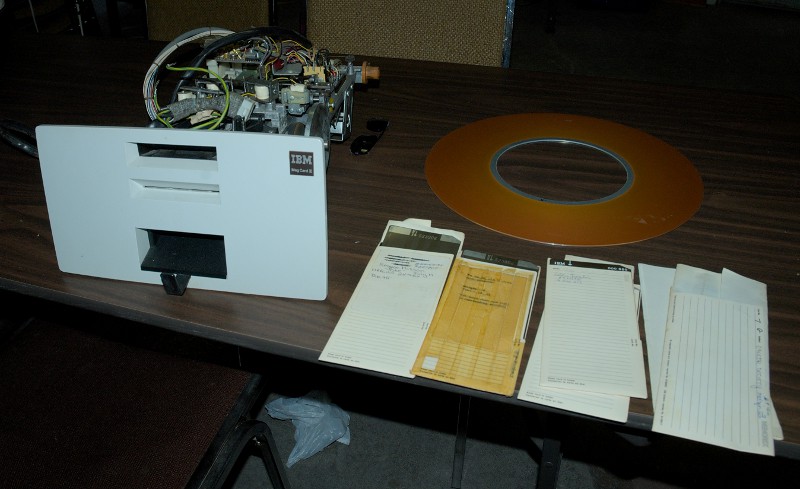
> got this thing kicking around picked it up in the spring for 20 bucks
http://farm8.staticflickr.com/7250/7547228432_e981da5a28_b.jpg
> curious if theres a way to hook it up?
-------------- Reply:
I've still got a couple of those drives from a Redactron WP, a dual-drive
version of IBM's MC/ST; have never tried to do anything with them and
certainly don't know anything about the IBM interface or protocol, but the
drive itself is kind of like a floppy, only linear.
The usual read/write heads, a solenoid (12V IIRC) to step from track to
track, and a motor drive to actually move the card in and out to read/write
it. Should make an interesting project; you could even put in some
photocells and turn it into a punched or mark sense card reader...
m
interesting indeed i'm guna have to look into this
On Mon, Dec 10, 2012 at 5:09 PM, Zane H. Healy <healyzh at aracnet.com> wrote:
> At 5:24 PM -0500 12/10/12, steve shumaker wrote:
>
>> On 12/10/2012 3:24 AM, Joost van de Griek wrote:
>>
>>> Sorry, Youtube's mobile site gave me a convoluted link on the iPhone, my
>>> manual cleanup must've mangled it. I meant this:
>>>
>>> <http://www.youtube.com/watch?**v=svdsXGqjWEg<http://www.youtube.com/watch?v=svdsXGqjWEg>
>>> >
>>>
>>> Point is, I wet scan directly on the flatbed, no (flimsy) film holders.
>>> Excellent results. Not drum-scanning level results, but good enough for
>>> home scanning.
>>>
>>> There is some experimentation involved with getting the best focus.
>>> Flipping the film and adding or subtracting mylar sheets until the image
>>> plane is in near-perfect focus.
>>>
>>> .tsooJ
>>>
>>> cool! Now I see what you meant.
>>
>> steve
>>
>
> That is pretty cool, while I'm familiar with wet scanning, I've not heard
> of adjusting the focus via mylar sheets.
>
>
> Zane
>
>
>
> --
> | Zane H. Healy | UNIX Systems Administrator |
> | healyzh at aracnet.com | OpenVMS Enthusiast |
> | | Photographer |
> +-----------------------------**-----+------------------------**----+
> | My flickr Photostream |
> | http://www.flickr.com/photos/**33848088 at N03/<http://www.flickr.com/photos/33848088 at N03/> |
> | My Photography Website |
> | http://www.zanesphotography.**com<http://www.zanesphotography.com> |
>
>
On Mon, Dec 10, 2012 at 12:12 PM, Zane H. Healy <healyzh at aracnet.com> wrote:
> Thank you for all your effort in this! Honestly this is an area I'm not
> that interested in, BUT, I really wanted to see Don's work preserved. Years
> ago, he helped me with info for my IMSAI-8080, which I always appreciated.
Agreed. Don helped me with my Kaypro when I first got it. Very happy
to see all of his work preserved.
Having inspected the zip file, what are the .lbl files? I thought
they might be disk labels, but the first one I looked at was a single
line of digits, repeating in fistfuls. Is it metadata for the .td0
file?
-ethan
All -
I have 3 more DEC keyboards available:
1) DEC LK401-AA with a hairline cracked bezel - probably easily glued
2) DEC LK401-AA with "gooified" feet
3) DEC LK201
No keys are missing and they seem mechanically sound, but they are a
little dirty. I have no means of testing them, sorry.
Asking $10 (plus shipping) for box/gas/driving hassle. Higher offers
will jump to the front of the line. Take 1 or 2 or all three... I just
want to get rid of them.
On 2012-12-10 08:21, Fred Cisin wrote:
> It was usually called "MTST", pronounced "empty ST", which
Raymond Scott once made a futuristic radio commercial for the MTST.
While listening you never got the impression it was about a word
processor. Only that it was a great solution.
"Machines should work, People should think."
Fred Jan
Does somebody have a Data General AV4300 (G70421-7)?
I have one, still running, and I would like to make a clone, in case this
one fails.
Hendrik Devogelaere
NOTICE: This mail is intended for the named recipient only. It may contain
privileged and confidential information. If you are not the intended
recipient, notify the sender immediately and destroy this e-mail. You must
not copy, distribute, or take action in reliance upon it.
Whilst all efforts are made to safeguard e-mails, TOSHIBA TEC Europe
Retail Information Systems S.A. cannot guarantee that attachments are
virus free or compatible with your systems and does not accept liability
in respect of viruses or computer problems experienced. TOSHIBA TEC Europe
Retail Information Systems S.A. reserves the right to monitor all e-mail
communications through its internal and external networks.
I'm trying to make up some TU-58 images with the needed
XXDP files. I'm new to both, so be kind.
I would think that i need to do the basic assign and mount
with e11 for the TU-58
assign TT1: DDA
Mount DDA0: 'file name'.dsk
E11 comes back with can't open file.
It will let me just mount it with out a file. but if
I'm going to write to it, I would guess there needs to
be a container file.
Thanks, Jerry
Hi Paul,
Thanks so much for the reply. I'm very interested. Will be in touch off-list.
Hope that you will be feeling better soon.
Steve
steve at tronola.comhttp://www.tronola.com/
>From: Paul Anderson <useddec at gmail.com>
>Hi Steve,
>
>I have all 3 items here, but I'm on the mend. I'll see if i can talk
>my son into finding them. I also have a plessey controller for the
>rk05, but can't remember it it's omni-bus or unibus (or both). Ship
>from 61853, Illinois.
>
>Thanks, Paul
>
>On Thu, Dec 6, 2012 at 8:36 PM, Steve Lafferty <steve at tronola.com> wrote:
>> Hi Folks,
>> I have been making good progress restoring a PDP-8/m and would like to buy a vintage hard drive and controller for it. Anyone know where I might find those? An RK05 or Diablo-31 drive would be nice. Will also need an RK8E controller board set...Please let me know if you know of any possibilities.
>>
>> Thanks, Steve