I now have over 40 recyclers across the country looking for items for
collectors. Below is a list of what is being asked for.
If you want to add to the request list, that is fine.
The scrappers are asking for pictures. Remember that to them, this is just
junk to be parted out; they are unfamiliar with the equipment.
If at all possible, PLEASE send me a LINK to a site that has a clear
picture, maybe some discussion about the machines in question.
The stuff I look for is very general terms...ESCON and FICON are the names
of the interconnects used to connect the machines to their disk arrays.
ESCON is older (but still common) and FICON is current. The earlier one,
called "Bus and Tag" or "Parallel Channel", is also something I can use, but
they're very old and much less common.
Models to look for are 3880, 3990, 3390 (much older), and "RVA". These will
typically be biggish, very heavy cabinets containing drives and a
controller.
MicroVAX 3400, 3500, 3800
HSC50, HSC70
Any whole or parts of VAX 11/780, 11/785, 11/725
VAX 6000
RA9x, RA60, TS11 drives
Any software and manuals for VAX machines
If you don't know how to test, they request that you NOT even try to power
the equipment on; they will buy it as-is.
IBM PS/2 Model 70 A21 (specifically)
IBM PS/2 Model 90
IBM RT PC 6150
IBM XT 370
Sun 386i
SGI Prism
Memorex 1270 Terminal Control Unit (used on IBM mainframes as an alternative
to 270x TCUs)
Memorex 620 (2311-11 equivalent), 630 (2311 equivalent), 660 (2314
equivalent) or 3660 (2314 equivalent) disk drives or the DEC OEM versions,
the RP01, RP02 or RPR02 disk drive
One terminal I have been looking for specifically for quite some time is the
Ann Arbor Ambassador
I'm always on the lookout for a Durango Systems "Poppy" PC
It's unlikely because they were unpopular, but a specific Amiga I'm casually
looking for is the CDTV - the one in the black "audio component" case. It's
essentially an Amiga 500 with CD-ROM that looks like a VCR or stereo
receiver. If you didn't spot the Commodore logo, you probably wouldn't
notice it was a computer if you saw it in a stack of stuff.
I am looking for scientific and industrial minicomputers from the 1960s and
1970s with "switches and blinkenlights" front panels.
Digital Equipment Corporation (DEC) PDP-4, PDP-7, PDP-9
PDP-8 and older PDP-11 models with the blinkelights
Data General Nova, Honeywell, Modcomp, and others as well.
I'm specifically looking for these machines from Computer Control Company
(3C), likely labeled Honeywell (after an acquisition): DDP-24, DDP-124,
DDP-224, DDP-416, DDP-516, H316. These are large machines in 6-ft racks or
4-ft cabinets. Also Datacraft 6024 and early Harris machines.
Probably a longshot, but I'm still on the hunt for JC80 series equipment
that was made by Johnson Controls. The JC80 was a building automation
"computer" that was made in the 70s/80s. I also wouldn't turn away other old
Johnson Controls stuff from the 1980s or 1990s such as JC85, DSC, old
Metasys, etc. My father once serviced these systems so I'm very familiar
with them. They are not the kind of thing that anyone who collects old
computers would likely want, so I suspect that 99.9% of them have been
scrapped long ago. I'd be willing to pay scrap value plus 10%, which
probably wouldn't be all that much anyway since these things are big heavy
steel boxes and racks with a lot of empty space inside. Because this sort of
stuff is so specialized, I wouldn't expect anyone to test it, and in fact it
would probably be safer not to try to test it since it would need repairs
and maintenance before it would even be safe to power up.
For me, non-PC keyboards are important - pre-ADB "Classic Mac" keyboards or
Amiga, especially Amiga 1000 keyboards in particular. I'm big into
Commodore, so anything pre-C-64 is also interesting (PETs, VIC-20s, disk
drives, some printers). Old external disk drives (single-sided Mac and any
Amiga) are also useful and interesting.
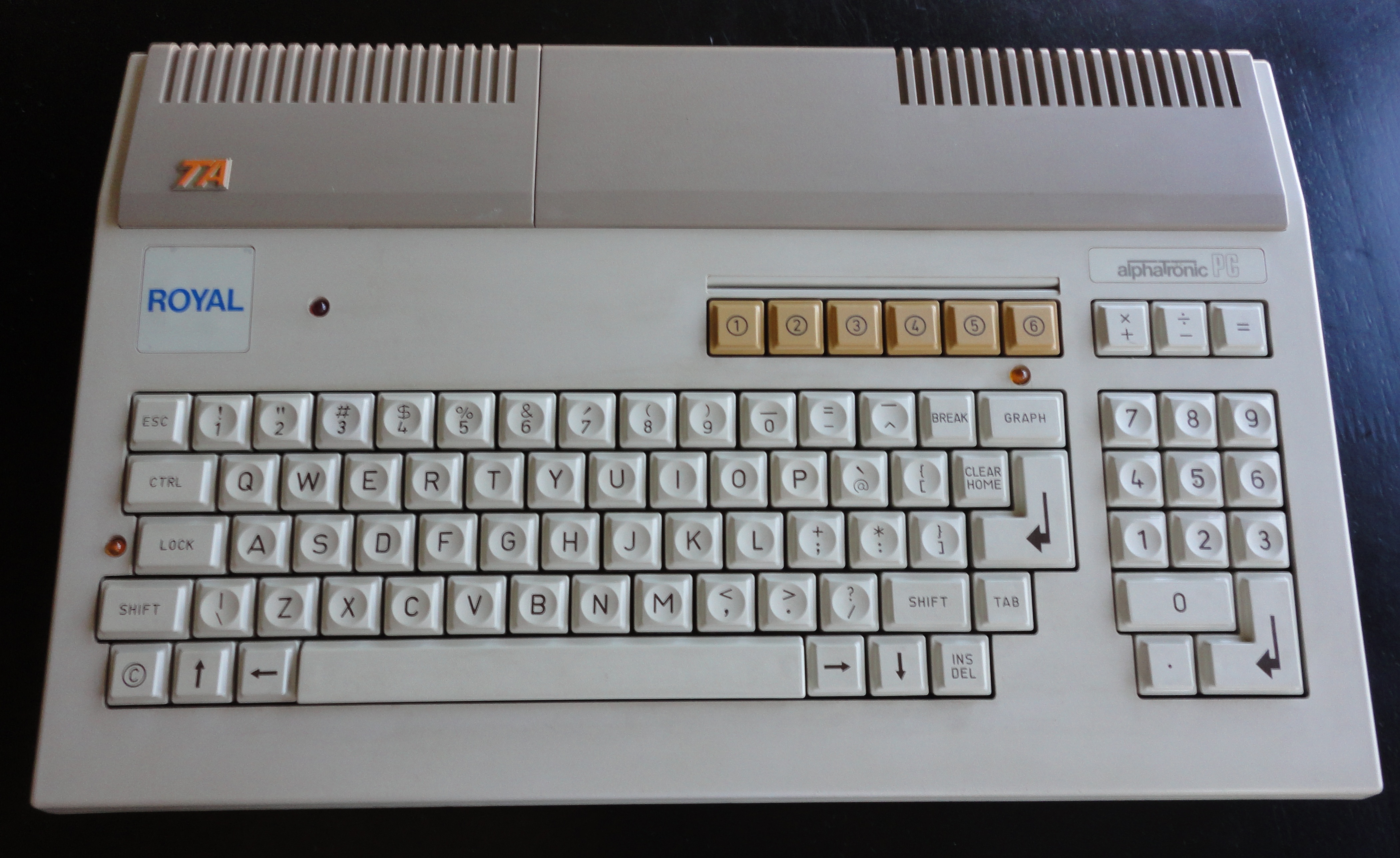
a complete Royal AlphaTronic PC system - with monitor & at least one of the
floppy drives. This is what it looks like:
http://vintagecpu.files.wordpress.com/2011/10/royalta.jpg
IBM 3174 desktop controllers
Any VAX mainframe computers, or any old DEC 6' cabinets that are populated.
Big Blue IBM machines
Cray super computers
Other large old interesting monsters, let me know what you get in?
Workstations:
- SGI IRIS
- SGI Personal IRIS
- SGI Professional IRIS
- SGI Indy
- SGI Indigo
- SGI Indigo^2
- SGI Octane2
- SGI O2
- SGI O2+
- SGI Fuel
- SGI Tezro
- SGI Prism
SGI Octane
Rack/deskside servers:
- SGI POWERseries
- SGI IRIS 4D series
- SGI Challenge
- SGI Onyx (any variety)
- SGI Crimson
- SGI Origin 2000 series
- SGI Origin 3000 series
Cindy Croxton
Electronics Plus
1613 Water Street
Kerrville, TX 78028
(830)792-3400 phone (830)792-3404 fax
AOL IM elcpls
_____
No virus found in this message.
Checked by AVG - www.avg.com
Version: 2013.0.3343 / Virus Database: 3184/6369 - Release Date: 05/30/13
On 5/31/13 6:21 AM, Michael Thompson wrote:
> Is the optical sensor still on the bottom of the HDA?
> The RICM has a bunch of RA81 drives that don't generate the pulses from the
> spindle sensor.
No, the HDA was stripped bare.
I do have the spindle.
I also have 3 RA82s and another RA81 (that goes to Dave McGuire once we
figure out how to get it there without hurting it (within his budget)).
alan
Woohoo! :D Not only I'm 39 now, but also got a gift from a fan of my
site!!!
A brand-new-like, boxed TI99/4A :oD
I'll take some pictures and add in www.tabalabs.com.br tonight :oD
Niiiiiiiiiiiiiiiice! :D
---
Enviado do meu Motorola PT550
Meu site: http://www.tabalabs.com.br
Just in case anyone's interested, I've finally gotten around to cleaning
up the PERQemu source to the point where Idon't feel too ashamed to show
it to others. (It's still a bit messy.) I meant to do this years ago
but kept putting it off.
I'm releasing it under the GPLv3 in the hopes that maybe some other PERQ
fanatic can finish what I started (or at least use it as the basis for a
different implementation). These days I have too many other projects
occupying my time to spend much time with it, and I kind of got burned
out on it a few years back.
http://yahozna.dyndns.org/projects/PERQemu/source/PERQemu-source.zip
(And you can read more about the project at
http://yahozna.dyndns.org/projects/PERQemu/index.html)
And a big thanks goes out to our own Tony Duell for his extremely
patient help with this project; the answers he provided to my questions
when I started on this project back in 2006 could fill a small book :).
And thanks to Al & Bitsavers for the scanned documentation and archived
software. Without these this project never would have gotten started.
Thanks,
Josh
From: cctalk Digest, Vol 117, Issue 58
> Date: Mon, 27 May 2013 22:21:25 +0100 (BST)
> From: ard at p850ug1.demon.co.uk (Tony Duell)
> To: cctalk at classiccmp.org
> Subject: Re: Tektronix / AMI custom chips
[snip]
>
>>
>>
>> In article <51A25503.8090002 at bluewin.ch>,
>> Jos Dreesen <jdr_use at bluewin.ch> writes:
>>
>> > The spare parts box that was part of a tek4052 deal has several Tektronix spe
>> cific 40 pins DIL, date around 1973
>> >
>> > These are
>> >
>> > 156-0235-00 C8684
>> > 156-0238-00 C1840
>> > 156-0236-00 C1841
>> > 156-0243-00 C1842
>> >
>> > also a MOS MCS1020
>> >
>> > Anyone know what these were from ( not the 4052), maybe a tek 31 ?
>>
>> They are almost certainly ROM chips. I can't think of any other Tek
>
> Were there any 40-pin ROM chips at that time? I can't think of any.
>
> My guess is that they're part of the processor in a Tekky 21 or 31, but
> it's only a guess. I do not know for sure.
>
>> sourced digital chips except ROMs in the circuit diagrams I've
>> studied. I think Tek did make a fair number of their own analog
>> chips in that time frame, though.
>
> What about the readout/display chips in a 7000 series 'scope? Or are
> those later?
>
> -tony
>
I posted a copy of the original question to the TekScopes list on
Yahoo. A list-member, David, quickly responded:
"I think all of these are Tektronix designs fabricated by AMI (American
Microsystems, Inc.) for the Tektronix Model 31 Electronic Calculator.
My parts book just indicates that they are MOS logic and the
156-0236-00 C1841 is a memory.
http://www.oldcalculatormuseum.com/tek31.htmlhttp://www.oldcalculatormuseum.com/s-tek31.html"
Bob
On Wed, May 29, 2013 at 8:04 PM, Zane H. Healy <healyzh at aracnet.com> wrote:
> What good are old UNIX systems? I'm curious, what are people using things
> like Sparc 2's through 20's for?
I used to run Sun gear all the time at home. I just don't power it up
anymore, so
the strict answer to your question is "keeping the shelves from being empty".
At one time, old Sun gear was a great gateway to learning "real" Unix and a foot
in the door for a "real" job. It's been far, far less true for coming
up on 10 years.
And then, around 4 years ago, give or take, if the job postings said "Solaris
experience required", it was Solaris 10 or nothing, something you can't do
with SPARC hardware from the 1980s.
I've turned down more free Sun hardware in the past 2 years than I've
kept. It's
still elegant, and it still runs DNS and web servers, and plenty of
other things,
but I personally don't care to spend that much on electricity for those sorts
of services at the bandwidths I require - an old laptop running Linux can do
everything I "need" at home in the way of services and suck up 90W or less.
I also have VAXen that I only turn on for special occasions - too hungry to
leave powered on all the time like we used to do back in the day. Of course,
in the winter, it's "electric heat", so no harm there, but it's summer up here
now, so most of that stuff stays off except for a few hours here and there.
-ethan
Can we point you to web sites with pix?
For DEC gear, you might look at
http://research.microsoft.com/en-us/um/people/gbell/Digital/timeline/tmlnho….
There's likely a taker for many of what is pictured. People have
mentioned VAXen and PDPs. If something is found pictured in the 12-bit
section there will certainly be *very* interested takers, and if they find
objects in the 18- or 36-bit sections, they may want to post guards.
KJ
List:
I'm working with some old media that has Swedish text on it. (8" SS FM
disks with 4 sectors of 1024 bytes per track--no OS or file structure on
it).
I can probably figure out the structural details that I need with the
exception of modern Unicode or UTF-8 characters corresponding to what's
on the disk.
Here's a binary dump sample of such a record (LIST format):
> ?000500 00 00 00 00 00 00 00 00-00 00 00 00 00 3C 44 65 <De
> 000510 74 20 76 61 72 20 66 FE-6F 72 62 61 6E 6E 65 6C t var f?orbannel
> 000520 73 65 6E 3E 0A 00 00 00-3C 73 6F 6D 20 64 72 65 sen>? <som dre
> 000530 76 20 6F 73 73 20 62 6F-72 74 20 66 72 FA 61 6E v oss bort fr?an
> 000540 20 53 61 6D 73 6F 6E 2E-3E 0A 00 00 00 00 00 00 Samson.>?
Note the characters FA and FE in this sample.
Can anyone help with this thing?
--Chuck
http://bits.blogs.nytimes.com/2013/05/24/how-vintage-apple-computers-used-t…
A friend sent me this history of an apple 1. It came from my neighborhood
and I didn't even know about it. I was the initial engineer for KMUN and
helped write the FCC application back in the 1970s. I didn't know about it
in the auction or I would have driven from PDX to bid on it as I was a
collector and secondary market computer dealer at the time.
Paxton
--
Paxton Hoag
Astoria, OR
USA
In a bid for the least impressive boot sequence, here the Epson TF-20:
http://fjkraan.home.xs4all.nl/comp/tf20/TF-20boot.avi
Why they gave the thing 64 kByte and not a proper firmware will probably
always be a mystery.
Once booted, 280 kByte of the remaining diskspace could be used by the
HX-20, PX-8 or PX-4.
Fred Jan
A nice example of Japanese 8-bit technology. The Epson QX-10
http://youtu.be/Oz1BIIaeF44
(I managed to get most of what I'd recorded off my broken camera..whew!)
Terry (Tez)
> Yes, they're wonderful little things, but I do worry about how robust they
> might be (and how easy it is to obtain* spares should one die in some
> horrible way). I am tempted to disconnect them and run the data cable -
> via a socket in one of the expansion bay positions - to a pair of external
The Epson SD-321 are probably as robust as normal disk drives, as there
are less mechanical parts. The only problem I have seen with them is
that the grease gets sticky, so you can either not get your floppy in or
get it out again. But there is an exellent technical manual describing
disassembly and re-assembly.
Fred Jan
At 15:41 -0500 5/30/13, <Erik> wrote:
>Hi there! Interesting to read, what others do with their
>vintage machines ... and for what reasons ;-)
1a) NeXT 040 cube, backup Mathematica platform for when our
department license server won't serve my daily-driver PowerBook G4
(is that machine itself on-topic? This list gets long if so) a
license. Things run slower, by a factor of about 100, but they still
generally run.
Because: I own machine and Mathematica license, so am pretty
sure no upgrade/license server issue is going to stop me calculating.
As long as my laptop is on the 'net somewhere, I can VPN to the NeXT
and get numbers back over the terminal interface (or retrieve plots
via sftp). Newer hardware for backup Mathematica is not hard, new
license is expensive.
1b) as above, running distributed.net. See
http://stats.distributed.net/misc/platformlist.php?project_id=8&view=tco
Pretty sure all the M68k/NeXTStep work units are mine (however I'm
not territorial, somebody else with a cube or 'station is welcome to
help me put those MIPS/OpenBSD guys in the rear-view mirror...)
Because: machine is always on (see above), might as well put
those CPU cycles to use. No power-save mode like on my laptops.
2) Powerbook 3400, drives an HP flat-bed scanner (which is SCSI
interface) and plays games.
Because: Scanner quality rocks, don't want to buy new
scanner, no SCSI interface on any new machine I own (and not sure
about drivers if there were). Don't want to buy new scanner; new
scanner linearity probably is not as good anyway.
3) (?) LaserJet 4M+, only working printer at home.
Because: per-page cost is very low, print quality is fine for
everything we need at home. House wired for ethernet, so no problem
with connectivity; even laptops speak 802.11 to DSL hub which puts
packets on ethernet to the printer. Printer is paid for and even a
"cheap" new printer will chew through toner faster than I like.
4) iMac G3, secondary web-surfing machine at home
If wife or kids are on the iMac flat-screen, I can still do
my banking/book club/check weather radar on TenFourFox (THANK YOU,
Cameron! 10-4-Fox-ROX!) http://www.floodgap.com/software/tenfourfox/
5...n) Education/Nostalgia machines
*Finally* beginning to understand machine language, thanks to
the TRS-80 Color Computer's 6809. Want to learn VMS/(Alpha/VAX) to
see what a real OS looks like. Love the dual-architecture Rainbow.
etc. etc. etc. But I suspect this isn't the "use" you were looking
for...
--
- Mark 210-379-4635
-----------------------------------------------------------------------
Large Asteroids headed toward planets
inhabited by beings that don't have
technology adequate to stop them:
Think of it as Evolution in Fast-Forward.
mc68010 <mc68010 at gmail.com> wrote:
>> On 05/29/2013 09:14 PM, Andrew Hoerter wrote:
>>> I still have this crazy notion of someday acquiring an Ultra
>>> Enterprise 3x00 or 4x00 to run at home for real work, though.
>>
>
> Careful what you wish for. I have played with those over the years at
> home and they draw about 6 amps doing nothing and more when they are.
> The wheel on the power meter goes into warp drive when you turn one of
> those on. I can't imagine leaving one on 24/7 if I was paying the power
> bill.
Ah, good to know... These are "115V amps" however, aren't they?? (Yep, I
know I'm talking absolute nonsense physically, but you get what I mean...)
I have both a E3000 and a E4000, as well as a couple of U450s. These are
my largest systems right now, with a HP 9000 K100 (PA-RISC) as a close
follower and a HP LH6000 NetServer (dual x86) coming next. For the record,
none of these is in active duty with me right now. The E3000 (equipped
with the "Creator3D" UPA-capable I/O board no less!) blew the switcher
transistor in its PPS1 (peripheral power supply) with a loud bang when
I last tried to power it up, burned out two inrush limiter resistors and
tripped the circuit breaker. The supply is optional, so I think I could
still run the system (with not too many SCA disks in it) right now.
I remember doing a test install of Solaris on my SparcSERVER 1000 (two
processor boards w/ one processor each) in my upstairs bedroom at home
and being already quite impressed by the amount of heat that put out.
The K100 has two impressive-looking radial fans in the bottom and I'm
curious for their noise alone when I'll be powering up that system!
So long,
Arno
>>> ? Wimp. ;)???I ran a fully-configured
>>> E3500 for years.? It really wasn't that bad.
>>
>> Raised my electric bill by over $200 a month. It draws nearly 15A
>> continuous in that configuration. I ran it for quite a while, but
>> eventually had to relegate it to occasional backup service, powering it
>> on only when I needed it.
> Inquiring minds want to know: What does one _need_ a beast like that for?
> :-))
There was a time in the mid-late-90's where a farm of Sun E4000 or Sun E3500's were the mark of an up-and-coming dot-com (you know, 64-bit and all, a big deal for someone who didn't have an Alpha VMScluster on their desk earlier in the decade), and a E10000 (especially being recently ex-Cray) was the mark of a huge dot-com. From where I sat it seemed to be some kind of unattainable entry ticket, although I'm sure folks who were elsewhere in the dot com boom felt different :-)
Tim.
On Wed, May 29, 2013 at 8:04 PM, Zane H. Healy <healyzh at aracnet.com> wrote:
> I've been working on getting shelving installed in our Garage, and as a
> result, I've been digging back to some systems that have been buried.
> Right now I'm moving a bunch of Sun hardware and it hit me. What good are
> old UNIX systems? I'm curious, what are people using things like Sparc 2's
> through 20's for?
Until relatively recently, my home DSL gateway was a SPARCstation LX. Not
too noisy, and a very convenient form factor.
Particularly with multiple heads, older SPARCs could still be useful as X
terminals (the Solaris X server just works, whereas configuring X on random
PC hardware can be frustrating even in these modern times).
Also, if you're writing code where portability is important, it doesn't
hurt to have on hand machines with "weird" (relative to x86) CPU
architectures for testing. (of course, there's always emulators)
But to be honest, I keep mine primarily out of sentimental value, and not
for a practical purpose. I still have this crazy notion of someday
acquiring an Ultra Enterprise 3x00 or 4x00 to run at home for real work,
though.
On Thu, May 30, 2013 at 6:06 PM, Dave <dave.g4ugm at gmail.com> wrote:
> On 30/05/2013 20:55, Ethan Dicks wrote:
>>> hack the small bead of sealing epoxy at one end of the battery...
>
> I have fixed on in an Atari but this is different. It doesn't look like
> there is small bead. It looks like the whole thing has been potted in
> Epoxy....
The common-in-PCs DS1287 (or its successor DS12887) is entirely
encased. The MKT02 and MKT08, etc, used in Sun equipment
has an epoxy-covered "bridge" at the nose and tail of the IC body
that conceals the connections to the crystal and the battery up in
the epoxy block on top. It's on the order of 1mm x 2mm and is
shiny black, not matte black.
-ethan
From: Alan Perry <aperry at snowmoose.com>
> Date: Thu, 30 May 2013 11:01:59 -0700
> Subject: Still looking for a home - RA81 parts
> I (still) have parts from a DEC RA81 HDD that I took apart years ago that
> I would like to get rid of. I posted them here a while ago, but figured
> that I would try again since I am trying to clear out space in the garage
> for a car project.
>
> I am primarily concerned with finding a home for the two larger parts.
>
> 1. The HDD minus the HDA. It is 28" x 18" x 10" and is fairly heavy. It
> has all of the boards. It is everything except the platters and heads. I
> imagine that, if you powered it up and hooked a tty to the serial port, you
> run diagnostics on it. Though, without a HDA, not many tests would pass.
>
> 2. An empty HDA. This is the aluminum housing that the platters and head
> assemblies once occupied.
>
> Located on Bainbridge Island, across from Seattle. Probably too big/heavy
> to ship.
>
> alan
>
>
Is the optical sensor still on the bottom of the HDA?
The RICM has a bunch of RA81 drives that don't generate the pulses from the
spindle sensor.
Have any of you with "machine farm collections" set up any sort of
file-system-server to manage disk images, "serve" disk images, or
direct-boot across your collections?
For example, see this moribund thread:
http://www.pdp11.co.uk/blog/2008/11/17/building-reliably-modern-storage/
-----
Building reliable modern storage
For many years I?ve been pondering the problem of how to provide a reliable
long term storage solution for my PDP-11 and PDP-8 machines. Whilst I have
plenty of period drives which are still operational it is apparent that in
the long term it is unlikely to be possible to keep them all running.
It also a sad fact that many more CPUs are being saved from the scrapheap
than drives leading to a lot of collectors having a CPU unit but no storage
to boot them from.
I?m therefore kicking off a pet project to build a versatile solution using
modern hardware to provide a long term storage solution for our machines.
The key objectives of this project will be as follows:
- Provide a reliable solution that as far as possible is not tied to any
technology that is likely to become obsolete in the next 10 years
- Ease of installation and operation.
- Provide adequate storage capacity for all of the common PDP-11
operating systems
- Make as much use as possible of pre-existing efforts to crack this
problem
My initial plan is to develop this solution in two phases:
1. Would involve a server running SIMH, a TU58 emulator, vtserver and an
RX01/02 emulator. The server would operate under Linux operating system
(Centos4) and would have a web based interface for managing the various
components. Installation would be via a yum based repository allowing users
to install and update the setup on their system from a simple set of
commands.
2. Much more ambitious, but where I think we should ultimately reach
will be to develop custom Unibus/Qbus/Omnibus controller cards for
interfacing directly to the bus. This will allow us to provide a solution
with a good level of performance without any requirements for pre-existing
controllers (such as RX11s).
-----
I (still) have parts from a DEC RA81 HDD that I took apart years ago
that I would like to get rid of. I posted them here a while ago, but
figured that I would try again since I am trying to clear out space in
the garage for a car project.
I am primarily concerned with finding a home for the two larger parts.
1. The HDD minus the HDA. It is 28" x 18" x 10" and is fairly heavy.
It has all of the boards. It is everything except the platters and
heads. I imagine that, if you powered it up and hooked a tty to the
serial port, you run diagnostics on it. Though, without a HDA, not many
tests would pass.
2. An empty HDA. This is the aluminum housing that the platters and head
assemblies once occupied.
Located on Bainbridge Island, across from Seattle. Probably too
big/heavy to ship.
alan
On Tue, May 28, 2013 at 11:37 PM, Jerry Kemp - other <other at oryx.cc> wrote:
>
> http://technologists.com/notes/2008/01/10/a-brief-history-of-dell-unix/
>
> Has anyone worked with Dell Unix on this list? Any thoughts or comments?
>
I spent a good bit of time with the SVR4 flavor in the early 90s. I was
working with a company that produced multi-port serial cards and we wanted
to support Dell. I thought it was one of the better polished, easier to
install & configure Unix products out at the time, and ran very well on the
Dell hardware of the time.
From: Sander Reiche <sander.reiche at gmail.com>
>
> Antoni Sawicki has.
> http://virtuallyfun.superglobalmegacorp.com/?p=1878
I'll have to give that a go.
KJ
As I haven't been able to source the microcode for my MV/2500 I am
attempting to rescue bits/bytes/words from it's 330MB system disk.
Naive use of ddrescue has yielded about 80MB of the disk - does anyone
have any suggestions for improving that ratio?
Also, are there any tools out there for examining partial disk images
in strange formats? :-/
Steve
--
/Stephen Merrony
http://stephen.homedns.org/dg/
/
I thought we were all going to go to the ikea vending machine, put in our quarters, and have it print out the shelf we want for us soon?
------Original Message------
From: ben
Sender: cctalk-bounces at classiccmp.org
To: cctalk at classiccmp.org
ReplyTo: General Discussion: On-Topic and Off-Topic Posts
Subject: Re: Record Storage
Sent: May 30, 2013 2:01 AM
On 5/29/2013 10:49 PM, Zane H. Healy wrote:
> Expedite shelves from Ikea.
Product description:
----------------
Particleboard, Paper, Fibreboard, ABS plastic, Foil, Printed and
embossed acrylic paint, Clear acrylic lacquer
----------------
No Thanks, I'll buy from IKEA when they use *REAL* wood again.
Hi all,
I'm looking for a power supply for an HP9845C option 200.
I was fortunate to acquire an HP9845C.? I am in the process of moving, so I haven't had a chance to examine it fully.? I did open up the base, and it has the option 200 CPU set.? It looks pretty clean inside, although the power supply is missing.
I do have a couple of working HP9845B's, but these use the hybrid processor, and my understanding is that the option 200 machines used a beefier supply.
Does anyone know if the regular 9845B supply will work in an option 200 machine?
The schematics are pretty complicated.? I'm wondering if the power supply has any special qualities that would prevent my putting together a switcher to supply the needed voltages, via an adapter.
If I can't find a supply, I may try to "downgrade" the unit to a hybrid processor, by swapping out the CPU from a 9845B, with a replacement ROM board loaded with the 9845C image; or, swap the monitor and keyboard over to a 9845B, and add the 9845C ROM image.? Can I expect either or both of those options would work?
Right now, we are in the middle of moving, and I don't expect to have a lab for a few more weeks, but when I do, I would love to try to get this machine up and running.
Many thanks,
Dave
The card sorter will be heading off to Binghamton, NY where it will become part of an IBM 1440 restoration project at the Center for Technology and Innovation. Chances are pretty good that the sorter was actually built in Endicott, NY so it will be returning home after a 50+ year absence.
Thanks to all who made an effort to keep this relic from the crusher!
Jack
BITNET revival? Or were there other uses for Jnet?
Was BITNET all 9600-baud synchronous modems or were there other (async?) links available between sites?
Tim.
Dave wrote:
>On 29/05/2013 02:25, Dennis Boone wrote:
>> Anyone know how to lay hands on Jnet for VMS?
>>
>> De
>When this was asked before I am pretty sure the answer was the owners
>still protect the copyright...
>... but I hope I am wrong.....
>
I asked Quest (who seemed to own it then) about this in 2010. They said JNET
went end of life 10 years ago and it is no longer available or supported.
I asked if they would allow its unsupported non-commercial or hobbyist use.
They said it would not be in their best interest to allow this.
I pointed to the OpenVMS and Multinet hobbyist licenses and asked if they
would be willing to do the same for JNET. They said it was not something
they would persue at this time.
:-(
Regards,
Peter Coghlan.
On Wed, May 29, 2013 at 10:26 AM, <cctalk-request at classiccmp.org> wrote:
> From: Al Kossow <aek at bitsavers.org>
> On 5/28/13 11:52 PM, Andreas Holz wrote:
>>> Also, anyone have a digital version of PILOT (the OS for the Xerox Star) or know where I can get a copy?
>>>
>
> I have a lot of software, including XDE (the development environment), Interlisp, early versions of Star and
> the server "services". I imaged these long before imagedisk, so they are in dmk format.
>
> I've put up a couple of versions of XDE and Star 5.0 and 5.2 on http://bitsavers.org/bits/Xerox/8010 along with
> a program that can extract files from raw floppy images.
>
> It will take a couple of hours to propagate out to the mirrors.
>
> I'll put the Interlisp images under 1108
Are these the actual VM images or disk images? If the latter, would
anyone be able to tell me how to get the VM images out? I'd like to
try to see if they'd run under my copy of Medley for DOS.
Thanks,
William
--
Live like you will never die, love like you've never been hurt, dance
like no-one is watching.
Alex White
>I wonder that since Quest is now owned by Dell, would Dell be more open to this?
>
>Thanks,
>Brad Arnold
The problem (from the point of view of the owner) is that any sort of release
requires a time commitment to ensure that they're not opening themselves up to
claims for royalties from licensors, creating infrastructure, vetting licensing
terms, setting up download servers, etc. - and the net return is about zero,
as the software isn't sold anymore. Nice in theory, but hard to justify for the
company on business terms. MultiNet, TCPware and OVMS are still sold, so there's
a publicity motive - that and originally hobbyist overhead was taken over by the
openvmshobbyist/Montegar group.
Hey everyone, I recently acquired a Xerox Star 8010, I now have panels
for it (Thanks Jason Timmons) and am now working on the power supply.
It is missing the transformer, does anyone have documentation on the
power supply? I know it outputs 5v/12v and therefore I am looking at a
8v/16v transformer. Any recommendations on AMPS? I can find a 20A/30A
transformer or a 80A/120A transformer, any suggestions?
Also, anyone have a digital version of PILOT (the OS for the Xerox Star)
or know where I can get a copy?
Thanks!
Nick
A while ago someone was looking for various Q-bus chips. I don't remember
who or what the chips were. If there are usable chips on the DEC M8044, I
have 25+ of them that the chips could be removed. If anyone one is
interested, please contact me off list with an offer. I can knock off a few
bucks per board if you don't want the fingers. shipping is from Illinois,
61853.
I'm still clearing out items, trying to make pathways.
Thanks, Paul
The spare parts box that was part of a tek4052 deal has several Tektronix specific 40 pins DIL, date around 1973
These are
156-0235-00 C8684
156-0238-00 C1840
156-0236-00 C1841
156-0243-00 C1842
also a MOS MCS1020
Anyone know what these were from ( not the 4052), maybe a tek 31 ?
Jos
Hi,
After being kept in a corner, I unearthed my LA180 aka DecWriter I.
After powering it up, no magic smore, but some humming from the fan.
The selftest went ok, but the ribben needs replacement, the characters
were faint.
Now, I want to hook it up, so I opened the backpanel to locate the
serial line, only to find out is is not having the converter board
which is an LAXX-NY for EIA signals according to the user guide.
So, is there someone having this board and is willing to sell it?
Thanks,
Ed
--
Dit is een HTML vrije email / This is an HTML free email.
Zeg NEE tegen de 'slimme' meter.
On Mon, 27 May 2013 09:49:09 -0700, Chuck Guzis <cclist at sydex.com wrote:
> On 05/26/2013 11:00 PM, Jonas Otter wrote:
>> >It would be interesting to know what the text is. This bit is about
>> >Philistines.
> It appears to be the Swedish subtitles for the movie "When the Whales
> Came". It blows me away that in 1989 (or later) that 8" floppies would
> still be in current use.
>
> --Chuck
I can't find any indication that this movie was ever released in
Swedish. Did you say it was from Svensk Text AB? The name rings a bell,
but they do not seem to exist any longer.
/Jonas
> Date: Mon, 27 May 2013 17:48:34 -0700
> From: Brent Hilpert <hilpert at cs.ubc.ca>
> To: "General Discussion: On-Topic and Off-Topic Posts"
> <cctalk at classiccmp.org>
> Subject: Re: Sourcing DIP Transformer replacements
> Message-ID: <351131F8-AC04-460B-8FE0-68F6B672ED93 at cs.ubc.ca>
> Content-Type: text/plain; charset=US-ASCII; delsp=yes; format=flowed
>
> On 2013 May 27, at 2:00 PM, Dave wrote:
>
>> On 27/05/2013 19:19, Brent Hilpert wrote:
>>
>>> ..
>>> The 2624- numbers appear to be Burroughs house numbers as I think
>>> the board is from a Burroughs machine, the 79xx/78xx date codes.
>>> I wonder if NPI was the transformer manufacturer. I RE'd the board
>>> so I do have a schematic that shows how they are used but don't
>>> know anything about their specs beyond that.
>>>
Pulse Engineering and Rhombus Industries are both, I think, still in
business.
We currently buy delay lines from Rhombus. They have limited stock
of many items for prototyping and repairs. Digi-Key has a wide range
of pulse transformers from about 5 manufacturers. If the transformers
are 1:1 winding ratio, there should be a huge range of parts available,
and the exact inductance may not be very important.
Jon
On
Sun, 26 May 2013 12:40:43 -0700, Chuck Guzis<cclist at sydex.com> wrote:
> Vi har v<FA>ara egna filist<FB>eer som ger
> sig p<FA>a oss om vi inte <FE>ar vaksamma.
>
> Thanks for any assistance.
<FA>a = a ring
<FB>e = e acute
<FE>a = a diaeresis
It would be interesting to know what the text is. This bit is about
Philistines.
/Jonas
I'm very sad with the way things are going...
I tried to buy a swivel base for my eMac, and NO ONE of the three or
four sellers accept shipping to Brazil, nor sending for some friend in USA
to repack and send me.
What is going on? :o(
---
Enviado do meu Motorola PT550
Meu site: http://www.tabalabs.com.br
I've started looking at what it's going to take to get the memory in the
Imlac running again. There are two core assemblies in this machineand
they're both in pretty bad shape as they were exposed to moisture for a
long enough period that they accumulated quite a bitof corrosion on the
control logic. (The cores themselves seem to be OK).
I went over the better of the two assembliesand cleaned the legs of
every socketed IC. In the course of doing so I found maybe 10 chips
with legs that were falling off. I took alook at a random sampling of
chips from the worse of the two assemblies and every single one of them
has legs that are corroded through. So I'm going to be replacing a lot
of chipsif I want to get these running again.
Most of these are 7400-series logicand aren't hard to find. However,
there a set of components that I'm not too familiar withand I'm not
having much luck finding replacements. Now that I have the schematic I
at least know what they are(had no luck looking them up based on the
labels on the chips), they're described as "Transformer, 60uH",
"Transformer, 6uH" and "Transformer, Square Loop" and have part numbers
of 517A0024, 517A0023, and 517A0021.
The chips themselves that are in my machine are labeled as follows (for
the 60uH variant):
14201
NPIPA-2581
<date code>
These are in 16-pin DIP packages. I'm going to need to replace quite a
few of them.
Any ideas of a modern replacement? (Any idea where to source NOS or used
ones?) I can provide pictures if that'll help.
Thanks,
Josh
> On 05/27/2013 01:22 PM, Liam Proven wrote:
> *Why* is this unfair?
I rarely side with "McGuire" on anything, but on this topic, I do.
Perhaps another way to try to understand it is like this: when Hatfield
bought the computer from Apple, his *intent* was likely merely to
purchase the A1 and use it; his purchase was likely innocent; he
likely had no idea that in the future, it would be worth 60x more.
In other words, his 60x gain was a fluke... a bit of luck.. not something
he *knew* about in the back of his mind when he bought the A1 from Apple.
Now the next guy. Here's the key difference: he bought the A1 for $40k full
well knowing he could turn around and sell it for at least $300k. His 12x
gain was no fluke, no luck, but something he *did know* about when he bought
the A1 from Hatfield.
What McGuire is saying, is that a moral person neither ellicits gain through
deception NOR that other perverse way of lying: not telling the whole truth.
You can swindle a person either way, and that's what it seems buyer #2 did.
- JS
I just ran through all of my 5" 20MB Bernoulli Box cartridges and a lot
of them would not format using the Iomega tools. The media itself looks
fine, but it might be worn out or magnetically compromised.
This media uses servo information that I don't think can be written by
the drive. So bulk erasing to try to clear up errors is out of the
question. I tried it just for grins and what was a marginal disk now
never comes ready.
Aside from making sure the drive and heads are clean, is there anything
else to be done with these? (In the event that they are dead, I'm
looking for ideas for an art project using them. ;-) )
Mike
----- Original Message -----
Date: Mon, 27 May 2013 13:46:01 -0400
From: Dave McGuire <mcguire at neurotica.com>
... Autumn and I assisted in 11 (yes nine) house moves in 2010, before we
left FL.
----- Reply: -----
Testing our octal skills?
m
----- Original Message -----
Message: 4
Date: Mon, 27 May 2013 12:37:00 -0400
From: Toby Thain <toby at telegraphics.com.au>
To: cctalk at classiccmp.org
Subject: British Computing heritage - Re: Another original Apple I
sells for an insane amount
Message-ID: <51A38BAC.6030301 at telegraphics.com.au>
Content-Type: text/plain; charset=windows-1252; format=flowed
On 27/05/13 11:39 AM, geneb wrote:
> On Mon, 27 May 2013, Liam Proven wrote:
>
>> On 27 May 2013 15:23, geneb <geneb at deltasoft.com> wrote:
>>> You don't know who/what Processor Technology was?
>>>
>>> That's it kid, turn in your nerd card.
>>>
>>> :)
>>
>> :?D
>>
>> British, remember?
>>
> Oh right. I keep forgetting you come from a computationally
> disadvantaged country. :D
Indeed, only the birthplace of Alan Turing - and hence Computer Science
- and in the hardware department, Colossus, and many other seminal
machines.
Not to mention, speaking of modern microcomputers, the BBC Micro which
knocked the socks off any Apple II during the 1980s.
--Toby
----- Reply: -----
Also the country where, after Turing had helped them win the war and they
didn't need him any more, they persecuted him, chemically castrated him, and
finally drove him to suicide...
m
A friend of mine is being forced to vacate his building at the end of the month. He has a nice Model 83 Card Sorter that has been well stored but unused for years. It must be removed before the end of the month. This is BIG - approximately 5 feet long, 4 feet high, 500+ pounds. If you want it and can come and get it (lift gate truck a necessity), please contact me _directly_ ASAP.
It will be junked if not taken this week.
Thanks,
Jack
On 27 May 2013 19:02, Cory Smelosky <b4 at gewt.net> wrote:
> On Mon, 27 May 2013, Liam Proven wrote:
>> On 27 May 2013 18:47, Cory Smelosky <b4 at gewt.net> wrote:
>>>
>>> I highly doubt he put in enough work to resell it for several hundred
>>> thousand.
>>
>>
>> [1] You're just trying to shift the point you are avoiding. What is
>> "enough work"? Who defines it? What does "enough" mean? Is it
>> /possible/ to do "enough work" on a single 8-bit computer to justify
>> such a price?
>
>
> If the time and effort put in to repair it somehow amounts to several
> hundred thousand, then it justifies the price.
Non sequitur.
> Enough meant "the work put in is reasonably similar to the price you will
> resell it for".
Non sequitur.
There is no possible amount of work that would justify the price.
Therefore, it is not the amount of work. Therefore, your argument is
invalid, because it manifestly was not that element of the deal.
>> [2] You don't just list such an auction on eBay, you know. There is
>> major work involved in professional auctions of such kit. A quick
>> email to Sotheby's with "hey guys, I have this computer to sell"
>> doesn't cut it. You need specialist knowledge, expertise, contacts and
>> things.
>
>
> Correct. It is absolutely absurd the price that either person sold the
> computer for. ;)
We are not debating what the price is. I think we are all in agreement
that the price. We are debating if the price was unfair.
> The lack of expertise shows in the prices.
/Someone's/ lack of expertise. Not theirs.
--
Liam Proven ? Profile: http://lproven.livejournal.com/profile
Email: lproven at cix.co.uk ? GMail/G+/Twitter/Flickr/Facebook: lproven
MSN: lproven at hotmail.com ? Skype/AIM/Yahoo/LinkedIn: liamproven
Tel: +44 20-8685-0498 ? Cell: +44 7939-087884
> I'm looking for operation information on the Arraid AEM-1 SMD disk emulator.
> Does anyone have infomation on the operation of this device they can send me?
> I'm looking any information on the commands used to setup/configure the
> device through the serial port.
>
> TIA,
> -scott
After a bit of sleuthing on archive.org, I've found the trove of documentation on Arraid
products back a number of years for arraid.com.
I need SMD drives on my machines because the legacy OSes I run don't support
MSCP, and I need large capacity (relative to RK/RL) disk.
Now that I've acquired some of these AEM-1 units to replace my ailing SMD drives
on my PDP-11 systems, I'm confident I'll keep my machines and OSes running for
quite some time.
I've got two units running now, with only a day's worth of effort primarily due to
the unclear documentation, and both are working great with Emulex SC31 UNIBUS
controllers (and also with UD33s).
If anyone is looking to keep an SMD disk-based system running and concerned about
failing media, I highly recommend looking into these used Arraid devices.? The prices
have come way down compared to new, and they've been showing up on ebay regularly.
Just thought I'd share my success.
-scott