On Wed Sep 17 10:53:07 CDT 2014 Tom P a50mhzham at gmail.com wrote:
> I used to work in Shorewood, Wisconsin, where Exec-PC was located for most
> of its early existence.
Ah, the good old days of Milwaukee BBS'ing. . . .
EXEC-PC, S.u.e., Maude. . . .
On-line Data Systems. . . . What ever happened to Mike Wesolowski, anyway? It's been years. . .
I am taking offers on the following list of vintage machines:
Sphere 1
Friden 132
Commodore PET 2001-8
Hazeltine 1500 terminal
Canon Cat w/Printer
LNW Research LNW80 + System Expansion II
Osborne Vixen
Olivetti Programma 101
SWTPC 6800
Polymorphic Systems Poly-88 w/custom keyboard
Computer Power & Light Compal 80
Byt-8
Intel Intellec 4/40
Intel Intellec 8
Kennedy 1600 7-track tape drive
Xerox 8010 "Star" - complete system, fully functional, boots to desktop
Heathkit H11 + H27 dual 8" floppy
Unicom 141p
Altair 8800
If interested, please e-mail me directly with your selections and
questions and I'll give you information about the machine(s) and present
an asking price.
As a general guideline, all these machines are in very good to excellent
physical, electronic and cosmetic condition and are readily restorable.
Photos available upon request.
Again, please contact me directly: sellam at vintagetech.com
Thanks!
--
Sellam ibn Abraham VintageTech
------------------------------------------------------------------------------
International Man of Intrigue and Danger http://www.vintagetech.com
Whatsoever a man soweth, that shall he also reap. The truth is always simple.
* * * NOTICE * * *
Due to the insecure nature of the medium over which this message has
been transmitted, no statement made in this writing may be considered
reliable for any purpose either express or implied. The contents of
this message are appropriate for entertainment and/or informational
purposes only. The right of the people to be secure in their papers
against unreasonable searches and seizures shall not be violated.
> From: Fred Cisin
> The fact that it was ... in a package of similar size does NOT mean
> that it contains 8" disks.
Argh! I looked at the package for like 12 msec, hefted it for 29 msec to see
what kind of noise it made / how the internal mass felt, and _guessed_, based
on 17 nsec of thinking about it, that 'I suspect ... 8" floppies'.
Had I stopped to think, I probably would have come to the same conclusion:
for original PC; original PC only had 5.25 inch floppies (which I had to look
up, I couldn't remember off the top of my head - my first was a KayPro AT)
--> probably 5.25" media inside - but I didn't, I wasn't that interested, I
just wanted to find a good home for it!
(And no doubt the seller made the same mistake, which was why it was in with
a bunch of 8" floppies...)
Noel
Chris Elmquist has kindly put my hand-drawn reverse-engineered schemtatics for the DEC Rainbow on his
'google drive'. You should be able to download them from the link below (I have checked, I can access them)
This covers all the parts of my (rather complete) 'bow, including PSU, drives, expansion boards and monitors.
Please let me know if there are any problems.
> The files should be visible to anyone that has this link,
>
> https://drive.google.com/folderview?id=0B6A73VHTVh23dFdxOVpFbFNKRms
-tony
In case anyone is interested, I whipped up a little CARDIAC
simulator as a JavaScript exercise last night. You can find
it at:
http://cs.drexel.edu/~bls96/museum/cardsim.html
If you were at VCFSE this past May, you may have seen a
short presentation I gave on the CARDIAC. If you're not
familiar with it, it was an educational tool developed at
Bell Labs back in the '60s to teach how a computer operated.
CARDIAC stands for CARDboard Illustrative Aid to Computation.
Enjoy,
BLS
Hi, all, along with some 8" floppies I just bought, I got a copy of "Hayes
Smartcom II" which I have no use for, so it's free to a good home (but the
receiver has to pay for shipping). FCFS.
It's NOS, in original plastic wrap (which I don't want to open, so I can't
tell you what's in it, but I suspect manuals and 8" floppies): the label
says "For the IBM PC .. and compatibles: Version 2.2: DOS 1.1, 2.0, 2.1,
3.0 or 3.1". It has a 1985 copyright date on it.
Noel
Hi,
I'm looking for copies of DECnet-11M 2.0 or 3.0, which would be paired with
RSX-11M 3.2 or 4.0. If anyone has a copy that isn't already out there on
the web, it would be much appreciated. I may actually have a copy, but we
haven't yet recovered the tapes that came with this machine.
Thanks!
Julian
Trying to help out a friend, he's unable to get the mouse working on his
Amiga 2000. We've determined that the +5V line(s) on the DB-9 controller
ports are dead, which would tend to account for the non-working mouse. That
is, I assume the mouse electronics draw their power from the +5V pin.
So the +5 pin on each of the two ports lead back to a common point, which
is a fuse.. thing is, it's a surface-mount fuse, and it's marked 4A.. as in
FOUR AMPS.
Now the schematics we have do show the fuse, I believe it's indicated as
F1. But there's no rating on the diagram. Can anyone confirm that this is
actually a 4A fuse? Why on earth would they have such a high-rated fuse
protecting those lines?
What sort of controller-port peripheral device could ever need that much
current - and is a common DB-9 connector (or for that matter, the PC board
traces) even capable of that kind of current?
400mA maybe?
> It's NOS, in original plastic wrap (which I don't want to open, so I
> can't tell you what's in it, but I suspect manuals and 8" floppies)
Someone pointed out to me that it's probably actually 5.25" floppies; the
original PC did come with 5.25's. The box size just looked the same as the 8"
floppy box, is why I assumed 8".
Like I said, I'm reluctant to unseal the box to confirm it's definitely
5.25", though.
Noel
I've started to post photos and data of some of the systems I'm offering
for sale. You can see them here:
http://vintagetech.com/sales/
I'll continue to post more systems and add data and photos for some of the
more spare listings as time goes on. Once again, if you're interested in
any system please contact me privately to discuss.
Thank you.
--
Sellam ibn Abraham VintageTech
------------------------------------------------------------------------------
International Man of Intrigue and Danger http://www.vintagetech.com
Whatsoever a man soweth, that shall he also reap. The truth is always simple.
* * * NOTICE * * *
Due to the insecure nature of the medium over which this message has
been transmitted, no statement made in this writing may be considered
reliable for any purpose either express or implied. The contents of
this message are appropriate for entertainment and/or informational
purposes only. The right of the people to be secure in their papers
against unreasonable searches and seizures shall not be violated.
I have a friend who is seeking an Ann Arbor Ambassador terminal. If you
have one you would like to sell, please contact Brian Kehew directly.
Reply-to: <briankehew at gmail.com>
Thanks!
--
Sellam ibn Abraham VintageTech
------------------------------------------------------------------------------
International Man of Intrigue and Danger http://www.vintagetech.com
Whatsoever a man soweth, that shall he also reap. The truth is always simple.
* * * NOTICE * * *
Due to the insecure nature of the medium over which this message has
been transmitted, no statement made in this writing may be considered
reliable for any purpose either express or implied. The contents of
this message are appropriate for entertainment and/or informational
purposes only. The right of the people to be secure in their papers
against unreasonable searches and seizures shall not be violated.
Some more sorting...
Plessey PMDC/11, which seems to be RK11-D compatible
A stack of VAX 6000 boards
54-19463-01 CPU
L4000-AA with KA670-AA control panel
L4006-AA with control panel
Memory available for all. Batteries assumed to be dead.
I have more and other CPUs and memory available without the control panels.
Feel free to contact me off list with questions and offers.
Shipping from 61853
Thanks, Paul
The Original II didnt sell at VCF, So I figured id offer it here one
last time before sending it off to eBay
Its an Original II, however the original owner had it upgraded to a II
Plus at one time, so the board's date code is 7/80. It has a II Plus
keyboard installed, but it comes with the non operational Original II
Keyboard.
It has a Disk II Drive with interface card that works great
16k Language Card
Thunderclock Plus Clock card
It comes with a 9inch B&W RCA Security Monitor in fair shape that works
good.
The system boots and works.
If youd like to see pics let me know
$250 dollars plus shipping gives it a home
I'm trying to get my VAXmate working, but the power supply is not
running. 300VDC is present, but no secondary voltages. Before I start
tracing the board, I'd like to know if anyone has the schematics for
this power supply, or maybe some tips on how to proceed.
Thanks,
Camiel
Thanks so much Phil this is awesome.
Marc
>
>I've got a W65SC02 (Western Design Center 6502) IA that I bashed
>together some years ago. I could be persuaded to dig it out (it'll be on
>a backup CD somewhere) if there's any interest.
>
>--
>Phil.
>classiccmp at philpem.me.uk
>http://www.philpem.me.uk/
On 9/16/14 08:10 AM Al Kossow wrote:
>
> On 9/16/14 6:55 AM, Earl Baugh wrote:
>
> > I'm missing some info from between this initial list in 1982 and the 1988
> > price list which has the Sun 3
> > items.
>
> > Al, is this perhaps on your queue to scan?
> >
>
> I have some glossies squirreled away that I need to dig out.
Great. Once I had a chance to help out with a restoration I pulled out my
notes, files and that
"folder for when I ever get access to a Sun 1". That's what ultimately
lead to me getting the 2 Sun 1's
I now have. I'm finding folks being very friendly and helpful in
gathering info... had folks open up a keyboard
and take pictures as well as in general going to machines and getting
pictures (museums, etc.). I'm building up
some very sizable and definitive docs... but the time from the intro of
the Sun 1 to the release of the Sun 2
is "light" in terms of info.
> I also let Bear know that I recovered all of the Sun Unisoft V7
> distribution for the Sun 1 off
> of cartridge tape with the exception of one block in the /usr tarball
> inside of
> /usr/bin/lex. That will go up on bitsavers today. I've spent last couple
> of weeks
> reading my personal backlog of 1/4" carts from the 1980s trying to figure
> out how much 68K software from the various JAWs vendors that I still have.
> Trying
> to help the guy trying to get a Convergent Mightyframe going again has
> reminded me
> of how much of this stuff isn't generally available, if it still exists at
> all. No
> one seemed to care much about preserving software from 1980's Unix
> workstations.
>
Ah, thanks... (bear and I chat fairly often, since he and I work at the
same company.... )
Did you happen to find any install instructions with the Unisoft V7?
BTW, I have an original Sun 1 CPU board, so I'm excited to hear this...I
was wondering where I'd
get the early OS for that... (and both of my Sun 1's boot...and got two
good HD units...
so have a place to "play").
Do you have any of the < 1.0 Sun OS images in queue? I was hoping to have
some
options as well..
(BTW, I've also spoken to Skeezics about your recovery of PERQ SW... and
let me also
pass along another THANK YOU for your efforts... it's terrific... what you
recovered
nicely overlaps with the floppies I just sent him... and will be helpful
with the working PERQ 1
that I'm slowly shipping to him, piece at a time...)
FYI, I have a working Sun 1, Sun 2, Sun 3 and the original 4/110 now, so
any early software I've got
great places to demo it
Earl
I have a quadruplet of U5s that has one working NVRAM between them. I
pulled one open to see if I could employ the battery modification that has
been used by others (several on this list, no less)... but the U5
appears to have quite a different NVRAM module.
The earlier ones that I've seen modification pictures of have the
'backpack' battery/xtal, and just a potted nub that requires scraping open
to provide access to the battery contacts.
The U5 NVRAMs are fully encased in a plastic housing that appears to be
epoxy bonded onto the IC/battery/xtal.
Are these also modifyable, or should I suck it up and pay $15 a NVRAM at
Mouser?
Thanks;
- JP
Sean,
File coming your way as soon as I get to my desktop computer.
Marc
> Can someone please send a copy of the invasm.zip file as an attachment to
> me at this e-mail address? I'd really appreciate it... don't want to have
> to set up a Yahoo ID, etc. just to snarf one file. I can test them on my
> 1662A.
>
> The PDF copy of the 1997 HP T&M Catalog that I'm looking at implies that
> the inverse assemblers will run on 1660s and their 1670 deep memory
> cousins. On p. 390 there is presumably a screenshot of an inverse
> assembler
> running on a 1670 series machine. Footnotes on p. 396 imply that they may
> even run on 1650 machines.
>
> I don't think even a preprocessor is necessarily required? I don't see
> anything the preprocessor would do, that the standard pods and test leads
> wouldn't, except maybe providing an easy interface for PGAs, QFPs, buses,
> etc. This is the big thing I want to test; if I need to go out and buy
> preprocessors, the inverse assemblers are less appealing to me... but if I
> can use the standard pods, it is a lot classier than manually keying in a
> symbol table...
>
> If I get a copy, I'll report back with my findings :)
>
> Best,
>
> Sean
>
> From: Paul Koning
> You can of course grab a handy caliper or micrometer and measure it...
According to my vernier calipers, 3.9mm (including insulation - the only
short stretch without is near the tips of the diodes, and I'd have to
disassemble the P/S to get to it).
Powered it on with 3 MLM's (3A total draw), and it ran fine; left it running
for an hour or so, and the problem connector was dead cool at the end.
Noel
PS: Odd factoid about MLM's (M7556) - they can be plugged into both the QBUS
_and_ UNIBUS (SPC slots only)! Probably the only card that's true of...
> From: Tothwolf
> The conductivity of tin/lead solder is simply higher than that of the
> wire and terminal alone
I think you meant 'resistance', not "conductivity", right?
> Can you tell what size the wire is?
Sorry, I'm not good at telling those larger sizes apart. I looked on the
insulation to see if it said, and all it gave was some manufacturer data, and
a 600V rating.
> Maybe they used too large of terminal for the wire and the crimped
> connection is bad?
I can verify that the opening in the terminal was 'full' of wire - i.e. wire
and terminal were size-matched.
I honestly don't think that it was the wire-terminal connection that caused
the problem. For one, the insulation on the wire right up at the terminal
shows no damage (it's still nice and flexible, I can put thumbnail prints in
it - unlike the insulation on the terminal, which was extremely brittle (I
wound up cutting the insulation off the terminal with a Dremel to check out
the crimp - replaced with heat-shrink), and if the wire-terminal connection
had been bad, I'd have expected the wire there to get pretty hot. Also, when I
pulled the terminal off the lug, melted solder from the terminal-PCB
connection had run down onto the lug, and you can see the shape of the
terminal in it. So either i) they soldered the lug onto the PCB after the
terminal had been placed on the lug (very unlikely), or the solder melted from
the overheat. (Some overheat!) Would that much heat from a poor wire-terminal
joint have made it to the PCB? Anyway, given both of these, I suspect it was
either the terminal-tab connection, or the tab-PCB connection.
>> Is that terminal a dual crimped type with a separate insulation crimp?
> If you look into the end of the connector, there would be a secondary
> crimp grabbing the wire's insulation.
I _think_ it's double crimped, but it's not 100.00% definite. Most of the other
terminals, all the smaller ones, are very definitely double crimped. The handful
of other large ones (from the full-wave bridge to the heat-sink/bus-bar) look
a lot like this one - strong indications of a double crimp, but not absolutely
positive.
> At the very least, the pc board mount tab should be resoldered.
Yep, did that - although I'm a tiny bit worried that I got a cold solder
joint on the pins, the solder didn't really flow up them the way it should.
There may be burned gunk (probably from the old rosin) on them; I may remove
the existing solder, and take corrective action.
(What I'm going to do first is turn the thing on with a bunch of Minimum Load
Modules in it, and run it for a while, and monitor the temperature of the
connection.)
Noel
PS: I just realized that perhaps the spade lug connector was under-specified,
and that's why it was getting too hot. So perhaps another alternative is like
the first (clean and put back together), only this time, solder the two
together; my intuition says that would increase the amount of amps it could
carry - or am I totally confused there?
Noel
First, thanks to everyone for the help; this is really a puzzler for me, and I
really appreciate the assistance. Anyway, on to substance (several replies all
packaged into one to minimize list traffic - and sorry the result is a bit of
a tome):
> From: Tothwolf
> What caused the excessive current draw though? Is there a marginal part
> on the pc board? You shouldn't be seeing that much current draw though
> a pc board.
I realized after I posted is that your first question is the $64K question -
and I don't know the answer. I suppose it could (broadly) be one of four
things:
- The previous owner tried to draw too much power (although the boards
that were plugged in when I bought it shouldn't have done that - I haven't
sat down to calculate the total draw, and compare it with what the PS can
supply, but the card cage was less than half full of stock items)
- There's a fault (e.g. partial short), or faulty component, somewhere
in the power supply
- The connector is under-specified for the current it could be/was asked
to carry
- There's a poor connection somewhere in the connector system, further
dividable into:
-- The wire<->terminal joint
-- The terminal<->lug joint
-- The lug<->PCB joint
I agree that without knowing the original cause, and correcting it, the
problem could recur - but I don't think I can (at this remove) work out which
one it was. So I can take some corrective action(s), but I don't think I can
be sure I got the orignal cause...
> The first question that comes to mind for me, is the terminal even
> original to the chassis or did someone replace it at some point in the
> field?
Well, I'd have said 'original' (it has the look/feel of original work), but
looking closely, I cannot be sure. It's the only connector of that type in the
PS - the other +5V lines are i) soldered to the tips of the rectifiers in the
full-wave bridge, and ii) use crimped bolt-on type terminals (i.e. not the
push-on tabs) for the rest. Those latter do have the same colour and general
look as this one, _but_ the crimping marks on their insulators are more
distinct. (Perhaps the heat removed them on this one?)
If it was a poor wire<->terminal connection, could that really have melted
the solder on the lug<->PCB joint?
> Is that terminal a dual crimped type with a separate insulation crimp?
Sorry, how would I tell?
> The .250 tab type terminal on the board is likely made by either AMP or
> Molex and would probably be pretty easy to source as a replacement part.
I read this to mean you think I should replace the soldered on tab (presumably
as well as the crimped terminal on the wire)?
> Done correctly, using the right compression dies and tools, crimped
> connections are always far more secure and reliable both mechanically
> and electrically
Alas, while I have a fairly well-equipped shop, it doesn't run to the
right compression dies and tools...
> From: Chuck Guzis
> You may want to consider a standard PCB screw lug
Well, I'd have to modify the PCB, which I'm loathe to do. The current tab uses
two round pins to make the connection to the PCB, which I suppose I could cut
into a slot, but there are other components in the immediate vicinity (seems
odd for such a high-current connection, but...)
> From: Paul Koning
> Solder helps keep things mechanically sound, but for high current
> connections a well executed crimp is probably better.
Really? I thought that while AC was carried in the skin of a conductor, DC was
carried spread evenly throughout, so I assume(d) that the wider cross-section
of a soldered connection would allow it to carry more current.
Perhaps the industries that stopped using soldered connections in favour of
crimped did so because with hand-soldering, you can get variation (and also
of course bad solder joints), whereas with a crimp it's pretty uniform from
joint to joint?
> What I would do is pull the old lug off, clean off the wire, and crimp
> on a new lug
Ah, to make sure I understand, you're talking about replacing the terminal
attached to the wire, right? (I tend to think of the 'lug' as the
spade-shaped thing soldered onto the board.)
> with a good quality (commercial grade, not Radio Shack) ratchet crimp
> tool.
And if I don't have such a tool... ?
> If it's done right it should be on very tight; if you can pull it off
> without serious force it's either the wrong size lug or the wrong tool.
You're talking about the wire into the terminal here, right? Yes, I've
always made sure a crimped wire _cannot_ be pulled loose (whatever size
connector).
FWIW, the terminal onto the lug is a pretty tight fit, too - I can wiggle it
with my fingers, but to get it off I'm going to need some mechanical help.
Noel
I received this email from some TV people - maybe you can help out:
----- Forwarded Message -----
>From: Barbara Heller <hellerb6 at gmail.com>
>Sent: Monday, September 15, 2014 11:02 AM
>Subject: Computers for TV Show
>
>
>Hi Steve,
>
>I'm hoping you can help me. I'm working on season three of "The Americans" and we need three or four visual 1050 computers.
>
>They don't have to work but they do need to be in good shape.
>
>I'm hoping you happen to have them or that you can suggest a source!
>
>Many thanks and I look forward to hearing from you.
>
>Best,
>
>Barbara
>
>Barbara Heller
>Set Dec Shopper
>The Americans, Season 3
>TVM Productions
>210 Douglass St.
>Brooklyn, NY 11217
>c: 917-402-9884
>o: 718-650-6417
>f: 718-855-7898
>
>
>
>
>
I've been trying to get my IBM 3174 establishment controller (to which my IBM 3179 terminals are connected) communicating with the Hercules emulator over TCP/IP. Hercules is an IBM 370/390/z-Series emulator.
I wanted a more immersive feeling of actually using a mainframe than using TN3270 emulators. They just didn't CUT it (little pun there).
After much grumbling and pulling out what little hair I have left, I finally managed to get everything working as evidenced here: http://www.shiresoft.com/new-shop/Shiresoft/Mainframe_Fun.html
The real challenge was getting the 3174 configured as there are literally 100s of configuration questions that need to be answered correctly. The configuration manual for the 3174 is 800+ pages and the questions from the configuration utility are of the form Q110: ___. You *really* need to read and understand how the 3174 is set up in order to do this right (along with filling out what seemed like 100 worksheets).
The big breakthrough came when I figured out that the 3174 was complaining that I didn't have enough memory for the configuration I was specifying. It seemed odd, since I had 4MB of memory...the max on most 3174s (some could go as high as 6MB). After finally cutting the configuration down to the absolute bare minimum I was finally able to get the "Connection Menu" to show up which allowed me to select from the configured hosts.
For those paying attention, the 399 on the 3174 status display is indicating that the SDLC link is not connected. I don't particularly care, so long as the ethernet and TCP/IP work. ;-)
If there are others on this list that are trying to do the same thing and haven't made progress, let me know...the details are still fresh in my head. ;-)
TTFN - Guy
> From: Sean Caron
> So you've got a spade lug terminating a line from a power supply, onto
> what I assume is a Q-bus backplane.
Not quite. The wire is from the main transformer (I'm pretty sure it's the
+5V center-tap), to the power supply board.
> Honestly it looks in pretty good shape to me .. you are seeing some
> discoloration on the insulating outer plastic on the spade lug.
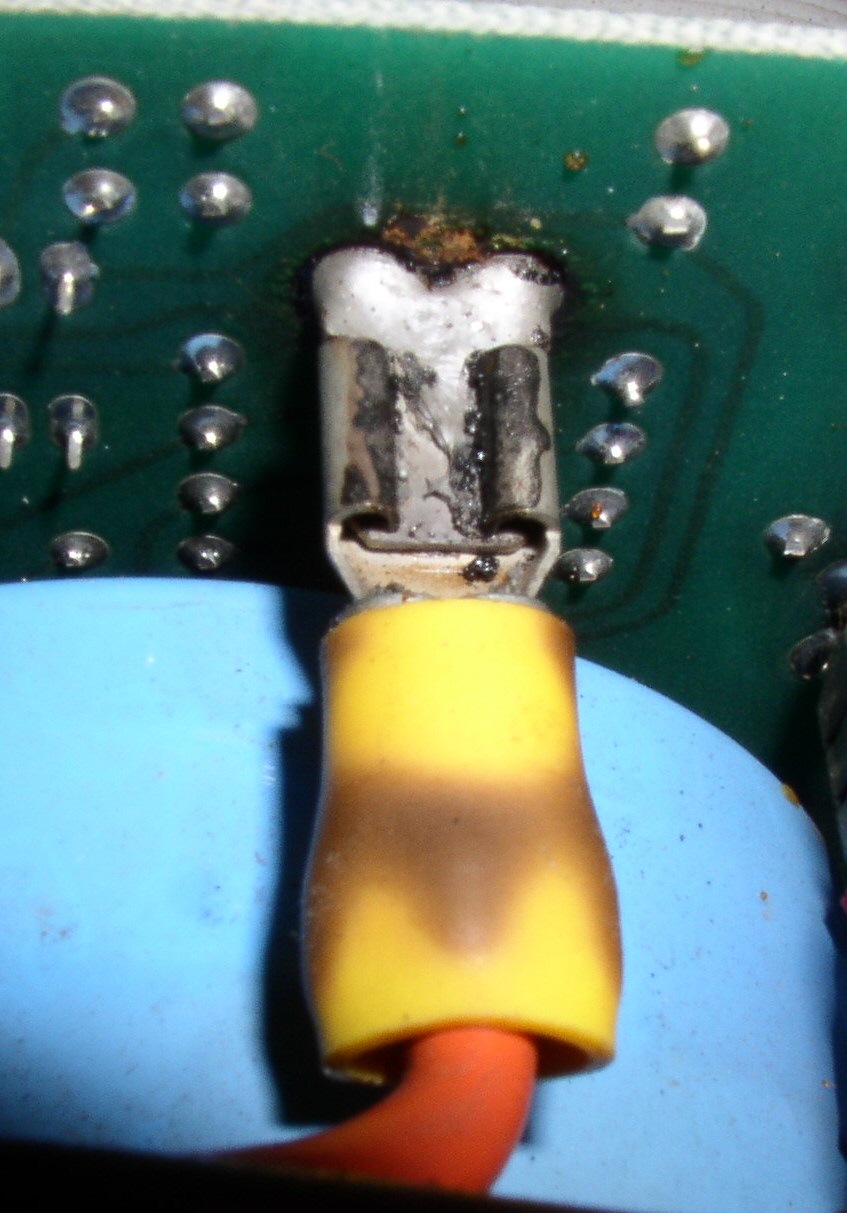
Ah, there's also crusty black gunk on the spade lug, where the connector
slides onto it; and on the PCB around the outer perimeter of the solder bead
at the base of the lug. See the picture again:
http://ana-3.lcs.mit.edu/~jnc/jpg/PDP11s/SigmaBurnedConnector.jpg
Maybe this is just a sign of a connector running hot, but that sure looks
like it was running a _lot_ hotter than such a connector should.
> I don't see any corrosion in there, or major discoloration on the PCB
> which would indicate very high heat at that point
There is a brown spot on the PCB, but I can't tell if it's surface deposit, or
goes deeper; from the other side, I do see a small area of slight
discoloration.
And I've just noticed that the solder job on the second of the two through-
board pins is crappy - maybe that's the source of the problem?
> If .. you have sufficient slack in the wire to work with
I don't, alas (see previous message).
> If you are really concerned about more power being drawn through
> whatever rail that is, than it is really rated for, you should really
> be focused on the supply wire and not the lug!
Right, but the wire looks fine - the signs of over-heating (and therefore the
voltage drop) is only right at that connector.
> Is it not running? If that is the worst you can find in the PSU, I'd
> bet it would run fine if you fired it up.
Yes, that's the only thing I saw.
The seller had powered it on, and the 'lights came on', so I'm pretty sure it
is working, but...
> heat the surface not the solder
I've found that when working with large things and a small iron, you may not
get good enough heat transfer with the bare iron to heat the item up enough
(no matter how hard you press). So sometimes I use a small bead of solder to
get better heat transfer from the iron to the piece. But yeah, the piece needs
to get hot enough to melt the solder itself.
Ah, well, off to try a few things. Thanks everyone!
Noel
A few weeks back somebody said that if I ever got my hand-drawn
reverse-engineered DEC rainbow PSU schematic scanned they would like a
copy. I've now managed to do this,. but I've lost their details.
If you get in touch mwith me (private email) I will see what can be done.
-tony
On Fri, Sep 12, 2014 at 10:58 AM, Paul Koning <paulkoning at comcast.net> wrote:
> That reminds me of an article, perhaps in the late 1960s, in QST by John Troster, w6ISQ, author of all manner of joke articles. The title was something along the lines of ?Murphy?s laws of electronics?.
> One of them: ?A transistor, protected by a fast acting fuse, will protect the fuse by blowing first?.
> Another one: ?A dropped tool will land where it does the most expensive damage ? this is know as the Law of Selective Gravitation?. (That came with a cartoon showing a hammer nudged off a shelf, on a direct path to an expensive vacuum tube in an open chassis on the bench.)
Amplifiers oscillate, and oscillators don't.
(Software equivalent: Constants aren't and variables won't.)
On Fri, Sep 12, 2014 at 4:52 PM, Tony Duell <ard at p850ug1.demon.co.uk> wrote:
> My point is that this does not go far enough,. If you protect a transsito
> with an expensive FF fuse, then not only will the transistor fail first,
> it will do so i na wat to blow the fuse. It will not protect the fuse.
> That owuld be contrary to Muprhy's Law...
Not necessarily. There's a meta-law "If Murphy's Law can go wrong, it will."
That has also been stated as the Ultimate Law: "If something could
have gone wrong, but didn't, it would have ultimately been better if
it had."
OK, next! As I mentioned, I have two systems I'm working on, and I'm starting
with the 11/23. It uses a Sigma BA11NL-1 chassis - very similar to the DEC
chassis of the similar id.
(Speaking of which... the chassis was in a box with a DEC "11L03-HA" label on
it - I can't work out if whoever owned it upgraded it with the Sigma [which
is Q22] or if DEC supplied the unit with the Sigma. I can't work out why DEC
would have used an outside supplier for that - unless either i) Sigma could
build a chassis much cheaper than DEC could, or ii) DEC was having supply
issues, and turned to Sigma to fill the gap.)
Anyway, so I've had it apart, and it's generally in very good condition...
with this exception in the power supply:
http://ana-3.lcs.mit.edu/~jnc/jpg/PDP11s/SigmaBurnedConnector.jpg
This spade lug appears to be the +5V common, although I'm too lazy to check
the prints to absolutely confirm that (there are two other similar wires
coming out of the transformer, but without the white stripe of this one, and
they both go to a honking great full-wave rectifier, the output of which goes
to a heat sink (!) which appears to be doing double duty as a bus bar).
Clearly, there was probably excessive resistance there somewhere, although
it's not clear if it was across the spade connector itself, or in the
wire-connector junction (note the brown spot on the insulating shield - I
first thought that indicated that the wire-connector joint was the problem,
but iff the spade connector got hot enough, the heat could have gotten into
the wire, and caused that spot).
So here's my question: what do I do? Do I:
- Pull the spade connector off, clean everything well (e.g. with a Dremel
wire brush), and put it back together, and hope?
- Replace the connector on the wire side only (slightly tricky, as there's
not much spare length in the harness, so I can't clip it off, I'd have to cut
the old one off with a Dremel wheel)?
- Try and replace the lug on the board too? (It looks like it got hot enough
to melt the solder - the solder has the surface crazing to it.) That might be
tricky...
- Do nothing and hope (on the basis that it didn't melt down yet :-)?
Whatever I do, of course, I should monitor it, and I'd like to avoid a lot of
grief replacing things unless I really need to, but I'm genuinely uncertain
what the best course is here. Thoughts?
Noel
Have a board here with subject chip on it. Also has 2 IMP-00A's. I assume
what I have is the 8 bit version of the IMP-16. Haven't been able to locate
instruction set for this 8 bit version. All the data sheet says is "CROM's
which implement 8-bit instruction sets are available as standard products."
Seems to be lots of info out there for IMP-16 but anyone heard of this
IMP-8A/521D?
Thanks,
Bill
Well, they do say that the device is there to protect the fuse...
http://www.classiccmp.org/acornia/tmp/fuse.jpg
Found in the chassis of an old 'scope. There's actually originally no
provision for a fuse in the 'scope itself - just a circuit breaker - but
quite why someone would take the trouble to cut a wire and then solder both
ends of the same fuse to it, I have no idea.
cheers
Jules
> From: Chuck Guzis <cclist at sydex.com>
> Do you mean something like the 2.54mm dual-row "Dupont" connector
> shells taking crimp pins?
> e.g. eBay 330875532644
Yes, that's it! How on earth did you find that? I looked on eBay (and then
Googling) for several hours, and couldn't!! :-)
> Paul Anderson <useddec at gmail.com>
> Do you need ones like used on the M7800 (DL11) and KL8?
> I have 20ma cables for these
Thanks; those are indeed the kind/size I'm looking for (quite a few DEC
boards use them), but I think I'm set now (above).
> John Wilson <wilson at dbit.com>
> the housing is technically 44 positions because it goes all the way to
> the edges, but the DEC connectors (like the IDC ribbon-cable
> connectors) skip the outer pairs so you only ever use the middle 40
> pins out of 44.
Interesting... I have a cable with 40-pin connectors (on an old IDE cable;
these are not keyed) and I tried plugging it in, and there is no space at all
on the sides (unlike, say, when one plugs a 10-pin shell into a 14-pin
DLV11-J connector). But looking at the connector carefully, I see that the
side arms of the top retainer piece take up space on the sides - looks like
just enough for a pin. So maybe the '40 pin' Berg headers really are
technically 44 pin size (although they do have only 40 pins).
Speaking of keying... does anyone know the name (let alone a source) for the
little plugs (usually white) that can go into one of the holes on one of those
connector shells, to key it so it can only go in one way round?
Thanks everyone, for all for the help!
Noel
> From: Tothwolf
> So was DEC using both AMP AMPMODU and Berg connectors for the cables?
Yup - and others as well - although seemingly not on the same board type,
though.
Pretty much all the 40-pin connectors I can see here (one a large range of
board types) have Berg on them (although it seems DEC was making the part
themselves under license, because all except one _also_ has a
"|d|i|g|i|t|a|l|" logo on it too); there is one DuPont. The non-DEC Berg and
the DuPont are absolutely identical except for the logo - and are on a pair of
cards which use them for an over-the-back connection, so I suspect they are
the same part, just re-labeled.
The 50's a a mix of Berg and 3M. There are 20's which are Berg. The ones on
the DLV11-J's (the one they gave the AMP part numbers for) aren't marked, nor
are a number of the other small ones.
Noel
> From: Tothwolf
> FCI bought out Dupont's connector division a long time ago, so what you
> are looking for is FCI's Mini-PV series.
> ...
> I'd advise against buying these type of contacts on eBay. 99% of the
> "Berg" or "Dupont" contacts on eBay are knock-offs and don't have
> decent plating (gold flash, if they have any gold on them at all) and
> aren't made to have the correct gripping force. .. they might not even
> fit a real HT-95.
Hi, thanks for all that great info. The 'gold flash' issue was new to me;
for those who are likewise unfamiliar with it, I found this nice write-up:
http://www.dfrsolutions.com/uploads/white-papers/Gold_Flash.pdf
Alas, I've already ordered some of the 'eBay knockoff' pins; when they get
here, I will look them over, and if poor quality, take appropriate action...
> From: John Wilson
> Digikey 3M9123-ND (3M 3435-0 "conn socket keying plug") is the version
> that fits into an IDC connector.
By pure chance, I later discovered, as I was reading the writeup on the
DLV11-J, that they gave AMP part numbers for the shell (10-pin, I assume),
contacts, and plug (they call it a "key pin"), and they seem to still work.
Here they are, if anyone has any use for them:
87133-5 Connector shell
87124-1 Contact
87179-1 Keying pin
How odd to find them in the DEC Interfaces Handbook!
Noel
Hi
I've found an old binary for the original TETRIS called TETRIS.SAV. I
believe it is a runnable binary made for RT-11 orginally run on of the
russian PDP-11 clones.
Now, I would like to run this under RTEM-11 on RSX-11M+, since that is
what I have available.
But I find very little documentation and I have no real idea how RTEM-11
works. Does anyone here with any experience want to give me some
pointers?
Simply, what do I do with an RTEM-11 installation and TETRIS.SAV?
Assume no or little knowledge on my side :)
/P
Hey, all, I'm looking for a source for 40-pin connector shells (to hold female
pins) for 2.54mm so-called Berg or Du Pont connectors. Anyone have a source
they can point me at? (I would call these male shells - since they go into the
female shells with male pins typically found on circuit boards - but I gather
the terminology is somewhat confused.)
The small ones (1-10 pins) are easy to find (they are used for audio/USB
connectors); the 40-pin females for use on ribbon cables are also easy to
find, as are the males that go into PCBs... but the 40-pin insertable pin
females appear to be unobtanium.
(I want them because a number of old DEC interface cards use them for cables,
and I refuse to pay $139 or whatever for a cable that's made of a total of a
couple of bucks worth of parts - I'm quite happy to roll my own.)
BTW, to quickly introduce myself (since this is my first message to the list);
I did a lot of work with PDP-11s 'back in the day', both as a software
development environment (using PWB Unix - roughly V6 - and later Ultrix), as
an application platform (multi-protocol routers, using LSI-11s), and also some
prototyping of high-speed network interfaces (1 and 10 Mbit/second rings).
I now have a couple of 11s (a 23 and an 84) which I'm trying to get running.
You'll be hearing lots more from me Real Soon Now as I get into that
project... :-)
Noel
Contacted you offline before I saw this. Thanks a lot.
Marc
> I'll see if I can get those disks imaged and uploaded somewhere in the
next day or two.
> -Glen
Howdy,
I've been having a good rescue year... earlier this year a PERQ, and now 2
Sun 1/100's (and yes, one is a 100, not a 100U).
(details of the rescues are getting written up for my blog at
http://www.vintagecomputerexpo.com... the first PERQ post is up already...)
With the Sun 1's I also got two tape/disk drive units... the first one
actually BOOTED the first Sun 1... first try (ok, 2nd try, after I
unparked the heads). The second actually does the initial boot but has
some hard read errors (so I'll have to give it a go with a
reformat to see if that resolves things...)
But the question I have is that the 2nd Sun 1 integrated monitor need to
have the vertical/horizontal hold adjusted. It currently
looks like someone tweaked the V-Hold and H-Hold dials that use to be at
least on my TV's :-)
On the outside there is only a brightness knob... so I'm going to have to
open it... but I've not been able to find any details on
what to look for... I'm assuming some potentiometers some place... does
anyone know?
Thanks.
Earl
I have a number of 16500 floppy disks I'd like to digitize, and am
wondering what the best way is to image them.
I will probably want to look at them if possible if they are FAT, as
some are, so having a flat image would be nice.
I'll look into the prior postings for software to image them for
reproduction.
I just tried a DD from one attached as an experiment in this way, and
did not get a good result:
Macbook Pro running Mavericks
Vmware Fusion.
Ubuntu 10
Teac USB floppy drive attached thru to the Ubuntu machine.
The floppy drive showed up, but a DD only copied in about 1mb from a
1.44 format disk. Not sure what quirk that was from. It's been a long
time, and even though I follow your discussions here, I'm not sure if
this pile will work.
I have a Linux Laptop and also a windows Laptop (XP) which I'm going to try.
thanks
JIm
Well, it's not so retro :)
I powered it up and seemed to work.
Booted from CD and removed root password.
While surfing in the HD, I got (console) a lot of ECC errors.
I powered it down and swapped two SIMM modules.
Then it refused to boot at all. CTRL-BREAK didn't respond in that phase.
So I rebooted and hit CTRL-BREAK early, and set diag-switch? true,
diag-level to max.
Resetted.
Got memory error, Ecache errors and RED state exception (may be I'm
missing something else...).
Did a lot of scrambling: memory modules, CPU modules (2).
Memory errors seemed to disappear, but Ecache errors remained for both
CPUs.
I noticed faults increase with temp.
Before I hit the wall multiple times with my head: shall I assume the MB
is gone fishing?
Ecache errors seems independent from CPU modules (I tried also 1-CPU
configuration).
I don't think a memory error (SIMM) could trigger and Ecache error (EDP)
on both CPUs.
Damn...
Thanks!
--
Vincenzo (aka Supervinx)
--==ooOoo==--
My computer collection:
http://www.supervinx.com/Retrocomputer
--==ooOoo==--
You can reach me at:
www.supervinx.comwww.facebook.com/supervinxhttp://www.youtube.com/user/supervinxhttp://www.myspace.com/supervinx
Glenn
I am super interested in a copy of these if it were possible. UPS just dropped a package with an HP1670G on my doorsteps a few hours ago (yay!) and I have an HP-IB and a 8085 probe on the way - but no inverse assemblers for either. Can I contact you off line?
Marc
>
> Message: 2
> Date: Wed, 10 Sep 2014 10:05:31 -0700
> From: Glen Slick <glen.slick at gmail.com>
> To: "General Discussion: On-Topic and Off-Topic Posts"
> <cctalk at classiccmp.org>
> Subject: Re: Reading HP 16500 Logic analyzer firmware disks
> Message-ID:
> <CAM2UOwLM5YNFgi8qOeadJZXS6v0weXdhZwpMg7PPwcACacqR3g at mail.gmail.com>
> Content-Type: text/plain; charset=UTF-8
>
> On Wed, Sep 10, 2014 at 9:53 AM, Sean Caron <scaron at umich.edu> wrote:
>> Has anyone archived Inverse Assemblers for various HP LAs anywhere? I'd
>> love to get the inverse assemblers for a few selected CPUs (68000, 6809,
>> 6502, Z80, ...) for my 1662A. Just stuff I'd be fooling around with while
>> breadboarding.
>>
>
> I have Config/IA disks for at least the following pre-processor interfaces:
>
> 10300B Z-80 probe
> 10304B 8085 probe
> 10342B HPIB/RS-232 probe
>
>
> ------------------------------
I just received a couple of the Cauzin Softstrip Readers, and after looking through everything included, there's no software to *create* my own barcodes! Does anyone have software that will let you print your own? I'm about to do a type-in BASIC contest starting tomorrow, and I thought it would be fun to offer the program in the softstrip format.
--
Follow me on twitter: @FozzTexx
Check out my blog: http://insentricity.com
I've been trying to familiarize myself with the soon-to-arrive SRAM board,
reading through the documentation, googling this & that, etc. But I'm
having trouble understanding a couple of concepts..
(You can d/l the manual for the board at http://nerp.net/~legendre/altair/
- "California Computer Systems 2016B". There's a pic there as well.)
I get that the S-100 memory space is organized into 16 blocks of 4096
(8-bit) bytes, with the high-order digit in the memory address denoting the
block number (0XXX-FXXX). This would correspond to address lines A12-A15.
Likewise, I get that the SRAM board is organized into 4 blocks of 4096
bytes per block, and that with the corresponding DIP switches, I can
individually map each 4K block into any of the 16 blocks in the memory
space. Great, I know how to configure the memory blocks..
But now what is this about 'banks'?
On p.33, section 3.3 the manual states "The 2016B is bank-selectable by
bank port address and bank byte. Thus it is fully compatible with Cromemco,
Alpha Micro and other port-bank-select systems. IT IS NOT COMPATIBLE WITH
ADDRESS-SELECT SYSTEMS SUCH AS IMSAI."
So what does that mean to me? There are apparently two parameters, Bank
Byte and Bank Port Address - and I just can't get what they're about. How
does a bank differ from a block, and why do I need to configure those
settings? And is this card even compatible with the Altair - I don't know
if it uses the former or latter (IMSAI) scheme..
As ever, thanks for your help!
>You don't get any sort of beep code out of it? I gather these 255/300s are
>supposed to beep at you like a PC does, given certain states where it can't
>produce a display (or, I guess, console output).
It cycles through the lights then stops there.
Based on your comments I pulled the NVRAM battery and then I get a 1-2-1
beep code that the manual calls "Real-time clock (BQ3287) failure, or the
real-time clock interrupt
did not occur." and the LED cycle stops at XX0X 0XX0 which it calls
"Interrupts test failed"
Still no output on Com 1 or on the video card (an S3 based VGA card).
My next thought is a new CR2032 and see if it get past that in the startup
sequence.
Any other ideas?
>Best,
>
>Sean
>
>
>
>>On Wed, Sep 10, 2014 at 3:59 PM, Sean Caron <scaron at umich.edu> wrote:
>>
>> Hi William,
>> Does it cycle through other LED states before it reaches 0xD1? Or does it
>> just start there at power-on and sit forever? That is pretty odd; not
quite
>> sure what to make of that. You tried the console with and without a
>> null-modem?
No null modem at hand. Just have a straight through cable and an Esprit
350C terminal.
Thanks,
William
--
Live like you will never die, love like you've never been hurt, dance
like no-one is watching.
Alex White l
> On Wed, 10 Sep 2014 08:56:52 -0700 Chuck Guzis wrote
>
> Indeed, if one looks carefully at the nonpolar crossover caps, they
> appear to be nothing more than back-to-back electrolytics. On the other
> hand, I note that motor run capacitors have gotten a lot smaller over
> the years, so a higher-voltage unit just might fit.
>
No one seemed inclined to recommend intermittent duty start capacitors so I've gone with high voltage run capacitors, all that seem available in the UK anyway.
As Chuck notes, things have got smaller. The originals (100uF, 60V) were 100mm long and 50mm diameter. The ones I have used (450V) are approx 120mm long plus a 12mm stud mounting and 60mm diameter. The TU56 has plenty of space although mounting them neatly without butchering the drive was a bit of a chore. Working satisfactorily - just the electronics to sort out now ;o).
Hello All:
I have a battery backed ISA RAM card by SemiDisk. It currently has a number
of Panasonic P-25AA 1.2V 250MAh rechargeable Nickel Cadmium batteries. Given
the card date backs from 1990 I am guessing the batteries are a bit dead and
I'd like to replace them. However, my Googlefu did not turn up anything.
Does anyone know if Panasonic still makes these batteries and if so where I
can purchase some in the USA? I did find some Chinese generic batteries:
http://www.amazon.com/Size-Rechargeable-Battery-250mAh-NiCd/dp/B005NRSQS8#
but I am not sure as to the quality of said battery. Any help is appreciated
in sourcing some batteries. Thank you.
-Ali