So, what's the best short name for the pair of machines, the PDP-11/05 and
PDP-11/10 (which differ only in the nameplate)?
I have generally been calling them the '11/05's, since that's what's on many
of the extant drawings, manuals, etc - and DEC seems to prefer the '05' in
manual ID's, even when the title references both - e.g. DEC-11-H05SS-B-D is
the "PDP-11/05-S, PDP-11/10-S system manual", with the /05 mentioned first.
However, for the 11/35 and 11/40, which we seem to normally call the 11/40
(again, following DEC's lead - EK-11040-TM-002 is the "PDP-11/40, -11/35
system manual", with the /40 mentioned first), the /40 is the end user
machine.
With the /05 being the OEM machine, and the /10 end user one, we (and DEC)
seem to have picked the OEM variant in one as the 'canonical' model, and in
the other, the end-user variant.
Maybe this isn't an issue/problem, but I noticed it, and thought I'd see what
(if anything :-) others thought.
Noel
Just started working on mine - been a back-burnered project for a long
time. Unfortunately all the cables were cut when it was dismantled; I
was lucky to grab just the CPU.
Got it powered up ok - no drama there. I faked cables to the port on
the WCS which drives the console and hooked up my trust VT220 at 2400
baud. Nada. No self-test prompt; no ROM> prompt.
Maybe I've messed up the faked console cable; I'll check - already
tried obvious things like making sure Rx & Tx were crossed (it's a
three wire cable according to the schematics - Rx Tx Gnd; no flow
control). But I'd like to know more about the assorted LEDs on the CPU
boards; maybe there's a clue there if it's not getting far enough into
the self-test to display console output. There's a fair few LEDs on
the M8391. But the doc I've looked through on Bitsavers doesn't seem
to document their meanings and interpretations. Can anyone help on
that point?
Hopefully this link works:
https://www.facebook.com/photo.php?fbid=10208521465663997&l=867897c786
Thanks
Mike
http://www.corestore.org
'No greater love hath a man than he lay down his life for his brother.
Not for millions, not for glory, not for fame.
For one person, in the dark, where no one will ever know or see.'
Hello list,
I've had this HP logic state analyzer for many years now, but never found actual use for it and thus never used it. So I decided that a new home would be more suitable for it. The analyzer comes with the option to debug and analyze 8080 microporcessors. Probes are provided, but no manual. However, there is a small command overview on the front of the keyboard.
The system completes the selftest and I did let it run for two hours yesterday. No more tests done, but if anybody wants me to do a specific test, then I can do it, provided you explain to me what to do.
Pictures are under
http://www.digitalheritage.de/other/hp_1611a/
Make me an offer via private reply. Pick-up in Bonn (Germany) or international shipping possible. However, keep in mind that the system weights 13kg (29 lbs), so shipping is not going to be cheap.
Cheers,
Pierre
-------------------------------------------------------------------------------
Pierre's collection of classic computers moved to: http://www.digitalheritage.de
On Mon, Feb 22, 2016 at 10:28 AM, Mark J. Blair <nf6x at nf6x.net> wrote:
> When I was debugging the connection between my VAX and tu58em on my Mac, I ended up buying an old serial protocol analyzer. Notably, I specifically avoided one with the same type of tape drive; I got one with a nice, reliable 3.5" floppy drive! ;)
HP 4952? I have two with tapes from the old days (they contain a
formatter, and we did wipe some scratch tapes for storage of our
analyzer programs, including a PU Type 2 BIND simulator that filled
the program memory, but it worked well enough for us to debug SNA BIND
sequences in the absence of a real PU Type 4).
-ethan
> From: Evan Koblentz
Now I'm triply bummed that he was sick, and didn't manage to make it to the
last VCF East.
He was one of the giants - somewhat unsung, but a giant. RIP.
Noel
We will be up for getting one to round out the HP display here
When I was in the biz they were out there but we did not sell any parts
for them,
I remember some developer friends complaining that the A version of
RTE version of the os did not have SESSION
Let us know if you have one folks even a dead one as it is a physical
display only situation
*(However if a complete setup running was to be had....that might be
fin too!)
Ed# _www.smecc.org_ (http://www.smecc.org)
The PDP-11 at the RICM says "dec pdp 11" on the system configuration paper
label on the back, and "M11 15" and "4720" on the metal tag. Unfortunately
it has an OEM front panel.
--
Michael Thompson
Would anyone out there happen to know the whereabouts of one or more
specific videos that were hosted on the Microsoft research web site maybe
10-15 years ago, starring James Gosling, where he talked about NeWS
(Network extensible Window System)?
I may even be able to dig up the URL for the video(s) when I get home, but
it's been dead for a long time now.
--
Eric Christopherson
Here's an interesting tid-bit.
I just got off the phone with the AT&T corporate archives, where I had
hoped to find schematics and internals documentation for the AT&T 3B2.
They do have it, but unfortunately they will not give access to any
of it because they still consider the 3B2 to be proprietary
information.
I'm disappointed, obviously, but not all that surprised. 25 years is
not a long time for a company like AT&T, and I understand the 5ESS
system still runs a 3B20 emualtor. They may even still have support
contracts for 3B2 installations, I'm not sure.
Anyway, all that aside, will soon have access to a couple of 3B2/310s,
so I hope to continue reverse engineering the hardware directly.
-Seth
--
Seth Morabito
web at loomcom.com
On 02/20/2016 08:26 AM, John Foust wrote:
>
> Can anyone help idenitfy these?
>
> https://www.reddit.com/r/vintagecomputing/comments/46nse6/a_family_member_f…
In spite of the floppy drives, I don't think these are general-purpose
boxes. The thing that strikes me, given the displays is that they might
be graphics workstations of some sort. There's just too much there for
a simple floppy-based computer.
The problem is that Hitachi is a huge outfit with tendrils in all sorts
of industrial areas.
--Chuck
I have been working to get my MicroVAX 3100 communicating with TCPIP, and I
got pretty far but I ran into a little snag. I don't have it on right
now, but anyone wanted to connect for fun it's available from
microvax3100.vintagecomputer.net, just give me a few minutes to fire it up.
I can telnet in/out and I can send SMTP messages, but I cannot yet receive
them (reply to). The issue is with the format of the email address.
I was wondering if I must send emails from my VMS 5.5 and multinet 4.1 as
such:
MAIL> MAIL
To: SMTP%"bill at myemail.com"
etc..
Is there a way instead to send like this:
MAIL> MAIL
To: bill at myemail.com"
Question #2
I'd like to be able to send messages to my MicroVAX (reply to messages).
At present if I try to send a message to SYSTEM at microvax3100@
vintagecomputer.net I get a rejection from the POSTMASTER like this:
Bad address -- <SYSTEM>
Error --
%MAIL-E-USERSPEC, invalid user specification ':'
-------------
I have been reading up and I have narrowed the issue down to the
differences between DEC mail format and "modern UNIX". I don't believe
anything is being blocked. I am sure if I sent an email from a VAX to my
VAX it would work just fine. I am also guessing there is a translation
gateway that I need to set as part of the boot up process, and that this is
a DECnet issue, not a Multinet issue. I was playing around with
*@MULTINET:MR_CONFIGURE
*but I am unsure if that's the correct process, or how to store this so
it's permanently set.
http://crpppc19.epfl.ch/vms/multinet/html/admin_guide/Ch08.htm#E15E104
Anyone have any tips? I don't want to upgrade the system unless I have to.
If I find the answer on my own I will post it here.
--
@ BillDeg:
Web: vintagecomputer.net
Twitter: @billdeg <https://twitter.com/billdeg>
Youtube: @billdeg <https://www.youtube.com/user/billdeg>
Unauthorized Bio <http://www.vintagecomputer.net/readme.cfm>
Is there a way to copy a disk from a commodore floppy drive to a SD card
if so please enplane how it is done also I have MANY hard to find games
if someonr would like to email the Fleet System 2+ I would be happy to
trade them a game for it!
Thank you all for all the great help you have given me!
Hi,
Just looking for suggestions on how best to setup my PDP-8A so that it can
use either a VT-52 (current loop version) or an ASR-33.
One idea I have is a multi-pole switch to change the baud rate from 110 to
9600 and to also switch the xmit and rcv current loops.
Does anyone out there have any other suggestions?
Thanks,
Marc
On 22 February 2016 at 20:08, <COURYHOUSE at aol.com> wrote:
>
>
> Then there is this information.....
>
> PDP-11/15
>
>
> (http://gunkies.org/wiki/PDP-11/15#column-one)
> (http://gunkies.org/wiki/PDP-11/15#searchInput)
>
>
> This is the OEM version of the _PDP-11/20_
> (http://gunkies.org/wiki/PDP-11/20) .
As gunkies came up a few times during this thread, please beware that
those of us who update gunkies in some cases simply try to collect
information that's floating around so that it doesn't disappear -
gunkies is different from Wikipedia, and is meant to be. Please read
http://gunkies.org/wiki/Main_Page, particularly 'Sentences starting
with "I seem to recall" are perfectly welcome here'
That doesn't mean that there's no trustworthy information there, but
there'll be an element of "research", and sometimes hearsay, which
Wikipedia doesn't allow.
In other words, the output from discussions on this list will
sometimes be input for gunkies, in that case it shouldn't be used the
other way around.. except for defacto factual stuff like images and
linked documents.
(In other news, gunkies was recently moved to a "less glacial server",
as the admin phrased it.. well, that's the understatement of the
century, it's now easy and quick to edit. I mention this because now
and then people on cctalk have asked for a place to collect lists of
technical information of various types, which are not welcome on
Wikipedia. This type of info *is* welcome on gunkies, and now that
it's snappy to use it is a real alternative. Feel free, folks.. the
only issue is that due to past spam problems it's necessary to email
the admin to get an account and write access.)
I had cause over the weekend to take apart my 8E dual-bay system (the
TU10/TM11 is being traded off). I remembered there was some discussion a few
weeks ago about the mid-sized dec cabinets with the sloped top front, so
figured I'd post a pic. Mine may be somewhat unusual in that the operator
controls for the TU10 are on this sloped front at the top rather than the
bottom left quadrant of the drive. The rack next to it with the 8E and TU56
has just a blank sloped front in that "PDP 8E Yellow".
Picture at :
https://www.flickr.com/photos/131070638 at N02/24884152340/in/dateposted/
J
Hi all,
Really hate to do this but been out of work for a while and need to clear
out a storage space to save some money. And I figure as much as I'd like
these machine working to play with, I'll never actually get to work with
them so offering them up for sale, trade for smaller more in line with my
other systems items, or if it gets down to it, just get it to a good home
though would be nice to get a little something out of it.
Have a PDP-11/34 in a rack with an RK05J drive though I suspect the drive
isn't any good now. The top of the drive is gone as I rescued this from a
scrapper who had started on the drive first. Several disk packs are included
but no idea what is on the disks as I didn't get to any point with it where
I could tell. I did test out the power supply and then bring up the system
itself and seem to run fine. The boards inside from what I recall are RK05
controller (M7254, M7255, M7256, M7257), memory (H-228B, H-222A (x2)),
memory parity (M7850), SLU & Realtime clock (M7856 (x2)), an M7814, console
interface (M7859), boot roms (M9301YF), and cpu (M8265, M8266).
Also have a DG Nova-3 but it is basic case without any boards inside at all.
Hope someone is interested and can pick them up as my only other option will
be to send it all back to the scrapper. Let me know if you need any more
info and I'll do what I can to get it. Not an expert on either system and
they are in the back of the storage space so it could take me some time to
pull them out to get any info off them.
Will have some other stuff to offer up as well as I clear out the space.
Best,
David Williams
www.trailingedge.com
Does anyone here have the vector artwork for the Briel Micro-Altair? As
shipped, these computers have a sticker on the front for the logo. I
recently discovered that the local hackerspace has a laser cutter that can
also blacken[1] metal plate. I would like to apply a better-looking logo
that way.
[1] The process, I gather, appears to involve applying a sheet containing
resin or something akin to powder coat which is then melted by the laser
and sticks to the metal substrate.
--
David Griffith
dave at 661.org
A: Because it fouls the order in which people normally read text.
Q: Why is top-posting such a bad thing?
A: Top-posting.
Q: What is the most annoying thing in e-mail?
> From: Bill Degnan
>> Yes, detailed histories might (and many do) indicate that the name
>> "PDP-11/10" was originally allocated to what later became the 11/15
> what detailed histories are these that you refer to that say there was
> never a single KA11 11/10 sold, not one installed?
I didn't say that they said "there was never a single KA11 11/10 sold, not
one installed".
So I just spent an hour looking through all the standard DEC histories (e.g.
Bell, Mudge, McNamara, "Computer Engineering: A DEC View of Hardware Systems
Design", etc, etc, etc, etc, etc) and I was unable to find _anything_ about
either the 'first' -11/10; or even the -11/15, for that matter! So I don't
know where I saw the mention of the 'first' -11/10 being what later became
the 11/15.
I _did_ find a mention of the 'first' -11/10 in the 1970 "PDP-11 Handbook"
(pg. 1), with the specs as in the 1969 price list. Unlike the -11/15, which
did have differences in the CPU itself, it seems that the 'first' -11/10
differed from the -11/20 only in the memory that came with it - i.e. the CPU
was the identical KA11 as in the -11/20.
So, do you know of any engineering document or photograph of one of those
'first' -11/10's? My bet is that there probably are none - because the
machine likely never existed. (Although DEC may have sold a few, what was
shipped was probably an -11/20 - with a front panel reading 'PDP-11', which
may be why the earliest -11/20's said that - with the configuration listed
for the 'first' -11/10.)
To repeat: To the extent that one allocates the name "-11/10" to anything, it
should, by virtue of the existence of _many actual physical instances_,
_marked as such_, be to the KD11-B machine.
Noel
PS: Amusing factoid: I have a PDP-11/20 price list from April 1, 1972 which
lists a "PDP-11/21"! (Versions are -CA, -CB, -CE, -CF.) It's repeated
multiple places throughout the list, which leads me to believe it's not a
typo.) No idea what that was all about.
how does the mac 8 bell computer I have tie in with ess? thx Ed#
_www.smecc.org_ (http://www.smecc.org)
In a message dated 2/22/2016 1:04:54 P.M. US Mountain Standard Time,
lists at loomcom.com writes:
Here's an interesting tid-bit.
I just got off the phone with the AT&T corporate archives, where I had
hoped to find schematics and internals documentation for the AT&T 3B2.
They do have it, but unfortunately they will not give access to any
of it because they still consider the 3B2 to be proprietary
information.
I'm disappointed, obviously, but not all that surprised. 25 years is
not a long time for a company like AT&T, and I understand the 5ESS
system still runs a 3B20 emualtor. They may even still have support
contracts for 3B2 installations, I'm not sure.
Anyway, all that aside, will soon have access to a couple of 3B2/310s,
so I hope to continue reverse engineering the hardware directly.
-Seth
--
Seth Morabito
web at loomcom.com
In a message dated 2/22/2016 11:50:15 A.M. US Mountain Standard Time,
cisin at xenosoft.com writes:
On Mon, 22 Feb 2016, Paul Birkel wrote:
> I wonder how long it took them to "figure it out"? I seems that the
> family-plan dates to April 1969.
When everybody realized and accepted that there would be more than one
sub-model, and decided that it might be handy to be able to tell them
apart. There may have been some holdouts in some departments, such as
silk-screening the panels.
By analogy, the phrase "single density" didn't originally exist.
After "DOUBLE-density" was developed, THEN "single density" needed a name.
Although just sticking with "FM" and "MFM" would have been a lot better!
(Although I guess that it was inevitable that marketing would invent "HD",
instead of "double data transfer rate MFM".)
There were even a few companies that freely intermingled HEADS V density!
Intertec/Superbrain decided to call their 5.25" 40 track DSDD, "QUAD
density", because it was twice the capacity of the 40 track SSDD! Then,
when they added an 80 track DSDD, they caalled that "SUPER density",
abbreviated "SD"! So, if you encounter an alien disk labelled "SD", it
might be 720K/800K, not 100K.
Similarly, if you were to search ancient archives, the phrase "World War
TWO" was first used BEFORE there was any mention of "World War ONE".
It wan't until a second happened, or was expected, before anybody had any
reason to declare the "Great war"/"World War" to be "nuber ONE".
So, the use of any sort of "first" name doesn't occur until "second" is
expected.
Or WW1 was also referred to as the "war to end all wars"
some good name sequence comparisons here
Ed#
In a message dated 2/22/2016 6:33:13 A.M. US Mountain Standard Time,
billdegnan at gmail.com writes:
>
>
>
> The PDP-11/10 was the second processor made in the _PDP-11_
> (http://gunkies.org/wiki/PDP-11) series.
> The PDP-11/05 CPU was identical to the PDP-11/10 (KA11-B). The only
> difference between the PDP-11/05 and the PDP-11/10 was that the
PDP-11/05
> was
> made for OEM, while the PDP-11/10 was for end-users.
> sort of like the 8 m and 8 f were same but one oem one end user
> Ed# at _www.smecc.org_ (http://www.smecc.org)
>
>
>
>
The second 11/10 obviously. Not the 1st. The first 11/10 was a KA11
I hope I am making my point - I am suggesting that everyone stop quoting
and repeating the DEC wiki's on the web. They all need to be updated to
reflect this subtle difference.
--
@ BillDeg:
Web: vintagecomputer.net
Twitter: @billdeg <https://twitter.com/billdeg>
Youtube: @billdeg <https://www.youtube.com/user/billdeg>
Unauthorized Bio <http://www.vintagecomputer.net/readme.cfm>
Bill.... read carefully - - I was talking about the second one
that paired with the 11/05
and using it as a comparison in nomenclature like they did with the
pdp-8 m or f
to show you could have same things but different name depending if
for customer or oem.
or that is what I was trying to do anyway. ---Ed# _www.smecc.org_
(http://www.smecc.org)
From: "Maciej W. Rozycki" <macro at linux-mips.org>
> I've only ever heard of and saw a single kind of monochrome graphics
> hardware for x86 PCs and that was the Hercules Graphics Card (HGC) and its
> clones, and these were already gone by early to mid 1990s.
The Wyse 700 and Bell Tech Blit were both ISA bus mono video cards.
There were others (maybe Radius...Metheus as well?).
P.S. - Sorry if I included the whole digest in my previous reply. Long day.
KJ
> From: Bill Degnan
> I hope I am making my point - I am suggesting that everyone stop
> quoting and repeating the DEC wiki's on the web. They all need to be
> updated to reflect this subtle difference.
The thing is that there never was a physical PDP-11/10 of the first type, it
was just marketing plans; whereas there were/are still many physical -11/10's
of the second type.
Yes, detailed histories might (and many do) indicate that the name
"PDP-11/10" was originally allocated to what later became the 11/15, but to
the extent that one allocates the name "-11/10" to anything, it should, by
virtue of the point above, be to the KD11-B machine.
Noel
On 2016-02-22 11:58 AM, Mouse wrote:
> Unix was done on the PDP-11 (something else
> before that, I think, but I forget what, and I think it was with the
> move to the -11 that it became portable enough to be ported instead of
> rewritten).
PDP-7, though it was more of a "reimplementation" than a port. The
PDP-11 code became (by v6 or so) portable enough that it was
subsequently made to run on the (sorta IBM 360-ish) Interdata 7/32 &
8/32, as well as VM/370, in the late 70s.
KJ
Hi All,
Does anyone still play around with HYPERchannel equipment? I have a
MultiBus I to HYPERchannel adapter that could use a new home. It is in a
Network Systems Corporation box with cables and manual. The model is
PIx50. It is in Madison WI (53714).
For more information about HYPERchannel:
https://en.wikipedia.org/wiki/HYPERchannelhttps://en.wikipedia.org/wiki/Network_Systems_Corporation
-Jon
In a message dated 2/22/2016 5:21:06 A.M. US Mountain Standard Time,
pontus at Update.UU.SE writes:
On Mon, Feb 22, 2016 at 07:16:24AM -0500, william degnan wrote:
>
> Here is the doc in question. Note is says 11/10 and 11/20
>
> http://vintagecomputer.net/digital/PDP11-20/PDP11_Price-List_19691215.pdf
Hmm, notice that it says "Turnkey Console" which I believe means it
lacks the lights and switches console?
/P
yes......
there therye was another pdp 11/10 that was a versioon of the 11/05
so in reality there were 2 differt 11/10's
one that was a deballed 20 and one that was a 05 variant... as
explainedd
The PDP-11/10 was the second processor made in the _PDP-11_
(http://gunkies.org/wiki/PDP-11) series.
The PDP-11/05 CPU was identical to the PDP-11/10 (KA11-B). The only
difference between the PDP-11/05 and the PDP-11/10 was that the PDP-11/05 was
made for OEM, while the PDP-11/10 was for end-users.
sort of like the 8 m and 8 f were same but one oem one end user
Ed# at _www.smecc.org_ (http://www.smecc.org)
Hi,
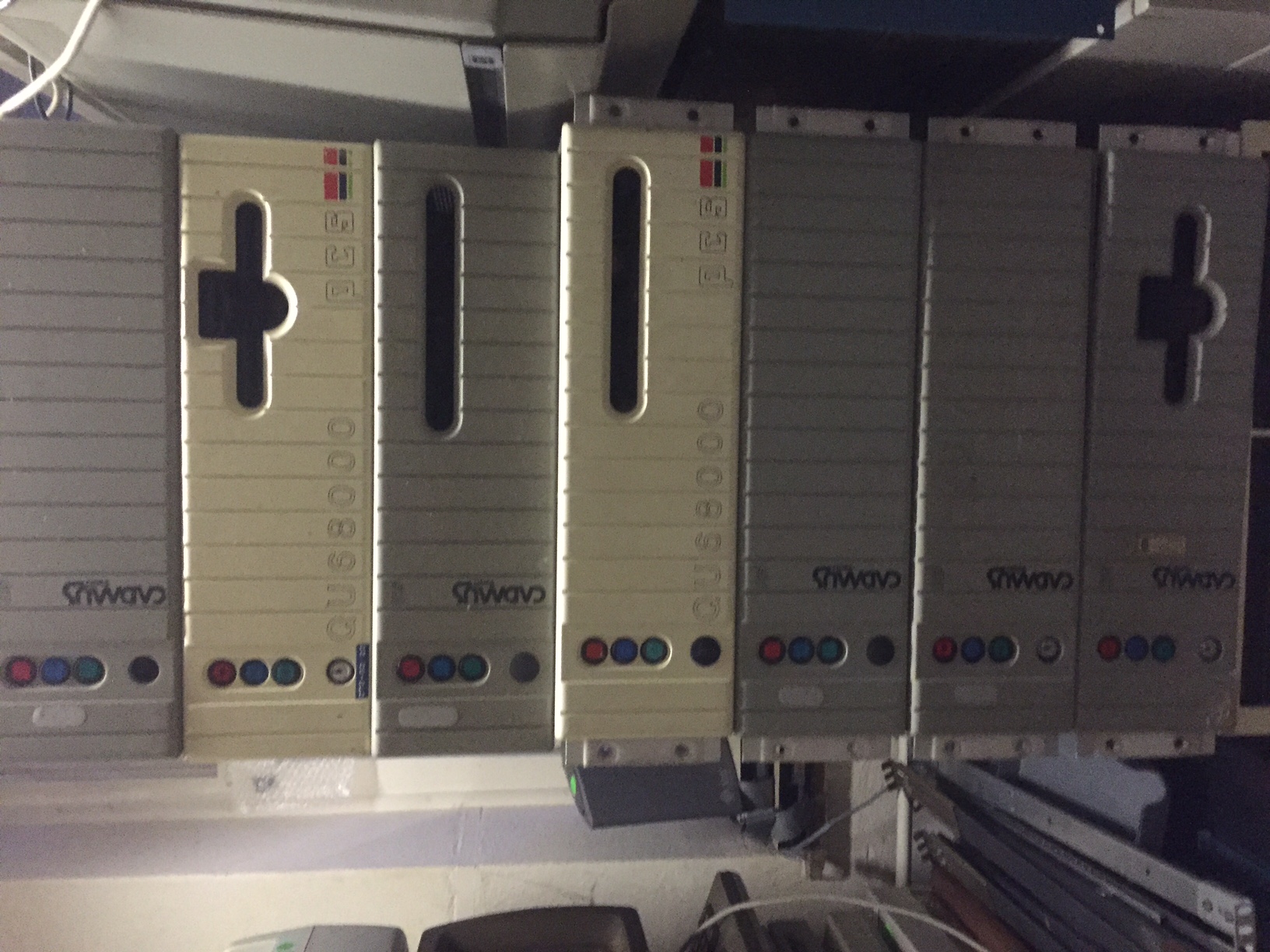
Is anyone interested in PCS Cadmus/QU68000 systems? We at Hack42 have no
idea what to do with them. We need to downsize and these take up a
significant amount of our space.
See http://dev.ramdyne.nl/IMG_2750.JPG for photograph of the stack.
If you know other people who are interested in beasts like these, please
pass this information on.
--
Andreas
> From: Bill Degnan
> I have an original 1969 PDP 11 brochure. In it there are two PDP 11
> model configurations to choose from; the 10 and the 20. For me at least
> this throws into question the whole "... the 10 first came out with the
> 5 in 1972..." story everyone repeats over and over
This is a known 'artifact' in PDP-11 history. DEC originally used the /10
designation for a cost-reduced 11/20. They never produced any, AFAIK - I'm
pretty sure (without checking) that machine was re-labelled the /15, and those
_do_ exist (I used one BITD).
According to DEC documentation, the /15 has a KC11 processor, not the KA11 of
the /20 (although I've never been able to find out much about the KC11 - I
suspect it was a slightly modified KA11); the main functional difference
listed is that it only supports one level of interrupt, not four; power-fail
re-start is also optional, not standard.
I have this bit set that both the /15 and /20 could be had with the 'simple'
front console, that that wasn't the differentiator between them.
The later /5-/10 pairing does indeed exist - I have one of each. They are
absolutely identical except for the printing on the faceplate.
Noel
In a message dated 2/22/2016 5:16:27 A.M. US Mountain Standard Time,
billdegnan at gmail.com writes:
On Mon, Feb 22, 2016 at 7:14 AM, Pontus Pihlgren <pontus at update.uu.se>
wrote:
> On Mon, Feb 22, 2016 at 07:07:35AM -0500, william degnan wrote:
> >
> > I have an original 1969 PDP 11 brochure. In it there are two PDP 11
> model
> > configurations to choose from; the 10 and the 20. For me at least this
> > throws into question the whole "...the 10 first came out with the 5
> > in1972..." story everyone repeats over and over, unless one must have a
> > "10" printed on the console in order to accept a computer model's
> > existence. DEC must not have sold many original 10 models, and/or
> everyone
> > who has a 10 does not realize that's what they have. But, facts are
> facts
> > and the brochure and price guide I have is what it is. Hoping some
here
> > will check for themselves and consider it misleading at least to simply
> > call the original PDP-11 a "pdp 11/20 without the nameplate". In
short,
> > the original bare-bones pdp11 was the pdp-11 10, the fully-equipped
> version
> > was the pdp-11 20.
>
> I will definitely correct myself in the future. It would be interresting
> to see if anyone has a "numberless" machine with the "M11-10"
> designation printed on the back, to see if any was actually delivered
> (and I wouldn't be surprised if there was).
>
> /P
>
Here is the doc in question. Note is says 11/10 and 11/20
hahahha!!!! turnkey console on 10
programmers console on 20
in brochure!
Ed#####
http://vintagecomputer.net/digital/PDP11-20/PDP11_Price-List_19691215.pdf
--
@ BillDeg:
Web: vintagecomputer.net
Twitter: @billdeg <https://twitter.com/billdeg>
Youtube: @billdeg <https://www.youtube.com/user/billdeg>
Unauthorized Bio <http://www.vintagecomputer.net/readme.cfm>
I have the regular Fleet System 2 bur I need a copy of Fleet System 2+
instead of blur the stickers are yellow there a 3 disks. I am hedding to
the dr and I will post the manual I got in the unopened box. so pics
coming up later today does anyone have a copy of the 3 Fleet System
Sisks they could email .e I have many things to trade I will post that
stuff later today . God Bless Yall!
In a message dated 2/22/2016 5:14:40 A.M. US Mountain Standard Time,
pontus at Update.UU.SE writes:
On Mon, Feb 22, 2016 at 07:07:35AM -0500, william degnan wrote:
>
> I have an original 1969 PDP 11 brochure. In it there are two PDP 11
model
> configurations to choose from; the 10 and the 20. For me at least this
> throws into question the whole "...the 10 first came out with the 5
> in1972..." story everyone repeats over and over, unless one must have a
> "10" printed on the console in order to accept a computer model's
> existence. DEC must not have sold many original 10 models, and/or
everyone
> who has a 10 does not realize that's what they have. But, facts are
facts
> and the brochure and price guide I have is what it is. Hoping some here
> will check for themselves and consider it misleading at least to simply
> call the original PDP-11 a "pdp 11/20 without the nameplate". In short,
> the original bare-bones pdp11 was the pdp-11 10, the fully-equipped
version
> was the pdp-11 20.
I will definitely correct myself in the future. It would be interresting
to see if anyone has a "numberless" machine with the "M11-10"
designation printed on the back, to see if any was actually delivered
(and I wouldn't be surprised if there was
/P
Well I owned one in 1980 that just said only PDP 11.... but so
long ago do not remember the label
when I got a chance to swap some stuff for the 11/20 for the
museum I jumped at it.
In a message dated 2/22/2016 5:07:40 A.M. US Mountain Standard Time,
billdegnan at gmail.com writes:
On Feb 22, 2016 4:39 AM, "Paul Birkel" <pbirkel at gmail.com> wrote:
>
> Agreed; I neglected to mention that mine also is marked in that manner!
> Seems like DEC had ramped up to about 15-20 machines/day by
mid-September.
>
> Guess that the front panel graphics guys "didn't yet get the memo". Or
> maybe someone was hedging their bets against an ignominious sales failure
in
> the initial front panel production?
>
> -----Original Message-----
> From: cctalk [mailto:cctalk-bounces at classiccmp.org] On Behalf Of
Christian
> Corti
> Sent: Monday, February 22, 2016 4:32 AM
> To: General Discussion: On-Topic and Off-Topic Posts
> Subject: RE: PDP-11/20 vd one that just says pdp 11 what are the date
> differences?? OEM?
>
> On Mon, 22 Feb 2016, Paul Birkel wrote:
> > My PDP-11 is labeled as "S-386" and dated 9/23/70, which I guess makes
> > it fairly early in the production run (but I do wonder what the
> > initial manufacturing rate was given the relative riskiness of this
> > new architecture). Anyone have S# and dates for "plain 11" vs.
> > 11/20-marked for comparison?
>
> Our PDP-11 is labeled as "S-308", the date is 9/16/70. And I think they
> called it PDP11-20 from the beginning, as the model number above the
serial
> number says "M11-20"
>
> Christian
>
I have an original 1969 PDP 11 brochure. In it there are two PDP 11 model
configurations to choose from; the 10 and the 20. For me at least this
throws into question the whole "...the 10 first came out with the 5
in1972..." story everyone repeats over and over, unless one must have a
"10" printed on the console in order to accept a computer model's
existence. DEC must not have sold many original 10 models, and/or everyone
who has a 10 does not realize that's what they have. But, facts are facts
and the brochure and price guide I have is what it is. Hoping some here
will check for themselves and consider it misleading at least to simply
call the original PDP-11 a "pdp 11/20 without the nameplate". In short,
the original bare-bones pdp11 was the pdp-11 10, the fully-equipped version
was the pdp-11 20.
Why DEC temporarily dropped it's pdp-11 10 model from the product line and
>from newer price sheets I can't say. Certainly the "10" was gone when DEC
rebranded their front nameplates to read "pdp 11/20". I believe the 1969
brochure is on bitsavers, or I think my website has a copy you can
download.
Bill Degnan
twitter: billdeg
vintagecomputer.net
I had heard a rumor the 10 was an oem version!?
does that make any sense Bill?
Ed#
Hi everyone. I'm hoping that one of the VAX experts out there can help me
figure out how to get my 3100 booting. I managed to cobble together the
necessary cabling and was able to run a "TEST 50" from the serial console.
Unfortunately my Google-fu isn't sufficient to help me figure out what the
results mean. Here is what I'm getting below. Any ideas where my problem
lies?
>>> test 50
KA42-A V1.3
ID 08-00-2B-16-58-20
MONO 0000.0001
? CLK 0000.0005
NVR 0000.0001
? DZ 0000.4001
00000001 00000001 00000001 00004001 00000000 00000000
MEM 0010.0001
01000000
MM 0000.0001
FP 0000.0001
IT 0000.0001
SYS 0000.0001
8PLN 0000.0001 V1.3
NI 0100.0001
>>>
Thanks,
Bryan
what was the break point as far as manufacture dates between the 2?
Ed#
In a message dated 2/22/2016 1:25:31 A.M. US Mountain Standard Time,
pbirkel at gmail.com writes:
Which has always struck me as a bit odd, since the PDP-11 family was
designed to be just that, a family. So you'd think that "marketing" would
have kept that in mind when designing the first front panel label ...
-----Original Message-----
From: cctalk [mailto:cctalk-bounces at classiccmp.org] On Behalf Of Pontus
Pihlgren
Sent: Monday, February 22, 2016 3:12 AM
To: General Discussion: On-Topic and Off-Topic Posts
Subject: Re: PDP-11/20 vd one that just says pdp 11 what are the date
differences?? OEM?
The PDP-11/20 was the first PDP-11. I believe the number was added when the
other models came out, to discern them.
/P
On Mon, Feb 22, 2016 at 03:03:17AM -0500, COURYHOUSE at aol.com wrote:
> PDP-11/20 vd one that just says pdp 11 what are the date
differences??
> OEM? was one version for customer and one for OEM?
> THANKS IN ADVANCE
>
> Ed#
>
>
Ok then it definitely defines the date then of a unit.
eons ago when I first had started compute exchange in Phx we had one
that just said pdp -11 as I remember it came from Sandia Labs.
Currently we have a 11/20 Ed# smecc.org
In a message dated 2/22/2016 1:12:16 A.M. US Mountain Standard Time,
pontus at Update.UU.SE writes:
The PDP-11/20 was the first PDP-11. I believe the number was added when
the other models came out, to discern them.
/P
On Mon, Feb 22, 2016 at 03:03:17AM -0500, COURYHOUSE at aol.com wrote:
> PDP-11/20 vd one that just says pdp 11 what are the date
differences??
> OEM? was one version for customer and one for OEM?
> THANKS IN ADVANCE
>
> Ed#
>
>
I've been looking for one of these for ages- I have a lead on a TeK storage
tube terminal and will make a trip for it as soon as I can, but I'd love to
find one of the computers.
I'll pay for one in any condition and shipping from anywhere I can find
one. Does anyone have a lead? Please let me know...
Thanks,
- Ian
--
Ian Finder
(206) 395-MIPS
ian.finder at gmail.com
Hi,
I'm looking for the schematic for a PA68-F. It's a two high collection of
single width M series modules that implements the paper tape high speed
reader/punch control for positive bus machines.
I found a Typeset 8 document that describes the maintenance for the beast
but not the schematics which are apparently in Dec document A-ML-PA68-F.
Does anyone out there know where I can download this document?
Thanks,
Marc
Hi all. Some of you may know me as the guy who set up the Unix Heritage
Society at www.tuhs.org. We've been able to restore some of the old Unix
systems to working order, including a PDP-11/20 version from 1972.
I've just been given a scan of the assembly listing for PDP-7 Unix
which includes the kernel and some user-mode programs. The scans are
at http://www.tuhs.org/Archive/PDP-11/Distributions/research/McIlroy_v0/
as the files 0*.pdf.
I have this crazy idea that this system could be resurrected to working
order on SimH and/or on a real PDP-7. But I'd a) need to learn the PDP-7
architecture, b) write an assembler, c) OCR the scan (manually) and
d) spend a lot of time debugging something that has no user manual and
may not even work!
I thought I'd ask here if there is any PDP-7 expertise that I could lean
on if I decided to actually proceed.
Many thanks in advance for pointers, suggestions, help.
Warren
P.S I've already found http://www.soemtron.org/pdp7.html
the PDP-7 Reference Manual f75ppdp7prelimumdec64.pdf and
http://bitsavers.trailing-edge.com/pdf/dec/pdp7/`
All ?
I had some time today to work on the second serial port for the H11 I received two weeks ago. I built the second cable for use with the TU58 emulator so I could load tapes into the machine. I loaded up the bootstrap using PDP11GUI, mounted the XXDPD2D tape and hit ?001000G? and it worked! Yea!
Next up, locating other bootable TU58 tapes and seeing if those work.
Rich
--
Rich Cini
Collector of Classic Computers
Build Master and lead engineer, Altair32 Emulator
http://www.classiccmp.org/cinihttp://www.classiccmp.org/altair32
Hi everyone,
I've been working for the last few months on implementing the MAME
emulator of HP 9845B system.
In case you're interested, have a look at MAME development page at
https://github.com/mamedev/mame.
My emulator mostly works, the main missing thing now is the graphic
mode and the ability to load optional ROMs.
Anyway, I'm posting here because I'd like to ask you a few questions on
HP docs.
The last thing I worked on for this emulator is the "TACO" tape driver.
I reverse engineered it
entirely from sw & the (scarce) docs available enough that it works.
So here a few questions for you:
* Back in the days, what was the HP approach to document
internally-developped chips for its own
sw developers? I mean, was there a kind of programmers' guide for TACO
chip? Is there any hope
someone scanned it and made it available somewhere? I know that for
hybrid processors HP made
an internal manual titled something like "how they do dat" manual...
* Just out of curiosity, what a big company like HP does with its
"historical" documents? Do they
have an archive where they keep documents & sw from, say, the 70s? Or
do they throw everything away
when there is some kind of company "shake-up" such as big layoff
phases, closing of a site, merging
and splitting of divisions?
Thank you.
-- F.Ulivi
Just to let everyone know, I'm making pretty good progress.
I just hit "code complete" on the FPGA. That means I've written all of the
Verilog code for the FPGA that is the heart of the MEM11. This includes
*all* of the Unibus functionality. It all synthesizes for the FPGA and
the remaining warnings are all "understood" and best of all it *fits* in
my chosen FPGA.
Interrupts were fun because I had to figure out how to propagate the bus
grants from one (internal) device to the next since their ordering isn't
fixed
(you can re-arrange the order of the interrupting devices...ie change their
slot order). In addition, the interrupting devices aren't fixed to specific
request priority...so it ended up being a bit more complicated than I had
originally envisioned but once I sat down and thought about it and started
writing the code, it wasn't all that hard (just a lot of code).
DMA was just a pain but one good side effect is that I created a 1KW(*) FIFO
for DMA transactions and the DMA state machine will run as long as there
is data in the FIFO. This means that the J1 only has to deal with DMA at
the start, end or when the FIFO needs refilling rather than on every word.
The DMA also has a programmable "delay" so that it won't swamp the Unibus
and starve the PDP-11 CPU. For the RF11 (the only DMA device on the MEM11)
this will typically be set to the original transaction speed of the RF11
disks
(for 60Hz machines that would be a word every 16us or 19.2us for 50Hz
machines). There are configuration settings in the RF11 emulation that
specify the rotational speed of the RF11 disks as well as the DMA transfer
delay.
I'm now off to start writing a bunch of test cases for the various blocks so
that I can start to simulate the design. Once I'm happy with the simulation
results, I'll start to create the schematic for the MEM11.
Because I'm so tight on pins (I'm using 129 out of the 158 I/O pins), I'm
having to use some of the "multi-function" pins. The main implication is
that I might need to use a small CPLD so that I can switch between the
different functions. The main set of multi-function pins that I have to
use
are the ones used by the FPGA to load it's bit-stream on power on reset.
This is an understood problem and isn't something that I have to worry
about now. The only impact will be in re-assigning pins so that low speed
I/Os (LEDs, and sense jumpers) are only shared with those pins.
I'll post another status update once I've made some significant progress on
the simulation and testing.
TTFN - Guy
(*) The reason that I chose a 1KW FIFO rather than something smaller is that
the "block RAM" in the FPGA comes in 18Kbit "chunks". So the easiest course
was to use one of them configured as 1K x 16 (I'm ignoring the 2
"parity" bits
in the "block RAM") as the memory for the FIFO. Since I'm using less
than half
of the "block RAMs" (all of the other used "block RAMs" are used for the
RAM
for the J1) I can make the FIFO substantially larger if I need to.
The microcomputer market back when classic computers were the in-thing
saw $1000 machines ; software costing $10s or $100s. Today
hardware-wise $500 buys a powerful machine while many apps/programs
are free or cost in the low $10s. Todays machine are 1000x maybe a
million times faster. Interesting history for machines we love!
Happy computing.
Murray :)
I just received three prototype Panda Display USB boards from Oshpark.
Now to finish the emulator side of the project and I'll have more to offer
up for sale. One or two of these prototypes might be available now if you
can make a good case for it (ie, you feel comfortable hacking klh10 to get
it working with the board).
https://www.flickr.com/photos/32548582 at N02/24861506310/in/dateposted-public/
--
David Griffith
dave at 661.org
A: Because it fouls the order in which people normally read text.
Q: Why is top-posting such a bad thing?
A: Top-posting.
Q: What is the most annoying thing in e-mail?