I?ve recently acquired a rare complete set of 10 TRS-XENIX 1.0 Development System floppy disks. I?ve done quite a bit of 8? disk imaging so I'm fairly comfortable using ImageDisk, cleaning disk heads, etc. I?ve run into a scenario with these disks that I have not had to deal with before. Since this is the only complete set of this software I?ve ever seen, I need to be really careful with how I proceed. The media itself looks pretty good. No scratches, no blotches. However, on a number of disks the sleeves have warped. I am afraid that this will damage the media when I spin them up. I?m thinking of cutting open the sleeves and placing the media in new 8? floppy sleeves. I?ve also heard about baking the media, although I?ve never tried this and not sure of its value.
What are your thoughts on how to proceed?
Hi folks,
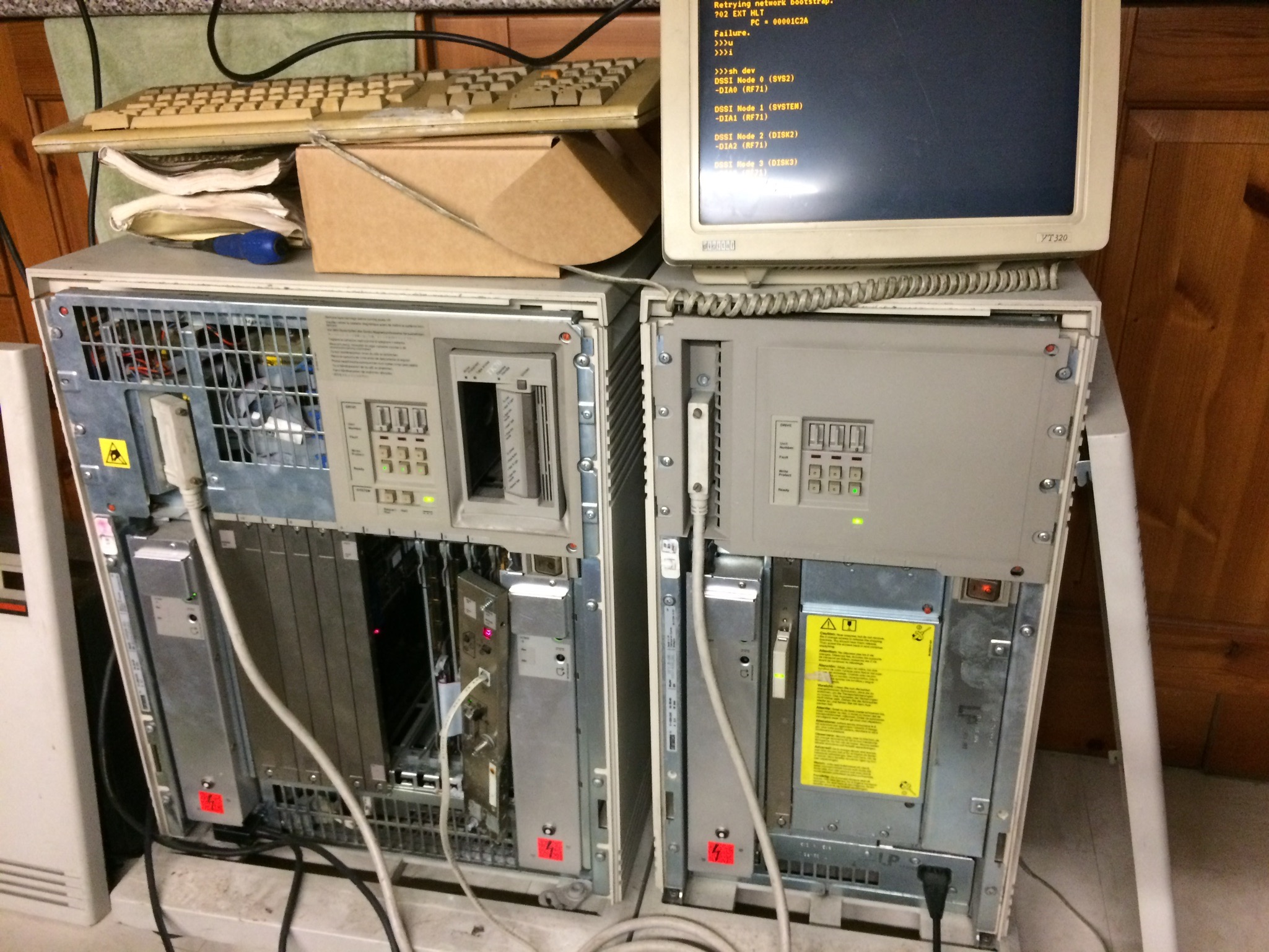
I've got my VAX3800 resuscitated after many years in limbo and two of the
four RF71s in there have gone bad. Has anyone tried swapping the controller
boards between drives? Is it just a matter of letting the drive
auto-calibrate or do I need to SET HOST onto the controller and tell it it's
on a different HDA...
Here it is in a happier mood shortly after first powerup:
http://www.binarydinosaurs.co.uk/VAX3800.jpg
(not my best LK201 keyboard but it was the closest :) )
--
Adrian/Witchy
Binary Dinosaurs creator/curator
Www.binarydinosaurs.co.uk - the UK's biggest private home computer
collection?
I don't see these manuals online at either bitsavers.org or hpmuseum.net.
Does anyone have copies of them available?
12044-90001 HDLC Direct Connect Interface Hardware Reference Manual
(12044A for A/L-Series)
12825-90001 HDLC Direct Connect Interface Hardware Reference Manual
(12825A for M/E/F-Series)
I have more than one HP-1000 CPU. Just curious what it would take to
connect some of them together running 91750A DS/1000-IV software.
So, I'm winding up to boot Unix V6 from an RX02 floppy. So I need two things:
- Details of how DEC ROM bootstraps boot from RX02's. I vaguely recall seeing
documentation of this somewhere (e.g. which sectors it loads, etc), but now I
can't find it. Don North has dumps of the RX02 ROM's, but I'm too lazy to read
through the code and figure out how they work. Is there some documentation
which covers it? I did a quick Google search, but if there is anything out
there, my Google-fu was inadequate.
- Did anyone ever do an RX02 driver for the V6 disk bootstrap? (Well, I guess
a V7 driver would work, too.) Note: what I need is _not_ either i) the Unix OS
driver for the RX02 (I found one of those already), or ii) a driver for the v7
standalone second-stage bootstrap (which would probably be in C). The thing
I'm looking for would be called rx.s, or something like that. Yes, I could
write it, but again, I'm lazy! :-)
Noel
I have uploaded a set of disk images from My Compupro system with an 8085
and 8086 card, plus regular z80. The thread starts a number of years ago,
but today I just updated, at the bottom, to include images of the disks I
have for the system.
Some interesting concurrent CPM and DOS stuff, not sure if this is really
MS DOS 1.25 or not, never got it to work on my system. I'd love to see
someone else make it work.
Thread:
http://vintagecomputer.net/browse_thread.cfm?id=265
Just get the IMD images:
http://vintagecomputer.net/disk_images/COMPUPRO/
As always, thanks Dave Dunfield, please use the images with the proper
licenses, etc.
Bill
SEEKING GOOD ILLUSTRATIVE MATERIAL ON IBM ADD ON BOXES GOT A STACK..
So need hi res scans of catalogs brochures etc showing them all
stacked and what when with what.
We had an early IBM pc for a while....but never this many add on boxes!
I am lost... Remember back in the 80s I sold HP stuff... any
help and guidance appreciated to make this all come together into
something nice visually!
thanks Ed Sharpe archivist for SMECC couryhouse at aol.com
Re: DEC bus transceivers
> From: allison
> Actually since about 1987 I've used about 1200 pieces of the 8641 alone
> repairing boards at the commercial level.
Well, that's over almost 30 years - and your total from that period is about
4% of the remaining stock (and in a commercial operation, to boot, not
hobbyist)...
> If you going to build a board or three maybe even 20 its not a big deal
> but its not a reliable source of predictable quality.
Sure, but try looking at it from our perspective: we either use an
out-of-production part, or have to design something (almost certainly from
discretes) that meets those specs; and we actually looked at the latter (viz.
Dave B's design). However, after some pondering, and taking everything
(including all the below) into account, we decided to go with the original
chips, since they were still sorta available.
Which is why both we and Guy have stocked up on them, at the start of the
process: we don't want to crank out boards designed for a certain part, and
then not be able to get the out-of-production parts the boards were designed
to use.
If we were designing something for serious production, that wouldn't be an
option, but for limited-volume hobbyist use, it is. The choice of an
out-of-production part does have a down-side, but it's minor (and mostly
alleviated by the pre-buying), and the other options were (in overall sum)
worse.
> If you get to the bridge your talking redesign in reality or an
> expensive buy from unreliable source then testing them in bulk.
But, but... I'm _already_ buying them from unreliable sources, then testing
them! :-)
But to be serious - if the demand for QSIC's, etc, runs the well of DS8641's
dry, yes, we'll probably have to re-design. In other words, we'd be right
where we'd be today if we decided not to use out-out-production parts.
Noel
Hi all --
Just wanted to let you guys know that a new version of the Xerox Alto emulator I've been working on at the LCM+L has been released; V1.1 of ContrAlto can be downloaded from: http://www.livingcomputers.org/Join/Online-Systems.aspx. At this point, the vast majority of software appears to be working properly, if you do run into any issues please let me know!
ContrAlto is open source, so if you want to hack on it the source is available on our GitHub site at https://github.com/livingcomputermuseum/ContrAlto.
Thanks!
- Josh
Many of us maintain large collections of bits that we'd like to preserve over a long time, and distribute, replicate, and migrate via unreliable storage media and networks. As disk sizes (and archive sizes) have increased, the probability of corruption undetected or uncorrected by the mechanisms normally built into disk drives, network protocols, and filesystems has increased to a level that warrants great concern.
I would be interested to know if there exists an archive format that has the following desirable properties:
1) It is well-documented, and relatively simple, to facilitate its implementation on many platforms present and future.
2) It supports some degree of incremental updating, but need not be particularly efficient about it. An explicit compaction operation is preferable to an overly complex format. It is adequate to use append-only strategies appropriate for write-once media.
3) Insertion and extraction of files, copying of the archives, and other archive-manipulation utilities support end-to-end verification that identical bits have been stably recorded to the media, bypassing or defeating platform-level or hardware-level caching mechanisms. Where this is not possible, the limits must be carefully delineated, with some basis for determining the properties of the platform and certifying reliability
properties where possible.
4) The format should provide for superior error detection capability, designed to avoid common failure modes with mechanisms typically used in hardware. For example, use a document-level cryptographic checksum rather than a block-level CRC.
5) The format should include a high degree of internal redundancy and recoverability, say, along the lines of a virtual RAID-array.
Just as biological organisms constantly correct DNA transcription errors,
the idea is to have a format that is robust across long-term exposure to
imperfect copying and transmission channels.
Does anything like this exist?
--Bill
I too have been searching for documentation/schematics for the Cambridge
Memories, Inc. Expandacore18 4k core memory boards. I have an old
Diversified Numeric Applications Med PL/185 machine which is a clone of the
Raytheon 703. This machine has 16k of core with 4 of these boards.
--
THE BLUES IS THE TRUTH. IF IT'S NOT THE TRUTH, IT'S NOT THE BLUES. (Willie
Dixon)
Here is an interesting article from the ozobob list on 50 yeas of
computing in the US Army!
http://www.dtic.mil/get-tr-doc/pdf?AD=ADA431730
About the earliest thing we have militantly computer related in the
museum are some parts of the NORAD SAGE system
(Apologies if this gets posted twice, e-mail changes appear to have lost
the first one...)
Hi all --
Just wanted to let you guys know that a new version of the Xerox Alto
emulator I've been working on at the LCM+L has been released. V1.1 of
ContrAlto can be downloaded from:
http://www.livingcomputers.org/Join/Online-Systems.aspx. At this point,
the vast majority of software appears to be working properly, if you do run
into any issues please let me know!
ContrAlto is open source, so if you want to hack on it the source is
available on our GitHub site at
https://github.com/livingcomputermuseum/ContrAlto.
Thanks!
- Josh
I have pmaz SCSI controller, a couple lofis, and a bunch of 8MB pmax+
modules that are being threatened with the local electronics recycler.
send me the address of your good home or place of business in the
continental US states, and I'll spare them that fate.
--
Aaron J. Grier | "Not your ordinary poofy goof." | agrier at poofygoof.com
I scanned my copy of the Hitachi 303 manual a few weeks ago. For anyone
interested in downloading it, I uploaded it here:
https://drive.google.com/open?id=0B8Ow1Wo1rBQUSVdXQU84SWtVRFU
Didn't see it on Bitsavers yet, so I thought I would share.
Thanks,
Kyle
I have not had good luck with the RuGRiD list. I am aware of it.
There are only a small handful of people there with Compass gear; It is
mostly centered around the later PC-compatible GRiD stuff.
There is one fellow with quite a lot of Compass media who has reached out
to me a couple times, but I don't get the drift he sees any urgency in
imaging the media, nor intends to share it. I have offered a hand, money,
etc.
If he does come through, I'll be very pleased, but at this point I am
trying to look elsewhere.
Steve, if you're willing to cross-post my list below and see if you have
better luck, please do.
I have never received a single response of value on that list.
- Ian
On Tuesday, October 25, 2016, Steve Hatle <shatle at nfldinet.com
<javascript:_e(%7B%7D,'cvml','shatle at nfldinet.com');>> wrote:
>
>
>
> -------- Original Message --------
> Subject: Need to archive: GRiD Compass Computer Operating System
> Software
> From: Ian Finder <ian.finder at gmail.com>
> Date: Tue, October 25, 2016 7:08 pm
> To: "cctalk at classiccmp.org" <cctalk at classiccmp.org>
>
> Folks, there appears to be a large GRiD-sized hole where archived copies
> of
> the Compass Computer Operating System software should be.
>
> ...
> --
> Ian Finder
> (206) 395-MIPS
> ian.finder at gmail.com
>
> >>
>
> There's a fairly active GRiD list at
>
> http://groups.yahoo.com/group/rugrid-laptop/
>
> You may wish to cross-post there, or I can if you don't wish to join up.
>
> Steve
>
--
Ian Finder
(206) 395-MIPS
ian.finder at gmail.com
I picked up an Informer 213 from eBay this week, but it has the IBM rom
set! Noooooo!
Anyone out there with the VT100 version willing to dump the roms for me?
Thanks,
- Ian
--
Ian Finder
(206) 395-MIPS
ian.finder at gmail.com
> From: allison
> What vendor
I don't recall, would have to look it up; I turned Guy onto them, and he
bought out everything they in stock.
> They have been scarce save though resellers that have NOS parts from
> old stocks and they are not cheap and unpredictable quantities.
Yeah, that vendor said they could get more (apparently from others who still
had stocks), but they'd be slightly more expensive. Apparently these people
all interact, and deal stuff around.
So that figure I was given of 30K in stock is probably not from that one
vendor, but across all of them. But since nobody is using these chips in a
product (that I know of), I suspect the number is likely to go down only
slowly.
> Then I could buy them they are about .86 dollar US, but that was in the
> early 80s.
The ones Guy and I recently bought were about $1 each (I don't recall the
exact amount, would have to check). So not cheap, but not ridiculous.
Noel
> From: Paul Koning
> The trouble with chip resellers is that it's hard to know which ones are
> legit, and which ones are in the fake chip business.
I suspect that the network of major resellers would tend to keep out the
riff-raff. (They don't need the aggro of dealing with the consequences.)
> a 7400 instead of something more valuable.
Which is why it's good that the DS8641's are going for little more than a
buck; at that price point, there's only minimal benefit from faking them.
Anyway, for any I get, random samples go straight into my tester board!
"Trust, but verify!" :-)
Noel
Hello,
surely the old transceivers are the most compatible solution, however you
still need to convert the voltages back and forth...
Plus the solution is not the cheaper, and a little uncomfortable too, as
you need to find these old chips, hoping not to buy fake chinese duplicates
(it happened to me more time unfortunately).
So I was searching a solution with modern components, but not using
components too much specific and difficult to be found.
As we need 3.3v logic, but able to work in 5v bus, I'm thinking about 5v
tolerant standard logic as TI LVC or LVT.
The problem is that there aren't open drain bus transceivers, but the
problem could be solved simply using input-only and output-only components,
connecting two in parallel but opposite direction on bidirectional pins.
So identifying one or maybe two codes would be enough for all the
components needed for the board.
The idea of using bare transistors seems to me too much simple.
Not that it couldn't work, but it would be almost impossible to satisfy all
the specifications of the bus in this way... unless you use a more complex
circuit with precise current sources and resistors to grant correct voltage
biases, impedances and slew rates, which in the end is a logic integrated
circuit.
Andrea
> From: Guy Sotomayor
> Secondary chip marke[t] (only reputable vendors).
I'm a little more willing than Guy to troll in disreputable waters (I bought
1K DS8641's from a source in Hong Kong), so I have this:
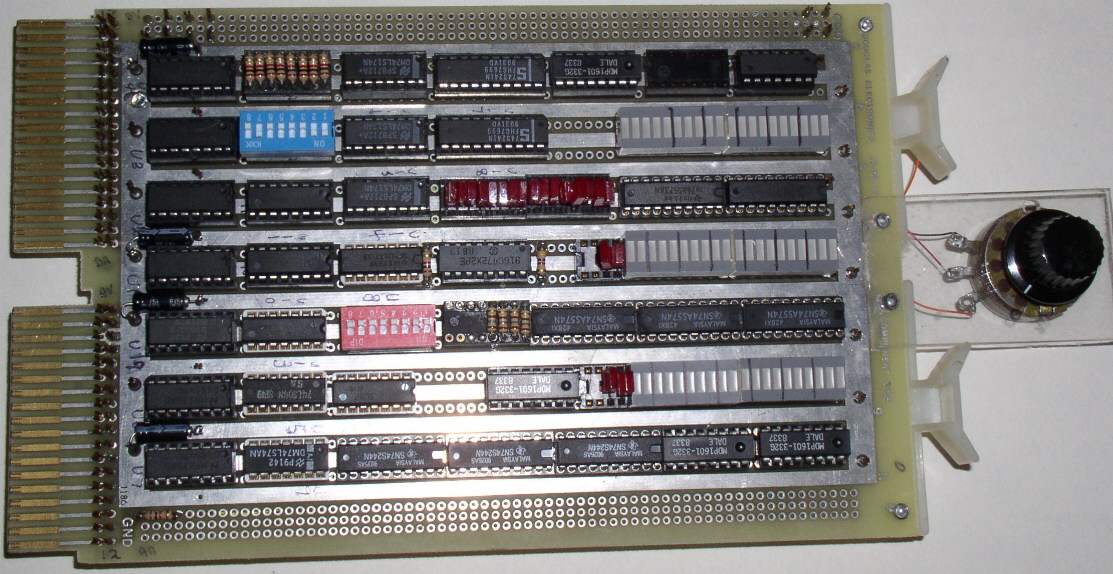
http://ana-3.lcs.mit.edu/~jnc/tech/QSIC/TestCardF.jpg
which has a bunch of special circuits on it to test chips to make sure they
meet specs; e.g. the large potentiometer is so I can vary the input voltage
to see where it switches from 0 to 1, etc.
> From: Paul Koning
> it would be odd to have one; I can't think of anyone who would expect a
> PDP11 to work with part of its devices powered down. For one thing, if
> the box with the terminator loses power
Forget the terminator - as Jon Elson also points out (his email appeared
while I was creating this one), any device which uses interrupts, if
un-powered, won't pass grants.
> From: allison
> Bottom line is someday there will be no DEC parts and what then? I
> reserve DEC parts for repairing defunct boards for new and unique build
> it would be a waste of scarce material.
For actual DEC interface IC's like DC003's, sure. Those are hyper-rare.
But DS8641's are available in the 10's of thousands, there's no earthly way
we could use them all on repairs. Yes, when they run out, we'll have a
problem - but I plan to cross than bridge _if_ and when we get to it.
Noel
Does anyone remember a subscription time sharing system called, I think, "game master".
It was at least available and marketed in the chicago area... possibly nationwide.
I just wonder if there is any info on what kind of system it ran on and any preserved info etc.
Thanks.
-Bob
Update: I've swapped the displays and drivers around, and the "tunnel"
effect seems to be a property of the panel and not drive electronics.
Perhaps they are all high-hour examples?
Anyone here an electroluminescent display expert?
>
>
> On Wednesday, July 20, 2016, Ian Finder <ian.finder at gmail.com> wrote:
>
>> No, I'm not convinced the EL repro isn't a driver electronics issue.
>>
>> I'm just a little confused about why the issue congregates at the edges
>> of the displays. Any ideas why that might be?
>>
>> I may try swapping the panels around this evening if I am feeling brave.
>>
>> On Wednesday, July 20, 2016, Brent Hilpert <hilpert at cs.ubc.ca> wrote:
>>
>>> On 2016-Jul-20, at 12:52 PM, Ian Finder wrote:
>>>
>>> > I have a few GRiD compass systems and some are suffering from massively
>>> > decreased contrast on the edges of the displays:
>>> >
>>> > [See the system on the left]
>>> > https://www.instagram.com/p/BIGGzUzgat-/?taken-by=tr1nitr0n
>>> >
>>> > [Or this one:]
>>> > http://www.ripstick.com/USCM/images/Grid_Compass_1101_
>>> Laptop_in_Box_002.jpg
>>> >
>>> > Meanwhile, other EL systems I have- like my HP integral PC- haven't
>>> > succumbed to this.
>>> >
>>> > I have seen similar issues on amLCD displays in my Tadpole, Toshiba and
>>> > other machines, so this is something we all may have to confront.
>>> >
>>> > -------
>>> >
>>> > I was wondering if the folks here had theories?
>>> >
>>> > I'm thinking moisture (or air) might be leaking in from the edges of
>>> the
>>> > glass panes, perhaps from a compromised seal- sorry for the silly
>>> picture
>>> > but you can see the composition of the display here:
>>> >
>>> > https://www.instagram.com/p/6BXaLBtSzd/?taken-by=tr1nitr0n
>>> >
>>> > Does anyone know how one might prevent this from progressing- storage
>>> tips?
>>> >
>>> > Could it be reversed?
>>> >
>>> > Better yet, does anyone have ideas on how to rapidly dehydrate the
>>> display?
>>> > Perhaps there is even a way to re-seal them.
>>> >
>>> > I think all two-glass-pane displays that don't have a vacuum may
>>> eventually
>>> > succumb to this.
>>> >
>>> > Perhaps it is just oxidation and not moisture, but I'd love to hear any
>>> > theories.
>>>
>>>
>>> Are you convinced this is a panel problem rather than a driver
>>> electronics problem?
>>>
>>> In one picture it looks like the sort of thing that happens when you
>>> have to turn up the brightness (for some types of display), resulting in
>>> partial illumination in other areas of the screen.
>>>
>>> I've never had opportunity to repair or work on EL flat-panel displays,
>>> I'm not familiar with the driving techniques and requirements, so this is
>>> just a query/guess. (I see it's an X/Y matrix drive scheme, but the
>>> voltages & timing & phasing I don't know about.)
>>>
>>>
>>
>> --
>> Ian Finder
>> (206) 395-MIPS
>> ian.finder at gmail.com
>>
>>
>
> --
> Ian Finder
> (206) 395-MIPS
> ian.finder at gmail.com
>
>
--
Ian Finder
(206) 395-MIPS
ian.finder at gmail.com
even with shipping across the pond a great deal if your system is
missing one!
Ed#
In a message dated 10/25/2016 3:15:40 P.M. US Mountain Standard Time,
linimon at lonesome.com writes:
If it were on this side of the pond I'll be all over that.
mcl
-------- Original Message --------
Subject: Need to archive: GRiD Compass Computer Operating System
Software
From: Ian Finder <ian.finder at gmail.com>
Date: Tue, October 25, 2016 7:08 pm
To: "cctalk at classiccmp.org" <cctalk at classiccmp.org>
Folks, there appears to be a large GRiD-sized hole where archived copies
of
the Compass Computer Operating System software should be.
...
--
Ian Finder
(206) 395-MIPS
ian.finder at gmail.com
>>
There's a fairly active GRiD list at
http://groups.yahoo.com/group/rugrid-laptop/
You may wish to cross-post there, or I can if you don't wish to join up.
Steve
Folks, there appears to be a large GRiD-sized hole where archived copies of
the Compass Computer Operating System software should be.
For those not aware, GRiD had an OS product that was quite advanced for the
time- with bitmapped graphics, multitasking, a beautiful forms-driven, UI,
etc.
Unfortunately, nothing but the basic OS seems to be preserved anywhere- no
add-on software, not even the utilities needed to format the hard drive.
This is a travesty- GRiD made something far more important than PC clone
machines, at one time.
*** I'm looking for leads on any software products mentioned below, or at
this URL:
http://www.1000bit.it/ad/bro/grid/GRID-1984-PriceList.pdf ***
I have been buying manuals for the express purpose of scanning, and have a
great deal of coverage, but am short on software.
I am not opposed to paying for any of this, nor shipping and returning the
original copies to the provider at my own expense.
I will certainly put all the images in Bitsavers, if Al is okay with that-
otherwise they will be made available through some other means.
Any leads on GRiD media is appreciated.
Thanks,
- Ian
GRiDWrite, Management Tools, GRiDVT100, and GRiDbasic have already been
preserved.
[35], [36] and [37-47] would be incredible to find.
REF PRODUCT MODEL VERSION NOTES
--- ------------------------- ----- ------- -----
18 GRiD-OS 110X/112X 29200 3.1.0.A [6]
19 GRiD-OS 113X 29210 3.1.5.D
20 GRiD-OS 110X/112X 29200 3.1.0.A
21 Management Tools 21100 3.1.0
22 GRiDMaster 21231 3.1.7
23 GRiDPaint 21214 3.1.5
24 GRiDWrite 21132 3.1.7
25 GRiDAccess 21212 3.1.7
26 GRiDPlan 3.1.5
27 GRiDPlan II 3.2.1
28 GRiDWrite 21132 3.1.7
29 GRiDVT100/Reformat 21191 3.2
30 GRiDVT100/Reformat 21191 3.1.5
31 GRiD3101/Reformat 21151 [7]
32 GRiD3101/Reformat 21151 3.1.5 [7]
33 GRiDTek4016 21228 36.9.4 [7]
34 GRiDTerm/Reformat 21141 3.1.5
35 GRiDTransfer/Partition 21210
36 GRiDRecord/Playback 3.1.5
37 C-86 23032 3.2.0
38 Pascal-86 23025 0.3.1 [1 COPY SOLD]
39 FORTRAN-86 23015 0.3.0
40 PL/M-86 23030 0.2.7
41 BASIC 3.1.0 [7], [1 COPY SOLD]
42 ASM-86 23031
43 GRiDDebug/Devel. Tools 29300 3.1.7
44 GRiDDebug/Devel. Tools 29300 3.0.0
45 GRiDTask II / Windows 21230 3.2
46 GRiDTask II 21230 3.1.7
47 GRiDTask 21230 3.1.7
48 ROM Builder 2.1.0 [7]
49 ROM: GRiD-OS System 112X 24100 3.1.0 [8]
50 ROM: GRiD-OS System 113X 24180 3.1.5 [8]
51 ROM: GRiD-OS Utilities 21400 3.1.0 [8]
52 ROM: GRiDMaster 3.1.7 [8]
53 ROM: GRiDVT100/Reformat 24150 3.2 [8]
54 ROM: GRiDWrite/Term/Refmt 24140 3.1.5 [8]
--
Ian Finder
(206) 395-MIPS
ian.finder at gmail.com
Friend of mine pointed this out to me, but I'm a software guy, don't have
any use for hardware. Maybe you guys would be interested.
http://www.ebay.co.uk/itm/DEC-PDP-15-console-panel-von-1970-/112179257620?h…
8 days left. I think he failed to sell it previously at 130 Euros so that
probably sets an upper limit on the auction price.
Graham
> I'll start with getting VTServer to run under V6 (my only Unix, don't
> have anything later :-)
So, I just got VTServer runnin under V6: it successfully loaded a memory
diagnostic from the 'server', into the 'client', using 'vtboot' on the
latter. (Both running on emulated machines, for the moment - I thought I'd
take all the hardware-related variables out of the equation, until I have the
software all running OK.)
It didn't require as much work on VTServer as I thought it might: I had to
convert the C to the V6 dialect (no '+=', etc), and some other small things
(e.g. convert the TTY setup code), but in general, it was pretty smooth and
painless.
Note that it won't run under vanilla V6, which does not provide 8-bit input
and output on serial lines. I had previously added 'LITIN' and 'LITOUT' modes
(8-bit input and output) to my V6; since the mode word in stty/gtty was
already full, I had to extend the device interface to support them. I didn't
add ioctl() or anything later, I did an upward-compatible extension to
stty/gtty. (I'm a real NIH guy. :-)
My only real problem in getting VTServer running was with LITIN; I did it
some while back, but had never actually tested it (I was only using LITOUT,
for my custom program to talk to PDP-11 consoles, which also did downloads,
so needed 8-bit output). So when I went to use it, it didn't work, and it was
a real stumper! But I did eventually figure out what the problem was (after
writing a custom program to reach into the kernel and dump the entire state
of a serial line), and get it working.
(I had taken the shortcut of not fully understanding how the kernel serial
line code worked, just tried to install point fixes. This turned out not to
work, because of a side-effect elsewhere in the code. Moral of the story: you
can't change the operation of a piece of software without complete
understanding of how it works...)
Is there any interest in all this? If so, I can put together a web page with
the V6-verion VTServer source, along with the modified V6 serial line stuff
(including a short description of the extended stty/gtty interface), etc.
> so if you turn up whatever you used to boot V6, it would probably still
> be useful.
So I guess my next step, if I don't hear shortly from someone who has
previously used VTServer to install V6, is to start on actually getting
a V6 file system created.
I'm still vacillating over whether it would be better to go V6-style (and
just transfer a complete, small existing V6 filesystem), or V7-style (and
get stand-alone 'mkfs', etc running with V6-format file systems). Anyone
have an opinion?
Noel
Hi Noel,
>> Any chance it could be put into 'production'?
Sure, if there is interest, I could make a run of boards.
>> Also, what FPGA board are you using? I assume it's one that has an SD
>> card socket or something, for actually storing the bits on?
My project is just an interface board for an existing RL02 emulator
project: www.pdp11gy.com There are a multiple project revisions listed on
the pdp11gy.com site that use different Altera FPGA dev boards: DE0 Nano,
DE0 Nano SOC, and BeMicro CV.
I was planning to use a Terasic DE0 Nano dev board since these boards can
be found on eBay from $50 to $100. The DE0 nano does not have an micro-SD
card socket which is why there is a socket on my interface board.
http://sierracircuitdesign.ddns.net/temp/RL02
The DE0 Nano SOC, and BeMicro CV dev boards have micro-SD card sockets, so
if you used one of those, then you would not need to populate the micro-SD
socket on the interface board. According to the author of the
www.pdp11gy.com RL02 project, the 40-pin headers on DE0 Nano, DE0 Nano SOC,
and BeMicro CV are compatible, so you could use my interface board with any
of these boards.
Regards,
Scott
Does anyone have a datasheet for an Intel 8089A, 8089A-3, or 8089-3?
The only datasheets I've found are for the "plain" 8089 with no "A" or
numeric suffix. The component resellers show better availabiliity for with
the "A" and/or "-3" suffix, though it's possible that those are in error.
The 8089 is an I/O processor. The "-3" suffix is most likely a speed grade.
The standard part without the "-3" is 5 MHz.
Hello all together,
i restore a rk05 disk drive in combination with an Plessey RK8E clone
controller.
Now the drive itself is restored, and the connection cables are built.
My problem is that the rk8e diskless controll test (dhrka) fails with an
data break error. The diskless controlltest
is running throug all register and also the databuffer test. But in the
first data break routine it fails.
Then i toggled in the Example program from the maintanence vol.III,
Single Cycle Data Break Transfers (Write than Read).
With this program the content of the SwitchRegister is written through
the data buffer registers and read back to the memory.
Afterwards it is compared to the original SR content. I found out that
the routine is running if SR=7777. Deeper investigation results that the
bits 0, 1, 4, 6 and 9 have to be one`s to run the routine. The other SR
bits are switchable while running the program.
Next thing i did is trying read data with futil. i could read data form
the disk. But with many read errors.
Because i do not know anything about the allignment between my diskpack
and the drive, i formated the pack
with the RK8E Formater (dhrkd). The write part of the format is running.
In the disk checking part the formater fails.
Anyway. Then i used futil and scanned the whole surface off the
diskpack. On the whole disk are 5 bad blocks left.
Now i am able to dump blocks from the disk. But it seems that no matter
witch block i dump out, it is the same block
all over the disk. Afterwards i tried to modifie some words in block 0.
And this is working. When i write the modified block i see the
modification also in every other block of the disk.
Have anyone the lightning idea?
On a Google search i found a post of Rick Bensene from 2014 on this list
witch described a similiar problem.
In this discussion where talked about an spike in the load signal of the
current address register.
I checked that and see that this was not my problem.
Thanks in advance
Marco Rauhut
Hello,
we are discussing on separate thread about doing an universal interface for
PDP11.
I'm taking all the relevant documentation about Unibus and Qbus busses,
aiming to check the possibility of doing a board compatible, with some
adjustments, with both worlds.
I started to read the 1979 specifications, however it's not all clear to
me, specially about Unibus.
What I understood:
- Qbus is complete on A and B connectors, so a dual card could be done.
Some backplanes have a true serpentine, while some other has C and D with
other signals, but those are of particular usage with dual-board interfaces.
Basically both dual and quad boards can be done, with the latter using A
and B and simply propagating grant on C and D, supposedly connected in
standard serpentine.
Unibus: the specifications are describing A and B, but backplanes are
complicate than that, and can have Unibus, Modified Unibus, Extended
Unibus, SPC...
What for?
If all the signals are in AB, why they are connected again in CDEF?
There's some complete documentation about the different backplane types,
and the standard approach for an Unibus board?
Thanks
Andrea
> From: David Bridgham
> Just the bus interface takes over half the area of a dual-height board!
In part because the level converters are SMD, and we had to mount them on
(modified) wide DIP carriers to use them in a wire-wrap board.
> I've played around with laying out what might be the production board
> ... and I've got it down to a row of 8641 bus transceivers and a row or
> two of the level-converter chips.
> http://pdp10.froghouse.org/qsic/proto-pcb.jpg
For those looking at that picture, it's not our current plan for 'producton'
QSIC's; the one in the picture uses a daughter-card with an FPGA on it, but
that makes the card to high to fit into a single slot. So the current plan is
to do a card with an FPGA on it directly.
Noel
> From: Glen Slick
>> Went unsold at $3500. Relisted, this time at $5000.
> there was a taker for that 11/35 at $5000 today....
Smack me with a wet halibut. They must not have seen the original listing?
I can't come up with any other explanation why someone would pass up a chance
to buy it for $3.5K, and pay $1.5 more for the priviledge...
Noel
> Philipp Hachtmann wrote:
> Was it really sold? I can't figure that out from here. Only "listing
> has ended". And when I try to search for it, the website doesn't show
> it :-(
??? If you go to the listing:
http://www.ebay.com/itm/142146207101
the image has 'Sold' emblazoned across it. And if you click on that image, it
takes you to the original listing, which says "Sold for: US$5,000".
Noel
Hi folks,
Now that the bouncing has calmed down I've got a question about this here
triple output pretty ubiquitous power supply. This one had some burst caps
so naturally wasn't working and was probably why the machine it came out of
was taken out of use.
I've replaced all of them because why not, along with the .1uF mains
filtering cap that would also burst at some point and I still get low output
on all rails. I've tested all the major components out of circuit and
checked for shorts; in Apple ][ power supplies (also Astec, apart from the
ones that aren't) low output is mostly caused by a feedback capacitor (C7)
going out of spec, but these are all new and as close a match to the
originals I could find.
One thing I've not done is reflowed all connections so I'll do that later,
but has anyone got experience of common failure modes with these things?
Cheers
--
Adrian/Witchy
Binary Dinosaurs creator/curator
Www.binarydinosaurs.co.uk - the UK's biggest private home computer
collection?
Hi All,
I have a few IBM PS/2s in various states of disrepair that are free to
anyone willing to collect from Yatton (Near Bristol), or arrange a courier.
Systems as follows:
Model 30-286 - powers on to BASIC prompt, bad floppy drive, missing hard
drive. A few minor scuffs, should make an easy restoration.
Model 50 - Boots from HDD to DOS, has bad sectors but might be OK after a
low level format, haven't tried it because the FDD is bad. Includes
untested tape drive in the second 3.5" drive bay. Some rust spots on case.
Model 77 - Very good cosmetic condition but doesn't power on, corrosion
around the BIOS chip so I'm guessing it's because of that.
If anyone's interested I can take photos and find out the system specs. I
also have one of the later IBM PS/2 mice.
Regards,
-Tom
> From: Scott Baker
> Feedback on this project is most welcome.
Any chance it could be put into 'production'? It just seems to me that
rather than having 53 people send in individual orders for boards, etc
it would be better (and also perhaps get a price break due to volume)
to do a small run. (You may not want to produce complete boards, but
even kits would be useful.)
I think an RL02 simulator is a great idea; those of us with RL0x controllers
could use this most of the time, avoiding potential damage to our old
drives/disks; I know I would buy several if they were available.
Also, what FPGA board are you using? I assume it's one that has an SD
card socket or something, for actually storing the bits on?
Noel
The fact that the installation procedures for V6 and V7 are wholly different,
in their technical detail, was apparently not well known.
The 'Setting up Unix' documents are more checklists, they don't go into a lot
of detail as to what is actually happening, so I have prepared two pages on
the Computer History wiki:
http://gunkies.org/wiki/Installing_UNIX_Sixth_Editionhttp://gunkies.org/wiki/Installing_UNIX_Seventh_Edition
which go into more detail on what is actually happening.
Noel
On 22 October 2016 at 17:27, Adrian Graham <witchy at binarydinosaurs.co.uk> wrote:
[..]
>> Same story from me, and I also wondered about the excessive bounces -
>> because of gmail.
>
> Ditto, and ditto. I also thought it was due to the dyndns attack so just
> resubbed after emailing Jay, but if everyone did that who got an excessive
> bounce message the poor chap will have quite a full inbox.
Yes, it must have been that attack. I wasn't aware of it at the time,
probably because I rely on 8.8.4.4. DNS which was never affected.
We still need that global task force to hunt down spammers and
ddos'ers and get rid of them once and for all. Or at least inflict
some discomfort.
Hello Dave,
exactly!
But in place of a plain FPGA, nowadays I would choose a FPGA-ARM board,
for example
the ZedBoard MicroZed or the Myirtech Z-turn, both of them have a Zynq
onboard,
and they can run linux for the software side and programmable logic for
the interface side.
Very nice and flexible.
For the development, I'm trying to figure if an hybrid QBUS / UNIBUS
solution is possible.
Of course one have to switch some jumper to avoid conflicts, but hey, in
the end you
would have a true universal board.
What kind of bus transceivers did you used for the QSIC, specially
because you have
to go from 5V open-drain logic to 3.3V logic?
Thanks
Andrea
On 10/21/2016 07:00 PM, cctalk-request at classiccmp.org wrote:
> You mean, perhaps, something like this?
>
> http://pdp10.froghouse.org/qsic/html/overview.html
> On Oct 18, 2016, at 11:00 AM, cctech-request at classiccmp.org wrote:
>
> does anyone of you happen to have the images of the firmware ROM of
> HP98034 module and/or of the HP9895 disk drive, please?
I?ve sent F.Ulivi the contents of the single ROM version from my 9895A, along with some preliminary reverse engineering work on the contents that I?ve done in conjunction with Eric Smith.
Just curious, I probably could have just asked Jay but incase this was wider spread I received a message that my subscription at my Gmail was suspended due to bounces. I was wondering if that may have been only today and more widespread from the Dyn dns ddos that happened? If so others may want to double check for similar issues as I probably missed some messages today.
No biggie, just a PSA if it affected more than myself.
micropolis 1325
--sectors 16,0 --heads 8 --cylinders 1024 --header_crc 0xffff,0x1021,16,0 --data_crc 0xffffffff,0x140a0445,32,5
--format WD_1006 --sector_length 512
40 meg disk in the system used a 1323, 4 heads instead of 8
OK, I have a fairly large collection of VAX 4000 and VAXStation 3000
systems which I have fun with and use with both OpenVMS and OpenBSD
over the years....
But, I also have two big rubbermade containers (about half a cubic
meter) filled with TK50 and TK70 tapes which I have never used.
Some are blank, some are the boot & install media for VMS 5.5, some are
software installations, etc. etc.
In the past 25 years that I have had them, I have not once ever used
my TK50 or TK70 drives...I've always either booted off the attached
disks or netbooted.
Should I just throw these things out? Do any collectors consider them
to be valuable? Since it's now 2016 and I think the last TK tapes were
made in the 1990s, I'm getting the urge to toss them.
Opinions? Comments?
---------------
Thomas "PDP-11" Dzubin
Vancouver, Calgary, or Saskatoon; CANADA
I wouldn't dismiss it if you're using images or any used software. Yes some platforms are more susceptible than others but unless you have no hard drive, power your system off after every use, and never switch disks while system is running it's still something that can infest your originals or archive.
Dan's great collection of cpm is a good example of something that ended up passed around the community and had a few infected images. ?Depending on whether it's a file, boot sector, MBr or TSR it will different and potentially detrimental impact.
I stopped archiving my Amiga disks but at a place I worked that had Amiga systems some kids brought in lots of games (some cracked) and while we didn't allow that it was spring break and they had finished their work. What's the worst that could happen? Kids slowly starting to walk up and say their computer says it's infected with a virus.
Probably one disk but who knows how many were infected after that. Took me longer just to find an antivirus for the Amiga than to get the systems cleaned lol but still, an unexpected pain.
One of the best preventative methods if the software doesn't need to write to the originals is write protect the floppy. ?But buying used, who knows if the previous owner was computer savvy or safe.
-------- Original message --------From: Steven M Jones <classiccmp at crash.com>
Well, glad to hear there's nothing to worry about.?