Several people asked me about archive pages for past Vintage Computer
Festival events. Much of the information was lost during a rebuild of
the former Festival owner's web site, however, much of the same
information was also available at Archive.org. Tonight we posted about
50% of the basic date from past Festivals -- when, where, who -- at
http://vcfed.org/wp/festivals/archives-show-summaries/. (It would be a
HUGE amount of work to post the exact web sites from past Festivals, and
there's not much point to saving the logistical information about what
time of day people will speak, etc., so what we are posting seems like a
good balance.) We hope to get the remaining 50% onto the page soon. PS.
You'll notice that the page is being populated from the bottom-up. No
particular reason why.
________________________________
Evan Koblentz, director
Vintage Computer Federation
a 501(c)3 educational non-profit
evan at vcfed.org
(646) 546-9999
www.vcfed.orgfacebook.com/vcfederationtwitter.com/vcfederation
Hey folks,
I've gotten to the part of a PDP-11/45 restore I?ve been working on where I need to run a Unibus cable between the CPU box in one rack and an RK11-C controller at the top of the next rack over. I'm a bit puzzled about how best to run the bus cable to keep it out of harm's way, e.g. getting it accidentally pinched or crimped while sliding the CPU cabinet in and out for service.
I can see there's a nice cable exit at the back of the sliding CPU cabinet, but from there...?? Anybody have a picture or remember how this was usually done around the slide rails etc. to avoid trouble?
The RK05 manuals do have recommended dress for drive cables between drives and the controller, but I haven't seen any recommendations for the cabling Unibus between cabinets anywhere yet.
cheers,
--FritzM.
If you're part of the AppleFritters forum you may have seen that I put it
up for sale, but if you're not and you're interested, please drive me an
email! I'm planning to put it up on eBay later tonight if nobody here is
interested :)
SN 1718
http://imgur.com/a/Bt2UV
-Andy
Guys,
I'm working on a special TU58 emulator called "tu58fs".
It saves the "tape content" not only in a binary image file, but also as
a file set in a shared directory on the host.
The content of the "tape" (as seen by the PDP) changes automatically as
files are moved in and out of the shared dir.
This works in both direction: creating/changing/deleting a file on the
"tape" modifies the files in the directory.
Today tu58fs passed the tests for standard XXDP tapes, good time to tell
the world about it.
If you like to have a look (and play beta tester):
Docs on http://retrocmp.com/tools/tu58fs
C sources and makefile on https://github.com/j-hoppe/tu58fs
tu58fs is intended to be a general tool for easy file sharing between a
PDP and the modern world. For this as much DEC filesystems as possible
should be implemented.
We need more than XXDP, but I wasn't able to find documents about the
structure of DOS-11, RT-11 or FILES-11/ODS-1.
Any links?
Joerg
I posted yesterday about my attempt to weld a IBM PC keyboard to my Compaq model 1 - the 'luggable'.
Well, it did not work, even though I saw clock and data on both Compaq and IBM keyboards that looked the same. I did not dig into the decoding, but somehow they are different.
OK so I already cut into the PC keyboard, a BTC 5100. I let my son play with it and a screwdriver, and as he gets it apart, I see capacitive foam pads inside.
Well guess what, they are the same size and fit for the Compaq Keytronics keyboard!
I popped out all the pads and transplanted them, you push them in and snap the plastic disk in the guides with an exacto, and they work perfectly.
I think a lot of these early keyboards before the switch to elastomeric rubber have these foam pads, and they are a standard size.
If you are stuck with a Tandy, Lisa, Sun with keyboard foam rot, take a look in you junk bin for a IBM PC compatible keyboard, it worked for me.
Randy
I've been working on documenting the hardware in the early Altos x86 machines
and it would be nice to find a copy of the eproms from a 586.
I tried asking Dave Dunfield about this, but never got a reply. Has anyone
heard anything from him lately?
I know Eric Smith was trying to contact him a few months ago about extending
the known disk types in Imagedisk (specifically adding M2FM as one of the formats)
but I don't think he ever heard anything back.
Hi folks,
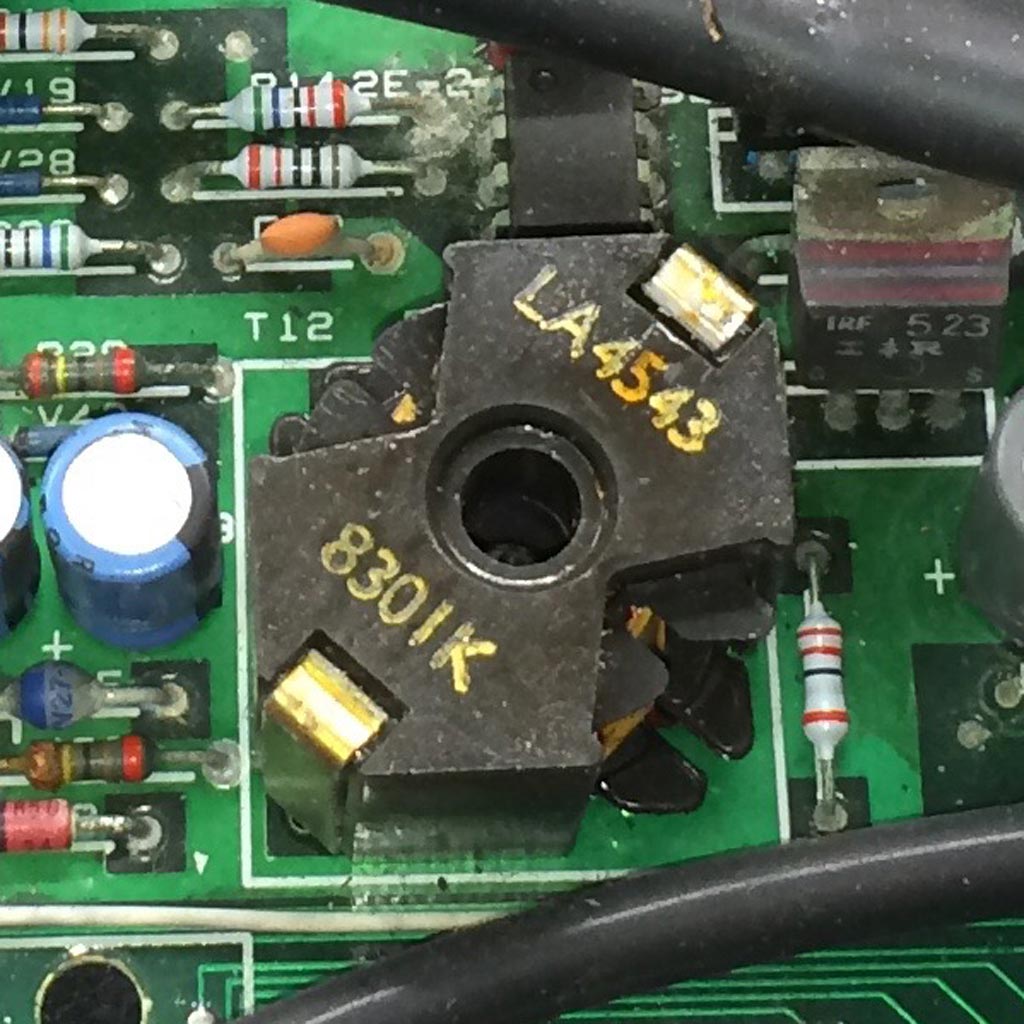
Does anyone know what this is? It's obviously a transformer coil(s) but
image search and googling those markings produces nothing:
http://www.binarydinosaurs.co.uk/la4543.jpg
It's taking and giving +5V but I'm sure it should also be producing another
voltage...
Cheers!
--
Adrian/Witchy
Binary Dinosaurs creator/curator
Www.binarydinosaurs.co.uk - the UK's biggest private home computer
collection?
Clearing out a bunch of stuff I have decided I no longer need around. There may not be any interest here but thought I'd check first. I have several books available for the cost of shipping if anyone is interested, otherwise they'll go to my local book reseller this coming weekend.? All are in pretty much like new condition.
Inside Visual C++ Version 4 - David KruglinskiVisual C++ 4 Unleashed - Viktor TothEssential Visual C++ 4 - Mickey WilliamsWeb Client Programming with Perl - Clinton WongGIMP for Linux Bible - Stephanie Bryant & Tillman HodgsonMangaging the WIndows NT Registry - Paul RobichauxDeveloping CGI Applications with Perl - John Deep & Peter HolfelderSendmail 2nd Edition - Bryan CostalesCore PHP Programming - Leon Atkinson
Also have a Partition Magic 7.0 User guide and Adobe Photoshop 5.5 for Photographers in this stack if anyone is interested.
David Williamshttp://www.trailingedge.com/
I have luggable with the famous Keytronics foam kepad rot.
I am searching for the foam (have not found it yet), and on a lark, I tried using a PC keyboard.
In the PC keyboard, I soldered in a 7805 to take the Compaq 12V to 5V for the PC keyboard.
Traced the clock and data lines, hooked it all up and it does not work.
The Keytronics (compaq) keyboard either has a different protocol or signals inverted, I have not got that far with the scope yet to see the difference.
Has anybody found a source for the Keytronics mylar foam pads?
Randy
Van: Tony Duell<mailto:ard.p850ug1 at gmail.com>
Verzonden: vrijdag 16 december 2016 17:54
Aan: General Discussion: On-Topic and Off-Topic Posts<mailto:cctalk at classiccmp.org>
Onderwerp: Re: Anyone want an RK11-C manual?
On Fri, Dec 16, 2016 at 4:31 PM, Henk Gooijen <henk.gooijen at hotmail.com> wrote:
>
> But I am not giving up hope ? I recently acquired something I did not think
> to be possible to happen ? I ?picked up? an H960 rack with RP11 controller
> and *three* RP03 disk drives aand 6 packs. The rack is already moved, the
> drives are a separate story. Each drive weighs 415 lbs. ?So what? you might
> ask. Well, they are in a cellar and three flights of stairs (10 steps, 6 steps,
> and 4 steps) is too much for 3 strong guys to push one drive up the stairs.
> We are now looking into another option to get the drives (and a DEC
> _line_printer, also very very heavy!) up to the first floor ?
Can these units be dismantled without totally losing alignment,etc. At least
remove PSUs, spindle motors, etc. I once moved an RA60 (much lighter,
but still too heavy for one person to carry easily) downstairs by taking it
almost completely apart. Incidentally, it is surprising how much the PCBs
in a full cardcage weight, it is often worth pulling them all out.
I suspect an RP03 dismantled like that would still be too heavy for one person
to move, but with 3 people it might be possible.
I hope your upstairs floor is strong enough for them... You do not want them
coming back downstairs at 9.81m/s^2
-tony
Grin ? I don?t plan to check whether Mother Earth?s acceleration is still working fine.
Indeed, the RA60 is heavy. Just like RA81?s, the RA60 is not good for your back, but
the RA60 is worse than the RA81. The RA60 is also ?longer? compared to the RA81,
and that does not help either when you hav to move an RA60 around.
I really do not want to mess with the mechanical construction of the entire RP03
drive. They are too rare. I want to move them ?as is?. The only thing that can be
done easily is removing the side panels.
However, the ceiling in the cellar has an opening although that is currently welded
by a closing lid. The system was installed in the 80ties, and it is not remembered
how the system got into the cellar back then. The system has operated in that cellar
for almost 20 years (PDP-11/40, RP11, Kennedy 9100 ? 3 H960 rack system).
I used wooden planks (shelves) laid on the stairs, and then pushed the racks up.
It was heavy, even for 3 strong guys --- OK, 2.5 ? I removed the Kennedy tape
drive to make the rack less heavy. The rack with the RP11 controller was also
heavy, but I really did not want to pull or dismantle anything of it. We got it out
of the cellar. The 11/40 (the 21? version in BA11-F, IIRC) rack had, to my surprise
an extra BA11-F with its H742 PSU ? One H742 PSU is already heavy, so two of
these beast made the rack way too heavy. I ended up with disconnecting the
power harness and move the 11/40 separately. That made it possible to move
the rack upstairs (with sweat and some swearing ^H^H^H^H^H^H^H^H calling
in the help of some gods ?
We did try moving one RP03 by pushing it upstairs using the ?planks? trick.
Three guys asking ?are we pushing?? Yes, but the drive did not move at all.
The RP03 is by far the most heavy item I encountered in 20 years!
We are now looking into the option to hoist the drives via the hatch in the
Ceiling. Needless to say we take all possible precautions ? for people and for
RP03?s.
To be continued,
* Henk, PA8PDP
My rt11 sends printer output to a lpt.txt. I have not done much more
regarding printing than that. I have an LA180 with serial for my actual
pdp8e.
B
Bill Degnan
twitter: billdeg
vintagecomputer.net
> From: Eugene (W2HX)
> Before deleting this, someone ... should double check to make sure I am
> right that the file is incorrect. ... But it seems to be backward to me.
Well, it is, and it isn't. The board is drawn with the 'bottom' (in DEC
nomenclature, for when the board is inserted in a backplane where the slots
run vertically) at the top of the drawing, and vice versa.
But, other than that, it appears to be correct - based on the keyed slots.
(So, the first land, at the bottom of the drawing, which is the 'top' of a
DEC board, normally, is AA. And the last - top of the drawing, 'bottom' of
the card when it's in vertical slot - is DV. Etc, etc.)
Noel
Hi friends.
I am 100% new to my pdp8e and I am troubleshooting a problem.
The problem is that whenever address bit 7 I asserted, I also see MD bit 4 asserted.
I am hoping there is a simple short somehow between these lines somewhere. I should mention that my setup has known working boards with the exception of M8310 does not work (all of my boards were tested in another machine one by one). So I am hoping the problem noted above might be occurring on the M8310 board itself.
I found a document that describes the signals on the bus located here:
http://bitsavers.informatik.uni-stuttgart.de/pdf/dec/pdp8/pdp8e/Omnibus_leg…
I noticed that B1J (MA7) is directly adjacent to B1K (MD4). Could this be related?
So I decided to pull my 8310 and check the resistance between these signals on the edge of the board. However, I cannot seem to square the signals named in the PDF and what I see on the card edge connector on the board.
I am wondering if I am not understanding the PDF correctly. I have the board sitting on my table with the components facing up and the omnibus card edge is at the bottom of the card. Going from left to right, do I have connectors ABCD or is it something else? Maybe DCBA?
Other than the reference PDF, is there another PDF that has a more detailed description of the bus and the signals?
Thanks
Eugene
Al,
I thought the problem with switching these chips was that part of the ROM code was embedded in them? I.e. it isn't just an issue of battery? Am I wrong? If I am then why not use one of the replacement chips that are available??
Thanks.
-Ali
-------- Original message --------
From: Al Kossow <aek at bitsavers.org>
Date: 1/21/17 12:12 PM (GMT-08:00)
To: "General Discussion: On-Topic and Off-Topic Posts" <cctalk at classiccmp.org>
Subject: DS12887 pcb substitute with battery
someone just pointed this out on vcfed
https://oshpark.com/shared_projects/qyNfzAMf
I'm starting to pick up my KA630 emulator again. In particular, I want
to give it MSCP disk.
I have various MSCP documentation files, but they talk about MSCP
proper. None of them describe the Q-bus - nor even Unibus - port
drivers in enough detail for me to write an emulator; most of them
barely mention either Q-bus or Unibus.
I find I wrote a bunch of code, and I'm fairly sure it was based on a
doc file, but I cannot now find that doc file. And I find the code
disagrees with NetBSD's MSCP support. I tried to use the NetBSD driver
as documentation but end up with the response ring doing unexpected
things.
So, I'm looking for the Qbus port specification. One of the text files
I found on bitsavers (a DEC-internal TMSCP document) says "See
UNIBUS/QBUS Storage Systems Port Specification for additional detail".
I also found a message to a simh mailing list, quoting an RQDX3
document which, in its "Applicable Documents" list, has
o UQSSP (Unibus/Qbus Storage Systems Port Specification)
Those sound like what I want.
Anyone happen to know where I might be able to find such a thing?
/~\ The ASCII Mouse
\ / Ribbon Campaign
X Against HTML mouse at rodents-montreal.org
/ \ Email! 7D C8 61 52 5D E7 2D 39 4E F1 31 3E E8 B3 27 4B
Not so much newsworthy, but 2 weeks ago I stumbled by accident on the
serial option for the LA180 (Decprinter I). My offer was accepted and I
got the card 2 days ago. I installed it this afternoon and after
configuring
it and checking the jumpers on the main board, it now works as a serial
printer.
Tomorrow I'm going to connect it with simh and see if printing jobs
will get processed as well.
Ed
--
Ik email, dus ik besta.
BTC : 1Lk6141nvDKPxtCa5erfFyovsoJN2LKqNJ
> From: Eugene (W2HX)
> I noticed that B1J (MA7) is directly adjacent to B1K (MD4). Could this
> be related?
"Rule #1: There are no concidences." :-)
> I have the board sitting on my table with the components facing up and
> the omnibus card edge is at the bottom of the card. Going from left to
> right, do I have connectors ABCD or is it something else? Maybe DCBA?
I don't know Omnibus, but I expect it follows the DEC connector conventions:
http://gunkies.org/wiki/DEC_card_form_factor
and in that configuration, Pfrom left to right, the groups should be D to A.
Generally one goes from right to left, so A to D in that direction; the pins
go from A to V in that direction.
Noel
Hey folks,
Helping my ex clean out her basement, she had a 1999 tray-loading "lime"
iMac G3 that she no longer wanted. The machine is complete w/ original
keyboard, mouse, and power cord. Boots and runs MacOS 9.2. CRT is
arcing occasionally (probably dust around the flyback?)
I'm not a Mac collector, but I scooped it in case anybody here might be
interested? Free for pickup in Oakland or Menlo Park CA, or for cost of
shipping anywhere else. Drop me a line if interested -- otherwise it'll
be off to the local ecycler in a week or two!
cheers,
--FritzM.
Hi folks,
STC Executel fun continues and I'm at the point where I'm fairly sure code
is running but it's stuck in a tight loop waiting for something to happen.
The 8085A reference tells me a non-memory I/O is signalled by IO/M going
high while it puts the port number on the address bus (0xE3 to 0xE8 in this
case), 8 bits on the data bus and sets S0/S1 to be WRITE. If that's the case
then this machine in its current state doesn't do any non-memory I/O - IO/M
is the only signal that stays low. It's not a failed CPU since I have 3
different ones and they all do this.
I've pondered if one of the 3 chips the IO/M signal goes to is pulling it
down; presumably I can test this by lifting the IO/M pin out of its socket
then briefly touching a 1Kohm resistor connected to +5V to the 3 inputs and
watch what the outputs do while the machine is running?
With my little logic analyser on the address bus it's continually active so
it's not a stuck bit either, at least not at the CPU. I can watch the
repetitive patterns while the code runs through 3 delay loops then the
patterns alter while it's off doing....something. All the 4116 RAM chips
seem to be OK too.
I'm also guessing things would be a lot easier if I had a memory map...
Cheers!
--
Adrian/Witchy
Binary Dinosaurs creator/curator
Www.binarydinosaurs.co.uk - the UK's biggest private home computer
collection?
Hi, All,
A friend of mine just returned a modem he got from me decades ago, a
Ventel MD212-plus. It's an early-1980s non-AT-command-set
autodialling modem. The settings are adjusted via a pair of 10-pin
DIP switches accessible from the back. I've checked the web and
bitsavers. So far, all I've found is some old Usenet articles and a
couple of pictures, but no manual or jumper guide.
One "feature" is that it lacks a modular jack to plug into the phone
system. Fortunately, my friend kept the proprietary DA15 cable. I've
never seen that choice of connectors on any other modem.
Does anyone have any Ventel docs?
Thanks,
-ethan
Hi Josh.
I hope you've been well. I noticed you posted recently about have an Imlac
PDS-1D. I'm curious how you came across it as there aren't many out there
as you observe.
I notice you're still trying to get the DPS-6 online. I'm surprised Al
Kossow hasn't been able to help with the operating system software at least.
Sellam
Hi List,
I've had eleven IBM binders with maintenance information in them here
for years. They're not doing anything useful so I'm inquiring here if
anyone wants them.
These are the labels on the spines:
3203-5 MLM , 4 TO 17 , VOLUME 02
3203-5 MLM , 18 TO 28 , VOLUME 03
3704 MLM , VOL 888 [note 1]
3704 ALD , AS CA SB , VOL 4
3704 ALD , YZ , VOL 1
3704 ALD , CC , VOL 2
3704 ALD , MX , VOL 6
3704 ALD , LB , VOL 8
3803 MLM IPC INST GUIDE [note 2]
3803 MLM TAPE SPECS [note 2]
4341 MI P.S. WIRING DIAGRAMS (YE) VOL 41
1: ALD scribbled out and MLM written under it in marker. VOL 888 in pen.
2: Written in pen
Obviously not a complete set and I can't guarantee the labels match the
contents, but I hope it'll help someone.
I'm located in Adelaide, Australia. Feel free to contact me off-list. I
can provide photos.
Cheers,
Alexis.
>
> From: jim stephens <jwsmail at jwsss.com>
> Subject: Re: ISO: Honeywell DPS-6 things (Josh Dersch)
>
> On 1/19/2017 5:26 PM, Michael Thompson wrote:
> > The RICM has a DPS-6, and another with an Ultimate label on it that may
> > have a Pick processor.
> I can help with this. Where is there information about this system?
> thanks
> Jim
>
There is some information here:
http://www.ricomputermuseum.org/Home/equipment/honeywellultimate-level-6
--
Michael Thompson
I post this not so much as an ebay to buy, though if anyplace could be
found with the means to use this it is on this list.
someone had an optical MO drive at some point and wrote their backup and
a Solaris (probably 2.5 or later) software onto two disks.
now it's a big oops if you don't have the drives. I figure someone here
to pop up and point one out on ebay, or have one.
Optical-Disk-128-MB-Fujifilm-230-MB-Maxell-Sparc-Software
http://www.ebay.com/itm/172492434487
Just late night chuckle.
Oh, he has a cheapo SS20 (compared to others), $49 bucks, but 42
shipping (if it goes that cheap).
Sun-SparcStation-20-/
http://www.ebay.com/itm/172490706990
I'll be digging out an Blade 100 and 150 soon.
thanks
jim
I've been offered a DEC TS05AA drive at a pretty good price. Before I
agree to the deal, I have a few questions that the DEC people can answer.
1. I understand that this drive is a rebadged Kennedy 9610. Corect?
2. The interface is supposed to be SCSI, but what kind of SCSI?
3. Do all 9610s have 800 NRZI support
4. What's your opinion of these drives in general?
Thanks,
Chuck
The same vendor which listed the CDC Keystone drives also has listed a
pair of Telex drives with Bus & Tag. I don't recall who has the
incoming 4341, but this would be a great and for the mainframe, compact
half inch tape subsystem. I would check, but I believe this would have
all you need for hooking it up from what the listing says for two drives.
Located in Sacramento, Ca, would need freighting & shipping, as auction
is marked local pickup only.
Hope someone saves them. Probably way more compact and less fuss the
3420's. I doubt anyone will find many 3411's which would be the next
most desirable, since it also has a builtin controller if you get the
370 version. With the 3411, you have to watch out for IBM 36 or some
such which looked the same, but only had a single Bus cable to the
host. But I digress. the 18" x 18" x 18" block of steel you don't have
to deal with in the 3803 and probably 900# of just the controller makes
a lot of difference.
Thanks
Jim
Telex-8020-Model-266-Controller-with-Tape-Drive-One-additional-Tape-Drive
http://www.ebay.com/itm/272516253336
Am I misremembering or wasn't denatured alchohol the recommended type when cleaning rubber type computer parts (i.e. rollers in laser printers). I thought isopropyl dried them out. ?I don't know the affects on either other than that though.
Ok. ?I'm assuming they can work together then? ?I have scoured the net and found a couple of pics of mark-8 boards with a mix of 1101a and 1101a1.. or maybe thats why they werent working? :)
Sent from my Samsung device
-------- Original message --------
From: dstalk at execulink.com
Date: 2017-01-20 2:54 PM (GMT-08:00)
To: cctalk at classiccmp.org
Subject: Re: Compatibility of 1101A and 1101A1
On Fri Jan 20 15:19:24 2017 vintagecomputer at bettercomputing.net (Brad H) wrote:
>
> I have some C1101A RAMs I was planning to use in my Mark-8 project.? I'm
> having trouble finding more, as previously mentioned because the price has
> shot up so much.? I'm wondering, I'm finding lots of P1101A1 RAMs with the
> correct date codes.. are those compatible with C1101A/P1101A?? I don't
> understand what the 1 at the end signifies.
>
According to my TI manual the 1101A is 1500 ns while the A1 is
1000 ns.
I have some C1101A RAMs I was planning to use in my Mark-8 project. I'm
having trouble finding more, as previously mentioned because the price has
shot up so much. I'm wondering, I'm finding lots of P1101A1 RAMs with the
correct date codes.. are those compatible with C1101A/P1101A? I don't
understand what the 1 at the end signifies.
> From: Lars Brinkhoff
>> They expressed some interest in the old MIT-AI KA-10 that you have in
>> storage. Can they have it?
> So maybe they got it after all!
So perhaps my memory is not so bad after all! :-) Or maybe I was just
remembering the discussion of them possibly getting it?
The real thing to do is check directly with those guys, rather than examining
tea entrails.
Howwever, if my memory is accurate, there perhaps might be, in those pictures:
http://www.stupi.se/Bilder/pdp-10/
some evidence that they did get it: in the row above the bottom, the picture
on the left seems to me like it might be a picture of the HIC-memory for AI.
But now that I look close, maybe it's just a CADR? The picture to the right
of that one shows what looks like a CADR (they had those giant swing-out
monolithic bays on the front which are the CPU - the AI Lab build a cool
robot to check the wirewrap when they went into production on the CADRs), and
so that may be the front of the same rack as that one before (which would
therefore be of the back of that CADR).
Noel
Hey all,
So one of my recent acquisitions is looking quite grubby, outside it just
looks like surface dirt on the plastic, inside seems dusty/basement dirty.
My question comes in two parts:
1. What do you use to clean the exterior plastic and/or metal if
applicable? I'm always worried about staining the plastic using strong
solvent... could you also include what type of cloth/sponge/anything you
use :)
2. You guessed it! What about internally? I've heard isopropyl is really
good, but how do you apply it? What do you use to apply it in order to make
the board shine as if it was just bought!? :D or if you use anything other
than isopropyl...
I also have a bonus question, how do you ground yourself to ensure you
don't blow a component? Is an ESD wrist strap good enough?
I absolutely love this group, really enjoyed your previous answers
regarding rarest/unusual machines!!
-Andy
Hello,
I'm remembering of an old post on vcfed, somebody found in the dump a lot
of tapes and floppies related to DPS6.
IIRC Al Kossow contacted the man to have the dump of the disks...
Maybe he has something?
Andrea
This was helpful, thanks. Unfortunately, I did not find anything
specifically related to the specific PROM/RAM board that I have.
There was a pretty good manual related to the VG PROM III. I'm sure
there is some overlap with my board. The documentation I have for my
board is very sparse. I'm not sure if this is all that is available,
but it discusses jumpers on the board but doesn't give details on how
they are configured, or a description of setup and operation of the
board.
I tried what I could decipher from my docs, but I haven't seen any
signs of life. It's also possible that the board is not working, but
I'd like to be sure I'm actually using it correctly.
Any other pointers appreciated.
Thanks...Win
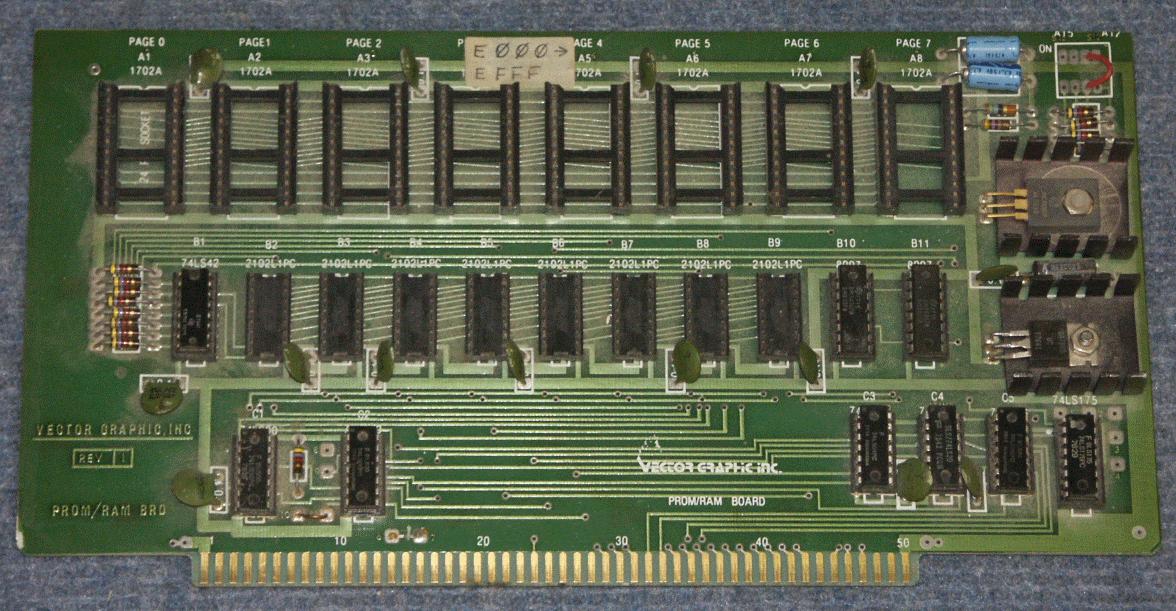
> Does anyone have experience with the Vector Graphics PROM/RAM
> card...like this one.
> http://www.classiccmp.org/dunfield/s100c/vector/promram.jpg
> (This is not my card...mine is not jumpered in upper right.)
> I have some documentation with mine and two PROMs loaded in A0 and A1
> (VIMON loaded on them), but am having some trouble getting any
> response from it. Most likely a config issue or a conflict with other
> RAM.
Win,
There are two resources that might be useful to you:
1. The VECTOR-GRAPHIC mailing list, inhabited by a couple of former
Vector employees, among others -
http://h-net.msu.edu/cgi-bin/wa?A0=vector-graphic
2. The Vector Graphic file archive -
http://vector-archive.org/index.php
De
So I have a friend who is originally from the U.K. He has his old BBC micro from when he was a kid and wants to be able to use it here in the states. His parents threw out his old TV in the U.K.
Is there a way to use a BBC Micro PAL version with a modern US LCD TV? Do some brands of modern TVs support both NTSC and PAL? Let's assume he may need to grab video before the modulator.
Thanks,
Corey
corey cohen
u??o? ???o?
>
> From: Josh Dersch <derschjo at gmail.com>
>
> So I have this DPS-6 taking up space in my basement right now and I thought
> I'd put out a call again to see if anyone has anything at all related to
> it. I'd like to get the system running but I'm missing:
>
> - Mass storage controllers (of any type -- floppy, tape, hard drive)
> - GCOS 6 operating system media (in any format, any version, etc.)
>
> If anyone has any hardware lying around, or GCOS 6 media (or knows anyone
> who might), drop me a line.
>
> Alternately, if there's anyone out there who has a need for a DPS-6 parts
> machine, let me know...
>
> Thanks as always!
> - Josh
>
The RICM has a DPS-6, and another with an Ultimate label on it that may
have a Pick processor.
--
Michael Thompson
Re: What's the rarest or most unusual computer-related item do you own?
Probably the rarest computer-related item I have is a 7AD7 flip/flop module from the Whirlwind I Computer.
I'm also rather fond of my Intel Intellec4 System. I also have an Intel Intellec 4/40.
- Gary
So I have this DPS-6 taking up space in my basement right now and I thought
I'd put out a call again to see if anyone has anything at all related to
it. I'd like to get the system running but I'm missing:
- Mass storage controllers (of any type -- floppy, tape, hard drive)
- GCOS 6 operating system media (in any format, any version, etc.)
If anyone has any hardware lying around, or GCOS 6 media (or knows anyone
who might), drop me a line.
Alternately, if there's anyone out there who has a need for a DPS-6 parts
machine, let me know...
Thanks as always!
- Josh
> From: Ethan O'Toole
> very dry clean air?
'Very dry' is _exactly not_ what you want! Air with decent humidity is less
likely to build up static voltage.
Dave B. had issues with static destroying components in his workshop in
winter-time, when with heating, humidity is low.
Noel
hi speed airflow from leaf blower could set static charge and could
knock out cmos?
Just a wild though... Ed#
In a message dated 1/19/2017 10:29:33 A.M. US Mountain Standard Time,
billdegnan at gmail.com writes:
On Thu, Jan 19, 2017 at 12:18 PM, Andy Cloud <r3trohub at gmail.com> wrote:
> Hey all,
>
> So one of my recent acquisitions is looking quite grubby, outside it just
> looks like surface dirt on the plastic, inside seems dusty/basement
dirty.
>
> My question comes in two parts:
>
> 1. What do you use to clean the exterior plastic and/or metal if
> applicable? I'm always worried about staining the plastic using strong
> solvent... could you also include what type of cloth/sponge/anything you
> use :)
>
> 2. You guessed it! What about internally? I've heard isopropyl is really
> good, but how do you apply it? What do you use to apply it in order to
make
> the board shine as if it was just bought!? :D or if you use anything
other
> than isopropyl...
>
> I also have a bonus question, how do you ground yourself to ensure you
> don't blow a component? Is an ESD wrist strap good enough?
>
> I absolutely love this group, really enjoyed your previous answers
> regarding rarest/unusual machines!!
>
> -Andy
>
You really need a decision tree but there is my process
1. vacuum or blow out debris, outside. I have used a leaf blower before
for really nasty machines, or very delicate vacuuming, all depends. Goal -
remove all loose dust, particles, anything that would gunk up a cleaning
process
2. Soap and water, inside and out. There is nothing wrong with using
soap and water on a computer board, hand dish soap. Just dry well. Use a
blow dryer or fan, depends on how delicate
3. Windex or glass cleaner for glass surfaces only.
4. Magic Eraser works great for plastic covers after you've washed with
soap. Or use that whitening compound everyone uses for yellowed cases.
Forget the name.
5. De-oxit for connectors and pins and such
6. Isopropyl alcohol for finishing touches, with a q-tip cotton swab.
Use common sense. Teletypes for example would not be the same cleaning
process as a surface mount laptop board.
b
Bill
Vintage Computer Federation registered for Amazon Smile, which is a
non-profit fundraising program. That means you can shop at
https://smile.amazon.com/ch/47-4133714, get all the same things at all
the same prices, and a tiny portion of it gets donated to VCF.
Please consider helping VCF by using Amazon Smile whenever you can.
Thanks,
Evan
> From: "Rick Bensene" <rickb at bensene.com>
>> - A Tektronix 4132 Unix workstation using a National 32016 CPU and a
>> 4.2bsd port called UTek
>>
Jon wrote:
>Gee, how does it perform? I built a clone of a Logical Microcomputer Co. 32016 Multibus system and got it working.
>But, it was glacially slow! I did have some memory that was likely a little slower than the stock memory, but it wasn't insanely slow. But, firing up certain things >like editors was just maddening. And, I'm not talking about Emacs, just vi. I eventually got a MicroVAX-II to replace it, and, yes, that DID have a cache to speed >up the memory, but it was quite a difference.
Well...considering the era, it wasn't too bad. By today's standards, yeah, it's pretty darned slow.
Vi starts up pretty quick, even with a couple of terminals running on it. It runs rogue pretty nicely, quick enough for multiple people to play it at once.
The machine has 7MB of RAM, which really helps. Without additional RAM, there's only 1MB on the main board, and running it with just 1MB makes it incredibly slow. There isn't any external cache.
It's fun to fire it up and just relive the days when I was on cloud nine to have my own personal Unix workstation that I built myself from parts.
-Rick
From: "Rick Bensene" <rickb at bensene.com>
>
> - A Tektronix 4132 Unix workstation using a National 32016 CPU and a
> 4.2bsd port called UTek
Those seem quite rare now, especially if it works. You should
preserve an image of UTek if possible. Any chance you have the
install media?
KJ
And the award goes too.... DM!
RFC 164 from 19 May 1971 says DM was to have NCP by end of week. RFC
211 certainly lists DMCG among other hosts. RFC 148 seems to imply NFP
was working to some extent even earlier.
RFC 342 from 15 May 1972 adds AI as a Network User. In RFC 344 is had
become a server.
RFC 366 from 28 June 1972 says "During this period the MIT Math Lab
PDP-10 (Network address 198) became a server."
If you are looking for tested working legacy IBM terminals with tested
complete M122 keyboards, please contact
<mailto:bfloyd at southtexasproducts.com> bfloyd at southtexasproducts.com. He
will sell the tested monitors with kbds for $85 plus shipping. Monitors
might have slight screen burn, but nothing really bad. He will also do
international shipping. He has 3151, 3196, 3197, and similar ones. Email for
complete list and pricing. Some older terminals available, but maybe not the
matching keyboards. No beam spring terminals or keyboards, no SSK, no
unsavers, etc. Just M122 with terminals.
Edit: Some Wyse terminals with kbds also available.
Cindy Croxton