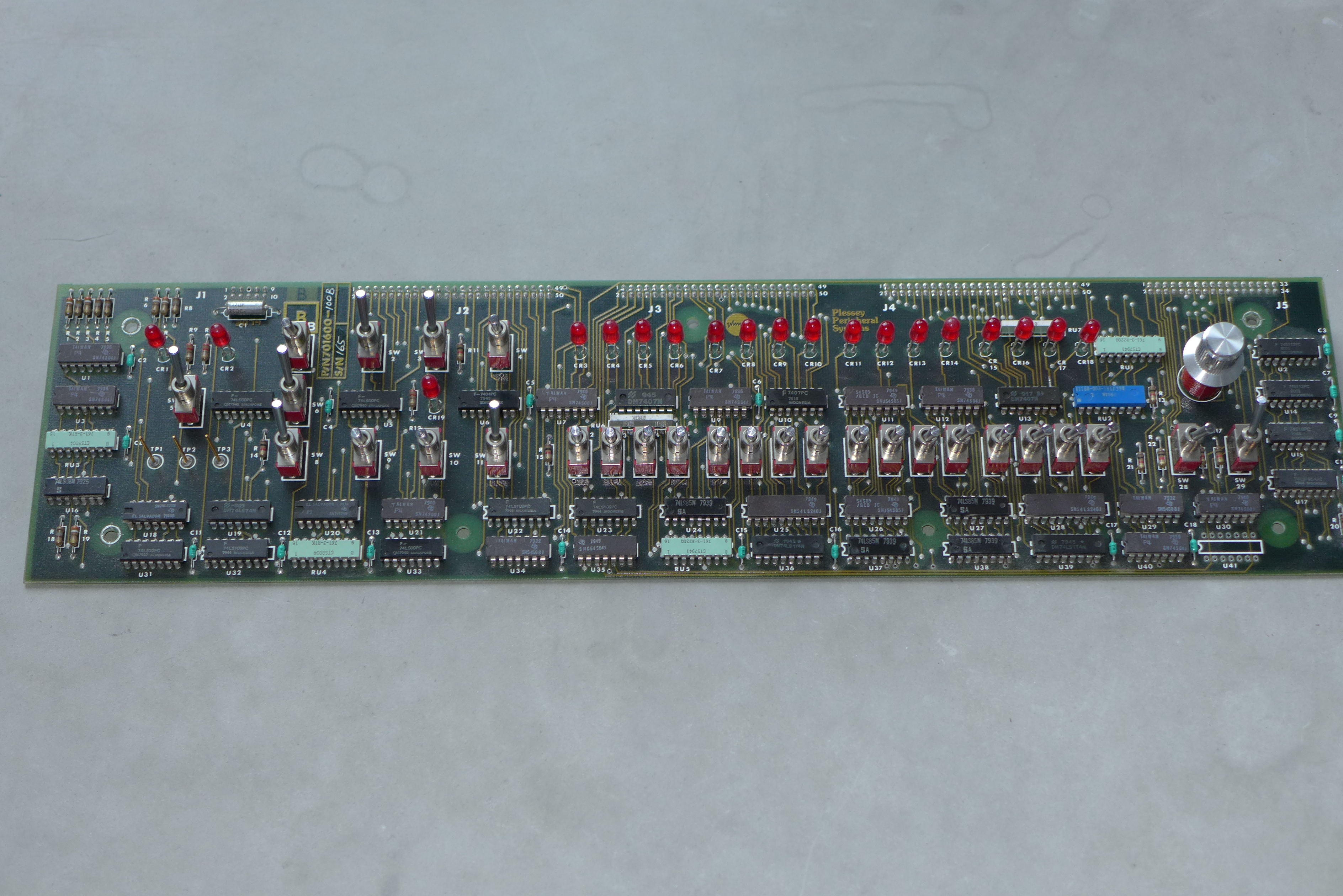
http://www.ebay.com/itm/361940854169
One of them does not seems to be at bitsavers.
The shipping is way to high to have them shipped to Sweden and scanned.
Maybe someone in the US would care to buy and scan it?
/Mattis
Re:
> From: Tony Aiuto <tony.aiuto at gmail.com>
> Subject: RIP: Daniel Bobrow
>
> http://www.legacy.com/obituaries/nytimes/obituary.
> aspx?n=daniel-bobrow&pid=184794881
I worked with Danny for about a year, around 1974, sometime after UCSD put
its B6700 onto the ARPAnet (we were something like the 35th computer).
The AI community needed a BBNLISP with more addressing space than a DEC-10
could provide, so they came to the king of virtual addressing: the
Burroughs.
We got the contract to implement BBNLISP, and Danny came to oversee.
I remember him typing on a terminal, linking UCSD to about 10 other
computers
on the ARPANET, finally linked back to us ... sending a message to himself.
He was demonstrating the lag time each computer added :)
IIRC, sometime during the project, BBNLISP was renamed INTERLISP. I still
have the wonderful manual, with the great artwork on the cover. Warren
Teitelman (the author) doesn't have his name on the cover. But, the bottom
portion has a guy is operating a meat grinder, with the input being the
letters of "reference manual" in random order, and the output being
"reference manual". Danny explained that Warren Teitelman hadn't gotten
the joke :)
Danny was funny, quick witted, friendly ... RIP.
Oh, UCSD LISP? About a week before we released it, DEC (or BBN?) had a
breakthrough and increased the addressability of their virtual memory,
obviating the need for our version :(
Stan Sieler
>
>
Your chance to use real DEC wall plates!!!
While going through boxes of stuff in the basement, I found a few cases of
DEC wall plates and Adirondack Wire and Cable AWC8100-14-W cables, both
sealed in factory bags.
There is no H # on the wall plates,but I recall seeing them in DEC sales
catalog
The cables look like RJ11 and I'll try to open one and measure it tomorrow.
Contact me off list if you are interested in making an offer. Shipping from
61853, and as many as you want $10 S&H in US.
Jay Herde, a viewer of my YouTube channel, contacted me to say that he has the following available that he would like to get rid of:
IBM System/3 Disk Concepts and Planning Guide.
IBM System/3 RPG II Disk File Processing Programmer's Guide.
IBM System/3 Models 8 and 10 Disk System Control Programming Reference Manual.
IBM System/32 Operator Training Student Text.
IBM System/32 Displayed Messages Guide.
He should be cc'ed above but I am not sure if his email we will make it through. Contact me off list if you are interested and I'll put you in touch with him.
Marc
I suspected that I could somehow get some music out of the SimH PDP-8
simulator for a while now, if I could only make it run real time and toggle
a GPIO pin fast enough say, on a Raspberry Pi. That may still be doable in
the future, but I also had a suspicion that I could generate music not in
real time.
I finally got around to trying out my idea last night. A few lines were
added to pdp8_cpu.c to spit out the elapsed instruction cycles every time a
CAF instruction is executed, the default "noise" instruction in the MUSIC.PA
program.
That's all I did to the simulator. I then ran MUSIC with a given .MU file
and watched as many integers are spit out onto the screen. These were
copied and pasted into a new text file and saved.
The rest of it is in a single C program that I cobbled together. It reads
in this new text file and generates a series of pulses as an array of
floats. Each interval is about 1.93 microseconds, which I calculated to be
the average number of pulses for the music program to be "in tune" with
A=440 Hz, plus or minus. This value is subject to change, particularly as
the notes get higher in frequency, but only by perhaps 6% or so from my
experiments. One detail to note is that per the recommendation of the
MUSIC.PA manual, these pulses are extended to roughly 6 microseconds, or
three time intervals in my program.
This array of floats is then downsampled use libsamplerate to 44.1 kHz
(from 1/1.93 microseconds, or roughly 520 kHz) and output to a canonical
WAV file, 16-bit single channel.
What do you know, it worked! Here's a sample:
https://www.youtube.com/watch?v=_urDcyluX9c
My code can be found here, for those interested:
https://github.com/drovak/music
Presumably, this technique could be used to generate music from any given
computer simulator.
Thanks,
Kyle
> From: Mattis Lind
> One of them does not seems to be at bitsavers.
That's on my list of items to get.
I have a page-feed scanner, so will easily be able to scan this (although
I'll have to get some instruction on exactly what incantation to use to
Acrobat to turn the TIFF's into a PDF; apparently "PDF/A", supposedly for
archival purposes, is apparently not in fact desirable for that).
Noel
Many people have been asking for details on the Hp gear. Here are some
pictures of everything.
https://postimg.org/gallery/wdgbt8lm/
I have powered up the machine and it boots up to hp basic. I never fired up
any of the external drive enclosures or the printer. If someone wants to
tell me how to test the external drives, I am more than willing to do so to
verify that they are in working order.
I have gotten several inquiries on the HP gear. Not sure how to handle many
people wanting the same gear, now that i have some pictures up showing the
model numbers, ill see if people are still interested and what they are
willing to offer.
--Devin
I have written a PDP-14 simulator using the simh framework. Paired
with a PDP-8 simulator as a front end it passes all the DEC
diagnostics. A pointless effort, perhaps, because there isn't much
that can be done with it without connecting it to something to
control.
In the course of research, I saw that there was an option to replace
the braided core ROM that was standard, with a R/W core memory. It
used a 4k memory module from the PDP-11 (MM11-E) with a special
interface module in the PDP-14. I can find no documentation for the
interface other than the wire-wrap list for the slot in the PDP-14
that it went into. From the signals available I have not been able to
reverse engineer the instructions used to write the core or any detail
really on how it might have been used.
The option was MM14-A consisting of an interface (M7407), memory
(MM11-E), chassis, and power supply.
If anybody is still reading, I would be very interested in ANY
information about it.
-chuck
I've been trying to put together a list of file extensions (and a one liner about that file extension) used by TRS-80's (including
all the XZ-80 machines, CoCo's, the 8" machines, pocket computers, the 100's. MC-10's etc).
Google has been my friend but has only turned up a few answers.
I was wondering if anyone has seen something more comprehensive or even has something more comprehensive.
Thank you!!
Kevin Parker
P: 0418 815 527
> From: Dwight Kelvey
> I need on of those.
I think it belongs in a museum, actually. Provided they can make it work, of
course! :-) I wonder how many working delay line main memories are left in
the world?
Noel
PS: Sorry about the previous mostly-duplicate message; I hit the 'interrupt'
key and it did the wrong thing.
Hi,
I picked up an empty 4x8 Q-bus chassis at VCF-East this year. It's
labelled "USDC CSS-823 Processor System" on the outside. It's not a DEC
backplane, but the chassis is light aluminum, smaller and in some ways
nicer than my pile of BA23s. It includes a switching power supply,
LTC and q-bus termination, and I confirmed it's wired for Q22. I was
hoping to transplant an 11/83 into it, since it will fit more comfortably
in my work area. It has lit DCON/RUN/LTC/HALT buttons on the front pane.
The etching on the backplane says something like "MDB Systems, Inc.
East Orange, CA 92665"
Unfortunately, I discovered slots are all wired Q22/Q22, no top ABCD
(Q22/CD) PMI slots like a BA23. So, not good for an 11/83 CPU wired
for PMI on slots C-D.
So, I was hoping I could get my KDJ11-B (quad-wide 11/73) running in it.
Upon power up or reset I get "Testing in progress. Please wait" on
the serial console, and the LEDs get stuck on test 56. CTRL-C doesn't do
anything yet, and my only options seem to be to hit reset, or if I hit the
run/stop toggle, I can reset to the ODT prompt. This is with either just
the KDJ11-B in the top slot, or with the addition of a suitably configured
MSV11-QA in the next slot. If I turn off the LTC on the front panel,
I get the expected Error 61 M8190 clock error, PC and register values,
and options to re-run once or loop on test, so I know the LTC is working.
I confirmed the KDJ11-B works fine in a BA23, getting past test 56. I also
tried an 11/53 CPU here in the ABAB backplane and that gets past the self
tests into dialog mode, but I really would like to get the KDJ11-B working
in this chassis. I do see that a couple traces to the KDJ11-B C-D slots
besides the Grant Continuity connections. I assume since the KDJ11-B
has those Grant Continuity connections on slots C-D, it can run in a
qbus/qbus Q22/Q22 quad Q-bus slot.
I noticed the FP "RUN" lamp never comes on (and is not burned out), but maybe
that's normal -- monitoring something on the bus that doesn't happen during
power on self test.
Does anyone here have suggestions about next steps in diagnosing this?
https://archive.org/stream/bitsavers_decpdp1111aintNov86_5833755/EK-1184A-M…
-----------------------------------------------------------------------------
4.10.18 Exit Standalone Mode (Test 56)
In the 22-bit mode, the exit standalone mode is checked by using the
guaranteed timeout address of 17 760 000 to verify that the timeout
logic works without hanging up the CPU.
-----------------------------------------------------------------------------
--
Mark G. Thomas (Mark at Misty.com), KC3DRE
> From: Steven Malikoff
> I've scanned the full version of this manual that comprises the
> installation guide, description, system specifications, theory of
> operation, timing chart, full schematic and manifest.
Oh, wow! You get the Documentation Preservation Gold Star! A needed, and
useful, manual. Thanks very much for doing this.
Noel
Systems Glitch said
> Looking for any information and/or documentation on DATARAM DR-111 (assembly
> 61101) 16Kx16 core memory boards for the Unibus. I've got four in unknown
> condition, one with a clearly destroyed 8T37.
> I have a large format scanner with ADF and can digitize print sets if necessary.
> Thanks,
> Jonathan
For anyone else that may be interested, I've scanned the full version of this manual that
comprises the installation guide, description, system specifications, theory of operation,
timing chart, full schematic and manifest. I believe there is a DR-111 document floating
around that is the installation guide only, hence the reason for this new scan.
You can find it at
http://web.aanet.com.au/~malikoff/pdp11/DATARAM_DR-111_core_memory_board.pdf
It's about 6Mb.
I have a stack of other docs to be done from my road trip to recover the FOX 2/10
last year, including the PDP-11/15 print set.
Steve.
Hello Todd,
I am a volunteer at the Computer History Museum. I led the museum's
full restoration of an IBM 1620 several years ago
(http://s3data.computerhistory.org/core/core-2001-03.pdf).
I am currently leading a new effort, the /IBM 1620 Jr./, to create an
operational, hands-on exhibit using a real IBM 1620 front panel driven
by a Raspberry Pi. As part of that effort, I'm writing a new,
cycle-level simulator. The existing simulators, like SimH, are
instruction-level and cannot drive the front panel.
The simulator work could greatly benefit from the IBM 1620 & 1622
manuals and system diagrams that you have.
I'd be happy to pay for any shipping costs.
When this project is complete, the manuals will be donated to the museum
to add to their collection of IBM 1620 documents.
Thanks,
Dave Babcock
Looking to make some space so i can work on some of the bigger gear i have
sitting around here. All this stuff was stored in a climate controlled
environment. I pick up interesting things whenever i can, be it at the
scrapyard, flea markets, etc, that is where most of this came from. I
worked in a computer shop for a while, a lot came from customers too, You
would be supersized what people would drag in.Fix it up... interest fades,
and then it starts looking like a museum.
3-4 commodore 64's. many 1541 disk drives, documentation, software.
Datassete in tattered box.
trs 80 coco - bent corner, works
Vic20 1525 graphics plotter / printer.
apple IIc - works - keyboard sticks sometimes
commodore 64 1702 monitor
zenith portable / luggable, complete, second drive sticks/ jams. Boots to
dos.
Boxed copy of ms dos 6.22 upgrade
boxed borland C++
boxed masm
like new in box tandy 1400 FD computer. excellent shape. Will not power on
>from wall jack, tapped into the 6v battery lead and it works fine, some
kind of power jack issue. charging jack works intermittantly.
Atari portfolio
commmodore amiga 500 with keyboard. Never bothered with it. Has scsi
controller, no hard drive. Ordered a floppy to boot it to workbench, it did
so. God knows where that floppy is now though...
Hp 9000 desktop with related peripherals. boots to hp basic.
External enclosure, hard drive and floppy drive
External enclosure, dual floppy drive.
keyboard
Tiny inkjet printer
(all the above gear is uses HPIB connection. Plan was to get this all wired
into my logic analyzer and other bench instruments, never bothered)
This list may be updated in the next week or so as i find more, feel free
to ask questions or inquire on pricing. Not looking to strike it rich, but
not just giving it away either.
Im shifting my focus to mainly DEC and SGI gear. I love picking up the
microcomputer stuff, but i just do not need that many machines. I have a
nice commodore 64, that should be enough for now.
That all being said, if anyone has a vax 780 for sale in florida.....
--Devin
> From: Glen Slick
> the Q22/Q22 backplane is not good for an 11/83 CPU ... M8190 boards and
> both have PMI signals on the CD half of the CPU board.
So I seem to recall hearing tales of PMI cards emitting smoke when plugged
into a Q/Q/ backplane. That doesn't seem to have happened here:
>> I confirmed the KDJ11-B works fine in a BA23, getting past test 56.
So I wondered if his off-brand backplane didn't have +12V or -12V wired up -
whatever it is that causes the damage. So I compared a list of PMI pins with
a QBUS pinout, trying to see if it was the +12V or 12V that would be the
problem.
However, I don't see any PMI pins that conflict? (Well, some of them are
ground, or +5V, but will that harm bus driver TTL?) Here's my list of PMI
pins:
CB1 PSSEL
CD1 PUBMEM
CE1 PBCYC
CF1 PUBSYS
CH1 PHBPAR
CJ1 PSBFUL
CK1 PLBPAR
CM1 PRDSTB
CP1 PBLKM
CR1 PBSY
CV1 PUBTMO
DB1 PWTSTB
DC1 PBYT
DD1 PMAPE
Anyone have any idea which pin(s) is the issue, when plugging a PMI card into
a Q/Q slot?
Noel
If anyone would be willing to rescue and hold a small-ish (large desktop)
machine near there for later pickup by me this summer, it would be much
appreciated. I can pay you a small fee either in beer or American currency.
Please let me know if you're willing to help coordinate a rescue.
--
Ian Finder
(206) 395-MIPS
ian.finder at gmail.com
Spring cleaning has unearthed manuals I no longer need (not clear if I ever needed them ... ).
Here's the list:
Univac an/uyk-7 theory & diagrams
Univac federal systems Technical Bulletins (1973)
IBM 1620&1622 CE manuals & complete system diagrams (vol 1,2, & 3)
IBM 3031 theory of ops diagrams (vol 1-5)
IBM 129 card punch CE & ald diagrams
IBM 3275 ald diagrams (2 vols)
Burroughs Global Memory schematics & flow diagrams
Teletype 33 teletypewriter (ksr & asr) technical manuals and parts list
--- Todd
I'm making arrangements to have four (mini-)supercomputers from the
1980's shipped to me. In the mean time, I'm trying to find out what I
can about these systems, so this is a fishing expedition.
The systems are:
* Convex C1-XP
* Convex C1-XL
* Intel iPSC/860
* Ardent Titan
Pictures of these can be found on my website, at
http://www.vaxbarn.com/index.php/collection/27-odd/76-four-supercomputers
(click on the thumbnails to see a larger version)
I'd like to get in touch with anyone who knows anything about these
machines, as well as anyone who may have documentation, but I also
have two specific questions:
- Can anyone identify the tape drives shown in the pictures? I believe
the one in the Intel iPSC/860 is an Exabyte 8mm one, but the ones used
on the Convex and the Ardent are a mystery to me.
- Does anyone know what the SRM (System Resource Manager) for the
iPSC/860 physically looks like? Does it look like a PC, and does it
say Intel on the front?
Reason I'm asking is that I'm getting these out of an estate, and I
need to tell them what to look for.
Thanks,
Camiel.
Awesome David! now I know what to look for!
I like things with a story for our museum displays... the original one
always best but next to it is 'one like it'
example We do not have Tim Berners-Lee's NeXT cube... but we have one
like it!
Ed# _www.smecc.org_ (http://www.smecc.org)
In a message dated 4/3/2017 8:20:04 P.M. US Mountain Standard Time,
davidkcollins2 at gmail.com writes:
It's an HP9000 E55. The HP Computer Museum even has one in our collection!
David Collins
Curator
www.hpmusuem.net
David Collins
Client Engagement Manager
Dimension Data
Tel: +61 3 9626 0593
Mob: +61 424 785 131
e-mail: david.collins at dimensiondata.com
(Sent from out of office)
On 4 Apr 2017, at 9:23 am, Cameron Kaiser via cctalk
<cctalk at classiccmp.org> wrote:
>> interesting... hp-9000 in the news! -
>> russian-hackers-used-backdoor-two-decades
>
> I'm trying to identify the specific unit. It looks like an early PA-RISC,
> but even the enlargement doesn't show the model number clearly.
>
>> https://www.wired.com/2017/04/russian-hackers-used-backdoor-two-decades/
>
> --
> ------------------------------------ personal:
http://www.cameronkaiser.com/ --
> Cameron Kaiser * Floodgap Systems * www.floodgap.com *
ckaiser at floodgap.com
> -- Please dispose of this message in the usual manner. -- Mission:
Impossible -
Hello All:
I am not sure if this is "vintage" enough. However, Dr Kan Yabumoto
(1948-2017) passed away after a long illness on 03-31-17. He was involved in
the computer industry for many years after being a chemical engineer. He
designed and programmed "Mad Planets", one of the "1001 Video Games You Must
Play Before You Die". However, in this group though he may be better known
for his work at his company Pixelab. Pixelab produced DatMan, XXCopy, and
XXClone. I had the good fortune to become friends with Kan while seeking
support for XXCopy. He was an intelligent and caring man and he will be
missed.
-Ali
I'm down to the last few P112 boards for sale and am pondering another run
of them because demand is steady. One of the biggest challenges for the
last run was getting the QFP-packaged 100-pin chips[1] in a state such
that the pick-and-place robot wouldn't throw a fit about slight
differences in lead position. The stuffing house insisted that I send
them new chips. Pulls, though they looked perfectly okay to me, were not
acceptable. Does anyone here know anything about pick-and-place robots
using pulled 100-pin QFPs, particularly a stuffing house that can work
with such chips and not screw up?
[1] The now-obsolete super-io chips
--
David Griffith
dave at 661.org
A: Because it fouls the order in which people normally read text.
Q: Why is top-posting such a bad thing?
A: Top-posting.
Q: What is the most annoying thing in e-mail?
due to it's infamy....I think we need one like it for the museums's
collection!
Ed# _www.smecc.org_ (http://www.smecc.org)
In a message dated 4/3/2017 4:23:47 P.M. US Mountain Standard Time,
spectre at floodgap.com writes:
> interesting... hp-9000 in the news! -
> russian-hackers-used-backdoor-two-decades
I'm trying to identify the specific unit. It looks like an early PA-RISC,
but even the enlargement doesn't show the model number clearly.
> https://www.wired.com/2017/04/russian-hackers-used-backdoor-two-decades/
--
------------------------------------ personal:
http://www.cameronkaiser.com/ --
Cameron Kaiser * Floodgap Systems * www.floodgap.com * ckaiser at floodgap.com
-- Please dispose of this message in the usual manner. -- Mission:
Impossible -
> I'm guessing it was a blob of foam, which has deteriorated, but maybe it
> was a metal spring, or a piece of u-shaped plastic etc.
May depend on the model, but mine has a spring under the plastic reset button in the top of the case and one of those metal domed tactile switches on the PCB.
Richard Sheppard
This series of articles focuses mainly on physical design, of cases
and so on, but there are some technical details in the articles too.
Note that this is the landing page -- at the bottom of the page are
links to other articles in the Inexhibit series, such as the Holborn
9100 and Olivetti Programma 101.
https://www.inexhibit.com/specials/history-of-computer-design-the-most-inno…
--
Liam Proven ? Profile: https://about.me/liamproven
Email: lproven at cix.co.uk ? Google Mail/Talk/Plus: lproven at gmail.com
Twitter/Facebook/Flickr: lproven ? Skype/LinkedIn/AIM/Yahoo: liamproven
UK: +44 7939-087884 ? ?R/WhatsApp/Telegram/Signal: +420 702 829 053
> From: Klemens Krause
> We clean our RK05 disks in a very robust way: with cheap burning spirit
> and paper towels. ... We rubbed away thick black traces from occasional
> head crashes and we never removed the oxide coating with this torture.
I am about to get a large batch of RK05 packs, so I am interested in the
details of this.
First, what is 'burning spirit'? (I assume this is a straight translation
into English of some German term, but not knowing German... :-) After poking
around with Google for a while (hampered no little by the fact that it's the
name of a band, and also a term in World of Warcraft :-), it seems like it
might be acetone?
Noel
Hi folks!
I recently acquired a functional Sun 2/120.
The framebuffer I have is switchable between TTL and ECL, so I can use
either an Sun 2 or Sun 3 monitor, which I am looking for.
I am also looking for a keyboard and mouse.
If anyone on list has any of these items and would be willing to sell them
to me, please contact me. I plan to completely restore the system.
Thanks,
- Ian
--
Ian Finder
(206) 395-MIPS
ian.finder at gmail.com
Hi,
I just saw that mails from some people now arrive as desired (real
sender, reply-to list), but some (e.g. myself) are still mangled with
"xxx via cctalk" - did I miss a setting?
Confused...
Philipp
Can anyone who's been inside an Intellivision confirm that there's supposed
to be a little foam disc beneath the reset switch plate?
I picked a system with a box of cartridges up earlier, half expecting the
machine to be dead (I was figuring it was going to be a blob of
easily-dead-after-so-many-years custom logic inside, but it's more like a
"real computer" in nature). It *was* dead, but the [initial, at least]
issue seems to be that the reset switch consists of a metal plate which is
supposed to make contact with the PCB when pressed - and presumably is held
away from the PCB by something when at rest. Except that there's no
"something" in this machine - with the machine the right way up, the plate
is free to contact the PCB, holding it in permanent reset.
I'm guessing it was a blob of foam, which has deteriorated, but maybe it
was a metal spring, or a piece of u-shaped plastic etc.
cheers
Jules
This card is sitting in a IBM RT PC.
http://i.imgur.com/Adqnxr3.jpg?1
What kind of card is it? The WD1935 seems to be a SDLC chip. I cannot find
any reference to the numbers P/N 6247874 (bottom layer etch) or the number
on the sticker on the backside: 6247871G001
It is connected to an IBM marked dongle which has 4 BNC connectors.
Is it a 3278-3279 emulation board?
/Mattis
Good hear it stood the test of time! As an HP PC dealer in the 80s
into early 90s we ha a calculator contract with HP also and...
we sold the heck out of them!
Is it the only one of the 10 series calcs that stayed in production?
I have a set of the special demo versions that were mounted on a
descriptive plaque
that had been in the PHX HP Corp demo center... when they redid that they
knew I
Hoarded stuff and sent them over. For some of the 10 series that were
still being used
we had them on the display floor the others went into the the suites
next to the business
in the historical display.
Ed#
In a message dated 4/2/2017 8:50:16 P.M. US Mountain Standard Time,
cctalk at classiccmp.org writes:
On Sun, 2 Apr 2017, Ed via cctalk wrote:
> That is an undertaking indeed! I had not seen this.... Ed#
> Someone said the 12c was still being made?
The 12c never went out of production. It has been continuously updated.
A lot of bankers, insurance people, etc still rely on them.
--
David Griffith
dave at 661.org
A: Because it fouls the order in which people normally read text.
Q: Why is top-posting such a bad thing?
A: Top-posting.
Q: What is the most annoying thing in e-mail?
That is an undertaking indeed! I had not seen this.... Ed#
Someone said the 12c was still being made?
In a message dated 4/2/2017 9:00:53 A.M. US Mountain Standard Time,
cctalk at classiccmp.org writes:
A few months ago I had a prototype of this 42S clone in my hands.
It looked and felt very promising!
I?ll will buy one when it will be available.
For those of you who are interested, please follow the discussions on
hpmuseum.org <http://hpmuseum.org/> forum.
Jurgen
> Am 10.03.2017 um 16:34 schrieb David Griffith via cctalk
<cctalk at classiccmp.org>:
>
>
> There's a Swiss guy who's made a name for himself by producing working
replicas of classic HP calculators. See https://www.swissmicros.com/. I
recently discovered his post on Youtube a video showing off an enhanced
replica of my favorite HP calculator, the HP42s. This one is called the DM42.
Here's the video: https://www.youtube.com/watch?v=0LK7JotR728
>
> --
> David Griffith
> dave at 661.org
>
> A: Because it fouls the order in which people normally read text.
> Q: Why is top-posting such a bad thing?
> A: Top-posting.
> Q: What is the most annoying thing in e-mail?
There's a Swiss guy who's made a name for himself by producing working
replicas of classic HP calculators. See https://www.swissmicros.com/. I
recently discovered his post on Youtube a video showing off an enhanced
replica of my favorite HP calculator, the HP42s. This one is called the
DM42. Here's the video: https://www.youtube.com/watch?v=0LK7JotR728
--
David Griffith
dave at 661.org
A: Because it fouls the order in which people normally read text.
Q: Why is top-posting such a bad thing?
A: Top-posting.
Q: What is the most annoying thing in e-mail?
Friends,
I have an instrument that has an intel motherboard with 400 MHz FSB PCI (not PCI-e). It has a 100 mbps Ethernet card and it would be very useful to get faster networking. The chassis of this instrument is such that I cannot fit a traditional PCI 1GB Ethernet card (I've tried). So I will have to go wifi (which I can make fit because I can remotely locate the wifi antenna). I have 802.11ac both 2.4 and 5 GHz available. While it certainly won't get as good a throughput as a dedicate GB Ethernet card, this is my only option.
The question is, whether you think I would be better off using PCI wifi card or a USB-wifi adapter. I should mention the USB on this instrument is USB 2.0, the spec for which claims up to 480 Mbps. Anyone have an opinion which might get me better results? The wifi infrastructure is one constant in this scenario, just looking to see pci- or usb-based wifi card.
Since this is wildly off topic, please respond to me directly so as not to bother everyone else :)
W2hx at w2hx.com<mailto:W2hx at w2hx.com>
Thanks
Eugene
I thought the Vintage Computer festival west link might have recommended hotels but I couldn't find anything for you.
I did a similar trip but needed to be quite a few hours south for my actual destination. I didn't find a very cheap hotel either, and the under $100 one I did find near long Beach was quite underwhelming. The type my wife wouldn't have let us stay at.
What I did find more useful was a super small rental car for $98 that did give me much more freedom to get around a few sites (and Weird Stuff). ?It was highly recommended not to sleep in the car though so best luck.
I explored airbnb but it seems to mirror closely to hotel prices and a surprisingly large amount want a 2 day stay.
But CHM is definitely a fun trip. I have a quite large collection for home computing so I wasn't sure how long I'd stay occupied but between the demos and tours and just perusing I definitely could have enjoyed more than the afternoon I spent.
Best recommendations were ubering or rental car then get a hotel in your price range but don't worry as much about location. Or get one near the train.
-------- Original message --------From: Christian Corti via cctalk <cctalk at classiccmp.org> Date: 3/29/17 3:29 AM (GMT-06:00) To: Evan Koblentz <cctalk at snarc.net>
>On Tue, 28 Mar 2017, Evan Koblentz wrote:
>> "What do an Apple 1, Commodore 65, >>Enigma Machine, and the inventor of C++
>> all have in common?"
>They're just overestimated pieces of junk ;-)?>(and C++, not its inventor)
>[duck...]
Said to most of us about our hobby and collections?
We're supposed to be challenging that battle, mate. Not feeding it ;-)
Hello, all,
In mid-June, I am planning a trip to Mountain View for two days to visit the Computer History Museum.
I plan on flying out of Portland early AM on June 14, checking into hotel, then heading straight to the museum for the day.
I will go back to the hotel for the evening, and return to the museum on the 15th, and stay into early afternoon, and then check out of the hotel and head to the airport to return home.
I haven't been to CHM before, and am looking forward to spending an extended period of time there.
What I'm asking for is help/recommendations in terms of a good hotel to stay at that is relatively close to the museum. I don't want to be in a luxury hotel, nor do I want to be in a dive.
I'd also like to be in a place that has a restaurant relatively close by (preferably within walking distance) that I could get some decent meals (breakfast/dinner) while I'm there.
Unless this is a topic of general interest to the group, it'd probably be best to reply to me directly rather than post responses to the list.
Many thanks,
-Rick
--
Rick Bensene
The Old Calculator Museum
http://oldcalculatormuseum.com
I'm looking for two items:
A VR241 to use with my DEC 380 as a colour head (even better if you have the
cable and a spare LK201, since I'm down to my last working keyboard). The
VR201 isn't cutting it anymore and I don't think I can use my VR260 with this.
An HP 6000 670H hard disk (the big one for the 300 series). XP even better,
but I've done just fine with an H.
Please include what price you're asking.
Thanks!
--
------------------------------------ personal: http://www.cameronkaiser.com/ --
Cameron Kaiser * Floodgap Systems * www.floodgap.com * ckaiser at floodgap.com
-- Communism doesn't work because people like to own stuff. -- Frank Zappa ----
> From: Brent Hilpert
> I don't have a full enough picture of the circuit and circumstances to
> provide a definitive suggestion but, some principles:
> ...
> It's not clear C-coupling is what's going on here (the wave shape looks
> pretty sharp for what I understand of the circuit/layout).
Thanks for taking the time for that detailed message.
I suspect, however, that Jon Elson has nailed it (thanks Jon :-); if that's
what's happening, it explains why we couldn't understand what the devil was
going on!
> (You've mentioned both 470K and 270K for the R, could make a difference
> to the analysis).
Yeah, that was just a typo; going from memory.
Noel