https://www.ebay.com/itm/263005049078
EBay listing for a "Soviet Magnetic Ferrite Core Memory Board". It looks
like 20 something gigantic cores and a lot of diodes. I am guessing it is
some kind of ROM, but it doesn't look like a rope memory. And maybe the
cores are not cores at all, but some sort of inductor. I've not seen this
before.
Hope this isn't too far off topic, but noticed a SOL-20, Helios-II, and
several disks available in Louisville via Craigslist. Can't afford more
stuff this year myself but price doesn't seem too bad. i don't know the
person that has it, just found it as I was searching.
https://louisville.craigslist.org/sys/d/processor-technology-sol-20/6391107…
Regards, Brian.
I am trying to bring some of my old PDP-11's back to life. Does
anyone have or know of a source for PROM Images? I need the
images for the M8189 (11/23+) and would also love to get the
images for my DECTalk.
bill
On Nov 29, 2017 17:15, "Toby Thain via cctalk" <cctalk at classiccmp.org>
wrote:
> On 11/29/2017 1:47 PM, drlegendre . via cctalk
I didn't have as much luck with Windows Photo Viewer. While it does
support multipage TIF, it seemed to hang after a few pages.
Irfanview is a pretty solid viewer/manipulator under Windows. I've been
using it to burst those TIFs into individual pages before making PDFs out
of them. I'll post a link to them when they're ready.
J
All ?
??????????????? For those interested in APE (the Altair Peripheral Emulator by Frank Barberis), I have recovered the site (with his permission) and Jay has agreed to host it on Classiccmp (thank you Jay!). It can be accessed at http://ape.classiccmp.org.
??????????????? No development has been done on it since 2014 when the original Comcast site went dark.
Enjoy
Rich
--
Rich Cini
http://www.classiccmp.org/cinihttp://www.classiccmp.org/altair32
Hi folks,
After sorting out the Model 4P (thanks to all who provided hints!) and scrubbing it up so it almost looks new again I turned attention to my Model 1 Level II which had been dead for at least the same amount of time as the Model 4. There?s some excellent troubleshooting tips for these machines out there and I quickly discovered a bad RAM chip, swap that for a NOS one and we?d be back in business if the video RAM wasn?t failing.
One of the 4 2102A chips is failing (MEM SIZE becomes OEO SIZE) and I?d like to double check this before I stump up the ukp4 required for a pair of NOS ones, can anyone think of a machine from back then that also used 2102A or 2102LPFC or NTE2102 video RAM?
Cheers!
?
Adrian/Witchy
Binary Dinosaurs - Celebrating Computing History from 1972 onwards
If you have a paper tape reader and no punch, you can now make real working paper tapes using a normal home stencil-cutting machine.
I've written a small command line utility that can take a .PTAP (or any other binary or textfile) and generate output that these
machines will cut. that your reader will read.
It can easily make repair pieces for existing old broken tapes from any byte offset. In addition it can make banner tapes, 5-level
Baudot RTTY tape, your own custom n-level paper tape or cut tapes from other materials such as plastic.
Even if you don't need it to make or repair tapes, it can be used to visualise a paper tape through the console output it produces.
I'd never claim it's any sort of replacement for a real punch, and it's a whole lot slower. But, it does work :)
A simple example to make a tape of the characters ABCDEF with 1/2 inch of sprocket leader and 1/2 inch of trailer:
C:\> ptap2dxf --text="ABCDEF" --leader=5 --trailer=5 --output=ABCDEF.dxf
+---------+
| . |
| . |
| . |
| . |
| . |
| O . O|
| O . O |
| O . OO|
| O .O |
| O .O O|
| O .OO |
| . |
| . |
| . |
| . |
| . |
+---------+
Joiner 0000: data byte 00000000 absolute position 00000011
The resulting ABCDEF.dxf file can be viewed in a DXF viewer such as Inkscape and directly loaded into the paper/vinyl cutter for producing
the actual working tape.
Another example: say you need a repair piece for an absolute loader, starting at byte 57 for 12 bytes. (A repair piece has removeable side
tabs for handling as a self-adhesive vinyl joiner):
C:\> ptap2dxf DEC-11-L2PC-PO.ptap --range=57,12 --joiner --ascii --control
+---------+
| O .O O| JOINER %
| . O | JOINER <STX>
| . | JOINER <NUL>
| O . O| JOINER !
| . OO| JOINER <ETX>
|OOOO .OOO| JOINER
| O. O| JOINER <HT>
| O O.O | JOINER ,
| . | JOINER <NUL>
|O .O | JOINER
| OO . OO| JOINER c
| . O| JOINER <SOH>
+---------+
The output for machine cutting will be in DEC-11-L2PC-PO.dxf
For larger tapes, the output can be chunked into sections which can be cut individually. There are other options to invert, mirror, reposition
the sprocket feed and so on.
If you think you may find it useful, it's fully open source and available at https://github.com/1944GPW/ptap2dxf
It will run on Windows (pre-built exe provided) and Linux and Mac (follow building instructions).
The 26-page illustrated User Manual PDF is at https://github.com/1944GPW/ptap2dxf/blob/master/Documentation/PTAP2DXF_User…
Steve.
(posted this just as the list went down earlier, apologies if it appears twice)
If you have a paper tape reader and no punch, you can now make real working paper tapes using a normal home stencil-cutting machine.
I've written a small command line utility that can take a .PTAP (or any other binary or textfile) and generate output that these
machines will cut. that your reader will read.
It can easily make repair pieces for existing old broken tapes from any byte offset. In addition it can make banner tapes, 5-level
Baudot RTTY tape, your own custom n-level paper tape or cut tapes from other materials such as plastic.
Even if you don't need it to make or repair tapes, it can be used to visualise a paper tape through the console output it produces.
I'd never claim it's any sort of replacement for a real punch, and it's a whole lot slower. But, it does work :)
A simple example to make a tape of the characters ABCDEF with 1/2 inch of sprocket leader and 1/2 inch of trailer:
C:\> ptap2dxf --text="ABCDEF" --leader=5 --trailer=5 --output=ABCDEF.dxf
+---------+
| . |
| . |
| . |
| . |
| . |
| O . O|
| O . O |
| O . OO|
| O .O |
| O .O O|
| O .OO |
| . |
| . |
| . |
| . |
| . |
+---------+
Joiner 0000: data byte 00000000 absolute position 00000011
The resulting ABCDEF.dxf file can be viewed in a DXF viewer such as Inkscape and directly loaded into the paper/vinyl cutter for producing
the actual working tape.
Another example: say you need a repair piece for an absolute loader, starting at byte 57 for 12 bytes. (A repair piece has removeable side
tabs for handling as a self-adhesive vinyl joiner):
C:\> ptap2dxf DEC-11-L2PC-PO.ptap --range=57,12 --joiner --ascii --control
+---------+
| O .O O| JOINER %
| . O | JOINER <STX>
| . | JOINER <NUL>
| O . O| JOINER !
| . OO| JOINER <ETX>
|OOOO .OOO| JOINER
| O. O| JOINER <HT>
| O O.O | JOINER ,
| . | JOINER <NUL>
|O .O | JOINER
| OO . OO| JOINER c
| . O| JOINER <SOH>
+---------+
The output for machine cutting will be in DEC-11-L2PC-PO.dxf
For larger tapes, the output can be chunked into sections which can be cut individually. There are other options to invert, mirror, reposition
the sprocket feed and so on.
If you think you may find it useful, it's fully open source and available at https://github.com/1944GPW/ptap2dxf
It will run on Windows (pre-built exe provided) and Linux and Mac (follow building instructions).
The 26-page illustrated User Manual PDF is at https://github.com/1944GPW/ptap2dxf/blob/master/Documentation/PTAP2DXF_User…
Steve.
Is anyone perhaps interested in any of the following?
It's essentially the remainder of some of my earlier offerings.
I took the time to provide some details (that previously may
have been missing)
I intend to clear out the majority of it by mid-December
(around the 15th), after that it will likely be hauled off
to the recycler.
---- tape drives and media
(pictures: <http://bit.ly/2AjxQYu>, <http://bit.ly/2jxDPkB>,
<http://bit.ly/2AjFkeh>, <http://bit.ly/2zBrv9S>,
<http://bit.ly/2AGR9Ot>, <http://bit.ly/2AI3Dp6>)
-- Ultrium (Linear Tape Open)
- Hewlett-Packard StorageWorks?Ultrium 920 (LTO-3)?external
? half-height tape drive SCSI U320 LVD/SE with auto-termination
- Quantum LTO-3?internal half-height tape drive SCSI U320 LVD/SE
? with auto-termination
- Seagate Viper 200?LTO-1 external full-height tape drive SCSI
? U320 LVD/SE with auto-termination
- Hewlett-Packard, Quantum, Maxell, Fujifilm, Sony, etc.
? LTO-{1,2,3} data and cleaning tape catridges, many new and
? unused, many available?(see pictures)
-- Digital Data Storage
- Hewlett-Packard StorageWorks DAT72?(DDS-5) internal tape drive
? SCSI U320 LVD/SE (possibly with auto-termination; not fully
? sure, need to check)
- Sony SDT-D11000?DAT40?(DDS-4) external tape drive, SCSI
? (LVD?/)SE
- Hewlett-Packard?StorageWorks?DAT160?(DDS-6) data and cleaning
? tapes, several tapes, nearly all new and unused
- Hewlett-Packard?StorageWorks?DAT72?(DDS-5) data and cleaning
? tapes, several boxes, 2~3, largely new and unused
- Hewlett-Packard, Compaq, Maxell, Fujifilm, Sony, etc.
? DDS-{1,2,3,4} data and cleaning tape cartridges, various
? types, many available (see pictures)
---- computer components (multi-platform, cross-architecture)
- Hewlett-Packard-branded S2io/Exar/Neterion 10Gbit?(10GBASE-
? SR) PCI-X NICs, including 850nm transceivers, supported on
? many platforms (including Windows, IRIX and OpenVMS), around
? 5 available
- Hewlett-Packard, LSI, etc. PCI/-X adapters, e.g.: SCSI, FC,
? FC/SCSI duo (hybrid), etc. HBAs, NICs, IEEE-1394a (FireWire/
? i.Link)?adapters and more, various types and (re)brandings
---- software
-- operating system
- Hewlett-Packard?OpenVMS?(I64) Open Source Tools?(2010)
? CD-ROM, in original sleeve
- Hewlett-Packard?Tru64?UNIX V5.1B Documentation?(2010)
? CD-ROM, in original sleeve
- Hewlett-Packard?Tru64?UNIX NHD-7?(New Hardware Delivery)
? kit (2010), in original packaging (unopened), primarily
? intended for e.g. HP AlphaStation/AlphaServer?DS15/A
- Compaq?OpenVMS?Alpha V7.2?(1999) CD-ROM, disc 1 of 2,
? in sleeve
- Compaq?OpenVMS?Alpha V7.2 & V7.2-1 System Crash Mandatory
? Update?(1999) CD-ROM, in sleeve
- Microsoft?Windows?7 Home Premium, NL (Dutch), licenses
? included, 2 available
- Microsoft?Windows?XP Pro?SP2b, NL (Dutch), OEM, only
? media (no license)
-- applications
- Frame?(later Adobe) FrameMaker?for SunOS/Solaris,
? advanced typesetting software, boxed with documentation
? and installation media
- Sybase Database?for OpenVMS?(Alpha), in original jewel
? case
- Syntax TotalNET Advanced Server?for SunOS/Solaris(?),
? boxed
- VITec RasterFLEX?(v4.0) for SunOS/Solaris, boxed
? (pictures: <http://bit.ly/2AoHk4P>,
<http://bit.ly/2j4QsE8>, <http://bit.ly/2Auth07>)
- Sega DreamKey, internet web browser software(?) for
? Sega Dreamcast, in original jewel case
---- books(mostly English and some Dutch)
- various (see picture: <http://bit.ly/2BlLtWu>), on computing/
? computers, computer architectures (e.g. MC68000),the
? history of IBM, also computer graphics, covering software
? like Maya (v2.5), Houdini?(v6~8) and LightWave?3D (v5.5~5.6),
? etc.
---- computer input devices and other peripherals
- Wacom serial?(perhaps also ADB and USB, need to check)
? digitizer tablets, in various sizes
- Logitech PS/2 trackball, barely used
---- Cardbus adapters
- Sitecom USB 2.0, providing 2 ports
- SIIG IEEE-1394a FireWire
---- Apple Macintosh serial & ADB adapters
- Keyspan Mac Serial Adapter (to USB)
- Griffin iMate?ADB to USB adapters, 2 available, one
? includes the original packaging
---- serial cables and converters
- DeLock, generic, etc. DB9, DB25 and conversion cables,
? including straight-through and 'null-modem' varieties,
? fairly large amount available
---- SCSI, SAS/S-ATA and FC cabling
- multi-vendor internal SAS to S-ATA cables, several,
? including in unopened packages
- multi-vendor internal and external SCSI cables,
? several available
- multi-vendor internal and external SCSI terminators,
? mainly LVD/SE (incl. UW and U320) but also HVD, both
? active and passive, several available
- multi-vendor LC (LC to LC) fiber-optical cables
? (contact me about OM type), several available and in
? various lengths
---- PCs and components
- IBM-branded DDR2 RAM R-DIMMs (as kits), I believe 8GB
? in total (I need to check), removed from a working IBM
? x346 server at the time
- ASUS M8N-E, with AMD Athlon64?X2 CPU, 8GB DDR2 RAM and
? documents
- ASUS M2N-E SLI, with AMD Athlon64?X2 CPU, 4GB DDR2 RAM
? and documents
- Cooler Master?600W (AT) PSU
- Cooler Master(?) 460W (AT) PSU
---- SGI (MIPS-powered) IRIX systems and components
- SGI?Tezro &?O3x0?HDD?sled/tray (Intel type), with
? optional blanking/airflow plastic included, at least 1
? (maybe 2, need to check)
- SGI DMediaPro DM10-compatible IEEE-1394a FireWire
? (3.3V) PCI card with cables, SGI DMediaPro?DM10 manual,
? etc., boxed
- SGI IMPACT?(MGRAS)?4MB TRAM module, possibly defective
-- not really interested in selling, but in theory for
?? sale (depending on the offer, I might be persuaded)
- SGI Indigo??IMPACT/10000, with 195MHz MIPS R10000 CPU,
? 1GB RAM, High IMPACT?plus 4MB TRAM, IMPACT Video plus
? VBOB, Plextor CD-ROM?drive, intact bezel, lockbar
? included, etc.
- SGI O2, with 400MHz MIPS R12000 CPU, 1GB RAM, digital
? A/V (AV2) module, Toshiba DVD-ROM drive, intact bezel,
? etc.
---- general 19" rack equipment
- general 1U fan (low-noise ventilator) unit, with
? temperature monitoring & control
- general rack trays (vented), at least one (possibly
? more)
- general rack mounting bars, cable managers and other
? accessories
- general mounting fasteners (RM mounting blocks and
? screws)
---- video games and peripherals
- Nintendo Super Scope?for Super NES?(Nintendo
? Entertainment System), PAL/EUR region, including
? cartridge and documentation
---- graphics monitors, cables and accessories
- Dell UltraSharp?U2412M, 24" IPS LCD monitors, 1~2
? available
- ATEN USB & VGA (HD15) KVMs, with documentation, about
? 2~3 available
- SGI 13W3 (HD13W3 to HD13W3) cable, about 2?~3 meters
? in length
- generic short DVI-D cables (around ~0.5 meters /
? ~1.6 foot), ideal for SGI VBOB plus DM5 with DM2/DM3
- generic component monitor cables, one with RCA (tulip)
? and another with BNC cabling
- generic DVI-D splitters (not sure if I still have
? them, I need to check)
---- video equipment
- JVC DTV Component Multi DT-V20L1D, 22" LCD, full HD,
? 10-bit (Deep Color), professional multi-format
? broadcast monitor, with lots of built-in I/O (HD
? component, HD-SDI, HDCP-capable DVI, composite video,
? etc.), with a few dead pixels
- JVC DTV Component Multi DT-V1710CG, 17" CRT, full HD,
? 10-bit (Deep Color), professional multi-format
? broadcast monitor, with various input modules
? (including SD-, HD-SDI and HD component, also available
? individually, in original boxes)
- Gefen 1080p Scaler for HDMI, boxed, professional-grade
? digital video scaler (picture: <http://bit.ly/2AgQjqS>)
- Miranda ASD-271p, professional analog-to-digital A/V
? signal converter, including external PSU, ?as-is?
? (untested, or not recently tested)
- generic HDMI to 3G/HD-SDI (also SD-SDI capable) bridge
- generic ~20 meter / ~66 feet, HD/3G/+-SDI BNC cable
- DeLock ~10 meter / ~33 feet, HD/3G/+-SDI BNC cables,
? two available and one in the original packaging
- DeLock and generic ~0.5~1 meter / ~1.6 foot, HD/3G/+
? -SDI BNC cables, around 3~5 available
- generic and various other lengths of HD/3G/+-SDI BNC
? cables, several available, some in original packaging
- generic 75? BNC terminators for SDI, many available
---- photo-/cinematographic equipment
-- cameras
- Sony HDR-FX1000E, HD video camera (3-CMOS), with
? optional accessories, like large Sony carrying bag
? (pictures: <http://bit.ly/2BBvxAw>)
- Blackmagic (Design) Pocket Cinema Camera?(BMPCC), RAW
? & 10-bit ProRES, full HD video camera, in original box,
plus optional accessories
-- BMPCC accessories:
?- BMPCC batteries, multiple of Blackmagic Design and one
?? of?Nikon?(original)
- Kamerar QV-1 viewfinder magnifier (loupe)
- ...and more (contact me)
(pictures for all of the above and some of the below:
<http://bit.ly/2j43Icr>)
-- lenses and adapters
- Panasonic Lumix G?II 14mm ?/2.5?prime MFT (Micro Four
? Thirds) lens
- Panasonic?Lumix G X Vario 14-42mm ?/3.5-5.6?Power-
? O.I.S. pancake electronic zoom MFT lens
- Panasonic Lumix 45-200mm ?/4-5.6 Mega-O.I.S. zoom
? MFT lens
- Metabones Speed Booster?Nikon F/G to MFT (focal
? reduction) lens mount adapter
- other MFT lens mount adapters (including with focal
? reduction), see pictures
- Samyang 16mm T/2.2 VDSLR?Nikon F mount DX/APS-C lens
- Sigma EX DG 17-50mm ?/2.8 Nikon F mount DX/APS-C lens
- KMZ Jupiter-8?50mm ?/2 Leica M39 35mm full-frame lens
- Sigma Art DN 013 60mm ?/2.8 E-mount APS-C lens
- Manfrotto 700RC2?lightweight video monopod/tripod head
- Manfrotto 585-1 ModoSteady 3-in-1, compact stabilizer
? rig
---- audio equipment
- Music Group/Behringer?Ultra-Match?SRC-9624, 96KHz
? 24-bit audio?interface, barely used
There might be more, but this is it for now.
Not all is directly related to computers, but most of
it has been used together with them, or can be used
together with them or to document/conserve retro
systems.
Everything is located in the Netherlands.
?- MG
I am looking for a book I remember borrowing from the local library
about late 1980, early 1990
this what remember:
* BASIC programing (type-in listings)
* Advance Graphics
* Polygon graphics
* IBM
* "that's all folks" image on front/back cover
* BSAVE/BLOAD (I think)
* two or three flight sims ( wireframe, filled polygons, AI ), they
looked like Microsoft Flight Simulator 1.0 looking back
* wait press?
Is anyone perhaps interested in any of the following?
It's essentially the remainder of some of my earlier offerings.
I took the time to provide some details (that previously may
have been missing)
I intend to clear out the majority of it by mid-December
(around the 15th), after that it will likely be hauled off
to the recycler.
---- tape drives and media
(pictures: <http://bit.ly/2AjxQYu>, <http://bit.ly/2jxDPkB>,
<http://bit.ly/2AjFkeh>, <http://bit.ly/2zBrv9S>,
<http://bit.ly/2AGR9Ot>, <http://bit.ly/2AI3Dp6>)
-- Ultrium (Linear Tape Open)
- Hewlett-Packard StorageWorks?Ultrium 920 (LTO-3)?external
? half-height tape drive SCSI U320 LVD/SE with auto-termination
- Quantum LTO-3?internal half-height tape drive SCSI U320 LVD/SE
? with auto-termination
- Seagate Viper 200?LTO-1 external full-height tape drive SCSI
? U320 LVD/SE with auto-termination
- Hewlett-Packard, Quantum, Maxell, Fujifilm, Sony, etc.
? LTO-{1,2,3} data and cleaning tape catridges, many new and
? unused, many available?(see pictures)
-- Digital Data Storage
- Hewlett-Packard StorageWorks DAT72?(DDS-5) internal tape drive
? SCSI U320 LVD/SE (possibly with auto-termination; not fully
? sure, need to check)
- Sony SDT-D11000?DAT40?(DDS-4) external tape drive, SCSI
? (LVD?/)SE
- Hewlett-Packard?StorageWorks?DAT160?(DDS-6) data and cleaning
? tapes, several tapes, nearly all new and unused
- Hewlett-Packard?StorageWorks?DAT72?(DDS-5) data and cleaning
? tapes, several boxes, 2~3, largely new and unused
- Hewlett-Packard, Compaq, Maxell, Fujifilm, Sony, etc.
? DDS-{1,2,3,4} data and cleaning tape cartridges, various
? types, many available (see pictures)
---- computer components (multi-platform, cross-architecture)
- Hewlett-Packard-branded S2io/Exar/Neterion 10Gbit?(10GBASE-
? SR) PCI-X NICs, including 850nm transceivers, supported on
? many platforms (including Windows, IRIX and OpenVMS), around
? 5 available
- Hewlett-Packard, LSI, etc. PCI/-X adapters, e.g.: SCSI, FC,
? FC/SCSI duo (hybrid), etc. HBAs, NICs, IEEE-1394a (FireWire/
? i.Link)?adapters and more, various types and (re)brandings
---- software
-- operating system
- Hewlett-Packard?OpenVMS?(I64) Open Source Tools?(2010)
? CD-ROM, in original sleeve
- Hewlett-Packard?Tru64?UNIX V5.1B Documentation?(2010)
? CD-ROM, in original sleeve
- Hewlett-Packard?Tru64?UNIX NHD-7?(New Hardware Delivery)
? kit (2010), in original packaging (unopened), primarily
? intended for e.g. HP AlphaStation/AlphaServer?DS15/A
- Compaq?OpenVMS?Alpha V7.2?(1999) CD-ROM, disc 1 of 2,
? in sleeve
- Compaq?OpenVMS?Alpha V7.2 & V7.2-1 System Crash Mandatory
? Update?(1999) CD-ROM, in sleeve
- Microsoft?Windows?7 Home Premium, NL (Dutch), licenses
? included, 2 available
- Microsoft?Windows?XP Pro?SP2b, NL (Dutch), OEM, only
? media (no license)
-- applications
- Frame?(later Adobe) FrameMaker?for SunOS/Solaris,
? advanced typesetting software, boxed with documentation
? and installation media
- Sybase Database?for OpenVMS?(Alpha), in original jewel
? case
- Syntax TotalNET Advanced Server?for SunOS/Solaris(?),
? boxed
- VITec RasterFLEX?(v4.0) for SunOS/Solaris, boxed
? (pictures: <http://bit.ly/2AoHk4P>,
<http://bit.ly/2j4QsE8>, <http://bit.ly/2Auth07>)
- Sega DreamKey, internet web browser software(?) for
? Sega Dreamcast, in original jewel case
---- books(mostly English and some Dutch)
- various (see picture: <http://bit.ly/2BlLtWu>), on computing/
? computers, computer architectures (e.g. MC68000),the
? history of IBM, also computer graphics, covering software
? like Maya (v2.5), Houdini?(v6~8) and LightWave?3D (v5.5~5.6),
? etc.
---- computer input devices and other peripherals
- Wacom serial?(perhaps also ADB and USB, need to check)
? digitizer tablets, in various sizes
- Logitech PS/2 trackball, barely used
---- Cardbus adapters
- Sitecom USB 2.0, providing 2 ports
- SIIG IEEE-1394a FireWire
---- Apple Macintosh serial & ADB adapters
- Keyspan Mac Serial Adapter (to USB)
- Griffin iMate?ADB to USB adapters, 2 available, one
? includes the original packaging
---- serial cables and converters
- DeLock, generic, etc. DB9, DB25 and conversion cables,
? including straight-through and 'null-modem' varieties,
? fairly large amount available
---- SCSI, SAS/S-ATA and FC cabling
- multi-vendor internal SAS to S-ATA cables, several,
? including in unopened packages
- multi-vendor internal and external SCSI cables,
? several available
- multi-vendor internal and external SCSI terminators,
? mainly LVD/SE (incl. UW and U320) but also HVD, both
? active and passive, several available
- multi-vendor LC (LC to LC) fiber-optical cables
? (contact me about OM type), several available and in
? various lengths
---- PCs and components
- IBM-branded DDR2 RAM R-DIMMs (as kits), I believe 8GB
? in total (I need to check), removed from a working IBM
? x346 server at the time
- ASUS M8N-E, with AMD Athlon64?X2 CPU, 8GB DDR2 RAM and
? documents
- ASUS M2N-E SLI, with AMD Athlon64?X2 CPU, 4GB DDR2 RAM
? and documents
- Cooler Master?600W (AT) PSU
- Cooler Master(?) 460W (AT) PSU
---- SGI (MIPS-powered) IRIX systems and components
- SGI?Tezro &?O3x0?HDD?sled/tray (Intel type), with
? optional blanking/airflow plastic included, at least 1
? (maybe 2, need to check)
- SGI DMediaPro DM10-compatible IEEE-1394a FireWire
? (3.3V) PCI card with cables, SGI DMediaPro?DM10 manual,
? etc., boxed
- SGI IMPACT?(MGRAS)?4MB TRAM module, possibly defective
-- not really interested in selling, but in theory for
?? sale (depending on the offer, I might be persuaded)
- SGI Indigo??IMPACT/10000, with 195MHz MIPS R10000 CPU,
? 1GB RAM, High IMPACT?plus 4MB TRAM, IMPACT Video plus
? VBOB, Plextor CD-ROM?drive, intact bezel, lockbar
? included, etc.
- SGI O2, with 400MHz MIPS R12000 CPU, 1GB RAM, digital
? A/V (AV2) module, Toshiba DVD-ROM drive, intact bezel,
? etc.
---- general 19" rack equipment
- general 1U fan (low-noise ventilator) unit, with
? temperature monitoring & control
- general rack trays (vented), at least one (possibly
? more)
- general rack mounting bars, cable managers and other
? accessories
- general mounting fasteners (RM mounting blocks and
? screws)
---- video games and peripherals
- Nintendo Super Scope?for Super NES?(Nintendo
? Entertainment System), PAL/EUR region, including
? cartridge and documentation
---- graphics monitors, cables and accessories
- Dell UltraSharp?U2412M, 24" IPS LCD monitors, 1~2
? available
- ATEN USB & VGA (HD15) KVMs, with documentation, about
? 2~3 available
- SGI 13W3 (HD13W3 to HD13W3) cable, about 2?~3 meters
? in length
- generic short DVI-D cables (around ~0.5 meters /
? ~1.6 foot), ideal for SGI VBOB plus DM5 with DM2/DM3
- generic component monitor cables, one with RCA (tulip)
? and another with BNC cabling
- generic DVI-D splitters (not sure if I still have
? them, I need to check)
---- video equipment
- JVC DTV Component Multi DT-V20L1D, 22" LCD, full HD,
? 10-bit (Deep Color), professional multi-format
? broadcast monitor, with lots of built-in I/O (HD
? component, HD-SDI, HDCP-capable DVI, composite video,
? etc.), with a few dead pixels
- JVC DTV Component Multi DT-V1710CG, 17" CRT, full HD,
? 10-bit (Deep Color), professional multi-format
? broadcast monitor, with various input modules
? (including SD-, HD-SDI and HD component, also available
? individually, in original boxes)
- Gefen 1080p Scaler for HDMI, boxed, professional-grade
? digital video scaler (picture: <http://bit.ly/2AgQjqS>)
- Miranda ASD-271p, professional analog-to-digital A/V
? signal converter, including external PSU, ?as-is?
? (untested, or not recently tested)
- generic HDMI to 3G/HD-SDI (also SD-SDI capable) bridge
- generic ~20 meter / ~66 feet, HD/3G/+-SDI BNC cable
- DeLock ~10 meter / ~33 feet, HD/3G/+-SDI BNC cables,
? two available and one in the original packaging
- DeLock and generic ~0.5~1 meter / ~1.6 foot, HD/3G/+
? -SDI BNC cables, around 3~5 available
- generic and various other lengths of HD/3G/+-SDI BNC
? cables, several available, some in original packaging
- generic 75? BNC terminators for SDI, many available
---- photo-/cinematographic equipment
-- cameras
- Sony HDR-FX1000E, HD video camera (3-CMOS), with
? optional accessories, like large Sony carrying bag
? (pictures: <http://bit.ly/2BBvxAw>)
- Blackmagic (Design) Pocket Cinema Camera?(BMPCC), RAW
? & 10-bit ProRES, full HD video camera, in original box,
plus optional accessories
-- BMPCC accessories:
?- BMPCC batteries, multiple of Blackmagic Design and one
?? of?Nikon?(original)
- Kamerar QV-1 viewfinder magnifier (loupe)
- ...and more (contact me)
(pictures for all of the above and some of the below:
<http://bit.ly/2j43Icr>)
-- lenses and adapters
- Panasonic Lumix G?II 14mm ?/2.5?prime MFT (Micro Four
? Thirds) lens
- Panasonic?Lumix G X Vario 14-42mm ?/3.5-5.6?Power-
? O.I.S. pancake electronic zoom MFT lens
- Panasonic Lumix 45-200mm ?/4-5.6 Mega-O.I.S. zoom
? MFT lens
- Metabones Speed Booster?Nikon F/G to MFT (focal
? reduction) lens mount adapter
- other MFT lens mount adapters (including with focal
? reduction), see pictures
- Samyang 16mm T/2.2 VDSLR?Nikon F mount DX/APS-C lens
- Sigma EX DG 17-50mm ?/2.8 Nikon F mount DX/APS-C lens
- KMZ Jupiter-8?50mm ?/2 Leica M39 35mm full-frame lens
- Sigma Art DN 013 60mm ?/2.8 E-mount APS-C lens
- Manfrotto 700RC2?lightweight video monopod/tripod head
- Manfrotto 585-1 ModoSteady 3-in-1, compact stabilizer
? rig
---- audio equipment
- Music Group/Behringer?Ultra-Match?SRC-9624, 96KHz
? 24-bit audio?interface, barely used
There might be more, but this is it for now.
Not all is directly related to computers, but most of
it has been used together with them, or can be used
together with them or to document/conserve retro
systems.
Everything is located in the Netherlands.
?- MG
Is anyone perhaps interested in any of the following?
It's essentially the remainder of some of my earlier offerings.
I took the time to provide some details (that previously may
have been missing)
I intend to clear out the majority of it by mid-December
(around the 15th), after that it will likely be hauled off
to the recycler.
---- tape drives and media
(pictures: <http://bit.ly/2AjxQYu>, <http://bit.ly/2jxDPkB>,
<http://bit.ly/2AjFkeh>, <http://bit.ly/2zBrv9S>,
<http://bit.ly/2AGR9Ot>, <http://bit.ly/2AI3Dp6>)
-- Ultrium (Linear Tape Open)
- Hewlett-Packard StorageWorks?Ultrium 920 (LTO-3)?external
? half-height tape drive SCSI U320 LVD/SE with auto-termination
- Quantum LTO-3?internal half-height tape drive SCSI U320 LVD/SE
? with auto-termination
- Seagate Viper 200?LTO-1 external full-height tape drive SCSI
? U320 LVD/SE with auto-termination
- Hewlett-Packard, Quantum, Maxell, Fujifilm, Sony, etc.
? LTO-{1,2,3} data and cleaning tape catridges, many new and
? unused, many available?(see pictures)
-- Digital Data Storage
- Hewlett-Packard StorageWorks DAT72?(DDS-5) internal tape drive
? SCSI U320 LVD/SE (possibly with auto-termination; not fully
? sure, need to check)
- Sony SDT-D11000?DAT40?(DDS-4) external tape drive, SCSI
? (LVD?/)SE
- Hewlett-Packard?StorageWorks?DAT160?(DDS-6) data and cleaning
? tapes, several tapes, nearly all new and unused
- Hewlett-Packard?StorageWorks?DAT72?(DDS-5) data and cleaning
? tapes, several boxes, 2~3, largely new and unused
- Hewlett-Packard, Compaq, Maxell, Fujifilm, Sony, etc.
? DDS-{1,2,3,4} data and cleaning tape cartridges, various
? types, many available (see pictures)
---- computer components (multi-platform, cross-architecture)
- Hewlett-Packard-branded S2io/Exar/Neterion 10Gbit?(10GBASE-
? SR) PCI-X NICs, including 850nm transceivers, supported on
? many platforms (including Windows, IRIX and OpenVMS), around
? 5 available
- Hewlett-Packard, LSI, etc. PCI/-X adapters, e.g.: SCSI, FC,
? FC/SCSI duo (hybrid), etc. HBAs, NICs, IEEE-1394a (FireWire/
? i.Link)?adapters and more, various types and (re)brandings
---- software
-- operating system
- Hewlett-Packard?OpenVMS?(I64) Open Source Tools?(2010)
? CD-ROM, in original sleeve
- Hewlett-Packard?Tru64?UNIX V5.1B Documentation?(2010)
? CD-ROM, in original sleeve
- Hewlett-Packard?Tru64?UNIX NHD-7?(New Hardware Delivery)
? kit (2010), in original packaging (unopened), primarily
? intended for e.g. HP AlphaStation/AlphaServer?DS15/A
- Compaq?OpenVMS?Alpha V7.2?(1999) CD-ROM, disc 1 of 2,
? in sleeve
- Compaq?OpenVMS?Alpha V7.2 & V7.2-1 System Crash Mandatory
? Update?(1999) CD-ROM, in sleeve
- Microsoft?Windows?7 Home Premium, NL (Dutch), licenses
? included, 2 available
- Microsoft?Windows?XP Pro?SP2b, NL (Dutch), OEM, only
? media (no license)
-- applications
- Frame?(later Adobe) FrameMaker?for SunOS/Solaris,
? advanced typesetting software, boxed with documentation
? and installation media
- Sybase Database?for OpenVMS?(Alpha), in original jewel
? case
- Syntax TotalNET Advanced Server?for SunOS/Solaris(?),
? boxed
- VITec RasterFLEX?(v4.0) for SunOS/Solaris, boxed
? (pictures: <http://bit.ly/2AoHk4P>,
<http://bit.ly/2j4QsE8>, <http://bit.ly/2Auth07>)
- Sega DreamKey, internet web browser software(?) for
? Sega Dreamcast, in original jewel case
---- books(mostly English and some Dutch)
- various (see picture: <http://bit.ly/2BlLtWu>), on computing/
? computers, computer architectures (e.g. MC68000),the
? history of IBM, also computer graphics, covering software
? like Maya (v2.5), Houdini?(v6~8) and LightWave?3D (v5.5~5.6),
? etc.
---- computer input devices and other peripherals
- Wacom serial?(perhaps also ADB and USB, need to check)
? digitizer tablets, in various sizes
- Logitech PS/2 trackball, barely used
---- Cardbus adapters
- Sitecom USB 2.0, providing 2 ports
- SIIG IEEE-1394a FireWire
---- Apple Macintosh serial & ADB adapters
- Keyspan Mac Serial Adapter (to USB)
- Griffin iMate?ADB to USB adapters, 2 available, one
? includes the original packaging
---- serial cables and converters
- DeLock, generic, etc. DB9, DB25 and conversion cables,
? including straight-through and 'null-modem' varieties,
? fairly large amount available
---- SCSI, SAS/S-ATA and FC cabling
- multi-vendor internal SAS to S-ATA cables, several,
? including in unopened packages
- multi-vendor internal and external SCSI cables,
? several available
- multi-vendor internal and external SCSI terminators,
? mainly LVD/SE (incl. UW and U320) but also HVD, both
? active and passive, several available
- multi-vendor LC (LC to LC) fiber-optical cables
? (contact me about OM type), several available and in
? various lengths
---- PCs and components
- IBM-branded DDR2 RAM R-DIMMs (as kits), I believe 8GB
? in total (I need to check), removed from a working IBM
? x346 server at the time
- ASUS M8N-E, with AMD Athlon64?X2 CPU, 8GB DDR2 RAM and
? documents
- ASUS M2N-E SLI, with AMD Athlon64?X2 CPU, 4GB DDR2 RAM
? and documents
- Cooler Master?600W (AT) PSU
- Cooler Master(?) 460W (AT) PSU
---- SGI (MIPS-powered) IRIX systems and components
- SGI?Tezro &?O3x0?HDD?sled/tray (Intel type), with
? optional blanking/airflow plastic included, at least 1
? (maybe 2, need to check)
- SGI DMediaPro DM10-compatible IEEE-1394a FireWire
? (3.3V) PCI card with cables, SGI DMediaPro?DM10 manual,
? etc., boxed
- SGI IMPACT?(MGRAS)?4MB TRAM module, possibly defective
-- not really interested in selling, but in theory for
?? sale (depending on the offer, I might be persuaded)
- SGI Indigo??IMPACT/10000, with 195MHz MIPS R10000 CPU,
? 1GB RAM, High IMPACT?plus 4MB TRAM, IMPACT Video plus
? VBOB, Plextor CD-ROM?drive, intact bezel, lockbar
? included, etc.
- SGI O2, with 400MHz MIPS R12000 CPU, 1GB RAM, digital
? A/V (AV2) module, Toshiba DVD-ROM drive, intact bezel,
? etc.
---- general 19" rack equipment
- general 1U fan (low-noise ventilator) unit, with
? temperature monitoring & control
- general rack trays (vented), at least one (possibly
? more)
- general rack mounting bars, cable managers and other
? accessories
- general mounting fasteners (RM mounting blocks and
? screws)
---- video games and peripherals
- Nintendo Super Scope?for Super NES?(Nintendo
? Entertainment System), PAL/EUR region, including
? cartridge and documentation
---- graphics monitors, cables and accessories
- Dell UltraSharp?U2412M, 24" IPS LCD monitors, 1~2
? available
- ATEN USB & VGA (HD15) KVMs, with documentation, about
? 2~3 available
- SGI 13W3 (HD13W3 to HD13W3) cable, about 2?~3 meters
? in length
- generic short DVI-D cables (around ~0.5 meters /
? ~1.6 foot), ideal for SGI VBOB plus DM5 with DM2/DM3
- generic component monitor cables, one with RCA (tulip)
? and another with BNC cabling
- generic DVI-D splitters (not sure if I still have
? them, I need to check)
---- video equipment
- JVC DTV Component Multi DT-V20L1D, 22" LCD, full HD,
? 10-bit (Deep Color), professional multi-format
? broadcast monitor, with lots of built-in I/O (HD
? component, HD-SDI, HDCP-capable DVI, composite video,
? etc.), with a few dead pixels
- JVC DTV Component Multi DT-V1710CG, 17" CRT, full HD,
? 10-bit (Deep Color), professional multi-format
? broadcast monitor, with various input modules
? (including SD-, HD-SDI and HD component, also available
? individually, in original boxes)
- Gefen 1080p Scaler for HDMI, boxed, professional-grade
? digital video scaler (picture: <http://bit.ly/2AgQjqS>)
- Miranda ASD-271p, professional analog-to-digital A/V
? signal converter, including external PSU, ?as-is?
? (untested, or not recently tested)
- generic HDMI to 3G/HD-SDI (also SD-SDI capable) bridge
- generic ~20 meter / ~66 feet, HD/3G/+-SDI BNC cable
- DeLock ~10 meter / ~33 feet, HD/3G/+-SDI BNC cables,
? two available and one in the original packaging
- DeLock and generic ~0.5~1 meter / ~1.6 foot, HD/3G/+
? -SDI BNC cables, around 3~5 available
- generic and various other lengths of HD/3G/+-SDI BNC
? cables, several available, some in original packaging
- generic 75? BNC terminators for SDI, many available
---- photo-/cinematographic equipment
-- cameras
- Sony HDR-FX1000E, HD video camera (3-CMOS), with
? optional accessories, like large Sony carrying bag
? (pictures: <http://bit.ly/2BBvxAw>)
- Blackmagic (Design) Pocket Cinema Camera?(BMPCC), RAW
? & 10-bit ProRES, full HD video camera, in original box,
plus optional accessories
-- BMPCC accessories:
?- BMPCC batteries, multiple of Blackmagic Design and one
?? of?Nikon?(original)
- Kamerar QV-1 viewfinder magnifier (loupe)
- ...and more (contact me)
(pictures for all of the above and some of the below:
<http://bit.ly/2j43Icr>)
-- lenses and adapters
- Panasonic Lumix G?II 14mm ?/2.5?prime MFT (Micro Four
? Thirds) lens
- Panasonic?Lumix G X Vario 14-42mm ?/3.5-5.6?Power-
? O.I.S. pancake electronic zoom MFT lens
- Panasonic Lumix 45-200mm ?/4-5.6 Mega-O.I.S. zoom
? MFT lens
- Metabones Speed Booster?Nikon F/G to MFT (focal
? reduction) lens mount adapter
- other MFT lens mount adapters (including with focal
? reduction), see pictures
- Samyang 16mm T/2.2 VDSLR?Nikon F mount DX/APS-C lens
- Sigma EX DG 17-50mm ?/2.8 Nikon F mount DX/APS-C lens
- KMZ Jupiter-8?50mm ?/2 Leica M39 35mm full-frame lens
- Sigma Art DN 013 60mm ?/2.8 E-mount APS-C lens
- Manfrotto 700RC2?lightweight video monopod/tripod head
- Manfrotto 585-1 ModoSteady 3-in-1, compact stabilizer
? rig
---- audio equipment
- Music Group/Behringer?Ultra-Match?SRC-9624, 96KHz
? 24-bit audio?interface, barely used
There might be more, but this is it for now.
Not all is directly related to computers, but most of
it has been used together with them, or can be used
together with them or to document/conserve retro
systems.
Everything is located in the Netherlands.
?- MG
Hi folks,
I just picked up a Kodak Diconix 150 Plus portable inkjet printer. No
power supply or documentation, but it works fine. It appears to be a
variant of HP's Thinkjet (it certainly uses the same cartridges) tweaked
for portable use. Looking inside, it's full of Chinon ICs, and was
apparently made in Japan (from the baseplate).
This one needed some parts on the DC interface board resoldering, but
after that it worked fine.
Which brings me onto my question... Does anyone have any information on
this printer?
I'm mainly looking for a DIP switch table (annoyingly, it won't produce
a config print - just a test page). I'd also love to find some details
on the control codes, emulations and character sets it supports.
Also - does anyone know what the material on the printhead capping
station is, or if they're still available?
It looks like a cardboard or blotting paper pad with a plastic backing
card. This one is soaked in ink and looks like it could do with being
replaced. I assume it's to stop the cartridge from drying out?
I've put a HP 51604A (expired 2012!) cartridge in there, and it seems
happy enough.
Thanks,
--
Phil.
classiccmp at philpem.me.uk
http://www.philpem.me.uk/
On 11/28/17 13:27, emanuel stiebler via cctalk wrote:
> Dave has a KV10 already in verilog, so why not port it to the uengine?
Well, the uengine would have to be considerably modified before it could be
used for a PDP-10 (e.g. wider data-paths); this version is very specialized
to the SD application (e.g. hardware CRC support, etc).
Noel
does the 71 sate seem early?
In a message dated 11/26/2017 2:38:17 P.M. US Mountain Standard Time,
cctalk at classiccmp.org writes:
The NCR 260 (first part of the part number) was a KSR portable
thermal printing terminal.
Somewhat similar to the Silent 700.
But, the NCR 260 had an integrated modem with acoustic coupler
Hi folks,
A random facebook post made me dig out my model 4P which has never worked as long as I?ve owned it, it?s always just sat on a shelf looking cute.
Good old ASTEC PSU problem so I fixed that, reseated all the thankfully socketed chips and it burst into life. Sort of. I know it?s running because I can turn the brightness up to raster lines and see the pattern actually change when RESET is pressed. With contrast right up I can JUST see the boot logo appear while it reads the floppy.
None of the pots on the video board deal with contrast so I?ve got it out on the bench to remove and test the capacitors. What else can I look at at the same time? Someone else has already mentioned the transistors Q101, Q102 and Q103 (on the yoke board).
Screen pic: http://www.binarydinosaurs.co.uk/trs80Model4PScreen.jpg <http://www.binarydinosaurs.co.uk/trs80Model4PScreen.jpg> - you can JUST see the boot logo, I know it?s not screen burn because it does disappear on RESET and comes back again.
Video board schematic: http://www.binarydinosaurs.co.uk/trs80Model4PVideoBoardSchematic.png <http://www.binarydinosaurs.co.uk/trs80Model4PVideoBoardSchematic.png>
Cheers!
?
Adrian/Witchy
Binary Dinosaurs - Celebrating Computing History from 1972 onwards
So, as part of the work on getting our QSIC card to support SD cards for
storage, Dave and I have produced some tools that people might find useful.
Dave's original concept was to do SD support with a state machine. However,
the SD protocol turned out to be a little too complex for that, so we decided
to create a bespoke micro-engine (hereinafter 'uengine' - I use 'u' in place
of the lower-case 'mu' all the time) to handle it.
This turned out to be a good call; Dave cranked out a uengine in Verilog
(which was incredibly quick to produce), and I whipped up (literally - the
first version was done overnight) a uassembler. The latter has since been
much improved; the current version reads the entire definition of the uengine
>from a configuration file, and thus should be usable on any umachine.
So, if you need a uassembler for some project, here's one. (And if you need
something it can't do, let me know, and I can add stuff; e.g. it doesn't
currently support the '+' operator in literals, only '|', but it would be
fairly simple to add '+' if anyone had a use for it.)
The source is here:
http://ana-3.lcs.mit.edu/~jnc/tech/QSIC/tools/uas.c
(and no, I don't have the energy to learn how to use sourceforge or github to
distribute it, so don't bug me about it). I wrote it under Cygwin on Windows,
but Dave compiled and runs it on Linux as-is, so it's pretty portable.
The current output format is hex that Dave massages into 'ROM' contents on
the FPGA in some fashion I don't know the details of, but if anyone needs
something different, again, I'd be happy to add whatever's needed.
The source syntax supported is documented in comments at the start of the
uassembler source; it's pretty simple, here's a brief synopsis (see the file
for more detail). ucode is a collection of lines, one per micro-instruction.
The syntax for individual lines is:
{<label>:} <operator>{, <operator>}... {<literal>}
<operator> can be either: <value> (symbolic) or <field>=<fvalue> (where
fvalue can be symbolic or numeric); specific symbolic values are assigned by
the configuration file (where they are defined) to specific fields.
<literal> is <data>{|<data>}... where <data> is symbolic (a label, or a
value) or numeric. Forward references to labels are supported. Numeric items
(everywhere) are either octal, decimal or hex. Whitespace (either space(s) or
tab(s)) can be used in most places. Comments start with a ';' or '/', and the
rest of the line is ignored.
A sample umachine configuration file (for the QSIC uengine) is here:
http://ana-3.lcs.mit.edu/~jnc/tech/QSIC/tools/ueng
and the (simple) format of the config file is documented in the comments at
the start.
A sample source file for uas for that uengine is here:
http://ana-3.lcs.mit.edu/~jnc/tech/QSIC/sd.asm
if you want to see what source looks like.
Dave has a github site where all his stuff is available; the latest version
of the ucode is here:
https://github.com/dabridgham/QSIC/blob/master/verilog/sd.asm
and the whole thing is here:
https://github.com/dabridgham/QSIC
including the Verilog for the uengine. Dave reports that it should be easy to
adapt his uengine design to other uses, it should run in pretty much any
FPGA. So if you want to build a PDP-15 (or a Multics! :-) in an FPGA, there
you go. Dave indicates he'd be happy to help anyone who needs to tweak the
uengine design for their particular application.
Hopefully someone will find this useful!
Noel
Anyone on here have any old RS/6000 parts? I have an old C10 I'm trying to beef up a bit for a project. I'm after the following (pardon the lame table):
FC FRU Qty Desc
3033 74G8824 2 2.2GB SCSI-2 Fast/Wide Disk Drive
4012 9H5583 8 32MB SIMM Memory
4224 02G7431 1 Ethernet 10BaseT Transceiver
3107 31G4126 1 Serial Port Converter Cable D/T 7008,7009
51G7737 1 System Unit SCSI Terminator
Also interested in some MCA blanks, if anyone has some extras lying around.
Thanks!
I was given two boards that were "spares for a PDP-11/40." The
business that I got my PDP-11/40 from was cleaning out storage and
found these two boards and gave them to me.
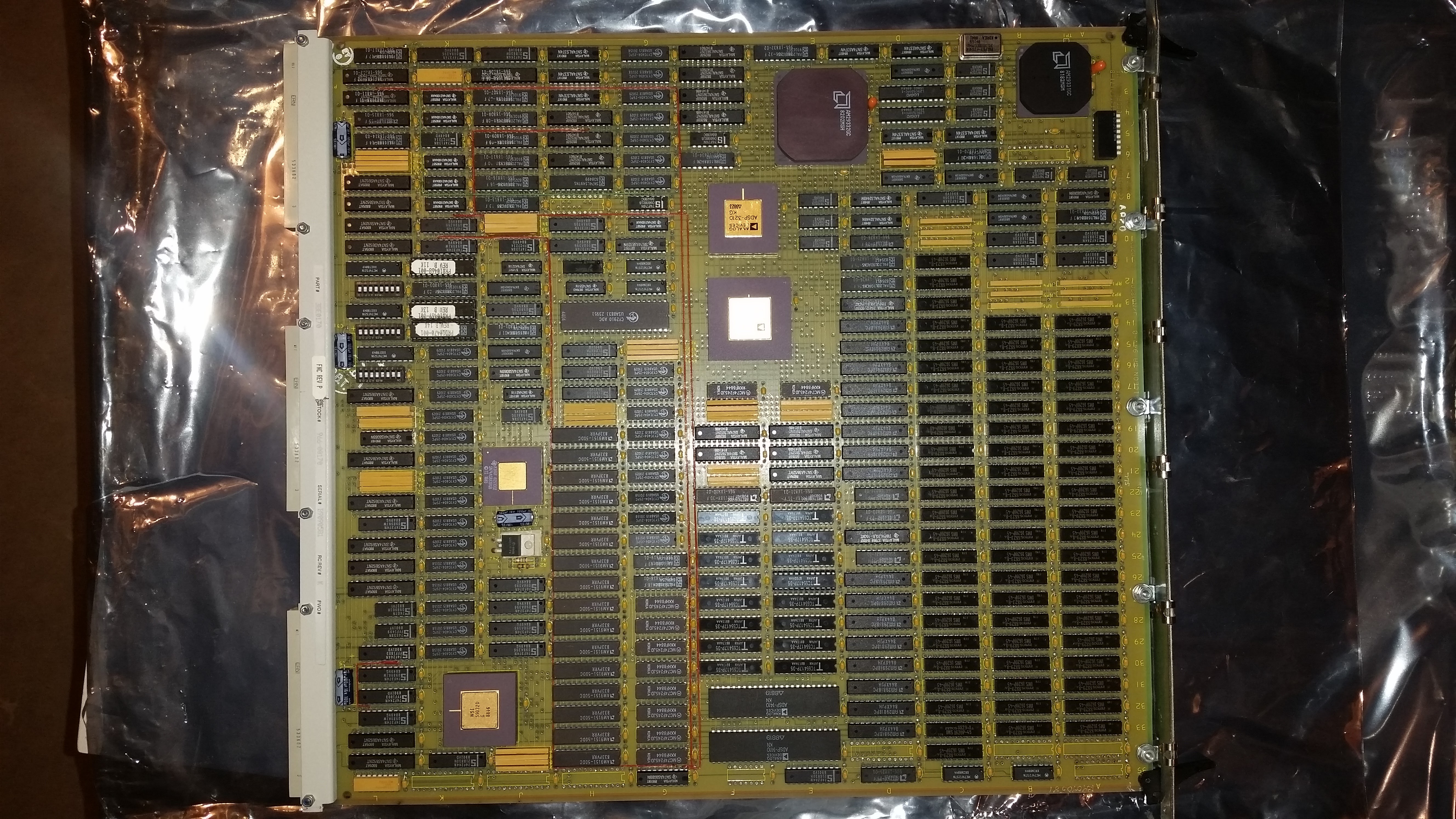
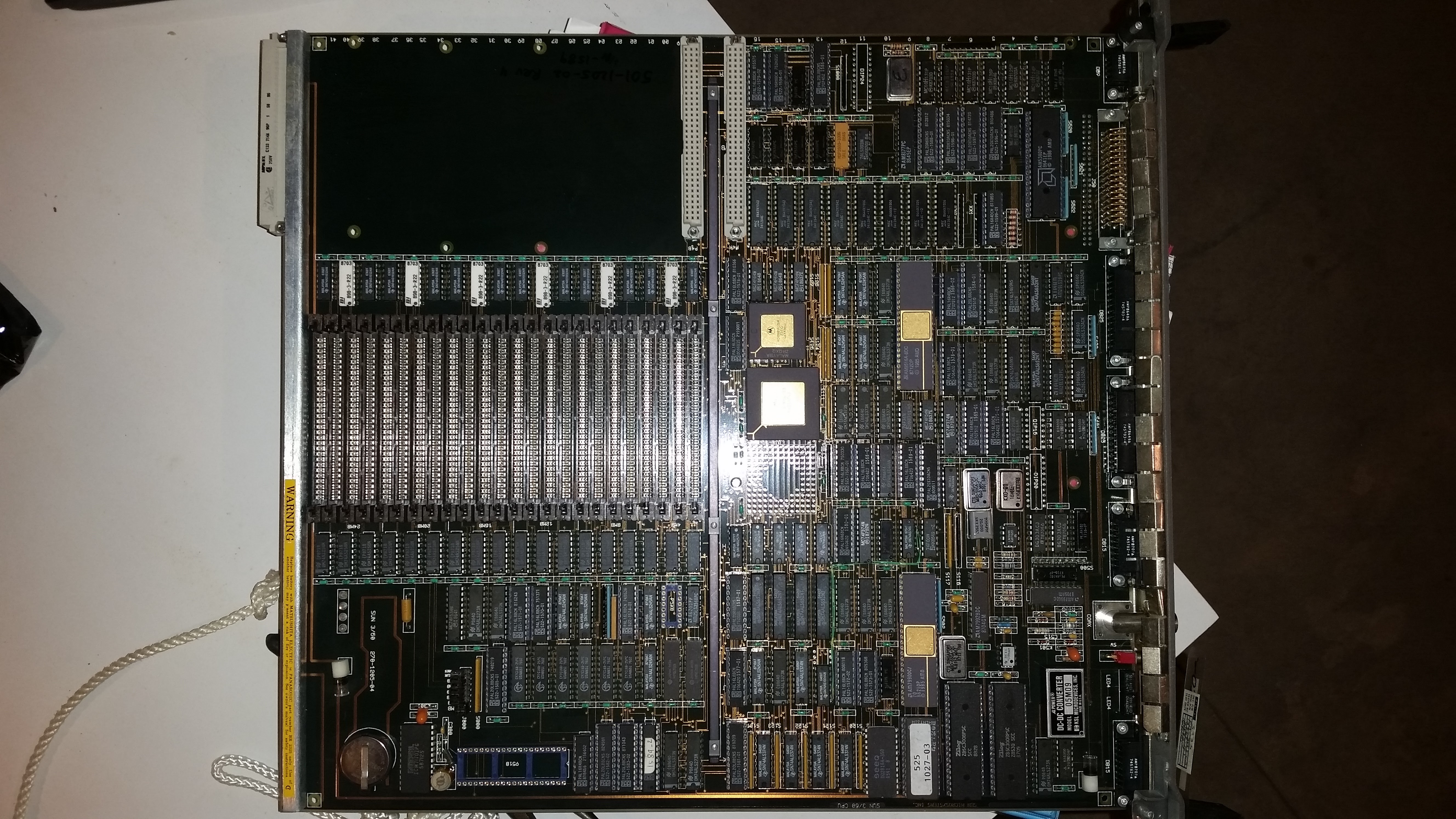
It looks like board 2 is for a Sun 3/50 workstation. Board 1 is some
kind of micro-programmed processor based on AM29331 and AM29331. There
are also some Analog Devices DSPs.
AM29000 based processor with Analog Device DSPs
http://www.chdickman.com/board1.jpg
Sun 3/50 processor
http://www.chdickman.com/board2.jpg
Can anyone identify them?
-chuck
COURYHOUSE at aol.com wrote:
> what is this NCR modem? what did it go to?
>
> NEW Vintage 1971 NCR Acoustic Coupler Modem, NOS, Factory Boxed, C260-400
> / F01 132411929563 on the bay
It is a Bell 103A compatible modem (110 or 300 baud) used with the NCR 260
series of thermal printing terminals. The 260 came in several variants:
-1 (receive only), -2 (keyboard send/receive), -6 (Automatic (cassette tape)
send/receive). I worked with them at NCR in 1973 and 74. I still have
the manuals, and just a few days ago scanned them for Bitsavers. If you
need a copy I can send you the raw TIFF files (one per page).
Both the -400 and -500 were EIA I/O to the terminal. The C260-400 connected
to a Bell System DAA (Data Access Arrangement), while the C260-500 was an
acoustic coupler. The acoustic coupler had a solenoid that would would
automatically raise and lower the handset on the telephone!
Back in those days you could not connect anything directly to the telephone
lines -- you had to use the telco-supplied DAA (kaching!) or an acoustic
coupler. I don't know if this modem can be connected directly to a phone
line without a DAA.
I think the asking price is totally unrealistic unless you are a rabid
collector of NCR gear.
Alan Frisbie
OK! Shades of the crown answering machine we have in the museum with the
handset lifter!
Yea the price is defiantly a barrier on this except for Paul Allen I
suppose.
Ed# _www.smecc.org_ (http://www.smecc.org)
In a message dated 11/27/2017 12:16:16 P.M. US Mountain Standard Tim,
cctalk at classiccmp.org writes:
COURYHOUSE at aol.com wrote:
> what is this NCR modem? what did it go to?
>
> NEW Vintage 1971 NCR Acoustic Coupler Modem, NOS, Factory Boxed, C260-400
> / F01 132411929563 on the bay
It is a Bell 103A compatible modem (110 or 300 baud) used with the NCR 260
series of thermal printing terminals. The 260 came in several variants:
-1 (receive only), -2 (keyboard send/receive), -6 (Automatic (cassette
tape)
send/receive). I worked with them at NCR in 1973 and 74. I still have
the manuals, and just a few days ago scanned them for Bitsavers. If you
need a copy I can send you the raw TIFF files (one per page).
Both the -400 and -500 were EIA I/O to the terminal. The C260-400
connected
to a Bell System DAA (Data Access Arrangement), while the C260-500 was an
acoustic coupler. The acoustic coupler had a solenoid that would would
automatically raise and lower the handset on the telephone!
Back in those days you could not connect anything directly to the telephone
lines -- you had to use the telco-supplied DAA (kaching!) or an acoustic
coupler. I don't know if this modem can be connected directly to a phone
line without a DAA.
I think the asking price is totally unrealistic unless you are a rabid
collector of NCR gear.
Alan Frisbie
thanks for dates. yes that all makes sense. some how my mind slipped a
decade.
I a looking for a GE Diginet tdm-114 acoustic coupler.
2 reasons, GE computer related
but also my first acoustic coupler I had with an ASR-35 teletype
I am also looking for the top mental plate that covers an ASR-35 punch
also.
( drop me a line off list if you have either you want to sell/trade/?)
thanks ed# _www.smecc.org_ (http://www.smecc.org)
In a message dated 11/26/2017 3:38:36 P.M. US Mountain Standard Time,
cctalk at classiccmp.org writes:
On Sun, 26 Nov 2017, COURYHOUSE at aol.com wrote:
> does the 71 sate seem early?
No, a 1971 date does not seem too early.
The price seems steep, even for a "relatively" early modem.
Bell 103 (300bps) dates from 1962.
The Bell 101 (110 baud) was 1958.
SCROTUS "Carterfone" was 1968 (ruling permitting direct connect)
Bell 212A (1200bps) came out in 1976.
The Livermore Data Systems modems that I sold off were from about 1964?
1970-1972, when I was working at Goddard Space Flight Center (Bldg 26,
"National Space Sciences Data Center"), we used a time-sharing system for
APL. APL type ball on Selectric terminal.
Yes, 1971 is prior to most mass-marketed "personal computers"
(1978?: Apple, PET, TRS80).
But there were teminals.
Where: Living Computers: Museums+Labs (Seattle, WA, USA)
When: February 10th and 11th, 2018
Registration deadline: December 10th, 2017 (About 2 weeks left)
We have about 15 registered exhibitors now. We are looking for a few more
to fill things out and to ensure that if somebody drops out that the show
doesn't look too thin. The exhibits span a wide range so it won't be a
pure 8 bit gaming or a DEC heavy iron show.
If you are procrastinating about being an exhibitor then it is time to
register ... If I can answer questions to help you decide then email me.
This is our first time in Seattle; the bar is low so don't be too worried
about having the perfect exhibit.
We are still looking for speakers too; the floor is pretty open. If you
did something cool during your career or just want to share aspects of the
hobby with others, this is a great place to do it. (I especially enjoyed
Lyle's talk on repair and restoration at VCF West.)
Interested or know somebody who is? Check out at
http://vcfed.org/wp/festivals/vintage-computer-festival-pacific-northwest/
. Please email me directly if you have questions or need encouragement.
Regards,
Mike Brutman
michael at vcfed.org
what is this NCR modem? what did it go to?
NEW Vintage 1971 NCR Acoustic Coupler Modem, NOS, Factory Boxed, C260-400
/ F01 132411929563 on the bay
not mine etc etc etc
ed#
This one is already on Bitsavers but if you'd like a nice original
copy with the fold-out schematics and color cover, I'll send it to you
for the cost of shipping from 60070.
The manual is in fairly good shape, bent a bit near the spine and the
glue is starting to crack. Still an essential display accessory for
your 9-track.
-j
I just got my HP-85 working for the first time over the weekend (except for its tape drive, which is still a work in progress). I'd like to acquire some accessories for it:
1) HP 82903A 16k RAM module
2) HP 9122C dual 1.44M 3.2" floppy diskette drive
Do any of y'all have either of those items available for swap or sale? I'm located in southern California.
Those two items are at the top of my HP-85 want list, but I might also be interested in other related bits such as the 82940A GPIO Interface, other compatible HPIB mass storage, etc.
--
Mark J. Blair, NF6X <nf6x at nf6x.net>
http://www.nf6x.net/
Free for shipping from 95006, a stack of original IBM documents for the
S/360 including Field Engineering Manuals and Systems Reference Library
documents plus others - dumpster rescues from an engineer's estate.? All
have been hi res scanned.
Titles from the IBM Systems Reference Library as well as several Field
Engineer Manuals.? Everything except one doc is an original publication
(and the dup looks like it was done contemporary to the other
originals).? Dates on everything are late 60s or early 70s.
some titles:
Field Engineering Manual Vol 1 3277
Field Engineering Manual Vol 1 3271
Engineering Reference Manual Automatic Punches
System 360 Model 40 Functional characteristics
System 360 System Summary
System 360 Basic Operating System Specifications File utilities
IBM 46-47 Tape to Card Punch Manual of Operation
IBM Systems Reference Library 7 Oct 1968 Cumulative Index of Pubs and
Programs
No parsing out individual titles - this is all or nothing.? Box weight
is ~28lbs ( and it's all paper - there are no 3 ring binders adding to
the weight).
It can ship media rate - figure 29 lbs by the time I get packing matl
and tape included.
First requester gets it..
Steve Shumaker
Boulder Creek, CA
Hi folks,
I can't seem to find the "Networking Support Utilities" package for
the 3B2 anywhere online. Unfortunately, this package is required in
order to install TCP/IP (which I DO have)
(Note that this is NOT the "Basic Networking Utilities" package --
that's UUCP, and I do have that)
If anyone has diskette images squirreled away, please let me know!
-Seth
--
Seth Morabito
web at loomcom.com
> From: Liam Proven
> TCP/IP basically postdates the MS-DOS era, in PC terms, and it's Bloaty
> McBloatface.
This must be a uSloth TCP/IP you are speaking of. There's the one from FTP
software which was based on the one done at MIT which was freeware. That one
was definitely DOS-era - it ran on DOS 1 and DOS 2. I think I have the MIT
version somewhere if you have a use for it.
> But only someone who thinks that Emacs or Vi are usable editors could
> think this was an appealing virtualisation solution.
Epsilon! Even on Windows 95, it was a not-so-humungous 261KB. If Lugaru
can't cough up a DOS version, I'm pretty sure I still have my DOS Epsilon
distro disks somewhere. Of course, I would have to get a 5" floppy drive
working... :-)
Noel
Hi all,
I was given an MTI MXV21 controller which is apparently compatible with
the RX02 drive. The card has a 50 pin header, but the RX02 drive has a
40 pin ribbon cable. Does anyone know what am I missing here?
I don't see anything about this in the manual:
http://bitsavers.informatik.uni-stuttgart.de/pdf/microTechnology/MXV21_flop…
Thanks,
Aaron.
Jon,
Then why not use a dip compatible version of the DS chip? I mean yes this allows for switchable battery which is very nice but SMT soldering is not for everyone.
I wonder if there is a way to determine if there will be BIOS issues by switching the DS12887?
-------- Original message --------
From: Jon Elson <elson at pico-systems.com>
Date: 1/22/17 9:16 AM (GMT-08:00)
To: General at classiccmp.org, "Discussion at classiccmp.org:On-Topic and Off-Topic Posts" <cctalk at classiccmp.org>
Subject: Re: DS12887 pcb substitute with battery
On 01/22/2017 10:07 AM, Ali wrote:
> Al,
> I thought the problem with switching these chips was that part of the ROM code was embedded in them? I.e. it isn't just an issue of battery? Am I wrong? If I am then why not use one of the replacement chips that are available?
>
These don't have a lot of memory on them.? many early PCs
stored some config info there, but generally the BIOS can
reconstruct it if it isn't there.? I suppose there is a
possibility that random data in the CMOS memory could cause
the BIOS to try to use unavailable features and hang.? I
don't think anybody put actual executable code in there.
Jon
So Dave Bridgham and I are continuing to make (slow) progress with the QSIC
and indicator panel project; the latest step was to find some LEDs which look
much more like the original lights:
http://pdp10.froghouse.org/qsic/new-led.jpg
So now I'm trying to make up a prototype 'light shield' (the flat board with
all the holes drilled in it); the parts list in the drawings (RF11 engineering
drawings, pg. 187) just calls it a 'Benelex', which is the name for the
material it was made of (sort of like MDF), but 'light shield' is what I've
taken to calling it.
Anyway, the drawings there do not, alas, give any dimensions. Can one of the
people who has an original please measure it for me? Just WxLxD is all I need;
I have a good photo, and can get all the other measurements I need from that,
once I know the 'scale'. (Well, not the depth, which I can't see in the image,
which is why I need that to.)
Thanks!
Noel
Here is an interesting article from early 1988 (probably written in min
1987) that compares and contrasts GUIs of the day. Interesting that they
do not mention OS/2 by name, by this point it would have been available,
given I used it in Jan 1987 when I was working at IBM. Also the XEROX
interface was not yet dead as the author makes it seem. If anyone used
Page Maker on a 1987/88 Xerox machine and compared that with "Windows OS/2"
machine trying to run the Page Maker on a PS/2 80 you'd probably agree.
Basically I am unsure what planet the author was from, but you can decide
for yourself. Talks a little about HP's GUI product, Sun/AT&T, Apple
Finder, etc. Mentions NeXT is coming, Commodore is dead, ... opinionated.
http://vintagecomputer.net/cisc367/PC-Letter_19880118.pdf
Bill
Hi:
The following answer comes from a retired IBM tape technologist:
The color of the coatings on a tape are dominated by the magnetic pigment (or the carbon used in back coats..which is black)..the earliest iron oxide coatings were based on the conversion of alpha-iron oxide which is a pale yellow and some what needle shaped (longer than wide) but non-magnetic to gamma iron oxide which is magnetic. The very early particles were not very homogeneous and were very highly aggregated....poor conversion as the early particle were being produced by paint pigment manufactures as a specialty product in low volume. These were a yellow brown color..but by the 60's gamma iron oxide of 250-300 Oe was commonly used in the magnetic layer coatings. These were typically brown to chocolate brown (if they had some carbon black mixed in for surface conductivity (anti-static) which depending on the use as well as the manufacturer varied a lot i n surface finish (gloss) as well). This market was driven by audio primarily and dynamic range and analogue signal characteristics such wow & flutter were driving formulation and magnetic particle development.
In the late 60-s and 70's new particles began to enter the market..Cobalt doped and later cobalt 'modified" gamma iron oxide as well as chromium dioxide..and some very early explorations of iron metal particles and some exotic mixed metal crystals... The colors of the magnetic coatings based on more acicular gamma iron oxide made specifically for the recording market were now reddish brown , cobalt doped were a dark brown - to black, chromium dioxide is very black..remember during this period digital recording in both tapes and disks were now the growth areas driving new pigment development and drastically improved formulations driven by the need for improved durability, longevity and wear characteristics (drop outs (defects & debris), head wear and head/drive contamination being increasingly problematic)..in the 90's metal particle and BaFe pigments took over tape while disks moved to thin film magnetic layers.
As for reel materials and hub evolution..the initial reels were metal and expensive...plastic became normal in the 60's and beyond for the most part..but for master copies or sensitive archival reels..glass or metal were preferred... but changes in the materials were driven by the higher tape speeds,tensions and demands for improved reliability and durability. Hubs in some drives had to be conductive so had carbon black or metals added to them to improve the compressive strength and conductivity. A lot of very innovative but subtle design features moved into tape reels/hubs specifically designed for various transports and industry demands. In addition lubrication and binder changes were common as the needs for the various products in audio, video and digital recording advanced.
Hope this helps..but if the interest is primarily in getting a useful detailed knowledge of a particular tape..color is pretty much useless..you need SEM/EDAX and GC/MS and a database of tape analyses to compare to in order to really begin..and then to really know the tape you need DMA/DMTA mechanical analysis, and AFM/MFM surface profiles.....but to my knowledge only IBM had that data and I imagine it ..like so much of that knowledge learned from 1962-2008 is now gone.
Tom
-----Original Message-----
From: Chuck Guzis [mailto:cclist at sydex.com]
Sent: Monday, November 20, 2017 10:35 PM
To: CCtalk
Subject: Idle question: Color of tape coatings
While working on some old (again!) half-inch tapes, I note that some of the very old ones have an oxide coating about the color of milk
chocolate. Newer ones are anywhere from dark chocolate to black.
Reel construction is another aspect. The really old ones tend to be all clear plastic, including the hub area. Newer ones have either a black plastic reinforcement to the hub or employ an aluminum sleeve.
In most cases, the oldest of these is from around 1964, but probably older than that, as the only clues I have are dates placed by the tape librarian when a tape is put back into the pool or a label indicating when the tape was last recertified.
Was there a date after which *all* half-inch tape became the dark brown to nearly black in color?
--Chuck
I've always thought STD-Bus missed a real opportunity here. Small
enough to be cost effective (relative to the size of, say, S-100
(bonus, no stupid power supply issues)), sane, flexible enough bus
structure that I believe there are at least CPU cards using:
- 4004/4040 (pre-standard?)
- 8080/8085/Z-80 and the myriad of variants
- 8088/8086/80188/10186 through at least 80486, including variants and
second sources
- 8048/8051 and the vast numbers of variants
- 8096/8097 and variants
- 6800 and variants
- 68HC11 and variants
- 6809/6309
- 6502 and variants
- 68xxx and variants up to at least the 68040 and 68332
- TMS9900/9995
- RCA 1802
- Signetics 2650
- Novix Forth
More importantly, the vast number of compatible I/O cards that were
produced. Much alternative history to be pondered.
KJ
Looking into fabricating a few (functional-only) copies of the Tektronix diagnostis rom pack
Seems quite a few people have non-functional units...
Any interest out there ?
Jos
This looks to me like the power supply and backplane of a PDP 11/05, looks
to be in nice shape. Surprised no one grabbed this yet, esp someone with
an 11/05 that has issues with power supply. Someone might have the missing
parts.
"DEC PDP-11 Digital BA11-KE Mounting Box"
https://www.ebay.com/itm/DEC-PDP-11-Digital-BA11-KE-Mounting-Box/28265372079
granted "all you need are the cards and the front panel" reminds me of the
steve martin routine. "It's easy to be a millionaire, first get a million
dollars and then ...."
Compare with
http://vintagecomputer.net/browse_thread.cfm?id=622
b
The fascinating discussion Jim just started on buses got me thinking
again about a book I've been trying to track down for a while. While
it's not necessarily classic-computing-oriented, it's not really about
newfangled computers either; heck, I encountered it in 2003 or so, so
it'd be pretty dated by now.
Basically, I'm looking for a certain book (although really any book in
the same vein would satisfy), which was on computer system architecture,
organization, etc.; it talked about the usual boolean logic, assembly
programming in some fictitious instruction set, an overview of two
actual architectures (I think at that time they were 32-bit x86 and
64-bit POWER). The other thing I remember very specifically was there
was a place near the back (probably an appendix) that talked about
one or more specific buses (I think at least PCI was there), with timing
diagrams to tell you what was actually going back and forth between the
bus and CPU.
Like I said, I'm sort of keen on finding the exact book I had, but I
realize that's somewhat unrealistic, so I'm open to recommendations on
any book like that. And if it can cover the relavant concepts for both
classic and newish computers, that would be great.
Basically what I hope to learn is how you actually deal with
peripherals, add-in cards, etc., on the assembly language level, and
what that really translates into on a signaling level. I only really
know a little about how to do that in memory-mapped IO systems like the
Commodores (and to be honest I don't understand how the buses work
there, just how to poke and peek.)
Thanks!
--
Eric Christopherson
On Tue, Nov 21, 2017 at 1:51 AM, Mattis Lind <mattislind at gmail.com> wrote:
> I think this is a 3/60 processor. Not 3/50.
I said 3/50 because that is what the silkscreen says. I found some
picture online and the 3/50 was a different layout. It sure looks like
a 3/60
Looking at some online schematics it looks like the P3 96 pin DIN
connector may only be for power. Is it possible to power this thing
through that connector without a proper chassis?
I know nothing about Sun hardware.
-chuck
Hi folks,
I'm picking my way through an LA30 restoration right now. It was pretty
filthy, so I've needed to pretty thoroughly disassemble it for proper
cleaning.
I noticed that a few of the thin steel ribbon springs in the paper path
are missing or broken on my unit, and some of the rubber bushings have
hardened and deteriorated. Long shot ask, but wondering if anybody out
there has spares of:
74-08648 (Spring, paper drag)
12-10357-3 (Bushing, rubber mount)
12-10358-3 (Ring, rubber mount)
Also, the maintenance manual recommends Molykote B2KR for lubrication in
a few places, but I can't seem to find specs on what this was. Can
anybody recommend an equivalent modern alternative grease?
cheers,
--FritzM.
> From: Fritz Mueller
> Overall, I have been pretty amazed by the sheer number of machined
> parts, castings, high quality bearings, etc. within this beast. Lots of
> stainless steel throughout. Sure wouldn't find anything built this way
> these days! What a tank.
That's DEC for you - quality engineering (mostly :-). Reminds me of this
Porsche/Lotus story:
http://www.chiappa.net/~jnc/nontech/chapman.html
Alas, that kind of engineering turned into a liability when DEC tried to
compete in the 'new world' of personal computers... :-(
Noel