I have paper copies of a few manuals I have no use for. Most of these
are single-sided photocopies made by others and sent to me for scanning
years ago. These are not originals. Almost all of them appear to be
available on bitsavers, but if you have a penchant for paper, this might
be your chance. Available by post (for whatever it costs to send them
plus the paypal fee) or by arrangement in Reading, UK.
MicroVAX Troubleshooting and Diagnostics. EK-O19AE-SG-005
MicroVAX Dual-Host Systems. EK-338AC-DH-003
VAX-11/780 Unibus Adaptor Technical Description. EK-DW780-TD.001
VAX-11/730 Diagnostic System User's Guide. EK-DS780-UG.002
VAX-11/780 Installation Manual. EK-SI780-IN-002
Translation Buffer Cache and SBI Control Technical Description.
EK-MM780-TD.001
VAX-11/780 Hardware User's Guide. EK-11780-UG-001
VAX-11/780 Console Interface Board Technical Description. EK-KC780-TD.001
FB780 Floating-Point Accelerator. EK-FP780-TD.001
MS780 Memory System Technical Description. EK-MS780-TD.001
* KA780 Centraler Processor Technical Description. EK-KA780-TD.001
* KA655 CPU System Maintenance. EK-306AA-MG.001
The last two (marked *) do not currently appear to be on bitsavers. They
do appear in my index of local files so I'll make them available to Al
sometime soon.
Send emails off-list please.
Antonio
--
Antonio Carlini
antonio at acarlini.com
Hey all - We have had soft-launched it on our website calendar a few months
ago but I wanted to confirm that yes on October 16 - 18 2020 the first
annual "Kennett Classic" weekend is scheduled and a GO; venue booked and
implementation is under way.
The centerpiece of the weekend will be a contest between teams of vintage
computer hobbyists competing for the Kennett Classic Cup, an award to the
team with the best network of vintage hardware based on up-time and
connectivity. There will be a substantial prize awarded to the winning
team. We're really excited to share the details of this event, but stand
by for now. In addition to the on-site teams, we will open the contest to
any qualifying team worldwide. This is a first-of-its-kind world-wide
vintage computing networking event!
We're working on the registration pages now, and once they're live we'll
share all of the details. Think of the Kennett Classic Cup as a car rally
for vintage computers. We have many other activities planned for that
weekend, stay tuned.
Interested?
We look forward to making this a huge success.
Bill Degnan
Kennett Classic
Kennett Square, PA
https://www.kennettclassic.com
Hello,
Does anyone have the "Extended Industry Standard Architecture Revision 3.10"
specification either in printed/book form that they are willing to separate
>from or in some sort of electronic format ala PDF? I am mostly interested in
the sections on the syntax for EISA CFG files. TIA!
-Ali
Hi - I am looking for an IMSAI PCS 80-30 ROM image made for with the
Tarbell 1011 controller and Persci 277..anyone have this? I received a
system and drive but I think the ROM was replaced and since then I was told
the system would no longer boot.
In the meantime I am going to find a drive and controller that is
compatible.
Or, ug, have to try to edit the ROM I have (version 1.1) to operate with
this hardware. I would not having a copy of ROM 1.0 at least to start from
scratch with.
Thanks
Bill Degnan
One shot in the dark if anyone has the DSP development or interface toolkit for
NI's TMS320C30 Nubus cards. I have a bunch of boards but never found any software
to use with them. This is probably LabView 2 or 3 timeframe.
I see NI, who is normally pretty good with keeping manuals around doesn't even
have them online any more for boards like the DSP2300
Hi,
I have access to some DEC items for a month or two before a house is
sold. Photographs are linked here:
https://imgur.com/a/HqxI4JA
I can locate and forward any items, if still available, for actual
shipping costs and any nominal packaging material costs.
Summary:
Hitachi ESDI drives
RX50 drives (many)
TK50 tapes (many)
DEC Professional magazine 1987-1994
DECUS software abstracts
DECUS software catalogues
Controlling Software Projects (DeMARCO)
Programming in C with Let's C (Vine)
Surefire Programming in C (Stewart)
PDP-11 Systems and Options Catalogs 1983-1989
Various databooks, DECdirect, etc
DECUScope magazines
Copies of RT-11 SIG newsletter(s)
issues of digital Canadian Digest, 1980s
DECUS Canada mailings
digital news & review magazines ("The Independent Newspaper & Test Lab
of Open Computing for DEC Sites")
various PDU units (see pic)
RD52/RD53 drives
various empty chassis/backplanes (see pics)
BA23 shells (2)
various tapes, drives (see pics)
As I said, last call, gone in 1-2 months.
--Toby
I have my Sun-4/110C set up and running SunOS 4.1.4.
Were there any fun SunView applications or hacks back in the day?
Other than the demos, the only stuff I currently have is emacstool (built as part of emacs 18.59) and the PLATO client (which I haven?t actually built yet). I know I can read through the comp.sources.unix archives but I figure maybe some folks might remember things to look for.
-- Chris
Hello folks;
I've recently had some free time and decided to look at some hardware
failures in my small collection.? I fixed a couple of analog boards in
the compact Mac department, and a failed scsi disk in one of them
prompted me to test the small stash of such drives that I have.? Turns
out, about half of those marked as "working" in 2015 have failed now in
many different ways.? Oh well... sucks, but it was to be expected...
I decided to image some of the still working ones, both in the stash and
in working machines.?? The one in the vaxstation 2000 (a 1GB scsi with
5.5-2) turned out to have file system corruption (probably from? AC
power failures), which has taken a while to fix.? And then, I remembered
that said system originally came with an RD53 that has sat elsewhere for
25 years.? It passed a read test in 2005.? So I tried to see if I could
read it and maybe image it now, but no go. The disk spins up, initiates
a seek (the arm is not stuck in a gooey stop pad; I've read that this is
a common failure mechanism for Micropolis 1325's; I opened it and saw
the arm move) but then the arm returns violently (clacking) to the rest
position; it does this a number of times (two to four, usually) and then
it spins down. Applied voltages and currents remain ok as this happens.
I've seen plenty of internet content about solving the stuck arm
problem, but not this.
Advice, please?
Carlos.
Here is a strange question. Does anyone happen to know how long unused Laser Printer and Ink Jet transparencies last? Do they go bad, or break down? I have a stack of them, still in the boxes, a lot are unopened. I scavenged them about 10 years ago, when people were getting rid of them.
I wanted them for a Photography Project, that I?ve never had time to try. At this point, I?d like to know if I?m wasting space storing them.
Zane
Never mind, I just realised there was a little "+" sign well away from the
symbol that allowed me to select it. It looks like the symbol is somehow
much bigger that how I have drawn it. I should be able to work it out now.
Regards
Rob
From: Rob Jarratt <robert.jarratt at ntlworld.com>
Sent: 07 March 2020 17:12
To: General Discussion: On-Topic and Off-Topic Posts (cctalk at classiccmp.org)
<cctalk at classiccmp.org>
Subject: Can't Select a Custom Device in Eagle
I have been using Eagle to reverse engineer a PSU schematic. I decided I
needed to make a custom device in Eagle for the transformer. I have done
this and it seems to be fine, except that when I put the symbol on a
schematic, after I have confirmed its position, I can't select it, so I
can't move it or anything.
I have done some web searches but I can't find anything about this. Anyone
know what the problem might be?
I am using the free version, and I am on version 7.2.0. Looks like later
versions are subscription only and I am reluctant to do that because they
could take away access at any time.
Thanks
Rob
I have been using Eagle to reverse engineer a PSU schematic. I decided I
needed to make a custom device in Eagle for the transformer. I have done
this and it seems to be fine, except that when I put the symbol on a
schematic, after I have confirmed its position, I can't select it, so I
can't move it or anything.
I have done some web searches but I can't find anything about this. Anyone
know what the problem might be?
I am using the free version, and I am on version 7.2.0. Looks like later
versions are subscription only and I am reluctant to do that because they
could take away access at any time.
Thanks
Rob
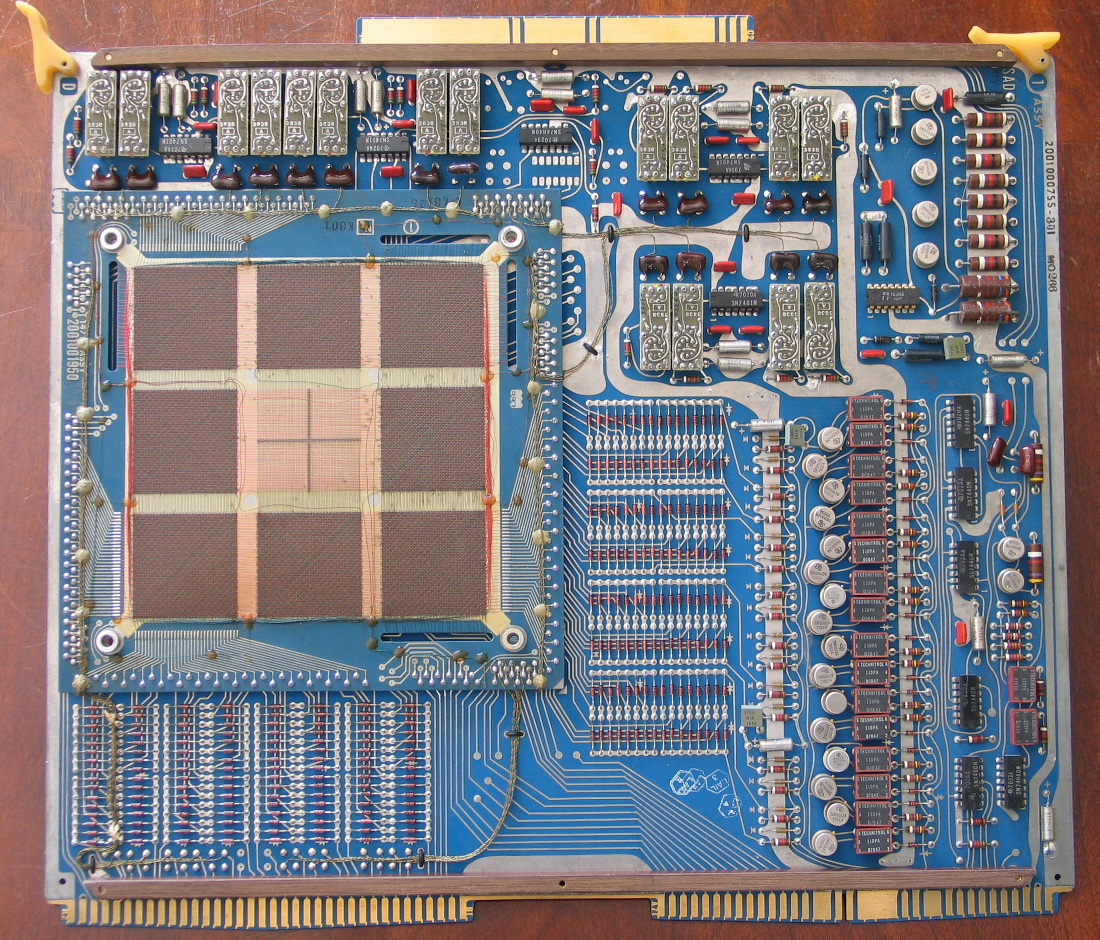
Hopefully collective wisdom can help on this one - does anyone have a clue
what system this core board was from:
http://www.classiccmp.org/acornia/tmp/coresmall.jpg
The curved edge connectors (presumably to make board insertion easier) are
quite distinctive, plus the way the power's fed in via an edge connector on
the "far" side of the board. What's interesting to me is the core ring
size; the TTL ICs on the board have 1970 date codes, but I didn't think
that the rings got quite that small until right at the end of core's era,
more toward the end of the decade.
It seems to be 8 blocks of 64x64, i.e. 4KB. p/n on the main board of
2001000755, and just hidden from view under the core daughterboard is a
logo that says "LEC", which I suppose might be meaningful.
There's a bigger (2181x1863) image as "coreboard.jpg" in the same dir if
more detail helps (I doubt it), but it's 2.4MB so maybe save Jay's
bandwidth by only looking at that one if you absolutely have to :-)
thanks,
Jules
> On Mar 5, 2020, at 05:20, Plamen Mihaylov via cctech <cctech at classiccmp.org> wrote:
>
> ? Does anyone have such machine ? I miss the PSU adapter as well as the Sbus
> framebuffer which connects the LCD panel to the mainboard. Any info is
> appreciated.
I had one, but sold it to someone on this list last year.
I used a generic power supply, one with multiple cord tips and selectable output. However, when I exhibited the BriteLite and had it running all day, the power supply died after a day and a half.
Good luck on finding a frame buffer for it. I don?t remember the details about it, but I took lots of photos of it.
alan
>
> Best regards,
> Plamen
> Date: Thu, 5 Mar 2020 14:23:30 +0200
> From: Plamen Mihaylov <plamenspam at afterpeople.com>
> Subject: RDI BriteLite
>
> Does anyone have such machine ? I miss the PSU adapter as well as the Sbus
> framebuffer which connects the LCD panel to the mainboard. Any info is
> appreciated.
>
> Best regards,
> Plamen
>
I have several BriteLites, including IPC, IPX, and LX versions.
I will see what power supplies go with them.
The Sbus video board is something special for the LCD panel.
--
Michael Thompson
Looking at the datasheet for the 6809 (specifically, the 6809E that
needs incoming quadrature clock), I read that !HALT can be asserted
200nS (for 1MHz part) before falling Q and the CPU will finish the
existing instruction and then go into a HALT state as long as the HALT
line is low during the falling edge of Q.
That's the store from the datasheet, but when I am testing it, I see
that, even if I pull HALT low at the very beginning of the last cycle of
an instruction, the 6809 will not acknowledge the HALT until executing
the next instruction.
My logic is watching for IO address $ff61.? When found, it drops Q
so, to start the HALT condition, I need only:
lda $ff61
Not that the trigger is being performed by the code, so the current
instruction (the lda) should complete and then the CPU should go into
HiZ.? What I see is:
lda $ff61
lda $ff60 <- the next instruction
executed, and THEN the CPU goes into HiZ.
I can deal with this (Yes, I should just look at BS=BA=1, which tell
when to safely use the bus, but I don't have access to those signals for
this project), but I thought I'd see if this was known by all, or if
there is something I am missing.
Jim
--
Jim Brain
brain at jbrain.comwww.jbrain.com
Now that I have my SWTPC 6800 loading and saving programs with paper tape, cassette, and floppy disk (using the Percom LFD-400 controller and their MiniDOS and MPX ?operating systems?), the next logical step is getting FLEX up and running. Unfortunately, I only have the Percom floppy controller and I don?t know if FLEX compatible disk drivers and boot code were ever written for it. Before I go create Percom support for FLEX from scratch, does anyone have any leads?
Mike
On 3/3/20 4:26 PM, Joe George wrote:
>
> Yup! Single sided, single density, 32 hard sectors. And the Wang 2200 had apparently some weird insert orientation, the ?Wang? labels are on the back of the diskettes, opposite side of the manufacturer sticker.
>
> Cheers,
My recollection is that the 8" floppy drives (in a lowboy floor-standing
unit) were vertically mounted and placed to the right of the operator.
The floppy eject button was then closest to the operator and any disk
inserted would be visible from the "rear" of the floppy.
Not nearly as weird as the Altos ACS8000, for example, that mounted the
floppy drives upside-down and horizontally, such that the eject button
was topmost. Those disks do have content labels placed on what we'd
consider the "backside" of the floppy for obvious reasons.
Did any 5.25" floppy-equipped systems do this?
--Chuck
I was watching this video on highway construction in the 1960's (as you do) and noticed what appears to be
a System 360 console, that I couldn't place. Presumably it's some peripheral or CE maintenance panel. I didn't
find it in the Physical Planning Guide (not that that's comprehensive) nor from perusing google images.
I'm a little curious as to what it is.
It's at 23:13 in https://youtu.be/apWSa6QlrTg?t=1393
Thanks
Steve.