Dear all,
I am looking for a version of the VAXSET Software Engineering Tools to
run on (Micro)VMS 4.7. The oldest version I have found so far is
VAXSET010 which requires VMS 5.3 to run (this was on CSD 1991/05.)
VAXSET is a bundle of the following components (and more in newer
versions):
- CMS (Code Management System)
- LSE (Language Sensitive Editor)
- SCA (Source Code Analyzer)
- MMS (Module Management System)
- PCA (Performance Coverage Analyzer)
- DTM (DEC/Test Manager)
I have found versions of CMS and MMS seperately that run on VMS 4.x. If
anyone has old versions of the other components and is willing to share,
that would be much appreciated :-)
Cheers,
Malte
--
Malte Dehling
<mdehling at gmail.com>
Dear colleagues in vintage computing ;-)
In the last years there has been substantial interest in the Apollo
Guidance Computer (AGC). So maybe someone might be interested what
happened outside of the United States in the 1960ties: Over the last few
years I restored a 920M computer which was (among others) used as the
guidance computer in the Europa rocket. This was the ancestor of the
European Ariane sapce launcher:
https://en.wikipedia.org/wiki/European_Launcher_Development_Organisation
Although not well known, this machine is a contemporary of the AGC, it
also uses integrated, SMD mounted circuits and is realized in DTL
techology (Diode Transistor Technology). Its word width is 18bit,
8k of core store where standard within a show-box sized chassis. 2us
and later down to 1us instruction time where stadnard. In contrast
to the AGC, this machine was a member of a whole series of airborne
computers - some of which are still in use TODAY (2021).
After core and the DTL chips became obsolete, this architecture even was
re-implemented by BAE systems using the AMD29XX chipset in the same
chassis as drop-in replacement.
The 920M never had core rope memory, and for rocket guidance 8k have
been enough although adding a 2nd box extending the core was possible.
Tte architecture is able to support up to 256k words of 18 bit.
Of course, the instruction set is very archaic - no carry flag, no stack
but it served its purpose with 18 bit choosen as the perfect word length
to give reasonable resolution without need for double-word calculation in
most applications; http://www.programmer-electronic-control.de/Elliott920FactsCard.pdf
If this triggered some interest, you may watch my recently released video
on the 920M (covers applications, internals and some software is shown
running)...
https://www.youtube.com/watch?v=v-gF5g0nnoE
...or visit my project page regarding the work of restoring three
different members of this computer family to working condition:
http://www.programmer-electronic-control.de/index.html
Happy computing to all of you,
best wishes,
Erik.
P.S. Just wanted to point out, that also in Europe there have been relevant
developments regarding spaceborne computing in parallel to the Apollo
programme! In no ways I want to diminish the achievemets of the
Apollo development team...
''~``
( o o )
+------------------------.oooO--(_)--Oooo.--------------------------+
| Dr. Erik Baigar Inertial Navigation & |
| erik at baigar.de .oooO Vintage Computer |
| www.baigar.de ( ) Oooo. Hobbyist |
+---------------------------\ (----( )----------------------------+
\_) ) /
(_/
Dr. Erik Baigar
Scientific Lead Spectroscopy Systems
Technologie Team Spectroscopy
THORLABS GmbH
M?nchner Weg 1
85232 Bergkirchen
Germany
Tel.: +49 (0) 8131 5956-40147
Fax.: ?+49 (0) 8131 5956-99
Mail: ?EBaigar at thorlabs.com
Web: ?www.thorlabs.com
General Manager: Dr. Bruno Gross
HRB No: 85345, M?nchen
Which is closer to being vintage, the sounds made, or the floppy disk drives
themselves?
Moppy + Star Wars Theme = Floppy Vader's Theme
https://youtu.be/LdgzsF_O7oI
Donald R. Resor Jr. T. W. & T. C. Svc. Co.
http://hammondorganservice.com
Hammond USA warranty service
"Most people don't have a sense of humor. They think they do, but they
don't." --Jonathan Winters
Last year I created an LK201 keyboard emulator that uses a USB keyboard.
More recently I extended that work to create a second one that uses a PS-2 keyboard instead. Partly because I had one and figured it would be fun to try.
You can find both designs on Github at https://github.com/pkoning2/lk201emu . The "doc" directory describes both; in particular, file doc/kicad.md talks about the hardware design, with pointers to an OSHPark layout, a parts BOM, and assembly instructions.
The new one is slightly larger than the old (2 by 2 inches, rather than 2 by 1.5). I like the audio implementation a bit better; perhaps I'll revise the USB version to use that same technique.
Enjoy. Comments and feedback will be much appreciated, either by email or on this list or as "issues" on Github.
paul
Today I finally got the SPACEWAR version for PDP-11/10 running again on my
PDP-11/05 with AR11 board. I played a couple of rounds together with my
daughter. She was better than me. Quite hard game IMHO.
https://youtu.be/fTiHRAKjyho
Bill Seiler and Larry Bryant wrote this version in 1974 and submitted it to
DECUS. It was believed to have been lost to history. But Bill had saved the
printouts from the PAL11 assembler. He sent me scans of these printouts as
pdf files. I then transcribed it into source files and iterated several
times in SimH to get a clean build and link. I got some help from people
here doing OCR on some files. But the lines mostly confused the OCR process
so a lot of errors was introduced. It turned out that it was easier to just
transcribe the whole lot by hand than finding and correcting errors.
The AR11 is somewhat different to the AD01 and AA11 that Bill and Larry
used. AA11 has a 12 bit 2?s complement D/A while the AR11 is only 10 bits
and not 2?s complement. I did some patches and eventually got everything
right.
I also connected a couple of analogue joysticks. The fire button is just
short ciruiting the viper of the potentiometer to the 5V supply lead. The
screen is a HP1332A vector screen.
All the transcribed code, AR11 patches and build instructions are available
on github. https://github.com/MattisLind/SPACEWAR
It should be possible to adapt it to orher types of A/D and D/A hardware if
anyone wishes to do so. However the gameplay might be harder when running
on a faster PDP-11?
Have fun!
/Mattis
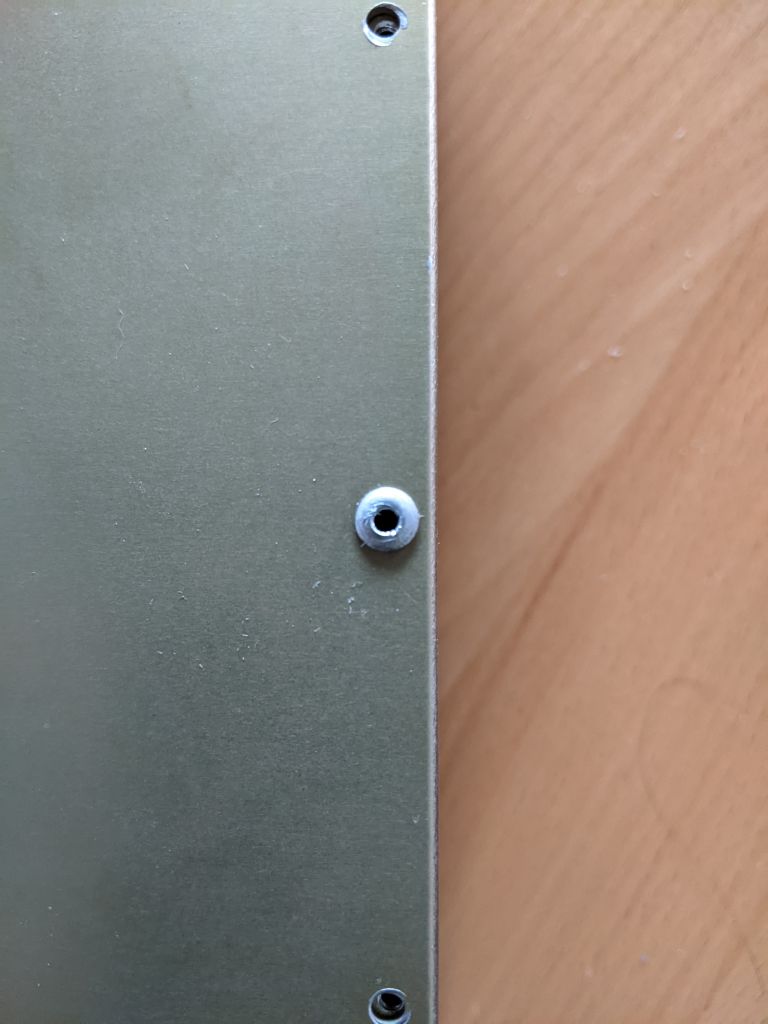
Anyone have any idea on how to open this particular Apple II PSU? It is
a Astec AA 11040B and has like a rivet on each side in the middle. All
the other supplies I've messed with just had screws along the bottom.
Trying to remove the bottom of the casing so I can work on the supply
itself. Link to a pic of it.
Thanks for any help.
http://www.trailingedge.com/images/A2PSU.jpg
David Williams
www.trailingedge.com
Does anyone have a DMC11 integral modem line card schematics set? I'm looking specifically for the part right next to the connector, i.e., the coax driver and coax receiver parts. I don't see it on Bitsavers.
That does have a line unit maintenance manual which has a schematic of the digital parts (in other words, everything up to the point I actually need the most) but it omits the analog part, saying to find it on "print D16".
The DMR11 print set does show a circuit for this, but it's very different from what the DMC manual describes and it has some aspects that don't make much sense, like a "sine generator" in the output stage.
paul
Jim,
I sent you an email to your jwsmail at jwsss.com mail account and haven't heard
back from you, so thought I'd better try to reach you on cctalk!
It's about potential restoration work needed in the LA area. Please get back
to me privately.
Sorry for the interruption of posting this to the cctalk list...
Best, Lyle
--
73 NM6Y
Bickley Consulting West
https://bickleywest.com
"Black holes are where God is dividing by zero"
Strange question, does anyone happen to have the keyboard overlays for the VAX/VMS version of Word Perfect that they can photograph, or better yet scan? I have the manuals, and the green, red, and blue stickers on the VT keyboard, but no overlays. I *might* have the overlays, but I can?t find the the VT keyboard I?m thinking of (though after digging, I know I have more than I thought).
I?m looking for the VT200/300 version (which should work for my LK401).
Zane
Date: Mon, 10 May 2021 10:15:34 -0700
> From: Vincent Slyngstad <vincent.slyngstad at gmail.com>
> To: cctalk at classiccmp.org
> Subject: Re: QBUS/UNIBUS card handles
> Message-ID: <826ef016-3060-e690-de81-8209479712e9 at gmail.com>
> Content-Type: text/plain; charset=utf-8; format=flowed
>
> On 5/10/2021 9:25 AM, Fritz Mueller via cctalk wrote:
>>
>>> On May 10, 2021, at 7:14 AM, Joshua Rice via cctalk <cctalk at classiccmp.org> wrote:
>>> I would assume it would be trivial to do an injection-moulded run of these handles...
>>
>> They might also be ideal for silicone mold / resin cast, for smaller/home production runs?
>
> Resin casting will work, but it's messy, etc. I haven't had any trouble
> with the toughness of 3D printed handles. Honestly, I often attach them
> with a pair of small zip-ties instead of rivets, and they are still
> plenty strong. The usual caveats about 3D printing apply -- just don't
> print it so that the layers will be torn apart when you pull on it!
>
> Maybe you PDP-11 guys are more used to hex cards, or something? I did
> have some PCB made where the card fingers tended to bind, but that's
> best addressed with some careful filing and a tweak of the CAD files for
> the next run :-). (The CAD files on so-much-stuff have long been
> tweaked for a good fit to the connector blocks.)
>
> Vince
Vince,
I recently had Shapeways 3D print some of your card handles in Nylon 12.
They call Nylon 12 ?versatile plastic? on their web site and they use a laser sintering
process for fabrication. I used the card handles on my QBone and UniBone boards
which makes them MUCH easier to insert and pull. The Nylon 12 seems to be
quite tough and I used 3mm x 6mm long screws to fasten them. Shapeways
charged $5.00 each plus shipping to make them.
Thanks for the great 3D design!
Best Regards,
Mark
Re:
Today I finally got the SPACEWAR version for PDP-11/10 running again
on my PDP-11/05 with AR11 board.
...
Bill Seiler and Larry Bryant wrote this version in 1974
Congratulations!
Odd coincidence, sort of, in names ... "Seiler" wrote SPACEWAR in 1974 for
the PDP-11, "Sieler" (me) wrote it for the Digital Scientific Meta 4 (an
IBM 1130 super clone) in 1971. I suspect he gets his name mispronounced as
much as I do :)
Stan Sieler (long "e")
Okay, now that my 11/45 is up and running well, I could really make good use of one of those rack caddies for RK05 packs to hold my most commonly used system packs for different operating systems. Anybody have one they'd be willing to sell/trade, or at least the DEC part number so I could try to track down some drawings?
Looking at pictures on the web, there seem to have been at least two styles: one with plated rod wings, and one with sheet metal wings? I'm supposing I'll end up needing to fab something myself unless these are less rare out there than I think they are (I've yet to see one go by on ePay, for example.)
cheers,
--FritzM.
On Sat, 2021-05-08 at 12:00 -0500, cctalk-request at classiccmp.org wrote:
> I seem to recall that the Tadpole AlphaBook performance is roughly on
> par with the DEC Multia, which is to say, not very good.? Though I
> don?t think I ever got OpenVMS running on my Multia.
>
> Zane
I did get it running on mine for a while. I remember it wasn't fast and
was kind of annoying - the VMS-capable SRM had a peculiar bug where if
the NVRAM battery died you had to failsafe-load the official Multia
firmware then load the VMS-capable one otherwise the framebuffer would
never initialize, not even after the battery was replaced. Finally got
a DEC 3000 and passed the Multia off.
Wish that some of the DEC gear that was showing up was nearby... ah
well.
Thanks Mattis - watching an AR11 making that
oscilloscope display brings back a lot of
memories from my PDP-11 programming days. Had
heard of spacewar in 1980, but was more
interested in playing around displaying data on
screen of a scope. One of my jobs was to clean
up electrophysiology data for publication and
that meant removing noise in signal so had a
joystick system which could move and click on
point on screen I wanted deleted. 11/34 was fast
enough that we had an EE summer student create a
dot matrix character set so we could put captions
on our oscilloscope images. Of course, only way
of getting hard copies of those was with an oscilloscope Polaroid camera.
Looking at the printouts that you're dealing
with, I had a hard time making out some of the
characters. Can see individual dots in a number
of the characters and haven't found any OCR in
past that works well on them. Had my MSc thesis
printed on and IBM lineprinter and looks good
>from afar but couldn't get any OCR program to
digitize it properly. At least the spacewar code is relatively short!
Boris Gimbarzevsky
>Today I finally got the SPACEWAR version for PDP-11/10 running again on my
>PDP-11/05 with AR11 board. I played a couple of rounds together with my
>daughter. She was better than me. Quite hard game IMHO.
>
>https://youtu.be/fTiHRAKjyho
>
>Bill Seiler and Larry Bryant wrote this version in 1974 and submitted it to
>DECUS. It was believed to have been lost to history. But Bill had saved the
>printouts from the PAL11 assembler. He sent me scans of these printouts as
>pdf files. I then transcribed it into source files and iterated several
>times in SimH to get a clean build and link. I got some help from people
>here doing OCR on some files. But the lines mostly confused the OCR process
>so a lot of errors was introduced. It turned out that it was easier to just
>transcribe the whole lot by hand than finding and correcting errors.
>
>The AR11 is somewhat different to the AD01 and AA11 that Bill and Larry
>used. AA11 has a 12 bit 2???s complement D/A while the AR11 is only 10 bits
>and not 2???s complement. I did some patches and eventually got everything
>right.
>
>I also connected a couple of analogue joysticks. The fire button is just
>short ciruiting the viper of the potentiometer to the 5V supply lead. The
>screen is a HP1332A vector screen.
>
>All the transcribed code, AR11 patches and build instructions are available
>on github. https://github.com/MattisLind/SPACEWAR
>
>It should be possible to adapt it to orher types of A/D and D/A hardware if
>anyone wishes to do so. However the gameplay might be harder when running
>on a faster PDP-11?
>
>Have fun!
>
>/Mattis
I managed to bring another one of my supercomputers back to life: an Intel iPSC/860. This one has 16 compute nodes, 8 i860?s and8 i386?s with Weitek co-processors, as well as 4 I/O nodes.
Detailed writeup here: http://www.vaxbarn.com/index.php/42-repair/756-ipsc-860-repair
Downloads (documentation, tape and floppy images available in the downloads section on my website.
Camiel
This e-mail (including any attachments) may contain privileged, confidential, proprietary, private, copyrighted, or other legally protected information. The information is intended to be for the use of the individual or entity designated above. If you are not the intended recipient (even if the e-mail address above is yours), please notify us by return e-mail immediately, and delete the message and any attachments. Any disclosure, reproduction, distribution or other use of this message or any attachments by an individual or entity other than the intended recipient is prohibited.
Does anyone have a mirror of the terminals wiki at https://terminals-wiki.org?? It seems to have gone dark over a year ago, and it would be a shame to lose the resource.?
If there is no mirror, does anyone know of a way to contact the owner/maintainer?? I'd like to see if there's anything I can do to help get it back online.
Thanks,
Dave
Working on restoring my very first computer, an Apple II+. Got it mostly
working with just a couple of issues identified at the moment. Some of
the keys on the keyboard don't register but I can work on that. The real
question I have is about the video, it constantly rolls and no amount of
playing with the vertical hold on any monitor I try will completely stop
it. I can get it close but it will slowly roll one way or the other at
best. Tried several different monitors and it is the same on each. Also
tried my old Apple IIe and it seems fine on all the monitors so trying
to decide what might be the issue with the II+. Any ideas or areas to
look?
Thanks.
David Williams
www.trailingedge.com
Folks,
Does anyone have a design for printing card handles for QBUS / UNIBUS
cards? It seems a natural application.
Some grepping of the list logs, a brief plonk through the gadawful
thingiverse search, and various googling have produced no existing
designs.
Thanks,
De
Hi All,
I have two Maxtor XT-4380E drives, one is a Series Code 3 and the other is
4. Is it OK to swap the boards between the two or is this a bad idea? They
physically appear to look the same.
Also a general question about PCB cleanup. Is there a method or solvent of
some sort to clean boards? I've always used 99% alcohol in the past.
-Kurt
> From: Paul Koning <paulkoning at comcast.net>
> Message-ID: <9D8BADA7-B597-42E1-99C8-4CC751F838C5 at comcast.net>
> Another part of the puzzle was figuring out how to feed 100 watts of power to a chip,?> and get rid of that amount of heat, neither of which were anywhere close to what was
> done at the time.? I still have some of the tech reports that describe that piece (and I?>contributed a wild idea -- which unfortunately DEC didn't get around to patenting?>before the project was shut down).
Back in the mid-90s, there was an outfit in Britain which made some laptops using Alpha processors.? There was a rumor inside DECin the same time-frame about DEC engineers prototyping an Alpha-based laptop (which never made it to market).
The rumor included the internal code-name... "BURNS".
Dick
On Friday, May 7, 2021, 11:07 CDT,?Zane Healy <healyzh at avanthar.com> wrote:
> These if I needed OpenVMS on a laptop, I'd simply run it via emulator or virtualization?> (not an option for Itanium).? I gather that at least some development on OpenVMS 9.2
> is being done on VM's running on the developers laptops.
Well, the latest version shipping from Bolton is V9.0-H, which has the long-awaited support for VMware, and IIRC some non-zero number of compilers available.? It's still pretty well set in the "bleeding-edge" field of software though.? It's labelled as V90EAK, with the last three letters indicating "Early Adopters' Kit", and made available to a rather small number of VMS customers who are interested in making their own products run on X64-86 platforms (as well as work properly on Itanics running v9.x)
I don't know whether VSI has any particular policy about making the field test kits available to hobbyists/end-users quite yet.? Bear in mind that there's a LOT of VMS components which aren't really ready to use yet.? If memory serves, the V9.1 kit will also be labelled as 'field test', but will be made available to a larger number of customers/test sites, and is expected to include working versions of the components currently 'in progress'.
Regards,Dick
On 5/8/21 12:00 PM, cctalk-request at classiccmp.org wrote:
> Message: 8 Date: Fri, 7 May 2021 21:59:08 +0000 From: W2HX
> <w2hx at w2hx.com> To: Andrew Back <andrew at carrierdetect.com>, "General
> Discussion: On-Topic and Off-Topic Posts" <cctalk at classiccmp.org>
> Subject: RE: 400 Hz Message-ID:
> <de37431b96cf4c82ba5ddb2b9daf1873 at EXBE015SV3.NA02.MSEXCHANGEOUTLOOK.COM>
> Content-Type: text/plain; charset="utf-8" I will add that aircraft are
> one of the main users of 400 Hz. This is because weight is always an
> critical design consideration. So with smaller transformers, smaller
> capacitors, etc, you can save a LOT of weight on electronic devices in
> an aircraft. 73 Eugene W2HX -----Original Message----- From: cctalk
> <cctalk-bounces at classiccmp.org> On Behalf Of Andrew Back via cctalk
> Sent: Wednesday, May 5, 2021 11:26 AM To: cctalk at classiccmp.org
> Subject: Re: 400 Hz On 05/05/2021 16:07, Grant Taylor via cctalk wrote:
>> Were the higher frequencies used because it directly effected the
>> amount of time / duration in (fractions of) seconds between peaks of
>> rectified (but not yet smoothed) power?
> Haven't read the rest of the thread and so at the risk of being profoundly wrong... Benefit of 400Hz mains is that transformers can be much smaller. Think of switching power supplies that rectify to DC and then switch up into kHz, which are then able to use far smaller transformer cores than an old linear PSU. At least this is a key motivation with 115V/400Hz 3-phase aviation power AFAIK.
>
> By coincidence we've just built a big 28VDC power supply, so that we can run a vintage 400Hz aircraft rotary inverter, which will then be used to power up old mil surplus kit that wants this. A classic adventure in yak shaving. Anyway, here's the 28VDC bit.
>
> https://www.rs-online.com/designspark/constructing-a-high-current-28v-dc-po…
That's a very neat repackaging of the Lambda power supplies! Do they
have the surge capability to start that rotary inverter (which may
require a LOT more than 44 amps until the armature gets moving)... I
hope you tested them first ;)
I bought a 1 KVA 115V 400 Hz supply, a PP-7482/G from Fair Radio back
when they still had them ("Reparable") a few years ago. The H-bridge
TO-3 transistors were all blown, some with holes melted through their
lids. I replaced them with BUX48A parts and it works again. It really
sings that A-flat though ;)
But I don't have anything to run with it! When I was young, 400 Hz
surplus gear was a dime a dozen because no one had 400 Hz power. Now I
do and all that gear has disappeared...
-Charles
WB3JOK/0 since '76 :)
I have found the Motor Generator thread to be fascinating and
enlightening. But it has made many a reference to the 400 Hz or other
frequency much higher than mains line frequency. Despite the comments
about the frequency, I'm still confused as to why the higher than mains
frequency was used.
Were the higher frequencies used because it directly effected the amount
of time / duration in (fractions of) seconds between peaks of rectified
(but not yet smoothed) power?
I ask because it seems to me like the percentage of time / duty cycle of
raw rectified but not yet smoothed) power would be the same at any and
all frequencies. Is this assumption / understanding correct or
completely off the mark?
A few different people made references to the amount of capacitance
needed at 400 Hz et al. vs 50/60 Hz mains frequency. Someone even spoke
about high power DC being produced by polyphase converters and the
possibility to tweak tweak winding voltages in order to possibly do away
with the need for capacitors.
Am I starting to understand the motivation behind the 400 Hz or is there
something else behind it? Is this really playing to the (dis)charge
time of capacitors in between peaks of rectified (but not smoothed) sources?
Aside: I started a new thread for this very specific minutia to not
mire the other Motor Generator thread down.
Thank you for all the comments and those who respond to help me learn
something new today. :-)
--
Grant. . . .
unix || die
First, thank you to everyone who replied and gave me things to think
about and learn from.
On 5/5/21 9:26 AM, wrcooke at wrcooke.net wrote:
> Hope this helps.
Yes, indeed, very much. Thankfully, your description happened to mesh
with the weird way that my brain processes things and your message just
clicked confirming what I was learning but still processing what other
people had written.
Thank you Will.
--
Grant. . . .
unix || die