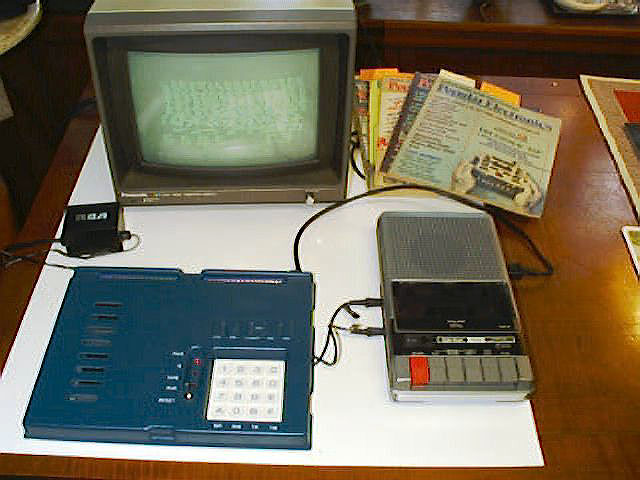
I just got back from spending 2 1/2 days at the Orlando hamfest. I made
quite a haul but here is my best find by far!
<http://www.classiccmp.org/hp/RCA/rca.jpg> As you can see it does work!
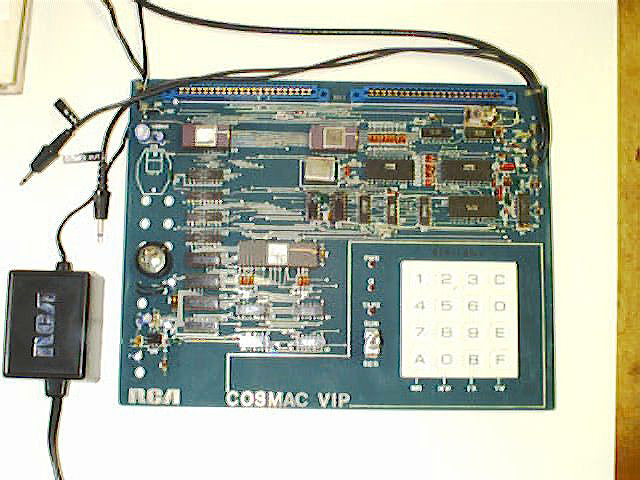
In case you don't recognize it, look here
<http://www.classiccmp.org/hp/RCA/rca2.jpg>. Right now it's in the hands
of a certain nameless CC Lister in Southern Georgia. I'm just hoping I'll
get to see it again!
Besides that nice trinket I also got two Gould logic analyzers, a
MicroMint Std-bus computer, some Multibus card cages, some good data books,
a Data I/O 19 EPROM programmer with a GangPak plug in and the PAL
programmig plug-ins, an Intel iUP 201 EPROM programmer, a 5 Mb Bernoulli
box for the MacIntosh (in it's original box with three new sealed
cartridges), an Alphapro 101 daisy wheel printer that's also in it's
original box, and finally a 16 Mb Matrox G4+ AGP video card for $20.
joe
> -----Original Message-----
> From: Vintage Computer Festival [mailto:vcf@vintage.org]
> I have no idea what various DAT formats there are so I'll
> have to research
> that. Ditto for the WORM drives (I have one more somewhere in my
> collection).
Basically, there are DDS-1 through DDS-4. A DDS-4 drive should read
and write any of the previous if I'm not mistaken. The problem is
that compression is brand-specific, generally, and possibly model-
specific (though I haven't heard of it being done...)
In other words, if your tape has hardware compression, you may be out
of luck without the exact drive that wrote it.
I have no idea about D-8, on the other hand. :) What I do know is
that my Eliant 820 will use 160 meter tapes, but only (I think) if
they're data tapes (meaning they have the MRS stuff in them...) Some
other Exabyte drives will supposedly use 160 meter tapes without MRS,
but will write only so much data to them, and won't read or write data
on any 160 meter cart at quite the density of the Eliant 820.
Anyway, you may need more than 1 8mm drive.
> Did the Bernoulli Box have a proprietary interface? If so,
> does anyone
> have one they want to get rid of?
I think they were SCSI, but don't take my word for it...
> least 500MB. I'm still trying to figure out what QIC-1000 is.
1.2G variant of the same technology used in QIC-120, I believe.
They're pretty large, klunky cartridges. Around the size of VHS,
but thinner, and not quite as wide (I think). :) I also think the
drives are downward compatible with QIC-120.
> I guess what I really want to know is if the various tape drives from
> different manufacturers for a certain specification, say
> QIC-40/80, read
> and write the same low- or high-level format. So for instance, if I
> create a tape on a Colorado drive and stick it into a Conner
> drive, will
> the Conner be able to read it?
I think so, ignoring the above issue with hardware compression, which
may have also been a problem on these drives if they had it. :) Again,
don't take my word for it.
Chris
Christopher Smith, Perl Developer
Amdocs - Champaign, IL
/usr/bin/perl -e '
print((~"\x95\xc4\xe3"^"Just Another Perl Hacker.")."\x08!\n");
'
> ----------
> From: Doc
>
> On Wed, 13 Feb 2002, Sellam Ismail wrote:
>
> > DDS-2 and DDS-3 use physically different media. I don't know how this
> > figures if the standards are all supposed to be backward compatible.
>
> Actually, DDS and DDS2 different media, but not as in
> different form factors. IIRC, DDS1 is 90m, DDS2 is 120m, and DDS3 is
> also 120m. They have and identifier embedded in the media that tells
> the drive which DDS the tape is. I know for sure that a DDS1 drive will
> simply spit out a DDS2 or DDS3 tape, and I think that holds true up the
> line.
> A DDS2 drive will read DDS1 archives, and write a DDS1 tape in DDS1
> format. I dunno about DDS3. Every shop I've worked with who used DDS3
> drives used DDS3 tapes exclusively.
>
> Doc
>
---
DDS3 is 125m. Have one right here :) DDS3 drives work fine with DDS2
tapes, under NT4 and VMS. That's the size combination we're using here at
work.
--- David A Woyciesjes
--- C & IS Support Specialist
--- Yale University Press
--- mailto:david.woyciesjes@yale.edu
--- (203) 432-0953
--- ICQ # - 90581
Mac OS X 10.1.2 - Darwin Kernel Version 5.2: Fri Dec 7 21:39:35 PST 2001
Running since 01/22/2002 without a crash
> >There are currently 5 DAT formats (DDS, DDS-1, DDS-2, DDS-3,
> and DDS-4)
> >and all are backward compatible.
>
> But, can a drive from manufacturer "A" read a DDS-1 tape written on
> manufacturer "B's" drive? It's been my understanding that sometimes even
> different model drives from the same manufacturer can't read the same tape.
You're supposed to be OK if you didn't used compression,
or also OK if you used software compression (assuming you
can find a program on the target platform that understands
the compression).
It's when you use hardware compression that you may be screwed.
-dq
Christopher Smith wrote:
[re. broken SGI Indy]
> He was able to find the faulty part. Honestly, I wish I'd been
> able to do that, myself, but I don't have the stack of SGI pieces
> to do it :)
On an only slightly related note, IMHO the build quality and general
longevity of Silicon Graphics hardware really isn't what you'd hope
of kit that cost so much new...
I've seen Sun boxes that have been through the mill several times by
the look of things, but flick the switch and you're up and running
(possibility of needing to solder a battery onto the PROM
notwithstanding.)
Personal (limited, I grant you ;-) experience of Indys on the other
hand suggest you need at least 3 candidates handy if you want to put
together a working combination of power supply, processor and mobo/PROM.
And the chassis is horribly weak - the way the power supply clips into
place is very neat, but also makes it structurally very poor at the
join (L-shaped computer, anyone?)
I also don't think I've yet forgiven SGI for making the power
supply (simple slide-in/slide-out with two thumbscrews) on the O2000
a non user replaceable part - i.e. they won't sell you one without
a service contract and an engineer round to plug it in. And trying
to get an SGI Challenge to actually see all the devices on its SCSI
bus without trying them in 100 different permutations can keep you
occupied for at least an afternoon...
Which isn't to say I don't love 'em, an Indy is my main workstation at
home & the sight of SGI rapidly going down the tubes is deeply sad...
Cheers,
Tim.
--
Tim Walls at home in Croydon - Reply to tim(a)snowgoons.fsnet.co.uk
> -----Original Message-----
> From: Fred Cisin (XenoSoft) [mailto:cisin@xenosoft.com]
> > Iomega ZIP (IDE)
> available internal and external, also in parallel, SCSI, and the "Zip
> PLUS" is BOTH parallel and SCSI.
I took his use of IDE there to mean that he got the internal ATA type
drive. I suppose given the proper definition of IDE, both the parallel
and USB versions could be called IDE.
Chris
Christopher Smith, Perl Developer
Amdocs - Champaign, IL
/usr/bin/perl -e '
print((~"\x95\xc4\xe3"^"Just Another Perl Hacker.")."\x08!\n");
'
>If you use Mac OS 7-9 on a used Mac and go with a used copy of Filemaker
>instead of Paradox, they are *far* more likely to be able to maintain the
>program themselves,
...
>Disclaimer: I don't run a business, so I may not know what I'm talking
>about. Anybody knowledgable here, please chime in. I think this is a
>*vital* topic for classic-computers, BTW, as keeping the machines
>productive is far and away the best way to keep them alive and known. The
>upgrade path availability is admittedly slightly off-topic, but relevant to
>the discussion.
FileMaker Pro was designed with the office Secretary in mind. It was
meant for the average boss to hand the program to the average word
processor literate secretary and tell them to create a database.
It is VERY user friendly, and VERY quick and easy to create solutions. It
has also grown significantly over the years into a rather powerful
database system. It is NOT as powerful as some other applications out
there (I know Access is more powerful due to its VB abilities)... but for
a good chunk of database needs you can use FMP to do your complete
solution.
I have been making some rather complex solutions in FMP for years, and
once in a while hit roadblocks with it, but usually can get to a work
around (sometimes kludgy, but usually doable). But I will take the
development speed vs loss of the super high end abilities any day.
FMP is also ODBC complient (I don't know to what extent, I keep all my
work right in FMP, so I have never used the ODBC interface). And FMP can
publish to the web instantly, or you can develop full web abilities with
FMP as the backend.
It is fully cross platform (Mac and Win32)... I mean fully... there are
really only two minor issues with moving back and forth. You need to make
sure you use standard fonts that are available on both platforms (stick
to Ariel, Times New Roman, and Courier New and you should be fine)... and
when laying out items on the screen, it is best to use the T-Bars or
Windows will sometimes shift where something is slightly.
But the database works on both platforms unchanged. I generally do all my
FMP development on the Mac, and the move it to a WinNT hosted FMP server
where winNT clients log into it to do their work... and I still log in
using my Mac for admin stuff... same database, transparent access.
All in all... if your users aren't likely to know how to work with a
database system... and you want them to be able to manage it in the
future... I highely recommend FMP... or if you just want to get the job
done in half the time of other systems.
-chris
<http://www.mythtech.net>
On Wed, 13 Feb 2002, Doc wrote:
> Congratulations. What does "chuffed" mean?
"Happy"... well, in this case "really happy", as I've been after
a VAX for yonks (a long time) :-)
Thanks to those who answered, and those who didn't but silently
cursed "RTFM" :-) I came across the OpenVMS online docs yesterday...
Cheers
Al.
[late reply because I get the daily digest]
??????????
:-)))
Greetings
----- Mensaje Original -----
Remitente: Chad Fernandez <fernande(a)internet1.net>
Fecha: Jueves, Febrero 14, 2002 9:38 am
Asunto: @@Rare@@Look@@ you can't pass this up!!!! :-)
> Silly isn't it :-)
>
As you will note, Barry authorized this posting.
- don
---------- Forwarded message ----------
Date: Wed, 13 Feb 2002 17:24:45 -0500
From: Barry A. Watzman <Watzman(a)neo.rr.com>
To: 'Don Maslin' <donm(a)cts.com>
Subject: RE: SOL-20 keyboard
I won't but you may if you want to.
Barry
-----Original Message-----
From: Don Maslin [mailto:donm@cts.com]
Sent: Wednesday, February 13, 2002 1:05 AM
To: Barry A. Watzman
Subject: Re: SOL-20 keyboard
On Tue, 12 Feb 2002, Barry A. Watzman wrote:
> By the way, in 1977 I made and sold a SOL-20 keyboard modification kit
> that included a new ROM for the keyboard and new keytops. The new ROM
> made the high order bit of the numeric keypad keys a "1" instead of a
> "0". This made it possible to distinguish between the keys in the
> numeric keypad and the numeric keys in the top row of the normal
> keyboard (in the stock keyboard, these different keys produced exactly
> the same output). This was transparent to normal applications because
> they normally did an "ANI 7FH" anyway, stripping this bit, but it
> could be used by an application if the application wanted to do so.
> The new keytops had word processing legends instead of numbers, and
> really was made for the "Electric Pencil" and "Wordstar" word
> processors. The keytops were actually made by Keytronic (I had to pay
> tooling charges, about $1,000 (those were 1977 dollars, it was about
> one-fourth the price of a new car)) and and matched the SOL keyboard
> exactly.
>
> I have a few of these kits left in a box in the basement. If anyone
> wants them, they are $25. What I'm not sure of is if I have the
> installation instructions anywhere.
>
> [If anyone takes me up on this, I'm actually going to have to FIND that
> box, which may be easier said than done.]
Hi all.
Many times I read with envy those phantastic finds in the US.
Now it is my time to get lucky:
- several 8- and 16-line serial MUXen with distr. panels
- Q-Bus Centronics printer interface with connector
- SC-08 Q-Bus (dual) SCSI controller (MSCP/TMSCP compatible)
with the Emulex doc and the rear connector panel
- KDJ11-A manual (0.5 inch thick)
- LA120
(with flaky electronics and both pin-feeds bands broken)
- PDP-11/73 with TK50, RD54 (Maxtor) disk and 2 M7551 memory boards
(but when powered up produced the smell of burning paper ...)
- PDP-11/93 (M8981-BA) but without documentation.
AFAIK, the 11/93 was the fastest DIGITAL PDP-11, so I consider this
a nice addition to my collection. Since the chassis only contained
in slot 1 A-B: M8981 PDP-11/93
in slot 2 A-B: M8047 grant continuity
in slot 3 A-B: M7546 TK50 controller
and the PSU of course, I moved the TK50 and the RD54 from the 11/73
into the 11/93 and added in slot 4, position A-B, the RQDX3 (M7555).
On the M8981 are 8 diagnostic LEDs, from top to bottom a yellow, 3
red LEDs, a green and 3 red ones again.
I call them yellow, red 1-2-3, green, red 4-5-6.
When the system is turned on (with HALT button in) the display on
the backpanel reads "7.7." and all LEDs on the CPU module are on.
When I push the HALT button out and press the RESTART button, the
display reads "0.4." and the LEDs are as follows:
yellow - on
red 1 - off
red 2 - off
red 3 - off
green - on
red 4 - on
red 5 - off
red 6 - off.
What does this mean?
BTW I connected a VT set at 9600 Bd to the console DB-25 connector.
Nothing appears on the screen.
The DIP switches on the backpanel are set as follows:
(left) (right)
+-----------------+
| # # |
| # # # # # # |
+-----------------+
Last piece of information I can think of is the backplane. It is
an H9278-A.
Reading what I have written, I come to think that I forgot to check
jumpers/DIP switches on the M8981 board itself ....
If necessary I can tell that tomorrow.
TIA
- Henk.
http://home.hetnet.nl/~tshaj
Sellam touched off a firestorm of responses:
>Ok, now's your chance to discuss your specialty and get the attention of
>other folks who have stuff that you may want.
Sellam, you *are* keeping a list of these answers, right? If anyone is
brave enough to declare themselves a specialist, they ought to get
questions about their "specialty" directed to them.
Mine (am I really that brave? Sigh):
---------
Dec Rainbow (see also Jeff Armstrong, or Tony Duell)
Own a 100A with 8087 board, VR201 and VR240 monitors, tech doc set,
some software
NeXT (I'm *definitely* not the only or best one of these on the list)
Own an 040 cube, OD often works, floppy, Laserprinter,
NS3.0 and 3.3 and a 1.0 OD,
Mathematica 2.2 and 3.0, WriteNow, various other SW
R. D. Davis asked:
>How many here still work, for an
>income, with the types of vintage systems they collect?
>
> ..Out
> of curiosity, how many others here absolutely refuse to work for an
> employer requiring one to work with those confounded annoyances called
> Micro$oft products?
The NeXT does most of my analysis and coding, a Mac PB3400 does most of the
rest, various Unix Boxen and Macs do what's left. A hand-me-down Power Mac
8500 with Oriffice 2000 translates to sylk or .pdf when I recieve tainted
files from co-workers.
I work pretty hard at not using Micro$oft (and advocating abstinence) but I
admit to bending at times.
- Mark
Here's a good FAQ on SyQuest drives that answered my question regarding
whether or not a 44MB drive was compatible with an 88MB drive was
compatible with a 200MB drive.
The bottom line is that the original 88MB drive could only read a 44, not
write to it. People got pissed, so SyQuest came out with an 88c ('c' for
"combination") that could both read and write 44MB disks. The 200MB drive
can read/write/initialize 44/88/200MB disks.
--
Sellam Ismail Vintage Computer Festival
------------------------------------------------------------------------------
International Man of Intrigue and Danger http://www.vintage.org
* Old computing resources for business and academia at www.VintageTech.com *
Contact Peter directly if you are interested.
Reply-to: <banjoman9(a)hotmail.com>
---------- Forwarded message ----------
Date: Wed, 13 Feb 2002 12:15:38
From: Peter Finucane <banjoman9(a)hotmail.com>
Subject: computers
I have several bits and pieces including a working Compaq portable from
about late sixties early seventies. Although "portable" it is heavy and
about the weight(and looks like) a portable sewing machine. It has a built
in 5 inch screen,integral keyboard and operates on two 5 1/4 floppy discs.
I live in Southern England and would be prepared to donate this if someone
was willing to collect it. I also have a working IBM 286 with monitor from
about 1988, again I will donate. Please advise if you are interested or
can put me in touch with someone who is.
Pete Finucane (banjoman)
--
Sellam Ismail Vintage Computer Festival
------------------------------------------------------------------------------
International Man of Intrigue and Danger http://www.vintage.org
* Old computing resources for business and academia at www.VintageTech.com *
> -----Original Message-----
> From: Sellam Ismail [mailto:foo@siconic.com]
> to be able to read just about anything, but writing isn't as critical.
> Usually when someone wants data converted these days, they
> want it on CD
> or 3.5" floppy.
Do you plan to read tk50, QIC-1000, 9-track? What about the SyQuest
removables that were so common on Macintosh systems?
Chris
Christopher Smith, Perl Developer
Amdocs - Champaign, IL
/usr/bin/perl -e '
print((~"\x95\xc4\xe3"^"Just Another Perl Hacker.")."\x08!\n");
'
>I'm looking for PC docs & drivers for old tape drives. I already have
>everything I need for Colorado tape drives, so I'm looking for older, more
>obscure stuff from the 80s. If anyone's got ANYTHING like this, for any
>type of tape drive (QIC, digital cassette, whatever) please let me know.
I have a Conner Tape-Store 800 with docs and drivers (drivers disks
appear to be BackUp Exec for windows)
I also have an Iomege Tape250 Insider with docs and drivers.
What exactly are you looking for? (ie: did you want them, or just copies,
or just wanted to know something about them). They are both in use right
now, so I don't know if I am apt to just give them away.
-chris
<http://www.mythtech.net>
On January 28, Doc wrote:
> > Yup, that's it! Anyone claimed it yet? I'd like it for my RT.
> > I think, therefore I am dangerous
>
> Well, I fired off an email asking for it Saturday, and haven't heard
> back. So, I hope *I* got first dibs....
Me too. We could all meet somewhere and fight for it. :)
-Dave, grunt grunt
--
Dave McGuire
St. Petersburg, FL "Less talk. More synthohol." --Lt. Worf
Hi.
I plan to do a BSD exhibition at the VCFE. Main focus is
4.3BSD{,-Tahoe,-Reno} on VAXen. But I want to show 4.4BSD-Lite on HP300,
SPARC and PMAX too. I have the 4.4BSD-Lite HP300 binaries, but nothing
for SPARC and PMAX. Are there any binaries still around? I don't want to
struggle with a SPARC and PMAX bootstrap...
Ahh, and 4.2BSD-Reno for HP300 is missing too...
--
tsch??,
Jochen
Homepage: http://www.unixag-kl.fh-kl.de/~jkunz/
Last night I finally got a cable sorted (thanks Pete!) to connect the VS3100
to a "VT52" (Atari ST running the emulator!), and was chuffed to find it's a
healthy 16Mb Model 30 with two hard disks and VMS 5.5-2 installed.
Unfortunately my old mate "HELP" doesn't want to play with me any more:
$ HELP
%HELP-F-OPENIN, error opening SYS$COMMON:[SYSHLP]HELPLIB.HLB as input
Rats. I was pretty much counting on HELP working to help dust off the
cobwebs :-)
I'm guessing it's not installed because the machine was configured to boot
>from the network (ESA0). A SHOW DEV revealed a couple of disks ("DKA200" and
"DKA300") and luckily it boots VMS from DKA300 no trouble. I reset the
SYSTEM password OK, so now I've got a system to play with but no HELP to
make life easier :-)
So, a few questions to help me on my way:
- are there VMS equivalents of 'find' and 'grep' to set loose on the disks
to look for this file?
- if the help file isn't on either disk, would somebody be able to send me a
copy?
- I'd like to find out more about how VMS boots, can someone point me at a
good website?
Finally, at the moment I don't have a suitable CD drive to be able to
install the Hobbyist OpenVMS. When VMS boots it displays:
%LICENSE-I-EXCEEDED, attempted usage exceeds active license limits
Is there a limit to the number of logins allowed after expiry? Am I going to
get locked out? :-}
Cheers,
Al.
Rumor has it that Tothwolf may have mentioned these words:
>On Tue, 12 Feb 2002, Roger Merchberger wrote:
>
>> So, to make sure this stays on-topic (as 90+% of what I'm using this
>> for is programming stuff for classic computers) if anyone has (or
>> knows where to find) the datafile to program a fresh GAL to fix a gray
>> Tandy Multi-Pak adapter (26-3024, IIRC) for CoCo3 usage, I'd be happy
>> to burn new GALs for anyone needing them for cost of GAL & shipping. I
>> have a Multi-Pak that needs updating, and I dunno if anyone else has
>> this ability (or cares) anymore...
>
>I've got a white 4 cart multipack adapter. What is the difference between
>the gray and white ones?
The color??? ;-)
Just kidding. IIRC, the white paks are 26-3124, and have a soldered-on ASIC
which can't be upgraded without external circuitry - someone somewhere on
the 'net had a howto on adding a dead-bug 74LS10 to the newer packs to make
them CoCo3 compatible.
The older packs used a (socketted?) PAL for address decoding, and with the
datafile to program a new PAL/GAL it's a drop-in replacement.
>> Just one thing left to find... an SMD rework station for around the
>> same ($200) mark... (again, so I can make boards for my CoCos...)
>
>I just found a flux/epoxy dispensing system this last weekend (no
>handpiece yet), so I'm just about ready to find a SMT rework station
>myself. Maybe I'll find one of those for $0.50 too...well, I can dream
>can't I? ;P
Like I always say... if you're gonna dream, dream *big*!!! :-)
HTH,
Roger "Merch" Merchberger
--
Roger "Merch" Merchberger --- sysadmin, Iceberg Computers
Recycling is good, right??? Ok, so I'll recycle an old .sig.
If at first you don't succeed, nuclear warhead
disarmament should *not* be your first career choice.
There's multiple varieties of what you describe, it uses stackable modules.
Was also a rackmount version too. It ran a motorola version of Sys/V, at
least the ones I know about did... Also was VME, at least the CPU etc was...
for sure existed as both 88k and 68k, I can borrow my friend's motorola
product catalog for more info if desired...
Will J
_________________________________________________________________
Send and receive Hotmail on your mobile device: http://mobile.msn.com
> Is there anything noteworthy to see in the London (England) area on
> the 23rd ?
Ohhhhhhh nooooo. I was writing to say that you have to go see
the Cabaret Mechanical Theatre -- Museum of Automata
(http://www.cabaret.co.uk) but the "About" page says it's now
closed for restoration for a year. Never mind.
brian
=-=-=-=-=-=-=-=-=-=-=-=-=-=-=-=-=-=-=-=-=-=-=-=-=-=-=-=-
_| _| _| Brian Knittel / Quarterbyte Systems, Inc.
_| _| _| Tel: 1-510-559-7930 Fax: 1-510-525-6889
_| _| _| Email: brian(a)quarterbyte.com
_| _| _| http://www.quarterbyte.com
Does it look like the one on this web page?
http://www.openbsd.org/mvme88k.html
On Wed, 13 Feb 2002 12:25:02 -0500 "Curt Vendel" <curt(a)atari-history.com>
writes:
> I saw one of these last year, I was I had bought it, kinda look like
> a stack
> of Micopolis HD cases in dark grey.
>
> Anyone know anything about those units??? History, OS, h/w and
> such.
>
>
>
> Curt
>
>
________________________________________________________________
GET INTERNET ACCESS FROM JUNO!
Juno offers FREE or PREMIUM Internet access for less!
Join Juno today! For your FREE software, visit:
http://dl.www.juno.com/get/web/.
Hey, I've got a DCA controller here in front of me. It's a full-length
8-bit ISA/MCA flippy card, with 1 BNC & 1 RJ-11 (4P4C) ports on it. One
sticker says `*LA 0006E1*' and one says `003581 REV.A' A little googling
indicates this might be some sort of 3270 controller, but I couldn't find
anything to confirm this. Anyone know what it is/want it?
Bob