> >Odd, for many years I used Naval Jelly to clean rust off cans in my beer
> >can collection. I never once saw it take any paint off, and I used it on
> some
> >pretty fragile old cans. It worked wonderfully without messing up the
> >paint.
>
> I'm sure it did. But Naval Jelly is a very old product and not very safe.
> There are better, safer, preparations.
Safe is totally in the hands of the user. Cyanide is used in gold plating and is
quite safe assuming stupidity is not part of the equation (i.e. let's see what
it tastes like.) Navel Jelly does a great job of disolving the rust, and that is
what it was intended for. Before using though, I wire brush off the heavy rust
deposits and use navel jelly sparingly as the next to final step ... the final
step is cleaning :).
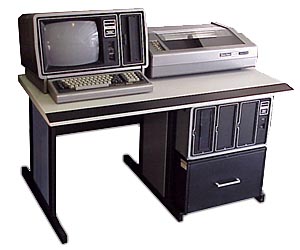
Yup, the one someone pointed out on ebay is exactly the one that I got
recently (except mine has dual floppies and a hard drive).
Note that the auction on ebay does not include the monitor (and the Wang
monitor is proprietary). So if anyone here does win that auction, I know
where a monitor and cable can be obtained pretty cheap, but only for a short
while. The local surplus guy tends to pitch things that don't sell after a
while.
Jay West
>
>Subject: Re: VCF Build-It-Yourself Workshops
> From: "Chuck Guzis" <cclist at sydex.com>
> Date: Mon, 02 Oct 2006 15:31:28 -0700
> To: cctalk at classiccmp.org
>
>On 10/2/2006 at 2:43 PM David Betz wrote:
>
>>I would *love* to assemble an FPGA kit that allowed me to experiment
>>with various classic architectures (and maybe some modern ones!).
>>Sign me up if you decide to have one!
>
>Golly, folks have been doing this for quite awhile. The XESS kits seem to
>be very popular. There was/is even a fellow who was offering a
>pin-compatible Z80 replacement implemented in FPGA.
>
>Here's one of the lists I've found:
>
>http://members.optusnet.com.au/jekent/FPGA.htm
>
>What's not really clear to me is what the practical difference is between
>implementing a classic CPU in FPGA and writing an emulator for on to run on
>a PeeCee.
That depends on many things. An emulator for a PC might be a microprogrammed
archetecture for a PDP-5 which is a sequential logic machine. With real logic
you have to deal with mudane and annoying things like two registers accessing
a single bus. From my point of view doing a classic in FLGA is convenient
as your not tied ot a PC but it's still more of a software exercise than real
random logic.
>As someone on the list has mentioned, it's really the old peripherals that
>are the interesting bit.
That because you have to interact with the physical world. Often that requires
much more than a bit of logic to fly.
Allison
>
> Are there disk images for earlier versions of Model 16 Xenix
> available
> on the 'net? My Model 16 came with 2.3A, and it's not
I'll see if I have any complete earlier versions.
Just a quick note to let everyone know of the workshops we've added to the
VCF this year.
These workshops feature vintage computing kits that you build yourself,
guided by the people who designed the kits.
So far we've announced workshops for the XGameStation Pico Edition run by
its designer Andre' LaMothe, and a COSMAC Elf 2000 (as featured on the
cover of Nuts & Volts last month) run by its designer Bob Armstrong.
Very soon I'll be announcing a third workshop run by Vince Briel to build
his new Replica-1.
These workshops are an excellent way for people who have always been
interested in hardware but never had a practical environment for
experimenting to pick up some new skills from top notch engineers, and
some nice new toys (that you build yourself!) in the process.
To read about the workshops, go here:
http://www.vintage.org/2006/main/workshop.php
There is a registration button for each workshop on its respective page.
Payment is via PayPal (from your account funds or credit card). The
workshops are scheduled at different times so the really adventurous can
go to all of them ;)
Vince's Replica-1 workshop will be going up very soon.
A full VCF update will be coming out this week, with the current speaker
schedule and more information on the first Vintage Computer Film Festival.
Remember, Woz will be there, along with a bevy of other early Apple
employees and founders for our 30th anniversary celebration of the birth
of Apple.
I'd also like to see some more exhibits get registered :)
E-mail me with any questions you might have.
--
Sellam Ismail Vintage Computer Festival
------------------------------------------------------------------------------
International Man of Intrigue and Danger http://www.vintage.org
[ Old computing resources for business || Buy/Sell/Trade Vintage Computers ]
[ and academia at www.VintageTech.com || at http://marketplace.vintage.org ]
I saw some mention in here about old HDs and such -- if anybody's in need of
the ribbon cables to hook those up with, either pin-type or edge-connectors
I have a pile of them.
I also saw mention of a "Spinwriter". If somebody's looking for one of these,
I have one sitting in a storage unit, though I will need some money to
change hands for the owner of said unit to allow for its removal...
--
Member of the toughest, meanest, deadliest, most unrelenting -- and
ablest -- form of life in this section of space, a critter that can
be killed but can't be tamed. --Robert A. Heinlein, "The Puppet Masters"
-
Information is more dangerous than cannon to a society ruled by lies. --James
M Dakin
> Josh Dersch
> Sent: Sunday, October 01, 2006 7:50 PM
<SNIP>
>
> - Is this drive actually compatible with a Model 16? The
> limited info
> I've found seems to hint that this was for a Tandy 2000 or
> 1000 system.
>
Not normally, but it could be used as a secondary drive if you have a 16b HD.
> - If it is compatible, what kind of drive goes in the enclosure, and
> where can I find the proper cable to connect it to the Model 16? (The
> enclosure has a 20 pin "Data" and a 34-pin "Control" connector on it,
> looks like a standard ST-506 configuration, while the Model 16 has a
> single 50-pin connector.)
That enclosure is made for a simple ST-506 drive. It is not meatn to be used as a primary boot drive for a model 16.
> - If the drive isn't compatible, anyone have a compatible one for
> sale/trade? :)
>
They're pretty rare, especailly in working condition. I have a couple of the big 50 pin units, but they're all in non-working order. You can replace the hard drive in them with just about any ST-506 drive with a few modifications. They are alsmost identical in interface with a WD1000-HDO card.
> I'd like to try to get Xenix running, I have the installation
> floppies
> -- just need something to install it to. I actually work
> with a guy who
> ported the Xenix kernel to the Model 16 back in the day, I
> thought he'd
> get a kick out of seeing a running system again...
You also need to verify that it has the latest PAL upgrade to run Xenix 3.1 or higher. See the short reference at: http://www.catcorner.org/xenix
Kelly
Dug out of the cruft in my desk - a CM-100 calculator in excellent condition. It's excess to my needs, so I've listed it on that great online dumping ground. eBay auction # 140036817700, no reserve.
I just acquired a TRS-80 Model 16. It came with an external hard drive;
model 25-1025, labeled as a "Tandy 10 Meg Disk System". It's a
considerably smaller unit than the usual TRS-80 hard drives I've seen --
it looks like it would normally hold a half-height 5.25" MFM drive.
Unfortunately, the drive enclosure is empty.
I'm not well-versed in the area of TRS-80 drives, so I have a few questions:
- Is this drive actually compatible with a Model 16? The limited info
I've found seems to hint that this was for a Tandy 2000 or 1000 system.
- If it is compatible, what kind of drive goes in the enclosure, and
where can I find the proper cable to connect it to the Model 16? (The
enclosure has a 20 pin "Data" and a 34-pin "Control" connector on it,
looks like a standard ST-506 configuration, while the Model 16 has a
single 50-pin connector.)
- If the drive isn't compatible, anyone have a compatible one for
sale/trade? :)
I'd like to try to get Xenix running, I have the installation floppies
-- just need something to install it to. I actually work with a guy who
ported the Xenix kernel to the Model 16 back in the day, I thought he'd
get a kick out of seeing a running system again...
Thanks,
Josh
Someone promised me copies of these years and years ago, and now now longer
returns my emails. I suspect they may have orig come from someone in the
Seattle area that had a bunch of 88780's a while back.
On the chance this person follows classiccmp, I'm looking for a copy.
Ethan Dicks wrote:
> I'm prototyping an LED display thingie and was trying to find a
> representation of how folks used to do letters on a 7-segment display.
> The two historical examples I came up with were the KIM-1 and a Byte
> magazine article between about 1977 and 1981.
> what I need is the definitive source for the patterns.
For the KIM-1, the only definitive source is the ROM,
and that only has patterns for hexadecimal:
* HEX-TO-LED SEGMENT CONVERSION TABLE
* SAME AS $1FE7 IN THE KIM ROM.
DB $BF,$86,$DB,$CF ;0 1 2 3
DB $E6,$ED,$FD,$87 ;4 5 6 7
DB $FF,$EF,$F7,$FC ;8 9 A b
DB $B9,$DE,$F9,$F1 ;C d E F
As Mr. Veit has written, the First Book of KIM has
more letters. Another source is issue 1 of the
KIM-6502 User Notes, which has a slightly different
alphabet:
DB $BD,$F6,$86,$9E ;G H I J
DB $B8,$BF,$F3,$ED ;L O P S
DB $BE,$EE,$FC,$D8 ;U Y b c
DB $DE,$F1,$EF,$F4 ;d f g h
DB $84,$9E,$86,$D4 ;i j l n
DB $DC,$F3,$D0,$F8 ;o p r t
DB $9C,$EE,$C0 ;u y minus
DB $F0,$B7,$D4,$E7 ;k m n q
DB $BE,$EA,$9C,$94 ;q v w x
DB $C9,$D3,$80 ;z ? space
You can find the KIM-6502 User Notes at
www.6502.org in the publications section.
--
Paul R. Santa-Maria
Temperance, Michigan USA
--- steven stengel <tosteve at gmail.com> wrote:
> Folks,
> Please take this/these away:
>
> Working, TRS-80 model II system, with desk, printe
r,
> external 8-inch floppy
> drive system. Looks like this:
> http://oldcomputers.net/pics/TRS-80-II_table.JPG
> MUST PICK-UP at zip:92656 (OC)
>
> Heathkit H29 video terminal.
>
> Atari Jaguar video game system with some carts.
> Atari Lynx handheld voideo game system with some
> carts.
>
Tried to look at the TRS-80 pic, but got a
"permission not granted to view this" message!
If no-one else wants them, I'll take the Atari
Jaguar & Lynx, but I live in the UK so they'll
need posting (I'll happily pay for P&P costs).
Regards,
Andrew B
aliensrcooluk at yahoo.co.uk
Hi all,
Just had a box come today. Inside are around
32 discs from CU Amiga and Amiga Format. I
plan to catalogue them along with my other
Amiga CD32 stuff during this week (I have the
week off).
Also in the box is a 56K (Data/Fax/Voice)
modem, manufacturer is unknown. It simply
states on the front end...
"56K V.90/K56 flex"
... with more data on the bottom of the kit:
"FCC No.: H52PT-3020
Data: K56 Flex/ITU-T V.90 & ITU-T V.34 MNP
4/5 & V.42/ V.42 bis
Fax: G3 14.4K/14.4K Send/Recieve
Voice: Simultaneous Audio/Voice & Data; Full-duplex
speakerphone mode
Power: AC 9V/1A
Made in Taiwan"
On the front it has two sockets for a mic.
and a speaker to be plugged in along with 9
lights for:
RD
TD
CD
OH
AA
HS
DTR
MR
PW
I think I know what most of them mean.
On the back it has an on/off switch, a power
socket, a parallel port style socket (I have
necessary cable), line socket and phone socket.
I assume the line socket plugs into the phone
connection socket, but what's the phone
connection for? To plug the phone/fax line in??
I also have Active: Netconnect CD's V2 & V3,
so having software to go online shouldn't be a
hassle - I just want to upload and download
stuff from Aminet (site for storing various
Amiga files, utilities, games, patches and more)
Regards,
Andrew B
aliensrcooluk at yahoo.co.uk
Folks,
Please take this/these away:
Working, TRS-80 model II system, with desk, printer, external 8-inch floppy
drive system. Looks like this:
http://oldcomputers.net/pics/TRS-80-II_table.JPG
MUST PICK-UP at zip:92656 (OC)
Heathkit H29 video terminal.
Atari Jaguar video game system with some carts.
Atari Lynx handheld voideo game system with some carts.
> he happened to drop that he had a A/UX tape that he could not read as his tape
> drive had "gone goo" It turns out to be A/UX 1.1 (!)
I really hope he didn't discover this by attempting to read the tape. If so,
he now has goo on the tape, and it will be extremely difficult to recover.
FWIW, I have an image of A/UX 1.0, made in the days when the only way to get
a copy was to go over to Bubb Road with a disc and have the original A/UX
group clone it for you.
Folks,
I'm posting this for a friend. Check out the pictures at
www.parse.com/~museum/misc/index.html
The last two items, the DEC WT78 (with a PDP-8 chip inside!), the RX02 floppy
drives, spinwriter, and the terminal, are all free to a good home as per
the website.
Cheers,
-RK
--
Robert Krten, PARSE Software Devices
Realtime Systems Architecture, Consulting, Books and Training at www.parse.com
Looking for Digital Equipment Corp. PDP-1 through PDP-15 minicomputers!
I'm looking for an 800 bpi readable tape drive,
with either HPIB or SCSI connection.
(Or option 800 for the HP7980/88780 tape drive,
HP part# 07980-60791 NRZI media kit)
Any leads would be appreciated.
Thanks,
Keven Miller
Did anyone happen to download "Zebra_Design.pdf" "An Outline of the
Functional Design of the Stantec Zebra Computer" which was made available
on this list in 2002 by Hans Pufal ?
Does anyone have other Zebra documentation?
Tony.
Hi everyone,
I have been looking for Sipke de Wal's SC/MP emulator and of course found
the note about his death in 2004
(http://www.classiccmp.org/pipermail/cctalk/2004-May/041480.html).
Looking at the fragments of his website still available in the internet
archive and on Google, I see he had a lot of interesting pages and
downloads many relating to old computers and processors. There are still
many sites on the internet that link to his website that hasn't existed for
2 years now.
It seems a pity that all that work has now disappeared when the storage
requirements and bandwidth, to maintain such a site, are quite modest. I
would be happy to host a copy of his site if it could be
reconstructed. I've reconstructed his SC/MP webpage (but still don't have
a copy of his emulator).
So a number of questions:
- Did anyone here download anything from his site that they've still got
(webpages or files) ?
- Does anyone have contact with his familiy ?
- Did anyone know Sipke well enough to know whether he would approve of the
resurection of his website?
Any help appreciated.
Tony.
----- Original Message ----
From: Jay West <jwest at classiccmp.org>
To: General Discussion: On-Topic and Off-Topic Posts <cctalk at classiccmp.org>
Sent: Saturday, September 30, 2006 3:40:31 PM
Subject: Re: WANG micro? found
I took more pictures of the unit after removing the chassis. They can be
found at:
http://www.ezwind.net/jwest/wang
The cpu main board is definitely the large L-shaped one that Roy Tellason
mentioned. Just eyeballing it, but what kind of backplane connectors are
those? They look larger than ISA connectors and appear to be 86 pin.
It seems to be quite clean inside and out. Not that I've had much time for
classic computers lately, but this one may be interesting for a while :)
Jay