Bongos? Babaloonet? LOL LOL LOL
--- cctalk-bounces at classiccmp.org
<mbbrutman-cctalk at brutman.com> wrote:
> Zane H. Healy wrote:
> >> Even with 5Mbps cable modem, my slowest
connection inside is still
> >> faster that my connection to the outside world.
> >
> > You obviously don't have any really old systems on
your network. I'm
> > still at 1.5Mbps, and have systems on my network
that can't keep up with
> > that.
> >
> > Zane
> >
>
>
> The context was the networking gear, not the
machines. I think my PCjr
> is fairly slow.
>
> In the case of a really old system like that, it
doesn't matter what the
> network is - the network will never be the problem,
unless I use bongos
> as the transport mechanism.
>
>
> Mike
>
>
>
__________________________________________________
Do You Yahoo!?
Tired of spam? Yahoo! Mail has the best spam protection around
http://mail.yahoo.com
--- Chuck Guzis <cclist at sydex.com> wrote:
**>> snip <<**
>
> You know, I've never had anyone ask about converti
ng
> one of the Brier
> flopticals (I've got the drive) or the Drivetech
> floppies, much less
> an Amlyn or Exatron stringly floppy. I can only
> conjecture that the
> media didn't last very long.
>
**>> snip <<**
> Cheers,
> Chuck
>
Yes, you are quite right Chuck.
The ESF (Exatron Stringy Floppy) drive,
advertised on the back of most of my issues
of 80 Microcomputing, didn't last long despite
the heavy advertising.
As I understand it, the folks at Exatron hoped
it would become the new standard for storing
data. Unfortunately the 3.5" floppy disk (or
one of similar size) was invented around the
same time and, obviously, became the new
standard.
The ESF was about x10 faster than a cassette
and the floppy was much more than that
(atleast x20?).
As I understand it the ESF's broke down after
a year or so. The thin layer of stuff (i forget
now, some ferrous material) which was coated
onto the erm... mylar (?) started flaking off
rendering the ESF's useless.
I'm sure I read an article on ESF's about 6
months ago... hense why I know a bit about
them. It may have been in an issue of 80
Microcomputing.
Regards,
Andrew D. Burton
aliensrcooluk at yahoo.co.uk
Anyone have an urgent need for 300' of thicknet? Never been used, approx
117m (according to the writing on the spool) with one cut end and one
N-connector on the other end.
It's 50ohm cable right? Maybe I can use it for amateur radio, if I keep it
indoors away from the UV.
[Oops] It's a question of whether we're going to go forward into the
future, or past into the back. --Dan Quayle
--... ...-- -.. . -. ----. --.- --.- -...
tpeters at nospam.mixcom.com (remove "nospam") N9QQB (amateur radio)
"HEY YOU" (loud shouting) WEB ADDRESS http//www.mixweb.com/tpeters
43? 7' 17.2" N by 88? 6' 28.9" W, Elevation 815', Grid Square EN53wc
WAN/LAN/Telcom Analyst, Tech Writer, MCP, CCNA, Registered Linux User 385531
Brent Hilpert wrote: I always
kind of liked the idea of making an entire processor out of just one basic
gate/IC type.
-------------------------
Didn't Seymour Cray do this on one of his later machines? The Cray 2?
Seems like it was a 5 input And gate.
But then he always did like to minimalize. The 6600, his first big iron,
used one transistor type tied together in different ways to make gates, flip
flops and timing circuits. He used circles and squares to denote gates -
but whther they were And or Ors depended on what fed them. Ah, twas fun to
work with. And I loved the esthetics of the logic diagrams. All those
little squares and circles had a kind of magic to them.
Billy
>Date: Tue, 19 Dec 2006 10:30:36 -0700
>From: Richard <legalize at xmission.com>
>In article <458726D7.17136.1434D6AA at cclist.sydex.com>,
> "Chuck Guzis" <cclist at sydex.com> writes:
>
>> But, given that the original uses RTL and core, what's the point of
>> building one in LSTTL?
>
>Is it even possible to build with RTL parts anymore?
>
>I guess you'd have to do it PDP-8 style with discrete transistors?
Is there a guide somewhere to the different families of logic, such
as RTL, TTL, LSTTL (never heard of that one) and CMOS? I was
choosing some simple logic components for my IIfx SIMM project the
other day and was somewhat bewildered by the choice of input/output
levels. Also, some are Schmidt Triggered?
My understanding extends to the idea that there are differences in
how they (at what voltage) interpret the low and high states but
beyond that, I'm ignorant.
Anyway, before I go on a Google hunt (which will probably turn up all
the surplus electronics suppliers and pricegrabber links first) does
anyone already know of a nice educational source on the topic?
Jeff Walther
> > Sometimes Goodwill has interesting stuff. Here's one you don't see
> > every day:
> >
> > http://shopgoodwill.com/viewItem.asp?ItemID=2423761
> >
> > Cheers,
> > Chuck
> >
> Thanks for the heads up and I bided on the item for the museum and it's at
> $21 right now.
> John
These are sold by the National Atomic Museum on Kirtland AFB in Albuquerque, NM:
http://www.atomicmuseum.com/store/ProductItem.cfm?Category=7
I bought mine (016 of 340) about eight years ago for $50 when I visited the museum. I'm amazed
they haven't sold all 340 by now. They now sell for $58 new to give you an idea of what your
maximum bid should be if you don't just buy a new one from the museum. The one in the auction has
been re-framed. I re-framed and re-matted mine but in a much nicer black frame than the one in
the auction (frame only cost me $5 on sale at Target due to superficial damage on its BACK side).
I, also, made some new labels with far more info about the machine and specific board.
ASCI Red, the first tera-ops supercomputer was recently decommissioned at Sandia (on Kirtland):
http://www.sandia.gov/ASCI/Red/
I emailed the National Atomic Museum to suggest that they get some boards and frame them because
of the significance of the tera-ops barrier. I received no response.
__________________________________________________
Do You Yahoo!?
Tired of spam? Yahoo! Mail has the best spam protection around
http://mail.yahoo.com
Almost all new equipment has to comply with "RoHS" (Reduction of Hazardous
Substances) requirements, which among other things means it's made with
lead-free solder. Enforcement is stronger in Europe than in the US, but in
any case industry is cleary moving in that direction even when and where not
absolutely required by law.
Question: If one is repairing RoHS compliant equipment, with respect to
functionality only is there a problem with using conventional tin/lead
solder? I'm not asking if it's legal or "environmentally friendly", I'm
asking if mixing the lead free solder and conventional tin/lead solder will
cause functional problems (for example, any kind of problems similar to
those which we used to see when someone repaired electronic equipment using
plumbing acid flux solder).
Also, if one wants to acquire and use RoHS compliant solder, are there any
changes that someone accustomed to conventional tin/lead solder needs to
make to their soldering technique? And I guess I should also ask the
reverse question from the paragraph above: Are there any issues in using
lead-free RoHS compliant solders on equipment originally built from tin/lead
solder?
Are there any other implications of RoHS that a casual classic computer and
electronics enthusiast should know about, in either direction?
Hi guys,
I've been having an esclating correspondance with a chap named
"Murray Balascak" (anyone know him?) - who contacted me regarding
his displeasure with my mention of the Apple-1 on the Apple-II page of
my site - here is what I have posted as part of my introdiuction to the
Apple-II:
--------------------------------------------------------------------------------------------------
In 1976, Steve Wozniak and Steve Jobs formed the Apple Computer Company,
and built a home computer they called the "Apple 1" in their garage. Although it
required the users to provide their own cabinet, power supply, keyboard and
video monitor, it didn't require a separate terminal, and a simple BASIC interpreter
could be loaded with an optional cassette interface. Although it required a fairly
technical user to complete the system and make it usable, about 200 Apple 1s
were sold in the first year.
The following year (1977), Apple refined the design, providing a keyboard and
power supply and packaging the machine in a attractive low-profile plastic cabinet
with simple connections for the video monitor and tape storage. Now - anyone
who could plug two connectors together could use this computer. The result, called
"Apple 2" was one of the most successful early personal computers, and sold
many thousands of units.
-------------------------------------------------------------------------------------------------
In Mr. Balascaks first correspondance, he stated that the KIM-1 was a far
better machine than the Apple-1, asked if I had succumbed to "the relentless
revisionism of the brand zealots?", and demanded that I "correct the above
reference to show the machine's irrelevance".
In his second correspondance, he stated that I am spreading "Apple
propaganda", again stated that the KIM-1 was better, sold in higher
quantities and cheaper (I still do not know what the KIM-1 has to do
with an Apple-II page).
In his third correspondance he acqused me of "posting lies and being
worse than useless by corrupting history into fiction". Again, he stated
that the KIM-1 was a far better machine and much cheaper.
In his last email, he indicated that he believes I am responsable for the
degradation of the internet and the reason that it cannot be trusted as
a source of information.
I don't know where this is coming from - I believe my reference to the
Apple-1 is accurate considering it's brevity - Apple was formed in 1976
and operated out of Jobs basement. The Apple-1 was sold through the
homebrew computer club as well as a few of stores, and although I do
not have confirmed numbers of sales, I believe it was around 200
units.
It was never my intention to make a page about the Apple-1 (I don't have
one, and I only feature systems on my site which are in my collection)...
I believe at some point someone asked why I didn't mention the Apple-1
so I added this one paragraph as part of the Apple-II history. I have no
other references to the Apple-1 (at least that I can recall) on my site.
In all of my responses to him, I indicated that I am unwilling to change
the site based on the hearsay of one individual, especially when that
person has an apparent (in my opinion based on correspondance
received) bias for or against the material being questioned, however I
would be happy to revise the site in response to any documented
facts/evidence he can provide that the material I have is incorrect.
All I have received in return is statements about how much better the
KIM-1 was (I make no such comparisons on my site), how expensive
the Apple-1 and Apple-II were (I post no such prices on my site), and
rants about a website that apparently lists Woz as the "inventor of
the single-board computer" (I make no such claim on my site).
I should probably just ignore it - but the fact that I have been accused
of lying and deliberatly posting misinformation is disturbing to me ...
So - I throw it to the list - As a background statement showing that
Apple existed and sold a predecessor in small volumes for a time
before the Apple-II ... Is my posting above non-factual? If so, in
what way, and can you provide supporting documentation?
Please keep in mind that I do not wish to post a page about the Apple-1,
only a single paragraph as a way of introducing the guys who built
the Apple-2.
Regards,
Dave
--
dave06a (at) Dave Dunfield
dunfield (dot) Firmware development services & tools: www.dunfield.com
com Collector of vintage computing equipment:
http://www.classiccmp.org/dunfield/index.html
Hi Will,
Look for an Apple II with the "Alpha Centauri" (or did they call it "Alpha
Syntauri"?) package. It was fantastic! It used two cards from a company
named "Mountain Hardware" and was an amazing synthesizer with 5 octave AGO
keyboard and waveform design software. It was polyphonic but I don't
remember the number of voices. I had the pleasure of using one while at
George Mason University in Fairfax Virginia. We bought one (I was a
computer center administrator there at the time) for evaluation and then
bought more for the music department, and they loved them!
If you can find one, it will be a real treasure! I don't remember if I
have any recordings, and if I do they would be on cassette tapes that would
be nearly 30 years old. I did use a lot of metal tape back in those days,
so if the binder on the tape is still good, they may be playable. First,
I'll have to see if any of the recordings still exist, and that will have
to wait until I'm recovered (bronchitis).
Good luck with your project!
John
At 12/24/2006 04:08 PM, William Donzelli wrote:
>I am currently working on a project involving music made with
>computers before MIDI. Some aspects and examples might be the old
>mainframes playing tunes on band printers, minicomputers making tunes
>with RFI, microcomputers controlling analog synthesizers, and so
>forth.
>
>I have no strict timeline on this, but I would like to pull things
>together in a few months maximum.
>
>Things I am looking for:
>
>1) Recordings of 2nd generation (or even before, if they exist)
>mainframes making tunes. There are a few recordings out there, and I
>may be getting some help from CHM for more.
>
>2) A working 1970s era minicomputer with core, probably a PDP-8 or
>Nova, that is reliable enough to make a performance.
>
>3) A 1970s era microcomputer controlling an analog synthesizer.
>
>4) Outstanding examples of Atari and/or C64s making music.
>
>5) Leads to artists and musicians that used classic computers in
>recordings, famous or not. Decent quality MP3s would be great.
>
>6) An example of the HP printer (a deskjet?) that contains the musical
>Easter Egg, operational.
>
>7) Any examples of music made by computer algorithms, remixes by
>computer, and so forth. Experimental works are welcome.
>
>8) Any suggestions to expand this. The computers need not be classics,
>the music need not be oddball, but the results should be a little on
>the weird side (for example, I do not need a Pentium 3 running
>Protools making trance).
>
>While I am not looking to buy any of these machines, I am looking for
>examples that are very reliable, and can travel to New Jersey for a
>Saturday morning (probably). Appearance is not important, being this
>will all take place in a studio.
>
>There is a very slim chance I can provide the minicomputer, but all my
>tapes are lost in limbo, so I doubt it. Being a PDP-8/S, normal PDP-8
>music tapes will not work. There is also a chance I can provide a
>Minimoog synthesizer, if someone can provide the microcomputer with
>D/A cards (for the control voltages) and some sort of software for
>making a tune.
>
>So please go and think about this, and tell me what you think, and if
>you can contribute. Certainly proper credit will be given to those
>that can help out, but sorry, no money. I am not getting paid for this
>either.
>
>Thank you for your time.
>
>--
>Will
John
*** When replying to this message, please do not delete these ***
*** signature lines. Otakon Katsucon HP3000-L @classiccmp.org ***
*** DigitalCosplay.comJohnKorbPhoto.comJohnPKorb.com ***
Been looking at Process Software's stuff- for people who have worked
with MultiNet and TCPware, what's the difference? Process doesn't seem
to have a comparison between the two, only comparing with UCX. Which is
easier for a newcomer to VMS to configure?
I know that the issue is with TCP/IP v5.0 on the VAX since the same
problems do not occur with an Alpha running VMS v7.3-1-TCP/IP v5.3. The
network bogs down with many surplus packets as soon as a telnet
connection is opened (doesn't happen with rsh/rlogin).
might be time to polish the ol bifocals mon frere LOL
LOL
--- cctalk-bounces at classiccmp.org
<ard at p850ug1.demon.co.uk> wrote:
> >
> > are we talking about the same puters lol?
>
> Ouch!. No we're not...
>
> I read 'Portable' and 'Plus' in the message text and
assumed we were
> talking about Apple Macs. What I said applies to
those machines...
>
> -tony
__________________________________________________
Do You Yahoo!?
Tired of spam? Yahoo! Mail has the best spam protection around
http://mail.yahoo.com
Found this on another list- thought someone might be interested.
Hi all,
I have a few older Silicon Graphics systems up for grabs if anyone is
interested. There's three 4D Predator racks, a deskside 4D/70GT and a
Challenge XL. All the machines are complete except for the Challenge
which is missing the CPU and memory boards. Except for that everything
is there. They also come with a few boxes of parts, cables, keyboards
and such. A 17" SGI monitor is also part of the lot.
Pictures here:
http://web.newsguy.com/AlexPhotos/sgi.html
Everything is free if you take them as is. If you only want boards or
other parts, I'll charge a small fee for the packaging material and for
my time.
The machines are located in Montreal, Canada.
Thanks.
Alex.
are we talking about the same puters lol?
--- cctalk-bounces at classiccmp.org
<ard at p850ug1.demon.co.uk> wrote:
> >
> > Before I open up both the Plus and the Portable
II,
> > can anyone tell me if the floppy drives are
swappable?
> > Obviously the Plus can't utilize a HD drive, but
what
> > about the other way around? Much appreciated.
>
> One thing I'll warn you about is that the ribbon
cables may not be what
> they seem. They have 20 pin connectors on the end,
but some of the
> 'wires' don't exist, that position on the cable is
solid plasic. Confused
> the hell out of me when I was looking isside a Mac+.
'Why is there -5V at
> that end of f the cable and the external eject
signmal at that end????' I
> am told the colour of the 'pin 1' stripe has some
significance, but I
> don't know the code.
>
> -tony
__________________________________________________
Do You Yahoo!?
Tired of spam? Yahoo! Mail has the best spam protection around
http://mail.yahoo.com
I had heard somewhere that Compaq used non standard
drives, but perhaps that applies to different (newer?)
models.
--- cctalk-bounces at classiccmp.org <cclist at sydex.com>
wrote:
> On 30 Dec 2006 at 11:11, Chris M wrote:
>
> > are we talking about the same puters lol?
>
> I was wondering the same thing, myself. The Plus is
the hard disk
> successor to the original Portable. Both have ISA
buses and fairly
> normal PC peripherals (and lousy keyboards, IMOHO).
>
> http://utopia.knoware.nl/users/stuurmn/complus.htm
>
> At worst, adding a new card may require that you use
a half-length
> card; the card cage for both the plus and portable
can accommodate
> rather tall 8-bit ISA cards.
>
> Cheers,
> Chuck
>
>
>
__________________________________________________
Do You Yahoo!?
Tired of spam? Yahoo! Mail has the best spam protection around
http://mail.yahoo.com
I posted this to CSA2 today. I figured you guys would want to download
these files. If you're anything like me, then you're a digital pack rat. ; )
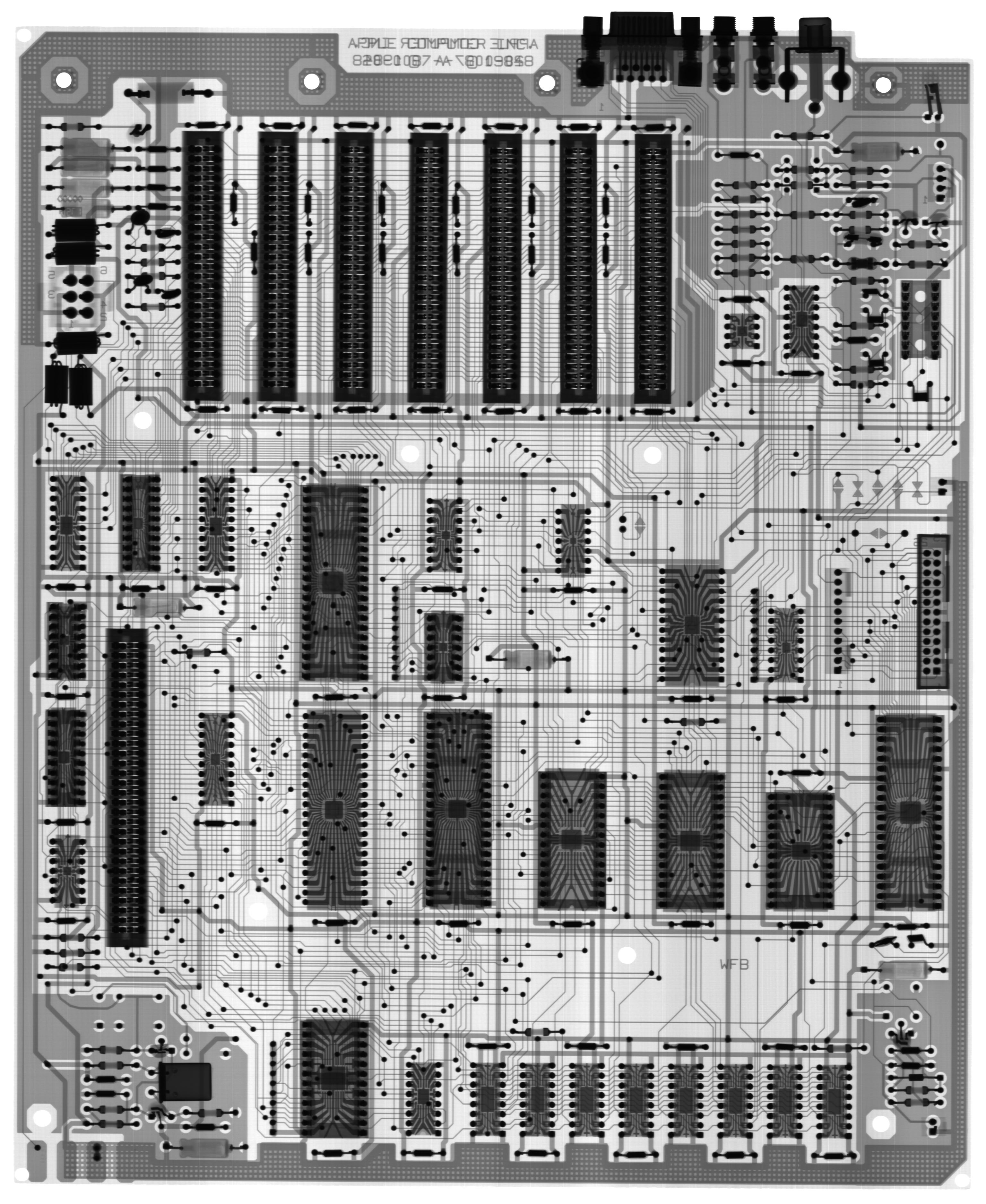
In preparation for cutting my Apple IIe motherboard in half I decided
it would help to have an x-ray of the board. This way it will be easy
to determine the most efficient cut line.
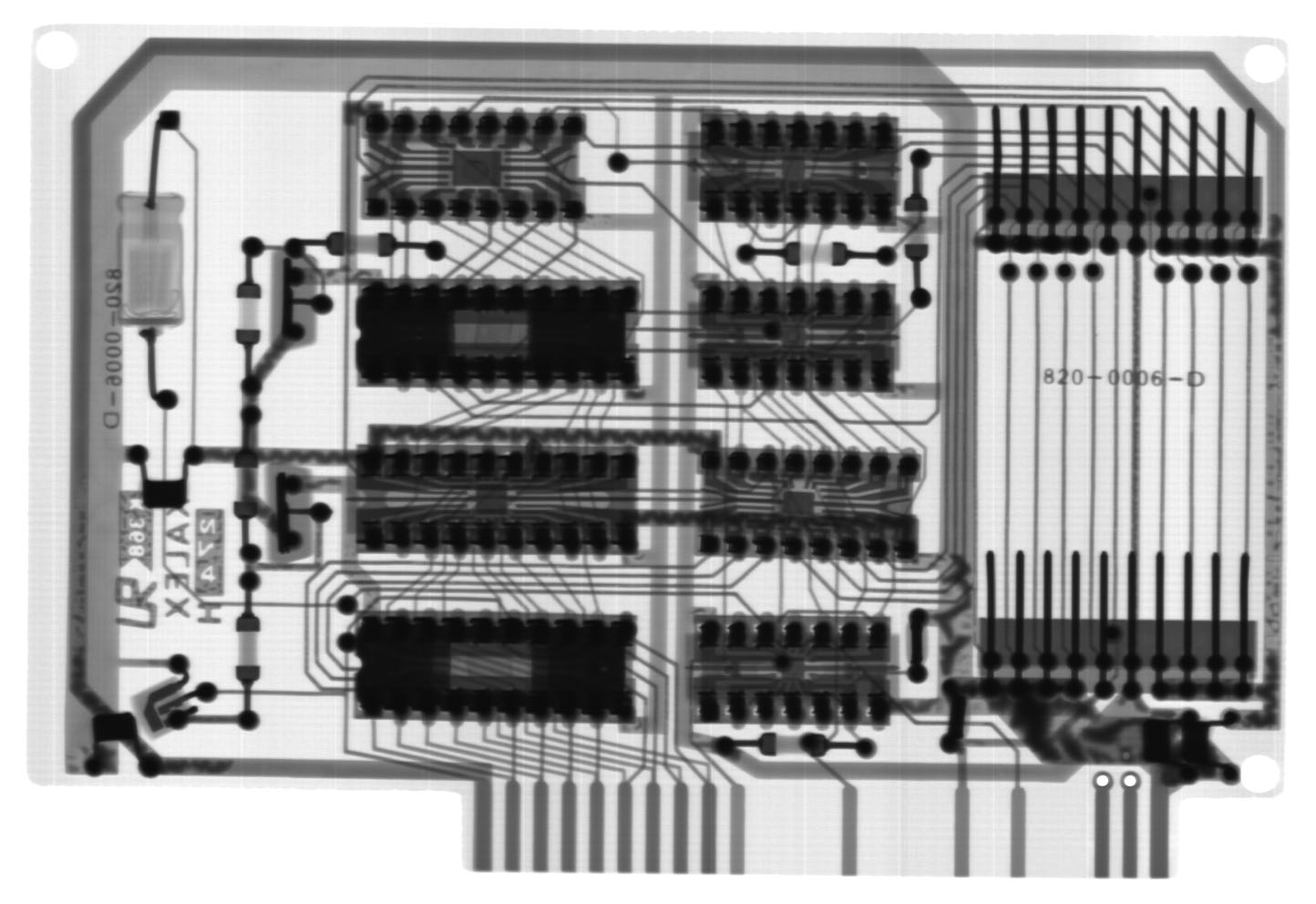
I've included an X-Ray of a Disk II card just for fun.
The X-Rays are at 300dpi. I'm not an X-Ray tech so my calibration was
a little off. Our resident X-ray guy is gone today. I'm not sure he
would be interested in an Apple IIe motherboard any way. ; ) Some
areas are dark. By adjusting "Levels" in photoshop you can bring them
out.
The motherboard received a dose rate of 17.84 R/min for the scans and
calibration. About 27 minutes (for 3 scans and a calibration). This
would have been a dose of 482 Rad.
The Disk II card received the same dose rate, but it was in the vault
for the whole time the motherboard was in there. It received radiation
for a total of about 32 minutes. 571 Rad.
To put it in perspective, if a group of people were exposed to that
dose 50-90% would die after 30 days. (90% without intensive medical
care). Primary cause of death is internal bleeding and infections.
Females become permanently sterile.
Motherboard:
http://www.stockly.com/images2/061228-Apple_II_80kv6ma35ms36SFD-Cut%20Edges…
Disk II:
http://www.stockly.com/images2/061228-Disk_II_80kv6ma35ms36SFD-Cut%20Edges.…
Any comments?
Grant
Scott,
> At 3:41 PM -0800 12/29/06, Scott Quinn wrote:
> >I'm running a VAX 4000/200 with OpenVMS 7.2 (Hobbyist V2) on it, and
> >I'm having terrible problems with the networking. (DIGITAL
> >TCP/IP/UCX v5.0). It seems that there were some bugs in this
> >release, but I'm not yet sure exactly how to find the fixes for them
> >(and the HP/DIGITAL website doesn't seem to be very helpful).
> >Especially when running telnet, the VAX slows to a crawl. What have
> >other members with this problem (and no access to newer UCXes at
> >work or other locations) done?
If you're telnetting into the VAX from Linux, make sure to issue:
'export TERM=vt100' before you connect with the telnet command. The
string 'xterm' especially drives your VAX CPU usage through the roof,
for some reason I was never told. All I know is that specifying
'vt100' or another terminal type VAX knows will solve that problem
easily.
Josef
--
"I laugh because I dare not cry. This is a crazy world
and the only way to enjoy it is to treat it as a joke."
-- Hilda "Sharpie" Burroughs,
"The Number of the Beast" by Robert A. Heinlein
I'm running a VAX 4000/200 with OpenVMS 7.2 (Hobbyist V2) on it, and
I'm having terrible problems with the networking. (DIGITAL TCP/IP/UCX
v5.0). It seems that there were some bugs in this release, but I'm not
yet sure exactly how to find the fixes for them (and the HP/DIGITAL
website doesn't seem to be very helpful). Especially when running
telnet, the VAX slows to a crawl. What have other members with this
problem (and no access to newer UCXes at work or other locations) done?
DEC bigots can skip this message safely. :-)
I've been working on a TCP/IP stack for my beloved PCjr. There are
already TCP/IP stacks that run on it, but that's not the point.
Borrowing a page from Tony's book, I decided to write my own so that I
could fix the inevitable bugs.
Anyway, I'm interested in reducing memory consumption. Any complex code
involves tradeoffs between function and performance, and I've been
careful, but one thing that is bothering me is the initialization code.
I've got a fair amount of code that reads environment variables, talks
to the packet driver, and sets up data structures. The nature of the
code is that it runs once, and then just sits there consuming memory.
Waaay back in history I was a Zbasic user - Zbasic was a fairly nice
BASIC dialect/compiler. Zbasic had overlay support, which I used
extensively. It wasn't sophisticated, but it did the job. It would be
perfect for this code - init everything that I need, and then overlay
the init code with the run code.
Now 20 years later I'm using Turbo C++ 3.0 for this project, and it has
overlay support but it has a more complicated memory manager that goes
along with it. I don't have a lot of 'gas' in the code, so going to the
VROOOM overlay manager just to overlay my init code is overkill, and
will probably require more memory. I was hoping Borland had a simpler
mechanism ...
Any ideas? The only one I can think of is kind of brute force ... have
two apps, one that inits everything and leaves the storage resident, and
another that refers to that resident storage. (I was hoping for
something simpler in the Borland runtime support.)
Mike
PS: I'm still looking for a late version of Zbasic .. I had 4.02 and I
know that 4.71 was released. I'd love to see what it evolved to, but
that's a different topic.
Before I open up both the Plus and the Portable II,
can anyone tell me if the floppy drives are swappable?
Obviously the Plus can't utilize a HD drive, but what
about the other way around? Much appreciated.
__________________________________________________
Do You Yahoo!?
Tired of spam? Yahoo! Mail has the best spam protection around
http://mail.yahoo.com
On 12/27/06, Jeff Walther <trag at io.com> wrote:
>
>
> This is a bit off-topic for the thread, but deals with the same
> philosophy of selling question.
> ...
Well, I shopped on ebay for 8250 UART's. I saw 19 pieces listed for $0.75
each. I offered best offer of $0.50 each for all. Of course I was rejected,
but to my surprise the price was then raised to $2.75 a piece. I am not
sure whether it was a price error or a new model of business. Fortunately I
am not so eager to get those chips, and I bought some from others for $0.50
a piece.
vax, 9000
> Jeff Walther
>
Lucky strike today :
10 swiss francs (7.50 USD) got me a ADM-3a in very reasonable cosmetic
state, with the dip-switch cover still intact, and with the optional
numeric keyboard.
On opening , I saw the unit even included the RG512 graphics option!
Not is all well , the crt has a severe case of moulding. This was
discussed before, I believe changing the CRT was the only good option ?
The unit also does not work. This might have to do with the can of Coke
that seems to have been emptied onto the keyboard and surroundings...
I will use my normal cleaning procedure of toothbrush and tapwater, and
letting things dry naturally.
Anyone have suggestions for the specific case of semi-dried Coke ?
Jos DReesen
>>
>> Mac portrait displays are presumably similarly difficult to get
>> replacement
>> CRTs for, at least without realigning the yoke (I gather that most
>> CRTs don't
>> like a change in orientation, although I used to run a Sun colour
>> display on
>
> Do colour portrait displays exist? The reason I ask is that I wonder if
> they use specially designed CRTs. IIRC, the whole point of the 'in line
> gun' (PIL) CRT was that the 3 electron gus were in a horizontal line,
> so
> that only the vertical component of the earth's magnetic field had much
> effect on the convergence, and that was relatively constant in a given
> area. So if the CRT was set up properly you could move the unit around
> without having to do a reconvergence (this was a problem with delta-gun
> CRTs which had to be set up in the positionan nnd orientation where
> they
> were going to be used, but if that was done they give an excellent
> picture).
>
> -tony
For a time anyway Radius produced the Color Pivot portrait/landscape
monitor.
When I was at school I saw a LCD that had an adjustment for (what would
that be? skew?) and for a while thought that someone had brought the
concept back. No dice, though.
Cool - I've been watching tcpdump on the Linux box, so I'm seeing the
activity.
I'll spare everybody and ask that people send me email (directly) only
if they see a problem. I'm going to comb through the logs from the DOS
box and the tcpdump when all is done to see if I missed any corner cases
in the protocol.
Straight TCP/IP is pretty fun to do. Getting the error handling down is
not as easy. I'm also missing a few functions:
- I'm not honoring the receive window from the other side.
- I'm not detecting or cleaning up half-open connections.
- I don't have a really robust algorithm for measuring round trip packet
time and determining a timeout period. (I'm just defaulting to 10 secs ..)
All of this will get fixed, but I was so desperate after a year of work
to see this code do something. :-)
Mike
I recently dug out an IBM XT to create some 5.25 floppy images and
while I'm at it I thought I'd try to get the Plus Hardcard 20
installed it it working. (This is a dual floppy XT without an
original IBM hard drive).
Does anyone know how to low-level format the Plus Hardcard 20? There
is ROM data at C800:0, but it doesn't look like g=C8000:5 would
execute valid code so I don't think that is the trick with this drive.
I searched the net for while but came up empty for useful info.
-Glen