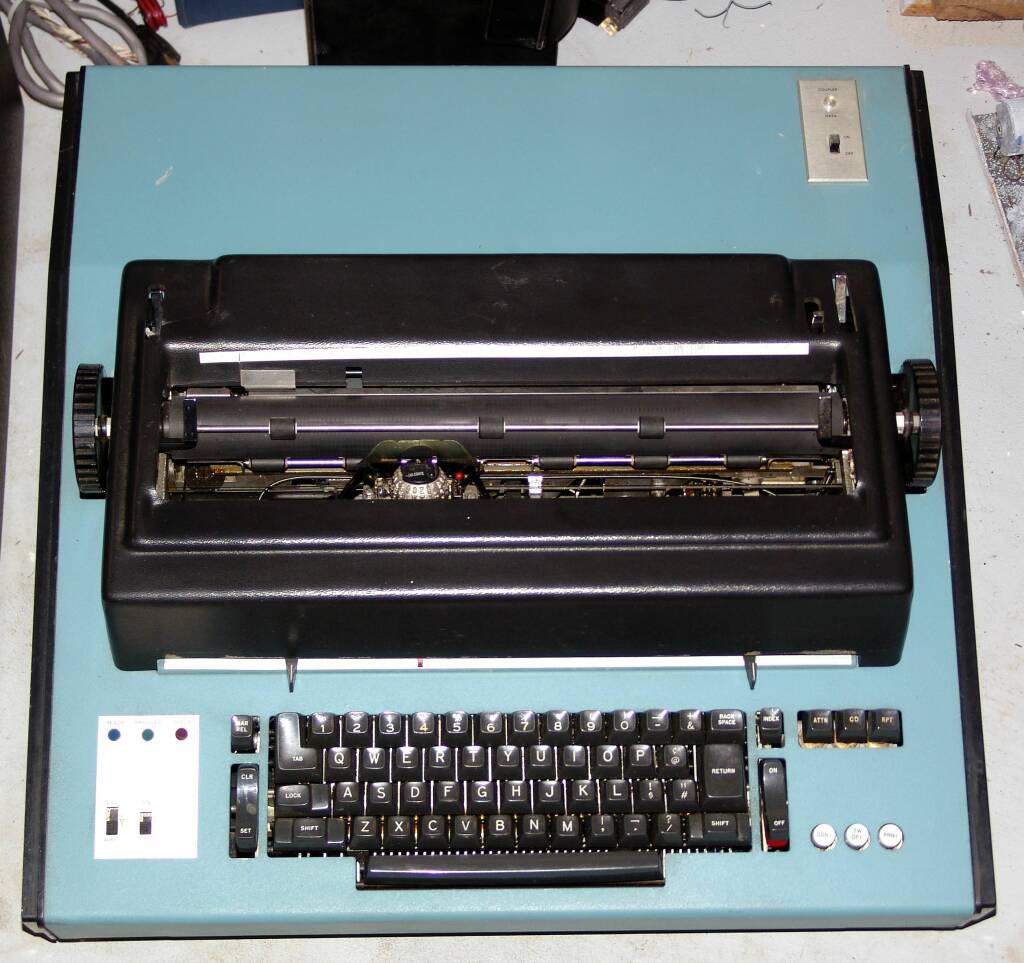
> So, who knows what documents I need and where to get them?
Clean copies of 8/E schematics are difficult to find. I'll go through
the scans that I have to try to find a good set.
Most of the omnibus interface schems are on line under
http://bitsavers.org/pdf/dec/pdp8/omnibus
There is a large pile of VAX and other documentation waiting for
disposal on the 7th floor of Disque Hall at Drexel University in
Philadelphia.
Disque hall is located on the former 32nd street between market and
chestnut streets, its the tall(~10 floors)) brick building.
Pretty much everything paper, and a working Phaser 370? printer (missing
its paper tray and missing the centronics->microcentronics adapter but
otherwise working) is free for the taking.
This documentation originally went along with the VAX machine which
someone from the list rescued from there about 2 years ago when it was
being disposed.
Jonathan Gevaryahu
jzg22 at drexel.edu
>
> I hope everyone came through alright. Is anyone on the list from
> Folkestone?
Not Folkestone but I felt it just West of Ashford. The joints in the
timber framed upper floor made a lot of noise, but nobody downstairs
(which is brick built) noticed anything. I had to turn the TV on to
confirm it was an earthquake. I'd felt one or two when I was in
Cupertino years ago but never expected to feel one in Kent. I think
the same 'quake in California would not even get a mention in the
news, but our buildings are not designed for them here.
190107136286
Told him about the timeline of CP/M and DOS and he gave me a very rude
response. So he got a "Inappropriate or excessive use of terms not
relevant to the item " from me.
Maybe otheres should point out the facts. : )
It really ticks me off when people try to take advantage of others...
Grant
Need to start paring down my book collection/pile!
Will send this to whoever wants it for the cost of shipping. "Linpack
Users' Guide" from 1979. ISBN 0-89871-172-X. Authors Dongarra,
Bunch, Moler, Stewart.
It's in good shape but has some writing on the first page. Appears to
be a second printing. Preface contains a nice list of Linpack test
sites and the machines in use, including the CDC Cyber 175 at NASA,
and a Honeywell 6080 at Bell Labs.
I'm in 60074 zip, will send book rate or whatever you like.
--
jht
> There are quite a number of versions of Utek (@&^!&^ Outlook won't let
> me capitalize the "t"). The first versions were for the National 320xx
> CPUs. This ran on the 6205's, 6130, and 4132. Later, a Motorola
> 68000-based verson was released.
FWIW, there was a V7 based system called TNIX which shipped on the 8560
development systems (11/23 and 11/73 based). Would be nice to find the
8" diag and release floppies for this (I have a couple of them).
Hi,
> I 'only' have the HP150-II. It's in a larger case, with a 12"
>CRT, an optional touchscreen (which is fitted on mine)....
I have one of these too, though without the touchscreen or any expansion
cards (it's even missing the rear plastic cover).
Seems like an interesting machine, one of these days I must get it set up;
I've only had it 9 years, LOL! How difficult are HP/IB hard drives to come
by for them (I've got the dual floppy drive unit)?
Always hankered after an original 150 though, it's a really cool shape! :-)
TTFN - Pete.
Hi,
we've cleaned and powered up our TI 960B at our museum, it seems to be
working fine. I've entered a small test program to test the basic parts:
1000 7007 0000 NOP
1002 7007 0000 NOP
1004 7082 1000 B @1000
Both single step and run mode work. But that's all we are able to do at
the moment because there is no documentation available for the 960B.
The machine (from 1975) has 8k of MOS memory, and only few CRU interfaces,
one TT/EIA (TT), one data interface (DI) (I think it's a digital I/O
board) and one timer interface (TI). So we need at least the programmer's
guides for the TT and DI, maybe the service manuals for the entire
machine. Is there a chance to find them somewhere?
Christian
Hi folks,
I am looking for docs about my PDP8/E CPU.
I found a maintainance manual ("volume 1" of ???) on bitsavers.
But no schematic.
So, who knows what documents I need and where to get them?
Best wishes,
Philipp :-)
Does anyone on the list own a Bandai Pippin - marketed in the UK and
Japan as the "Atmark"?
As owners of this Apple Power PC-powered box are well aware, software
(mostly games and edutainment stuff) is difficult to come by, and when
it appears on Ebay, often goes for stratospheric prices. For example:
http://cgi.ebay.com/Bungie-Super-Marathon-for-Pippin-world-mark_W0QQitem
Z150114489326QQihZ005QQcategoryZ62053QQrdZ1QQcmdZViewItem
So, I am looking for Pippin owners who might have software to exchange.
Here is a list of what I have:
@World TV Works
@World Basics
@World Registration
@World Browser
Compton's Encyclopedia
Racing Days
Mr. Potato Head ("award winning")
Home Improvement 1-2-3 (Home Depot)
Ugoku Burotsuku (Japanese - "moving blocks")
Fortullia (Japanese - "fortune teller")
Victorian Park (Japanese)
-W
Chuck Guzis wrote:
On 1 May 2007 at 9:09, Billy Pettit wrote:
> The Cricket was the first 1.6 inch hard drive. Never made it to market
> though a few samples exist. It was 20 years before the 1.8 inch which did
> get to market.
Didn't HP roll out a very small hard drive before that? I seem to
recall that there was something about the head suspension that would
enable it to withstand very high G-forces.
Cheers,
Chuck
---------------------
Billy wrote:
HP rolled out the Kittyhawk in the mid-'80s. It had reasonable success in
some printers and copiers, as well as a few other applications. They are
fun little drives to play with.
The Cricket was about 8 years earlier and had no success - the technology
wasn't there.
There were many other experiments in small factor over the last 30 years. I
remember a Comdex in the late '80s where IBM showed off a 7/8" drive. They
were going to mount 32 of them on both sides of PC card and have a plug in
RAID system. Like all multiple drive applications, the vibration from drive
working gave errors to the rest.
Conner made a 1.3 inch drive in the early '90s. I see them on eBay a few
times a year. I have one that is still operational.
There have been numerous attempts at the small form factor. The iPod was
the first practical application so it drove the 1.8" development and
production. It also drove the 1" development. That turned out to be a
disaster for everyone involved when the Price War on NAND Flash destroyed
the 1" market. It didn't help the Flash people either. (So far this year,
NAND prices have dropped 65%!)
There must have been other small drives. It's an idea that looks great
until you try to do execute. I've only mentioned the ones that I worked on
or have samples to study.
Billy
Alexandre Souza asked:
>The Cricket was the first 1.6 inch hard drive. Never made it to market
>though a few samples exist. It was 20 years before the 1.8 inch which did
>get to market.
Billy, wasn't that drive that fitted a Polaroid PDC-2000 camera?
I had one of these with a VERY SMALL hard drive inside!
Greetings from Brazil
Alexandre Souza
<http://www.tabajara-labs.com.br>
----------------------
Billy answers:
To my knowledge, no Crickets were ever sold. But an awful lot of samples
went out. It was designed and built in the Normandale plant of Magnetic
Peripherals.
I know nothing about the Poloroid camera. But I'm not surprised. The small
drive idea is one that seems to come to every engineer in the industry.
There have to be more attempts. It's a geek thing. Keeps coming around;
sort of like the 3.5" CD, or the vertical IC.
Billy
Chuck Guzis asked:
What was the smallest fixed-head drum memory ever constructed?
Cheers,
Chuck
-----------------
Billy:
The smallest I ever worked on was a little less than 1" in diameter and 3"
long. It used fluid bearings and spun at a high RPM - I want to say 10K but
think it might be a little less. The heads fit on a bar that rotated to
bring them close to the drum once it was up to speed. The bar was spring
loaded so it could unload the heads automatically in case of a power
failure.
The whole assembly was heavily shielded and shock protected. It was to fit
in a fire control computer used by the Navy and Air Force. It's purpose was
to reload the main computer memories in case of an EMP from a nuclear
device.
It really sticks in my mind because I later found out that the purchase
price was in excess of $100K.
Billy
* Alexandre Souza wrote:
>continued to play with floppy media for years. A wonderful example is their
>Cricket drive - every PC collection should have one.
Maybe Click? :o) That was nice, a drive inside a pcmcia card :oD
----------------
You're right. My bad. Too much crosstalk between my synapses. The IOmega
drive was the Click.
The Cricket was the first 1.6 inch hard drive. Never made it to market
though a few samples exist. It was 20 years before the 1.8 inch which did
get to market.
Billy
Probably an extremely frequently asked question, but searching didn't
seem to bring anything up.
What is the current status of PDP-11 O/S software? USENET seems to
indicate that there is no non-commercial license, yet the simh website
has some of them available for download, with the license file having a
clause that states that it is valid for emulators owned by DEC (??),
and also seems to indicate that RSX-11 is covered, yet RSX-11 isn't
available.
Mentec's site isn't very helpful, all they talk about are Windows
programs and it is so full of features as to be practically unusable on
dialup.
Any quick rundowns on the status anywhere?
Scott Quinn
I obtained one of these at a computer show yesterday.
I was told that the 3" disks are still available in
the UK. Is this so?
This page: http://www.seasip.demon.co.uk/Unix/Joyce/
states that there is a "hideous hybrid" of an upgrade
that effectively turns it into an PEECEE/AT. I demand
to know where I can find one.
And I was aware that Mallard as in Mallard BASIC was
a reference to a steam engine, cuz I'm shmott. I
almost got my fingers on a "TT scale" version in kit
form, but I decided not to because it wasn't after all
real TT scale, but rather a decadent hideous hybrid.
__________________________________________________
Do You Yahoo!?
Tired of spam? Yahoo! Mail has the best spam protection around
http://mail.yahoo.com
Seeking recommendations for a good MSDOS/FreeDOS-compatible binary file viewer
(hex / ASCII modes) to stick on my Imagedisk machine...
Technically I don't actually need any editing facilities - just the viewer
side would do.
I think PCTools came with a reasonable one at one point, but there's probably
something better out there that's downloadable...
cheers
Jules
---------------Original Messages:
Date: Thu, 26 Apr 2007 09:45:08 -0700
From: "Chuck Guzis" <cclist at sydex.com>
Subject: Re: DC-600/300XL tape cart observation
On 26 Apr 2007 at 12:16, M H Stein wrote:
>> Aside from the issue of archiving them, is it better to leave them
> until needed, or should I run them through a retension occasionally
> to prevent some of the problems mentioned recently? Any special
> conditions for storage?
>Well, obviously, a lot depends on the tape formulation itself. The
job immediately before this one was a DC-6250 written in 1992. Went
without a hitch. The problem tapes are "Scotch" and were written in
1986-87 and are nothing but problems.
>To me "archiving" is the key. Copy the things off to another storage
medium (say, CD-R) and regenerate copies every few years. It's just
plain foolish to leave things to the mercy of Father Time.
Cheers,
Chuck
---------------Reply:
I'm still curious; assuming any useful data has been archived
and I just want to reuse the tapes some day, what would
maximize the chances of their still being useable? Is heating
them a last-ditch recovery procedure or could it be considered
preventive maintenance? I assume that the 2120s, Travans etc.
are prone to some of the same problems?
Next question:
The DC600s & 615s are Cromemco Cromix+ and UNIX system
and backup tapes; those I have hardware for and they're no great
loss even if they have problems. However, the 300s are for an
Arete/Arix system and I no longer have any hardware that could
read them nor do I know of anyone with an Arix; also, there's the
usual problem that they may have confidential client data on them
along with the system files, so what do I do with them?
I wouldn't mind reusing the tapes but hate to erase them.
Format aside, can a drive meant for DC600s read the lower
coercivity DC300s?
mike
Hi Jim,
I'm going to the City of Chicago recycling center on Goose Island this weekend to dump some old monitors. I'll let you know if there is anything interesting there. Otherwise, as you say, the thrift stores in Chicago are worthless. I had much better luck with the dumpster out behind a local computer repair place near Northeastern Illinois University (5600 N, 3500W) until they moved. From the junk discarded, it looked like they had contracts to service copy machines and some document scanning systems, as well as PC's. You might want to leave word with places like that about what you are interested in.
Bob
P.S. Jim, my email to trixter at oldskool.org was bounced with the following message:
The following addresses had fatal errors:
trixter at oldskool.org: 550 [PERMFAIL] destination not valid within DNS
Message: 7
Date: Mon, 30 Apr 2007 16:33:59 -0500
From: Jim Leonard <trixter at oldskool.org>
Subject: Re: IBM 540MB old hard drive
To: General Discussion: On-Topic and Off-Topic Posts
<cctalk at classiccmp.org>
Message-ID: <463660C7.4090209 at oldskool.org>
Content-Type: text/plain; charset=ISO-8859-1; format=flowed
Paxton Hoag wrote:
> In Portland Oregon I would try the Free Geeks Thrift Store on 10th St
> east side 2 blocks south of Hawthorn.
>
> In Eugene Oregon I would look at NextStep Recycling thrift store. They
> often have 2 inch hard drives but I haven't looked at them.
Are there any of these kinds of stores in the Chicagoland area? The
only one I know of is Software Re-Runs, but that's more of a repair shop
than a recycler/thrift.
I have had *zero* out of at least 20 goodwill store successes (99% of
the computer stuff is old VGA monitors) so that's out in this area.
--
Jim Leonard (trixter at oldskool.org)
Chris M wrote:
Just curious how, or even if, old design drawings and
such were preserved in the old days. I could barely
venture a guess as to when the first optical recording
drives became "useful", all I remember is a friend
obtaining one of the first (locally) cd players for
his auto in ~the summer of '87. I was in contact with
a few of the people who were involved w/the Mindset
computer, and had hoped I would obtain info on the
custom vlsi chips it used, in any form of course. This
just lead me to ponder when this stuff started
*appearing* on cd's and such.
Can anyone name the different optical CD formats that
modern readers can't work with? I know there must be a few...
-------------
Billy answers:
There are two parts to your question. The first is how old design drawings
were preserved. In all the companies I have worked for in the last 45
years, the drawings were destroyed. Some individual copies survived. And
patent applications remain. But all design drawings were destroyed as a
matter of policy. That way there was no way support obligation coming up
long after it was cost effective. And it makes patent challenges difficult,
especially prior art arguments.
Even today, most of the design archives where I work have a very limited
life time.
The second question is a little more logical. Early on, CDs were not well
accepted. One reason was that they were rigidly defined by a document
called the "Red Book" which precisely described the format, the media, the
recording method and so on. To get access to the Red Book, you have to sign
a conformity and privacy agreement.
The technology is much more complex than that used on magnetic recording.
The huge base of vendors building according to the spec has very much
limited the variation of formats. And this rigidity has been kept up on the
DVDs.
I have seen modern readers demostrate this compatibility by modern devices
reading some of the very first CDs made in the labs at Philips. While there
may be some odd formats, I'm not familiar with any of them. The start up
costs to create the media and OPUs prevent any but the most brave of souls
>from going this way.
Whereas a unique floppy or hard drive format was easy to do. Any engineer
with a "better idea" could throw together a circuit and be shipping in a few
months. His costs often were only one small media formatter.
You can see this effect if you try to list all the different floppy formats
for 8" and 5.25". There were dozens of different formats. At MPI, I
remember a wall chart showing the relationship of more than 50 formats that
we were shipping.
Things settled down a little with the 3.5" floppies, but there were still
variations floating around. And a few odd ball experiments like the 3 inch
drive. MPI had a 1.6" floppy in the lab, but fortunately it died. IOmega
continued to play with floppy media for years. A wonderful example is their
Cricket drive - every PC collection should have one.
An optimist would say the CD people learned from the floppy fiasco. A cynic
would say nobody could afford to be an indiviualist.
Billy
Well, the Univac III is back: UNIVAC III Computer (In Storage since 1975),
eBay auction Item # 2733726990. This time the starting price is $7,500 and the
buy-it-now is $11,000.
The URL is:
http://cgi.ebay.com/ws/eBayISAPI.dll?ViewItem&item=2733726990&category=1247
OK, somebody, jump right on it! :-)
(Not me, I'm into LITTLE computers like PDP-11's and VAXen, with an occasional
side dish of 6502 or 8085)
Stuart Johnson
>
>Subject: Goofy question about "industrial" archiving
> From: "Billy Pettit" <Billy.Pettit at wdc.com>
> Date: Mon, 30 Apr 2007 17:37:19 -0700
> To: <cctalk at classiccmp.org>
>
>
>Chris M wrote:
> Just curious how, or even if, old design drawings and
>such were preserved in the old days. I could barely
>venture a guess as to when the first optical recording
>drives became "useful", all I remember is a friend
>obtaining one of the first (locally) cd players for
>his auto in ~the summer of '87. I was in contact with
>a few of the people who were involved w/the Mindset
>computer, and had hoped I would obtain info on the
>custom vlsi chips it used, in any form of course. This
>just lead me to ponder when this stuff started
>*appearing* on cd's and such.
> Can anyone name the different optical CD formats that
>modern readers can't work with? I know there must be a few...
>
>-------------
>
>Billy answers:
>
>There are two parts to your question. The first is how old design drawings
>were preserved. In all the companies I have worked for in the last 45
>years, the drawings were destroyed. Some individual copies survived. And
>patent applications remain. But all design drawings were destroyed as a
>matter of policy. That way there was no way support obligation coming up
>long after it was cost effective. And it makes patent challenges difficult,
>especially prior art arguments.
>
>Even today, most of the design archives where I work have a very limited
>life time.
Industrial archives are varied depending on product and lifetime of the
product. Most places I've been 7 years seems to be the upper limit. There
are exceptions, Military and aerospace in particular. Those guys have to
by contract maintain complete archive and production sets for the operating
life of the program. For example the Shuttle program is 30 years old and
still going and the contractors are required to keep everything until 10
years after the last flight. Thats a lot of paper, blue line, Vellum,
Mylar, tapes, floppies and even CDs. If the program requires ongoing
material sourcing as in spares or parts to make a new airframe those
drawings must be useable as well as production methods may be described in
those documents.
I will not address the second question on CDs.
Allison