I have just been told about the availability FOC of the following:
3-off Televideo TS-800A terminals with keyboards (believed RS-232 and
believed serviceable)
2-off IBM Monitors 5153 (condition unknown but I had one a while back and it
was serviceable)
2-off IBICO printer calculators 1050 and 1060 (condition unknown)
These are headed for the dump unless a home is found fairly quickly. I don't
have a need but will gladly put any takers in touch with the owners or in a
pinch will collect and store for a short time pending final collection.
Sorry, no shipping possible or arrangements outside the UK.
Current location is Coventry (UK) but equipment can be relocated to Redditch
(UK) or Stourbridge, West Midlands (UK). I don't imagine the current owners
will be keen on protracted or complex arrangements as they just want rid so
preference is likely to be given to someone willing to take the lot. A chit
will need to be signed affirming the kit has been removed so that the owners
can substantiate that it has not just been dumped for audit purposes.
Any interested parties should email me off-list at
james/at/attfield/dot/co/dot/uk. Please be quick - I'm pretty sure it won't
be kept for long.
Jim
This outbound email was scanned by Norton AntiVirus 2007 when transmitted
and all reasonable precautions have been taken to ensure that this email was
free of current known viruses and other malware when sent. Please be aware
that between here and you are an indeterminate number of email relays so you
should not rely wholly on this and ensure that you have adequate up-to-date
protection against viruses, worms, spyware and trojans etc. The sender can
not be held responsible for any undesirable elements or malware in a
received email sent by him. Please note that if your reply originates from
GOOGLE, HOTMAIL, MSN or YAHOO it may never reach me as these domains are
blocked.
ISTR a web page I saw the otehr day, where a guy showed how to modify a
Commodore 64 to do stereo output, made the case smaller, etc. Does this
ring a bell with anyone here?
--
--- Dave Woyciesjes
--- ICQ# 905818
--- AIM - woyciesjes
"From there to here,
From here to there,
Funny things
are everywhere."
--- Dr. Seuss
Hi All
Picked up a good lot of pdp stuff at the auction yesterday a Netcom
11/23, and a H960 rack which I've been looking for to put my 11/04 in.
As a bonus, the rack came with a TS03 which I've read is a re badged
Kennedy 9700, a 9-track tape drive w/ 7" reels. The rack had the expansion
Unibus box with the TMB11 interface, Doesn't the TS03 have a pertec
interface and if it does, wouldn't a third party emulex or diloq unibus
card work? Any advice or gotchas on this tape drive would be appreciated!!
Cheers
Tom Ponsford
>
>Subject: Re: Kaypro 4/84 questions
> From: Brian Wheeler <bdwheele at indiana.edu>
> Date: Wed, 07 Nov 2007 11:26:54 -0500
> To: "General Discussion: On-Topic and Off-Topic Posts" <cctalk at classiccmp.org>
>
>On Mon, 2007-11-05 at 17:54 -0400, Roy J. Tellason wrote:
>> On Monday 05 November 2007 13:13, Brian Wheeler wrote:
>> > * I'd like to replace the 2nd drive with a 3.5" floppy. I've found a
>> > Sony HD drive along with a power and plug converter. Knowing that PCs
>> > use a twisted cable scheme, what things should I be aware of when
>> > cabling in this new drive?
>>
>> The twist in the cable was to not have to worry about jumper settings which
>> you had to deal with prior to that point. Those drive select jumpers are
>> marked, depending on the brand, either 0-3 or 1-4 on the drive electronics,
>> with the first two choices being the ones commonly used (0 and 1, or 1 and
>> 2). The cable with the twist setup has both drives set to the second choice,
>> so you probably won't need to worry about messing with anything there,
>> selecting the drive should be apparent as Kaypros tend to leave the light on
>> all the time.
>>
>> > Will it be supported in some manner by the software?
>>
>> Hm, kinda doubtful, though I couldn't say for sure as it's been a long time
>> since I dove into those particular interface specs.
>>
>> > Its not a big deal if it turns out to be a 360K 3.5" floppy, as long as its
>> > readable by my linux box.
>>
>> That might just be what you end up with. Do tell us when you find out, I'd
>> be curious to know...
>>
>
>I've got the 3.5" drive installed and cabled and it seems to be working
>rather well. I ended up using vice grips to get the screws loose in the
>drive cage since the heads kept wanting to strip. As I suspected, it
>really thinks its just a DSDD 5.25" drive. I formatted a disk using
>mfdisk as an IBM 9 sector DS disk and could read it (as 360K) without
>problems on my linux box.
>
>The drive I ended up using was a chinon FZ-357 which has a jumper for
>RDY as well as drive select jumpers. It also had the interface pins on
>the same side as the original disk so I could use the original cable.
>All of my other 3.5" drives had it on the other side, but the cable
>wasn't long enough to shift sideways enough.
>
>Its weird when it does a format since it counts tracks from 0 to 79 but
>its really counting cylinder 1 as tracks 0 and 1, etc.
>
>However, trying to read a kaypro formatted disk isn't working. It reads
>4K and then fails. Anybody used setfdprm on linux to set up reading
>kaypro iv/10 disks? They look like they're 10 sector (numbered 0x0a -
>0x13), rate=2 disks.
You may have to notify the software of what format is being used.
>I'll probably mount the 5.25" DSDD drive in my linux box as well, but
>it'd be nice to know how to read disks without hassle :)
>
>Now for some more questions:
>
>* is it possible to run CP/M 3.x on it, or am I limited to 2.2G?
Yes, but without any banked memory.
>* what's the J9 header for? It looks like it has 8 data bits and 8
>address bits wired to it (at least according to the schematics I've
>found). Seems like it'd be possible to hang a home-made IDE interface
>onto it (if I ever get time/inclination)
Its host interface for WD1001HDO HDC, Sorta like IDE save for the
board was bigger than the drive, it wasn't integrated, it was 8bit
and the registers were slightly differnt. To do IDE with that
should be easy as its basiccally the process or bus for IO. There
will not be software support (BIOS) unless you do it.
Allison
>
>Thanks to all of the suggestions and advice!
>
>Brian
>
On Nov 7, 2007, at 2:00 PM, Chuck wrote:
> On 7 Nov 2007 at 10:58, Richard wrote:
>
>> Umm... IIRC, Xenix was a unix implementation that didn't even require
>> virtual memory, ran on x86 architectures (386?) and required very
>> little memory; certainly much less than Win96 since Xenix was
>> available in 1986.
>
> Early Xenix ran on a 286. I don't think it ever ran on anything
> less. I have an early Microsoft MSDOS 2.0 OEM announcement that
> talks about eventually unifying Xenix and MSDOS. I guess that goes
> in the same category as Microsoft OS/2 2.0...
There were versions for Lisa and (not used but seen pictures of) an
8086 version - perhaps on one of the early Altoses.
Later versions of Xenix were 286 and up, and later (with XENIX System V
386) 386 and up.
>
>Subject: Re: Tarbell is making me insane
> From: Grant Stockly <grant at stockly.com>
> Date: Wed, 07 Nov 2007 23:35:01 -0900
> To: "General Discussion: On-Topic Posts Only" <cctech at classiccmp.org>
>
>
>>Changing the crystal would half the data rates making it right for
>>5.25" floppy.
>>
>>One of the modes all the contrllers that use hang mode (wait), is
>>sector never found. Wrong clock rate will insure that.
>
>I was also considering that at 2MHz instead of 4 the FDC controller
>will be operating close to its limits and may need the wait
>state. What was happening was probably a missed wait state.
More like the data rate for the board was halved 250kbits/sec
and the data was never being read. That will hang the system as
the FDC is waiting for the data and at the wrong rate it will
never arrive. The Clock crystal is used to derive the data rate
for reading and writing.
>>Both work. The logic however uses the 8T97 and tristates it when
>>not needed (board not addressed) which is a "legal" way to do it
>>though it seems like more effort.
>>
>>Of course using high is active and mixing than with low is active was
>>a dumb thing too. Even Tristate asserts a better low than a high.
>
>The front panel buffer is hard wired on, so the Tarbell was shorting
>out the panels XRDY.
That too. On front pannelless systems thats not an issue.
>
>I reviewed the 1k memory card and it does tristate it like you
>said. My problem with the 1k card way back then was that the MITS
>documentation puts both on the PRDY line. In my two systems this was
>no good. The transients would corrupt the bus cycle. This was found
>when working with an altair laying on a wooden table. It wasn't in a
>metal case. I never tried putting both on the PRDY line when it was
>in an enclosure. I imagine it would have worked better in the case
>since I've never read any errata on it, but I wanted to play it safe.
It would ahve worked btter is the rams used wer 600ns rather than 1uS
and the wate states never needed.
>If you want to talk about media abuse...1.4MB disk with the HD hole
>covered, formatted to 71k : )
That works.
>
>One of my problems MIGHT have to do with the 16v and 8v supplies not
>turning on at the same time. I will have to investigate that more...
Why do they not turn on at the same time? All the altairs I know of
the switch was on the AC side and it all came up soon as AC was applied.
Allison
I recall seeing that someone was going to show off their software
emulation of the IBM 5100 computer at the VCF that just happened. Did
it make an appearance? I just checked the VCF exhibitor list and didn't
see it there anymore. Was it retracted? Does anybody know who
developed it? I'm quite curious to learn more about it; writing such an
emulator was on my long term TODO list, but I'm glad somebody beat me to
it, as there are many other projects on that same list.
Thanks.
I have an Axel Platine terminal that seems to fit all the requirements -
except maybe that the terminal emulation for older computers might be a bit
lacking.
Size of a 'Letter/A4' piece of paper, an inch thick, uses standard PC
keyboard/monitor/LCD and uses 8W of power. They can be bought cheaply of
EBay (in the UK anyway)
Just a thought
Mark
>
>Subject: Re: Tarbell is making me insane
> From: Grant Stockly <grant at stockly.com>
> Date: Wed, 07 Nov 2007 12:07:22 -0900
> To: "General Discussion: On-Topic Posts Only" <cctech at classiccmp.org>,
> Pete <petechapman at frontiernet.net>
>
>
>>Welcome to S100.
>>
>>I don't have info on tarbel 1011 seris FDC. The schematic on hand I
>>could comment more. However 8" DD with 2mhz 8080 is very difficult
>>to do as single density is already pushing the 8080 through some very
>>tight software loops.
>
>I think the crystal on the tarbell has been changed from 4MHz to
>2MHz. I do know that one of the failure modes is for the Tarbell to
>"crash" within a wait state.
Changing the crystal would half the data rates making it right for
5.25" floppy.
One of the modes all the contrllers that use hang mode (wait), is
sector never found. Wrong clock rate will insure that.
>I read the manual and when it started talking about not using
>"Active" wait state generation I was given a hint.
>
>The tarbell as I received it was using XRDY for wait states. My
>front panel uses XRDY.
>
>When I was developing the Altair kit I found that the 1k memory card
>would NOT deposit or examine because the PRDY was being driven by the
>front panel. The 1k memory card would have to basically over power
>the front panel buffer. This would cause some nice transients too.
>
>So this morning I changed the tarbell from XRDY to PRDY and it
>worked. It has worked fine every time I have tried it since, so
>maybe I found the 'BUG'.
It's always Prdy. The 1K card uses it becuse the rams installed were
Sllooowwww and wait states were needed. I'd not use that card ever.
When using A FDC that asserts wait for syncronization you really
don't want memory that insert wait states as the CPU is alreay slow
enough and slow memory is a bad thing.
>So, WHY do all these old cards use 8T97 type drivers to force the
>wait line? I guess its only the MITS display board and 1k memory
>board that drive the wait line regardless of if they are addressed or
>not. Whats wrong with these guys using open collector parts with a pullup???
Both work. The logic however uses the 8T97 and tristates it when
not needed (board not addressed) which is a "legal" way to do it
though it seems like more effort.
Of course using high is active and mixing than with low is active was
a dumb thing too. Even Tristate asserts a better low than a high.
>I'll report on how robust it is later on. I've had several false
>starts with this setup...
>
>>Also sounds like oneshot problems. Check cpu timing. Even small timing
>>errors tend to magnify bus noise issues and incompability problems.
>
>I checked that.
Good, keep checking it as those oneshots are not reliable in my book.
Allison
>Grant
On Nov 7, 2007, at 8:19 AM, cctalk-request at classiccmp.org wrote:
> Memory for Indigo 2 (IP22) needs to be FPM with ECC. But I couldn't
> find anywhere if these SIMMs may be "registered", aka "buffered".
> I see quite a few cheap FPM ECC SIMMs for sale, but most of them have
> some strange additional chips on them, I guess that means there are
> of the buffered kind. Will these modules work in I2?
>
FPM 36-bit (often called parity). I have seen on the Internet reports
that the IP22 gangs them together similar to the way DEC does with some
21164 machines to get ECC, but skimming the documentation for the MC1
and DMUX1 doesn't make reference to this, merely "parity". There are
other 72-pin SIMMS (such as the IBM RS/6000 ones) that are ECC, so make
sure that you're not trying to use one of these (ECC uses a different
pinout).
They don't need to be buffered (only 3 banks).
Regarding the Indigo: Indigo R3k uses SGI-proprietary IP12 SIMMS
(shared with the 4D/30 and /35). Indigo R4k has the same memory
controller as IP22 Indigo2, and uses 36-bit 72-pin SIMMs.
>
>Subject: Re: modern serial terminal
> From: woodelf <bfranchuk at jetnet.ab.ca>
> Date: Wed, 07 Nov 2007 19:43:05 -0700
> To: General Discussion: On-Topic and Off-Topic Posts <cctalk at classiccmp.org>
>
>Jim Leonard wrote:
>> So what's your thoughts on the 8088? 16-bit registers, 8-bit data path
>> (but with 16-bit addressing). Is it a 16-bit CPU or an 8-bit CPU?
>8 bit CPU with 16 bit instructions. :(
Both 8088 and 8086 are 16bit cpus, also 80188 and 80186 they differ only in
external bus width. That bus width has no programatic effect in that binaries
are the same for both. Internal register sizes are same for both flavors.
The 68K also had the 68008 a 32bitter that had a narrow data bus.
DEC T-11 (PDP-11) also had the option at reset time to configure the bus
as 8bit wide or 16bit. The Z280 also had this option. However the T-11
is without question 16bits and the Z280 is 8bit.
The 386SLC and 486slc were both 32bit but had a 16bit wide bus for interface
convenience.
The point is bus width only determins bus bandwidth and performance
and is not the say all for "xx width" cpu.
Allison
I recently acquired a Kaypro 4/84 and I'm in the process of cleaning it
up and getting it happy.
There are a couple of problems with it that maybe someone can shed some
light on:
* one of the keyboard latches is broken. Anyone know a good substitute
and/or workaround? I don't care so much about it, but it'd be nice to
be able to lug it into the kitchen and carry something else at the same
time :)
* They keyboard cable is missing, but I substituted a keyboard cable
>from a DEC terminal keyboard and it seems to work. The tech manual I
found online says that using a phone cord causes dropped characters due
to the smaller wire gauge, so I'm hoping that this cable will be sturdy
enough.
* There is a screw in the 2nd floppy drive opening. I've tried removing
the drive sled (via the screws on the bottom), but alas it seems like
the drives have to come out of the front individually. The screws are
pretty solidly inserted and I cannot get them loose without stripping
them. I'm not able to get to the inner ones easily without removing the
motherboard and the monitor. Is it possible to take the bezel off of
the drive and then slide the cage backward and then out? The drives are
the shugart ones.
* I'd like to replace the 2nd drive with a 3.5" floppy. I've found a
Sony HD drive along with a power and plug converter. Knowing that PCs
use a twisted cable scheme, what things should I be aware of when
cabling in this new drive? Will it be supported in some manner by the
software? Its not a big deal if it turns out to be a 360K 3.5" floppy,
as long as its readable by my linux box.
To follow up, it seems as if the code at offset 058Dh in the Version
3 PC AT BIOS is the speed-tester. Curiously, it seems not simply to
test for an overfast CPU clock, but a slow one also. The timebase
for the check is the "refresh" bit (bit 4 of port 61h). Values lying
outside of the acceptable range result in doing a 0101h beep.
A workable patch would seem to be to insert an unconditional jump at
5BC to 5CB, which would bypass both tests. When I get a chance, I'll
burn some ROMs and try it, after recomputing the ROM checksum.
Cheers,
Chuck
Sorry, I just had to share this with someone, and I thought some of you
guys might appreciate it...
I've been working on a Three Rivers PERQ emulator since last year in my
spare time, though I've had basically no time the past eight months or
so. Last I left the code, it managed to boot POS about halfway before
the boot process would hang. Well, I managed to fix (or at least, work
around) the bug causing the hang, which brought me to this:
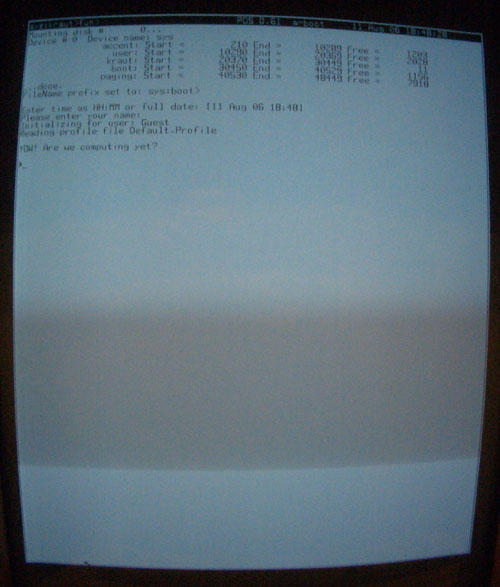
http://yahozna.dyndns.org/projects/PERQemu/PERQ-3.png
Ok, it doesn't look like _much_, but compare it with the photo here:
http://yahozna.dyndns.org/computers/perq/photos/pos-boot.jpg
(Hint: They're the same thing, only one's really scrambled up :P)
The boot process is still erroring out, but it's about 99% there (at DDS
951). Of course, I obviously still have a ways to go. As evidenced by
the completely garbled text, I have yet to get the PERQ's unique (and
extremely complicated) RasterOp hardware emulated to any significant
degree. And after that I have a ton of hardware details to work out.
But this is a major milestone, and I'm so excited that I just had to
share my excitement with someone... I never thought I'd get anywhere
near this far with the emulation, given how complicated the PERQ is.
And if I've seen so far, it's because I've been standing on the
shoulders of giants. Or one giant, at least -- our own Tony Duell who's
been ever-so-patient with my questioning and who probably knows more
about the PERQ hardware than the original designers did...
Thanks for taking a look, and sorry for tooting my own horn...
Josh
Hi,
Does anyone have any experience with using a TOP2049 as a TTL 74xxx chip
tester?
How did it work for you? Do you recommend it as a worthwhile piece of test
equipment?
Thanks!
Andrew Lynch
Are the three drive expansion boxes for the TRS-80 Model 2 rare or
anything? I have one in pretty rough shape that I plan to part out,
but I will hold off if the things are seriously in demand. Let me know
in a few hours, as I am loading up to go to the junkyard tomorrow.
I also have the TRS-80 Mod 2 computer that I need to test. I do not
want it. I would like to sell it or trade it, but I really do not want
to pack it.
--
Will, in 10512
reminder.... discussions of environmental issues are not freaking on topic!!
Do I really have to say that? I'm simply amazed. And then I see quotes from
Dr. Who. Un Freaking Believable.
J
Hi,
>....On Saturday I watched Terminator 3....
My utmost condolences.
That's a couple of hours of your life which you'll never get back....
TTFN - Pete.
Greetings all;
I'm reading up on the Onyx (rackmount, original Onyx) and the manual says
that units with three power supplies (OLS') are configured for three
phase, and units with two OLS' are configured for two phase.
While my machine does have the optional lower VME card cage and also the
second SCSI box (thus necessitating the 3 OLS'), I won't be likely to use
either of them. 220v I can do (handy-dandy nearby 40A circuit for a stove)
- 3 phase would require wiring changes in the building.
Is anyone aware if there was an established procedure to go from 3 phase
back to 3 phase on these units? Could I be lucky enough to have someone
here who has done it?
Thanks!
JP Hindin
Unless someone takes it off me, a basket case Friden Flexowriter will
hit the big smelter in the sky.
It is a later model 2309.
Location : Zurich Switzerland. Shipping is a no-no.
I bought it on ebay for 10$, but it turned out to be more effort to
repair than I am willing to invest.
BTW the seller compensated me with a nice, functional ASR-33 AND an
SWTPC CT1024...
Jos
>
>Subject: Re: WTB: LIM/EMS/XMS 16-bit ISA memory expansion board
> From: "Chuck Guzis" <cclist at sydex.com>
> Date: Wed, 07 Nov 2007 10:03:21 -0800
> To: "General Discussion: On-Topic and Off-Topic Posts" <cctalk at classiccmp.org>
>
>On 3 Nov 2007 at 20:25, Allison wrote:
>
>> Sounds like someone looking for an ASk 6Pak Pro.
>
>Do you mean "AST"?
Yep. Finally retired the nasty keyboard.
> No, not really--I don't need all the other glarf;
;) Well I was hoping..
>just the memory. There was a plethora of makers of memory expansion
>boards for the 286. I like the Intel Aboveboards, myself and avoid
>the Everex versions, for example.
Aboveboard was a good one. I have one paired with with my Intel Inboard386.
Allison
>Cheers,
>Chuck
>
>Subject: Kaypro 4/84 questions
> From: Brian Wheeler <bdwheele at indiana.edu>
> Date: Mon, 05 Nov 2007 13:13:40 -0500
> To: "General Discussion: On-Topic and Off-Topic Posts" <cctalk at classiccmp.org>
>
>I recently acquired a Kaypro 4/84 and I'm in the process of cleaning it
>up and getting it happy.
>
>There are a couple of problems with it that maybe someone can shed some
>light on:
>* one of the keyboard latches is broken. Anyone know a good substitute
>and/or workaround? I don't care so much about it, but it'd be nice to
>be able to lug it into the kitchen and carry something else at the same
>time :)
>
>* They keyboard cable is missing, but I substituted a keyboard cable
>from a DEC terminal keyboard and it seems to work. The tech manual I
>found online says that using a phone cord causes dropped characters due
>to the smaller wire gauge, so I'm hoping that this cable will be sturdy
>enough.
The DEC cable is about the best choice available.
>* There is a screw in the 2nd floppy drive opening. I've tried removing
>the drive sled (via the screws on the bottom), but alas it seems like
>the drives have to come out of the front individually. The screws are
>pretty solidly inserted and I cannot get them loose without stripping
>them. I'm not able to get to the inner ones easily without removing the
>motherboard and the monitor. Is it possible to take the bezel off of
>the drive and then slide the cage backward and then out? The drives are
>the shugart ones.
Mine had screws top and bottom. They tended to vary things.
>* I'd like to replace the 2nd drive with a 3.5" floppy. I've found a
>Sony HD drive along with a power and plug converter. Knowing that PCs
>use a twisted cable scheme, what things should I be aware of when
>cabling in this new drive? Will it be supported in some manner by the
>software? Its not a big deal if it turns out to be a 360K 3.5" floppy,
>as long as its readable by my linux box.
I've done this using a 3.5" to 5.25" adaptor. The software will not utilize
the full 80 tracks of the 3.5" floppy and possibly both sides if the roms
are not updated.
The Advent turborom with disk personality card and likely others support this.
The drives I used had the 1-4 jumper like 5.25" floppies so it was a matter
of pin to card edge adaptor, power adaptor and drive select jumper. For later
drives you make have no choice but to make a "funny cable" to do drive select.
the reason for that is those drives are locked to cable select.
Allison
I can boot my 10 MHz AT clone with the IBM Version 1 (01/10/84) ROM
just fine, but the Version 3 (11/15/85) beeps out a system board
error (long-short). I seem to recall that the Version 3 BIOS checked
for an 8MHz CPU clock and complained if it was anythng else. I know
that the Ver. 2 BIOS checked for a 6MHz clock.
Is my memory correct--and does anyone know of a patch? I could do a
little digging into the POST code, but I'd rather not duplicate
someone else's effort.
Cheers,
Chuck
Sridhar Ayengar wrote:
> David Griffith wrote:
>>> I think it goes like this, someone please correct me if I'm wrong:
>>>
>>> 1984 IRIS (terminal/workstation)
>>> 1988? Personal Iris
>>> 1990 Indigo
>>> 1992 Indigo^2
>>> 1993 Indy
>>> 1996 O2
>>> 1999 Octane
>>> 2000 Octane2
>>> 2002 Fuel
>>> 2003 Tezro
>>
>> I seem to recall the O2 coming out in 1999, roughly at the same time as
>> the Octane.
>
> Didn't the O2, O20 (Octane), O200 and O2000 come out at roughly the same
> time?
More or less. Besides that, the Indigo2 and Indy represent a split in the low-end line, both being offspring of the Indigo, with O2 being Indy's successor and Octane being Indigo2's successor. The O200 was the offspring of the Challenge S (and M) low-end server offering. The Fuel and Tezro are also pretty much complementary machines.
Also, since Octane sported the Cube logo, I seriously doubt that 1999 introduction date. The logo was changed in 1997/1998 and debuted on the Octane2/O2+ in the IRIS workstation line.
Here's the family tree, then:
/-> Indigo2 -> Octane -> Octane2 -> Tezro
Personal Iris -> Indigo -<
\-> Indy -> O2 -> O2+ -> Fuel
,xtG
tsooJ