Does anyone have any experience working with modems that didn't include
internal / auto dialers?
They came up in a conversation in a newsgroup and I realized that I know
of them, but know virtually nothing about them.
I think they were separate devices, which probably means that they
likely had separate serial ports to talk to each of them. Did they
support some sort of pass through? Or did they really require two
serial ports on the host?
--
Grant. . . .
unix || die
Get a load of this:
http://www.gopherprotocol.com
I pointed them to RFC 1436 in case they haven't been paying attention.
I eagerly await their next protocols, IPX and TCP/IP!
g.
--
Proud owner of F-15C 80-0007
http://www.f15sim.com - The only one of its kind.
http://www.diy-cockpits.org/coll - Go Collimated or Go Home.
Some people collect things for a hobby. Geeks collect hobbies.
ScarletDME - The red hot Data Management Environment
A Multi-Value database for the masses, not the classes.
http://scarlet.deltasoft.com - Get it _today_!
I have a large qty to donate to a vintage computer group. I do not want to
ship. Someone in Austin or San Antonio area want to come and get it?
I would like it gone before this Saturday.
Cindy Croxton
Electronics Plus
1613 Water Street
Kerrville, TX 78028
830-370-3239 cell
sales at elecplus.com
---
This email has been checked for viruses by Avast antivirus software.
https://www.avast.com/antivirus
> L series are combinatorial only. You (or someone who has a working one)
> should be able to figure out a logic map by either running through all
> the input permutation or putting it in a reader that will do the same
> (vs reading the fuse data).
>
> -Alan
>
> Good luck.
unfortunately I don't have a working PAL, that's why I'm looking for the jedec file
After long delay, we can finally share the location of this year's
show! Room registration is open and awaiting your reservation. We've
got a new venue this year and that means a new table layout, which
we're hard at work on and will be posted Real Soon Now. Then we can
start signing up exhibits and vendors. Look for another announcement
email when we're ready to begin.
Here are the vital accommodation infos:
WHERE: Waterford Banquets/Clarion Inn, 933 S. Riverside Drive, Elmhurst, IL
WHEN: September 14-15, 2019
HOW MUCH: We have a group rate of $109/night for single or double-bed rooms
RESERVATIONS: We have a direct link for our group code. Note that the
dates default to the entire block (Wed-Mon) and you will have to
adjust them to your needs.
LINK: https://www.choicehotels.com/reservations/groups/gw24z4
OTHER STUFF: Please make use of our group code if you're staying with
us. Every room (and room-night) counts toward reducing our venue costs
and increases the chances of being invited back next year! If you
book with AAA or another group plan, please let the hotel know that
you are attending VCF Midwest and they will credit your stay to our
block.
RESERVATIONS MUST BE MADE BY AUGUST 24, 2019! NO GROUP RATE WILL BE
HONORED AFTER THAT DATE!
Note: If the online form is not working or not giving you the group
rate, please call the hotel directly at 630-279-0700 before contacting
us!
Oh yes, we figured new location = new era = new website. Besides,
some found the old site a bit unfriendly and primitive, what with all
that green monospace nonsense, like it's some kind of old computer or
something. This new "interactive[1]" look is sure to impress.
Surely. nothing says "user-friendly" like... http://vcfmw.org
Thanks to all and we'll see you in September,
-j
[1] In that it's "not batch".
All HP fans in general and Tony in particular,
I have the exact same problem. HP98035 real time clock module
(http://hpmuseum.net/display_item.php?hw=168), plugged into a HP9825T
(http://hpmuseum.net/display_item.php?hw=171), accepts commands, reads back
all 8's. Battery is new, is charging and at the correct voltage.
Documentation says "never run the module without the battery or it would
damage the AC5954N clock chip". When I got the module it had not battery in
it, so this is what could have happened. Tony, did you eventually repair
your module or find some data on the clock chip?
Marc
List: classiccmp <https://marc.info/?l=classiccmp&r=1&w=2>
Subject: AC5954N clock chip (I think)
From: ard () p850ug1 ! demon ! co ! uk (Tony Duell)
<https://marc.info/?a=104957097300008&r=1&w=2>
Date: 2001-08-26 22:55:32
<https://marc.info/?l=classiccmp&r=1&w=2&b=200108>
[Download RAW message
<https://marc.info/?l=classiccmp&m=104961357310567&q=mbox> or body
<https://marc.info/?l=classiccmp&m=104961357310567&q=raw> ]
I've got a non-working HP98035 real time clock module (for HP9825, etc)
on the bench.
It accepts commands, it sends something back, so I think the bus
interface and microcontroller are all fine. The problems are :
The real time reads back as 88:88:88:88:88
There is no activity on the crystal connected to the AC5954N clock chip
(or at least I think it's a clock chip). Enabling the oscillator
testpoint doesn't do a darn thing (well, the control/setting latch U7
changes state so again the microcontroller is doing something). There is
no activity on any of the pins on the chip.
It is getting power (it's not a problem with the NiCd battery).
I suspect the chip. Has anyone come across it? It may be a common digital
clock/calendar chip, or at least related to one (if it is HP-custom).
It doesn't seem to be particularly designed for a microprocessor bus --
the output may be for direct driving 7-segment displays or maybe a
multiplexed BCD output to link to a display decoder/driver.
Thanks in advance for any help.
-tony
I have been scanning a few manuals and brochures related to the Alfaskop
series of IBM 3270 compatible and Uniscope 100 compatible terminals.
http://www.datormuseum.se/peripherals/terminals/alfaskop
Unfortunately very little seems to be saved regarding this series of quite
successful terminals. In total around 900.000 units were produced.
Starting with the dumb 3100 with delay line memory, to the 3500/ 3700 with
a TTL CPU and the the 4100 series with 6800 CPU and finally the 91xx series
with 68k CPU (I believe). There is a brief history on the wiki page (
https://en.wikipedia.org/wiki/Alfaskop)
One interesting thing with the 41xx series is that it has a general purpose
real time operating system described in this manual
http://storage.datormuseum.se/u/96935524/Datormusuem/Alfaskop/Alfaskop_Syst…
This manual refers to a SPL programming Language, and a SPL reference
manual, which I am lacking. The SPL language seems to have realtime
constructs like WAIT, DECLARE TASK, POST etc. Is there anyone that
recognize the language or is it an invention made by Datasaab back in the
days?
Another interesting feature is that the 41xx series made use of a star
coupled 300 kbit/s sort of network. Mainly to communicate with the likewise
networked floppy drive or communication controller. The terminal could be
configured to work stand alone with a floppy drive or using a communication
controller as it seems.
Depending on what it was configured for, the terminal could either run
various terminal emulations, the Alfaword wordprocessing package or even
the UCSD p-system.
It would really be very interesting to find any of this software. So if
anyone knows anything I am interested.
> From: Allison
> ODT for the two systems are very different. .. KDF-11 the ODT is part
> of the higher level code. The larger cards (11/23 and 23+) boot to
> resident (ep)rom.
Ah, no. (Well, the KDF11 CPU's can boot to EPROM, which in the -11/23+ can be
on the CPU card; the -11/23 is a dual card and has no functionality on the CPU
card except the CPU.)
The ODT in the KDF11's (and KDJ11's) is, just like in the LSI-11's,
microcode, not macro-code. From the 1982 'microcomputers and memories'
handbook, pg. 161 (in Chapter 7, "Octal Debugging Technique (Microcode
ODT)"):
"The console emulator Octal Debugging Technique (ODT)is a portion of
the processor microcode ... The console ODT implemented on the LSI-11/23,
PDP-11/23 and PDP-11/23-PLUS is identical."
and on pg. 154:
"Unlike the LSI-11 and LSI-11/2, the LSI-11/23 does not enter console
ODT upon occurrence of a double bus error"
>From which I think is quite clear that the KDF11's have microcode ODT.
Noel
A follow-up to close out something:
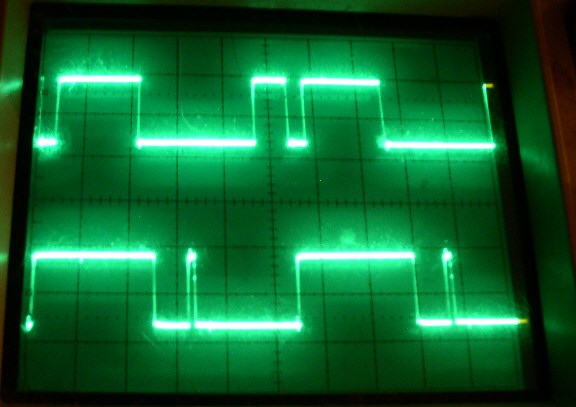
> OK, now a picture of the bus with no console card:
> http://ana-3.lcs.mit.edu/~jnc/tech/pdp11/jpg/BSYN-BDAL_NoMem.jpg
[Note: image re-named, to correctly say what it's showing]
> It's a bit hard to interpret what's going on here .. The long assertion
> of BSYNC is undoubtly the CPU trying to get the console CSR to respond,
> and eventually timing out. Not sure what the short assertion following
> it is - without looking at the ucode for the ODT, there's no way to know
> what the CPU's doing.
> Even harder to understand is what the BDAL line is doing. It looks like
> it's un-asserted (0, i.e. +3V) on the falling (electrically - rising,
> logically) edge of BSYN (which would be incorrect - see above). And then
> it hops around while BSYNC is asserted, which makes no sense at all to
> me.
So this makes a little more sense now.
This is actually showing a NXM cycle to main memory (apparently to address 0),
hence the '0' on BDAL10. (The second assertion of BSYNC must be somehow
associated with the NXM.) Apparently it doesn't even try to talk to the
console card unless the memory is there OK; if it can't see the memory, it
must just reset and try again.
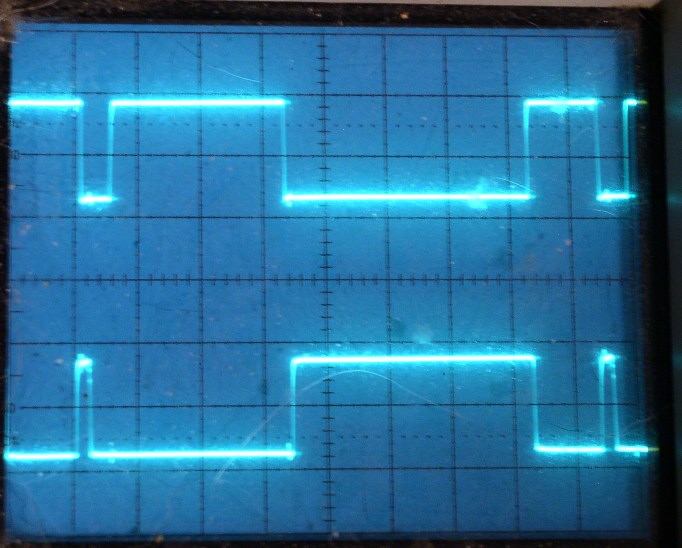
Here:
> http://ana-3.lcs.mit.edu/~jnc/tech/pdp11/jpg/BSYN-BDAL_NoCon.jpg
is a system with memory, but without a console. A very similar picture, but
here BDAL10 _is_ '1', as expected.
So the original picture did in fact indicate what the problem was - had I
known enough to know how to interpret it! Schaeffer's Law strikes again!
Although I still don't understand why the LSI-11 wants to see main memory on
the bus, in order for ODT to run. ODT doesn't use memory at all; ODT on the
KDF11 CPUs will run without any memory.
Noel
> From: Mister PDP
> Wow, I wasn't aware that the ODT console needed memory to run.
It was news to me too! (And apparently to most others here too?)
I was going to look at those confusing bus cycles, using an only slightly
mis-addressed console, and wanted to first check that that console worked when
properly configured; so I plugged in it and an LSI-11/2 CPU - nothing.
Switched to a different CPU (maybe the first one died), _still_ nothing? So I
tried an -11/23, ODT worked! So, the console worked; the chances of two CPUs
that were working a week ago suddenly both dying seemed slim... what else
could it be?
And the /23 works with no memory! Odd. Will definitely have to make a note
of that LSI-11 behaviour on the CHWiki.
> I plugged in my 32kw module with my M8017-AA, and it fired right up to
> ODT without a hassle.
Yee-hah!!! EXCELLENT!!!
Well, it took a while, but we finally got there! Do let us know how it goes
with your next steps - and if you have an issue, let us know! (Hopefully, next
time, we won'tbe so clueless! :-)
Noel
PS: Might be useful to check that the DLV11-J works; having a stock of known-good
boards you can swap in is such a tool for QBUS debugging.
I have a few of these that need to be tested. I am certain they have not
been plugged in for many years.
Is the anything special I need to do before I just plug them in and turn
them on?
Cindy Croxton
Electronics Plus
1613 Water Street
Kerrville, TX 78028
830-370-3239 cell
sales at elecplus.com
---
This email has been checked for viruses by Avast antivirus software.
https://www.avast.com/antivirus
Wow, I wasn't aware that the ODT console needed memory to run. Checking on
my board, it looks like the 4kw was disabled. I plugged in my 32kw module
with my M8017-AA, and it fired right up to ODT without a hassle. Seems that
was the issue all along.
On Fri, Jun 7, 2019, 3:08 PM Noel Chiappa <jnc at mercury.lcs.mit.edu> wrote:
> Hi, sorry I'm slow to do those tests; got distracted by the power
> card stuff.
>
> So I've just dicovered that in a system with _only_ an LSI-11/2,
> and a console, ODT doesn't start. I had to plug a memory card in
> as well for ODT to work. (Confused the dickens out of me!)
>
> Is the RAM on your CPU card configured off?
>
> Noel
>
Hi,
I think someone was looking for tape seals for 9 track tapes, a few weeks
ago.
If they can contact me offline, I have about 20 of varying sizes for
shipping cost or local pickup.
Stan
sieler at allegro.com
> From: Systems_Glitch
> I believe the big difference was in the current-supplying capability on
> the +15V rail -- 1A vs. 4A.
Ah, thanks for the tip.
I have an H742, so I was exable to examine it, and the 5409730 (difference
details on that below). The transformer may also be different (see below).
The other differences seem to be mechanical; a larger cooling fan on the 7420,
and the sheet-metal enclosure that holds the the power control board,
transformer and fan is in two parts, bolted together.
Interestingly, in light of your issue, the H7420's all have a fuse in the AC
supply line to the 5411086; it's mounted on the enclosure. Nothing in the
H742, though.
> I believe it was mentioned as an upgrade thing in one of the technical
> manuals I'd read some time ago.
If you happen to recall where that was, I'd be very interested to see it.
Upgrading from an H742 to an H7420 appears to be relatively simple; the pinout
on the Mate-N-Lok which carries the outputs from the power board (DEC's name
for it changes) is the same in both versions. (Have yet to look at the two
Mate-N-Lok's on either side of it; I guess those carry the ~30V AC to the
bricks.)
Upgrading an H742 _to_ an H7420 appears to be more problematic. To start with,
the power board is mounted vertically (on the inside face of the enclosure) in
the H7420, but horizontally (above the transformer) in the H742. Maybe they
changed the transformer too? Will have to check. It's also possible that was
caused by the switch to the larger fan. Anyway, the 5411086 might not fit
in the horizontal; plus the interface is different (see below).
> It would be easy to make up a new harness to swap one in place of the
> other, since the 5411086 goes to a Mate-n-Lok that plugs into the power
> distribution board.
Yes and no!
The 5409730 and the 5411086 are significantly different, mechanically. The
former doesn't have the edge connector (the one that burned out on you),
rather it has a short 12-wire pigtail to a female Mate-N-Lok which plugs into
a hole in the enclosure. That's for the _outputs_ - the AC input is in a
separate 4-pin Mate-n-Lok (physically exactly like the one on older disk
drives on PC's) which is mounted onto the board. (4 pins since there are two
differnet AC inputs - one pair is filtered through what seem to be hefty coils
in the input wiring.)
The harness used in the BA11-K is also significantly different from the one in
the H7420; the former has a male Mate-n-Lok, the latter is a female. The
pinout appears to be a subset on the BA11-K, only 9 of the 12 pins are wired;
assuming standard colour coding, the +8V DC is missing, as is the second
ACLO and DCLO.
Although, as you say, one could make a new harness. Speaking of which, do you
know of a source for the connector that goes onto the edge connector? (Some of
my BA11-K's are missing the harness.)
I'm slowly adding all this info to the CHWiki.
Noel
A friend at work picked up a nice MacPlus but no boot disk.? I have no
Mac compatible drive options here, so I am hoping someone might be able
to help.? I believe it can run OS6.0.8 on 800K floppies, but others
might know more.? Happy to pay for disk, work, and shipping.? Was going
to buy from BMOW, but they are out of stock.
Jim
--
Jim Brain
brain at jbrain.comwww.jbrain.com
> From: Paul Anderson
>> (I also should check to see if the H742 uses the same 15V board; it
>> uses the same 'bricks', so it may.)
> Didn't the H7420 , which replaced the H742, use that also? The H742 uses
> a different one .
Oooh, good catch! The H742 uses a 5409730, but the H7420 does use the 5411086,
the same as in the H765. I always wondered what the difference was between the
H742 and H7420.
I wonder if the two boards (and thus the the power harness) have an identical
pinout, or not.
Noel
> From: Systems Glitch
> I finally fixed the power supply in my PDP-11/10S ... For those who
> have original 5411086s that haven't failed yet, you might want to
> make up a little pigtail with an inline fuse holder.
Congratulations, and a great blog write-up.
The issue you point out (lack of fusing for some components on the +15V
board) will of course apply to not just -11/10S's, but any -11 which uses
the H765, either for the CPU box (e.g. /04, /34) or for an expansion box.
This is important enough that I think I'll add a writeup to the CHWiki
article for that:
http://gunkies.org/wiki/H765_Power_System
which restates the problem, and the proposed solution. (I also should check
to see if the H742 uses the same 15V board; it uses the same 'bricks', so
it may.)
Noel
Rick,
I have a Rockwell AIM-65 and back in the day did a lot of laboratory data acquisition and other things with them. I interfaced one to an atomic absorption graphite furnace to collect the readings and compute the parts per billion of various trace minerals in samples to translate 6 bit ticker tape code at 66.67 baud to 9600 baud ascii for a PDP-11/44. I did development on the AIM-65 and then transferred the code on EPROMs to Rockwell RM6500 single board cards usually. At home I made a ballistic chronometer with some aluminum foil and a resistor and my trusty AIM-65.
The most interesting project was an instrument I designed to measure how stable a vegetable oil was to oxidation. The AIM-65 would test 16 samples using a wire wrapped relay board to sequence through the signals, an Intersil 7109 12 bit A/D chip, a conductivity circuit, 32 Kbytes of RAM to hold data for plotting and a small 4 inch wide Radio Shack Pen Plotter. We built about five of them to use within our company, but had requests from customers for the instruments. Eventually, we out licensed the patents to an external company and I rewrote the software to run on a IBM PC. Later I rewrote the software in LabVIEW and it still runs in many labs where vegetable oils are refined or used. The analytical method for it is called the ?Oil Stability Index? and I wrote the official method (AOCS Cd12b-92) that defines it. If you search for ?Oil Stability Index? you?ll find it is widely used in the field. It is also sometimes called the Rancimat method after another automated instrument introduced later that works in the same way.
When I do get my AIM-65 out to play, it often is catatonic at first. I?ve found that (at least for mine) it is related to the inexpensive IC sockets Rockwell used in it. Usually some Deoxit or tuner cleaner on the sockets and reseating some ROM chips is all that is needed to get it going. That said you certainly could have more complicated issues as well.
Best,
Mark
full writeup here: http://www.glitchwrks.com/2019/06/05/pdp1110-psu-repair
I finally fixed the power supply in my PDP-11/10S, it turned out to be a
shorted bridge rectifier on the 5411086 board, which provides +15 VDC, LTC,
and AC LO/DC LO. Unfortunately, when it failed, the rectifier burned up the
edge connector traces for the AC input to the board. I ended up cutting the
edge connector traces away (what was left) and soldering on a pigtail to
connect to the Mate-n-Lok coming from the AC transformer. I added a 15A
inline fuse, in the repair.
For those who have original 5411086s that haven't failed yet, you might
want to make up a little pigtail with an inline fuse holder. It'd be easy
to make up such that it could plug into the existing harness without
permanent modification, and it'll save your edge connector traces if the
rectifier shorts. It can happen in the other regulator modules too, but
they use a Mate-n-Lok instead of an edge connector, so any damage would be
repairable.
Anyway, the PDP-11/10S is back up and running!
Thanks,
Jonathan