> > When I worked at Odetics Anaheim,CA in the mid-70s we used tons of
the
> > "flatpacks" in our Spacebourne black boxes. They came in TTL, CMOS
and I
> > think even some ECL. The parts were spot welded with the legs
straight
> out
> > to gold posts that protruded slightly off of the PCBs. Expensive
stuff,
> a
> > RAM chip cost about $600 at the time. The parts were real low
profile
> and
> > weighed less than DIPs ( important in spacecraft, weight / space is
at a
> > premium ). The parts were all MIL-STD and some projects even RAD-
> hardened
> > parts. Fun stuff.
In the 1960's and 70's my mother worked as a bonder for Transitron in
Wakefield Massachusetts. They mostly did .gov work and a lot of her work
went to NASA and defense work. She would bring home reject work that had
not been "capped" (open top, die, pins and bonding wires visible). I
remember her making some into jewelry. They were so unusual at the time
that they attracted a lot of attention.
BTW, a bonder soldered the hair thin gold wire from the "chip" (dice) to
the carrier legs (pins). They used stereo microscopes and it was
precision work.
While we're on this topic, I wanted to mention that I am looking for a 67MB
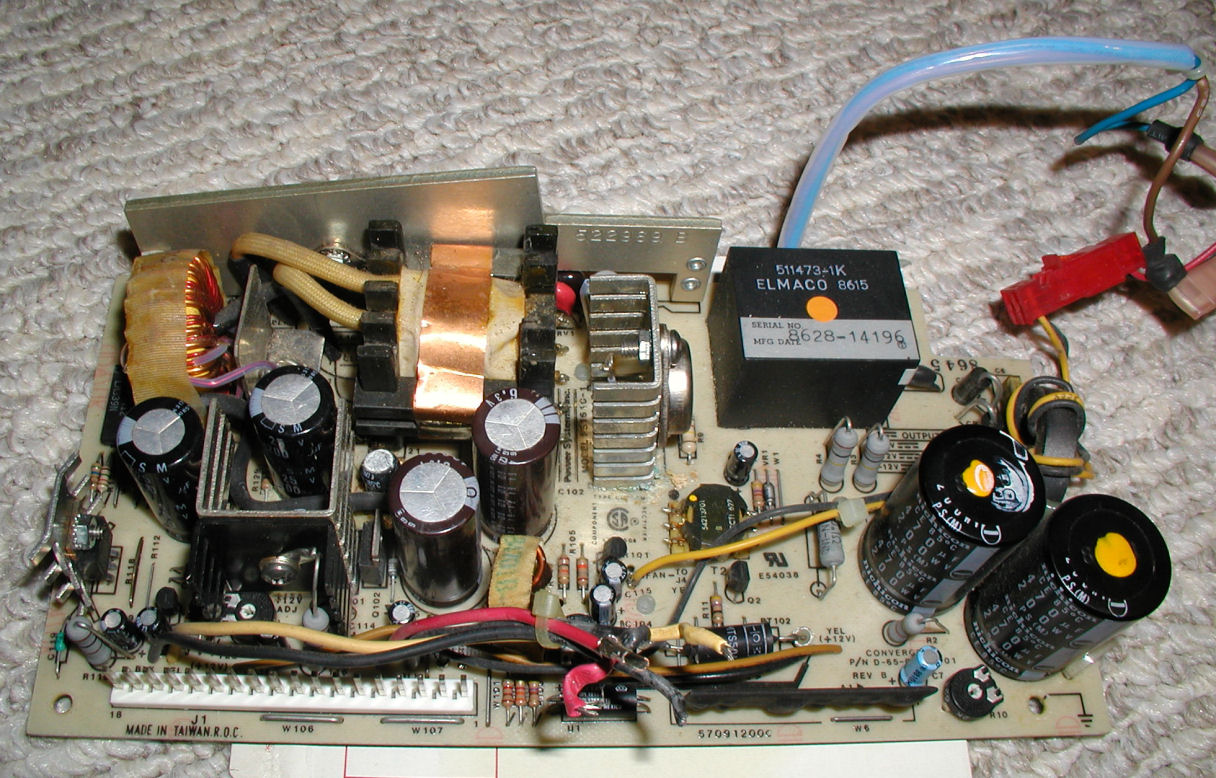
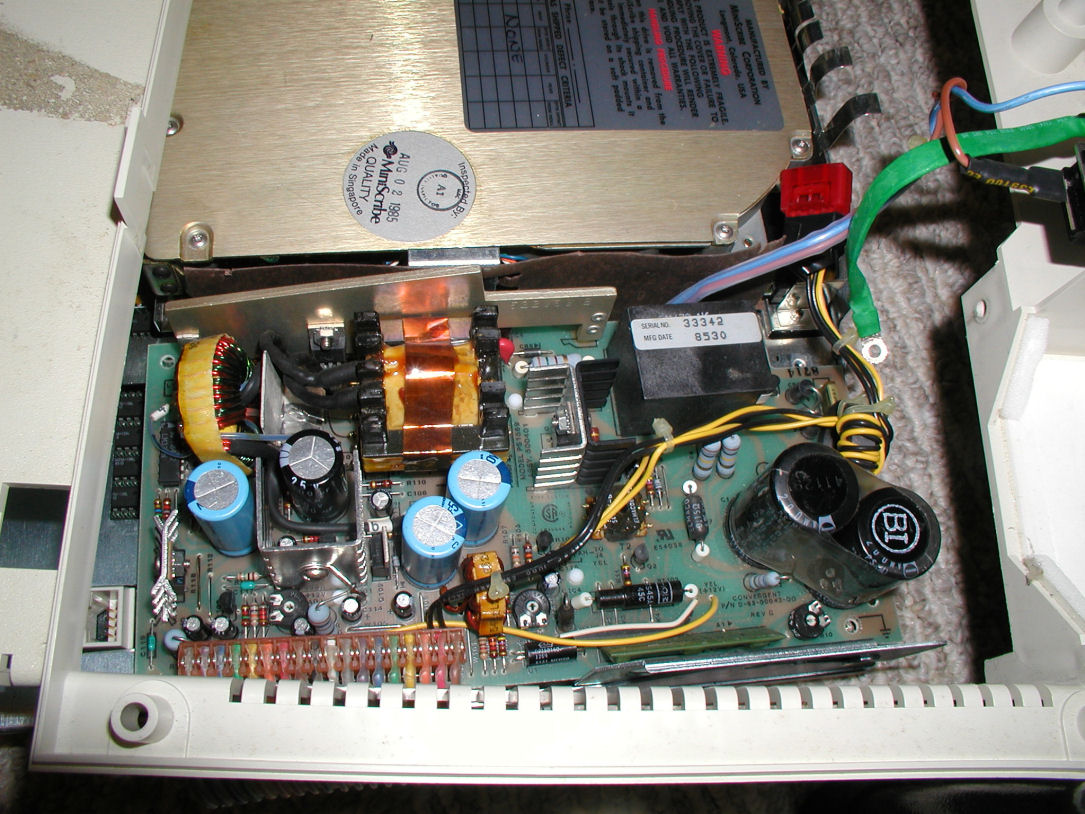
version power supply. I have taken pictures of the two kinds of UNIX PC
power supplies should anyone be interested:
67MB UNIX PC Power supply
http://vintagecomputer.net/att/3B1/ATT_UNIX-PC_3B1_370429065_pwr_suppl.jpg
Earlier "7300" UNIX PC Power Supply.
http://vintagecomputer.net/att/7300/ATT_UNIX-PC_7300_pwr-suppl-b.jpg
There seems to be some confusion about what you call the 67MB UNIX PC. Is
it a 3B1 or a 7300?
I also need an earlier 7300 motherboard.
For either, please contact me directly.
Thanks.
Bill
At a rescue last week (thanks, Barry), I picked up a pile of ARCNET
hardware including 8-bit ISA cards, active hubs and power supplies. Some
of it has been claimed by MARCH members, but I still have a batch
available for the cost of shipping from 16803:
Manuals:
Tiara Lancard/A * PC
ARCNET User's Manual for CN008AH and CN008TH
CNet 120A ARCNET User's Manual (qty 4)
Diskette: ARCNET 5.25" MEGA Diskette #75-00790-3000
Cards (8-bit ISA):
SMC ARCNET-PC130 (qty 3)
Tiara Lancard/A * PC (qty 12)
CNet ARCNET 120A (qty 1)
Active Hubs:
Addtron ARCNET Active Hub, 8-port, ARC800ST (qty 5)
CNet Arcnet HUB 008AH, 8-port (qty 2)
(The Addtron and CNet hubs have an internal power supply and take
a standard power cord)
Tiara ARCNET LanHub, 8-port (qty 2), Power Supplies (qty 3)
SMC ARCNET Active Hub, 8-port (qty 13), Power Supplies (qty 6)
Please contact me off-list if you're interested in any of this lot.
Mike Loewen mloewen at cpumagic.scol.pa.us
Old Technology http://sturgeon.css.psu.edu/~mloewen/Oldtech/
>
>Subject: Re: Forgotten PC History
> From: "bfranchuk at jetnet.ab.ca" <bfranchuk at jetnet.ab.ca>
> Date: Fri, 08 Aug 2008 21:04:53 -0600
> To: General Discussion: On-Topic and Off-Topic Posts <cctalk at classiccmp.org>
>
>Roy J. Tellason wrote:
>> There were also those "flatpacks" which I never could figure out. A precursor
>> to surface mount? Something else?
>>
>>
>I would guess so, but I've never seen a flat pack in the flesh myself so
>I can't
>say.
>
I had some of the dual 3 input parts used in the AGC block2 and still have
a few uA709 opamps in the 8leg flavor. Package actually was flat ceramic
hermetic and lived formany years for mil, High rel, and extended temp
appications for a cost premium. Look in Burr brown, Intersil, or old RCA
data books before 1976 and you may see samples of the package.
Allison
I've got a lot of old manuals (some very old) including PC, MAC,
Commodore, TI and much, much more. I'm going to be putting them in
the trash in about a week. If anybody would like to come pick up all
of them let me know.
I have one batch now and will have other batches in the future.
Not going to go through them to look for anything specific.
> Date: Tue, 05 Aug 2008 16:17:32 -0400
> From: Sridhar Ayengar <ploopster at gmail.com>
> Subject: LocalTalk
>
> Hi. I'm looking for a LocalTalk->Ethernet bridge and some LocalTalk
> cables. Anyone have any available?
I don't have one available but the product names you are looking for include:
AsantePrint
MicroAsanteprint
AsanteTalk
in order from oldest to more recent. All three of those were by Asante.
There were similar products from Farallon and Dayna, but I do not remember
the specific product names. All of those will bridge from LocalTalk to
Ethernet, but I think they only bridge the AppleTalk protocols and not
TCP/IP.
The latter two are about the size of a deck of cards and pretty much look
identical, except there's a variation on the middle one with a BNC
connector in addition to the RJ45 jack. The earlier two have more network
management features which one is unlikely to use in a home network.
For LocalTalk cabling, unless there's some reason you really want to use
original LocalTalk cabling, you should get PhoneNet connectors and use
phone cable for the connections. The PhoneNet connectors are a dongle
(available in many different brands) which plug into the serial
(LocalTalk) port and have two RJ11 jacks on the other end. The RJ11 jacks
can be used to form a daisy chain network. If a PhoneNet connector is at
the end of the chain (only one jack used) then the unused jack should have
a terminating resistor installed. I don't remember the value.
Finally, PhoneNet uses the two wires in four conductor cable, which the
telephone system does not use (yellow/black vs. red/green). However,
there are a lot of telephone cables out there shipped with modems which
only include the telephone pair and not the pair which PhoneNet needs.
You can spend a lot of time trying to diagnose a PhoneNet connectivity
problem when the necessary wires are absent from your cable. :-)
When ethernet became very affordable, old PhoneNet equipment was more or
less being given away free. Most of it has been disposed of by now, so it
may be a bit challenging to find, but probably not too challenging. I
remember seeing a lot of 150 PhoneNet dongles go for something like $.99
plus shipping. :-) But that was probably eight years ago.
Jeff Walther
While cleaning out my barn, I found the following two paperback
books, that may be of interest to someone here.
1) small paperback "Varian DATA 620/i computer manual" (Bulletin
605-A, April 1968).
2) "The Helios Operating System" by Perihelion Software Ltd
(1989). Says it's an OS designed to run on transputer
architectures, but I guess you'd know that if you want it :)
If interested please contact me off-list. Just looking for postage
costs and a token amount to cover the trip to the post office.
thanks
Charles
cctalk-request at classiccmp.org wrote:
> Send cctalk mailing list submissions to
> cctalk at classiccmp.org
>
> To subscribe or unsubscribe via the World Wide Web, visit
> http://www.classiccmp.org/mailman/listinfo/cctalk
> or, via email, send a message with subject or body 'help' to
> cctalk-request at classiccmp.org
>
> You can reach the person managing the list at
> cctalk-owner at classiccmp.org
>
> When replying, please edit your Subject line so it is more specific
> than "Re: Contents of cctalk digest..."
>
> Today's Topics:
> 1. Forgotten PC History (Jim Brain)
>
>
> ----------------------------------------------------------------------
>
> Message: 1
> Date: Fri, 08 Aug 2008 12:03:27 -0500
> From: Jim Brain <brain at jbrain.com>
> Subject: Forgotten PC History
> To: Classic Computer Talk <cctalk at classiccmp.org>
> Message-ID: <489C7C5F.7000008 at jbrain.com>
> Content-Type: text/plain; charset=ISO-8859-1; format=flowed
>
> I don't mean to repost, but I had not seen this posted as yet:
>
> http://www.computerworld.com/action/article.do?command=viewArticleBasic&art…
>
>
WOW;
Does that bring back Memories. My first Computer job was for a Data
Processing Outfit in New Jersey as a Computer room Operator. One day
they brought in a Machine "Datapoint 2200" and I said I can program
that. I had gone to a Programmers school a couple of years before. I at
some point dumped the Datapoint's 8K of memory to the Printer then
decoded it and re-assembled a program written in Assembly to intake
three 11 line screens of data. It had Interrupts and You could even back
track fields to correct them. Took me six months. Gave it to the Rep who
eventually slid it into the Round File where some of my Best work ended
up over the years. Wish I had been able to save the listing. The Manual
for the editor said "Go have a cup of coffee while your files were being
copied from the rear cassette to the front. I was still working on the
Datapoint's in 1979 when I left the firm and moved to Wisconsin. I moved
on to CP/M then the PC's as well as Learning how to Program for the IBM
Series/1 in EDL. Now there was a Language. Still got a 110 Volt IBM 4952
in the Basement but never got it running. Wish I could find a GURU who
could help me get it up and running. Kick my self for not doing it back
in the early 90's when I brought it home. I was doing consulting on the
Series/1 then but didn't find the time.
Oh Well
Bob in Wisconsin
Have a working Intel Above Board Plus 8 with 2MB RAM and would like to
populate it to the full 8MB. It will take 120ns or faster 1mbit chips
-- but where can one find that kind of thing nowadays? Are those still
commercially available or am I going to have to scavenge them from
somewhere else?
Manual lists acceptable part numbers like:
Fujitsu MB81C1000P-xx
Hitachi HM511000P-xxS
Mitsubishi M5M41000AP-xx
Motorola M5M511000P-xx
NEC UPD421000C-xx
NMB AAA1M100-xx
OKI M511000RS-xx
Samsung KM41C1000P-xx
TI TMS4C1024-xx
Toshiba TC511000P-xx
...etc but google searches haven't been very fruitful (that is, the
pages returned when I search for IC part numbers don't return vendors
with plain pricing/availability info).
I just want a few tubes of these to populate the board, I'm not looking
for a box of 'em :-) Any pointers?
--
Jim Leonard (trixter at oldskool.org) http://www.oldskool.org/
Help our electronic games project: http://www.mobygames.com/
Or check out some trippy MindCandy at http://www.mindcandydvd.com/
A child borne of the home computer wars: http://trixter.wordpress.com/
/The/ classic PC keyboard, IMHO.
Alas, one of my treasured 'boards fell off a table and its space bar
is shattered. Anyone know where I could buy a spare spacebar?
--
Liam Proven ? Profile: http://www.linkedin.com/in/liamproven
Email: lproven at cix.co.uk ? GMail/GoogleTalk/Orkut: lproven at gmail.com
Tel: +44 20-8685-0498 ? Cell: +44 7939-087884 ? Fax: + 44 870-9151419
AOL/AIM/iChat: liamproven at aol.com ? MSN/Messenger: lproven at hotmail.com
Yahoo: liamproven at yahoo.co.uk ? Skype: liamproven ? ICQ: 73187508
Hi,
I cam across your posting and wanted to see if you also collected IC's?
Finding other collectors is a rarity for me so I thought I would shoot
you and e-mail. I collect clones (russian, eastern block, etc.), Intel
engineering samples and any IBM cpus.
Brennan
http://vintagecomputer.net/
This REV is titled "From Giant Brains to Hobby Computers - 1957 to 1977"
"Giant Brains" from Radio & Television News Jan 1957 - Including pictures
of UNIVAC, IBM 650, Mark I
"An Informal History of the Hobby Computer Market" from the Jan-Feb premier
issue of Personal Computing
Recent project work and pictures
-Bill
Simon,
Sorry,
I have only the one copy. I have seen other copies sold on eBay, but
have not been willing to pay the $100 USD or more that they have sold
for. It is really a shame that no one has been able or willing to have
one scanned, but that would take a LOT of work - the manual is over an
inch thick. Without proper OCR it would be a PDF of pictures, which
load very slowly and would make the scan huge. I've seen quite a few
manuals done this way and they aren't nearly as usable as the OCR'd
variety.
I thought about scanning mine back in 2003, and even bought a flat-bed
scanner w/OCR software, but it wasn't up to the job at that time.
Better equipment and software would have been necessary, along with
cutting away the spine of the manual. Today there are better and more
affordable solutions, but I am not up to doing it as my health has
forced me to retire.
I'm not willing to sell my manual in case anyone is wondering, sorry.
This looks like an opportunity for someone with the manual, proper
equipment, and time - anyone?
Simon, do you have the required setup to do this without damaging the
book?
Regards
Stuart Johnson
---
On Aug 6, 2008, at 9:38 AM, cctalk-request at classiccmp.org wrote:
> Hi Stuart,
>
>
>
> This is a long shot, but here goes...
>
> I have an HP5036A lab, but lack the book.
>
> Searching, I found this on a forum from way back in 2003:
>
>
> "Yes, I managed to get a manual, by watching auctions on eBay. In
> fact, I
> bought another HP 5036A plus manual and let the seller keep the
> hardware to
> save shipping costs from England to the US. The manual is softcover
> and
> would not be easy to copy without cutting the spine off, which would
> ruin
> its value.
>
> Don't give up, though. I know someone that has a manual that has
> been cut up
> and copied and I'm trying to get it so that I can make an Acrobat
> PDF file
> of it. Stuart Johnson"
>
> I don't suppose you ever got a .pdf copy scanned?
> Just interested.
>
>
>
> Cheers,
>
> Simon Coleby
>
> Customer Service Centre.
>
> Agilent Technologies UK Limited, Registered Office: 710 Wharfedale
> Road, Winnersh Triangle, Wokingham, Berkshire, RG41 5TP - Registered
> No. 03809903
>
General question for PDP-8 fans: I've seen references to someone having
created an RF08/RS08 replacement. Does anyone on the list know details
of such a project?
Thanks,
Rich
Rich Alderson RichA at vulcan.com
Server Engineer, PDPplanet Project (206) 342-2239
Vulcan, Inc., 505 5th Avenue S, Seattle, WA 98104 (206) 465-2916
cell
> Date: Thu, 07 Aug 2008 11:19:33 -0700
> From: Eric Smith <eric at brouhaha.com>
> Chuck Guzis wrote:
>> "COBOL programmers are hard to come by these days," said Fred Forrer,
>> the Sacramento-based CEO of MGT of America, a public-sector
>> consulting firm. "It's certainly not a language that is taught.
>> Oftentimes, you have to rely on retired annuitants to come back and
>> help maintain the system until you're able to find a replacement."
>
> It's not at all hard to find COBOL programmers, and they are NOT all
> retired. Offer a decent salary, and you'll get them. What the state is
> specifically trying to do, though is to cut everyone's salaries, so how
> likely is it that they'll offer a good salary to a COBOL programmer.
>
> The real story is that it's a bunch of political posturing.
When anyone with a tech company says "We can't find anyone to do X" what
they really mean is "We can't find any new graduates to do X" because
heaven forbid they should hire an older (like over 35) worker. There are
plenty of older tech experienced folks working at hardware stores, who
would jump at an entry level tech salary, but for some reason, human
resource drones in tech companies are universally convinced that they
would be too expensive or otherwise a poor choice. Sigh. <happy I have a
good job finally>
It's the same story as a few months back when B. Gates went before
congress and asked for more H1Bs claiming he couldn't find any
programmers.
Jeff Walther
Note: This was written at a eariler date than mailed.
This is due to the fact I personally do not have a net connection
and read email whenever and however I find a unsecure IEEE 802.11g
"Wi-fi" access point. As of such, I ask that would someone please be
so kind as to compile all relevant replies to this email into a digest
and email that to me, as at the last time I checked my email, I had
over thirty thousand unread email messages (30,069 to be exact) from
over the last 20 months or more and I am simply too lazy to junk them
all -- it's a GMail account and the ratio of incoming daily mail to
storage growth is low enough that accumulating email appears to be a
non-issue, even with 3 very high volume mailing lists subscribed;
wine-dev, cctalk, and I think LKML. (Normally, I sort this all out
using a rather ad-hoc set of regexp filters in Thunderbird)
My question is rather perplexing. When most people refer to
segmented memory, AFAIK, they mean banked memory systems, where
each segment is like a piece of paper, that is, seperate from each
other. On the contrary, the Intel 8086's segmented memory model is
like lessing some source code and using the terminal arrow keys
or K/L to move the display one line; given segment X, segment X+1
contains almost all of the memory of segment x, except for a new
line of 16 bytes (which the metaphor between a new line in 'less'
and the segment differential is rather ironic; most hex editors I have seen
display exactly 16 bytes of data per line)
The question is, is the Intel 8086's memory model brain-damaged? IMHO,
extremely much so.
> I'm based in Philadelphia. My current provided is disabling
> telnet capability at the beginning of September. I would like
> to know if anyone knows of a service that will permit me that
> capability?
> bs
Don't use standard ports. My provider (Comcast) blocks port 25 (mail)
inbound and outbound, and doesn't allow relaying through its mail
servers. Instead I use port 2525 and an external mail relay service.
With telnet, you won't need a relay service if anyone accessing your
system knows that it's on a non-standard port.
Do you really need telnet though? SSH preferable if your host can run
it.
Anyone collect and/or need parts to the AT&T Unix PC? I've got a pile
of systems I dismantled over a decade ago, and don't really want or know
how to put back together. I bought them "new" as surplus by the pallet
at the time, and about half of them were defective with only displaying
horizontal lines when turned on. The monitors are perfect, I also have
the 20Mb MFM drives and 5.25" drives, as well as the mainboards,
plastics etc. I'm not sure exactly how many and what I have yet, but
checking for interest here. Please reply if these are of interest at all.
Any suggestions on the line problem?
Mike Lee
ok, so i got a mac SE off ebay, for a decent deal. now a logic board,
floppy drive, CRT tube (I let the magic gas out of the first one)
later, im back where i started. i write a boot disk with my powerbook
1400cs, pop it in. it boots up to the system software. i go to hd sc
setup like i did when i used my external floppy to boot, and it shows
nothing. the first time, i got to boot with an external floppy and the
old logic board, and it showed the drive until i attempted to format
it, which it wouldnt. after that, i couldnt see the drive again, and
my boot disk kept getting wiped each use, and id have to reload it. so
then, i replaced the board, the CRT, and the floppy, and now its still
doing the same damn thing as it was before. is it possible i need new
or replacement SCSI and floppy cables? its just being really
weird.....
Thanks to all who helped out, I've got the problem sorted out. AIX 3.2
does not have a rmtcpip command, but, doing an rmdev on en0, then
issuing the mktcpip command has solved the problem - guess it was
something left over from the last site.
T.H.x.
Devon
Hey guys;
This may, or may not, be a silly question, but in all my years of
fiddling, I realised I had never tried this, so I'm unsure of what the
results will be.
My HP Logic Analyser (1630G) can talk to a HP 9121 via HP-IB. I have found
a 9122, which is a double-sided version of the same device, as far as I
can tell. I'm fairly confident the 1630G won't care - but the diskettes
that I have (inverse assembler pack, thanks Gavin - you rock) are
single-sided.
Is there any reason that the 9122 DS drive won't read a SS diskette for
the 9121?
Thank you for your help!
- JP
> What I'm remembering is a BASIC decompiler, written in BASIC,
> that was running on RSTS/e circa 1983. So that was BP, not BP2,
> right?
Circa 1983? Chances are it's BP2.
When I was a high school senior in 1978, I wrote a BP2 decompiler for an Independent Study project, so BASIC-PLUS-2 had been around for quite some time by 1983.
I got some of my first exposure to computers through Project DELTA (hi, Rich!!), and was fascinated by PPCODE. I still have a source listing at home on a VERY faded length of Teletype paper.
-- Tony
-----------Original Message(s):
Date: Wed, 06 Aug 2008 15:10:55 -0400
From: Sridhar Ayengar <ploopster at gmail.com>
Subject: Re: IBM Model M keyboard spares
To: General Discussion: On-Topic and Off-Topic Posts
<cctalk at classiccmp.org>
Message-ID: <4899F73F.3010608 at gmail.com>
Content-Type: text/plain; charset=windows-1252; format=flowed
Liam Proven wrote:
> /The/ classic PC keyboard, IMHO.
The Model M came out *waay* after the PC. The 84-key is the one for the
PC. I don't think the Model M is even compatible with the PC.
Peace... Sridhar
------------Reply:
People reverently talk about the Model M as though there was only one;
in fact there were probably almost 50 different versions, including at least
one for the late model XT (no indicator lights) and I *think* that at least one
version was dual-mode as well.
See:
http://en.wikipedia.org/wiki/Model_M_Keyboard
To the OP:
I have a few different ones in the scrap pile somewhere, if you can send me
a picture of yours; does it have the removable keycaps?
I understand that replacing the spacebar on one of the older Model Ms
is a bit of a challenge BTW.
m
Hi all,
I'm looking for a KW11-L line time clock (that's the M787) for a
PDP-11. I don't suppose anyone happens to have one lying around they'd
be willing to part with for a reasonable sum or maybe trade for other
DEC stuff?
A KE11-F floating point module (M7239) would also be a welcome
addition, although I suspect there's much less chance anyone has one
of those going spare ;-)
Cheers,
--
Steve Maddison
http://www.cosam.org/
Doesn't matter - in the end it is all MADE IN CHINA ;)
Tony
-----Original Message-----
From: Jason T silent700 at gmail.com
Sent 8/7/2008 12:31:47 AM
To: General Discussion: On-Topic and Off-Topic Posts cctalk at classiccmp.org
Subject: Re: MIT based on rip off NES and not Apple II
On Wed, Aug 6, 2008 at 9:52 PM, Christian Liendo
christian_liendo at yahoo.com wrote:
It seems that the information was wrong it they are basing it on a machine called the Victor 70, which seems to be a clone of the Nintendo Famicom.
Pictures of the Victor.
http://picasaweb.google.co.in/dereklomas/TVComputer
That looks awfully similar (in concept at least) to the Subor, a
Russian (?) clone of the NES built into a PC keyboard:
http://sovietsouvenirs.com/catalog/product_info.php?cPath=5&products_id=404