One of my machines is an old Packard-Bell Legend 610 machine, to which I am
trying to fit a second hard drive.
The machine will not recognize any modern (or semi-modern) hard drive I have
attempted to fit. I have tried various master/slave combinations, to no avail.
My guess is that this is due to the BIOS being of am early type. The BIOS
chip is a socketed DIP package and the lettering on it is too faded to read.
The screen boot-up display is this:
PhoenixBIOS(TM) A486 Version 1.01
PB400 OPTI 486WB
Reference ID 08
Is this a reasonable guess?
If so, what might be done by way of a BIOS upgrade?
Thanks,
Kurt
I obtained the Wang 1200 word processor that was mentioned few weeks
>from list member Bradley Slavik (thanks!). it is sitting in my sister's
garage in Berwyn IL (just west of Chicago). I need to ship it to
Austin, tx.
My hand wave on the item, not having seen it, but having a picture of
one in a brochure. 4" wide, 2.5" deep, 3.5" high, 100 lbs or so. It
turns out 100 lbs is a price boundary, but up to 200 lbs is only about
$50 more.
Based on my hand wave of dimensions and weight, craters & freighters
quoted $500 to pick it up in berwyn (60402), crate it, and ship it to
austin (78737). Certainly you couldn't pay me $500 to do it myself, so
on that basis they are the best option I have so far.
I know various people on this list have had better or worse experience
with shippers, and I don't mean to get into that discussion again. I
was just wondering if this quote is reasonable.
Thanks
>Message: 22
>Date: Tue, 19 Aug 2008 15:40:17 -0400
>From: "William Donzelli" <wdonzelli at gmail.com>
>Subject: Re: Opening computer museums
<snip>
>> Yeah, but part of the grant always goes to administrative overhead.
>Splat!
>"Administrative overhead" is a big red flag for the organizations that
>are issuing the grants.
<snip>
>> At any rate, the grant is going to be issued as the parent
>> organization and not directly to you; that's the whole point of
>> working under an umbrella organization. But yes, you're correct that
>> grants are legal documents with restrictions that have to be observed.
>It is wiser to keep any kick backs to the parent organization
>completely outside any grants, and wise to keep them above the table.
>--
>Will
Having worked at the Field Museum of Natural History in Chicago, and written a number of grant proposals, I can say that whether or not you include overhead depends both on to whom you are applying (do they allow overhead?) and the institution through which you are applying. Some institutions will let you get by without writing overhead into your grant, while others will insist on overhead greater than what you are asking for in the first place. Overhead rates are usually negotiated in advance between the institution and the granting agency, and the rates vary depending on the use of the money -? salary usually gets a higher overhead rate. At the FMNH, you couldn?t even _talk_ to funding sources without first clearing it with the grants office. The main reason for that was that, by asking the funding source about funding your project, you might jeopardize the funding of other projects that were already in the works or planned.
Bob
>>> without an endowment or a building you are forever treading water untill you find help.
Exactly. The toughest place to start is at square one. So I urge people to emulate what we did here in NJ -- start by partnering with an existing organization. A science museum is the best place. Colleges, libraries, community centers, etc. are next. IMHO, the least desirable kind of partner is a private company.
The same overpriced goods and always without a picture. It appears
that this seller has just recently gotten a new identity. You may
want to adjust your searches to exclude the new identity as I have.
--
"The Direct3D Graphics Pipeline" -- DirectX 9 draft available for download
<http://www.xmission.com/~legalize/book/download/index.html>
Legalize Adulthood! <http://blogs.xmission.com/legalize/>
Does anyone have a DEC PC04 paper tape reader/punch that they would be
interested in letting go? I'm also looking for the matching PC8-E
(M840) UNIBUS controller card.
Thanks,
-Mardy
Richard wrote:
> In article <5107C05E-01F2-4A99-AEBB-4475E5C10E8B at comcast.net>,
> CRC <technobug at comcast.net> writes:
>
>> I was at my local scrapper recently and ran across a number of
>> manuals
>> for the IBM Grelystone Display Station in the dumpster:
>>
>> Maintenance Analysis Procedures
>> Greystone Parts Catalog
>> Maintenance Information Manual
>
> What is a "Greystone Display Station"? Googling didn't turn up
> anything obvious.
Jason T helpfully added:
> On Mon, Aug 11, 2008 at 11:01 PM, Richard <legalize at xmission.com>
> wrote:
>
>> What is a "Greystone Display Station"? Googling didn't turn up
>> anything obvious.
>
> Ah, sometimes you have to look to the non-obvious:
>
> http://www.pmsimon.com/images/productplacement.jpg
So that everyone is not left with the wrong impression I scanned a
couple of pages from the manuals and they can be found at
<elipsoid.home.comcast.net/Greystone.html>.
The manuals appear to be drafts for a CRT display station. Again, if
interested, they are available for postage.
CRC
-- g-wright at att.net wrote:
> I think all of the Power Stack computers by Motorola where
>Power PC systems. I have 2 AViiON's here which where 88k. (Of >coarse quit large)
SO, which AViiON models do you have? I have a 400 and a 412, with
enough parts to build a 530.
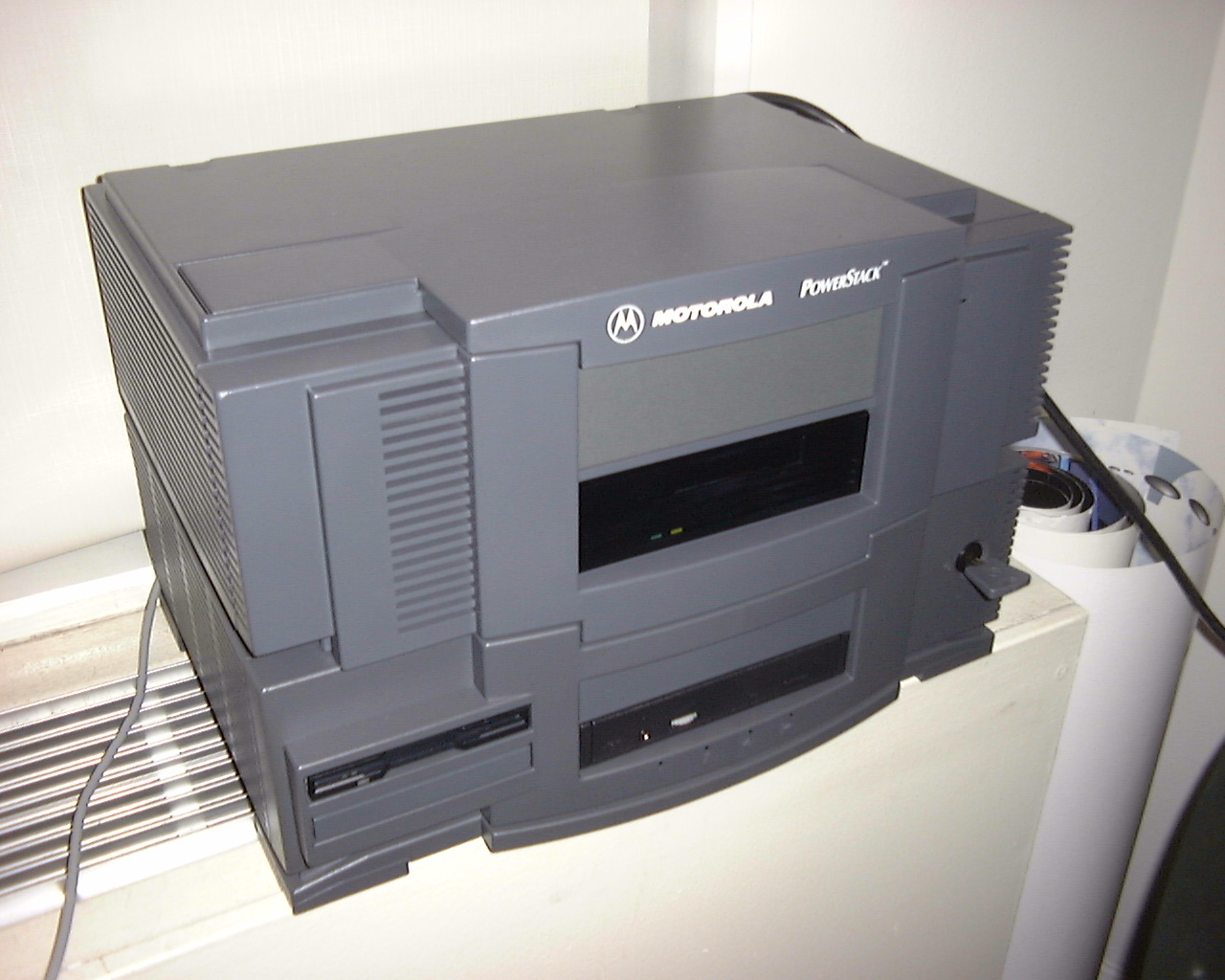
The 'PowerStack' systems I was thinking of looks like this:
http://www.corestore.org/powerstack.jpg
It looks kinda like a series 900, but not quite exact. Never seen
one IRL.
____________________________________________________________
Free quote and debt consolidation information. Click Here.
http://thirdpartyoffers.juno.com/TGL2141/fc/Ioyw6i3m2Xh79qfbH31rKOFSMlAirCs…
A local business contacted me to ask if I had a parallel port card
(centronics) for an Apple //e. They apparently got "hit" and lost the
existing card. Seems they still have an old application they need to
keep running for a few more months while they convert to something
newer.
I'm not an Apple guy, but promised I'd ask around. So, list, anyone
have such a card they'd be willing to part with? Presumably they'd be
willing to pay something for it.
Mid Michigan, though such a card can presumably be mailed without too
much pain from nearly anywhere.
Thanks,
De
This is not my system, contact stan below for details:
======================================================
I have an old HP 64000 development system that I would like to sell to the appropriate person or collector of vintage computer equipment. I just don't know where to look. I am on the east coast on Long Island.
stans829 at optonline.net
Snagged a bunch of these in original packaging from a box in the
engineering department.
http://csplan9.rit.edu/users/john/archerkbd.jpghttp://csplan9.rit.edu/users/john/archerkbd-tag.jpg
Very nice key placement for a UNIX keyboard, assuming you can live
without an ALT key (although I guess that is a potential function for
the FUNCT key). Maybe I should get a microcontroller and try making a
terminal :)
John
--
Ph'nglui mglw'nafh Cthulhu R'lyeh wgah'nagl fhtagn
Does anyone happen to know which font(s) best replicate the DEC logo, such
as this: http://www.vaxination.ca/vms/alpha/digital_556.jpg ...? I thought
Arial Narrow might be correct, but things like the bottom of the lowercase
"a" are different.
We're looking to make a DEC banner for an exhibit in our museum here in New
Jersey. (Or, does anyone have an existing DEC banner to loan / donate
inexpensively sell to us?)
- Evan
Can anyone identify the power control connectors used on the H7874 power
supplies in the DEC BA4xx boxes? They look a lot like RJ-45s, but there are
some extra ridges in them so that an RJ style plug won't fit. And the
contact arrangement is different, so it probably wouldn't work even if it
did fit.
I'm trying find a cable so I can daisy chain the power control on a couple
of cabinets, or matching connectors so that I can make my own.
Thanks,
Bob Armstrong
A local auctionsite yielded me a dead hp85 for 1$.
The error was quickly identified : the internal flatcables were badly aligned and shorted out several lines.
The machine is now functional, but still suffers from bad contacts. I might resolve to soldering some wires instead of the offending flatcables.
Of course tapedrive and printer need to be rebuild : any source for small quantities of these belts in Europe ?
Jos Dreesen
> Just wondering if anyone's found a decent tool for pushing wire-wrap
> socket pins out of (thick) 1/8" prototyping board.
I made something a LONG time ago by drilling a hole into the end of a center punch.
-- Jim Battle <frustum at pacbell.net> wrote:
Dave McGuire wrote:
> On Aug 17, 2008, at 10:20 AM, Steven Hirsch wrote:
>> Just curious if the person who owns this eBay store is a list regular?
>> And, more the the point, do they actually get anyone to pay nearly
>> $500 for an AT&T PC7300?
>
> I sold one for $300 last summer. Remember, this whole notion of
> classic computers never being worth any actual money is pretty much
> restricted to this mailing list.
Yeah, and I guess the whole notion of the classic computers hobby
being a level playing field was also restricted to this list.
Ooops, I guess not even that is true anymore, huh?
____________________________________________________________
Click for online loan, fast & no lender fee, approval today
http://thirdpartyoffers.juno.com/TGL2141/fc/Ioyw6i3m3WL623vT1MXViOvoiNjovS5…
All,
A couple of things I have but don't have time to fool with:
User's Reference Manual only :-( for Tenon Mach-Ten Unix for Macintosh.
also the box for the media, but *no media*.
A/UX Essentials Manual only for Apple A/UX
X/11 Reference for A/UX
X/11 User's Guide for A/UX
Apple MacX (User's Guide Supplement for A/UX (2 copies)
X-11 for A/UX and MacX install disks (3.5" floppies)
I'd like to get shipping + 25% or so; I'm in Zip 78254.
Also still looking to divest myself of many many reels of 9-track tape.
Suggestions welcome as to a better venue for this kind of
announcement, but I'm not a big fan of eBay. Contact by email
preferred, cellphone below is also OK.
--
- Mark 210-379-4635
-----------------------------------------------------------------------
Large Asteroids headed toward planets
inhabited by beings that don't have
technology adequate to stop them:
Think of it as Evolution in Fast-Forward.
-- Steven M Jones <classiccmp at crash.com> wrote:
jeff.kaneko at juno.com wrote:
>> You'd probably have better luck locating an 88k AViiON.
>> Many more were produced, with similar (VME) architecture.
>> Documentation is scarce, but if you get the right model,
>> there's some good info available.
>
>Appreciate the suggestion. I already have a few deskside
>88k AViiONs buried in storage,
Cool! Which model(s)?
> several Moto MVME 88100/88110 modules and a chassis
>or two,
Yep, standard issue . . .
>an ADP-badged M8120,
The Shoebox! Looks like OpenBSD kinda-sorta works on this
one . . .
>and one of the OMRON Luna 88k SMP workstations. That last just
>popped up on eBay one day so I grabbed it
You lucky dog! These are the rarest of the 88k systems (unless
you also consider the nearly-mythical 88k NextStation). ISTR a
LUNA appeared or E-bay a couple of years ago. Was yours that
one? The price was quite high IIRC. . .
>-- say, wonder if I can dig that out in time for VCF...
Maybe there should be an 88k contingent this go around?
Maybe I can bring my 412. . . .
Jeff
____________________________________________________________
Live your dreams. Click here to find information on becoming a lawyer.
http://thirdpartyoffers.juno.com/TGL2141/fc/Ioyw6i3oFGmeTdIHkCRO7tYZ1uPzwsM…
I know this is a 'blast from the past', but did anyone ever find the
McIlroy paper? The McIlroy algorithm both inspired and was in direct
competition with the NRL algorithm. The NRL algorithm was developed by
Votrax and the Naval Research Laboratory, details of which are discussed
in another paper (NTIS ADA0121 929, NRL report 7948) which is available
>from the national archives in college park, MD. (I'm planning to get a
copy of the latter, but have no idea how to get a copy of the M. D.
McIlroy paper. the version in the journal of the acoustical society of
america is not the complete paper, but a citation of it for a
conference, afaict)
*
*
--
Jonathan Gevaryahu
jgevaryahu(@t)hotmail(d0t)com
jzg22(@t)drexel(d0t)edu
*
Don Y* dgy at DakotaCom.Net
<mailto:cctech%40classiccmp.org?Subject=OT-ish%3F%20%20McIlroy%27s%20%22Synthetic%20English%20Speech%20by%20Rule%22&In-Reply-To=>
/Wed Jul 19 21:37:44 CDT 2006
/
My only claim to being *possibly* on-topic is the age
of the article (1974) and the fact that it inspired
many of the early phoneme-driven speech synthesizers
(Votrax, etc.).
Does anyone have access to a suitably good engineering
library with a copy of:
McIlroy, M D, "Synthetic English Speech by Rule",
Bell Telephone Labs, CSTR #14, 1973 (though I have
also seen it referenced as 1974!)
or:
Ainsworth, W A, "A System for Converting English Text
to Speech", IEEE Trans Audio & Electroacoustics AU-21 #3
pp 288-290, 1973
The former is far more interesting to me than the
latter :-(
(sigh) There are *some* advantages to being a student
(though those days are long past, in my case!)
I can try my local public library to see if it is
available via ILL. I guess I could also try the local
university's engineering library.
Thanks!
--don
I am starting to put stuff up for sale on the Vintage Computer and Gaming
Marketplace:
http://marketplace.vintage-computer.com/index.php?
Included are an Aim-65 and a Pro-Log 900 Prom Programmer. More stuff will be
added as time permits.
Date: Wed, 13 Aug 2008 13:49:22 -0700
From: "Chuck Guzis" <cclist at sydex.com>
Subject: Re: Upgrading early BIOS
On 13 Aug 2008 at 15:36, M H Stein wrote:
>> AFAIK cable select has always been an option with Parallel ATA drives,
>> although it was rarely used in pre-UDMA days; the cable was obviously
>> different (40 conductors with standard connectors vs. 80 conductors and
>> unique special connectors) and the order of the drives was usually reversed
>> (i.e. the slave on the end of the cable).
>Nope--I've got a couple of very early Conner and Maxtor drives (less
>than 100 MB)--CS isn't an option on the jumpers.
If you'd read more carefully, you'd have seen that I *did* say that "not all drives
supported the CS option;" in fact, quite a few of the older drives did not.
I was responding to the posted statement that CS "had not been invented" in
the 486 days, when AFAIK, it was part of the early ATA specs (although
rarely implemented in practice).
> It's the motherboard that determines the cable type and mode from pin 34,
> which is grounded at the mobo end in a UDMA cable, so if the mobo isn't
> UDMA-aware I don't think the drives would be, and the cable wouldn't matter.
> Also, not all drives supported CS.
>Read the Wiki article you cited:
>"Pin 34:
>Pin 34 is connected to ground inside the blue connector of an 80
>conductor cable but not attached to any conductor of the cable. It is
>attached normally on the gray and black connectors".
>On UDMA-66 capable drives, it's the cable, not the mobo that dictates
>speed. Put an ordinary 40 conductor cable on a UDMA-capable drive
>and mobo, and the configuration won't take advantage of it. When the
>changeover was in progress, we used to get support calls quite often
>on the subject of UDMA cables and drives on non-UDMA mobos.
Well, I never knew that just replacing the cable in my 386 and 486 systems
would speed things up; live and learn. I always thought that if the mobo
wasn't pin 34 aware and UDMA capable then the cable wouldn't have much
effect on the transfer mode. AFAIK in order to use UDMA all three items
have to be UDMA capable, the mobo, the cable and the drives, although
I'd say that, assuming it's UDMA aware, the mobo controls the speed
depending on what kind of cable and drives it sees. Semantics?
You said that with a UDMA cable, any UDMA capable drive will operate in
UDMA mode (presumably regardless of the mobo); how does a drive know
what kind of cable is connected? I always assumed that only the mobo can
tell from pin 34.
BTW, a UDMA cable certainly works with non-UDMA drives and/or mobos,
although you have to remember that it is also a CS cable, but I don't think
it'll be any faster.
>Similarly:
>"With the 40-wire cable it was very common to implement cable select
>by simply cutting the pin 28 wire between the two device connectors;
>putting the slave device at the end of the cable, and the master on
>the "middle" connector. This arrangement eventually was standardized
>in later versions. If there is just one device on the cable, this
>results in an unused "stub" of cable, which is undesirable for
>physical convenience and electrical reasons. The stub causes signal
>reflections, particularly at higher transfer rates."
>Bottom line is that if you use a non-CS-capable (i.e. 40 conductor
>"straight through") cable, it won't work. Depending on what the
>mobo/controller end does with pin 28, you'll have either two masters
>or two slaves on the same cable.
Agreed; I took it for granted, but with our detour into UDMA the most
important point to be made relevant to the OP is that Cable Select needs
a special cable and with pre-UDMA drives & mobos you're probably
better off using Master/Slave and a standard cable.
>Cheers,
>Chuck
m