Just learned of this via a tweet from a former colleague:
?
The KIM Uno is a small "open-source hardware" project to build a
replica of the classic 1976 KIM-1 computer. It doubles up as a 6502
programmable calculator. It costs about $10 in commonly available
parts (board & parts without case or power supply), but provides a
faithful KIM-1 'experience'. An atMega328 (Arduino Pro Mini, actually)
mounted on the back of the board contains all the logic and memory.
?
http://obsolescence.wix.com/obsolescence#!kim-uno-summary/c1uuh
--
Liam Proven ? Profile: http://lproven.livejournal.com/profile
Email: lproven at cix.co.uk ? GMail/G+/Twitter/Flickr/Facebook: lproven
MSN: lproven at hotmail.com ? Skype/AIM/Yahoo/LinkedIn: liamproven
Cell/Mobiles: +44 7939-087884 (UK) ? +420 702 829 053 (?R)
Well, it's been a long time project, but I'm happy to finally announce a
more public initial release of TCP/IP for RSX-11M-PLUS.
This is the result of over 20 years of development. Needless to say,
I've been doing a lot of things over the years, and this code have been
through four reimplementations over the years.
What I now release is something that I believe is a nice and useful
piece of software. I am aware of the fact that most people do not use
these machines any longer, but if someone actually wants to talk to me
about support for this or other RSX software, let me know.
Also, feel free to spread this information to anyone who might be
interested, anywhere.
So - what is in this release?
It is a complete implementation of ARP, IP, UDP, and TCP for
RSX-11M-PLUS. It has been tested on RSX-11M-PLUS V4.6, but should work
on any V4 release. There might be some small tweaks or fixes required,
but nothing major.
It do require a system with split I/D-space, or else at least the TCP
part will not fit.
For Unibus machines, it should be possible to run without any additional
software except what is in a base RSX distribution.
For Q-bus machines, DECnet is required for ethernet networking.
The TCP/IP stack can co-exist with DECnet.
Some utilities also utilize RMS for file access.
A bunch of tools, utilities and libraries are also included. These include:
. IFCONFIG network configuration tool.
. NETSTAT network information tool.
. PING
. TRACEROUTE
. DNS client
. FTP daemon
. FTP client
. HTTP server
. TELNET client (rudimentary)
. TFTP client
. TFTP server
. INET server that can do SINK, ECHO, DAYTIME, QUOTE, and IDENT
. NTP client
. LPR client that sits in the queue manager (rudimentary)
. FORTRAN-77 library
. BASIC+2 library
. PDP-11 C library
The implementation fulfills most of the requirements put forth in RFC
1122. There are a few limitations because of restrictions in the PDP-11,
but none of them should really cause any problems.
Documentation is still on the thin side, but example configs are also
provided, along with installation scripts.
A bunch of test programs and example programs are also included, as well
as the sources of all tools and libraries.
The TCP/IP stack itself only comes in binary form.
All tools are also included precompiled in the distribution, so an
installation only have to build the stack itself for your system, and
then you should be ready to go.
The API only have a slight resemblance to the Unix sockets API. However,
if someone sits down to write code to use TCP/IP under RSX, I'm sure
they will discover that it is extremely easy to use the libraries, or
the basic functions.
The TCP/IP implementation is mostly written as device drivers. This also
have some other interesting implications, such as it is possible to
access TCP as a normal file. You can, for instance do something similar
to the Unix netcat command by issuing the MCR command:
> PIP TI:=TC:"foo.com";4711
which would open a connection to foo.com, on port 4711, and any data
sent from that machine will be shown on the terminal.
The resources used by TCP/IP are modest. A memory area (size selectable
at generation/startup) is used internally. The amount of memory in the
private pool limits the amount of data that can be buffered. Normal pool
is used in a small quantity for each TCP port that is open.
People are welcome to play around with this, and make improvements.
Contributions of code is most welcome.
There are still lots of things to do. The programs marked as rudimentary
should be rewritten.
The most obvious thing still missing is a telnet daemon, which probably
is my next step.
However, the reason for now announcing the release is that it can
finally be distributed natively from an RSX host.
The main locations to download the TCP/IP for RSX are:
Madame.Update.UU.SE (anonymous ftp).
This is one of my development systems for this software. It runs under
E11, and if things are down, I blame E11. :-)
When connected, you are already in the right directory. There is both an
RL02 disk image there, which can be downloaded by anyone. If you happen
to have an RSX system which you are conneting from, you can also try
getting the BQTCP.TAP tape image. Such an image will not transport
cleanly to a non-RSX system, however. Sorry.
ftp.Update.UU.SE (anonymous ftp) - /pub/pdp11/rsx/tcpip
The disk image is normally duplicated to ftp.update.uu.se as well, so
the same file can be found there.
I hope some people will find this useful/amusing. :-)
Johnny Billquist
--
Johnny Billquist || "I'm on a bus
|| on a psychedelic trip
email: bqt at softjar.se || Reading murder books
pdp is alive! || tryin' to stay hip" - B. Idol
?
The BBC Microcomputer System (or BBC Micro) was an innovative machine
back in the early 1980?s. One feature that impressed reviewers was a
?tube? interface that allowed the machine to become an I/O processor
for an additional CPU. When the onboard 6502 became too slow, it could
become a slave to a Z-80 or even an ARM processor. The bus was
actually useful for any high-speed device, but its purpose was to add
new processors, a feature Byte magazine called ?innovative.?
[Hoglet67] has released a very interesting set of FPGA designs that
allows a small board sporting a Xilinx Spartan 3 to add a 6502, a Z80,
a 6809, or a PDP/11 to a BBC Micro via the tube interface. There?s
something satisfying about a classic computer acting as an I/O slave
to a fairly modern FPGA that implements an even older PDP/11.
?
http://hackaday.com/2015/10/03/vintage-bbc-computer-gets-fpga-buddies/
--
Liam Proven ? Profile: http://lproven.livejournal.com/profile
Email: lproven at cix.co.uk ? GMail/G+/Twitter/Flickr/Facebook: lproven
MSN: lproven at hotmail.com ? Skype/AIM/Yahoo/LinkedIn: liamproven
Cell/Mobiles: +44 7939-087884 (UK) ? +420 702 829 053 (?R)
I found a company selling new 8" 32-sector hard sector floppies.
http://www.athana.com/html/diskette.html Item # 47-0801
They want $150 per box of 10. That's a pretty hefty pricetag... but in the
absence of other suppliers I may just have to break down and buy a box from
them.
J
Hi there,
I've been wanting to get a nice serial terminal to use with my old systems (mostly UNIX) for a while now, but I haven't managed to find anything locally.
Over the past few years I've been to thrifts, garage sales, surplus shops... But I haven't found any. This sort of surprises me, as Toronto isn't a small town.
Is there anybody around the Toronto area that has a few extra dumb terminals lying around, or does anybody know of a good source for them around the Toronto area?
Thanks
-Brian
Hi, all. I'm looking for information on slang terms with the word "farm"
in them, relating to computaters; especially the origins of such terms.
I've known "cube farm" (a bunch of cubicles where office workers work)
and "render farm" (a cluster of computers used for graphics rendering in
parallel) for a long time, but just recently I found a reference to
"link farm" as meaning "an incremental backup consisting mostly of links
(most likely hard links) to the relevant files in the preceding
iteration of the backup"; but this page
<http://onlineslangdictionary.com/meaning-definition-of/link-farm> says
"a website with little or no content, consisting of mostly (or entirely)
links to other websites."
So, does anyone know what the first such "farm" slang term was, and when
and where it originated? And how about other terms with "farm" in them?
(I came across a new one the other day, but of course I've forgotten it
now.)
--
Eric Christopherson
Hello.
Just wondering if any one has any experience setting up an ETOS system on a
PDP-8?
I've got most of it working, including adding a second terminal, but can't
for the life of me figure out the process on making a second drive available
to the users once we are in ETOS timesharing.
According to the system managers manual, it's a combination of Lookup and
assign.
Cheers, Joe
Word comes in that there is a number of "cartons" of Sun 4 and HP QIC
tapes in the pile, which I'm hoping may be install media. Bad news is
that it is QIC and in the place it is in. Good news is that it surfaced
at all.
I will see if Al or someone can image them if they are of interest. The
HP tapes may just be brand names and not software, unknown at this
time. Also there are some half inch 9 and 7 track tapes in the pile.
The dig also turned up Sunsoft manual sets, which are promising as far
as the 4/260 is concerned. Suggests that the software and manuals are
for that system and not another.
Once I get an inventory of the tapes, I'd appreciate any updates as to
whether they are already imaged and saved somewhere.
thanks
Jim
> From: Diane Bruce
>> There was a version on the V6 PDP11 Unix at MIT; not sure if that was
>> a local port, or one we picked up from somewhere else.
> There was a hack for PDP11 Unix which added RT-11 compatibility
> syscalls to the kernel. (UofT Spencer)
The PDP-11 Unix machines are Tech Sq definitely did not have that; it would
have run on standard Unix (although it may have included an RT11 emulator in
the application - I don't at the moment have access to all that MIT stuff -
yet!)
Noel
> From: Ben Franchuk
> Did advent run under PDP11 unix?
There was a version on the V6 PDP11 Unix at MIT; not sure if that was a local
port, or one we picked up from somewhere else.
Noel
there is a cool video in the hackaday link below
http://hackaday.com/2015/10/19/repairing-55000-of-vintage-core-memory/?utm_…
--
The contents of this e-mail and any attachments are intended solely for the use of the named
addressee(s) and may contain confidential and/or privileged information. Any unauthorized use,
copying, disclosure, or distribution of the contents of this e-mail is strictly prohibited by
the sender and may be unlawful. If you are not the intended recipient, please notify the sender
immediately and delete this e-mail.
My reply didn?t show up for some reason... resubmitting:
It should directly in TSX-Plus . Make sure your current memory limit is
56K.
See below for my attempt. BTW TSX should only use RT11 to ?boot?.
TSX doesn?t run over RT11SJ in this version. TSX replaces all the OS code.
.sh memory
?...
Current job memory limit = 56Kb
Maximum job memory limit = 64Kb
.sh ver
6.20
.run advent
WELCOME TO ADVENTURE!! WOULD YOU LIKE INSTRUCTIONS?
-----------------------
It turns out I have (at least the pack that?s in the drive) TSX-Plus 6.16,
not 6.50.
But ADVENT does work now. I have to admit to ?operator error?
The bootable XM pack is currently in drive 0, and the bootable SJ pack with
TSX-Plus is in drive 1.
Somehow I?d forgotten to copy one of the ADVENT files from one pack to the
other. So when I rebooted from DL1: it couldn?t find ADVTXT and crashed!
Anyhow it does now run (on both the console and the other time-sharing
terminal). Thanks for the information, though.
-Charles
I have a PDP-11/23+ with 4 MB RAM and two RL02 drives. I can boot RT-11XM,
then run VBGEXE and start ADVENT with no problem.
But TSX-Plus 6.50, at least the version I have, has to run over RT-11SJ, and
VBGEXE reports "Wrong version". And ADVENT won't run by itself (without
VBGEXE), whether SJ or XM.
So is there any way to run ADVENT while running TSX-Plus?
thanks
Charles
OK, so it's sort-of computery. I snagged a JAMMA arcade board from a
recycling pile a couple of days ago (this is an m68k-based early 90's
board). Supposedly it's faulty, but I don't know the nature of the fault -
maybe it's just RAM or a reset problem or something, so I figured I'd put a
little bit of time into it.
Anyway, I'm having a hard time finding details about the video output - I
know it's negative composite sync (I got the manual, which says that much),
and I *think* it's TTL levels (right?), but I'm not sure about frequencies.
Then there's the RGB outputs - analog, but I'm not seeing anything that
tells me peak voltages.
I suppose the question is, what's the easiest display to try and hook this
up to? I've monitors with an assortment of inputs (VGA, EGA, CGA, MDA,
mono-composite), and I think there's a CRT TV kicking around that has a
composite input too (and maybe S-video, not sure). It doesn't bother me if
the quality's not great; I'm just interested in whatever's quickest to
interface to at this stage, just to see if I can get something working.
cheers
Jules
A run to a dark corner of Orange County yielded a Sun 4-260 and a
DecServer 550. After loading the 4-260 the DecServer 550 seemed like a
feather.
Also in the pile to be collected, a stash of Hitachi ESDI drives of some
sort (full high 500mb) Probably will be selling them.
The storage circumstances was a bit rangy but beggars can't be choosers.
Thanks
Jim
One of my DECserver 90M PSUs got dropped and stopped working as a result,
possibly because it got pulled by the cable. That sounds like the kind of
damage that might be repairable. I tried to open the enclosure and I found a
hole under one of the labels, expecting it to be a screw hole, but it isn't.
I am guessing you just have to pry the halves apart, but without knowing
where the clips are inside it is easy just to break the thing.
Does anyone know how you open these PSUs?
Thanks
Rob
PS Yes I know these PSUs are notoriously unreliable, and that you can make a
PSU with a DIN plug and a wall wart, but I would still like the original to
work if possible.
Hi Folks,
Does anyone have a electronic copy of the original Decmate Owner?s Guide (AA-K330C-TA) that they could share?
Alternatively, can anyone describe what can be accomplished (if anything) from the initial ?Setup? prompt on a VT278 *without* any disks attached?
The situation is that Brent and I are trying to resurrect a Decmate ? we?ve plugged in a VT100 keyboard (Thanks, Bill!):
- it boots to the ?Setup? prompt with the flashing cursor.
- the ?Power? light on the rear of the unit is steady and the ?CPU OK? light is blinking.
- the keyboard lights indicate ?online"
- pressing ?2? or ?PF3? cause ?Setup? to disappear. ?3? seems to cause it to perform some self-test like procedure.
- most keys cause keyclicks, but ?space?, ?M?, and ?/' don?t. With an oscilloscope, we can see data from the keyboard being sent for the ?silent? keys, however.
Without disks, what else should we able to do?
Eventually, we?d like to find or construct some solution for mass storage, but we?re still at the point of checking out the VT278 itself.
Thanks,
Rob Ferguson
>
> Date: Mon, 12 Oct 2015 18:29:11 +0000
> From: tony duell <ard at p850ug1.demon.co.uk>
> Subject: RE: PDP-12 Restoration at the RICM
>
> > We swapped the TU56 and TU55 drives between the PDP-12 and the PDP-8/I.
> We
>
> Does the TU55 work correctly on the 8/I ?
>
Yes, it works perfectly. It even worked OK after we put it back in the 8/I.
> > The TU55 behaved a little better than the TU56, and sometimes would
> > actually boot OS/8. We continued chasing the issue and found glitches on
> > data channel 3. We have swapped every module and cable that relates to
> data
>
> What exactly do you mean by 'glitches'? Are these on a TTL level signal,
> an analogue
> output of the read amplifer, or what?
>
You can see the logic analyzer trace of many of the TC12 signals here.
<https://4310b1a9-a-11c96037-s-sites.googlegroups.com/a/ricomputermuseum.org…>
The labels at the far left of the image include the backplane slot and pin
number for the probe location. The signals were TTL level by the time the
logic analyzer saw them.
Have you looked for glitches on the other data channels?
>
Tracks 1 & 2 look fine. We swapped the probes for track 2 & 3 just to make
sure that it wasn't a logic analyzer problem. A 'scope connected to the
differential signals shows the same track 3 glitches. The glitches were
present with the TU55 and the TU56 tape drives. We used different control
and data cables for the TU55 and TU56. We swapped the G882 modules between
tracks, and from the TC01 in the PDP-8/I and did not see a change. We
swapped the W603 module in slot F16, the R107 in F12, and the W512 in F13.
The LTR WRITE ON L signal is inactive and stable. We tried several tapes,
including ones formatted and written by DEC and the glitches are present on
track 3.
-tony
>
--
Michael Thompson
Hey guys,
Posting this to various forums in the hopes of finding someone in the know -
I have this ASCI u68 system (6800 cpu) that I understand was used in
educational environments. I kind of have it running but know little about
assembly language programming, etc. Or the unit itself. Have any of you
ever messed with these? It looks like it has a serial connector on its
mainboard.. was trying to figure out a way if I could patch it to one of my
terminals.
Also trying to find some simple 6800 assembly programs/routines to test it
and see if it really works properly. There is an MC6821S chip on it (there
are three of them actually) and one in the middle is marked 'BAD'. I
understand those handle peripherals.
I'd also heard rumours there was a second board available for these that
gave them BASIC. I've never seen such a board for sale anywhere - wondered
if anyone had seen one in the wild.
Brad
> From: "Jay West" <jwest at classiccmp.org>
> Subject: nut bars? ;)
<...>
> Is there a modern source of nut bars that one could order with specific
> thread size and # of holes (NEMA pattern)? Yeah, I know I'm being OCD and
How about something from here? http://www.ebay.com/bhp/rack-rails
I know they're not the floating-nut style you may have been thinking of, but
they might work...
~~
Mark Moulding
While I was fooling around with my ASCI I decided to test the serial
connection to my PC. The only thing I had available was my CT-1024 terminal
with the optional serial board. This unit never worked when I got it.
Thought it was its ancient and probably non functional PSU, but after
hooking it up to a bench PSU same issues:
1) Unstable video display with large whitish band in the middle.
2) No response to keypresses.
3) Field of blinking ? marks if cursor is switched off, garbled one
line of random characters up top if switched on.
When I connected it to my PC running PUTTY via serial cable, I fully
expected it to do nothing. But to my surprise, it generates a continuous
stream of Js (punctuated by the odd H) on the PUTTY screen if the RECV
switch is off. If I hit Break, it generates a whole bunch of Bs. If I
switch the RECV switch ON, the Js stop but I can still generate Bs with the
Break key.
One thing I'm wondering now that I've switched power supplies and the video
situation isn't cleared up.. I'm wondering if this thing was set up to
connect to a composite monitor at all? I've seen pictures of the CT1024
with a Sanyo monitor just like mine.. but on the Sanyo it does the same
thing it does on all the others.
Anyway, thoughts/ideas welcome. Would love to get this thing running again.
I am searching for a CPU card for a 9835 to replace the dead processor
in my 9835A, but a CPU card from a 9845B/C would also be ok. I would
prefer the 9835 card as it would be a drop in replacement but with a
9845 card I would have to transfer over the CPU module. The part number
on the module should be 5061 3001.
Paul. phb.hfx at gmail.com
Woot! I finally got my HP 7970E (yeah, a year in the making!), HP 88780, and
Overland Data OD3201 9-track tapes all working at the same time. One on
HP-IB, one on SCSI-1, and one on Parallel Port interface. Only my ever
finicky Qualstars got jealous and decided not to play ball. Here is a family
video:
https://youtu.be/eCBxNhEzIfc
The DOS computer is a vintage Dolch PAC 65.
Thanks for all here who helped with tips, documentation and software.
Marc
I bought a set of five DEC RX01 8" floppies (for the disks, since I have an
RX01 hooked up to my PDP-8/A) but I thought the contents might be of
interest to someone before I wipe them.
They are labeled VAX PSI V3.0 1/5 thru 5/5, (c) 1984. In order they are
AS-L154G-BE, AS-L155G-BE, AS-L156G-BE, AS-DC36B-BE, AS-DK35A-BE.
I did email Al Kossow about archiving but maybe he didn't receive the
message.
Anyhow, if anyone is interested, please contact me off-list. I don't have a
VAX so I can't read them.
Perhaps we can trade for blank SSSD disks?
thanks
Charles
Cctalk'ers,
Vintage Computer Federation -- the new 501(c)3 non-profit that now runs
the MARCH museum, and which will soon make some major expansion
announcements -- has a very cool new logo. Here's a preview:
http://www.snarc.net/vcf-logo-preview.png. Hoping everyone likes it!
- Evan
Amazing!
I had not seen this - a great chronicle!
It is important for all the folks to write up
what they did... if they do not there will be no record...
Ed# - _www.smecc.org_ (http://www.smecc.org)
In a message dated 10/14/2015 6:34:04 A.M. US Mountain Standard Time,
lproven at gmail.com writes:
The Burroughs B5900 and E-Mode
A bridge to 21st Century Computing
By Jack Allweiss Copyright 2010
My name is Jack A. Allweiss, also known as ?The Father of the B5900
System?. I did not give myself that title, my friends and co-workers
at Burroughs Corporation did, and I consider it a great honor. This
true story is about the B5900, and why it was an important milestone
for Burroughs and later Unisys, as well as the computer industry in
general.
?
http://jack.hoa.org/hoajaa/BurrMain.html
I've been watching a lot of vintage computer videos put up by enthusiasts
(thanks so much for that). I have been really fascinated lately by the
Altair and teletypes, paper tape readers and so on. Just watching one
fellow load BASIC into his Altair. you just felt the history and the
connection to Bill Gates and all the pioneers of an era that was happening
just as I was being born.
I only ever see teletypes for sale on ebay, only in the US, and of course I
don't bite because of shipping costs, plus usually people ask insane prices
for them. I am wondering what a reasonable price should be for a unit with
a paper tape reader, and any tips on how I might go about finding one beyond
Craigs, etc, up here in Canada. And anything I should watch out for and so
on.
Thanks muchly,
Brad
the red apple ref book had a 5 level running off game port or???
something as I remember....Ed#
In a message dated 10/15/2015 11:20:28 P.M. US Mountain Standard Tim,
unclefalter at yahoo.ca writes:
Thanks for this great explanation. So would anyone doing computing back
in
the early 70s have used a 5 level machine?
I saw this one on ebay (or is it two? Not sure what the deal is here)
It's probably sacked:
http://www.ebay.com/itm/Teletype-equipment-1-model-28-writer-1-reperforater-
1-50vdc-supply-etc-/121784463105?hash=item1c5aeb6f01:g:UR8AAOSwnDZUJHWs
-----Original Message-----
From: cctalk [mailto:cctalk-bounces at classiccmp.org] On Behalf Of Brent
Hilpert
Sent: Thursday, October 15, 2015 10:07 PM
To: General Discussion: On-Topic and Off-Topic Posts
<cctalk at classiccmp.org>
Subject: Re: Fair price and ways to find a teletype
On 2015-Oct-15, at 6:25 PM, Brad wrote:
>
> Also separate question to others: I want to stay away from the Baudot
machines, right? (ie. Model 28, etc)
I'd say it largely depends on what your interests or purposes are.
A brief overview of the technology:
In the main, there were 3 generations of teletypes:
Era Common Model Code
Speed Common Interface Mechanism
====== ============ ==========
======= =============== ============
1) 1930s-40s: Model 15,19 5-level
~30-50 bps 60mA current loop Modified Typewriter Cage
2) 1950s-60s: Model 28 5-level
<=75 bps 60mA current loop Typebox
3) 1960s-70s: Model 33 7/8-level/ASCII 110
bps 20mA current loop Type Cylinder
These are the "page printers" that would type across and down sheet paper
fed from a roll.
There are other models, variations on the above.
Not included here are the tape printers, simpler mechanisms that printed in
one dimension on a narrow paper tape, ala stock tickers.
The mechanism was the overriding distinction between these generations as
speed and code capability followed from the mechanism:
1) Modified Typewriter Cage:
Decoding bars select 1-of-30-odd symbol/type arms
arrayed in an arc, to swing and hit the paper, just like a common
typewriter.
2) Typebox:
An ~ 1" by 2" metal box holds typeface symbol pins
in two 4*8 matrices.
The box is shifted up/down and left/right to bring a
selected
symbol pin between a hammer and the paper.
3) Type Cylinder:
A cylinder embossed with the typeface is moved
up/down and rotated CW/CCW to select a symbol.
The 5-level devices are commonly referred to as Baudot devices but this is
not strictly correct as they generally use the ITA2/USTTY codes
(International Telegraphy Alphabet No.2).
The speed of Model 28s (at least) was determined by a selected gear-set.
5-level machines need code conversion of course.
They all need current loop interfaces.
A lot of old computer equipment will do 110 bps as the 33s were so
associated with computers.
For working form modern equipment, the bit rates for all of them are
potentially awkward.
When working on the 28s, which were geared for 75 bps, I lucked out as I
found the USB-serial interface I was using could do 75 bps
- not entirely surprising as 75 is a factor of 2 down in the common
9600,1200,300 bps series. How many USB-serial interfaces are capable of
this
I have no idea.
Regardless, the baud rates are slow enough that bit-banging from a program
is not difficult, or an adjustable RC oscillator to a UART should do.
-----
No virus found in this message.
Checked by AVG - www.avg.com
Version: 2015.0.6172 / Virus Database: 4447/10805 - Release Date: 10/12/15
I don't know if this memoir is well-known or not, but I thought it
might interest.
?
The Burroughs B5900 and E-Mode
A bridge to 21st Century Computing
By Jack Allweiss Copyright 2010
My name is Jack A. Allweiss, also known as ?The Father of the B5900
System?. I did not give myself that title, my friends and co-workers
at Burroughs Corporation did, and I consider it a great honor. This
true story is about the B5900, and why it was an important milestone
for Burroughs and later Unisys, as well as the computer industry in
general.
?
http://jack.hoa.org/hoajaa/BurrMain.html
--
Liam Proven ? Profile: http://lproven.livejournal.com/profile
Email: lproven at cix.co.uk ? GMail/G+/Twitter/Flickr/Facebook: lproven
MSN: lproven at hotmail.com ? Skype/AIM/Yahoo/LinkedIn: liamproven
Cell/Mobiles: +44 7939-087884 (UK) ? +420 702 829 053 (?R)
Perhaps my google skills are challenged (probably so), but I can't find
this.
Is there a modern source of nut bars that one could order with specific
thread size and # of holes (NEMA pattern)? Yeah, I know I'm being OCD and
can just use individual nuts. But after you keep losing a handful of
standard nuts in the bottom of the rack, I see why they used nut bars. In
some cases, nut bars are very preferable to cage/clipon nuts.
J
Does anyone have any idea what drive/system an 8-sector decpack would have been used with? We have a few of them on our shelves at the LCM and I can't find any reference that mentions 8-sector packs. (Just the usual 12 and 16-sector ones.)
They're clearly labeled "decpack 1100 BPI - 8" and the sector ring marks out eight sectors. These are RK05 (IBM 2315) style packs.
Thanks,
Josh
Sr. Vintage Software Engineer
Living Computer Museum
www.livingcomputermuseum.org<http://www.livingcomputermuseum.org>
At 07:59 PM 10/15/2015, drlegendre . wrote:
>Sounds like another nice freebie M15 just popped up on the greenkeys list..
>though it's stateside, and once again in St. Louis!
There ought to be plenty of the 15-RO units kicking around in the States. Time was when every almost radio station in the country had one (or sometimes two in larger markets) for AP or UPI. I have an ex-UPI 15-RO that I would like to get rid of. I once thought of restoring it, but I have too many other more useful things awaiting restoration.
Dale H. Cook, Roanoke/Lynchburg, VA
Osborne 1 / Kaypro 4-84 / Kaypro 1 / Amstrad PPC-640
http://plymouthcolony.net/starcity/radios/index.html
> From: Liam Proven
> I don't know if this memoir is well-known or not, but I thought it
> might interest.
> ...
> http://jack.hoa.org/hoajaa/BurrMain.html
Wow! What a fabulous story/writeup! Highly recommend to everyone.
Noel
Hey all --
Anyone have a copy of the ULTRIX-11 3.0 or 3.1 manuals lying around?
I've got the 11/44 up and running with an SMD disk and a SCSI 9-track
tape drive and I have ULTRIX-11 3.1 installed. (Yay!) But there are
issues (Boo.)
Unfortunately, the "setup" tool (and *what* a tool it is!) doesn't seem
to be able to access the tape drive to install optional software. (I
know it's working -- the files are there in /dev, mt talks to it fine
and I can dd files off of it no problem). Of course, in a very un-UNIXy
move on DEC's part, "setup" is an executable, not a shell script so I
can't see what the heck it's trying to do. And in a *very* UNIXy move,
"setup" provides no actionable diagnostics whatsoever. It immediately
fails (having made no attempt to access the drive as far as I can tell)
and prints "Open of distribution device FAILED: Try again <y or n>?"
I'd like to be able to restore the rest of the optional software and
whatnot; the files on the tape appear to be tar archives so I can just
do it manually (and tediously) and I imagine that that's what the setup
tool does *anyway*, but I'd like to at least *try* to do it the official
way. Anyone have any experience here?
Also, having an actual manual would be useful, ULTRIX-11 3.X seems to be
considerably different than 2.0 (at least in that it has this wonderful
new "setup" program I'm having so much fun with), which is all I've been
able to find.
Thanks as always,
Josh
I'll be picking up a huge lot of DEC and some DG keyboards( no part numbers
yet) over the next few days. I know what some of the DEC gear is and the
condition of it, but not of the VTs. I would expect some power supply
problems, but have no idea of tube rot/burn or cosmetics, except that all
are complete.
I don't really want to have to ship any, but I have reached out to one list
member and will ship to him any possibly others. Boxing them, putting them
in a gaylord and putting them on a pallet is the best I can come up with.
This will be costly and labor intense, and if I have to ship, with one
exception, I would prefer 4 to 6 units at a time.
When I get home in a week or so I'll be putting out a list of unibus
options which include the backplane and boards- like DB11-A bus repeater,
DR11B, DH11s, a lot of com options, RH11, etc.
Any questions, please contact me off list.
Thanks, Paul
Be patient. 75 dollar 33s still exist
Sent from my Verizon Wireless 4G LTE smartphone
-------- Original message --------
From: "drlegendre ." <drlegendre at gmail.com>
Date: 10/14/2015 16:34 (GMT-07:00)
To: "General Discussion: On-Topic and Off-Topic Posts" <cctalk at classiccmp.org>
Subject: Re: Fair price and ways to find a teletype
Brad,
A few montns ago, with a fair bit of help of the folks on this list, I did
up an Altair 8800 rebuild. And apparently you & I both saw the same videos,
as I got all hot and bothered about getting an ASR33 and using it to load
software - BASIC, for starters - into? the Altair. And again, on members'
suggestion, I joined the Greenkeys list.
Too bad, but I was totally +shocked+ at the 'value' placed on ASR33 these
days!! Thousand dollars and more, not all all unusual.. and my resources
just can't justify that level of expenditure for what is generally a
'cheap' DIY hobby of sorts. Meanwhile, a Greenkeys member in St. Louis, MO
popped up with a very nice M15 (ex-Bell) that was Free to Good Home. I have
(or at least had, ha!) a good friend in St. Louis, and he was able to take
care of the pickup for me - and several months later, i arranged to have it
delivered to my house by a relative.
Now the M15 isn't a 33ASR, and lacks the paper tape punch & reader (though
devices do exist). But what it is, is a truly fantastic piece of
electro-mechanical engineering that borders on the "tight metal" genre of
some earlier business machines, such as the Felt & Tarrant Comptometer. If
you have general mechanical experience, I'd say the M15 is roughly on a par
with a 2-spd or even 3-spd automatic transmission, in terms of mechanical
complexity (the the tranny will have a higher parts count.. I think!).
So while they can be worked with, and documentation is plentiful, they are
a bit intimidating the first time you see one in action - or inaction, as
it may be - and they do NOT respond kindly to false moves or other
ham-fistery. But they are well worth learning, and don't yet seem to have
joined their later progeny in the financial stratosphere.
-Bill
On Wed, Oct 14, 2015 at 2:39 PM, william degnan <billdegnan at gmail.com>
wrote:
> You can ship these in a box if you detach the pedestal and put it on its
> side, making sure the main unit is well padded and there is a weight
> balance to the box, as you never know from what angle the box will
> sit/fall/land/be carried.? I shrink wrap the main TTY to ensure it stays
> secure, then wrap in layers of bubble wrap and foam.? I have shipped five
> or six that way.? You can also use two boxes.? It's very easy to re-attach
> the main unit from the pedestal, many have a reader motor in the pedestal,
> but you just unscrew it.
>
> On Wed, Oct 14, 2015 at 3:28 PM, ben <bfranchuk at jetnet.ab.ca> wrote:
>
> > On 10/14/2015 12:48 PM, Brad wrote:
> >
> >> How heavy are these things?? They look like solid steel in pictures.
> >> That's one of the things that presents a big problem for me up here in
> >> Canada... shipping from the US has gotten outrageously expensive.
> >>
> >
> > Well for big things shipping I think it is about the same for the last
> few
> > years.
> > It is the US mail that is strange ... $3.00* for 3 weeks or $60 for
> > overnight. I expect still cheaper shipping than when new. Note you still
> > need a truck to get from the shippers warehouse.
> > Ben.
> > * I think books still send that way.
> >
> >
> >
> >
>
>
> --
> Bill
>
Hello,
I'm almost sure that the DG dual 8" uses hard-sectored floppies with 32
sectors (33 holes).
The internal logic will generate sync signals for 8 sectors starting
>from the 32 on the floppy.
So industry standard hard-sectored floppies should be fine.
You need to use formatted disks, DG supplied floppies already formatted,
and the OS cannot format it.
But: the drive itself has a format mode, so using a special formatter
program (available at least on paper tape),
you can format disks.
Interesting thing (I think):
as I have a Nova 3 with 6030 floppy, which I would restore when time
will allow me to,
and as I have no media to start the machine from, I searched a way to
write new media from PC.
Then I developed a tool to connect it to PC via serial, using the
console port;
this tool is somehow similar to VTserver for PDP11 realm, but more
expandable.
Basically, you can do memory transfers between Nova and PC (both
directions), and
execute almost *ANY* I/O instruction on the Nova, under the strict
direction of the PC.
On the PC, a tool developed in Python is used to bootstrap a special
binary program (using Program Load feature on Nova),
and then to execute special scripts, prepared for particular disk and/or
tape peripherals, to dump a device to image file (compatible with SIMH),
dump an image file to device, format a disk, and so on...
As all these procedures are controlled remotely by the PC, on the Nova
always sits the very same small binary code,
thus supporting new peripherals should be very easy, once one
understands how the whole stuff works.
I already developed (and debugged using an emulated Nova3 on SIMH) all
is needed to read/write/format disks on 6030.
I think the very same code should work on the S/130, so if you want you
could give a try.
Interested?
Andrea
Hey everyone,
I know it exists out in the wild somewhere, but I can't find a copy
myself. It's for a VT100 clone terminal called the Visual 100 - from
around 1982.
If anyone can help me track the circuit diagram down, and/or any other
information too, I'd be very greatful.
If payment is required I have the usual PayPal etc.
Thanks!
Jono
> From: Ben Franchuk
> I would get rid of the outer leaves
I think I might agree - they don't add much, for the amount of space and
complexity they add. Very clever to make them out of PCB traces, though!
Noel
On Tue, Oct 13, 2015 at 4:07 PM, Henk Gooijen <henk.gooijen at hotmail.com> wrote:
> On Tue, Oct 13, 2015 at 2:13 PM, Henk Gooijen <henk.gooijen at hotmail.com> wrote:
>> I'd love to get one complete RK11-C ... anybody? :-)
>
> I have an RK11-C but it did not come with a panel.
>
> Now you know where you can leave it behind for a good old retirement :-)
> You don't happen to get that RK11-C from an eBay auction some 8 - 9,
> maybe 10 years ago?
I did not. I've had it since August, 1984, and I got it from Software
Results shortly before starting to work there. It (along with a
stripped PDP-8/a and a DataSystems 310 desk) came with a pair of RK05
drives: one RK05J and one RK05F (but no power supply) that I wanted to
use with the PDP-8. I'm told the whole pile came from Ohio State
Surplus sometime in 1983 or so.
Sadly, I mangled the RK05F due to youth and inexperience. I might
still have the front cover for that RK05F in a box of parts, but I'm
pretty sure the rest of the drive got stripped for parts 30 years ago
to repair RK05J drives (if I knew then what I know now, I assure you
that events would have unfolded differently, but I had no docs and no
experience... then I had a series of "educational experiences" with
this hardware and am wiser now). I only ever saw one other RK05F in
the wild, FWIW.
> I remember (just) one RK11-C passing by on eBay, and that was when I
> still worked at Oc? training centre, so at least 8 years ago. It sold for
> ~ $50 (IIRC). Will never forget that I let that one go! :-(
That's an amazing price just for the pile of FLIPCHIPs.
-ethan
I was just speaking with a guy who works in the physics department at
work (A large State University) . He was looking for a 68pin SCSI card
for some purpose, which I was able to find for him in my pile-o-stuff.
It turns out he's trying to revive one of their VMS machines which
didn't come back after a power outage a couple weeks ago. Then I learn
that they're still using a VAX to run their freakin' particle
accelerator, I asked if I could see that stuff in action. So, I'm going
to go over for a tour sometime in the next couple weeks. :)
He also mentioned that they're starting to transition off the old DEC
hardware -- this is also my chance to be sure it doesn't just end up in
the bin.
--Jason
> From: Henk Gooijen
> I will probably download everything ... in my experience, websites
> with "/~xxxx/" in it seem to disappear after "some" time :-/
True, but pages maintained by institutions are almost equally bad about
staying put! Many's the time I've clicked on a link, and the target's gone...
I make a real effort to try and not not kill any URL to my Web site that ever
worked (via redirects, if needed). I wish institutions were the same, but
alas, for most Web-masters, they apparently seem not to give a rodent's
posterior.
But the downloading is a good idea - the more copies, the better (although in
this particular case, it's not like the content is irreplacable).
> I have probably all PDP-11 models (except the PDP-11/50)
> ...
> I am not going to disassemble just for a scan.
Well, the /45 front panel is easy: take out the 4 screws holding the bezel on
(quite easy - unlike, say, removing an H7420 to clean it - something I am
probably going to have to do), and then take out the 3 counter-sunk screws
holding the panel on (ditto), remove the two knobs (ditto again) - done! And
equally easy to reverse the process.
> I could take pictures, but as you say, edges will warp a little.
We've already got pretty good pictures of the 11/45 panel, and the RP11-C.
There are no RF11 or RK11-C images (that I know of - the RF11 manual only has
a drawing, and the RK11-C manual, not even that), so if you have either of
those, a picture would be better than nothing.
Noel
Looks good Evan... Yea the ADM 3 a classic indeed!
Ed# _www.smecc.org_ (http://www.smecc.org)
In a message dated 10/13/2015 7:13:24 P.M. US Mountain Standard Time,
cctalk at snarc.net writes:
Cctalk'ers,
Vintage Computer Federation -- the new 501(c)3 non-profit that now runs
the MARCH museum, and which will soon make some major expansion
announcements -- has a very cool new logo. Here's a preview:
http://www.snarc.net/vcf-logo-preview.png. Hoping everyone likes it!
- Evan
Afternoon all,
This may be forgotten knowledge - or perhaps more likely, something that
was never known in the first place - but are there any typical failure
modes of ST506/412-type drives (beyond the obvious mechanical damage
between heads and platters)?
I've seen quite a few dead drives over the years, but of course haven't
invested much time into thinking about what might actually be wrong with
them, because they were once quite common. Now that working ones are
getting scarce, it got me wondering if there were any obvious things to check.
In this particular instance, I've got an IBM 0665 30MB drive in a Compaq
which spins up, bounces the heads around a little, then causes the machine
to issue a fixed disk failure at boot time. This is an embedded servo drive
with a voice coil, not a stepper type. Oddly enough, it passes Compaq
diag's spare cylinder read/write tests, but fails the seek test. I've not
tried a LLF yet because I was interested in trying to salvage whatever data
might be on it first; there are several large ASICs in the logic board, but
also a lot of more common stuff, so it's possible that the fault is
something fixable - but checking component by component is probably more
trouble than it's worth.
Yeah yeah, MFM emulators and whatnot... but I do want to keep noisy old
boat anchors alive in my machines for as long as I can - while a modern
replacement is the only long-term solution, I always think of modern tech
as detracting from the experience of using old hardware.
cheers
Jules
Ok, correction to previous message. It's a Xebec 1410A with 1.0 Firmware.
Should be MUCH easier to find now that we have the correct model number!
Was curious if anyone here has - or knows someone who does - a Xebec 1402A
> Seagate HDD controller. The drive is in an IBM 5150. Note that this MUST be
> the 1402A, NOT the more common 1402. There is some important historical
> data we are trying to recover, but the controller is nonfunctioning.
> Thank you for any help!
--
Devin Monnens
www.deserthat.com
The sleep of Reason produces monsters.
> From: Ethan Dicks
> I only ever saw one other RK05F in the wild, FWIW.
I only ever saw one, also.
> On Tue, Oct 13, 2015 at 4:07 PM, Henk Gooijen wrote:
>> I remember (just) one RK11-C passing by on eBay .. at least 8 years
>> ago. It sold for ~ $50 (IIRC).
> That's an amazing price just for the pile of FLIPCHIPs.
Hey, back in the late 60's, you could buy an outdated Ferrari racing car, or
a retired Cobra Daytona, for a couple of thousand, US$. Those cars now sell
for tens of millions...
>> Will never forget that I let that one go! :-(
The people who passed on those Ferraris, Daytonas, etc now have the same
reaction!
I wonder if PDP-11's will ever get anything like that stupid? Probably not
(although one never knows, q.v. the Ferraris and Daytonas); although I reckon
they will be more noteworthy to later collectors (i.e. who didn't use them
themselves) than most other old machines, because the PDP-11 was the machine
that really set Unix on the road. (Which is not why _I'm_ big on them,
mind...)
Noel
will add it to my list as I go though arrivals here Carl. thx---
Ed# _www.smecc.org_ (http://www.smecc.org)
In a message dated 10/13/2015 2:42:55 P.M. US Mountain Standard Time,
Carl.Claunch at gartner.com writes:
I have a Perkin Elmer VT2222 disk drive (Vanguard I) which due to the
acquisitions of the time, was Interdata and became Wangco and Cipher. Looking
for a manual especially schematics.
I have an IBM 9347 (9 track tape drive) which uses IPI-3 for its
interface. If I can get schematics for the drive (or for the controller board that
goes in a 9370 system, I can get work up a replacement interface. Looking
for the manuals for drive or controller.
Thanks,
Carl
________________________________
This e-mail message, including any attachments, is for the sole use of the
person to whom it has been sent, and may contain information that is
confidential or legally protected. If you are not the intended recipient or have
received this message in error, you are not authorized to copy,
distribute, or otherwise use this message or its attachments. Please notify the
sender immediately by return e-mail and permanently delete this message and any
attachments. Gartner makes no warranty that this e-mail is error or virus
free.
Yep, I was the one that scored that SYM-1 and accessories for $40 :)
Pictures at https://www.flickr.com/photos/131070638 at N02
Just arrived, have yet to power it up as I'm busy with DG projects (next
email!) :)
J
> From: Henk Gooijen
> yes, please take a nice picture of it! ... The higher the resolution
> the better!
OK, I scanned it (I prefer scanning to pictures, as there is almost
inevitably distortion when using a lens), at 300 dpi. The whole thing
wouldn't fit in my A3 scanner, but I got the majority of it, and the part
that's not shown is just the plain two-colour band.
Available here:
http://ana-3.lcs.mit.edu/~jnc/tech/jpg/CanadaPanel.jpg
and I've also added it to my 'PDP-11 resources page', here:
http://ana-3.lcs.mit.edu/~jnc/tech/pdp11/PDP-11_Stuff.html
Also, I have recently scanned in the front indictor panel for the 11/55 and
11/70 (the later one, with the blue/blue colour scheme), and those can be
found on that page too, along with drawings of the basic 40-45-70 panel (only
the on/off switch, etc, locations differ) and the basic 45-50-55 panel (with
on/off switch and selector switch holes added); those have also been added to
that page.
I'd like to encourage people with other front panels (I myself am
particularly interested in those for the 11/45, RF11, RK11-C and RP11-C) to
scan them too, for people who are interested in doing reproductions. I can
host the images, for people who don't have that capability.
Noel
I have a Perkin Elmer VT2222 disk drive (Vanguard I) which due to the acquisitions of the time, was Interdata and became Wangco and Cipher. Looking for a manual especially schematics.
I have an IBM 9347 (9 track tape drive) which uses IPI-3 for its interface. If I can get schematics for the drive (or for the controller board that goes in a 9370 system, I can get work up a replacement interface. Looking for the manuals for drive or controller.
Thanks,
Carl
________________________________
This e-mail message, including any attachments, is for the sole use of the person to whom it has been sent, and may contain information that is confidential or legally protected. If you are not the intended recipient or have received this message in error, you are not authorized to copy, distribute, or otherwise use this message or its attachments. Please notify the sender immediately by return e-mail and permanently delete this message and any attachments. Gartner makes no warranty that this e-mail is error or virus free.
Hey there,
I'm currently working on a replica of Don Lancaster's prototype TV
Typewriter (pic here:
http://s1381.photobucket.com/user/unclefalter/media/20151011_125748_zpssu7yy
ujf.jpg.html?o=0 ) and I was wondering - does anyone know where the unit
that appeared on the cover (with the more refined keyboard) ended up? I've
asked around, including Don and nobody seems to know where it got to.
I'm also wondering if anyone knows a source that might have the keytops that
unit used or something close (I understand they were made by Mechanical
Enterprises). I've enough parts here to build two or three TVTs and I
thought after I get the prototype replica done I might go for the cover
unit, esp. if it no longer exists anymore. But I understand those keytops
were kind of a one off deal for that article.
Thanks!!
Brad
We did a lot more debugging on the TC12 LINCtape controller.
We saw a 500ns glitch in the LMU MOTION signal that corresponded to a short
slowdown in tape speed. We will investigate this next week.
We entered the LINC instruction to check a single block (0707) in the left
switches and a block number (0777-0000) in the right switches. When we
pressed the DO key it should go to that block on the LINCtape. With large
block numbers (07xx) and with the tape positioned half way through the tape
it worked OK. With lower block numbers it sometimes could not find the
block and searched back-and-forth on the tape. The logic analyzer showed
that the block numbers were correct in a sequence of several blocks, and
then it will read a bad block number. The TC12 would tell the TU55 to turn
around, it would read a good block number, realize that it was going the
wrong direction, and turn the tape around. It would then read a good block
number, and then a bad block number, and turn around.
At this point we don't think that we are working with bad tapes, but the
problem might be in either the TU56 tape drive, or the TC12 LINCtape
controller. We see bad behavior in both devices so we will do as Charles
Lasner suggested and swap a TU55 and TU56 between the PDP-12 and the
PDP-8/I. This will let us test the TU56 with a known good TC01 LINCtape
controller, and test a known good TU55 with a questionable TC12 LINCtape
controller.
We ran the A-to-D converter test and were rewarded with a display on the
VR14 that showed correct operation of the knobs and A-to-D converters.
--
Michael Thompson
> >
> >> On Oct 13, 2015, at 11:52 AM, tony duell <ard at p850ug1.demon.co.uk>
> wrote:
> >>
> >>> The only other terminal I worked
> >>> with that could do that was a Tektronix storage scope terminal
(4010
> >>> or 4014, IIRC). The Tek printer wasn't built-in, but it did take
a
> >>> scan of the live screen, so that was similar. The paper was
> >>> silver-grey and I remember it coming out wet too. Everything else
I
> >>> worked with was either thermal or dot-matrix impact, and could
only
> >>> capture text as it arrived at the terminal, not a screen image.
> >>
AFAIK, the Tektronix external "hard copy units" for their DVST display
terminals (4002A, 4010, 4012, 4014, and others that were integrated into
various systems (e.g., the 4081 computer system, and 4051/4052/4054
desktop computers)) were dry-process devices. The paper was a
dry-silver paper that was photosensitive, but it was developed by heat
rather than by chemicals.
It is possible, in the very early days of the DVST terminals, that some
kind of wet-process hard copy may have been used...or that perhaps a
third party developed a wet-process hard copy unit, but my only
experience was with the thermal-developing dry-silver paper hard copy
units.
I used these devices extensively in my time at Tektronix, and became
quite expert at troubleshooting/adjustment of the hard copy units.
There were no chemicals or toners involved. The paper would come out of
the machine quite warm from the developing process.
The tube in these hard copy devices was indeed weird...wide, but not
very tall. It produced a single scan line that was synchronized with
the motion of the paper through the machine. The scan line was driven
by the terminal, which used a low-intensity scanning beam to "read" the
charge on the storage element of the display screen, and sent the analog
signal from the read-out image to the hard copy unit.
The DVST technology that Tektronix created for these terminals was very
much an example of the extreme levels of CRT technology and knowledge
that existed within Tektronix during those days. Just about every tube
they used for oscilloscopes, scan converters, and all of the DVST tubes
were designed and manufactured in-house at TektroniX HQ in Beaverton,
Oregon. The CRT building was one of the earlier buildings on the
Tektronix campus there. It was quite a place to visit. Even in the
late 1970's, there was amazing CRT development going on there for
building things like the tube for the first 1GHz (analog) oscilloscope.
Rick Bensene
The Old Calculator Museum
http://oldcalculatormuseum.com
I'm in the process of refurbishing an old model SPD Flexowriter (from
the 1950s.) When I
placed it in storage, all worked ok. The storage room was dry (though
not heated or cooled)
and there were no mice or other vermin involved in it's repose. However,
upon starting it
back up (and lubing every moving part beforehand) I discovered the punch
wasn't firing
"on all cylinders."
After disassembling the punch solenoid block, I discovered two of the
coils were now open
(corresponding to the two missing positions) but also, two coils had
apparently shorted
somewhere and changed value. From a nominal 850 ohms, the two were now
about 150 and
500 ohms.
I have a lot of old gear with relays (similar to these driver coils) and
I've *never* had a problem
with an open relay coil (that wasn't caused by obvious damage.) Is this
a problem any of you
have experienced and if so, have you ever discovered the root cause? I
presume it is some
corrosion, but the open coils were open near the middle of the winding
(#41 AWG wire with
about 11000 turns.) The breaks were NOT at the junction of the #41 and
the sturdier wire
that connects to the terminal block.
Also, question 2: the Flexowriter parts list shows two different coils
(both 850 ohms) used in this
assembly. Four of one and four of another. I'm presuming these are
magnetically polarized
so that half are North-up and half are North-down in order to not have
truly strange things
happen all 8 are firing and you get so much magnetism that some
armatures are repulsed
rather than pulled, but I don't find that mentioned in the manual. I'm
planning an experiment
with a hall-effect sensor to verify. So far my failures have all been
one type so I don't have any
to visually examine while I'm unwinding them. The Flexo parts differ
only in their part
number - no other visible differences are seen.
I am rebuilding the coils as I have an ample supply of #41 but I want to
know if I need
this 'normal/reverse' polarity thing if it exists. So far, I've rewound
one coil with a match
in wire direction to the one it replaced and it seems to be ok.
TIA,
Gary
Hi All,
we have a 1039 in our space with the user guide, but without any service
docs. Our specimen does not react to buttons except the reset and test
buttons. the four statusleds light up on a reset and after a second the
center two leds start blinking in sequence. paper and pens are loaded as
per the user guide.
anyone with documentation on this thing?
--
Met vriendelijke Groet,
Simon Claessen
drukknop.nl
> From: Rod Smallwood
> I could use the H960 its attached to!!!
Cold, dead, hands, etc, etc! :-)
But to be serious, those things are in really hot demand - I know Paul A
wants some more, I'd like a couple more, etc, etc. They aren't _that_
complicated - it shouldn't be impossible to get more built? Does anyone have
any expertise in this area, to let us know how/where to start?
Noel
Hello all,
I am trying to replace some rubber feet on a couple of items and it appears
the OEM used 3M Bumpons. I've been trying to find a source that will sell
small quantities but all I can find is one box minimum (which is a couple of
thousand!). I am willing to buy as much as a whole sheet but prefer less if
possible. Looking for models:
SJ5780 and SJ5023 both in Grey (not black).
The SJ5023 is available on eBay but not the round SJ5780s (in Grey).
Any help is appreciated. TIA!
-Ali
On Mon, Oct 12, 2015 at 03:51:14PM -0300, Jecel Assumpcao Jr. wrote:
> There are a lot of people who would like to buy people's votes
It's a good thing this does not happen in any other countries <cough>.
:-)
mcl
Subject line covers it; the M2372K manual isn't on Bitsavers (the 2382K
is, but it's significantly different) and all I've found is this
covering the basics, and I'm not 100% sure it's correct:
http://stason.org/TULARC/pc/hard-drives-hdd/fujitsu/M2372K-824MB-8-0-FH-HSM…
Anyone have this manual? Can you confirm that the settings listed on
stason.org are valid? I'm trying to get this drive to format using an
Emulex UD33 (UNIBUS SMD) controller, and I'm not having much luck. (I'm
also not certain that the 2372K isn't too new for the controller;
another place a manual would be of immense help.)
Thanks,
Josh
Hi Mouse - Yes we know that 545 scope and have one in storage to be
refurbished
If you can get it to we guarantee it will be loved and perch in the
display with the display of the scope.
Many Thanks in advance -
Ed Sharpe archivist for SMECC _www.smecc.org_ (http://www.smecc.org/)
In a message dated 10/12/2015 2:10:55 P.M. US Mountain Standard Time,
mouse at Rodents-Montreal.ORG writes:
I have a Tektronix "OPERATORS' MANUAL" for "CATHODE-RAY OSCILLOSCOPES
TYPE 535 AND 545" (those are quotes from the front cover) which says it
"applies to standard Type 535 Oscilloscopes having serial numbers
between 6045 and 7552, to rack-mounted Type 535 Oscilloscopes having
serial numbers 4048 and 4072, to standard Type 545 Oscilloscopes having
serial numbers between 5946 and 7400, and to rack-mounted Type 545
Oscilloscopes having serial numbers between 1740 and 1775". (I suspect
there is a "between" missing before "4048".) It is a small 45-page
booklet and is definitely a user's manual; it is not a repair document,
not even what tony calls a boardswapper guide.
It apparently got wet at some point in its history; the first and last
few pages are stained green, presumably from the covers (which are
green). (Not stained to the point of illegibility.)
I do not have any device it applies to, do not really expect to, and am
inclined to doubt I would need it even if I did, so I would cheerfully
pass it along to someone who actually wants it. It's currently in
Ottawa (Ontario, Canada); I could pop it in the post easily enough.
Anyone?
/~\ The ASCII Mouse
\ / Ribbon Campaign
X Against HTML mouse at rodents-montreal.org
/ \ Email! 7D C8 61 52 5D E7 2D 39 4E F1 31 3E E8 B3 27 4B
unique keys? I am not sure of that Unless he lettered in CTL
looked like weird Mohawk data sciences keys or something.... I have
seen this type of keyboard before... or some other place in a scrap
environment post 1799..... Ed Sharpe archivist for SMECC
In a message dated 10/12/2015 10:01:15 P.M. US Mountain Standard Tim,
unclefalter at yahoo.ca writes:
Hey there,
I'm currently working on a replica of Don Lancaster's prototype TV
Typewriter (pic here:
http://s1381.photobucket.com/user/unclefalter/media/20151011_125748_zpssu7yy
ujf.jpg.html?o=0 ) and I was wondering - does anyone know where the unit
that appeared on the cover (with the more refined keyboard) ended up? I've
asked around, including Don and nobody seems to know where it got to.
I'm also wondering if anyone knows a source that might have the keytops
that
unit used or something close (I understand they were made by Mechanical
Enterprises). I've enough parts here to build two or three TVTs and I
thought after I get the prototype replica done I might go for the cover
unit, esp. if it no longer exists anymore. But I understand those keytops
were kind of a one off deal for that article.
Thanks!!
Brad
I have a Tektronix "OPERATORS' MANUAL" for "CATHODE-RAY OSCILLOSCOPES
TYPE 535 AND 545" (those are quotes from the front cover) which says it
"applies to standard Type 535 Oscilloscopes having serial numbers
between 6045 and 7552, to rack-mounted Type 535 Oscilloscopes having
serial numbers 4048 and 4072, to standard Type 545 Oscilloscopes having
serial numbers between 5946 and 7400, and to rack-mounted Type 545
Oscilloscopes having serial numbers between 1740 and 1775". (I suspect
there is a "between" missing before "4048".) It is a small 45-page
booklet and is definitely a user's manual; it is not a repair document,
not even what tony calls a boardswapper guide.
It apparently got wet at some point in its history; the first and last
few pages are stained green, presumably from the covers (which are
green). (Not stained to the point of illegibility.)
I do not have any device it applies to, do not really expect to, and am
inclined to doubt I would need it even if I did, so I would cheerfully
pass it along to someone who actually wants it. It's currently in
Ottawa (Ontario, Canada); I could pop it in the post easily enough.
Anyone?
/~\ The ASCII Mouse
\ / Ribbon Campaign
X Against HTML mouse at rodents-montreal.org
/ \ Email! 7D C8 61 52 5D E7 2D 39 4E F1 31 3E E8 B3 27 4B
On 2015-10-12 2:51 PM, Jecel Assumpcao Jr. wrote:
> Paul Koning wrote on Sat, 10 Oct 2015 11:44:58 -0400:
>>> On Oct 9, 2015, at 5:39 PM, Jecel Assumpcao Jr. wrote:
>>> [noticed voter ID terminal had cable to voting machines!]
>>
>> That's not the real problem.
>
> Indeed, not *the* problem but just *a* problem I noticed while still in
> line to get into the voting station.
>
>> The real problem is that you had no way to be sure, no way to verify,
>> that the machine was recording your vote and would accurately report
>> it later. It might just as easily report numbers that someone had told
>> it to report, not connected to any reality. How would you know? If
>> anyone were to question this, how would you prove that the count is
>> honest?
>
> This issue was raised, so the third time these machines were used in a
> national election there was a pilot with modified machines that printed
> their results so that the voter could see (but not touch) and then
> dropped the paper version into an urn. Observers from all the different
> parties could use the paper trail to verify the numbers presented
> electronically by the machines. After that single trial, TSE declared
> that the result was that a paper trail was proved to be unnecessary and
> caused delays and added expense, so those machines were never seen again
> and elections in Brazil have been paper free ever since.
Leaving the vulnerability.
>
> There are several aspects of voting culture in Brazil that are quite
> different ...
>
> -- Jecel
>
>
> On Oct 12, 2015, at 2:51 PM, Jecel Assumpcao Jr. <jecel at merlintec.com> wrote:
>
> Paul Koning wrote on Sat, 10 Oct 2015 11:44:58 -0400:
> ...
>> The real problem is that you had no way to be sure, no way to verify,
>> that the machine was recording your vote and would accurately report
>> it later. It might just as easily report numbers that someone had told
>> it to report, not connected to any reality. How would you know? If
>> anyone were to question this, how would you prove that the count is
>> honest?
>
> This issue was raised, so the third time these machines were used in a
> national election there was a pilot with modified machines that printed
> their results so that the voter could see (but not touch) and then
> dropped the paper version into an urn. Observers from all the different
> parties could use the paper trail to verify the numbers presented
> electronically by the machines. After that single trial, TSE declared
> that the result was that a paper trail was proved to be unnecessary and
> caused delays and added expense, so those machines were never seen again
> and elections in Brazil have been paper free ever since.
Cute. So that demonstrates that the results of that one election are accurate, but it tells you nothing about the later ones. And the claim that the paper is "unnecessary" shows either ignorance, or dishonest intent, on the part of the person making that claim. After all, you have no way to know whether the later machines are still honest, just because the ones used in that one election were.
paul
>
> Date: Sun, 11 Oct 2015 18:44:54 -0500
> From: Jay Jaeger <cube1 at charter.net>
> Subject: Re: PDP-12 Restoration at the RICM
>
> Don't forget about the other more remote possibilities: cables,
> backplane, bad wrap, supply voltages at the actual card(s) for the
> mis-behaving channel, etc.
>
> JRJ
>
We used different control and data cables for the TU55 and the TU56 drives
and observed the same track 3 bad behavior.
The backplane appears to be in good shape.
My scope had a little trouble looking at 10-15mV signals in differential
mode using the math functions, but we looked at the head signals going into
the track 3 amplifier, and they looked reasonable.
The power supply voltages at the cards are within spec. The track
amplifiers are supposed to be differential, so they should be fairly immune
to power supply noise. We plan to connect a lab supply to the backplane
near the track cards and adjust it slightly higher than the PDP-12 power
supply. That should clean up any 60Hz noise on the power. Maybe that will
help?
We have swapped everything else between the tracks, including the logic
analyzer probe, and the issue always stays with track 3. Maybe it is a
backplane wiring problem?
--
Michael Thompson
> On Oct 9, 2015, at 5:39 PM, Jecel Assumpcao Jr. <jecel at merlintec.com> wrote:
>
> John Robertson asked:
>>> After the fiasco about the Deibold machines changing votes during the
>>> Bush election of 2000, Brazil opted for them?
>
> To which Alexandre Souza replied:
>> Yep. Welcome to the land of the stupid.
>
> Ok, I think we need some facts, here. Note that from the very first time
> I used one of these machines to vote and noted that they typed in my
> voter ID number using a little keyboard which had a cable going into the
> voting "cabin" to prep the machine for my vote, my opinion of the whole
> thing has be very negative. After all, I had only their word that they
> were not saving my ID along with my vote - there was no hardware
> limitation against it doing this.
That's not the real problem. The real problem is that you had no way to be sure, no way to verify, that the machine was recording your vote and would accurately report it later. It might just as easily report numbers that someone had told it to report, not connected to any reality. How would you know? If anyone were to question this, how would you prove that the count is honest?
paul
So, I recently acquired a machine which has an unusual "digital equipment of
canada, ltd." pdp11 logo panel at the top of the H960 it's in.
Is there anyone who would really have a connection to a panel with that on it?
(Let me hasten to add that I have nothing _against_ it, and would be happy to
leave it there, but maybe someone out there is dying to have one.) If so, I'd
be more than happy to swap this one for a plain pdp11 logo panel (i.e. one
that says "digital equipment corporation").
Also, if anyone wants a scan of this, let me know, and I'll crank one out.
Noel
Was curious if anyone here has - or knows someone who does - a Xebec 1402A
Seagate HDD controller. The drive is in an IBM 5150. Note that this MUST be
the 1402A, NOT the more common 1402. There is some important historical
data we are trying to recover, but the controller is nonfunctioning.
Thank you for any help!
--
Devin Monnens
www.deserthat.com
The sleep of Reason produces monsters.
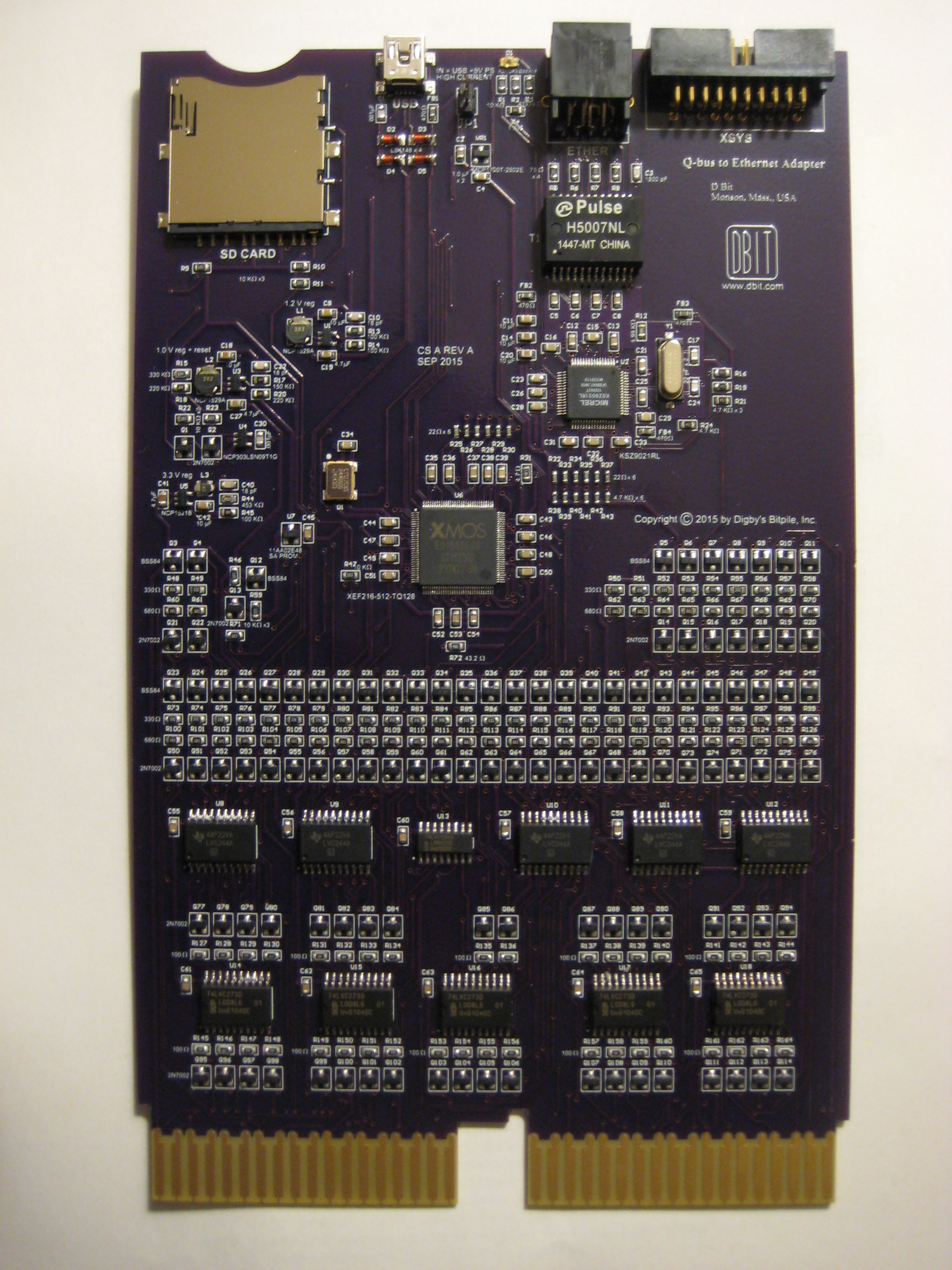
Wow. A pretty board indeed. Thanks for showing it off. This is also
interesting to me since a friend and I have been talking about building
something rather similar (and entirely different at the same time, we're
just focusing on the mass storage function and using an FPGA). I'm
curious about some things though, if you'd be willing.
Bus drivers (along with voltage level conversion) have been a problem.
You seem to be using 74LVC parts. Are they close enough? Though I also
see a bunch of FETs down there.
I've used OSHPark in the past for small boards but for 45 sq.in. boards
they'd seem to be awfully expensive, even if using their medium run
pricing. The fingers look gold plated. It could be just the ENIG
finish but I also see little tails running off the bottom as if you're
setup for hard gold plating. Does OSHPark have that capability?
I gotta say that I'm impressed with your soldering skill as well as
stamina. I was going to ask if it was machine assembled but I see in a
later message that it wasn't. I was hoping for the Pick 'n' Paste
machine to come along and save me from having to do all that by hand but
that project seems to have faded away.
I'm curious why you didn't use resistor networks instead of discrete
components.
I also love that your design tool put omegas on the silk screen for the
resistor values.
-Dave
> From: Mattis Lind
> Very nice and clear description on what is required to have relay to
> activate!
Indeed! Thanks, Brent, for that wonderful writeup - I'm sure I'll find it
immensely useful when the time comes to work on my 11/44.
I'll have to carefully save a personal copy in a file - finding it in the
archives, when the time comes, won't be too easy. If only we had a Wiki
we could put all this kind of stuff in... (Hint, hint!)
Noel
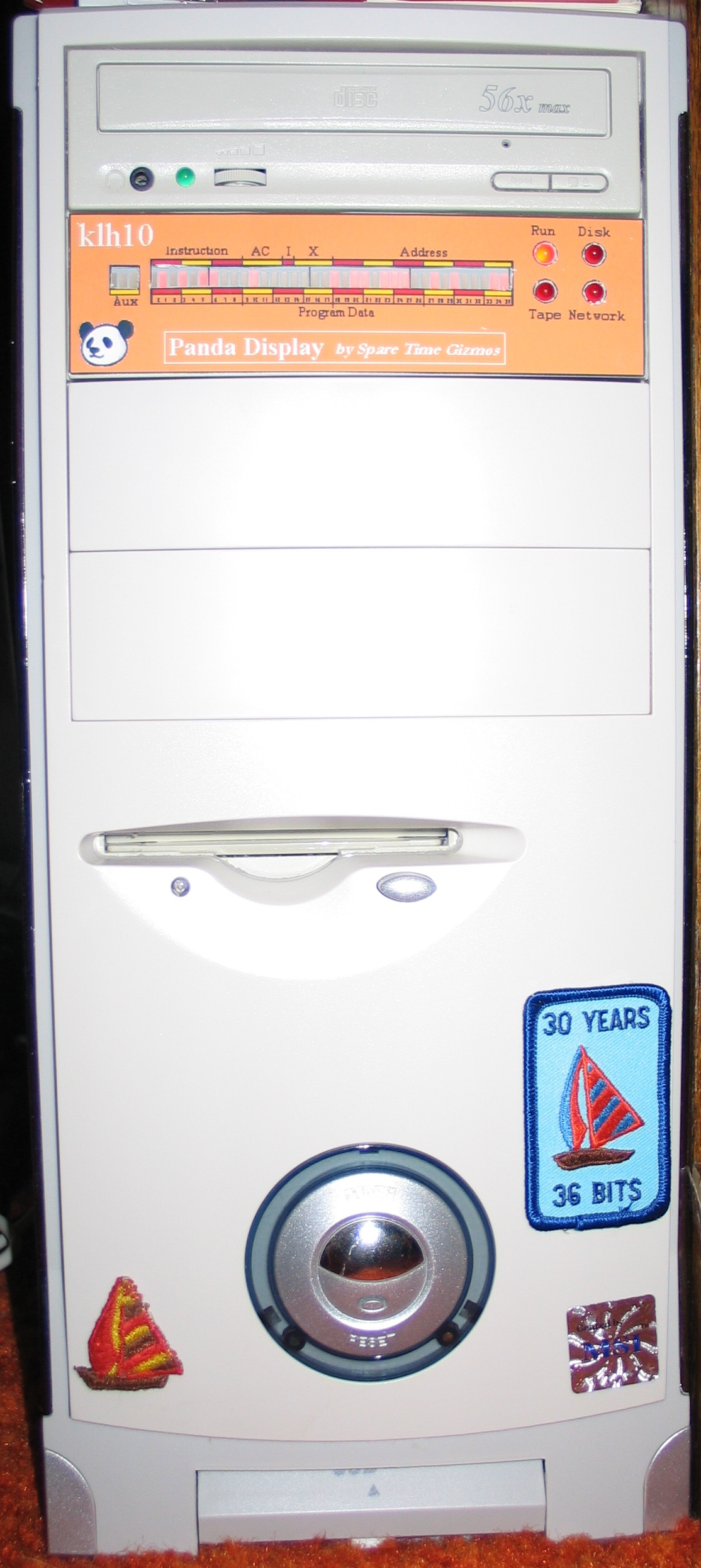
(BCC to Spare Time Gizmos and Rich A. - both of whom may have a clue!)
Folks,
I've finally dug out my Panda Panel and got it going - after having to
deal with various strangeness in a dodgy parallel port connector, and
figuring out I really DID have to be root to get it to initialize!
It all works; the 'aux' CPU load segments respond appropriately, as
does the Run/Disk/Tape/Network cluster. But from the moment KLH10 is
started, every single segment of the main display is ON and remains ON
until the host machine is powered off.
Any suggestions? Is this normal behaviour? Is it just that the thing
is running too fast for me to see any patterns? Does the Panda Panel
care what mode the parallel port is set to in the BIOS?
The fact that the other parts of the panel do the right things
suggests to me that the interface etc. is basically sane... but the
one photo I've ever seen of an operational panel looks quite
different... http://www.sparetimegizmos.com/Hardware/images/Lingling.jpg
Thanks
Mike
http://www.corestore.org
'No greater love hath a man than he lay down his life for his brother.
Not for millions, not for glory, not for fame.
For one person, in the dark, where no one will ever know or see.'
Hi Guys,
I wanted to give you guys an update on the latest progress on the
Multicomp09. Neal Crook has just completed modifying the boot process in
NitrOS-9 6809 L1 v3.3.0 and it is now booting flawlessly on the Multicomp09!
I have updated my Multicomp09 with Neal's latest VHDL code and also with the
latest Multi-software environment as well. I'm proud to announce that I too
now have NitrOS-9 6809 L1 v3.3.0 running on my Multicomp09 as well!
Whoo-Hoo!
NitrOS-9 6809 L1 v3.3.0 was just born on the Multicomp09 a day or two ago so
it is by far not fully tested though I'm not expecting any big hiccups at
this point. Everything I've tried so far has worked fine if I recall
correctly. I've been up most of the night checking it all out. :P
I've changed from the default shell that comes preconfigured with L1 to
Shellplus so now I have my cd command back that I'm so used to using in L2!
Finally I can traverse directories with ease.
I've created a /T2 device for serial port A on the Multicomp PCB. I
connected putty on my laptop via a USB to serial cable and now I have a
fully usable NitrOS-9 Terminal on my laptop! It's a 2 User system now. One
of the next hurdles will be to get the other serial port running.
There are 4 - 720KB virtual floppy drives online with the boot dsk image
file on drive 0 of course and at this point the same image on the other
three virtual floppy drives just to get the system up and running. With a
fully functional serial port, I'm eager to see about getting Drivewire 4 up
and running though 64KB of ram might be pushing it a bit. We'll see how
that goes.
I'm going through various commands now to make sure everything works.
The device descriptor for serial port A, /T2, will need to eventually be
included in the OS9Boot file as /T1. Some unneeded modules currently exist
like bitbanger stuff which are not needed on the Multicomp09. Since I have
shelled /T2, I can work on this at my favorite hang out at my favorite table
in Mickey D's! Cool!
By the way, are any of you guys on Skype? We could have a little video
conference on the Multicomp! :) Take care my friends.
Kip Koon
computerdoc at sc.rr.comhttp://www.cocopedia.com/wiki/index.php/Kip_Koon
Thanks Brent, I had used your very helpful site before to help me figure out
IO cards, but had missed this gem.
Marc
==================================
From: Brent Hilpert <hilpert at cs.ubc.ca>
On 2015-Oct-10, at 9:59 PM, Marc Verdiell wrote:
>> I had originally written it in a re-targetable cross-assembler in a
> now-outdated development environment under MacOS9.
>> Last year rewrote someone else's assembler (C source) - it should work in
> any standard C environment.
>> Was using it to re-assemble HPBASIC.
>> [...] Can send you the source if you wish.
>
> I'll gladly take the source, that would be very helpful later on.
Forgot, it's online already:
http://www.cs.ubc.ca/~hilpert/e/HP21xx/software/index.html
the Compaq III is quite cool there was also an add on docking thingie
too to go with it. .... IBM also made a ps2 sort of one with a plasma
screen on it too that was a box that closed up on it self. used to be
able to find these in thrift shops often but these days you seldom see
them. I got one and used it for a while until the power supply quit. For
now it will have to remain a static display... for a while anyway.
(schematics or maint. manual anyone!?)
I even used to find Burroughs BTOS desktops in T shops but now
what I need one for a display here at the museum.... none to be found!
Need some to sit in the middle of these photo panel and some incredibly
neat promotional items related to that computer Burroughs had put out
at one time.
Ed# _www.smecc.org_ (http://www.smecc.org)
In a message dated 10/11/2015 7:53:11 P.M. US Mountain Standard Time,
nw at retrocomputingtasmania.com writes:
On Mon, Oct 12, 2015 at 12:49 PM, drlegendre . <drlegendre at gmail.com>
wrote:
> I believe that I do have one of these machines, and it's in good working
> order as of a couple months back. You're looking for a Portable ///
> correct?
>
> Are you in the USA?
>
Hi Bill, thanks for the follow-up, seeking the updated variant known as the
Compaq Portable 386.
https://en.wikipedia.org/wiki/Compaq_Portable_386
I'm in Australia but willing to pay the shipping to get it here.
Hello,
4 hours ago I posted an email concerning a huge amount of documentation
that I have. I also included about 30 pictures. I can find no
indication that this email was distributed. Is there a problem with
this information? Was it received?
Tony Pflum
>
> Once again, I find myself in over my head debugging a power supply, this
> time an H7140 from a PDP-11/44. Here's the skinny:
That doesn't surprise me, the H7140 is one of the most complex PSUs you are
likely to come across...
> When power is applied (plugged in, breaker switch flipped to "On") the
> relay does not click - based on my readings of the manuals this should
> happen after the bias voltages are up to spec. I measure 308VDC on the
> lugs on the top of the memory board, so that's at least something
> working. Getting to other points to test voltages is a bit more
> difficult, especially with those high voltages in the way, what a nice
> design :).
That 300-odd volts comes from rectified (or voltage-doubled) mains. The
relay is part of the soft-start circuit, it should operate after the 'bias' PSU
has started up (it shorts out a resistor in the mains input circuit). With no
other load on the supply you will get the 300V with the resistor still in circuit.
There are _3_ SMPSUs in that box. One for the logic, one for the memory and
one (known as 'Bias' in the DEC documentation) to power the control circuits,
PSU control logic, etc. The last one is a relatively conventional SMPSU, it sounds
like it isn't working. It's nasty in that almost all the circuitry is on the mains side of
the isolation barrier, and an isolating transformer is almost essential when working
on it. The chopper transformer is on the PSIU baseboard, the chopper transistor
and much of the control circuity is on the 'Bias/Interface' PCB (leftmost board in the
PSU box). Be warned, therefore that some circuitry on this board is not isolated
>from the mains.
I would start by seeing if the 12V (and 5V?) from the 'Bias supply' are missing.
-tony
dunno did not see it Tony - - maybe file to large?
send to me direct to check out
thanks ed Sharpe archivist for smecc
In a message dated 10/11/2015 6:13:45 P.M. US Mountain Standard Time,
tonypf11 at gmail.com writes:
Hello,
4 hours ago I posted an email concerning a huge amount of documentation
that I have. I also included about 30 pictures. I can find no
indication that this email was distributed. Is there a problem with
this information? Was it received?
Tony Pflum
If anyone knows anyone looking for a Cray,
Cray J932SE system. 32 proc, 2 megawords of RAM as I recall.
Has VME IO subsystem, HIPPI channels on a lot of the CPU boards
(originally was 4 x J932SE in a hypercube via hippi IIRC.) Has 4 SCSI
disks (9GB) although has room for lots more (system checks disk firmware
vendor.)
I like it but no place to keep it and I don't want to keep moving it
between rental house garages. It's currently in Norfolk Virginia, I'm in
Northern Virginia. I have pics of it.
I'm not sure the Unicos build I have is compatible with it, it kernel
panics on startup. I have some software, the SWS Sparcstation 5. Uses 3 x
220v outlets @ 30 amps each.
Here is some stuff from last time I played with it:
https://users.757.org/~ethan/pics/geek/cray/
These are RARE. I think I know of two or three J932SE systems in the wild,
one in Germany one in another foreign country.
Was looking for $8500 or so. Pound for pound such a better deal than an
Altair.
--
Ethan O'Toole
Brent Hilpert <hilpert at cs.ubc.ca> wore:
>I had that problem with the stuck reel hubs. Failed to take my own
advice-to-self to leave the reels unmounted and they stuck again,
>although easier to get off this time as it hadn't been many years under
pressure.
I ended up covering the rubber hub with black electrical tape. That prevents
it from sticking again.
>I had originally written it in a re-targetable cross-assembler in a
now-outdated development environment under MacOS9.
> Last year rewrote someone else's assembler (C source) - it should work in
any standard C environment.
> Was using it to re-assemble HPBASIC.
> [...] Can send you the source if you wish.
I'll gladly take the source, that would be very helpful later on.
Marc
Hi folks,
Some storage reorganisation last week uncovered a PET4032 I'd forgotten I
had. Spotless internally (I remembered why later) and glass fuse intact so
I attempted powerup. Nothing. No screen and no chirrup.
Google + schematics time. I've checked AC voltage at the iron lump and all
major chips + DRAM are getting the right voltages. The processor is
generating a clock signal at PHI2 (~2.7V), I've checked continuity of all
address and data lines for ROMs/processor/VIA/PIA. I can't check the
contents of the Kernal ROM since it's not socketed and my track record of
successfully removing big chips whole isn't good.
One chip that does get hot is the Character Generator at UA3 which I was
going to swap with the one in my other 4032, but that doesn't power up
either. Presumably I can borrow one from a 3032 or 8096?
A lot of the repair pages use a piggyback 6502/ROM/RAM add-in called a
PETvet but all I have is a DMM, logic tester and other working PETs as
sources of chips I can borrow.
Are there any more steps I can try before checking ROM contents becomes
necessary?
Cheers.
--
adrian/witchy
Owner of Binary Dinosaurs, the UK's biggest home computer collection?
www.binarydinosaurs.co.uk
Does anyone have a loose 3M/Georgens MCD-405 tape drive they could take board pictures
and firmware dumps from, or any of the other MCD-40 series tape drives? I'm trying to
figure out how similar it is to the one in the Apple 40mb tape drive.
I was asked about recovering some tapes from a Supermac 40mb tape/disk scsi box, and I
am trying to figure out what tape drive I might need to do it. It appears it is Gammamat
format, which would work with the Apple drives, and I wanted to compare the firmware from
a non-Apple, so I started looking around for SCSI Gammamat drives. I also thought this
would be useful knowledge for anyone trying to dump Symbolics XL-Series DC2040 tapes.
One interesting thing mentioned in the Amiga BTNTape tape handler was they mention it was
possible on some MCD series drives to format a blank DC2000 tape. They mention formatting
with 2:1 interleave.
Sadly, there were also people who said there was a tech manual available from Georgens on
the series, but they didn't want to spend $50 for it. Georgens Industries was in San Diego
and there still a few traces of them, but they are long gone at their last adr. I see that
Chuck mentioned they were into the maintenance biz, Georgens was involved with DEI down there
looking at his patents, and bought 3M's streamer tape line.
Places like Weird Stuff have piles of the DC2000 floppy tape drives, need to do more digging
to see if there are any SCSI ones around.
Then, I have to redo the pinch roller. All the Apple tape drives have been dead for over ten
years with rollers turned to orange goo.
(cross posted to MARCH list)
Question about UNIBUS RAM with Parity vs. None
I assembled a pdp 11/05 in a BK11-K box with a sticky 5 light - I can load
an address, but the 5 light will erroneously (often but not always) light
when I examine. Once 5 is turned on it stays on, even if the toggle switch
is down. Once this occurs I cannot deposit nor can I examine contents of
RAM. I intend to test the front panel to verify that toggle 5 is ok
electrically, this is a to-do.
The power checks out including DC LO AC LO. I transplanted the CPU cards
into another system to test and they work also. Aside from the console
itself, it must be a RAM problem.
The system has 8K Core
G235 (xy drive module)
H217D (memory stack)
G114 (sense / inhibit)
M8293 (memory control module)
My question - I have read, and to the best of my understanding believe I
can swap an H217D with an H217C in this box.
Anyone disagree, and if so why did DEC want their 11/05 S to use "D" model
core (D=parity) and not C (C=no parity)? The PDP 11/40 I have uses C.
--
Bill
Hey all --
Once again, I find myself in over my head debugging a power supply, this
time an H7140 from a PDP-11/44. Here's the skinny:
I examined the supply physically before experimenting and found a
capacitor on the Bias/Interface board that was leaking, bursting and
rather burned-out looking (not a great sign) -- this is capacitor C4 in
the printsets on Bitsavers
(http://bitsavers.informatik.uni-stuttgart.de/pdf/dec/pdp11/1144/MP00897_11X…)
Everything else looked OK physically; I replaced the obviously bad
capacitor at C4.
When power is applied (plugged in, breaker switch flipped to "On") the
relay does not click - based on my readings of the manuals this should
happen after the bias voltages are up to spec. I measure 308VDC on the
lugs on the top of the memory board, so that's at least something
working. Getting to other points to test voltages is a bit more
difficult, especially with those high voltages in the way, what a nice
design :).
Switching the front panel switch to "Local" (or any other position) has
no effect -- no fans, no LEDs, nothing. I've double-checked all the
wiring and everything looks OK.
Capacitor C4 looks to be involved with the START-UP DRIVE signal
circuitry (which drives the relay) so the behavior I'm seeing makes
sense if C4 died and took a couple of things with it (or if something
else died and took C4 with it).
Here's where it gets kind of odd -- I spent some time testing diodes and
transistors in the related area near C4 and while doing so I noticed
that there are four diodes (D1-D4) listed on the schematic that are
missing from my board. "Missing" as in someone clipped them out at some
point -- there are just nubs of the leads left. I'm not sure why this
would have been done, but there were a number of ECOs applied to this
board (a few wires and resistors added) and I don't want to assume that
if I just put four new diodes in that it won't cause other problems.
Anyone know if there were other revision levels of the bias/interface
board that would have done away with these diodes? Anyone have an H7140
they can easily crack open to compare? (It's actually relatively easy
to get to, if you can get to the supply...)
Thanks as always,
Josh
Found some IBM parts recently. Any idea what specifically these might have
come out of? I'll be picking them up soon and getting more pictures, but
here's a few for now.
http://imgur.com/a/pikqG
Thanks,
Kyle
This may never see the light of day (if the prototype turns out to be
stillborn) but it's pretty and I can't resist posting a pic before I've
powered it on and proven its uselessness:
http://www.dbit.com/wilson/projects/qba.jpg
Officially it's for my morally repugnant attempts to earn a living (so it's
supposed to be a Q-bus bridge that connects over Ethernet), but I wanted to
still be able to do something fun in the very likely case that the Ethernet
port doesn't work (no idea if my PCB layout is kosher for something as fast
as the gigabit PHY's bus) or has uselessly high latency, so I added an SD
card slot and made all the CPU-end terminators switchable, so it can act
as just a plain peripheral (I'm mainly thinking disk controller -- I've
already found a reason why the USB device port can't work), if its CPU's
alive and can talk to the Q-bus. We'll see. Many many many chances for
mistakes. Five different power-supply voltages, for starters.
As always, I can't say enough good things about XMOS microcontrollers and
OSHpark.com.
John Wilson
D Bit
Looking for an Atari ST mouse, have an extra Amiga mouse to trade?
Also looking to buy a 520ST power supply to complete a system if anyone
knows of extras.
--
Ethan O'Toole
I wanted to let folks know what the current status is on the MEM11
project. I apologize in advance for the long post.
Previously I had mentioned that the emulator was fully functional (more
on that later) and that I was starting to debug the MEM11 firmware. I
have made significant progress and I'm in the final stages of testing
the recovery image firmware and the configuration image firmware. In
reality, the recovery image firmware is a heavily stripped down version
of the configuration image firmware - I had to make space for all of the
strings, in the configuration image the strings are kept in FRAM. This
usually means that I can do most of the testing in the configuration image
and (with a few exceptions) I'm assured that it'll work properly in the
recovery image.
The recovery image is what will be in the J1's RAM (in the FPGA) after
reset. It is also the "cold boot" loader. Depending upon configuration
settings and a couple of jumpers, it looks for a version of firmware
to run. Recall that there are up to 5 copies of the firmware:
2 copies of the "run time" firmware, this is what makes the MEM11
a set of Unibus devices
2 copies of the "configuration" firmware, this allows you to
configure the board, load new firmware, load/save memory, ROM
images and RS11 disk images
1 copy of the "configuration" firmware that is deemed "safe". This
copy cannot be updated except by the recovery image
The recovery image is part of the FPGA programming so it cannot be
updated in the field.
The recovery and configuration images support the XMODEM protocol for
uploading/downloading FRAM contents.
I'm going through and exhaustively testing all of the command and
checking that they produce the proper results and leave no extraneous
bits on the stack(s).
I haven't been able to do any testing on the XMODEM command yet because
I don't have support in the emulator for connecting other programs to
the console. So once all of the other commands have been tested, I'm
going to extend the emulator to handle some other devices. I'm also
going to add some scripting capabilities. I'm getting really tired of
typing some commands (the first 3 in the session below are burned into
my brain). It should also allow me to provide some capability to
emulate the Unibus side of things once I get to the point of testing
out the runtime firmware.
Here's a short session on using the emulator:
$ gforth emulator/j1-emulator.fs
J1> mode status 0008
J1> load 60000 mem11-cfg.img
J1> get j1-boot-ram.img
J1> run
MEM11 Recovery Interface
MEM11 Firmware Version 0.4 (EMUL)
RECOVERY> help
Commands:
BOOT Boot selected image
CLEAR Clear specified memory region
DUMP Dump out a section of FRAM
MAP Display FRAM address map
MODIFY Modifies contents of FRAM
VERSION Display version
RESET Perform a HW reset
XMODEM Download into FRAM using XMODEM protocol
SET Set configuration information
SHOW Show configuration information
Additional help:
HELP <command-name>
RECOVERY> boot safe
MEM11 Command and Configuration Interface
MEM11 Firmware Version 0.3 (EMUL)
SAFE> help
Commands:
BOOT Boot selected image
CLEAR Clear specified memory region
DUMP Dump out a section of FRAM
ENABLE Enable indicated UNIBUS device
DISABLE Disable indicated UNIBUS device
EXAMINE Examine J1's RAM
LIST Lists names of images
MAP Display FRAM address map
MODIFY Modifies contents of FRAM
POKE Change J1's RAM
VERSION Display version
RESET Perform a HW reset
XMODEM Download into FRAM using XMODEM protocol
SET Set configuration information
SHOW Show configuration information
Additional help:
HELP <command-name>
SAFE> set defaults
SAFE> show dl11 0
ENABLED
SLOT: 3
CSR: 777560
LENGTH: 000010
INT VECTOR: 060
INT PRIORITY: BG4
BAUD RATE: 9600
PARITY: NONE
DATA BITS: 8
STOP BITS: 1
SAFE> show memory
ENABLED
BASE ADDR: 000000
LENGTH: 760000
SAFE> show kw11l
DISABLED
SLOT: 7
CSR: 777540
LENGTH: 000010
INT VECTOR: 100
INT PRIORITY: BG6
LINE FREQ: 16667 uS
SAFE> list boot-image
0 : <NO IMAGE>
1 : <NO IMAGE>
2 : <NO IMAGE>
3 : <NO IMAGE>
B SAFE : MEM11 Config V0.3 (EMUL) Built on Fri Oct 9 20:18:31 PDT 2015
SAFE>
Execution Stopped at: PC: 016C
J1> help
Commands:
HELP - Help command
DUMP - Examine the contents of FRAM
MODIFY - Modify the contents of FRAM
EXAMINE - Examine the contents of J1 RAM
PATCH - Modify the contents of J1 RAM
CLEAR - Clear the contents of FRAM
LOAD - Load FRAM from a file
SAVE - Save FRAM into a file
GET - Load J1 RAM from a file
QUIT - Exit the emulator
RUN - Run the J1 program
STEP - Single step the next J1 instruction
BREAKPOINT - Set a breakpoint
CONTINUE - Continue J1 execution
.R - Dump the J1 return stack
.S - Dump the J1 data stack
.PC - Display the current J1 program counter
DEPTH - Report the depth of the J1 data and return stacks
TRACE - Control tracing of J1 instructions
RESET - Reset J1 and the emulated peripherals
MODE - Set or view the MEM11 mode
LED - Display the LEDs that would appear on a MEM11 board
Typing 'HELP <command>' will give additional details about the command
J1> .s
DSP: 5
ST0: 0005
Data Stack:
5 : 0000
4 : 1E1E
3 : 1E6E
2 : 1E1E
1 : 0000
J1> .r
RSP: 6
Return Stack:
6 : 0D84
5 : 0D4A
4 : 0D7E
3 : 1C1A
2 : 3B26
1 : 3BB2
J1>
Unfortunately SVT ?ppet Arkiv is not available to anyone outside Sweden,
which is a pity. A great source.
This interest for computers and election vigils come from the fact that I
had a email conversation with a person that was involved when DEC won the
contract to for the election in 1976 in Sweden for SVT. He was involved in
adapting the VT30 system for TV use. Genlock and stuff.
I found three clips in ?ppet Arkiv which I trimmed down heavily. These
shows tend to be quite long anyhow. I hope SVT is not getting mad now.
https://www.youtube.com/watch?v=qDoFM3hfbic
/Mattis
Glen,
I'm right in the middle of resuscitating an HP7970E (1600 bpi with the HP-IB
interface). The main problem I had so far was the rubber in the reel hubs
had completely fused to the tape reels that were left on the hubs. I had to
disassemble the hub locking mechanism and use lots of careful X-Acto knife
work to separate the two. A few tape rollers were rough or stuck - just
oiled them for now. Then it started to work, I am very surprised. There are
three red switches on the motor control board inside to make the tape go
forward, reverse and fast rewind. So it's pretty easy to test if the
transport works and the motor servos and tension arms move how they are
supposed to.
Brent,
Wow, looked at your site, and you actually wrote a HP 2100 cross-assembler?
Nice. Would it work for the HP21MX too? Did you compile it using the command
line tools in XCode?
Marc
==========================================================
Date: Wed, 7 Oct 2015 13:29:37 -0700
From: Brent Hilpert <hilpert at cs.ubc.ca>
To: "General Discussion: On-Topic and Off-Topic Posts"
<cctalk at classiccmp.org>
Subject: HP & 800BPI / was Re: Tape cleaner on eBay
Message-ID: <858603D2-2D79-45D6-993C-A8939D996815 at cs.ubc.ca>
Content-Type: text/plain; charset=us-ascii
On 2015-Oct-07, at 12:56 PM, Glen Slick wrote:
> I have an 800BPI 7970B in a 2113B rack system. I've never gotten
> around to trying to get it up and running. Are they fairly reliable
> drives to get going again? I don't have any other 800BPI drives to
> write any tapes to read with it.
>On Wed, Oct 7, 2015 at 12:46 PM, Brent Hilpert <hilpert at cs.ubc.ca> wrote:
Well, the unit here was in pretty good physical condition as received.
It had a cascading failure in the capstan driver but it was a fairly
straightforward fix.
I think there was one sluggish/partially-seized pulley bearing (freed up
with some oil).
Pretty rugged drives as you know. I wonder about the capstan rubber in the
long term but I think that's about the only thing to worry about on age
alone.
I think bitsavers nowadays has manuals and schematics for the B version as
you have, years ago I had to do some reverse-engineering for the capstan
repair.
This page is over ten years old and needs some updating, but FWIW:
http://www.cs.ubc.ca/~hilpert/e/HP21xx/HP2116CSys/index.html
Note the tape drive repair log page linked there.
Hello All,
This is just a general shout out and thanks to David (Gesswein) for the
excellent work on the MFM emulator boards. I received both of my fully
assembled emulators today. They arrived professionally packaged and ready to
go out of the box. I wish more hobby/home brew projects went this smoothly
and bore such excellent fruit. Kudos to David!
-Ali