Er.. that was.. 'down one side of the CN tower'.. :)
Sent from my Samsung device
-------- Original message --------
From: Brad H <vintagecomputer at bettercomputing.net>
Date: 2016-08-01 5:29 PM (GMT-08:00)
To: "General Discussion: On-Topic and Off-Topic Posts" <cctalk at classiccmp.org>
Subject: Re: Bill Gates: Windows 95 Was 'A High Point'
???
I would call Win 95 a high point also. ?I lived near Toronto at the time and remember the unfurling of a huge Win 95 banner down one side. ?There were events everywhere. ?MS was really at their zenith. The excitement around that launch was like nothing since. ?I believe I got swept up and installed it immediately but shortly after removed it. ?Couldn't get used to the interface. ?Eventually for one reason or another I had to and did go back to it. ?Wasn't the greatest or most stable OS and was kind of a half breed at that, but man.. what I wouldn't give to feel the anticipation again, the difference between it and DOS. ?Nothing released on either PC or Mac has come close.
Brad
Sent from my Samsung device
-------- Original message --------
From: Cameron Kaiser <spectre at floodgap.com>
Date: 2016-08-01? 4:25 PM? (GMT-08:00)
To: cctalk at classiccmp.org
Subject: Re: Bill Gates: Windows 95 Was 'A High Point'
> > <https://tech.slashdot.org/story/08/05/28/2214214/bill-gates-windows-95-was-…>
> http://cdn.cultofmac.com/wp-content/uploads/2015/08/introducing.gif
I have a "Windows '95 = Macintosh '89" pin on my iMac G4, as seen here:
http://www.theapplecollection.com/Collection/pin/PinsBadges.html
--
------------------------------------ personal: http://www.cameronkaiser.com/ --
? Cameron Kaiser * Floodgap Systems * www.floodgap.com * ckaiser at floodgap.com
-- Business is war. -- Jack Tramiel -------------------------------------------
Doug we have a next cube, neat next monitor and NEXT laser printer at
SMECC museum but alas no manuals
Please advise
Ed Sharpe archivist for SMECC
ADDED NOTE need some great NEXT promo stuff to make the back drop
for the display of this setup
-
-
-
--
-
-
-
-
--
-
-
In a message dated 8/1/2016 6:31:36 P.M. US Mountain Standard Time,
tmfdmike at gmail.com writes:
Just to clarify did you 'rescue' these hoping to find good homes for
them later - or to keep for yourself?
If the former I would definitely be interested in the TI Explorer - and
the RT.
Mike
On Tue, Aug 2, 2016 at 10:23 AM, Doug Fields <doug-cctalk at dpf.cc> wrote:
> I took these things home with me:
>
> TI Explorer II
> AT&T 3b2-1000-70 & BLIT monitor
> Commodore 64 + disk drive
> HP 85 (non-B, I think)
> Bunch of NeXT manuals and PowerPC 601/603/604 manuals
>
> Cheers,
>
> Doug
>
>> On Aug 1, 2016, at 6:05 PM, Glen Slick <glen.slick at gmail.com> wrote:
>>
>> On Aug 1, 2016 2:57 PM, "Doug Fields" <doug-cctalk at dpf.cc> wrote:
>>>
>>> Apparently the list strips HTML out, which I didn't know.
>>>
>>> https://www.icloud.com/sharedalbum/#B0ZGWZuqDGXYWQL <
>> https://www.icloud.com/sharedalbum/#B0ZGWZuqDGXYWQL>
>>>
>>> Try that?
>>>
>>> Cheers,
>>>
>>> Doug
>>
>> TI Explorer II - someone is probably interested in that one.
>>
>
--
http://www.corestore.org
'No greater love hath a man than he lay down his life for his brother.
Not for millions, not for glory, not for fame.
For one person, in the dark, where no one will ever know or see.'
I posted this on vcfed and thought I'd ask here too.
I have a working H8. ?It has the basics plus a 64k ram card and serial/cassette card. ?I have been looking and looking for info on what program to enter or rom change you have to make to get the machine to operate with a terminal. ?Surprisingly, I can't find any info on this at all. ?The H9 terminal guide describes general assembly and operation but does not say specifically how you use it in conjunction with an H8.
Per others it sounds like you'd need to enter a program on the front panel to get the machine talking to the terminal. ?Or change ROMs. ?Does anyone have any info on how that all works? ?Can you actually redirect the front panel input/output to terminal? ?
B
Sent from my Samsung device
At 04:03 AM 8/1/2016, drlegendre wrote:
>Non-polar caps are used in locations where they must pass AC.
Conventional polarized aluminum and tantalum capacitors are also used in locations where they must pass AC, such as interstage coupling capacitors and bypass capacitors, not to mention electrolytics as power supply filter capacitors. Any capacitor that could not pass AC would not be a capacitor.
There are two principal situations where non-polar electrolytics are used:
1) When there is no constant DC offset to the applied voltage - if the voltage applied to an electrolytic capacitor reverses the capacitor can be damaged. When there is no constant DC offset the second reason can come into play:
2) When a large value non-polarized electrolytic can, as previously noted, cost less than a large film, oil-filled, or other non-polar capacitor.
Some of us still deal daily with analog circuitry at work.
Dale H. Cook, Radio Contract Engineer, Roanoke/Lynchburg, VA
http://plymouthcolony.net/starcityeng/index.html
there is an 8i with similar crazy price but different user id....
hmmm.... beware?
also a Rare Digital DEC H-500 Computer Lab, 1960s, Same Switches as
PDP-8/I, Vintage for 700+
( we have an extra one of these Computer Lab, if anyone here is
interested)
Ed# _www.smecc.org_ (http://www.smecc.org)
In a message dated 7/19/2016 12:07:02 A.M. US Mountain Standard Time,
jwsmail at jwsss.com writes:
On 7/18/2016 10:23 PM, Sam O'nella wrote:
> There may be some archives here or vcf with enough prices. Iirc i
thought i remember one selling for something pretty high (8000/12000?) X years
ago although i think like this it's a calculated price of doubling the last
sale they saw. Although apple 1s seem to accomplish whatever that law is
called :-)
I think Straight 8's are nearly to the point that other systems which
have published tracking inventories. There are very few, this one looks
complete, or near complete.
That said I'd figure though some of the higher prices such as the
current PDP8/I and GT40 are setting for want of bids, they aren't that
far from what you have to pay to get said systems on demand. This one
may go for around the opportunistic price, and be lower, but $10 to $12k
isn't going to be surprising.
Here's some shots of it. ?I forgot about the guy rappelling down the tower. ?Don't think anyone rappelled for Windows 10!
http://motherboard.vice.com/read/this-guy-rappelled-down-the-cn-tower-for-t…
Sent from my Samsung device
-------- Original message --------
From: Brad H <vintagecomputer at bettercomputing.net>
Date: 2016-08-01 5:33 PM (GMT-08:00)
To: "General Discussion: On-Topic and Off-Topic Posts" <cctalk at classiccmp.org>
Subject: Re: Bill Gates: Windows 95 Was 'A High Point'
???
Er.. that was.. 'down one side of the CN tower'.. :)
Sent from my Samsung device
-------- Original message --------
From: Brad H <vintagecomputer at bettercomputing.net>
Date: 2016-08-01? 5:29 PM? (GMT-08:00)
To: "General Discussion: On-Topic and Off-Topic Posts" <cctalk at classiccmp.org>
Subject: Re: Bill Gates: Windows 95 Was 'A High Point'
???
I would call Win 95 a high point also. ?I lived near Toronto at the time and remember the unfurling of a huge Win 95 banner down one side. ?There were events everywhere. ?MS was really at their zenith. The excitement around that launch was like nothing since. ?I believe I got swept up and installed it immediately but shortly after removed it. ?Couldn't get used to the interface. ?Eventually for one reason or another I had to and did go back to it. ?Wasn't the greatest or most stable OS and was kind of a half breed at that, but man.. what I wouldn't give to feel the anticipation again, the difference between it and DOS. ?Nothing released on either PC or Mac has come close.
Brad
Sent from my Samsung device
-------- Original message --------
From: Cameron Kaiser <spectre at floodgap.com>
Date: 2016-08-01? 4:25 PM? (GMT-08:00)
To: cctalk at classiccmp.org
Subject: Re: Bill Gates: Windows 95 Was 'A High Point'
> > <https://tech.slashdot.org/story/08/05/28/2214214/bill-gates-windows-95-was-…>
> http://cdn.cultofmac.com/wp-content/uploads/2015/08/introducing.gif
I have a "Windows '95 = Macintosh '89" pin on my iMac G4, as seen here:
http://www.theapplecollection.com/Collection/pin/PinsBadges.html
--
------------------------------------ personal: http://www.cameronkaiser.com/ --
? Cameron Kaiser * Floodgap Systems * www.floodgap.com * ckaiser at floodgap.com
-- Business is war. -- Jack Tramiel -------------------------------------------
Has Orange/Purple decorative top in good shape. No sides, door etc.
I don't have it but it will be up for sale, I think they are asking around
$50.
Let me know if anyone is interested and I can pass the info on
-pete
I'm here in Austin picking up that Multiflow and they have a bunch of other computers. The most intact looking is an AT&T 3b2-1000-70. There are also two rude looking IBM RTs plus an Evans and Sutherland Freedom 1000 with Sun Graphics tower, a Sparc Printer, lots of old Apple printers, and other stuff. I'm trying to put it all on Imgur but having problems since I never used it before so if you want pics email me your iMessage account and I can share it somehow that way.
Cheers,
Doug
--
Sent from my iPhone
Actually found a pretty nice hp machine with a bunch of peripherals.
Thankfully it came with the keyboard. Also a external hard drive and
floppy, as well as a tiny printer.
HP 362 "controller"
Hp thinkjet 2225A printer
Hp 9153B - HD and floppy
Also a IBM wheelwriter 3 with the parallel interface, as well as what im
assuming is a s100 backplane.
Pretty interesting. I have a couple of other Hp devices, a logic analizer,
pattern generator, and volt meter, it will be interesting to see if i can
get them talking with the computer. Computer works. boots into basic.
Pretty complete setup for something at the scrapyard.
https://www.slashflash.info/~devin/images/scrapyard_lot/
--Devin
I remember company using varian... v series.. minI to drive display was prototype in az..... why varian? There were mivso in the 80s. And this was NOT early 80s
Sent from my Verizon, Samsung Galaxy smartphone
-------- Original message --------
From: Brad H <vintagecomputer at bettercomputing.net>
Date: 8/1/16 13:17 (GMT-07:00)
To: "General Discussion: On-Topic and Off-Topic Posts" <cctalk at classiccmp.org>
Subject: Re: Mall directory computers
???
It wasn't those two.. I remember Harvard Graphics. ?It had a friendlier name than that.. Direct something? ?Darn. ?Gotta find it now.
Sent from my Samsung device
-------- Original message --------
From: ethan at 757.org
Date: 2016-08-01? 12:49 PM? (GMT-08:00)
To: "General Discussion: On-Topic and Off-Topic Posts" <cctalk at classiccmp.org>
Subject: Re: Mall directory computers
>You know.. come to think of it.. it might have been something like this
>software I used to play with obsessively as a kid. ?My Dad had it for
>our PC. ?I completely forgrt the name. ?It was a CGA graphics
>proto-Powerpoint kind of deal. ?You could draw pictures, graphs etc..
>and it also had clip art. ?You could do fade ins and outs and other effects.
>?I think we had it later on.. 85 or after. ?But the colors and way it
>drew graphics was similar. ?And I think you could hotkey it to go to
>specific 'slides'. ?The mall computer just had a series of buttons
>alongside the screen from what I remember. ?Could have been rigged up to
>replicate certain keys. ? Wish I could remember the program name..
There was GRASP / GRASPRT? You could author all sorts of stuff in it.
There was presentation software called Harvard Graphics I think.
--
Ethan O'Toole
It wasn't those two.. I remember Harvard Graphics. ?It had a friendlier name than that.. Direct something? ?Darn. ?Gotta find it now.
Sent from my Samsung device
-------- Original message --------
From: ethan at 757.org
Date: 2016-08-01 12:49 PM (GMT-08:00)
To: "General Discussion: On-Topic and Off-Topic Posts" <cctalk at classiccmp.org>
Subject: Re: Mall directory computers
>You know.. come to think of it.. it might have been something like this
>software I used to play with obsessively as a kid. ?My Dad had it for
>our PC. ?I completely forgrt the name. ?It was a CGA graphics
>proto-Powerpoint kind of deal. ?You could draw pictures, graphs etc..
>and it also had clip art. ?You could do fade ins and outs and other effects.
>?I think we had it later on.. 85 or after. ?But the colors and way it
>drew graphics was similar. ?And I think you could hotkey it to go to
>specific 'slides'. ?The mall computer just had a series of buttons
>alongside the screen from what I remember. ?Could have been rigged up to
>replicate certain keys. ? Wish I could remember the program name..
There was GRASP / GRASPRT? You could author all sorts of stuff in it.
There was presentation software called Harvard Graphics I think.
--
Ethan O'Toole
You know.. come to think of it.. it might have been something like this software I used to play with obsessively as a kid. ?My Dad had it for our PC. ?I completely forgrt the name. ?It was a CGA graphics proto-Powerpoint kind of deal. ?You could draw pictures, graphs etc.. and it also had clip art. ?You could do fade ins and outs and other effects. ?I think we had it later on.. 85 or after. ?But the colors and way it drew graphics was similar. ?And I think you could hotkey it to go to specific 'slides'. ?The mall computer just had a series of buttons alongside the screen from what I remember. ?Could have been rigged up to replicate certain keys. ?
Wish I could remember the program name..
Sent from my Samsung device
-------- Original message --------
From: Brad H <vintagecomputer at bettercomputing.net>
Date: 2016-08-01 12:08 PM (GMT-08:00)
To: "General Discussion: On-Topic and Off-Topic Posts" <cctalk at classiccmp.org>
Subject: Re: Mall directory computers
???
I've been searching the dim recesses of my mind trying to remember the one at Oakville. ?As I recalled the graphics output was quite slow.. it'd draw shapes individually and then fill in. ?And the color was not great. ?Must have been a CGA PC or some derivative. ?This would have been around 1982-1983. ?I just remember being fascinated as a kid pushing buttons and having stores and locations of things show up. ?For early 1980s it was a pretty cool idea vs the big directory board you had to look all over.
Sent from my Samsung device
-------- Original message --------
From: Ian Finder <ian.finder at gmail.com>
Date: 2016-08-01? 11:22 AM? (GMT-08:00)
To: "General Discussion: On-Topic and Off-Topic Posts" <cctalk at classiccmp.org>
Subject: Re: Mall directory computers
you should certainly open it up and remove the battery. I would guess the
add on shell is a power supply, video modulator of some kind, and possibly
a hard drive controller.
On Mon, Aug 1, 2016 at 3:06 AM, Kevin Parker <trash80 at internode.on.net>
wrote:
> I'm not exactly sure - it was one of those things that someone gave me and
> I put it away - my policy is grab first and ask questions later so it
> doesn't become landfill.
>
> I have tried to research this based on info from another reply but no joy.
>
> I might open it up and see if there are any clues inside.
>
> My understanding was that it was connected to a large flat panel monitor
> and just used for displaying advertisements and specials etc. It has a
> floppy disk "jammed" in the floppy drive which won't come out - not sure
> why.
>
>
>
> Kevin Parker
>
> -----Original Message-----
> From: cctalk [mailto:cctalk-bounces at classiccmp.org] On Behalf Of
> drlegendre .
> Sent: Monday, 1 August 2016 09:41
> To: General Discussion: On-Topic and Off-Topic Posts <
> cctalk at classiccmp.org>
> Subject: Re: Mall directory computers
>
> It's not +just+ an A500. What's the extra hardware piggybacked on the A500
> case?
>
> Looks to have a set of six RCA (F) type jacks on it. Is this for
> connection of a touchscreen display?
>
> On Sun, Jul 31, 2016 at 2:43 AM, Kevin Parker <trash80 at internode.on.net>
> wrote:
>
> > Thanks for the clarity and the extra info? - as I said I haven?t
> > opened it or fired it up much less had a good look at it.
> >
> >
> >
> > Kevin Parker
> >
> > -----Original Message-----
> > From: cctalk [mailto:cctalk-bounces at classiccmp.org] On Behalf Of Ian
> > Finder
> > Sent: Sunday, 31 July 2016 17:28
> > To: General Discussion: On-Topic and Off-Topic Posts <
> > cctalk at classiccmp.org>
> > Subject: Re: Mall directory computers
> >
> > That is certainly not a C= 64 as the title in your link suggests but
> > rather an Amiga 500.
> >
> > These were quite popular for "video billboard" sort of purposes- I
> > imagine they had it running SCALAMultimedia or a similar authoring
> environment.
> >
> > My local high school district channel ran on a similar setup for many
> > years. I recall seeing it stuck on the Amiga Workbench one day...
> >
> > On Sunday, July 31, 2016, Kevin Parker <trash80 at internode.on.net> wrote:
> >
> > > Just spotted this Brad clearing up email after a 4 week break. I
> > > can't answer your question but it reminded me of something that
> > > other list users may be able to help with or it might just be of
> interest.
> > >
> > > Quite some time ago a friend of mine bought a travel agent in a
> > > shopping mall, did a refit of the shop and then later went bust.
> > > Fortunately before the refit and going bust he gave me his old shop
> > > display which was run on a modified Commodore.
> > >
> > > I haven't opened it up or powered it up but if anyone knows what
> > > this is I'd be grateful. I've posted some photos:
> > >
> > >
> > > http://koken.advancedimaging.com.au/index.php?/albums/shop-mall-comm
> > > od
> > > ore-64/
> > >
> > >
> > >
> > > Kevin Parker
> > >
> > > -----Original Message-----
> > > From: cctalk [mailto:cctalk-bounces at classiccmp.org <javascript:;>]
> > > On Behalf Of Brad H
> > > Sent: Thursday, 14 July 2016 12:25
> > > To: 'General Discussion: On-Topic and Off-Topic Posts' <
> > > cctalk at classiccmp.org <javascript:;>>
> > > Subject: Mall directory computers
> > >
> > > Been wondering about this for a while.?? Just one of those odd
> childhood
> > > memories.
> > >
> > >
> > >
> > > When I was a kid growing up in Oakville, Ontario, I remember
> > > Oakville Mall getting one of those very early mall directory computers.
> > > This would have been like, 1982-84, somewhere thereabouts.? From
> > > what I remember, they had kind of CGA-sh graphics and a chiclet
> 'keyboard'
> > > you used to browse the directory.? I'm wondering, were they just
> > > PCs, most likely?? Or some kind of custom job?
> > >
> > >
> >
> > --
> >??? Ian Finder
> >??? (206) 395-MIPS
> >??? ian.finder at gmail.com
> >
> >
>
>
--
?? Ian Finder
?? (206) 395-MIPS
?? ian.finder at gmail.com
I had thought of locating original MIKBUG roms but can't tell for sure if it would work. ?The system has four EROM sockets and they are all occupied.. first two by this WEEBUG thing.
Finding SWTPC ROMs would be difficult. ?I am getting an original 6800 machine next week but I'm loathe to mess with it too much.
>From what I've read MSI were one of the more popular ss50 systems. ?But yeah.. next to nothing out there about them.
Sent from my Samsung device
-------- Original message --------
From: william degnan <billdegnan at gmail.com>
Date: 2016-08-01 11:57 AM (GMT-08:00)
To: "General Discussion: On-Topic and Off-Topic Posts" <cctalk at classiccmp.org>
Subject: Re: Midwest Scientific Instruments 6800
COSAM sells new reproductions for SWTPc btw.
On Mon, Aug 1, 2016 at 2:57 PM, william degnan <billdegnan at gmail.com> wrote:
>
>
> On Mon, Aug 1, 2016 at 2:37 PM, Christian Liendo <cliendo at gmail.com>
> wrote:
>
>> Shout right back! I have one but I haven't really played with it.
>>
>> On Mon, Aug 1, 2016 at 1:32 PM, Brad H
>> <vintagecomputer at bettercomputing.net> wrote:
>> > Just thought I'd send out another shout out to anyone who might have
>> one of these or is familiar with them.
>>
>
>
> I would think you could put a SWTPc ROM board in there, right?? Just use
> mikibug.? I thought the cards were interchangable, or am I not thinking of
> the right thing?
>
> --
> @ BillDeg:
> Web: vintagecomputer.net
> Twitter: @billdeg <https://twitter.com/billdeg>
> Youtube: @billdeg <https://www.youtube.com/user/billdeg>
> Unauthorized Bio <http://www.vintagecomputer.net/readme.cfm>
>
>
>
--
@ BillDeg:
Web: vintagecomputer.net
Twitter: @billdeg <https://twitter.com/billdeg>
Youtube: @billdeg <https://www.youtube.com/user/billdeg>
Unauthorized Bio <http://www.vintagecomputer.net/readme.cfm>
I've been searching the dim recesses of my mind trying to remember the one at Oakville. ?As I recalled the graphics output was quite slow.. it'd draw shapes individually and then fill in. ?And the color was not great. ?Must have been a CGA PC or some derivative. ?This would have been around 1982-1983. ?I just remember being fascinated as a kid pushing buttons and having stores and locations of things show up. ?For early 1980s it was a pretty cool idea vs the big directory board you had to look all over.
Sent from my Samsung device
-------- Original message --------
From: Ian Finder <ian.finder at gmail.com>
Date: 2016-08-01 11:22 AM (GMT-08:00)
To: "General Discussion: On-Topic and Off-Topic Posts" <cctalk at classiccmp.org>
Subject: Re: Mall directory computers
you should certainly open it up and remove the battery. I would guess the
add on shell is a power supply, video modulator of some kind, and possibly
a hard drive controller.
On Mon, Aug 1, 2016 at 3:06 AM, Kevin Parker <trash80 at internode.on.net>
wrote:
> I'm not exactly sure - it was one of those things that someone gave me and
> I put it away - my policy is grab first and ask questions later so it
> doesn't become landfill.
>
> I have tried to research this based on info from another reply but no joy.
>
> I might open it up and see if there are any clues inside.
>
> My understanding was that it was connected to a large flat panel monitor
> and just used for displaying advertisements and specials etc. It has a
> floppy disk "jammed" in the floppy drive which won't come out - not sure
> why.
>
>
>
> Kevin Parker
>
> -----Original Message-----
> From: cctalk [mailto:cctalk-bounces at classiccmp.org] On Behalf Of
> drlegendre .
> Sent: Monday, 1 August 2016 09:41
> To: General Discussion: On-Topic and Off-Topic Posts <
> cctalk at classiccmp.org>
> Subject: Re: Mall directory computers
>
> It's not +just+ an A500. What's the extra hardware piggybacked on the A500
> case?
>
> Looks to have a set of six RCA (F) type jacks on it. Is this for
> connection of a touchscreen display?
>
> On Sun, Jul 31, 2016 at 2:43 AM, Kevin Parker <trash80 at internode.on.net>
> wrote:
>
> > Thanks for the clarity and the extra info? - as I said I haven?t
> > opened it or fired it up much less had a good look at it.
> >
> >
> >
> > Kevin Parker
> >
> > -----Original Message-----
> > From: cctalk [mailto:cctalk-bounces at classiccmp.org] On Behalf Of Ian
> > Finder
> > Sent: Sunday, 31 July 2016 17:28
> > To: General Discussion: On-Topic and Off-Topic Posts <
> > cctalk at classiccmp.org>
> > Subject: Re: Mall directory computers
> >
> > That is certainly not a C= 64 as the title in your link suggests but
> > rather an Amiga 500.
> >
> > These were quite popular for "video billboard" sort of purposes- I
> > imagine they had it running SCALAMultimedia or a similar authoring
> environment.
> >
> > My local high school district channel ran on a similar setup for many
> > years. I recall seeing it stuck on the Amiga Workbench one day...
> >
> > On Sunday, July 31, 2016, Kevin Parker <trash80 at internode.on.net> wrote:
> >
> > > Just spotted this Brad clearing up email after a 4 week break. I
> > > can't answer your question but it reminded me of something that
> > > other list users may be able to help with or it might just be of
> interest.
> > >
> > > Quite some time ago a friend of mine bought a travel agent in a
> > > shopping mall, did a refit of the shop and then later went bust.
> > > Fortunately before the refit and going bust he gave me his old shop
> > > display which was run on a modified Commodore.
> > >
> > > I haven't opened it up or powered it up but if anyone knows what
> > > this is I'd be grateful. I've posted some photos:
> > >
> > >
> > > http://koken.advancedimaging.com.au/index.php?/albums/shop-mall-comm
> > > od
> > > ore-64/
> > >
> > >
> > >
> > > Kevin Parker
> > >
> > > -----Original Message-----
> > > From: cctalk [mailto:cctalk-bounces at classiccmp.org <javascript:;>]
> > > On Behalf Of Brad H
> > > Sent: Thursday, 14 July 2016 12:25
> > > To: 'General Discussion: On-Topic and Off-Topic Posts' <
> > > cctalk at classiccmp.org <javascript:;>>
> > > Subject: Mall directory computers
> > >
> > > Been wondering about this for a while.?? Just one of those odd
> childhood
> > > memories.
> > >
> > >
> > >
> > > When I was a kid growing up in Oakville, Ontario, I remember
> > > Oakville Mall getting one of those very early mall directory computers.
> > > This would have been like, 1982-84, somewhere thereabouts.? From
> > > what I remember, they had kind of CGA-sh graphics and a chiclet
> 'keyboard'
> > > you used to browse the directory.? I'm wondering, were they just
> > > PCs, most likely?? Or some kind of custom job?
> > >
> > >
> >
> > --
> >??? Ian Finder
> >??? (206) 395-MIPS
> >??? ian.finder at gmail.com
> >
> >
>
>
--
?? Ian Finder
?? (206) 395-MIPS
?? ian.finder at gmail.com
Since I acquired a Coco Orchestra 90 unit awhile back, and I am trying
to find the source of some humming in my system when the Orch 90 unit is
operational, I looked at the schematic:
http://www.colorcomputerarchive.com/coco/Documents/Manuals/Hardware/Orchest…
(page 109 of the PDF)
I understand the ROM, the resistor ladders, and the latches, but analog
is not my strong suit. I made my way through the op-amp design, but I
am stumped on one component (actually three)?
C7,C9, and C10
They look like electrolytic polarized caps, but are NP (non polarized),
with no '+' on the schematic.
Can someone shed light on what these are and where you would find them
(or if they can safely be replaced with another kind of capacitor)? I
will admit I've never seen mention of these before now.
Are they "bipolar"?
http://www.digikey.com/product-detail/en/nichicon/UVP1H010MDD/UVP1H010MDD-N…
Or, are they called something else now?
Jim
--
Jim Brain
brain at jbrain.comwww.jbrain.com
> From: Mouse
>> the modern 'active content' mania causes me to grind my teeth, too.
> Oh, it doesn't make me grind my teeth. I just ignore it.
Well... part of the problem is that some sites that _I_ find useful really
depend of active content, and are completely unusable unless you use it.
But, above and beyond that, my anger (not too extreme a word, I think) at
active content is about more than me.
There's a quotation from a novel I once read that made an impression on me;
about how a professional marine civil engineer was ticked off at some shoddy
work, saying that if offended him because people might think that the
professionals in the field couldn't do any better; and they could, but not
all of them did. Here it is:
"I'm in the business of building things. And I am a specialist in the ways
of protecting structures from the sea. I guess it would be personally
offensive to me to have the public at large think my profession is so inept
and unaware that we would build a few hundred million dollars' worth of
high-rise living units on a fragile sandspit without knowing what will
happen."
(It's from "Condominium", a so-so book by John D. MacDonald. Fine - in fact,
very good - for an airplane flight or the beach, but not serious literature.)
But that's a big part of it, for me - the notion that as a field, we know full
well how to do better - but instead, for complex reasons I don't want to get
diverted into now, we have inflicted this abomination on all the innocent
users, who are nowhere as well able to protect themselves as you and I are.
Noel
I just dug out what might be my last extra DECmate II CPU for a list
member, and now have access to several Pro and Rainbow CPUs and other parts.
If you have any interest, please contact me off list. Shipping from
Illinois.
Thanks, Paul
I have a couple of VT-52 keyboards that need repair and I'm looking for a _broken_ VT-100 keyboard to serve as a donor for switch bodies. Anybody have a junk keyboard with a few working keys lying around? Please contact me off list.
Thanks, Jack
j at ckrubin.us
PS I'll be at VCF next week if that makes delivery any easier.
Hello Paul,
I have a Pro380, including box, PSU, motherboard, RX50 interface and RX50.
Unfortunately no other interface, so any missing part could be
interesting, specially HD / graphics / network.
Please let me know if you find something.
I tried to forward the sent emails from two different email accounts, I
hope at least one of the two will come at destination.
I double checked for answers in the last month, including in spam, but
unfortunately no luck.
It seems there's something wrong with email somewhere...
Thanks
Andrea
I have a heap of floppy disks on hand. Most with old junk on them. Some are
going bad, and have bad spots in the middle of the disk. Is there a good
utility for either windows or dos that can format a floppy and mark the bad
parts of the floppy to not be used?
If anything, such a utility can let me find what disks are having issues
and i can pitch them before i run into the aggravation of finding there is
an issue with a disk down the line.
--Devin
Is there a part number on the nvram? The chips Sun used with the enbedded
battery were a standard part available from Mouser. Or is there a visible
battery on the board anywhere?
>> I guess it will require getting ahold of a backplane, and seeing what
>> I can find out with an ohm-meter.
> It looks like I'll still have to do this at some point, to confirm my
> theories about how the two busses are wired on the backplane
> (separation of UB and EUB address lines, and cross-connection of the
> data lines, for the EUB/SPC slots)
I have checked an -11/24 backplane, and the wiring is indeed as I
hypothesized (above).
> Another mystery: The "PDP-11 UNIBUS Processor Handbook" (1985) says
> (pg. 4-10) that in the 5.25" box, "only one MS11-P memory module can be
> configured". Anyone know the cause/source of that restriction?
> ...
> I can't come up with any technical rationale for that limit? Am I
> missing something? Or is it just DEC marketing, trying to limit how
> powerful the machine can be?
I would still be grateful for any insight from anyone about this.
Noel
Hi again...
My recent adventures with the StorageTek tape unit is on hold since I
got a whole new computer to play with... (and because the disk on my
linux with SCSI card had gone bad). A NORD-1 by Norsk Data AS (or Norsk
Dataelektronikk AS as the company was called in those days). It is a
computer built from TTL chips, a whopping 2250 of them. I seems to be in
great shape and I even have drawings of the most of the CPU.
More about it here : http://www.ndwiki.org/wiki/NORD-1_Serial_47 ...
with pictures. :-)
The NORD-1 was designed in 1967, the first one was sold in 1969 and
somewhere between 60 and 120 were produced until it was succeeded by the
NORD-10. A few NORD-1 ended up in Cern.
The power supplies all was within 0,05V from nominal, not bad for a 44
year old computer. And except from a few broken switches, a shorted
capacitor (mechanical damage) and a few missing cards it is in "running
condition". Well, liberally used definition, it sort of runs. I can set
the address register and inspect the different registers. When put in
continuous mode the program counter runs through and loops the memory.
My guess so far is that there is a problem with reading and writing to
the memory. The problem is that I have no documentation over the memory
module except a drawing of the circuitry used to access it. ND bought
several different models of core memory for it's early computers and
just adapted the interface.
So once again I turn to the cctech for help, does anybody have
instructions about ExpandaCore 18 from by Cambridge Memories INC,
Newton, Massachusetts (also known as CMI but probably not the CMI on
bitsavers).
So far the only thing I've found was a newsflash in a computer magazine
about a sale of memories to another computer maker.
My plan is to have this machine up and running within a year, in time
for the 50 year anniversary of ND founding. :-)
... and this is a long shot, if anyone has a copy of ND-NEWS (ND-NYTT in
Norwegian) I would like to have a scan of it. There might be an article
in it about delivering this machine to the school that I got it from.
Thanks in advance, G?ran
Hi
A rather large Unisys memory board came up for sale locally. The seller
doesn't know much about it and I'm curious which machine it comes from.
Here are some picture, fairly low resolution I'm afraid: http://www.pdp8.se/slask/unisys_mem/
Do you know what it might be?
Thanks,
Pontus.
Hello Paul,
hope you are fine now.
I'm interested too to Pro380 boards, because I have a machine with
almost no expansion.
I'm trying to contact you since weeks, sent some emails but never
received an acknowledgement.
Maybe there are problems with spam-killers?
Please check your email and let me know if you didn't receive anything.
Thanks
Andrea
Ahhh, thanks Ray. I still need to replace several bulbs of my NOVA3 console.
Somebody knows of a source for 28V 40 mA ?grain? bulbs with wires?
I could use some 10 ? and 20 as spare ?
BTW, I read somewhere that the bulb to LED replacement is not as
straight-forward as you may think. The small continuous current through
the bulbs (to prevent thermal shock) is enough to make LEDs appear
continuous on!
- Henk.
Van: Bruce Ray<mailto:Bruce at Wild-Hare.com>
Verzonden: vrijdag 22 juli 2016 20:16
Aan: General Discussion: On-Topic and Off-Topic Posts<mailto:cctalk at classiccmp.org>
Onderwerp: Re: Nova 3 front panel
DG generally used 28V, 0.040 Ma (nominal), fragile wire-lead
incandescent bulbs for the Nova/SuperNova/Nova2/Nova3 front panels as
well as the early Eclipses. The S/130 was DG's first LED-based front
panel and was much-appreciated by Field Service.
More followup off-list...
Bruce
On 7/21/2016 10:53 PM, jim stephens wrote:
> Is there anyone with documents on the Nova 3 front panel, and what
> drives it? It has some number of custom DG chips, which hopefully are
> good if I want to try to fire it up to play, but am interested in that
> on good authority there are 28v incandescent lamps.
>
> A friend has an Eclipse front panel with nearly identical bezel, which
> has LED's and a number of differences in the logic (different connector
> to the system, for instance). So it is probably all run on 5v.
>
> I have not had time to figure out the driver circuit for any of the
> lamps to see what that may turn up, and wanted to know whether it was
> 28v lamps before I buy 40 of them. (the thing has only 2 out of a lot
> of lamps).
>
> Thanks
> Jim
Was cleaning out some stuff and ran across some HP drive sleds I don?t need.
HP Model A3647A made for 4.3GB HVD 3.5? SCA 7200 RPM drives.
I have 4 of them and all the screws that were inside holding the drives.
Any interest?
---
This email has been checked for viruses by Avast antivirus software.
https://www.avast.com/antivirus
I've got an old amiga 2000, that I have stuffed a GVP G-Force 030
accelerator into.
Does any one have, or know a source for the 1mb or 4mb 64pin GVP Simms?
Thanks
I've been asked to refer a customer to someone with a 20MB 8" Bernoulli
setup. There are only 2 disks involved and absolutely nothing is known
of the provenance. I can put you in contact and you can name your terms
to do the work.
Note that a sector-by-sector image of the disks might be useful as it's
unknown if these are PC or Apple format.
Contact me off-list if interested. US only, please.
Thanks,
Chuck
Hello Adrian,
if the head positioning motor works, but the drive simply doesn't read
the data,
maybe the problem is in some track misalignment or bad head signal
amplification / A/D conversion.
Don't know about these drives, but if the interface is pretty standard,
you could try the correct operation
of the positioning motor simply powering the drive setting the signal
DIRECTION high or low, and giving pulses to the
STEP signal. You can do it connecting simple wires between 5V and GND
and the pins on the connector on the back.
The positioning motor should move back and forth in steps.
For the track-0 sensor simply use a multimeter / oscilloscope and check
if the level changes when the head is in track-0 position.
For the READ signal the thing is more difficult, because you need an
oscilloscope to check the fast changing signals.
You can check for good looking output signal, without spurious pulses or
bad edges.
Then you possibly have to check for correct timings, and this is even
more difficult, but doable with the right equipment (powerful
oscilloscope). Some drives have a small trimmer to slightly correct the
spindle motor speed, whence the timing.
Alignment can be corrected loosening slightly the blocking screws
between the head carriage and the stepper motor moving it,
or in some drive the screws holding the stepper to the chassis frame,
and moving head carriage / stepper motor very slowly in both directions
until the amplitude of the signal of the read head is at the maximum.
Then lock again the screws.
Years ago I had to repair four floppy drives for two DG One machines, as
they were all failing, not reading nor formatting.
Spindle rotated well, head moved correctly, but the drives couldn't read
disks, and not even re-read its own data (formatting),
hence something bad on read / write circuits.
After various tests, the problem was on bad electrolytic capacitors on
the spindle board. As the spindle motor started,
it emitted high current pulses that caused ripple on the supply and also
induced spurious pulses on the analog read signal.
Result, the read data was badly interfered, and of course not correctly
interpreted by the controller.
I changed the capacitors, 3 over 4 drives worked. The last one required
head alignment, but I didn't have any alignment disk.
So I wrote three test disks with the 3 working drives, and tried to
align the 4th to the best match.
Then finally even the 4th worked!
If you are in willing to try something, let me know.
Andrea
I'm looking for an Orchestra 90 cartridge for my CoCos. Does anybody have an extra for sale or trade?
--
Mark J. Blair, NF6X <nf6x at nf6x.net>
http://www.nf6x.net/
Hi folks,
This a long shot but worth an ask. Has anyone got a pair of Epson SD521
5.25" drives going spare? I have two in a Memotech FDX disk subsystem that
appear to have gone south on me, and while I can swap out for any other
DS/DD drive it'd be nice restore it using original spares.
The SD521 is an odd beast since it doesn't have a slide or lever to engage
the heads, it's all done on a push button. These ones are aware there's a
disk inserted and will home the heads if manually pulled forwards, but
seeking doesn't work. Maybe the track0 sensor?
Cheers!
--
Adrian/Witchy
Binary Dinosaurs creator/curator
Www.binarydinosaurs.co.uk - the UK's biggest private home computer
collection?
>On Sunday, July 24th, 2016 at 14::29:59 -0700, Don North wrote:
> >On 7/24/2016 8:06 AM, william degnan wrote:
>
>> >On Jul 24, 2016 8:58 AM, "Jerome H. Fine" <jhfinedp3k at compsys.to>
>> wrote:
>>
>>>> >On Wednesday, July 20th, 2016 at 18:02:44 - 0400, william degnan
>>>> wrote:
>>>> Is there a minimum memory requirement for RT-11 v5? I was
>>>> discussing with
>>>
>>>> Ray Fantini about it today, unsure...anyone know if 16K will work
>>>> (from
>>>> 000000).
>>>>
>>>> Bill
>>>>
>>> You need to be more specific! Starting with V05.00 of RT-11 in 1983,
>>> there were a total of 17 versions released up to V05.07 in 1998,
>>> including
>>> sub-versions V05.01B, V05.01C, and V05.04A to V05.04G of RT-11.
>>>
>>> Up until V05.05 of RT-11, RT11SJ.SYS required the least memory which
>>> was replaced with RT11SB.SYS for V05.06 and V05.07 of RT-11.
>>>
>>> Attempts to boot from RT11SJ.SYS under V05.00 of RT-11 with 24K
>>> bytes of memory were successful. Attempts to boot with 16K bytes of
>>> memory were unsuccessful. An RK05 was used as the disk drive since
>>> it is close to the smallest device driver. The answer to your question
>>> about using 16K bytes of memory is NO for all versions of RT-11
>>> starting with
>>> V05.00 or RT-11.
>>>
>>> Attempts to boot from RT11SJ.SYS under V04.00 of RT-11 with 24K
>>> bytes of memory were successful. Attempts to boot with 16K bytes of
>>> memory were also successful. An RK05 was used as the disk drive. The
>>> error message "Insufficient memory" is displayed, but some useful work
>>> might be done with just 16K bytes of memory. However, you did not
>>> ask if useful work being done was one of the criteria?
>>>
>>> NOTE that I used the Ersatz-11 emulator to check the above details,
>>> so there might be a difference with actual hardware.
>>>
>>> If you have any more questions, please ask.
>>>
>>> Jerome Fine
>>
>> Thanks for the details. I had been trying to boot rt-11 v5.3 on a
>> 16k core
>> 11/40 using RL11 (rl02) and it did not work. The system was unable to
>> complete the initialization. CPU diagnostics passed, I could load BASIC
>> papertape. RL11 working correctly. In this context I posted my
>> question.
>>
>> After I posted my message here I loaded up simh and emulated an 11 with
>> 32k. RT-11 v5.3 disk boots. When I re-built the system and reduced to
>> 16k, I could not boot, bombed.
>>
>> One thing to remember is 16KW in a pdp11 is not the same thing that simh
>> refers to when one sets the CPU to 16K. WWW do not all make this
>> distinction clearly. I get it, just making this comment for future
>> readers
>> of this thread.
>>
>> Bill
>
>
> RT-11 v5.03 single job monitor boots fine and runs in just 32KB (16KW)
> of memory.
>
> You need to be more specific about how you specify the memory
> configuration (words vs bytes).
>
> DEC routinely specified everything in KW (words) but most users and
> tools use KB (bytes) nowadays.
>
> Note that to force RT11SJ (vs RT11FB) to boot on the below image I
> booted first using FB
> in a larger memory configuration, did a:
>
> COPY/BOOT DL1:RT11SJ.SYS DL1:
>
> to force it to boot using the SJ monitor the next time.
NOTE that while the above command is REQUIRED to perform a
hardware boot (from boot ROMs on real hardware or from
within the SimH emulator. Starting at least with V04.00 of RT-11,
a software boot (which uses DUP.SAV) is supported from within
RT-11 from within any disk (with the files required to support being
a System Disk) to boot any specific monitor file (in this example
RT11SJ.SYS) using the RT-11 command:
BOOT DL1:RT11SJ
Thus even if there has been the RT-11 command to set up a
boot block on a specific disk for a specific RT-11 monitor
file, it is possible to override the boot block and use any
qualified RT-11 monitor file via an RT-11 software boot
(which uses DUP.SAV).
It is also possible from within RT-11 to force the use of the Primary
Boot Code (which is placed in block zero via the COPY/BOOT
command) via the RT-11 command:
BOOT/FOREIGN DL1:
If the user includes a specific monitor in the command:
BOOT/FOREIGN DL1:RT11FB
then the specified monitor file is ignored and the boot code in
block zero of DL1: (placed there via the COPY/BOOT command)
is used instead along with the actual monitor file that had been
specified during the COPY/BOOT command.
>
> Don
>
>
> PDP-11 simulator V4.0-0 Beta git commit id: 4065f47f
This portion of my reply contains many questions. If possible,
answers to all of them would be appreciated, not just the first
question.
Is this the latest version of SimH? Also, is is possible to support
a VT100 display. I have heard that telnet can be used, but I have
never been able to do so. Since I always use the RT-11 SL:
(Single Line Editor) device driver to support a command stack,
it is essential to support a VT100 display, etc. in order to use
the ARROW keys to move the cursor around. Is it possible
to support VT100 escape sequences when SimH is being used?
If so, how is that done in general and what specific programs
are required along with the specific commands to implement?
I would need to know how to do this from a 64-bit Windows 10
point of view since that is the only system that I will have available
after the Windows 98SE system that I currently use to run RT-11
is no longer available. As a default, Ersatz-11 supports running
via the Win32 variant under a 64-bit Windows 10 system.
>
> CPU 11/34, FPP, idle disabled, autoconfiguration enabled
> 32KB
>
> NOTE: ctrl-E to exit to SIMH monitor
> sim> boot rl1
>
> RT-11SJ (S) V05.03
>
> .sho all
If I remember correctly, the above RT-11 command may be incorrect.
I seem to remember that the following output is displayed as a result of
the RT-11 command:
SHOW CONFIGURATION
unless, of course, the rest of the display was omitted and there was
much more actually output.
>
> RT-11SJ (S) V05.03
> Booted from DL1:RT11SJ
>
> USR is set SWAP
> EXIT is set SWAP
> KMON is set NOIND
> TT is set NOQUIET
> ERROR is set ERROR
> SL is set OFF
> EDIT is set KED
> KMON nesting depth is 3
>
> PDP 11/34 Processor
> 32KB of memory
> FP11 Hardware Floating Point Unit
> Extended Instruction Set (EIS)
> Memory Management Unit
> 60 Cycle System Clock
Jerome Fine
I forgot to remove the "Spam Key" notice that my ISP puts into most of
my e-mail when I replied the first time - I apologize!!!
>On Sunday, July 24th, 2016 at 14::29:59 -0700, Don North wrote:
> >On 7/24/2016 8:06 AM, william degnan wrote:
>
>> >On Jul 24, 2016 8:58 AM, "Jerome H. Fine" <jhfinedp3k at compsys.to>
>> wrote:
>>
>>>> On Wednesday, July 20th, 2016 at 18:02:44 - 0400, william degnan
>>>> wrote:
>>>> Is there a minimum memory requirement for RT-11 v5? I was
>>>> discussing with
>>>
>>>> Ray Fantini about it today, unsure...anyone know if 16K will work
>>>> (from
>>>> 000000).
>>>>
>>>> Bill
>>>>
>>> You need to be more specific! Starting with V05.00 of RT-11 in 1983,
>>> there were a total of 17 versions released up to V05.07 in 1998,
>>> including
>>> sub-versions V05.01B, V05.01C, and V05.04A to V05.04G of RT-11.
>>>
>>> Up until V05.05 of RT-11, RT11SJ.SYS required the least memory which
>>> was replaced with RT11SB.SYS for V05.06 and V05.07 of RT-11.
>>>
>>> Attempts to boot from RT11SJ.SYS under V05.00 of RT-11 with 24K
>>> bytes of memory were successful. Attempts to boot with 16K bytes of
>>> memory were unsuccessful. An RK05 was used as the disk drive since
>>> it is close to the smallest device driver. The answer to your question
>>> about using 16K bytes of memory is NO for all versions of RT-11
>>> starting with
>>> V05.00 or RT-11.
>>>
>>> Attempts to boot from RT11SJ.SYS under V04.00 of RT-11 with 24K
>>> bytes of memory were successful. Attempts to boot with 16K bytes of
>>> memory were also successful. An RK05 was used as the disk drive. The
>>> error message "Insufficient memory" is displayed, but some useful work
>>> might be done with just 16K bytes of memory. However, you did not
>>> ask if useful work being done was one of the criteria?
>>>
>>> NOTE that I used the Ersatz-11 emulator to check the above details,
>>> so there might be a difference with actual hardware.
>>>
>>> If you have any more questions, please ask.
>>>
>>> Jerome Fine
>>
>> Thanks for the details. I had been trying to boot rt-11 v5.3 on a
>> 16k core
>> 11/40 using RL11 (rl02) and it did not work. The system was unable to
>> complete the initialization. CPU diagnostics passed, I could load BASIC
>> papertape. RL11 working correctly. In this context I posted my
>> question.
>>
>> After I posted my message here I loaded up simh and emulated an 11 with
>> 32k. RT-11 v5.3 disk boots. When I re-built the system and reduced to
>> 16k, I could not boot, bombed.
>>
>> One thing to remember is 16KW in a pdp11 is not the same thing that simh
>> refers to when one sets the CPU to 16K. WWW do not all make this
>> distinction clearly. I get it, just making this comment for future
>> readers
>> of this thread.
>>
>> Bill
>
> RT-11 v5.03 single job monitor boots fine and runs in just 32KB (16KW)
> of memory.
>
> You need to be more specific about how you specify the memory
> configuration (words vs bytes).
>
> DEC routinely specified everything in KW (words) but most users and
> tools use KB (bytes) nowadays.
>
> Note that to force RT11SJ (vs RT11FB) to boot on the below image I
> booted first using FB
> in a larger memory configuration, did a:
>
> COPY/BOOT DL1:RT11SJ.SYS DL1:
>
> to force it to boot using the SJ monitor the next time.
>
> Don
NOTE that while the above command is REQUIRED to perform a
hardware boot (from boot ROMs on real hardware or from
within the SimH emulator. Starting at least with V04.00 of RT-11,
a software boot (which uses DUP.SAV) is supported from within
RT-11 from within any disk (with the files required to support being
a System Disk) to boot any specific monitor file (in this example
RT11SJ.SYS) using the RT-11 command:
BOOT DL1:RT11SJ
Thus even if there has been the RT-11 command to set up a
boot block on a specific disk for a specific RT-11 monitor
file, it is possible to override the boot block and use any
qualified RT-11 monitor file via an RT-11 software boot
(which uses DUP.SAV).
It is also possible from within RT-11 to force the use of the Primary
Boot Code (which is placed in block zero via the COPY/BOOT
command) via the RT-11 command:
BOOT/FOREIGN DL1:
If the user includes a specific monitor in the command:
BOOT/FOREIGN DL1:RT11FB
then the specified monitor file is ignored and the boot code in
block zero of DL1: (placed there via the COPY/BOOT command)
is used instead along with the actual monitor file that had been
specified during the COPY/BOOT command.
> PDP-11 simulator V4.0-0 Beta git commit id: 4065f47f
This portion of my reply contains many questions. If possible,
answers to all of them would be appreciated, not just the first
question.
Is this the latest version of SimH? Also, is is possible to support
a VT100 display. I have heard that telnet can be used, but I have
never been able to do so. Since I always use the RT-11 SL:
(Single Line Editor) device driver to support a command stack,
it is essential to support a VT100 display, etc. in order to use
the ARROW keys to move the cursor around. Is it possible
to support VT100 escape sequences when SimH is being used?
If so, how is that done in general and what specific programs
are required along with the specific commands to implement?
I would need to know how to do this from a 64-bit Windows 10
point of view since that is the only system that I will have available
after the Windows 98SE system that I currently use to run RT-11
is no longer available. As a default, Ersatz-11 supports running
via the Win32 variant under a 64-bit Windows 10 system.
> CPU 11/34, FPP, idle disabled, autoconfiguration enabled
> 32KB
>
> NOTE: ctrl-E to exit to SIMH monitor
> sim> boot rl1
>
> RT-11SJ (S) V05.03
>
> .sho all
If I remember correctly, the above RT-11 command may be incorrect.
I seem to remember that the following output is displayed as a result of
the RT-11 command:
SHOW CONFIGURATION
unless, of course, the rest of the display was omitted and there was
much more actually output.
> RT-11SJ (S) V05.03
> Booted from DL1:RT11SJ
>
> USR is set SWAP
> EXIT is set SWAP
> KMON is set NOIND
> TT is set NOQUIET
> ERROR is set ERROR
> SL is set OFF
> EDIT is set KED
> KMON nesting depth is 3
>
> PDP 11/34 Processor
> 32KB of memory
> FP11 Hardware Floating Point Unit
> Extended Instruction Set (EIS)
> Memory Management Unit
> 60 Cycle System Clock
Jerome Fine
Another fellow is slimming his warehouse. There are 4 pallets, and I have a
spreadsheet. Every item has been tested, and there are comments, from "Works
OK" to "loud noise and smells burnt".
Primarily old Apple gear, but there are also 2 NIB Tandon TM848-E 8" floppy
drives. If you want to see the spreadsheet and the pics, send me an email.
Cindy Croxton
Electronics Plus
500 Pershing Ave.
Kerrville, TX 78028
830-370-3239 cell
sales at elecplus.com
AOL IM elcpls
A collection of intel floppies containing software related to the 432
processor was identified and purchased by Nigel Williams. I made flux
images of the diskettes some time ago, but have failed to assemble the
attention span to decode most of them.
Technical details:
These are 8" diskettes, written in several different formats. There are
FM and M2FM, and possibly MFM, floppies. The flux images were created
using a DiscFerret board. Three flux image files were created from each
diskette, at three sampling rates: 25, 50 and 100 MHz. (This is
certainly overkill, but I wasn't sure what would end up working best.)
Both sides were imaged, and the reader software was told to take two
passes over each track. The FM diskettes are SSSD, with 128 byte
sectors. (The FM ones are already mostly decoded.)
For each floppy, a photo of the label, a text transcription of the
label, and the three .dfi image files are available. The files are
available here:
http://www.kb8zqz.net/intelfloppies/
Documentation of the .dfi file format is here:
http://www.discferret.com/wiki/DFI_image_format
I'm available (drb at msu.edu) to try to answer questions about the imaging
process.
Nigel and I hope that this might lie close enough to someone's interests
to attract some tuits.
De
Pictures or it didn'didn't happen ;)
-Ali
-------- Original message --------
From: William Donzelli <wdonzelli at gmail.com>
Date: 6/9/2016 10:39 PM (GMT-05:00)
To: "General Discussion: On-Topic and Off-Topic Posts" <cctalk at classiccmp.org>
Subject: IBM 3511
So today I picked up something I had never seen before - an IBM 3511.
This is a large tower expansion chassis for the PS/2 line. It looks
very straightforward - but can any of you PS/2 fans comment on this?
Was it an unsuccessful product? Low demand item?
--
Will
I just acquired a PDP-11/84 that didn't come with a console panel.
That should have a 25-pin D-shell connector for the console serial
port, a baud rate selection switch, and a forced dialog switch, with a
single 20-pin connector for a ribbon cable that attaches to the
KDJ11-B and MDM. The part number should be 54-16508-01 according to
the manuals I have seen, although the only hits I find online have it
transposed as 54-16058-01.
If you have one available let me know offline in private email how
much you would want for one. I'm located in the Seattle, WA area.
-Glen
>> a baud rate selection switch
> That turns out to be purely off-board (using a clock on the card, and
> the 'external clock' option on the CPU (same as the 11/23+).
Ooops, my mistake - I _thought_ it was the same as the -11/23+, but now that I
look, it brings the baud rate selection lines out to the daughter card. Still,
you can select the baud rate without the daughter card - like I said, I have
run -11/84 CPU cards in a stock (Q/CD!) QBUS box.
>> a single 20-pin connector for a ribbon cable that attaches to the
>> KDJ11-B and MDM.
> I'd have to check to see if there's anything critical in there for
> controlling the power supplies.
My guess would be no, since the only things on the serial card that come
through that cable from the MDM board are the baud rate and force dialog,
which come from the CPU card through the MDM card. (Why on earth DEC did
that, instead of just having them come directly from the CPU card, I have
no earthly idea. Anyone have a guess?)
Noel
> From: Glen Slick glen.slick at gmail.com
> a PDP-11/84 that didn't come with a console panel.
You should be able to get it running without the DEC panel (I have certainly
run M8190 cards in an 11/23 chassis, without the front panel); the serial
connection is the same as the DLV11-J, etc, pinout here:
http://gunkies.org/wiki/DEC_asynchronous_serial_line_pinout
and most of the functionality of the panel (e.g. the force dialog switch) is
repeated on the CPU board as jumpers/switches.
> a baud rate selection switch
That turns out to be purely off-board (using a clock on the card, and the
'external clock' option on the CPU (same as the 11/23+).
> a single 20-pin connector for a ribbon cable that attaches to the
> KDJ11-B and MDM.
This is the only part I wonder about - I'd have to check to see if there's
anything critical in there for controlling the power supplies.
Noel
While looking for some other docs, I found a few new copies of Multiplan
for the VT180, NOS. White folder, 2 books, sealed floppy.
If you have any questions or interest, please contact me off list. Easy to
mail from zip 61853.
Paul
Hi:
I just recently acquired a Cybernex APL-100 APL/ASCII terminal; it appears to be complete, but the only documentation that I have for it is a sales brochure.
Is there anyone familiar with this? It was manufactured in Ottawa, Ontario (Canada) in the late '70s - any technical information would be appreciated.
> Is the bulk of the computer in the monitor and the box it stands on "just"
> an ISA expansion, PSU and hard disk?
Yes, it's an optional expansion box. The idea behind the vaxmate was that
instead of from a hard disk, it could run from a disk image on a VAX, so a
local hard disk was optional.
Camiel
agreed.
if it would have been 11/20 and a h960 would have been muccchhhh more
reasonable..
what was there was totally amazing.
Ed#
In a message dated 7/24/2016 9:05:37 P.M. US Mountain Standard Time,
jnc at mercury.lcs.mit.edu writes:
> From: Glen Slick
> For the curious about the eBay market value of the PDP-11/20 today
That one was a once-in-a-lifetime thing, though: not only a KA11 in
absolutely pristine condition, but also an additional BA11 stuffed to the
gills with memory; the most complete set of original documentation I have
_ever_ seen with a computer that old; a complete H960 in perfect condition,
with all the blank panels, the rear door, etc; trays and trays of original
paper tape software, etc, etc.
When you consider that that PDP-11/70 that went a while back for $10K - and
-11/70's are a lot more common that -11/20's - I think this one was easily
worth what it went for.
I'm quite serious - I doubt we'll ever see another -11/20 in this good a
shape, and this complete, for sale, at least, not in my remaining lifetime.
Noel
> From: Glen Slick
> For the curious about the eBay market value of the PDP-11/20 today
That one was a once-in-a-lifetime thing, though: not only a KA11 in
absolutely pristine condition, but also an additional BA11 stuffed to the
gills with memory; the most complete set of original documentation I have
_ever_ seen with a computer that old; a complete H960 in perfect condition,
with all the blank panels, the rear door, etc; trays and trays of original
paper tape software, etc, etc.
When you consider that that PDP-11/70 that went a while back for $10K - and
-11/70's are a lot more common that -11/20's - I think this one was easily
worth what it went for.
I'm quite serious - I doubt we'll ever see another -11/20 in this good a
shape, and this complete, for sale, at least, not in my remaining lifetime.
Noel
Think it was add on box that went for the $$$$$! ---Ed#
Sent from my Verizon, Samsung Galaxy smartphone
-------- Original message --------
From: Glen Slick <glen.slick at gmail.com>
Date: 7/24/16 20:08 (GMT-07:00)
To: "General Discussion: On-Topic and Off-Topic Posts" <cctalk at classiccmp.org>
Subject: Re: Straight 8 up on Ebay just now
>
> Straight PDP-8
> http://www.ebay.com/itm/152171436497
>
> PDP-11/20
> http://www.ebay.com/itm/201624309371
For the curious about the eBay market value of the PDP-11/20 today, it
just sold for $5,655.55
After successfully repairing the G231 module of the MM11-L set I continued
with the next one. This one was not able to access addresses ending 0100
(binary). Luckily it was not the transistors arrays that were bad but the
selector chip. A Signetics N8251 chip.
I found a source on ebay at $4.95 each plus $13 shipping. A little bit to
much for my taste (although I could make an offer)
Anyone know of a cheaper source? I could use five or ten maybe.
/Mattis
I've finally started digging through all my stuff in storage, at least
in a small way. Two (or three) things I've found so far might be of
interest here. (There will likely be more eventually, but it's
anybody's guess when I'll find the round tuits to do more digging.)
- One DEC 54-17507. Google makes me think this is the Qbus backplane
from a BA123. It appears to be in good shape; while I am not set up
to test it, it looks pretty much "too simple to break". It consists
of the PCB, the Qbus connectors on one side, two 18-pin power
connectors and one ten-pin connector with blue plastic shroud on the
other side, and a piece of heavy sheet steel all this is bolted to.
(And the bolts, of course. :-) Oh, all four resistor packs are
installed.
- Two Sun type-4 keyboards. (Whether the list is two or three things
depends on whether you count these as one thing or two.) They are
somewhat age-yellowed, and one of them has some stain spots. All
the keys appear to work mechanically. I have a machine I can test
these with, but I will have to first dig out a suitable cable;
whether they are available now or later depends on whether you want
to wait for me to find a cable to test them.
These are in Ottawa (Canada's national capital, for those who don't
know the name or who want disambiguation) and are anyone's for the
claiming. In theory I can ship, but in practice I find I totally suck
at getting stuff shipped (I have two things pending shipping right now,
pending for long times), so you are much more likely to get something
soon if you can pick it up or give me a local(ish) place I can drop it
off, and if someone wants something shipped and someone else is
prepared to pick it up, I'm taking the easy-for-me option.
/~\ The ASCII Mouse
\ / Ribbon Campaign
X Against HTML mouse at rodents-montreal.org
/ \ Email! 7D C8 61 52 5D E7 2D 39 4E F1 31 3E E8 B3 27 4B
I was digging around in storage and found a 965 board that is missing
its eproms. Does anyone have one handy that they could dump the proms from?
It's kind of unusual in that it uses a 65816 cpu. Seems to be a midway
design between the earlier 6502's and the later 68000's.
> Guess I should document all this in the Computer History Wiki
OK, done:
http://gunkies.org/wiki/PDP-11/24
> those prints (KT-24, and -11/24 backplane) would still be useful.
Big thanks for Al for putting the KT24 prints up - very good to have them.
> I guess it will require getting ahold of a backplane, and seeing what I
> can find out with an ohm-meter.
It looks like I'll still have to do this at some point, to confirm my
theories about how the two busses are wired on the backplane (separation of
UB and EUB address lines, and cross-connection of the data lines, for the
EUB/SPC slots), since we still don't have any backplane info.
Another mystery: The "PDP-11 UNIBUS Processor Handbook" (1985) says (pg. 4-10)
that in the 5.25" box, "only one MS11-P memory module can be
configured". Anyone know the cause/source of that restriction?
I don't think it can be the backplane; i) AFAIK, the 5.25" and 10.5" (for
which no limitation is stated) boxes use the same backplane, and ii) the 5.25"
box can take more of the smaller MS11-L cards (albeit, again, limited - to
three). So I don't think it can be 'the backplane doesn't carry all 22 address
lines to all EUB slots' (although I will check); and the CPU does drive all
22.
My next thought was that it's some power supply current issue, but on
checking, that board only uses +5V, and there's nothing about limiting the
number of ordinary boards when an MS11-P is in use. (I have to check the power
supply specs, and compare with the board power consumption specs, to make
completely positive there's no issue there.)
So I can't come up with any technical rationale for that limit? Am I missing
something? Or is it just DEC marketing, trying to limit how powerful the
machine can be?
Noel
I'm on the hunt for diskette images of DEC VAXmate software. From a
post to comp.sys.dec there appears to be at least the following
diskettes, but possibly more:
VAXmate MS-DOS version 3.10 for VAXmate Oper Environ V1.1
VAXMATE S/A INSTALL V1.1
VT240 EMULATOR UPDATE For VAXmate Oper Environ V1.1
VAXMATE INFO. SYSTEM V1.1 FOR VAXMATE OPER ENVIRON V1.1
VAXMATE MS-WINDOWS V1.03 (three disks)
If anyone has the diskettes or can point me somewhere to look, it
would be appreciated.
thanks.
Other notes:
If anyone is desperate to own a VAXmate I can provide contact details
of someone who has a few.
Here is my VAXmate running a generic MS-DOS 4.0, the screen is very
dim, and a few other pictures (as it arrived, so before any cleaning -
quote dusty inside):
https://goo.gl/photos/cQkbekoLiWBCZoad9
Hi,
I have got a 9845B which has a defective power supply unit - obviously a very common problem.
After replacing the cracking epoxy capacitors I found that the mains transformer seems to have a broken input winding.
Maybe someone tried to run it at 220V using the 110V input selector switch.
What I am now looking for is a defective PSU with a good transformer, resp. just the transformer which may also have been used in other HP devices..
The transformer is located on the PSU mother board between the two large capacitors.
It has the part number "9100-4037" and the date code "8-81" printed on it. It has two input windings and three output windings. Thus the output is a bit different (one additional winding compared to Tony Duells schematics).
Maybe someone can help?
Martin
So after replacing a microcode PROM on the PDP-11/05 control board and then
concluding that the remaining problem relating to indexed addressing was
caused by one single micro code line that got missing when typed in,
desoldering the PROM, program two more bits (0xf to 0x5), the CPU is now
working. Passing the D0OA diagnostics and the D0NB (except for the mov r0,
(r0)+ tests)
But during the journey the core memory died. I am used to things failing in
my face. The M9301 board started of working. Then it developed some kind of
amnesia, permanently forgetting what was once stored. When this was cured
with yet another PROM, one, then a second DEC8881 driver on the M9301-YF
gave up. But now it seems to work.
So finally I am back to the core memory. Luckily I had a spare set so I
could find at least what board that was failing. Card swapping gave that
the G231 module was at fault. The failure mode is that it does read out the
contents once. The second time it reads out all zeros. Write never works.
Apparently it is the write / write back mechanism that is failing
completely in the G231 module. Since it is in fact reading, the X / Y
selection seems to work and most of the writing takes place on the G110 as
far as I understand since it contains the Inhibit drivers. So what part of
the G231 is specific for the write?
I have a few other G110 / G231 modules with different types of failure
modes so it would be really nice if someone with MM11-L know-how would step
forward and share all the details on this board set.
I will continue to browse the schematic and the user manual to try to find
the failing component, but help is highly appreciated!
/Mattis
I picked up two crates jam packed full of floppys today. Bunch of random
old utilities in there, borland turbo asm, turbo pascal, windows for
workgroups etc.
I found a set of disks with the DEC digital logo on them. 4-5 disks, says
dos for the dec pc. Some utilitys too. Are these of any use to anyone, or
is it just a stock dos install with a dec sticker on the disk?
There are little heaps of disks on just about every surface around here, i
will post back with a complete list of what is here to see if anyone is
interested in what is here. I just want some of the software off of the
disks, i don't necessarily want to keep the two full crates of disks around
. There is also an original copy of doom on floppy that looks to be
complete.
--Devin
Hi Mark, it wasn't myself either.
Apologies (and to Brian, James and Jon) I was watching & wanting to respond
but got hit by a wall of things, then noticed that someone had bid on it.
Very glad to see it was acquired, and that Chris could confirm.
Hello, just came across this site. I recently got a Compucorp 122E, but
without any manual. I would like to use this calculator for tests in
programming - does anyone have a manual/pdf?
Thanks,
Matthias
ps.: this mail is for the "list" - how can I have access to the list?
How do I see a reply, in case there is one?
Tel.0049-6741-1720
http://m-draeger.com/
Matthias Draeger
Auf dem Haehnchen 32
56329 St. Goar/ Germany
> From: Corey Cohen
> It was not someone at the PCB manufacturer. They would not have had
> access to the prom software.
So, do you have a theory about where this came from? (There is absolutely zero
snark here, this is a serious question. It's quite a puzzle, and an
interesting one.)
Maybe a collaboration between two people, one at Apple, one at the PCB house?
'Make two extra boards, and I'll trade you the PROMs for one of them.' Can't
do it with just a person at the PCB house - as you point out, need the ROMs.
But you'd think that if someone at Apple just pulled a board, that would be
noticed (board count wrong).
Noel
http://www.abc.net.au/news/2016-07-22/vintage-computer-museum-revives-hp211…
A keen mountaineer who died trekking in Tibet has left a rare computer
collection behind as his legacy.
Surrounded by bushland in the eastern suburbs of Melbourne is a wooden shed
with barn doors.
It closely resembles a shed in California where, in 1939, Bill Hewlett and
Dave Packard launched the company that would become HP.
The much larger Australian shed is home to the HP Computer Museum, filled
with ageing computers, printers and calculators, most of which are a dull
light grey. ...
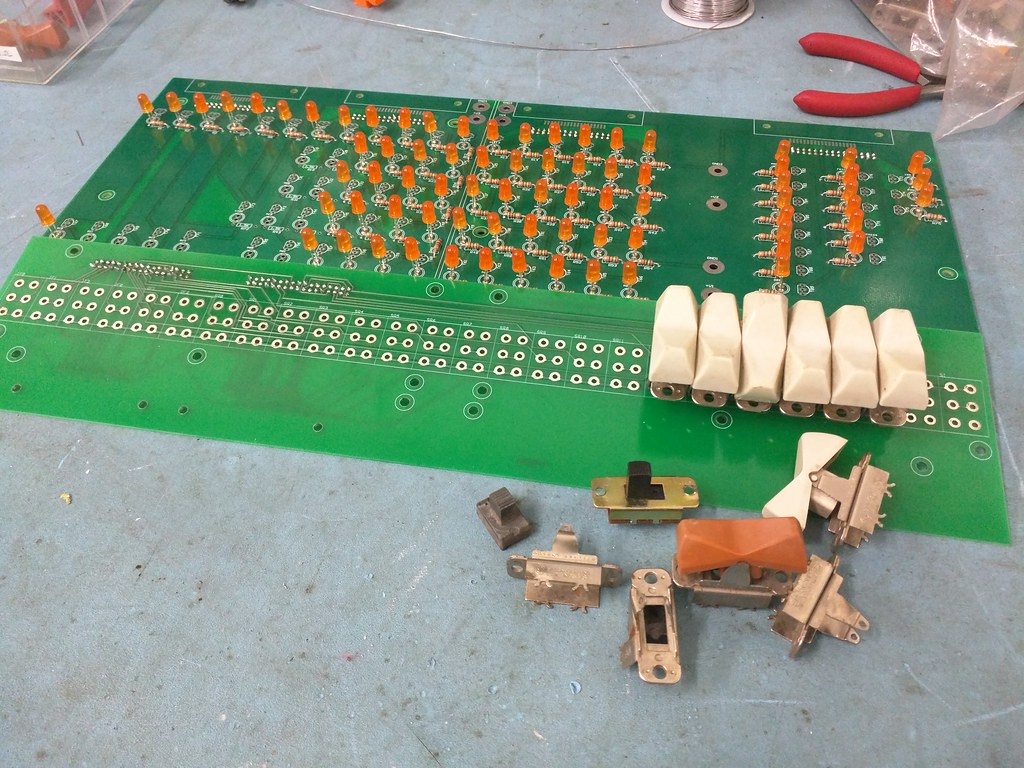
finaly got some pregress on this 8i from a feild restoration of mine..
now to sit down and do an order for the transistors
and go talk to the local ewaste recycler on monday see if they can help me
source some slider switches like one i found in the junk pile at the local
hacker space last night looks very promising will need to get new rocker
peics made to atach the 8i switches to but its looking promising if this
works out there may be a suden suply of replacement switch assemblys
avail...
https://c1.staticflickr.com/9/8752/27863539914_a92d0264c7_b.jpg
baby steps baby steps
Is there anyone with documents on the Nova 3 front panel, and what
drives it? It has some number of custom DG chips, which hopefully are
good if I want to try to fire it up to play, but am interested in that
on good authority there are 28v incandescent lamps.
A friend has an Eclipse front panel with nearly identical bezel, which
has LED's and a number of differences in the logic (different connector
to the system, for instance). So it is probably all run on 5v.
I have not had time to figure out the driver circuit for any of the
lamps to see what that may turn up, and wanted to know whether it was
28v lamps before I buy 40 of them. (the thing has only 2 out of a lot
of lamps).
Thanks
Jim
> From: Corey Cohen
> This board is from the 1st PCB house that made the "byte shop" boards
> but has the more expensive and reliable RN sockets.
Maybe someone at the 1st PCB house made an extra board for themselves, and
used better sockets (since it was for themselves)?
Noel
Hi Guys,
I've got an HP 9810A that has been stored in sub-optimal conditions by
a previous owner; a lot of the keyboard springs have rusted away, so
I'm looking for a replacement. These are about 15.5mm outer diameter,
0.35mm thick wire, about 10mm high when uncompressed, and have only
about 1.5 turns of wire.
Any pointers would be appreciated!
Camiel.
I am probably too stupid to not understand how to get into this box:
http://i.imgur.com/7KXKP2l.jpg
Before I break some parts of the old plastic I better ask...
What is the procedure to open this up?
The drive doesn't seem to work properly. Either I need to get it working
somehow or replace it with a new (512 byte block capable) drive.
/Mattis
>You used to be able to find a set with connector blocks for $200 to $300
>range on EBay. But I haven't seen any pop up for a couple of years now.
>
There are actually two individual board on eBay now, but the they are a
bit expensive, ~$250 each. The freight change is about $200 to Sweden for
each board (don't now if they combine chipping). I'll guess I have to pay
for customs as well...
>Keep an eye on machines. These options were found in the variants of E's
>(F and M) and some A's. You might have to buy another machine in order to
>get this option.
>
If I only could find one...
>Remember that you are looking for what I would classify as a fairly rare
>option on machines that are becoming rare now. There are not a lot of
>these machines in service anymore.
>
>Good Luck!
Thanks, I know that those things starts to get really rare. I could live
with a broken set.
/Anders
> From: Paul Koning
>> I always felt that RISC meant 'making the basic cycle time as fast as
>> possible by finding the longest path through the logic - i.e. the
>> limiting factor on the cycle time - and removing it (thereby making the
>> instruction set less rich); then repeat'.
> "Making the cycle time as fast as possible" certainly applies, in
> spades, to the 6600. The deeper you dig into its details, the more
> impressed you will be by the many different ways in which it does things
> faster than you would expect to be possible.
My formulation for RISC had two parts, though: not just minizing the cycle
time, but doing so by doing things that (as a side-effect) make the
instruction set less capable. I'm not very familiar with the 6600 - does this
part apply too?
>> RISC only makes (system-wide) sense in an environment in which memory
>> bandwidth is plentiful (so that having programs contain more, simpler
>> instructions make sense)
I should have pointed out that programs of that sort take not just more memory
bandwidth, but more memory to hold them. In this day of massive memories, no
biggie, but back in the core memory days, it was more of an issue.
>> One of the books about Turing argues that the ACE can be seen as a RISC
>> machine (it's not just that it's load-store; its overall architectural
>> philosophy is all about maximizing instruction rates).
I looked, and it's "Alan Turing's Automatic Computing Engine"; in Chapter 8,
"Computer architecture and the ACE computers", by Robert Doran (which is not,
for some reason, listed in the ToC).
> I think a lot of machine designers, though not all, were seriously
> interested in making them go fast.
Again, RISC has two legs, not just making the machine fast, but making them
fast by using techniques that, as a side-effect, make them inscrutable, and
difficult to program. The concept was that they would not, in general, be
programmed in assembler - precisely because they were so finicky.
Remember, the 801 was a combined hardware/compiler project, in which
complexity was moved from the hardware to the compiler; and early RISC
machines has things like no interlocks between pipeline stages. So they really
were not intended to be programmed in assembler - the compiler was critical.
The ACE, on the surface, didn't follow this, as it had no compiler. However,
at a higher level, Turing definitely followed the RISC philosophy of making
the machine as fast as possible, by using techniques that made it very hard to
program; instead of moving the complexity to the compiler, he moved it to the
programmer - the latter not being a problem, if you're Alan Turing! :-)
Noel
Hi All,
I noticed that the Multiflow race 14/300 system listed on eBay didn't sell
recently. I don't have any personal background with these machines but it
seems they could be both significant and rare? It's been sitting on eBay but
I wasn't sure if it had slipped between the cracks somehow? I've been in
contact with the seller and he's said that he's still hoping to sell it, but
that it has to be cleared soon (and would be scrapped). I don't live in the
US, so it's not an easy one for me to work with. Is this of interest to
anyone? Cheers Evan
http://www.ebay.com/itm/112050410557
I need to find a place to ask questions about scanners (scanner in the
sense of an Epson Perfection 1260 flatbed scanner, not in the sense of
radios).
Several searches have yielded only radio-type scanner sites (or dead links).
Does anyone here know of newsgroups or discussion boards for scanners?
Thanks,
Kurt
So I'm trying to work out how the PDP-11/24 memory works - in particular, how
the memory slots in the backplane can also support SPC devices.
Chapter 5 of the -11/24 Technical Manual does not help - irritatingly! It
spends a lot of time talking about the CPU's memory mapping (well documented
elsewhere), and little on these blasted busses!
Alas, there seems to be no KT-24 prints online (although the tech manual makes
reference to various pages in it); prints of the backplane would also be
really useful, but again, don't seem to be in what is online. Does anyone have
either one?
Failing that, I guess it will require getting ahold of a backplane, and seeing
what I can find out with an ohm-meter.
In general, I am not absolutely positive about how the UNIBUS and the Extended
UNIBUS manage to co-exist on the backplane (although I think I have worked it
out - see below). The tech manual acts as if the KT-24 acts as an intermediary
between the two... which is fine, except that how are the both carried on the
backplane, separately, but at the same time?
When there _is_ a KT-24 (the system can work without one - more below on
this), how is the EUB (which is just the UNIBUS plus a couple of extra address
lines) separated from the UB? The way the UNIBUS mapping registers work, the
EUB address for any given cycle can vary from the UB address by an arbitrary
amount, so lower address bits can't be shared between the two busses.
(Because address bit X might have to simultaneously be '0' for one bus, and
'1' for the other.) I.e. the two busses can't somehow mostly share the same
pins, through some kludge...
It appears likely that somehow the UNIBUS is on connectors C-F (i.e. where it
normally is on SPC slots), and the EUB is on the A-B connectors (as in MUD
slots) - and the two are not connected together.
(Note that on the 11/24 backplane, 4 slots are marked "SPC/Mem", and two
"SPC/MUD", which supports this theory; the 4 slots would have the EUB and the
UB not connected together - as they would be in a normal MUD/SPC slot.)
Looking at the CPU prints (which _are_ available), it appears to confirm this
theory; the 22-bit EUB address bus is carried on the MUD/EUB address lines
(connectors A/B), and the 18-bit UNIBUS addresses are carried on the SPC
address pins (connector E). Dollars to donuts those pins are carried across
slots 1-6, and not intereconnected vertically (I have yet to verify that,
either with the backplane prints, or with an ohm-meter, but I would put a very
large bet on it.)
Oddly enough, the CPU uses the UNIBUS SPC data pins (connector C), instead of
the MUD ones (connector A). The thing is that EUB memory boards (e.g. MM11-M -
the relevant page of the MS11-P prints are missing from the online set, alas)
pick up the MUD pins for data. So the backplane must connect together the SPC
data pins and the MUD data pins.
The system can apparently also work _without_ a KT-24! Which raises the
question 'how do DMA devices get to the memory when there's no KT-24'?
>From looking at the CPU prints, (pg. K11) it _looks_ like the UNIBUS is
automagically mapped through to the EUB when there's no KT24 (there's a pin
which is apparently pulled low by the KT-24); the low (256-8=248) KB of UNIBUS
address space is mapped straight across to low address space on the EUB memory
bus.
With no KT24 in, a standard EUB memory can go in 2. Slot 2 is special, though;
the KT24 needs not just the UNIBUS lines, and EUB address lines (to map from
one to the other); it also has some special interconnects with the CPU, e.g.
that 'UNIBUS adapter present' line.
Guess I should document all this in the Computer History Wiki, but those prints
(KT-24, and -11/24 backplane) would still be useful.
Noel
> From: Tony Duell
> If it's anything like the 11/44 ... the memory bus is carried on the A
> and B connectors, the peripheral bus on the C,D,E,F connectors.
I have yet to totally grok the -11/44, but the documentation indicates the
slots for memory are memory only (i.e. EUB on the A/B connectors). Are you
saying they are also SPC on the C/F connectors? (If so, ever tried plugging an
SPC device into a 'memory' slot? :-)
If so, that would make it very similar to the -11/24, then - although does it
also have the thing where the data lines are connected from the EUB (connector
A) to the SPC UNIBUS (connector C)? The CPU prints show data from the CPU
going to connector A, unlike the -11/24, which sends data to C - although if
the backplane has the EUB and SPC data busses connected, it would all be the
same in the end.
Noel
So the online set of MS11-P Field Maintainence prints is missing page 3 of the
prints (data drivers page). Does anyone have an original hard-copy, and can
supply a scan of the missing page? Thanks (in advance, and hopefully :-).
Noel
*Accuracy takes power: one man?s 3GHz quest to build a perfect SNES
emulator*
*Emulators for playing older games are immensely popular online, with
regular arguments breaking out over which emulator is best for which game.
Today we present another point of view from a gentleman who has created the
Super Nintendo emulator **bsnes**. He wants to share his thoughts on the
most important part of the emulation experience: accuracy.*
http://arstechnica.com/gaming/2011/08/accuracy-takes-power-one-mans-3ghz-qu…
--
Sent from my phone - please pardon brevity & typos.
I have a few GRiD compass systems and some are suffering from massively
decreased contrast on the edges of the displays:
[See the system on the left]
https://www.instagram.com/p/BIGGzUzgat-/?taken-by=tr1nitr0n
[Or this one:]
http://www.ripstick.com/USCM/images/Grid_Compass_1101_Laptop_in_Box_002.jpg
Meanwhile, other EL systems I have- like my HP integral PC- haven't
succumbed to this.
I have seen similar issues on amLCD displays in my Tadpole, Toshiba and
other machines, so this is something we all may have to confront.
-------
I was wondering if the folks here had theories?
I'm thinking moisture (or air) might be leaking in from the edges of the
glass panes, perhaps from a compromised seal- sorry for the silly picture
but you can see the composition of the display here:
https://www.instagram.com/p/6BXaLBtSzd/?taken-by=tr1nitr0n
Does anyone know how one might prevent this from progressing- storage tips?
Could it be reversed?
Better yet, does anyone have ideas on how to rapidly dehydrate the display?
Perhaps there is even a way to re-seal them.
I think all two-glass-pane displays that don't have a vacuum may eventually
succumb to this.
Perhaps it is just oxidation and not moisture, but I'd love to hear any
theories.
Thanks,
- Ian
--
Ian Finder
(206) 395-MIPS
ian.finder at gmail.com
Hello everyone. My employer plans to close the data center where I have
been working for several years usually. This involves the destruction or
elimination of all kinds of manuals, books, documents and diverse equipment
considering that this is deprecated. In general the hardware belongs to IBM
for contractual reasons, but not so with the documentation I have mentioned.
In my case I saved from destruction several old manuals and training
courses that I will begin to scan in the coming months. But I can not take
care of all available material. As an example there are enough red books
related IBM OS / 2 and its environment. There are also several CICS 2.1 ...
it is difficult to make an accurate count. I will try to make some more
detailed photos as possible and post them somewhere so that anyone
interested can review. Given my residence in the European Union, I think it
would be easier to send these documents to interested persons who also
reside in the EU, if necessary.
On the other hand I must say that we store yet one IBM 3705 operative until
few years ago. I don't know what plans have IBM for it. But that's another
story.
With kind regards
Sergio
A very nice IBM 3480 brochure ended up in my hands yesterday and I had
to bump it to the top of the scan queue:
https://archive.org/details/IBM3480MagneticTapeSubsystemBrochure
Lots of nice shots of IBM data center tape equipment as well as a cool
"history of tape at IBM" set of pages. I've never heard of 7340
Hypertape.
-j
> From: Mouse
> I'm wondering how practical it might be to take a laser and turn it
> into a vector display on a handy blank wall
Those have been around for decades - I recall seeing them used to draw things
on the sides of building, _many_ moons ago. I'm assuming they bounce the beam
off a mirror, and actuate the mirror, but I don't actually know how they
worked.
Noel
I recently got access to an orginal PDP-11/70 front console (the one in
magenta and rose), and also an 'Industrial' -11/70 (blue and red). Scans of
both of these front panels have been added to my PDP-11 stuff page:
http://ana-3.lcs.mit.edu/~jnc/tech/pdp11/PDP-11_Stuff.html
My A3 scanner won't _quite_ eat the whole thing in one gulp, but it did manage
to 'see' all the printed stuff. The actual panel is very slightly larger, so
there are some thin sections on either side missing from the scan, _but_ on
that page there is a mechanical drawing that gives the dimensions of the whole
thing. So the two together should enable a complete reproduction.
Noel
I wonder if any of the other digi labs leads are comparable? We have
fabratek and a few other brands. We got a bit obsessed with trainer type
gear for electronics and physics 'this what that got young people
interested back when' display.
if there are any list member with a small turret lathe that would be
nice to make pins with. pretty labor intensive. Better would be small
Brown and Sharpe screw machine would make buckets of them once you got
the machine all set up to make the run. Or cnc machine ( I never ran
one of those) --- or as mentioned casting some.
I will look and see is we need any pins.
Ed#.
In a message dated 7/19/2016 11:30:10 P.M. US Mountain Standard Time,
v.slyngstad at frontier.com writes:
From: Karl-Wilhelm Wacker: Tuesday, July 19, 2016 5:21 PM
> This company does custom tapered pins in brass -
> There are others out there I'm sure.
>
> I would find out what their minimum is and get a bulk order together.
>
> http://www.stanlok.com/Taper_Pin_Pages/an386.html
>
> A place I worked for in the past had www.mill-max.com do a custon part
for
> them,
> in the 100's - I would talk to them about a part also.
>From what I can gather from the websites you referred me to,
the tapered part of the pin's dimensions are very close to the woner if
fabratecnarrow end of a standard taper #4/0 in the 3/4" length? Have
I done the math right on that?
>From there it would seem to be a matter of getting a way to
mount the wire, and optionally to shorten the overall length
of the pin and wire attachment to .65" from .75". (Or maybe
just slot the pin's fat end, solder in the wire, and call it good.)
I also thought about using a taper reamer to create molds and
perhaps casting with solder around the fluxed wire. (Casting
brass or bronze seemed to require more heat than I could
generate easily.)
(For some reason that I've forgotten over the years, my eBay
search for suitable pins looks for "42107" and "42279". Never
gotten any results for it, though.)
Vince
On Tue, Jul 19, 2016 at 5:01 AM, <COURYHOUSE at aol.com> wrote:
> also a Rare Digital DEC H-500 Computer Lab, 1960s, Same Switches as
> PDP-8/I, Vintage for 700+
>
> ( we have an extra one of these Computer Lab, if anyone here is
> interested)
Does anyone have a modern source of pins that fit the socket holes in
the Computer Lab? ISTR there are a few of us here who have an H-500,
but very few, or no, patch cables. I think Molex pins have been tried
and rejected.
Also, the 1969 Computer Lab Handbook is on bitsavers (in
'dec/handbooks'). I recall a 8.5"x11" book on the Computer Lab, newer
layout, probably a 1970s publication date, possibly a teacher's guide.
I was given one as a kid, but it vanished decades ago. Anyone
remember this? Anyone have one for scanning?
-ethan
http://m.ebay.com/itm/DEC-PDP8-I-MINICOMPUTER-PDP8-PDP-8-PDP-8-/201627112300
Did someone already post this other pdp-8 auction? Same semi-ridiculous starting price as other straight 8 but i honestly don't know enough about PDP to know what this is or if its not a straight version. ?Seems like a museum piece though although perhaps all of you PDP collectors have a similar setup :-)?
> From: Mouse
> my impression is that they're only for pre-prepared displays, and only
> some displays (notably those that don't involve the beam turning any
> sharp corners
My vague recollection is that they could do pretty sharp corners, but it's
been decades. IIRC, they were multi-coloured.
> Turning sharp corners is the hard part with mechanical deflectors like
> mirrors, as it means very high acceleration of the mechanical parts.
Probably the trick is to do what old voice-coil actuator drives did for
multi-track seeks, which was to evenly accelerate up to maximum velocity,
coast at that until you got close to the target track, and then evenly ramp
down, so that the head assembly's radial velocity goes to 0 as you get to the
target track. (If you're not moving enough tracks to do the whole thing, you
only ramp up part-way, then ramp back down.) The RK05 drive did this with
fancy analog circuits, but these days one would do it in software.
I would assume one would do something similar with the mirror; evenly
accelerate up to maximum slew rate, then back down at the end of the move, so
that when one gets to the corner, the mirror is mostly stationary, and so not
so much force is needed to sharply change directions. Of course, this might
make the parts of the line where the mirror is moving slower brighter, but
perhaps one could tweak the brightness to compensate.
Noel
A reseller in GA is dumping some online inventory that they used to sell on
ebay. Included are
23 SEAGATE ST32500N HARD DRIVE
If interested, email to Mike Roetzer [mike at tbfcomputing.com]
Not affiliated with the seller at all.
Cindy Croxton
I just put in pdp-8 in ebay search and saw it last nite -Ed#
In a message dated 7/19/2016 12:24:15 P.M. US Mountain Standard Time,
pontus at Update.UU.SE writes:
I can't find it, does anyone have a URL?
/P
On Mon, Jul 18, 2016 at 01:58:12PM -0700, jim stephens wrote:
> 25,000, Alexandria, Va.
>
> Josh Dersch can have one for his home and for work.
>
> BTW, about the other nice system noted here, I was hoping the 11/20
would
> stay off the radar and not go for a zillion bucks, so much for that idea.
> At least I have the means to go to Tucson and get it if I'm nuts and go
for
> it.
>
> Thanks
> Jim
25,000, Alexandria, Va.
Josh Dersch can have one for his home and for work.
BTW, about the other nice system noted here, I was hoping the 11/20
would stay off the radar and not go for a zillion bucks, so much for
that idea. At least I have the means to go to Tucson and get it if I'm
nuts and go for it.
Thanks
Jim
A rescue available... contact Ric directly below.
- John
>From: Ric Chitwood <dancetech at comcast.net>
>Subject: Atari 1040ST
>Date: Mon, 18 Jul 2016 10:56:05 -0600
>
>I have a fully functioning Atari 1040ST with monitor in the original boxes that I would like to donate.
>It also has the Hybrid Arts Smpte Track hardware and software included.
>
>I also have a fully functioning Apple 7100AV computer with monitor and Digidesign sound card and software floppy discs. Are you interested in these computers or do you know of someone who is?
>
>Ric Chitwood
>Pleasant Grove, Utah
In the UK we have, for DOMESTIC premises something call "Part P"
> -----Original Message-----
> From: cctalk [mailto:cctalk-bounces at classiccmp.org] On Behalf Of Mouse
> Sent: 19 July 2016 17:47
> To: cctalk at classiccmp.org
> Subject: Re: Cray J932SE (was Re: Straight 8 up on Ebay just now)
>
> >> [...electrical wiring...]
> > This very definitely is an area where, if you're not 100% comfortable
> > with t$
>
> Also, know your own limits. A depressing number of people think they're
> more competent than they are.
>
> For example, I once had a neighbour who replaced an outlet in his kitchen.
> Turned off the breaker, removed the old one, put in the new one, all very
> nice. Turned the breaker for that circuit back on and popped the service
> main breaker.
>
In the UK we used to have an inspection regime. You did the work, they would
inspect.
These days, for DOMESTIC premises we have something call "Part P" which
limits what a householder can and cannot do.
So you can generally do "like for like" replacements, add additional outlets
where permitted and one or two other things.
Originally all work in Kitchens was defined as "Special" and was notifiable,
but this was modified so that is no longer the case.
So as the above is a "like for like" replacement, I believe it is currently
permitted in the UK.
Of course in a Museum, or even a Scout Hut, provided it does not share a
supply with residential premises then any one can do the
Work so long as it is later inspected.....
... the problem with Part P is that it encourages a "tick box" approach and
the Electrician who replaced my "Consumer Unit" (distribution panel)
With a new one with multiple RCD's which tripped suggested it would be
simpler to re-wire rather than fix the existing wiring.
This sort of approach seems common. The actual fault was that I have a pair
of linked smoke detectors, and one was connected via one RCD, the other via
a different RCD.
The connection between the two was sufficient to cause an imbalance. I
replaced them with wireless linked smoke detectors and all works well....
> When I investigated, it turned out the new outlet still had the bridging
piece
> that shorts together the hots for the two outlets, and this was a kitchen
> outlet and thus had separate circuits for each half (and, as is often the
case,
> they were on adjacent fingers in the breaker box and thus on different
> phases). So, of course, the new outlet shorted the two hot phases
together.
>
> He didn't have the experience to recognize that those shorting pieces
exist,
> to realize that having four conductors instead of three coming to the
outlet -
> or its being a kitchen outlet - likely means the two halves are on
different
> circuits and thus likely different phases, or the electrical understanding
to put
> those facts together. Which wouldn't've been a problem, except that he
> thought he was fine - he didn't bring me in until the main service breaker
> blew. (He did, fortunately, have enough sense for that to tickle his
> "something I don't understand happened, call for help" reaction.)
>
> I've been doing electrical work since I was maybe ten or twelve, when I
> helped my parents wire the house they were building. (My father inspected
> my work first; then, this being de rigeur there-and-then, it was inspected
by
> a suitable authority. Only then was it energized.) I don't hesitate to
do
> routine house electrical work, maybe even installing 30A outlets (though
I'd
> make sure I looked up the appropriate gauge of wire, and probably then
> used the next larger gauge). But I'd call in someone more experienced for
> something well outside my own experience, like (say) dealing with 600/600
> service.
>
> I would say that, if you don't have a good deal of experience, find
someone
> who does to look over your work before you energize it.
> Indeed, some jurisdictions require that for work done by unlicensed
persons
> - or at least used to, and I would assume some still do. Even if yours
doesn't,
> it strikes me as the smart thing to do.
>
> /~\ The ASCII Mouse
> \ / Ribbon Campaign
> X Against HTML mouse at rodents-montreal.org
> / \ Email! 7D C8 61 52 5D E7 2D 39 4E F1 31 3E E8 B3 27 4B
Dave
G4UGM
> From: Paul Koning
> The article, as usual, talks about a whole bunch of things that are
> much older than the author seems to know.
"The two most common things in the universe are hydrogen and stupidity." OK,
so technically it's ignorance, not stupidity, but in my book it's stupid to
not know when one's ignorant.
> RISC, as a term, may come from IBM, but the concept goes back at least
> as far as the CDC 6000 series.
Hmm; perhaps. I always felt that RISC meant 'making the basic cycle time as
fast as possible by finding the longest path through the logic - i.e. the
limiting factor on the cycle time - and removing it (thereby making the
instruction set less rich); then repeat'. (And there's also an aspect of
moving complexity from the hardware to the compiler - i.e. optimizing system
performance across the _entire_ system, not just across a limited subset like
the hardware only).
As I've previously discussed, RISC only makes (system-wide) sense in an
environment in which memory bandwidth is plentiful (so that having programs
contain more, simpler instructions make sense) - does that apply to the CDC
machines?
> Pipelining, to the CDC 7600.
Didn't STRETCH have pipelining? Too busy/lazy to check...
> And if you equate RISC to load/store with simple regular instruction
> patterns, you can probably go all the way back to the earliest
> computers
Well, I'm not at all sure that load-store is a good indicator for RISC - note
that that the PDP-10 is load-store... But anyway, moving on.
One of the books about Turing argues that the ACE can be seen as a RISC
machine (it's not just that it's load-store; its overall architectural
philosophy is all about maximizing instruction rates).
Noel