-------- Original message --------
From: "Ian S. King" <isking at uw.edu>
Date: 2016-10-09 2:30 PM (GMT-08:00)
To: "General Discussion: On-Topic and Off-Topic Posts" <cctalk at classiccmp.org>
Subject: Re: Twiggys [was: Re: ka... ching!]
On Sun, Oct 9, 2016 at 2:37 AM, Dave G4UGM <dave.g4ugm at gmail.com> wrote:
> > -----Original Message-----
> > From: cctalk [mailto:cctalk-bounces at classiccmp.org] On Behalf Of Brad H
> > Sent: 09 October 2016 07:41
> > To: General Discussion: On-Topic and Off-Topic Posts
> > <cctalk at classiccmp.org>; jwsmail at jwsss.com
> > Subject: Re: Twiggys [was: Re: ka... ching!]
> >
> >
> >
> > I'd like to learn more about programming, esp for my 6800.? It'd be fun
> to test
> > its limits and see what uses I can find for the graphics board I got. I
> just don't
> > understand how they programmed the thing. All the hex stuff throws me
> > off.? :)
>
> Does it have a serial interface and memory. In which case it was probably
> programmed in Assembler.
> When I started with 6800 board and 256 bytes of memory, and toggle
> switches to load it I used to hand assemble the programs to get the
> hex/binary.
> I soon got bored of the toggle switches and built a little box with an old
> calculator keyboard and display and some TTL so I could enter data quickly.
>
>
> Dave
>
> I recently acquired a SWTPC 6800, a machine I remember from when it was
new.? :-)? There are many programming environments available for it - I'm
working to get Forth running on mine, then I'll branch out.
It's been said that the 6800 inherited a lot of ideas from the PDP-8, and I
agree with that to some extent.? The ISA is actually very clean and neat,
once you wrap your head around it - I used to program 6800 assembler
professionally, my first paid job as a programmer!? Unlike the PDP-8, I/O
is memory-mapped.? Depending on what monitor ROM you have (if any), you may
have different system services available.? One very useful system is the
one that can read S-records from the serial input, allowing you to easily
transfer programs onto the machine.
If you want to grok the 6800 in fullness, there are online scans of
Motorola's programming manual for the device.? Another great resource is
the swtpc.com site, even if you don't have a SWTPC machine (what do you
have?).
Have fun with it!? Cheers -- Ian
--
Ian S. King, MSIS, MSCS, Ph.D. Candidate
The Information School <http://ischool.uw.edu>
Dissertation: "Why the Conversation Mattered: Constructing a Sociotechnical
Narrative Through a Design Lens
Archivist, Voices From the Rwanda Tribunal <http://tribunalvoices.org>
Value Sensitive Design Research Lab <http://vsdesign.org>
University of Washington
>There is an old Vulcan saying: "Only Nixon >could go to China."
I've an original SWTPC 6800. ?Also have an ASCI System X and a Tektronix 6800 board bucket. ?Right now I'm enjoying working with the SWTPC. ?I'm trying to deck it out as completely as one could have.
I don't quite understand assembly.. I assume to program in that, as with BASIC you need to load an 'assembler' language first? ?I tried this with my Digital Group system with 5 different tapes marked 'assembler' but never got them to load. ?Not sure if I understand the concept.
I'd like to learn more about programming, esp for my 6800. ?It'd be fun to test its limits and see what uses I can find for the graphics board I got. I just don't understand how they programmed the thing. All the hex stuff throws me off. ?:)
Sent from my Samsung device
-------- Original message --------
From: william degnan <billdegnan at gmail.com>
Date: 2016-10-08 8:54 PM (GMT-08:00)
To: jwsmail at jwsss.com, "General Discussion: On-Topic and Off-Topic Posts" <cctalk at classiccmp.org>
Subject: Re: Twiggys [was: Re: ka... ching!]
To me, getting old computers up and running, or programming on them *is*
the game as far as I am concerned.? More fun than most packaged software
games.? I have made my own games, and I certainly play computer games, but
that's not why I am interested in vintage computing.
I just spent a few hours tonight attempting to network my NeXTstation color
computer and get to the post of accessing the vcfed.org forum so I could
post a message on there.? Just for fun, using ancient dawn of the WWW
technology.??? Feels like a game to me, there is no practical purpose to
doing this other than enjoyment.
My point is for those of us who pooh pooh vintage gamers not to take
themselves too seriously.? We're all just playing games if you ask me.
I'm interested!
I'm down in California and I also have no idea what it's worth, I'm new to
the PDP scene.
On Oct 9, 2016 10:00 AM, <cctech-request at classiccmp.org> wrote:
> Send cctech mailing list submissions to
> cctech at classiccmp.org
>
> To subscribe or unsubscribe via the World Wide Web, visit
> http://www.classiccmp.org/mailman/listinfo/cctech
> or, via email, send a message with subject or body 'help' to
> cctech-request at classiccmp.org
>
> You can reach the person managing the list at
> cctech-owner at classiccmp.org
>
> When replying, please edit your Subject line so it is more specific
> than "Re: Contents of cctech digest..."
>
>
> Today's Topics:
>
> 1. PDP-11/23 system for sale in Portland Oregon (Scott Baker)
>
>
> ----------------------------------------------------------------------
>
> Message: 1
> Date: Sat, 8 Oct 2016 11:31:29 -0700
> From: Scott Baker <scott.l.baker at gmail.com>
> To: cctech at classiccmp.org
> Subject: PDP-11/23 system for sale in Portland Oregon
> Message-ID:
> <CABW5Ymky8tCrsTKL4ehEUDt4vtkDxO1hYTDAUS2ANnxxux8Ykg at mail.
> gmail.com>
> Content-Type: text/plain; charset=UTF-8
>
> Hi,
>
> Pictures can be found here: http://sierracircuitdesign.
> ddns.net/temp/pdp11/
>
> The system is located in Portland, Oregon. Local pick-up is preferred.
> Not sure if it still works. I have not tried to turn it on in years.
> I do not have any software of floppies for it.
> I'm not sure what it's worth. If you are interested in it, make me an
> offer.
>
> Regards,
> Scott
>
>
> End of cctech Digest, Vol 28, Issue 4
> *************************************
>
> From: Ian S. King
> What I want to record here for posterity is how to open one of these
> things.
I archived this to the Computer History wiki:
http://gunkies.org/wiki/TeleVideo_TPC-1
Hope that was OK!
Noel
no real interest in playing games though the curiously of seeing star
trek game on friends Digital Group Computer ( had little screen in the
front of it... I want one for SMECC display working or not)
group and getting a baudot teletype model 14 lead to me starting a
computer company in 1979...
The big and best game for me was THE HARDWARE and running timeshare
systems ) hp-2000 then later hp-3000 later also became full line
Independent HP PC products dealer.... but that was just selling stuff not
the feel of thrill and adventure the other phases had!
Ed# _www.smecc.org_ (http://www.smecc.org)
In a message dated 10/9/2016 9:07:45 A.M. US Mountain Standard Time,
ard at p850ug1.demon.co.uk writes:
> > Find better games :)
>
> Nope, not even. Has as much appeal as base jumping. I'd rather be
I think I'm with you on this one. The only computer games I find even
mildly interesting are ones that involve thought and/or hackery to
complete. I found the HP67 Games Pac (A set of programs for a
handheld calculator with a numeric display) to be much more
entertaining than anything on a modern console.
But even so, I even enjoy those games that much. Relaxation for
me is reading the service manual for something I don't own,
figuring out what the schematics really mean, etc. Or mindlessly
stuffing a PCB.
-tony
=
Flipping is just treasure hunting by another name. ?Estate and storage locker sales are the modern equivalent of digging for pirate gold. ?I think people worldwide love that stuff but particularly Americans because they have that brash adventurer spirit embedded in the national character.
Sent from my Samsung device
-------- Original message --------
From: ethan at 757.org
Date: 2016-10-09 8:46 AM (GMT-08:00)
To: "General Discussion: On-Topic and Off-Topic Posts" <cctalk at classiccmp.org>
Cc: General at classiccmp.org
Subject: Re: Twiggys [was: Re: ka... ching!]
>>>? Just like the car collecting, comic book collection and just about
>>> most other hobbies when they mature.? The same type of people who
The comic book market crashed due to the flipping side of it as far as I
know. When it changes from a hobby to a speculative mania, I suppose that
is when things eventually explode?
They can go on a lot longer if backed by the government and low interest
rates, see speculation in housing. Plus weak returns in other markets.
Unlike basic needs like the housing market bubble (which has yet to crash,
but probably will which isn't a bad thing) hobbies like Classic Computers
probably have interest waves. Certain people who grew up with such and
such hold it dear. Eventually interest in it will probably fade as the
people with memories of the subject fufill reliving the experience, or
die. And there is a lot of money to be made, then vendors might swoop in
to make cash (see Roland and Yamaha with their recent Botique recreations
of vintage analog synthesizers.)
Also for much of the younger generation housing costs are so high (and
perhaps job opportunities weak) that collecting things becomes more of a
burden. It costs a lot of time to move stuff from apartment to apartment,
and money to store it. Buying a house with low prospects of job stability
is also a risk and can damage chances of relocating for jobs after
layoffs. The damage of the years of offshoring and outsourcing is hidden
behind the national debt, student loan debt and housing debt.
Also there is some sort of American obsession with flipping stuff. A lot
less shows about building new things versus shows about flipping stuff (be
it Pawn shops, Storage Units, American Pickers type stuff, and of course
-- housing flip shows.)
-------- Original message --------
From: Chuck Guzis <cclist at sydex.com>
Date: 2016-10-08 2:17 PM (GMT-08:00)
To: "General Discussion: On-Topic and Off-Topic Posts" <cctalk at classiccmp.org>
Subject: Re: Twiggys [was: Re: ka... ching!]
On 10/08/2016 09:46 AM, js at cimmeri.com wrote:
> I think the people who complain about "Altairs just sitting on
> desks" might be doing so for at least one reason being because a
> particular purpose seems to violate the original spirit, intent, and
> purpose behind the creation.? I hear that a lot eg. "it's a shame
> it's just sitting there, not being used."
>
> It's when other purposes come in, and begin to make this hobby
> purpose more difficult to engage in and "unobtainium", that the
> hobbyists lament.? If there were enough for everyone, then there'd be
> no complaining.
I have to confess to a certain amount of bemusement when I witness the
phenomenon of game-obsession with early PCs.? With the exception of
"home" systems, such as Commodore and perhaps Apple and the like, I knew
very few people who *purchased* a PC for game playing.? Did people play
games on PCs?? Sure--but that was rarely the reason that anyone ponied
up for a 1970s or 80s multiple-kilobuck system.? Mind you, this was
around the time that one could purchase a Porsche 914 for little more
than $3000.
Most of the people I knew purchased a PC to do business applications
(AR, AP, GL, inventory, payroll or word processing) or worked with
spreadsheets.?? Yet, very little of this is ever discussed on fora such
as the Vintage Computer Federation site.
Indeed, I think it's safe to speculate that the bulk of Intel Inboard
cards were sold to those running Lotus 1-2-3.
After we're all gone, what will future generations think of us? That we
developed new hardware and software solely to play games?
Wow.
--Chuck
>
When I was a kid we had the IBM PCjr through PS/2. ?Concurrently I had my own Commodore 64. ?Up until we got our AT, the Commodore was the game machine. ?There were lots of PC versions of games out there but they *sucked* in terms of graphics and sound (we also lacked a joystick for the PCs) compared to the Commodore. ?King's Quest was the earliest game I played on PC.. but I don't recall it being available on Commodore at the time. ?One of my best memories was of the computer lab at our school. ?We had 30 64s up there chained to a 4040 (I think) via C64 Link expanders. ?We had a game day every so many weeks and had all kinds of fun trying to get games to load via that setup.
I remember thinking of gaming on 'Dad's computer' as an odd idea. ?But then Test Drive came out. ?Then our school dumped the Commodores and went to PCs. ?People started showing up at school for game day with PC games like Empire. ?And then the PC finally started to catch up and surpass the Commodore in quality and the games reached a level the Commodore couldn't do. ?Between that and the ease of loading things quickly from hard drive.. the C64 ended up going into hibernation. ?After that it was all about upgrading the PC to run Falcon or some such acceptably.
Hi folks,
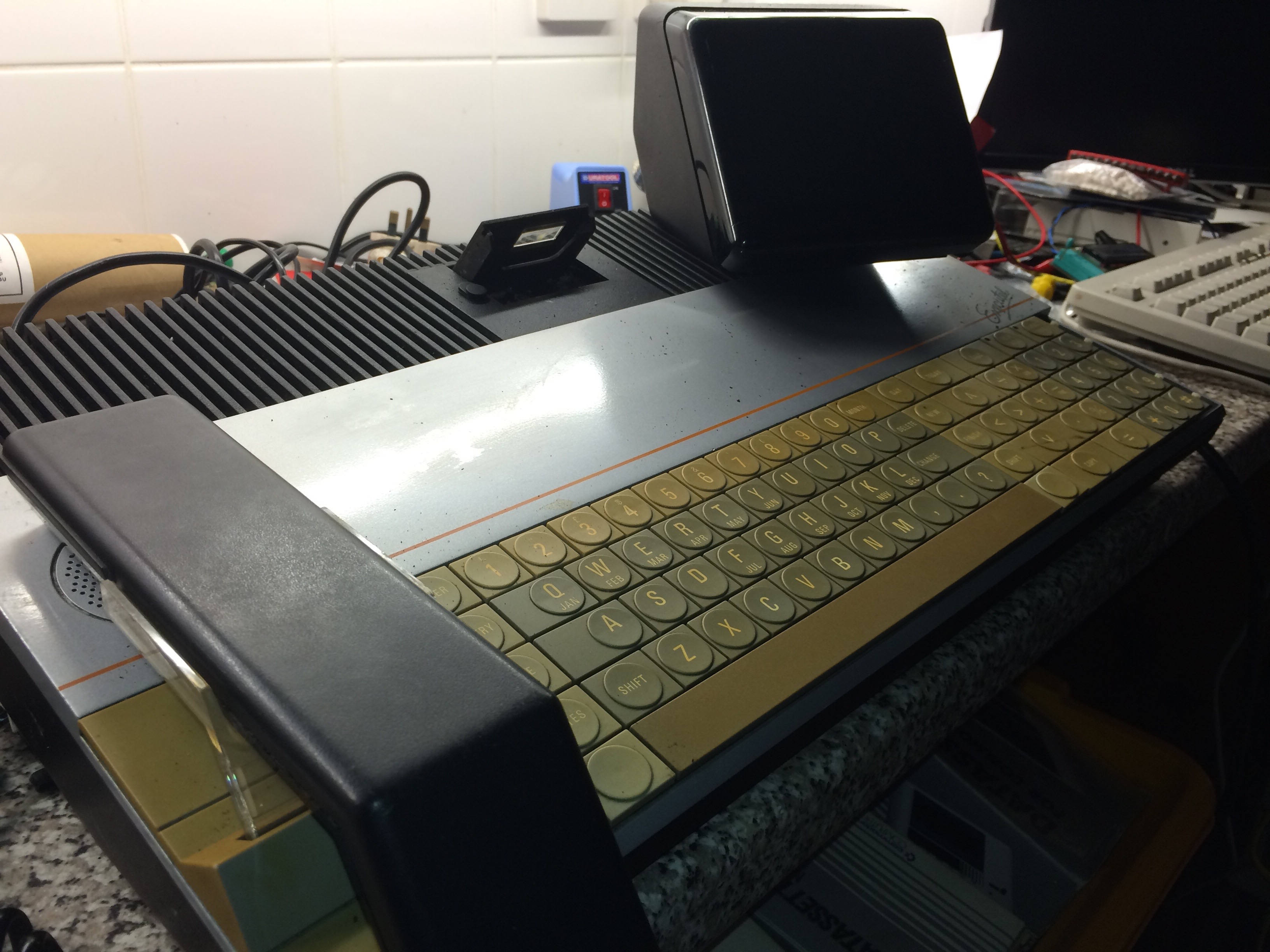
I happened upon a rare beast last weekend and it finally dropped into my
hands yesterday. Most folk know about the ICL One-Per-Desk which was
essentially a Sinclair QL with re-engineered microdrives and sold massively
well here in the UK (British Telecom rebranded it as the BT Merlin) and
Australia (Computerphone) and I think it made it to the US too?
People don't seem to know about its predecessor, me included. STC (Standard
Telephone & Cable) had this designed in the late 70s but it didn't make it
to market until 1984 - the STC Executel 3010. It's an AMD8085A powered desk
phone with 5" monitor that could store your phone entries, diary
appointments, autodial and connect to Viewdata services - PRESTEL in the UK.
It was expensive and didn't sell, some googling seems to show that there are
only maybe half a dozen in existence with 4 of them in the Cambridge area,
apt since it was designed by PA Consulting who amongst other things
redesigned the Tandy Coco for the UK and marketed it as the Dragon32.
What's interesting from a US standpoint is that it apparently DID make it
over the pond and was sold as the 'Buckingham' so the question is, anyone
heard of it?
http://www.binarydinosaurs.co.uk/STCExecutel01.jpg
--
Adrian/Witchy
Binary Dinosaurs creator/curator
Www.binarydinosaurs.co.uk - the UK's biggest private home computer
collection?
Hi,
Pictures can be found here: http://sierracircuitdesign.ddns.net/temp/pdp11/
The system is located in Portland, Oregon. Local pick-up is preferred.
Not sure if it still works. I have not tried to turn it on in years.
I do not have any software of floppies for it.
I'm not sure what it's worth. If you are interested in it, make me an offer.
Regards,
Scott
On Sun, Oct 2, 2016 at 8:20 PM, jim stephens <jwsmail at jwsss.com> wrote:
>
>
> On 10/2/2016 6:23 PM, Ian S. King wrote:
>
>> Hi all,
>>
>> I've posted looking for help with a TeleVideo TPC-1, and I've heard a lot
>> of crickets <snip>
>>
> I saw your FB posting, good job, and chirp chirp.
>
>> I've ordered an exact, tested/guaranteed
>> working replacement from ePay,
>>
> Those were common drives, but be sure to do a careful inspection, as some
> of the drives had variants that were subtle.
>
> good job, great you got it working.
> thanks
> JIm
>
>> and I'm going to have everything working to
>> spec before I snap this thing back together.
>>
>> Yes, I'm having fun. :-)
>>
>> OK, my 'new' Teac drive arrived and passed inspection. I carefully
jumpered it to match the original, reassembled just enough that I could
plug it in, and... success! So to recap (pun intended), the machine had
bad caps in the power supply (leaking goo) and a bad drive 0.
What I want to record here for posterity is how to open one of these
things. It was a real pain, which I've heard was intentional. Reassembly
was challenging, too, but at least I could see what was happening. So here
goes:
To disassemble, you need to remove four screws. Facing the unit as it sits
on the bench (i.e. operating position), there are two screws on the top of
the machine at the front corners and two others on the rear, vertically
centered and near each vertical edge (one of them is in the recess where
you can store the power and keyboard cables). Now it gets fun.
The unit disassembles into a top cover that wraps over side-to-side, and a
rear piece that holds the majority of the electronics. The bottom piece of
the main case holds the power supply, floppy cage and some of the video
electronics. There are plastic 'teeth' that fit into indents at various
point along those pieces. For the top cover, the 'teeth' are part of the
cover, one per corner. For the back panel, the teeth snap into the top and
bottom of the main part of the case. The teeth are also accompanied by a
very thin indent in the case piece.
It's sort of a muscle job to get these things separated. I got the back
piece free before removing the top piece, with a little help from a putty
knife in those indents.
There are screws in the bottom of the case that hold in the power supply
and the floppy cage One of the floppy case screws is located underneath
the tilt 'foot'.
Putting it back together: be sure you have the logic board *inside* the
screw points for the back panel, but don't put in the screws yet. Seat the
top cover with its teeth in place, and insert the two front screws (don't
screw down tightly yet). Then, lever the back panel's teeth into their
slots, watching the top cover to be sure it doesn't try to pop off. Insert
the two rear screws and tighten. Now tighten the front two screws, and
it's back together. It may take a little jostling to get everything to
reseat completely.
Now to go through the metric butt-ton of software I got with this thing -
over a hundred floppies. Looking at the labels, some are duplicates, some
are 'working' disks, and some are original TeleVideo floppies with system
software. Fortunately, one of them is Kermit, which will make the
archiving job a lot easier!
OK, that was fun. Next! Probably the Kenwood TH-77A I bought that won't
transmit. Cheers -- Ian
--
Ian S. King, MSIS, MSCS, Ph.D. Candidate
The Information School <http://ischool.uw.edu>
Dissertation: "Why the Conversation Mattered: Constructing a Sociotechnical
Narrative Through a Design Lens
Archivist, Voices From the Rwanda Tribunal <http://tribunalvoices.org>
Value Sensitive Design Research Lab <http://vsdesign.org>
University of Washington
There is an old Vulcan saying: "Only Nixon could go to China."
Right on... The most important thing is.... IS THE OBJECT BEING SAVED?
Even if you restore something today it will be crap in another 50 years
If you do not restore it now it will run like crap too.
SO... in 50 years both are equal.. they will both run like crap no
matter if restored now or not.
The only caveat to the above examples is in ANY and EVERY case make sure
the old batteries are out of it!
And lastly... usually the people that raise the most protest 'about
something not being used' are those that do not have one. Draw your own
conclusions...
Ed#
In a message dated 10/8/2016 9:46:04 A.M. US Mountain
.......................
> Just like the car collecting, comic book collection and just about
most other hobbies when they mature. The same type of people who complained
about the price of an Xmen#1 because people would just buy and display them
and not read them, complain when someone buys an ALTAIR to sit on their
desk and doesn't turn it on. Better that than the garbage heap, without
money coming into our hobby it would eventually die out and many artifacts
would be lost to the dump.
I have an RD53 disk drive. When I plugged it in the other day something blew
up, smoke etc. I found that it was a tantalum capacitor on the motor control
board that had gone. I suppose I am wondering if just replacing it is a good
idea, could the failure be a symptom of another problem, could it have
damaged something else? I realise that without a schematic it may be
difficult to comment, but I suppose it is more a question about what can
cause these caps to fail?
If anyone has a schematic, or a drive they can examine, it is C1 on the
motor control board, quite close to the molex socket for power.
Regards
Rob
A buddy located this just in time, it was out at a scrapyard and we are
about to get hit with a hurricane over here in florida. Picked up a
commodore amiga 2000 with the keyboard, no mouse or monitor. I hooked it up
to a tv via composite and get to the boot screen. It appears to have a scsi
hard drive controller in it.
I figured this would be the place to ask... It looks as if PC compatibility
boards can be added to the machine, boards with a 286, 386, or 486 and
some memory on a board, capable of running MS DOS. IF i were to install
such a board, what kind of graphics capability would the dos side of things
have?
I just got started with the machine, im still trying to get it to boot up,
but if it would be pretty capable with dos then i will keep an eye out for
one of the cards.
any suggestions to get started would be appreciated.
--Devin
> From: Fred Cisin
>> Did you tell the dumpsterers that they'd thrown out stuff worth
>> thousands of dollars? (I would have made to sure to let them know
>> that, with great spite.)
> "So? Boss said throw out everything in the closets. ..."
Clearly, the Indians weren't to blame. But I sure hope someone told the
chief...
> From: Corey Cohen
> As for stuff in vintage computer that is going up, it's not just Apple.
> It has to do with how mainstream and how rare something is. ... I do
> agree the rare Apple stuff is growing faster, but that's because it can
> pull from the business community as buyers who love the comeback story
> of Apple and what it represents.
Oh, I don't have any issue with Altairs going for $1-2K; I think one can make
a rational case for that; they were a key machine the growth of personal
computers, etc, etc. But I do think that when it comes to Apples, there is a
certain level of irrationality in some/many buyers. ($20K for a pair of
floppies?) There is definitely an Apple cult, which I think is a factor.
Let me make another analogy with cars (which I also used to collect). I think
early Ferraris are really, really cool - and the 330 P4 is, in my eyes, one
of the most beautiful race cars ever built (maybe _the_ most beautiful). But
if I had $10M, I sure as hell wouldn't spend the whole lot on an original P4;
I think better value would be to buy a down-to-the-last-bolt-exact replica,
for say $500K, and have $9.5M left over to buy other cool stuff with.
This goes quintuply for an original GTO, at $50M. One could do all sorts of
amazing things with that much money. Is having an original _really_ worth as
much (or more) than all those other things? Like I said, a certain level of
irrationality.
Noel
-------- Original message --------
From: Brent Hilpert <hilpert at cs.ubc.ca>
Date: 2016-10-07 8:46 PM (GMT-08:00)
To: "General Discussion: On-Topic and Off-Topic Posts" <cctalk at classiccmp.org>
Subject: Re: Twiggys [was: Re: ka... ching!]
On 2016-Oct-07, at 5:17 PM, Noel Chiappa wrote:
>> On 10/7/2016 5:21 PM, Chuck Guzis wrote:
>
>> That simply defies logic. I *really* don't get this collecting business.
>
> It's Apple-related. Some Apple devotees seem to have an, ah, excessive
> attachment to things Apple. (Q.v. $1M Apple I's.) I'm suprised that some of
> them didn't commit suttee when Steve died.
I agree this valuation is primarily "Apple"-driven rather than say "vintage-computer" driven,
but here's an interesting non-Apple sale, just completed:
http://www.ebay.com/itm/Cromemco-Dazzler-JP-1-Joysticks-D-7A-S-100-Card-Doc…>IMSAI-/291888851989
And yet the untouched original Mark-8 boards I bought only went for $1500. ?I don't get it.
90 mm f 2 summacron was a great lens!
wish I had one back for our M2.
In a message dated 10/7/2016 7:15:36 P.M. US Mountain Standard Time,
cisin at xenosoft.com writes:
On Fri, 7 Oct 2016, COURYHOUSE at aol.com wrote:
> Leicas dumpstered? OMG !?
> oh.... the humanity!!!!!!!
Indeed!
M2 AND M3, with marvelous lenses. CHead had promised me the Summicrons,
which I have always dreamed of having.
I found 2 cases that the dumpsterers missed, containing a mint 2-1/4x3-1/4
Graflex and lenses, and a Visoflex Tele-Elmarit with serious cosmetic
damage due to the foam deteriorating. When it became clear that the rest
were gone, I did a quick sale of the Tele-Elmarit for $1000, kept a 47mm
Super-Angulon (almost fills 4x5!), and gave the Graflex with the rest of
its lenses to another of CHead's friends who wanted to learn what HE
considered "large format". I'm currently playing with swings and tilts
with the Super Angulon on a Hama/Kenlock/Spiratone bellows as a miniature
technical camera.
> From: Fred Cisin
> I found 2 cases that the dumpsterers missed ... I did a quick sale of
> the Tele-Elmarit for $1000
Did you tell the dumpsterers that they'd thrown out stuff worth thousands of
dollars? (I would have made to sure to let them know that, with great spite.)
And if so, what did they say?
Noel
Leicas dumpstered? OMG !?
oh.... the humanity!!!!!!!
In a message dated 10/7/2016 5:18:44 P.M. US Mountain Standard Time,
cisin at xenosoft.com writes:
On Fri, 7 Oct 2016, COURYHOUSE at aol.com wrote:
> but.... if you were a hardcore mustang collector you would not sleep
> until you had every part that went with it...
Having been around when they came out, and still around when I did not buy
non-running rolling rebuildables for a few hundred dollars, I'm not likely
to ever become that hardcore Mustang collector!
I will sell my Leicas to the hardcore! (So that they won't get
dumpstered after I die, like CHead's did!)
> Maybe not astronomical, but most of the systems I'm interested in,
> anyways, are almost always outside my price range.
> ...
> it's not 'astronomical' just out of reach.
Look at old cars. There's a whole range, from $15M Ferraris on down. The
existence of cars are higher prices doesn't stop lots of people from enjoying
lower-priced ones.
I completely fail to see why old computers should be any different. Can
everyone afford a Ferrari? No. Has this seriously damaged old car collecting?
Doesn't see to have.
Noel
I'd like to see a dig like they did for the Atari ET carts where the Lisas are buried. ?Although, I think they were all Lisa 2s?
Sent from my Samsung device
-------- Original message --------
From: Chuck Guzis <cclist at sydex.com>
Date: 2016-10-07 4:58 PM (GMT-08:00)
To: "General Discussion: On-Topic and Off-Topic Posts" <cctalk at classiccmp.org>
Subject: Re: Twiggys [was: Re: ka... ching!]
On 10/07/2016 04:41 PM, Al Kossow wrote:
>
>
> On 10/7/16 4:32 PM, js at cimmeri.com wrote:
>>
>>
>> how astonishingly retarded that they sold for that much.
>
> nah.. maybe Alan in Soquel will list the ones he's been hoarding.
In non-computer-related sales that initially commanded an outrageous
price, I've seen the prices of subsequent sales decline precipitously.
So Alan may not be in such a deliriously happy place.
Sort of like a stamp collector selling a specimen thought to be the only
one in existence and then discovering that there were 10 more out there.
In particular, I have to wonder how much of this stuff is buried in
overseas e-waste piles.
--Chuck
but.... if you were a hardcore mustang collector you would not sleep
until you had every part that went with it...
Ed#
In a message dated 10/7/2016 5:07:12 P.M. US Mountain Standard Time,
cisin at xenosoft.com writes:
If I had a 65 Mustang, missing the ashtray, the only reason that I would
pay anything significant for NOS replacement would be if I had immediate
plans to sell it to somebody for whom that stuff matters.
Yes, I can see the differences between the original headlight assembly on
the Honda, and the Chinese imitation replacement. But, I don't care.
'Revolutionary Force' Bombs IBM Offices
Computer Word, March 18, 1970..
http://vintagecomputer.net/browse_thread.cfm?id=654
Does anyone have a stash of these old Computer World's? I have found very
few online. I assume there is a complete set somewhere...?
Bill
Here's a scan - and special bonus audio tracks - of a brochure and 7"
record I found on ebay recently:
http://chiclassiccomp.org/docs/index.php?dir=%2Fcomputing/EG%26G
"Data on a Platter" from a company called EG&G (anyone heard of them?)
describes their vinyl (as in analog audio record) data storage scheme
and how it will fit into your business. There's no date anywhere but
the brochure is a great example of 60s typefaces, not to mention
language. The recording includes examples of how the data sounds if
played on a regular phonograph. Who's up for decoding it?
-j
I don't get the lack of love here. Every good hacker knows the answer is because it can. I think it adds to the charm and shows the power of the Amiga quite well. Also it shows off the technology of a computer on a card technology.?
For the architecture wars fans it also reflects that they don't need a dreaded "pee see". In any event I'm a fan of emulation and hardware emulation I think is pretty solid technology vs the software counterparts.
In a demo story an Amiga employee in town said he did a demo of his Amiga 3000 tower on a tech TV show. While he was playing some music on the Amiga he started up his bridge board app and loaded Windows 3.x. Then while waiting for Windows to load switched windows to show a restore off an internal SCSI tape drive.
Pretty amazing technology. Plus you could even run a dos game then see the difference in the Amiga version ?(that'd be a great VCF demo).
-------- Original message --------From: Chris Hanson <cmhanson at eschatologist.net> Date: 10/5/16 12:50 PM (GMT-06:00) To: "General Discussion: On-Topic and Off-Topic Posts" <cctalk at classiccmp.org> Subject: Re: Picked up Commodore Amiga 2000
On Oct 4, 2016, at 7:13 PM, devin davison <lyokoboy0 at gmail.com> wrote:
>
> It looks as if PC compatibility
Frankly, um, who cares?
A generous list member gifted me a DEC 3000 model 400 early alpha system. This is my first alpha and I'm excited to play around with VMS and Tru64 however he warned me that it was having some memory issues when he retired it several years ago. It does indeed appear to have some bad ram. I'm wondering if anyone on the list has memory modules they'd be willing to part with.
Is there anyone on this list who has a VNEbus Ethernet adapter?
I figure not, but I've been using a fair amount of alcohol to troll ePay
tonight, just out of morbid curiosity, and might as well ask.
mcl
Hello Seth,
Its been a few months, and I am wondering if the 3b2 emulator project is still
moving forward, or put on the back burner for now?
Thanks for any updates,
Jerry
Does anyone want a collection of 40 CDROMs with PC games on from around the
Windows 95 and 98 era?
All I want is to cover postage and save these from the bin. A paypal gift
of $4.99 will cover Collect+ shipping.
Please email me direct - first come first served!
Regards, Mark.
Lol well crap. I was trying to remember which member here owned that site but figured it out. So where'd you find the picture Steven?
-------- Original message --------
> From: steven stengel <tosteve at yahoo.com>
>
> What is this unusual Apple Lisa display - some sort of diagnostics?
>
> http://oldcomputers.net/temp/lisa.jpg
I've got a half dozen different source trees for mc680x0 Unixen, but
nothing for an mc68010 CPU + mc68451 MMU. I know Unisoft did some. I
don't know if the Motorola ports (like for the VME/10) were Unisoft or
done internally.
Did any '010+'451 source trees survive to escape into the wild?
KJ
https://youtu.be/bS_qGy3Ei3s <https://youtu.be/bS_qGy3Ei3s>
Finally got around to converting this down from 4k 100mbps to 1080p and uploaded it to youtube.
Enjoy, Erik Kline did a great job moderating the panel.
Cheers,
Corey
have a unit with toaster but we need a keyboard. it sets flat not a
tower. Ed# _www.smecc.org_ (http://www.smecc.org) fills history in 2
areas we cover - computers and video production
In a message dated 10/4/2016 9:58:46 P.M. US Mountain Standard Time,
nf6x at nf6x.net writes:
Congratulations on rescuing the 2000! I wanted one pretty badly when I was
working in an Amiga dealership in the late 1980s, but had a 1000. I still
don't have a 2000, but I've scratched that itch with a 3000 that I got a
couple years ago. I still have my old 1000, but haven't powered it up for a
very long time. It's overdue for a cleaning-up and resurrection.
> On Oct 4, 2016, at 21:32, TeoZ <teoz at neo.rr.com> wrote:
>
> Anyway the XT and 286 Bridgeboards are not that expensive but anything
faster sure is.
The Bridgeboards were indeed an odd kludge. I don't remember if we
actually sold any in the store I worked in, but I think we had at least one
installed in an Amiga 2000 for demo purposes.
I quit looking for Bridgeboards over a year ago when eBay and I started
seeing other people, but at the time I had little luck finding any. I
wouldn't mind having any working Bridgeboard to try out in my Amiga 3000 just for
kicks, but I wouldn't expect it to be of much practical use. So if there's
a hidden source of cheap XT and 286 Bridgeboards out there, I might like to
acquire one. Devin would get first dibs on any that turn up, of course.
I do have something vaguely Bridgeboard-esque: I have one of the SunPCi
cards in my Sun Ultra 60. I think I set up DOS and NT virtual disks for it,
but I haven't found any practical use for it. It's just a neat example of
the wacky things that were kludged together for folks such as engineers who
needed a UNIX workstation for their main job, but also needed access to a PC
for things like Word. Now that I think of it, I haven't exactly found a
practical use for the Sun it's installed in, either. :)
--
Mark J. Blair, NF6X <nf6x at nf6x.net>
http://www.nf6x.net/
From: "Ian S. King" <isking at uw.edu>
> Sorry for the delay in responding, Jon - I'm launching a spaceship this
> week. :-)
May I once in my life be able to say this and not be engaged in metaphor. :-)
pssst...If Blue Origin is looking for a CSO/CISO, I'm in.
KJ
Hello Everyone,
I was wondering if anyone out on the list has (or knows of someone who has)
an IBM 5324 monitor? This would be the monitor that goes with the IBM 5324
system (the tower version of the 5322/System 23/DataMaster). I have spare
parts from a 5322 including a working display unit which I can transplant
into a nonworking external monitor case. However, my preference would be for
a clean/working monitor > non-working but clean monitor > working beat up
monitor > beggars can't be choosers! Thanks.
-Ali
From: "Mike Stein" <mhs.stein at gmail.com>
>
>Did Unisoft distribution tapes normally include sources?
>
Good question. I don't recall that they did, but it's been a
frighteningly lot of years since I've culled through a Unisoft distro
tape.
KJ
Getting Ready to the NeXT Adventure at SMECC
Found some of the boxes of cables, the mouse, trays for the laser printer.
Another crate had these slipcases with lots of 8x11 NeXT Manuals in
them... In addition there are CDs
Located the CUBE, the Monitor and Keyboard need to find where the
printer is. I know it is there!
A couple weeks back I was given a copy of "Steve Jobs & the Next Big
Thing" and started reading it. Very Interesting although it was done before
apple got jobs back and from what I see in other sources adapted the NeXT
software to be OS-X.
I would interested in hearing from the group to how accurate they
consider this book.
I am also interested an any suggestions how I handle the initial power
up... this whole machine is a new thing to me as Macs and NeXT are
systems I never used back in the 'the day'
Any advice on or off list appreciated!
After I get it running, assuming it will I will set it in the
display area and will need to look for some colorful advertising stuff to
help decorate the display. If is totally roached and will not fire up then
I guess it becomes a static display ( until some other parts units show
up?)
Thanks Ed# _www.smecc,org_ (http://www.smecc,org)
So I just bought, and have been avidly reading:
Lamont Wood, "Datapoint: The Lost Story of the Texans Who Invented the
Personal Computer Revolution"
and I was wondering what other people thought of it.
(For those who aren't familiar with it, his thesis is in the sub-title. He
reckons the first Datapoint machine, the 2200 - announced 1970, shipped 1971 -
was the first personal computer, and a direct ancestor of all the PC's out
there today. The Intel 8008 - base of the later 8080 and 8086 - was not
actually related to the 4004, but instead was done persuant to a contract with
Datapoint to provide a CPU for the 2200, to replace its inital CPU, which was
built out of discrete chips.)
It seems to be a reasonably scholarly work - he did a lot of interviewing of
the principals, has made extensive use of archives of contempory written
material, and it has some source footnotes (although not as many as would be
optimal).
So I think he might have a good case....
Any collectors of early Datapoint machines out there on the list? If his
thesis is correct (and I think it is) these are very historic machines - up
there with Altairs, etc.
Noel
>
> Date: Sun, 2 Oct 2016 20:53:27 -0700
> From: Al Kossow <aek at bitsavers.org>
> To: "General Discussion: On-Topic and Off-Topic Posts"
> <cctalk at classiccmp.org>
> Subject: pinouts for LH Research Super-Mite and Mighty-Mite-A sense
> connectors
> Message-ID: <7cf54132-fe8b-abde-0fe0-d4dcfeb17f04 at bitsavers.org>
> Content-Type: text/plain; charset=utf-8
>
> I'm working on documenting these supplies, since there seems to be almost
> nothing on them on
> the web of use. There is a list of what is on the 9 pin molex on the SM,
> but no actual pinout.
> Same for the 15 pin D on the MMA, but at least there are enough pictures
> around to be able to
> assume the sense lines are on 1 and 2.
>
> The general form of the part numbers for them starts with 2 or 3 letters
> (TM,MM,MMA,SM) a rough
> power rating code (1-7) and the number of outputs (1-5) a dash, then model
> number probably encoding
> supply outputs/amps. This is based on looking at a bunch of eBay pictures.
>
Al,
I have a MM65-E0506/115 that needs repair.
This is also known as a DEC H7130C from a KS10.
5V at 30A
5V at 60A
12V at 10A
15V at 3A
5V at 5A
I see lots of companies that advertise repair services for these supplies,
so the documentation must exist. It would be great if you could find some
documentation for these power supplies.
--
Michael Thompson
Vintage Computer Federation has big dreams. We?re restructuring our
organization to help make them come true.
Our mission is to empower collectors, grow the community, and teach
everyone about computer history. We especially want to raise interest in
computer history among young people.
To do so, we are planning many changes. For example, we want to expand
the Vintage Computer Festival event series, offer new resources on the
vcfed.org site, foster regional chapters, and improve our museum space.
There are still other ideas that we hope to share in 2017 and beyond.
We firmly believe these goals are attainable and imperative. However, as
an all-volunteer unit, there simply isn?t enough time to devote to our
cause without overly sacrificing time spent at our regular jobs, being
with family, collecting vintage computers, and so on.
As such, effective today, Vintage Computer Federation co-founder Evan
Koblentz is stepping down as president and accepts the new position of
part-time director. Evan is the Federation?s first employee. He reports
to the board. Evan will continue day-to-day administration of the
Federation and will embark on new fundraising initiatives.
Erik Klein, formerly vice president, is now board chairman. Jeffrey
Brace, also formerly a vice president, is now vice-chairman. Corey Cohen
retains his role as business manager.
We feel this new structure will help us gain resources, meet our goals,
and continue to save and teach computer history for many years to come.
Vintage Computer Federation Inc. is a 501(c) non-profit organization.
> From: Al Kossow
> Stack Limit
That's there - that's the KJ11.
> From: Tony Duell
> KW11-L line time clock?
I don't really consider the LTC as a CPU option. It's on the actual UNIBUS,
it's just in a specially wired UNIBUS slot that's only one slot wide, and only
has BR/G6 and D6/7 wired to it. Yes, in this case that slot is in the CPU, so
one can make an argument...
Noel
> From: Alexandre Souza
> the outsider comes and says "if he is selling for 1000, I'll sell mine
> for 1100 and see what happens" and the price goes to actual unpayable
> levels.
Except it usually doesn't work.
Look at that PDP-8 that was listed for ever at $25K. No takers. And this
PDP-11/04:
http://www.ebay.com/itm/172192522620
which does, after all, have the programmer's console, and has been listed for
months at $2K.
Noel
> From: William Degnan
> Some of the CPU options not present.
Huh? The KT11-D is there, as is the KE11-E and KE11-E, and even a KJ11-A of
sorts (might be an after-market one, doesn't have the standard DEC handle).
What other 11/40 CPU options are there?
Noel
Hi folks,
if you're interested... I have made available my Honeywell H316
environment. Consists of all you need to run the machine and more.
Contains software to split and rearrange libraries. The Fortran IV
compiler SOURCE. The assembler. Scripts that run compiler and assembler
transparently on files (with help of SIMH).
Plotter library. Mandelbrot program. Much more. Only SIMH is needed. The
rest should be done by the Makefile. It's just all I have.
http://gitweb.hachti.de/git/h316.git
:-)
--
Dipl.-Inf. (FH) Philipp Hachtmann
Buchdruck, Bleisatz, Spezialit?ten
Alemannstr. 21, D-30165 Hannover
Tel. 0511/3522222, Mobil 0171/2632239
Fax. 0511/3500439
philipp at hachtmann.comwww.tiegeldruck.defacebook.com/buchdruck
UStdID DE 202668329
I'm working on documenting these supplies, since there seems to be almost nothing on them on
the web of use. There is a list of what is on the 9 pin molex on the SM, but no actual pinout.
Same for the 15 pin D on the MMA, but at least there are enough pictures around to be able to
assume the sense lines are on 1 and 2.
The general form of the part numbers for them starts with 2 or 3 letters (TM,MM,MMA,SM) a rough
power rating code (1-7) and the number of outputs (1-5) a dash, then model number probably encoding
supply outputs/amps. This is based on looking at a bunch of eBay pictures.
They want waaaay too much money for them on there.
This all started because I need to fix the MM72s for the Alto. I got the four I took a look at
fixed by replacing all of the 19000uF/7.5v caps. All of them were dried out. Not a huge surprise
since they were from around 1978. Measured the rest of the caps in them with an in circuit
capacitance/ESR meter and they were all reasonable, even the 1400uf/200v ones, which I had some
spares for, but are much harder to find in the right size than the 19mF ones.
Switching supplies from the mid 70's are NOISY (10-20mV on all four supplies)
I was wondering if this item would attract much attention.
http://www.ebay.com/itm/262642624725
Sold for $787 this evening.
I don't know anything about these systems. Looks interesting, but this
bit of text didn't sound too encouraging: "The 550s have not held up
particularly well over time. As of 2013, the museum had two units.
Both units have non-functioning power supplies. The system control
boards are also subject to damage from battery corrosion."
http://www.hpmuseum.net/display_item.php?hw=581
Also this bit of text about the HP-UX 5.0 Operating System:
"The downloadable file is an image of the system software tape for
HP-UX on 500 Series computers. It was made from a 150ft tape. We
obtained 47 read errors while imaging the tape, so it's probably not
entirely intact, and we don't have a working 500 Series machine to
check. However, the file contents of the tape are readable by issuing
the BASIC CAT command from a 300 Series computer."
http://hpmuseum.net/display_item.php?sw=534
Just curious if anyone knows much about these systems and if anyone
has one in working condition. What might the chances be for whoever
bought this system to get it into any sort of working setup? Does
anyone else have software for these squirreled away in their
collections?
I have been keeping a registry of key machines.. Apple IIs and Altairs and such.. whenever a serial number is available I try to record it. ?Ive only seen one or two come up twice.. and I think one was the vintagecomputermuseum guy. ?I'll keep keeping tabs and see just for fun if stuff is in fac recycling. :)
Sent from my Samsung device
-------- Original message --------
From: william degnan <billdegnan at gmail.com>
Date: 2016-10-02 1:37 PM (GMT-08:00)
To: "General Discussion: On-Topic and Off-Topic Posts" <cctalk at classiccmp.org>
Subject: Re: ka... ching!
On Sun, Oct 2, 2016 at 4:29 PM, TeoZ <teoz at neo.rr.com> wrote:
> There are also the type of people who get into a hobby and buy all kinds
> of gear then get bored and ditch it a few years later.
>
> -----Original Message----- From: Jon Elson
> Sent: Sunday, October 02, 2016 3:32 PM
> To: General at classiccmp.org ; Discussion at classiccmp.org:On-Topic and
> Off-Topic Posts
> Subject: Re: ka... ching!
>
>
> On 10/02/2016 12:50 PM, Al Kossow wrote:
>
>>
>> On 10/2/16 10:15 AM, Jay West wrote:
>>
>>> I have a new theory. No new machines are ever
>>> found, we all just keep trading ownership of them amongst ourselves,
>>> sometimes with the same machine coming back years later!
>>>
>>> Thats been a joke at hamfests for decades :-)
>>
>>
>>
>> It is NOT a joke, it really happens.? The old gear outlasts
> the owners, and people use it for a while, upgrade, move to
> a retirement home or whatever, and it goes to someone else.
> Then, the cycle repeats.
>
> Jon
>
I have noticed a lot of "new" items coming into availability. People have
been horders of computers since companies first started letting employees
to take them home after depreciation.? Plenty is still out there.
I still want to got to Cuba to find a Univac there.? I have this feeling
that some thought-lost vintage machines are to be found there.
b
So there's another 11/35 up on eBait:
http://www.ebay.com/itm/142135416325
10-1/2 'desktop' cabinet. It does have the semi-mythical KE11-F, from what I
can see. Not sure what the group of 4 quad cards is (none of the pictures
show the numbers clearly) - maybe an RK11-D, if we can believe the tape along
the edge? Does have a couple of DL11's, and one 16KB core memory group.
Noel
thanks for the info....
I will now have to find where I put it!
It was not like the mac mouse and I do not or
I did not think I had one for our Lisa but I guess I do now!
our SMECC Lisa has a floppy and a hard drive.
hard to say what is wrong with it... just a screen full of letters
(any info on this is good to hear from you-)
Ed# www.smecc.org
In a message dated 10/1/2016 7:13:55 P.M. US Mountain Standard Time,
cisin at xenosoft.com writes:
On Sat, 1 Oct 2016, COURYHOUSE at aol.com wrote:
> In reality, what do you feel the mouse is worth?
As a mouse, $5 - $20
as a historic artifact, $10 - $1000, depending on prevenance (Engelbart's
mouse is worth more than mine)
In reality, what do you feel the mouse is worth?
Ed#
In a message dated 10/1/2016 4:47:10 P.M. US Mountain Standard Time,
js at cimmeri.com writes:
On 10/1/2016 6:38 PM, Adrian Graham wrote:
> On 01/10/2016 23:52, "Santo Nucifora"<santo.nucifora at gmail.com> wrote:
>
>> For those who are bidding on the twiggy drives, you can have a Lisa 1
>> faceplate here: http://www.ebay.com/itm/like/222262204758 and a
matching
>> Lisa 1 mouse here: http://www.ebay.com/itm/172360487433
>>
> Hells, he's still trying to flog that mouse for $3K. We've picked that
one
> apart a few times here :)
And the incredible gall of him to have a shipping charge on top of
that. Uneffingblinkenbelievable.
- J.
Come on! there are still treasures to be found! ( probaby not the 57
chevy though)
In a message dated 10/1/2016 4:06:55 P.M. US Mountain Standard Time,
cisin at xenosoft.com writes:
Yes, it is easy to remember times when IBM 5150, '57 Chevy, Altair,
Isetta, functioning TTYs, could be had for the effort of carrying them
home.
Well before our time, Van Gogh paintings could be had for a bottle of
wine.
>Can
>everyone afford a Ferrari? No. Has this >seriously damaged old car collecting?
But it has seriously damaged my ability to enjoy and collect Ferraris. :D
-Ali
I second what Mike says, Chuck.
I don't enjoy fighting with these deep pocketed 'collectors', especiallu knowing a lot of this stuff is destined for a trophy case never to be used. ?But.. that's the free market. ?Plus high prices ensure I'm not able to immediately fill my basement. :)
I actually find myself more excited by reproduction.. I think as cool as it would have been to own an original TVT building one myself has really made it special. ?Along the way I keep finding new potential projects. ? ?
Sent from my Samsung device
-------- Original message --------
From: Mike Stein <mhs.stein at gmail.com>
Date: 2016-10-01 1:47 PM (GMT-08:00)
To: "General Discussion: On-Topic and Off-Topic Posts" <cctalk at classiccmp.org>
Subject: Re: ka... ching!
----- Original Message -----
From: "Chuck Guzis" <cclist at sydex.com>
To: "General Discussion: On-Topic and Off-Topic Posts" <cctalk at classiccmp.org>
Sent: Saturday, October 01, 2016 2:12 PM
Subject: Re: ka... ching!
> On 10/01/2016 08:27 AM, js at cimmeri.com wrote:
>
>> Ohhhh, I see.??? Now that makes sense -- Thanks, Al.??? But, like
>> airplanes and boats, this looks like only a rich person's game.
>
> Sigh.? There was a time when I was in this old computer stuff to help
> out people who were trying to do something or retrieve otherwise lost
> information.
>
> The game has changed, obviously.? We are in an era now when folks with
> too much money and spare time and narcissism want to buy and sell and
> display toys rather than play with them.
>
> Looks like it's time to get out of this racket.
>
> --Chuck
>
=====================
Please don't, Chuck!
You're one of the most prolific sources of information and helpful advice in this hobby, across almost all platforms, and you would be sorely missed indeed.
Obviously I don't have anything close to what you have to contribute, but my reasons for spending time on these lists & forums are more or less the same (as well as the hope of regaining some space in my house ;-).
For various reasons I've also from time to time reflected on why I waste so much time on what is just old junk to most people; someone here (Al? Fred?) once asked rhetorically how much money or lost income we spend just storing this crap, and that in particular hit home.
I did get rid of a fair bit of stuff after the unpleasantness on the Vintage Forum and have cut back a lot on the time I spend on the various lists, but when I consider 'getting out of the racket' completely the friends I've made and the occasional opportunity to actually help someone with a hard-to-find item or even a piece of advice have kept me 'in it' after all.
Please don't go!
m
I have no idea how many people this person emailed, but I did get emailed
directly about it so passing it on..
"Stuff" available (as of today for sure) in central NH. See a few pictures
at www.ezwind.net/nh <http://www.ezwind.net/nh>
The person said it includes 2 or 3 systems (altos? PDP? Vax?), and a lot of
documentation and media. Some other documentation is present for other
systems (Honeywell, etc.).
They also said some Prime manuals but not sure I buy that.
Snippets in email I received:
You would not want to see what I have go into the dump. My Dad was a
programmer from day until . His life's work is in my basement. Includes a
VAX and a Dec PC and an Altos. Also have numerous PDP and PDP material. Many
VAX/VMS manuals, multitude of software and manuals.
And.
We have some PDP=10 and somePDP11 books and manuals. Prime.
And.
Still available. Location Central NH. Come get it or call me via telephone.
Where do you want it shipped and can you pay for freight charge? Want it
gone now as soon as possible. Thank you.
And.
Here are pics of the DEC machines and an Altos. All of the documentation
goes with the computers and some is from other mid-range platforms. Some
text books as well. I need to sell all of this stuff to an interested buyer.
Moving and can't take it with me.
If you are serious (and able) to get this equipment within a week or two,
then contact me off-list and I'll send an introduction email. Whoever takes
this on should be in the NorthEastern US at least..
Best,
J
I'm working on getting a shipment of some 1980's computer equipment
>from Stanford, CA to the Netherlands arranged. I've sorted out the
pickup, shipping, and delivery part of it, but the systems will need
to be palletized prior to pickup. So, I'm looking for someone, or a
business, in the area that can go to the location where the systems
are with 5 40"x48" pallets and other packaging materials, and then
load the cabinets (up to 500 lbs each) onto the pallets, cover them
with which corrugated cardboard, secure them to the pallets with
straps, and put shrink-wrap all around it.
Recommendations for this kind of service are most welcome. Suggestions
for alternate packaging options are also welcome.
Kind regards,
Camiel Vanderhoeven
So, does anyone out there actually have a KT11-B? I ask because I have just
realized that the "KT11-B" sold on eBay:
http://www.ebay.com/itm/201624309371
was not, in fact, a KT11-B! If you look closely at the pictures of the unit
in the back of the cabinet:
http://i.ebayimg.com/images/g/7sYAAOSwGtNXiUAM/s-l1600.jpghttps://i.sli.mg/zvOSH1.jpghttps://i.sli.mg/6fWvkw.jpg
although it has the quad-high backplane of the general type used by the
KT11-B, the Flip Chips plugged in are completely not those given in the Flip
Chip chart for the KT11-B:
http://gunkies.org/wiki/KT11-B_Technical_Manual#Module_Locations
Rather, the ones shown in the images show it to be (mostly) an RK11-C. Cool,
but nowhere near as cool as a KT11-B. (On a cool scale of 10, I rank the
RK11-C as a 6, a TC11 as an 8, and a KT11-B as a 23.)
I say "mostly" because there appear to be extra cards on the right hand end;
whether those are some sort of upgrade to the RK11-C, or whether someone just
stored spare Flip Chips out there, I have no idea.
Noel
On Thu, 29 Sep 2016 12:29:06 -0400, Paul Koning <paulkoning at comcast.net> wrote:
> There are inkjet printers that support white ink (or pigment). Those are probably professional type machines, so they are likely to cost over $1000. Possibly you can find a service bureau that will do the job. I think I've
> seem them described as machines for making labels (to put onto bottles and boxes etc.). Epson makes them if I remember right, and there are likely to be others.
We have a couple @work to put datecodes, tracability numbers etc. on PCB assemblies, but they're probably more commonly used to print e.g. freshness dates directly onto cans, bottles etc. Ours are made by Markem Imaje in France, they can also do logos, 1D and 2D codes, and I _think_ there are white inks for them as well. They are also intended for integration into some machine or process as they depend on the material moving by and sensing its speed by an encoder. Ink droplets are continuously produced from a single nozzle and electrostatically deflected in 2 axes, either into a gutter inside the print head or out through the aperture and onto the medium. Using such to print onto clear adhesive label stock might be a start, but the resolution is hmmm...limited.
So long,
Arno
Interesting story (well maybe for some). For any of you who have followed
my projects, here is some context:
It is one and the same company who used both the Point 4 IRIS systems and
the Convergent Technologies MightyFrame systems that I have spent the last
3 years reconstructing and restoring. Some of the guys from that company
distinctly remember one single programmer, who was responsible for
programming (and possibly sourcing the hardware) for both of these systems
for them.
The programmer's name was Bruce, who's initials were BAM, and who worked
for a company in the Los Angeles California area called Future Dimensions,
back in the 1982-1985 area. It is also possible that he later had some
connection with Compuware around the same timeframe..
Anyway, I thought I would just put this "out there", to see if anyone
reading this might be this very Bruce, or someone who might know who he is.
He once wrote this program to run on login of their Point 4 IRIS system. He
also often commented his programs as the author as BAM.
#BASIC 2/CALLME
LIST
10 DIM A$[10],B$[50]
20 IF ERR 0 GOTO 40
30 INPUT ""A$
40 PRINT "\207\\233\*\215\\215\\215\\215\\215\\215\\215\\21 5\\215";
41 PRINT "CHUCK, THE LOCATION REPORT IS READY."
42 PRINT "ALSO, THE MODEL REPORT IS READY"
50 PRINT "\215\PLEASE CALL ME. BRUCE. TYPE '0' TO GET OUT OF THIS ";
60 INPUT A$
70 IF A$="0" CHAIN "VM."
80 GOTO 40
RUN
\?*
It's my hope that someone finds this at least humorous, maybe even silly,
if nothing else.
Thanks always,
-AJ
http://point4iris.comhttp://MightyFrame.comhttp://QICreader.com
We have several Atari in the museum's collection is this really rare? I
will have to go check which we have... we were given a bath of as new in
box cpu, monitors, etc etc... What is a good reference site
for us to come up to speed on this gear?
Thanks Ed# _www.smecc.org_ (http://www.smecc.org)
In a message dated 9/28/2016 7:00:47 P.M. US Mountain Standard Time,
ethan at 757.org writes:
OMG RARE
On Wed, 28 Sep 2016, Curt Vendel wrote:
> Date: Wed, 28 Sep 2016 19:55:39 -0400
> From: Curt Vendel <curt at atarimuseum.com>
> Reply-To: "General Discussion: On-Topic and Off-Topic Posts"
> <cctalk at classiccmp.org>
> To: "General Discussion: On-Topic and Off-Topic Posts"
<cctalk at classiccmp.org>
> Subject: Atari 1400XL for sale...
>
> I saw one of these go on Ebay recently and I'm considering sell my
1400XL.
> Looking for a respectable amount, so if you are interested, please don't
> offer low ball offers. Please contact me off list to discuss, thank you.
>
> http://www.atarimuseum.com/computers/8bits/xl/1400xl/1400.html
>
>
> Curt
>
>
>
>
--
Ethan O'Toole
I have a couple of BA23 based boxes and one BA11-M box that I haven't
powered on in a couple of years and would like to resurrect them into
working PDP11's.
How should I go about powering them up without doing any damage?
What is an appropriate load for the power supply?
Hi
White on clear labels- yes. Size, Content and expected price
to me please.
Rod (Panelman) Smallwood
--
*PDP-8/e PDP-8/f PDP-8/m PDP-8/i Front Panels ex Stock - Order Now*
> From: Ethan Dicks
> One aspect of it is that some of the labels are damaged
> ...
> Before embarking on spinning up a process, I thought I'd ask if anyone
> has already done so.
This definitely sounds like a place where it would be good to have one person
specialize in this, rather than everyone rolling their own.
I, for instance, could use a number of these labels (starting with the one
that lists the boards in the 11/45 CPU - although that one's black on white).
Anyone up for becoming label-meister?
Noel
Hi, All,
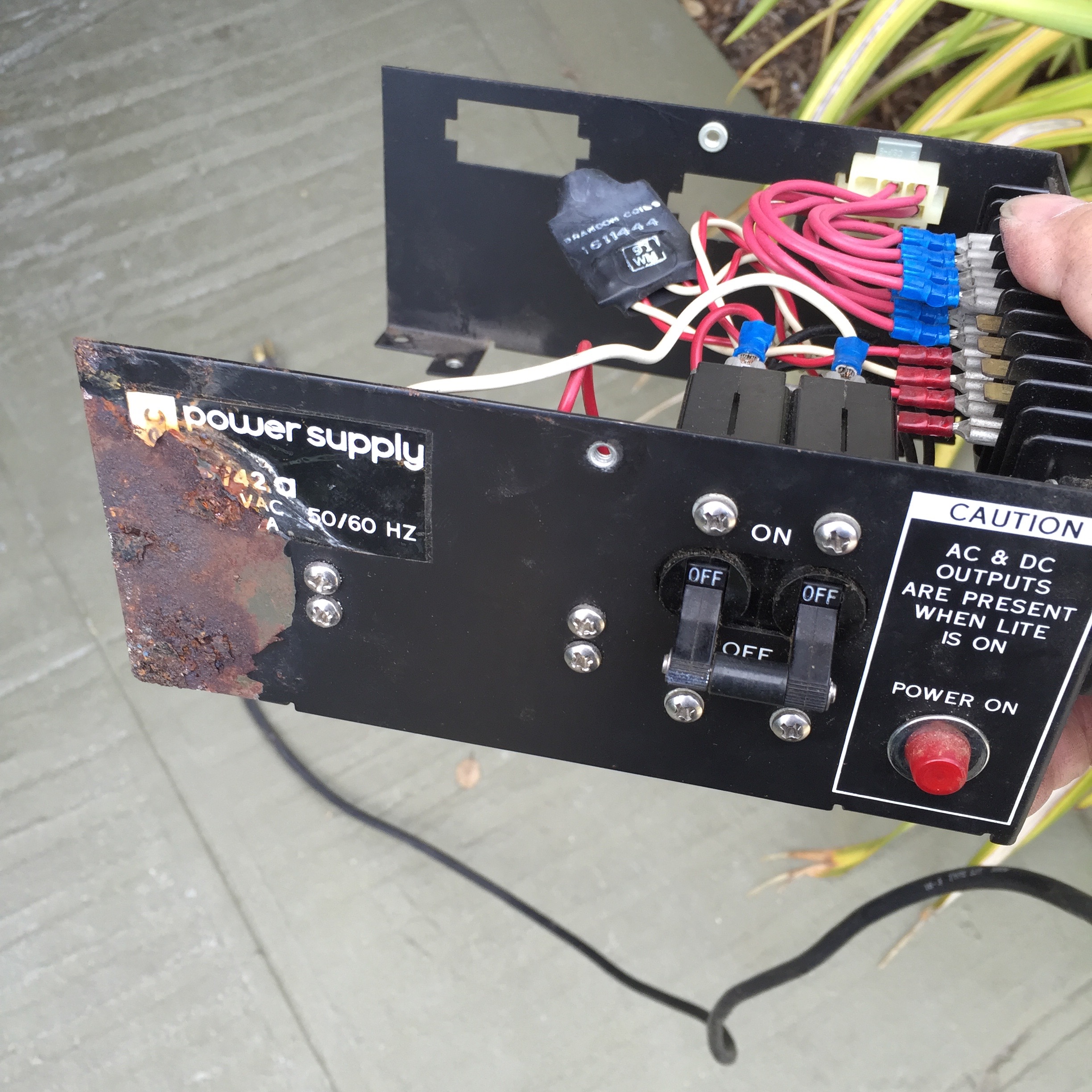
I'm restoring some stuff from the mid 1970s and a recent acquisition
was previously cleaned of mouse damage but needs to be sanded and
repainted by me. One aspect of it is that some of the labels are
damaged (but some can probably be masked and painted around). The
level of damage I'm talking about looks a bit like this...
http://fritzm.github.io/images/pdp11/h742-corrosion.jpg
Most of the item intact, but rust and scale to be cleaned, sanded,
primed and painted. The damage to the label in that pic is
representative.
I have access to all the modern tools, so it's easy to print black on
clear adhesive sheet, but not so much with white. Before embarking on
spinning up a process, I thought I'd ask if anyone has already done
so. In particular interest to me is the era from about 1965-1980,
>from PDP-8s through PDP-11s and VAX-11 machines, both CPUs and
peripherals. I would like to get close matches and I already know in
some cases, there just aren't close matches with modern TrueType font
files. I can, of course, just take photos of the label areas now,
restore the damage, and put on stickers some time in the future, but
doing it all at once has its own appeal
-ethan
then I head ho some lisa cases later had mc boards shoved in them!?
Ed#
In a message dated 9/28/2016 9:54:55 P.M. US Mountain Standard Time,
santo.nucifora at gmail.com writes:
I have this one one of my Lisa's as well. It's like a start up menu that
allows you to launch the Finder. That's all I ever do with it. I don't
know what the name is but it may be a part of specific version of MacWorks
Plus.
Sorry, I don't have any more info.
Santo
On Wed, Sep 28, 2016 at 3:02 PM, Paul McJones <paul at mcjones.org> wrote:
> > Date: Wed, 28 Sep 2016 09:15:42 +0000 (UTC)
> > From: steven stengel <tosteve at yahoo.com>
> > Message-ID: <916931269.6067118.1475054142110 at mail.yahoo.com>
> >
> >
> > What is this unusual Apple Lisa display - some sort of diagnostics?
> >
> > http://oldcomputers.net/temp/lisa.jpg
>
> I suspect it is a Macintosh utility (Disk Copy?) Lisas could run
Macintosh
> software using something called MacWorks.
>
>
Hi,
I had heard many years back that the DOS version of WPS could
read and open DEC AI1 files. I was able to get a copy of WPSDOS and
tried to no avail. Anyone have any luck opening AI1 files on a PC
computer in DOS or Windows to get a file to open with all of the proper
formatting and settings? I can open raw with notepad but much of it
is buried is formatting code, I'd like to be able to properly open up a
file with its formatting in tacked.
Thanks,
Curt
I saw one of these go on Ebay recently and I'm considering sell my
1400XL. Looking for a respectable amount, so if you are interested,
please don't offer low ball offers. Please contact me off list to
discuss, thank you.
http://www.atarimuseum.com/computers/8bits/xl/1400xl/1400.html
Curt
> Date: Wed, 28 Sep 2016 09:15:42 +0000 (UTC)
> From: steven stengel <tosteve at yahoo.com>
> Message-ID: <916931269.6067118.1475054142110 at mail.yahoo.com>
>
>
> What is this unusual Apple Lisa display - some sort of diagnostics?
>
> http://oldcomputers.net/temp/lisa.jpg
I suspect it is a Macintosh utility (Disk Copy?) Lisas could run Macintosh software using something called MacWorks.
> Date: Wed, 28 Sep 2016 09:15:42 +0000 (UTC)
> From: steven stengel <tosteve at yahoo.com>
> To: "General Discussion: On-Topic Posts" <cctech at classiccmp.org>
> Subject: Unexpected Apple Lisa display - what is it?
> Message-ID: <916931269.6067118.1475054142110 at mail.yahoo.com>
> Content-Type: text/plain; charset=UTF-8
>
> What is this unusual Apple Lisa display - some sort of diagnostics?
>
> http://oldcomputers.net/temp/lisa.jpg
It's the MiniFinder - part of Macintosh System release 2, I believe.
https://pbs.twimg.com/media/CZan7K4UkAUvZak.jpg
So, the KT11-B Paging Option engineering drawings recently made their
appearance online:
http://bitsavers.org/pdf/dec/pdp11/1120/KT11-B_EngrDrws_Feb72.pdf
After a good bit of study of them, I have prepared a 'Technical Manual' for
the KT11-B, somewhat in the flavour of the old DEC technical manuals:
http://gunkies.org/wiki/KT11-B_Technical_Manual
since the prints, by themselves, are fairly inscrutable: an incredibly large
mass of gates (almost no MSI, other than a couple of Flip Chips included in
the drawings as modules).
The article basically attempts to describe how the thing works internally; it
includes sections which describe the function (i.e. point) and operation of
the circuitry on each page of the prints, and there's also a signal
dictionary which describes what all the major signals mean/do.
It's not quite absolutely complete, but it's 96% there at this point; I am
still working on it. One thing I do intend to add (when I can work it out :-)
is to annotate the table of states with info one what each states _means_.
If anyone is particularly interested in this device, and reads the article, I
would be very grateful for feedback on what's still missing that I could add,
suggestions for better organization, etc, etc.
Noel
As common as this monitor is, I don't see a scanned copy of a manual on any real site.
Anyone know of a copy?
I went ahead and bought a VM-4512 manual from Tucker to scan. At least that will be around..
Sir;
I working on a project to build a PDP-8i for a combined Compute
Science/Electronic Engineering course on design. The purpose of this
course is to teach the basic of computer design, build and Programing a
computer they must build. This course is still a year down the road.
I volunteer to accomplish the building of the prototype system using only
the parts available at the time the orginal computer were built.
The point of the build is, if a 70+ can sit down with the course material,
and design and build a working model of the PDP-8i, the there is no excuse
that each student attending the course, should not be able to accomplish
the same task.
1. I would like to know if you still have your PDP-8i Front Panel still
available?
2. What is the cost for the panel plus shipping to Tucson, Arizona?
3. I understands that you are attempting to re-manufacture the Switch
Rocker Assembly? And possibly the PCB board for mounting the switches?
a. If so, I would like to know status, and an estimated cost for a
complete set?
B. Would these items be compatible to with c&k 7000 u-frame series
switches assembly?
One other question I have is do you have any drawings that give both the
dimensions and profile of the mounting frame? If so are they available?
I want to Thank You for taking the time ahead of time in answering this
E-mail.
Respectfully;
Ray Neal
Hi Ray (and everyone),
I'm also very interested in knowing the mechanical dimensions of the front
panel PCB and positions of the lamps/switches/mounts/etc., but for the
PDP-8/e. Does anyone have front panel PCB dimensions and positions for all
the UI components I could use?
I can make a simple PCB design for each of the main areas (lamps, switch
register, other switch groups) that will arrive at a few smaller PCBs,
saving a ton of cost. I also have experience in LED display and switch
matrix design so we won't need a thousand wires going everywhere when used
with an emulator. For example, one USB cable for the entire front panel.
There exists the amazing PiDP-8 (
http://obsolescence.wixsite.com/obsolescence/pidp-8) that has all of these
items taken care of. But there does /not/ exist one for the PDP-8/e.
I await your wisdom,
--
Anders Nelson
+1 (517) 775-6129
www.erogear.com
---------- Forwarded message ----------
From: Ray Neal <rayneal382 at gmail.com>
To: cctalk at classiccmp.org
Cc:
Date: Sun, 25 Sep 2016 11:59:24 -0700
Subject: Availability of PDP-8i Front Panel
Sir;
I working on a project to build a PDP-8i for a combined Compute
Science/Electronic Engineering course on design. The purpose of this
course is to teach the basic of computer design, build and Programing a
computer they must build. This course is still a year down the road.
I volunteer to accomplish the building of the prototype system using only
the parts available at the time the orginal computer were built.
The point of the build is, if a 70+ can sit down with the course material,
and design and build a working model of the PDP-8i, the there is no excuse
that each student attending the course, should not be able to accomplish
the same task.
1. I would like to know if you still have your PDP-8i Front Panel still
available?
2. What is the cost for the panel plus shipping to Tucson, Arizona?
3. I understands that you are attempting to re-manufacture the Switch
Rocker Assembly? And possibly the PCB board for mounting the switches?
a. If so, I would like to know status, and an estimated cost for a
complete set?
B. Would these items be compatible to with c&k 7000 u-frame series
switches assembly?
One other question I have is do you have any drawings that give both the
dimensions and profile of the mounting frame? If so are they available?
I want to Thank You for taking the time ahead of time in answering this
E-mail.
Respectfully;
Ray Neal
I picked up a 700/60, the ANSI version of the HP 700-series terminal and when I took it
apart to clean, it had a VDC 1401DP31BE inside. I swapped the CRT into a 700/92 which
has a slightly different board, and a burned in amber tube, and it worked fine.
Also I noticed the 700/96 PCB is almost identical to the 700/60, so I'll try a
rom swap to see what happens.
Too bad there aren't generally available cross reference list for terminal CRTs.
FWIW, the 700/96 has a Philips M32ECD3G CRT.
VDC is having a "sale" on the 1401DP4 and P31. The tube price is pretty cheap but the
shipping is about double when you price it against their normal $55 price. The shipping
goes down with quantity, so if you buy 5 or so it ends up being about $25 a tube and
significantly cheaper than all of the ones listed on eBay.
Department of Defense Debuts Vannevar Bush Faculty Fellowship, Research
Grant Now Accepting Proposals
The Department of Defense (DoD) has announced a new competition for the
"Vannevar Bush Faculty Fellowship" in a recent Funding Opportunity
Announcement (FOA) (N00014-16-R-FO12) on www.grants.gov. This program is formerly
known as the National Security Science and Engineering Faculty Fellowship
(NSSEFF), and both program names will be used for this round of competition
during the transition phase.
The Vannevar Bush Faculty Fellowship program is sponsored by the Basic
Research Office, Office of Assistant Secretary of Defense for Research and
Engineering (ASD(R&E)). The Office of Naval Research (ONR) executes the
program for ASD(R&E) and is soliciting proposals. This program seeks outstanding
researchers to propose basic research that is potentially transformative in
topics areas of interest to the DoD.
?I strongly believe DoD faces some of the most exciting and difficult
problems to be found in research and technology,? said Secretary of Defense Ash
Carter. ?Vannevar Bush fellows will lead the way in transforming and
defining new fields of science and in helping the Department look to the future.
?
This new program name commemorates Dr. Vannevar Bush (1890-1974). He was
the Director of Scientific Research and Development during World War II and
the author of "Science, The Endless Frontier.? Bush was also a professor
and Dean of Engineering at MIT and later founded a large defense and
electronics company. As a devoted teacher, administrator and entrepreneur, Bush
made creative and innovative contributions to science, engineering and the
nation.
During World War II, Bush mobilized America?s scientific resources to
achieve advances in defense technologies that were decisive in winning the war.
After the war, he was instrumental in formulating sound policies for the
advancement of science, engineering and education.
Bush, in his famous 1945 report, "Science: The Endless Frontier,? wrote
that ?the pioneer spirit is still vigorous within this nation. Science offers
a largely unexplored hinterland for the pioneer who has the tools for his
task. The rewards of such exploration both for the nation and the
individual are great. Scientific progress is one essential key to our security as a
nation, to our better health, to more jobs, to a higher standard of
living, and to our cultural progress." For more information on how to apply,
please visit _http://www.acq.osd.mil/rd/basic_research/program_info/vbff.html_
(http://links.govdelivery.com/track?type
=click&enid=ZWFzPTEmbWFpbGluZ2lkPTIwMTYwOTI2LjY0MjI4NDExJm1lc3NhZ2VpZD1NREItUFJELUJVTC0yMDE2MDkyNi42NDIyODQxMSZkY
XRhYmFzZWlkPTEwMDEmc2VyaWFsPTE3MzUwOTI3JmVtYWlsaWQ9Y291cnlob3VzZUBhb2wuY29tJ
nVzZXJpZD1jb3VyeWhvdXNlQGFvbC5jb20mZmw9JmV4dHJhPU11bHRpdmFyaWF0ZUlkPSYmJg==&
&&101&&&http://www.acq.osd.mil/rd/basic_research/program_info/vbff.html?sour
ce=GovDelivery) .
> From: Chuck Guzis
> Call it anything you want, but we know what Motorola called it.
The _first implementation_ may have been 16-bit, but I am in no doubt
whatsover (having written a lot of assembler code for the 68K family)
that the _architecture_ was 32-bit:
- 32-bit registers
- many operations (arithmetical, logical, etc) defined for that length
- 32-bit addresses
Etc, etc, etc, etc.
Noel
I was looking thru one of the yearbooks from my time at University of
Missouri, Rolla. I found what I think is a photo of a GE-200. I
"liberated" this system or one of them to a lab I had, when they were
mothballed, and I could swear that is what the systems were.
If anyone recognizes them, let me know. This is the first hint of any
sort as to what I had. And my memory could be wrong. The square
indicator and switch style is very much like what I recall for this
particular system.
I had gotten handed a couple of very heavy trays of Lambda power
supplies which clearly were for some purpose due to how they were
mounted. I later found the system I think was a GE-200 neglected in a
stockroom in the EE building and recognized that the interconnnect would
fit the power supply trays I had.
The system was transistorized, not IC I might add. That was why it took
4 or 5 large Lambda supplies. Luckily we had not broken the supply tray
up and i was able to play with it.
The other thing i think might be of interest are several photos of an
analog computer that the EE dept had. I know there was another much
larger system in the Physics department as well, and maybe I'll luck out
and find a photo of it later.
Oh, and the blond at the keypunch. I might add that she is probably
retired now.
thanks
Jim
http://s1101.photobucket.com/user/jws1971/library/UMR%20computer%20photos
"Fan belts only exist, briefly, in the intervals between stars
Reviewing the informative Turing?s Cathedral
Programming the ENIAC, the world's first digital computer (US Army photo)
Book review
It's a full four years since it was published, but Reg contributor
Geoffrey G Rochat has finally gotten around to reading George Dyson's
worthy tome Turing?s Cathedral. He finds it's not just a Best Book
list lurker, but something actually worth reading."
http://www.theregister.co.uk/2016/01/10/turing_cathedral_fan_belts_exist_br…
Contains some discussion of level-based versus pulse-based logic in
early valve computers which is frankly way over my head but might be
of interest to some here.
--
Liam Proven ? Profile: http://lproven.livejournal.com/profile
Email: lproven at cix.co.uk ? GMail/G+/Twitter/Flickr/Facebook: lproven
MSN: lproven at hotmail.com ? Skype/AIM/Yahoo/LinkedIn: liamproven
Cell/Mobiles: +44 7939-087884 (UK) ? +420 702 829 053 (?R)
Some time ago I acquired a HP 3000/37 micro, it has a faulty psu.
One of the mosfet controlling the power transistor BUX48 was shorted an blew
up the whole power stage.
Getting new fet's and power transistor wasn't the problem, but the regulator
IC also has blown.
The regulator IC is marked CC3896F made by SB and also has this number
'3713045', the only info I can find on the net is provided by the known IC
brokers from China.
I'd like to get this box running again, so I'm looking for the IC or a
replacement PSU which is an ITT PEC 3945 P/N 6064265.
Any other info about it like diagrams and datasheets about the CC3896F are
also welcome.
Thanks,
-Rik
Not the GE 200 I am used to! what did it have for a console?
Ed# _www.smecc.org_ (http://www.smecc.org)
In a message dated 9/26/2016 3:21:41 A.M. US Mountain Standard Time,
jwsmail at jwsss.com writes:
I was looking thru one of the yearbooks from my time at University of
Missouri, Rolla. I found what I think is a photo of a GE-200. I
"liberated" this system or one of them to a lab I had, when they were
mothballed, and I could swear that is what the systems were.
If anyone recognizes them, let me know. This is the first hint of any
sort as to what I had. And my memory could be wrong. The square
indicator and switch style is very much like what I recall for this
particular system.
I had gotten handed a couple of very heavy trays of Lambda power
supplies which clearly were for some purpose due to how they were
mounted. I later found the system I think was a GE-200 neglected in a
stockroom in the EE building and recognized that the interconnnect would
fit the power supply trays I had.
The system was transistorized, not IC I might add. That was why it took
4 or 5 large Lambda supplies. Luckily we had not broken the supply tray
up and i was able to play with it.
The other thing i think might be of interest are several photos of an
analog computer that the EE dept had. I know there was another much
larger system in the Physics department as well, and maybe I'll luck out
and find a photo of it later.
Oh, and the blond at the keypunch. I might add that she is probably
retired now.
thanks
Jim
http://s1101.photobucket.com/user/jws1971/library/UMR%20computer%20photos
You might try looking at the M9312 proms that Don North has made available here:
http://www.ak6dn.com/PDP-11/M9312/
If you have an M9312 in your system it will have the basic console prom in it.
There are listings of the prom contents on that web page.
There is also a simple diagnostic prom that loops forever near the bottom of the page.
If you don't have an M9312 then you could probably key in a program from the rom listings provided.
I'd bet Don will be along shortly to provide a better explanation.
the only difference might be the keycaps and ROMs! let me know!
Ed#
In a message dated 9/25/2016 9:35:27 P.M. US Mountain Standard Time,
davidkcollins2 at gmail.com writes:
Apart from the different colors I'd be surprised if all the tubes weren't
interchangable between the 700 series. I think the only difference between
models is the logic PCA and ROMs etc. The 700 series service manual
would confirm one way or the other.
David Collins
(Sent from out of office)
> On 26 Sep. 2016, at 3:08 am, Al Kossow <aek at bitsavers.org> wrote:
>
> I picked up a 700/60, the ANSI version of the HP 700-series terminal and
when I took it
> apart to clean, it had a VDC 1401DP31BE inside. I swapped the CRT into a
700/92 which
> has a slightly different board, and a burned in amber tube, and it
worked fine.
> Also I noticed the 700/96 PCB is almost identical to the 700/60, so I'll
try a
> rom swap to see what happens.
>
> Too bad there aren't generally available cross reference list for
terminal CRTs.
> FWIW, the 700/96 has a Philips M32ECD3G CRT.
>
> VDC is having a "sale" on the 1401DP4 and P31. The tube price is pretty
cheap but the
> shipping is about double when you price it against their normal $55
price. The shipping
> goes down with quantity, so if you buy 5 or so it ends up being about
$25 a tube and
> significantly cheaper than all of the ones listed on eBay.
>
>
>
Hi all --
I have myself a Bunker Ramo BR2412 12-bit minicomputer. This is similar
(but not identical) to the Nuclear Data ND812. There are schematics /
maintenance manuals for the ND812 on Bitsavers which have been immensely
helpful. The main difference between the BR2412 and the ND812 is that
the BR2412 uses Intel 1103 RAMs (backed up by a big lead-acid battery)
rather than core memory. (There are other more subtle differences, the
ND812 used incandescent bulbs on the front panel, the BR2412 has LEDs).
I've been working on restoring this thing (which has been an interesting
challenge -- there are 325 wire-wrap sockets with dodgy connections with
the ICs to deal with) and I've been making steady progress, but I've
finally reached a point in my debugging where the schematics differ from
reality, as I get closer to the memory interface. I can likely work
things out by hand, but having a real set of documents would obviously
be helpful.
I realize this is a long shot since it's a pretty obscure machine, but I
thought I'd ask before I dive in too deep here. Oh, and while I'm asking
for impossible things, if anyone has any *parts* for one of these, let
me know -- I'm missing the TTY interface...
Thanks!
Josh
sounds like a good reason to have a rom cloning party too! Ed#
_www.smecc.org_ (http://www.smecc.org)
In a message dated 9/25/2016 6:08:39 P.M. US Mountain Standard Time,
aek at bitsavers.org writes:
I picked up a 700/60, the ANSI version of the HP 700-series terminal and
when I took it
apart to clean, it had a VDC 1401DP31BE inside. I swapped the CRT into a
700/92 which
has a slightly different board, and a burned in amber tube, and it worked
fine.
Also I noticed the 700/96 PCB is almost identical to the 700/60, so I'll
try a
rom swap to see what happens.
Too bad there aren't generally available cross reference list for terminal
CRTs.
FWIW, the 700/96 has a Philips M32ECD3G CRT.
VDC is having a "sale" on the 1401DP4 and P31. The tube price is pretty
cheap but the
shipping is about double when you price it against their normal $55 price.
The shipping
goes down with quantity, so if you buy 5 or so it ends up being about $25
a tube and
significantly cheaper than all of the ones listed on eBay.
> If your CPU is an 11/73 (which can directly 'access' [hate that verbism
> :-] all of memory from ODT, unlike the 11/23 which is restricted to the
> bottom 256KB), try playing around with a failing location, and its
> alternative, directly, and see if a store of random data into one can be
> read back directly from the other
Note: The 11/'73' CPU powers up with the cache enabled, even for ODT!
So if you write xxx into some location, if you then read it back, you will get
the correct data even if the memory location is busted - the CPU is getting
the (correct) data from the cache. To have your 'memory' reads and writes
actually go to the memory, you need to turn off the cache:
17777746/ 02000
Note that starting the machine does an INIT, which will again enable the
cache.
> I'll start the Computer History wiki page for this board with that info.
Started:
http://gunkies.org/w/index.php?title=CMV-4000
Currently has only the memory chip info, I'll add the config stuff as I get it
doped out.
Noel
Does anyone know of documentation for the HP9895A format with its own M2FM encoding?
I have a kryoflux preservation stream but so far can make no sense of it.
Denise
________________________________
I've got quite a stack (more than a dozen) first-generation DOS laptops that
are headed for the recycler unless someone wants them. They re mostly
Toshiba T-1000 or T1000SE units, but there's a Tandy in there also, and
probably a another outlier or two. There are also a few Portege's running
Win-95, and a few fabric laptop cases. At one time all of these worked
(obviously), but I'm sure that most don't now, for various reasons. A few
may have been cannibalized a bit, but for the most part all the parts are
there.
I'm not looking for any cash for these, but I don't want to pay anything
(like shipping) either, especially since the electronics recycler is less
than three miles from my house. If anyone wants to pick these up (I'm in
San Carlos, near Redwood City, CA), or wants to pay me to ship them (at cost
only), let me know. At the end of this week (01-Oct-2016), they'll be
gone...
~~
Mark Moulding
-----Original Message-----
From: cctalk-request at classiccmp.org
Sent: Sunday, September 25, 2016 10:00 AM
To: cctalk at classiccmp.org
Subject: cctalk Digest, Vol 27, Issue 24
Send cctalk mailing list submissions to
cctalk at classiccmp.org
To subscribe or unsubscribe via the World Wide Web, visit
http://www.classiccmp.org/mailman/listinfo/cctalk
or, via email, send a message with subject or body 'help' to
cctalk-request at classiccmp.org
You can reach the person managing the list at
cctalk-owner at classiccmp.org
When replying, please edit your Subject line so it is more specific
than "Re: Contents of cctalk digest..."
Today's Topics:
1. MSI Texscan SpectraGen SG4B (Jim Brain)
2. Re: DEC TC11 maindec listings? (Al Kossow)
3. Re: DEC TC11 maindec listings? (Don North)
4. Re: DEC TC11 maindec listings? (Mattis Lind)
5. Electronic surplus in the southwest (William Maddox)
6. Re: Decoding kryoflux stream for HP9895A (Eric Smith)
7. AC Filter Cap Brand Recommendations (Craig Ruff)
8. Re: AC Filter Cap Brand Recommendations (Peter Cetinski)
9. Re: AC Filter Cap Brand Recommendations (Chuck Guzis)
10. Digital Storage Architecture - Media Format (Rob Jarratt)
----------------------------------------------------------------------
Message: 1
Date: Sat, 24 Sep 2016 19:50:56 -0500
From: Jim Brain <brain at jbrain.com>
To: "General Discussion: On-Topic and Off-Topic Posts"
<cctalk at classiccmp.org>
Subject: MSI Texscan SpectraGen SG4B
Message-ID: <b689fdda-69db-57fd-9874-67476dd62c26 at jbrain.com>
Content-Type: text/plain; charset=utf-8; format=flowed
I know it's a long shot, but does anyone have a manual for a SpectraGen
4B Video Title Generator? I am trying to resurrect one, and it seems to
be a Z80-based unit.
Jim
--
Jim Brain
brain at jbrain.comwww.jbrain.com
------------------------------
Message: 2
Date: Sat, 24 Sep 2016 20:32:57 -0700
From: Al Kossow <aek at bitsavers.org>
To: cctalk at classiccmp.org
Subject: Re: DEC TC11 maindec listings?
Message-ID: <1fe8bb6e-28bd-c997-c52c-f6ddb9e26b98 at bitsavers.org>
Content-Type: text/plain; charset=utf-8
I had it on fiche, which I scanned this afternoon.
It should be up on the bitsavers mirrors by morning PDT under pdp11/xxdp
along with rev E of the XXDP+ users guide.
I'll probably also do the RX02 diags if I can find them for Don, though
he may have them on fiche.
The step and repeat fiche scanner isn't on line yet so I used the Canon
manual positioning one. It's tedious, and it gets out of focus easily, but
they are better than nothing.
On 9/21/16 12:38 PM, Mattis Lind wrote:
> I have been looking for TC11 maindec listings in the usual places, but
> didn't find any. I think they should be named ZTCA, ZTCB, ZTCC, ZTCD and
> ZTCE.
>
> Does anyone know of an online location or happen to have an offline paper
> original?
>
> /Mattis
>
------------------------------
Message: 3
Date: Sat, 24 Sep 2016 21:08:19 -0700
From: Don North <north at alum.mit.edu>
To: "General Discussion: On-Topic and Off-Topic Posts"
<cctalk at classiccmp.org>
Subject: Re: DEC TC11 maindec listings?
Message-ID: <90d93153-2109-0f5f-6b1e-c1d4daa7a83b at alum.mit.edu>
Content-Type: text/plain; charset=utf-8; format=flowed
On 9/24/2016 8:32 PM, Al Kossow wrote:
> I had it on fiche, which I scanned this afternoon.
> It should be up on the bitsavers mirrors by morning PDT under pdp11/xxdp
> along with rev E of the XXDP+ users guide.
>
> I'll probably also do the RX02 diags if I can find them for Don, though
> he may have them on fiche.
I was able to get ZRXDC0, ZRZEA0, and ZRXFB0 listings from the fiche images
on
http://www.retrocmp.com/tools/pdp-11-diagnostic-database
so I am fine for RX02 diagnostics listings.
Don
> The step and repeat fiche scanner isn't on line yet so I used the Canon
> manual positioning one. It's tedious, and it gets out of focus easily, but
> they are better than nothing.
>
>
> On 9/21/16 12:38 PM, Mattis Lind wrote:
>> I have been looking for TC11 maindec listings in the usual places, but
>> didn't find any. I think they should be named ZTCA, ZTCB, ZTCC, ZTCD and
>> ZTCE.
>>
>> Does anyone know of an online location or happen to have an offline paper
>> original?
>>
>> /Mattis
>>
>
------------------------------
Message: 4
Date: Sun, 25 Sep 2016 07:53:58 +0200
From: Mattis Lind <mattislind at gmail.com>
To: "General Discussion: On-Topic and Off-Topic Posts"
<cctalk at classiccmp.org>
Subject: Re: DEC TC11 maindec listings?
Message-ID:
<CABr82SJWUVc7HURrEhaLoL7A7CEo4kPyAp+Hhfk3Z87MhaZjvA at mail.gmail.com>
Content-Type: text/plain; charset=UTF-8
2016-09-25 5:32 GMT+02:00 Al Kossow <aek at bitsavers.org>:
> I had it on fiche, which I scanned this afternoon.
> It should be up on the bitsavers mirrors by morning PDT under pdp11/xxdp
> along with rev E of the XXDP+ users guide.
>
Exactly what I needed! Thanks a lot Al!
/Mattis
>
> I'll probably also do the RX02 diags if I can find them for Don, though
> he may have them on fiche.
>
> The step and repeat fiche scanner isn't on line yet so I used the Canon
> manual positioning one. It's tedious, and it gets out of focus easily, but
> they are better than nothing.
>
>
> On 9/21/16 12:38 PM, Mattis Lind wrote:
> > I have been looking for TC11 maindec listings in the usual places, but
> > didn't find any. I think they should be named ZTCA, ZTCB, ZTCC, ZTCD and
> > ZTCE.
> >
> > Does anyone know of an online location or happen to have an offline
> > paper
> > original?
> >
> > /Mattis
> >
>
>
------------------------------
Message: 5
Date: Sun, 25 Sep 2016 06:41:16 +0000 (UTC)
From: William Maddox <wmaddox at pacbell.net>
To: "cctalk at classiccmp.org" <cctalk at classiccmp.org>
Subject: Electronic surplus in the southwest
Message-ID: <166539568.4256917.1474785676417 at mail.yahoo.com>
Content-Type: text/plain; charset=UTF-8
I will be visiting Albuquerque, Phoenix, Tucson, and various points nearby
and in-between shortly.Any recommendations on electronics surplus and junk
shops to check out? ?Some of the most famous, like the Black Hole in Los
Alamos are long gone. ?Any other must-see attractions for the classic
computer geek?
--Bill
------------------------------
Message: 6
Date: Sun, 25 Sep 2016 02:32:34 -0600
From: Eric Smith <spacewar at gmail.com>
To: "General Discussion: On-Topic and Off-Topic Posts"
<cctalk at classiccmp.org>
Subject: Re: Decoding kryoflux stream for HP9895A
Message-ID:
<CAFrGgTT31V-4HPpJU1_9TXVyMMebOd3A9mW3oSEtKZWoQxxExw at mail.gmail.com>
Content-Type: text/plain; charset=UTF-8
On Tue, Sep 20, 2016 at 7:42 AM, Denise de Vries
<denise.devries at flinders.edu.au> wrote:
> Does anyone know of documentation for the HP9895A format with its own M2FM
> encoding?
> I have a kryoflux preservation stream but so far can make no sense of it.
On Wed, Sep 21, 2016 at 12:59 AM, Christian Corti
<cc at informatik.uni-stuttgart.de> wrote:
> I've already written a decoder for the HP 9885/9895 format. Denise already
> sent me his image, but I haven't had the time to try decoding it yet...
Denise sent me the image as well.
dfitoimd has now been renamed to fluxtoimd, as it now supports both
DiscFerret and KryoFlux image input. I've partially added HP M2FM
format; it now correctly decodes the address fields, but I have a bit
more work to do on the data fields. I expect to have it completed
tomorrow.
> - 0xD0: ECC data address mark
Any idea how they use that? Aside from that being included in the list
of address marks in the service manuals, it's not described at all.
Since the 7902/9885/9895 don't do ECC, perhaps it was reserved for
future use.
------------------------------
Message: 7
Date: Sat, 24 Sep 2016 21:31:23 -0600
From: Craig Ruff <cruff at ruffspot.net>
To: cctech at classiccmp.org
Subject: AC Filter Cap Brand Recommendations
Message-ID: <AE56D6F8-11C3-457E-A464-5709245849D8 at ruffspot.net>
Content-Type: text/plain; charset=utf-8
Wouldn?t you know it, the same day I decide to order a ribbon and some paper
for my HP 82905B (aka Epson MX80) printer, the AC line filter cap (C1 on the
MFIL board), expelled its magic smoke rather impressively. After some
cleanup, the printer has been banished to the garage until the smell
diminishes. It appears to be a 250 V, 0.1 ?F X type. What manufacturers
have good reliability for this application, in your opinion?
------------------------------
Message: 8
Date: Sat, 24 Sep 2016 23:38:08 -0400
From: Peter Cetinski <pete at pski.net>
To: "General Discussion: On-Topic Posts" <cctech at classiccmp.org>
Subject: Re: AC Filter Cap Brand Recommendations
Message-ID: <35029F98-7F90-405F-85E9-3611BE2DF2BC at pski.net>
Content-Type: text/plain; charset=utf-8
On Sep 24, 2016, at 11:31 PM, Craig Ruff <cruff at ruffspot.net> wrote:
>
> Wouldn?t you know it, the same day I decide to order a ribbon and some
> paper for my HP 82905B (aka Epson MX80) printer, the AC line filter cap
> (C1 on the MFIL board), expelled its magic smoke rather impressively.
> After some cleanup, the printer has been banished to the garage until the
> smell diminishes. It appears to be a 250 V, 0.1 ?F X type. What
> manufacturers have good reliability for this application, in your opinion?
That?s a common item on Tandy power supplies so I?ve replaced a lot of
these. I?ve used this replacement numerous times with great success.
https://www.digikey.com/product-detail/en/kemet/PMR209MC6100M047R30/399-751…
<https://www.digikey.com/product-detail/en/kemet/PMR209MC6100M047R30/399-751…>
------------------------------
Message: 9
Date: Sat, 24 Sep 2016 22:58:53 -0700
From: Chuck Guzis <cclist at sydex.com>
To: "General Discussion: On-Topic Posts" <cctech at classiccmp.org>
Subject: Re: AC Filter Cap Brand Recommendations
Message-ID: <e7b74d80-ceab-4a41-2b31-4a367667b52b at sydex.com>
Content-Type: text/plain; charset=utf-8
On 09/24/2016 08:31 PM, Craig Ruff wrote:
> Wouldn?t you know it, the same day I decide to order a ribbon and
> some paper for my HP 82905B (aka Epson MX80) printer, the AC line
> filter cap (C1 on the MFIL board), expelled its magic smoke rather
> impressively. After some cleanup, the printer has been banished to
> the garage until the smell diminishes. It appears to be a 250 V, 0.1
> ?F X type. What manufacturers have good reliability for this
> application, in your opinion?
>
Any of the major brands should be good--Kemet, Panasonic,..
--Chuck
------------------------------
Message: 10
Date: Sun, 25 Sep 2016 13:30:36 +0100
From: "Rob Jarratt" <robert.jarratt at ntlworld.com>
To: "General Discussion: On-Topic and Off-Topic Posts"
<cctalk at classiccmp.org>
Subject: Digital Storage Architecture - Media Format
Message-ID: <00b601d21728$9f1eeb20$dd5cc160$(a)ntlworld.com>
Content-Type: text/plain; charset="us-ascii"
The VMS documentation mentions specification for the Digital Storage
Architecture that cover media formats. I have looked at the DSA folder on
bitsavers and cannot see any document that covers media formats. Is this
documentation available anywhere?
Thanks
Rob
End of cctalk Digest, Vol 27, Issue 24
**************************************
I have been looking for TC11 maindec listings in the usual places, but
didn't find any. I think they should be named ZTCA, ZTCB, ZTCC, ZTCD and
ZTCE.
Does anyone know of an online location or happen to have an offline paper
original?
/Mattis
The VMS documentation mentions specification for the Digital Storage
Architecture that cover media formats. I have looked at the DSA folder on
bitsavers and cannot see any document that covers media formats. Is this
documentation available anywhere?
Thanks
Rob
I will be visiting Albuquerque, Phoenix, Tucson, and various points nearby and in-between shortly.Any recommendations on electronics surplus and junk shops to check out? ?Some of the most famous, like the Black Hole in Los Alamos are long gone. ?Any other must-see attractions for the classic computer geek?
--Bill
Wouldn?t you know it, the same day I decide to order a ribbon and some paper for my HP 82905B (aka Epson MX80) printer, the AC line filter cap (C1 on the MFIL board), expelled its magic smoke rather impressively. After some cleanup, the printer has been banished to the garage until the smell diminishes. It appears to be a 250 V, 0.1 ?F X type. What manufacturers have good reliability for this application, in your opinion?
I know it's a long shot, but does anyone have a manual for a SpectraGen
4B Video Title Generator? I am trying to resurrect one, and it seems to
be a Z80-based unit.
Jim
--
Jim Brain
brain at jbrain.comwww.jbrain.com
Hi, all, I have a HP 7970B/E Tape Unit Diagrams and Parts Manual available; I
got it with a group of other manuals, and I don't have any use for it.
I'd prefer to get something in return for it (some PDP-11 manual/print I don't
have, or something), but mostly I want to get this into the hands of someone
who can actually use it (it's already on Bitsavers, so it doesn't fill a
lacuna).
Noel
> From: J?rg Hoppe
> I'm talking of that data path check up after power-on.
Huh, I never knew about that. (The manuals don't mention it.)
I was just last night looking at the microccode for the 11/04 (a very similar
machine - they share the front consoles, etc), and it doesn't have anything
like that (see the /04 power on ucode at pg. 130 of EK-KD11D-TM-PRE).
Looking through that /34 ucode flow diagram, I discovered that the /34
supported the M[FT]PS instuctions - I thought that was only the QBUS CPU's,
etc.
Live and learn! :-)
Noel
> From: Devin Davison
>> If the machine HALTs on power-up, some micro coded diagnostic failed
There are no microcoded diagnostics in the 11/34. The boot ROMs do contain
minimal CPU and memory diagnostics.
> using pdp11gui to load the dec diagnostics sounds like the way to go.
The CPU and UNIBUS have to be basically working for the boot ROMs (and the
console emulator they provide via the console serial line) to work; ditto for
PDP11GUI. Note that the console emulator will work without working memory,
provided the correct boot option (console emulator without diagnostics) is
configured on the card that holds the boot ROMs. You won't, of course, be
able to load anything without working memory.
And the Programmer's Console doesn't require working memory either, and a lot
less of the CPU working - the CPU only has to respond to HALT requests from
the console. (I had one /04 - very similar to the /34, uses the same front
console - which didn't run because there was a bit stuck on in all the
registers - but the console still worked.) It does require the UNIBUS not to
be wedged, though.
Noel
Hi, All,
Good seeing many of you at VCF-midwest. One of my scores was an
Atari-badged Novation CAT modem. Digging around for any docs, what
I'm mostly finding is lots of info about Novations Apple II products,
and scant mention with thumbnail pictures of the original CAT acoustic
coupler, that and dozens of sites copying the Wikipedia article.
Anyone have any CAT info? I can reverse-engineer the schematic, but
if that's already been done, no reason for me to redocument the wheel.
I know it wants a 20VAC 400mA PSU, but I want to check how strict that
is (i.e., 18VAC @ 500mA or 24 VAC @ 350 mA, for example, which may be
easier to find than an unregulated 20VAC PSU).
I would love to play with a CBM 8010 (since I have so many PETs) but I
do happen to have a couple of IEEE-488 to RS-232 devices, which will
work fine with this Atari 830/Novation CAT.
-ethan