actually when it all shows up as cc talk as the sender it is of value
as we can clear the group of mail faster after I have picked out the
topics relative to what we are working on.
Ed#
In a message dated 3/1/2017 2:47:11 A.M. US Mountain Standard Time,
cctalk at classiccmp.org writes:
On 28 February 2017 at 21:23, Rich Alderson via cctalk <
cctalk at classiccmp.org> wrote:
> OK, it's official. I rarely criticize mail interfaces, because they're
> usually
> mostly innocuous. However, today's change makes life a lot more
difficult.
>
> In the past, it was simple to direct a reply to an individual instead of
> to the
> list because the originator's address was right there in the From:
> header. As
> of today, the list address is substituted for that, so that it is
> impossible to
> respond privately...
Users.
--
Yoyodyne Propulsion Systems: "The Future Begins Tomorrow"
Visit us at: http://www.yoyodyne-propulsion.net
--------
"When a true genius appears in the world, you may know him by this sign,
that the dunces are all in confederacy against him." -- Jonathan Swift
On Wed, 1 Mar 2017 cctalk-request at classiccmp.org wrote:
> Message: 17
> Date: Tue, 28 Feb 2017 20:10:33 +0100
> From: Lars Brinkhoff <lars at nocrew.org>
> To: Mattias Engdeg?rd <mattiase at acm.org>
> Subject: Re: DEC VT100/220 line wrapping semantics sought
> Mattias Engdeg?rd wrote:
> > Data for VT100, VT220 and VT510 have been collected, as well as
> > several emulators
> > (https://github.com/mattiase/wraptest/blob/master/results.txt). If
> > anyone has access to other working terminals, VT3xx/VT4xx in
> > particular, I'd be most grateful if you would take a few minutes to
> > run the test program.
>
> I have a VT420 set up for my kid to play with. I'll borrow it and
> submit a pull request with the results.
>
I have a VT525 in my home office that I use to read the mail (including
this and other mailing lists) when I don't want to fire up a workstation.
(It's quick, simple, and I get check/send a message without much fuss).
Would results from that terminal help?
Fred
Ersatz-11 V7.3 is finished. CDs have been mailed to users with current
update subscriptions, and the free Demo version may be downloaded from
www.dbit.com/demo.html as usual.
E11 V7.3 has the following new features:
- My favorite one: a BREAKPOINT command which accepts arbitrary boolean
test expressions, compiles them into native x86 code (to reduce the speed
penalty), and incorporates them (until disabled with BREAK/CLEAR) into
the main fetch/decode loop). Examples:
break pc >= 2000 and pc < 3000 and @(r4+4) = 42776
(range of code with specified value in block pointed to by R4)
break ci(pc)&177400 = 104000
(about to fetch an EMT instruction)
break phys(14634520) <> 3044
(location at physical address gets changed from expected value)
Errors at run-time are silent. If a specified test causes a bus timeout,
odd address trap, or division by 0, the test fails. Well OK division by
*constant* 0 gives an error but I just mean nothing damaging happens if
the registers aren't pointing where you thought, etc.
- A few rare antique emulated devices: DC11 SLU. Basically similar to
the DL11 (ignoring the extra CSR bits and programming it like a DL11A
works), but it also has a settable baud rate and modem control which
is different from how it was done on DL11s.
- Also the DM11 single-speed serial mux (not that E11 minds running each
line at a different speed, but the original did). It uses DMA for
transmission but also for reception into an in-core FIFO which the
documentation adorably calls the "tumble table". And yes this is the
origin of the DM11BB modem-control option more commonly used on the DH11.
There's a new command to tell DM11BBs which to attach to (the default is
still the DH11 with the same controller letter).
- Finally, the justifiably forgotten TR79F 1600 BPI tape controller for
TR79 drives (really HP7970Es), which includes the parity track in core
with each byte of tape data taking up a word, so it's a pain to program.
But it had 1600 BPI pretty early. The only driver I can find for the
TR79F is in the "TRDP" version of XXDP, which is on Bitsavers as a scan
of a microfiche of the listing. It can be used to load the ZTRAB0
diagnostic (the only other program I know of for the TR79F), but of
course the test immediately trashes your boot tape. I felt dumb.
- Driver for raw ATA/SATA/ATAPI disks (DOS and stand-alone versions).
- Driver for National Instruments PCI-DIO-96 digital I/O card (DOS and
stand-alone versions). It's a bad fit to emulating the DRV11/DR11C
(ASSIGN OA: DIO96: does work but you'd have to wire up an adapter with
buffering since the drivers are rated at only 2.5 mA) but it's probably
the most common digital I/O board around. Even though it's PCI (not PCIe),
it's still made new (at great expense), but cheap used examples are
everywhere.
- Ability to use a digital I/O card to drive real display and switch
registers. Wiring up a blinky-lights board for your $25 eBay PCI-DIO-96
is a lot easier than making one for current PC busses, even if the
100-pin D-shell plug is a pain (but AMP makes an IDC connector that
brings it out to two 50-pin Bergs)..
- SET HISTOGRAM command enables/disables histogram of PDP-11 opcode usage
(which again is temporarily compiled into the main loop when enabled).
HISTOGRAM command displays the results or saves them to a file.
- EXAMINE/DEPOSIT /BYTE /WORD /LONG /QUAD switches support various data
types besides just words. Finally.
- MOUNT <tape> FILE.TAP /LENGTH:n or /SIZELIMIT:nMB enables emulation of
EOT early warning flag (giving the approximate maximum length of the
tape in feet or megabytes). Not generally needed (who minds an unlimited
tape?), but some diags want to fill a tape with test data all the way
to EOT.
- ASSIGN <TTY or digital I/O device> NULL: /LOOPBACK switch. Does what
you think.
- Experimental POWERFAIL command simulates power failures on command,
or SET POWERFAIL command schedules one at shutdown (with a core dump
to a file). Thank you Oleg Safiullin for the idea! Might need some
changes -- I've never dealt with power failures on a real PDP-11.
- Dramatically improved timer precision in DOS and stand-alone versions.
SET THROTTLE in particular is silky smooth, but this improvement affects
many many things.
- All commands that take a time duration as a parameter will now accept a
decimal point and/or unit suffix. The default units are the same as in
previous versions. So instead of SET THROTTLE DELAY=1 (microseconds),
you can use SET THROTTLE DELAY=1.2 or SET THROTTLE DELAY=1200NS (values
will be rounded if needed). I hadn't realized so many places use time
values -- I might have missed something.
There are also many bug fixes and minor changes, but most importantly:
- WMSG.LOG file that grows and grows (in Windows versions). Sorry about
that! That was supposed to be disabled in the released version. Well
it is now.
John Wilson
D Bit
I don't know if anyone here has the interest or capability to do it, but
creating a replica of the blue tape trays with the clear overlay that
one could sell for a few bucks with some random fanfold copies of DEC or
other diagnostics would be nice.
Perhaps if there were a ready source of replicas with a perpetual
listing or 10 to overwhelm the auctions with 100 and 300 dollar auctions
for the genuine originals the originals would be listed and sold for a
reasonable amount.
I'm sure there there are things going to people with no idea what they
have which would have been nice to image and save. I would think
someone with vacuum molding and some skill with plastics could do the
trays. not sure about the source of tapes to sell with them, maybe that
does justify some extra expense.
People with working readers and libraries of tapes might like them as well.
thanks
Jim
Would someone with a real DEC VT terminal be so kind and help settle, once and for all, the question about how they behave with respect to line-wrapping, exactly? It is something that isn't covered by any standard, nor by any of DEC's manuals, and there is a scarcity of information online that is not vague repetition of folklore.
There are emulators, of course, but these do not agree with one another to the point that they can be trusted, and are probably just copying each other in any case. It seems that some ground truth would be welcome, for the benefit of both application and emulator writers.
First, the problem: A VT100, when in "auto-wrap" mode, will wrap text from one line to the next in a peculiar way, sometimes called "soft-wrap" or "the VT100 glitch". When the terminal receives a printable character with the cursor in the last column, the character is put at that location but the cursor remains in place. Instead, the terminal enters a pending wrap state, which causes the cursor to wrap before next printable character is displayed. This behaviour is widely known.
What isn't widely known are the finer points:
* What control codes will cancel the wrap state?
* What cursor position is reported in the wrap state?
* Do any operations behave differently in the wrap state?
* Is the wrap state saved/restored by the save/restore cursor codes?
and so on. Every emulator programmer seems to have a different answer to these questions.
If you have a VT100, VT220 or later model (compatibles like Wyse are also of interest) and have a spare moment, I'd be most grateful if you would download and run
https://raw.githubusercontent.com/mattiase/wraptest/master/wraptest.c
in that terminal, and send me the resulting output. (Redirect stdout to save the report.)
The test program is not comprehensive but would give us a good idea of the rules.
Current results, right now only from various emulators, are found in
https://raw.githubusercontent.com/mattiase/wraptest/master/results.txt
OK, it's official. I rarely criticize mail interfaces, because they're usually
mostly innocuous. However, today's change makes life a lot more difficult.
In the past, it was simple to direct a reply to an individual instead of to the
list because the originator's address was right there in the From: header. As
of today, the list address is substituted for that, so that it is impossible to
respond privately unless you happen to have a bunch of old messages archived and
the person to whom you want to respond is someone who has written previously.
Is this a conscious choice, or a configurable with a different default setting
in a new mail system than was previously in place? However it came to be, it
greatly diminishes communications quality (IMAO).
Rich Alderson
Vintage Computing Sr. Systems Engineer
Living Computers: Museum + Labs
2245 1st Avenue S
Seattle, WA 98134
mailto:RichA at LivingComputers.orghttp://www.LivingComputers.org/
This is probably a long shot, but does anyone have a Sparcbook 3TX hard
drive? I know they're difficult to find.
I have a 3TX in great condition, but no drive.
(hopefully this isn't a repost, I tried this when the list was having
issues and don't think it went through)
--
Ben Sinclair
ben at bensinclair.com
> From: Tony Duell
> I fail to see how anyone can be a good digital designer and not
> understand analogue electronics.
It's easy! As long as your devices are being run in a domain where their
behaviour is purely, well, digital, one can get away with it! :-)
I'm a perfect case in point!
I seem to have some bizarre brain dysfunction where I have a very hard time
understanding even the simplest analog circuits. You, or someone like Brent
Hilpert (whose explanation of core memory drivers I still remember :-) can
explain something with sufficient clarity for me to 'get' it, but I can
almost never work it out on my own.
However, I've designed a number of digital devices, at least one of which
became a product!
Noel
> From: Rich Alderson
> it is impossible to respond privately unless you happen to have a bunch
> of old messages archived and the person to whom you want to respond is
> someone who has written previously.
If you go into the list archive:
http://www.classiccmp.org/pipermail/cctalk/
the email address of the sender, for any given message, is still listed (in
slightly mogrified form).
Noel
So sorry for the temporary email outage on the list. We're moving
datacenters and one of my folks moved several front end mail processors -
not realizing that the classiccmp server which stayed behind was still using
them.
Through the magic of a vpn tunnel between front end mx hosts and the backend
mailstores (classiccmp included), it seems to be back up. I'll talk to the
guy tomorrow to discuss the actual movement of that vm. Yes, IP's will be
changing for the list and all websites hosted therein. But DNS is "a thing",
so should be mostly transparent. Depending on timing, I may go ahead and do
some upgrades and recombine the lists - or may do that after the move.
I'll try to do a better job of coordinating this..
Best,
J
I'm trying to help out Jason Perkins who wants to demo Multiplan on
Xenix 3.0 for the Apple Lisa at the upcoming VCF. While the bits for it
are on bitsavers, it requires a serial number and so far he's had zero
no luck finding one.
So I'm trying to use adb to step through the code and find where it
checks for the serial number, etc.
So I run adb ./brand and then set a breakpoint using :b on "." which is
the start address for the binary, and then I do :r /usr/lib/mp/mp and it
does stop before the 1st instruction is executed (or maybe right after),
however, when I try :s to step to the next instruction it runs the rest
of the program in its whole. I know there's also :e which should step
but skip over any function calls. I've also tried :ss, and got the same
results (whole program runs without stopping).
? and enter does disassemble the non-running binary. $r and $m show
registers and the map.
I'm actually not sure if I'm setting the breakpoint correctly as $b
shows it, but there's also a "command" field next to the address, so if
I do :bfoo, it shows address 0 and foo for the command. So what should
"command" be? and how do I single step through the running code?
Some more details of what I got so far for those with historical interest:
The basic installation is untarring the multiplan disk, which writes to
/usr/lib/mp and /once. In /once there's a script init.mp that runs
brand -s {serial} /usr/lib/mp/inter, but if you enter the wrong serial
number it removes all the files.
brand seems to look for a string starting with SCOSN - there's 4 copies
of the "SCOSN" string inside brand, not sure why. The /usr/lib/mp/inter
binary has only one like this: SCOSNMFO9999990000.
I suspect that brand replaces the stuff after SCOSN with whatever the
properly encoded serial number is. There's some sort of simple
ROT13-like encoding of the string stored in inter. Out of the box
running "/usr/lib/mp/inter /usr/lib/mp/mp" produces output with a
product number and a serial # of NUL-000000 - the "MFO" is decoded to
NUL (basically substitutes A for Z, B for Y, 0 for 9, 1 for 8, etc.) and
ofc it says invalid serial # and quits.
The serial number is checked by both brand and inter, but maybe not the
code in mp.cod (I touched a file called /usr/lib/mp/foo.cod and then it
said /usr/lib/mp/foo.dat missing, so I touched that one too, and when I
ran it, it said invalid serial number. Running inter by itself just
prints a banner without saying invalid serial number.)
I'm guessing the serial number is 3 letters a dash and 6 digits, but
there's maybe 4 more digits that have to be entered, or those 4 extra
digits are generated by brand, not sure. However, so far brand hasn't
accepted any serial number tried.
I suspect inter to be a Microsoft virtual machine that wants to load
mp.cod and mp.dat which are the real code for multiplan. I read
somewhere that early on MSFT was using VMs to do help them from having
to port the same code to lots of targets. This way they could port the
interpreter for the vm and run anywhere, though inter has string saying
multiplan so perhaps there's some customizations to each copy of inter
based on what it's supposed to run?
brand seems to take two more options -m and -n (and -q which I suspect
is "quiet" as the init.mp script uses it). Both -m and -n cause a core
dump but first print "identifier string found at D in"
This is an interesting bit of history that I'd like to reverse engineer
if possible.
brand hasn't been stripped so it's likely a bit easier to disassemble.
inter however is stripped, so would be much harder to reverse engineer.
But it would be very useful to be able to step through one instruction
at a time to find where it's doing a checksum or whatever and try to
figure out what the serial number looks like.
Jason is trying to brute force it assuming it's SCO-###### by running
brand in a loop, but so far no luck either.
Thanks.
IT LIVES!
I spent most of today hacking on the 560Z board. I got the 12-bit porthole going first, took a bit as the manual doesn't tell you that you need IC CC installed if you want to be able to write to the 4K exposed in the porthole. After that, I plugged in a Z80 and tried to get it running the test code in the manual. Turns out I had a dud Z80 :) With a good one installed the test code ran no-problem, as did a little hand written code to push data to the lamp register on the new memory board. I plugged in an IM-6100 and pretty much determined that at least the first one I tried is dead. I'll recheck the soldering on it later -- it's stuffed into a machine pin socket and soldered in, since half of the legs were rotted off by that corrosive black foam everyone loves so much.
Anyway, the second IM-6100 works! And the 560Z board works! And the 12-bit RAM board works! I made a (low-res, poorly focused) video with our old digital point-n-shoot:
https://www.youtube.com/watch?v=ZYbGXHJST8U
The IM-6100 is running a little loop that increments the accumulator and stores it to the lamp register. Storing of course clears the accumulator, but I have the lamp register mapped over RAM, so I just read the value back out of it. My first foray into PDP-8 code, it's certainly different, but it's still just machine code. Very happy that this seems to be coming fully together! Now if only I could find more IM-6100s...I'll test the remaining 3 tomorrow.
Thanks,
Jonathan
GREAT TO SEE PROGRESS!
Keep up the good work Cory!
yes, heads have to be close to work..
at least that is the way it was with the VRC drums for storage on the
GEPAC process control systyems
Ed# _www.smecc.org_ (http://www.smecc.org)
In a message dated 2/25/2017 7:24:30 P.M. US Mountain Standard Time,
coryheisterkamp at gmail.com writes:
Some promising news on getting the LGP-30 up and running. With all systems
stable, I tightened the head spacing on the three timing track heads
(using brass 0.001" feeler gauges though I may have to go closer). This has
resolved 'hanging' when hitting Start; it actually appears to execute for a
cycle before toggling back to Stop for each press of the Start key. Of course
without being able to see what's happening, it's likely just 'executing'
garbage, but it's a solid first step.
In Manual mode, keystrokes from the Flexowriter now trigger a Stop/Compute
toggle for each key entered and status neons on the flip-flop cards are
registering unique bit patterns as each comes in.
I put the scope on the (rebuilt) clock generator card and we have good 'T'
and 'T-bar' signals propagating, but still haven't licked the 'digital
display' issue. After further probing, the display began to stabilize and the
single line expanded into the proper 3 for Counter, Instruction and
Accumulator, and eventually a bit pattern emerged for the Instruction. No signs of
data yet for Counter nor Accumulator, and there is an extremely pronounced
'throbbing' and visible refreshing. Here's a video:
https://youtu.be/Nhya46V-l70
System timing looks spot on (top trace), but I also see some 'throbbing'
when putting my scope on any of the three timing heads which seems a little
strange to me (example on lower trace). Here's a quick vid:
https://youtu.be/JjRKDWVUyjA
One thought is that the timing and short register heads are still too far
off the drum surface for a solid signal, purely conjecture at this stage.
-C
I have a 2647 or a 2628.. ( has cassettes in it) I thought there was
basic for it... neat.. how do we generate the tape to load it?
Bet the rollers in the drive are toast?
details?
thanks ed#
In a message dated 2/25/2017 4:46:10 P.M. US Mountain Standard Time,
mloewen at cpumagic.scol.pa.us writes:
On Sat, 25 Feb 2017, Dave wrote:
> Also, the online documentation indicates that there is supposed to be a
> "BASIC/Autoplot/47" disk, but I only see an "Autoplot/47" disk among the
> included floppies. Is this likely to contain the BASIC as well, or am I
> missing a disk? I'd be interested in any software anyone may have for
> this machine.
The HP Museum site has a ZIP file available for download that has 3
disk images:
http://www.hpmuseum.net/display_item.php?sw=306
Mike Loewen mloewen at cpumagic.scol.pa.us
Old Technology http://q7.neurotica.com/Oldtech/
Some promising news on getting the LGP-30 up and running. With all systems stable, I tightened the head spacing on the three timing track heads (using brass 0.001" feeler gauges though I may have to go closer). This has resolved 'hanging' when hitting Start; it actually appears to execute for a cycle before toggling back to Stop for each press of the Start key. Of course without being able to see what's happening, it's likely just 'executing' garbage, but it's a solid first step.
In Manual mode, keystrokes from the Flexowriter now trigger a Stop/Compute toggle for each key entered and status neons on the flip-flop cards are registering unique bit patterns as each comes in.
I put the scope on the (rebuilt) clock generator card and we have good 'T' and 'T-bar' signals propagating, but still haven't licked the 'digital display' issue. After further probing, the display began to stabilize and the single line expanded into the proper 3 for Counter, Instruction and Accumulator, and eventually a bit pattern emerged for the Instruction. No signs of data yet for Counter nor Accumulator, and there is an extremely pronounced 'throbbing' and visible refreshing. Here's a video: https://youtu.be/Nhya46V-l70
System timing looks spot on (top trace), but I also see some 'throbbing' when putting my scope on any of the three timing heads which seems a little strange to me (example on lower trace). Here's a quick vid: https://youtu.be/JjRKDWVUyjA
One thought is that the timing and short register heads are still too far off the drum surface for a solid signal, purely conjecture at this stage. -C
https://goo.gl/photos/edJN2M7AMsFFRL928
Tek 4050 some duplicates
Apollo Model unknown
Motorola MVME332XT
Unused w/Tektronix Label
Don't know the condition of the elastomer band.
-pete
> I wonder if this kryoflux supports this format. . . ?I got a kryoflux from another hobbyist but never tried it out.
Obviously, Teledisk supports it, if it's in the HPmuseum archive. ? I suppose Imagedisk does as well.
Dave
> Without pulling the board out to double check how it is labeled it
> must actually be a QG-640, not a QC-640. I was going from memory.
>
> This manual matches the board I have.
>
> http://www.bitsavers.org/pdf/matrox/265-MU-00_QG-640_User_Manual_Mar91.pdf
Glen,
The documentation link is exactly what I needed. Thanks!! It describes my QC-640 board
exactly. It would be nice to have some drivers for it, but the documentation provides
info on the pin outs for the connectors which I definitely needed.
Thanks again,
Mark
Hi!
I just picked up an HP 2467F on Ebay (best offer accepted), and received it yesterday. ?It seems to be in great condition, with all the original materials in the original packing. ?Unfortunately, the disk and cable were not included. ?I did manage to find the disk drive in a separate auction by the same seller, but have not yet received it.
Would anyone here be interested in the original box and packing materials? ?Perhaps someone with a 264x series terminal who values having a box? ?It's all in great condition, and came packed in a slightly bigger box, so I could ship it out undamaged, if there are any takers.
This is a neat little 8085 computer disguised as a terminal. ?It was introduced in 1978, according to the hpmuseum, but this one has a warranty card suggesting a 1982 manufacture date. ?This appears to have been sold in Germany by a German distributor.
I'm looking for a cable. ?The manuals seem to have the information required to make one, but would rather locate an original if possile. ?If anyone has a spare, I'd be interested.
Also, the online documentation indicates that there is supposed to be a "BASIC/Autoplot/47" disk, but I only see an "Autoplot/47" disk among the included floppies. ?Is this likely to contain the BASIC as well, or am I missing a disk? ?I'd be interested in any software anyone may have for this machine.
Thanks!
Dave
> From: Glen Slick <glen.slick at gmail.com>
> To: "General Discussion: On-Topic and Off-Topic Posts"
> <cctalk at classiccmp.org>
> Subject: Re: story of Mel
>
> On Feb 23, 2017 12:23 AM, "Pontus Pihlgren" <pontus at update.uu.se> wrote:
>
>
> (I'm just hoping I'l get lucky and find one.. I have an 11/73 with
> graphics, it would be nice to add sound to it)
>
>
> What do you have for graphics? I have a DEC VSV11 board set and a Matrox
> QC-640 board.
Glen, (or any one else)
Would you happen to have any documentation for that Matrox QC-640 board?
I have one also that came with some BA23 I purchased, but I have nothing on it.
Thanks,
Mark
> From: Jim Stephens
> That A6006 produces a hit in this document
> ...
> AAV11-C ANALOG OUTPUT BOARD
> ...
> 4 DACs, and a DC-DC converter.
Sounds like it might be a standard analog output board, for lab settings.
I'll bet the music thing is some marketing ploy, like the card game in 'The
Story of Mel'. (What, you haven't read 'The Story of Mel'?!? :-)
Noel
I need to replace the toggle switch on the M848 power fail and restart
board for a pdp8/e.
It is a singer controls corp T8001 as best I can read on it. A month
or so ago I search and found an exact replacement, but Google is now
failing me and I can't find it back.
Anybody know who bought Singers switch product line?
> From: Bill Gunshannon <bill.gunshannon at hotmail.com>
> I always thought music in the old days was more about MIDI and letting
> something designed for it do the work ala Usenix Nashville 1991.
The MIDI control standard wasn't even finalized until 1983, and it
took a couple years to really proliferate after that. Most computers
at the time required a dedicated MIDI adapter because of its unusual
baud rate (31.25Kbaud, not one supported by most standard UART setups)
- the Mac, Amiga, and Atari ST could all handle MIDI with nothing more
than a breakout box (or, in the ST's case, its onboard ports,) but
those didn't roll out until 1984-1985.
Prior to that, most "computer music" was either using a few
proprietary computer-to-synthesizer interfaces such as Roland's DCB or
the DK Synergy's dedicated Kaypro software, or using onboard DACs or
simple PSG-style tone generators as being discussed here.
-------- Original Message --------
Subject: Re: Sun E10000 Historical Enquiry
From: Jonathan KatzThere was a guy who I used to talk to who was on one
of the
Sun lists and was based in the top-tier hardware development/software
development out of San Diego, and then later he moved east, but I
forgot who that was.
==
I know who it is - we're still in contact once in a while. I plan to
ping him and see if he's interested in participating. I also have
another friend who drove a number of E10Ks for a large company here in
the Twin Cities.
Steve
All,
Dave from osiweb.org and I have been working on reproducing some Ohio Scientific boards, including the OSI 560Z "processor lab." The 560Z is probably most well-known for allowing the user to run PDP-8/E code on an OSI using an Intersil IM-6100 PDP-8 compatible CPU.
I'm getting parts kits together for these boards, but I've been unable to find IM-6100s through any of the usual supply channels. I have a handful from my personal stash, I'll probably be selling all but one. Does anyone have some they want to sell? I'll be reselling them to other hobbyists at whatever price I can get them for.
Thanks,
Jonathan
Hello all! I've tried to sign up for cctalk several times over the years, and never had a successful registration. Seems this time worked.
I'm Jonathan, glitch on some other lists and forums, I'm the one responsible for glitchwrks.com. I hack on old computers, pre-PC stuff, mostly S-100, PDP-11 (largely QBus), and Ohio Scientific. I do industrial systems engineering/repair, legacy systems support, and server-side programming for $day_job. Also starting to get into *selling* some of my hobby designs as kits.
Thanks,
Jonathan
> From: Jim Stephens
> Compare to $5000 asking for the full running PDP 11/34 which was listed
> (and I think is still wanting for a bid) recently.
No, it sold on re-list, for the US$5K asking.
Noel
Hi
This has been discussed on this mailinglist before (back in -95 and
-03). But with very little information came out of that.
I'm curious about the "Q Bus Music Board" that DEC made. What system was
it used in, what software was available that took advantage of it, how
would you program it?
All I know is from the cctalk threads and a few pictures from an ebay
auction, with missleading description, that I missed out on. The number
on the green handle is "93 08036" and on the PCB there is the number
"EY-0105E-MS-0101" and it looks like it has two AY-3-8192 synthesiser
chips.
So, does anyone know anything more?
And if anyone has one they could part with, I'd be interested.
Kind Regards,
Pontus.
Seems like someone on list was willing and able to read PAL16L8s and
give a try to some PAL16R4s... Is that person still on list and still
interested? If so, please contact me off-list.
I am trying to restore some C64 carts, and the PAL on my working unit is
protected, so I cannot replicate.
Jim
--
Jim Brain
brain at jbrain.comwww.jbrain.com
Hi folks,
it has taken a while but I'm now actively planning to shift out another
batch of OmniUSB boards. The last batch is sold out for a long time and
I've been asked for more from time to time.
As some of you might remember, it's a cool device to connect your
pdp8/f/a/m/e to the modern world using lightning fast USB.
The originial board has it's website here:
http://pdp8.hachti.de/projects/omni_usb/
The new board will do the same, perhaps even more.
- the USB connector will be replaced by a mini (NOT micro!!) USB connector.
- The connector position and cable routing will be improved.
- The board will be shorter. But it will come by default with a laser
cut acrylic extension that makes it full size again.
There will be at least those options to buy:
- Kit (board + all parts)
- Kit+ (board + all parts, SMT already assembled)
Possible:
- complete version - Everything soldered and tested.
- discount for omitting acrylic extender
I cannot guarantee that I can deliver fully assembled boards
(regulations) and would be able to do that only if there's a reasonable
number of interested buyers.
If have set up a doodle poll to get a realistic picture of the interest
in the board/kit/device:
http://doodle.com/poll/d7y524mvyfezqp9w
PLEASE take the minute and fill in your name (ideally that I can
recognise you) and check the options which most precisely match your
demands.
PLEASE be as honest as possible as I will base my decisions IF and for
which PRICE I can run the show.
Thank you!!!
Kind regards
Philipp :-)
The scientific graphics software package, written By Ian Hirscholn. Later sold to Coumputer Automation.
He ported it to the PC later, with his company ISSCO.
They also made a neat bitslice machine to run it, the Portable Graphics Mainframe, I had one for a bit, I was their rep.
Anybody have anything on this beast, it was amazing.
Randy
Hi folks,
Looking for documentation on the DATARAM DR-118 16Kx12 core memory for PDP-8/e. I have the documentation on the DR-118A which is for the PDP-8/a. It is probably similar, but would love to find the right version.
Anyone have such thing?
Thanks
Eugene
Greetings to all;
All this talk of favourite machines and getting into the hobby has gotten
me amped up to work on my E10k. The E10k was always the "coolest" machine
for me - largely due to the timing of my entry into the industry.
I recently read Tracy Kidder's Soul of a New Machine and was pondering the
history of the E10k and its start in Cray Research Inc and its subsequent
sale to Sun. The asset transfer that must've taken place and then how Sun
turned it around to make it a Sun product and made its impact on the
market has to be a fascinating story too.
I would love to talk to anyone who was involved in the development,
transfer, initial rollout and support of the E10k - from both CRI's and
Sun's perspective. Heck, I'd be fascinated to talk to anyone who purchased
the machines during their lifespan (1997-2001) and could tell me what you
used them for.
If you only know of someone that was involved that you might think would
be interested in talking to me, please pass my eMail address on.
Maybe if I get a big response I could put something together, if there was
suitable interest of course. But at this point, I'm mostly just
fascinated for myself.
Thanks to all!
- JP
Hello,
I'm grateful that there are plenty of pictures of classic computer.
However, I want more. 3D scans and sound recordings. Has anyone
attempted to do that?
For those curious about the status of the LGP-30 restoration, I?ve got a
blog up with the latest. http://radar58.com/LGP30/
The power supplies are stable, the blower unit was overhauled and new
bearings installed, all the modules have been recapped. I had a noisy
bearing in the memory drum, thankfully it was one that could be accessed
through the pulley end and I was able to inject fresh grease. There were
burnt contacts in one of the open frame relays in the sequencer unit
leading to intermittents. I found a NOS 3-pole version with fresh contacts
and transferred those over yesterday and we now have correct startup. The
?digital display? chassis has been worked over with fresh resistors and
this has made the controls much more responsive. The Flexowriter is
behaving and the 6 associated FF's in the machine respond to keystrokes.
All-told, I?m at the point of troubleshooting the scope display- I have a
sad, unintelligible, wavy line, but I believe retrace is derived from the
system clock track on the drum, so that?s my next investigation. Both
vertical and horizontal boards have been rebuilt and tubes substituted with
no change. -C
> From: Jon Elson
Dave Bridgham and I have been using KiCAD for our stuff, and we're pretty
happy with it.
Here are a few bits: this is just data, I'm not trying to convince anyone to
use it - the points about 'complex tools one is already very used to' are
very good ones.
> I'm most concerned about the reliability of the design rules check
> ...
> If these checks miss errors, I REALLY don't want to use the package.
I'm not quite sure what's covered here, but I have used the checker on my
admittedly-tiny projects, and been happy with it.
> and layout vs. schematic.
Again, Dave has used it to lay out at least one moderately-sized card, and
seems to have been happy with the results.
> (KiCad seems to still require picking operations from a menu, Protel
> has user-configurable keyboard shortcuts that are a big help. Maybe
> KiCad has that and I just need to learn them.)
KiCAD does have keyboard shortcuts. I don't know if they are configurable.
> From: Guy Sotomayor Jr
> In terms of community supplied libraries, Eagle has those too and I've
> found that by and large they are junk (it's easier/quicker for me to
> create a part on my own
> ... While I haven't seen a lot of KiCAD contributed libraries (that's
> part of the problem)
KiCAD came with a fairly large set of user-contributed libraries. For various
reasons (including working with archaic parts), I've wound up adding quite a
few, but i've usally found it pretty easy to modify an exising part from the
libraries, to get what I need. YMMV.
Noel
Hi,
I recently acquired a couple of IBM 3278 terminals (finally!). They are complete and working
when shipped. I haven?t powered them up yet?I need to check them out but other than some
slight screen burn they?re complete and very clean. However, they came with data entry
keyboards. I?d really like to find one or more typewriter keyboards for 3278?s.
If anyone knows where some might be pried loose, I?d appreciate it. I?m willing to trade or
pay $$?s.
Thanks.
TTFN - Guy
While debugging the PDP-12 at the RICM we found a mistake on sheet
TC12-0-LTR in the PDP-12 schematics. The pins on the data cable between the
TU56 and the TC12 labeled BT2 and FT2 should be BL2 and FL2. DEC wired the
TC12 backplane per the incorrect schematic and grounded pin F06T2 instead
of F06L2. The W032 on the end of the data cable has nothing connected to
pin T, so this leaves the TC12 end of the Triax cable shield for data track
3 ungrounded.
Data track 3 is the one on which we are having a noise problem, so this is
a promising discovery.
The 1969 and 1972 PDP-12 Engineering Drawings both have the same revision sheet
TC12-0-LTR and the same error. Maybe all PDP-12s have this wiring error?
--
Michael Thompson
well I save the tiff because that's what archivists do
generally I end up using the jpeg to make picture from. or post to
net!
In a message dated 2/19/2017 4:25:48 P.M. US Mountain Standard Time,
toby at telegraphics.com.au writes:
On 2017-02-19 3:50 PM, COURYHOUSE at aol.com wrote:
> When we scan stuff at SMECC
> it is saved in the following 3 formats for each item scanned.
>
> PDF with ocr background
> TIFF
> JPEG
> and if containing a lot of text a TXT file as well.
>
> Kind of a shotgun approach... but should stand test of time?
Only if you're publishing it somewhere and many people are mirroring it.
--Toby
>
> Ed# _www.smecc.org_ (http://www.smecc.org)
>
>
>
> In a message dated 2/19/2017 1:44:52 P.M. US Mountain Standard Time,
> jnc at mercury.lcs.mit.edu writes:
>
>> From: Toby Thain
>
>> Often the source material is a multipage TIFF from the scanner or other
>> processing step.
>
> Multiple single-page TIFFs, in my case.
>
>> So relevant tools are things like tiff2pdf (tiffutils)
>
> But also JPEG's, for pages where the B+W scanning I use (with fax
> compression
> to keep the file size down) results in pages that aren't readable -
this
> happens on faded pages. Does tiff2pdf handle a bunch of single-page
> TIFF's, with a JPEG or two throw in?
>
> Noel
>
>
When we scan stuff at SMECC
it is saved in the following 3 formats for each item scanned.
PDF with ocr background
TIFF
JPEG
and if containing a lot of text a TXT file as well.
Kind of a shotgun approach... but should stand test of time?
Ed# _www.smecc.org_ (http://www.smecc.org)
In a message dated 2/19/2017 1:44:52 P.M. US Mountain Standard Time,
jnc at mercury.lcs.mit.edu writes:
> From: Toby Thain
> Often the source material is a multipage TIFF from the scanner or other
> processing step.
Multiple single-page TIFFs, in my case.
> So relevant tools are things like tiff2pdf (tiffutils)
But also JPEG's, for pages where the B+W scanning I use (with fax
compression
to keep the file size down) results in pages that aren't readable - this
happens on faded pages. Does tiff2pdf handle a bunch of single-page
TIFF's, with a JPEG or two throw in?
Noel
> From: Toby Thain
> Often the source material is a multipage TIFF from the scanner or other
> processing step.
Multiple single-page TIFFs, in my case.
> So relevant tools are things like tiff2pdf (tiffutils)
But also JPEG's, for pages where the B+W scanning I use (with fax compression
to keep the file size down) results in pages that aren't readable - this
happens on faded pages. Does tiff2pdf handle a bunch of single-page
TIFF's, with a JPEG or two throw in?
Noel
Hey guys,
I have a second SWTPC 6800 system I got recently and have it all running.
It came with a Gimix 8K PROM board and, thankfully, the manual. It has two
EPROMs installed:
https://drive.google.com/file/d/0B4pq0-BHd2x6R29LVy03d3c4dTA/view?usp=sharin
g
I'm assuming this board is used for things like storing BASIC in ROM, etc.
Based on the manual with DIP switch 7 set it is set to use C000 - if I
wanted to try and init whatever is on those chips, would it be as simple as
J C000 at the SWTBUG prompt?
Many thanks,
Brad
In a message dated 2/19/2017 8:06:50 A.M. US Mountain Standard Time,
mouse at Rodents-Montreal.ORG writes:
> - PDF/A is [...]
> Those are all good archival properties! However, it's also R/O.
Maybe if you stick to Adobe's tools. As demonstrated by this thread,
it's entirely possible to modify such files, even if the currently-easy
ways to do that involve a trip through a completely different
representation.
I find it astonishing that anyone would seriously call any documented
file format read-only. (If PDF/A isn't documented, then IMO it's not
suitable for archival under any circumstances. But this thread makes
it sound as though it's documented.)
/~\ The ASCII Mouse
\ / Ribbon Campaign
X Against HTML mouse at rodents-montreal.org
/ \ Email! 7D C8 61 52 5D E7 2D 39 4E F1 31 3E E8 B3 27 4B
======================
OK .. (correct me if I am gong in the wrong direction) so the
important thing is that there is...
- data in a format that is readable by others and a description of
formats so if needed a reader can be constructed at a later date if needed.
-non-commercial tools to access it or have the ability to modify the data
in the future for all of time.
-a reader/writer can be redone to work under a new operating system since
source code is freely available for it?
.... yea... makes sense...
I do know what I do in any given week here is not necessary for the
present but for years and sometimes lifetimes far removed from the
present moment.
#Ed _www.smecc.org_ (http://www.smecc.org)
Adobe claims " PDF/A ? the ISO standard for long-term archiving"
-I am confused about all the versions etc..
-which are good which are bad?
-are there good programs for opening hesitant to open pdf file?
- what is a good freeware PDF generator? / modifier?
- are older versions of the reader better than the newer ones?
-my HP scanner software makes PDF files eiher as graphics or as graphics
with OCR
-is my HP scanner making "good" pdf files that can be read into the
future?
Sorry if I seem confused on this... but I am!
thanks for any help Ed# _www.smecc.org_ (http://www.smecc.org)
In a message dated 2/18/2017 11:24:14 A.M. US Mountain Standard Time,
bobalan at sbcglobal.net writes:
On 2/18/2017 10:04 AM, Paul Birkel wrote:
>> -----Original Message-----
>> From: cctalk [mailto:cctalk-bounces at classiccmp.org] On Behalf Of Al
Kossow
>> Sent: Saturday, February 18, 2017 12:50 PM
>> To: cctalk at classiccmp.org
>> Subject: Re: PDP-11/24 CPU later version
>>
>> PDF-A
>>
>> which is the reason it's not on bitsavers
> Thank you Al. It's not just me then who has heartburn with that format
...
>
> ----
>
>
I removed the /A format and put the copy up here:
http://dvq.com/docs/EK-11024-TM-003.pdf
Bob
--
Vintage computers and electronics
www.dvq.comwww.tekmuseum.comwww.decmuseum.org
If you are near Atlanta, there is an immediate opening for someone who knows
terminals and keyboards. Must be able to drive fork lift, climb ladders,
carry 50 pounds, etc. Email me if interested. This is a long term, full
time, good paying job.
Cindy Croxton
If you are near Atlanta, there is an immediate opening for someone who knows
terminals and keyboards. Must be able to drive fork lift, climb ladders,
carry 50 pounds, etc. Email me if interested.
Cindy Croxton
So I was recently provided (thanks!) with a copy of the later rev of the
PDP-11/24 Tech Manual (EK-11024-TM-003), which I have had scanned for a while
now (waiting for a quite period on the list ;-), and is now available for
upload here:
http://ana-3.lcs.mit.edu/~jnc/tech/pdp11/EK-11024-TM-003.pdf
(Bitsavers et al, please pick this up and distribute.)
So it has an Appendix D, which described the -YA later rev of the CPU card
(in which a bunch of gates were replaced with a couple of custom gate arrays.
Does anyone have one of these? I'd love to get a photo of one, if so.
Thanks!
Noel
I'm looking at what I suspect is a labeled Harris VOS (Vulcan) tape.
Is it the case that the Harris minis are incapable of writing tape
records that aren't a multiple of 3 bytes in length? The reason I ask
is that the VOL HDR, etc. records all seem to be 81 bytes in length.
All other records on the tape are also a multiple of 3 bytes long.
Anyone remember anything like this? The Bitsavers documents are of no
help as far as I can determine.
--Chuck
> From: Al Kossow
> PDF-A
Sorry, what's the issue with PDF/A?
Since it's supposedly the 'archival' version, that's what I asked for; I
wanted to maximize the lifetime of these things.
What version of PDF should I be asking for? (I'm not doing the PDF'ing. The
person who is is using Acrobat.)
> which is the reason it's not on bitsavers
Are any other of the things I've scanned that aren't up for the same reason?
List here (first two sections):
http://ana-3.lcs.mit.edu/~jnc/tech/pdp11/PDP-11_Stuff.html
Please let me know, and I'll get them re-PDF'd into an acceptable form.
Noel
Wow from 2013
> I've put together a small box of old TTL books, computer references
> of all sorts that I simply do not want anymore. If someone really
> wants to collect old databooks instead of me sending this stuff out
> to pulp let me know. It would be easiest if someone local to me here
> in Ottawa could deal with it.
I had a nibble from a local but somehow we never got the move
arranged and it has grown to two smallish boxes now.
I'll throw in DEC books and maybe a few other goodies.
Toronto/Montreal is a possibility too if you can arrange a pickup.
Diane
--
- db at FreeBSD.org db at db.nethttp://www.db.net/~db
Hey folks,
after my OmniUSB-thread has gone down the teleprinter way... I'll start
a new thread.
Did you now how I came to vintage computers? How I became some kind of
computer engineer? Probably not. It's so easy. Listen. Long story ahead.
In 1999 I started to study computer science. Java and algorithms and all
that clean stuff.
One day in autumn 2000 I had that idea: I need a Fernschreiber
(=teleprinter)! I had nothing to do with that stuff. And I did no know
how it worked. I even did not remember having seen one. It was just that
word in my head.
So I bought my first Siemens T100 (still here in the house, two floors
below me). It was a machine with strange connectors which made awful
noise when connected to power.
So I went to the library and found a good book from 1934. That told me
how the teleprinter works.
I then somehow soldered a simple interface to connect that beast to the
parallel (!!!) port of my Linux server (the first hachti.de server was a
mainboard and a harddisk in the corner of my student home where we had
10mbit LAN acess and fixed IP. I even did a DNS reverse mapping
philipp.vorstrasse.uni-bremen.de for my IP).
At that time all about programming I knew was Turbo Pascal, some Z80
machine language (not assembly language, I programmed that beast in hex)
and a bit Java. I didn't even know much about Linux. The server back
then had been setup by someone else who was in need of a server. So he
used it as well.
I used the parallel port because I had an idea how to control the pins.
I knew that there was something ugly called serial port but I had not
yet made the connection that this was EXACTLY what I would have needed.
To program that thing I needed some software. So I went to the bookstore
at noon. Will never forget that. Bought the O'Reilly Linux Kernel
drivers book (the one with the horse) and started to write my first C
program ever. It was a kernel module. The Kernel must have been Linux
2.2. It was frustrating. But after a decent 30 hour nonstop session and
hundreds of reboots (haha, of my web and mail server which was also
running X from time to time) I really had some bitbang code which made
the teleprinter say what I wanted it to say.
I soon realised that with a multitasking OS like Linux I had the choice
of outputting correct data using busy wait in Kernel or outputting a
mess when the system gets under load. So I learned THAT lesson.
I decided that I needed something else. Because I had heard of other
people working with something called PIC Microcontroller, I bought one
and a programmer. And a breadboard. That evil 16f84 was sitting there on
my desk, naked, and did - nothing.
Getting the PIC up and running was pure horror. The hardest architecture
I've ever mastered. Since then I know: PIC is a load of complete shit!
In the end I failed to create a RS232 (had learned that in the meantime)
to teleprinter converter but had the idea to hook up two teleprinters
using modems. TelexPhone was born. The project (telexphone.net) was
eventually kind of stolen a few years later and continued to something
still in existence called i-telex over internet. That was never what I
wanted because the V21 modems (hard to find!!) are bit transparent. That
means that the teleprinters on both sides of the wire run as synchronous
as with a real wire between them. Very cool. The TelexPhone used a
16f876 with a approx 2k cooperative multitasking system written entirely
in assembly. It was somehow modular. I managed to hook in modules with
private main loop and init parts by writing an impressive linker script
which automated that.
Hey, I was 21 and did all that on my own! Please do NOT laugh!
In the meantime someone somewhere invented something called eBay. And
because It's always good to have several different devices of the same
type and even better to have several examples of each those different
devices, I had an eBay search for "Lochstreifen" which means punched
paper tape. Paper tape for teleprinter, of course.
One day I found an offer "Honeywell H316 minicomputer" which sounded
interesting. With paper tape. And no pictures. In Switzerland. A quick
search (probably already google? I used altavista.digital.com before)
told me that this could be an interesting toy. So I bought it for the
incredible amount of SFr 450.
Borrowed a car and went there. What I found was some messy stuff
somewhere on an uninsulated attic in Switzerland. Very dirty. I nearly
turned down the deal because it all looked so crappy. The seller
admitted that he had kept the stuff in that open attic since beginning
of the 1980s.
I took it home. Had to drive TWICE from Bremen to Switzerland to get it
all. And it was a lucky buy.
After fiddling and cleaning around some weeks (never seen a minicomputer
before!) and reading the manuals, I found out that the PSU had a slight
problem which lead to unjustified shutdown. After I had solved that by
pulling out one of the security circuit card from the PSU, it powered up
the computer. And it magically worked instantly exactly as the manual
told me. That was in 2004. The H316 has never since then failed a single
time. Only issue are some contact issues with some memory cabling which
may happen after moving the machine.
Since then I have never had to switch a chip or a lamp or whatever. No
single failure. Not one failed CPU or memory test (except when I stress
the cable's card edge connector). It's so amazing that it became boring.
Programming in FORTRAN IV? Read the manual, punch tape, use the
compiler, linking loader and libraries as described in the manual -
works. No secret shit. And The machine came with all that software as
nice source code listing and binary paper tapes.
While still wandering around on my Olympus of quality, I got a call by a
teleprinter friend who asked me if I would take a pdp8 computer. I
thought that bit of that infamous DEC mess could be a good counter
example for my H316's unlimited quality and went to pick up the pdp8.
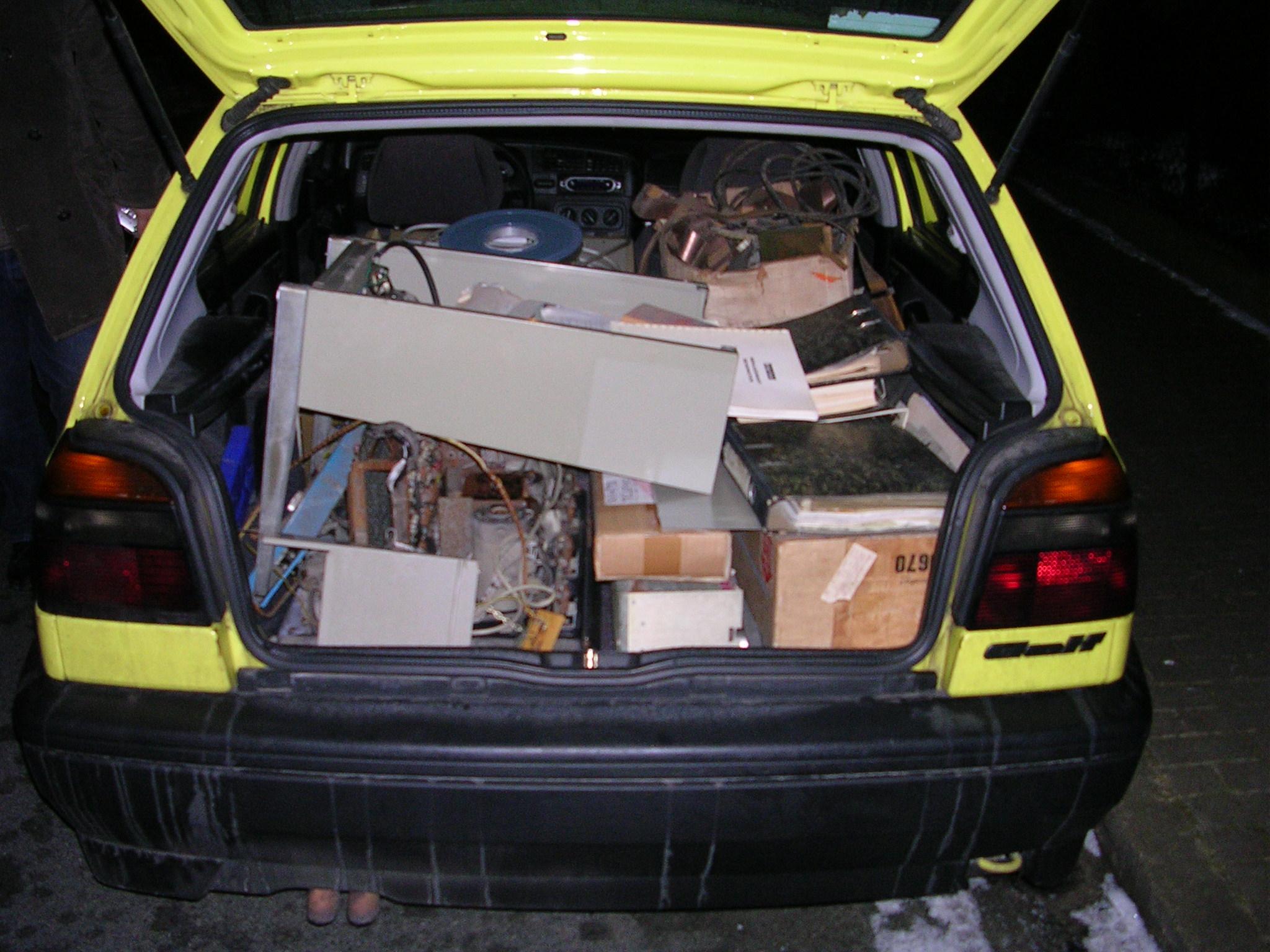
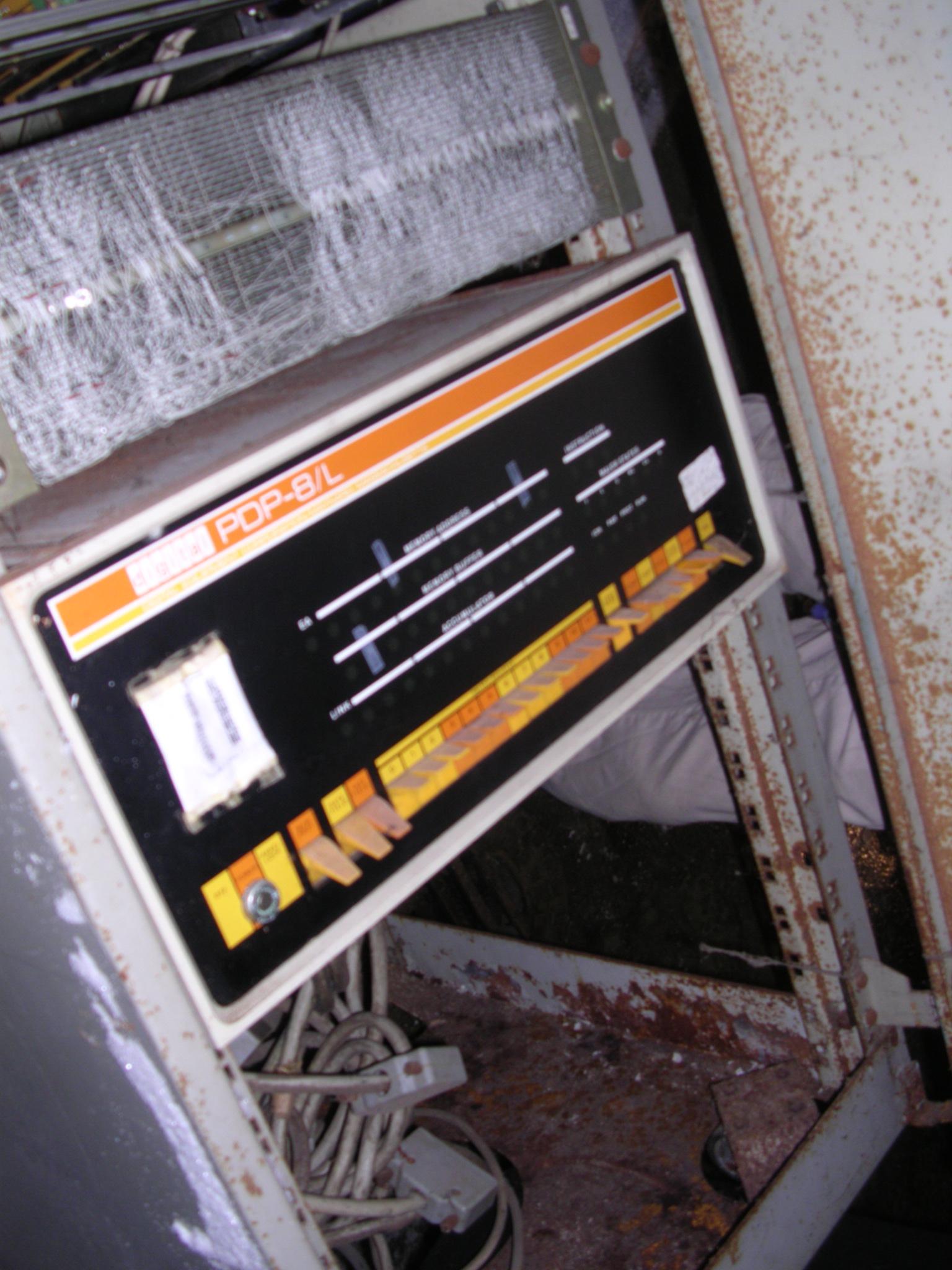
The day ended with my yellow car completely stuffed with rusty pdp8/l,
and lots of other stuff. It were three machines. The tape drives and
racks were fubar and went to scrap.
http://pdp8.hachti.de/gallery/haul/dscn0750_full.jpghttp://pdp8.hachti.de/gallery/haul/dscn0751_full.jpghttp://pdp8.hachti.de/gallery/haul/dscn2109_full.jpg
That was the beginning of the end. It just happened. Later 8/e, lab8/e etc.
And I had to admit that playing with Omnibus pdp8 is absolutely amazing!
It's a great toy! I think the pdp8/e (not straight-8, 8/i, /s or
whatever) is one of the greatest toys ever made. There are many games,
it breaks regularly while still giving you a chance to be satisfied
after fixing it. And it's so versatile!
And digging through those blurry schematics is a game in its own right!
For the Honeywell everything comes in high quality print, completely
correct, no derivations and workarounds. With DEC it can be an adventure
to get an overview over a hardware, its features, ECOs and FCOs and what
else could happen.
Someday I also made a pdp8 in an FPGA. That was during the time I wanted
to be a chip designer. But the only place where I could to ASIC design
(I did my diploma thesis about a video generator FPGA design) was closed
down instead of hiring me. Thank you, Silicon Image!
Currently I'm working for a Bosch/Denso joint venture doing Linux
security for car multimedia systems. In my free time I have just started
to construct a M?rklin model railroad digital decoder which I will try
to sell commercially (the competition use closed source PIC stuff. I use
GPLv3 AVR code). And I run a letterpress print shop with the biggest
machine being over 5 metric tons.
In the printshop there's also an 8/e. And I have inherited a forklift.
Don't know why I wrote this... Just wanted to write it. The teleprinter
discussion... It was the teleprinter discussion....
I never learned to get that paper... I just had the right toys.
That's it for now :-)
Sorry I don't recall his name, but wondering what the progress is on the
11/70 version of this. Raspberry pi, functional front panel with
blink'n lights which functions like the 11/70.
My back archives are in a bit of a scramble, so can't search it either,
again apologies.
thanks
Jim
My B&L Stereozoom microscope didn't have any protection for the
objective lens assembly. It uses a rather oddball 38 mm threaded mount.
I thought that those with the same scope might be interested in the
adapter being sold as eBay 401250097157. It fits the 38mm thread on
the B&L perfoectly and adapts it to a standard 52mm filter thread.
Cheap--less that $3 shipped. Just got it today and it fits like a glove.
FWIW
--Chuck
________________________________________
From: cctalk [cctalk-bounces at classiccmp.org] on behalf of cctalk-request at classiccmp.org [cctalk-request at classiccmp.org]
Sent: Wednesday, February 15, 2017 9:31 AM
To: bill.gunshannon at hotmail.com
Subject: confirm e3191f334ef584df40dccf9737f54f4dcd016a5d
______________________________________________
There was some talk a short time ago about accounts being shutdown because
of excessive bounces. Well, a couple days ago I got one of these messages.
I have not stopped receiving messages from the list. I think there is a problem
with the mailing list software. :-)
bill
Anybody interested in a copy of:
Communications Options Minireference Manual (EK-CMINI-RM-001)
USPS Flat Rate would be under $15.00 Throw in a couple more fo the trouble of
taking to the PO and it's yours.
bill
Don't laugh
http://w2hx.com/x/New%20Shack/0224151752b.jpg
________________________________
From: ben <bfranchuk at jetnet.ab.ca>
Sent: Feb 14, 2017 1:54 PM
To: General Discussion: On-Topic and Off-Topic Posts
Subject: Re: New batch of pdp8 OMNIBUS to USB interface! Please Read and react!
On 2/14/2017 6:27 AM, Alfred M. Szmidt wrote:
> FWIW, Mini-B connectors are on their way out, nor USB OTG compliant.
> Though agreed that they are flimsy... Why not just a type A or
> something? Easy, big, and robust.
>
Why not mini and regular?
Ben.
PS: Add a 45.5 baud serail port. Control everything with a 5 level TTY. :)
On Wed, Feb 15, 2017 at 11:29 PM, Tony Duell <ard.p850ug1 at gmail.com> wrote:
> I think at one time radio amateurs (at least over here) had to use 5 bit
> ITA2
> machines for RTTY.
Same here.
> It may even be to this day that RTTY implies that, and
> that ASCII is classed as 'data'.
The FCC order authorizing Amateur Radio use of ASCII went into effect in
March of 1980, but at the moment I can't track down a copy of the actual
order. The current FCC regs (?97.309) are more recent, and lump RTTY and
"data emission" together, allowing ITA2, AMTOR, or ASCII, or, with
additional limitations, "an unspecified digital code". I suppose I could
use EBCDIC, FIELDATA, or the IBM Stretch character code, as long as I
didn't use it for the purpose of obscuring the meaning of the
communications, or to communicate with a station in a country with which
the US doesn't have an agreement allowing those codes to be used.
But the 5 level machines that were used over
> here tend to be Creeds (Creed 7s, 75s and 444s mostly).
>
I'm told that Teletype models 15, 19, and 28 were very common here. I've
mostly seen models 15 and 28. I've only once seen a mdoel 32 (ITA2
five-level version of model 33).
I've seen some Kleinschmidt teleprinters, but I've never seen a Creed.
Hi,
Phil emailed me out of the blue -- I'm not interested but anyone on the
list want his 029 keypunch in Ohio?
--Toby
-------- Forwarded Message --------
Subject: Fwd: ibm 29
Date: Fri, 10 Feb 2017 16:25:44 -0500
From: Phil Masturzo <pmasturzo at neo.rr.com>
To: toby at telegraphics.com.au
My name is PHiL and I live in Cuyahoga Falls, Ohio. I got your email
>from a computer museum who thought you may be interested in purchasing
my IBM 29 computer. If so, email me back or call me on my cell
phone at xxx-xxx-xxxx, if I can answer any questions you may have.
Thanks,
Phil
They are really neat looking! Phillipp!
http://www.radista.info/tt_units/teleprinter_T-68d.jpg
Yes I like the colors! what is the weight!
Anyone heading to western US with large suitcase soon? (grin!)
Another one our favorite sortta cute teletypes we like here at the SMECC
museum is the model 31. we are looking to get all possible variants of this
machine.
We have some interesting stuff at this link here
http://web.archive.org/web/20170103075925/http://www.smecc.org/teletype_mode
l_31.htm
And... we are interested in more of them, any photos of them or scans of
them in various uses to continue to build this section out. Please drop us
a line offlist at couryhouse at aol.com
Ed# _www.smecc.org_ (http://www.smecc.org)
In a message dated 2/15/2017 11:22:51 A.M. US Mountain Standard Time,
hachti at hachti.de writes:
Hi,
On 02/15/2017 03:16 PM, COURYHOUSE at aol.com wrote:
> there are one of the Siemens teletypes that print tape and has a
dial
> on the front from Germany I have seen very compact nice unit used
for
> telex I would love to have.
It's the t68d. Exists in very different versions. With paper tape,
without, with dial, black, brown, etc.
I have a few of those.
I even have one sitting in Morocco. I brought it there by car...
Always good to review what the terms of each is. Newcomers may not
understand completely.
Same with photo usage and video and music usage - there are various
terms of usage for these media types.
Ed# _www.smecc.org_ (http://www.smecc.org)
In a message dated 2/15/2017 9:13:36 A.M. US Mountain Standard Time,
hachti at hachti.de writes:
One should also be aware of the difference between public domain, open
source, free software and the different license models and have an
understanding of the applicable rights and obligations.
Kind regards
Philipp
there are one of the Siemens teletypes that print tape and has a dial
on the front from Germany I have seen very compact nice unit used for
telex I would love to have. shipping on teletypes from overseas is
expensive though.
If one was local ad inn really nice shape we would be a candidate fro
it for the telecom display at SMECC.
Ed# _www.smecc.org_ (http://www.smecc.org)
In a message dated 2/15/2017 7:12:47 A.M. US Mountain Standard Time,
hachti at hachti.de writes:
>> I could swap something for a nice creed machine.
>
> I suspect they're more common in the UK than elsewhere. They were used
> by the Post Office
> for the Telex service, for example.
I know. Here everything is full with Siemens and Lorenz.
Je aussi voudrais avoir une machine de Sagem...!
> are wondering). Obviously these machines are normally 'collection
> only' the sellers will not ship
That's the main problem :-(
But teletypes are easier to find here than in US :-P :-P :-P
From: william degnan <billdegnan at gmail.com>
> that's fine, but the reasoning was totally political and narrow minded.
I'd be fascinated at a justification for this opinion that squared
with "John C. Calhoun?s legacy as a white supremacist and a national
leader who passionately promoted slavery as a ?positive good?".
On Wed, 2/15/17, jim stephens <jwsmail at jwsss.com> wrote:
> I saw her speak twice...
I got to hear her speak once when I was a freshman in
college before I really knew much about who she was.
Yet there were still several things she said that have stuck
with me ever since.? Years later I was talking with a retired
Navy admiral that I worked with and if I remember correctly
how he put it, Hopper was the only person Nimitz was ever
scared of.
>? But she had only brought a couple of "nanoseconds" and so I
> missed a chance to snag one.
Alas, I never got one of her nanoseconds either.? But I
still love telling my students the story about them.
> Very nice lady.
>From everything I've heard she was indeed, in addition to
being a force of nature. Always wished I had gotten a
chance to meet her.
BLS
Indeed! It is fun to learn what got people interested in the
history... and their
replies are in some cases interesting history itself!
Ed# _www.smecc.org_ (http://www.smecc.org)
In a message dated 2/15/2017 10:03:05 A.M. US Mountain Standard Time,
nf6x at nf6x.net writes:
Thanks for sharing. That was a delightful origin story.
--
Mark J. Blair, NF6X <nf6x at nf6x.net>
http://www.nf6x.net/
> From: Toby Thain
> Even if your argument weren't absurd and offensive
Absurd and offensive is in the eye of the beholder. Can we please drop
this topic? Thanks.
Noel
Personally, i don't care about lead free solder. I am quite happy with lead. Is there a rohs requirement for small production, non profit, prototyping project?
________________________________
From: Philipp Hachtmann <hachti at hachti.de>
Sent: Feb 14, 2017 11:54 AM
To: General Discussion: On-Topic and Off-Topic Posts
Subject: Re: New batch of pdp8 OMNIBUS to USB interface! Please Read and react!
Hi,
> I'm interested. How much did a board from the previous batch cost?
Was different. I first made a poll and sold a batch of boards in my
online shop for a certain price. It was somewhere about 105 EUR without VAT.
After I received the payment, I made the boards and delivered them (I
announced exactly that procedere!!).
Later, as a few boards were left, I increased the price up to nearly EUR
200. I did it like with kickstarter - the people who trusted and funded
got it cheaper. The whole thing barely covered the costs btw.
> And
> will that be any indication of what the new boards price?
No, not really. But I already have some rough idea.
The board will most probably be full size again. Reducing the size does
seems not to offer enough benefit with respect to the hassle of adding
enlargement afterwards.
After my poll it looks as if there will be the following options:
- Kit with full size board and SMT already soldered RoHS compliant.
This will most probably go for short under EUR 100 (without VAT where it
applies).
I have to check with the assembly house. This time I try not to sit
there and solder lead free SMD by hand for days. I like soldering SMT
but that lead-free stuff and masses of boards can get quite annoying.
The last boards were all hand soldered by me.
One problem could be the gold fingers: My usual board house finally
realized that their calculation tool was plain wrong when it charged me
extra EUR 1,50 per board for the hard gold fingers.
The board will be like the old ones but:
* some unused (upper bit) IC positions removed
* The diode stuff moved away from the edge (that was so stupid, sorry!)
* The USB connector will be moved away from the edge, I will think about
some holes to fix the cable using a strap. The USB will become mini USB.
- Wonderful handle/set of handles to attach to the board. Probably made
of milled wood, still thinking about it.
This will be extremely expensive, I have no idea yet. Perhaps EUR 30 per
"one piece" or set.
And if someone really insists, I will manually complete and test a
board. That would add another EUR 65 to the game. And perhaps an USB cable.
If I continue to sell boards in that way, it will take not even 5 more
years until it has paid for my Eagle 6 and 7 licenses..
Please continue to add to the doodle "calendar", if you are interested.
Kind regards,
Philipp
I have not heard of 40 mil loop here on ttys... generally 20 mil or
60 mil. - At least what I have encountered. Is the 40 mil. standard in
Europe?
Ed# _www.smecc.org_ (http://www.smecc.org)
In a message dated 2/14/2017 2:24:15 P.M. US Mountain Standard Time,
hachti at hachti.de writes:
On 14.02.2017 22:18, geneb wrote:
> On Tue, 14 Feb 2017, ben wrote:
>
>> On 2/14/2017 6:27 AM, Alfred M. Szmidt wrote:
>>> FWIW, Mini-B connectors are on their way out, nor USB OTG compliant.
>>> Though agreed that they are flimsy... Why not just a type A or
>>> something? Easy, big, and robust.
>>>
>> Why not mini and regular?
>> Ben.
>> PS: Add a 45.5 baud serail port. Control everything with a 5 level
>> TTY. :)
>
> Dirty casual. 20mA current loop or nothing.
The 45 baud machines do NOT run on 20mA. They usually run on 40mA :-)
20mA is the domain of model 28, 32, 33 etc.
> From: Josh Dersch
> Sorry, typo.
Ah, no wonder I couldn't find it... :-)
The memory card (?) - the hex board leaning up against the wall in the middle
- does look a lot like the MS95 memory card from the manual (three horizontal
DuPont headers at the top, two vertical ones at the bottom, etc) but it also
has differences - it doesn't have the two large square chips, etc. (And
there's an MS95 in the board list, IIRC.)
None of the other boards seem to correspond to anything in the QED 95 manual,
though. So, rather a mystery. Quickware Engineering does still have a Web
page (http://quickware.com/) which says that "Our core business is providing
custom PDP-11 processor emulator upgrades", but it contains little content.
Noel
Does anyone know what the QED board (4th image) in this eBay lot:
http://www.ebay.com/itm/322414100718
is? The large chip looks like a J11 chip. However, the only QED PDP-11 board
I found mention of online is a high-performance hex board UNIBUS processor,
the QED 95.
Noel
Perhaps a silly question but have you poked around local social media for a local unix group? Or a local craigslist ad for someone to borrow a key? I wouldn't think they'd be thst uncommon although admittedly I also stopped/paused a project for similar lack of results a while back (much different system though).
> From: Tony Duell
> Having other hardware decode instructions that appear as NOPs to the
> main processor is not uncommon in HP machines.
Ah, so you actually had some prior knowledge that helped in working out that
puzzle, that that's what's happening here! :-)
Noel
Its literally Christmas for me today.
I came into physical position of a well optioned-out SPARCserver 1000e,
accompanied by several SPARC Storage Arrays.
I'm doing a physical review of the 1000e, i.e. re-seating boards, physical clean
up, etc. And reviewing all the appropriate hardware documentation, still
available, directly from Oracle.
Anyway, on the front of the case is a (4) position power switch (i.e. standby,
on, DIAG, lock), that is unfortunately not set to the on position.
Hoping that someone out there either has a key that they will part with, or,
knows of another (presumably Sun) key that will work in the 1000e key switch.
Thanks for looking,
Jerry @ 75077
Hi CC folks:
Been trying for several years now to find the vital parts I need to
get a Nova 3/12 from my old Univ. up & running. What I do have now is
the chassis with PS, front panel, CPU and FPU boards, some of the
documentation, and, hopefully pending, a disc drive (not sure if it
has controller). Most of all, of course, we badly need Mag or MOS
memory, plus I/O boards/peripherals. Have posted on "vintage
computers" several times and also contacted a DG specialist but so far
no success with parts. ANY help in getting this thing going before,
at pushing 70, I get too old to ever see it run even a simple routine
or ancient game, (or care !) would be very deeply appreciated!!
Please eMail: firesweep "at" verizon "dot" net if you can help or have leads!
regards,
Roger A. in NY
On Tue, Feb 14, 2017 at 4:22 PM, Philipp Hachtmann <hachti at hachti.de> wrote:
>>> PS: Add a 45.5 baud serail port. Control everything with a 5 level
>>> TTY. :)
>>
>> Dirty casual. 20mA current loop or nothing.
>
> The 45 baud machines do NOT run on 20mA. They usually run on 40mA :-)
The M19 is 60mA at 100VDC... takes a bit to pull that relay.
> 20mA is the domain of model 28, 32, 33 etc.
Yep. That's all I have in my own pile... (33 and 35).
-ethan
> From: Tony Duell
> Personally I _do_ care about lead free solder. I won't have it. The
> fact that part of this board comes pre-assembled with that horrible
> muck means I won't even consider buying one.
Gee, Tony, why don't you tell us what you _really_ think! :-)
Noel
Hi there,
I've got a couple of DEC QBUS boards (including a quad SLU) for which
configuration is set by wire-wrap jumpers. I don't have a wire-wrap tool,
and have found that trying this by hand without one is not workable.
Has anyone come up with a clever way to permit reconfiguration of these
boards without semi-permanent changes? Or, alternatively, what wire-wrap
tool would you recommend?
Thanks!
- Earl
That is a very nice and robust part you linked to. Looks perfect
________________________________
From: Ethan Dicks <ethan.dicks at gmail.com>
Sent: Feb 14, 2017 10:03 AM
To: General Discussion: On-Topic and Off-Topic Posts
Subject: Re: New batch of pdp8 OMNIBUS to USB interface! Please Read and react!
On Tue, Feb 14, 2017 at 8:27 AM, Alfred M. Szmidt <ams at gnu.org> wrote:
> FWIW, Mini-B connectors are on their way out, nor USB OTG compliant.
> Though agreed that they are flimsy... Why not just a type A or
> something? Easy, big, and robust.
This is a peripheral. USB OTG doesn't apply, and USB-A would be
"inappropriate". Pretend this is an inkjet printer. What plug would
you expect to find on that?
I don't _mind_ Mini (I have a number of devices and cables that are
mini) and it _is_ more robust than Micro (I have seen plenty of phones
and tablets with broken micro plugs).
I have a suggestion... put 4 vias on 0.1" spacing next to the micro
connector so we could, for example, add a chassis-friendly exit cable
of our own purchase/manufacture if we choose, to have a nice fat USB-B
on the outside of the case.
https://newnex.com/images/UHR1-B-0005Blarge.jpg
-ethan
AT&T 3B2 Computer UNIX System V User Reference Manual
Original red hardcover, 3-ring binder, 9"x9"x2" Published July 1985
Excellent condition, never used
Best offer plus $10 for shipping.
Tony Duell wrote:
> My first thought, and it's probably wrong, is that these instrucitons
> (which differ by one bit, so might be
> setting/reseting something) are NOPs to the CPU, but are interpretted
> by the memory mapping hardware in those
> 9825s that have more than 64K or RAM and ROM total.
This seems likely. According to your schematics, gate U47 detects the pattern 0701xx. This signal feeds into the U43c flipflop, which appears to latch the state of the low 4 bits of the MAD bus into register U42, which sets the state of the /ForceRAM (bit 3), /ForceROM (bit 2), /DiagRd (bit 1) and ALLROM (bit 0) signals. Thus, these two instructions appear to toggle the state of the /ForceROM signal.
If I?ve wrapped my brain around the details it appears that 070113 deasserts the /ForceROM signal, and 070117 asserts it?
I agree quite a unique bit of code
On Feb 13, 2017 4:07 PM, "Noel Chiappa" <jnc at mercury.lcs.mit.edu> wrote:
> From: Tony Duell
> My first thought, and it's probably wrong
Apparently not... :-)
> these instrucitons (which differ by one bit, so might be
> setting/reseting something) are NOPs to the CPU, but are interpretted
> by the memory mapping hardware
Ooh, very clever/cool.
Noel
> From: Josh Dersch
> (while installing the MMU and Stack Limit Register in my own 11/40)
BTW, I think I found out why the MMU requires the SLR. The SLR is not
operative in User mode. I haven't checked out the circuitry to see exactly
what the interaction is, but it has to be something associated with that.
> you *will* need an LTC to run V6 UNIX
Actually, it will work with a KW11-P, too; those are actually more commmon
than the KW11-L's, I've found. But as Guy pointed out, the DL11-W will do too
- and those are _very_ common (since they were used in the 11/34's, etc).
Noel
> From: Tony Duell
> My first thought, and it's probably wrong
Apparently not... :-)
> these instrucitons (which differ by one bit, so might be
> setting/reseting something) are NOPs to the CPU, but are interpretted
> by the memory mapping hardware
Ooh, very clever/cool.
Noel
Looking for a DATAC 1000 if anyone has one for sale or trade (or a site
with pictures). This is a Philadelphia USA origin 6502 trainer. I am
interested in it for the local history.
Thanks
Bill
> From: William Degnan
> PDP 11 KE11E M7238 EIS board (for PDP 11/40) which causes the CPU to
> crash when installed; front panel not responsive
> ...
> I installed a removable jumper so I can flip jumper configs back and
> forth between EIS installed/not installed. Without the EIS the system
> works fine
To understand this symptom, one needs to understand how the EIS interacts
with the main CPU. Both include microcode, and what is supposed to happen is
that when an EIS instruction happens, control is passed to the microcode on
the EIS board (the actual microcode words being fed back to the main CPU
through those three over-the-back jumper cables). The microcode on the EIS
board can then control the data paths, etc in the main CPU, to feed the EIS
data, and take back the results of the computation performed on the EIS card.
I'm trying to understand what W1 does, but I'm not there yet. It's shown on
the KD11-A print K3-8 (pg. 48), in the lower left corner, but its effects are
somewhat obscure.
To start with, the array of odd chips E6-E7 (74H60's) and E17 (74H53) are
expandable AND-OR gates. I'd never seen these before, but the lines running
to and from pins 11 and 12 on the 'H53 join the other three gates below it
into it - i.e. that whole array of AND gates all feed into one NOR gate
(output on pin 8 of the 'H53).
So far, so good, but from there I'm still lost. When W1 is inserted (no EIS)
it grounds the signal ECIN00, which comes in from off-board (as shown by the
"A05S2", which is the pin it arrives on). The output of that giant NOR gate
is CIN00, which is immediately sent off-board (pin 'A05P1'). I have yet to
try and chase these signals down, and work out what they do; the KD11-A Tech
Manual is fairly cryptic on the subject.
Note also that, IIRC, the front console operates under control of microcode.
So I'm _guessing_ that what is happening is that somehow the EIS is, when
enabled, messing up the operation of the microcode in the main CPU, causing
it to freeze.
> Thought - I don't have a LW11L, M787 installed. ... Do you think that
> maybe the EIS board requires this for some reason
No. I've looked at the KW11-L prints in the past, and it's just a very simple
UNIBUS device. I don't see any way it not being there could cause the
symptoms under discussion.
> I could swap out the current 11/40 backplane with a backplane that has
> the jumpers for the M787 already removed
I think it's only one jumper - for BG6, no?
> I neglected to mention I had no M787
To run Unix V6 you'll need either a KW11-L or KW11-P (see previous
discussion about how Unix needs a clock - both at a low level, because
it will panic() if it doesn't find one, and at a high level, because
even if we patch the panic, stuff won't 'work right' without one).
Noel
Question - I am working on a PDP 11 KE11E M7238 EIS board (for PDP 11/40)
which causes the CPU to crash when installed; front panel not responsive,
can't boot XXDP. I installed a removable jumper so I can flip jumper
configs back and forth between EIS installed/not installed. Without the
EIS the system works fine, can boot OS's that do not require it like RT11.
As discussed before the EIS is required if I want to boot up UNIX 6 on the
11/40, which is a goal of mine.
Thought - I don't have a LW11L, M787 installed. This is a the Line TIme
Clock option card. Do you think that maybe the EIS board requires this for
some reason, even though there are no references to this as a requirement
in any docs I can find? Maybe the docs writers assume it's installed? I
only wonder because any time I have seen the M7238 installed in an 11/40 I
have also seen a M787.
I could swap out the current 11/40 backplane with a backplane that has the
jumpers for the M787 already removed, but I only want to do this if it's
necessary. When we were talking before I neglected to mention I had no
M787, you may have assumed I did.
Bill