How do you subscribe to Computer Collector
+++++++++++++++++++
Kevin Parker
Web Services Manager
WorkCover Corporation
p: 08 8233 2548
e: webmaster(a)workcover.com
w: www.workcover.com
+++++++++++++++++++
-----Original Message-----
From: cctech-bounces(a)classiccmp.org
[mailto:cctech-bounces@classiccmp.org]On Behalf Of Computer Collector
E-Mail Newsletter
Sent: Tuesday, 11 May 2004 7:56 AM
To: General Discussion: On-Topic Posts Only
Subject: Re: Computer Estate
Hi there,
I'm not sure if he does estate sales, but I strongly suggest you contact Sellam
Ismail, who owns a company in Silicon Valley called VintageTech. You may have
seen his name on this list as well as "VCF" or "Vintage Computer Festival."
Anyway, Sellam's pretty much the biggest collector in the known galaxy, and his
company, VintageTech, lets him do this hobby for a living.
You can reach Sellam at vcf(a)vintage.org.
Why you should trust my opinion: I'm the founder/editor of Computer Collector,
which is an online news magazine (with about 500 subscribers each week) serving
the hobby.
Good luck,
-- Evan Koblentz
(PS -- I personally collect handhelds and PDAs. If there are any in the
collection, I'd like to look through the list.)
--- Bogilady(a)aol.com wrote:
> Is there a company or private party in the Pacific Northwest that specializes
>
> in liquidating computer estates? They date from the late 1970s to the mid
> 1990s in various conditions.
>
> I really don't want to recycle them at scrap price if someone out there can
> use them.
> I figured ebay is a good place for anything unopened, but all the rest is
> simply overwhelming.
>
> Help, suggestions, ideas and warnings are welcomed.
> Cathy
************************************************************************
This e-mail is intended for the use of the addressee only. It may
contain information that is protected by legislated confidentiality
and/or is legally privileged. If you are not the intended recipient you
are prohibited from disseminating, distributing or copying this e-mail.
Any opinion expressed in this e-mail may not necessarily be that of the
WorkCover Corporation of South Australia. Although precautions have
been taken, the sender cannot warrant that this e-mail or any files
transmitted with it are free of viruses or any other defect.
If you have received this e-mail in error, please notify the sender
immediately by return e-mail and destroy the original e-mail and any
copies.
************************************************************************
I'm actually going to make it to the Dayton Hamvention this year, taking
off Friday morning, for about a 9.5 hour drive... staying until Sunday
morning/noonish, I believe. Any good things to see/do/visit/eat/drink
whilst I'm there?
Thanks, and who knows? Maybe I'll finally meet someone else on the list
"like, in person, eh?" ;-)
Laterz,
Roger "Merch" Merchberger
--
Roger "Merch" Merchberger | "Profile, don't speculate."
sysadmin, Iceberg Computers | Daniel J. Bernstein
zmerch(a)30below.com |
"Joe R." <rigdonj(a)cfl.rr.com> wrote:
> About a month ago I picked up what I thought were a couple of HP-IB
> disk drives made by a compnay by the name of IEM of Ft. Collins Colorado.
I have an IEM HP-IB tape drive (a 4400 series). I posted a similar
request for info on cctalk a couple of months ago, but nobody responded.
My box has an HP-IB to SCSI motherboard and an HP 4.0Gb DAT SCSI
tape drive.
> [...] It has a LCD
> display on and it [...] There are also three buttons on it
> marked Select, Next and Previous.
Mine has the same panel and buttons. I tried your trick with the
select button and it gave me a similar demo (nice trick, thanks).
It claims to work with MPE and HPUX and to be compatible with
the HP 7978 tape drive (and the C1511 whatever that is).
Unfortunately, my Integral PC does not recognize this drive.
I suspect that the motherboard for the tape drive is the same as
the one in your optical jukebox, but with different ROMs. There
is also a DIP switch in the back (for setting HP-IB address and
various options) and a bunch of jumpers inside. I have no idea what
they are supposed to do. If you want I can take a photo of the
motherboard and send it to you.
**vp
I collected a number of Otrona parts over the years with the intent of
reassembling them into a working system, but that hasn't happened, and I
think other interests are going to keep me from ever spending the time it
needs. I think almost everything you need to build a basic working system
is here.
I have the following items available, up at auction on the Vintage Computer
Marketplace...
http://marketplace.vintage.org/bid.cfm?ad=727
All items are completely and totally untested. Links to photos are on the
listing at the link above.
* Six CPU boards, "pulls"... Most with parts on them, one bare board. The
ones with parts all have some parts missing that I think are relatively easy
to find: 765 floppy controller chip, Z80 PIO or SOI, or 5027 video
controllers, etc. Only one board has a 5027 on it, but I also have a
"loose" 5027 that I will include. I have EPROM images for the CPU board
EPROMs.
* Three floppy drives loose plus two in their chassis components--the
special not-quite-half-height drives the Attache used;
* GPIB cards in various states of assembly, rework, or disassembly. I
believe there is also an 8086 card, but it's stripped of parts.
* Case and chassis parts that I believe are enough to build (or reface) a
complete unit, include outside cover, two rear bezels (one with PSU attached
to it), a front bezel still wrapped in foam, keyboard shell top and bottom
halves, handle;
* Additional keyboard assembly, dirty, but usable; plus three keyboards
without case.
* One video/CRT field replacement unit (tube + boards + mounting hardware),
plus an extra video board, extra yoke, and another incomplete video
assembly. I think I also have a third partial assembly in a box; if I find
it, it will be included.
* A number of expansion/daughter cards for 25th line, graphics, and high-res
graphics; some are loose, but some are mounted to CPU boards (see photos).
* CP/M boot disks in unknown condition (images also available from Don
Maslin, I believe).
* Binder with schematics.
Hi,
i'm the winner of an eBay auction for an AMI Goliath board. The seller doesn't want to ship
internationally (i asked him before, but got no response in time ...).
Can anyone accept delivery and forward the stuff to me ? I will pay of course for all expenses !
Thanks alot
Bernd
Just a heads up; I have started to list stuff on the Vintage Computer
Marketplace. The things being listed are what I can easily get to right
now :).
http://marketplace.vintage.org/
Besides what I am listing, there are some other interesting things
there!
I have 2 VT100 terminals plus a vt100 plastic shell that I'm parting out.
They are VERY yellowed cases, obviously a smoking environment. Definitely
some screen burnin too. On at least one of them the fasteners that hold the
top of the case to the bottom of the case are broken. I don't think they are
worth much more than the junk heap. They all power up and go into setup mode
just fine. They are all true VT100's, not 102's, etc. Some or all of the
keyboards are missing some keycaps. I think one keyboard may have all it's
keys.
In addition, I have a vt102 without the top or bottom case. It is in perfect
working order, clean, and no burnin with one major flaw. The metal band
around the front of the tube has slipped, meaning two of the L brackets that
are held down by that band have slipped back so the monitor is about 1/2
inch forward of where it should be. Thus it won't fit into a plastic case
quite right. The band is too tight to push the L brackets back into place,
and I'm not comfortable cutting that band and trying to put a new one in
place (something about working with a large glass object under pressure
scares me a bit).
So far my plan is to keep the vt102 chassis as spares, and ditch the 2.1
vt100's. If anyone wants me to scavenge parts (logic board, power supply
board, flyback, transformer, keycaps, crt tube, etc.) I would be happy to do
that. Total price for each shipment will be shipping cost + 5 bucks (unless
you just want a keycap or something)...negotiable. The only stipulation is
you must let me know in a day or two, I'm itching to get them out of the
house and gone.
Jay West
---
[This E-mail scanned for viruses by Declude Virus]
The best long-term storage method I know of is to inscribe the information on a
tablet of wet clay and bake it in an oven, after which it becomes hard as rock.
Sumerians did this 6000 years ago and their writings are still perfectly
readable.
MS
I am just about ready to rid myself of the DEC equipment I have. I'm
starting
with the classic computer mailing list, but I may part the stuff out on
e-bay. I want to preserve the equipment and related manuals, but I'm also
not ready to just make a gift.
The equipment was purchased in 1979 with updates in maybe 1981. It was used
in my business and has only been moved once (Fall, 2001). It is now in my
garage which is obviously not air conditioned. Most of the manuals and
printed materials are in a storage room a few miles away in "conditioned"
air. The computer was used primarily as a BASIC processor, but we also had
compiled Dibol applications we developed (actually DBL).
I have the mid-height (42") newer-looking cabinet containing the processor
and dual RL01's. The dual RX01 unit is stand-alone, desk-top unit with
matching exterior. The original basic unit was an 11T03 with an 11/03
processor. After a few years I swapped the processor to an 11/23 (dual size
M8186): KDF11-AC with KTF11-AA makes the cpu a KDF11-AA. Also added
KEF11-AA FPU to help my number crunching. Current memory is 256K
(MSV11-LK).
The monitor is a VT100 with an extra board for advanced video, plus a
tilt-swivel stand (DEC version). I also have an LA120BA terminal unit with
keyboard that I used as the wide-carriage printer. I generally used TSX
and at one time had a time-sharing client using a proprietary program
through a 1000 baud modem. I believe the latest RT11 I used was v.3B, but
v.4 may also be there.
I have the usual stuff that went with operating the machine:
- printed docs ( box of paper ) for diagnostics, plus microfiche version
- original diagnostics on RL01
- original manuals for each item (I think)
- some hardware diagrams/schematics, along with installation booklets
- 8-10 of the small paperback books of equipment from DEC
- 4-5 large blue notebooks from DEC regarding operating system, etc.
- maybe 9 RL01 disk packs in total - a few used RX01s
- software - RT11, BASIC, Fortran?, TSX?, DBL? - some confusion in this
since the distributions came from a third-party developer via RL01, not from
DEC on distribution-type media.
The CPU and memory seem fine. The bottom RL01 powers up but shows a fault
light; the other works fine. Both RX01 drives work. The VT100 works fine.
Haven't tried the LA120 lately.
I recently hooked a PC as the console and used Kermit to transfer all the
data on the RL01s. I have slowly been trying to separate my data from DEC
data on the RL01s and do a wipe routine after, thus protecting client data.
Maybe I'll only release half of the RL01s.
I've infrequently reviewed the digest versions of this mailing list, but
this is my first attempt to participate. I am switching from digest so
that I can try to be responsive on-line (generally between 7:00 pm and
11:00 pm EST). Are other times more appropriate? I can also answer emails,
generally within a half day. I can maybe get some pictures on-line, but
most of the participants in this list know what they're dealing with.
I'm in central South Carolina.
bill bailey
Update:
At 14:14 -0500 4/29/04, Mark Tapley wrote:
>1) Screen display is too far to the left.
At 23:59 +0100, 4/29/04 ard(a)p850ug1.demon.co.uk (Tony Duell) replied:
> On the back of the yoke are 2 metal plates.
>Rotating them, either together or in oposite directios, will move the
>picture (strictly the raster, but anyway..) around on the screen.
Got the machine far enough apart to spot those and play with them
yesterday. Sure enough, that fixed the screen-shift (and it's almost
a certainty that I disturbed them when I took out the Elf Armor).
FWIW, the plates are perpendicular to the path of the electrons in
the CRT and more or less centered on that path near the back end of
the CRT. They are circular (umm, annular? I can't see anything but a
mm or two at the rim of the circle), and have little tabs at 2
locations 180 degrees apart. There are 2 plates, stacked together.
They are "finger tight". I fooled with them while watching the image,
but I used an insulated tool, so I didn't fool with them much. A
slight twist (maybe 15 degrees) on one of them moved the image right
where I wanted it.
Thanks, Tony!
Still in the to-do list: ordering a new rectifier (thanks, Chris!)
against the day my CR5 dies (but it seems OK right now, picture is
fine and steady) and borrowing an o-scope to see how much ripple is
on the 5V line. And probably saving up for an ESR meter to test the
caps around the connector that goes to the digital board, and
probably getting a new capacitor or two. And retouching J4. After the
picture adjust, coincidentally, machine ran fine for several hours
yesterday (all the time I could spend on it). Love that BrainStorm!
--
- Mark
210-522-6025, page 888-733-0967
I have an extra Mohawk Data Services 7 track (!) tape terminal
available. Basically, it is a tape drive with a keyboard - oh the weird
stuff they used to do back then!
Anyway, this is a late 60s (probably) all transistor and core box, about
five feet tall and 300 pounds. It takes standard tapes. I don't think the
thing is completely working right now, as I can't get it to do much, and a
light blinks as in "something wrong!".
I have no docs on the thing. I should also say that the keyboard on this
thing moved the bar as far as how bad human engineering can get.
Anyway, I want to make it go away, so if anyone has stuff to trade (no
micros, please - (cruddy) big stuff or docs are good) or has a little cash
(were not talking much here folks - scrap value is probably only $100), we
can deal. I can deliver to VCFeast or anywhere near NY/NJ/CT/RI. I could
ship it as well, as I do have a sort of crate thing.
Let me know! Please, I need the room!
William Donzelli
aw288(a)osfn.org
I have a "Gibson Light Pen by Koala", with software and docs. Does anyone
know if this is truly the "sucessor" to the LPS II or just a repackaged
version?
-- Adam
Over the years, I have been pretty successful in acquiring Hyperions.
Actually the bulk of my collection is Hyperions.
A recent letter to the group made me pause and think about the future of my
Hyperions. I won't sell them but I would love to have them with someone who
can sort out the hardware and the manuals and make the information available
to those who are interested. At this point I have too much on my plate to do
this myself. Trades will be considered but not outright sales.
I've contacted a couple of the Canadian museums with an offer of this
equipment but haven't been honored with a reply. Soooo, Canada is good but
if they have to go to the states, so be it. No shipping though, only pick-up
in Scarborough.
Points for anyone who is interested in these units :
1. Are they of interest to someone who could pick them up in Toronto
(Scarborough actually, 20 minutes from the CN tower.)? I won't ship them.
2. My original Hyperion, which I purchased and am keeping, does not boot so
the others may be in the same condition and
I already know that at least one of the storage towers has had some trace
problems, if that's what you call them. There are about 6 complete units,
one for parts
and two storage towers that are about two by three feet and very heavy
(maybe 50 pounds or more.)
3. I'd like to keep one set of manuals but there are doubles and triples of
just about everything plus boxes of software and records from their original
site which was a Canadian tech college.
4. There would have to be some agreement that this stuff wouldn't be sold as
I was given all of it under the condition that I wouldn't sell it. If you
have a museum and are interested in this stuff, that would be absolutely
prime.
5. All of the material has to be kept together. I'm not going to piece it
out. It has value both monetary and historically and I would love if it
could be in a bricks and mortar museum somewhere.
That's about it. Volume is probably a stretch mini-van full or a bit more.
If nothing happens with this, I will obviously keep it all and hope my kids
will be interested in it in about ten years. If you have some ideas, let me
know at :
antique101(a)hotmail.com
I may add to this if I've forgotten anything important.
bm
The RD53s are toast, but is the controller O.K.? I'll lend you an RD54
with some version of VMS on it if you want to try to boot that way. Either
way, I have a MVII with some RD54s on it (maxtor 2190s I believe) and
maybe a loaner rqdx3. and we can talk about the back door also.
BTW, I am coming up on my vacation, so I'll get back to you about the
other qbus stuff I have, if you still want an LSI-11 flavor machine...
Joe Heck
And no, I haven't forgotten Curt, Steve and the many others who have asked
about the "stuff" I am getting rid of. During the month of June when I
am off from work, I'll get back to all the emails I saved about my equipment.
>
The only real chance is to make sure that the data has redundant
storage. Paper burns well. Why is it that many of the classic
systems we like have no docs. These docs were on paper. One type
of storage is no solution at all.
===
This is EXACTLY why I created bitsavers.org
>> I << don't want to have the only surviving copy of a paper document
or program.
The problem is, there are no 'real' mirrors (I can see in the logs that
dozens of people are mirroring it for themselves..)
On May 9, 0:26, Guy Sotomayor wrote:
> On Sat, 2004-05-01 at 12:38, Fred Cisin wrote:
>
> > How well does DEC stuff handle weather?
>
> Poorly.
>
> Paul, Fred and myself collected all of this last weekend. Our
> "adventure" is now up on my web site at:
> http://www.shiresoft.com/pdp-11/rescue/index.html
Ow!
--
Pete Peter Turnbull
Network Manager
University of York
Things are jumping over at www.sebhc.org , with more than 70 members
committed to the preservation of Heathkit 8-bit computers - come take a
look.
Several of us have tried unsuccessfully to get in touch with either Dave
Shaw or Dave Wallace, both of whom created websites featuring H8
emulation, one Mac-based, the other Windows-based. While email addresses
are available, no-one has had a recent response from either Dave.
Can anyone on classiccmp provide some help -
1) working email addresses for Dave Shaw or Dave Wallace, or possibly
for reviewers of their emulators, including Larry Bledsoe, Steve
Novosad, Charles Horn, Neal Granroth, Stanley Webb, or Bob Myers;
2) did anyone download the emulator source or support files from Dave
Shaw's defunct website?
Any help appreciated!
Jack
Found while scouring Usenet for something totally unrelated:
"Well, you never know what someone might be doing with old, but usable,
hardware. I have heard that there is a major bank in Great Britain
that keeps an IBM 360 running because its 1401 emulator emulates a 704
(as did the original 1401) for a program whose Autocoder source was
lost long ago. Also, don't underestimate the geek factor. Was
AlphaLISP ever ported to Alpha Micro's 680x0 line?
"Transported to a surreal landscape, a young girl kills the first woman
she meets and then teams up with three complete strangers to kill
again." -- TV listing for "The Wizard of Oz" in a Marin County newspaper,"
Posted 2002-04-03 by one Michael Roach.
Apocryphal? Who knows. Might be worth following up one...
--
Sellam Ismail Vintage Computer Festival
------------------------------------------------------------------------------
International Man of Intrigue and Danger http://www.vintage.org
[ Old computing resources for business || Buy/Sell/Trade Vintage Computers ]
[ and academia at www.VintageTech.com || at http://marketplace.vintage.org ]
I just downloaded an atari 800 emulator for my Ibook.
When I have written a basic program how do I save it to floppy?
How do I load it again?
Directory list?
the emulator has 8 diskette drives, how do I specify them in my
commands?
Any good sites on the Internet with simple stuff like that -
I can find basic sites, and Assembly language sites but I don't
see anything on DOS sites.
Thanks!
I just picked up an HP 97 at a church rummage sale. It was sold "tel
quel" ("as is"), so it was a bit of a gamble, but I figured if it was
broken it'd be even more fun 'cause then I would feel no compunction
about opening it up and Investigating.
The battery pack appears dead (based on a 1kohm/volt voltmeter, it's
producing about .1V) and it didn't come with a wall wart. But the
battery pack was visibly made up of four cells, so I figured four
rechargeable cells is probably about 5V - and the external power
connector is marked 5V. So I hooked it up to 5V from a peecee power
supply (peecees are good for _something_; they provide me with power
supplies :), and it seems to be in full working order. Even the
printer works (though the ribbon appears a little enfeebled).
All I need to do is find a manual for the thing. Anyone know of one?
Google found me a few places _selling_ scanned copies of the manual,
but none civilized enough to have it up for fetching.
The thing cost me all of five bucks. :) Maybe not quite on a par with
an ASR33, but it's also a lot easier for me to find space for. As yet
I may be but a dilettante when it comes to old computing gadgets, but
*I* think it has a healthy dose of gamish!
/~\ The ASCII der Mouse
\ / Ribbon Campaign
X Against HTML mouse(a)rodents.montreal.qc.ca
/ \ Email! 7D C8 61 52 5D E7 2D 39 4E F1 31 3E E8 B3 27 4B
I've set up a trade with another Listmember who needs a '3' as much as I
need a '1' - so Things have worked out well!
Thanks to all who have responded so far!
Cheers
John
Does the "gamer" lifestyle include classic computers or are we unlikely to
see Sellam on there again?
Comcast Agrees to Purchase TechTV
Thursday, March 25, 2004
Comcast recently announced that it has signed an agreement to acquire
TechTV, a cable network focused on cutting-edge technology and the impact of
technology on daily life, from Vulcan Programming Inc. When the deal
closes, Tech TV will be merged with G4, the Comcast-owned television network
devoted to video games and the "gamer" lifestyle.
Folks,
Spent a day troubleshooting this one so I'm wondering if any of you have
come across this before: 3100-95 with internal SCSI set at ID 7. Give it a
boot disk at any free ID and another device (doesn't matter what) at ID 6.
At the dead sergeant prompt all the devices are visible, but boot VMS 7.2
and whatever device you have at ID 6 is not seen unless it's the boot disk
itself in which case it shows up as DKA600.
Is there something hard-coded into VMS for MicroVAX 3100s that always
assumes the SCSI controller is at ID 6 no matter what? I know that older
3100s always had the controller at 6 and I don't remember it being
changeable....
Most odd :)
Cheers!
--
Adrian/Witchy
Owner & Webmaster, Binary Dinosaurs
www.binarydinosaurs.co.uk - possibly the UK's biggest online computer museum
www.snakebiteandblack.co.uk - ex-monthly gothic shenanigans :o(
I have discovered a couple of RL02 (and other drives) 'READY' buttons,
which also determine the drive's 'number' in the system, 0-3. I would
like to trade a brand-new '3' button for a '1' button that is known good.
I have several RL02 drives, all of them '0' devices.
I'll pay shipping to you. Straight trade, no money involved.
Cheers
John
Does anyone know, or know of a reference to, the serial-line protocol
spoken by Summagraphics tablet digitizers (specifically, the MM1103)?
I have one. After a bit of detective work, I got it to at least
somewhat work. I now have it to the point where I can connect it up
and turn it on. When I do, I get nothing until one of the buttons on
the puck is pressed, at which point it starts generating a stream of
samples, continuing for as long as some button is pressed. The format
is fairly easy, just %04d,%04d,%1d\n sent with the 0x80 bits set to
provide even parity, where the four-digit numbers are the location
(based on an 8.5" edge of a piece of paper and some arithmetic, it
appears to be 200dpi) and the last indicates what button is pressed.
This makes it all at least somewhat usable. But I'd really like to be
able to get samples back even when no buttons are pressed, whence my
question.
The back does include a sticker saying, among other things, "BIT PAD
FORMAT", which may or may not mean anything useful. I did go
a-googling, but either there's nothing to be found or I didn't guess
the right incantation to find it. `Summagraphics MM1103 serial
protocol' turns up no hits - though it probably will once this message
gets archived and googled :) - and neither did `"bit pad format"'.
It _is_ on-topic; there's a sticker on the back with a Date: field
containing a handwritten date that is clearly in 1984 (it appears to
read "10/17/84"), which contains other text implying it was added by a
leasing/service organization.
Thoughts?
/~\ The ASCII der Mouse
\ / Ribbon Campaign
X Against HTML mouse(a)rodents.montreal.qc.ca
/ \ Email! 7D C8 61 52 5D E7 2D 39 4E F1 31 3E E8 B3 27 4B
On May 8, 8:09, Joe R. wrote:
> I think I have a couple of Exabyte 8200 drives laying around if
you want
> one and are willing to pay shipping from the US.
> At 12:05 AM 5/8/04 +0100, you wrote:
> >Slightly off topic: I need to recover some data (about 500MB) from a
> >tape written 8 years ago on an 8mm ExaByte 8200.
Thanks for the offer. I think I'll pass on that, though (unless things
change) as I've had a couple of offers in private email.
--
Pete Peter Turnbull
Network Manager
University of York
Hello,
I'm working on an old Bering 8020RM HP-IB disk drive that uses a
removable disk cartridge. I found that it uses a Bernoulli drive and it
uses a 8" cartridge. I THINK the disk is 20Mb but I'm not sure. Does anyone
have an old 8" Bernoulli disk that I can try in it?
Joe
Slightly off topic: I need to recover some data (about 500MB) from a
tape written 8 years ago on an 8mm ExaByte 8200. Ultimately I need it
transferred to a hard disk but DAT (DDS or DDS2) or DLT (anything that
can be read on a DLT7000) would be an excellent intermediate step.
Does anyone in the UK have the ability to do that for me? I can
provide the DDS or DLT tape.
--
Pete Peter Turnbull
Network Manager
University of York
On May 7, 19:57, SHAUN RIPLEY wrote:
> already gone?
Drat! Sorry about that, in my haste at the end of the day, I got the
file permissions for external access wrong (and a couple of the links).
The links should work now.
Several people mailed me privately to tell me; you're all welcome to
make copies/backups/mirrors/whatever.
I also didn't have time yesterday to find a copy of tiffcp and convert
the big g3-compressed TIFFs to g4-compressed. I've done that now;
sometime shortly after 1300 BST today (Saturday) I'll change the
index.html file to point to the g4-compressed TIFFs, which are *much*
smaller (a factor of 3).
> --- Pete Turnbull <pete(a)dunnington.u-net.com> wrote:
> > We also mentioned DEC's UDA50 Programmer's Documentation Kit a
> > while ago. I had a chance to play with a new scanner at work
> > today, so I've provided scans of all three documents in the set,
> > as TIFFs and PDFs. Due to lack of space I can't keep them there
> > very long, but for the moment they're at
> >
> > http://www-users.york.ac.uk/~pnt1/MSCP/
--
Pete Peter Turnbull
Network Manager
University of York
On May 8, 8:27, Nico de Jong wrote:
> From: "Pete Turnbull" <pete(a)dunnington.u-net.com>
> > Slightly off topic: I need to recover some data (about 500MB) from
a
> > tape written 8 years ago on an 8mm ExaByte 8200.
> > Does anyone in the UK have the ability to do that for me? I can
> > provide the DDS or DLT tape.
>
> Denmark good enough ?
If no-one closer offers, yes :-)
--
Pete Peter Turnbull
Network Manager
University of York
On May 7, 21:33, Christian Fandt wrote:
> This is great Pete, thanks very much. I printed and filed the index
with my
> disks. In a month or two I may have time to fire up my Micro PDP-11
and see
> how they work. But first . . .
>
> Two more questions:
>
> 1.) Are the HELP.TXT files found on a couple of disks fairly
detailed or
> are they rather terse?
They won't help much with individual diagnostics, but they do tell you
how to do things in general.
> Is an XXDP manual online anywhere?
Some time ago (about 11 years) I created a document about how to use
XXDP; it's called "Notes for XXDP+ and XXDP V2 Operating Systems" and
it's at
http://www.dunnington.u-net.com/public/PDP-11/
In fact, IIRC, I put that doc on the web in response to a request from
you (Christian) several years ago :-)
There are PostScript and (thanks to the kind services of another
listmember, Bill King) PDF versions. It's also mirrored on at least
one other site which also has some XXDP info. XXDP is an enhanced
version of the original XXDP (there's also one we used to refer to as
XXDP++, but I'm not sure either name was offical), and V2 is what came
out with the later microPDP-11s. V2 is a bit friendlier.
The document consists of notes I made in the mid-80s when I was on a
DEC maintenance course, plus reformtted stuff from the V2 files. So
long as you remember that much of it uses the V2 commands, and replace
them with the V1 equivalent, it will be useful.
The one thing I never got round to doing -- because I have it on
paper,in various forms -- is a list of *exactly* what each diagnostic
is. There's a partial (very incomplete) list at
http://www.chd.dyndns.org/pdp11/xxdp25.notes.txt
See also
http://starfish.osfn.org/rcs/pdp-11/xxdp/
Will Kranz also had some stuff -- he was working on how to completely
decode an XXDP disk, but his site at earthlink has disapeared.
> I checked
> bitsavers.org already - just something on DEC/X11 extant. In one of
those
> X11 manuals mention is made of an XXDP+ manual with an Order Number
of
> AC-F348?-MC (Yes, there's a "?" printed in that number. See page
three of
> http://bitsavers.org/pdf/dec/pdp11/XXDP/AC-F055D-MC_X11crossRef.pdf
.)
I've never seen that, though I'm sure it will exist somewhere. If
nowhere else, it should be at the front of any complete set of XXDP
microfiche.
> 2.) Pete indicates these are a basic set of XXDP (XXDP++) disks for
a
> microPDP-11/23. What functionality will they have on my 11/73 (or a
11/53
> if I build one up from a heap of parts on hand)??
Actually I think they are XXDP V2, now that I think about it (I don't
have a system with an RX50 on it at the moment, to check).
They'll test most of the basic hardware in the machine. Read the
document and the list I referred to; it'll let you work out what
hardware the tests are for. But to actually use certain of them
effectively, you really ought to have the listings of the individual
diagnostics. They don't all print nice messages; sometimes you need to
know what the "switch settings" are to make them do certain things,
sometimes they just halt on error and you can't tell what happened
unless you can look up the error address in the listing.
For example, for the ZKMA memory test:
bit 15 set = halt on error
bit 14 set = loop in selected subtest (see bits 0-3)
bit 13 set = don't print errors
bit 12 set = enable memory management
bit 11 set = enable parity testing (default is ignore parity bits)
bit 10 set = halt after each sub-test
bit 9 set = don't do program relocation (so it can't test all of
memory)
bit 8 set = test in blocks of 4K, and print the first failing bit
in each block
bit 7 set = enable "long galloping test" (takes a while :-))
bit 6 set = don't size the memory (normally the diagnostic tries to
work out how much memory there is to test)
bit 5 set = don't print "END PASS xx" (normally does this every time
round the loop)
bit 4 set = don't print anything
bits 0 to 3 are used to select a single subtest. See bit 14.
Machines used to come with paper listings (though I think that practice
stopped around the time of microPDP-11s) and some sites had the set on
microfiche (one and a half boxes about 15" deep, so it's a LOT of
microfiche for the whole set).
We've discussed this on the list several times before. Maybe I should
dig out the rest of my XXDP paper notes and scan them :-)
--
Pete Peter Turnbull
Network Manager
University of York
>From: "Jay West" <jwest(a)classiccmp.org>
>
>This has been discussed on this list a few times before... but I just came
>across a rather detailed article about the topic of longevity of CD, DVD,
>and CDRW media.
>
>I'm thinking the best long term storage solution is... paper printouts. How
>retro :)
>
---snip---
The only real chance is to make sure that the data has redundant
storage. Paper burns well. Why is it that many of the classic
systems we like have no docs. These docs were on paper. One type
of storage is no solution at all.
When I look at things like older floppies, the biggest failure
I've seen was the higher end floppies with the inner liners.
The self sticking adhesive eventually migrated through the liner
to the disk surface. Of course wear and tear is an issue for those
in constant use but I'm more concerned here with archiving.
As you can easily see there is no especially great storage media.
Each has its downfalls. Redundancy in media types as well as
redundancy in the actual data stored are the only chances we have.
As the article points out, there are unforeseen problems with most
every single method. Any valid system must allow for this and
respond to this in a preplanned procedure.
I store my valued information on as many storage types as I can.
There are practical limits for me. I try to get others to duplicate
what I have ( with limited success ). What if my house burned.
What if the roof fails and the rain comes in. What if I die.
What if, what if....
We are solidly into the "Lost Information Age".
Dwight
On May 7, 15:01, Al Kossow wrote:
>
> People who have been thinking about building an IDE MSCP
> Qbus controller may find these two manuals interesting:
>
> http://www.bitsavers.org/pdf/dilog/2120-0088_DQ226um_Dec85.pdf
> http://www.bitsavers.org/pdf/webster/SRQD11um_1984.pdf
We also mentioned DEC's UDA50 Programmer's Documentation Kit a while
ago. I had a chance to play with a new scanner at work today, so I've
provided scans of all three documents in the set, as TIFFs and PDFs.
Due to lack of space I can't keep them there very long, but for the
moment they're at
http://www-users.york.ac.uk/~pnt1/MSCP/
--
Pete Peter Turnbull
Network Manager
University of York
Olivier De Smet <desmet(a)cnam.fr> wrote:
> I was wondering if it's possible to use rom dump as binary program
> (loaded with loadbin), perhaps with some "relocations" ?
Unfortunately this is not possible, unless you can disassemble the ROM
and then reassemble the code with the desired "relocation" address
(ORG). This is also the reason why HP-86/87 binary programs are
incompatible with HP-83/85 machines and vice versa.
A better bet is to try to find a programmable ROM drawer on eBay etc.
Check also www.series80.org for other info on HP 85-86.
Best Regards
**vp
>Nothing like walking across the parking lot with the system disk in one
>hand and the backup copy in the other. I was careful not to drop either
>pack.
I joined the RT-11 development team in 1978... and got my first office
in the mill. At that time we had a lab full of systems where we did
our development and testing. Occasionally there were fire alarms and
evacuation drills at the mill. It was not unusual to see a bunch of
us with our RK05 (or RL01,02) disks which contained the most recent
RT sources, out in the parking lot. The first thought many of us
had when the alarms went off was to power down the drive and get
the disk... then calmly exit the building...:-)
Megan Gentry
Former RT-11 Developer
+--------------------------------+-------------------------------------+
| Megan Gentry, EMT/B, PP-ASEL,ST| email: mbg at world.std.com |
| Member of Technical Staff | megan at savaje.com |
| SavaJe Technologies, Inc. | (s/ at /@/) |
| 100 Apollo Drive | URL: http://world.std.com/~mbg/ |
| Chelmsford, MA 01824 | "pdp-11 programmer - some assembler |
| (978) 256 6521 (DEC '77-'98) | required." - mbg KB1FCA |
+--------------------------------+-------------------------------------+
On May 7, 13:17, John Lawson wrote:
> On Fri, 7 May 2004, Jay West wrote:
>
> > This has been discussed on this list a few times before... but I
just came
> > across a rather detailed article about the topic of longevity of
CD, DVD,
> > and CDRW media.
> Actually, if ya wanna go techno-retro - we found (MGM Studios /
Library
> of Congress / Filmbond Archival Institute) that the most long-lived
medium
> for this kind of work is optically encoded data on well-processed
Mylar
> linear film of some kind. With proper encoding techniques, one can
get
> bit densities of more than a megabyte per inch - of standard 35MM
> sprocketed stock - of course an order of magnitude more using 70MM -
and
> even more if wider stock is used.
So our discussion a few weeks ago about film resolution was relevant
after all ;-)
--
Pete Peter Turnbull
Network Manager
University of York
store as much as possible on
multiple hard drives, in multiple systems, utilizing good backup
strategies.
==
How much of your PERQ software is stored this way?
So far, I've not been able to find anyone who has a copy of
POS or any other PERQ operating system that I can get to try
to revive my machine, even though there are several people
who 'have it somewhere'
A while ago I retrieved a Franklin Ace 2200 from a neighbour who was
throwing it out. Well most of one, anyway. I have the CPU and the
joystick. No keyboard, no screen. The computer is clean and while I
obviously can't really tell, it appears to boot. I believe it has 128K
RAM (8 4164 chips on a riser card and 8 3764s on motherboard). No
expansion cards. There was a floppy in each drive; when you power it up
it beeps and disks spin and click away for a while like it's loading its
DOS.
I know next to nothing about this system, and don't want to get into
diagnosing anything... Until finding this one I knew them only from
cheesy Byte ads when I was 10. I grabbed this one for good obsolete
computer karma, so someday when my Atari 800XL craps out I hope there'll
be someone who snagged one from a neighbour for a dollar back when
neighbours still had those things, and I'll pay him well.
Five bucks plus shipping (your choice). It's built like a tank, so the
shipping is not going to be free. If you live around Boston MA you can
come get it. Respond by direct e-mail: I don't normally read this
mailing list, it was suggested to me by another old computer enthusiast.
Enjoy and good day, Peter.
On May 7, 5:58, Dave Dunfield wrote:
> Popped the top off, and immediately discovered that the platters did
> not want to turn.
[...]
> I don't recall why, but "just for kicks", I took a fine cloth,
> polished the spot on the platter [...]
> Blew out the drive with a bit of air, and put the top back on, and
> installed it in a machine to "see what would happen".
>
> Not suprisingly the drive spun up right away. So, I low-level
formatted the drive
> and ran a test --- then I got a suprise --- NO ERRORS!
I can't remember if I told this story before... I had a machine that
ran for a couple of years; never powered off because it was a pain to
get the drive to spin again. Well, the inevitable happened, and I had
a power cut last August, which outlasted the UPS. This time the usual
tricks didn't work, and I ended up taking the drive into the workshop.
Even giving it a higher voltage on the 12V supply wouldn't make it
start, so with nothing more to lose, off came the top.
I discovered I could release the brake by hand, but even so I had to
apply 14V (instead of 12V :-)) from a big bench PSU directly to the
innards, and flick the disk with my finger to get it to start.
However, once started, it would run on 12V, though it wouldn't restart
normally if I let it stop. I had to think about how to keep that drive
spinning while I took it back to the machine. Don't try this at home
;-)
It went something like this: connect a PSU from a PC to the smallest
available UPS, and stack the PSU and and the topless drive on the UPS .
Start the drive as described above, then whip off the bench power
leads and connect the PC PSU before it has a chance to spin down
completely. I seem to remember using a paper clip to disable the brake
while doing that. Unplug the UPS from the mains and carry the whole
lot up to the office, with the drive still spinning. Connect to the
computer, cross fingers, and power up the computer. To my surprise and
releif, I was able to read almost all of the drive. I only lost a
couple of files. Needless to say I replaced the drive after that :-)
I've taken the tops off small drives a few times. I don't recommend
this, because I may just have been lucky, but as a last resort it's
allowed me to rescue the data from a few stuck or damaged drives.
Except for the most recent one (I took the wrong screw out and
finished the drive off).
--
Pete Peter Turnbull
Network Manager
University of York
> Millenium! If is a yellowish box about 15" w x 8" x 8" and the top opens
>up. I have a couple of them, one for 6800 and one for z-80 or 8080 IIRC. I
>also have a manual for them. It's a 8 1/2" x 11" three binder about 3 or 4"
>thick.
I'd like to add it to the scans if you get a chance to scan the manual.
I've just put up a user's manual for the Futuredata.
And, I'm working through the 64000 manuals I have access to.
This has been discussed on this list a few times before... but I just came
across a rather detailed article about the topic of longevity of CD, DVD,
and CDRW media.
I'm thinking the best long term storage solution is... paper printouts. How
retro :)
http://www.cnn.com/2004/TECH/ptech/05/06/disc.rot.ap/index.html
Jay
---
[This E-mail scanned for viruses by Declude Virus]
On Tuesday 20 April 2004 10:45, Jay West wrote:
> Ok folks, the discussion of non-computer hobbies has been fun and
> enjoyable, helping to know the folks here and get a better picture.
> But lets get back to on-topic stuff!
And to kick it off, I'm announcing yet another "feature" I'm working on
adding to my website. Right now, it's a set of pictures of some DEC
peripherals, I hope to expand it to include some specs on the devices
as well, and possibly include things like CPUs or boards. Also, it'd
be nice to get some non-B&W pictures, but this is what I've got to
start with. I'm trying to fix the fustration that I've had using
google to figure out what an RM03, for example, looks like.
The URL:
http://computer-refuge.org/dec-pics/
Pat
--
Purdue University ITAP/RCS --- http://www.itap.purdue.edu/rcs/
The Computer Refuge --- http://computer-refuge.org
Anyone have the datasheet for this chip?
I've got one chip + 1 ROM that isn't either of the usual speech
ROMs. This was supposed to have been pulled from a telephone
answering machine.
Lee.
________________________________________________________________________
This e-mail has been scanned for all viruses by Star Internet. The
service is powered by MessageLabs. For more information on a proactive
anti-virus service working around the clock, around the globe, visit:
http://www.star.net.uk
________________________________________________________________________
I've got 16 Hitachi HN27C1025HG-85 EPROMs on a board I just salvaged from
a photocopier. I figure these would be useful to someone. Any interest?
Make an offer...
--
Sellam Ismail Vintage Computer Festival
------------------------------------------------------------------------------
International Man of Intrigue and Danger http://www.vintage.org
[ Old computing resources for business || Buy/Sell/Trade Vintage Computers ]
[ and academia at www.VintageTech.com || at http://marketplace.vintage.org ]
In 1977 I started out with an 11/35 with 4 RK05 drives. System was on
one pack, programs on another pack, data was stored on 2 packs.
Software was hard coded to look for 2 Megs of data files at a time.
When we got the RP04 we made it look like 20 RK05's to the application
software.
In about 1980 our R&D lab had upgraded from a PDP11/35 to a PDP11/70
system with one RP04. We were in a computer room in the middle of a
warehouse, when we asked for more AC they said we could have an
additional air conditioner.
About a week later a sawsall blade came through the wall of the computer
room as they cut a hole for a new window air conditioner. The output
side was in the general warehouse space!
We were a little mad because nobody warned us about the dust flying into
the computer room. We shutdown until the AC was installed. It did cool
the room down a lot.
Only having one RP04 was a problem. Whenever a backup was scheduled I
took the system pack and the backup pack in the back of my Toyota to
another computer room a mile away so that I could do a standalone
backup.
Nothing like walking across the parking lot with the system disk in one
hand and the backup copy in the other. I was careful not to drop either
pack.
Later we thought about getting a VAX 11/730 but decide the 11/70 was
fast enough.
Mike
Message: 12
Date: Fri, 7 May 2004 04:42:39 +0100 (BST)
From: ard(a)p850ug1.demon.co.uk (Tony Duell)
Subject: Re: Pro-Log M422 4040/4004 System Analyzer
To: cctalk(a)classiccmp.org
Message-ID: <m1BLwG3-000JAXC@p850ug1>
Content-Type: text/plain
> I have been wanting to play with it, but it seems that anything that
> could be done with an 8085 could be done with a PIC and in one package...
You want to make a Radio Shack Model 100 in a single package using a PIC?
Rather you than me!
-tony
It probably wouldn't be that difficult, with the overblown versions of the PIC that are availble today - 64KRAM/ROM access aren't difficult, it seems.
________________________________________________________________
The best thing to hit the Internet in years - Juno SpeedBand!
Surf the Web up to FIVE TIMES FASTER!
Only $14.95/ month - visit www.juno.com to sign up today!
Are you still looking for a tray and controller;
http://cgi.ebay.co.uk/ws/eBayISAPI.dll?ViewItem&category=2662&item=31914004…
-------------------------------------------------------------------------------------
This e-mail is from MNPA whose registered office is at Ashcombe House, The Crescent,
Leatherhead, Surrey KT22 8LQ.
CAUTION: The information contained in this e-mail is confidential and is intended
for use only by the addressee. Any unauthorised dissemination or copying of this
e-mail, and any use or disclosure of information contained in it is strictly
prohibited and may be illegal. Please notify by reply e-mail if this e-mail has
been sent to you in error and delete it together with any backups on your systems
immediately.
While attachments are virus checked, MNPA does not accept any liability in respect
of any virus which is not detected.
Opinions, conclusions or other information in this message that do not relate to the
official business of MNPA shall be understood as neither given nor endorsed by it.
-------------------------------------------------------------------------------------
My ability to search the web is hampered by poor sat comms right now, so I'd
like to ask if anyone knows where to purchase an ICL7660 negative voltage
supply chip? My Basicon MC-1N is apparently missing it, but RS-232 comms
being as loose as they are, I can still talk to it even though there's no
negative comms voltage.
Thanks for any pointers,
-ethan
--
Ethan Dicks, A-130-S Current South Pole Weather at 04-May-2004 23:10 Z
South Pole Station
PSC 468 Box 400 Temp -81.4 F (-63.0 C) Windchill -160.3 F (-106.9 C)
APO AP 96598 Wind 19.3 kts Grid 013 Barometer 674.8 mb (10824. ft)
Ethan.Dicks(a)amanda.spole.gov http://penguincentral.com/penguincentral.html
I acquired a dead VT52 DecScope today and I am going to attempt
to revive it. I have a copy of the VT52 maintenance manual. I
am also getting a second one that "lights up" in about a week.
I am hoping to be able to create at least one functional VT52.
Does anyone here have any experience repairing a dead VT52
DecScope? When I apply power, I hear a mild hum coming from
the transformer area, but there is nothing on the screen..
no cursor, no raster. I just turned it on this evening and
have not followed through the debugging information in the
manual. One thing I did notice is that the manual talks
about a fuse on the back. There is no fuse on mine, but I
do see what appears to be a circuit breaker button on the
right side near the on/off switch.
Any ideas from experienced folk would be welcome!
Thanks,
Ashley
>never mind - stiction it is... I got the bottom board off the drive and
>managed to free up the spindle by hand, it now seems to spin up properly
>by itself...
I have a little story about Stiction ... this is not "cyber legend", this
actually happened, and I was the one who did it!
Way back, sometime in the mid to late 80's, when this stuff was not cheap or
easy to come by, somebody gave me a dead Lapine "Titan" hard drive - I think
it was a 20meg drive. The drive just wouldn't spin up at all.
I tried the "shake and bake" technique, rotating it back and forth about the
spindle axis during power up etc. - no dice, the drive just would NOT spin
up.
So, "this is trash --- lets look inside".
Popped the top off, and immediately discovered that the platters did not want
to turn. On closer inspection, I discovered that the head did not want to budge
>from the platter surface, and came to the conclusion that the head was stuck
to the platter.
Memory is a bit dim on exactly what I did, however during my fooling around the
head eventually came lose, and I could spin the platter - there was a discolored
spot which had been under the head - it was slightly rough due to a bit of
surface corrosion or deposits.
I don't recall why, but "just for kicks", I took a fine cloth, polished the spot
on the platter (IIRC it was still discolored, but I removed the surface deposits).
Blew out the drive with a bit of air, and put the top back on, and installed it
in a machine to "see what would happen".
Not suprisingly the drive spun up right away. So, I low-level formatted the drive
and ran a test --- then I got a suprise --- NO ERRORS!
This was interesting "I wonder how long it will last", so I left it running surface
scans overnight --- in the morning --- NO ERRORS!
So I used it for "non critical" data - months went by and I never got a disk error.
Eventually I gave the machine to a company I worked for who used it as a lab/test
machine, and when I left the place a few years later, it was still going and to my
knowlege had never gotten an error.
"Clean room ... we don't need no steeenking clean room".
Regards,
--
dave04a (at) Dave Dunfield
dunfield (dot) Firmware development services & tools: www.dunfield.com
com Vintage computing equipment collector.
http://www.parse.com/~ddunfield/museum/index.html
Has anyone seen an altair 8800 with a circular keylock power switch, I
would like to track down the bastard
that ripped me off a long time ago.
This was in Oregon, 20 years from before, He ripped off a bunch of other
people, IMHO, Jim Willing and Mike Boyd.
His position was last reported in Eugene, that was years ago.
Jim Davis.
At 20:40 06/05/2004 +0000, you wrote:
>
>I know very little about these machines, but one just turned up on the
>doorstep for the museum. Power supply checks out, I get a white display
>(so something useful looks to be happening in the video circuitry), but
>I get no spin-up from the hard disk (A Seagate ST-157 SCSI drive) and a
>steady floppy drive light.
>
>I'm not sure if the hard disk is fixable yet - no idea if it's a head
>crash or whatever. There seems to be little about these drives on the
>web, but I did see one comment that they were famous for stiction - in
>which case maybe I can give it a hand in spinning up...
>
>Does anyone have install media if it comes to that though? I can always
>drop a different SCSI drive in it (I think I have a spare 160MB drive
>somewhere), but I don't have any floppies for this machine and I gather
>they never were particularly common, sitting somewhere between the ST
>and the Falcon...
>
>cheers
>
>Jules
Try putting a blank 720K MS-DOS formatted diskette in the floppy drive.
I don't have intimate experience with the TT030 (haven't found one yet), but I
believe it has the operating system in ROM, just like the ST series, which I do
know fairly well.
I do know that with my ST machines, the screen just shows "white" unless there is
a diskette in the drive. Then the system will come up. The ST (and I believe the
TT) uses a FAT format, and can read/write DOS disks - a blank formatted disk works
on the ST, so I'm guessing it might work on the TT as well.
Failing that, I do know someone locally with a TT030 who might be able to send an
install disk image...
Regards,
--
dave04a (at) Dave Dunfield
dunfield (dot) Firmware development services & tools: www.dunfield.com
com Vintage computing equipment collector.
http://www.parse.com/~ddunfield/museum/index.html
>Anyone got any pretty audio or video demos which will work on the TT030
>machines? (probably not...) Were any games ever produced for them?
>(Again, probably not :-)
Does the TT run ST software?
If so, I've got a few games and other software.
If you want to try, I can email you a few 720k diskette images - you can
make the disks on a PC.
Regards,
--
dave04a (at) Dave Dunfield
dunfield (dot) Firmware development services & tools: www.dunfield.com
com Vintage computing equipment collector.
http://www.parse.com/~ddunfield/museum/index.html
>Do you
>think Timbuktu would lag on a GB ethernet setup?
I meant to put this on the other email... sorry.
I'm not sure where the lag is happening in Timbuktu. What I find isn't so
much a delay in things happening, so much as it is a delay in me seeing
it. If I click something that should beep, it beeps pretty much right
away... however, if there should also be a window pop open, I won't see
the window open until a good half second or more later.
And I don't notice that the lag is too much worse over a slower
connection (dialup and DSL). So it may just be the way Timbuktu deals
with sending the screen draws.
Also, it seems easy to get ahead of it. If you move the mouse too fast,
it won't show you where it has gone, and then it jumps. So you end up
moving slower so you can target correctly rather than constantly jumping
around the screen hoping to get the right spot. And you have to click
slower or it will accept it as a double click or ignore additional clicks.
None of it is that far off. Maybe by half a second. But when you are
doing long, repetative things, those half seconds add up fast.
Since I can't say that I notice a huge difference in the lag when there
is a huge difference in bandwidth, then I tend to think the lag may be
elsewhere. Either in the remote machine's ability to processes
everything, or in Timbuktu's limit of displaying or sending/receiving the
data.
-chris
<http://www.mythtech.net>
>Is there any reason an ADB KVM can't be used in this setting?
Only because I toggle between the two often. I think flipping a switch
back and forth will get annoying. I'm not sure that sliding the mouse
across the top of the menu bar won't also... but I just have a feeling
that will be less annoying (mostly because I currently use two monitors
on my one Mac, and already move the mouse between screens all the time,
and I don't find it the least bit annoying, so to me, I just think it
will be like having an additional screen to work on, that just happens to
have the processing happening on another computer).
-chris
<http://www.mythtech.net>
>That doesn't mean there's no lag (you say "because"). Try it over a
>satellite link, or a slow dialup, sometime.
Oh very very true, over a slow connection.
I know I used it in the past over a localtalk network, and it worked
without lag. Simply because there wasn't enough data being pushed to be
an issue. I'm sure over a slower connection that wouldn't hold true.
However, because this software does NOT push the screen image of the
remote machine back to the primary Mac... you really wouldn't use it over
anything other than a LAN. You need to be able to see the monitor
physically connected to the remote Mac to use it. All this does is allows
you to bypass using a different keyboard and mouse.
>Of course, this does mean that the two machines in question are almost
>certain to be connected by a low-latency high-enough-bandwidth link....
Exactly. Since the machine is unlikely to be more than a few feet away,
you can use Localtalk at the very least, which in my past use, was
sufficient bandwidth (I ran it on a 25 MHz 68040 over localtalk
connecting to a 100 MHz PPC 603 laptop... now I want to use it on a 400
MHz G3 connecting to a 250 MHz PPC 603e over 10Mbs ethernet... so I'd
assume there will be no lag as well... there is only minor lag in
Timbuktu which does FAR FAR more)
-chris
<http://www.mythtech.net>
It had been taken before, but I checked recently and found that whoever
registered hp1000.org had let it expire, so I snagged it! :)
Now I got hp2000.org and hp1000.org. Woohoo! Excuse my happy snoopy dance.
Now if I can just find someone who knows html to create a webite for it.. ;)
Jay West
---
[This E-mail scanned for viruses by Declude Virus]
>I think we experimented with something like that years back. What we had
>was called Timbucktu (spelling?)
I probably should have mentioned in my original post that I am attempting
to replace Timbuktu.
Timbuktu does a fine job, EXCEPT that I find there to be enough of a lag
that it gets on my nerves when I use it thru the day.
The software I'm looking for was the software equivelent of a KVM switch,
without the V. There was no lag, because all that was being done was
sending the keyboard and mouse commands to the remote machine. You still
viewed the remote machine on its own monitor.
-chris
<http://www.mythtech.net>
Hello Fred van Kempen,
I've seen your post quite some time ago about your problem with the
"locked" battery of the Dec HiNote Ultra.
You wrote that is was kind of "locked" and that DEC came up with a small
tool to "revive" it.
I now have the same problem with my notebook. It doesn't charge...even
in the small LCD-display at the right of the display-chassis the
battery-icon is not displayed. But I can not find this small tool which
should bring up my battery again. The url (revive.com) seems to be replaced.
Could you please help me with a hint or something? That would be very nice.
best regards
Matthias Bauchinger
PS.: Sorry for posting it to several email-adresses...was not sure which
one would work.
PPS.: Your old post:
Ha! DEC noticed a problem with these battery packs "locking up"
after extensive periods of no activity, so they came up with a
small utility (revive.com) to "revive" the batt pack. It worked,
too.. my battery came back to life, and, after a full charge, is
as good as were it new.. !
Lappy is not a portable, ultra-light TCP/LAT/Serial/X11 terminal :)
(muhaha, with 802.11b WLAN ;-)
Cheers,
Fred
I was wondering how much information is around on the
microprocessors HP built in the late 70's/early 80's
I found some information on the MC2 in the Osborne processor
books from '79, and it appears an MC5 is used as the maint
processor in the HP3000 Series 44.
Anyone know what processor is used in the HP64000? One note
on Usenet claimed it was an Inmos part?
Hello,
I came across a screening of 'Wargames', with a presentation afterwards
about the computers and hacks used in the film ... and I was just blown
away by the front panel of the IMSAI :)
Do you know of any programmable computer today which has a programmable
front panel? Are there maybe some machines for education? Or are there
classic computers which have this feature and are less rare (and
expensive) than the IMSAI?
thanks!
Gottfried Haider
PS: Please CC me as I am going to unsubscribe soon.
Once upon a time I had a program for the Mac, older program (System 7
era) that allowed you to "tunnel" your keyboard and mouse to another mac.
The way it worked was, you would move the mouse to the top corner of the
screen, above the Apple menu, and "push" thru to another screen. It would
then move your keyboard and mouse control to another Mac. Basically, it
worked as a software KV switch (no M as it required you to have a monitor
on the other Mac).
I've been unsuccessful in turning up a copy of this program in my
archives. Partly hampered by not remembering what it was called.
Does anyone remember what this software was, and do they have a copy they
can send me?
-chris
<http://www.mythtech.net>
you can buy a IMSAI II new at www.imsai.net which is a second generation copy of the original IMSAI.
best regards, Steve Thatcher
-----Original Message-----
From: Gottfried Haider <gohai(a)gmx.net>
Sent: May 6, 2004 8:04 AM
To: cctalk(a)classiccmp.org
Subject: looking for a computer with front panel
Hello,
I came across a screening of 'Wargames', with a presentation afterwards
about the computers and hacks used in the film ... and I was just blown
away by the front panel of the IMSAI :)
Do you know of any programmable computer today which has a programmable
front panel? Are there maybe some machines for education? Or are there
classic computers which have this feature and are less rare (and
expensive) than the IMSAI?
thanks!
Gottfried Haider
PS: Please CC me as I am going to unsubscribe soon.
At 14:04 06/05/2004 +0200, you wrote:
>Hello,
>
>I came across a screening of 'Wargames', with a presentation afterwards
>about the computers and hacks used in the film ... and I was just blown
>away by the front panel of the IMSAI :)
>
>Do you know of any programmable computer today which has a programmable
>front panel? Are there maybe some machines for education? Or are there
>classic computers which have this feature and are less rare (and
>expensive) than the IMSAI?
>
>thanks!
>Gottfried Haider
>PS: Please CC me as I am going to unsubscribe soon.
It ain't exactly "inexpensive", but they are producing a series-2 IMSAI:
http://www.imsai.net/products/imsai_series_two.htm
Regards,
--
dave04a (at) Dave Dunfield
dunfield (dot) Firmware development services & tools: www.dunfield.com
com Vintage computing equipment collector.
http://www.parse.com/~ddunfield/museum/index.html
Hi,
Does anyone have any recollections or information
about the DTC MicroFile? Data Terminals and
Communications made it. It's a piece of furniture
on wheels, contains a box with a dual 8" floppy drive and
appears to be designed to sit in between a terminal
and a daisywheel printer -- a primitive word processor?
Haven't had a chance to crack the box open yet, and am
curious if anyone has any concrete information.
Cheers
Brian
>From: "Jay West" <jwest(a)classiccmp.org>
>
>> Why
>> should they make computers that are so heavy?
>
>Or the corrolary to that... why should they make computers that require 220
>3-phase!
>
>J
Most 3 phase is 208, not 220.
Dwight
On May 5, 14:31, Tom Uban wrote:
> At 03:22 PM 5/5/2004 -0400, Ashley Carder wrote:
>
> >Does anyone here currently have a functioning RK05 drive?
> >Has anyone here ever brought one back from the dead?
>
> Yes, I have one which I brought back from the dead by replacing
> the foam, NiCd batteries, debugging the boards, etc.
I had two on an 11/40 that hadn't been used in between 10 and 15 years.
They needed the dust and disintegrated foam vacuumed out, the NiCads
replaced, some replacement foam (some was draught sealing strip from
the hardware shop, some was foam sheet from an upholsery shop) and a
bit of TLC (soapy water and elbow grease for the casing, reseating the
boards, etc) but they worked fine. The packs also were fine; some had
been kept in ziploc covers, some not. The drives are now on an 11/34
which will probably end up running RSTS (the 11/40 used to run RT-11).
--
Pete Peter Turnbull
Network Manager
University of York
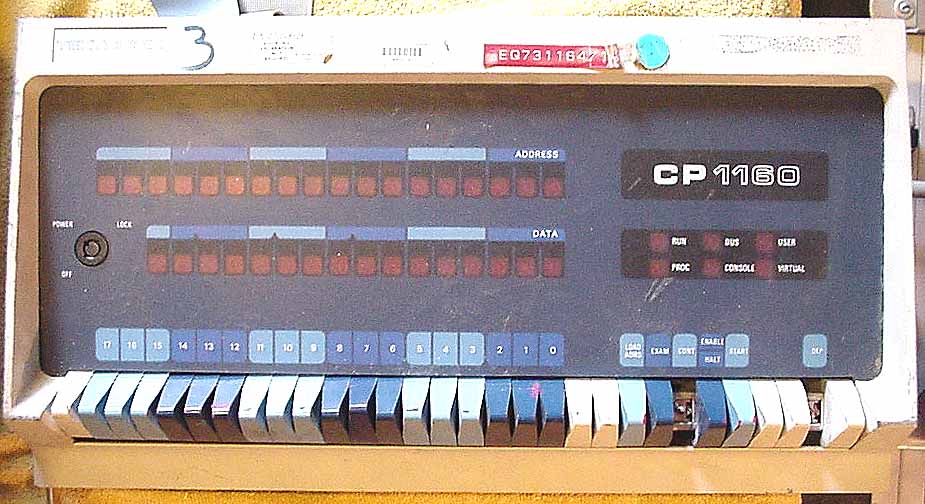
A couple of months ago I found a DEC computer with a front panel. Then I
found a second one a few weeks ago. The panels are painted in two tone blue
Tekronix colors. I finally got around to photograghing one of the front
panels today. I'm posting a picture of it at
<http://www.classiccmp.org/hp/dec-k/cp1160.jpg>. Sorry but I haven't
cleaned it up. It's also missing two switch handles. The first one was
marked as being a 11/35FC but I don't remember seeing a model number on the
2nd one.
Joe
Hello,
I came across a screening of 'Wargames', with a presentation afterwards
about the computers and hacks used in the film ... and I was just blown
away by the front panel of the IMSAI :)
Do you know of any programmable computer today which has a programmable
front panel? Are there maybe some machines for education? Or are there
classic computers which have this feature and are less rare (and
expensive) than the IMSAI?
thanks!
Gottfried Haider
PS: Please CC me as I am not subscribed to the list.
There used to be a program called The Network Eye which let you remotely
control one computer from another over a LANtastic network.
Does such a program exist for MS-DOS over TCP/IP? Preferably, the client
would be Windows based.
--
Sellam Ismail Vintage Computer Festival
------------------------------------------------------------------------------
International Man of Intrigue and Danger http://www.vintage.org
[ Old computing resources for business || Buy/Sell/Trade Vintage Computers ]
[ and academia at www.VintageTech.com || at http://marketplace.vintage.org ]
On May 4, 19:11, Patrick Finnegan wrote:
> On Tuesday 04 May 2004 17:54, Tony Duell wrote:
> > There is no such thing as ground!.
>
> Sure, there is. It's the voltage potential present on a long
electrode
> inserted into the earth. :)
Measured with respect to what? That wire dangling from your kite, Mr
Franklin? :-)
--
Pete Peter Turnbull
Network Manager
University of York
> That's what you'd think but it isn't the case. 9825s in paricular are
> nearly indestrucable but I have constant problems with all of the 9845s.
In 1979 I did a data-logging project at the Hanford Nuclear Reservation in
central Washington. We had 6 or 7 trailers that collected ground water
measurement on HP 9825s (using the built in tape drive.) The measurement
equipment was connected via HP-IB.
The power was from a mobile generator. Every time the air conditioner
started the line voltage would dip about 25 volts.
This test ran for over a year with out a single failure. I was impressed.
In the spring of 1980 the place was thick with grasshoppers. They would get
into the equipment it you let them. After Mount St. Helens dumped a foot of
ash on the place there wasn't a grasshopper to be found.
Michael Holley
www.swtpc.com/mholley
> I think the first one was the Portable (8088 w/ 256k, then the Portable
>II (smaller but still 8088 and 640K) then the Portable 286 (286 CPU and
>640k(?)), then the Portable III (the small lunchbox sized computer (I don't
>remember if theese were 286s or 386SXs)) and then the Portable 386 (it had
>a full fledged 386DX). FWIW I have a P-II sitting about five feet from me.
FWIW, the Portable III is a 286 machine. I have pictures of mine posted on
my site if anyone wants to see one.
If anyone has the original setup disk for the Portable III, I would love to
get an image of it - the "generic" AT setup disks work in that you can configure
the drives and get it to boot, however Compaq apparently "rolled their own"
checksum algorithm, as once configured with any of the generic disks, it gets a
CMOS Checksum error.
Regards,
--
dave04a (at) Dave Dunfield
dunfield (dot) Firmware development services & tools: www.dunfield.com
com Vintage computing equipment collector.
http://www.parse.com/~ddunfield/museum/index.html
Hello,
I was wondering if it's possible to use rom dump as binary program
(loaded with loadbin), perhaps with some "relocations" ?
(I have an HP86B and some CS-80 HD but no EMS roms)
Thanks in advance
I have a tape that contains the backup of a Macintosh 8100. I have tried to
use Retrospect to restore it but it doesn't recognize the tape as a valid
format.
I did a raw restore and the header does mention "Macintosh-BU1" and also
"BackUp- 01.74" The tape was made in 1995.
Anyone know what program I can use on my Mac to restore this tape?
-Ken V.
***************************************************************
This E-mail is confidential. It should not be read, copied, disclosed or
used by any person other than the intended recipient. Unauthorized use,
disclosure or copying by whatever medium is strictly prohibited and may be
unlawful. If you have received this E-mail in error, please contact the
sender immediately and delete the E-mail from your system.
***************************************************************
Ok, the post from Kevin reminds me of a VT220 question I've been wondering
for some time. Is there a "BREAK" key on the vt220 terminal???? I can't find
it, nothing is labelled "break". I'm not looking for a key combo that
interrupts a specific host platform like ^C or ^P or something, I want to
generate a real electrical "BREAK" signal via the keyboard. What is it?
Jay West
---
[This E-mail scanned for viruses by Declude Virus]
> On Mon, 3 May 2004, Scott Stevens wrote:
> > I ran Windows 3.1 on frighteningly underpowered machines for a long
> > time. My 8088 XT Clone ran Windows 3.1 in several configurations:
>
On Mon, 3 May 2004, Fred Cisin wrote:
> You were probably running 3.0!
> 3.1 requires extended memory (286)
IIRC, you DON'T need extended memory to run Win3.1 in "Standard" mode,
just "386 Enhanced" mode. Of course, "Standard" couldn't switch tasks
or do much of what people expect of Windoze now (except crash). I recall
the day I came back from the Rochester (NY) Hamfest with a $5 RAM board
that gave me a whole 1MB on top of my 640K and the chance to turn on the
Enhanced functions...
Bob Maxwell
- still running 3.1 on 486s at home -
Is there a source for new 8in floppy disks? New old stock is fine. I
just would like a box of unused blank disks.
Two reasons, first I have a STD bus computer with a Z80 CPU and dual 8in
drives (one that does not work) that I might like to play with. Second I
have an IBM S/34 that has an 8in drive and I need a box of disk for
someone to copy some disks for me...
-chuck
I picked up another load of early PC software last week. Everything was
in nearly new condition :-) :-) One of the things that I got was a
package of Lotus 123 version 2.01. It's marked as a Government Edition and
has an eagle of the disk labels. Anybody know what this is all about? The
manuals seem to be standard and don't say anything about it having
different features. However I'm thinking that it might be a
non-copyprotected version.
Joe
>>If anyone has the original setup disk for the Portable III, I would love to
>>get an image of it - the "generic" AT setup disks work in that you can
>configure
>>the drives and get it to boot, however Compaq apparently "rolled their own"
>>checksum algorithm, as once configured with any of the generic disks, it
>gets a
>>CMOS Checksum error.
>
> Mike Haas has has the setup disk. I gave it to him along with the P-IIIs
>that I had. The setup program should also be one several of the machines.
>FWIW I once found a third party setup program that worked on them. I don't
>remember the name of it but I'm pretty sure that it was put out by a
>company in Clearwater Florida that was later bought out by Quarterdeck. I
>may still have a copy of it or the Compaq setup program. I'll look and see.
>One thing to be aware of is that only the very first few drive table enties
>match that used by IBM so be carefull setting the hard drive type.
>
> Joe
Thanks Joe, however the one I downloaded from other instructions posted in this
thread appears to do the job, so no need to bother.
Regards,
--
dave04a (at) Dave Dunfield
dunfield (dot) Firmware development services & tools: www.dunfield.com
com Vintage computing equipment collector.
http://www.parse.com/~ddunfield/museum/index.html
I have a DEC VT102 terminal that I got some time ago from a listmember. On
the right of the keyboard where the numeric keypad is, the keys don't match
the color of the other keys on the keyboard. The upper left key in the
keypad is gold, and the other keys on the keypad are different colors - red,
blue, white - and have editing words on them, I think words like "left,
copy, print", something like that.
My question is - is it likely that someone scavenged keys from another
non-vt100 keyboard to replace missing keys, or was this some option used
with some word processing software? If the later, I'm happy I have something
unusual. If the former, I am going to yank those keycaps off and scavenge
the "correct" keys from one of the other VT100's I'm going to junk.
Anyone know the answer?
Thanks!
Jay West
---
[This E-mail scanned for viruses by Declude Virus]
If anyone could help this woman out with the question of memory options for an original Compaq Portable, please do respond directly back to her, as well as to the list. Thanks, David
My, I'm just full of terminal questions...
I have a Televideo 910.. maybe it's a 950 but I think it said 910 on it.
When the terminal is just sitting there with stuff on the screen, no data is
being sent or received... it will suddenly flip to a "previous screen" all
by itself. I don't know if the terminal supports multiple pages of display
memory, but the symptom is as if it does support multiple display memory and
spontaneously all by itself it switches pages and I see data on the screen
that came by a while ago.
Can anyone point to a likely culprit that may be causing this? The terminal
itself is in perfect mint condition so I hate to get rid of it but this
problem is annoying!
Regards,
Jay West
---
[This E-mail scanned for viruses by Declude Virus]
About a month ago I picked up what I thought were a couple of HP-IB
disk drives made by a compnay by the name of IEM of Ft. Collins Colorado. I
searched the net for information about them but didn't find anything
useful. I also posted message here asking about them but didn't get any
replies.
Last week I got one of my PCs up and running with a HP Hyper Viper card
(a HP 9000 300 computer on a card) in it so I decided to use it to check
out some of the HP-IB drives and such that have been piling up around here.
I found a couple of sites that said what kind of MO disks were supposed to
be used in the IEM MO drive but I didn't have the right ones so I stuck in
a HP MO disk that I had laying round. It worked! The system thinks the
drive is a HP 7935 with 404Mb capacity. Flip the disk over and you've got
another 404Mb to play with. Not bad!
The 2nd IEM drive turned out to be even stranger. In addition to the
HP-IB port it has what looked like a SCSI port on the back. It has a LCD
display on and it keeps saying off-line. There are also three buttons on it
marked Select, Next and Previous. Pressing the buttons did nothing except
make the display say "Next Pressed" etc. I finally turned it off then held
down the Select button and turned it on and it came up in a demo mode. It
says that it's a "Rewriteable Optical Jukebox Controller"!! It says that
it's compatible with the HP 1000, 3000, 9000, etc etc and that it is CS-80
and plug and play with MPE, HPUX, Pascal BASIC, RTE, etc etc. It also says
that it supports the C1700/C1701 HP Library System. So it's not a drive
after all. (I never opened it up, I just assumed that it was!) That also
explains why it has a SCSI connector on it.
Anybody here have any experience with optical jukeboxs?
I've done a lot of searching on the net for IEM but it appears that
they're long gone. I found phone numbers for them but didn't get an answer
on either one. I didn't find ANYTHING about the jukebox controler but found
a couple of sites that gave cross references for disks that can be used in
the MO drive. Of course I'm not using any of those disks but it's working!
Joe