Over the weekend I ran accross (5) HP 13356A Disk Cartridges that look to be
in excellent condition. The 13356A's are typcially used in HP 3000 Series
II/III and are 7 platter/120MB. They are also marked 2613A.
I collect DEC, SGI, etc., but not HP, so I didn't pick them up. If you'd like
me to attempt to acquire them for you, please contact me off list.
I have no business relationship (other than as a customer) with the firm that
has the cartridges.
Lyle
--
Lyle Bickley
Bickley Consulting West Inc.
http://bickleywest.com
"Black holes are where God is dividing by zero"
tar and gzip then? :)
--
No smiley necessary.
I have tarballs I wrote in the late 70s that are still completely usable.
I don't use compression on any archive I care about. If you get a bad block,
everything after it is unrecoverable if it has been compressed.
Tar also has the advantage that the file information is distributed across
the archive, and can be resynchronized at block boundaries.
Hi, John,
*********** REPLY SEPARATOR ***********
On 15-Nov-04 at 19:25 John Boffemmyer IV wrote:
>it is an IBM PS/2 Model 70, found it is lacking the SCSI card he thought
>was in there (he had 2 and the other one went to a relative). Looking for
>a compatible SCSI card with standard 50 pin header for MCA as I don't
>possess the funky ribbon for the non-standard edge-connector type that IBM sold.
I may have a line on the MCA SCSI adapter AND the edge-connectored cable. RE-PC may be able to help with both.
Failing that, you would want an Adaptec AHA-1640.
>That being said, since it is a model 70, anyone know where I could find
>the config disk for it?
I believe I have that one in my archives. How big a file attachment can you accept?
Keep the peace(es).
-=-=-=-=-=-=-=-=-=-=-=-
Bruce Lane, Owner & Head Hardware Heavy,
Blue Feather Technologies -- http://www.bluefeathertech.com
kyrrin (at) bluefeathertech do/t c=o=m
"If Salvador Dali had owned a computer, would it have been equipped with surreal ports?"
This should be a reminder to people to watch for old copies of backup
software, and the trash bits of failed companies to try to document
on-tape file formats.
I gave up using anything but documented tape formats for my backups
exactly because I was unable to get documentation for the backup file
format used by Retrospect.
On Tue, 16 Nov 2004 "Charles H. Dickman" <chd_1(a)nktelco.net> wrote:
> Is there a schematic online for the DEC PDP-11 maintenance tool KM11?
> Googling, the best I found was a description by Tony Duell for a
> homebrew replacement. Excellent as that is, a schematic is just so much
> easier to read.
See if you can find the cpu manuals for an 11/70. There are some
documentation on the KM11 in those, I seem to remember.
Johnny
Johnny Billquist || "I'm on a bus
|| on a psychedelic trip
email: bqt(a)update.uu.se || Reading murder books
pdp is alive! || tryin' to stay hip" - B. Idol
At 07:25 PM 11/15/04 -0500, John Boffemmyer IV wrote:
>it is an IBM PS/2 Model 70, found it is lacking the SCSI card
Check out the MCA Mafia, its a whole bunch of sites that together have MCA
totally nailed down.
http://www.mcamafia.de/mcapage0/mcamafia.htm
Just been offered a Minolta PCW-1 and PCW-2 - anyone know if they're
typewriters or computers? :-) Google seems somewhat confused either way.
The chap who has them calls them desktop computers, but a) I didn't know
that Minolta ever made 'real' machines, and b) Google turns up a lot of
hits about typewriter ribbons in relation to the PCW-2...
ta
J.
--
I'm sorry for all the times I intentionally ducked underneath the sneeze
guard at a salad bar and sneezed on everything until I couldn't sneeze
any more. I have a problem.
Greetings!
I have an old (ca 1992) SCSI-1 Maynard Maynstream DAT drive
that uses DDS1 DAT carts without software. The drive is up
and running in a Pentium 200MMX machine but we no longer
have the TMENU MSDOS software that was used to write files
to tape back then. Of course, we now need to get some of
the data off of the drives. I've followed Archive via the
web from Archive to Conner to Seagate to a "final
destination" at a company called Certron. Needless to say,
the tech support people at Certron have no idea where to
find the software.
By any chance, have any classic-comp'ers used this drive
under DOS? Any other ideas where I may find the software?
Thanks!
-gk
-------------------------------------------------------------------------
Gary S. Katz, Ph.D. 326 Sierra Tower
Assistant Professor (818) 677-2964 office
Dept. of Psychology (818) 677-2827 dept
California State University - Northridge (818) 677-2829 fax
18111 Nordhoff Street
Northridge, CA 91330 http://www.csun.edu/~gk45683
-------------------------------------------------------------------------
Allright, I just fucked up severely. I tipped a scented candle over my
two keyboards. One of them is a Tandberg PS/2 keyboard, hooked up to my
Indy, which I without worry took downstairs and scrubbed thoroughly with
a dishwashing detergent.
However, the other keyboard is a Sun Microsystems Type 5.
How rugged is this KB? Will it take water, and relatively hot water
too?
I will of course separate the keyboard layer from the logic layer if
they turn out to be separate
Does anyone know, or am I walking on undiscovered land?
I'll report back if I try (I have two spares, thank God... This and the
Tandberg are my two favorite KBs.)
--
Tore S Bekkedal <toresbe(a)ifi.uio.no>
http://cgi.ebay.co.uk/ws/eBayISAPI.dll?ViewItem&category=1484&item=57313
27055&rd=1
This looks like a VAX 6000-610 in Wales (UK).
No bids so far. There's a VAX 4000 of some sort
available too.
Surely worth the trip in a Luton van for
someone with a bit of storage (or a decent
basement)?
Usual disclaimer applies: it's not me and it's
noone I know (AFAIK!)
Antonio
--
---------------
Antonio Carlini arcarlini(a)iee.org
Does anyone know anything about a Moore mycroterm?
Moore was taken over by Siemens,
It is 2 beige boxes with handles, shorter and squatter than a Compaq
luggable. I've been told that it has Motorla cpu.
I haven't been able to get it past my wife yet to have a closer look.
It came my way in exchange for a few 286's which are going back into
service.
--
Collector of vintage computers http://www.ncf.ca/~ba600
Machines to trade http://www.ncf.ca/~ba600/trade.html
Open Source Weekend http://www.osw.ca
Date: Sun, 14 Nov 2004 23:31:27 -0800 (PST)
From: "Zane H. Healy" <healyzh(a)aracnet.com>
Subject: Re: DEC colours
To: cctalk(a)classiccmp.org
>Actually Mike isn't the only one that would be interested in knowing the
>Pantone colours for DEC HW. Though I'd also like to know the correct
>colour
>for "China Red" as used in later model PDP-10's.
I have it on good authority that the 'Chinese Red' (aka orange!) was
identical to the commonly-available car colour known as 'Toyota truck
orange' - in fact a post mentioned that cans of the Toyota paint were used
for touch-ups in final assembly at DEC, IIRC.
That's why it wasn't on my list of colours! Though it would still be nice to
have a Pantone number, I agree...
Google alt.sys.pdp10 for 'truck orange'.
Mike
http://www.corestore.org
In a message dated 11/21/2004 5:17:49 PM Eastern Standard Time,
allain(a)panix.com writes:
OK, here's a an OT, I can't wait...
I have a seven year old IBM 760XL Laptop somebody
gave me for free with all the trimmings (with 2 different docking bays)
that likes to switch over to the VGA port every time it boots completely
up. The LCD panel is seen for the period right after power-on to the time
the OS starts. I haven't seen LCD control in the BIOS start-up
(powerswitch+F1) or in the Control Panel. I want to tell it to keep the LCD
display on always.
Perhaps someone has worked with this particular model?
Reply to me directly, if you intuit that this is not a true list question.
BTW this is mechanically a pretty interesting machine. You can
lift up the keyboard and change out any of this: Batteries,spares,
Floppy,CD,HD, and memory, all using no tools at all.
Thanks,
John A.
------------------------------
I have this laptop too and have never had this problem. You can switch using
a function key, FN+F3 I think. What happens if you toggle through the
LCD/external display options?
760XL is not a bad laptop because it does not have the crappy MWAVE stuff.
Only problems are the keyboard keys get hard to push due to wear.
Folks,
They keep coming... last week it was a System/38, this week a System/34. Two
of them to be precise, in Ottawa, .ca.
I'm down for one - but the recycler who is picking them up only wants to
deal with both of them - he needs to recoup scrap value, plus pickup
expenses.
They're complete, working, with docs and disks.
Any takers for the second machine? Someone local in NE USA / New England
area would obviously help...
Mike
http://www.corestore.org
I picked up some INTERESTING manuals today!
Instruction Mnaual for the Computer Control Company DDP-24 General Purpose Computer, 1964.
AMS-C Computer System Manual (Copy #1!) "Supplements the Apollo Mission Simulator System Manual" and "reflects the addition to the AMS system of a DDP-224 Gerneral Purpose Computer", 1965.
IBM - Logic Blocks Automated Logic Diagrams SLT, SLD, ASLT, MST, 1971.
IBM - Service Manual "Selectric" Typewriter Models 7X1, 7X3, 7X5, 8X2, 8X5, 1972.
Repair Operation Manual for the Jaguar Series 3 V.12 'E' type, 1971.
Joe :-)
Do to damage from shipping I need replacement parts for a IBM 548 Punch card
Interpreter and a IBM 5211 Printer. Anyone know some sources for parts?
Also would like to get three more cables to hook up the IBM 5251 terminals
and a couple more plastic "magazines" used to hold the 8" floppies for
reading (have 1). Thanks John
See below.
Reply-to: a7a10658(a)telus.net
---------- Forwarded message ----------
Date: Sun, 21 Nov 2004 19:19:38 -0800
From: Gerry <a7a10658(a)telus.net>
Reply-To: ghickford(a)telus.net
To: Vintage Computer Festival <vcf(a)siconic.com>
Subject: Re: 8 inch disk drives
I live on Vancouver Island British Columbia small town of Port Alberni,
if you know anyone that can use them and has someway to or someone coming
this way they are quite welcome to the drives. Otherwise off to the dump
they go. Thanks for your reply and I know it is a long way to ship such an
item but they are here for the taking. CHEERS.
Gerry
On Sun, 21 Nov 2004 10:24:59 -0800 (PST), Vintage Computer Festival
<vcf(a)siconic.com> wrote:
> On Sun, 21 Nov 2004, Gerry Hickford wrote:
>
>> Have a Industrial Micro Systems Disk Drives in a approx. 24x24x12 inch
>> case with 2 8in. drives in it I will donate if you are interested would
>> be glad to get rid of them if they can be of interest to you.
>
> Hi Gerry.
>
> I'm not sure I can use them. But I'm sure I can find someone who can.
> Where are you located?
>
--
Sellam Ismail Vintage Computer Festival
------------------------------------------------------------------------------
International Man of Intrigue and Danger http://www.vintage.org
[ Old computing resources for business || Buy/Sell/Trade Vintage Computers ]
[ and academia at www.VintageTech.com || at http://marketplace.vintage.org ]
I just received a mint condition HP 110 plus computer from an ex HP
employee. He didn't send me a manual or power cord, so I'm left with some
questions I was hoping some folks could help.
1) I was thinking about hooking this up to my HP 1631D logic analyser.
Connected to my logic analyser is a 9121 floppy drive and 2225 printer. The
9121 and 2225 are hooked up to the 1631D via HP-IB. My 1631 analyser has an
HP-IB port (of course) and an HP-IL port as does the HP110 plus. So can I
hook up the 110 plus to the 1631D via HP-IL, and have the laptop see the
printer and floppy that are hooked up to the 1631 via HP-IB? In essence I'm
asking if the 1631 will act as a hub between the two different types of
connection since it has both. I know nothing about HP-IL.
2) Would anyone have a cable to accomplish the above? I have HP-IB cables
but no HP-IL cables.
3) Um... uh... I have to admit I can't figure out how to turn on the 110
plus. It would appear to have no power switch at all. If my guess as to the
power cable connection on the back is correct, it will require a
non-standard power cable of some type. Anyone have a spare or know where I
can get one?
4) It'd be nice to find a manual for the unit. Anyone have a spare, or know
where a PDF copy is? I'd like to find a complete set of manuals for it and
the apps built into the roms.
Any help is most appreciated!
Regards,
Jay West
"Joe R." wrote:
> AMS-C Computer System Manual (Copy #1!) "Supplements the Apollo Mission Sim
>ulator System Manual" and "reflects the addition to the AMS system of a DDP-22
>4 Gerneral Purpose Computer", 1965.
I'm sure you know this, but Ron Burkey (http://www.ibiblio.org/apollo/)
might be interested if this in any way touches on the AGC (which it may
not, I realize).
-brad
Hi, my friend Greg (Beermat) is on cctech and says he's not received any
messages since Nov 12th, and that the cctech archives stop at the same
time that his feed seems to have done.
alex/melt
der Mouse <mouse(a)rodents.montreal.qc.ca> wrote:
> As it left here it, like approximately all my mail, had
<
> Mime-Version: 1.0
> Content-Type: text/plain; charset="iso-8859-1"
> Content-Transfer-Encoding: 8bit
Yeah, I see that message that them indeed, so I probably just overlooked
them on the other one, probably because the mailing list filter moved
the Content-Transfer-Encoding: to the end.
MS
der Mouse <mouse(a)rodents.montreal.qc.ca> wrote:
> If we consider the lamp to nominally draw =BDA[%], that means we have
^^^
Tsk tsk tsk. You've posted an 8-bit character, and furthermore one of
undefined meaning since there is no charset indication (no Content-Type:
header at all in fact). Aren't you a proponent of ASCII mail like your
signature says? ASCII is 7-bit.
MS,
who reads mail directly as it travels over SMTP without any decoding
whatsoever, and is annoyed as hell by quoted-printable.
I've had several business deals with Marv - he's a stand-up guy, very
pleasant and honest. I've taken the liberty to snip off the rather
extensive list of RF and general-purpose devices, which are off-topic
here.
There might be some chips-of-interest to various of us on The List -
contact him directly if so.
Cheers
John
---------- Forwarded message ----------
Date: Sat, 20 Nov 2004 12:37:06 -0800
From: Radio WC6W <wc6w(a)juno.com>
To: amps(a)contesting.com
**** Integrated Circuits ****
Most, if not all of these are long discontinued, but may be just what
someone needs for servicing a relic of the 20th century...
Allegro (Sprague) ULN3859 IF chip $5 ea
Altera -- $10 ea
EP600DC
EP900DC
AMD
2964BPC $20
29C117 $50
29C516APC $50
AMI
S2814 $15
CMDmicro
CM1210 $5
CM1232 $5
Cypress
CY7C901C $10
Delco NOS (Take all the Delco parts for $100)
DM1 $7 ea
DM4 $10
DM12 $20
DM14 $5
DM22 $20
DM25 $20
DM29 $10
DM37 $3
DM39 $10
DM43 $3 ea
DM44 $4
DM45 $3 ea
DM46 $4
DM50 $4
DM51 $4
DM68 $3 ea
DM77 $5
DM79 $4 ea
DM91 $5 ea
DM103 $4
DM115 $5
DM118 $3 ea
DM120 $5 ea
DM127 $5
DM136 $7 ea
DM166 $5 ea
DM195 $5
DM201 $5 ea
DM210 $5
DM235 $7 ea
DM226 $10
DM270 $10 ea
DS77 $3 ea
(DM?)0879 $5
(DM?)0880 $4
(DM?)1202 $2
(DM?)2193 $10
21450 $5
23859/23-020 $3 ea
56728 $5 ea
S005A3 $5
S014A4 $4 ea
S812A1 $5
Fairchild
11C83DC 1 GHz ECL divide by 248/256 Prescaler NOS $20 ea
11C90DC 650 MHz ECL divide by 10 Prescaler NOS $20 ea
Fujitsu MB3713 5.7 watt Audio Amp NOS $10 ea
Hitachi HA1366WR 5.5 watt Audio Amp NOS $10 ea
Hughes
HNVM3708P 1Kx8 EEPROM $10
ITT -- $5 ea
SAA1250
SAA1251
SAF1032P
SAF1039
TEA1009
Lambda
LAS 723B Voltage regulator, lead formed 10 pin TO-5 $3 ea
Hybrid Regulators NOS -- $10 ea
FBH-24-003 FBH-24-004 FBH-24-009 FBH-24-015
FBH-24-020 FBH-24-021 FBH-24-022 FBH-24-023
Linear Corp. -- Remote Control IC's $5 ea
R7411-1
R7411-2A
T7411-1
Micro Networks -- NOS in Ceramic packages; lots of Gold too!
DAC87H 12 bit D/A $15
MN373 16bit Track & Hold $20
MN373H 16bit Track & Hold $20
MN376 12bit Track & Hold $15
MN379 Flash Track & Hold $15
MN565AJ 12 Bit D/A $25
MN574AL 12 Bit A/D $25
MN5101 8 Bit A/D $15
MN5131 8 Bit A/D $15
MN5143 8 Bit A/D $15
MN5211 8 Bit A/D $15
MN5240 12 Bit A/D $40
MN5245 12 Bit A/D $40
MN5290 16 Bit A/D $60
MN7120 8 Bit Data Acq. Sys. $60
MN7140 12 Bit Data Acq. Sys. $60
MN7150-16 12 Bit Data Acq. Sys. $100
Mitsubishi
DN828P NOS $10
M51517L (Audio Amp?) NOS $10 ea
MMI
74S409N $15
Motorola
EF68000-10C $20
MC68000G8 $15
MC1438R (5) $25 ea
MC1468R $25
Dual Conversion FM receivers NOS $3ea
MC3359P MC3374FTB
ECL NOS
MC10102L $4 ea
MC10104L $4 ea
MC10131L $7 ea
MC10138L $10 ea
ECL pulls (from sockets, no solder) $2 ea
MC10H124P MC10H174P
RF amps NOS $10 ea
SWA106H SWA127H
Communications
51-84267A09 Whatever that is... NIB $3
National
DP8409AN-3 $15
NS16032SD-4 $20
NS16032SD-6 $25
NS16081D $20
NS16201D-6 $10
MM53200N Remote Control IC $5 ea
CRT Controller Chipset NOS $25 for all 5
DP8510CV DP8511CV DP8512CV DP8515CV DP8516CV
NEC D751-4CW NOS $20
Nitron NC6400-0218 (An EEProm?) $5
Plessey NOS $5 ea
ML924 ML926 ML927 MV500
SL301A SL301B SL486 SL1532C SL2521B SL2541B
Plessey NOS $10 ea
SL6600C SL6700C SP4632 SP4634 SP4642
SP5000 SP5010 SP5050 SP8634B SP8735B
PLX Tech -- $10 ea
PLX448-45
PLX464-45
Q-Bit QBH-110 Hybrid RF amps (15 dB, 5-500 MHz) NOS $15 ea.
RCA CA3088E AM Receiver IC NOS $5 ea
Regency House Numbered parts NOS $3 each
310-576-48 600-565 600-596 600 606-5
85420 -- These are Microchip ER1400's probably programmed with
something
Regency pulls -- a dozen chips total $10 all
600-603-16A 600-603-9B 600-680 600-565 301-576-3
Rockwell 6522 uP VIA Interface NOS $5 ea
Siemens - $10 ea
SLE5001
SLE5002
Silicon General
SM625B - $10 ea
Sylvania ECG1058 Audio Amp NOS $10 ea
Telefunken U4062B FM Receiver IC NOS $5 ea
Texas Instruments
SN76477N Sound Generator $15 ea
TMS32010JDL $15
Toshiba NOS
TA7205 5.8 watt Audio Amp $10 ea
TC9188N $10 ea
TRW -- $150 ea
2310H7C
MPY12AJ
Unitrode
PIC8015 $10ea
PIC600 (13) used $5 ea
Vanguard
VN2018D $10
VN3018 $10
VN1025 $15
Waferscale
5901C $10
59016C $15
59016JSBS $15
**** SEMICONDUCTORS ****
All of the above plus shipping, if necessary, naturally.
Contact: Marv WC6W 310 649 3111 (reasonable hours Pacific Time
please)
or via wc6w(a)juno.com
[Wow - C.L.C. has an automatic spell checker on the subject line :-]
>The conclusion is that, yes, you should always be careful, but Hantavirus
>is not ubiquitous, and you shouldn't panic if you accidentally come in
>contact with rodent poop.
Yeah, thats pretty much what I have determined, although I will be excercising
more caution when I find mouse "residue" from now on.
This particular machine was in a garage in the middle of Toronto. From what I
have read, the virus is carried by deer mice, which are less likely to be found
in the city. Also there have been no reports of HPS in Toronto (closest is infected
mice found in Northern Ontario which is quite some distance away). So I think the
chances of a problem are minimal - nonetheless, since I'm scheduled for checkup
this week anyway, I think it's serious enough that I'm going to mention my
activities to my doc.
For now, the machine is "double bagged" and not in the house - when I can work
on it outside and with the right precautions, I will see what I can do with it.
One question I have not found an answer to is "How long can the virus remain
alive in a dormant state - outside of a host"?
Most of the information I have seen suggests washing suspected areas with a 10%
bleach solution, and to let it sit for at least 5 mins.
Anyone know if this would be safe for a PCB? Assuming it was immediately rinsed
afterward with distilled water and well dried? - Unfortunately there's a keyboard
included in the PCB assembly...
Regards,
--
dave04a (at) Dave Dunfield
dunfield (dot) Firmware development services & tools: www.dunfield.com
com Vintage computing equipment collector.
http://www.parse.com/~ddunfield/museum/index.html
At 17:09 20/11/2004 -0500, you wrote:
>
>
> Right off the bat I'd be pretty careful of that, in terms of the various
>(some pretty hideous) diseases that rodents carry with them - HantaVirus
>comes immediately to mind.
>
> Me, I'da left the damn thing right where it was... yuk!
Thats a good point...
I had no idea it was so bad until I opened it up. Had I known, I might have
left it as well. I hate to toss it, as it's pretty old, but you are right -
I do have to consider the health risk.
Other than gloves, mask and open-air venting, what precautions can be taken.
Is it worth trying to rescue, or should I dump it asap. Interested in opinions.
Regards,
Dave
--
dave04a (at) Dave Dunfield
dunfield (dot) Firmware development services & tools: www.dunfield.com
com Vintage computing equipment collector.
http://www.parse.com/~ddunfield/museum/index.html
In a message dated 11/15/04 11:03:11 AM Pacific Standard Time,
allain(a)panix.com writes:
BTW I have a 2nd hand Pantone guide right here, it reads out to "three
parts Pantone light red and 1/8 part ..." yadda
Well, that is how I mix the ink colors, by weight. Makes doing parts easy.
All major ink manufacturers sell Pantone colors so you can mix whatever color
you want.
The only inks sold in RGB type colors are multiple color process inks and to
blend them it is a process of screens and angles and you need to have multiple
passes through the press.
RGB does not lend itself to printing processes well. It is much cheaper to
print just one color.
John, since you have a Pantone book could you match the numbers to the DEC
stuff you have?
On each color swatch there should be a corresponding number. That is what is
important not the formulation.
You want to ignore the C and U letters as they refer to Coated and Uncoated,
more printing terms. (refers to whether you are printing a clear gloss coat on
top of the ink to get the glossy look or if printed on gloss stock.)
Somewhere DEC published the Pantone numbers in their documents they sent to
printers......
PS Printers are supposed to upgrade their $50 Pantone books every 6 months to
deal with fading, not many I know did that.
Paxton
Astoria, OR
I've been contacted by someone interested in getting rid of a Trendata
setup including a video terminal and a print terminal. I'm guessing
that the latter, as a part of a large desk, also contains some sort of
computer. I'm not sure about this, though.
There are a few pictures at
http://www.vintage-computer.com/trendata.shtml
The system is located in Northern Ontario and is free for the
collection. You may be able to convince the owner to ship it, at your
expense, but it's going to be expensive (300 pounds worth of expensive.)
I know almost nothing else, but I'll be happy to put you in touch with
the owner if you are really interested.
Erik Klein
www.vintage-computer.com <http://www.vintage-computer.com/>
www.vintage-computer.com/vcforum
The Vintage Computer Forum
Did you notice that Vintage Computer Marketplace is ALSO mentioned in
that ad? This is a terrific time to add more stuff to VCM!!!
>
> <http://cgi.ebay.com/ws/eBayISAPI.dll?ViewItem&rd=1&item=5138917267&ssPageNa…>.
>
> $800 with almost two days to go! And this is that INCOMPLETE and untested HP 1000!!!! Has everybody lost their minds?
>
> Joe
Hi All,
I'm trying to get my recently aquired PDP11/34A to boot. I already checked
that the console port is correct and that the M7856 operates correctly.
Since booting doesn't output anything on the console, I think I should
check if the contents of the ROMs on the M9301 are correct. Does anyone
have the contents of these ROMs available for me?
Regards,
Bert
> squeal continuously as long as they're attached to the SCSI bus
The SCSI cable is backwards.
I ran into this a few weeks ago.
You should also think about cleaning the heads. The easiest, totally
non-obvious way is pop the two C washers (with the power off obviously
on the head stack, and pull the stack up to gain access to the head
surface.
Clean with "head cleaner" if you can still find a bottle, or 99% isopropyl
--
TK50 media sucks.. I just had to read several hundred carts from the mid
80's and every one was sticky. The REALLY annoying thing about serpentine
media is you get to spread accumulated gunk across the ends of the tape
after each pass, and risk the motor stalling and leaving a big pile of
gunk after each direction reversal.
The Sperry 7000, aka CCI 6/32, Harris HCX/7, Tahoe, was a nice
machine
--
It has some problems. UW Milwaukee bought a Sperry 7000 and there
were microcode bugs that they couldn't get fixed which resulted in
unacceptable numbers of kernel panics.
Stephane Tsacas <stephane.tsacas(a)gmail.com> wrote:
> The Sperry 7000, aka CCI 6/32, Harris HCX/7, Tahoe, was a nice
> machine, AFAIR microcoded architecture, amd2901 based, and with a VAX
> like (reduced) instruction set.
Ah yes, the Tahoe of the 4.3BSD-Tahoe fame. It's a VAX knock-off
deliberately modified to not run VAX binaries (particularly VMS), I guess
so that DEC wouldn't sue them. They made it big-endian and reversed the
nibbles in VAX opcodes, and made a few other random changes while they
were at it. Its OS was, you've guessed it, 4.3BSD-Tahoe. It was the
most short-lived architecture in the history of BSD UNIX, introduced
after 4.3BSD and discontinued before 4.4BSD.
Just out of curiousity, does there still exist at least one (1) Tahoe
machine in the world that hasn't been melted down? I'm still carrying
the Tahoe code in the 4.3BSD-Quasijarus source tree, completely unmaintained
and bitrotten, and wondering if it will ever be touched by anyone in the
time between now and the Big Crunch (opposite of Big Bang) in which the
Universe will end.
MS
I'm in Assachusetts (Falmouth) visiting my ailing father,
taking a break at the local cafe/bithole. How is it that we're
related to our parents, anyways? Who are these people?!!
I knew my brother Gregg had an old CP/M machine of mine, plus
some other stuff, but I found out yesterday he has my ENTIRE
CP/M HISTORY HARDWARE MANUALS DOCUMENTATION LISTINGS SOFTWARE
SOURCE back to the middle 1970's, just sitting in his closet. Not
even dusty! Every CP/M thing I've ever written, back to 1976,
plus my Digital Research OEM 8" diskettes, manuals, sources
to all the ROM debuggers, CPM BIOSes, things like details on
making a 4FDC talk to Shugart 851's (plus my 801's and 851's)
(solution: the data-separator add-on card for some Tandy Model
x computer, a daughter board that fits under the 1771 chip)
software I wrote for Alloy COmputing, about 50 S100 cards
(all choice stuff; I worked for a bunch of system houses) plus
!!linkable PDOS binaries, cp/m plink, plib, plus SID (the best
debugger for cpm) PDOS docs, plus I not only didn't remember I
did this, I anally documented everything and that's printed out,
plus printed source listings (?) so even if every flop is bad
I have records. UN-f'ing-believable.
A few dozen brand-new 8" flops in those plastic flip boxes,
all nice and loose in a warm house for 25 years. TVI terminal,
my CMC Marketing S100 box (monstrous ferroresonant P.S.),
a Comark dual flop box...
4-feet of manuals and docs OEM and hand-written.
* TEI Inc was the name of the S100 box I was trying to recall
for a year, not "Compupro". Nice boxes.
* Comark is a company in Woburn MA I ported CP/M-80 for (to their
Multibuss machine) then later -- bargain of bargains for them --
I did a full port of MSDOS 2.x or 3.x to their 8086 multibuss
system, in exchange for one. THat machine was in the hands of
Don Kulha, FidoNet #125 I think, recently deceased, Napa area,
no idea what happened to it.
Plus, this CP/M machine is the "original fido", that I named
the BBS after, so named because it is a mongrel, eg. a dozen
S100 cards, all different, including homemade EPROM card. The
hardware and software documentation binder (!) has the name,
EPROM monitor/boot ("bugger"). The Konan disk controller and
the damned BASF-6172 8" hard drive (damn its miserable silicon
soul to landfill).
Oh yeah and I got a 32K Cromemco bytesaver card so I can read in
(some few types of) old EPROMs for archival purposes.
There are enough copies of bootable flops that I will clean the
drives and simpyl boot it (after the usual old-hardware-bringup
routine, though this thing was run 10 yrs ago allegedly). My
TELINK program does XMODEM so I'll get a serial link up and
transfer everything to my laptop.
Plus I have some choice oldies, a very early (76?) copy of
CBBS asm source, modem2.17, tdl/xitan FORTRAN4, Algol(!),
somebody's pascal (forgot the acronym). Just going by floppy
labels I can recall from yesterday.
I'm taking one box of docs with me as checked baggage, the other
stuff needs packing, which my brother has volunteered to do
(my expense of course).
Though I'm not very nostalgic (all my interest in old computing
predates me) I have been bemoaning the fact I have utterly no
recorded history of my work before 1994. I still have no examples
of any my early 86DOS/MSDOS work, which was an interesting time,
but maybe the 86DOS manuals are in the boxes, since I got most of
this hardware when I worked at CSSN Inc (Boylston Ave, BOston)
where I got the 86DOS manuals (and wrote an 86DOS BIOS with
that one-pass 8086 absolute assembler of Tim Pattersen's).
It's weird to come across so much stuff I have no recollection
of. I remember a lot of it, but entire projects, and notebooks
of writing, has my name on it and I recognize the style, but
I don't recall it.
It'll be some weeks before it's all shipped home, and while I swore
I wouldn't do this before I had the other old thing up, this
should be pretty easy to get up and running.
This Apple /// I picked up today has two boards in it:
1) Labelled "ICE KONAN ADAPTOR", with a ROM and 6116 RAM chip on it + a
few 74xx logic chips. It's got a 26 pin header on board.
2) Labelled "ICE multiplexor host adapter". Has a 20 pin header on it,
plus two (empty) 24 pin IC sockets (and a handful of LS logic).
Any ideas what they are? The first *could* be a clone Profile controller
I suppose - the owner swore that the Profile I got went with the
Apple /// and not the Lisa. I get the impression he hadn't looked at
either machine in years though so I suppose he could be wrong.
The system itself has a large RAM expansion board in it, but otherwise
looks to be stock.
cheers
Jules
--
"We've had a lot of loonies around this place, but you're the first one
who thought the sunrise was made out of stale beer. Now are you going to
pick up your flute and leave, or shall I part your hair with this
crowbar?"
I have 2 TZ30 drives that, instead of the short beep at power-up,
squeal continuously as long as they're attached to the SCSI bus (RQZX1
TSCMP adapter). Attached to power but not on a SCSI chain, they beep
like tey should. I honestly don't know if they work or not, because
neither I nor my cats can stand the sound long enough to check.
I do have one TZ30 that works correctly on the same mahine, so I'm
relatively sure it isn't a controller problem.
Does anybody have any idea what the deal is? Since the TZ30 is
apparently the only tape device that's bootable on the RQZX1, I'd like
to have at least 2 working units.
Doc
> The BBN CPUs are odd in that they don't plug into a socket
This is a BBN Butterfly system. The processors interconnect through
a "Butterfly Switch"
I have to check with the Computer Museum, but this may be the only
surviving system. It's a drag you weren't able to save at least one
of the chassis.
try googling "bbn butterfly switch"
Butterfly Switch
A parallel processing topology from BBN Advanced Computers Inc., Cambridge, MA, that mimics a crossbar and provides high-speed switching of data between nodes. It can also be used to create a hypercube topology.
> does anyone know what happened to the sigma computer
I asked Lee Felsenstein, and it was scrapped. Some of the documentation and
a few of the magtapes are at the Computer History Museum. I don't know if
enough of the software survives to get it running in simulation. Even if it
does exist, according to the histories I've read of the Community Memory
Project, the mass storage interfaces were custom.
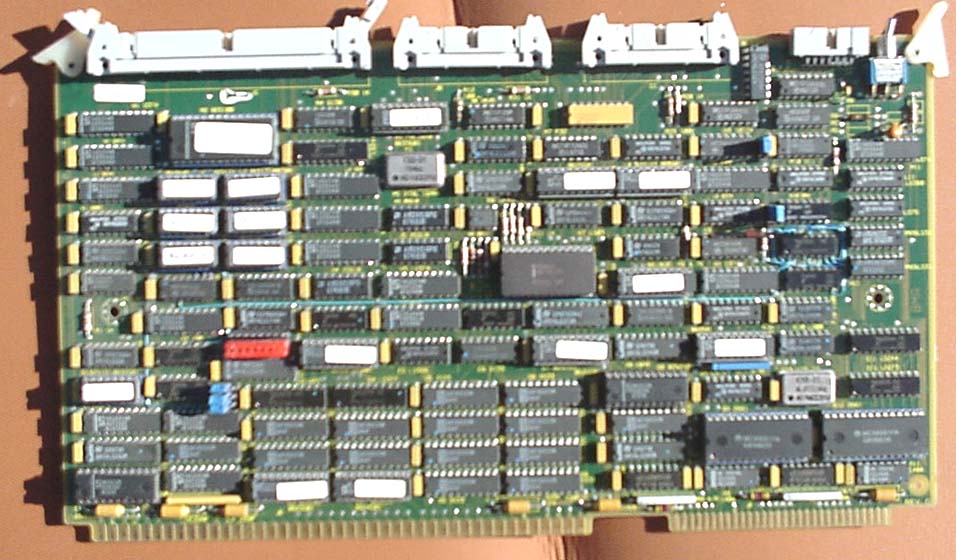
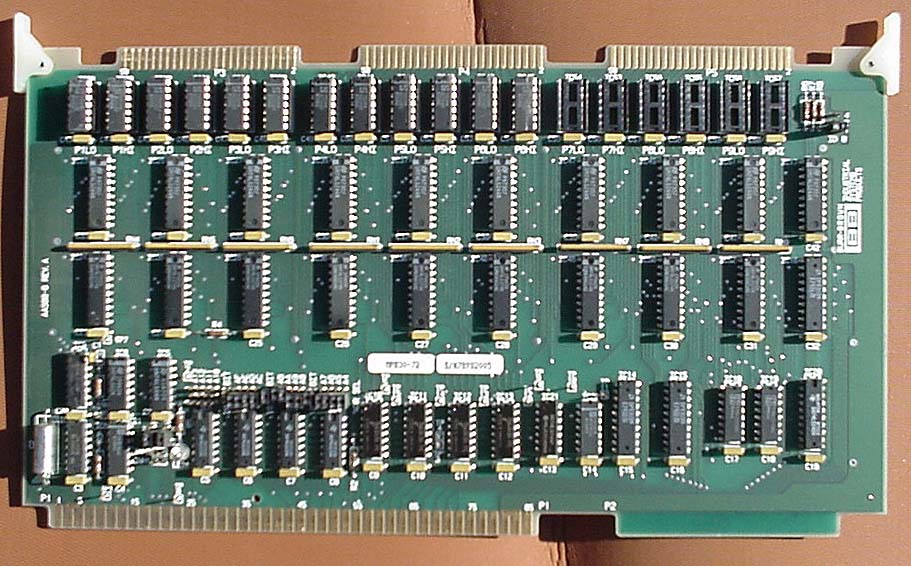
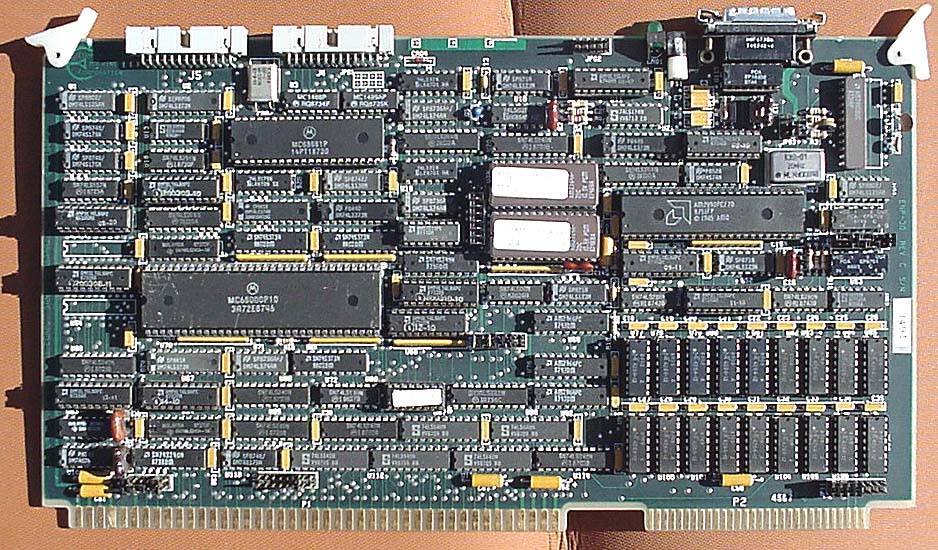
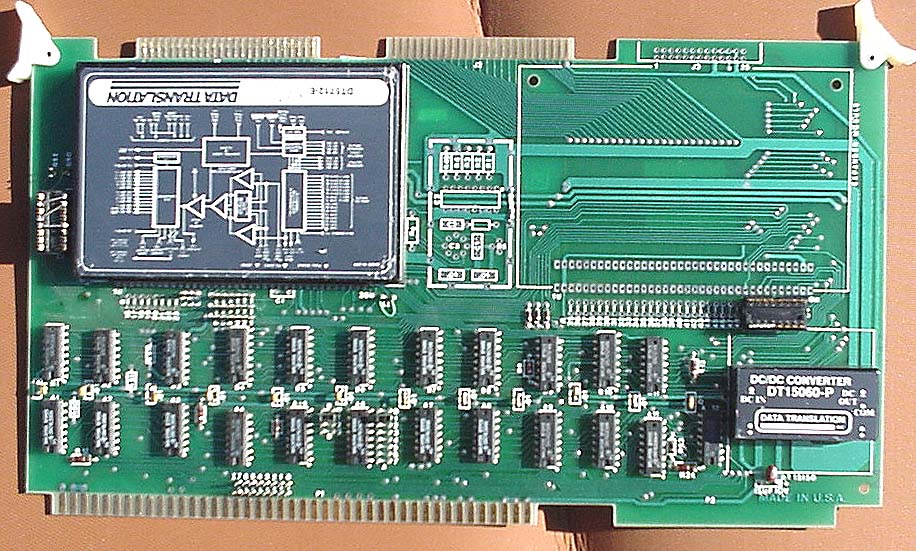
Added more pictures. Here <http://www.classiccmp.org/hp/bbn/multibus/> are pictures of the Multibus cards that are used in the BBN. I don't think I mentioned it but the BBN has two card cages plus a place for the Switch card. As I mentioned earlier, the BBN card cage has no sockets and all the card connections are made through cables on the front edge of the cards. In addition to the BBN CPU card card, there's also a Multibus card cage for the IO controllers and such. These house an IKON DR-11W emulator card <http://www.classiccmp.org/hp/bbn/multibus/DR-11W.jpg> that's used to talk to the BBN CPU cards. A Burr-Brown 830-72 72 channel TTL I/O board <http://www.classiccmp.org/hp/bbn/multibus/Burr%20brown%20830-72.jpg>. A CMC or Excelan EXOS201 Intelligent Ethernet controller board <http://www.classiccmp.org/hp/bbn/multibus/CMC%20Ethernet.jpg>. A Data TRanslation DT5712E high performance A/D converter card <http://www.classiccmp.org/hp/bbn/multibus/Data%20Acq%20module.jpg> and a NCR HPSIO card with 8 RS-232 ports and 1 parallel printer port.
Joe
Here are some pictures of SOME of the stuff that I got last weekend. Besides a huge box of manuals that I've sent to Al, I found five BBN computers and I'm attempting to rescue enough of one to make a workable system for Tom Uban. Plus all the cards out of the other ones for him for spares. The BBN chassis is just too big to deal with but I got ALL the cables, the complete PSU (on the back panel!), the multibus card cage (and all the MB cards) and the switch card that lets all the CPUs talk to all the other CPUs. The BBN CPUs are odd in that they don't plug into a socket so the card cage isn't absolutely necessary. All the power and signals go through connectors on the front of the card. Warning: this is a SCRAP place and some of it isn't pretty!
<http://www.classiccmp.org/hp/bbn/>
Here's also some pictures of the internals out of one of the 7 1/2 (yes half!) SMS Multibus computers that I rescued. These are pictures of the card cage and cards from the 1/2 computer. The scrappers had already started on it but I managed to find the cards, hard drive, floppy drive, etc.
<http://www.classiccmp.org/hp/sms1/>
I'll post more pictures and details about these later. I also rescued three Masscomp Multibus systems but no pictures or anything for them yet. OOPS! I forgot, I also rescued four Intel 86/384 computers and a MN-26C radio compass on Saturday. More about those later too.
Joe
Here are some pictures of SOME of the stuff that I got last weekend. Besides a huge box of manuals that I've sent to Al, I found five BBN computers and I'm attempting to rescue enough of one to make a workable system for Tom Uban. Plus all the cards out of the other ones for him for spares. The BBN chassis is just too big to deal with but I got ALL the cables, the complete PSU (on the back panel!), the multibus card cage (and all the MB cards) and the switch card that lets all the CPUs talk to all the other CPUs. The BBN CPUs are odd in that they don't plug into a socket so the card cage isn't absolutely necessary. All the power and signals go through connectors on the front of the card. Warning: this is a SCRAP place and some of it isn't pretty!
<http://www.classiccmp.org/hp/bbn/>
Here's also some pictures of the internals out of one of the 7 1/2 (yes half!) SMS Multibus computers that I rescued. These are pictures of the card cage and cards from the 1/2 computer. The scrappers had already started on it but I managed to find the cards, hard drive, floppy drive, etc.
<http://www.classiccmp.org/hp/sms1/>
I'll post more pictures and details about these later. I also rescued three Masscomp Multibus systems but no pictures or anything for them yet. OOPS! I forgot, I also rescued four Intel 86/384 computers and a MN-26C radio compass on Saturday. More about those later too.
Joe
yes, those mains light switches are complicated...
-----Original Message-----
From: der Mouse <mouse(a)rodents.montreal.qc.ca>
Sent: Nov 18, 2004 10:14 PM
To: "General Discussion: On-Topic and Off-Topic Posts" <cctalk(a)classiccmp.org>
Subject: Re: tracing out schematics
> You will _never_ successfully trace a schematic you don't understnad.
I think that's a bit of an overstatement. There have been devices that
I understood not a lick until I sat and studied the traced-out
schematic for some time.
/~\ The ASCII der Mouse
\ / Ribbon Campaign
X Against HTML mouse(a)rodents.montreal.qc.ca
/ \ Email! 7D C8 61 52 5D E7 2D 39 4E F1 31 3E E8 B3 27 4B
>I attended a presentation at AppleNYC last night to oogle all
>the neat hardware and hear about the Software but I failed to
>ask this question:
> Can you take an X11 application compiled for PPC/linux or
> /freeBSD and run it on the Mac?
>
>Think they said that their OS was Posix compliant but apps
>were'nt portable To other platforms. But From?
>
>I've seen a few X11 crashes in my day but I'll still give 'em
>a chance.
I would think there is a good chance. There is an X11 setup for OS X. You
can download it from various places online, or it comes with OS X.3 (but
I don't believe it is part of the default install, so you have to choose
to install it).
I know OpenOffice was ported to OS X for use with X11. I just don't know
how much was involved beyond a recompile.
-chris
<http://www.mythtech.net>
Picked up some nice stuff just now:
Apple Powerbook 170
Apple /// + Profile unit
Apple Lisa
BeBox + manuals + software
Commodore PET 3032
Commodore PET 8096-SK
Only just got back so I'm only just about to start poking around inside
things :)
What's more impressive is that it all works apparently, apart from the
Lisa...
I'm sure I'll have questions to follow as I pull cases off...
cheers
Jules
Here's a fun event. Have you got a computer history question that's been
burning for an answer? Come ask it this Friday to a panel of computer
historians at the Computer History Museum.
FRIDAY, November 19, 2004
Stump The Historians
Board members of the IEEE's Annals of the History of Computing share how
they view the history of computation and what they see for the future.
Come loaded with your questions and try to stump the historians!
Panelists include:
David A. Grier
Editor in Chief, IEEE Annals of the History of Computing Associate
Professor, Computer Science and International Affairs Center for Science
and Technology Policy George Washington University
Nathan Ensmenger
Professor of History and Sociology of Science University of Pennsylvania
Michael S. Mahoney
Professor of History, Program in History of Science Department of History
Princeton University
Raul Rojas
Professor of Artificial Intelligence
University of Berlin
Dag Spicer
Senior Curator
Computer History Museum
6:00 PM Member Reception
7:00 PM Lecture
LOCATION
Computer History Museum
1401 N. Shoreline Boulevard
Mountain View, CA
http://www.computerhistory.org/events/directions/museum_map.html
REGISTRATION
Free. Suggested donation of $10.00 at the door from non-members.
RSVP is required. For more information on the event, please visit the
Museum's Web site at:
http://www.computerhistory.org/historians_11192004
--
Sellam Ismail Vintage Computer Festival
------------------------------------------------------------------------------
International Man of Intrigue and Danger http://www.vintage.org
[ Old computing resources for business || Buy/Sell/Trade Vintage Computers ]
[ and academia at www.VintageTech.com || at http://marketplace.vintage.org ]
Teo Zenios <teoz(a)neo.rr.com> wrote:
> I have yet to see an consumer OS that did not crash [...]
"Consumer OS" is an oxymoron that constitutes the very root of the problem.
There should be NO such thing as a "consumer OS". No consumer should
ever be given a computer or an OS. Or for that matter, there should be
no consumers at all. Two-leggeds living their lives as consumers are
unworthy of life and are not even human since the true purpose of human
life is to produce and contribute, rather than consume, eat, shit, sleep,
fuck and pollute the environment with SUVs. Consumer societies like the
modern Western world are a cancerous tumor on the body of Mother Earth
that needs to be cut out (a few strategic nukes would be nice) to save
the planet.
-MS, Communist and believer in rule by the workers, noting that
worker == producer. Workers of the world, unite to overthrow and
annihilate the consumer society and replace it with a producer society!
On Nov 18 2004, 16:52, Tore S Bekkedal wrote:
> Brilliant! That is extremely useful general-purpose information. I
also
> happen to have what in Norwegian is called isopropanol, I can only
> assume that they are the same?
Yes, same thing.
> Again, thank you, that info will come in handy.
>
> I have some insanely dirty SGI KB's I got recently, too.
Unless something like salt water, red wine (Mateus Ros? is bad too, one
of my friends discovered), etc has got in, there's an easier and less
dramatic way to clean them.
Usually the dirt is (1) general dirt on the keys, (2) biscuit crumbs,
paper clips, hair, etc, under and in between the keytops, and (3)
general dirt anddiscoloration of the case and cable. Take off the
keytops (you can get a little puller to make this easier, but if you
take the cover off the keyboard you can do it with your fingers). Use
a vacuum cleaner and a small paint brush to remove the crud around the
keys. Clean the cable with a small amount of white spirit on a paper
kitchen towel, and finsh off with a dry towel (optionally add a very
small amount of furniture polish). Clean the case with a damp cloth
and detergent or kitchen-surface cleaner (don't forget to rinse it
off!).
I use one of two methods to clean the keycaps, depending on how many I
do at once.
One way is to dunk them in a small washing-up basin (or a large kitchen
bowl) with some mild detergent (I use Flash, which is a non-foaming and
fairly gentle floor cleaner) and swish them around for a while, then
pour out the liquid, dump the keycaps into a towel, and dry them off.
If I do it that way, I often spray a little (very little) Mr Sheen
(liquid furniture polish) onto the wet keycaps just before I dry them;
it leaves an almost imperceptible coating of wax that prevents them
getting dirty again so quickly.
The other way is to put them into a pillowcase, tie the open end off so
they can't escape, and sling the pillowcase in the (clothes) washing
machine. Dry in the tumble drier (still in the pillowcase), with your
preferred fabric conditioner (same effect as the Mr Sheen above). You
can get brownie points from She Who Must Be Obeyed by doing this as
part of a small load of the regular laundry :-)
Liz, of course, is used to finding sprayed-painted metallic parts
curing in the oven, pillowcases rattling quietly in the tumble drier,
and circuit boards in the dishwasher (don't use the hot drying cycle,
dry using IPA and compressed air).
That's got me looking at the five keyboard around me. Yuk. Time to
find that pillowcase, I fear, at least for three of them :-(
--
Pete Peter Turnbull
Network Manager
University of York
Hi
The Sun keyboards would need to be disassembled if they have
water on them. These are made of multiple layers of flexible
pcb. One might dry for a month and not get it dry. Just
a few hours with the layers wet will cause traces to be rotted
away ( from experience ).
Dwight
>From: james <james(a)jdfogg.com>
>
>> How rugged is this KB? Will it take water, and relatively hot water
>> too?
>
>Any keyboard will take boiling water, at least on the circuitry. During
>manufacture circuit boards are washed after wave soldering in a 200
>degree spray (ph isn't neutral, but I don't remember which way it
>swings).
>
>The only concern is the plastics.
>
>I've washed all my keyboards (incl Sun) in dishwashers on regular cycle
>with a little detergent (NOT Cascade or other powder detergents that
>contain sand - use liquid). I don't recommend using the drying cycle.
>The trick is to chase the water afterwards and I use isopropynol
>(rubbing alcohol) to do that. Isopropynol binds to water and will take
>it away as it flows off the board.
>
>Follow with a hair dryer and a day or two in the sun.
>
>This also works for rescuing electronics that have been dropped in
>lakes/oceans if you get to them quickly.
>
>
At 13:25 18/11/2004 +0000, you wrote:
>Bert Thomas wrote:
>
>> I've read in the past that Tony called someone a whimp cause he said he
>> didn't dare to reverse engineer a 4 layer board or something like that. I
>> wonder, if _that_ is easy, how does one solve problems like traces that
>> run under components? If its a simple and cheap component, it could be
>> removed and replaced later.
>>
>
>When I traced out the circuit diagram for my Ensoniq Mirage sampler's
>ailing analogue section, I just measured the DC resistance between two
>points and guessed. With a bit of thought, you can usually judge what
>makes sense to be connected to what.
A technique that I've used out of desperation when trying to track a few
signals through a multi-layer board where I had "no idea" where they came
out, is to cut a square of aluminum foil - size depends on board size and
how "fine" you want to be - press it onto regions of the board using a
pad or sponge to insure it presses down on all connections (obviously you
do this with the power off, board disconnected and any nicads/supercaps
removed etc.) - this lets you test conductance from the original signal
to whole areas of the board.. Once you narrow down the area where the
signal appears, it is much easier to find it.
Whole pile of caveats and warnings about shorting components which may
still be charged, passing current from DVM through unknown paths through
the circuitry etc. will no doubt be forthcoming - just be careful and
aware of what you are doing - YMMV, but it has worked for me on more than
one occation.
Regards,
Dave
--
dave04a (at) Dave Dunfield
dunfield (dot) Firmware development services & tools: www.dunfield.com
com Vintage computing equipment collector.
http://www.parse.com/~ddunfield/museum/index.html
> It's in excellent cosmetic condition. I powered it up
You really should learn the basics about applying power to
electronic gear that has been off for some unknown period
of time.
It is an INCREDIBLY BAD idea to just go into a room full of
old computers and just randomly start applying power to equipment
in unknown condition. At an absolute minimum, you should check
the condition of the power supplies.
Hi Joe,
>One of the things that I noticed was that the computer kept running and
>even though I turned >off the power switch the cap kept sizzling.
On the 2113 (and I guess from your description the 2117) the capacitor is
directly across the terminals on the mains input socket - i.e. on the
'always hot' side of the on/off switch. So turning the power off behind the
front panel of the computer won't help.
In order to effectively control interference the capacitor has to be mounted
as close to the point at which mains enters the equipment enclosure as
possible. Mounting it further away causes the input leads to act like an
antenna inside the enclosure.
>I had to unplug the line cord to stop it.
Yep, this is the only way to shut the power off to this capacitor, it is
always live when the equipment is plugged into a live mains socket.
A good reason NOT to leave this sort of equipment plugged in but turned off!
Peter Brown
Hi Bob and Jay,
Thanks for replying to my post. I now have a pile of schematics to try to
understand!
Bob: Thanks for the info on the -2 volt rail - I'm not going to be running
any 2116 hardware so I guess I should be OK.
I'm still intrigued as to why my rail should be out of spec (the service
manual is pretty precise about the rail limits). If any one has access to
the schematic for the standard power supply for the 2113B (i.e. without the
battery back up option) then I'd be very interested in getting hold of a
copy.
Cheers
Peter Brown
I picked up an HP 41C calculator at the VCF 7.0 earlier this month. It
has damage from leaking batteries and is beyond my ability to repair
it. Would anyone like to take a try? It has the following modules
installed:
Memory Module
Financial 1
Math 1
Please let me know by private email if you are interested. I'm offering
it for free and I will pay shipping. Heck, it weighs next to nothing
and won't cost much to ship. If you want it, send me email.
David Betz
dbetz(a)xlisper.mv.com
Hi All,
Excitement in the lab last night! - I left the 2113B running on the bench
whilst I went to make a cup of tea (yep, British) only to return to a room
full of smoke.
Turned out that the 240 volt rated 0.22u surpressor capacitor (mounted
across the live and neutral pins on the mains socket) had decided to give up
the ghost. No real damage done - just a bit stinky and a bit of smoke
damage.
The machine had run just fine for about two hours before the cap decided to
break. This has happened to me before on another piece of ageing
electronics - it is probably worth checking all old electronics for this
type of surpressor capacitor and replacing them BEFORE turning the equipment
on.
Hope that this is of help to someone.
Peter Brown
Does anyone in or near Colorado want the following items Sanyo MBC550 and a
Sanyo monitor ? Email me and I will put you in contact with the person that
has them.
Jim Isbell, W5JAI <jim.isbell(a)gmail.com> wrote:
> BUT...now she expects to have the system updated every two weeks. She
> used to be satisfied with my cast offs but now she wants the latest!!
You mean she can't use an ASR33? Why not? Teach her how to use one!
MS
Hello all,
OK ... So far all of the responses to part #1 have been "I look
forward to part #2", or "I'll take what's left"... Therefore, I'll
keep it all available, in case someone wants the entire kit. If not,
then I'll sort out what's left and let the vultures get it :-)
Please note that I am NOT willing to ship anything in this list. Too
big, too heavy, too much trouble. Please do not ask me to ship it...
You can pick it up in Westminster, MA 01473.
Here's the deal:
- A case the size/weight of a typical desktop PC, labeled on the front
"VAX 4000-100", and on the back "MicroVAX 3100". Nice and clean,
nothing in the 5.25" external bays, and only one hard drive in the
internal bays, RF31T-EA (Google says 381MB DSSI). Has what looks like
a standard set of ports on the back (I found one similar to this on a
Google search, and it had all the same ports: printer, DSSI, Q-Bus,
SCSI, Ethernet, Console, Printer). NOT powered on, untested, working
pull.
- DEC TS05 Tape drive, with two cables. HEAVY! Untested, working pull
- MTI StingRay DS and StingRay Disk Array. The DS unit looks to be
the controller, and the Disk Array has 7 1GB drives. DS unit weighs
about 40lbs., and the Disk Array is at least double that (about the
size of a FULL 486 PC Tower case). Untested, working pull
- R400X expansion unit. Again, some Googling reveals it is a BA440
cabinet, with 4 drives (DSSI I believe). Also has a M7493-PA card,
and H7874-00 power supply. Untested, working pull
- B400X expansion unit. Another BA440, NO hard drives, but does have
a TK70 tape drive. Has the same H7874-00 power supply. Cards are:
M9060-YA load module, M7530-PA TS05 controller, M9047-00 grant card,
M7559-00 TK70 controller, M9405-PA QBus Expansion card. Untested,
working pull.
I'll take emails for a couple of days OFF-LIST please. I'd like to
get this out of the house (or, rather, my wife would :-) ), so
priority will be given to those who can come sooner rather than
later.....
I'll try to answer any questions, but I am a DEC neophyte...
Thanks,
Rich B.
> This is Meltie's department, though whether he can get the means
> together to get to welshland is another thing entirely. I can't, plus
> I've got nowhere to put it :-\ The 4000 would be nice but I've already
> got a 4505a :)
Thanks for thinking of me, but Snowdon computers (i've seen it already by
a stroke of luck) get them in occasionally and I just can't afford the van
at the moment :(
Give me six months and i'll have given up on Uni and moved to
Cheltenham/Bristol to work with a mate in VMS admin.
Sod Uni... Job! Money! House! 3-Phase!
alex/melt
My inner voice kept urging me to stop by the local used-computer place today despite my currently low cash level. Now I know why.
Besides the SCSI connection adapter I needed, I also picked up a neat piece of computing test equipment history. It's a V-ATE POST and diagnostic test card, made by Vista Microsystems and vintage about 1991.
I remember seeing these things (and lusting after them, but I couldn't afford $2,300+ at the time) in the Specialized Products catalog of the time, right alongside the Lynx floppy-disk tester/exercisers, RS232 breakout boxes, and other such goodies. I never in my wildest dreams thought I'd ever own one.
This particular board will work in any AT-type system with an ISA slot. Besides doing the usual POST code readout and diagnostic functions, it will also function as an AT-bus specific logic analyzer.
God only knows what I'm going to use it for right now, but I just couldn't leave it there to be picked up by some brainless boob who has no idea of the history of the thing, much less how to use it!
<sigh> And I thought I was done collecting computer hardware some years ago. At least I'm not bringing home VAXstations now... ;-)
Keep the peace(es).
-=-=-=-=-=-=-=-=-=-=-=-
Bruce Lane, Owner & Head Hardware Heavy,
Blue Feather Technologies -- http://www.bluefeathertech.com
kyrrin (at) bluefeathertech do/t c=o=m
"If Salvador Dali had owned a computer, would it have been equipped with surreal ports?"
I suppose someone here might know this! I've an external Sun case that
accepts a single 5.25" SCSI device such as a CDROM or DAT drive (the
case is open at the front).
It's one of those two-colour plastic shelled ones, pale blue / cream,
with 68 pin SCSI connectors on the back and a 50 pin connector
internally + power cable.
*nowhere* on it does it seem to say what capacity load it'll drive
though. Most unhelpful. Anyone happen to know?
It'd be a useful way of temporarily hooking up old 50 pin SCSI devices
to my modern PC for backup purposes as it lives on top of my desk, but I
rather suspect the PSU might go into meltdown if hooked up to a 5.25" FH
drive (with the top of the Sun case removed of course :)
ta!
Jules
What was the fastest Pentium Pro CPU produced? On one site that a
Jeeves search turned up, there was mention of the Pro getting up to
300MHz, yet another search result says that the fastest is 200MHz.
Plus, the HP Vectra XA that I am tinkering with uses a Pentium Pro CPU
(she currently has a 200), and according to the geeksheet for this
motherboard (http://www.embeddedlogic.com/TH99/m/E-H/35391.htm) this
board can take up to a 266.
So, which is it?
It's got to be 10 years old now, right?
gopherspace was wonderful, a brilliant use of the internet
besides email. Too bad for gopher that http was better.
I long ago took down my gopher server, and it seems it's largely
disappeared from the net, even wiretap.spies.com appears empty
in my browser (firefox) which tries to render it as html!
Besides a few flat-earthers ("Bring Back Gopher!") it's largely
disappeared.
Anyone on this list still run one? What's the best client to use?
Here's a good quick ref on it:
http://en.wikipedia.org/wiki/Gopher_protocol
Please email Alexis directly if you want this item as I do not have any knowledge about it. Thanks
----- Original Message -----
From: Alexis Skriloff
To: jkeys(a)houstoncomputermuseum.org
Sent: Monday, November 15, 2004 11:51 PM
Subject: collectioins
hi,
i have a 386 AMT, 40 mg hard drive, toshiba dot matrix printer, keyboard, nec multisync 3d monitor, and mouse. some floppies, software and manuals.
are ;you interested and if not, do you know of anyone who might be interested?
sincerely,
alexis
Anyone know what a 74ACT2155 IC is? Memory of some sort, but is there
anything special about them?
I've managed to pull the NCR Tower into the middle of the garage and
have pulled the covers off - I'll take the disks out later and see if
they spin up first as the machine's somewhat useless if they don't!
After that I'll reseat the boards, check the PSU etc. but I do remember
the machine had developed some sort of fault when I parked it up years
ago. ISTR it being *totally* dead, so there's likely a PSU problem.
Anyway, there are quite a few of these 74ACT2155 chips on little modules
on the system board; one of the modules is labelled as being cache so
they're definitely memory of some flavour - I've just not come across
these with a 74xxx part number before.
NCR didn't half like their PAL chips. I counted over 40 on the system
board alone. There's almost as many as there are typical logic ICs.
cheers
Jules
Does anyone have codes - Pantone numbers, or something like that - or
commercial paint names, for the following shades of DEC paint:
pdp-15 'powder blue'
pdp-10 dark blue
pdp-12 green
The light, very slightly creamy, grey paint used for front panel frames,
RA8x disk drives, etc.
Have some restoration to do!
Thanks - please CC any replies to my email, list digest distribution seems
slow of late!
Mike
http://www.corestore.org
Picked up a nice 1650B logic analyzer, but no manuals. Before I debate
about spending $100.00 for a set of manuals, I thought I'd see if
someone has a 1650A/B manual around, or has copies.
Jim
--
Jim Brain, Brain Innovations
brain(a)jbrain.com http://www.jbrain.com
Dabbling in WWW, Embedded Systems, Old CBM computers, and Good Times!
If anyone would like to help this person, contact me offlist....
--------------
Hello,
I am not a programmer, but my husband is.
He has 4 each 7" tapes and 2 each 11" tapes that I believe came from a old
PDP11
On these tapes are stories that my husband wrote 15 to 18 years ago. His
son, along with his fiancee and 7 of his best friends were killed in a
tragic airplane accident in 2001. On one of the tapes is a story that he
wrote.
I thought if I could somehow download or get a copy in print form what is on
the tapes it would be a wonderful gift to my husband.
Please let me know if you can direct me where I might find someone to help
me.
Thank you,
Sincerely,
Hi All,
I'm in the process of powering up a 2113B. I took a look at the output
voltages from the PSU and they all look fine *except* the -2 volt line that
appears to be running at -2.47 volts.
I have the 2109B / 2113B installation and service manual but the service
procedure just talks about adjusting the 5 volt line and all the other
supply voltages tracking this one.
I can't find a schematic for the power supply in the documentation that I
have 02109-90015.
Questions:
1. Is my copy of 02109-9005 (Installation and service manual) incomplete
i.e. should there be a schematic in it?
2. Does anyone have a schematic for the 2019B / 2113B computer power supply.
Note that the 'B' is important as the power supply was revised between the
'A' and 'B' models.
3. What is the -2 volt line used for?
4. Does it matter that the -2 volt line is outside specification?
5. Is a full schematic available for the 2113B computer? - I'm sort of
interested in what exactly is going on on the motherboard.
Many thanks
Peter Brown
Is there a schematic online for the DEC PDP-11 maintenance tool KM11?
Googling, the best I found was a description by Tony Duell for a
homebrew replacement. Excellent as that is, a schematic is just so much
easier to read.
Hi Jay et al.,
I've had a look at the .pdf's that you suggested - interesting stuff!
Unfortunately just as it begins to get really interesting it looks as though
the pages are missing.
The bits that are most relevant to me, 'B-series power supply', are listed
in the index .pdf as being at the end of section 9 but the scans of these
pages haven't been published.
Does anyone have the relevant pages? Looks like section 9, page 132 and
following...
Cheers to all
Peter Brown
Anybody what OS these use or anything else about them? I picked up seven of them with docs this past weekend. They're rackmount chassis with 5 Multibus 1 slots. According to the manual they have an Intel 86/35 CPU card, 4 Mb of RAM, a 12 Mb Seagate ST 213 12Mb hard drive with an intel iSBC 214 controller, a 48 TPI 5 1/4" floppy drive and a SMS peripheral controller. I have dug into any of them yet to check.
I'll be asking lots more questions. I picked up an American Buttload* of computers this past weekend. And you won't believe where they came from!
*That's at least 2x a Metric Buttload!
Joe
hi all, I have a ISIS version of kermit that requires a PLM compiler to "fix" Does anyone have a copy available? I must have left my copy back in Seattle and I was trying to get a bunch of files copied over, but I need to fix kermit first... Thanks!
best regards, Steve Thatcher
Allright, I got around to translating a part of the Norwegian ND history
site. It's now up under
http://heim.ifi.uio.no/~toresbe/nd/stuff/history
Read and rejoice :)
--
Tore S Bekkedal <toresbe(a)ifi.uio.no>
Norsk Data struck chord somewhere in my memory, and I found my copy of
"Norsk Data - A Success Story" by Per Oyvind Heradstveit. Published in
1985, it covers the history from its founding in 1967 through 1984. A
quick book search turned up no hits, so I have no idea how easy or how
hard this book might be to find. However, for anyone interested in Norsk
Data, it is a wonderful book!
I am cleaning out a storage locker and have a lot of stuff I won't take,
that I can hardly begin to count up here.
the best item for this list is a pile of older sun manuals for anyone
into old sun 4.x stuff, and early solaris. I also have tapes and what
have you too.
I have some sun 3/x stuff left, from some things that I could get from
long ago, such
as some smd drives and cabinets.
Please plan to pick this up. I do not have the means to ship this
stuff.
Jim Stephens
I found this in a load of scrap this weekend. It's marked MicroSolutions (makers of the highly desirable Capticards) so I grabbed it. It fits an 8 bit ISA slot and says Pacific Rim Technologies on the component side and MicroSolutions on the other. It has jumpers for address (only marked A and B) as well as DMA and IRQ settings. It's only about 4 inches long and has a UM8272A LSI IC and about a dozen SSI ICs. There is a D(something) 37F connector on the back on the card and solder pads for 34 ribbon cable header on the inside edge but no header installed. What have I got? I'm sure that it's some kind of floppy drive controller but nothing beyond that.
joe
Tecmar also made PC expansion cards. I recall a TECMAR Graphics Master video card too. I recall the 1st Mate, but not as a tape controller. I would suspect it was an I/O expansion. The large chips would be the ones to ID the fuctionality - 8250(40 pin) - serial, MM58167(24 pin) - time of day clock, 74LS374(20 pin) - parallel port
best regards, Steve
On Mon, 15 Nov 2004, Stefan wrote:
> Does anyone know what a Tecmar 1st mate card is ?
Does anyone know what a Tecmar 1st mate card is ?
It came from an IBM PC and has one male 25 pin connector on the card itself
and has another 25 pin female connector attached to a flatcable. Its from
1982 and probably has part number 200029.
Stefan.
-------------------------------------------------------
http://www.oldcomputercollection.com
Pantone numbers are what you would use to communicate with a print shop if
you needed to get an exact replication of color in a lithographic printing job.
I, too, would be interested in the Pantone Numbers for DEC equipment.
Paxton
Astoria, OR
I think I creatated a Frankinstein Monster!!
For 40 years my wife has not been interested in computers. 5 years
ago I finially got her introduced to computers. She surfs the
internet lika pro, installs her own software etc.
BUT...now she expects to have the system updated every two weeks. She
used to be satisfied with my cast offs but now she wants the latest!!
This came to light most recently when I installed a Lansing sub woofer
speaker system. Its not the latest technology and I even got it off E
Bay for only $2.25 but it is the best I have ever heard. Now she
wants one!!!
--
Jim Isbell
W5JAI
UV #257
CAL 27 #221
Date: Sat, 13 Nov 2004 17:50:53 -0500
From: "Glen Goodwin" <acme(a)gbronline.com>
Subject: Enigma kits in USA
To: "General Discussion: On-Topic and Off-Topic Posts"
<cctalk(a)classiccmp.org>
> http://www.xat.nl/enigma-e/
>
> That's DAMMED cool! Somebody needs to start selling these in the US!
>
> Joe
---------------------------------------------------------------
>>Okay, you got my attention. I import stuff from all over the
>>world, so why not Gt. Britain?
>>
>>Bletchley Park sells them for GBP119.99 (US$222.49),
>>and the Museum Jan Corver in The Netherlands charges
>>EUR130 (US$168.72), freight not included.
>>
>>If ten people on this list raise their hands and say "I want one"
>>at *roughly* US$200 plus UPS shipping from Florida, I'll
>>get in touch with the Enigma-kit folks and see what we can work out.
>>By bringing in a number of them we'll save on the freight and possibly
>>get a volume discount, too.
>>[clipped]
-----------------------------------------------------------------------------
Hi Glen, I'm interested!
Thanks, Robert Greenstreet (gstreet(a)indy.net)
DEC deskside computer system labeled R4000X-B9 found at local surplus
spot.
I think it may be a MIPS processor based system.
Mike
m m c f a d d e n at c m h dot e d u
Hi all,
Evan K. here again with a (blatantly commercial) list message: as an extension
of the newsletter, I've now published the Guide to U.S. Computer Museums, 2005
Edition. The guide is in booklet form.
It includes explanations of the history, mission, and uniqueness of more than
20 museums across the country. It also includes GPS coordinates, to help you
find the museums on trips to new places. There is an "additional resources"
appendix too.
The information in the booklet is much more detailed than what I've posted
online before. For example, we all know the Computer History Museum, but do
you know about the ones in Kansas, Rhode Island, and Virginia? Do you know
about the Perham Collection or the Historical Electronics Museum? Do you know
where you can tour a supercomputer or see an original Enigma decoder machine?
LOL, and for your talkative list members, the above questions are not intended
for endless discussion here... they're just to make a point. :)
Anyway, it took some time and effort and money to compile all of this
information, so here's the commercial part (sorry, Mr. West!): I'm selling the
booklets for $6 each (or $10 for two). There is also a $1 shipping cost, per
every two copies -- makes a terrific holiday gift for your favorite traveling
nerd.
The booklets are available at my web site, http://news.computercollector.com
... thanks for reading this,
- EK
=====
Tell your friends about the Computer Collector Newsletter!
-- It's free and we'll never send spam or share your email address
-- Publishing every Monday(-ish), ask about writing for us
-- Mainframes to videogames, hardware and software, we cover it all
Visit the museums directory and read about past events
at our web site: http://news.computercollector.com
Contact us at news(a)computercollector.com
585 readers and counting!
I have a friend who's needing a copy of RT-11 for an SMS1000, any help in
finding a copy would be appreciated.
This chap works at a fische and printshop and the 11/34 they used for
talking to their lasers kicked it, so they're going to replace it with an
SMS1000 they have on hand.
The guy says that the stock PDP11/34 RT-11 image won't run on the SMS1000,
so he's assuming a more specialised version is required.
Thanks all;
JP
At the recent Ft. Wayne hamfest, I picked up an HP 4951B Protocol
analyzer, but it didn't have a manual with it. Does anyone have
one that I can get either a scan or copy of?
--tnx
--tom