Hi Jules,
>Do you rely on being able to get the raw data stream from the floppy
>controller and decode in software? Or are you letting the FDC handle
>that?
>
>Reason I ask is that I just had a look under Linux and it's possible (at
>least with 2.6 kernels - no idea about earlier) to setup the FDC from
>user-land via the fd floppy device. In other words, a Linux port might
>be possible (for someone to do! :) assuming you're not doing anything
>'odd' with the FDC...
The 765 does not provide the ability to perform raw track reads/writes
like the WD devices do ...
I interface with the FDC via direct hardware I/O to both the FDC itself
and the DMA system.
At some point I will tidy up the source code and make it available, however
it is written for my own Micro-C 16-bit DOS compiler, and makes use of my
own screen/windowing library - it would take a fair bit of work to port this
to another system, but someone with enough spare time could take advantage
of my "learning experience", and re-implement the algorithms under Linux or
some other system.
Regards,
Dave
--
dave04a (at) Dave Dunfield
dunfield (dot) Firmware development services & tools: www.dunfield.com
com Collector of vintage computing equipment:
http://www.parse.com/~ddunfield/museum/index.html
Hi Fred,
>Q: are you going to continue to expand the collection of images,
>and perhaps take over where Don Maslin left off?
>If so, read through to the end!
I am actively attempting to archive all of the system disks in my collection.
My primary purpose is to preserve them so that I will not lose the data should
the physical media go bad - however I see no reason not to make them available
should other people need these disks.
If others want to contribute images to the archive, I will certainly welcome
them - or if someone else wants to set up a repository of images, you are welcome
to take the ones that I have done.
>> One weakness - the program currently cannot handle disks which have different
>> sector sizes within the same track ... so far I have encountered only one disk
>> type which *MAY* do this, BMC if800 - TeleDisk reports that the sector size
>> changes within the track ... however I have never been able to get TeleDisk to
>> restore a workable disk, so I am not convinced that it handles it either - it
>> also reports sectors missing and "no data" in sectors, as well as really odd
>> sector numbers - I have a feeling that it is an incompatible format and it is
>> getting "garbage". Still, it's an option I could provide if there proves to be
>> a need.
>
>IIRC, the Ensoniq Mirage had mixed sector sizes.
>
>There is apparently at least one BMC if800 format that can be done with
>765.
I looked into this a bit more after posting last night, and it looks like
the 765 cannot do mixed sector sizes ... Although you do feed it the sector
size for each sector, it also requires the sector size as one of the initial
command parameters - I'm guessing the initial parm sets the actual sector
size formatted, and the DMA value simply controls what gets written to the
ID fields :-(
>I had some difficulties with "automatic format recognition", particularly
>from used reformatted disks. I wasted some time when somebody sent me
>single sided disks that had been formatted over PC 360K disks, which
>hadn't removed the old content on the second side, and with HP 3.5"
>diskettes that only rewrote the first 77 tracks, etc.
I've run into these issues as well - ImageDisk will analyze the disk for you
if you don't know the format, however it also allows you to manually set many
of the parameters. For example, when I know that a system is single-sided, I
usually tell ImageDisk to only do one side.
>Because I was only dealing with file transfer, I never bothered to even
>list which of the sample format diskettes that I have are system disks.
>http://www.xenosoft.com/fmts.html
>
>Would you like me to send you some sample diskettes to look through?
Thanks - I'll may ask for some, but at this point, I believe most of the
incompatibilities I am encountering are due to limitations of the 765. Once
we have a bit more experience and information with ImageDisk, I may take
you up on the offer for some specific formats.
Regards,
Dave
--
dave04a (at) Dave Dunfield
dunfield (dot) Firmware development services & tools: www.dunfield.com
com Collector of vintage computing equipment:
http://www.parse.com/~ddunfield/museum/index.html
Here's a new direction for that analog modem question... it's sort of getting
creative in some interesting directions, but not quite what
I have a system with 5 internal modems - I can't go with serial
ports/external modems for this system, they must stay internal. So, I need
to find a way so people can telnet to them. Essentially, I have a lan
connection and a bank of analog modems - Can anyone think of a solution, no
matter how crazy it is, to get me to be able to telnet from the internet and
connect to these 5 systems?
If I get 5 phone lines, that's not doing me any good, as I want to make it
accessible over the net. So, somehow I have to get a connection to go from
the net to trigger an analog modem source, which calls one of the 5 internal
modems, then feeds the data back over the line and to the telnet connection.
I've been researching some of the solutions people have proposed, but I'm not
real familiar with some of the capabilities of these systems. With the
reverse telnet concept, that would work if I could change my computer's modem
pool to external serial devices (get rid of the analog). I can't do that
yet..
Perhaps is there a device that acts as a remote access server, that once
connected, it dials out through another port to make a connection? Or, was
there a LAN device that would allow you to telnet to the device and initiate
a call over an analog phone line?
Pete
On Tue, 2 Aug 2005 17:23:33 -0500, Patrick Finnegan <pat at computer-
refuge.org> wrote:
[...]
>> Any help will be greatly appreciated.
>>
>
> Unfortunately, your system is completely useless.
>
> Please send to... ;)
>
> Pat
> --
> Purdue University ITAP/RCS --- http://www.itap.purdue.edu/rcs/
> The Computer Refuge --- http://computer-refuge.org
>
My friend says that you are welcome to the beast. However, you must
also take its power conditioner (see <http://www.liebert.com/assets/
products/english/products/pwrcond/datawave/60Hz/bro_4pg/acrobat/
sl_20199.pdf> it's the 20kW model) and insists on shipping FedEx
Custom Critical Freight.
Please send your bank account info ((:-P
CRC
I have one, and the screen gives me a headache.
It has the 9-pin video connector up front - is that just "regular"
RGB? Such that a straight 9-9-pin video cable and my trusty Commodore
1084 will give me external video?
Doc
I have been preparing my exhibit for this November's VFC 8.0 in California
since last November. It will probably cost me a thousand dollars to show my
Southwest Technical Products stuff. I won't notice a $10 fee.
The first SWTPC. 6800 computer was introduced 30 years ago in November 1975.
Today I got the loan of an Ultrasonic Sniffer, the first kit that Daniel
Meyer (founder of SWTPC) sold in 1963.
http://www.swtpc.com/mholley/PopularElectronics/Mar1963/PE_Mar1963.htm
Michael Holley
www.swtpc.com/mholley
I have an NRI 832. I'll check the box and see if it contains any literature.
By the way, I am interested in learning how folks on this list store their
vintage documentation and display their collections. Do you keep the
documents with the machines, or in a separate more "climate controlled" area
or in a conservation storage box, etc. I currently have all my documentation
stored with my machines, but I am considering placing it into a more
"friendly" environment, such as acid free envelopes or conservation boxes.
Any thoughts?
Also, do you keep your machines on display or locked away in a closet? In
addition to early computers and antiques that calculate, I also collect
early video games and handhelds. I like to display those, but frequently
find my kids and their friends "exploring" the functionality of my display
equipment. Thanks <frequent listener, first-time poster)
*************************************************************
In response to:
From: William Maddox <wmaddox at pacbell.net>
Subject: NRI 832
To: cctalk at classiccmp.org
Message-ID: <20050802053153.96891.qmail at web81310.mail.yahoo.com>
Content-Type: text/plain; charset=iso-8859-1
Does anyone have a copy of the NRI 832 documentation?
It was sold as part of a correspondence course, and
was presumably quite well documented by the course
materials.
--Bill
>
> Worked pretty good for me too. I've got one in a IIgs. If you read the
> forums however, he does warn that some CF cards are not compatible w/
> the thing. I had good luck w/ some little 128Mb SanDisk CF cards.
I believe that's past history. The developer has since diagnosed and
corrected a timing issue (EPLD and wiring mods required) and it should
work with any CF card.
*************************************
Apex Electronics (surplus) in Sun Valley has at least one CDC
Plato terminal out in the junk/scrap area. It's a ruin, though
likely complete. CRT is pushed back in the case, you can see the
touch screen junk. Rain and sun soaked. It's out near all the
other historic terminals, all ruined (Beehives, DEC stuff, all the
old brand names) in a heap with scrap and dirt and rain.
Too bad!
Ok all you 'vark fans, you can't pass this one up!
http://www.simpits.org/~geneb/ef111/ef111.html
I don't own it (unfortunately), but if you'll email me off-list I'll put
you in contact with the owner. The cockpit has been ejected and as you
can see is in remarkably good shape.
The owner has also made a preliminary identification so whoever ends up
with it can get the history and redacted accident reports from the USAF.
(No he can't ship it to Australia. Sorry Rod! :) )
g.
--
"I'm not crazy, I'm plausibly off-nominal!"
Proud owner of 80-0007
http://www.f15sim.com - The only one of its kind.
--- On Tue 08/02, Paul Koning < pkoning at equallogic.com > wrote:
From: Paul Koning [mailto: pkoning at equallogic.com]
To: cctalk at classiccmp.org
Date: Tue, 2 Aug 2005 17:48:00 -0400
Subject: RE: VCF Midwest update?
>>>>> "Julian" == Julian Wolfe <fireflyst at earthlink.net> writes:<br><br> Julian> I actually have a few problems with how the show was run,<br> Julian> speaking mainly as an exhibitor, I think it was run quite<br> Julian> backwards. To charge to exhibit, then not charge for<br> Julian> admission, is a slap in the face to the individuals who<br> Julian> hauled their stuff out to show. <br><br>It's perfectly common hamfest practice, and no one seems to think this<br>is strange -- and certainly they don't think of it as an insult.<br>Instead, it's a way to make the event more attractive to the buyers --<br>think of it as a small marketing fee.<br><br> paul<br><br><br>
Maybe it's due to I have never attended a hamfest, but I agree with
Julian it seems odd to me to charge the people exhibiting and not for
admissions.
_______________________________________________
Join Excite! - http://www.excite.com
The most personalized portal on the Web!
A friend came across a DECMATE I and we have been playing with the
beast, but are unable to figure out how to get a system loaded
without the necessary floppies for the RX02. It talks nicely to my
VAXStation 3540 as a VT100 (DP278A option), but it looks only like a
terminal.
I've Googled DECMATE and am totally FAQed up with the history and
long lists of software with little in the way of description. Is
there any runes to cast or incantations to key in so that we might be
able to load in a system over the RS232?
Any help will be greatly appreciated.
CRC
Essentially the layout would be this. I have a computer with 4 internal
modems in it. Has to be internal, I can't do this with external
modems/serial ports. Somehow I get it configured so that I can telnet from
the internet to this "emulator" and it directs my telnet session to one of
the 4 free analog lines.
Now, there's some solutions like lantronix UDS devices, where the device has
an ethernet jack and a 25 pin serial port and it can be set to emulate an
external modem, so folks can telnet to this device and it then tricks the
computer into thinking a modem connection is made...
...but my scenario is different in that I want the connection going to the
PC to still be analog lines. So, this device would have to have some sort of
modem emulation of its own.
It sounds sort of off-the-wall, but I wanted to run it by the group to see
if it rang any bells. Maybe there's some situation where such a device
would have been developed, but I'm not seeing the connection yet. Perhaps
if you were putting a multiline BBS system (that didn't support external
modems) on a local LAN? Maybe that's stretching the boundaries of sensible
communications a bit :)
Pete
Sellam:
>>In telco parlance this is what's called a "hunt group"
Yes, thanks, I couldn't remember the right word for it.
One could use telnet from the outside to hit a specific port on the gateway
PC (105.27.33.33:2020 for example for the main line). Each port relates to a
specific path through the gateway to a classic machine or to a "random"
server. The routing software on the gateway wouldn't be trivial, but
wouldn't be too tough either.
I'm also thinking about dial-out from an exhibitor display to a BBS in
addition to a "dial-in" from the outside.
Time to hit eBay and search for a Panasonic 616 :-) Sold commercially, used
units go for $450. The 308 is about $300. I'm obviously looking to pay
less...
Rich
-----Original Message-----
From: cctalk-bounces at classiccmp.org [mailto:cctalk-bounces at classiccmp.org]
On Behalf Of Vintage Computer Festival
Sent: Tuesday, August 02, 2005 4:16 PM
To: General Discussion: On-Topic and Off-Topic Posts
Subject: RE: Analog modem emulator?
On Tue, 2 Aug 2005, Cini, Richard wrote:
> I was talking about the VCF exhibit, where I believe you would still
D'oh! Sorry.
> need a modem bank. If I have two Apple II's each with a modem plugged into
> the PBX and I "dial" extension 101 which is the host PC, won't I get a
busy
> when the second Apple dials "101"? I think you do need a modem bank on the
> host PC with the fallover feature on the PBX programmed properly. The PBX
is
> simply acting as the "phone company" for purposes of connecting the two.
In telco parlance this is what's called a "hunt group", where you have
multiple destinations in a group that all have the same function where it
doesn't matter which one you reach (for instance a customer support line).
So you have one number assigned to the entire group, and the PBX will pick
the first available extension based on some simple algorithm (hunt from
top down, bottom up, least used, etc.)
In the VCF exhibit, my thinking is that each exhibitor is assigned an
extension, and so people on the outside (or inside) can call into a main
number and then from there transfer themselves to a particular exhibitor's
extension. If there's a TCP/IP to telco gateway (what we are discussing
here) then the gateway PC would have a bank of modems connected into the
PBX and anyone coming in on a TCP/IP "call" would be randomly assigned a
physical modem, and from there they could dial into any available
extension. If the extension is busy, they try another (or get routed to
e-mail to leave a message ;)
--
Sellam Ismail Vintage Computer
Festival
----------------------------------------------------------------------------
--
International Man of Intrigue and Danger
http://www.vintage.org
[ Old computing resources for business || Buy/Sell/Trade Vintage Computers
]
[ and academia at www.VintageTech.com || at http://marketplace.vintage.org
]
Just curious...has there ever been a device available to anyone's knowledge
that functions like an analog phone line and allows transmission via TCPIP?
For example, taking an older BBS system that has 5 internal modems in it,
and plugging the lines into this "mystery" device and then being able to
telnet to different ports and it makes the connection to one of the ports?
I've seen the UDS-10 device from Lantronix to emulate a serial modem, so
essentially you can telnet to it from another PC and it fakes the computer
into thinking someone's "ringing the phone, etc...but I want to take it one
step back...leave the modems in place but emulate the phone lines.
If it rings any bells, or if someone can think of a scenario this might be
needed in, please drop me a note and maybe it'll help me track down
something...
Thanks!
Pete
>
> Message: 9
> Date: Thu, 28 Jul 2005 18:51:07 -0400
> From: "B. Degnan" <websupport at degnanco.com>
> Subject: Re: DR DOS 5.0
> To: cctech at classiccmp.org
> Message-ID: <5.1.0.14.0.20050728184908.038f88e8 at mail.degnanco.net>
> Content-Type: text/plain; charset="us-ascii"; format=flowed
>
> >Subject: DR DOS 5.0
> >Anybody knows something about its history ??
> >I have installation disks with files dated 6/1990 and also a boot
> disk
> with some files dated in 2/1991, I know that several bug fixing
> versions
> exist, but Which is the last ??
> >I remembered it when I was reading all that Windows Vista
> (LongHorn)
> stuff. Seems that M$ is using 'vaporware' again to distract attention
> from
> Intel Mac OS X much like
> >they did with MS-DOS 5.0 and DR DOS 5.0.
>
> I have a copy of version 6. It's on 1.2MB 5 1/4 disks. If you'd
> like an
> eval copy, let me know.
> Bill
> vintagecomputer.net
>
Thanks a lot for your offer, but I have three copies of DR DOS 6.0
(9/91 original English & Spanish and 4/92 "Bussiness Update" for
Windows 3.1)
and a set of patches (3/93 for WfW 3.1). Actually I'm interested in the
latest issue of DR DOS 5.0 (2/91 or later) only.
Diego.
______________________________________________
Renovamos el Correo Yahoo!
Nuevos servicios, m?s seguridad
http://correo.yahoo.es
Sellam:
You're description is based on a remote telnet inbound connection
where you're coming in over the internet and using the host PC and the PBX
to route the call to the right one of the four modems on the computer from
the original example. In this case I agree with you -- it's one inbound
connection reaching one destination.
I was talking about the VCF exhibit, where I believe you would still
need a modem bank. If I have two Apple II's each with a modem plugged into
the PBX and I "dial" extension 101 which is the host PC, won't I get a busy
when the second Apple dials "101"? I think you do need a modem bank on the
host PC with the fallover feature on the PBX programmed properly. The PBX is
simply acting as the "phone company" for purposes of connecting the two.
Rich
-----Original Message-----
From: cctalk-bounces at classiccmp.org [mailto:cctalk-bounces at classiccmp.org]
On Behalf Of Vintage Computer Festival
Sent: Tuesday, August 02, 2005 2:22 PM
To: General Discussion: On-Topic and Off-Topic Posts
Subject: RE: Analog modem emulator?
On Tue, 2 Aug 2005, Cini, Richard wrote:
> Refining the BBS idea a bit, the problem with it is multiplexing. You'd
need
> to run a modem bank (like Hayes or Multitech) into the PBX and use an
n-port
> serial card in the host PC. The PBX I'm sure can be set for number
fallover
> so if you keep dialing extension "101" and it's busy, it will roll to
> extension 102, etc.
The modem bank off the host is not necessary. The PBX solves the
multiplexing problem. You have one modem on the gateway PC that is
connected to an extension on the PBX. It can then dial any one of the
other extensions which will then connect it to one of the modems on the
target PC.
> I used to have a 24-modem (2400 baud) Multitech modem bank from an old DEC
> installation but I got rid of it a long time ago. Just another piece of
> hardware I should have kept...
That stuff is really common if you know where to look ;)
--
Sellam Ismail Vintage Computer
Festival
----------------------------------------------------------------------------
--
International Man of Intrigue and Danger
http://www.vintage.org
[ Old computing resources for business || Buy/Sell/Trade Vintage Computers
]
[ and academia at www.VintageTech.com || at http://marketplace.vintage.org
]
> If you build it, they will come.
Next time you watch "Field Of Dreams" listen carefully to what's said
"If you build it, HE will come."
Very subtle, but significant difference in the meaning wrt the plot.
Refining the BBS idea a bit, the problem with it is multiplexing. You'd need
to run a modem bank (like Hayes or Multitech) into the PBX and use an n-port
serial card in the host PC. The PBX I'm sure can be set for number fallover
so if you keep dialing extension "101" and it's busy, it will roll to
extension 102, etc.
I used to have a 24-modem (2400 baud) Multitech modem bank from an old DEC
installation but I got rid of it a long time ago. Just another piece of
hardware I should have kept...
Rich
-----Original Message-----
From: cctalk-bounces at classiccmp.org [mailto:cctalk-bounces at classiccmp.org]
On Behalf Of Vintage Computer Festival
Sent: Tuesday, August 02, 2005 11:38 AM
To: General Discussion: On-Topic and Off-Topic Posts
Subject: RE: Analog modem emulator?
On Tue, 2 Aug 2005, Cini, Richard wrote:
> This setup should then work if I wanted to demonstrate old BBSes and
> how one could dial into them using classic hardware. For example, using
> classic machines like the Apple II or even an IMSAI with a 212A modem or
the
> DC Hayes board to dial into a CBBS setup hosted on a PC. This would be a
> great VCF demonstration, particularly if you could have a few machines
from
> different displays "dialing-into" the BBS.
That's a great idea. Next VCF I could run a PBX through the exhibit area
and then anyone exhibiting a live computer with a modem could hook it up
to the PBX and we could have people dialing each other's exhibits. Not
very practical but fun.
An even better idea that I've been toying around with is to do a version
of Core Wars. I'd come up with a basic specification and then it would be
up to each exhibitor to write an implementation on their exhibited
computer. The network would be serial based so just about anyone should
be able to hookup. Whoever wins would get the Grand Prize ;)
If this sounds like fun to you then please send me some feedback (directly
preferred). If there's enough demand then I'll put it higher on my
priority list amongst the 30,000 projects I already have going on.
--
Sellam Ismail Vintage Computer
Festival
----------------------------------------------------------------------------
--
International Man of Intrigue and Danger
http://www.vintage.org
[ Old computing resources for business || Buy/Sell/Trade Vintage Computers
]
[ and academia at www.VintageTech.com || at http://marketplace.vintage.org
]
ard at p850ug1.demon.co.uk (Tony Duell) wrote:
> Can't be! The 9830 tape drive and cassette are very different to those
> used in the 9825.
Mea Culpa. Its from the 9825A manual. The web page had the correct
attribution all along. I do not know what I was thinking as I was
typing the article (prob 9835 as I have the service manual for that
one as well).
----------------------------
"Joe R." <rigdonj at cfl.rr.com> wrote:
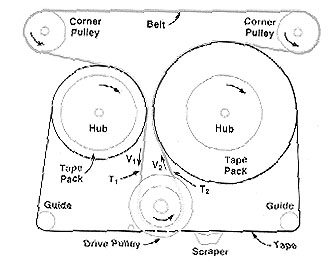
> You might want to add this picture <http://www.classiccmp.org/hp/hp-tape.jpg>
> from my website. It shows the tape and belt paths better than the one you
> have does.
I have added it to the page, much appreciate it. It is better, although
kinda low res. Anybody have a better scan of that image?
Thanks
**vp
Sellam:
This setup should then work if I wanted to demonstrate old BBSes and
how one could dial into them using classic hardware. For example, using
classic machines like the Apple II or even an IMSAI with a 212A modem or the
DC Hayes board to dial into a CBBS setup hosted on a PC. This would be a
great VCF demonstration, particularly if you could have a few machines from
different displays "dialing-into" the BBS.
Rich
-----Original Message-----
From: cctalk-bounces at classiccmp.org [mailto:cctalk-bounces at classiccmp.org]
On Behalf Of Vintage Computer Festival
Sent: Tuesday, August 02, 2005 10:33 AM
To: General Discussion: On-Topic and Off-Topic Posts
Subject: Re: Analog modem emulator?
On Mon, 1 Aug 2005, Pete Bartusek wrote:
> ...but my scenario is different in that I want the connection going to the
> PC to still be analog lines. So, this device would have to have some sort
of
> modem emulation of its own.
I doubt you'll find anything to do this, not that they don't exist, but if
you do it'll probably be outside your price range.
Sounds like a custom solution to me. Get a Linux box with a modem and an
external switch (in this case "switch" meaning a PBX of some sort). A
Panasonic 606 is perfect for what you need: small, easy to program (the
default programming will work), and it's a hybrid so it uses both
proprietary digital sets and normal analog sets (auto-sensing). They're
also abundant and probably cheap by now. In fact, I think I have one I
can sell you. A Panasonic 1232 is the same thing with just more ports (12
CO trunks, 32 stations) but overkill. Plug the 4 modems of the target box
into one of the 16 extensions, then plug the modem on the Linux gateway
into a fifth extension. The Linux modem can then dial directly into any
one of the 4 target machine modems by dialing its extension number.
Then, write some software to do the conversion :)
--
Sellam Ismail Vintage Computer
Festival
----------------------------------------------------------------------------
--
International Man of Intrigue and Danger
http://www.vintage.org
[ Old computing resources for business || Buy/Sell/Trade Vintage Computers
]
[ and academia at www.VintageTech.com || at http://marketplace.vintage.org
]
JDR Microdevices has an 8-port PCI card for $128. Look for item MCT-P8S-1. I
noticed that they also have a 4-port ISA card, too. That's $48 (item
MCT-4S-1).
Rich
-----Original Message-----
From: cctalk-bounces at classiccmp.org [mailto:cctalk-bounces at classiccmp.org]
On Behalf Of Vintage Computer Festival
Sent: Tuesday, August 02, 2005 10:20 AM
To: General Discussion: On-Topic and Off-Topic Posts
Subject: Re: Analog modem emulator?
On Mon, 1 Aug 2005, Vintage Computer Festival wrote:
> I have a great multi-port (8) ISA serial card that's super
> easy to configure. It uses standard 16550s mapped to standard base
> addresses and uses one interrupt. You can even chain up to 4(?) more
> cards to it that share the same interrupt. It has an external connector
> (something like a DD-50) that then plugs into a breakout box where you
> have all 8 ports as DB-25s. It's a generic board and I don't have any
> info off-hand to help you find one but if anyone's interested then e-mail
> me and I'll find out where you might be able to order one. I'm sure they
> turn up on eBay from time to time as well.
It's called the Decision Computer Group PC-COM ISA Bus 8 port RS-232/422
card. Here's some technical info:
http://www.thegreenhouse.us/th99/i/C-D/52585.htmhttp://www.thegreenhouse.us/th99/i/C-D/52584.htm
Here's their website apparently:
http://www.qna2002.com/
Not sure how you're supposed to order one. I used to buy mine through the
same company that wrote the C serial port library I used.
--
Sellam Ismail Vintage Computer
Festival
----------------------------------------------------------------------------
--
International Man of Intrigue and Danger
http://www.vintage.org
[ Old computing resources for business || Buy/Sell/Trade Vintage Computers
]
[ and academia at www.VintageTech.com || at http://marketplace.vintage.org
]
Message: 26
Subject: Re: Emulex DM01 information
>Jerome H. Fine wrote:
>> >Gordon JC Pearce wrote:
>>
>>> Hi there,
>>> I need to find out about the ST506 cables for an Emulex DM01 QBUS
>>> card. I've just got one with no cables. I understand that it's
>>> similar to other Emulex MSCP cards (makes sense really) but it has a
>>> 50-pin cable to connect the drives up. Anyone know how to make up a
>>> cable for this? Or even, got a spare cable?
>>
>>
>> Jerome Fine replies:
>>
>> Making up the cable is actually rather easy in this case.
>> But my cable is buried somewhere at the moment. Basically,
>> 34 lines are used for the 34 pin edge connector (daisy
>> chained if there are 2 drives) and the remaining 16 lines
>> are split into 2 groups of 8 lines, one for each of the
>> two 20 pin edge connectors, i.e. one for each drive. The
>> DM01 supports two MFM drives. If no one replies in a day
>> or two, I will try and locate my cable and specify exactly
>> how the connectors are set up.
>>
>
>Did you ever turn this cable up? And does anyone know if the DM01
>controller will be compatible with the breakout board and 50-pin plug in
>a BA23 enclosure?
Yes, I did make those cabes some long time ago.
I have no idea if the DM01 and the RQDX3 have the same pinout on the
Drive-plug. But if you have the breakout board and a ohm-meter at hand I
can suppley you with the relevant manual pages of the DM01 so you can make
the cable and tell us the nice to know answer to the compatibility issue.
Just tell me where to sent this, if not above adress. I will scan these
pages tonight.
Frank
My wife and I just got back from beautiful West Lafayette, IN, home of the
(first annual) Vintage Computer Festival Midwest. I'm sure Pat will provide
all the details relating to attendance numbers, etc. but from at least one
participant's point of view, it was a great event.
Ethan Dicks and Ray Borrill were the scheduled speakers; Hans Franke also
gave a (relatively) impromptu presentation on photographing vintage
computers. All the presentations were great though the audio quality in the
room left a bit to be desired, especially for the more vintage among us who
might be a bit lacking in audio input capabilities.
The exhibit/swap section was small but a decent crowd showed up to view and
buy/swap. My goal as a vendor was to return home with an empty car and I
came close to achieving it, not counting the "new" treasures I picked up in
exchange.
Participants in the now traditional post-fest dinner included Pat Finnegan
and crew, Tom Uban, Jay West, Dan and Karen Cohoe, and of course, Hans who,
contrary to expectations generated by a well-known vintage computer
journalist, had only one entr?e.
Thanks again to Pat for putting this all together and giving those of us in
the Heartland an opportunity to share our passion/affliction closer to home.
Looking forward to next year ...
Jack
Browsing Wappingers Falls, NY, USA salvation army today and walked past an
Apple Performa 6115 and an Apple PowerPC 7200/120 with 10/100 Ethernet
add-on card! Both work and there is an Apple 14" monitor, keyboard and
video cable adapter too. Talked to the manager lady and she said she'd let
it all go for $14.99 US. I don't do Apples too much and don't have the
money to spend, but if anyone in the area wants em, they are still available.
-John Boffemmyer IV
>
>Subject: Re: TG43 signal and the Nec 765 (Jules Richardson)
> From: "Herbert C. Williams" <herby1620 at yahoo.com>
> Date: Mon, 01 Aug 2005 01:14:58 -0700 (PDT)
> To: cctech at classiccmp.org
>
>The TG43 signal has NOTHING to do with pre-compensation. The original
>IBM specification for single density (128 byte per sector, 26 sector
>per
>track, 77 tracks) floppies has an option to change the write current on
IBM spec aside that, had little to do with what was done.
>the drive head for the more densely packed sectors on the interior of
>the disk. because of the constant angular velocity (360 rpm to be
>exact) the interior tracks were more dense than the outer ones. To
>prevent the bits from blasting into each other they (IBM) reduced the
>write current on the inside (greater than 43, thus TG43) of the disk.
>This was purely a drive option. Some later drives had more smarts and
>could count track position on their own, and didn't need the signal.
Precomp wasn't _required_ for Single density,however double density
it was required. Also some vendows found that modifying the
precompensation amount (due to bit crowding) based on TG43.
Now I'd also add that TG43s effect on write current also had a similar
effect on the bit shift that precomp would and the combined effect could
be very profound.
>Precompensation was NOT used on single density 8 inch drives. When
Look at what you have already stated. Reduced write current was used
to compensate for bit crowding on inner tracks.. if that not write
compensation? Precomp is used for the the same reason only its based
on the bit pattern.
>things changed to double density drives (MFM encoding) precompensation
>was necessary when too many transitions were next to each other. The
>floppy formatter chip usually did this internally, and since it had the
>track register, it could do it "automagically". Some did it
>differently, but it basically shifted the bits a bit to one side or the
>other to "compensate" for bit crowding.
Actually the first generation (1791 and 765A) double density FDC chips
did NOT do the precomp internally but instead supplied the signals needed
to do it externally using fast TTL.
Allison
when he gets them scanned, where will they end up?
Question on HPL, for anyone willing to help,
The following line of code gets a value from the keyboard buffer. I looked
in HPL Operating Manual 98614-90010 manual for keycode conversion table (
page B-3) and it only goes to 255. Where do I find out what these
2874,2873...ect values are , with respect to the keyboard buffer?
65: "kbd":pbeep 2460,.05;key}K;if K=2874 or K=2873;1}Z;kret
66: if K=2867;1}Z}W;kret
67: if K>=2896 and K<=2906;gto "char"
68: if K>=2916 and K<=2941;gto "char"
69: if K>=2788 and K<=2813;gto "char"
70: if K=2782;gto "char"
71: if K=2862;if T>0;" "}V$[T,T];T-1}T;gto "kret"
72: if K=2845;aclr ;gclr;tabxy 61,17;prt "(RAM) HPL 2.1 Ready";stp ;end
73: gto "kret"
74:
75: "kret":V$[1,16]}T$[1];kret
76:
77: "char":if D=0;1}S;if T<16;T+1}T;char(asc K)}V$[T,T];gto "kret"
78: if D>0 and D<5;if T<6;T+1}T;char(asc K)}V$[T,T];gto "kret"
79: gto "kret"
|---------+----------------------------->
| | "Joe R." |
| | <rigdonj at cfl.rr.co|
| | m> |
| | Sent by: |
| | cctech-bounces at cla|
| | ssiccmp.org |
| | |
| | |
| | 07/30/2005 10:19 |
| | AM |
| | Please respond to |
| | "General |
| | Discussion: |
| | On-Topic Posts |
| | Only" |
| | |
|---------+----------------------------->
>---------------------------------------------------------------------------------------------------------------|
| |
| To: "General Discussion: On-Topic and Off-Topic Posts" <cctalk at classiccmp.org> |
| cc: |
| Subject: HP 9825 computer/calculator manuals & Re: HPL manual request |
>---------------------------------------------------------------------------------------------------------------|
Oops! I forgot to add that HP refers the HPL users to the HP 9825
Calculator manual for more details on HPL. There's an auction of E-bay
right now for a set of HP 9825 manuals. That's what reminded me about the
referral.
<ttp://cgi.ebay.com/HP-9825-computer-calculator-manuals_W0QQitemZ6788289667Q
QcategoryZ16210QQrdZ1QQcmdZViewItem>
Joe
At 09:58 AM 7/27/05 -0400, you wrote:
>
>
>
>
>I was able to find HPL Operating Manual and Programming Update
>(09826-90040) on bitsavers website. I have HPL Operating Manual
>(98614-90010). Does anyone know if HPL Condensed Reference (98614-90020)
>is archived anywhere? Is there any other references available for HPL 2.1?
>
>Hutch
I just finished packing a BUNCH of HP manuals and shipping them to Al to
be scanned and archived. In the pile are several HPL manuals, a manual for
BTL (Board Test Language, a variation of HPL that was used on the 3060
circuit card test station) and a photocopy of the HPL Condensed Reference
Manual.
Joe
Here's a little background on Varisystems. I'll try to dig up some more info on the hardware, but it will take some time (weeks...).
I started working for Varisystems on August 9, 1979, just a few months before they moved from Hauppague, NY (Long Island) to Bohemia, NY (also Long Island). Varisystems was founded by Bob and Owen Shevlin. IIRC, Bob was the computer guy and Owen was the business guy (President).
Varisystems did its own design, purchasing, manufacturing, QA, and software. Bob Shevlin had developed a proprietary bit-sliced CPU, made of discrete TTL logic. It had its own bootstrap loader, micro-code, and assembly language, for which Bob had written an assembler. He had also created his own character generator, and all software?tools were?created in numerous languages, naturally with all accented caracters available.
Varisystems also developed exceptional editing and composition software to run on this home-made hardware. TheVarisystems
units were able to drive the optical output machines from various manufacturers, including Mergenthaler, Bobst, and others. They had a good business going.
At about the time I was hired, the Shevlin brothers were in the process of selling Varisystems to Jacuqes Bobst & Fils, a prestigious Swiss phototype company. Bobst's optical typesetters were of the highest quality and expensive, but their editing systems were far less capable. In the acquisition, Bobst got a lot of good front-end design and equipment, and the Shevlins got a lot of money. The rest of us got shafted - as the last of the projects were shipped off to Switzerland, we were all laid off. That was late in 1980, or early 1981.
I had been?hired as a Tech Writer to develop the user manual for the "1200" editing terminal, the first standalone editing station they produced. The first version went out with the first production machines in October 79. A second, moreprofessional version, was
issued the following spring. I also participated on the design team, providing input on "human factors" for various functions and software messages. The "1200" was intended to offload editing work/time from the expensive "production" machines that drove the output devices. Jobs were transferred via 8" floppies. The "1200" unit was well received in the industry.
While I was there, Gavon Balharry (a consultant from Australia) developed the Arabic version of the editing software. It let you choose whether English or Arabic was the "primary" mode, and when you "inserted" text, you could insert either the primary or secondary language. The inserted language always followed its own rules. So if English was primary and you inserted Arabic, it inserted at that point from right to left, and if necessary word wrapped to the next line, also according to the language! All kashidas weredetermined on the fly and as the
next character was typed, the kashidas would change to their appropriate next form. I worked closely with Gavon, doing QA testing as he cranked out new compiles... Quite amazing - I think he was truly the only Genius I have ever met.
Anyway as I try to recall the hardware, I only remember 8-bit instructions, nothing 16-bit. In fact, the big microprocessor threat on the horizon was the Z80.
I'll be cleaning out the garage later this summer, so I'll keep an eye open for any leftover assembly listings... Wish me luck!
-John
hi tom
i am so sorry that i dont know anything about computers so i dont know if i clicked on to the right site. please please help me. where can i find a memorywriter 620. i dont care if it is old just so that it works.
thank you
please email me at getaylor at aol.com
jackie
hi
i am so sorry i dont know anything about computers so i dont know if i clicked on the right site. please please help me. i am looking for a 620 memorywriter. i dont care how old it is just so it works. i sure hope you can help me.
thank you.
please email me at getaylor18 at aol.com
jackie
Cleaning up a bit here and just came across an IBM reel tape that is
free for p&p. Its a small reel tape and has the following info on the label :
REF. NO. TFQE5
PROGRAM 5665-955
FEATURE 5068 REL/LEV 1.00
TAPE 6250 BPI
TITLE UMVS12
VOL/VOL 2/2 REFER TO DOCUMENT 044130
MADE IN DENMARK
P&P wont be too bad since it fits a bubble envelope so.
Locate in the netherlands btw
Stefan
-------------------------------------------------------
http://www.oldcomputercollection.com
I'm looking for a HP 7440A Plotter User (Operator) and Service Manual. If
someone has a scanned copy, please let me know how to download it/them.
If a scanned copy is not available - and someone has hard copy manuals and are
willing to lend them to me - I'll be glad to pay for shipping both ways.
With your permission, I'll also pass it by Al to put on bitsavers.org.
Cheers,
Lyle
--
Lyle Bickley
Bickley Consulting West Inc.
Mountain View, CA
http://bickleywest.com
"Black holes are where God is dividing by zero"
>From: "John Foust" <jfoust at threedee.com>
>
>At 01:54 AM 8/1/2005, you wrote:
>>Wouldn't it be easier to just issue two MODE commands to redirect COM1: to
CON, then feed debug a script to write out binary files?
>
>Hey, that's why I think it would be a useful and interesting FAQ.
>I thought the other guy's CTRL/Z preservation method was quite
>cute, too. I'm intrigued by solutions that would require a
>minimum of prep or magic tools on the sending PC.
>
>- John
>
>
Hi
The only time I did anything like this, I used
LapLink. One copied a file from the com to a
text file and then rename changed it to a *.com file that
was the bootstrap loader for the rest of LapLink.
The bootstrap file must have avoided anything with
a ^z as part of the binary. Similar things can
be done for most any setup, requiring no magic tools
on the sending side.
Code with ^Z's in them can be escaped such that the
loader program can change these to the right binary
value. The sending program could then be any generic
'copy to comm' program.
Dwight
Dwight:
The software loopback is tonight's project. I have the terminal
software set for no flow control which should be OK for low baud and
loopback testing.
Actually, both the 8251 ACIA and the TMS6011 UAR/T have a reset
sequence requiring software initialization (with the 8251 being more arcane
than the 6011). With the Bit Streamer board, the baud rate is set by
switches but the other line parameters are set in software. With the SSM
board, the baud rate is set by a DIP jumper and the line parameters through
software.
More to come tomorrow...
Rich
-----Original Message-----
From: cctalk-bounces at classiccmp.org [mailto:cctalk-bounces at classiccmp.org]
On Behalf Of Dwight K. Elvey
Sent: Monday, August 01, 2005 1:10 PM
To: cctalk at classiccmp.org
Subject: RE: Serial Configurations (was Devilish Altair
SerialConfigurationProblem)
Hi Richard
There is no software initialization for these serial
chips unless the board has registers to do this. It is
usually done with jumpers. I'm not familiar with the SSM
boards but unless they got fancy, it should just be jumpers.
Check the data sheet for the chip, any of the ones list
should be the same.
Can you first connect things as RS232 with a light box?
You should then be able to make a simple loop back. At
lower baud rates, you should be able to watch the lights
flicker. A simple echo program should work here.
Once there, you should be able to scan the loader program
for the I/O operation and the status test used. Then
configure your board to use that status bit.
Dwight
>From: "Richard A. Cini" <rcini at optonline.net>
>
>Allison:
>
> No success so far. I'm going to write a small test program
>tomorrow to accept a character from the SSM and echo it back. I have the
>two ports configured two different ways -- the first equivalent to a
>Revision 1 SIO (active low) and the second equivalent to an 8251. It's
>still a remote possibility that the board is bad, so I hope this will
>flush it out.
>
> I'm still hopeful that someone on the list has a working SSM
>2p-2s that they could report on how it's configured and how the cable is
>wired. This has bothered me all day, which usually means it's a hardware
>problem.
>
>
>Rich
>
>-----Original Message-----
>From: cctalk-bounces at classiccmp.org
>[mailto:cctalk-bounces at classiccmp.org] On Behalf Of Allison
>Sent: Sunday, July 31, 2005 3:09 PM
>To: cctalk at classiccmp.org
>Subject: Re: Serial Configurations (was Devilish Altair Serial
>ConfigurationProblem)
>
>
>>
>>Subject: Serial Configurations (was Devilish Altair Serial
>ConfigurationProblem)
>> From: "Richard A. Cini" <rcini at optonline.net>
>> Date: Sun, 31 Jul 2005 12:35:05 -0400
>> To: "'General Discussion: On-Topic and Off-Topic Posts'"
><cctalk at classiccmp.org>
>>
>>All:
>>
>> The problems I'm having have to be related to status bits and
>device
>>initialization. The board is an SSM 2p+2s which is based on the TMS6011
>
>>(which has lots of equivalent UARTs such as the COM2502, 2017, TR1402,
>>AY3-1015). The SSM board is very flexible -- I can change status bit
>>order and polarity to match almost any configuration need. Right now I
>>have it strapped to match the Altair Revision 1 SIO board (ports 0/1,
>>RxStat=bit0, TxStat=bit1, active high polarity). I've also tried TxStat
>
>>at bit7.
>
>That should work.
>
>>
>> Does someone have sample working code for initialization, input
>and
>>output? I have a few datasheets but none of them give sample code
>>sequences. I'm missing something here and I'd appreciate a push.
>
>OH, one more detail.. Most of the MITS software when loaded inits
>based on the front pannel sense switches (IN FFh). The configuration
>sets the board in use and bits. T he setting are in the MITS software
>manuals.
>
>Allison
>
>
Hi Richard
There is no software initialization for these serial
chips unless the board has registers to do this. It is
usually done with jumpers. I'm not familiar with the SSM
boards but unless they got fancy, it should just be jumpers.
Check the data sheet for the chip, any of the ones list
should be the same.
Can you first connect things as RS232 with a light box?
You should then be able to make a simple loop back. At
lower baud rates, you should be able to watch the lights
flicker. A simple echo program should work here.
Once there, you should be able to scan the loader program
for the I/O operation and the status test used. Then
configure your board to use that status bit.
Dwight
>From: "Richard A. Cini" <rcini at optonline.net>
>
>Allison:
>
> No success so far. I'm going to write a small test program
>tomorrow to accept a character from the SSM and echo it back. I have the
>two ports configured two different ways -- the first equivalent to a
>Revision 1 SIO (active low) and the second equivalent to an 8251. It's
>still a remote possibility that the board is bad, so I hope this will
>flush it out.
>
> I'm still hopeful that someone on the list has a working SSM
>2p-2s that they could report on how it's configured and how the cable is
>wired. This has bothered me all day, which usually means it's a hardware
>problem.
>
>
>Rich
>
>-----Original Message-----
>From: cctalk-bounces at classiccmp.org
>[mailto:cctalk-bounces at classiccmp.org] On Behalf Of Allison
>Sent: Sunday, July 31, 2005 3:09 PM
>To: cctalk at classiccmp.org
>Subject: Re: Serial Configurations (was Devilish Altair Serial
>ConfigurationProblem)
>
>
>>
>>Subject: Serial Configurations (was Devilish Altair Serial
>ConfigurationProblem)
>> From: "Richard A. Cini" <rcini at optonline.net>
>> Date: Sun, 31 Jul 2005 12:35:05 -0400
>> To: "'General Discussion: On-Topic and Off-Topic Posts'"
><cctalk at classiccmp.org>
>>
>>All:
>>
>> The problems I'm having have to be related to status bits and
>device
>>initialization. The board is an SSM 2p+2s which is based on the TMS6011
>
>>(which has lots of equivalent UARTs such as the COM2502, 2017, TR1402,
>>AY3-1015). The SSM board is very flexible -- I can change status bit
>>order and polarity to match almost any configuration need. Right now I
>>have it strapped to match the Altair Revision 1 SIO board (ports 0/1,
>>RxStat=bit0, TxStat=bit1, active high polarity). I've also tried TxStat
>
>>at bit7.
>
>That should work.
>
>>
>> Does someone have sample working code for initialization, input
>and
>>output? I have a few datasheets but none of them give sample code
>>sequences. I'm missing something here and I'd appreciate a push.
>
>OH, one more detail.. Most of the MITS software when loaded inits
>based on the front pannel sense switches (IN FFh). The configuration
>sets the board in use and bits. T he setting are in the MITS software
>manuals.
>
>Allison
>
>
Just wanted to say thanks for the people who have contributed knowledgebase
articles to the classiccmp knowledgebase (www.classiccmp.org/kb)
I do know that one person here is working on a really good article, should
show up there soon!
So, who wants to spearhead putting in a short knowledgebase article about
hooking HP-IB devices, given the recent discussion :>
Jay West
I saw a GenRad 2293 central station today. It looks like a computer.
It stands with a digital storageworks frig size frame, but I don't
know whether they are related. I looked at the back and found various
ports, with one labeled "TK 50". Does anybody know what is inside?
The TG43 signal has NOTHING to do with pre-compensation. The original
IBM specification for single density (128 byte per sector, 26 sector
per
track, 77 tracks) floppies has an option to change the write current on
the drive head for the more densely packed sectors on the interior of
the disk. because of the constant angular velocity (360 rpm to be
exact) the interior tracks were more dense than the outer ones. To
prevent the bits from blasting into each other they (IBM) reduced the
write current on the inside (greater than 43, thus TG43) of the disk.
This was purely a drive option. Some later drives had more smarts and
could count track position on their own, and didn't need the signal.
Precompensation was NOT used on single density 8 inch drives. When
things changed to double density drives (MFM encoding) precompensation
was necessary when too many transitions were next to each other. The
floppy formatter chip usually did this internally, and since it had the
track register, it could do it "automagically". Some did it
differently, but it basically shifted the bits a bit to one side or the
other to "compensate" for bit crowding.
____________________________________________________
Start your day with Yahoo! - make it your home page
http://www.yahoo.com/r/hs
I have a semi-urgent need to read some 8" floppies that I believe were
created on a pdp8 system. Does anyone have the hardware available or
know what I need to find to accomplish this task? How about the i/o card
for the pdp8? I have access to an 8" floppy drive that was used on a
pdp11 (rx01/rx02).
Thanks,
Thom
Best Regards,
Thom Restivo
LEWIS AND CLARK
624 Fishtail Palm Blvd.
Melbourne, FL 32901
Phone: (321) 537-2384
Fax: (321) 768-0006
Email: <mailto:trestivo at lewis-clark.com> trestivo at lewis-clark.com
Web: http://www.lewis-clark.com
<outbind://1-0000000093B4C03865156F4391D62644BDA1760CA4652700/exchweb/bi
n/redir.asp?URL=http://www.lewis-clark.com>
Is there a Stratus simulator out there? Maybe this is another project
someone can work on for SIMH.
Rich
-----Original Message-----
From: cctalk-bounces at classiccmp.org [mailto:cctalk-bounces at classiccmp.org]
On Behalf Of Vintage Computer Festival
Sent: Thursday, July 28, 2005 1:43 PM
To: General Discussion: On-Topic and Off-Topic Posts
Subject: Re: QuantumLink
On Thu, 28 Jul 2005, Jeff Davis wrote:
> I have some baubles (qlink keychain, install disks); I don't think anyone
kept
> backup tapes of the server software, since it ran on Stratus minis, not
> exactly something people had in their basements. Plus it was company
> confidential, etc.
Someone somewhere has to have backup tapes laying about.
--
Sellam Ismail Vintage Computer
Festival
----------------------------------------------------------------------------
--
International Man of Intrigue and Danger
http://www.vintage.org
[ Old computing resources for business || Buy/Sell/Trade Vintage Computers
]
[ and academia at www.VintageTech.com || at http://marketplace.vintage.org
]
Charles,
VERY IMPORTANT:
get the disk pack out of the drive before shipping.
You must lock the heads!
If the cover is closed, there are 2 ways to open it.
1) apply power. The FAULT light will go on, but what is
more important is that the cover latch is unlocked.
2) without power, open the small "cover" at the right
side. Now you have mechanical access to the latch.
When you have removed the pack, look at the opening in
the middle at the rear end (inside the cartridge space).
You will see a small square plate that is held by one screw.
Turn the screw some 4-5 times. Now you can rotate the
square plate 90 degrees. It will cover the opening from
which the heads come out. Tighten the screw. Now the heads
are locked, and you are safe to ship the drive.
Not sure if it is necessary to lock the spindle ... maybe
others can shed a light on this issue?
Cleaning becomes an issue when you have the drive :~)
See www.pdp-11.nl (peripheral -> disk -> RL01/RL02").
gd luck,
- Henk, PA8PDP.
-----Original Message-----
From: cctalk-bounces at classiccmp.org
[mailto:cctalk-bounces at classiccmp.org]On Behalf Of
charlesmorris at direcway.com
Sent: woensdag 27 juli 2005 17:08
To: cctech at classiccmp.org
Subject: "New" RL02 on the way - how to power up?
I have just purchased an RL02 and while waiting for it to arrive, I am
wondering what to do for cleaning and lubrication before power-up. I don't
know how long it's been sitting (indoors). I have downloaded the manual from
bitsavers. I know there has been some discussion on this list recently but I
think that was on the care and feeding of RK05's...
Also, the seller tells me he can't get the pack out:
>When I had the disk pack cover off, the release handle on the pack did
>not release the disks and I did not want to force it. Does the drive
>need to be powered on and is there a way to remove them without powering
>it on?
He does know about the shipping screws and will install them before
Fedexing.
So, what should I do first?
thanks for any assistance.
Charles
>
>Subject: Serial Configurations (was Devilish Altair Serial ConfigurationProblem)
> From: "Richard A. Cini" <rcini at optonline.net>
> Date: Sun, 31 Jul 2005 12:35:05 -0400
> To: "'General Discussion: On-Topic and Off-Topic Posts'" <cctalk at classiccmp.org>
>
>All:
>
> The problems I'm having have to be related to status bits and
>device initialization. The board is an SSM 2p+2s which is based on the
>TMS6011 (which has lots of equivalent UARTs such as the COM2502, 2017,
>TR1402, AY3-1015). The SSM board is very flexible -- I can change status
>bit order and polarity to match almost any configuration need. Right now
>I have it strapped to match the Altair Revision 1 SIO board (ports 0/1,
>RxStat=bit0, TxStat=bit1, active high polarity). I've also tried TxStat
>at bit7.
That should work.
>
> Does someone have sample working code for initialization, input
>and output? I have a few datasheets but none of them give sample code
>sequences. I'm missing something here and I'd appreciate a push.
OH, one more detail.. Most of the MITS software when loaded inits
based on the front pannel sense switches (IN FFh). The configuration
sets the board in use and bits. T he setting are in the MITS software
manuals.
Allison
I'm replying to several postings at once here, since I'm in digest mode
anyway... We all know the subject by now, doing bignum arithmetic in F77
on a PDP-11, and all the side topics this have generated...
> From: "Jerome H. Fine" <jhfinexgs2 at compsys.to>
>
> Johnny Billquist wrote:
>
> >>Jerome H. Fine wrote:
> >
> >
> >>As for endian issues, I can define the most significant word to be
> >>at either end, but I tend to think that I will place the most significant
> >>at the high end of the word since this allows FORTRAN 77 to use
> >>octal to output the value correctly with 64 bit floating point values.
> >>
> >??? Not sure what you actually say here. Floating point values hardly have
> >anything to do with this. Pick whatever byte order you want, and stick
> >with it. Output is something you'll have to figure out anyway, and you
> >deal with any byte order you decided on then. Either way is not that
> >difficult. However, I'd recommend using little-endian, since that is the
> >"natural" order of the PDP-11, and F77 on the machine. That means you can
> >let it deal with 16-bit quantities natively without having to to byte
> >swapping.
> >
> Jerome Fine replies:
>
> Please define little-endian and big endian.
This have now been covered, so I think I can safely skip this. If you
really need some help in figuring out what little and bigendian is, then
say so, and we'll take a crash course.
> Also, I should have explained what I meant! Specifically,
> it should be possible to use floating point variables
> as arguments to subroutines and let FORTRAN 77 take
> care of allocating the actual storage by doing so:
And I don't see the need. When you pass arrays as arguments in FORTRAN,
you only pass pointers, and actually access the parameters in the callers
address space. So no allocation is done, nor need to be done.
Using REAL*8 as a return value from the function is actually what you are
most interested in anyway when you go down this lane, since it's the
result you might want to allocate space for automatically. However, it
will not help you beond 64 bits anyway, so it's a dead end. Bite the
bullet and do it in a way that will deal with arbitrary large values, if
that's what you want.
> 1000 FORMAT ( O25, O25 )
> REAL * 8 Value1, Value2
> CALL I64ADD ( Value1, Value2 )
> TYPE 1000, Value1, Value2
>
> I64ADD::
> Mov R0,-(SP)
> Mov R1,-(SP)
> Mov 2(R5),R0
> Mov 4(R5),R1
> Add (R0)+,(R1)+
> Adc (R1)
> Add (R0)+,(R1)+
> Adc (R1)+
> Add (R0)+,(R1)+
> Adc (R1)+
> Add (R0)+,(R1)+
> Mov (SP)+,R1
> Mov (SP)+,R0
> Return
> .End
This code has a bug in it, as has been pointed out. You actually needs to
do the ADC for all subsequent words after each add step, since every ADC
in turn also can generate a carry.
> If I am correct, the above code assumes that the low order
> words/bytes are the least significant and the high order
> words/bytes are the most significant. Is this little-endian
> or big-endian?
Yes, and that is little-endian.
Well, actually, your code only assumes that the *words* are little endian.
You don't look at individual bytes, and thus the CPU can have them either
little or bigendian without you knowing.
> NOTE that if the most significant bit is in the most
> significant word and byte (as per the above MACRO-11
> subroutine), then the most significant of everything
> is in the highest address of everything. HOWEVER, from
> looking at the order of bytes, words and bits in the
> PDP-11 manual (Chapter 10 of Microcomputer Processor
> Handbook), when the most significant bit is in the
> word with the lowest address, the most significant
> bit (actually the sign bit and the exponent of real
> floating point numbers) is in byte 1 rather than byte 0.
Please stop looking at floating point data, since it's a whole other game.
I'll even repeat this: DON'T TRY TO USE FP, IT'S A WHOLE OTHER ISSUE IN
ALL ASPECTS! Even endianess don't actually apply to fp.
If you look at how 16-bit integers are stored in memory, you'll see that
the most significant bit of the 16 is stored in bit 7 of byte 1. And thus,
the least significan bit is stored in bit 0 of byte 0, which is a
small-endian machine.
[...]
> Date: Sat, 30 Jul 2005 21:54:05 -0400
> From: "Jerome H. Fine" <jhfinexgs2 at compsys.to>
> Subject: Re: FORTRAN 77 on PDP-11
> To: General Discussion: On-Topic and Off-Topic Posts
> <cctalk at classiccmp.org>
> Message-ID: <42EC2F3D.1080901 at compsys.to>
> Content-Type: text/plain; charset=us-ascii; format=flowed
>
> >Johnny Billquist wrote:
>
> >>Jerome H. Fine wrote:
> >
> >
> >>More seriously, if I am using all 16 bits as unsigned integers, then
> >>the high order bit can't be easily eliminated.
> >>
> >True. And if you don't use all 16 bits, then the MUL instruction deals
> >with the sign itself anyway, so there is no need to take absolute values
> >and so on either... In short, a good suggestion in theory, but one that
> >don't work in real life.
> >
> >But of course you still haven't reflected on the fact that in FORTRAN-77
> >you can do 32-bit integer multiplication already...
> >
> Jerome Fine replies:
>
> OK. I just checked how FORTRAN 77 internally handles:
> INTEGER * 4 ITest1, ITest2, ITest3
> REAL * 8 RTest1, RTest2, RTest3
> ITest1 = 65536
> ITest2 = 10
> ITest1 = ITest1 * ITest2
> The integer instruction Mul allows only 2 signed 16 bit numbers
> that then produce a 32 bit number. When 2 signed 32 bit numbers
> are multiplied, FORTRAN 77 first converts them to floating point
> numbers, multiplies them as 2 real 64 bit numbers and converts the
> result back to an integer.
What FORTRAN 77 are you using??? You gotta be kidding. Here is my small
example code:
-----------
PDP-11 FORTRAN-77 V5.4-26 20:35:33 31-JUL-05 Page 1
TMUL.FTN;1
0001 PROGRAM TEST
0002 INTEGER*4 X,Y,Z
0003 X = 42
0004 Y = 4711
0005 Z = X*Y
0006 END
PDP-11 FORTRAN-77 V5.4-26 20:35:33 31-JUL-05 Page 2
TMUL.FTN;1
.TITLE TEST
.IDENT 31JUL
000000 .PSECT $CODE1
000000 JSR PC,OTI$
000004 MOV #76400,-(SP)
000010 MOV #76733,R4
000014 JSR R4,@$NAM$
; 0003
000020 MOV #-3,$SEQC
000026 MOV #52,X
000034 CLR X+2
; 0004
000040 MOV #11147,Y
000046 CLR Y+2
; 0005
000052 MOV X+2,-(SP)
000056 MOV X,-(SP)
000062 MOV Y+2,-(SP)
000066 MOV Y,-(SP)
000072 JSR R4,MLJS$
000076 MOV (SP)+,Z
000102 MOV (SP)+,Z+2
; 0006
000106 JSR PC,EXIT$
------------
Notice how the compiler pushes two 32-bit integers on the stack and calls
MLJS$
Where did you find any FP stuff???
The rest of your questions about F77 are irrelevant, since you are asking
things on the compiler, but the compiler clearly don't do what you say.
> Johnny (or anyone else), can you please comment on if it is
> necessary for FORTRAN 77 to use the stack? If it is not
> needed, why does FORTRAN 77 use this approach?
The reason for using the stack is that FORTAN-77 have a calling convention
using R4 as the argument pointer. And since the function for doing 32-bit
multiplications is just a function, the parameters needs to be passed
somehow, and the stack is a very good choise.
As for the algoritm for the sieve, I'll skip that part, since I haven't
given it enough thought to see if what you say make sense or not. And I'm
not overly interested in primes, so please don't ask me. I remember from
my math classes that a sieve is both memory inefficient and slow. Doing
factorization is rather fast in comparision, so unless you want to print
all primes you can think of, it would be faster. Doing them all will be
slower, but will use a fixed, very small amount of memory anyhow.
[---]
> Date: Sat, 30 Jul 2005 22:28:28 -0400 (EDT)
> From: der Mouse <mouse at Rodents.Montreal.QC.CA>
> Subject: Re: FORTRAN 77 on PDP-11
> To: "General Discussion: On-Topic and Off-Topic Posts"
> <cctalk at classiccmp.org>
> Message-ID: <200507310254.WAA18849 at Sparkle.Rodents.Montreal.QC.CA>
> Content-Type: text/plain; charset="iso-8859-1"
>
> > Please define little-endian and big endian.
>
> Little-endian and big-endian apply whenever you have a multi-digit
> value broken up into smaller ordered multi-digit units. (Usually this
> is for base-2 digits, but it doesn't have to be.) Most often, the
> smaller units are 8-bit bytes, with the order being memory addressing,
> but this doesn't have to be so. (An example that violates all of those
> assumptions is sending multi-bit bytes over a bit-serial line, where
> the "smaller..units" are individual bits, ordered by chronology on the
> wire.)
[...]
Good enough that we hopefully can terminate that question?
> The PDP-11 is an odd case. The hardware is little-endian, but the
> hardware is 16-bit. Some languages store 32-bit integers in what we
> might call "schizophrenic endian": that 12345678 value is stored in
> four consecutive bytes as 34 12 78 56: it is broken into two 16-bit
> words with the more-significant one stored first, but those 16-bit
> words are then stored little-endian in the bytes making them up.
The (I believe) official term is "middle-endian". :-)
And like I believe I said before, FORTRAN-77 on the PDP-11 is pure
little-endian. FORTRAN IV however, is middle-endian.
I think I've written a small test program in most languages that have
32-bits integers on the PDP-11, which shows what byte order they use, if
someone is interested.
[...]
> > I64ADD::
> > Mov R0,-(SP)
> > Mov R1,-(SP)
> > Mov 2(R5),R0
> > Mov 4(R5),R1
> > Add (R0)+,(R1)+
> > Adc (R1)
> > Add (R0)+,(R1)+
> > Adc (R1)+
> > Add (R0)+,(R1)+
> > Adc (R1)+
> > Add (R0)+,(R1)+
> > Mov (SP)+,R1
> > Mov (SP)+,R0
> > Return
>
> I see two problems here. First, you have to eliminate the
> postincrement on the second and third ADC instructions.
Yup.
> Second, this
> loses carries resulting from the ADCs.
Yup.
> (Also,
> the return instruction is normally spelled "ret", not "return".)
Nope.
The PDP-11 don't have a RET instruction. RETURN is actually a macro, and
is the usual name used for this.
If you want the actuall assembler mnemonic, it's "RTS PC" :-)
CALL is the same deal... Don't exist either, and is instead a macro, so
"CALL nnn" gets translated to "JSR PC,nnn"
Johnny
Johnny Billquist || "I'm on a bus
|| on a psychedelic trip
email: bqt at update.uu.se || Reading murder books
pdp is alive! || tryin' to stay hip" - B. Idol
Charles Fox posted a message a couple weeks back about a bunch of stuff he
was getting rid of. There were a few stacks of magazines that nobody
wanted but that I would really like to add to my archive. The problem is
Charlie doesn't have the time to pack and ship them.
Is there anyone near Windsor, Ontario, that could go meet Charlie and take
the magazines away for shipping to me? I'll of course reimburse the kind
volunteer for time and trouble.
Please reply directly.
Thanks!
--
Sellam Ismail Vintage Computer Festival
------------------------------------------------------------------------------
International Man of Intrigue and Danger http://www.vintage.org
[ Old computing resources for business || Buy/Sell/Trade Vintage Computers ]
[ and academia at www.VintageTech.com || at http://marketplace.vintage.org ]
>From: "Zane H. Healy"
>>Hi,
>>
>>Check this out:
>>
>>http://dreher.net/?s=projects/CFforAppleII&c=projects/CFforAppleII/mai
>>n.php
>>
>>Great way to do instead of relying on aging floppies.
>>
>>Cheers, Wizard
>Interesting, anyone have any experience with this?
Zane
Works fine in Apple II, II+, 2e, IIGS under PRODOS and GS/OS
Good quality product.
Hans
>
>Subject: Devilish Altair Serial Configuration Problem
> From: "Richard A. Cini" <rcini at optonline.net>
> Date: Sat, 30 Jul 2005 22:40:19 -0400
> To: "'CCTalk'" <cctalk at classiccmp.org>
>
>All:
>
> This problem has been beating me up all day so I wanted to throw
>it out to the group for ideas.
>
> In my 8800b, I have a Vector Graphics Bit Streamer serial board
>(8251 chip) set for standard ports (0/1 parallel, 2 serial data, 3
>serial command/status). I modified the Turnkey Monitor to use the ports
>based on the VG instruction manual. The manual outlines initialization
>and moving characters in and out. Works perfectly.
the base altair boards were com2502 based on the RXrdy and TXempty bits
sis not corrospond with 8251.
> Now, I want to get standard Microsoft BASIC paper tapes (8k or
>Extended 4.0) working with this board. However, when I look at the sense
>switch options, none fit using the Bit Streamer -- the parallel ports
>are swapped with the serial ports in the order, and the data port comes
>before the status port (all basically the opposite of what BASIC
>expects). I also can't seem to find a toggle loader that works properly.
Will not work. The MITS loader was specific to the mits boards unless
you modified them. However then the loaded image (BASIC) will still
need the drivers patched. The expected boards were either MITS SIO
or the 2SIO.
> So, I decided to pull out a Solid State Music 2p/2s board and
>try to configure it to work with BASIC. I spent the better part of a day
>trying different options with no success. Based on some basic testing of
>the board I believe it works.
The board may be ok but it will not solve the basic problem of
correct IO address and bits within BASIC.
> Has anyone configured an SSM board to successfully work with
>Microsoft Tape BASIC? What loader did you use? How about getting a
>standard VG Bit Streamer working with standard MS Basic?
Neither, never had them.
Back when faced with the MITs IO and some of the problems of
storage I took a different route until I got a disk.
I used a MITS SIO-B for the console (address 0/1). The
original load was done using a MITS ACR from audio tape for
the 8K and the extended 12k. Then the system was stopped
and a hand loaded program saved the image to a different
tape system as a binary save. The goal being to get away
>from MITS ACR (unreliable on a good day) or PTape (SLOW!!!).
The audio tape system was homebrew and ran NRZI at 4800 and
later 9600 using a Redactron digital casette tape deck (saturation
recording, not audio). The inital load file was straight
binary with a loader that looked for a leader byte and then
stuffed memory till byte count equaled zero. Later versions
evloved to CPU control of the tape drive and blocked files.
> As an aside, I'm using Procomm from DOS on an old PC. Can one
>use the "ASCII Upload" option to move the tape image over the line or
>should I do something from DOS like "copy 8kbas40.tap com1:"?
Using todays tech (a PC) I'd render the BASIC to a binary image
on the PC (using a sim if needed) and download it using straight
binary transfer (8n1 terminal) to a simple binary loader. At
9600 baud it's plenty fast and low error. Also using a SIM
you can get inside the BASIC and find all the IO instructions and
change the relevent routines. I had to do that using the
ALTAIR8800 front pannel.
I stopped using all that when I started using NS* MDS with NS*dos
and NS*BASIC back in late 1977.
Allison
I found these three items listed in an upcoming auction. Anybody know
what they might be?
'VAX model 83k03820102 cost $537,300',
'Digital Computer model 7FBMAXA cost $467,850',
'Digital Computer model 7FAMXA cost $433,750'
Joe
Does anyone know if the M8357 (the RX-01 controller for the PDP-8) will
work with the DSD-440 drives? Someone here needs to read some RX-01 disks
on a PDP-8 >>>ASAP<<< and they think that this combination will work but I
don't think so. I have a good DSD-440 drive system but I don't have the DSD
controller for the PDP-8. I also have a M8357 but no RX-01 drive system!
Anybody have a DSD controller for the PDP-8 that they want to sell or do
some horse trading for?
Joe
All:
This problem has been beating me up all day so I wanted to throw
it out to the group for ideas.
In my 8800b, I have a Vector Graphics Bit Streamer serial board
(8251 chip) set for standard ports (0/1 parallel, 2 serial data, 3
serial command/status). I modified the Turnkey Monitor to use the ports
based on the VG instruction manual. The manual outlines initialization
and moving characters in and out. Works perfectly.
Now, I want to get standard Microsoft BASIC paper tapes (8k or
Extended 4.0) working with this board. However, when I look at the sense
switch options, none fit using the Bit Streamer -- the parallel ports
are swapped with the serial ports in the order, and the data port comes
before the status port (all basically the opposite of what BASIC
expects). I also can't seem to find a toggle loader that works properly.
So, I decided to pull out a Solid State Music 2p/2s board and
try to configure it to work with BASIC. I spent the better part of a day
trying different options with no success. Based on some basic testing of
the board I believe it works.
Has anyone configured an SSM board to successfully work with
Microsoft Tape BASIC? What loader did you use? How about getting a
standard VG Bit Streamer working with standard MS Basic?
As an aside, I'm using Procomm from DOS on an old PC. Can one
use the "ASCII Upload" option to move the tape image over the line or
should I do something from DOS like "copy 8kbas40.tap com1:"?
Thanks.
Rich
Rich Cini
Collector of classic computers
Build Master for the Altair32 Emulation Project
Web site: http://highgate.comm.sfu.ca/~rcini/classiccmp/
/************************************************************/
On Fri, 29 Jul 2005 "Jerome H. Fine" <jhfinexgs2 at compsys.to> wrote:
> >Sean 'Captain Napalm' Conner wrote:
>
> >It was thus said that the Great Jerome H. Fine once stated:
> >
> >
> >>By the way, are there any standard algorithms for the
> >>4 basic operations (add, subtract, multiply and divide)
> >>for 128 bit numbers which are composed of 8 * 16 bit
> >>words? As per your suggestion, I would probably use:
> >>CHARACTER * 16 ARRAY ( nnn )
> >>
> >What language? In assembly addition and subtraction are pretty trivial if
> >you have a carry bit you can use (not all RISC based CPUs have a carry bit).
> >Just make sure you keep track of endian issues (given an array A[n] is A[0]
> >the Most Significant or Least Significant word?).
> >[Snip]
> >
> Jerome Fine replies:
>
> While the logic will probably be in FORTRAN 77 under RT-11
> on an emulated PDP-11, I might actually check that it all works
> on a real PDP-11. However, since FORTRAN 77 is rather nasty
> using more than 32 bit integers, I will probably code the routines
> in MACRO-11 for 64/128 bit add and compare after I first write
> the program for 32 bit integers which can calculate up to 2 billion.
I've already posted code for how to do arbitrary size additions in
FORTRAN-77 on the PDP-11. Substraction is very straight forward the same
deal. Multiplication and division follows the same line as well. Nothing
difficult at all, really.
> As for endian issues, I can define the most significant word to be
> at either end, but I tend to think that I will place the most significant
> at the high end of the word since this allows FORTRAN 77 to use
> octal to output the value correctly with 64 bit floating point values.
??? Not sure what you actually say here. Floating point values hardly have
anything to do with this. Pick whatever byte order you want, and stick
with it. Output is something you'll have to figure out anyway, and you
deal with any byte order you decided on then. Either way is not that
difficult. However, I'd recommend using little-endian, since that is the
"natural" order of the PDP-11, and F77 on the machine. That means you can
let it deal with 16-bit quantities natively without having to to byte
swapping.
> > A B C D
> > W X Y Z
> > ---------------------
> > AZ BZ CZ DZ
> > AY BY CY DY
> > AX BX CX DX
> > AW BW CW DW
> >
> >(and don't forget the carries!) One trick you might want to try is to take
> >advantage of the fact that these are binary values so multiplication becomes
> >shifts and adds but with larger values like these, doing the multibyte
> >rotates may not be as effective as using the actual MUL instructions.
> >
> For the PDP-11, I tend to understand that MUL is only for signed
> 16 bit numbers, so I don't think MUL can be useful with unsigned
> values which are required for a 64 bit multiple as per the above
> example.
>
> CAN SOMEONE PLEASE CORRECT ME IF I AM WRONG???
Yes, the MUL instruction sign adjust the 32-bit result, based on the two
16-bit input values. However, who cares?
You can get FORTRAN-77 to do unsigned 16 bit multiplication by just
grabbing the 16 bit value, and move it (unsigned) into a 32-bit variable,
do the multiplication, and you'll get an unsigned result back, in
combination with the carry into the next word (when split into two 16-bit
values again).
> That said, in MACRO-11, it should not be too difficult to do multiple shift
> and add operations. However, maybe someone already had some code
> handy?
Someone probably have, yes. But it is still *very* easy.
No more than a days work. If you pay me, I'll throw the code together for
you.
> > Division is nasty, but again, works like long division.
> >[Snip]
> > I have some C code that does some of this---one is a C implementation of a
> >techique Woz used in calculating e to 100,000 digits (as described in Byte
> >magazine of either Dec 1980 or Dec 1981) and another one that does division
> >in C, if you are interested.
> >
> I am interested!!!!!!!
Do it just like you do on paper. Deal with 16 bits at a time, stuffed into
32-bit variables. Sign will be preserved, overflow dealt with, and
everything works out just fine.
Johnny
Johnny Billquist || "I'm on a bus
|| on a psychedelic trip
email: bqt at update.uu.se || Reading murder books
pdp is alive! || tryin' to stay hip" - B. Idol
On Fri, 29 Jul 2005 "Jerome H. Fine" <jhfinexgs2 at compsys.to> wrote:
> >Sean 'Captain Napalm' Conner wrote:
>
> >>It was thus said that the Great Jerome H. Fine once stated:
> >
> >>For the PDP-11, I tend to understand that MUL is only for signed
> >>16 bit numbers, so I don't think MUL can be useful with unsigned
> >>values which are required for a 64 bit multiple as per the above
> >>example.
> >>
> >>CAN SOMEONE PLEASE CORRECT ME IF I AM WRONG???
> >>
> >Easy enough method---just multiply the absolute values and record the
> >signs prior to multiplication, then reset the sign afterwards to the correct
> >value.
> >
> That is too easy a solution - anything a bit more difficult?
>
> More seriously, if I am using all 16 bits as unsigned integers, then
> the high order bit can't be easily eliminated.
True. And if you don't use all 16 bits, then the MUL instruction deals
with the sign itself anyway, so there is no need to take absolute values
and so on either... In short, a good suggestion in theory, but one that
don't work in real life.
But of course you still haven't reflected on the fact that in FORTRAN-77
you can do 32-bit integer multiplication already...
> Of course another
> method is to keep all the values below 10,000 decimal which
> can then allow me to use FORTRAN much more easily. But
> I really prefer to use the full 64 bits.
What 64 bits??? Native integers are 16 bits. You also happen to have
32-bit integers in FORTRAN, but there aren't any 64-bit integers. You have
64-bit entities for REAL*8, but they don't hold 64 bits of mantissa, apart
>from the rounding errors always expose yourself to when using FP.
> On the other hand, if I
> use the sieve method to find the primes, I don't need either
> multiplication or division, just 64 bit adding and 64 bit compares,
> probably increments by 2 and 4 and of course conversion of
> 64 bit values to decimal output. The last can also be done by
> repeated subtraction of powers of 10, so again no division.
Why use the sieve? Unless you have lots of memory, and are trying to list
every prime you can find, it's pretty inefficient. And you don't have lots
of memory in a PDP-11. Assuming you represent every odd number with one
bit (no need for the even ones), and assuming that you can stuff an array
of 50Kbytes, that will still only give you primes less than 400.000.
Absolutely no problem representing that in a 32-bit integer.
I'd go for a simple factorization instead, if you want to search for
larger primes. And then you need division and remainder.
Johnny
Johnny Billquist || "I'm on a bus
|| on a psychedelic trip
email: bqt at update.uu.se || Reading murder books
pdp is alive! || tryin' to stay hip" - B. Idol
Hi
For those that are interested in such things, they
have found a formula to calculate any digits of
PI. The only problem seems to be that it can only
do this for the Hexadecimal digits and not the
decimal digits. They are still looking for an equation
that will do it for decimal digits.
This can be used to verify ones PI calculations.
I saw the formula in a Science News about 2 years ago.
Dwight
Sorry, but I need in a hurry 1-2 hard drive chassis for my Data General
Aviion 3700 server. It's a quad P-III Xeon with 1GB main memory and RAID:
pretty bad-ass server basically. I'm trying to get it up and running to
replace the venerable VCF web server (a late 1990s era P-PRO) so I can
finally get some new services installed (and hopefully to start hosting
mirrors of different archives).
The drive chassis are specific to this Aviion server. They hold 3.5" hard
drives...Seagate types where LC are the last two letters of the part
number, e.g. ST39102LC. I guess I could use a drive also. I have three
installed and want to configure them in a RAID 5 arrangement but am having
trouble making it work with SuSE Linux (9.3). So I'm thinking to add a
4th drive to make as the boot/OS drive.
I guess as a way off-topic side question, does anyone know how to properly
configure a RAID 5 in Linux so that I can also boot from it? Everything
I've read so far in Google is way outdated.
Checked on eBay for the parts (which is why I found all that keen DG stuff
I posted) but nothing's come up so far :(
Please respond directly to me so the list doesn't get cluttered with
this crap.
Thanks!
--
Sellam Ismail Vintage Computer Festival
------------------------------------------------------------------------------
International Man of Intrigue and Danger http://www.vintage.org
[ Old computing resources for business || Buy/Sell/Trade Vintage Computers ]
[ and academia at www.VintageTech.com || at http://marketplace.vintage.org ]
On Jul 26 2005, 14:42, Jules Richardson wrote:
> I'm not sure how complex such a box would be. I *think* an ST506-
> interface drive looks pretty much like a big floppy, just with more
> heads. Far as I know, it doesn't do anything intelligent on the drive
> itself, just responds to head select / step commands from the
controller
> and reads or writes data.
Yes, except normally the step pulses are buffered, so you can send them
fast and the drive will handle them at the correct rate. At least, all
but the oldest drives do that. That's the main difference between
ST506 (not buffered) and ST412 interfaces.
> The bit I don't know is the nature of the data signal at the
interface -
> it uses +/- signal lines for both read and write data. I'm not sure
if
> that's an analogue signal or a digital one.
Digital.
> I don't think there's a need to handle anything complex in the
virtual
> drive. I believe an ST506 drive's purely a data store/replay device
and
> it knows nothing of the actual data stored on it - most of the
circuirty
> on board is presumably just motor control and head amplifiers /
filters.
Correct.
--
Pete Peter Turnbull
Network Manager
University of York
<snip>
> I asked the author (Olivier De Smet) about his project. His reply:
> - Yes I hope to continue to develop it this summer
> - I hope to be able to use an HPIB pcmcia card to connect directly
> HPIB devices, I don't have an ISA HPIB card).
*IIRC*, I have an ISA adapter card with an IEEE-488 (?) female connector
at the plate. I can check this monday. I am donating the card for the
good cause ... if Olivier lives in The Netherlands. Otherwise, it would
be nice to get shipping costs refunded.
- Henk, PA8PDP.
I got bogged down in my other emulators, web
sites, and real life, and somebody beat me to the punch (oddly, it
isn't easy to
find -- you'd think one of the hp 8x sites would promote it.
--
ugh.. windows only and no sources.
anyone know anything about this (mentioned in the readme)
Thanks:
-------
Christoph Gie?elink for Emu42 sources (used to start this emulator)
Oops! I forgot to add that HP refers the HPL users to the HP 9825
Calculator manual for more details on HPL. There's an auction of E-bay
right now for a set of HP 9825 manuals. That's what reminded me about the
referral.
<ttp://cgi.ebay.com/HP-9825-computer-calculator-manuals_W0QQitemZ6788289667Q
QcategoryZ16210QQrdZ1QQcmdZViewItem>
Joe
At 09:58 AM 7/27/05 -0400, you wrote:
>
>
>
>
>I was able to find HPL Operating Manual and Programming Update
>(09826-90040) on bitsavers website. I have HPL Operating Manual
>(98614-90010). Does anyone know if HPL Condensed Reference (98614-90020)
>is archived anywhere? Is there any other references available for HPL 2.1?
>
>Hutch
I just finished packing a BUNCH of HP manuals and shipping them to Al to
be scanned and archived. In the pile are several HPL manuals, a manual for
BTL (Board Test Language, a variation of HPL that was used on the 3060
circuit card test station) and a photocopy of the HPL Condensed Reference
Manual.
Joe
Hello Pat,
I was wondering if you had any luck yet in finding software for this
system. I've bought this system without software today and I'm stuck
with the same problem.
GreetZzz Romano
I'm still keeping an eye out for Commodore Pet software on cassette...if you
have anything, can you let me know? I'd really like to revive this machine!
Thanks,
Pete
Attention classiccmp-ers near Austin, Texas: I am running out of room, so it is
time to triage.
Over the years I had assembled nice HP-85, HP-85, and HP-87XM systems, along
with docs, accessories, software, etc, with the intention to one day write an
emulator for this family. Well, I got bogged down in my other emulators, web
sites, and real life, and somebody beat me to the punch (oddly, it isn't easy to
find -- you'd think one of the hp 8x sites would promote it. it is here:
http://www2.akso.de/files/series_80/Emulator/Series_80_Emu_Win.zip).
I'm keeping the 87 since it is the most capable. The 85 and 86B must go.
These are for pick up only in SW Austin -- if I wanted to pack them well enough
for shipment and slog them over to fedex, I'd instead sell them on ebay. I am
also unwilling to hold on to these for a long time (say, more than a month). No
cherry picking either -- take it all and throw out the stuff you don't want whem
I'm not looking. Sorry for being inflexible.
System #1 -- HP-85
------------------
00085-15004 matrix rom
00085-15002 plotter rom
00085-15001 mass storage rom
00085-15003 input/output rom
82903A 16K memory module
82937A HPIB interface
spare printer drive belt (I don't think it is needed)
the built in printer works, but there is uneven printing (might be print head,
might be paper)
three rolls of thermal paper in apparently great shape
HP-85 financial decisions pack tape
five used DC-100 tapes
three shrinkwrapped DC-100 tapes
a box containing three pounds of unused DC-100 tapes
xerox copy of the hp 85 field service manual
82939A opt 002 serial interface (in box)
standard pac software manual (no software)
HP-85 owner's manual and programming guide
matrix rom manual
i/o programming guide
System #2 -- HP-86B
-------------------
built-in 128 KB RAM
built-in HPIB interface
external HP 82913A 12" B&W monitor
HP dust covers for the computer and monitor
82939A serial interface
monitor instructions
HP 85 owner's manual and programming guide
HP 85 i/o programming guide
File/80 owner's manual
Word/80 owner's manual, software
serial interface owner's manual
visicalc plus manual and three 5.25" floppy disks
Lock Software Market 86.1 technical analysis owner's manual
perhaps others
If more than one person is interested, I'll pick one based on an unspecified
weighting of response time, how easy they make it on me, and interest.
Thanks.
Today at work what I was really hoping to happen did happen.
I was given three working Commodore SX-64 machines. We are in the
process of consolidating to fit the lab into a smaller space and they're
throwing away tons of stuff.
There is a fourth SX-64 still in occasional use, and I was able to get
these machines by promising that if the one at work fails I will bring
in one of these to use in it's place. So I have all three machines, but
they're essentially 'non-transferrable' until we come up with a
replacement for the one on a fixture. Which will probably happen
eventually (and then I'll probably get a fourth SX-64.)
I also got a whole pile of mid-years DOS clone machines and misc. The
three most interesting machines are
1. An 'Expansion Box' chassis, i.e. a passive backplane with a card in
it and a card with a wide cable on it, meant to plug into another
chassis that has the CPU.
and
2. An old Wyse 386 machine that has a fairly curious construction. The
CPU is on a card plugged into a 'passive' backplane, and the Hard Drive
controller plugs in planar to the backplane. The HD controller appears
to be a fairly standard 'AT' type controller. This machine also has no
'standard' PC-type keyboard connector. There's a snap in connector
similar to a telephone connector, and on the same bracket area, a 9 pin
connector. There's a VGA ISA card plugged into the system, but is it
possible the machine would work with a serial console? The 'CPU' cards
plugged into the backplane are complex, with a bridge connecting two of
them on the opposite side, parallel to the backplane connectors.
3. (probably least interesting) An ALR 386 system. The big classic
'full AT' case and motherboard. The CPU is a 386DX-16 and it also has
the '387 coprocessor.
Anyhow, I consider it all a fairly good 'score' though the SX-64's
greatly eclipse all the PeeCee boxes.
I think its now called Caldera DOS - try Googling it
++++++++++
Kevin Parker
Web Services Consultant
WorkCover Corporation
p: 08 8233 2548
m: 0418 806 166
e: kparker at workcover.com
w: www.workcover.com
++++++++++
-----Original Message-----
From: cctech-bounces at classiccmp.org [mailto:cctech-bounces at classiccmp.org] On Behalf Of Diego Rodriguez
Sent: Monday, 25 July 2005 4:26 AM
To: cctalk at classiccmp.org
Subject: DR DOS 5.0
Anybody knows something about its history ??
I have installation disks with files dated 6/1990 and also a boot disk with some files dated in 2/1991, I know that several bug fixing versions exist, but Which is the last ??
I remembered it when I was reading all that Windows Vista (LongHorn) stuff. Seems that M$ is using 'vaporware' again to distract attention from Intel Mac OS X much like they did with MS-DOS 5.0 and DR DOS 5.0.
______________________________________________
Renovamos el Correo Yahoo!
Nuevos servicios, m?s seguridad
http://correo.yahoo.es
************************************************************************
This e-mail is intended for the use of the addressee only. It may
contain information that is protected by legislated confidentiality
and/or is legally privileged. If you are not the intended recipient you
are prohibited from disseminating, distributing or copying this e-mail.
Any opinion expressed in this e-mail may not necessarily be that of the
WorkCover Corporation of South Australia. Although precautions have
been taken, the sender cannot warrant that this e-mail or any files
transmitted with it are free of viruses or any other defect.
If you have received this e-mail in error, please notify the sender
immediately by return e-mail and destroy the original e-mail and any
copies.
************************************************************************
Jules Richardson wrote:
> Because they were never sold presumably, unlike gearbox bearings.
> Presumably there are parts of a hard disk that never left the factory
> except in a complete drive.
Nah, all bearings are standard.
Gordon.
No, not on disk drives. Some are the standard size, but lubricants,
especially grease, are unique to disk drives. The grease had a bad habit of
out gassing hydrocarbons, which eventually cover the head and media
surfaces. Disk drive lubrication became such a science that eventually only
one or two companies would meet the standards.
Bearings also had a bad habit of allowing particles to pass through them and
cause head crashes as flying heights came down. Bearings then moved to
labyrinth seals.
They look like standard bearings, but they are not.
Billy
I have a MPI 9448 cartridge drive that has a cartridge in it that I need to
remove and I also need to prep the drive to be moved. Anyone know how to do
this? I don't know if I can power it on or not. The power cord to the system
has been cut off and was 3ph 220 anyway. If the drive just takes 110VAC 1ph
I can probably get an extension cord to it. Otherwise I need to know how to
get the cartridge out without power. Joe
Joe,
The top cover can be removed by taking out the two screws on the sides.
Then slide the entire top cover (black) to the rear.
Now you find the door release solenoid right behind the cartridge door. You
can release it manually with a long thin screwdriver. You should be able to
fold the door down, which will break the magnetic seal. By pulling the door
down, the carriage assembly will move up and forward and the cartridge is
riding on Teflon grooved rails via four pins. Just slide it out.
If it is wedged or won't come loose, there is a worse case scenario to
remove the entire carriage. Loosen the 6 screws on one side only of the
carriage assembly. They are at the top on the sides. Don't take them out.
The bottom of the carriage side can be pulled out enough to come off the
guide pins and lift up and toward the front. There are two arms attached to
the front door and the carriage. It is easier to remove if you disconnect
the arms, but I've done it without disconnecting.
I was factory tech support on these drives and the Hawk/Falcon/Lark for 10
years up to 1986. I may have a manual or two, but unfortunately don't have
any parts. Incidentally, the designer of the 9448 is VP of engineering here
at my new employer, WD.
Billy Pettit
I have a MPI 9448 cartridge drive that has a cartridge in it that I need to
remove and I also need to prep the drive to be moved. Anyone know how to do
this? I don't know if I can power it on or not. The power cord to the system
has been cut off and was 3ph 220 anyway. If the drive just takes 110VAC 1ph
I can probably get an extension cord to it. Otherwise I need to know how to
get the cartridge out without power. Joe
Joe,
The top cover can be removed by taking out the two screws on the sides.
Then slide the entire top cover (black) to the rear.
Now you find the door release solenoid right behind the cartridge door. You
can release it manually with a long thin screwdriver. You should be able to
fold the door down, which will break the magnetic seal. By pulling the door
down, the carriage assembly will move up and forward and the cartridge is
riding on Teflon grooved rails via four pins. Just slide it out.
If it is wedged or won't come loose, there is a worse case scenario to
remove the entire carriage. Loosen the 6 screws on one side only of the
carriage assembly. They are at the top on the sides. Don't take them out.
The bottom of the carriage side can be pulled out enough to come off the
guide pins and lift up and toward the front. There are two arms attached to
the front door and the carriage. It is easier to remove if you disconnect
the arms, but I've done it without disconnecting.
I was factory tech support on these drives and the Hawk/Falcon/Lark for 10
years up to 1986. I may have a manual or two, but unfortunately don't have
any parts. Incidentally, the designer of the 9448 is VP of engineering here
at my new employer, WD.
Billy Pettit
>From: "Jules Richardson" <julesrichardsonuk at yahoo.co.uk>
---snip---
>
>Any machine's going to eventually fail due to natural chip destruction
>(50 - 100 years?), but anything with a mechanical nature's probably
>going to fail long before that.
>
>cheers
>
>Jules
>
>
Hi Jules
All machines with bearings should be periodically
run to distribute the grease. If not, they will fail
sooner than one that isn't periodically exercised.
Dwight
>From: "Gordon JC Pearce" <gordon at gjcp.net>
>
>Tony Duell wrote:
>>
>> That's a secondary issue. Once you have something that looks like an
>> ST506 drive to any controller you care to name, and which stores the
>> bitstream in semicondcutor memory, you can then consider a server that
>> loads images from, say, a SCSI drive into that memory.
>
>I think you're overthinking this. I can't see it being that hard to
>adapt the mechanical bits of a different drive to a given set of
>electronics. Come to that, I don't really see how it could be that hard
>to repair ST506 drives, assuming they had not suffered a catastrophic
>head crash.
Hi
I have several that were destroyed by someone mecahnically
rotating the media backwards. The trailing edge of the heads
have a razor sharp edge that will dig into the media. Units
without the brake can be damaged by handling as well. The
danger is reduced if the heads are parked since the linear
shift is smaller for a given amount of rotation but how many
systems actually park the drives before powering off or
even have a park for a person to use before transport.
Of all the units I've collected over the years ( less than
10 I'll admit ) the most comon failure was a surface failure.
Dwight
>
>They were built in relatively dirty environments compared to today's
>clean rooms, out of bits that were very high precision *then* but pretty
>crappy now. If I can walk into my local SKF or Timken stockist and pick
>up the incredibly obscure bearings for my gearbox off the shelf, why not
>a hard disk?
>
>Gordon.
>
>
I have a MPI 9448 cartridge drive that has a cartridge in it that I
need to remove and I also need to prep the drive to be moved. Anyone know
how to do this? I don't know if I can power it on or not. The power cord
to the system has been cut off and was 3ph 220 anyway. If the drive just
takes 110VAC 1ph I can probably get an extension cord to it. Othewise I
need to know how to get the cartridge out without power.
Joe
>
> Message: 13
> Date: Wed, 27 Jul 2005 22:22:13 -0500
> From: Scott Stevens <chenmel at earthlink.net>
> Subject: Re: DR DOS 5.0
> To: "General Discussion: On-Topic and Off-Topic Posts"
> <cctalk at classiccmp.org>
> Message-ID: <20050727222213.7e95d26b.chenmel at earthlink.net>
> Content-Type: text/plain; charset=US-ASCII
>
> On Sun, 24 Jul 2005 20:56:18 +0200 (CEST)
> Diego Rodriguez <dieymir at yahoo.es> wrote:
>
> > Anybody knows something about its history ??
> > I have installation disks with files dated 6/1990 and also a boot
> disk
> > with some files dated in 2/1991, I know that several bug fixing
> > versions exist, but Which is the last ??
> >
>
> I have a set of disks for DR-DOS 3.41 on original Digital Research
> diskettes in a matched set with the GEM/3 Desktop. This combination
> was a competitor with Windows 3.0 if I recall correctly. The only
> 'big' Application for GEM I'm aware of was Ventura Publisher.
>
> It appears it was all licensed together as a set. There are
> rubberstamped matching serial numbers on all the diskettes, and there
> are two S/N's, one for the DR-DOS diskettes and a second for the GEM
> desktop. There's also a full manual set and the sticker on front of
> the DR-DOS users guide has a hologram Digital Research sticker that
> cites "DR DOS, R3.X, GEM/3 Desktop, R3.X and GEM Paint, R2.X." So
> it's a full bundle. My copy is in original 'plain white' box.
>
This seem a very interesting stuff, I'm subscribed to a DR DOS
discussion group at yahoo: http://groups.yahoo.com/group/dr-dos/
I wonder if you be so kind to post some photos of that bundle in the
group.
BTW: What are the dates of the files in the disks, We have a copy of DR
DOS dated 6/89, and I have (last release ??) GEM desktop 3.13 disks
with some files dated 2/89 and the rest in 1988 (I don't remember the
month now)
______________________________________________
Renovamos el Correo Yahoo!
Nuevos servicios, m?s seguridad
http://correo.yahoo.es
>
> Message: 15
> Date: Thu, 28 Jul 2005 19:52:18 -0700
> From: Gene Buckle <geneb at deltasoft.com>
> Subject: Re: DR DOS 5.0
> To: General at deltasoft.com, "Discussion at deltasoft.com":On-Topic and
> Off-Topic Posts <cctalk at classiccmp.org>
> Message-ID: <42E999E2.40500 at deltasoft.com>
> Content-Type: text/plain; charset=ISO-8859-1; format=flowed
>
> > There's a project to enhance the open source version to feature
> parity
> > and more, the DR-DOS Enhancement Project.
> >
> > http://www.drdosprojects.de/
> >
> > The management of Lineo set up a new company, DeviceLogic. They're
> > offering DR-DOS 8 now.
> >
> > http://www.drdos.com/
> >
> The bummer is, I've got a CD with the full sources and build chain
> for
> OpenDOS 7.01 - but can't release it. I got it when Roger Gross and I
>
> thought that Caldera was going to go the whole route and open source
> it
> all. That was back in '96. At least I got 'em to release GEM and
> related software. :)
>
> g.
>
I've heard that Novell/Caldera had lost all the DR DOS sources previous
to release 6.0 (including the DR DOS 5.0 ones) Is that true ?
______________________________________________
Renovamos el Correo Yahoo!
Nuevos servicios, m?s seguridad
http://correo.yahoo.es
OK, on to box #6.
1) 35741 HP color Display Monitor Installation Guide (loose)
2) BASIC 5.0/5.1 Programming Techniques Volume 1: General Topics
3) BASIC Language Reference Volume 1: A-N HP 9000 Series 200/300 Computers
(it doesn't say but I think this is for BASIC 5.0/5.1).
4) Pascal 3.0 User's Guide
5) Series 200 Model 16 BASIC Operating Guide
OK I'm going to take a break now. Besides I'm running out of boxs.
I still have some HP BASIC 2.1 and BASIC 4.0 manuals. Should Al scan
those too? Opinions?
I have a slew of HP IPC manuals and HP-UX manuals and I've been talking
to Al about copying those too. Any opinions?
Shoot! While we're at it should I send Al my HP 85/86/87 manuals? What
about the 9825 manauls? Ditto the 9835 and 9845 manuals. Let see that still
leaves all the HP disk drive manuals. And I'm sure that there's more around
that I haven't thought of yet.*
Joe
*PS I also have a boxful of HP Journals that didn't go in the great purge.
I had to stop for a while to take care of business but now I'm back
with more books.
Box #5 is now packed and ready to go. It contains more full size books
in three ring binders.
1) BASIC 3.0 Programming Techniques includes same plus BASIC 3.0
Documentaion Guide and Master Index
2) Pascal 3.0 Graphics Techniques
3) Pascal 3.0 Procedure Library
4) "Customer Support Training" includes 9816 CE Hnadbook (this need to go
into the CE Handbook binder), Series 200 Model 16 Self-Paced Learning
Guide, HP 9816 Computer Service Manual, HP Series 200 Computers System
Tests for the HP Series 200 Computers.
Joe
OK Box #4.
1) Pascal 3.0 Workstation System
2) HP pascal Language Reference including same & Pascal 3.1 Documentaion
Guide and Master Index
3) HP 9000 Series 200 Computers BASIC 3.0 Graphics Techniques.
4) "HP-IB" includes Tutorial Description of the Hewlett-Packard Interface
Bus, Programming Note Introducory Operating Guide for the HP 1980A/B
Oscilloscope Measurement System With the HP 9825 Desktop Computer, Product
Note 1980A/B-44 An Introduction to Automatic Measurements with the
1980A/B's Trigger Flag, Programming Note Introductory Operating Guide for
the HP 1980A/B Oscilloscope Measurement System With the HP 85 Personal
Computer, Programming Note Introductory Operating Guide for the HP 1980A/B
Oscilloscope Measurement System With the HP 9835 or 9845 Desktop Computer,
& various program listings.
5) "HP 9800 Series 200 Cards" includes HP Series 200 Computer Pricing
Information (Apr 1983), HP 82912A/HP 82913A Video Monitor Instruction
Sheet, HP 98625A Disk Interface Installation, HP 98640A 7-Channel Analog
Input Module Hardware Installation and Reference Manual. I pulled three
manuals out of this book since another copy is already included in the
previous box.
6) HP Computer Systems - Student 9826/36 BASIC Language Operating &
Programming Course (with solutions).
7) Shared Resource Management HP Series 200 Workstation Manual includes two
copies of same plus HP 9000 Series 200 Computers Loader Utility manual.
Once again these are all full size manuals in three ring HP binders.
Joe
Ok that box wasn't quite full so I'm adding these loose manuals:
6) HP Series 200 Computers 9888A Bus Expander Installation and Service.
7) HP 98644A Asynchronous Serial interface Refeence Manual.
8) HP 98620 Direct Memroy Access Controller Installation Note.
9) HP 98625B HP-IB High Speed Disc Interface Hardware Reference Manual
10) HP 98622A GPIO Interface Installation.
11) HP 82906A Printer Owner's manual.
12) HP 98626A RS-232 Interface Installation.
Joe
Al & et al,
OK, Third box!
1) HPL Operating Manual contains HPL Operating Manual and Programming
Update for the HP 9826 and 9836 Computers, HP 9000 Series Computers Model
216/226/236 HPL Operating Manual, portions of a HP 3060 manual (the 3060 is
a board test system that used a derivative of HPL called BTL (Board Test
Language)), HPL Condensed Reference (photocopy) and HPL Operating Manual
and Programming Update for the HP 9826 Computer (photocopy).
2) BASIC 3.0 Interfacing Techniques
3) Configuration Reference Manual includes two different Memory
Configuration Wheels (maybe you can take them apart and scan everything
then people can print it all out and make their own), Infotek Systems AM
Series Memory Baord Instation and User's Manual, HP A1401A DIO-I Slot
Upgrade Installation Guide, HP 9000 Series 300 Computer Systems Pricing
Information (Oct 1988), HP 9000 Series 300 Models 310 and 320 Hardware
Technical Data (Sept 1986), HP 9000 Series 300 Computers Configuration
Reference Manual and several Installation Notes for HP memory cards.
4) Service Manual includes HP 98270F Powerfail Option Installation for the
HP 9826 and 9836 Computers, HP 9000 Series 200 Computers Model 226/236
Service Manual.
5) BASIC Utilities Library for the HP Series 200 Computers includes some
interesting Installation Notes and Programming Notes in the back including
one on setting up the BASIC ROM card, also a brochure on the HP Series 200
Software available from HP.
These are all in full size (8 1/2" x 11") three ring HP binders.
Had enough yet Al? Or should I keep going? :-)
Joe
Previous
I found another handy sized box so I packed up some more books. This lot
includes:
1) Peripheral Installation Guide, HP 9000 Series 200/300 Computers & 35731
HP Monochrome Monitor Installation Guide
2) Using the BASIC 5.0/5.1 System, HP 9000 Series 200/300 Computers
3) FSD CE Handbook including Model 226/236 Installation Guide & Models 26
and 36 CE Handbook & Model 220 Installation Guide & Installation Notes for
various cards
4) Pascal 3.0 User's Guide
5) Installation Reference HP 9000 Series 300 Computers Model 375 & BootROM
Configuration Mode User's Manual, HP 9000 Products & Use with Terminals and
Monitors, Series 300 Computers
6) BASIC Language Reference Volume 2: O-Z, HP 9000 Series 200/300
These are also "short" manuals in three ring binders. BTW I have some
HP-UX manuals but some of them are paperback bound. Can you scan them
without damaging them?
These should also get into today mail. If I can find more boxs, I'll
pack more books.
Joe
Previous
Al,
OK I'm packing up a box of HP books for you. I'm including:
1) Using HP BASIC for Instrument Control, a Self-Stufy Course
2) BASIC 5.0/5.1 Graphics Techniques
3) Installing, Using and Maintaining the BASIC 5.0 System
4) Pascal 3.1 User's Guide
5) Installation Guide HP 9000 Series 200 Model 226 and Model 236.
6) BASIC 5.0 Interfacing Techniques, Volume 1: General Topics
These are all in the grey HP three ring binders and are all short
(roughly 8" x 8 1/2") books. These cover a variety of topics and should
make a good start. I specificly included the Installation book (#3) since
it contains the information that Tony needs. It's probably the starting
point for everything esle but it's actually a very difficult book to find
and the reference manuals and such don't cover such basic topics as how to
boot the machines or how to create or save the operating system.
I'll probably ship this box today via USPS Media mail. I'll also go
ahead and start packing some more books.
Joe
At 05:05 PM 7/24/05 -0700, you wrote:
>
> I guess you don't have the manuals for this. AFIK I have the full set of
>manuals for BASIC 5.1 along with a bunch of other useful related HP manuals
>such as the HP 9826/9836 and HP 9000/300 Series Computer Installation
>manuals, various peripheral configuration manuals, BASIC 2.1 and 3.0
>manuals, HPL manual, Pascal manuals, Self-Study Guide to Instrument
>Interfacing using HP Basic, FSD Customer Engineering Manual and more. This
>stuff needs to be made available to the everyone. Al has asked about
>borrowing the stuff and scanning it and I've told him that he can but we
>haven't done anythng to make it happen yet. But it's about time that we
>did. How about it Al? Do you have time to do this stuff yet?
>
>
>---
>
>
>I'll make time to get it done. I have a couple of other manuals to get
>on line (like the other PASCAL manual and the 9836 service manual)
>
>Was talking to a friend of mine today who makes a little Ubicom board
>and I suggested he implement an HPIB interface on it and implement
>enough of a emulator to provide an HPIB peripheral to Ethernet interface.
>Then, you could have a box on the net simulate the rest.
>
>
California Digital still offers original boxed DR CP/M for $15 at
http://www.cadigital.com/software.htm
Bob
Original Message:
Message: 12
Date: Thu, 28 Jul 2005 14:52:57 -0400
From: Roger Merchberger <zmerch at 30below.com>
Subject: If yer lookin' for CP/M...
To: cctalk at classiccmp.org
Message-ID: <5.1.0.14.2.20050728144501.03a67ab0 at mail.30below.com>
Content-Type: text/plain; charset="us-ascii"; format=flowed
Stumbling across some of the links previously provided for the different
permutations of DR-DOS, I found this:
ftp://ftp.fsn.hu/pub/OpenDOS/cpm2.2/
Caldera at one point acquired some form of CP/M, and this appears to be a
CP/M 2.2 for a Z80, if the filenames are any indication.
HTH,
Roger "Merch" Merchberger
>
>Subject: Re: DEC Rainbow disks - help
> From: Paul Koning <pkoning at equallogic.com>
> Date: Fri, 29 Jul 2005 09:14:35 -0400
> To: cctalk at classiccmp.org
>
>>>>>> "Allison" == Allison <ajp166 at bellatlantic.net> writes:
>
> >> ...
> >> Ok, so where physically is LBA 0? On most disks it is cyl 0 track
> >> 0 sec 0. But not on the RX50; there it is cyl 1 track 0 sec 0.
> >>
> >> So what LBA lives on cyl 0 track 0 sec 0? Answer: I'm getting too
> >> confused in the arithmetic, but it's an LBA in the range 790 to
> >> 799.
>
> Allison> snipped...
>
> Allison> OK, that applies to NON CP/M and DOS disks and I can see how
> Allison> it would be a PITA to create DOS or CP/M media from other
> Allison> DEC systems. Having done it in the past those memory bits
> Allison> were lost. ;) Mostly due to trying to do the reverse (DEC
> Allison> OSs from CP/M hardware).
>
> Allison> I see no other impact to the Rainbow from the RX50.
>
>I don't actually know the Rainbow, but I have a bit of code elsewhere
>that contains this comment:
>
>/* Convert block number to cylinder, head, sector for RT11-RX50.
> * This is different for RT11 than for Rainbow DOS:
> * For DOS, for cylinders 2 through 79, the sectors are interleaved 2:1.
> * (DOS capability is not supported in this RT11 version).
> * For RT11, all sectors are interleaved 2:1, and each subsequent
> * track has the first logical block offset by 2 more sectors.
> */
>
>So the implication is that Rainbow RX50s are still weird, but weird
>differently than PDP11 ones. I don't have more detail than that, and
>I don't remember the origin of that comment.
>
> paul
No, the dos disk are structured not unlike the CP/M disks where the first
track(cylinder) is system area (loads a loader from there). They are
weird compared to nominal PC but in the CP/M system world they are
not so strange.
FYI: some CP/M systems did not use interleave (skew) at the bios level
and instead wrote the cylinders with non sequential (skewed) sector
numbers. The effect is the same but required less code to get skewing.
Ths was especially handy when 512byte sectors were used
(4 logical cpm sectors).
Allison
>
>Subject: Re: DEC Rainbow disks - help
> From: Jules Richardson <julesrichardsonuk at yahoo.co.uk>
> Date: Fri, 29 Jul 2005 15:28:06 +0000
> To: cctalk at classiccmp.org
>
>On Fri, 2005-07-29 at 09:14 -0400, Paul Koning wrote:
>> I don't actually know the Rainbow, but I have a bit of code elsewhere
>> that contains this comment:
>>
>> /* Convert block number to cylinder, head, sector for RT11-RX50.
>> * This is different for RT11 than for Rainbow DOS:
>> * For DOS, for cylinders 2 through 79, the sectors are interleaved 2:1.
>> * (DOS capability is not supported in this RT11 version).
>> * For RT11, all sectors are interleaved 2:1, and each subsequent
>> * track has the first logical block offset by 2 more sectors.
>> */
>>
>> So the implication is that Rainbow RX50s are still weird, but weird
>> differently than PDP11 ones. I don't have more detail than that, and
>> I don't remember the origin of that comment.
>
>Strange how they don't interleave the first couple of cylinders for the
>Rainbow. Why is that? It there some situation where it's necessary to
>write some form of boot sectors on the disk in order?
Those are reserved for "system" tracks and are not part of the data area.
>For RT11 it sounds like there are issues with the hardware finding the
>index hole and being able to react in time to read the first sector on
>the track, hence the offset within the track to the first logical block
>on that track?
No. RT11 has no such problem. It's possible the controller could but, that
is not true either. The index hole and all are invisible to the OS as it's
all a controller problem.
Allison
----- Original Message -----
> On 7/27/05, gordonjcp at gjcp.net <gordonjcp at gjcp.net> wrote:
> > You can't open the lid, unless you open a little hatch on the
> right-hand side and trip the catch by hand.
>
> If that unit has one. The little hatch does not appear on all drives.
Everything's fine. Pack is out, heads are secured, a 4 lb hammer was plenty big enough :)
It should be on the way.
Now, can someone tell me what to do when it arrives? Something like, check the filters, run for a while with the heads locked to purge dust, etc. Any good source for a new filter?
thanks
Charles
Hi there Curt
My name is Michael from Melbourne Australia, a Musician
that has always loved ataris for Midi work and still using mine
today.
I am not sure if I have the right person or Not, I am chasing a Curt that posted
a Message on one of the Developer sites with regards to Atari UNIX Disk images
" For those who own Atari TT030 workstations, I have finally gotten a
hard disk with Atari's version of Unix System V on it running along with a
diskette with setboot.prg utility that sets the nvram in the TT030's to
recognize and boot from the Unix Hard Disk.
If anyone is interested, I can make ghost images of the 300MB SCSI
hard disk
If you want a copy, I need a 300mb SCSI HD to Ghost the image to and
you pay shipping to and from me.
Curt
If you are the person that did submit this back late last year? does your offer
of the disk images still stand.
Kind regards
Michael Sims
m_sims at iprimus.com.au
" Home Email Address"
Just got a call from a guy at a local high-school that's doing some cleaning, and they're apparently getting ready to dumpster a bunch of Apple IIe's. He says he can probably save some for me, and maybe the monitors to go with them, if I let him know soon. I'm probably going to grab a couple for myself; would anyone else like one for the cost of packing and shipping? Let me know ASAP.
P.S. - Shipping would be from Nebraska.
>Strange how they don't interleave the first couple of cylinders for the
>Rainbow. Why is that? It there some situation where it's necessary to
>write some form of boot sectors on the disk in order?
Assuming this is a hardware interleave (ie: physically different sector
number ordering on the track):
The loader is typically loaded "raw fast" by the boot, which is simply
reading the sectors into memory, so once one is done, it can be
immediately ready for the next one. It may therefore speed up the boot
process slightly to put these sectors with 1:1 interleave.
The remainder of the disk is "application area" and the amount of
processing required between sectors is indeterminate, but you can
be fairly sure that most of the time there will be some gap between
sector requests, so it makes sense to interleave these.
If it's software interleave (like CP/M does with it's XLT table), then
the reason may be more basic - the loader may not include enough smarts
to perform the local to physical sector translation, hence boot tracks
have logical=physical.
I doubt that interleave will affect the functionality of either area
other than speed.
Regards,
Dave
--
dave04a (at) Dave Dunfield
dunfield (dot) Firmware development services & tools: www.dunfield.com
com Collector of vintage computing equipment:
http://www.parse.com/~ddunfield/museum/index.html
>
>Subject: Re: DEC Rainbow disks - help
> From: Paul Koning <pkoning at equallogic.com>
> Date: Thu, 28 Jul 2005 17:42:48 -0400
> To: cctalk at classiccmp.org
>
>>>>>> "Allison" == Allison <ajp166 at bellatlantic.net> writes:
>
> >> The other confusing point is the addressing: logical block 0 is at
> >> the start of track 1, the sectors are 2:1 interleaved, and
> >> physical track 0 holds the LAST 10 logical sectors...
>
> Allison> ???? CP/M disks nominally start logical block 0 after
> Allison> system tracks. Dos disk are different and I never paid much
> Allison> attention to them. POS for the PRO was same media but file
> Allison> allocation was different again from CP/M or DOS [or RT11 and
> Allison> VMS as well] on RX50.
>
>I'm not talking about the file system, I'm talking about block
>numbering -- the linear block numbers (0 to 799) which sit underneath
>the file systems. All the DEC PDP11 and VAX OSs use linear block
>addressing; the sector/track/cylinder structure of the drives exists
>below the file system only, and is mapped to LBA by the disk device
>driver.
>
>For example, on all disks, LBA 0 is the boot block.
>
>Ok, so where physically is LBA 0? On most disks it is cyl 0 track 0
>sec 0. But not on the RX50; there it is cyl 1 track 0 sec 0.
>
>So what LBA lives on cyl 0 track 0 sec 0? Answer: I'm getting too
>confused in the arithmetic, but it's an LBA in the range 790 to 799.
snipped...
OK, that applies to NON CP/M and DOS disks and I can see how it would be
a PITA to create DOS or CP/M media from other DEC systems. Having done
it in the past those memory bits were lost. ;) Mostly due to trying to
do the reverse (DEC OSs from CP/M hardware).
I see no other impact to the Rainbow from the RX50.
Allison
Bob said:
"I've got scads of Apollo hardware and documentation.
Most of it needs a new home, but there has been little interest so far."
Well, I'm interested. Just the logistics of getting it across the
country.
I was googling for the proper spec earlier but so far haven't been able
to find it :-( (presumably because it's not something hobbyists ever
really messed with)
--
This has been discussed several times in the past year on cctalk.
The best overview was published by National when they were building
disc controller chips.
Unfortunately, cctalk's archive is out of sync with what Google thinks.
Look for "disc simuatlors" as the topic, but look at the cached copy
of the page.
Here is what I wrote the last time:
A good overview of disc formats can be found in two National app notes
http://www.national.com/apnotes/Others__v17.html
AN-413
AN-501 describes the SMD interface, but National doesn't have it on line
any more. It can be found at:
http://manuales.elo.utfsm.cl/datasheet/national/pdf/nsc04334.pdf
There are lots of other related app notes there related to using their
disc chipsets which would be handy as well
Hi
I'm Arron, 15, from New Zealand.
Yesterday I just finished piecing together two dead spectrums into one
working unit. I had a few problems with screen quality so I replaced
the modulator with a little composite circuit. Better quality, though
flicker still remains.Might add a power switch also. This has been my
first foray into Sinclair machines.
Are there any other New Zealanders here? I met Ethan Dicks a while ago
on his way through the country.
-Arron
In a message dated 7/29/2005 12:17:34 AM Eastern Standard Time,
bill at timeguy.com writes:
Just got a call from a guy at a local high-school that's doing some
cleaning, and they're apparently getting ready to dumpster a bunch of Apple IIe's.
He says he can probably save some for me, and maybe the monitors to go with
them, if I let him know soon. I'm probably going to grab a couple for myself;
would anyone else like one for the cost of packing and shipping? Let me know
ASAP.
P.S. - Shipping would be from Nebraska.
-------
if they can't all be saved, it would be nice to at least grab any internal
cards and disk drives. I'd be interested to know if they're enhanced models
with the duodisk, or the latest silver revision of it with the keypad.
Note to self: check Google, _then_ ask on list. I never imagined anyone would have the 680b PROM monitor code on a web page (I was wrong). Never mind. Thanks.
Hi gang. In order to complete our hardware Altair 680 look-alike project, we need a binary image of whatever was included in the ROM/PROM on the motherboard. Any additional code for the system would also be happily accepted. Can anyone supply a copy, or point me to a web site where I can download it? Once we get the thing going, I'll put up some information on my web site. Right now we've got the front panel electronics done, and it looks very nice.
I was just flipping channels and found the original "Airplane!" movie...
they showed a scene in the tower where two of the traffic controllers were
playing Atari 2600 Basketball on the RADAR scope.
Good stuff!
-----------------------------------------
Evan Koblentz's personal homepage: http://www.snarc.net
Also see: http://groups.yahoo.com/group/midatlanticretro/
Where did PDAs come from? http://www.snarc.net/pda/pda-treatise.htm
*** Tell your friends about the (free!) Computer Collector Newsletter
- 770 readers and no spam / Publishes every Monday / Write for us!
- Mainframes to videogames, hardware and software, we cover it all
- W: http://news.computercollector.com E: news at computercollector.com