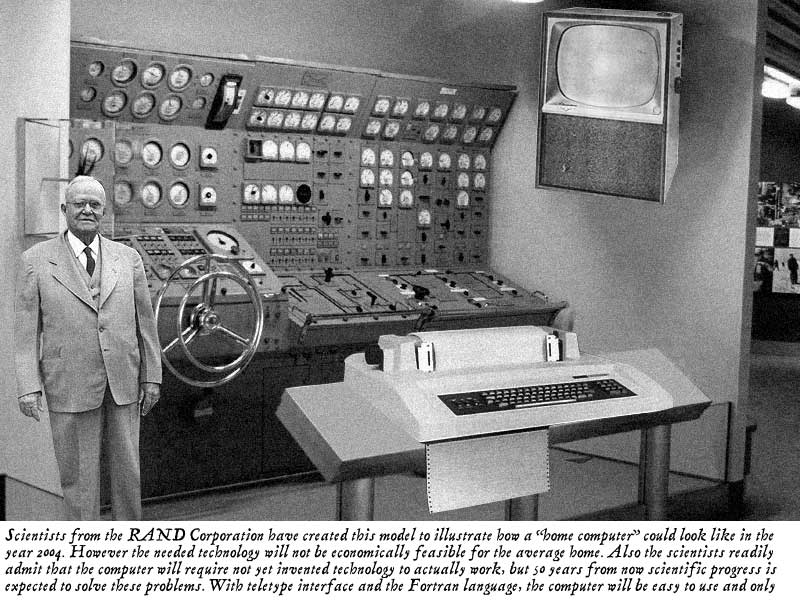
This was posted a few days ago on the TI-99/4A mailing list.
I thought a few people on here might get a laugh out of it! :)
Cheers,
Bryan
>
> I found this, supposedly from an IBM manual.
>
> "All parts should go together without forcing. You
> must remember that the parts you are reassembling were
> disassembled by you. Therefore, if you can't get them
> together again, there must be a reason. By all means,
> do not use hammer."
>
> -- IBM maintenance manual, 1975
>
> Now what was the line from the TI Disk Memory System
> controller manual? Something like "You can break off
> this tab. Then you can throw away the card."
>
> It was something like that in the original manual I
> had,
> in the section on installing the card in the PEB.
>
> Whatever happened to a bit of dry humor in computer
> hardware manuals? :)
>
>From: "Jules Richardson" <julesrichardsonuk at yahoo.co.uk>
>
>Barry Watzman wrote:
>> On recordable CDs, the data is on the label side and scratches can remove
>> the data. On DVDs, the data is inside the media, between two layers of
>> plastic. Scratches cannot permanently destroy the data proper as they can
>> with CDs. The risk is that DVDs can delaminate, which will destroy them.
>> Also, air getting in between the two plastic layers laminated together (with
>> the data between them) can destroy the data by oxidizing the dye layer.
>> This form of failure occurs from the outside in.
>
>I've certainly seem the same thing on data (rather than video) laserdiscs too,
>although on 20 year old discs the damage doesn't seem to extend in more than a
>centimetre or so.
>
>> I don't buy the "spiral track" argument that was made against optical media.
>> These are "random access" media, not sequential access.
>
>Don't the drives work by some sort of successive approximation when seeking?
>So in theory, sprial recording or not, an error could affect a fairly large
>chunk of the disc... I have a vague memory of reading something like that once
>somewhere.
>
Hi
For files, I believe it gets the location from the directory
and then calculates about how many tracks to skip. Once
there it looks for the headers ( just like soft sectored ).
I don't think it spends too much time doing this.
Even not knowing the track spacing, a couple of header reads
on a few tracks would determine the rate of change relative
to the disk diameter. It is relatively easy to calculate
the data block location from that ( linear equation ).
No need to do a truly random search unless one doesn't
know the byte/bit offset into the disk.
Dwight
>cheers
>
>Jules
>
I think I have several Z-100s, and one of them was given to me by
someone who was moving out of town. In checking it out, it had a Pickles
& Trout S-100 board in it (HPIB I think.) The docs didn't have any info
on this board, so I called Dana Trout to ask him what this thing was. He
was a bit puzzled for a bit because it didn't have a serial number on it
and all of their boards were serialized. As the pieces came together, it
turned out he gave this computer to the person who gave it to me with
the understanding he would never see it again :).
> > The Z-100/H-100? That wasn't much of a "clone", was it? So many
> > differences from the original!
> >
> > Cheers,
> > Chuck
>
> Yes, and so much cooler!!! Love my Z-100! CP/M-86 rocks!
>
> Glen
> 0/0
>
Those are the systems -- Larry's brother was the guy with the barn.
-- Tony
----------------------------------------
Return-Path: <cctalk-bounces at classiccmp.org> Wed Mar 15 09:50:43 2006
Received: from dewey.classiccmp.org [209.145.140.57] by mail34.safesecureweb.com with SMTP;
Wed, 15 Mar 2006 09:50:43 -0500
Received: from dewey.classiccmp.org (localhost [127.0.0.1])
by dewey.classiccmp.org (8.13.1/8.13.1) with ESMTP id k2FErBx0070946;
Wed, 15 Mar 2006 08:53:12 -0600 (CST)
(envelope-from cctalk-bounces at classiccmp.org)
Received: from keith.ezwind.net (keith.ezwind.net [209.145.140.15])
by dewey.classiccmp.org (8.13.1/8.13.1) with ESMTP id k2FEr7Nu070940
for <cctalk at classiccmp.org>; Wed, 15 Mar 2006 08:53:07 -0600 (CST)
(envelope-from jfoust at threedee.com)
Received: from pc.threedee.com (mail.threedee.com [66.84.209.228])
by keith.ezwind.net (8.13.1/8.13.1) with ESMTP id k2FF1IJ1016254
for <cctalk at classiccmp.org>; Wed, 15 Mar 2006 09:01:18 -0600 (CST)
(envelope-from jfoust at threedee.com)
Received: from gerber.threedee.com (gerber [192.168.5.21])
by pc.threedee.com (8.11.0/8.11.0) with ESMTP id k2FF2BW27432
for <cctalk at classiccmp.org>; Wed, 15 Mar 2006 09:02:11 -0600
Message-Id: <6.2.3.4.2.20060315083259.04ce80a8 at mail>
X-Mailer: QUALCOMM Windows Eudora Version 6.2.3.4
Date: Wed, 15 Mar 2006 08:48:46 -0600
To: <cctalk at classiccmp.org>
From: John Foust <jfoust at threedee.com>
In-Reply-To: <53eb31c8211149c98e76b7bac20c1023 at machm.org>
References: <53eb31c8211149c98e76b7bac20c1023 at machm.org>
Mime-Version: 1.0
Content-Type: text/plain; charset=us-ascii; x-avg-checked=avg-ok-6BB17CA6
X-Virus-Scanned: ClamAV version 0.86.2,
clamav-milter version 0.86 on keith.ezwind.net
X-Virus-Status: Clean
X-Spam-Status: No, score=0.0 required=4.0 tests=none autolearn=failed
version=3.0.2
X-Spam-Checker-Version: SpamAssassin 3.0.2 (2004-11-16) on keith.ezwind.net
Subject: SPAM-LOW: Re: New Big Iron Acquisition - IBM Tabulating Equipment
X-BeenThere: cctalk at classiccmp.org
X-Mailman-Version: 2.1.5
Precedence: list
Reply-To: "General Discussion: On-Topic and Off-Topic Posts"
<cctalk at classiccmp.org>
List-Id: "General Discussion: On-Topic and Off-Topic Posts"
<cctalk.classiccmp.org>
List-Unsubscribe: <http://www.classiccmp.org/mailman/listinfo/cctalk>,
<mailto:cctalk-request at classiccmp.org?subject=unsubscribe>
List-Archive: <http://www.classiccmp.org/pipermail/cctalk>
List-Post: <mailto:cctalk at classiccmp.org>
List-Help: <mailto:cctalk-request at classiccmp.org?subject=help>
List-Subscribe: <http://www.classiccmp.org/mailman/listinfo/cctalk>,
<mailto:cctalk-request at classiccmp.org?subject=subscribe>
Sender: cctalk-bounces at classiccmp.org
Errors-To: cctalk-bounces at classiccmp.org
X-SmarterMail-Spam: BAYESIAN FILTERING, SPF_None
X-Rcpt-To: <tony.eros at machm.org>
At 07:19 AM 3/15/2006, Anthony L.Eros wrote:
>Does anyone know of another organization that has restored one of these?
There was an April post by Evan regarding a rescue from a Larry Metzler of
Green Bay, Wisconsin, who had an IBM 513 reproducer and a 405
accounting machine. For a moment, I thought Sellam was helping
to acquire it to the CHM. Is this that system? Or a different one?
Sadly, it looks so corroded that it will never tabulate again...
When it comes to barns in this part of the country, just because
it's not getting rained on doesn't mean it's not going to rust.
- John
Re:
>
>Assuming that the FDC will work with two (I've never heard of an FDC that
>won't?)
>
Some late-model Asus motherboards support only a single floppy drive,
period, no way around it. An example is my Asus P4T533 ... one floppy
drive, neither hardware nor software support for a 2nd one.
Stupid. Incredibly stupid, but that's what they did.
As some of you may remember I've been playing with some old Nicolet
Digital Storage Scopes. I just bought a set of manuals and some of the
optional software for them from a guy on E-bay. In addition to the original
manuals and disks, the previous owner scanned the manuals and sent me
copies of everything in PDF and EXE files. I was impressed with the scopes
before I got the manuals but after reading the manuals I'M REALLY IMPRESSED
with them. I'm posting the copies of everything on my website at
<http://www.classiccmp.org/hp/Nicolet%20Digital%20Storage%20Scope%20Manuals%
20and%20Software/>. The files that I have are for the model 4094 DSOs but I
think most of them will also work with the other Nicolet models.
Just to keep this on topic the model 4094 DSO uses a 68000 CPU!
Joe
Does anyone have, or know where I could possibly get, a 4MB Multibus
memory card for a Sun-2/120 workstation?
I'm specifically looking for Sun p/n 501-1232, but would also consider
any third-party upgrades (like Helios Systems 2MB, 3MB or 4MB cards).
Per
Can you send me the (copy) schematics of the mpf-1 ?
I will be thankfull for it.
the adress is :
J. P. Theunis
Blokmaalder 27
1531 Pe Wormer
The netherlands
E-mail :
j.p.theunis at freeler.nl
Greetings.
Hans
> Also a nice compare of the instruction set formats of early machines
> can be found here.
should be:
http://www.quadibloc.com/comp/cpint.htm
much of this derived from the manuals on bitsavers.
I was hoping someone would do something like this.
I don't recall when it changed, but the first several versions of MS-DOS
did require io.sys and msdos.sys to be the first two files on the disk.
I would guess that changed at DOS 4.x or 5.x so that IIRC only io.sys
had to be the first file on the disk.
Being lazy, I would most likely go to machine running the version of DOS
you want to install, and make a system floppy and add any other files
you want/need. Then use "attrib -h -s -r" to make everything visable,
and just copy them (in the same order as on the boot floppy) to the
partition in question from whatever has access to that partition. I'm
assuming here that you have a way of getting files to some other OS on
that computer so they can be transferred to the DOS partition.
ISTR that copying them to a formatted floppy would not work as something
needed to be done to the boot sector, but I don't think that limitation
applied to HDs. To boot from the HD, that partition needed to be made
active using fdisk.
I've never dealt with systems that can boot multiple OSs or the boot
software that can handle that part, so I don't know the tricks of doing
that part.
IIRC, the maximum partition size is a function of the version of DOS you
are using (33 MB or so for 3.3 and earlier.)
> I want to put MSDOS on the FAT partition and triple-boot the machine - but the
> laptop has no floppy drive on it, so I can't just boot from a DOS floppy and
> run SYS that way.
>
> So is there a way of putting the necessary files on there from either Windows
> or Linux such that DOS will boot? Can't remember how MSDOS does it's boot
> process now, but I assume that certain files (io.sys for one) need to be in
> certain locations on the FAT partition or something?
>
> At one point I would have known how to do this, but the info's long since
> fallen out of my brain...
>
> (Currently I'm booting Debian / Win2k from Grub - it should handle booting
> MSDOS too though).
>
> Before I shoot myself in the foot, are there any other gotchas (like MSDOS
> needing to be the first partition on the drive or anything nuts like that)?
> The FAT partition is about 2GB into the disk - I seem to recall that a FAT
> partition can't be more than 2GB in size, but presumably providing the BIOS
> can see the whole disk DOS won't care about the offset to the start of the
> partition?
>
>
> (All I actually want to do is put Slackware Linux on the machine there in
> place of Debian, but the CDROM drive's too flakey to boot from. If I can get
> MSDOS on there by copying from a remote machine then I can boot the Slackware
> installer from MSDOS and then install the rest of Slackware across the network
> - talk about complicated!!)
>
>
> Ok, long email - will shut up now! :-)
>
> cheers
>
> Jules
>
>
>
>
Hey there;
So over the weekend I reread Cliff Stoll's The Cuckoo's Egg and after
reading various mentions of VAXes running VMS it occurred to me that while
I've worked with RSX-11M, RT11 and even various UNIXes on DECs, I've never
actually touched a VMS machine.
And while it would be reasonably acceptable to run OpenVMS on a SIMH
simulated VAX, it would also be quite nice to have a real VAX to do it on.
Anyone around Iowa (or even up in Minnesota) have a over-full garage or
basement and want to get rid of a VAX?
I'm fairly open to what model, I'm not snobby. Big or small, it should run
VMS fine.
I do actually own one VAX, a MicroVAX 2000 - charming little thing.
Unfortunately it is sitting in New Zealand, a little out of reach right
now.
Not expecting much - but I thought I'd ask, you never know... ;)
Thanks all;
JP
Another DOS question! :)
I've got a laptop that currently has Win2k and Debian Linux on it, along with
a small FAT partition (it's actually FAT32 currently, but I can change that
easily enough)
I want to put MSDOS on the FAT partition and triple-boot the machine - but the
laptop has no floppy drive on it, so I can't just boot from a DOS floppy and
run SYS that way.
So is there a way of putting the necessary files on there from either Windows
or Linux such that DOS will boot? Can't remember how MSDOS does it's boot
process now, but I assume that certain files (io.sys for one) need to be in
certain locations on the FAT partition or something?
At one point I would have known how to do this, but the info's long since
fallen out of my brain...
(Currently I'm booting Debian / Win2k from Grub - it should handle booting
MSDOS too though).
Before I shoot myself in the foot, are there any other gotchas (like MSDOS
needing to be the first partition on the drive or anything nuts like that)?
The FAT partition is about 2GB into the disk - I seem to recall that a FAT
partition can't be more than 2GB in size, but presumably providing the BIOS
can see the whole disk DOS won't care about the offset to the start of the
partition?
(All I actually want to do is put Slackware Linux on the machine there in
place of Debian, but the CDROM drive's too flakey to boot from. If I can get
MSDOS on there by copying from a remote machine then I can boot the Slackware
installer from MSDOS and then install the rest of Slackware across the network
- talk about complicated!!)
Ok, long email - will shut up now! :-)
cheers
Jules
What are the various options available for getting disk images onto media that
an Apple ][ can read?
Seems like there might be a few ways of doing this, involving both original
hardware, later Apple hardware, and modern PCs with a Disk ][ drive grafted on...
Experiences / references anyone?
cheers
Jules
"Chuck Guzis" wrote:
>On 3/13/2006 at 10:35 PM Jules Richardson wrote:
>
>>So is there a way of putting the necessary files on there from either
>>Windows or Linux such that DOS will boot?
aside from the files themselves, you can use the "mtools" from linux to
copy files to the partition.
I'm not sure how to get the MBR installed, but you could "dd" a block
>from another disk I guess.
To be honest, when I want to play with dos I use one of the nice X86
emulators like "bochs" and run with a virtual disk (i.e. a file). It's
much nicer than actually booting dos. You can set up the mtools
programs to allow you to copy files in/out of the disks.
bochs also lets you debug things like boot tracks and peripheral eproms,
which can come in handy. I once did a uboot port to an x86 chip and did
95% of the work using bochs.
bochs will boot almost anything, including linux. I have run linux inside
bochs - it's not bad on a fast machine.
qemu is also pretty snappy.
-brad
I think it was about 15-20 years ago there was, I believe, a self-study course
put out by some company for learning the hardware (and I think some aspects
of software, i.e., DOS) of computing at that time. The course came with an
8088 computer that, if I recall correctly, one built and "learned by doing."
I'm pretty sure it was not a Heathkit. I have searched everywhere and have
not come up with anything. Does this sound familiar to anyone? Any information
would be helpful. I'm trying to track one of these courses/computers down.
Thanks!
Gary
_______________________________________________________________________
Your Site for Swiss Maps: http://www.swissinfo-geo.org/
I kind of followed the discussion when this item was first mentioned
(item #8777485423), but what makes it *really* funny is 1) the same
handbook is listed on ABE for $20.00 with several other sources show the
pricing between $20.00 and $157.50, and 2) the sellers email in light of
these prices :).
I have a nice original NeXT machine, with an HP 660 97548sn HDD in
it. This disk has some data that I wanted to rescue at some point,
and between then and now, the disk had started acting up. The disk
motor will spin, but once the NeXT boot process begins (or SCSI sense
on a PC with a SCSI card), I hear a click, and the motor spins back
down. My guess is that a head is stuck? If so... a) is there a way to
resuscitate the disk, and b) is there someone that repairs older
drives like this, and c) if not, can I do it myself.
FWIW. The data on the disk is, I believe, one of a kind, rare, data,
and the machine is overall in excellent condition.
Does anybody haev (or know of a source) of a data sheet or pinout diagram
for the Epson E3890S chip (60 pin PQFP)?
I am pretty sure it's an LCD driver, it's used in the Panasonic RL H1400
handheld computer which I am currently trying to sort out.
[As usual, please send only text to this address. If you have a image or
pdf giving the information, I can give you another address to send it to.
Thanks!]
A couple of gotchas on the RL H1400. Firstly, the display window is also
the front polarising filter for the display. You'll see nothing on the
display with it out of the case.
Secondly, the ASIC on the CPU board is also involved in driving the LCD.
The 8 LCD backplane lines are connected to wires in the interconnecting
cable between the CPU board and the keyboard/display PCB.
-tony
Don't know if this one comes up too often, but I recently acquired an HP
4145 semiconductor analyzer software diskette. It's SSSD 5.25". If
anyone's interested, I can shoot out an image.
Cheers,
Chuck
Yeah, I'm not a huge fan of the age (or gender) limits but it is their show.
I'd encourage anyone, of any age or gender, to contact them if interested.
I've talked to them and they are reasonable folks.
They have a target demographic in mind, obviously, but I suspect they could
be swayed by a particularly interesting collector.
They are firm on the "active collector" aspect, though. They want folks who
are in the field looking. . .
-----
Erik Klein
www.vintage-computer.comwww.vintage-computer.com/vcforum
The Vintage Computer Forum
--------- Original Message --------
From: "General Discussion: On-Topic and Off-Topic Posts"
<cctalk at classiccmp.org>
To: "General Discussion: On-Topic and Off-Topic Posts"
<cctalk at classiccmp.org>
Subject: Re: Do you want to be on TV?
Date: 10/03/06 02:24
> SO ONLY MALES 18-45.
What a crock! Joe Rigdon's about my age (over 45) and
would be a perfect candidate for this except for the
arbitrary age limitation.
Whaddya say, Joe? Ya never know, might be a buck in it.
Glen
0/0
Erik Klein wrote:
>
> I just got the following in my mailbox:
>
>
> -----
> I am with a documentary television company that is looking for amateurs
who
> are able to distinguish junk from treasure, and that includes
architectural
> and computer salvaging, dumpster divers, etc. for a pilot series for the
> History Channel. The show is sort of Antique Roadshow with a little bit
more
> testosterone SO ONLY MALES 18-45.
>
> We are definitely looking for people who can share their know-how in
> locating discarded items "that have lost their shine and sparkle, but not
> their value – or their history."
> In particular, we are looking for people who do this as a hobby and have a
> great passion for it.
>
> Our show is about the search for such items, the history of the item and
the
> appraisal of the item's value.
> We would be doing an hour-long show featuring three collectors and would
> follow each collector on their journey for their hidden “treasure."
>
> If you would be interested in speaking with me regarding this show, could
> you please contact me at the number or e-mail listed below.
> Thank you!
>
________________________________________________
Message sent using UebiMiau 2.7.9
In case anyone missed it -- the History Channel tonight aired "How William
Shattner Changed the World" which includes a 15-minute segment featuring
Bruce Damer / DigiBarn. He's on 45 minutes into the first hour of the
two-hour show. It's on again tonight at midnight EST. More details from
Bruce's announcement:
Dear DigiBarn News subscribers,
Here is your brief Winter 2006 newsletter (#16). 2005 was a wonderful year,
finishing off with our Homebrew Computer Club 30th birthday
event at the Vintage Computer Festival in November. We now have some cool
audio, video and pictures of the event below (including Woz
telling some great stories, and Altair expert Erik Klein playing "fool on
the hill" on an original 8800). Read all about this wonderful and inspiring
event at: http://www.digibarn.com/history/05-VCF8-HomeBrew30/index.html (for
movies, audio, pics, Altair, Woz and more!)
##############
Breaking News:
HOW WILLIAM SHATNER CHANGED THE WORLD (the DigiBarn is featured on this
show!)
Sunday March 12th (5 and 8pm) and again all week including Friday March 17th
(8/7 central US time) and Saturday. Check Local Listings
for your region/country or the schedule at: http://www.historychannel.com/
Starting tomorrow the DigiBarn and curator (yours truly) Bruce Damer will
appear on the History Channel on a cool segment (in the first
hour) of a show called "How William Shatner Changed the World". This is a 2
hour special on how Star Trek (well, Gene Roddenberry and his
writers) came up with many gadgets and ways of working back in the 1960s
which have become reality today. This show is Captain Kirk at
his best, with Bill Shatner in an off-the-wall performance you won't forget.
Details of the show including the DigiBarn excerpt are at:
http://www.digibarn.com/collections/movies/05-11-DiscoveryCA-Shatner/index.h
tml
(originally produced by Discovery Channel Canada, video excerpted with
credit). See the History Channel pages on this show at:
http://www.historychannel.com/ and direct to the show:
http://www.historychannel.com/space/verizon/
Instead of hashing it out here, call the guy. I ordered from the web site,
got an immediate response that they were waiting for stock and that they'd
contact me.
3 days later He contacted me that they were in stock and shipping.
They were MK4s
> -----Original Message-----
> From: Richard [mailto:legalize at xmission.com]
> Sent: Saturday, March 11, 2006 7:23 PM
> To: General Discussion: On-Topic and Off-Topic Posts
> Subject: Re: CatWeasel card
>
>
>
> In article <200603101819450723.4315859A at 10.0.0.252>,
> "Chuck Guzis" <cclist at sydex.com> writes:
>
> > On 3/10/2006 at 6:30 PM Richard wrote:
> >
> > >Hmm... the card offered on softhut says it is an ISA card.
> So is the Mk
> > IV Catweasel ISA or PCI?!?
> >
> > It's PCI--the original Catweasel was ISA.
>
> Softhut says their PCI card is Mk 3, not Mk 4.
> --
> "The Direct3D Graphics Pipeline"-- code samples, sample chapter, FAQ:
> <http://www.xmission.com/~legalize/book/>
> Pilgrimage: Utah's annual demoparty
> <http://pilgrimage.scene.org>
>
Thanks to all who responded, I've got the information I need to continue.
Gary
"I think it was about 15-20 years ago there was, I believe, a self-study
course put out by some company for learning the hardware (and I think some
aspects of software, i.e., DOS) of computing at that time. The course came
with an 8088 computer that, if I recall correctly, one built and "learned
by doing." I'm pretty sure it was not a Heathkit. I have searched everywhere
and have not come up with anything. Does this sound familiar to anyone? Any
information would be helpful. I'm trying to track one of these courses/computers
down. Thanks!"
_______________________________________________________________________
Your Site for Swiss Maps: http://www.swissinfo-geo.org/
Hello,
I don't remember if I received an answer or not. I kind of dropped the
subject due to a lack of time to spend on the old computers.
Thanks,
Jeff
hmmmm..
bidpay.com went 'unvailable' late last week, then the domain
wasn't resolving, now someone with no references to Western
Union appears.
Anyone heard of a buyout?
--
not that I would use them anyway...
they started out OK, then got to be a total PITA to use.
I believe there's a fellow on the web who sells a 34-to-50 pin
adapter with
a PIC installed to count seek pulses and handle RWC after track 40.
--
John Wilson
http://www.dbit.com/fdadap.html
I have the following early mid 1980s Multibus 1 cards that are closing
Sunday on ebay. The sale number is following the item.
Sun 2 Multibus 68010 CPU Card, 1983 8776175837
Sun Multibus 1/4" Tape Controller Card, 1982 8776357220
Systech Multibus Mag Tape Controller, 850/1650BPI 8776370593
Xylogics 450 Multibus One SMD Drive controller 8776228165
Or search for seller innfosale
They are Sun 2 cards from a Parallel Computer in the 1980s. The tape
controllers are from the same system. There has been some interest in
Sun 2 lately and I finally found these.
Paxton
Astoria, Oregon
Innfosale
--
Paxton Hoag
Astoria, OR
USA
Hi everyone. I don't usually do this, but here is the current issue of
Computer Collector, in its entirety -- read carefully to learn about the
DigiComp 1 v.2.0 kit and, perhaps more interesting to some of you, Vince
Briel's new "AltairPC" kit.
==============================================
>> WELCOME TO THE COMPUTER COLLECTOR NEWSLETTER
>> W: http://news.computercollector.com E: news at computercollector.com
>> March 11, 2006: News/opinion, tidbits, classifieds
This week's issue:
1. Build a DigiComp; 2. Another new Altair replica; 3. Plasma Pong; 4.
Apple's 30th anniversary; 5. Rockwell thermal printers wanted
Is this issue late from last Monday, or early for next Monday? You decide.
We just know the news has been flowing in like it's high tide lately. Help
us keep up the pace: what interests you in the hobby, what should we write
about, what's your funniest collecting story? Share your scoop at
news at computercollector.com -- we're interested!
Please tell your friends about our newsletter!
**************************************
NEWS & OPINION
Ever feel like putting aside the complicated digital dinosaurs and getting
back to binary basics? If so, the DigiComp kit from Minds-On Toys
(http://www.mindsontoys.com) might be just what you need, but don't be
surprised if your child is equally fascinated.
The original Digi-Comp 1 was a mechanical, plastic computer made by
Montclair, N.J.-based ESR Inc. starting in the mid-1960s. It sold for just
$6 and now they're on eBay for hundreds. A discussion group formed in 1999
(http://groups.yahoo.com/group/friendsofdigicomp/) but things turned more
exciting when Minds-On Toys last year began selling its replica kit called
the Digi-Comp 1 v.2.0 for just $55.
Originally the idea for a modern replica was discussed at various times in
the Yahoo group, but the commercial version was the brainchild of Minds-On
(a play on "hands-on") which is owned by Tim Walker. Walker has an
impressive history in computers and education: he studied social psychology
at Harvard, worked as a high school teacher, earned a masters degree in
interactive telecommunications at New York University, studied under Seymour
Papert at the MIT Media Lab (http://web.media.mit.edu/~papert/), and worked
on Hypercard for a contractor to Apple Computer.
Walker decided to build the replica as part of his ongoing research into the
history of educational toys. His first round of 100 kits quickly sold out,
so now it's in the second run. An interesting experience happened while
building early prototypes out of heavy paper and similar materials -- he
realized how much better it would function out of precision-cut metal --
akin to the experiences of Charles Babbage, whose ideas exceeded his
technical resources. Luckily, Walker has access to modern production
companies, although a large amount of reverse-engineering was required
because he didn't own an original Digi-Comp while designing the replica.
So what can the replica kit actually do? First, it can count from 0 to 101
(seven); if you have patience it can solve math problems and even play
games. There isn't any memory, so you have to assist the machine by keeping
track of values. But that's the point! Digi-Comp is for learning, not
computing. You can literally view every step as it happens, and the 48-page
instruction manual is simple enough for a 10- year-old, yet elegant enough
for a trained programmer. After reading a few pages, it's clear why the
original Digi-Comp was successful.
- Evan Koblentz, editor
---------------------------------------
Speaking of replicas, our inbox tonight contained an exciting message from
Vince Briel, known for his Replica 1 kit version of the Apple 1 computer.
Vince is making an earlier-than-expected announcement of his new replica,
which is a semi-real Altair faceplate for an ordinary PC (not unlike Rich
Cini's Altair32 project which we mentioned two weeks ago.) To read the
details , visit http://www.brielcomputers.com or see it for yourself at the
Vintage Computer Festival East 3.0 this spring (see the VCF details in our
Tidbits section, below.)
***************************************
BOOKS FROM THE CCN STAFF:
>> Buy your copy of "Collectible Microcomputers" directly from author
Michael Nadeau: http://www.classictechpub.com. This amazing book includes
more than 700 computers with details and pricing.
>> Christine Finn's "Artifacts: An archeologist's year in Silicon Valley" is
the story of the change from farmlands to high-tech. Buy it directly from
MIT Press at http://tinyurl.com/6rllz (also see Christine's blog
http://traumwerk.stanford.edu:3455/ChristineFinn/9).
****************************************
This week's vintage gaming news from Armchair Arcade, please visit
http://www.armchairarcade.com/aamain/news.php for details:
-- This. Is. Freaking. Awesome! -- Plasma Pong. I just played it and, trust
me, you'll love it: http://216.120.241.243/~plasmap/
-- Coming soon: version 4 of Apple II Compact Flash:
http://www.armchairarcade.com/aamain/news.php?extend.502 ... Also, the
AppleWin software is now licensed under the GPL (same link)
****************************************
TIDBITS
-- The latest update on VCF East 3.0: there are now two live auctions, four
keynote speeches, 14 exhibitors, and just two months to go! We're getting
excited and you should be, too. Visit http://www.vintage.org for all the
details and frequent updates.
-- Over at CNET News.com, they're planning a special report for the 30th
anniversary of Apple (http://tinyurl.com/o2pwl). April 1, 1976 was Day One,
with the founders listed as Woz, Jobs, and Ronald Wayne -- who sold his
stake two weeks later for $800. Anyway, CNET wants to know what you love(d)
about Apple, so we'll do the opposite: tell us your favorite Apple horror
stories. What were the company's biggest blunders, from executive strategies
to customer support? Tell us what you HATE about the Cupertinians. Yes, we
are serious. It'll be fun.
****************************************
CLASSIFIEDS
This week's classifieds are sponsored by the Vintage Computer Forum at
http://www.vintage-computer.com/vcforum/.
For sale:
1. Free! IBM PC-2 for cost of shipping:
http://www.vintage-computer.com/vcforum/showthread.php?t=2667
2. Sharp PC5541 portable 286 computer:
http://www.vintage-computer.com/vcforum/showthread.php?t=2666
3. Assembled Briel Replica 1 (New Jersey):
http://www.vintage-computer.com/vcforum/showthread.php?t=2660
4. Commodore magazines and manuals:
http://www.vintage-computer.com/commodore64.shtml
5. Full collection of Electronics Australia magazine:
http://www.vintage-computer.com/magazines.shtml
6. Free! TRS-80 Model I with expansion interface for cost of shipping:
http://www.vintage-computer.com/trs80mod1nk.shtml
Items Wanted:
1. Early PC World magazines:
http://www.vintage-computer.com/vcforum/showthread.php?t=2691
2. Monochrome monitor with RCA jack:
http://www.vintage-computer.com/vcforum/showthread.php?t=2654
3. Thermal printers for Rockwell AIM-65:
http://www.vintage-computer.com/aim65.shtml
****************************************
SPONSORED LINKS:
>> For more buy/sell/trade opportunities, please visit the Vintage
Computer Marketplace at http://www.vintagecomputermarketplace.com.
>> VintageTech provides services such as patent litigation support,
prior art research, vintage computer consulting, movie and photography
props, media and data conversion, appraisals, and sales brokering.
Visit us: www.vintagetech.com.
>> Special thanks to EvenLink LLC for sponsoring our domain name and
e-mail hosting. Please visit http://www.evenlink.com for details.
****************************************
HAPPY VINTAGE COMPUTING!
Anyone on list have a Fluke 87 IV True RMS multimeter? I got one at auction
and just downloaded the manual (96 pages) from a online website. If you have
one, what do you feel about it's usefulness? thanks
> I've not found the number yet, but are you interested in getting
> rid of them? I've got a bunch of HP hardware and could likely use
> them. Some other HP cables:
>
> http://rikers.org/gallery/hardware/20050417_214520
>
> The centronics connectors are 50 pin card edge on the other end? or
> higher pin count?
Same pin count, but it's centronics-to-mrac or winchester-to-mrac.
Here's a pair of images showing the two types:
http://yagi.h-net.msu.edu/img_1848.gifhttp://yagi.h-net.msu.edu/img_1849.gif
The camera did funny things to the colors; the jacket of the cables
have a silvery color, and the connector shells are metal. They're
cleaner than they look.
They're probably available.
De
Re:
**********
> If its the physical letters on the paper, if they are lumpy or if they
> are smearing if touched then your High Voltage power supply board is
> starting to fail.
Intuitively, if the toner smears when touched, I'd assume it wasn't being
fused properly, and would investigate the fuser and its control system
first.
**********
That is correct. If the toner smears when touched, the problem is in the
fuser, and it has nothing to do with the HV power supply, drum or anything
else. In early laser printer (up to at least the Canon EX engine in the
Laserjet 4 and, I think, 5), fusing was done with heated rollers. The upper
fusing roller was an aluminum roller with a silicone (non-stick) coating,
and inside the hollow roller was a high-power tubular halogen lamp (500 to
900 watts). The lamp was line-operated, thus different for 110v and 220v
printers, and the cause of failure was almost always that the lamp had
simply burned out (although lamp control problems are possible, but not
common -- the lamp does not burn continuously, it's cycled based on the
roller temperature). The lamp can be replaced ($30-ish, typically) by a
technician who knows what they are doing, but it's more common to replace
the entire fuser assembly ($100+ in most cases).
Later models (those that have near-zero warm-up) use "thin film fusing",
which is more sophisticated, much more power efficient, and also more
complex and difficult to repair unless you go for the swap of the entire
fusing sub-assembly.
No problem if you can find a copy of PCAnywhere/Carbon Copy/Freeware equivalent;
Serial or parallel port connection would be trivial, NetBIOS no problem either; don't
know about TCP/IP.
mike
-------Original Message
Date: Fri, 10 Mar 2006 17:10:06 +0000
From: Jules Richardson <julesrichardsonuk at yahoo.co.uk>
Subject: Re: C Compilers for (MS)DOS
Ta, will take a look!
Ultimately I'd like something that sat on the network and could be controlled
remotely (and be able to say FTP or HTTP or NFS or SMB transfer data to a
remote box holding disk images) - but that's a colossal amount of work to get
going under DOS! Serial port control is a little easier though, and at least
means the machine with the drives in doesn't need its own keyboard / display.
Or I could just get a KVM, but that's no fun :-)
Hi Tony Duell.
Could you remember this thread below ?
I have the same system and need some help to reassemble an HP tape drive.
After disassembling and ultrasonic cleaning of a HP-Tape-Drive for this
HP9915B two parts remaining unassembled.
Two parts, small thin chromium-plated metal stripes, are droped down out of
the device during dismantling.
I could not find out where these have to be mounted again.
Here you could see few pictures of these parts.
http://www.nadhh.hanse.de/CMuseum/HP/HPTapeHilfe.htm
I would be really happily if someone could help me to get out where these
parts has
to be placed back into that tape-drive. Could you help me ?
With regrads
j?rgen
>
> Hi,
>
> I have a faulty HP 9915B (the industrial version of the HP 85B). I don't
I guess I should respond :-). I don't know anything about the 9915B, but
I have a reverse-engineered schematic of the 9915A, and from what yuo say
below the PSUs are very similar.
(Incidentally, the 9915A schematic is on the HPCC scheamtics CD-ROM,
should you want it)
> have the right circuit diagram for it, only the ones for the HP 85A and
85B
> from their service manual. Looking at the 9915B it seems to have a similar
> circuit, but some of the differences I can't understand.
>
> So far I have checked the following:
>
> rectifier output = 32V DC (OK)
> but none of the regulated voltages are working (eg the +12V line is at
> +1.4V, similarly +5V, -12V are around 1V).
Ouch!
I am going to assume it _is_ the same PSU as the 9915A. From what you say
there, it's clear that the crowbar (Q4) hasn't fired, since this shorts
the 32V (Vin, on my diagram) line to ground.
>
> The power supply is based on DC-DC converters running at around 30kHz. I
> found the PWM regulator (U30, equivalent to U1 in te 85B), and this is
> generating pulses on pin 3 and has a 5V reference on pin 16. This part is
> labelled SG9496, the 85 uses a SG3524 (datasheet on the web), the pin-out
> seems to be the same.
My diagram shows U30 as an SG3524, but that may be because it had a
custom HP number on it, and I found it was pinout- and functionally-
identical to the 3524...
>
> Signals on the other pins are:.
> .
> pin1 - OV DC (would be around 3V if ok)
Should be a potted-down version of the 12V line, If that's missing, then
pin 1 will be olow.
> pin2 - 3V (ok, derived from %V)
Potted sown from the Vref ouput (pin 16
> pin 9 = 0.5V (see below)
This is called 'comp' on the 3524 datasheet. It's the output of the error
amplifier and what's worth knowing at this point is that it can be pulled
low exernally to shut the outputs down.
> pin 7 = 0.2V to 4.5V ramp as per 85 service manual
OK, so the oscillator is running (that's the timing capacitor pin). And
the reference output is also present. U30 may well be good.
> pins 12 & 13 = 32V DC
Outputs to the chopper (collectors of the output transistors, the
emitters (pins 11 and 14) are grounded). It's clear the chopper is not
being driven.
>
> I traced pin 9, and this is connected to C20 which in turn is connected
R23
That's the first compoent reference difference (or I've made a mistake). On
my diagram, C20 is the dcoupling cap on the V+ (pin 15) supply input to U30.
There is a compenstation network, 0.1uF in series with 8.25k between pin
0 and pin 1, though.
> then pin 1 (similar to 85). pin 9 is also connected to diode CR4 which
goes
> into transistor Q2 (which in turn is connected to 0V). It looks like pin 9
> is being pulled down by CR4 and Q2 as these are both forward biassed. One
> question is what does CR4 and Q2 do? Are they part of some protection
> circuit?
Ah....
Q2 is the overcurrent protection transsitor. It's turned on by U31 (LM311
comparator), which is driven from T1 (9100-0456 transformer) which
measures the current through the chopper. If that current is too high,
then U31 triggers, turns on Q2, and shuts the supply down.
Whatever you do, don't disable this circuit. If there is a short, the
results will be spectacular and expensive.
>
> The output on pins 12 &13 has no negative going pulses, so the psu never
> gets started up. pim 12 connects to an 820 ohm resistor (number hidden)
> which then goes to transistor Q5 (the main switching transistor, Q1 on the
> 85). This is different to the 85 which uses an intermediate driving
Watch out!. Q5 is not a simple transsitor (at least not in the 9915A).
It's a PIC645, which seems to be some kind of darlington with the flyback
diode, etc, in the package. It's roughly a PNP transistor, emitter to Vin
via T1 primary (current sense), collector to pin 3 of T2 (12V supply
transformer primary tap), base to the output of U30 via that 820R resistor.
> tranhsistor. I guess this means the U30 PWM has to drive more current.
No, Q5 is more than one transsitor.
OK, what I'd do next is look at U31 (assumeing it's a 311 comaparator).
The -ve input should be at about 2V (potted down from Vref again), the
_ve input should be 0 (it comes from the sense transformer, but with no
AC current flowing through the chopper, it can't be doing much). Then see
if Q2 really is turned on, or shorted, or what.
>
> Any advice gladly received, eg source or equivalent for a SG9496
controller,
> copy o9f service manual would be great too!
Hope that helps
-tony
If something "blew", there must be a major 'problem' somewhere
else! Did you find out why the board "blew"?
Tip on power supplies (in the 11/34): check the rectifier bridge.
Often (for what's "often" worth) a diode inside is open circuit,
thus the full-wave sine is used just for one half.
I agree with Tony. You must do several simple voltage measurements
at the power supply, distribution panel, connectors, sockets, etc.
Basically everything a connection "meets" from the PSU to the
backplane. Don't forget the wire itself!
- Henk.
> What do you mean 'the board blew'? Did the magic smoke come
> out (if so, out of what?). Was there a hole burnt through the
> board, melted traces?
>
> FWIW, unless the board was actually burnt, I think it would
> be repairable. I once did something very silly to a H754
> brick with the result that 4 transsitors blew apart, one
> ressitor totally burnt up, etc.
> And that brick is working again now.
>
> And the +15V board is actually very simple. It's a linear regulator...
>
> > deal with and it came back to life - sans the H745 coming up.
> >
>
> I will ask you once more. Have you done any actual electrical
> tests on this PSU?
>
> -tony
This message and attachment(s) are intended solely for the use of the addressee and may contain information that is privileged, confidential or otherwise exempt from disclosure under applicable law.
If you are not the intended recipient or agent thereof responsible for delivering this message to the intended recipient, you are hereby notified that any dissemination, distribution, or copying of this communication is strictly prohibited.
If you have received this communication in error, please notify the sender immediately by telephone and with a "reply" message.
Thank you for your cooperation.
Can't remember if there's a way of doing this or not!
I've acquired a nice compact HP PC which I had plans to use as a data recovery
box - except that I've just discovered that the braindead BIOS only supports
one floppy disk drive; I need a 3.5" HD drive as the first disk and a 5.25" HD
drive as the second...
Assuming that the FDC will work with two (I've never heard of an FDC that
won't?), is there a way of telling MSDOS about the second drive even when the
BIOS refuses to acknowledge its presence?
If not, the whole machine's off to the tip... stoopid PCs, grrr! (actually,
I'll freecycle it, which is where I got it from, but the thought of it being
crushed makes me feel better right now)
cheers
Jules
What's the state of play regarding DOS C compilers? I might have a need to do
some DOS-based C development work - are there any good-but-free DOS compilers
about?
I did have Turbo C on tape, but I haven't tried to read those tapes in years
and wouldn't hold out much hope of them still being intact...
ta
Jules
See below.
Contact: Laura.Childers at sandersbros.com
I think it's in Georgia (the US state, not the country).
--
Sellam Ismail Vintage Computer Festival
------------------------------------------------------------------------------
International Man of Intrigue and Danger http://www.vintage.org
[ Old computing resources for business || Buy/Sell/Trade Vintage Computers ]
[ and academia at www.VintageTech.com || at http://marketplace.vintage.org ]
---------- Forwarded message ----------
Date: Fri, 10 Mar 2006 11:26:12 -0500
From: "Childers, Laura" <Laura.Childers at sandersbros.com>
To: donate at vintage.org
Subject: IBM system 34
Morning,
Would you be interested in an IBM system 34 and printer?
Thanks for your time - Laura
Laura A Childers
Sanders Bros., Inc.
Phone 864-487-6118
Fax 864-487-6170
Laura.Childers at sandersbros.com
Got an IBM 4019 here, and it has a postscript board in it, I'm told. I
can't seem to find any info on that option.
The problem is, every time you power the thing up it kicks out a page with
stats and settings and whatnot on it -- which over time is a hell of a waste
of paper, particularly if you're not printing much.
Anybody know of a way to make it stop doing that?
--
Member of the toughest, meanest, deadliest, most unrelenting -- and
ablest -- form of life in this section of space, a critter that can
be killed but can't be tamed. --Robert A. Heinlein, "The Puppet Masters"
-
Information is more dangerous than cannon to a society ruled by lies. --James
M Dakin
Talk to them.
That's the best I can offer. I felt comfortable with their premise when I
did.
I'd encourage anyone interested to do their own homework. This sounds like
it could be a lot of fun and it could provide a nice boost to the hobby.
Honestly, I can't imagine they are trying to railroad folks into a
humiliation-fest. That doesn't seem like a sustainable business model, does
it? ;)
I'll agree that some folks here might come off as lunatics (regardless of
the medium) but I think these folks are after knowledgeable treasure
hunters, not pocket-protector geeks. The blurb that I posted hardly conveys
their entire plan. . .
-----
Erik Klein
www.vintage-computer.comwww.vintage-computer.com/vcforum
The Vintage Computer Forum
--------- Original Message --------
From: "General Discussion: On-Topic and Off-Topic Posts"
<cctalk at classiccmp.org>
To: "General Discussion: On-Topic and Off-Topic Posts"
<cctalk at classiccmp.org>
Subject: Re: Do you want to be on TV?
Date: 10/03/06 03:13
Erik Klein wrote:
> Yeah, I'm not a huge fan of the age (or gender) limits but it is their
show.
>
> I'd encourage anyone, of any age or gender, to contact them if interested.
> I've talked to them and they are reasonable folks.
Although they don't really say how any such people signing up would be
portrayed in the show - there's probably a fine line between making people
look like knowledgeable folks and complete lunatics...
________________________________________________
Message sent using UebiMiau 2.7.9
Although I'm outside the age range, depending on memory rather than a
collection for information, I'd advise anyone who got into this to make
sure that they can be part of the editing process. Researching and opining
about something is one matter if you're sitting in front of a computer and
fact-checking; it's quite another kettle of fish if you're asked to think
on your feet real-time.
When I think back over the late 70's and 80's and all of the harebrained
underfunded (and some overfunded) projects I had pitched at me by a bunch
of guys with a "good idea", I'd be afraid of running into one of these "we
made and delivered a couple hundred of these and then we closed down"
relics. Few have any idea of how many IBM BC "near clones" there were.
I think they may have outnumbered the Z80/8085-type 8 bitters.
Cheers,
Chuck
It was the version 4 card. I enquired directly with Jens and that is who was
suggested I purchase from in the US (softhut.com).
And man, is that a nice card. I have a Version 1 card too, but I use them
both.
> ----------
> From: Richard
> Reply To: General Discussion: On-Topic and Off-Topic Posts
> Sent: Friday, March 10, 2006 1:03 AM
> To: General Discussion: On-Topic and Off-Topic Posts
> Subject: Re: CatWeasel card (was: I guess I should have asked this
> before asking for a 5.25" floppy drive)
>
>
> In article <3572C311B2DB4C418DAB189F1F190799A33849 at mail.catcorner.org>,
> Kelly Leavitt <CCTalk at catcorner.org> writes:
>
> > Where did you hear that they were not being made? I was able to purchase
> a
> > brand new one from softhut.com in January. It was shipped over in a new
> > batch then.
>
> Hrm. Never saw softhut.com before. It just says "Catweasel", but
> there are several different versions of the card. Which version did
> they sell you? The page I was looking at is the page supposedly by
> the people who actually design and manufacture the catweasel. When I
> enquired in August of 2004 they were unavailable worldwide. Is
> softhut offering the "new batch" that I was told would be ready in
> "Spring 2005" but which never materialized at that time?
> --
> "The Direct3D Graphics Pipeline"-- code samples, sample chapter, FAQ:
> <http://www.xmission.com/~legalize/book/>
> Pilgrimage: Utah's annual demoparty
> <http://pilgrimage.scene.org>
>
All:
When using sysgen to create a new bootable CP/M disk, does
sysgen copy the cold start loader, too? I'm trying to do a single-drive
sysgen with CP/M 1.4 and it reports that it has copied the system tracks but
the disk won't cold boot.
Also, I am looking for a disk formatting program for the iCom
Frugal Floppy system.none of the disks I have contain a formatting program
of any type. I've also tried the two programs in the SIGM archive and they
both report "drive fail" which isn't right since the drive works.
TIA!
Rich
Rich Cini
Collector of classic computers
Build Master for the Altair32 Emulation Project
Web site: <http://highgate.comm.sfu.ca/~rcini/classiccmp/>
http://highgate.comm.sfu.ca/~rcini/classiccmp/
/************************************************************/
HP shows the 1311B (14") display with the 1351A in their 1982 catalog.
The combinations is sold as the 1351S.
Other displays mentioned for use with it are the 1310B (19"), 1317A
(17"), and 1321B (21"). All are offered as
options with the 1351S system.
Bob
>
>
>
>------------------------------
>
>Message: 6
>Date: Thu, 09 Mar 2006 11:52:11 -0700
>From: Richard <legalize at xmission.com>
>Subject: Display model # for HP 1351A?
>To: cctalk at classiccmp.org
>Message-ID: <E1FHQF9-0004Rl-00 at xmission.xmission.com>
>
>What is the model number of the HP XY display that goes with the 1351A
>graphics generator?
>
>
I use ADT for Windows...one source is here: http://adt.berlios.de/
-----Original Message-----
From: cctalk-bounces at classiccmp.org [mailto:cctalk-bounces at classiccmp.org]
On Behalf Of Jules Richardson
Sent: Friday, March 10, 2006 7:43 AM
To: On-Topic and Off-Topic Posts
Subject: Writing Apple ][ disk images...
What are the various options available for getting disk images onto media
that
an Apple ][ can read?
Seems like there might be a few ways of doing this, involving both original
hardware, later Apple hardware, and modern PCs with a Disk ][ drive grafted
on...
Experiences / references anyone?
cheers
Jules
On Fri, 10 Mar 2006 01:37:05 +0100, "Juergen Sievers"
<jsievers at nadhh.Get-on-IT.com> wrote:
> Hi Tony Duell.
>
> Could you remember this thread below ?
> I have the same system and need some help to reassemble an HP tape
> drive.
> After disassembling and ultrasonic cleaning of a HP-Tape-Drive for
> this
> HP9915B two parts remaining unassembled.
>
> Two parts, small thin chromium-plated metal stripes, are droped
> down out of
> the device during dismantling.
> I could not find out where these have to be mounted again.
>
> Here you could see few pictures of these parts.
> http://www.nadhh.hanse.de/CMuseum/HP/HPTapeHilfe.htm
>
> I would be really happily if someone could help me to get out where
> these
> parts has
> to be placed back into that tape-drive. Could you help me ?
>
> With regrads
> j?rgen
>
[...]
J?rgen -
Having dropped a good number of the little pieces while repairing old
HP test equipment, I think you will find that they came from several
of the keyboard key switches. They return the key after a press. Hope
this helps...
CRC
to ericmac at swissinfo.org:
what are you trying to accomplish? I currently, and am
no gewroo by any stretch, am entertaining the notion
of connecting an IBM PC compatible video card to my
IBM PC incompatible Tandy 2000 (in which ways is it
incompatible...EVERY way). I'm studying here and
there. Reading and learning a little bit. I have loads
of books on the subjects. Tell me what it is you're
trying to do...and it helps to be specific (i.e.
focused). Then you know the right questions to aks. Of
course you have to learn some basics to even know what
it is you want to know...
I do have schematics that I can send you also.
__________________________________________________
Do You Yahoo!?
Tired of spam? Yahoo! Mail has the best spam protection around
http://mail.yahoo.com
> I haven't done as much with damaged data CDs as with "odd" format
>CDs, but I've found that Linux and NetBSD have *far* fewer issues with
>burned media vs reader issues than Windows or MacOS. I regularly use
>disks burned in Linux (on *cheap* media) in RRD42s on VAX, old 68K Macs
>with 300i drives, etc.
> I think a lot of the "CD reader" issues are really "CD writing
>software" issues. A lot of CD-copy software will insist that all the
>world's ISO9660 unlss you beat it up first. Even dd won't produce a
>bootable image in some formats unless you tweak the blocksize. (AIX
>v.<any> and IRIX v6.5 come to mind) Do some research on the format
>you're copying and the software you're using, life gets much smoother.
My first choice is XCDRoast- mindless burning/reading for pretty much anything, runs on almost all graphics-capable platforms. Sadly it only recognizes images with the extension .iso, but you can just rename .efsimg or .ods2img to .iso and vise-versa when you need to (don't know if this counts as "beating it up"). Seems to be pretty good about slowing down and rereading, too (imaged a scrached Libc5 linux distro that had been in the garage uncased for ~6 years, took a while but it worked. The CD would not read for install, but read for copy O.K.)
Setup can require a bit of typing (e.g. the dd'ing required for creating SGI EFS cds.)
Thanks to those who gave advice on hooking the BNC connector from HP
4951B serial protocol analyzer to an external monitor. I bought an
adapter from Radio Shack Phono-to-BNC Adapter 278-254 and ran a regular
phono cable from it to a Magnavox "Computer Monitor 80" green screen
monitor.
Works great, and now I can make out the characters a bit better (though
the internal display is great, it's a bit small).
Another possibility would be to hook the thing to the video in jack on
one of my graphic cards on desktop.
-- John.
Hi everyone. All but four booths are sold, so if you're planning to exhibit
and haven't signed up yet, get your binary butt in gear. :)
All the details are at Sellam's http://www.vintage.org site.
Email me privately with any questions.
- Evan
What is the model number of the HP XY display that goes with the 1351A
graphics generator?
--
"The Direct3D Graphics Pipeline"-- code samples, sample chapter, FAQ:
<http://www.xmission.com/~legalize/book/>
Pilgrimage: Utah's annual demoparty
<http://pilgrimage.scene.org>
I have got a laserjet 4/MV which produces really grainy printouts. I
have put a new Toner in and it seems the same. Anyone know where I can
go from here ?
Am I expecting too much from it, should a pure black picture print black ?
thanks
Dan
I sent the seller a message wishing him luck selling it at that
price. And asked him why he thought that price was justified.
Here is is snide and rude answer:
======
Hey PDPTIM, you do this all the time, just because you really need these parts and books to go with the PDP-8 systems that you sell. The truth is you are a bottom dweller who has been unable to win a single PDP item on ebay. you keep trying but your bids are always way too low and you've tried this trick on me before and you probably do it to others as well. Get a life.
=======
As far as I know I have never had any dealings with him either
via eBay or e-mail. What an ass.
--- On Wed 03/08, Joe R. < rigdonj at cfl.rr.com > wrote:
From: Joe R. [mailto: rigdonj at cfl.rr.com]
To: cctalk at classiccmp.org
Date: Wed, 08 Mar 2006 17:59:41
Subject: Re: Such a deal, let the bidding begin ... :-)
At 02:52 PM 3/8/06 -0800, you wrote:>> I have one. Is it THAT rare??? >>Define rare. Worth $199 (starting price!!!) I have several, from different years, and even with different>bindings. But then my collection of DEC handbooks definitely isn't the>norm.>> Zane>
_______________________________________________
Join Excite! - http://www.excite.com
The most personalized portal on the Web!
Re: archival cd-r - really true?
Here are some studies that may provide references.
http://www.itl.nist.gov/div895/gipwog/StabilityStudy.pdfhttp://www.itl.nist.gov/div895/gipwog/Public%20SP%20500-263%20November%2
02005.pdf
***** An aside ****
I have been scanning 50 year old slides and they are coming out great
except for some dust particles. I have been saving both huge TIFF
images and reduced versions that are JPEG's. I have created multiple
copies on DVD and CD for all the kids, aunts and uncles. I also have 85
year old negatives of family pictures to eventually scan. I also still
keep the originals, the digital copies are easier to display.
Mike
> Pardon my ignorance but, is it possible to interface the IBM 8"
> floppy model 9331-011 to any DEC PDPs? Specifically, can it be used
> to replace the RX01/02 floppies?
Nowhere in the interfaces does the IBM unit have the same interface
as the DEC RX01/02 unit. Well, maybe at the 120VAC plug :-).
If you want to replace a DEC RX01/02 with something else, there
were a bazillion RX01/RX02 clones made with their own Q-bus/
Unibus/Omnibus interfaces. Again, not the same as the serial
bus between the bus interface and the DEC drives, but actually
far more generic.
Usually the clones use very standard Shugart 801 type interfaces
somewhere along the way. Some have a Q-bus or Unibus card
that has the 50-pin floppy bus on a header connector. Others
have their own serial-type bus and a "formatter" card at the
drive that turns that into the Shugart floppy bus.
There were probably 20 different manufacturers of 8" floppy drives
using the 50-pin Shugart bus.
Maybe, just maybe, the head load pads in the IBM drive
will work in a DEC RX02 :-).
Tim.
Pardon my ignorance but, is it possible to interface the IBM 8"
floppy model 9331-011 to any DEC PDPs? Specifically, can it be used
to replace the RX01/02 floppies?
Or must there be major hardware reconstructive surgery performed?
> My primary concern is the next 5-10 years. Maybe 20 at the outside.
I
> just want media that won't degrade in *my* lifetime.
The biggest risks you're looking at are losing the CD or getting the top
scratched. Be careful labeling it (realistically get a good box and
label the box instead, this also helps with "don't lose it" and "don't
scratch it"). Check readability after you write.
The Mitsui/MAM-A gold's are just fine. As are (probably) the cheap
things you buy at the corner drugstore.
Tim.
Long shot, but does anyone have system install media for one? Have been
talking to someone who may have unearthed one of the machines (multi-processor
Natsemi 32016's - 'rah!) but it sounds like the OS install tapes were
vapourised years ago...
(although in theory it still has intact disks - no idea if they'll be any good
or not)
cheers
Jules
Anyone have a copy and can scan part 2 of the article on the Dragon 6809
coprocessor for the BBC micro which should be in there?
I've got the August copy that has the first part of the article but
haven't seen the second part that's supposed to be in the following month...
ta
Jules
Without thinking much about it, I'd say that mounting any
real blinkenlight console on a 11/44 is *not* trivial!
Of course, grabbing UNIBUS address- and data-lines and wiring
that to the lights is trivial, but to get all panel functions
(LOAD ADDR, DEP, EXAM, etc). working on an 11/44 is more work.
I guess there are more people on the list who have a boring
PDP-11/44 with a dull panel, that would like to make the /44
more sexy with an 'appropriate' panel. The "upgrade" is,
of course, done in such a way that it can be undone ...
I (we) do not have a /74 panel :-( , but I'd like to hear
what approach you are thinking of, Don.
Hmm, you could do it like I did as add-on to SIMH. Hardware
with some intelligence reads the front panel and translates the
switches to messages in ODT syntax which are send to the 11/44
monitor program ...
- Henk, PA8PDP.
> -----Original Message-----
> From: cctalk-bounces at classiccmp.org
> [mailto:cctalk-bounces at classiccmp.org] On Behalf Of Don North
> Sent: vrijdag 10 februari 2006 21:07
> To: On-Topic and Off-Topic Posts
> Subject: Re: Original 11/74 front panel
>
> Actually I was thinking of making a replacement/alternate
> front panel for my 11/44 using the 11/74 panel.
> Add real blinking lights/switches connected up to the real
> UNIBUS/memorybus.
>
> The 11/44 panel is *way* too spartan looking, and the 11/74
> panel would fit just perfectly on the front of the box.
This message and attachment(s) are intended solely for the use of the addressee and may contain information that is privileged, confidential or otherwise exempt from disclosure under applicable law.
If you are not the intended recipient or agent thereof responsible for delivering this message to the intended recipient, you are hereby notified that any dissemination, distribution, or copying of this communication is strictly prohibited.
If you have received this communication in error, please notify the sender immediately by telephone and with a "reply" message.
Thank you for your cooperation.
Hah, still a good thing that you replied Zane!
That last URL was new to me ... but then again,
it is quite a new page. Thanks!
If I get the 2113E or 2117F console panel working with the
Blinklight board set and SIMH, I will let you know!
Thanks for mentioning me on the pdp8 page :-)
- Henk, PA8PDP.
> Al Kossow wrote:
> > Zane will probably pop up about this at some point as well.
>
> Only if you really insist :^) I don't think there is really
> anything I can add in this case.
>
> For everything PDP-10 related, my webpage is a good starting point:
> http://www.aracnet.com/~healyzh/pdp10emu.html
> It includes links to the TENEX related material Al has up on
> Bitsavers, and Dan Murphy's TENEX papers. Basically it has
> links to all PDP-10 materialon the Internet that I'm aware
> of. It should provide all the info needed to choose and
> emulator, and start running TOPS-10, TOPS-20, or ITS.
>
> While I'm at it, I might as well add, for DEC emulation, see
> the following page, there are links to each of the different
> architectures.
> http://www.aracnet.com/~healyzh/decemu.html
>
> And for a start of a basic page on Big Iron emulation:
> http://www.aracnet.com/~healyzh/bigironemu.html
>
> Zane
This message and attachment(s) are intended solely for the use of the addressee and may contain information that is privileged, confidential or otherwise exempt from disclosure under applicable law.
If you are not the intended recipient or agent thereof responsible for delivering this message to the intended recipient, you are hereby notified that any dissemination, distribution, or copying of this communication is strictly prohibited.
If you have received this communication in error, please notify the sender immediately by telephone and with a "reply" message.
Thank you for your cooperation.
Some people don't have any decency at all.
Perhaps somebody else, better versed in English than I (me?),
could wite him something like:
"I was tempted to open the bid at $199, but then I noticed
the discoloration by the sun of the spine of the book.
The spine should have the same color as the cover. I know
that this color turns blue if exposed (long enough) by sunlight.
I don't consider *this* book in "very good condition" as you
describe in the auction. Thanks, I pass."
:-)
- Henk.
> I sent the seller a message wishing him luck selling it at
> that price. And asked him why he thought that price was justified.
> Here is is snide and rude answer:
> ======
> Hey PDPTIM, you do this all the time, just because you really
> need these parts and books to go with the PDP-8 systems that
> you sell. The truth is you are a bottom dweller who has been
> unable to win a single PDP item on ebay. you keep trying but
> your bids are always way too low and you've tried this trick
> on me before and you probably do it to others as well. Get a life.
> =======
> As far as I know I have never had any dealings with him
> either via eBay or e-mail. What an ass.
>
> --- On Wed 03/08, Joe R. < rigdonj at cfl.rr.com > wrote:
> From: Joe R. [mailto: rigdonj at cfl.rr.com]
> To: cctalk at classiccmp.org
> Date: Wed, 08 Mar 2006 17:59:41
> Subject: Re: Such a deal, let the bidding begin ... :-)
>
> At 02:52 PM 3/8/06 -0800, you wrote:>> I have one. Is it
> THAT rare??? >>Define rare. Worth $199 (starting price!!!)
> I have several, from different years, and even with
> different>bindings. But then my collection of DEC handbooks
> definitely isn't the>norm.>> Zane>
This message and attachment(s) are intended solely for the use of the addressee and may contain information that is privileged, confidential or otherwise exempt from disclosure under applicable law.
If you are not the intended recipient or agent thereof responsible for delivering this message to the intended recipient, you are hereby notified that any dissemination, distribution, or copying of this communication is strictly prohibited.
If you have received this communication in error, please notify the sender immediately by telephone and with a "reply" message.
Thank you for your cooperation.
Hi,
Sorry to bother you, but I just saw a question you asked on classiccmp.org
about programming a 1702 on a Prolog M900 machine.
Did you ever get an answer or figured out how to make it work ?
Cheers,
Serge Roube
All:
On one of my 8" SSSD drives I noticed that the pressure pad on
the arm opposite of the disk head is worn and making marks on the disk
media. What can be used to replace this pad?
Thanks.
Rich
Rich Cini
Collector of classic computers
Build Master for the Altair32 Emulation Project
Web site: <http://highgate.comm.sfu.ca/~rcini/classiccmp/>
http://highgate.comm.sfu.ca/~rcini/classiccmp/
/************************************************************/
I don't have R-E handy, but "Mac's Radio Service Shop" shows up in the
May 1955 issue of Radio & Television News. ISTR that it was a regular in
the magazine. Also, wasn't Radio & Television News the predecessor of
Radio-Electronics Magazine?
> Didn't Radio-Electronics also have a regular fictional series about the
> adventures of a repair-shop guy? This would be back around the time of
> C&J.
> Cheers,
> Chuck
I don't remember which was missing, either +15v or -15v. It was
a long time ago. I removed the one brick and checked that. Checked
everything I could. Someone suggested it was probably in the PCB
where the power switch is. I removed it, but because of the way
it's installed it was hard to check. I happened to have a second one handy so tried it and it worked. It's been running fine since then.
--- On Wed 03/08, Julian Wolfe < fireflyst at earthlink.net > wrote:
From: Julian Wolfe [mailto: fireflyst at earthlink.net]
To: cctalk at classiccmp.org
Date: Wed, 8 Mar 2006 18:35:42 -0600
Subject: RE: 11/34a problems continue
What was yours doing? > -----Original Message-----> From: cctalk-bounces at classiccmp.org > [mailto:cctalk-bounces at classiccmp.org] On Behalf Of Tim> Sent: Wednesday, March 08, 2006 5:56 PM> To: cctalk at classiccmp.org> Subject: RE: 11/34a problems continue> > > > That's where my problem was for my 11/34a. > > --- On Wed 03/08, Julian Wolfe < fireflyst at earthlink.net > wrote:> From: Julian Wolfe [mailto: fireflyst at earthlink.net]> To: cctalk at classiccmp.org> Date: Wed, 8 Mar 2006 16:23:21 -0600> Subject: RE: 11/34a problems continue> > I just replaced that unit recently, so I really don't think > it's at fault. I suppose it could be. > > > -----Original Message-----> From: cctalk-bounces at classiccmp.org > > > [mailto:cctalk-bounces at classiccmp.org] On Behalf Of Tony > Duell> Sent: > > Friday, March 03, 2006 6:44 PM> To: cctalk at classiccmp.org> Subject: > > Re: 11/34a problems continue> > > > > I forgot to note, I replaced > > the H745 module with a known > good one, > > it didn't >
help.> > I now > > suspect the +15V supply... It's produced by that PCB > > under the mains > > transformer I think. I'll look in the prints.> > -tony>> > _______________________________________________> Join Excite! - http://www.excite.com> The most personalized portal on the Web!> > >
_______________________________________________
Join Excite! - http://www.excite.com
The most personalized portal on the Web!
I forgot to note, I replaced the H745 module with a known good one, it
didn't help.
> -----Original Message-----
> From: Julian Wolfe [mailto:fireflyst at earthlink.net]
> Sent: Friday, March 03, 2006 5:40 PM
> To: 'General Discussion: On-Topic and Off-Topic Posts'
> Subject: 11/34a problems continue
>
> Well, I've been messing with the 11/34 on and off now for a
> few months as I feel like it.
>
> The problem right now is that I have no light on the H745
> power regulator. Both lights are on, on the two H7441s in
> the other slots.
>
> If I need to measure draw on the backplane to solve the
> problem, where do I do it from? If on the power distribution
> board or backplane, then at what points?
>
> Secondly, do certain modules need to be installed to utilize
> the H745's resources? (i.e. a device that uses -15vdc) or
> should the light come on anyway from just being connected to
> the power distribution board? I've tried with both those
> modules in and removed from the system, and it didn't seem to
> make a difference.
>
> What do I need to do to diagnose this problem? It's really
> driving me nuts.
>
> Appreciating any help you can give,
>
> Julian
That's where my problem was for my 11/34a.
--- On Wed 03/08, Julian Wolfe < fireflyst at earthlink.net > wrote:
From: Julian Wolfe [mailto: fireflyst at earthlink.net]
To: cctalk at classiccmp.org
Date: Wed, 8 Mar 2006 16:23:21 -0600
Subject: RE: 11/34a problems continue
I just replaced that unit recently, so I really don't think it's at fault. I suppose it could be.
> -----Original Message-----> From: cctalk-bounces at classiccmp.org > [mailto:cctalk-bounces at classiccmp.org] On Behalf Of Tony Duell> Sent: Friday, March 03, 2006 6:44 PM> To: cctalk at classiccmp.org> Subject: Re: 11/34a problems continue> > > > > I forgot to note, I replaced the H745 module with a known > good one, > > it didn't help.> > I now suspect the +15V supply... It's produced by that PCB > under the mains transformer I think. I'll look in the prints.> > -tony>
_______________________________________________
Join Excite! - http://www.excite.com
The most personalized portal on the Web!
> -----Original Message-----
> From: Richard [mailto:legalize at xmission.com]
> Sent: Wednesday, March 08, 2006 6:51 PM
> To: General Discussion: On-Topic and Off-Topic Posts
> Subject: CatWeasel card (was: I guess I should have asked this before
> asking for a 5.25" floppy drive)
>
>
>
> In article <200603081539070889.3835C414 at 10.0.0.252>,
> "Chuck Guzis" <cclist at sydex.com> writes:
>
> > Not written with plain old PC hardware, unless you count
> the lash-up using
> > the PC parallel port. The more conventional way to do this
> is with a
> > CopyIIPC option card, a Catweasel card or a MatchPoint card.
>
> If someone has a CatWeasel card they'd like to sell, I'd love one.
> They're not currently being made (despite that the web site says it
> would be available "Spring 2005") and I have need of one on a
> semi-regular basis!
> --
Where did you hear that they were not being made? I was able to purchase a
brand new one from softhut.com in January. It was shipped over in a new
batch then.
Kelly
If anyone has one of these to sell (preferably in beige), please contact me via email.
Thanks.
__________________________________________________
Do You Yahoo!?
Tired of spam? Yahoo! Mail has the best spam protection around
http://mail.yahoo.com
All this is late model stuff :) compared to when DEC started and that
begs the question; when did DEC first begin publishing their Small
Computer Handbook and other such handbooks? The earliest I have is the
1967 Small Computer Handbook.
> > Currently active on eBay: http://tinyurl.com/pstwm has to be seen to
> > be believed.
> >
> > If it was from the *first printing* then I shudder to think of what the
> > price would be :)
>
> I think I can come up with a copy for the low, low price of $180, but if it
> is a first addition I want $500.
>
> And yes, I'm serious, if someone wants to pay that much for a copy, who am I
> to deny them the joy of owning one :^)
>
> Zane
>From: shoppa_classiccmp at trailing-edge.com
---snip---
>
>In 100 years it'll be like a cylinder record. Yeah, my dad still
>has cylinder records and a player, as do museums.
>
>Tim.
Hi
Cylinder reecords take a lot less technology to read than does
a CD-R.
I have a Amborola 30 to read mine.
Dwight
Due to impending job change/move I need to slim down my collection
there will be quite a few machines. Some of the bigger stuff I need to
put on ebay as I really need the money.
I will be putting a 4000/500 with 9 dssi drives and a 4000/700 with 12
dssi drives on ebay towards the end of the month.
I have gone through some machines there will be more :
Vaxstation 3100/30 12mb unknown drive
Vaxstation 3100/76 2xRZ74 16mb Floppy
Vaxstation 3100/30 2gb drive 8mb Floppy
Vaxstation 3100/40 3x100mb drive 32mb ram missing front flap
Microvax 3100 16mb 2xRz25 3.2gb
Vaxstation 3100/76 floppy 16mb 500mb drive
Vax storage expansion box no drives but possible with the cable if I
can find it.
These are all free to pick up from Soho London.
Dan
While cleaning up I found a Tektronix box with four smaller boxs in it
that contain Corvus Transporter cards. There are FIVE cards with manuals
(no SW). Four of the cards are about half length cards and have the
mounting bracket on them. The other is about 3/4 length and doesn't have a
bracket. All are 8 bit cards and all are Corvus Transporter boards. They
appear to be new and unused and in the original boxs. Anybody want them for
the price of shipping (and maybe some beer money :-)? I didn't see any SW
but it may be stuck inside of one of the manuals. They all have a three pin
male plugs on the back edge of the card. It looks like these came from the
Charlotte hamfest in '94, that's all I know about them.
Joe
> If we're talking about the same thing, TENEX ran on a modified
PDP-10.
> It was a precursor to TOPS-10 (at least I think it was).
That's what Ivan & Bert Sutherland said (it was Bert, I think) in a
Computer History Museum video on google I watched the other day.
---
google for "Dan Murphy" and "TENEX" for the history.
Zane will probably pop up about this at some point as well.
TENEX was developed at BBN to develop a more modern operating
system for the original PDP-10 (KA-10) processor. It required
special hardware to support demand paging (the BBN Pager Box)
TOPS-10 was the original PDP-10 operating system.
DEC hired Murphy later to modify TENEX for the third generation
(KL-10) processor. This became TOPS-20.
A couple of other variants of TENEX were developed as well; the
one used on the PARC-devoped MAXC and the Foonly (called FOONEX)
Docs for the BBN pager are scanned under bbn on bitsavers.
Hello Everybody,
OK I finally got off my butt and took some pictures. Here's pictures of
everything that I have. <http://www.classiccmp.org/hp/Sage/>
Joe
> AFIK they (Corvus) never made computers.
They most certainly did. That's who made the Corvus Concept
and various OEMed 68k workstations.
They also built x86 stuff near the end.
There were a couple of generations of Omninet, the ones with
the pin connector was the first
More docs than you care about on this stuff on bitsavers under
corvus.
Chuck:
Interestingly, I've tried to use that program and it mostly reports
that the drive access fails, even though the drive works fine (CP/M boots
and is usable). I will give it another go however.
Rich
-----Original Message-----
From: cctalk-bounces at classiccmp.org [mailto:cctalk-bounces at classiccmp.org]
On Behalf Of Chuck Guzis
Sent: Wednesday, March 08, 2006 12:48 PM
To: cctalk at classiccmp.org
Subject: Re: Icom Frugal Floppy question
On 3/7/2006 at 9:59 PM Richard A. Cini wrote:
> Does anyone know if the Frugal Floppy system had and/or used a
>disk formatting program before SYSGENning the disk?
There are a couple of Icom diagnostics in the SIG/M volume 5 archive that
do perform formatting. Check out, for example, 3712DIAG.ASM.
Cheers,
Chuck
Hi Joe
'Not many 1702's made. They are truely rare. 1702A's were
by the milions. 1702B's were not made by Intel that had
already stopped producing them by then. I think AMD was
one of the manufactures of 1702B's. I have one someplace.
I don't have a 1702 but I do have a 1602 that uses the
same algorythm as the 1702 does. I can program 1702's
with my sim4-01 setup but I'd need to change the code
a little to match. There is a hardware switch as well.
Dwight
>From: "Joe R." <rigdonj at cfl.rr.com>
>
>At 02:01 PM 3/8/06 -0800, you wrote:
>>Hi
>> I'm sure you mean 1702A or 1702B. The 1702 used
>>a different programming algorithm!
>
> I wasn't aware of that. I just checked the programmer and the plugin in
>it says 1702A. IIRC the EPROMs that I was using were 1702As. I don't recall
>ever seeing any 1702Bs. I've probably seen 1702s but I can't say for certain.
>
> Joe
>
>
>>Dwight
>>
>>
>>>From: "Joe R." <rigdonj at cfl.rr.com>
>>>
>>>Hi Serge,
>>>
>>> I was probably the one that asked the question! As you already know from
>>>our direct E-mails I have a Prolog programmer and the plug-in for
>>>programming the 1702s. I've been able to use it to copy 1702 EPROMs but I
>>>haven't been able to read or alter the EPROM contents once they're in the
>>>programmer's buffer therefore I haven't been able to alter the programming
>>>in the 1702s. I don't know if I was doing something wrong or if the
>>>programmer has a problem. Like you I was looking for a manual for the Model
>>>900. I have the manual for the 980 but it doesn't help with this problem.
>>>
>>> Joe
>>>
>>>
>>>At 06:01 PM 3/4/06 -0500, you wrote:
>>>>Hi,
>>>>
>>>>Sorry to bother you, but I just saw a question you asked on classiccmp.org
>>>>about programming a 1702 on a Prolog M900 machine.
>>>>
>>>>Did you ever get an answer or figured out how to make it work ?
>>>>
>>>>Cheers,
>>>>
>>>>Serge Roube
>>>>
>>>>
>>>
>>
>>
>
All:
I'm having a devil of a time getting my Icom disk system working
to my satisfaction due to a flaky second floppy drive. Anyway, in the rare
times that I can get the second floppy to work, I want to make a backup of
my boot disk. I found the original disk from Icom and there doesn't appear
to be a "format" program on it.
Does anyone know if the Frugal Floppy system had and/or used a
disk formatting program before SYSGENning the disk?
Rich
Rich Cini
Collector of classic computers
Build Master for the Altair32 Emulation Project
Web site: <http://highgate.comm.sfu.ca/~rcini/classiccmp/>
http://highgate.comm.sfu.ca/~rcini/classiccmp/
/************************************************************/
Hi
I'm sure you mean 1702A or 1702B. The 1702 used
a different programming algorithm!
Dwight
>From: "Joe R." <rigdonj at cfl.rr.com>
>
>Hi Serge,
>
> I was probably the one that asked the question! As you already know from
>our direct E-mails I have a Prolog programmer and the plug-in for
>programming the 1702s. I've been able to use it to copy 1702 EPROMs but I
>haven't been able to read or alter the EPROM contents once they're in the
>programmer's buffer therefore I haven't been able to alter the programming
>in the 1702s. I don't know if I was doing something wrong or if the
>programmer has a problem. Like you I was looking for a manual for the Model
>900. I have the manual for the 980 but it doesn't help with this problem.
>
> Joe
>
>
>At 06:01 PM 3/4/06 -0500, you wrote:
>>Hi,
>>
>>Sorry to bother you, but I just saw a question you asked on classiccmp.org
>>about programming a 1702 on a Prolog M900 machine.
>>
>>Did you ever get an answer or figured out how to make it work ?
>>
>>Cheers,
>>
>>Serge Roube
>>
>>
>
There's a copy of the 1955 Ferranti Pegusus programing manual on eBay
at the moment. (item 8774515396).
I was very tempted to buy it and scan it, but then I noticed that a
scan of the 1962 edition of the same manual is already available from
bitsavers.org.
The introduction to the 1962 version mentions the original document
and says that it adds extra information about the Pegasus 2 to it,
but it doesn't really say if anything else has changed. Does anyone
happen to know if there's any useful/interesting material in the 1955
edition that *isn't* in the 1962 edition?
Cheers,
Brian.
Have you documentation for it?
Can you send me ?
Thank you very much in advance.
vitaliano
vitaliano.sanzi at telecomitalia.it
--------------------------------------------------------------------
CONFIDENTIALITY NOTICE
This message and its attachments are addressed solely to the persons above and may contain confidential information. If you have received the message in error, be informed that any use of the content hereof is prohibited. Please return it immediately to the sender and delete the message. Should you have any questions, please contact us by replying to webmaster at telecomitalia.it.
Thank you
www.telecomitalia.it
--------------------------------------------------------------------
There's a copy of the 1955 Ferranti Pegusus programing manual on eBay
at the moment. (item 8774515396).
I was very tempted to buy it and scan it, but then I noticed that a
scan of the 1962 edition of the same manual is already available from
bitsavers.org.
The introduction to the 1962 version says that it adds extra
information about the Pegasus 2, but it doesn't really say if
anything else has changed. Does anyone happen to know if there's any
useful/interesting material in the 1955 edition that *isn't* in the
1962 edition?
Cheers,
Brian.
Anybody need this thing? It's for a VERY primitive programmer. I don't
think it even does EPROMs, it appears to only do Biploar PROMs. It has 2101
memory ICs but no microprocessor that I can find. It appears that
everything is done with a state machine using TTL logic.
Joe
Hi
Something like NRI?
Dwight
>From: ericmac at swissinfo.org
>
>I think it was about 15-20 years ago there was, I believe, a self-study course
>put out by some company for learning the hardware (and I think some aspects
>of software, i.e., DOS) of computing at that time. The course came with an
>8088 computer that, if I recall correctly, one built and "learned by doing."
>I'm pretty sure it was not a Heathkit. I have searched everywhere and have
>not come up with anything. Does this sound familiar to anyone? Any information
>would be helpful. I'm trying to track one of these courses/computers down.
>Thanks!
>
>Gary
>
>_______________________________________________________________________
>Your Site for Swiss Maps: http://www.swissinfo-geo.org/
>
>
>
>
>