All,
I've done this before with good results (I'm not much of a classic
computer buff, but sometimes I run across stuff that folks on this list
are interested in) so here goes.
I've got a Procom CDT14-T8X-ETP networked CD-ROM tower, in pristine
working condition, that I've no use for. Not exactly *classic*, but old
enough that it's -- as far as I can tell -- not worth selling on eBay
(unless someone here informs me otherwise). I thought the case, which is
up on casters, would be cool for a project of some sort, but I honestly
can't think of anything to do with it. And as far as I can tell, there's
no way to get it up and running under Linux, so... One man's garbage,
and whatnot.
In any event, if anyone's interested, they're welcome to it. First come,
first serve -- just email me saying that you want it and when you'll be
able to pick it up (I live in Vermontville, MI). Comes with the CD-ROM
tower itself, all 14 8X SCSI CD-ROM drives, manual, software (realize
this is Netware only hardware), and even the key for the doors. You'll
just need to supply two standard power cords. The case has no dents,
dings, scratches -- just a couple of very minor scuff marks.
If need be, I also might be willing to drop it off...
Thanks,
Blair
Well, it's vintage, anyway.
I took out my HP 5307A counter yesterday and discovered that it has decided
to go insane. While the CHECK function correctly registers a display of
1's as it should, external frequency measurements are complete nonsense.
60 Hz, for example, shows up as 112 Hz. A quick check of power supply
voltages shows they're all within about 5% of nominal value; there doesn't
seem to be more than a couple of mv. of ripple. The 10 MHz oscillator is
right at 10 MHz.
Any ideas or suggestions? It'd be nice to have "old reliable" back again.
Cheers,
Chuck
Several specific 9000 server questions:
(1) is there any way to figure out how to turn off the "Remote: locked inactive multiple ACCESS FAULT:" messages that come up when you go into
the CM? It seems (per newer HP hardware guides) to be looking for non-present hardware. Not sure how to trim it, though.
(2) is there any way to speed up the self tests that happen when you go "CO" ? it takes about 5 minutes to get to the PDC . . .
> Would it be possible to put a random DC-100A or HP85 tape in a TU-58 and
> connect the heads (after amplification) to an A/D like Al is doing with
> 9-tracks?
You should be able to connect the heads directly to the preamp, and use the
tapewizl directly. I was going to try recovering HP and Apple 40meg tapes
this way using a TU58 transport. I haven't looked at the head geometry on
the different drives that take DC100 carts yet, though. I know I've scanned
some documentation on the 3M transport, will need to see if I've pdf'ed it
yet.
I'm also hoping to use this on TEK 405x as well (no head movement to worry
about controlling)
I'd like to try this at some point on QIC carts, but getting firware going
to do the serpentine tracks will be a bit of work.
All
Came across some schematics for our Intel iPDS units while doing a clean-up.
Also, by a bit of a fluke, came across the Intel patent which actually
explains what is going on inside the iPDS. They give an especially nice
piece on the way the multi-processing works, and apart from a few typos
where chip functions don't agree with the schematics, it's pretty useful.
Also found some colour glossy brochures for the iPDS, in case anyone is
interested.
Cheers
Jason
Hi,
Several of my older machines run on 10Base2 networks, here.
I have found that traditional BNC tee's make cable dressing
problematic. But, "goal post shaped" tee's seem to be kinder
to the cables. (I haven't yet tried "F"-shaped tee's but I
suspect they wouldn't be as good as the goal posts).
Problem is, I don't find these sold many places. Seems
like regular tee's are the norm.
Pointers?
Thanks!
--don
------------Original Message:
>From: "Ethan Dicks" <ethan.dicks at gmail.com>
>Subject: Re: Parallel ASCII keyboards
>On 7/28/06, M H Stein <dm561 at torfree.net> wrote:
>> --------------Original Message:
>> From: "Ethan Dicks" <ethan.dicks at gmail.com>
>> Subject: Re: Parallel ASCII keyboards
>>
>> <snip>
>> My recollection is that the mid-1970s were the heyday of ASCII
>> keyboards (AIM-65 and similar machines).
>> <snip>
>> ---------------Reply:
>> ASCII keyboard on an AIM65??? Not on any of mine...
>I have to admit that I've never dug into the AIM-65 ROMs, so if not
>ASCII, then just scan codes that get converted in software?
>-ethan
-----------Reply:
Just a scanned matrix, as mentioned elsewhere, nothing on the
keyboard except the switches; guess your AIMs aren't exactly handy
at the moment :).
The -40 did have a parallel ASCII display unit and a Centronics-interface
printer, but its keyboard was still a scanned matrix.
mike
This may look familiar. I'm reposting (once), in hopes that somebody may
know the answer but missed the post last time.
I've got a DEC PDP-8/I with the typical current-loop TTY interface. I also
have an ASR-33 teletype. The teletype, though, isn't a DEC-modified
version; it's got a Data General card in it instead of the 4915 card DEC
installed in their teletypes.
I'm Data General ignorant, I'm afraid. :/ So here's my questions:
-Do your typical Data General systems use a 20ma current-loop to talk with
ASR-33s?
-What's the pinout for DG/Teletype connections? Is it something that can
be made DEC-friendly by simply wiring a different connector to the DG
TTY's cables, or are the differences in signals more extensive?
-If the solution isn't that simple, does somebody have a DEC 4915 teletype
modification card they wanted to part with (or a schematic of one) (or a
DEC-outfitted ASR33 they wanted to trade for a DG-outfitted ASR33 <g>)?
Any help appreciated. Thanks!
-O.-
Hi!
Would you have scans of the whole Minivac manual? I am particularly
interested to see if there is a schematic of the whole thing. Thanks!
Sincerely,
Jim Hanak
"Make a difference in life - Subtract!"
--
No virus found in this outgoing message.
Checked by AVG Free Edition.
Version: 7.1.394 / Virus Database: 268.10.5/403 - Release Date: 7/28/2006
Hi Guys,
ImageDisk has reached the point where I haven't had to make any changes
for quite a while, so I have decided it is time to make the first public release
of the source code.
Thanks for waiting - the sources are available on a "Source Code" link by
the ImageDisk entry in the "Disks/Software Images" page of my site:
www.classiccmp.org/dunfield/img/index.htm
Regards,
Dave
--
dave06a (at) Dave Dunfield
dunfield (dot) Firmware development services & tools: www.dunfield.com
com Collector of vintage computing equipment:
http://www.classiccmp.org/dunfield/index.html
On Jul 28 2006, 22:25, Patrick Finnegan wrote:
> On Friday 28 July 2006 21:42, Roy J. Tellason wrote:
> > It may be that I'm mis-remembering, this _was_ thirty years ago or
> > so I was last messing with that machine. Wasn't there a line on
> > that bus to indicate one or the other byte, though?
>
> Yeah, BDAL00. From looking at a QBUS pinout, I don't see any other
> signals to indicate even/odd.
There is one, for writing. For reading bytes, the CPU just reads a
word and discards the upper byte. For writing, it asserts BWTBT and
only the lower byte is written.
--
Pete Peter Turnbull
Network Manager
University of York
Does anyone here know what the startup of a Compaq XP1000 (Alpha-based
system for OpenVMS) is supposed to look like?
I have an XP1000 with PowerStorm 300 and U2W-SCSI that I just received. It
powers on, and all 8 diagnostic LED's light up. There are no beeps, and
there is no video. I've tried to connect a VT420 to the serial ports using
the cable for my PWS 433au, but have had no luck. I've tried reseting the
CPU board, RAM, Video, and SCSI.
Any suggestions would be appreciated.
Thanks,
Zane
From: Fred Cisin <cisin at xenosoft.com>
> and people get especially weirded out when you count on your fingers in
> binary (up to 1023). Just reaching the number 4 upsets them.
By extention of this method, I should be able to count to 2097151. My wife,
unfortunately for her, can count only to 1048575.
:-)
Ken
Hi,
We have 11 pulled and in working condition TEAC FD55 360 K Floppy Drives. Are you interested and what would you pay for them? We also have Mini Flexible Disc Drives #M4853, 10 in stock. If interested in those also name your price?
> I would
> like to find someone who could
> borrow or sale his drive or read these tapes for me.
Every drive I have been able to find has a bad roller. It is not very likely
that you will find a working drive.
Which version of the Microexplorer software do you have? There is at least
one version which has been recovered.
It makes much more sense to talk base-2 about computer things, since computers operate base-2.
Trying to force computer things to base-10 would be similar to walking around spouting base-7 numbers to
people and expecting them to make sense of it.
Although, base-2 counting of paces is useful. Once your "counter" rolls around to zero you've gone about
a mile (2^10=1024 paces)
Good day,
I would like to backup up some old Apple 1/4" qic tapes. I do have an "Apple
Tape Backup 40SC" drive
but the drive's rubber became soft. I already damaged 2 tapes so I would
like to find someone who could
borrow or sale his drive or read these tapes for me.
What's on them ? Software for TI Microexplorer Lispmachines !
Greetings,
Marc
P.S.:
I'm located in the south of Germany.
I just picked up 3 XP1000 boxes, then I found there were no CPU boards in them. I'm in Kansas City.
2 have disks, 1 has display card, they have PSU and CR-ROM drives
Large power sink on motherboard made me think that was the CPU. I thought memory was under PSU. Imagine my suprise
If anybody wants them they are yours for shipping.
Thanks
Mike
Today I was feeling nostalic for the old Alpha Micro I used to use, the first
computer I actually hacked into manually (much to the dismay of the system
administrator who then demanded to know how I did it). In particular I know
it was a 68K AlphaMicro, probably an AM-1200. Is anyone getting rid of one of
these, or knows someone who is?
I found an Alpha Micro emulator and it's even Mac friendly but it just
isn't the same as being in front of one of those amber terminals with an
AMOS prompt.
--
--------------------------------- personal: http://www.armory.com/~spectre/ ---
Cameron Kaiser * Floodgap Systems * www.floodgap.com * ckaiser at floodgap.com
-- Had this been an actual emergency, we would have fled already. -------------
>Date: Thu, 27 Jul 2006 16:05:14 -0500
>From: Brad Parker <brad at heeltoe.com>
> I have an old computer from the '80s and it has a frame buffer with
> RGB+S (sync) output on classic BNC connectors.
>
> But I do have a
> bunch of new-ish LCD monitors which seem quite happy to sync up to
> pretty much anything.
>>
> So, can I just (somehow) connect the RBG+S signals to a mondern LCD?
> Has anyone tried this?
At some point I had a VGA to BNC cable. I bought it at Altex
Computers here in Austin, TX when I received some old CRT monitors
with BNC connections. They have a web presence so, if they still
carry them, you may be able to mail order one.
Of course, I don't know if such cables work in the other direction
but I can't see why they wouldn't. One list member's suggestion
about checking the peak voltages sounds prudent.
> I did once have a DW13 to RBG/BNC connector.
Is DW13 the connector often used by Sun which is frequently called 13W3?
If you get an IBM 9519 (T85A) LCD panel (18.1", 1280 X 1024 native
resolution, ca 2000 - 2001) it has VGA & 13W3 connectors. So your
BNC to DW13 cable might be able to connect your machine to an IBM
T85A LCD panel.
Jeff Walther
I have a NeXT Computer (cube) with the 68040 processor board,
1Gb hard drive, 16Mb RAM, nice monitor, mouse, and keyboard.
The machine works and has NEXTSTEP 3.0 installed. The optical
drive does the spin up/down cycle when you try to load a
disk, so it minimally needs a cleaning to be useable.
I was given this machine a few years back and recently
dusted it off to take it to VCF Midwest 2.0. I've decided
that someone else would probably get more enjoyment/use
out of the box than I am and so I am offering it up to anyone
who would either like to pick it up or pay for shipping...
--tom
--------------Original Message:
From: "Ethan Dicks" <ethan.dicks at gmail.com>
Subject: Re: Parallel ASCII keyboards
<snip>
My recollection is that the mid-1970s were the heyday of ASCII
keyboards (AIM-65 and similar machines).
<snip>
---------------Reply:
ASCII keyboard on an AIM65??? Not on any of mine...
m
>
>Subject: Re: Parallel ASCII keyboards
> From: "Ethan Dicks" <ethan.dicks at gmail.com>
> Date: Fri, 28 Jul 2006 13:16:25 +1200
> To: "General Discussion: On-Topic and Off-Topic Posts" <cctalk at classiccmp.org>
>
>On 7/28/06, M H Stein <dm561 at torfree.net> wrote:
>> --------------Original Message:
>> From: "Ethan Dicks" <ethan.dicks at gmail.com>
>> Subject: Re: Parallel ASCII keyboards
>>
>> <snip>
>> My recollection is that the mid-1970s were the heyday of ASCII
>> keyboards (AIM-65 and similar machines).
>> <snip>
>> ---------------Reply:
>> ASCII keyboard on an AIM65??? Not on any of mine...
>
>I have to admit that I've never dug into the AIM-65 ROMs, so if not
>ASCII, then just scan codes that get converted in software?
>
>-ethan
A lot of the keyboards were laid out such that the row column values were
ASCII 1:1 corospondence for the the non shifted condition. Those that
use the Ay, KRO chips this was the rule and also those chips had a ~2500
bit rom to sort out things like shift and alt-chars. Scan codes are
a mostly PC invention. Some of the simpler designs like that sold by RS
and SWTP did it all with a few peices of TTL and some diodes.
Building a parallel interface ASCII keyboard is not that hard. The only
hard part is finding a suitable keyboard (keyswitches).
I happen to have to keyboards that are not parallel but the serial format
is like that of the PCxt with one variation, the keycodes are direct ASCII.
The onboard 8035 with 2716 did all the work (key scan, encode and serialize).
the same chip with a minor code change could easily do parallel.
Out on the net there are PIC based code to translate PS2 keyboard to
ASCII serial and even parallel.
Allison
>only down side of this box (C240) and others like it is that the boot disk
>generally
>has to be a HVD Scsi drive. Most of these have narrow single ended
>scsi interfaces, but they won't boot
HP reved the SCSI at C200 - it's now Ultra-Wide-SE (confusing moniker- sounds like it should be 32-bit datapath
or something. Ultra narrow also brings up interesting mental pictures). All dual-bus HP9ks will boot off of a narrow CD-ROM,
seems likely some at least will boot from narrow HDDs.
Regarding the Nova series (FGHI 40,50,60,70) Not "supported" but workable.
I have a G70 2xPA7100 box happily crunching away with HP-UX 11i [9/2003] (well, not now - it's too hot to run the big beasts)
Auto-install crashed, but manual install worked O.K.
I have heard that the ASP chipset and CRX graphics have been definitely done away with, but could be worth a try - it's not like you're
out big $$. Try the manual install - auto install seems more likely to break with unsupported equipment..
> From: M H Stein <dm561 at torfree.net>
>
> <snip>
> >Of interest to the classic computer community is a SWTPC PR-40
> >Alphanumeric printer, an incomplete Rockewell R6500 (AIM 65)
> >motherboard, HP Demo Board for the HP 2416 smart displays
> >(used in the AIM 65),
> <snip>
> ---------------------Reply:
> Are you sure about those HP2416s being used in an AIM65?
> Wouldn't want you falsely advertising on eBay...
Thanks Mike, you are right. The AIM 65 uses the 1416 displays and I
misread/misremembered it as 2416 :(. Thanks for pointing that out! A quick
glance at the datasheets seems to show they are the same except for the size. If
so, an adapter would be needed to convert the 2416 smart displays to fit into
the AIM 65.
Depends greatly on how much you pay for the used laser, also (Boeing had LaserJet 5s for $1 a month ago).
It seems like there was a sweet spot where you could get solidly built high-resolution printers (LJ4/5 -> LJ 4100 era about),
that had PostScript (4100 is a clone, but . . .) and use cheap toner cartridges.
My school district IT swapped out some of our old printers (Lexmarks, they were dying anyway) for new HP LaserJets.
I am not impressed. Short cartridge life, cheesy plastic construction, pricy cartridges with no 3rd party alternatives.
What's not to like about a 4100? Quality is nice - isn't that one reason we like the computers we do?
--- Dave Dunfield wrote:
-snip-
> > I did it with an XT. Read a character and print
> it to LPT, in a loop.
> >
> > Dave's mention of building a circuit would
> certainly be a smaller, more
> > "elegant" solution.
>
> Yeah, but an old PC is cheaper (ie: free), much
> faster to build (all you need
> to make is the LPT->keyboard interface cable),
> already in a box and better
> looking (at least compared to MY that my homebrew
> creations).
Huh? Your D6809 portable is one of the most impressive
homebrew cases I've ever seen. It's certainly more
interesting than some forgettable pile of sheet metal
and plastic.
Liam Busey
__________________________________________________
Do You Yahoo!?
Tired of spam? Yahoo! Mail has the best spam protection around
http://mail.yahoo.com
> Several of my older machines run on 10Base2 networks, here.
> I have found that traditional BNC tee's make cable dressing
> problematic. But, "goal post shaped" tee's seem to be kinder
> to the cables. (I haven't yet tried "F"-shaped tee's but I
> suspect they wouldn't be as good as the goal posts).
If memory serves me right, Ethernet isn't tolerant of the "leg" of the T
being anything more than incredibly short, and the standards mention
something about that.
I've had success using 90 degree elbows (2 per connection). Radio Shack
should still carry them. It would make your "goal post" configuration.
--------------------Original Message:
From: Marvin Johnston <marvin at rain.org>
Subject: For Sale
To: ClassicCmp <cctalk at classiccmp.org>
<snip>
>Of interest to the classic computer community is a SWTPC PR-40
>Alphanumeric printer, an incomplete Rockewell R6500 (AIM 65)
>motherboard, HP Demo Board for the HP 2416 smart displays
>(used in the AIM 65),
<snip>
---------------------Reply:
Are you sure about those HP2416s being used in an AIM65?
Wouldn't want you falsely advertising on eBay...
mike
Hi Dwight,
I would be very interested in the cassette tape images! In looking through the
file cabinets of information, I did not find any information on the cassette
board, but I did find a copy of the assembly manual and schematics in one of the
Poly procedures books. It has a picture of the cassette board, and I am somewhat
doubtful that I have one. But, from what I could see, it wouldn't be hard to
relayout the board since I can see the traces on the component side. IIRC, I
probably have six - ten of the parallel boards installed in a burnin unit they
had, and those appear to be the same size. There is still one file cabinet I
can't get to right now that has some engineering drawings, ROMs, etc. so I'm
going to make an effort to get to it :),
BTW, I still have two more Poly 88 units, and a couple of chassis. So I am not
by any means leaving the Poly area :).
> From: "dwight elvey" <dkelvey at hotmail.com>
>
> Hi Marvin
> Please note that I have many of the cassette tape copied to image files
> on the PC. I also have a simple way to download them to the Poly88 with
> a serial card. You'd still need to find a cassette board or make one. The
> manchester decoder chip might be hard to find but this could be constructed
> from descreet parts or programmable logic.
> A simple serial card can be easily made.
> Dwight
> -0700
> >
> >
> >I've put a few classic computer related items up on (ugh) ebay since I am
> >rapidly reaching the point where money is more than just a concept :). A
> >seller
> >search for KE6HTS will find me. Of interest to the classic computer
> >community is
> >a SWTPC PR-40 Alphanumeric printer, an incomplete Rockewell R6500 (AIM 65)
> >motherboard, HP Demo Board for the HP 2416 smart displays (used in the AIM
> >65),
> >and a Poly 88. I am also putting stuff up on the VCM at
> >http://www.vintagecomputermarketplace.com/ and probably will be until I run
> >out
> >of stuff in the year 2074 :).
>
>
Looking for thoughts on which machines used parallel ASCII keyboards...
I've got a couple of working machines here that used such a keyboard based
around the AY-3-4592 chip, but only one keyboard to go between them.
The interface between the keyboard and system is just 8 data lines and a
strobe though, all at TTL, so presumably any old keyboard that outputs ASCII
data could be made to work.
Ideally I'd like to find a real basket-case of a system that could provide me
with a donor keyboard. I'm not 100% happy with that, but providing the rest
doesn't go in the bin (such that it might be useful to someone at a later
date) and it's not something that's ultra-rare, it seems a reasonable thing to
do in order to complete an otherwise-pristine system.
Knowing which systems to look out for would be a start. Nascom, maybe? I think
RML 380Z's are probably parallel ASCII too, but their keyboards are already
rare as hen's teeth so I wouldn't be happy with that...
cheers
Jules
--
(\__/)
(='.'=) This is Bunny. Copy and paste bunny into your
(")_(") signature to help him gain world domination.
>Date: Wed, 14 Jun 2006 22:20:05 -0500
>From: Jim Leonard <trixter at oldskool.org>
>Doc Shipley wrote:
>> I paid $100 for mine, but it had a 6900 page count. 4000 models go
>> cheaper.
>
>No idea where you got it; ebay shows >$200 for models that have 35K
>pagecount. One 4050 was selling for $79, but it had an 800K (!!!)
>pagecount, is that possible? Can these things last nearly one million
>pages?
It seems to vary a great deal with time. A few months ago there was
a surplus dealer selling LJ4050s with Postscript and after the first
bunch sold at higher prices, the remainder were selling for $40 -
$80, plus shipping.
If the original poster's only requirement is 600 dpi, then consider
the HP LJ 4 Plus or 4M Plus (the M denotes postscript included).
Those did 600 dpi, but are quite old by now. I think they're very
cool though, because they had an optional 500 page paper tray and an
optional duplexer, and these options just made the printer higher,
they didn't increase the small footprint.
<digression> Though for small footprint it's really hard to beat the
TI Microlaser Plus from around 1989 - 1991. Unfortunately, you'd be
hard pressed to find one with working pick-up rollers (not exit
rollers, which are easily replaced) and the pick-up rollers are no
longer available anywhere. But it was 300 dpi, so not really
relevant to this discussion. BTW, does anyone want to come by
Austin, TX and pick two up? One has Postscript and a LocalTalk
port, but has the pickup roller problem. It has new exit rollers and
the maximum RAM installed. The second one I don't know much about as
I picked it up to scavenge the pick up rollers out of. I've got a
couple of new toner cartridges, an OPC drum, and a developer kit too.
Since we bought the LJ2100 keeping the TI ML wheezing along seems
kind of pointless. </digression>
The 4050 does 1200 X 1200 dpi, I believe. The LJ2100 is a nice
little printer and also does 1200 dpi. The Computer Works store in
San Antonio has been selling a couple of pallets of LJ2100s for $80
each (IIRC) and of course they're available on Ebay as well. The
ones in SA have anywere from 10^4 pages to 3 X 10^5 page count,
depending on how busy the office from which they came was.
Jeff Walther
I've put a few classic computer related items up on (ugh) ebay since I am
rapidly reaching the point where money is more than just a concept :). A seller
search for KE6HTS will find me. Of interest to the classic computer community is
a SWTPC PR-40 Alphanumeric printer, an incomplete Rockewell R6500 (AIM 65)
motherboard, HP Demo Board for the HP 2416 smart displays (used in the AIM 65),
and a Poly 88. I am also putting stuff up on the VCM at
http://www.vintagecomputermarketplace.com/ and probably will be until I run out
of stuff in the year 2074 :).
I came in this evening to over 1,500 new messages, the majority of them from cctech.
I'm not sure if the server just sat on them for a while, or something else hiccupped. I do know that I'll need to unsubscribe if it's going to be an ongoing occurrence. I cannot deal with retrieving that big a load when I'm on the road.
Explanations of why this may have happened would be welcome, along with ideas on whether it will happen again.
Thanks much.
-=-=-=-=-=-=-=-=-=-=-=-
Bruce Lane, Owner & Head Hardware Heavy,
Blue Feather Technologies -- http://www.bluefeathertech.com
kyrrin (at) bluefeathertech do/t c=o=m
"If Salvador Dali had owned a computer, would it have been equipped with surreal ports?"
IMHO, not worth it, but maybe they'll take a decent offer???
=-=-=
MCA-based NCR box w/386SX20... $386.20 (ain't that funny... not!) - but
it's a nice box if yer into that sorta thing - coprocessor & SCSI built-in.
http://cgi.ebay.com/ws/eBayISAPI.dll?ViewItem&item=320002549109
Or for you transputer(28each)/i860(24each) and at least 192 Meg RAM
"supercomputer" hunters with $8K burnin' a hole in yer pocket and want to
score the "Mother Lode":
http://cgi.ebay.com/ws/eBayISAPI.dll?ViewItem&item=220007046405
Me? I was just looking for info on EPROM programmers... Too rich for my
blood anyway - I'll stick with my CoCos & Model 200's...
;-)
Laterz,
Roger "Merch" Merchberger
--
Roger "Merch" Merchberger | Anarchy doesn't scale well. -- Me
zmerch at 30below.com. |
SysAdmin, Iceberg Computers
Well, there's always sell off the extra to someone on the list who'd like an
Alpha.
OpenVMS on Alpha would be kool 8-)
On 7/26/06, Zane H. Healy <healyzh at aracnet.com> wrote:
>
> >On 7/26/06, Zane H. Healy <healyzh at aracnet.com> wrote:
> >>Someone on comp.os.vms suggested playing with the DIP switches that
> >>control the 500/667Mhz settings on the mainboard and daughterboard.
> >>Guess what, I had a 500Mhz CPU in a 667Mhz system. Obviously someone
> >>swapped the board out prior to my buying it. Another reason screen
> >>shots are good when buying a system on eBay.
> >
> >Is it acceptable if you were to share who this unethical seller is so
> >that we may all avoid him?
>
> I want to see what kind of a response I get from them first. I
> realized this morning I sent the email about the system to the wrong
> address.
>
> Zane
> --
> | Zane H. Healy | UNIX Systems Administrator |
> | healyzh at aracnet.com (primary) | OpenVMS Enthusiast |
> | MONK::HEALYZH (DECnet) | Classic Computer Collector |
> +----------------------------------+----------------------------+
> | Empire of the Petal Throne and Traveller Role Playing, |
> | PDP-10 Emulation and Zane's Computer Museum. |
> | http://www.aracnet.com/~healyzh/ |
>
When did keycaps start getting "cheap"? (i.e. crappy
quality).
Is this just a consequence of the lower profile
inherent in laptops, etc.? Or, are other keyboards
no longer molding the legends into the caps (instead
of printing it on)? (i.e. quality keyboards used
to employ two shots of plastic -- one that filled in
the legend and the second that filled in the body).
My employer has a DEC VT-180 with keyboard, disk drives, printer,
software, cables, and manuals, all in original boxes with original packing
slips, sitting unused on a shelf. Where should I look or who should I
contact who would be interested in it? Several local and national
computer history museums and centers have politely declined our offer
already. Ideally the recipient would have some use, either practical
(data recovery?) or educational, for it; my employer would prefer it to go
to a home where it would be used and/or publicly displayed, rather than
sitting idle in a private collection.
This is in the Greater Boston area, and we are unlikely to be able to
package and ship it.
Thanks for any suggestions!
Ariel
> My only claim to being *possibly* on-topic is the age
> of the article (1974) and the fact that it inspired
> many of the early phoneme-driven speech synthesizers
> (Votrax, etc.).
>
> Does anyone have access to a suitably good engineering
> library with a copy of:
>
> McIlroy, M D, "Synthetic English Speech by Rule",
> Bell Telephone Labs, CSTR #14, 1973 (though I have
> also seen it referenced as 1974!)
>
> or:
>
> Ainsworth, W A, "A System for Converting English Text
> to Speech", IEEE Trans Audio & Electroacoustics AU-21 #3
> pp 288-290, 1973
>
> The former is far more interesting to me than the
> latter :-(
Just maybe I have either or both; I'll check when I get home.
You know about the old post on net.sources?
Have a look at some of the stuff in here:
http://www.gtoal.com/wordgames/text2speech/
It's the same vintage, may be of interest.
Also, I hacked the navy code around a bit to make it more
accurate and to assist with using a large phonetic
word list. And to parameterize the tables from an editable
data file rather than being hard coded in the C source.
The algorithm is considerably improved if you subject the words
to TeX's hyphenation algorithm before applying the grapheme->phoneme
rewrite rules. Hyphenation points roughly correspond to phoneme
boundaries, and stop words like haphazard from sounding half-assed.
Graham
From: jim stephens <jwstephens at msm.umr.edu>
>Roger Merchberger wrote:
>
>> IMHO, not worth it, but maybe they'll take a decent offer???
>>
><snip>
>
>> Laterz,
>> Roger "Merch" Merchberger
>
>Nice to spot roger. However if you read their crapola, they have
>all the worst attributes of a "power ebay seller". No support,
>therefore no answers about where it came from, condition questions
>pre or post sale, etc.
>
>No local pickup (have to steal as much for packaging it as they can)
>
>no phone calls
>
>I try my best to totally avoid these types, since that is all that I
>can do.
>
Ciro100 is definately one to avoid.
I won an auction from him, and he demanded that I leave positive feedback
for him before he would complete the deal. I finally agreed to cancel the
transaction to avoid him leaving a retaliatory negative.
> My current favorite to deal with is the fellow in New Mexico
> who posts as riatla.
Agreed! Riatla is a very, very honest seller who often has nifty items.
Ken
On 7/26/06, Zane H. Healy <healyzh at aracnet.com> wrote:
> Someone on comp.os.vms suggested playing with the DIP switches that
> control the 500/667Mhz settings on the mainboard and daughterboard.
> Guess what, I had a 500Mhz CPU in a 667Mhz system. Obviously someone
> swapped the board out prior to my buying it. Another reason screen
> shots are good when buying a system on eBay.
Is it acceptable if you were to share who this unethical seller is so
that we may all avoid him?
>
> i am negotiating on purchasing a larage quantity of PDP8 boards which
> includes G,M, R, and S series boards. Also included in this are the M8341
> to match my M8340's to make up complete sets. I discussed these and
> seveeral other parts with numberous members of the list several months ago
> and have been waiting to get a detailed inventory.
If anyone is interested in these or any other PDP8 boards or options please
contact me off list.
Thanks,
Ppaul Anderson
useddec at gmail.com
(217)586-5361
BTW, it is also missing the interface card between the box and the Sun Sparc station that would be connected to it. So, for $8000 he is off his rocker...
Ram
-----Original Message-----
From: cctalk-bounces at classiccmp.org on behalf of Ram Meenakshisundaram
Sent: Wed 7/26/2006 9:03 AM
To: General Discussion: On-Topic and Off-Topic Posts; cctalk at classiccmp.org
Subject: RE: Just in case you have *way too much money*...
I can get that same "SuperComputer" for about $200. But its a bit useless without the software and drivers. The person who was willing to sell it to me got a formatted hard-drive with nothing in there. Kind of hard to get this running without the drivers. I do have trollius, but it requires the drivers from Alexis for it to run on that machine. I have talked to the original developers of Trollius to see if they had any of the software, but alas no luck...
Ram
I can get that same "SuperComputer" for about $200. But its a bit useless without the software and drivers. The person who was willing to sell it to me got a formatted hard-drive with nothing in there. Kind of hard to get this running without the drivers. The software I do have, but the drivers are necessary....
Ram
-----Original Message-----
From: cctalk-bounces at classiccmp.org on behalf of Roger Merchberger
Sent: Tue 7/25/2006 7:07 PM
To: cctalk at classiccmp.org
Subject: Just in case you have *way too much money*...
IMHO, not worth it, but maybe they'll take a decent offer???
=-=-=
MCA-based NCR box w/386SX20... $386.20 (ain't that funny... not!) - but
it's a nice box if yer into that sorta thing - coprocessor & SCSI built-in.
http://cgi.ebay.com/ws/eBayISAPI.dll?ViewItem&item=320002549109
Or for you transputer(28each)/i860(24each) and at least 192 Meg RAM
"supercomputer" hunters with $8K burnin' a hole in yer pocket and want to
score the "Mother Lode":
http://cgi.ebay.com/ws/eBayISAPI.dll?ViewItem&item=220007046405
Me? I was just looking for info on EPROM programmers... Too rich for my
blood anyway - I'll stick with my CoCos & Model 200's...
;-)
Laterz,
Roger "Merch" Merchberger
--
Roger "Merch" Merchberger | Anarchy doesn't scale well. -- Me
zmerch at 30below.com. |
SysAdmin, Iceberg Computers
Cleaning out - found a copy of the PDP11 Peripherals Handbook, c. 1975.
If anyone wants it, $5 shipped will do the trick.
Lemmeno.
Thanks!
--
Paul Braun
Valparaiso, IN
"There's a fine line between stupid, and clever." - David St. Hubbins
"Enjoy every sandwich." - Warren Zevon
"The Fountain of Youth is a state of mind." - The Ides of March
--------------Original Message:
Date: Tue, 25 Jul 2006 13:20:14 -0400
From: Brad Parker <brad at heeltoe.com>
Subject: re: B-1700 (was Re: MLP-900)
"Al Kossow" wrote:
>
>The cold-load on all but the very last of the systems were from cassette. I ha
>ve them, but need to read their contents.
yes, I remember that :-) I remember looking at s-machine docs too. I
seem to remember lots of BNF like diagrams. I was young and
not-well-educated at the time.
I used COBOL and thought I remembered fortran and algol as well. I
remember the machine had a card reader/punch and disks which looked like
RP06's. Booting it was a little odd but not too painful.
I didn't want to mention the cassettes, mostly due to the terror of
thinking about reading them. But now I've said the words and wondering
whats on them - microcode? How would you read them?
(isn't this how you always find your victims? :-) "sure, just try and
disassemble the micrcode, how hard could it be?" :-)
hmmm... they're just cassettes. how hard could it be? :-) I'm willing
to try if you have any extra tapes.
-brad
------------------Reply:
If it helps, AFAIK they used separate clock and data tracks;
one or more transitions within a clock pulse denotes a 1,
no transitions a 0.
I think I have a cassette drive somewhere with tech docs
(schematics & interface signal description). Don't know if
it's compatible with B17 tapes though (I believe there were
several different recording methods used).
mike
> From: jim stephens <jwstephens at msm.umr.edu>
> My current favorite to deal with is the fellow in New Mexico
> who posts as riatla. He has S100 stuff right now, and had the
> CDC-160, and an 029 keypunch. he is the nicest reseller I have
> ever dealt with, and will answer questions all day long. It is possible
> to have an ebay business and be civil, as opposed to the lister
> of these.
I've been to their store in Albuquerque, and found them to be reasonably
friendly although they price most of their stuff by ebay standards. In case
anyone doesn't already know, riatla is Altair spelled backwards.
>
> . If you have any interest in these boxes, please contact me off list and
> I can supply you with configurations.
Thanks,
Paul Anderson
useddec at gmail.com
(217) 586-5361
> IIRC, _The Medium is the Massage_ had a photo of printing
> on an (raw) egg yolk. A good example of what you *could*
> do with inkjet technology
Tomorrow's World, a BBC TV programme, did a live demonstration of
just such a thing back in nineteen seventy something.
Lee.
I've got a rather ancient 8" diskette (hard-sectored; 32 sectors) with the
Harris Lanier brand on it. About all that I know is that it was created
during the 1970's and contains word processing documents.
It looks to be MFM with the usual n, 1.5n and 2n frequency distribution,
but I'm not getting much meaningful from digesting the bitstream.
Does anyone have any clues?
Cheers,
Chuck
> -----Original Message-----
> From: cctalk-bounces at classiccmp.org
> [mailto:cctalk-bounces at classiccmp.org]On Behalf Of Chuck Guzis
> Sent: Tuesday, July 25, 2006 2:50 PM
> To: cctalk at classiccmp.org
> Subject: Re: Help on odd diskette
>
>
> On 7/25/2006 at 5:46 AM Segin wrote:
>
> >I said reader? I meant drive. Hell, I don't even have a computer for
> >which a drive was ever made for one of those!
>
> Fortunately, 8" drives aren't yet hard to come by. And
> hooking one up to a
> PC floppy controller (or a Catweasel) isn't difficult either.
>
> FWIW, if anyone wants to take a stab at solving this puzzle,
> I've got a
> catweasel dump of a representative track that I can make available for
> download.
>
> CHeers,
> Chuck
>
>
>
Chuck:
I'd be interested in taking a look at the bitstream.
Kelly
Andrew Hastings of the controlfreaks list has put some old computer industry
ads up on the web: http://www.dvq.com/oldcomp/oldads.htm
They are chronological, so pick your favorite year and enjoy.
Excellent job - I was filled with memories.
Billy
Maybe I'm behind the curve on this, but here's something that may be
important to those of you with SCSI hardware; Plextor was praised by many as
the best/most compatible CD/DVD (esp. scsi)drives money can buy.
-----Original Message-----
From: Sales Main [mailto:sales at plextor.com]
Sent: Tuesday, July 25, 2006 12:13 PM
To: Julian Wolfe
Subject: RE: SCSI DVD-R/RW?
Hello,
No, unfortunately we no longer make any SCSI drives whatsoever.
Thank you for your interest in Plextor products.
Regards,
Plextor Sales Team
Plextor Corporation
48383 Fremont Blvd. Ste 120 | Fremont CA 94538 |
phone: 510 . 440 . 2000 | fax: 510 . 651 . 9755
-----Original Message-----
From: Julian Wolfe [mailto:fireflyst at earthlink.net]
Sent: Monday, July 24, 2006 12:42 PM
To: Sales Main
Subject: SCSI DVD-R/RW?
Do you guys make a SCSI DVD-R or DVD-RW? I need one for my Alpha box.
> I was thinking software simulator... still a challenge?
Yes, just due to the complexity. Much of the low level stuff would have to be reverse engineered
for the later machines, since that is what software survives, but it is not documented as well as the
earlier stuff. I also suspect the only language that survived is COBOL, though there was FORTRAN
and BASIC (a C was written as an experiment in Santa Barbara and LISP at the U of Utah, but there
is no sign that they survived).
Burroughs used the concept of "S-Machines" (interpreted instruction sets in microcode) on several
of their low and mid range systems. Same idea a P-code. Docs exist for the instruction sets for
some of their high level languages (there was no assembly lang for the system).
The cold-load on all but the very last of the systems were from cassette. I have them, but need to
read their contents.
I am still looking for the service manaul or diagnostic info on the MSD SD-2
Disk Drive. I have the 4 schematics that are posted on the net, but need a
bit more help.
Also, if anyone has a dead (or live!) one they want to get rid of PLEASE let
me know.
Thanks.
Hi Chris,
Do you have the prom images that need to be programed? If so I know I can
program the national series. i do not htink that I have any blanks in stock
at the moment, but I am located in Amery WI. If you can send the images as a
binary or hex file, they should be able to be programed.
Phil
> How about the B-1700? I used one once and it was really interesting.
> Has anyone archived any old tapes or software for those machines? Any
> known emulators?
The situation on that series is a little better than most of the Burroughs
machines. CHM has a not-quite last generation machine (19xx) as does William
Donzelli. Some software came with the CHM machine, I went to one of the last
guys who took care of them in TN a few years ago and brought back a large
stash of maint docs/sw and a card set from a 19xx he had in storage. Since
there are a lot of B-1xxx alums in the Bay Area, there is some possiblity
the CHM machine could be restored. A hardware simulation of the machine
would be a challenge.
Unfortunately, there were lots of interesting software/langs for the
machine, and almost nothing has survived that I've been able to find. Same
is true for the B5xxx/B6xxx etc. series. Univac and Burroughs had a scorched
earth policy and almost nothing survives today from their old machines.
Hi all
> >
> >
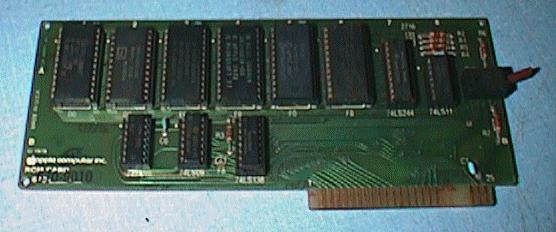
> > The second is an Apple-labeled 12k ROM card with part number 960-9104. It
> > has six sockets and appears to be ORGed at $D000. There's a jumper labeled
> > "2716" and a small red toggle switch. Maybe it can program EPROMS? Five of
> > the six slots are filled with Apple ROMs - the D8 ROM is missing.
>
>My guess would be this is the AppleSoft ROM card. It goes in slot 0
>(IIRC) on a machine with Integer BASIC on the motherboard. The switch
>selects between AppleSoft and Integer BASICs.
http://www.retro.co.za/ccc/apple2/apromcrd.jpg ?
W
Hi,
Does anyone know what the available bandwidth of "standard"
parallel ports might be? E.g., on PC's I believe bus speed
is emulated at 8MHz (?) for I/O instructions (legacy). But,
what about other machines with parallel (printer) ports?
Thx,
--don
> From: "Chuck Guzis" <cclist at sydex.com>
>
> Actually, it's pretty amazing how an 8088 at 8MHz is entirely usable under
> DOS (or CP/M-86).
>
> Does anyone know if MS Network can be run on an XT or does it have
> 286-specific code? I can't recall.
>
>
On review, looks like I missed the intent of your actual question, Chuck...
IIRC, the mid-80's IBM's PC Lan and MS's LAN Manager both ran on 8088's using DOS 3.3 and above and NETBIOS. I don't believe that a 286 was required.
Jared
Hi, all:
I've got a DEC PDP-8/I with the typical current-loop TTY interface. I also
have an ASR-33 teletype. The teletype, though, isn't a DEC-modified
version; it's got a Data General card in it instead of the 4915 card DEC
installed in their teletypes.
I'm Data General ignorant, I'm afraid. :/ So here's my questions:
-Do your typical Data General systems use a 20ma current-loop to talk with
ASR-33s?
-What's the pinout for DG/Teletype connections? Is it something that can
be made DEC-friendly by simply wiring a different connector to the DG
TTY's cables, or are the differences in signals more extensive?
-If the solution isn't that simple, does somebody have a 4915 card they
wanted to part with (or a schematic of one) (or a DEC-outfitted ASR33 they
wanted to trade for a DG-outfitted ASR33 <g>)?
Any help appreciated. Thanks!
-O.-
Hello,
I have a Zenith version of the Heathkit 89. Inshipping the tube fell back and pulled some wires out of the board. Can you help? I need eith a photo or a description of where they go. The wires in question plug straight into the back of the tube. That part is fine. I need to know where they go on the board. There are 2 browns (still fastened) 1 yellow(fastened) green, black, red and white (unfastened) The places where they come out of the bard are labeled G1,G2,G,G4 but I don't know which wire went to wich board location.
Your assistance would be appreciated.
thanks, Charlie
> Anyone know anything about the MLP-900 from Standard Computer Corporation?
There may be some things at CHM from Gordon's archives.
It is doubtful one has survived. The only surviving QM-1 I know of is in
Canada.
So, has anyone ever heard of a MENTEC SBC-100? I just acquired a pair of
DEC-clone boxes, each has a Mentec board, which has screen printed on it "SBC
100-04" and a label that says "SBC 104B" on it.
The board is a quad-height QBUS module, with a J11 chip, 4x 10-pin headers for
serial ports, and 4MB (2MW) of ram soldered onboard. There's also a 8-pin DIP
on the board labelled "19.660M" which I'm guessing is a 19.660MHz oscillator,
a 16-switch dip switch, and a pair of 27C128 EPROMs that are
labelled "R10-70A (C) 1991 MENTEC", and R10-71A.
Pat
--
Purdue University ITAP/RCAC --- http://www.rcac.purdue.edu/
The Computer Refuge --- http://computer-refuge.org
While not strictly OT, I figure if any crowd would know an answer to this,
this one would. I'm building some electronic toys that need a retro look.
I'm looking for some toggle switches (SPST) with long paddle handles, very
old school. All I can find in the regular catalogs have anemic small
paddles. Any pointers?
Ken
After over two years, I have finally completed converting scanned docs
for my BASICON MC-1N from JPEG (!) to ASCII and put up a small page
describing this somewhat obscure INS8073-based microcontroller. The
docs (posted _with_ permission) will probably be interesting to anyone
who is looking for information on the INS8073. There is, naturally, a
lot of material that relates specifically to the MC-1N and its memory
map and its on-board peripherals (an 8255 PPI and an MM58174A
clock/calendar), but the bulk of the manual is about NSC Tiny BASIC.
One of the motivations for finishing the docs was to better understand
the RB5X (INS8073 w/*3* 8255 PPIs and 8K of SRAM). The memory map may
be different, but that's trivial to transpose.
http://www.penguincentral.com/retrocomputing/INS8073/
If anyone has any questions, stories, ideas, etc., for INS8073
projects, I'm interested, on-list or off-list.
-ethan
I obtained a socket 7 SBC from Weirdstuff late last
fall. It has the capability of interfacing to a
*variety* of lcd dislplays. Phor phun I had in mind to
*hopefully* connect these old Thinkpad panels dating
fron the 770c (IINM) era. The sbc manual gives a
pinout, so my basic question is are these things
(lcd's) generic enough in the way they interface to be
able to use *most any* source of signals. The sbc uses
a C & T 65550 ic, and their are drivers for W3.1, WNT?
(3.51 methinks...book not in front of me), and of
course beloved W95. You can set jumpers according to
what *type* of panel yer using, according to
resolution, etc. I can scan the relevant pages and
e-mail them if anyone is curious. Grassyarse.
__________________________________________________
Do You Yahoo!?
Tired of spam? Yahoo! Mail has the best spam protection around
http://mail.yahoo.com
> From: "Chuck Guzis" <cclist at sydex.com>
>
> Actually, it's pretty amazing how an 8088 at 8MHz is entirely usable under
> DOS (or CP/M-86).
>
> Does anyone know if MS Network can be run on an XT or does it have
> 286-specific code? I can't recall.
>
>
Indeed, there is a Microsoft Client for DOS that will function within a
MS-flavor network. I've used it successfully in the past for various
reasons, and DOS of course doesn't support long names, it is fully
functional as a client (and with some tricks, a server) in the MS
networking realm.
If you are interested in experimenting, Google for "DOS MSClient". I'd
make this site my first stop:
http://www.jacco2.dds.nl/samba/dos.html
and view the "Network Client for DOS" section.
With just a few tricks, you can actually get the DOS machine to act as a
file server, too. All is explained in Jacco's discussion.
BTW, I've used both the TCP/IP and IPX stacks with DOS clients.
For those that have a truly warped sense of humor, you can make your XT
(or even a HD-less PC) into a HTTP and FTP server. Check out these two
sites:
http://8088.eznos.orghttp://www.eznos.org
Makes for some real geeky entertainment on a slow evening with nothing
else to do!
Jared
I've observed pulses in the 100-200ns range on an PowerMac using a PCI
parallel port card and a three instruction bit twiddle. You need to remove
the filter caps on the I/O connector to use it at that speed.
A customer called and says she's got a working Kaypro 10 (and maybe two)
looking for a good home. She's in the Richmond, VA area. If interested,
drop me a line and I'll furnish contact information.
Cheers,
Chuck
We had a nice booth for MARCH on the first floor of the conference, manned
by myself, Bill Degnan, Bill Sudbrink, and Sridhar Ayengar. We met LOTS of
cool people and lots of people who are collectors but they just didn't know
it yet. :)
Were any other classiccmp'ers there?
On Fri, 21 Jul 2006 04:19:36 -0400 (EDT), der Mouse
<mouse at Rodents.Montreal.QC.CA> wrote:
> Thanks to my sister's bf's generosity, I am now the proud owner of a
> Fluke 87 "TRUE RMS MULTIMETER".
>
> However, I am told it needs recalibration (this is why he gave it
> away).
[...hack...]
The manual is on the Fluke web site and includes calibration procedures.
However, Fluke has a van that tours all the major cities and provides
a cal check for any meter you bring in. Yearly I help a friend tote
all his toys down and have them tested - it's free! Check with your
local Fluke distributor and see if you are so blessed.
CRC
>no grounded track immediately available, so I'm running the leads across the two channel N outputs.
>also tried to chassis/earth ground, didn't make a difference . . .
That doesn't make much sense. The scope is across the PSU Channel 4 (-5V) outputs
(labeled + and -, I'm pretty sure they are GND and -5V in that order)
I've got an OD3210 9-track drive that's been sitting around here for a
couple of years. I note that it has a Pertec interface (seems to work) and
a parallel port interface. I'm curious about the latter. It appears to be
4-bit each direction, but I don't have a clue as to the protocol or command
set.
Does anyone have a driver or information about the Overland parallel port
interface?
Thanks,
Chuck
If anyone wants 3.5" DSDD disks from me, I'm all out. That lot that I
posted about last week is mostly bad judging from the sixty I've gone
through so far. With 200 to go, I'll just chuck this mess out unless
someone here wants to do something silly like make a suit of armour out of
floppies. If that's the case, I'll sell the whole lot for the cost of
shipping.
--
David Griffith
dgriffi at cs.csubak.edu
A: Because it fouls the order in which people normally read text.
Q: Why is top-posting such a bad thing?
A: Top-posting.
Q: What is the most annoying thing in e-mail?
I'm starting to get a bit peeved - I've tried randomly throwing capacitors across the output, scientifically choosing a capacitor to have a reactance of 1 ohm
at the trouble frequency, and taking that cap and putting another .022?f unit in parallel -
and the noise doesn't get attenuated at all, it's still at around 500mV, in high audio frequencies.
If it was going down (to ~300 mV) I'd just build a LC choke filter and be done with it, but its stubborn spurning of something that
should work is bothering me. Is the ripple carrying that much current that the resistance of the capacitor is an issue? I don't think so-
this is a secondary supply (-5V!). I also don't get why there should be a relatively equal AC component in 3 secondary supplies that do
share much after the transformer primary, and yet a low level in the main +5V.
Could this be something bizarre in the connection of the scope? I'm doing a very bodged scope -> BNC cable (one of the bundle that usually
runs to the monitor) -> 2 alligator clip leads stuck on to the relevant bits of the other-end BNC connector.
Been trying to work out this board. It's one daughtercard in the PSU, the chopper transisors are on another. Yet, there are 3 TO-3 cased bipolar
(2Nxxx parts) scattered amongst the rectifier diodes. Similar units are not present in the +5V channel. Would this have linear regulators on the non-main channels?
I've got a friend who was reminiscing his old days in computing, and
was thinking he'd like to have his old Tandy PC-2 again. Does anyone
have one they're looking to part with (a Sharp PC-1500 would also
suffice)? I'd like one that's cosmetically clean, has the
cassette/plotter base and manuals. If you have one you're looking to
part with, please contact me off-list at jcwren at jcwren.com
--jc
> Forgive a stupid question, Scott--are you taking your ground return for
>your scope from the metal chassis or from a grounded track on the PCB?
>They might not be the same thing.
no grounded track immediately available, so I'm running the leads across the two channel N outputs.
also tried to chassis/earth ground, didn't make a difference . . .
Tony Duell wrote:
UK TVs (even back in the 405 line era) tend to use a 75 ohm coaxial
aerial cable (not a flat twin 300 ohm one that's popular in the States).
This cable often had an air-spaced insulator between the centre core and
the braind, and thus there were channels the full length of the cable.
The aerial terminal box had developed a water leak. Rain came in there,
ran down the channels in the cable (not down the outside), then came out
inside the coaxial plug at the back of the set and ended up on the floor.
Of course this messed up the properties of the cable, hence a weak signal
and a poor picture.
-tony
Nice tale and after seeing some of those old coaxials, easy to believe it
must have happened more than once.
Reminds me of one of my worst memories on the big iron systems. Had a
computer that was on the top floor. The building maintenance people were
running the grounding cable on the lightning rod down to the earth rod..
And discovered this wonderful cable channel that carried the power from the
basement MGs up to the main frame power supplies. The inevitable happened
and a lightning bolt took out all the supplies on the entire system. The
overvoltage crowbars saved most of the logic. But the lightning literally
vaporized the power cables, and the MG was a big piece of toast.
Nobody was punished - the union said that there were no guidelines stating
this was a bad thing. And common sense seems to be a rare commodity.
Billy
>At least TPC files are slightly more portable than some formats (RSX-11M+
>Virtual Tape comes to mind).
Now if only there were some magic to keep a TK50/TK70/TZ30 drive working
for more than ten minutes. And by "working", I mean anything that doesn't
require disassembly of the drive and the computer to free a jammed tape.
Actually reading the bits is more than I could hope for :-)
Bob
On 7/22/06, Robert Armstrong <bob at jfcl.com> wrote:
> Now if only there were some magic to keep a TK50/TK70/TZ30 drive working
> for more than ten minutes.
Speaking of the drives, I have a small Perl program that will emit the
right PostScript to directly print lines of text on the label inserts.
Free if anyone wants it.
I was tired of handwritten cardboard labels and misaligned
laserprinted Avery sticky labels.
-ethan
Someone I know is working on a DECstation simulation, and is looking for
Ultrix to test on it. Anyone have images of the distr discs?
Also, FWIW, I found someone who has a simulated 5xxx and O2 running
http://gavare.se/gxemul
And thusly were the wise words spake by Star Master
>
> Does anyone know where I can get an MSD SD-2 Service Manual? I'm willing
to
> pay an indivual or a company (Can't find one that has it).
> Thanks
This has the schematics and user manual:
http://staff.washington.edu/rrcc/uwweb/MSD-SD2/
Cheers,
Bryan
Thanks Bryan, I already found those...However I need the service and or
diagnostic info for it. When I turn it on all the lights turn on and stay
on, and it is not seen by the computer.
Anyone else?
Thanks
> It is usual to bake the tape at a low-temperature owen (a box with foil
> paper and an incandescent lamp) to dry the humidity of the tapes. It makes
> them less sticky, but PLEASE do not try to re-run the tapes. It is enough to
> save the contents, but not always make tapes useable again
>
> This is an old tip from recording studios...
Bertram and Cuddihy "Humid Aging of Magnetic Recording Tape"
IEEE Transactions On Magnetics Sep 1982
Has a detailed analysis of the failure mechanism in the binder, along with
some temperature/humidity curves that show the rate at which the binder can
be rejuvenated.
I just bought a Toyo Living controlled humidity chamber this past week to
begin the exact characterization of the temperature and humidity protocol
required to process 1/2 tapes so that they can be read safely.
The whole "baking tapes" process has way too much black magic involved, and
I have tapes at the Museum that I have to read that are irreplaceable (and
VERY old) so I don't have the option of just throwing them onto a drive and
see if they start to squeel.
After that is dealing with DC-300's and DC-100's that I've observed with
exactly the same sticking problems.
Fortunately, the Museum has very few TK50s
> Now if only there were some magic to keep a TK50/TK70/TZ30 drive working
> for more than ten minutes.
Ten minutes sounds about the right length of time for the first traversal of
the tape, at which time the collected sticky crud from most old tapes is
deposited at the end of the track when it reverses direction, and then
proceeds to stick the tape to the head.
I don't know if the formulation of the tapes is such that you can remove the
stickiness with heat/dehydration. This is also something I need to try on
DC-300 carts that have become sticky.
You also need to THOUROUGHLY clean the head stack. I have a TZ30 that I
leave partially disasembled so I can pull the stack out the top so it can be
cleaned with isopropyl on a cotton swab.
--
It's probably time to put together lists of what TK50s (distr at least..)
have already been read to save others the grief of dealing with old sticky
media.
> And then there was the attempt when wiring up an outside light where the kid
>decided to hook both wires from the light and both wires from the feed up to
>the switch. Turned the breaker back on and the light was on all the time,
>until he flipped the switch, which popped the breaker, because he had it
>going _across the line_.
Unorthodox, but it does work . . . I know for a fact that Silicon Graphics used a similar system on some machines
(Twin Tower, possibly others) to shut down the power supply if sufficient bits were removed to impede cooling.
Not sure if it was the same designer . . .
Hi,
I've got a Laserjet III that's intermittently throwing Service 50 errors.
Fusing lamp tests good as per
<http://www.fixyourownprinter.com/reference/guides/fuser/sx>. I assume this
means the AC power module has fried itself.
Best I can find on Google is that I need to replace the triac and some
'support components'. I can find component designator IDs, but not component
values - does anyone know what needs replacing, and what to replace it with?
It's also been throwing 13 Paper Jam errors, but there's no paper jam
visible. Anyone know what causes this? I'm guessing the optosensor on the
fuser assembly has failed, but I can't identify the opto. Does anyone have a
part number for it?
Finally, if by some twist of fate I manage to get this thing running, I'm
going to need an A4 paper tray. Anyone in the UK got a spare they feel like
parting with?
Thanks.
--
Phil. | Kitsune: Acorn RiscPC SA202 64M+6G ViewFinder
philpem at dsl.pipex.com | Cheetah: Athlon64 3200+ A8VDeluxeV2 512M+100G
http://www.philpem.me.uk/ | Tiger: Toshiba SatPro4600 Celeron700 256M+40G
I purchased a Computer Link Pack inspector about 2 months ago on Ebay.
I just got a junk pack to play with this week (same vendor). It is marked
"Master Alignment Pack" and is declassified navy badged. Anyway though
people might get a kick out of it.
I would love to have a real use for it, but it is just for collection
and display
purposes.
Jim
http://jwstephens.com/pack-insp-2006-07-20/page_01.htm
I have several old Apple IIs, a TRS-80 (new in the box), and a few other
older computers. I would like to get them all running again, if
possible. I have been putting computers together since the late 80s,
but have little knowledge of actual computer electronics repair
(soldering, replacing broken wires, etc.). I would appreciate any
suggestions about good, accurate, thorough books to purchase so that I
can start teaching myself the basics. There are a number of such books
out there, but I am having difficulty evaluating the accuracy and
thoroughness of them.
Since this question is probably not of interest to many others on the
list, please feel free to email me any suggestions at
jephraim at ci.southlake.tx.us
Many thanks!
Jesse Ephraim
Adult Services Librarian
Southlake Public Library
1400 Main Street, Suite 130
Southlake, TX 76092
(817) 748-8247
jephraim at ci.southlake.tx.us
"A circulating library in a town is as an evergreen tree of diabolical
knowledge."
- Richard Brinsley Sheridan (1751-1816)