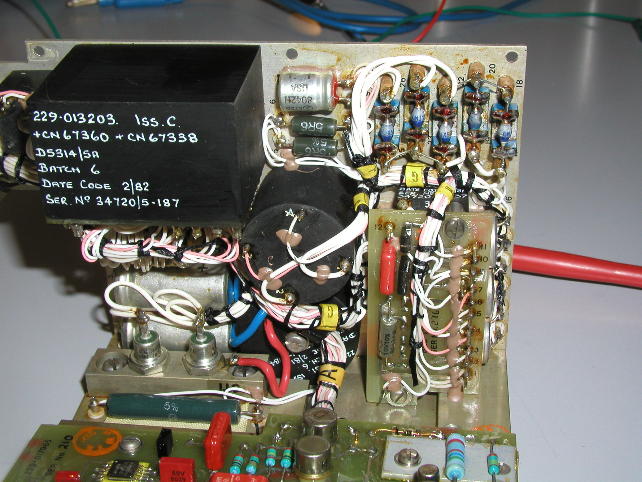
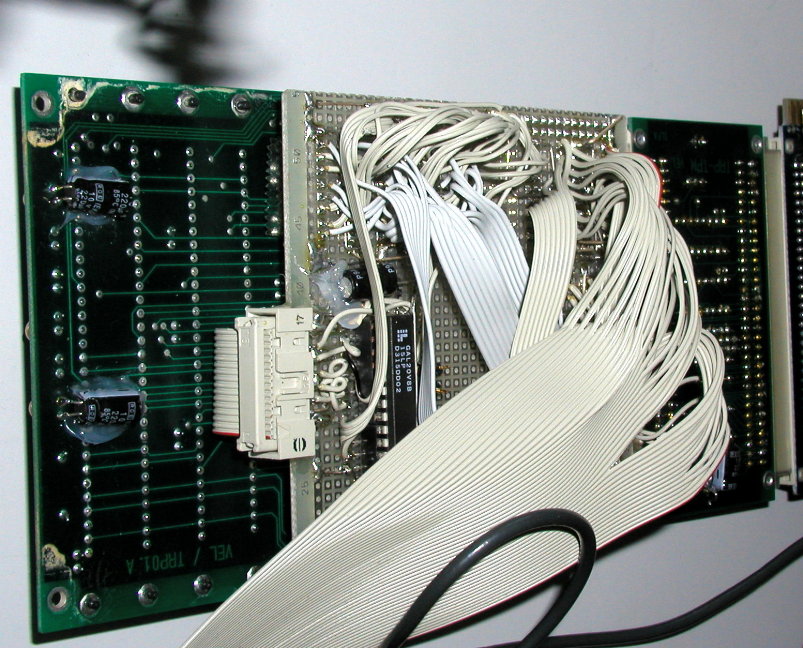
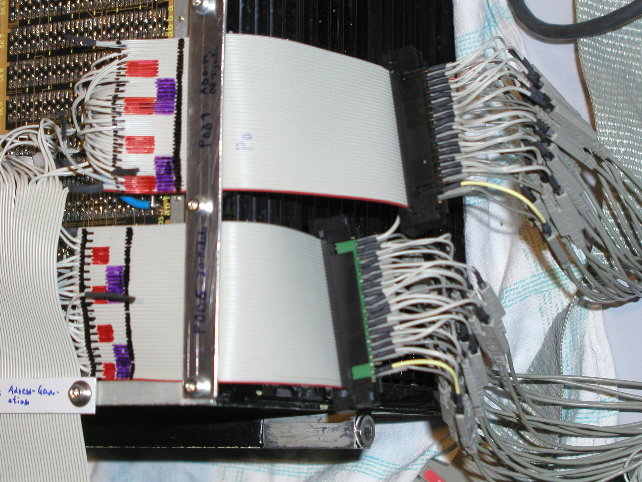
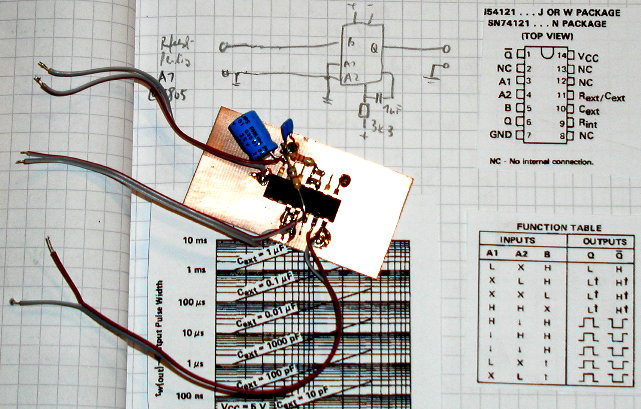
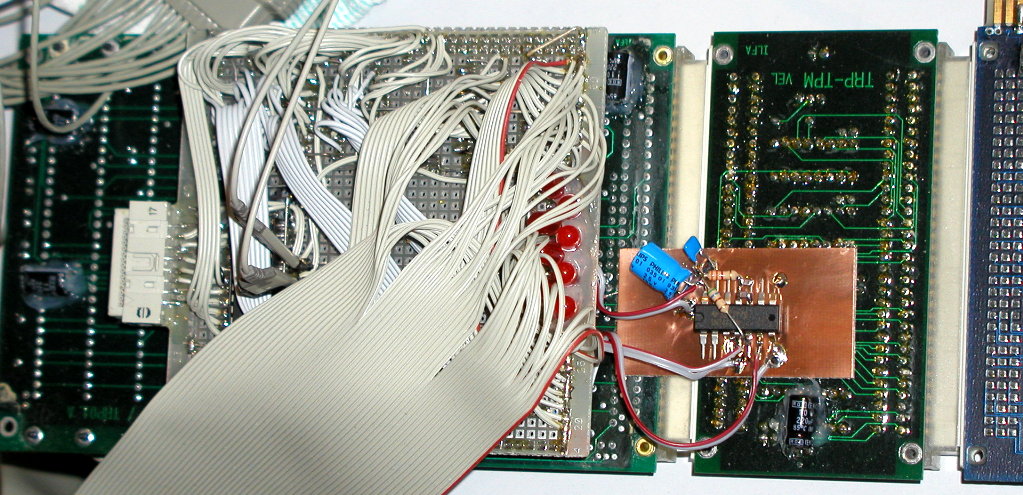
>> Then I looked at the pictures, and saw it was made by my old
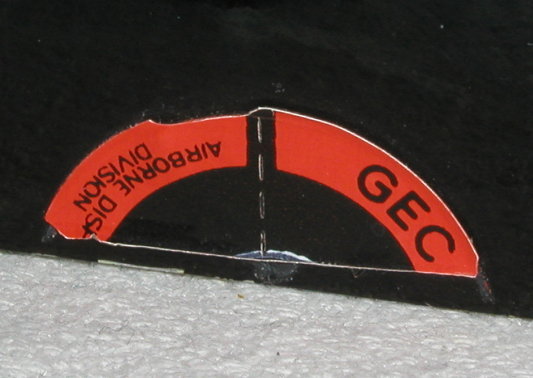
>> employers, Marconi Avionics who took over Elliott Brothers, and
>> continued to make 920 series machines. I think there were 12 bit
>> versions made by one of the divisions, though I am surprised they
>> were still making them in the 1980s.
> Yes, the unit was made after 1986 I think. One quy in the
> rec.aviation.military claimed, that the box might be from
> early tornados as I mentioned in my original posting. I do
> not know how long development of such an aircraft takes but
> the first take-off was in 1974 I think, so this would match
> the design of this box wuite well - what do you think?
Aircraft development takes a long long time. To make it worthwhile
the aircraft has a long service life. Whilst the computers are bullet
proof in an office/home, the temperature extremes, vibration, high G
forces etc in service means that many failures occur and PCBs could
be replaced many times over the years, so do not pay too much notice
of the dates on components of the boards currently installed.
There were at least four 12 bit versions, and one 13 bit apparently.
Then 12 bit models were the 902, 102C, ARCH 105 and Minim or 12/12.
>
>> One part of Elliott Brothers became GEC Computers (based in
>> Borehamwood).
> Yes, that matches - the core memory module already has the
> label GEC. So this is (as I suspected) older than the CPU and
> taken maybe from a different design?!
You have it the wrong way around. The GEC name replaced the Marconi
name, which had earlier replaced Elliott. Core memory was very
convenient for military applications and was in use long after it was
replaced in commercial applications. Think of a missile or torpedo
held in stock for many years, stick a power plug into it and program
the target, pull out the plug and then launch it. Only then does the
internal power supply come up, the processor boots up and does its
thing.
>
>> One of your labels is from Airborne Displays Division based at the
>> same Rochester site as I worked. This was also part of Marconi
>> Avionics, and the company later changed its name to GEC Avionics. I
>> worked on compilers, linkers and other utility software for the 18
>> bit 920s before moving on to the Zilog Z8001.
> Hey, than you are a valuable expert on these - do you have
> got any source of intormation about the 920s?
Not directly but I may be able to help.
>
>> Erik, could you tell me if the instruction code is anything like
>> this:
>> 0 Load B (indexing) register and the Q register (shift extension)
>
> RIGHT
>
>
>> 1 Add to accumulator
>
> RIGHT
>
>
>> 2 Negate and add to accumulator
>
> RIGHT
>
>
>> 3 Store the Q register
>
> RIGHT
>
>
>> 4 Load accumulator
>
> RIGHT
>
>
>> 5 Store accumulator
>
> RIGHT
>
>
>> 6 And to accumulator
>
> RIGHT
>
>
>> 7 Jump if zero
>
> RIGHT
>
>
>> 8 Jump
>
> RIGHT
>
>
>> 9 Jump if negative
>
> RIGHT - all three jumps are relative ones
On the 18 bit machines these were relative to the start of the 8k
memory module the instruction was in. An interesting modification.
>
>
>> 10 Increment
>
> RIGHT
>
>
>> 11 Store program counter (for function return)
>
> SIMILAR - This stores PC and then does a
> table jump
On the 18 bit machines, it actually stored the program counter + 1
and the following instruction was either an 8 or a "/8", i.e. 24.
>
>
>> 12 Multiply
>
> RIGHT, unsigned multiplication
This should multiply the signed accumulator and the signed memory
operand giving a double length result in the A and Q registers.
>
>
>> 13 Divide
>
> HMMM, the command takes very long but the results are
> very strange. I thought it might be some type of
> random number generation by an irreducible polynomal,
> but it is definitively not Divide. Maybe here is something
> different or wrong with the microcode.
This divides a signed DOUBLE LENGTH number in the A and Q registers
by a signed memory operand. IIRC the A register gets the result and
the Q register the remainder.
>
>> 14 Shift
>
> In PART: Here exist many subgroups of commands including
> shift left/right. Also the Q as you call it can be transferred
> to Accu and vice versa. There als is a MTA (MoveToAccu as I call it)
> which is a two-word instruction (most others are one-word) and
> transfers the word following this command into Accu. About
> 16 bit patterns have (at least to me now) the same meaning in
> this segment.
Shifting by the entire word length does transfer Q to A or A to Q
(but the data disappears from the source). A load immediate
instruction would have been very handy. There was also a block move
instruction here in the 18 bit machines. Maybe some of the special 15
orders were encoded in the 14 order on the 12 bit machines with only
256 numbers available compared with 8k on the 18 bitters.
>
>
>> 15 Input/Output and special (like interrupt return)
>
> Yes, in part as well. Commands for sending and receiving
> via the serial links I found here.
>
>> 16 to 31, as above but indexed by B register.
>
> NOPE - The box is 12-bit and does not have got this block.
> EVERYTHING is done via the index register I as I called it.
Do you mean you cannot turn the B-register modification off?
Does it get cleared automatically somehow?
>
>
>
> So
>
> #######
> # # # ##### ###### # # ##
> # # # # # # # # # #
> ##### # # # # ##### #### # #
> # # # ##### # # # ######
> # # # # # # # # # #
> ####### #### # # ###### # # # #
Eh?
>
> the box is a 12-bit version of the Elliot series of Computer.
> Lot of work for rediscovering the instruction set of the 920
> Elliot...
>
> Roger, do you have got any detailed information on these
> you are willing to share with me! I am familar with the above
> mentioned instruction set, but some details are still open and
> perhaps studying the Elliot would help to solve the remaining
> problems??!?!?!!
I am willing to try.
By the way, there are two 't's in Elliott.
>
>> In early versions of the 920, the B and Q registers were the same
>> register and it and the program counter were held in memory. There
>
> In this box the registers are stored in "batteries" of 74xxx flip
> flops on the processor boards.
On the later 920s, the current interrupt levels B register and
sequence control register (i.e. program counter) were held in real
registers but the other interrupt ones were held in memory. There was
extra circuitry to make it so that writing to the current level's B
register address actually got trapped and also modified the real
register.
>> were four levels of interrupt and a set of these registers for each,
>> held in location 0 to 7. The high end of memory held a paper tape
>> bootstrap, in later versions, this was just copied into core when the
>> machine was initialised.
> Interesting. The Programmer Electronic Control starts execution
> at 0x0a0 after reset.
Could it be that there is a value of 0x0A0 at location 0?
> But of course the application was different
> and the operation software was completely loaded via the big plug
> boefore operation.
I suspect the big plug is for the OMP (Operator's Monitor Panel), and
yes the program would be loaded via this once, probably in the
factory or at a maintenance depot, and the machine would probably be
rebooted many times afterwards.
>
>> If this indeed a military machine, you can be sure the memory was
>> erase by flipping every bit backwards and forwards several hundred
>> times to remove any trace magnetism before it was released from
>> the RAF.
> Yes you are probably right. I thought just in case there are some
> fragements inside it would have been interesting to study them
> in order to learn about the instruction set.
>
> I am sure the unit supports interrupts (one for each serial
> port (panavia link I think) and maybe there is an additional
> for the timer. This timer has a reload register and
> thus can be programmed to arbitrary intervals (12bit, running
> at 2MHz). But up to now I was not able to read or write it
> nor occured an interrupt. Here studying the Elliot would
> really be inspiring - I am very sure that they reused the
> know how here as well...
The 920 was unusual in that it booted into the highest level
interrupt, level 1, so no interrupts will be serviced until you go
down an interrupt level or two or three.
The 15 order is coded thus:
15 0 to 2047 Input
15 2048 Shift A register left 7 places and OR in a character from the
paper tape reader (via OMP)
15 2052 (IIRC) Wait until character pressed on teletype and read into
A register (via OMP)
15 4096 to 6143 Output
15 6144 Output character to paper tape punch (via OMP)
15 6148 Output character to teletype (via OMP) if I remember correctly
15 7168 Terminate current program level i.e. return from interrupt
15 7169 Test if standardised IIRC, skip the next instruction if the
accumulator is zero or top two bits are different
15 7170 Increment B and skip the next instruction if bottom 13 bits
are zero
15 7171 Read the value of the control keys on the OMP
15 7172 Move l.s. 17 bits of A to the m.s. 17 bits of Q. Bottom bit
of Q is zeroed
15 7173 Move m.s. 17 bits of Q to l.s. 17 bits of A. Top bit of A is
zeroed
15 7174 Move A to B
15 7175 Move B to A
15 7176 Set relative addressing mode
15 7177 Set absolute addressing mode
In relative mode, all addresses are relative to the start of the 8k
block of memory the instruction is in. In absolute mode (the
default), 7,8 and 9 orders are still relative but in all others the
address is absolute, so that only the bottom 8k of memory is
accessible without using B modifiers.
Roger Holmes.
Is there any interest here in DEC XMI gear? Preferably cash or trade
interest.... ;)
I have several rackmount XMI enclosures, a couple of CI and a *bunch*
of SCSI and ethernet boards with cab kits. They're about to go on eBay,
but I thought I'd check here to see if anyone's looking.
Oh, yeah, I also have 5 or 6 star couplers and a bunch of Big Blue CI
cable, and a couple of HS<mumble> CI-SCSI adapters *without* their flash
cards.
For that matter, I have 2 rackmount DEC7000 cabinets I'd like to see
disappear. One is the bare cabinet, the other has 2 procs and the
laserbus-XMI adapter intact.
I'm supremely uninterested in crating or palletizing the enclosures,
so you'll need either to arrange that yourself or prepare to be extorted. :)
Reply off-list if interested. I'll be making a more specific
inventory this weekend.
Doc
Does anybody have images of the v2.1 Z-80 firmware for the VT-180 (aka
Robin) ? At least, I think 2.1 was the last version ever released. They
should be DEC part numbers 23-017E3-00 and 23-021E3-00.
Thanks,
Bob Armstrong
Hi all,
The VCF East 4.0 web site at www.vintage.org is now ready for use. The
event, in case you forgot, is TWO days this year -- June 9-10.
Exhibit booths and vendor booths cost the same. (At past VCFs it cost a lot
more for a vendor booth than for an exhibit booth.)
The single-booth fees are:
$15 for paid MARCH members ($5 cheaper than last year)
$25 for everyone else
Discounts may be available for people who reserve multiple booths.
We'll have almost twice as much physical space as last year, so we want as
many exhibitors as possible. We'll accept vendors but that really is not
the focus.
PLEASE SIGN UP EARLY. AS EARLY AS POSSIBLE.
Even if you only have a general idea so far of your exhibit topic, that's
fine. Go ahead and sign up. It makes life much easier for us in planning
and marketing the event. If everyone waits until the last minute, then the
public will go to the VCF web site and see what appears to be very little
participation, and decide not to attend. Conversely, if people sign up
early, it builds excitement for the event.
- Evan
I bought this from dvdplanet the other day (good deal: $15) and
watched it recently.
They seemed to skip the entire minicomputer/workstation phase and
jumped straight from mainframes to the personal computer.
What was interesting though is the collection of footage that they
used throughout. I spotted what looked like footage of an HP terminal
factory, manufacturing 2621's. On the shelves in the background were
2648 style cabinets. It was a brief clip, but I felt "cool" knowing
that I was one of the few people who would recognize the equipment!
--
"The Direct3D Graphics Pipeline" -- DirectX 9 draft available for download
<http://www.xmission.com/~legalize/book/download/index.html>
Legalize Adulthood! <http://blogs.xmission.com/legalize/>
I'm hoping someone out there can help me remember. I can dig through
my hellbox and hook up a drive and figure it out, but I'd just as
soon hear it from someone with a better memory.
It's this:
The old Sony SS 40-cylinder 3.5" floppy drives--was cylinder 0
located an additional step outwards from where modern 3.5" drives put
cylinder 0? I can't remember for sure--it's a sign of age.
Cheers,
Chuck
Somehow I got subscribed to an optics catalog. This got me to thinking.
How hard would it be to cause a laser beam to sweep with the speed and
accuracy to be a substitute for a CRT? The upshot? Take an old terminal
with nasty screen burn. Cut off the gun end of the bottle, clean off the
old phosphor. Apply new phosphor of some kind, then mount the laser
rasteriser where the old gun was. Projecting raster images on the side of
a building would be fun too.
--
David Griffith
dgriffi at cs.csubak.edu
A: Because it fouls the order in which people normally read text.
Q: Why is top-posting such a bad thing?
A: Top-posting.
Q: What is the most annoying thing in e-mail?
Told ya'll I was going to dig back in to that 11/45 restoration project :)
Got the workroom cleaned up enough to actually have room to work on the
thing. Stripped it down to the very most basic configuration possible
(including getting rid of the 9312 for a 930, etc.). Barebones. No cards in
SPC slots except grants. Known good 16K of core and then a base processor
set (without segmentation and without FP).
Turned on the bottom 742, then the top one... fans all come on but nothing
on the front panel at all. Checked the obvious front panel keylock, it
wasn't off. Time to check voltages & ripple on the backplane.
E02B2 is at 0.55v, indicating the H745 in slot E is officially a problem
child.
E15A1 is at 0.95v and E01B1 is at 0.05v, so the +15v regulator built into
the top H742a is suspect. Noted that the small fan on the top of the top
H742a isn't turning so likely the regulator is well-done.
The test points on the backplane for regulators B, C & D are ok, as is
the -15v from the bottom H742a.
Time to get the H742a docs from bitsavers :)
Jay West
"the resident Atari Maniac with a side fetish for Mindset and Corvus
systems,
now playing with a VAX.....Curt"
Just a blind shot in the dark trying to find someone who knows about Corvus
Systems and Atari 8-bits>
We had heard one time that Ataris had beenn hooked to a Corvus system and
were wondering if you had any info.
Thank you for your time
--
No virus found in this outgoing message.
Checked by AVG Free Edition.
Version: 7.5.446 / Virus Database: 268.18.7/710 - Release Date: 3/4/2007
1:58 PM
They are on the web if you look hard enough.
Unfortunatley the whole collection is a mess. They should have distributed
it in PDFs of the original pages to maintain the feeling of the originals.
But NO, they html the whole thing poorly, and the original art is low res
too.
I am fortunate to have the university nearby, and there is nothing like
flipping through old SciAm binders. The computer ads from the 50s-60s are
incredible.
where's my flying car?
I want the future as depicted in the magazine.
If you can have access to these, also notice the employment ads. Everybody
was in the exciting field of computers, a rocket scientist, or electronics
engineer.
Dont forget to check out the Amateur Scientist book too. There is a relay
based tic-tac toe machine, farmer fox, goose computer too. It is a
collection of some of the best articles.
In the magazine, Marvin Gardner's Mathematical puzzles column too! lots of
binary and computer algorithms foretelling the future are in there.
I grew up in the NASA environment. As A kid I got to go in the clean rooms
and see the spacecraft. Then they brought me into the computer room to play
tic tac-toe at the console.
I want to go back...
Or surround my basement with vaccum column tape drives and a console of
switches and blinkinlights. Nevermind its a PC runing the show, but its
running a s/360 emulator..
Grab your pocket protectors and slide rules, come over to my house!
Randy
>From: Bob Rosenbloom <bobalan at sbcglobal.net>
>Reply-To: "General Discussion: On-Topic and Off-Topic
>Posts"<cctalk at classiccmp.org>
>To: General Discussion: On-Topic and Off-Topic Posts
><cctalk at classiccmp.org>
>Subject: Re: raster laser? - Ameteur Scientist
>Date: Sat, 10 Mar 2007 05:12:33 -0800
>
>
>
>Dave McGuire wrote:
>>>
>>>Does anyone on the list have this collection (SciAm Amateur Scientist
>>>columns on CD-ROM)?
>>
>> I have them...I ordered them the day they were announced.
>>
>> -Dave
>>
>>--Dave McGuire
>>Port Charlotte, FL
>>
>They are available on ePay for $24.00
>
>Bob
_________________________________________________________________
Find what you need at prices you?ll love. Compare products and save at MSN?
Shopping.
http://shopping.msn.com/default/shp/?ptnrid=37,ptnrdata=24102&tcode=T001MSN…
On 3/10/07, Sridhar Ayengar <ploopster at gmail.com> wrote:
> Ethan Dicks wrote:
> >> > I think a 11/750 makes a fine single-user VMS "workstation" ;-)
> >>
> >> Never trust a workstation that couldn't roll over you and smash you flat?
> >
> > I almost had an 11/750 land on me, but I was able to coax it out of
> > the side door of a Chevy Astro mini-Van (alone) without getting
> > squished or pinched. That was a fun experience.
>
> I once (with the help of a bunch of other people) was attempting to
> unload a DECsystem 5810...
> It landed on me as I was kneeling down. I caught it.
I think I've heard people reference this incident on the list. I
didn't know it was quite as spectactular as all of that - sounds like
a combination of luck and quick action on the part of all present.
> > Thinking about the whole "11/750 workstation" concept - I wonder if
> > one could take a qbus mono framebuffer and hang it off of some flavor
> > of Qniverter?
> I once asked a question as to whether it would be possible to build a
> VAX 6000-based workstation by hanging a Qbus framebuffer from a Unibux
> slot hooked to a VAXBI bridge in a VAXBI slot in a secondary BI cage
> hooked to a VAX 6000 through an XMI->VAXBI bridge. The consensus was
> that it probably wouldn't work. 8-)
Hmm... I have an 8300 in the basement with a non-working DWBUA (it
used to work, about 13 years ago but that was before the machine got
moved). My recollection of it was that (when it was working), the
DWBUA was ok in a native VAXBI environment like the 82xx/83xx, but
that when you started stacking bus converter on bus converter, it
didn't take much to get things to the point of violating timing
maximums on certain things. We had a problem with a Qbus COMBOARD
being stuck in the same Qbus as a TLZ04 controller on an early model
VAX 4000 since the CPU bus _wasn't_ Qbus, and there were enough subtle
changes that hardware bus timeouts came into play, especially when the
TLZ04 controller "went away" for a bit - I think officially, the
timeouts were too stringent, but had never been a problem up to that
model of VAX.
I have to seriously wonder if you could get traffic from the Qbus,
over the Q/Univerter, over the DWBUA over the XMI-BI bridge (forget
the model #) before something timed out somewhere.
No reason not to attempt it, but if it doesn't work the first time,
the chain might just be too much to handle.
-ethan
P.S. - the problem I'm now having with my DWBUA might be a wonky UET
(Unibus Exerciser/Terminator). The UET has to work perfectly and
respond correctly when the DWBUA talks to it, or the DWBUA fails
self-test. Could be cables, could be bad components, or could just be
the phase of the moon. Either way, I installed a DWBUA correctly
once, and now it appears to have been a fluke. It hasn't worked right
since I moved it. :-( I have the docs, and according to the various
device status registers, it acts like the DWBUA isn't seeing the right
things from the UET. *slaps forehead* I have just the thing to check
it out - a not-yet-assembled bare-board UA-11. I think assembling
that just moved up the priority chain to sometime in the first 1/2 of
this year!
Erik Baigar <erik at baigar.de> wrote:
> Beginning of 2005 I got this small airborne computer via eBay and
> I bought it mainly because of the 96k of core memory inside. Those
> days some of these have been sold by ABEX (...)
(Not directly related to your current project, but I immediately thought of it when I read "Tornado" - because I saw the Moving Map Display there - and noticed you're also from Germany)
I assume you're aware of the massive amounts of aeronautic, military and electronic stuff
www.helmut-singer.de
(in or near Aachen) has to offer?
Yours sincerely,
--
Arno Kletzander
Stud. Hilfskraft Informatik Sammlung Erlangen
www.iser.uni-erlangen.de
"Feel free" - 10 GB Mailbox, 100 FreeSMS/Monat ...
Jetzt GMX TopMail testen: www.gmx.net/de/go/mailfooter/topmail-out
Erik, well done with the reverse engineering.
I read your description of this computer with a strange feeling. I
did not recognise it having 12 bits but everything else seemed very
reminiscent of the Elliott 920 series.
Then I looked at the pictures, and saw it was made by my old
employers, Marconi Avionics who took over Elliott Brothers, and
continued to make 920 series machines. I think there were 12 bit
versions made by one of the divisions, though I am surprised they
were still making them in the 1980s.
One part of Elliott Brothers became GEC Computers (based in
Borehamwood).
One of your labels is from Airborne Displays Division based at the
same Rochester site as I worked. This was also part of Marconi
Avionics, and the company later changed its name to GEC Avionics. I
worked on compilers, linkers and other utility software for the 18
bit 920s before moving on to the Zilog Z8001.
Erik, could you tell me if the instruction code is anything like this:
0 Load B (indexing) register and the Q register (shift extension)
1 Add to accumulator
2 Negate and add to accumulator
3 Store the Q register
4 Load accumulator
5 Store accumulator
6 And to accumulator
7 Jump if zero
8 Jump
9 Jump if negative
10 Increment
11 Store program counter (for function return)
12 Multiply
13 Divide
14 Shift
15 Input/Output and special (like interrupt return)
16 to 31, as above but indexed by B register.
In early versions of the 920, the B and Q registers were the same
register and it and the program counter were held in memory. There
were four levels of interrupt and a set of these registers for each,
held in location 0 to 7. The high end of memory held a paper tape
bootstrap, in later versions, this was just copied into core when the
machine was initialised.
If this indeed a military machine, you can be sure the memory was
erase by flipping every bit backwards and forwards several hundred
times to remove any trace magnetism before it was released from the RAF.
>Date: Fri, 09 Mar 2007 14:40:11 -0600
>From: Jules Richardson <julesrichardsonuk at yahoo.co.uk>
>Subject: Re: Shameless Plug - 74xxxx series ICs
>To: General Discussion: On-Topic and Off-Topic Posts
> <cctalk at classiccmp.org>
>Message-ID: <45F1C62B.5000107 at yahoo.co.uk>
>Content-Type: text/plain; charset=ISO-8859-15; format=flowed
>
>Doc Shipley wrote:
>> I was up there yesterday and they have literally
>> 50-60 feet of 6' shelves, nothing but 74xxxx ICs.
>Seriously though, thanks for letting us know - personally I'd rather deal with
>people that someone knows personally than some random ebay auction etc.
MC Howard is about a mile from my house. I've shopped there for
years. The only bad thing I can dredge up to say about them is that
prices may vary wildly. Sometimes they charged me $.50 to program a
handful of EPROMs, other times it was closer to a dollar or two.
I've had many happy shopping hours there.
There. Now someone who has personally dealt with them has
recommended them. :-)
I would have mentioned them myself, but it just never occurred to me
that they were that rare/sought-after/valuable. I guess one takes
the familiar for granted.
Bob, my favorite sales person there, retired last year, but the other
folks seem nice enough. I was used to Bob.
All the times I've been there, they've never had any WD92C32s. I'm
still looking for those at something close to $1 each. I've found
folks who'll sell them at $5 each. I did find a handful of 92C16s
at Howard's. Found some 68882s there, one at 50 MHz once. They
still have a few at 16 MHz.
I never found any 53C80s there, but I've found some 85C30s.
They have a book shelf of old datasheet books for browsing and Bob
used to make me photocopies if I found a chip that interested me.
They also have a large assortment of housings and plugs and
receptacles and sockets and such. Handy to have nearby when you're
trying to get things to mate.
Jeff Walther
On 3/10/07, Zane H. Healy <healyzh at aracnet.com> wrote:
> At 12:32 AM -0500 3/10/07, Ethan Dicks wrote:
> >Did anyone on the list ever get that uVAX2000 SCSI mod working?
>
> All mine can do (or at least could in the late 90's) is format
> drives. The memory is bad, but I could still use it as a formatter.
My memory of things was that you first had to swap out the ROMs, then
hang both a SCSI disk _and_ an RD disk off of the machine, _then_
patch a driver for the SCSI drive, then one could restore a saveset
onto the SCSI disk and stop using the RD disk. Kind of a
chicken-and-the-egg issue, but not insurmountable - just tedious.
> Somehow I think it is easier, and likely cheaper to simply get a
> better VAXstation, or an Alpha. Might not be as much fun, but I like
> my VMS faster! :^)
True enough, but at the time I was fiddling with all of this, I _had_
the uVAX 2000, and RD54s were $800-$1000 each while SCSI disks double
that size were free or nearly so.
SCSI-based VAXstations were nowhere close to free at the time, and I
think a "noname" AT-sized Alpha motherboard was about $50-$100 w/0MB
RAM.
Given the hardware environment of the time, what I was doing made some
modicum of sense. Now, it'd be just for the exercise of doing it,
especially since if I _really_ just want to run VMS software and don't
care about fiddling about with ancient disks and slow processors, I
can throw a copy of VMS up on simh and get "real" work done (and given
that my previous job was as a(n Open) VMS Administrator, I'm not that
long out of using VMS 8-10 hours per day).
Lately, though, I spend more time per month running simulated TOPS-20
than any flavor of VMS. Gotta finish ordering parts for that PANDA
display so I can show it off.
-ethan
> I feel the need to ask - what is it that makes DEC stuff so popular and
> collectible, versus other machines of the same time period? Generally they're
> equally as interesting, and often more so (IMHO) due to all the quirks and
> design differences versus the more mainstream DEC stuff.
>
> So... why? More of a community? Better documentation? Better hardware or
> software availability? What do collectors *do* with their running DEC systems
> anyway?
I can't speak for everyone, but I can cite several reasons why
I'm always more conscious of picking them up:
- Early exposure: A lot of us used DEC systems in college. If
we've stuck with the field, we probably have good memories
of that time, and when you start getting to a certain point, the
nostalgia connecting you back to a happier time is worth a
few bucks.
- Availability: While we'd all love to get our hands on a straight-8
or a PDP-7, there are certainly a number of models that are
quite plentiful. So newcomers to the hobby can get their feet
wet with with something outside the 8-bit world pretty easily.
- Available software: Partly because of the availiability of the
hardware, there's a lot of software out there. So when you
get one up and running, you generally can do more than look
at the blinkin' lights (though that's worthwhile in itself--much
more soothing that a lot of other things).
- Company history: The history of the company is long enough
to be rich and short enough to be an object lesson. Because
of that, the machines are connected with an important element
of the overall history of the comuter industry.
- Interesting machines: As you pointed out, there're often quite
interesting machines. There's a good collection of documentation
out there both in terms of details of specific models and in terms
of the evolution of the families.
- Connection to other history: Because they were so widely
deployed, they're associated with a number of other historic
bits of computing history. UNIX may be the most obvious
example.
Anyway, those are a few that come to mind at the moment.
BLS
Dear vintage computing fans,
in this posting I want to report the community on the restoration and
reverse-engineering project I did over the last two years as a hobby.
Maybe someone is interested in this or even has valuable information.
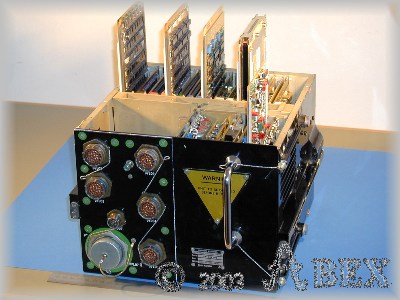
http://www.baigar.de/TornadoComputerUnit/p8172677.jpg
Beginning of 2005 I got this small airborne computer via eBay and
I bought it mainly because of the 96k of core memory inside. Those
days some of these have been sold by ABEX and it is still on their web
page:
http://www.abex.co.uk/sales/electronic/other/programmer/item.htm
But they do not have them any more :-( :-( :-( (see below)
In this forum William Maddox mentioned an eBay auction regarding
one of these in his Nov/17/2003s posting "Latest EBay finds,
including a real museum piece". After getting the unit I
disassembled it and noticed that this must be a complete
computer (size a little bigger than a shoe box) and I tried
to collect information. But as expected no one was able
supply significant information so I started
PHASE0 (January 2005):
Inspecting of all PCBs I drew basic wiring schemes and
located the major parts of the system as timing generation,
core logic, core drivers, microcode, ALU and so on. It became
clear: THIS IS A 12-BIT MACHINE.
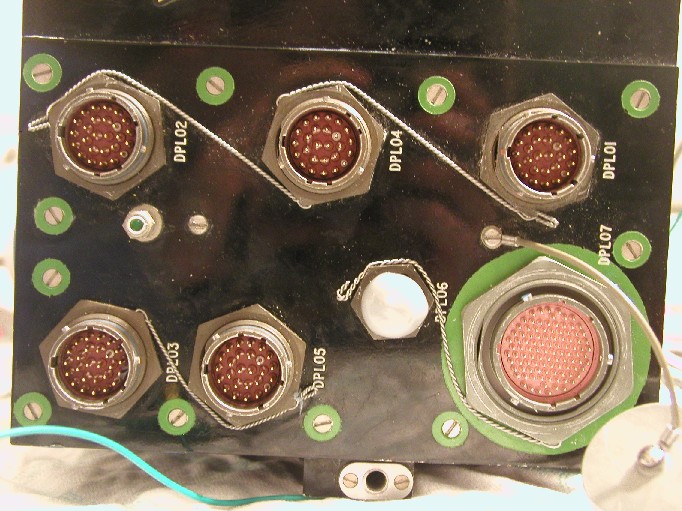
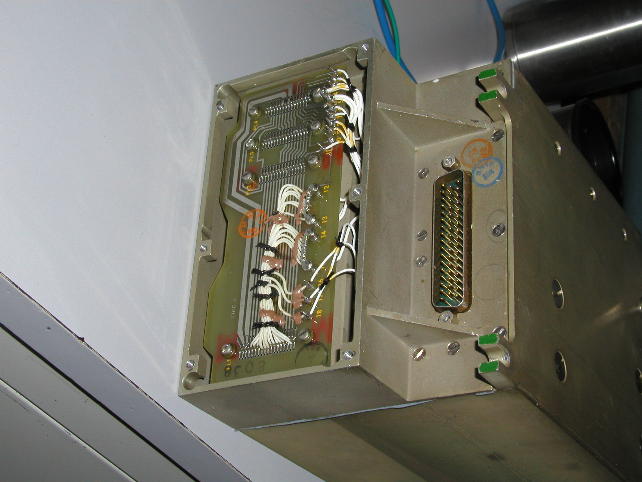
The number of connectors of the box is limited (one for power,
5 plugs connecting to some kind of serial differential links and
only one very big 135-pin beast). Since the big plug was
the only one equipted with a protection cover I got the hope,
that everything neccessary to operate the unit is within the
one box I have got and not distributed over more devices.
http://www.baigar.de/TornadoComputerUnit/Connectors.jpg
Here I made the decision to continue reverse-engineering with
the goal to make the unit OPERATIONAL.
PHASE1 (March 2005):
I put the core memory aside and investigated the power supply.
Since I do not have got the 100V-tree phase AC of some weired
frequency, this small switch mode power supply seems to
quire, I figured out what voltages this generates and supplied
them from external supplies (5V, 8A; -5V, +12V and variable
voltage for core). I also located the "power good" signal and
applied this, too. See pictures:
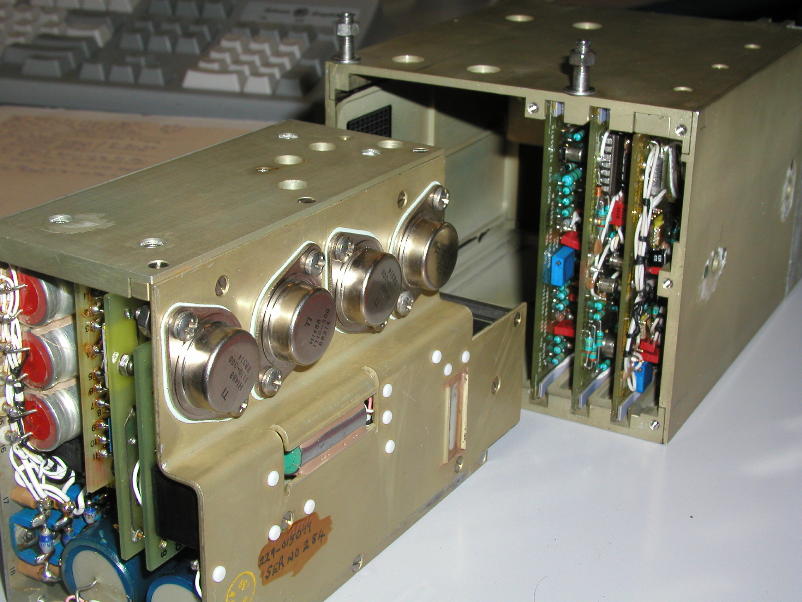
http://www.baigar.de/TornadoComputerUnit/SupplyWithSubAssembly.jpghttp://www.baigar.de/TornadoComputerUnit/SupplyBackplane.jpghttp://www.baigar.de/TornadoComputerUnit/PowerSuppSubAssy1.jpg
Now I was able to supply power and observed with the oscilloscope
that there is activity. Now I thoroughly examined the core section
until I had a good idea how it works, leading to
PHASE2 (April 2005):
supplying data to the data lines by using a 12-bit DIP-switch.
This allowed me to make te processor reading the same word
of data over and over again and therby stepping through the
whole address space.
http://www.baigar.de/TornadoComputerUnit/Switches.jpg
With this I characterized the core memory timing, I tried
to identify important lines, refined my schematics and
connected a logic analyzer to all vital signals. In applying
different patterns I already discovered read instructions,
2-cycle instructions, read-modify-write instructions and
some instructions freezing the unit and requiring a power
cycle (not only a reset pulse!):
http://www.baigar.de/TornadoComputerUnit/Switches.jpghttp://www.baigar.de/TornadoComputerUnit/DeviceUnderTest.jpg
In parallel I did detective work on the stickers and
posted my information to a thread in rec.aviation.military.
This lead to the suspicion that the unit is from an early
tornado aircraft (probably only from one of the first
prototypes) and was responsible for controling some kind
of display:
http://www.baigar.de/TornadoComputerUnit/Sticker1.jpg
These experiments showed me that (a) the machine is not
completely dead and that (b) the command set is not
compatible (this was my hope first) with the well known
PDP8 or any other known 12-bit machine. So what was
needed was
PHASE 3 (Sep 2005)
an in-circuit analyter and the possibility to read
and write core memory. With quite a amount of reverse-
engineering, thinking and try-and-error I discovered a
DMA mechanism which in my opinion was used to load
software onto the unit via the big plug - but was
unused during normal operation (big plug sealed off).
Since I hate any PC-stuff and I needed a powerful
and real-time capable tool to generate the appropriate
timing for writing into the core, I decided to use a
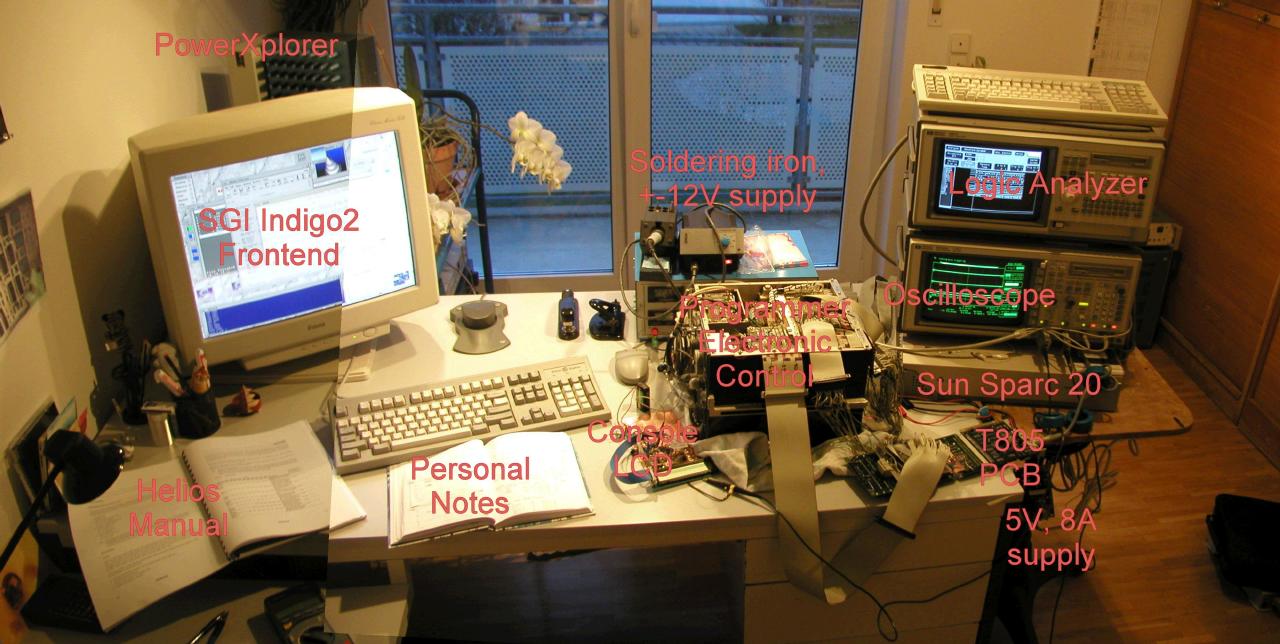
vintage transputer board from a ParsyTec-Megaframe,
running the operating system helios (beautiful
unix-type parallel OS) which I connected to the Programmer
Electronic Control using a homemade interface PCB and
flat ribbon cables:
http://www.baigar.de/TornadoComputerUnit/TrapuInterface.jpg
During this process I refined my schematics again,
analyzed the ALU and the timing generation and made more
professional connections to the logic analyzer:
http://www.baigar.de/TornadoComputerUnit/Connection.jpg
Here much efford went into establishing all the
tools needed - but it was worth the efford, since in
this environment the complete cycle of
- doing a modification (solder iron),
- booting the helios (UNIX!),
- triggering the logic analyzer
- launching the test software
- read out the results
only takes 20 seconds. To be on-topic here: Vintage techniques
involved in the setup:
+ Sun Sparc 20 for GPIB-interfacing to logic analzyer, and
for booting the helios client via BBK-S4 board.
+ One T805 entry-node of a Parsytec PowerXplorer for
development and ompiling of the helios software.
This is booted from the SunSparc 20 as well.
+ SGI Indigo2 as frontend and data processing.
Soon the timing matched what the processor does on its own.
PHASE4 (Nov 2005):
I inserted the core memory and tested my tools on word 0
only (read, write) and it was perfect. So the hope was to
recover information still sitting in the memory. But
after doing tests on word 0 and than reading the remaining
4095 words, I only discovered some type of test pattern
beeing inside the memory. But now the tools worked very well
allowing cycles of
(1) Write test patterns
(2) Let unit execute some cycles
(3) Observe dataflow (logic analyzer) and read out
core memory.
(4) Put data into files for later analysis (dinotrace).
One of these cycles takes around 15 seconds.
PHASE5 (Jan 2006):
Doing lots of cycles I discovered lots of commands and
instructions. So this lead to defining a own assembler
language.
In parallel I implemented an assembler understanding the
already discovered commands and generating files suitable
for writing into the core memory. So it became more and
more comfortable to write test programs to analyze new
instructions.
In this manner I analyzed systematically the whole 12
bit space to discover jump instructions, arithmetic
instructions and so on. In summary this is a VERY
ARCHAIC and unusual machine:
- THE MACHINE HAS 1 ACCUMULATOR
- THERE EXISTS ONE INDEX REGISTER (indirect addressing)
- CALCULATION IS DONE IN 1-complement!!!
- NO CARRY-FLAG (essentially all arithmetic
only uses bit 0-11, bit 12 is sign/carry)
- SHIFT-COMMANDS use a hidden 12bit SHIFT REGISTER!
- There is a MULTIPLY-INSTRUCTION (did not expect this!)!!!
- Only one instruction for ABSOLUTE JUMPS using
a very delicate table jump algorithm. This can
be used to simulate someting like a CALL (no stack
on this unit!) - Really ugly!
Doing this it became obvious that the unit has problems
in accessing the upper 4k words of memory. In doing so
it freezes, requiring a power cycle to recover. So far
I was not able to locate the problem and unfortunately
all attempts to get hands on a second unit for swapping
the micro code and sequence generator failed.
# ##
### #
# #
##### #
# #
### #
# ##
It must be a problem with micro-code since the
unit can execute code in the upper half, but
data access fails.
In writing bigger programs I encountered problems in my
transputer setup related to refresh cycles on the transputer
PCB:
PHASE 6 (Nov 2006):
The box itself runs at 1.2us cycle time for core accesses,
but the core timing has to be accurate to <30ns for
proper operation. The built-in refresh of the DRAM
on the transputer lead to an error-rate of approx 1%
in my tools writing and reading core. So a small PCB
had to be added to the transputer setup to detect
this refresh cycles and to synchronize the helios
software to them:
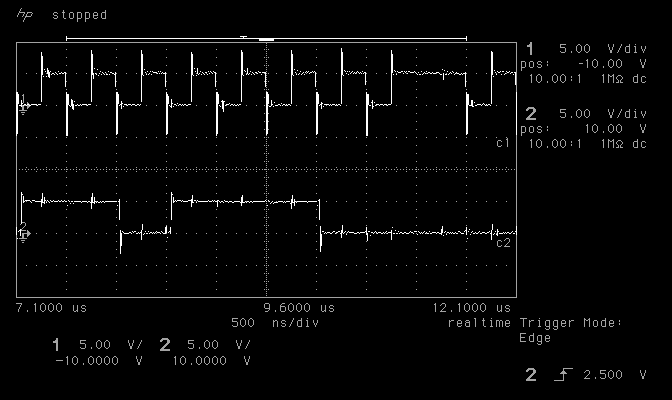
http://www.baigar.de/TornadoComputerUnit/RefreshDetect.jpghttp://www.baigar.de/TornadoComputerUnit/T805refreshOK.jpg
With this the error rate dropped to 0.004% which is
more than enough for the application. From there on
the complete setup did not change any more:
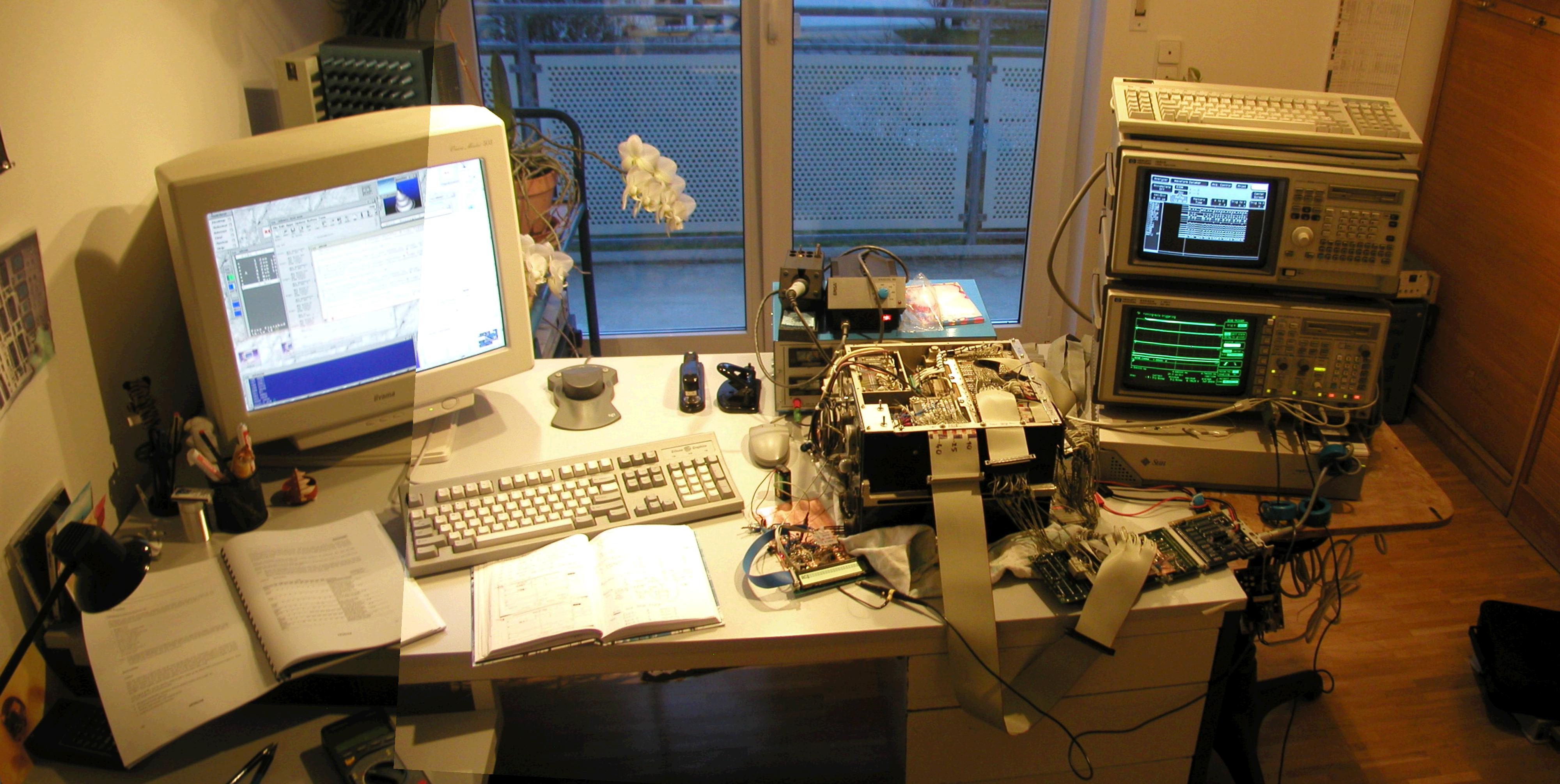
http://www.baigar.de/TornadoComputerUnit/SetUpPanorama.jpghttp://www.baigar.de/TornadoComputerUnit/SetUpPanoramaExplained.jpg
Today the assembler understands approximately 25 instructions,
generates appropriate warnings and errors and warns if an
instruction will freeze the unit (TCL together with m4 makes
it very easy to write such a macro-assembler and tcl past
8.4.7 is reasonable fast to lead to very short compile
times even on my slow hardware)...
PHASE 7 (Jan 2007):
A closer look at the serial links revealed that they are
some type of serial, differential SPI buses, allowing messages
of 12 bit + 2bit identifier + some kind of address. Not
all identifiers can be sent out on all plugs. These
interfaces (as my limited understanding of this is) should
be panavia-link or short panlink interfaces. But sorry - I do
not know any details about this:
http://www.baigar.de/TornadoComputerUnit/PanLink1.gif
The latest action was, to build a small interface PCB to
decode the messages, i.e. seperate data from address and
identifier and generate CS and CE signals. With this
it is possible to connect different devices to these serial
links in the future.
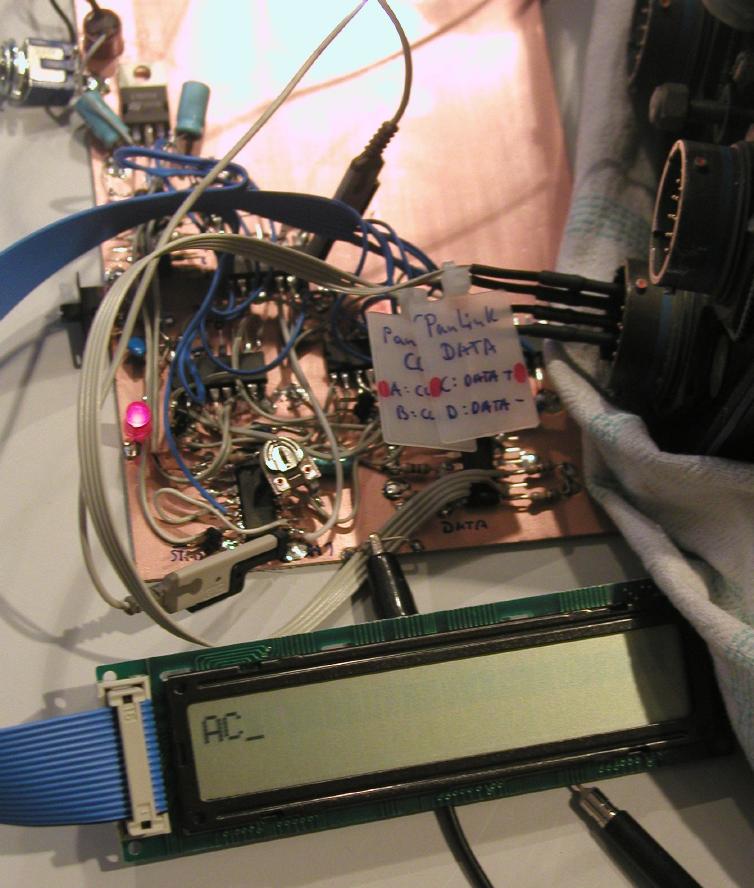
The first device I connected two weeks ago was a small LCD
display and look - it works:
http://www.baigar.de/TornadoComputerUnit/ConsoleLCDonDPL03.jpg
In my assembler, this "Hello World" looks like this (including
initialization of the display):
reset: MTA 0b00111000 ; Display Initialisieren (8bit, 5*8 chars)
WDPL3.ID0 0 ; Befehl ans Display (RS=0)
DELAY(4200) ; Warten 4.2ms bis Display initialisiert
MTA 0b00000001 ; Display Loeschen
WDPL3.ID0 0 ; Befehl ans Display (RS=0)
DELAY(1640) ; 1.64ms Wait bis sich Display geloescht hat
MTA 0b00001111 ; Cursor an, Display ist jetzt leer mit Cursor
WDPL3.ID0 0 ; Befehl ans Display (RS=0)
DELAY(110) ; 110us Wait, dann hat sich das Display konfiguriert
MTA 0b00000110 ; Auto-Increment-Mode, d.h.Cursor wandert
WDPL3.ID0 0 ; Befehl ans Display (RS=0)
DELAY(50) ; Nach 50us Wait ist der Cursor an und alles bereit
;
; Text ans Display ausgeben
;
MTA Text ; Zeiger auf Text
STA Index ; initialisieren
loop: LDI Index ; Naechsten Buchstaben holen
LDA 0 ; und Daten ans Display (RS=1)
RJAZ Fin ; falls nicht 0 (das waere Ende)
WDPL3.ID0 1 ; schicken. Danach
INC Index ; Index erhoehen und warten...
DELAY(50) ; 50us Wait
rjmp loop ; Naechsten Buchstaben
Fin: rjmp Fin ; Endlos-Schleife!
In this DELAY is a macro defined within the assembler and consisting of
a simple loop.
So this is the current state!
F U T U R E :
The following things are still on my to-do-list:
(1) The unit has got a 12bit-start/compare timer which
I currently do not have access to.
(2) Approx 40 of the possible bit-patterns are not valid
commands now - either I do not understand their meaning
yet or the microcode is somehow defective.
(3) I can read data from the plugs, but I did not
discover a sync mechanism: When has data completely
arrived???
(4) There is still the problem of the unit freezing in
accessing the upper memory half.
(5) On each serial link, there seems to be an interrupt
signal. I do not know how to enable the interrupts
and what action they cause (I suppose they cause a
jump to a certain address in memory).
So thank you for reading all this junk of bad English and
maybe something was interesting for you. For me the work on
this unit was a hobby and real fun. I spent around one day a
month on this unit and my big hope would be to
G E T H A N D S O N A S E C O N D
O F T H E S E "Programmer Electronic Controls"
Best regards,
happy computing,
Erik.
> - Available software: Partly because of the availiability of the
> hardware, there's a lot of software out there. So when you
> get one up and running, you generally can do more than look
> at the blinkin' lights (though that's worthwhile in itself--much
> more soothing that a lot of other things).
DEC computers have literally two orders of magnitude more software
titles that still exist than most other systems. The closest runners
up are HP and Data General, though CHM has almost no DG software.
It is really sad how little software from other vendors has survived,
and beleive me, I've been beating the bushes trying to find it!
> I'm not quite sure how to get the message out there that this stuff's of
> potential interest - particularly without being drowned in copies of mundane
> PC software.
Guess we need to just keep putting the word out that there are places around
the world capable of reading old media. I'm saddened by the number of people
that I contact that don't want to bother sending old tapes because they are
'impossible' to read.
> I've largely come to the conclusion that it's impossible to
> actively seek out - but that it does exist out there and will sometimes turn
> up completely at random.
Frustrating, but true. The collections I know of that are still 'latent' will
probably stay that way forever, because the people who have them want to restore
their machines to read the media (a REALLY bad idea..)
>
>Subject: VMS for MicroVAX II/III (was Re: Value of a PDP/8?)
> From: "Zane H. Healy" <healyzh at aracnet.com>
> Date: Fri, 09 Mar 2007 15:19:27 -0800 (PST)
> To: cctalk at classiccmp.org
>
>> > If you want to run VMS it's fairly available.
>>
>> What would be the most appropriate version to run on a MicroVAX II or
>> III? Are there installation tape media images available somewhere?
>
>Realistically? Any version you can get on a pair of good TK50's (as I
>recall even V5.5 is 2 TK50 tapes). I've run V5.5 on my MicroVAX II before
>turning it into a PDP-11/73. I've got V7.2 on my MicroVAX III. However, I
>was able to copy the 7.2 install CD over DECnet and write it out to an RA72
>and install from that, in order to setup my MVIII.
V5.5 runs well on MV-II with full load of ram. If your less than full
ram consider 4.7 though 5.2 also runs ok that way.
>>It's not the suggestion you want, but you should think about getting a
>VAXstation 3100 or 4000 series machine. With those and a SCSI CD-ROM that
>is capable of doing 512-byte blocks you can easily install OpenVMS, and then
>remotely boot the MicroVAX II/III as a cluster node.
>
>At least I assume you aren't lucky enough to have a Q-Bus SCSI adapter.
Another option is after netbooting BACKUP you can do an image copy the disk to
the MVII, either net is slow but still faster than TK50!!! I've done this.
The 3100 I use has a small (100mb RZ2x) and it's a bootable system though
cramped and I can use backup and image copy it to RD54 sized drives via
'net. That way I clone the OS to machines then tweek it (system name and
all that stuff). Saves a bunch of time and messing with TK50s that tend to
do annoying things.
IF you have a SCSI adaptor (even if you can't leave it in the system) you
can create a disk on a 3100 or whatever and then transport the adaptor and
media to the MVII and copy to the MSCP drive.
Allison
Out of interest, whereabout in the US is good (mail order) for getting hold of
tools / test gear and components? There's only a Rat Shack in town here, which
as everyone knows is utterly useless for absolutely anything :(
> I feel the need to ask - what is it that makes DEC stuff so popular
> and collectible, versus other machines of the same time period?
> Generally they're equally as interesting, and often more so (IMHO)
> due to all the quirks and design differences versus the more
> mainstream DEC stuff.
For me, DEC was the first "real" computer that I could actually work on.
Attending the Maynard training facility was a blast. The instructors used to
have us practice troubleshooting the 11/45 by putting tape on a finger
"somewhere", and then we had to find the fault. I still remember a friend and I
going in one night to practice, putting a piece of tape on a random finger, and
taking some two or three hours to find the "problem" :). Normally, the
instructor faults would take us maybe 30 minutes max.
Later, I programmed an 11/05 as necessary when looking for faults in the control
system for a large bakery. T'was just plain fun!!!!!
y'all,
This really is a plug for a for-profit business. Flame on.
A few weeks ago there was a thread concerning sources for 7400 TTLs.
I thought my friends here stock them, but kept my mouth shut till I
had a chance to check. I was up there yesterday and they have literally
50-60 feet of 6' shelves, nothing but 74xxxx ICs.
They also have an amazing array of arcane memory modules sitting around.
I have a vested interest in this. MCH introduced me to the art of
hacking when they saved me several hundred bucks by swapping the DRAMs
on a memory module for me. They're one of the few shops I know that
still keep soldering irons and use them. I want them to stay
profitable. :^)
They're MC Howard Electronics in Austin, Tx.
http://www.mchoward.com
1-800-490-6896
eBay seller mchowardelectronics
Warning: pay no attention to the prices on the website. Call 'em up
and chat. They ship internationally.
Doc
> Jules wrote:
>I feel the need to ask - what is it that makes DEC stuff so popular and
>collectible, versus other machines of the same time period? Generally they're
>equally as interesting, and often more so (IMHO) due to all the quirks and
>design differences versus the more mainstream DEC stuff.
>
>So... why? More of a community? Better documentation? Better hardware or
>software availability? What do collectors *do* with their running DEC systems
>anyway?
>
>I'm not knocking the DEC crowd in any way - just trying to work out what it is
>that makes the systems so much more popular than anything else of the time. I
>feel like I'm missing some vital piece of info :-)
With me (and maybe with other folks too), the PDP-11 was the first computer
I ever "knew", and it is what I learned on. I think in the 1970s
the PDP-11 and PDP-8 were commonly used in academic computer centers. Once
I met the PDP-11, I was hooked. My life / career has revolved around computers
ever since.
As for what I do with my running DEC systems, I boot them up from time to time
and maybe play a game of Adventure, punch a program on paper tape on the
ASR33, print a pinup poster on the LA36 on greenbar paper, copy RK05 packs
to disk image files on my PC, etc. Periodically I will get a new peripheral
(drive, terminal, etc) and test it out and rack it with my system. Lately
I have done nothing at all because I have been too busy with other things.
Ashley
I have posted scans on my web site for the Hewlett Packard "A quick
reference to HP Time-Shared BASIC"
The guide was printed in 1969 for users of the HP 2000A.
http://www.vintagecomputer.net/hp/2000A/
I received an email from a gentleman in Burnley, England
who has recently received a NEC APC, and managed to format
A: instead of B: while attempting to backup the only system
disk ... (and he didn't have it write protected).
He's found my APC images, but he's not setup to make a
8" disk on a PC. He's asked for my help, however I
wanted to check and see if there's someone closer to him
(I'm in Canada, so it's a fair ways to post disks).
He needs someone who can either write my DOS 2.11 disk
image to an 8" floppy for him (it's in ImageDisk format),
or someone who has a working APC and can simply copy the
DOS 2.11 boot disk. He has blank disks - he just needs
someone who can put the system on one for him.
Can anyone help? Please contact me and I'll connect the
two of you.
Regards,
Dave
--
dave06a (at) Dave Dunfield
dunfield (dot) Firmware development services & tools: www.dunfield.com
com Collector of vintage computing equipment:
http://www.classiccmp.org/dunfield/index.html
> OK, so this is a pretty dumb question, but what is the 'value' of a
> typical PDP/8?
PDP8/A's appear to be the least valuable. The original PDP-8 and 8/S
much more so. Price ranges are $300 or so for an 8/A. A well configured
Original 8 with a discs and DECtape sold for well over 10K within the
past few years.
If you want something with lights and paddle switches, an 8/E with a
usable mass-storage device and full compliment of memory will be on
the order of 2K
for the St. Louis collectors this might be interesting. It may even be
the one I sold some years ago. I had both this one, and the small
keyboard package (ACT-I?) which fed composite video as well.
I wish I still had the original one, but IIRC I got quite a bit for it
in the 80's when I sold it.
maybe Jay might like this one if he doesn't have one already.
Just be sure if you buy this one or any similar to make sure they
handle the suspension of the CRT in the package. I have had a
microdata Prism for example snap the plastic mounting tabs
by not supporting the thing and then putting it in proper packaging.
jim
270095781634
>> > Where can you get real VT52s nowadays? I haven't
>> seen one on Ebay for at
>> > least three years.
>>
>I have never seen one on eBay - and I have looked
>often. Found a lot of other things that are named VT52
>though...
I have several VT52s, alive and semi-alive. I have
been clearing out some space in my shop and would be
willing to part with one of the semi-alive ones for
a small fee.
If anyone is interested, contact me off-list at
wacarder at usit.net. If you're not into component-level
debugging, I can dig up the name of a place in the
northeastern U.S. that would repair them for $125
a couple of years ago.
Ashley Carder
http://www.woffordwitch.com
> I was just at the local scrapper and had him put aside two
> RL02s, an RA81, an Unibus crate ( I wasn't able to get the
> model), a dual cassette box, and the red and orange trim
> pieces that go at the top and between the units - everything
> was about to be sent to the shredder. If there is any
> interest, let me know and I'll pass on the info. I can do any
> checkout anyone wishes later in the week.
What part of the country are these in?
Hi all,
I've just dug out my old Gemini 80-BUS computer to remind myself what
I was doing back then.....
It has a Shugart SA604 hard drive with a Xebec S1410 controller and a
Gemini GM829 FDC/ SASI controller card.....as well as two TEC FB-504
floppy drives. I have the original test certificate for the Shugart,
dated 5-16-84 signed off by the operator Barb!
I have a file with all the old user manuals, and a catalogue from the
mid-1980s with a price list from May 1986!
Question is, do I put this lot back into the cupboard, do I sell it
or do I junk it?
Any suggestions?
Richard
Pulled this out of archives:
> Chuck Guzis cclist at sydex.com
> Wed Nov 30 01:06:31 CST 2005
>
> I've got both Chi Corp./Computer Logics PCTD3 and PCTD16 Pertec-interface
> tape controlers. What I don't have is a clue as to how to drive them.
>
> Normally, this wouldn't be a problem that running down traces and some
> pencil and paper work wouldn't cure. But, other than for a couple of
> lines, much of the logic for these cards is hidden inside an early Xilinx
> FPGA. Thus far, my "pork poking" hasn't given up any information.
>
> So, I'm wondering if anyone has any information on these beasts or perhaps
> has hung onto the TDRIVER.EXE or API.EXE files. I'm not interested in
> using the files, but rather want to use them to give up some clues on how
> that blasted FPGA is set up.
>
> Thanks,
> Chuck
>
Do you still have a PCTD16? I acquired one not too long ago and have
it cabled up to a Fujistu 2444AC. I'll have to take another look at
the card. I don't remember seeing anything that looked more
complicated that 16-pin DIPs. Nothing that clearly stood out as an
FPGA.
Luckily it was acquired inside a PC with Chi API.EXE and Outright on
the MS-DOS boot drive, along with a small manual with the programming
interface for the API.EXE TSR. No sign of TDRIVER.EXE.
It didn't take too much to port the 2.11BSD maketape.c program
(http://www.tribug.org/pub/tuhs/PDP-11/Distributions/ucb/2.11BSD/) to
an MS-DOS application using the API.EXE TSR interface. Last night I
created a 2.11BSD installation tape using the PCTD16, then connected
the 2444AC to a QT13 (using a pair of Pertec cables I built up myself)
and finally got 2.11BSD installed and booting up on my 11/73.
-Glen
Someone I know *had* some 14" drives but the only thing I saw left were two 14"
platters and an aluminum casing. It sounded like the complete unit was about 24"
or so square and maybe 18" high. Rack mount? I don't know.
First, does this *really* vague description describe anything useful? Second,
there was half an aluminum casing left; is this worthwhile saving?
He is going to see if there are any more drives left, but I am kind of curious
if it is worth the effort.
At 04:03 PM 3/8/2007, Ethan Dicks wrote:
>For VT100-compatible work, it's not _too_ hard to set up an emulation
>environment that handles 99% of what's thrown at it (vttest is a good
>way to see how your emulator _really_ behaves). If you need
>double-high/double-wide or flashing chars, etc.,
I've wondered if anyone ever developed an emulator based
on an emulation of the hardware and ROM inside the terminal.
- John
Dwight,
The early Data I/O burners took individual sets of digital/analog cards
to program each prom or family. For models 1 through 9, these were
separate cards. In Models 17 and 19, the same two cards were combined in
a Card Pak (carrier) which snapped into the chassis just like the
UniPaks.
For the Intel 1702A and equivalents, the card set was the 909/919-1183-1
(909 meant the two cards alone, 919 is the same two cards in a
programming pak carrier. In either case, the card set consisted of a
"digital" card, 701-1173, and an "analog" card, 701-1183-1. The cards
were joined by cable 709-1608. In addition, a special socket adapter,
p/n 1047, was used for these PROMs. I have the programming pak carrier
minus the socket adapter and with a set of 1063 cards installed.
Unfortunately, I have no idea what the target PROM is for this card set.
I do have the calibrator and 1702 adapter card for it but without the
programming cards it really isn't too useful.
Scooter (riatla) is one of the eBay "good guys" and would probably be
willing to take a peek inside the chassis to see what cards are
included.
More to the point, I figured by now that you or one of the other listers
would have come up with a modern programmer for the 1702A - can't be too
difficult other than the -48v programming requirements and I expect a
few others would be interested in the project if someone designed one.
Jack
--
No virus found in this outgoing message.
Checked by AVG Free Edition.
Version: 7.5.446 / Virus Database: 268.18.7/711 - Release Date: 3/5/2007
9:41 AM
>
>Subject: Re: Vintage terminals (was Re: PDP-11 available in New Zealand)
> From: "Ethan Dicks" <ethan.dicks at gmail.com>
> Date: Thu, 08 Mar 2007 17:05:00 -0500
> To: "General Discussion: On-Topic and Off-Topic Posts" <cctalk at classiccmp.org>
>
>On 3/8/07, Chuck Guzis <cclist at sydex.com> wrote:
>> David Griffith <dgriffi at cs.csubak.edu> writes:
>>
>> > Where can you get real VT52s nowadays? I haven't seen one on Ebay for
>> > at least three years.
>>
>> At the expense of looking stupid (again), why not use one of the many
>> VT-100/VT-220-type teminals that also have a VT-52 mode?
>
>Dunnou about David's needs, but for my own (VTEDIT under OS/8),
>emulation within a more modern dumb terminal is rarely accurate
>enough. If you just want approximate emulation, lots of DEC terminals
>and DEC-compatible terminals do offer VT-52 emulation, but I've only
>tested and rejected the emulation in the VT220.
>
>-ethan
I use my VT320 and 340 in VT52 mode with no issues. The VT100 does it
very well. Vt220 did bse VT52 but it was a marketing error to not make
it fully compatable, something fixed in later tubes.
The hard reality is the VT52 was so limited that to write an emulation
>from scratch is fairly trivial. Heck I did a PT VDM-1 driver that did
base VT52 (video side) sequences so I could use it with Vedit and VTedit
(under cp/M and as terminal to PDP8). The only significant breakage
was 64 vs 80char lines.
What is hard is a good keyboard emulation of VT100 or VT52 on PCs as
the keypads really don't match.
PC terminal emulations are mostly plain broken.
Allison
>from ttp://arstechnica.com/news.ars/post/20070306-commodore-announces-
new-gaming-pcs.html:
"At the upcoming CeBit electronics show in Germany on March 15, a
company called Commodore Gaming is scheduled to release a new line of
gaming PCs for the European market.
"25 years ago, Commodore launched the best selling personal computer
of the late 20th Century, the C64, and defined the early computer
games experience for millions of people worldwide," said Bala
Keilman, CEO for Commodore Gaming. "We are privileged and excited to
bring the Commodore brand back to the gaming community and mark a new
chapter in its history with this exceptional machine. We're sure that
it will deliver what gamers need and want."
Cheers,
Chuck
For the record a PDP 11/04 is on offer at:
http://www.trademe.co.nz/Computers/Vintage/auction-90878548.htm
I seem to recall that comment on the list has been that these machines are
fairly easily obtained. And there's the *slight* drawback for anyone who's
interested that it's pick-up only!
Cheers,
Peter
> I suppose (or is it like that already?) bitsavers needs some form of database
This is difficult to do the way that it is hosted and mirrored currently. Right
now, it is just a directory heirarchy with a couple of files I have to manually
edit and upload every time I add something (IndexByDate and Whatsnew in the pdf
directory) There are no equivalent files in the 'bits' directory.
I know Jay would like it to distribute the transfer load across the mirrors, too.
At 07:21 PM 3/6/2007 -0500, you wrote:
>On 3/6/07, Steven Canning <cannings at earthlink.net> wrote:
>>I think the multiplexing issue has been well addressed ( no pun intended )
>>so for those who would like to mux their nixies may I suggest checking into
>>the following IC's for that purpose: 7441, 74141 and the Soviet KM1551 ( Das
>>Vadanya ! ) .
>
>I knew about the 7441 and the 74141 (such things are well covered in
>Don Lancaster's "TTL Cookbook"). I did _not_ know what the Russian
>part number is. I'll have to see if I can scare up one or two of
>those. I was thinking of breaking my large strip of Nixies into a
>clock or three.
My great treasure is a box of Burroughs 7971 nixies. I have five, or maybe
six of them. As you may know, these are "British Flag" displays that can do
any number, letter, and some punctuation. They're 4.55 inches high,
excluding the pins, and the characters are 2.5 inches high.
They have 15 segments each making designing for them a challenge. What I
want it a device I can build with a PIC or two that will display the time
and maybe the temp, plus a scrolling alpha numeric message uploaded to it
via a USB port. I see USB port boards for PIC use all over the place, but
I'm fairly daunted by the prospect of designing a circuit flexible enough
to drive 6x15 segment nixies. Maybe a character generator in addition to
the main PIC??
The other thing I want is a WWV decoder so it sets itself. Yes, I know I
could periodically set it over a USB port, but I want it to be self
sufficient if no PC is handy. The only suggestions I've gotten so far are
to cut up a cheapo atomic clock from a big-box store and salvage the 1 PPS
output from it. That might help me keep it accurate, but won't help me set
it automagically.
Others have suggested a GPS eval board. Those are certainly cheap enough
and some require no more than power and spit out NMEA strings the minute
you power them up. But GPS won't work indoors and certainly not in the
basement.
Still looking,
-Tom
-----
445. [Humor] I just got skylights put in my place. The people who live
above me
are furious. --Steven Wright
--... ...-- -.. . -. ----. --.- --.- -...
tpeters at nospam.mixcom.com (remove "nospam") N9QQB (amateur radio)
"HEY YOU" (loud shouting) WEB: http://www.mixweb.com/tpeters
43? 7' 17.2" N by 88? 6' 28.9" W, Elevation 815', Grid Square EN53wc
WAN/LAN/Telcom Analyst, Tech Writer, MCP, CCNA, Registered Linux User 385531
> On Wed, 7 Mar 2007, Jules Richardson wrote:
>
>> Jim MacKenzie wrote:
>>> Hello,
>>>
>>> I just recently got approved as a participant on the list.
>>
>> Welcome, pull up a VAX cluster etc. :-)
>
> Speaking of which, and continuing my wantwantwant: does anyone have a
> fairly recent OpenVMS VAX (i.e. beyond 7.3-something, whatever version
> shipped TCP/IP with ssh v2, or better) ? In return I can assist with
> kits
> from a recent-ish CONDIST for OpenVMS VAX.
That would be difficult. OpenVMS AXP can be done (but is not convenient
- I've been keeping tabs on the Hobbyist distro and they're trying to
remaster with v8.2, but it is slow).
v8.anything VAX would require acquisition of sources and backporting.
VAX support stopped at 7.3 (boo, hiss, and all that I suppose).
BTW, excl. a better SSH (which can be done with Multinet or TCPware,
see www.process.com [they even have hobbyist licenses]) what are the
advantages of v8 for you?
> From: "Chuck Guzis" <cclist at sydex.com>
> I can remember seeing at least one project for a crystal-controlled
> timing source using tubes (I think it used push-pull 6F6's in the
> output stage) to run an ordinary synchronous-motor wall clock. This
> would probably be during the 1940s or 50s.
>
> Does anyone remember that the oldest of said wall clocks required the
> owner to start the motor manually by spinning a little knurled shaft
> located on the back?
I seem to recall a rumor where the power companies were offering to replace at
no charge those clocks that needed to be mamually started (before my time.) The
reason had something to do with using power that didn't register on the power
meter. Anyone here know if this is fact or fiction?
At 19:41 -0600 3/7/07, ard wrote:
>Well, I've said many times the most important piece of test gear is not a
>'scope or multimeter, it's that thing between your ears. Your call :-)
Ah. My "ballast". (My family calls it 'rocks', but what do they know ...)
--
- Mark, 210-379-4635
-----------------------------------------------------------------------
Large Asteroids headed toward planets
inhabited by beings that don't have
technology adequate to stop them:
Think of it as Evolution in Fast-Forward.
Hey listmates ... some good news ... Computerworld magazine invited me to
blog for them about our hobby.
I'm really excited about this because Computerworld's site reaches hundreds
of thousands of people! This means awesome exposure for our hobby to a
prime audience of potential new collectors. (Way back in April 2004, as
many of you will recall, I announced the "Computer Collector Newsletter" ...
that started with 350-ish subscribers and reached 1,000 before I burned out
two full years later. But that's kiddie play compared to the likes of
Computerworld.)
There isn't much posted yet -- just a short bio and a short "hello world"
post. There still won't be much until post-VCF East this summer. Anyway, I
just wanted to share the good news. The classiccmp list will be atop the
blog's links page.
Feel free to suggest blog topics, etc.
- Evan
I'm curious about how cable management was typically done on the H960
cabinets when stuffed with peripherals... by DEC field engineers. As I've
racked up several peripherals for my 11/34 and tonight I was racking the
last bits I want to go with my 11/45 - the problem becomes rather obvious.
Put two RL0x's in a cab right together and you quickly realize it's a pain
cause the cables from the top one drag on the bottom drive (making it come
out too) when when pulling it out to mount platters, etc.
If you leave enough slack for the cable to go out with the drive, it'll get
caught when pushing the drive back and such. In some of the later white
"corporate cabs" I have seen (and have) spring loaded bars to ziptie the
cables to. However, I suspect this particular arrangement wasn't done on the
older H960 cabs generally - when they first came out and all.
I haven't come across much in any of the installation manuals I've seen that
really talk about routing the power and data cables in an H960 for
peripherals that slide out the front and lock on chassi-trak rails. What was
usually done historically in the field?
I can jerry rig something that will work... but I'd rather find out what was
done as installed by DEC installers at the time. I'd appreciate any advice,
pointers to manuals I must not be finding, etc.
And yes, this means I'm getting ready to revisit my 11/45 restoration. Where
I left it off, the thing was basically running (booting xxdp and running
some diags) but it had a problem with interrupts. No matter what device
interrupted, it always got a constant vector (3 or 4 or 0, I forget what).
I'm hoping Tony can direct me on how to troubleshoot that when I get back to
it. Before I start troubleshooting I need to go back and refamiliarize
myself with the box (check where I had jumpers for NPR removed, recheck all
the power supplies, move all the cards back to a sane test setup). After
that I'll be asking the wise ones here for direction :)
Jay West
> On Wed, 7 Mar 2007, Chuck Guzis wrote:
>> I never *could* figure out where the card hopper was on the
>> Advantage.
>
> No hopper.
> You have to load the cards one at a time into the card drives on the
> front. It uses special 5.25" round cards (in a square jacket), and
> permits some magnetic data storage in the spaces between the punch
> holes.
Those early 5.25" punched cards don't have the best data density, but
on the upside they beat the Apple cards (1-bit per card).
As an added feature, they come pre-punched so you don't need to mess
with them.
All "ones", though.
>Subject: Re: tools / test gear / components in the US?
>>
>> Out of interest, whereabout in the US is good (mail order) for getting hold of
>> tools / test gear and components? There's only a Rat Shack in town here, which
>> as everyone knows is utterly useless for absolutely anything :(
Digikey is one,
Mouser,
JDRmicrodevices
Jameco
I've used all of them and some others at one time or another. Ratshack
used to have Allied electonics (big supplier) but, that may have gone away.
Allison
One poster mentioned the plasma drivers keeping the array below the threshold where they would glow.
TI used to make a pair of drivers to control a plasma display. SN55500 and SN55501. Those were the military numbers, the commercial, I beleive, were 75500 and 75501.
Does anyone know if multiplexing Nixies will significantly reduce their
lifespan? Or does it in fact help versus "permanently on as needed"?
I'm not sure if it's rapid hot-cold switching that'll kill them or if it's
simply down to "on time"... (or even neither :-)
I'm reviving the Nixie-based Sudoku idea mentioned on here in the past as I
think I've found a good source of tubes in the Ukraine. Latching every digit
isn't an option (due to sheer number of ICs required), but likely failure
causes dictates how many tubes will participate in each multiplex...
cheers
Jules
> Does anyone know if multiplexing Nixies will significantly reduce their
> lifespan? Or does it in fact help versus "permanently on as needed"?
Looking at the datasheet for the non multiplexed GN4 nixie the different
cathode currents are given as ..
Cathode current 2mA
Maximum continuous current 3mA
Maximum pulse current 4mA
.. So from that I'd guess multiplexed nixies are a special breed.
Lee.
>
>Subject: Re: Copying DEC VAX set up disks rx50, help
> From: "Chuck Guzis" <cclist at sydex.com>
> Date: Mon, 05 Mar 2007 16:19:46 -0800
> To: "General Discussion: On-Topic and Off-Topic Posts" <cctalk at classiccmp.org>
>
>At sometime today, Allison wrote:
>
>> It's not 300 data rate it's 250!
Thats out of context. When I say 250 data rate I refer to the nominal
speed drive it was intended for (300 RPM) not the 1.2mb aberation.
I helps to know what the source media is for and in the case of DEC
the formats are limited in number used are easy to get data about
and recognize. Of course the file organization on that media can be
far more varied in the DEC cases A partial list includes (on floppy):
POS, RSX-11, DOS, RT-11, RSTS, Files-11, ultirx-11
VMS, VMS saveset, ultrix/VAX,
formats used for MIPS based systems,
OS8/78/278
DECmate WPS systems.
VT180 Robin (CP/M on RX180)
I likely missed something. However, the media if floppy based is
only RX01/2 (8"), RX50, RX33, and late in the game RX25(3.5" 720k) and
(RX26 3.5" 1.44m).
I understand reading a DD 5.25" disk on a 360rpm fixed speed 1.2mb drive
will give 300 as data rate. I tend to treat and sequester all 1.2/1.6mb
5.25 disks away from all other rates as they are usually PC application
with an exception outside the PC application space (RX33 for example).
So the PC I have for reading disks is a older 486/66 with three drives
on two controllers. The drives are standard 3.5" that does both 720 and
1.44m, 360k (48tpi FD55BV), FD55F for 96tpi DD (formats like RX50). I
do not bother with PC 1.2MB format and the only place it appears here
is DEC RX33 disks that my PDP11[Qbus 11/73 with an RQDX3/RX33) handles
as native. Even that PDP-11 is an unusual nonDEC configuration as it has
RX02, RL02, RX50/33 and RD52(2 of them) in a rack mount format.
I have Imagedisk, Fcopy, and teledisk and it runs dos/win95 for networking.
this makes for a predictable PC based system that is well behaved reading
formats like RX50. It was easier to put an old 486/66 minioard in a small
tower with all the disks as I had it and the ISA floppy controllers, NIC and
all needed. It has a small 420mb disk for local storage and programs
as that all that is needed sice with networking I can mount the selected
drive and copy from there usless it's an nonPC format.
For those times when it's not PC based there is a NS* crate with NS*
controller for hardsector two of my intelligent controllers for
8"/5.25"/3.5" formats that occur in the CP/M and NS*dos worlds.
>Well, let's see what the numbers say.
>
>360 RPM is 6 revolutions per second or 0.167 second/revolution
>300 RPM is 5 revolutions/sec or 0.200 seconds/rev.
>
>Thus, the raw capacity of a 300 RPM drive at 250Kbps is 50,000 bits
>or 6250 bytes. The raw capacity of a 360 RPM drive at 250kpbs is
>41667 bits or 5208 bytes.
>
>On the RX50, since there are 10 sectors of 5120 bytes, we have
>
>6250-5120 = 1130 bytes for gaps and ID marks, CRCs, etc. on a 300 RPM
>drive. On a 360 RPM drive, one has 5208-5120 = 88 bytes for all that
>overhead. Not considering gaps yet:
>
>There are 10 bytes for a IDAM: A1 A1 A1 FE cc hh rr nn cr cr, where
>cc is the cylinder number, hh is the head number, rr is the sector
>number, nn is the sector length code and cr cr is the CRC for the
>IDAM. To that, add the data preamble of 4 bytes A1 A1 A1 FB and a 2
>byte CRC and you have (without gaps) 15 bytes per sector or 150 bytes
>for a 10-sector track--and we're out of space already at 360 RPM
>before we can add the barest of gaps (e.g. 12 bytes of 00 preamble
>for the IDAM, 12 bytes of 00 preamble before the DAM...
>
>You just can't do it at 250Kpbs and 360 RPM. Heck, 10x512 is a
>fairly tight fit at 300 RPM.
>
>Cheers,
>Chuck
I agree! The trouble maker is the interrecord gaps when added to the data
fields and other "position" fields like IDAM space becomes very tight.
DEC solved this partially by truncating the end of track gap and the
Index gaps making it harder to read with a FDC that was designed
to expect them.
Allison
>
>Subject: Re: Copying DEC VAX set up disks rx50, help
> From: "Chuck Guzis" <cclist at sydex.com>
> Date: Mon, 05 Mar 2007 14:22:39 -0800
> To: "General Discussion: On-Topic and Off-Topic Posts" <cctalk at classiccmp.org>
>
>On 4 Mar 2007 at 18:00, Allison wrote:
>
>> Wrong. The RX50 format and RX33 formats are very differnt...
>
>Ah. So an easy accommodation is to declare a 360RPM 1.2MB drive as a
>1.44MB 3.5". That keeps the 250Kbps data rate for low density while
>the drive keeps spinning happily at 360 RPM. There's still the issue
>of the missing IAM gap, but some National chips (8473 IIRC) seem to
>be a bit more tolerant.
>
>Cheers,
>Chuck
DEC did do 3.5" formats those wer RX25(720k) and RX26(1.44m) and they did
appear on later uVAX3100s.
Allison
While repairing our VT11 that hangs the Unibus as soon as you point the
light pen to the high frequency fluorescent room illumination (which makes
playing lunar lander a pain) I've discovered that the schematics of the
M7014 board (bus control & bootstrap) as found in the GT40 engineering
drawings (from bitsavers) do not correspond to our board (a M7014-YA).
The document number for the M7014 board is D-CS-M7014-0-1.
Does anyone have the document numbered D-CS-M7014-YA-1 in electronic form
(or even the complete VT11 engineering drawings)?
Christian
> Personally I find I sometimes get lost in the archive (via the web interface)
> though as a filename often doesn't obviously correspond to a document title.
The file naming has evolved over the 7+ years. In general, anything new is being
added with <manual part number> <title> <date>
This started on a system with 32 character file names, so <title> was ruthlessly
truncated, and as you noticed, <title> wasn't always the document title.
The worst problem with the current arrangement is file renaming and rearrangement
of the heirarchy. I'm not sure if the mirrors reflect these rearrangements.
In general though, it seems to serve it's purpose, so I'm not inclined to spend
a lot of time adding database functionality to it.
I've been working on a MUCH harder problem on how to organize the CHM digital holdings,
of which the bitsavers archive is a fairly tiny part.
Richard wrote:
> "Some day in the future" features
> - extract first page of the PDF as an image and link with a
> thumbnail
I have done things like this in the past and it is very straightforward
with e.g. PDF::API2 (one of my favorite Perl modules) or even just
ghostscript.
Somebody else mentioned databases... properly done this could be quite
handy. But the existing directory hierarchy (multi-level) really is more
amenable to the actual needs than any database system (which
unfortunately tend to "flatten" the structure).
Flattening the structure is useful for some things, but only if you
then "blow it back up" into a hierarchy. For example I could imagine a
directory of 3rd-party-DEC-compatible stuff that softlinks back into the
manufacturer's directories. This is NOT a flat structure... "A maze of
twisty passages all alike" is a better analogy!
Tim.
Hello,
I have two Meiko Computing Surface nodes I'm hoping to soon finally get
round to restoring. Removal of dust, cobwebs and rust is one thing, but I
sadly don't have any software for them, e.g. 'MeikOS', CS Tools, link
adapter drivers etc.
One is a 1st generation CS with boards filled with transputers, a
host/monitor board, RAM card and gfx card. Also have a PC ISA link adapter
and a connecting cable made from something akin to miniature flat twinax
(well the links did run at 10Mb/s).
The 2nd node is a later CS/i860 (aka Concerto), which again has
transputers but also as the name suggests i860 CPUs, and a module which is
a Sparc 1+ front end processor. Sadly the HDD had died and so I couldn't
recover the SunOS 4 install along with the kernel bits for the link
adapters and any other platform software. Pretty sure the NVRAM has had it
too but that is the least of my worries...
If anyone could help locating any Meiko software else just point me in
the right direction it would be very much appreciated.
Regards,
Andrew
----------------
Andrew Back
a at smokebelch.org
Jules wrote:
> I suspect the main problem with any of this is that
> bitsavers need mirror sites - and any introduction
> of a database on the primary site means that the
> mirror sites need to use the same database and
> the db contents need to be kept
> in sync :(
Don't make it any more complicated than it has to
be - a .CSV file would be perfect and anyone could
use it with "grep" or just the find function in their
browser or do cgi-bin stuff with Perl on it.
Tim.
Could somebody remind me of a source for proper replacement bulbs for the
RL01/2 and RA8x drives? Sorry if this is a repeat question - I was pretty
sure it had been discussed before, but I couldn't find an answer.
BTW, the RL0x and RA8x bulbs are mechanically similar, but they're
definitely not the same bulb.
Thanks,
Bob Armstrong
Try here http://bitsavers.vt100.net/roytron/
Tell me if you want to sell one it does not need to be working
My father was the inventor for this unit (see US Pat. 3201570 - Filed Dec
27, 1961)
Jeff Perez
Date: Mon, 05 Mar 2007 21:34:19 -0800
From: "dwight elvey" <dkelvey at hotmail.com>
Subject: RE: Multiplexing Nixies
>>From: Jules Richardson <julesrichardsonuk at yahoo.co.uk>
>>
>>Does anyone know if multiplexing Nixies will significantly reduce their
>>lifespan? Or does it in fact help versus "permanently on as needed"?
>>
---snip---
>Hi
>It is not a good idea to multiplex Nixies.
<snip>
---------------------
Well, good idea or not it was certainly common practice. Some info at:
http://wps.com/archives/Burroughs/index.html
(N101 & N102)
mike
--- dwight elvey <dkelvey at hotmail.com> wrote:
> (...) I've seen it a lot on older radios. It is easy to spot, the metal
> is all expanded and crumbles.
That condition (called "Zinkpest" in German) is also well known (and loathed!) for attacking the rotor disks in some types of old pinwheel calculating machines, especially those made in GDR and Russia.
So long,
--
Arno Kletzander
Stud. Hilfskraft Informatik Sammlung Erlangen
www.iser.uni-erlangen.de
"Feel free" - 5 GB Mailbox, 50 FreeSMS/Monat ...
Jetzt GMX ProMail testen: www.gmx.net/de/go/mailfooter/promail-out
> Does anyone know what PROM/EPROM types this machine will
> program? Is it able to do 1702A's ?
http://cgi.ebay.com/ws/eBayISAPI.dll?ViewItem&item=190088001102
It is totally dependent upon the programming module plugged in.
Prior to the Unipak, every prom family had its own adapter
socket adapter 715-1318-1 doesn't jump out at me as a known type
you can try contacting the seller to see if there is an adapter
table in the manual, though it has been my experience that sellers
will rarely respond to such questions.
I've hacked together an RSS feed for the 50 most recently added PDF
files to bitsavers based on pdf/Whatsnew.txt.
<http://www.xmission.com/~legalize/vintage/bitsavers.xml>
I'd appreciate it if some other people would subscribe to this RSS
feed in their web browsers/RSS readers and let me know how well it
works.
Features:
- parses out the file path from pdf/name/name/name.pdf to
'name :: name :: name', hopefully trying to make it more legible.
- Takes anything after the first space on the line to be a
description of the file. These haven't been added to the .txt
file for some time, but if they're there, I'll pick them up.
- adds categories based on the first name in the path, i.e. the
company name folder on bitsavers
- includes the PDF itself as a linked attachment (through the
vt100.net mirror)
- is updated once an hour
- is generated from a one page perl script
"Some day in the future" features
- extract first page of the PDF as an image and link with a
thumbnail
--
"The Direct3D Graphics Pipeline" -- DirectX 9 draft available for download
<http://www.xmission.com/~legalize/book/download/index.html>
Legalize Adulthood! <http://blogs.xmission.com/legalize/>
Cathode poisoning in nixies is caused by them being left on the same
digit for a long time, usually days or months. Consistently running them
on the same digit (first digit in a 12-hour clock, first digits on a
frequency counter that doesn't blank unused digits) will also cause
relative darkening of the adjacent cathodes, and occasionally some
sputter will actually cause an internal short circuit which may or may
not ultimately destroy the tube. Multiplexing should extend the life of
the tubes. Running nixies at less than their rated current will increase
their lifespan, and running them over-current for shorter periods will
often rejuvenate them.
Regards,
Micah Mabelitini
Your OS depends on the keyboard. HP 400s were the "hybrid" models made
after HP acquired Apollo, so from the factory they were set up to run
either HP-UX (9 or earlier) with a HP-HIL keyboard or mouse, or
DOMAIN/os (Aegis) with a Domain keyboard. Switching between the two
requires keyboard/mouse swap and setting one value in the NVRAM.
I've only used DOMAIN on my 425, since HP-UX of the early '90s has been
described as not spectacular. SR10.4 works well, and with the y1k997
patches it seems to tick along just fine in the 21st century. DOMAIN is
neat since it's so network-transparent and very unusual, but with the
BSD or SysV environments the learning curve is not nearly as big as
with the Aegis environment.
Of course, NetBSD can be run on them with a HP-HIL keyboard setup as
well, but I think it's pretty evident which camp I'm in. Bear has some
manuals on his site (www.typewritten.org)
Scott
thanks Richard!
> Takes anything after the first space on the line to be a
> description of the file. These haven't been added to the .txt
> file for some time, but if they're there, I'll pick them up.
If someone wants to add the descriptions, that would be great. I should
do it when I add the entries, but..
Has anyone considered teaming up with someone who makes neon signs to make
a nixie tube?
--
David Griffith
dgriffi at cs.csubak.edu
A: Because it fouls the order in which people normally read text.
Q: Why is top-posting such a bad thing?
A: Top-posting.
Q: What is the most annoying thing in e-mail?
I don't know about cases but I do remember a TV program where an IBM guy
reached into a drawer and produced the first and original wire wrapped
8088 PC prototype board. Talk about 'mother of many'!!
Rod Smallwood
-----Original Message-----
From: cctech-bounces at classiccmp.org
[mailto:cctech-bounces at classiccmp.org] On Behalf Of Fred Cisin
Sent: 05 March 2007 20:44
To: General Discussion: On-Topic and Off-Topic Posts
Subject: Re: place your bets
> > Did the earliest prototypes of the PC, and later AT, that Microsoft
> > got to work with have cases?
>
On Mon, 5 Mar 2007, Chris M wrote:
> Whether that question is rhetorical or not, I haven't the answer. Are
> there pictures of these things somewhere out there?
not rhetorical
(Don't you hate rhetorical questions?)
There don't seem to be pictures, and the people are getting scarcer.
I had a friend who worked at Microsoft in those days (and before, when
you could ask for somebody on the phone by first name), but he died a
few years ago.
>
>Subject: Re: Copying DEC VAX set up disks rx50, help
> From: "Dave Dunfield" <dave06a at dunfield.com>
> Date: Sun, 04 Mar 2007 07:00:53 -0500
> To: "General Discussion: On-Topic and Off-Topic Posts" <cctalk at classiccmp.org>
>
>> Image Disk reads it with out errors
>> 0/0: 300k DD 10 sectors of 512 bytes - G1:9 G2:17
>> 0/1: Single sided
>> 0/0: Single Step
>> 800 sectors (800 data, 0 compressed, 0 unaval)
>> Read complete
>>
>>
>> Trying to write and it has errors from the get go.
>> 0/0: 300k 10 sectors of 512 bytes
>> :format error <0> overun
>> :write error <2> no sector
>> and on .............................
>>
>> written on a PC with 1.2 HD drive
>> Tried on another 1.2 and on a 360k drive
>> all capable of SD .
>>
>> I tried both HD and DD disks . all bulk erased first.
>
>Don't use HD disks - as ImageDisk noted in it's initial
>report, all sectors in the image are double-density.
To affirm this, as exDEC RX50 is DD (250kbs).
>You didn't show all the information, but since it's
>single-sided, 10 sectors per track, and there are 800
>sectors, this tells me it's an 80 track disk.
>
>So - don't use a 360K drive (they are only 40 tracks).
>You shouldn't need to worry about SD capability - there
>are no SD sectors in the image.
Correct The RX50 drive is a dual spindle single head
positioner 80 track (96tpi) drive.
>The 300k data rate tells me that you recorded this on a
>1.2M HD drive - I'm assuming you did not specify a 300-250k
>data rate translation when you recorded it (?)
It's not 300 data rate it's 250!
>Assuming all that, it should write back to a 1.2M HD drive
>with ImageDisk. It should also write back to a 80 track DD
>drive such as TEAC-55F or SA-460 or TM-100-4. You would need
>to set a 250->300k data rate translation to write on a DD drive.
>
>I don't have any VAX disks to try, however I have read and
>written Rainbow disks, which are also RX50 and use 80 tracks
>by 10x512byte sectors, so I know ImageDisk works with this
>format.
VAX, Rainbow and otehr DEC RX50 media are all the same save for
the filesystems. The only other DEC 5.25 formats are RX180 (Robin
aka VT180 which is 40 track single sided DD 180k) and Vaxmate
(286 PC like) that used the RX33 drive for standard PC 1.2mb
format.
There is a VAX RX33 format that was found in microVAX2000 or
RQDX3 controller for QBUS systems [must be late firmware on
the MSCP sontroller]. That format was a flavor of 1.2mb PC
format and also did RX50 using FD55GFR (aka RX33 drive). Older
firmware RQDX-1/2/3 controller only did RX50 format.
>10x512byte sectors can be twitchy on some PC setups. It
>pushes the limits of the drive and formatting more than
>the standard PC formats do. Most systems which use 10x512
>have a more flexible FDC than the PC does.
>
>Some suggestions:
>
>- Clean the heads and make sure the drive is working OK.
> Format a floppy on your PC, then read it with ImageDisk
> and see if all sectors can be written.
>
>** Don't bother looking at any other suggestions until your
>** drive is verified to be operating 100%
>
>- Make sure you are using a recent copy of ImageDisk (you
> can get the latest from my site). Some of the older
> versions had trouble with gap calculations, especially
> on "tighter" disks.
>
>- Try another PC (not just a different drive).
Important as PC controler vary in implmentation at the subtle level.
>- Try making one of the Rainbow images from my site - this
> is the same format.
> NOTE: My images reflect the true data rate of the target
> system (250k), so you will need to set a 250->300k
> data rate translation to write them on an HD drive.
> If this works, then there may be a problem with the
> imaes you have created - send me one to look at.
>
>- Check your drive speed. If it's high, try slowing it to
> exactly 360 rpm - if it's "bang on", you might try slowing
> it by 5-10 rpm - this can help if your PC is marginal at
> the gaps required for 10x512.
This works and can help greatly.
Also make sure the PC is trying to run the 1.2mb drive at 300rpm
and NOT 360 or switching to 300kbs while using the nominal 360rpm
as NEITHER WILL WORK. RX50 is NOT 1.2mb mode its a 80track flavor
of DD (400k per disk single sided). This is a foreign format
and requires forcing the PC hardware in many cases. I cheat
I use a FD55E (96tpi, single sided 360rpm only) as then the PC
cannot force 300 rpm.
>- Look at the calculated gap sizes, and try reducing them
> slightly. You shouldn't need to, but it's worth a try - PCs
> are "highly variable".
;) you got that one nailed.
>I don't have VAX disks to try, but I've just successfully made
>one of my Rainbow images using ImageDisk 1.14 and a HD drive.
>The speed test shows my drive at 359 rpm.
Rainbow RX50 and VAX RX50 are same on disk low level format.
The filesystems are very different but if your reading sectors
(raw) then they are identical. I may add that XXDP(x11 diags)
on RX50 and RT-11 on RX50 also share that common media level
format.
In DEC parlance RX50 refers to 80tracks, 96tpi, single sided
with 10 sectors per track and 512bytes persector formatted
at a data rate of 250kbs @360 rpm. It also refers to the drive
known as RX50.
Hole this clears up some misconceptions.
Allison
> Will we be able to see the listing of those cards you just won from
> NASA? :-)
I'm assuming they are binaries for the IBM 704, since they are described
as 704 column binary.
the auction was
http://cgi.ebay.com/ws/eBayISAPI.dll?ViewItem&item=330095278250
> After a recent fight with some Cipher tape drives,
> trying to boot a system, I managed to badly mangle the
> leader of my boot tape.
> The BOT on a nine track is
> just a hunk of sensing foil
True, but on tapes 1600 bpi and higher there is a burst
recorded over the BOT marker on one of the tracks to identify
the density. You obviously can't move the mark very far into
the tape without running into the first data block either, even
if you force the read density, which you can't really do on auto
loading Ciphers.
I have spliced new leader onto damaged tape before, using
analog tape splicing techniques (diagonal cut with two overlapping
pieces, then tape on the back). From memory, Cipher drives don't
have flux gates (little door over the top of the head). Thin clear
packing tape works OK, but don't plan on reusing the tape after you
get the data off.
>
>Subject: Re: Copying DEC VAX set up disks rx50, help
> From: ard at p850ug1.demon.co.uk (Tony Duell)
> Date: Sun, 04 Mar 2007 03:00:37 +0000 (GMT)
> To: cctalk at classiccmp.org
>
>> I dunno, RX50 format is easy to copy. Make sure that your 1.2M drive
>> is declared as such in the BIOS setup--if it's confused with a 1.44MB
>> drive, it's not going to work, as 2D operation on a 1.2MB requires a
>> write clock (300KHz) that conforms to a 360 RPM drive. A 1.44MB
>> drive is 300 RPM--so any attempt to write a 2D format using a 250KHz
>> clock rate is guaranteed to fail--you'll run out track before you run
>> out of data.
>
>I once saw a PC multi-I/O card that couldn't do the 300kbps data rate, I
>think it just did it as 250kbps.... Needless to say that card went
>straight back to the suppliers...
>
>Anyway, with so few people (other than on this list :-)) using 5.25"
>drives now, I wonder if most modern PCs can still generate the 300kbps
>rate, If not, this could explain the problems the OP is having...
>
>-tony
Wrong. The RX50 format and RX33 formats are very differnt. The RX33
is PC compatable and was not used for VMS floppy sets. The RX50 drive
is a Single sided 80 track (96tpi) double density drive with the oddity
of two spindles and one head positioner. I have used FD55F as a single
drive repelacement as RX50s are not very reliable and noisy (acousticlly).
The RX33 drive (FD55GFR or similar) in the slow mode also works fine.
The problem is to fit 10sectors DEC used the WD1793 and fudged the format
some to truncate the Index mark gap and end of track gap.
The 765 will read this if: it is the 765A or 7265 and the drive is not
running fast (works better if running 1% slow!). The 765 has a built in
ship over index time and the later versions had this time shortend or
eliminated in the case of the 7265. The easy fix is slow the drive a
few percent till it starts reading. The hard way fix is to crank up the
clock driving the 765by 2% (replace the 8/16/24or 32mhz clock with
one 2% faster). It's harder as finding a clock that is just a tad faster
is not common. FYI: some PC floppy controller work better than others
due to implmentation differnces internal to the integrated flavors of the
765 (9266, 8243, 37C65m 37C665...).
Me I cheat, I use either the PDP11 or a real microVAX with RX50 or rx33
and avoid the pain.
Allison
Chris M wrote:
Ok, here's probably the zaniest question of the week.
How many computers/terminals/or-what-have-you used
happy colorful keytops? I really expect you all to
work hard at a comprehensive list this time, or I'll
get so mad I just might quit the list! LOL LOL LOL
don't count on it!!
Billy: I'm certain you'll see all kinds of answers. This is an old idea,
reinvented every generation of keyboards. Coloured keys was a common
technique long before the PC world. In the late '50's, different colours
were used to indicate which keys represented instructions - this was back in
the days of inputting your program directly through the keyboard. A good
example is the RPC-4000 or LPG-30.
Before that, there were some keyboards that were used for more than one
language, with switches to control the language. I saw this on some of the
Fujitsu computers of the mid-50's. The keyboard could input normal English
characters or Kanji. The Kanji characters were colour coded to reflect the
root character.
Saw that same concept on many other keyboards that used characters unique to
a language all through the early computer industry around the world.
Going further back, some of the linotypes were modified for special
characters and used different coloured key tops for special characters.
I've seen photos of this from the 30's and 40's.
I'll have to ask the typewriter egroup what they think is the oldest. I
would bet it goes back to the earliest typing machines.
Billy
Got a call from someone here in NJ. He has about 10
older computers, 1 has the old style "10 inch" floppy
drives. I have to assume that means 8 inch (didn't
bother getting into that with him over the phone) -
but what could it be??? My bet is some sort of Tandy
something or other, for these are the most commonly
found units with those drives. He has to take pictures
and whatnot and e-mail them to me. I haven't got any
finger nails left...
There never was a 10" drive, was there?
____________________________________________________________________________________
Need a quick answer? Get one in minutes from people who know.
Ask your question on www.Answers.yahoo.com
Evening folks,
Anyone know of a decent source of BC16e cable? We're trying to replace a
drum of the stuff at work so we're not after it for nothing (though that's a
nice price :)) but actually finding a known source in the UK is proving
difficult.
Any tips appreciated.
--
Adrian/Witchy
Binary Dinosaurs creator/curator
Www.binarydinosaurs.co.uk - the UK's biggest private home computer
collection?
> Also, does anyone who has sold up there know what time to be in line or to get
> there?
Used to be before dawn, and over by noon.
It gets off to a slow start now, so any time before 7.
The Livermore swapmeet was "mudded" out Sunday, so I am planning on being at the
De Anza (foothill) swapmeet in Cupertino (California) this Saturday. I'll be
bringing a bunch of stuff I owe to people up there, so if anyone sees anything I
have on VCM they would like to buy and have me bring up, let me know. I like
"free" shipping :).
Also, does anyone who has sold up there know what time to be in line or to get
there?
Date: Sun, 04 Mar 2007 13:51:46 -0500
From: "Curt @ Atari Museum" <curt at atarimuseum.com>
Subject: Re: QB Format?
Mike,
Let me know if you do have a copy please.... thank you.
Curt
--------------------
That might take a while considering the state of my floppy collection,
but I'll keep an eye out (if my recollection is even correct).
Meanwhile, try the Amiga version if you can, and also look around
for various others; there were several programs named Qbackup and
it might well have been one of those.
mike
=================================================
-------------
M H Stein wrote:
> Message: 33
> Date: Sun, 4 Mar 2007 00:50:22 -0500 (EST)
> From: bpope at wordstock.com (Bryan Pope)
> Subject: Re: QB Format?
> To: cctalk at classiccmp.org
> Message-ID: <20070304055022.8D0C4162B4 at mail.wordstock.com>
> Content-Type: text/plain; charset=us-ascii
>
> And thusly were the wise words spake by Curt @ Atari Museum
>
>> I'm going through and archiving 3.5" disks onto my PC, I've run across a
>> box of disks marked:
>>
>> QB Format and I am unable to read them with some of the disk utils I
>> have, is anyone familiar with this format and know what system it
>> belongs too? I was thinking Amiga perhaps, but I haven't been able to
>> find any reference to Amiga and QB format.
>>
>>
>
> QuarterBack? An Amiga backup program...
>
> Cheers,
>
> Bryan
> -------------------------------
> Also used by PCs; might even still have a copy somewhere.
>
> mike
>
>
>
-------------- Original message from "Dave Dunfield" <dave06a at dunfield.com>: --------------
> > Image Disk reads it with out errors
> > 0/0: 300k DD 10 sectors of 512 bytes - G1:9 G2:17
> > 0/1: Single sided
> > 0/0: Single Step
> > 800 sectors (800 data, 0 compressed, 0 unaval)
> > Read complete
> >
> >
> > Trying to write and it has errors from the get go.
> > 0/0: 300k 10 sectors of 512 bytes
> > :format error <0> overun
> > :write error <2> no sector
> > and on .............................
> >
> > written on a PC with 1.2 HD drive
> > Tried on another 1.2 and on a 360k drive
> > all capable of SD .
> >
> > I tried both HD and DD disks . all bulk erased first.
>
> Don't use HD disks - as ImageDisk noted in it's initial
> report, all sectors in the image are double-density.
>
> You didn't show all the information, but since it's
> single-sided, 10 sectors per track, and there are 800
> sectors, this tells me it's an 80 track disk.
>
> So - don't use a 360K drive (they are only 40 tracks).
> You shouldn't need to worry about SD capability - there
> are no SD sectors in the image.
>
> The 300k data rate tells me that you recorded this on a
> 1.2M HD drive - I'm assuming you did not specify a 300-250k
> data rate translation when you recorded it (?)
>
> Assuming all that, it should write back to a 1.2M HD drive
> with ImageDisk. It should also write back to a 80 track DD
> drive such as TEAC-55F or SA-460 or TM-100-4. You would need
> to set a 250->300k data rate translation to write on a DD drive.
>
> I don't have any VAX disks to try, however I have read and
> written Rainbow disks, which are also RX50 and use 80 tracks
> by 10x512byte sectors, so I know ImageDisk works with this
> format.
>
> 10x512byte sectors can be twitchy on some PC setups. It
> pushes the limits of the drive and formatting more than
> the standard PC formats do. Most systems which use 10x512
> have a more flexible FDC than the PC does.
Thats the answer ...........................
>
> Some suggestions:
>
>
snip ............................................................... long reply, lots of help.
All is well, the disks booted a VAX 8250 with out any problems
as I said in a earlier post it was the controller that caused the problem.
I guess that why I have 6 image disk machines.
Dave if your reading this, Thanks for a great product.
1) question. I was reading some Cromemco Cromix disks
which are 360k DD with sd boot tracks on a 1.2 meg dirve
and a SD controller. Disks where all original Cromemco
or Dynatech software.
I would get
0/0: unable to determine interleave
:300k SD - 18 sectors of 128 bytes G1:7 G2:9
0/1 300k DD -10 sectors of 512 bytes G1:13 G2:20
and on.................... (xxx data, xx compresses. 0 unavil)
This did not happen on all of the disks (50%) but the first one
which is bootable, did have problems.
It seemed to read them OK, but I switch to a 360 drive
to be safe. I did not try to write any of these but would
they still work with the interleave error. The 360k drive setup
had no problems at all.
--
> dave06a (at) Dave Dunfield
> dunfield (dot) Firmware development services & tools: www.dunfield.com
> com Collector of vintage computing equipment:
> http://www.classiccmp.org/dunfield/index.html
Thanks, jerry
Hi,
I have a stack of the orginal VAX Disks (console and
set up , 5 1/4 RX50 ) The ones in front of me are
for a 8200 series. I would like to copy them but can't
get image disk to work. Is this possible or do I have to
use a VAX.. I have RT11 on a micro PDP-11 with a RX50
and I think my professional still works. But would really like to
get it on a better media for long term storage.
Image Disk reads it with out errors
0/0: 300k DD 10 sectors of 512 bytes - G1:9 G2:17
0/1: Single sided
0/0: Single Step
800 sectors (800 data, 0 compressed, 0 unaval)
Read complete
Trying to write and it has errors from the get go.
0/0: 300k 10 sectors of 512 bytes
:format error <0> overun
:write error <2> no sector
and on .............................
written on a PC with 1.2 HD drive
Tried on another 1.2 and on a 360k drive
all capable of SD .
I tried both HD and DD disks . all bulk erased first.
Thanks, Jerry
-------------- Original message from "Ethan Dicks" <ethan.dicks at gmail.com>: --------------
> On 3/3/07, g-wright at att.net wrote:
> > Hi,
> >
> > I have a stack of the original VAX Disks (console and
> > set up , 5 1/4 RX50 ) The ones in front of me are
> > for a 8200 series. I would like to copy them but can't
> > get image disk to work. Is this possible or do I have to
> > use a VAX..
>
> You should not have to use a VAX. There's nothing strange about the
> low-level format for 8200 console disks (I have an 8200/8300 in my
> basement, FWIW).
>
> > I have RT11 on a micro PDP-11 with a RX50
> > and I think my professional still works. But would really like to
> > get it on a better media for long term storage.
>
> Sure.
>
> > Image Disk reads it with out errors
> > 0/0: 300k DD 10 sectors of 512 bytes - G1:9 G2:17
> > 0/1: Single sided
> > 0/0: Single Step
> > 800 sectors (800 data, 0 compressed, 0 unaval)
> > Read complete
Heres is where I believe I missed the problem. The disks are not full
using Anadisk on the floppy, data ends at cylinder 28 and is
blank to the end. Anadisk can scan the whole disk with out errors.
with 800 data and no compressed some thing is wrong. If I understand
Image disk correctly.
I moved to another Image Disk machine (I have 6 now) and its seems to
work fine. Although I believe the proof will be by trying them. The
new readings are (800 sectors, 472 data, 328 compressed, 0 Unavail)
and the Write works with out errors. The original IMD file size was
400k the new one is much smaller. I have writen these out on both
DD and HD media. both bulk erased first.
>
> So far, so good...
>
> > Trying to write and it has errors from the get go.
> > 0/0: 300k 10 sectors of 512 bytes
> > :format error <0> overun
> > :write error <2> no sector
> > and on .............................
> >
> > written on a PC with 1.2 HD drive
> > Tried on another 1.2 and on a 360k drive
> > all capable of SD .
> >
> > I tried both HD and DD disks . all bulk erased first.
>
> Hmm... Others on the list can chime in with their floppy expertise,
> but from the way you are describing what you've tried, it doesn't
> sound as if you have a clear picture of the media in front of you.
Boy did you read that one right Thank you Ethan .............. This did help
move me along.
>
> RX50 disks are single-sided (as mentioned by imagedisk in your read
> example, above), 80-track, ten 512 byte-sectors per track for a total
> of 400Kbytes. Your 360K drive can _not_ write RX50 disks (among other
> issues, it's a 40-track drive).
>
> If you've verified that your 1.2MB drive works as a PC drive, then,
> presuming you have the right media, you shouldn't have any hardware
> issues writing RX50 images. Media is where I get a little fuzzy on
> the details. I've personally only ever written RX50 images to RX50
> media. I've never tried to recycle PC floppies, so I'm not sure what
> the best choice is. I do seem to recall that what you want should
> *not* have hub reinforcement rings, as they can cause alignment
> problems in real RX50 drives.
>
> If you can score a Teac FD55GFR drive, it can be strapped up to be a
> _real_ RX33 or strapped to behave "normally" on a PC FC controller.
> The strapping has to do with motor on and select lines, not data, BTW.
> I mention the FD55GFR because it was the 5.25" drive DEC shipped
> after they moved on from the RX50, so you can be sure that you aren't
> having hardware compatibility issues (plus, it's all-around good,
> solid 5.25" drive).
I did try this and it is the controller that causes the problem. no to sure
why ???
I have been re-reading all of my disks with image disk and have found
that many of my original disks worked fine but the copies I made on the
original hardware had bad tracks. So now I'm re-writing everything and
trying it in the original machine if possible. The machine here that did not
work was my main machine for 22disk, anadisk and teledisk. But it has a
secondary controller (compaticard 4) with 4 more external drives.
The most trouble free set up so far is a Adaptec AHA-1542cp SCSI
controller with floppy. I now have 4 PC's with this card and have not seen
any problems with single density or in this case odd formats. These are the
ISA version with a HD SCSI connector on the back. Some of the other
version of the card can't do Single density.
>
> In your case, I'd run some read/write/verify tests with your 1.2MB
> drive and PC-compatible floppies and if they show any marginal
> problems, try cleaning the heads. You can clean the heads in any
> case, but it might be nice to have a "before" picture to compare
> post-cleaning performance. If you can locate some real RX50 media,
> try writing to those. They aren't "magical", but they are
> pre-formatted for 10 sectors-per-track (MS-DOS uses 9 sectors for 360K
> disks and 17 sectors for 1.2MB disks, if you didn't remember). As
> with the RX01s, most DEC equipment can *not* lay down the RX50
> low-level format, the Rainbow being the most notable exception. A PC
> _can_ format an RX50, but you'll need some 3rd-party tool to do that -
> DOS can't by itself.
>
> I'm sure others will be able to chime in with various informed opinions.
>
> -ethan
>
> P.S. - just found this old doc on the state of RX50s and various
> versions of DOS and tools for DOS...
> http://www.classiccmp.org/rainbow/files/rx50faq.doc Dunno what OS you
> are using to write your disks, but perhaps some info in this FAQ will
> shed some light.
I have a good friend that has almost every VAX and PDD machine made
so He is going to test these.
After these disks get tested, I will post a follow-up.
Thank, Jerry
Jerry Wright
g-wright at att.net
So, I've acquired a Wyse 99gt with no screen burn, but I need to turn the
contrast up all the way to be visible. Can anyone point me to documents
or other resources on brightening the CRT?
--
David Griffith
dgriffi at cs.csubak.edu
A: Because it fouls the order in which people normally read text.
Q: Why is top-posting such a bad thing?
A: Top-posting.
Q: What is the most annoying thing in e-mail?
DEC LK Keyboard series used coloured characters and symbols on keycaps
Rod Smallwood
-----Original Message-----
From: cctech-bounces at classiccmp.org
[mailto:cctech-bounces at classiccmp.org] On Behalf Of Andrew Burton
Sent: 04 March 2007 21:42
To: General Discussion: On-Topic and Off-Topic Posts
Subject: Re: compucolor II on ebay
Chris M <chrism3667 at yahoo.com> wrote:
Ok, here's probably the zaniest question of the week.
How many computers/terminals/or-what-have-you used happy colorful
keytops? I really expect you all to work hard at a comprehensive list
this time, or I'll get so mad I just might quit the list! LOL LOL LOL
don't count on it!!
Hmmm, I can only think of one. I'm not sure whether it was the BBC or
the Archemedes, but i'm sure one of them had orange function keys (F1 to
F12?).
Regards,
Andrew B
aliensrcooluk at yahoo.co.uk
I have found a couple boxes of 8" disks; many of the disks are labeled
"backup" and are likely boring, but there were a few interesting ones:
065-060400-01
MPDTOS
FE USE ONLY
QF1
REV 7.00
(SET OF 2)
(c) Data General Corporation 1982
and
RS/30 STARTER DISKETTE REV. 6.0
FOR CS/10 MOD C1 DISKETTE #1
3-9-83
LICENSE MATERIAL - PROPERTY OF TRANSACTION DATA SYSTEMS, INC.
(and other similar RX/30 disks with other labels)
Interestingly, RS/30 is still be sold by Transaction Data Systems:
http://www.rx30.com/
If anybody wants these, I'll mail them for the price of postage. Please
reply off list.
Some of you may reacll that, back in July, I wrote about an
oscilloscope whose power transformer failed in service. Well, today I
was going through my tuit collection and found some round ones. I've
now clipped the transformer free of the circuit and removed it.
I then applied an ohmmeter to the transformer, now that it's free of
the machine, which gave me good guesses at what winding is what. Then
I got out the current-limiting light bulb rig and hooked the primary up
(well, half the primary; it has a split primary, for 115/230 mains
switching). Then I measured the primary voltage and the voltages on
various interesting windings. Based on all of this, I think I have a
good guess what's what:
- Input mains: four wires, two windings, which are connected in
parallel for 115V operation and series for 230V operation.
- 5VAC filament winding for B+ rectifier tube.
- ~800VAC CT (400-0-400) winding which is rectified for B+. (With 26V
on the 115V-nominal mains primary, this measured 176V, or ~778V when
running normally.)
- Filament winding for one HV rectifier tube.
- Filament winding for the other HV rectifier tube.
- HV supply winding.
- 6.3VAC CT winding to run the heaters for most tubes. (There are some
12V-heater tubes, but they all have centre-tapped heaters.)
- There is one more wire unaccounted for. On opening the transformer
case, I find it is a case ground.
The HV supply winding appears to be fried. I didn't bother with all
the filament windings (though I did measure the heater winding, which
appeared to be intact); the B+ supply winding seemed intact, but the HV
supply winding showed ~2V instead of the 200-300V I would expect with
~25V on the primary.
So now I'm thinking of finding a half-dozen different transformers to
run the six different pieces off of....
/~\ The ASCII der Mouse
\ / Ribbon Campaign
X Against HTML mouse at rodents.montreal.qc.ca
/ \ Email! 7D C8 61 52 5D E7 2D 39 4E F1 31 3E E8 B3 27 4B
INTEL MDS
-----Original Message-----
From: cctech-bounces at classiccmp.org
[mailto:cctech-bounces at classiccmp.org] On Behalf Of Cameron Kaiser
Sent: 03 March 2007 22:03
To: cctalk at classiccmp.org
Subject: Re: place your bets
> >>> For fun, how's about we create a list of units that had 8"
> >>> drives. Off the top of my head:
Commodore even did.
--
--------------------------------- personal:
http://www.armory.com/~spectre/ ---
Cameron Kaiser * Floodgap Systems * www.floodgap.com *
ckaiser at floodgap.com
-- "I'd love to go out with you, but my personalities each need
therapy." -----
>
>Subject: Re: Copying DEC VAX set up disks rx50, help
> From: g-wright at att.net
> Date: Sun, 04 Mar 2007 20:08:17 +0000
> To: "General Discussion: On-Topic and Off-Topic Posts" <cctalk at classiccmp.org>
>
>
>
>-------------- Original message from "Ethan Dicks" <ethan.dicks at gmail.com>: --------------
>
>
>> On 3/3/07, g-wright at att.net wrote:
>> > Hi,
>> >
>> > I have a stack of the original VAX Disks (console and
>> > set up , 5 1/4 RX50 ) The ones in front of me are
>> > for a 8200 series. I would like to copy them but can't
>> > get image disk to work. Is this possible or do I have to
>> > use a VAX..
>>
>> You should not have to use a VAX. There's nothing strange about the
>> low-level format for 8200 console disks (I have an 8200/8300 in my
>> basement, FWIW).
>>
>> > I have RT11 on a micro PDP-11 with a RX50
>> > and I think my professional still works. But would really like to
>> > get it on a better media for long term storage.
>>
>> Sure.
>>
>> > Image Disk reads it with out errors
>> > 0/0: 300k DD 10 sectors of 512 bytes - G1:9 G2:17
>> > 0/1: Single sided
>> > 0/0: Single Step
>> > 800 sectors (800 data, 0 compressed, 0 unaval)
>> > Read complete
>
>
>Heres is where I believe I missed the problem. The disks are not full
>using Anadisk on the floppy, data ends at cylinder 28 and is
>blank to the end. Anadisk can scan the whole disk with out errors.
>with 800 data and no compressed some thing is wrong. If I understand
>Image disk correctly.
>I moved to another Image Disk machine (I have 6 now) and its seems to
>work fine. Although I believe the proof will be by trying them. The
>new readings are (800 sectors, 472 data, 328 compressed, 0 Unavail)
>and the Write works with out errors. The original IMD file size was
>400k the new one is much smaller. I have writen these out on both
>DD and HD media. both bulk erased first.
>
HD media will have an increased likelyhood of errors as its the wrong
media for tha data rate.
> >
>> So far, so good...
>>
>> > Trying to write and it has errors from the get go.
>> > 0/0: 300k 10 sectors of 512 bytes
>> > :format error <0> overun
>> > :write error <2> no sector
>> > and on .............................
>> >
>> > written on a PC with 1.2 HD drive
>> > Tried on another 1.2 and on a 360k drive
>> > all capable of SD .
>> >
>> > I tried both HD and DD disks . all bulk erased first.
>>
>> Hmm... Others on the list can chime in with their floppy expertise,
>> but from the way you are describing what you've tried, it doesn't
>> sound as if you have a clear picture of the media in front of you.
>
>
>Boy did you read that one right Thank you Ethan .............. This did help
>move me along.
>
>>
>> RX50 disks are single-sided (as mentioned by imagedisk in your read
>> example, above), 80-track, ten 512 byte-sectors per track for a total
>> of 400Kbytes. Your 360K drive can _not_ write RX50 disks (among other
>> issues, it's a 40-track drive).
>>
>> If you've verified that your 1.2MB drive works as a PC drive, then,
>> presuming you have the right media, you shouldn't have any hardware
>> issues writing RX50 images. Media is where I get a little fuzzy on
>> the details. I've personally only ever written RX50 images to RX50
>> media. I've never tried to recycle PC floppies, so I'm not sure what
>> the best choice is. I do seem to recall that what you want should
>> *not* have hub reinforcement rings, as they can cause alignment
>> problems in real RX50 drives.
The Problem os If the 1.2mb drive works your're cooked as the format is
not 1.2mb or even close. You would be testing for the worng thing.
>> If you can score a Teac FD55GFR drive, it can be strapped up to be a
>> _real_ RX33 or strapped to behave "normally" on a PC FC controller.
>> The strapping has to do with motor on and select lines, not data, BTW.
>> I mention the FD55GFR because it was the 5.25" drive DEC shipped
>> after they moved on from the RX50, so you can be sure that you aren't
>> having hardware compatibility issues (plus, it's all-around good,
>> solid 5.25" drive).
Either strapping the FD55GFR for 360rpm only and 250kbs data rate only
or better yet use a FD55E.
>I did try this and it is the controller that causes the problem. no to sure
>why ???
>
>I have been re-reading all of my disks with image disk and have found
>that many of my original disks worked fine but the copies I made on the
>original hardware had bad tracks. So now I'm re-writing everything and
>trying it in the original machine if possible. The machine here that did not
>work was my main machine for 22disk, anadisk and teledisk. But it has a
>secondary controller (compaticard 4) with 4 more external drives.
FYI: IF the original hardware has an RX50 drive.. thats your problem as
they tended to have speed and alignment problems galore. when the RX50
drive is questionable (all are untill proven working!!!) I sub in a
pair of FD55E or suitably (nonDEC jumpering) jumpered pair of FD55GFR
with a hacked up cable and pull the RX50.
Since I have a collection of Qbus VAXen and Qbus PDP-11s it's far easier
to rely on the RQDX3 and RX33 drives as they do RX50 just fine and do
not incur the RX50 relability issues. Also the RX50 is just plain LOUD.
Allison
>The most trouble free set up so far is a Adaptec AHA-1542cp SCSI
>controller with floppy. I now have 4 PC's with this card and have not seen
>any problems with single density or in this case odd formats. These are the
>ISA version with a HD SCSI connector on the back. Some of the other
>version of the card can't do Single density.
>
>>
>> In your case, I'd run some read/write/verify tests with your 1.2MB
>> drive and PC-compatible floppies and if they show any marginal
>> problems, try cleaning the heads. You can clean the heads in any
>> case, but it might be nice to have a "before" picture to compare
>> post-cleaning performance. If you can locate some real RX50 media,
>> try writing to those. They aren't "magical", but they are
>> pre-formatted for 10 sectors-per-track (MS-DOS uses 9 sectors for 360K
>> disks and 17 sectors for 1.2MB disks, if you didn't remember). As
>> with the RX01s, most DEC equipment can *not* lay down the RX50
>> low-level format, the Rainbow being the most notable exception. A PC
>> _can_ format an RX50, but you'll need some 3rd-party tool to do that -
>> DOS can't by itself.
>>
>> I'm sure others will be able to chime in with various informed opinions.
>>
>> -ethan
>>
>> P.S. - just found this old doc on the state of RX50s and various
>> versions of DOS and tools for DOS...
>> http://www.classiccmp.org/rainbow/files/rx50faq.doc Dunno what OS you
>> are using to write your disks, but perhaps some info in this FAQ will
>> shed some light.
>
>I have a good friend that has almost every VAX and PDD machine made
>so He is going to test these.
>
>After these disks get tested, I will post a follow-up.
>
>Thank, Jerry
>
>Jerry Wright
>g-wright at att.net
> I was just at the local scrapper and had him put aside two RL02s,
> an RA81, an Unibus crate ( I wasn't able to get the model), a dual
> cassette box, and the red and orange trim pieces that go at the top
> and between the units - everything was about to be sent to the
> shredder. If there is any interest, let me know and I'll pass on
> the info. I can do any checkout anyone wishes later in the week.
Should have noted that the items are in Tucson, Baja Arizona.
CRC
Message: 33
Date: Sun, 4 Mar 2007 00:50:22 -0500 (EST)
From: bpope at wordstock.com (Bryan Pope)
Subject: Re: QB Format?
To: cctalk at classiccmp.org
Message-ID: <20070304055022.8D0C4162B4 at mail.wordstock.com>
Content-Type: text/plain; charset=us-ascii
And thusly were the wise words spake by Curt @ Atari Museum
>
> I'm going through and archiving 3.5" disks onto my PC, I've run across a
> box of disks marked:
>
> QB Format and I am unable to read them with some of the disk utils I
> have, is anyone familiar with this format and know what system it
> belongs too? I was thinking Amiga perhaps, but I haven't been able to
> find any reference to Amiga and QB format.
>
QuarterBack? An Amiga backup program...
Cheers,
Bryan
-------------------------------
Also used by PCs; might even still have a copy somewhere.
mike
> From: Allison <ajp166 at bellatlantic.net>
> > From: Fred Cisin <cisin at xenosoft.com>
> >Are there ANY 30 year old computer companies that didn't?
> >(not counting "consumer electronics" companies :)
>
> Apple! While there were add on 8" drives Apple started with 5.25.
Ah yes, Lobo Drives made 8" drives available for the Apple computer. The three
external drive units I have here all have 8" hard drives in the chassis as well.
I was just at the local scrapper and had him put aside two RL02s, an
RA81, an Unibus crate ( I wasn't able to get the model), a dual
cassette box, and the red and orange trim pieces that go at the top
and between the units - everything was about to be sent to the
shredder. If there is any interest, let me know and I'll pass on the
info. I can do any checkout anyone wishes later in the week.
CRC