> http://www.4004.com/
I forgot to point out that they are still requesting volunteers at the project web page linked to above (under the "How can I contact you?" heading).
I'm surprised that I can't find anywhere on-line a project to create an entire MCS4 system on a single, low-end FPGA. Am I just missing it?
>From http://www.sacbee.com/111/story/1132588.html concerning the
California budget crisis:
The state payroll system is based on the COBOL, or Common Business
Oriented Language, programming language - a code first introduced in
1959 and popularized in the 1960s and 1970s.
"COBOL programmers are hard to come by these days," said Fred Forrer,
the Sacramento-based CEO of MGT of America, a public-sector
consulting firm. "It's certainly not a language that is taught.
Oftentimes, you have to rely on retired annuitants to come back and
help maintain the system until you're able to find a replacement."
What does California's DMV use?
Cheers,
Chuck
I have a copy of it (original IBM EGA manual), apparently I made it back in
the 1980's, it's definitely a copy but it's exactly like the original (e.g.
double sided in the original 5.5 x 8.5 format). It's 168 pages ... it would
be a hell of a job to scan or copy, and since it's an odd page size, I can't
run it through an ADF "automatically".
Barry Watzman
Watzman at neo.rr.com
------------------------------
Message: 12
Date: Mon, 11 Aug 2008 22:39:12 -0400
From: Jonathan Gevaryahu <jzg22 at drexel.edu>
Subject: IBM EGA Programming manual: anyone have a copy?
To: cctech at classiccmp.org
Message-ID: <48A0F7D0.3060606 at drexel.edu>
Content-Type: text/plain; charset=ISO-8859-1; format=flowed
I'm searching for a copy of the official IBM EGA programming
manual/reference manual.
If I recall correctly, in order to actually GET that manual you needed
to have bought the $150? CGA/MDA programming/reference manual (or
something like that) and have sent in the little registration card, and
IBM sent you the EGA one in the mail.
Does anyone have a copy of it?
(a copy of the cga/mda one would be nice too, but isn't nearly as important)
Contact me off-list (or on-list if you'd like) if you do, I'm quite
willing to pay for photocopying/scanning/time/etc.
--
Jonathan Gevaryahu
jgevaryahu(@t)hotmail(d0t)com
jzg22(@t)drexel(d0t)edu
------------------------------
I'm searching for a copy of the official IBM EGA programming
manual/reference manual.
If I recall correctly, in order to actually GET that manual you needed
to have bought the $150? CGA/MDA programming/reference manual (or
something like that) and have sent in the little registration card, and
IBM sent you the EGA one in the mail.
Does anyone have a copy of it?
(a copy of the cga/mda one would be nice too, but isn't nearly as important)
Contact me off-list (or on-list if you'd like) if you do, I'm quite
willing to pay for photocopying/scanning/time/etc.
--
Jonathan Gevaryahu
jgevaryahu(@t)hotmail(d0t)com
jzg22(@t)drexel(d0t)edu
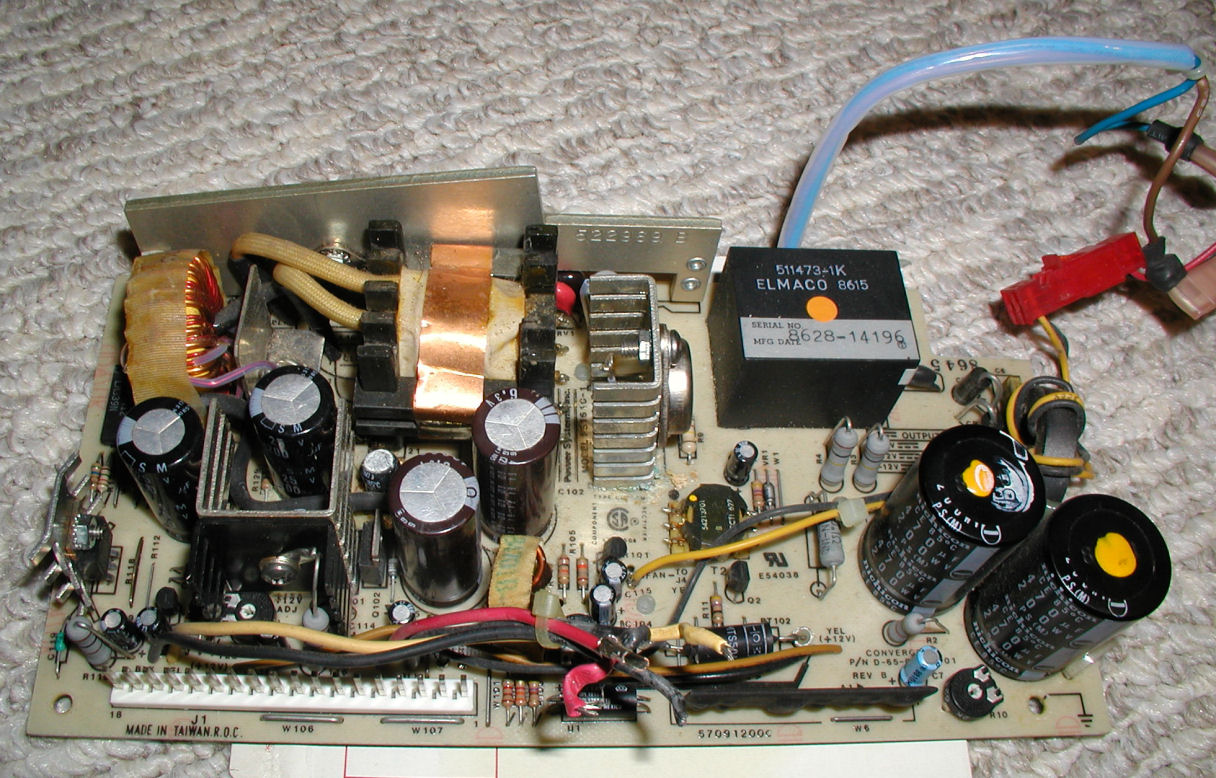
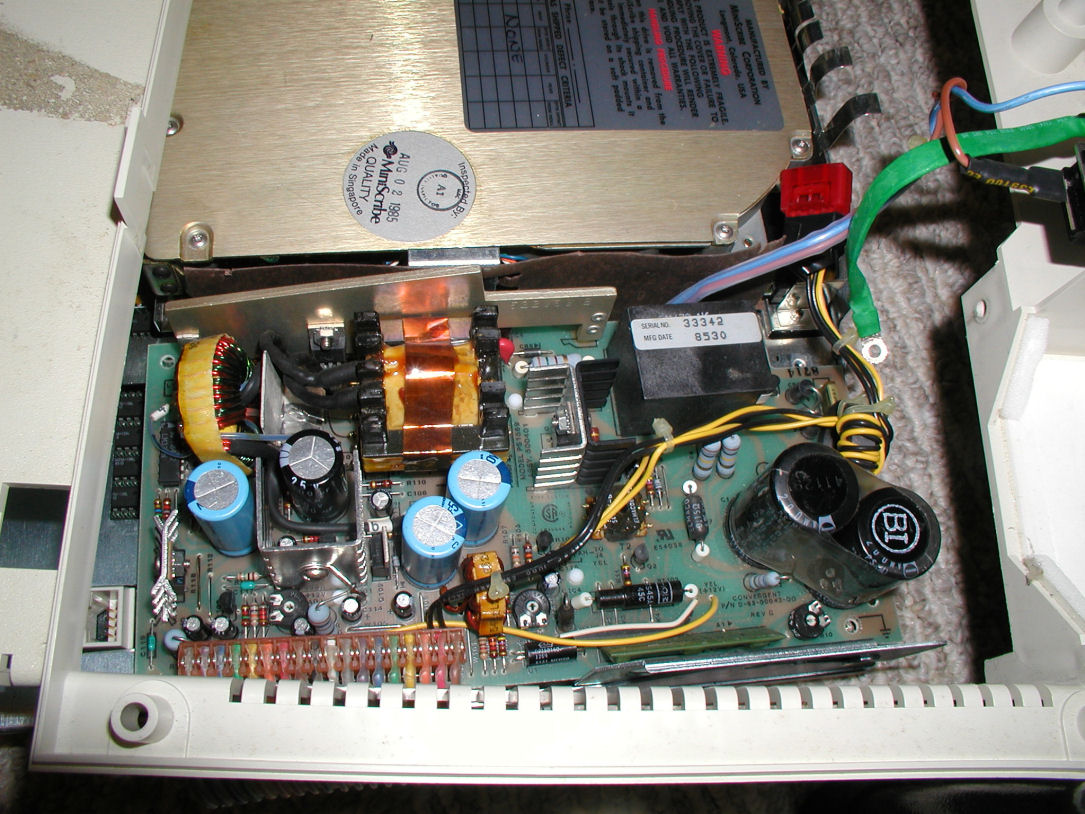
The part number on the front is "H74 a" and it's the big part of the power
supply in the back. In front (looking from the side) are 5 "h754"
modules. The modules and the console power are attached to the "H74
a" Other H74x supplies should work.
Here is the wording on the unit:
Dec Power Supply
H74 a
Caution
AC & DC OUTPUTS ARE PRESENT
WHEN LIGHT IS ON
POWER ON
(( ))
------------
where (( )) = the light bulb.
System was working recently.....The supply's red indicator light no longer
comes on, nor do the console lights, though the fans still run. In the
meantime I will test with a volt meter and so on, maybe there's a bad
connection.
Thanks in advance
Bill
Hi,
I have a cad system (Altium), which can convert some formats, maybe
I could convert EAGLE files.
But, if you tell me, how the final board should be, and its not so
much work, I can do it for you and you get Gerber files, which are
accepted by most of the PCB manufactures.
Cheers
Gerhard
Barbie PC's are VERY expandable. They have 4 USB ports (at least the one
I have does), so you can easily put a USB hub on there to have even more
ports.
I've put USB wiireless adapters, USB NIC adapters on my sisters.
I've put a 512mb RAM DIMM in it, and put a better CD-ROM drive in it.
It came with Windows 98, but runs fine on Windows XP Home or Pro.
It's not a top end box at all, but can be a nice Internet/Wordprocessing
computer.
There was also a Hot Wheels Computer which had a Blue and Yellow case
with Flame stickers on it.
Changing out the battery is no big deal. I just did that for my sisters
unit.
They are old and slow, but I'm sure there are lots of uses for them.
Al
I was at my local scrapper recently and ran across a number of manuals
for the IBM Grelystone Display Station in the dumpster:
Maintenance Analysis Procedures
Greystone Parts Catalog
Maintenance Information Manual
If anyone has interest, they are available for postage.
CRC
On Sun, Aug 10, 2008 at 2:11 PM, <Hollandia at ccountry.net> wrote:
> One of my machines is an old Packard-Bell Legend 610 machine, to which I am
> trying to fit a second hard drive.
>
> The machine will not recognize any modern (or semi-modern) hard drive I have
> attempted to fit. I have tried various master/slave combinations, to no avail.
>
> My guess is that this is due to the BIOS being of am early type. The BIOS
> chip is a socketed DIP package and the lettering on it is too faded to read.
> The screen boot-up display is this:
>
> PhoenixBIOS(TM) A486 Version 1.01
> PB400 OPTI 486WB
> Reference ID 08
>
> Is this a reasonable guess?
>
> If so, what might be done by way of a BIOS upgrade?
>
> Thanks,
>
> Kurt
>
>
---------------------
If after all the good advice here you still haven't got it working, this is the sort
of issue that's pretty commonly discussed and solved on the Vintage Computer
Forum which deals largely with old PC problems. Might be worth a look.
http://www.vintage-computer.com/vcforum/index.php
m
I have 8 EPROMS in carriers, some MCM68764C and some MCM68766C. I
believe they go with the Panasonic HHC but I'm not sure. In any case,
I don't have an HHC anymore so I don't need them. Anyone interested?
Send me your mailing address off-list and I'll send them to you.
The barn cleanup continues. I found a box of data books that date
back to my first EE job (early 1980's). See picture for titles.
http://tinypic.com/view.php?pic=x51mkl&s=4
Please contact me off-list if interested in some or all.
There are more data books buried in those piles of ancient boxes,
too... will post as I uncover them.
thanks
Charles
Tony blathered:
> I don't collect in the hope that I'll be able to sell them later for
> more money.
No, Tony, I believe you are entirely unique in this regard as everyone
else subscribed here is just in it for the money.
Weirdo.
--
Sellam Ismail Vintage Computer Festival
------------------------------------------------------------------------------
International Man of Intrigue and Danger http://www.vintage.org
[ Old computing resources for business || Buy/Sell/Trade Vintage Computers ]
[ and academia at www.VintageTech.com || at http://marketplace.vintage.org ]
Hi folks,
>CPLD's are cheap and easy to program now days.
> I suspect getting high speed 2901's and proms
> for any micro-programed machine is tricky.
Over the past 6 to 9 months I've become rather intrigued about Lilith.
One of the great things about the design of MCode (the Lilith's stack-based bytecode) is that it lends itself to being emulated directly by a Microcontroller, rather than emulating the machine at a Microcode level (170ns / microinstruction).
My preliminary calculations imply that a low-end 60MHz ARM Microcontroller attached to 128k (or 256K of RAM) could emulate a Lilith in this way at full-speed even if it didn't have a proper memory bus (i.e you access the RAM via I/O Ports).
> I suspect 16bit addressing and data seems to be the limiting
> factor of this design.
The later Liliths accessed memory as 2 banks of 64KW => 256Kb in total.
>>> But can one build the hardware from scratch?
>>> None of this software emulation.
Well, I suppose the ARM version would be software emulation, but on the other hand, it's a dedicated hardware / software combination and it'd probably give you a Lilith for around $12!
... I wonder if MIT & India would be interested ;-)
-cheers from Julz @P
On Sun, August 10, 2008 1:10 pm, Sridhar Ayengar wrote:
> Dave McGuire wrote:
>> On Aug 9, 2008, at 3:49 PM, Philip Belben wrote:
>>> That makes sense. I think someone said it already: if the chip was a
>>> custom job for a lowish-volume contract, Intel wouldn't want to go and
>>> find a new packaging contractor for it.
>>
>> Did they actually outsource their packaging?
>
> That's actually a fairly common occurrence.
I know it is now, but I didn't think it was in the 1960s and early 1970s.
-Dave
--
Dave McGuire
Port Charlotte, FL
Those with an interest in the ETH Lilith Modula-2 should point
their FTP clients to
ftp://jdreesen.dyndns.org/ftp/lilith
where they will find plenty of data concerning that machine.
Most important is a binary image of the Lilith Systemdisk, and a
directory containing all files ( more then 700..) of that systemdisk.
Among these files are :
Medos binaries and source code.
Modula-2 compiler binaries with source code.
Lilith system utilities with source code.
Bootfiles and system files.
Microcode sources and assembler
Manual
Also available are hardware docu and some screenshots.
Enjoy ,
Jos Dreesen
Server is on a basic DSL line, so download speeds will vary....
No, now we can point at the toaster collectors:
http://www.toastermuseum.com
Navigate your way over to "SPECIALS" and then "What is it worth?" to read
up on toaster pricing. It will seem strangely familiar.
--
Sellam Ismail Vintage Computer Festival
------------------------------------------------------------------------------
International Man of Intrigue and Danger http://www.vintage.org
[ Old computing resources for business || Buy/Sell/Trade Vintage Computers ]
[ and academia at www.VintageTech.com || at http://marketplace.vintage.org ]
Roy J. Tellason wrote:
> There were also those "flatpacks" which I never could figure out. A
> precursor
> to surface mount? Something else?
Eric Smith wrote:
> Yes, for military applications. For instance, the Apollo Guidance
> Computer is full of chips in flatpacks.
>
> I'm not an expert on early IC packaging, but AFAIK the flatpack predated
> the DIP. Prior to the DIP, most ICs had 10 pins or fewer, and were
> offered in flatpacks or round metal cans.
Here is a picture of a circuit board which is a flight spare for the
Instrumentation Unit
of the Saturn V showing the flat packs IBM designed for the Apollo missions:
http://www.iamvirtual.ca/collection/space/SaturnVIUBoard.html
While cleaning out some junk I found a NEC thimble
(Tech Math/Times Roman).
One of the fingers is a little shorter than the rest, but it
doesn't look broken (and the LC char is blank, unlike the
rest); is this a normal index key, or is it in fact broken?
And if it's OK, does anyone want it?
m
> > When I worked at Odetics Anaheim,CA in the mid-70s we used tons of
the
> > "flatpacks" in our Spacebourne black boxes. They came in TTL, CMOS
and I
> > think even some ECL. The parts were spot welded with the legs
straight
> out
> > to gold posts that protruded slightly off of the PCBs. Expensive
stuff,
> a
> > RAM chip cost about $600 at the time. The parts were real low
profile
> and
> > weighed less than DIPs ( important in spacecraft, weight / space is
at a
> > premium ). The parts were all MIL-STD and some projects even RAD-
> hardened
> > parts. Fun stuff.
In the 1960's and 70's my mother worked as a bonder for Transitron in
Wakefield Massachusetts. They mostly did .gov work and a lot of her work
went to NASA and defense work. She would bring home reject work that had
not been "capped" (open top, die, pins and bonding wires visible). I
remember her making some into jewelry. They were so unusual at the time
that they attracted a lot of attention.
BTW, a bonder soldered the hair thin gold wire from the "chip" (dice) to
the carrier legs (pins). They used stereo microscopes and it was
precision work.
While we're on this topic, I wanted to mention that I am looking for a 67MB
version power supply. I have taken pictures of the two kinds of UNIX PC
power supplies should anyone be interested:
67MB UNIX PC Power supply
http://vintagecomputer.net/att/3B1/ATT_UNIX-PC_3B1_370429065_pwr_suppl.jpg
Earlier "7300" UNIX PC Power Supply.
http://vintagecomputer.net/att/7300/ATT_UNIX-PC_7300_pwr-suppl-b.jpg
There seems to be some confusion about what you call the 67MB UNIX PC. Is
it a 3B1 or a 7300?
I also need an earlier 7300 motherboard.
For either, please contact me directly.
Thanks.
Bill
At a rescue last week (thanks, Barry), I picked up a pile of ARCNET
hardware including 8-bit ISA cards, active hubs and power supplies. Some
of it has been claimed by MARCH members, but I still have a batch
available for the cost of shipping from 16803:
Manuals:
Tiara Lancard/A * PC
ARCNET User's Manual for CN008AH and CN008TH
CNet 120A ARCNET User's Manual (qty 4)
Diskette: ARCNET 5.25" MEGA Diskette #75-00790-3000
Cards (8-bit ISA):
SMC ARCNET-PC130 (qty 3)
Tiara Lancard/A * PC (qty 12)
CNet ARCNET 120A (qty 1)
Active Hubs:
Addtron ARCNET Active Hub, 8-port, ARC800ST (qty 5)
CNet Arcnet HUB 008AH, 8-port (qty 2)
(The Addtron and CNet hubs have an internal power supply and take
a standard power cord)
Tiara ARCNET LanHub, 8-port (qty 2), Power Supplies (qty 3)
SMC ARCNET Active Hub, 8-port (qty 13), Power Supplies (qty 6)
Please contact me off-list if you're interested in any of this lot.
Mike Loewen mloewen at cpumagic.scol.pa.us
Old Technology http://sturgeon.css.psu.edu/~mloewen/Oldtech/
>
>Subject: Re: Forgotten PC History
> From: "bfranchuk at jetnet.ab.ca" <bfranchuk at jetnet.ab.ca>
> Date: Fri, 08 Aug 2008 21:04:53 -0600
> To: General Discussion: On-Topic and Off-Topic Posts <cctalk at classiccmp.org>
>
>Roy J. Tellason wrote:
>> There were also those "flatpacks" which I never could figure out. A precursor
>> to surface mount? Something else?
>>
>>
>I would guess so, but I've never seen a flat pack in the flesh myself so
>I can't
>say.
>
I had some of the dual 3 input parts used in the AGC block2 and still have
a few uA709 opamps in the 8leg flavor. Package actually was flat ceramic
hermetic and lived formany years for mil, High rel, and extended temp
appications for a cost premium. Look in Burr brown, Intersil, or old RCA
data books before 1976 and you may see samples of the package.
Allison
I've got a lot of old manuals (some very old) including PC, MAC,
Commodore, TI and much, much more. I'm going to be putting them in
the trash in about a week. If anybody would like to come pick up all
of them let me know.
I have one batch now and will have other batches in the future.
Not going to go through them to look for anything specific.
> Date: Tue, 05 Aug 2008 16:17:32 -0400
> From: Sridhar Ayengar <ploopster at gmail.com>
> Subject: LocalTalk
>
> Hi. I'm looking for a LocalTalk->Ethernet bridge and some LocalTalk
> cables. Anyone have any available?
I don't have one available but the product names you are looking for include:
AsantePrint
MicroAsanteprint
AsanteTalk
in order from oldest to more recent. All three of those were by Asante.
There were similar products from Farallon and Dayna, but I do not remember
the specific product names. All of those will bridge from LocalTalk to
Ethernet, but I think they only bridge the AppleTalk protocols and not
TCP/IP.
The latter two are about the size of a deck of cards and pretty much look
identical, except there's a variation on the middle one with a BNC
connector in addition to the RJ45 jack. The earlier two have more network
management features which one is unlikely to use in a home network.
For LocalTalk cabling, unless there's some reason you really want to use
original LocalTalk cabling, you should get PhoneNet connectors and use
phone cable for the connections. The PhoneNet connectors are a dongle
(available in many different brands) which plug into the serial
(LocalTalk) port and have two RJ11 jacks on the other end. The RJ11 jacks
can be used to form a daisy chain network. If a PhoneNet connector is at
the end of the chain (only one jack used) then the unused jack should have
a terminating resistor installed. I don't remember the value.
Finally, PhoneNet uses the two wires in four conductor cable, which the
telephone system does not use (yellow/black vs. red/green). However,
there are a lot of telephone cables out there shipped with modems which
only include the telephone pair and not the pair which PhoneNet needs.
You can spend a lot of time trying to diagnose a PhoneNet connectivity
problem when the necessary wires are absent from your cable. :-)
When ethernet became very affordable, old PhoneNet equipment was more or
less being given away free. Most of it has been disposed of by now, so it
may be a bit challenging to find, but probably not too challenging. I
remember seeing a lot of 150 PhoneNet dongles go for something like $.99
plus shipping. :-) But that was probably eight years ago.
Jeff Walther
While cleaning out my barn, I found the following two paperback
books, that may be of interest to someone here.
1) small paperback "Varian DATA 620/i computer manual" (Bulletin
605-A, April 1968).
2) "The Helios Operating System" by Perihelion Software Ltd
(1989). Says it's an OS designed to run on transputer
architectures, but I guess you'd know that if you want it :)
If interested please contact me off-list. Just looking for postage
costs and a token amount to cover the trip to the post office.
thanks
Charles
cctalk-request at classiccmp.org wrote:
> Send cctalk mailing list submissions to
> cctalk at classiccmp.org
>
> To subscribe or unsubscribe via the World Wide Web, visit
> http://www.classiccmp.org/mailman/listinfo/cctalk
> or, via email, send a message with subject or body 'help' to
> cctalk-request at classiccmp.org
>
> You can reach the person managing the list at
> cctalk-owner at classiccmp.org
>
> When replying, please edit your Subject line so it is more specific
> than "Re: Contents of cctalk digest..."
>
> Today's Topics:
> 1. Forgotten PC History (Jim Brain)
>
>
> ----------------------------------------------------------------------
>
> Message: 1
> Date: Fri, 08 Aug 2008 12:03:27 -0500
> From: Jim Brain <brain at jbrain.com>
> Subject: Forgotten PC History
> To: Classic Computer Talk <cctalk at classiccmp.org>
> Message-ID: <489C7C5F.7000008 at jbrain.com>
> Content-Type: text/plain; charset=ISO-8859-1; format=flowed
>
> I don't mean to repost, but I had not seen this posted as yet:
>
> http://www.computerworld.com/action/article.do?command=viewArticleBasic&art…
>
>
WOW;
Does that bring back Memories. My first Computer job was for a Data
Processing Outfit in New Jersey as a Computer room Operator. One day
they brought in a Machine "Datapoint 2200" and I said I can program
that. I had gone to a Programmers school a couple of years before. I at
some point dumped the Datapoint's 8K of memory to the Printer then
decoded it and re-assembled a program written in Assembly to intake
three 11 line screens of data. It had Interrupts and You could even back
track fields to correct them. Took me six months. Gave it to the Rep who
eventually slid it into the Round File where some of my Best work ended
up over the years. Wish I had been able to save the listing. The Manual
for the editor said "Go have a cup of coffee while your files were being
copied from the rear cassette to the front. I was still working on the
Datapoint's in 1979 when I left the firm and moved to Wisconsin. I moved
on to CP/M then the PC's as well as Learning how to Program for the IBM
Series/1 in EDL. Now there was a Language. Still got a 110 Volt IBM 4952
in the Basement but never got it running. Wish I could find a GURU who
could help me get it up and running. Kick my self for not doing it back
in the early 90's when I brought it home. I was doing consulting on the
Series/1 then but didn't find the time.
Oh Well
Bob in Wisconsin
Have a working Intel Above Board Plus 8 with 2MB RAM and would like to
populate it to the full 8MB. It will take 120ns or faster 1mbit chips
-- but where can one find that kind of thing nowadays? Are those still
commercially available or am I going to have to scavenge them from
somewhere else?
Manual lists acceptable part numbers like:
Fujitsu MB81C1000P-xx
Hitachi HM511000P-xxS
Mitsubishi M5M41000AP-xx
Motorola M5M511000P-xx
NEC UPD421000C-xx
NMB AAA1M100-xx
OKI M511000RS-xx
Samsung KM41C1000P-xx
TI TMS4C1024-xx
Toshiba TC511000P-xx
...etc but google searches haven't been very fruitful (that is, the
pages returned when I search for IC part numbers don't return vendors
with plain pricing/availability info).
I just want a few tubes of these to populate the board, I'm not looking
for a box of 'em :-) Any pointers?
--
Jim Leonard (trixter at oldskool.org) http://www.oldskool.org/
Help our electronic games project: http://www.mobygames.com/
Or check out some trippy MindCandy at http://www.mindcandydvd.com/
A child borne of the home computer wars: http://trixter.wordpress.com/
/The/ classic PC keyboard, IMHO.
Alas, one of my treasured 'boards fell off a table and its space bar
is shattered. Anyone know where I could buy a spare spacebar?
--
Liam Proven ? Profile: http://www.linkedin.com/in/liamproven
Email: lproven at cix.co.uk ? GMail/GoogleTalk/Orkut: lproven at gmail.com
Tel: +44 20-8685-0498 ? Cell: +44 7939-087884 ? Fax: + 44 870-9151419
AOL/AIM/iChat: liamproven at aol.com ? MSN/Messenger: lproven at hotmail.com
Yahoo: liamproven at yahoo.co.uk ? Skype: liamproven ? ICQ: 73187508
Hi,
I cam across your posting and wanted to see if you also collected IC's?
Finding other collectors is a rarity for me so I thought I would shoot
you and e-mail. I collect clones (russian, eastern block, etc.), Intel
engineering samples and any IBM cpus.
Brennan
http://vintagecomputer.net/
This REV is titled "From Giant Brains to Hobby Computers - 1957 to 1977"
"Giant Brains" from Radio & Television News Jan 1957 - Including pictures
of UNIVAC, IBM 650, Mark I
"An Informal History of the Hobby Computer Market" from the Jan-Feb premier
issue of Personal Computing
Recent project work and pictures
-Bill
Simon,
Sorry,
I have only the one copy. I have seen other copies sold on eBay, but
have not been willing to pay the $100 USD or more that they have sold
for. It is really a shame that no one has been able or willing to have
one scanned, but that would take a LOT of work - the manual is over an
inch thick. Without proper OCR it would be a PDF of pictures, which
load very slowly and would make the scan huge. I've seen quite a few
manuals done this way and they aren't nearly as usable as the OCR'd
variety.
I thought about scanning mine back in 2003, and even bought a flat-bed
scanner w/OCR software, but it wasn't up to the job at that time.
Better equipment and software would have been necessary, along with
cutting away the spine of the manual. Today there are better and more
affordable solutions, but I am not up to doing it as my health has
forced me to retire.
I'm not willing to sell my manual in case anyone is wondering, sorry.
This looks like an opportunity for someone with the manual, proper
equipment, and time - anyone?
Simon, do you have the required setup to do this without damaging the
book?
Regards
Stuart Johnson
---
On Aug 6, 2008, at 9:38 AM, cctalk-request at classiccmp.org wrote:
> Hi Stuart,
>
>
>
> This is a long shot, but here goes...
>
> I have an HP5036A lab, but lack the book.
>
> Searching, I found this on a forum from way back in 2003:
>
>
> "Yes, I managed to get a manual, by watching auctions on eBay. In
> fact, I
> bought another HP 5036A plus manual and let the seller keep the
> hardware to
> save shipping costs from England to the US. The manual is softcover
> and
> would not be easy to copy without cutting the spine off, which would
> ruin
> its value.
>
> Don't give up, though. I know someone that has a manual that has
> been cut up
> and copied and I'm trying to get it so that I can make an Acrobat
> PDF file
> of it. Stuart Johnson"
>
> I don't suppose you ever got a .pdf copy scanned?
> Just interested.
>
>
>
> Cheers,
>
> Simon Coleby
>
> Customer Service Centre.
>
> Agilent Technologies UK Limited, Registered Office: 710 Wharfedale
> Road, Winnersh Triangle, Wokingham, Berkshire, RG41 5TP - Registered
> No. 03809903
>
General question for PDP-8 fans: I've seen references to someone having
created an RF08/RS08 replacement. Does anyone on the list know details
of such a project?
Thanks,
Rich
Rich Alderson RichA at vulcan.com
Server Engineer, PDPplanet Project (206) 342-2239
Vulcan, Inc., 505 5th Avenue S, Seattle, WA 98104 (206) 465-2916
cell
> Date: Thu, 07 Aug 2008 11:19:33 -0700
> From: Eric Smith <eric at brouhaha.com>
> Chuck Guzis wrote:
>> "COBOL programmers are hard to come by these days," said Fred Forrer,
>> the Sacramento-based CEO of MGT of America, a public-sector
>> consulting firm. "It's certainly not a language that is taught.
>> Oftentimes, you have to rely on retired annuitants to come back and
>> help maintain the system until you're able to find a replacement."
>
> It's not at all hard to find COBOL programmers, and they are NOT all
> retired. Offer a decent salary, and you'll get them. What the state is
> specifically trying to do, though is to cut everyone's salaries, so how
> likely is it that they'll offer a good salary to a COBOL programmer.
>
> The real story is that it's a bunch of political posturing.
When anyone with a tech company says "We can't find anyone to do X" what
they really mean is "We can't find any new graduates to do X" because
heaven forbid they should hire an older (like over 35) worker. There are
plenty of older tech experienced folks working at hardware stores, who
would jump at an entry level tech salary, but for some reason, human
resource drones in tech companies are universally convinced that they
would be too expensive or otherwise a poor choice. Sigh. <happy I have a
good job finally>
It's the same story as a few months back when B. Gates went before
congress and asked for more H1Bs claiming he couldn't find any
programmers.
Jeff Walther
Note: This was written at a eariler date than mailed.
This is due to the fact I personally do not have a net connection
and read email whenever and however I find a unsecure IEEE 802.11g
"Wi-fi" access point. As of such, I ask that would someone please be
so kind as to compile all relevant replies to this email into a digest
and email that to me, as at the last time I checked my email, I had
over thirty thousand unread email messages (30,069 to be exact) from
over the last 20 months or more and I am simply too lazy to junk them
all -- it's a GMail account and the ratio of incoming daily mail to
storage growth is low enough that accumulating email appears to be a
non-issue, even with 3 very high volume mailing lists subscribed;
wine-dev, cctalk, and I think LKML. (Normally, I sort this all out
using a rather ad-hoc set of regexp filters in Thunderbird)
My question is rather perplexing. When most people refer to
segmented memory, AFAIK, they mean banked memory systems, where
each segment is like a piece of paper, that is, seperate from each
other. On the contrary, the Intel 8086's segmented memory model is
like lessing some source code and using the terminal arrow keys
or K/L to move the display one line; given segment X, segment X+1
contains almost all of the memory of segment x, except for a new
line of 16 bytes (which the metaphor between a new line in 'less'
and the segment differential is rather ironic; most hex editors I have seen
display exactly 16 bytes of data per line)
The question is, is the Intel 8086's memory model brain-damaged? IMHO,
extremely much so.
> I'm based in Philadelphia. My current provided is disabling
> telnet capability at the beginning of September. I would like
> to know if anyone knows of a service that will permit me that
> capability?
> bs
Don't use standard ports. My provider (Comcast) blocks port 25 (mail)
inbound and outbound, and doesn't allow relaying through its mail
servers. Instead I use port 2525 and an external mail relay service.
With telnet, you won't need a relay service if anyone accessing your
system knows that it's on a non-standard port.
Do you really need telnet though? SSH preferable if your host can run
it.
Anyone collect and/or need parts to the AT&T Unix PC? I've got a pile
of systems I dismantled over a decade ago, and don't really want or know
how to put back together. I bought them "new" as surplus by the pallet
at the time, and about half of them were defective with only displaying
horizontal lines when turned on. The monitors are perfect, I also have
the 20Mb MFM drives and 5.25" drives, as well as the mainboards,
plastics etc. I'm not sure exactly how many and what I have yet, but
checking for interest here. Please reply if these are of interest at all.
Any suggestions on the line problem?
Mike Lee
ok, so i got a mac SE off ebay, for a decent deal. now a logic board,
floppy drive, CRT tube (I let the magic gas out of the first one)
later, im back where i started. i write a boot disk with my powerbook
1400cs, pop it in. it boots up to the system software. i go to hd sc
setup like i did when i used my external floppy to boot, and it shows
nothing. the first time, i got to boot with an external floppy and the
old logic board, and it showed the drive until i attempted to format
it, which it wouldnt. after that, i couldnt see the drive again, and
my boot disk kept getting wiped each use, and id have to reload it. so
then, i replaced the board, the CRT, and the floppy, and now its still
doing the same damn thing as it was before. is it possible i need new
or replacement SCSI and floppy cables? its just being really
weird.....
Thanks to all who helped out, I've got the problem sorted out. AIX 3.2
does not have a rmtcpip command, but, doing an rmdev on en0, then
issuing the mktcpip command has solved the problem - guess it was
something left over from the last site.
T.H.x.
Devon
Hey guys;
This may, or may not, be a silly question, but in all my years of
fiddling, I realised I had never tried this, so I'm unsure of what the
results will be.
My HP Logic Analyser (1630G) can talk to a HP 9121 via HP-IB. I have found
a 9122, which is a double-sided version of the same device, as far as I
can tell. I'm fairly confident the 1630G won't care - but the diskettes
that I have (inverse assembler pack, thanks Gavin - you rock) are
single-sided.
Is there any reason that the 9122 DS drive won't read a SS diskette for
the 9121?
Thank you for your help!
- JP
> What I'm remembering is a BASIC decompiler, written in BASIC,
> that was running on RSTS/e circa 1983. So that was BP, not BP2,
> right?
Circa 1983? Chances are it's BP2.
When I was a high school senior in 1978, I wrote a BP2 decompiler for an Independent Study project, so BASIC-PLUS-2 had been around for quite some time by 1983.
I got some of my first exposure to computers through Project DELTA (hi, Rich!!), and was fascinated by PPCODE. I still have a source listing at home on a VERY faded length of Teletype paper.
-- Tony
-----------Original Message(s):
Date: Wed, 06 Aug 2008 15:10:55 -0400
From: Sridhar Ayengar <ploopster at gmail.com>
Subject: Re: IBM Model M keyboard spares
To: General Discussion: On-Topic and Off-Topic Posts
<cctalk at classiccmp.org>
Message-ID: <4899F73F.3010608 at gmail.com>
Content-Type: text/plain; charset=windows-1252; format=flowed
Liam Proven wrote:
> /The/ classic PC keyboard, IMHO.
The Model M came out *waay* after the PC. The 84-key is the one for the
PC. I don't think the Model M is even compatible with the PC.
Peace... Sridhar
------------Reply:
People reverently talk about the Model M as though there was only one;
in fact there were probably almost 50 different versions, including at least
one for the late model XT (no indicator lights) and I *think* that at least one
version was dual-mode as well.
See:
http://en.wikipedia.org/wiki/Model_M_Keyboard
To the OP:
I have a few different ones in the scrap pile somewhere, if you can send me
a picture of yours; does it have the removable keycaps?
I understand that replacing the spacebar on one of the older Model Ms
is a bit of a challenge BTW.
m
Hi all,
I'm looking for a KW11-L line time clock (that's the M787) for a
PDP-11. I don't suppose anyone happens to have one lying around they'd
be willing to part with for a reasonable sum or maybe trade for other
DEC stuff?
A KE11-F floating point module (M7239) would also be a welcome
addition, although I suspect there's much less chance anyone has one
of those going spare ;-)
Cheers,
--
Steve Maddison
http://www.cosam.org/
Doesn't matter - in the end it is all MADE IN CHINA ;)
Tony
-----Original Message-----
From: Jason T silent700 at gmail.com
Sent 8/7/2008 12:31:47 AM
To: General Discussion: On-Topic and Off-Topic Posts cctalk at classiccmp.org
Subject: Re: MIT based on rip off NES and not Apple II
On Wed, Aug 6, 2008 at 9:52 PM, Christian Liendo
christian_liendo at yahoo.com wrote:
It seems that the information was wrong it they are basing it on a machine called the Victor 70, which seems to be a clone of the Nintendo Famicom.
Pictures of the Victor.
http://picasaweb.google.co.in/dereklomas/TVComputer
That looks awfully similar (in concept at least) to the Subor, a
Russian (?) clone of the NES built into a PC keyboard:
http://sovietsouvenirs.com/catalog/product_info.php?cPath=5&products_id=404
On Wed, August 6, 2008 1:50 pm, Stuart Johnson wrote:
> This looks like an opportunity for someone with the manual, proper
> equipment, and time - anyone?
>
> Simon, do you have the required setup to do this without damaging the
> book?
I have the manual (with a 5036A) and am willing to loan it out, but not
if the spine must be cut.
-Dave
--
Dave McGuire
Port Charlotte, FL
please could you get in touch? I've a disk I need to read, and I've
just discovered that my Master no longer feels like working :(
ObCCTalk: symptoms are just the message "Acorn MOS, Acorn ADFS" and
then a flashing cursor upon switch-on. The drive does click as if it's
being selected, and the light comes on, but there are never any
head-movement sounds, and nothing further happens onscreen.
Thanks,
Ed.
JP Hindin <jplist2007 at kiwigeek.com> wrote:
> My HP Logic Analyser (1630G) can talk to a HP 9121 via HP-IB. I have found
> a 9122, which is a double-sided version of the same device, as far as I
> can tell. I'm fairly confident the 1630G won't care [...]
Unfortunately, the HP9121 and HP9122 are very different. The former
uses the Amigo protocol to communicate with the host while the HP9122
uses the more recent SS-80 protocol.
If the 1630G can use both protocols you are OK, otherwise you're stuck.
The HP-85 had an optional ROM that allowed use of SS-80 drives, perhaps
there is a firmware update for the 1630G that talks SS-80.
Regards
**vp
A friend of mine told me he just got an IBM Powerstation 320h system
and wants to know if I want it, but I can't seem to find any
information on it. Anybody here got some typical specs and/or opinions
on the computer?
Thanks
John
--
Ph'nglui mglw'nafh Cthulhu R'lyeh wgah'nagl fhtagn
Brad,
I suggest a much better use: turn it into a windmill.
I finally got my hands on a motor from a 9-track I scrapped. It puts out
several amps at 24V+ when I hand-spin it. It will do nicely as a current
source to charge a lead-acid battery, especially where I live:
http://en.wikipedia.org/wiki/Altamont_Pass_Wind_Farm
As Tony already mentioned, it won't have enough power output to be good
for a go-kart.
--
Sellam Ismail Vintage Computer Festival
------------------------------------------------------------------------------
International Man of Intrigue and Danger http://www.vintage.org
[ Old computing resources for business || Buy/Sell/Trade Vintage Computers ]
[ and academia at www.VintageTech.com || at http://marketplace.vintage.org ]
This has only a little to do with classic computing, but it seems like
it could generate epic amounts of email, so what the heck...
Does anything know much about the construction and capacity of a typical
9 track tape drive motor? Like the big 1 foot x 6" tubes which I've
seen a kennedy or DEC drive?
I don't know anything about how they are constructed, but I assume they
are high RPM and high torque. And probably some sort of DC stepper.
I have a racing go-kart frame which is currently missing a motor (a CRG
if anyone cares). It occurred to me that it might be fun to grab a
large number of high capacity batteries and somehow rig one of the tape
drive motors to the live axle. I assume via a reduction gear and chain.
(clearly math needs to be done, but I want to start by finding the right
motor)
I would imagine several versions, starting with the simplest version but
moving to something where both rear wheels are driven and having some
sort of "software differential" and the moral equivalent of compression
braking.
no doubt there is something like alt.cars.electric-karts where I should
go with this, but I thought i'd ask about the tape drive motors first.
Anyone know what their specs are approximately and if they would be
appropriate?
(my goal is to be able to smoke the rear wheels and then turn on the
traction control :-) clearly I've been spending too much time on the
Tesla and Spacex web sites :-)
-brad
I just bought up a large lot of vintage stuff and found 3 Altos computers in
the lot. Not exactly my cup of tea for collecting but I know someone out
there will be interested in these They appear in good shape overall (no
broken pieces or anything). I hate eBay so thought I would post these here.
I would prefer local pickup but I'm happy to ship too (they aren't that
big). I'm taking offers for one or all.
Along with the Altos machines I recently picked up I also have a Grid 1105,
several Osborne 1's, an Osborne Executive, an IBM luggable, and several
Morrows that I'm looking to sell. The IBM and Osborne's work, the Grid does
but comes up with an error. The Morrows need a terminal connection but they
do power up. Please send offers.
> > I find almost anything old to be interesting. Lately I've been
looking
> > at old vacuum tube intercoms (the kind with art deco cases).
>
> What make? I'll bet I have manuals for some of that stuff...
I like Rauland and Bogen, the Bakelite years. I'm watching eBay to see
what comes up.
Lately I'm spending a lot of time in the barn with some new horses and
goats. I don't want to run a PBX extension to the barn, but an intercom
is appealing. A lightning strike on a PBX extension would ruin my day. A
tube type intercom is more likely to survive, especially a wireless one
(carrier current I think is what they called that wireless method using
power lines). Also, an intercom would let me monitor audio in the barn
to see if everyone is getting along well in my absence.
My other choice is a pair of VoIP capable routers and an 802.11 wireless
bridge in the barn. I'll use the routers in an OPX configuration to the
PBX.
The toaster people can point at the vacuum cleaner collectors.
Although the vacuum guys do have conventions and competitions with their
collections, not unlike the VCF :)
(Saw it once on The Daily Show)
--
Sellam Ismail Vintage Computer Festival
------------------------------------------------------------------------------
International Man of Intrigue and Danger http://www.vintage.org
[ Old computing resources for business || Buy/Sell/Trade Vintage Computers ]
[ and academia at www.VintageTech.com || at http://marketplace.vintage.org ]
> > No, now we can point at the toaster collectors:
> >
> > http://www.toastermuseum.com
> >
> > Navigate your way over to "SPECIALS" and then "What is it worth?" to
> read
> > up on toaster pricing. It will seem strangely familiar.
> >
> >
> This is very judgmental and technist.
>
> I am surprised to see such comments posted here.
>
> I suppose, now you will go after the vacuum cleaner belt people?
I don't know about vacuum cleaner belt collecting, but I've seen some
examples of lovely old (and odd) vacuum cleaners.
I find almost anything old to be interesting. Lately I've been looking
at old vacuum tube intercoms (the kind with art deco cases).
Does anyone have one of the PC SVR4 releases from the early '90s? I'm
looking for a complete set of Interactive, Microport, or Esix (have I
forgotten any?). Prefer complete docs, and would rather have tape
install than floppy, but I'll go either way. I'm happy to pay
something reasonable. -Tom
Eric Smith did say:
> Another criticism of OLPC, which I don't think you're trying to make,
> but that many others have, is that they failed to make a $100 laptop,
> since the price is around $188.
That's what I was getting at when I said he needed to get his act
together, i.e. try to get it down to $100. But even at $188, it is still
a spectacular little machine.
--
Sellam Ismail Vintage Computer Festival
------------------------------------------------------------------------------
International Man of Intrigue and Danger http://www.vintage.org
[ Old computing resources for business || Buy/Sell/Trade Vintage Computers ]
[ and academia at www.VintageTech.com || at http://marketplace.vintage.org ]
Hello,
I will possibly be driving from Los Angeles to Las Vegas to Denver to Omaha to South Dakota (and back) in early September.
If you're along the route, I'm interested in trading some of my old computer systems for others of similar vintage/value/scarcity/coolness/whatever.
Browse my site
http://oldcomputers.net/
to see if there's anything that catches your eye. Not everything is available, of course, but feel free to ask.
Steven Stengel.
A few (worthless) comments:
1) I agree with Eric Smith for the most part.
2) This will FAIL.
3) As Eric said, it's a cool idea for us retro-dorks, but for real people
they will wonder why someone bothered to hand them a cheezy video game
console for $12 that they earned working for four cents an hour from 6am
until midnight seven days a week for eight years.
4) The title of this thread is dumb, but at least it's lame.
5) If Nicolas Negroponte (brother of John Negroponte, war criminal)
finally gets his act together and is actually able to produce the OLPC for
$100 then it would render this $12 thing a dumb joke. The OLPC is a real
computer. I've used one. It is made from the element Awesome (symbol
Aw). This thing being described wouldn't even be 1/12 of an OLPC.
6) www.xgamestation.com
--
Sellam Ismail Vintage Computer Festival
------------------------------------------------------------------------------
International Man of Intrigue and Danger http://www.vintage.org
[ Old computing resources for business || Buy/Sell/Trade Vintage Computers ]
[ and academia at www.VintageTech.com || at http://marketplace.vintage.org ]
7) Right said Fred: "There exist non-infringing copies of the Apple
][ firmware - Basis, Franklin, and Laser128?" - I had the same idea...use
the Franklin 1000 ROMs because they are legal and I doubt there is anyone
left from Franklin to go after you.
8) Chuck Guzis made the most sensible suggestion I've heard in this entire
thread:
"I'd humbly suggest that they simply market a keyboard and mouse that
interfaces with a mobile phone. There should be more than enough
compute power there--and you get connectivity as a side benefit."
It's genius in its simplicity. Chuck, I'll write up the business plan,
you go find some funding :)
--
Sellam Ismail Vintage Computer Festival
------------------------------------------------------------------------------
International Man of Intrigue and Danger http://www.vintage.org
[ Old computing resources for business || Buy/Sell/Trade Vintage Computers ]
[ and academia at www.VintageTech.com || at http://marketplace.vintage.org ]
Folks,
Today I came across an oddity, a standard ds-47dbm-b9 VAX 4000-105A but
seemingly featuring a third-party FWD/DSSI/SCSI option. Instead of the usual
angled rear connector box containing 2 DSSI busses and a SCSI-1 connector
the machine had a rectangular breakout box that featured from top to bottom
FWD SCSI (68pin), blank, DSSI (single port), SCSI-1. The FWD port was
connected to a Baydel RAIDER5 raid system and also had a differential
terminator.
I'm pretty sure that wasn't a DEC option in the UK, 2 DEC resellers I know
agree so has anyone else heard of this? I wasn't allowed to shut the machine
down so I couldn't check for manufacturers or part numbers..... VMS
designator for the drive was DKW100 which further points at it being wide
SCSI....
cheers!
--
--
adrian/witchy
Owner of Binary Dinosaurs, the UK's biggest home computer collection?
www.binarydinosaurs.co.uk
I could use a small favor if anyone on the list is in Houston. It's
classic computer related, but will not involve picking up or shipping
anything.
If you might be able to help out, please email me directly at
<eric at brouhaha.com>, don't reply to the list.
Thanks!
Eric
Hi
Sorry for the short notice on this... I have various vintage Sun
items available for collection following a storage clear out. No
charge for the items, but collector must take everything as I
wont have time to split or arrange for multiple pickups.
*Various parts for a Sun 3/80 including case, motherboard,
possibly floppy drive, and more parts (can confirm).
*Sun 3/60 fitted with colour framebuffer.
*Sun 2/120 deskside unit. This is the deskside Sun 2 case with
internal PSU and multibus card frame. The original multibus
cards have been removed and I am unable to find them. There
is no keyboard.
*Sun monitor (mono)
*Various other computer related parts including an old
acoustic coupler modem and phone and a motherboard from
an old Sun server (VME bus I think).
All these items are untested and for parts only - that is
you should assume nothing works.
Now for the bad news .. unfortunately these items need to
be collected by Friday 8th August ie. this week so would
suit someone in the bay area (CA). Contact me off list
if interested.
Cheers
Ian.
Wanted to buy for a reasonable price + shipping:
3-1/2" drive sled for SGI Indigo2
5-1/4" drive sled for SGI Indigo2
(x3) 3-1/2" drive bracket for SGI Indy
Anyone with some extras? Please contact me off-list.
Last weekend I came across a(n) SGI Indigo2 and several Indys at the
local university surplus store. Having no experience with SGI gear I
couldn't resist and picked up the Indigo2 and (x2) Indys. The prices
were quite reasonable, and now I know why! There are no drives inside.
As a rule, all systems from this outlet are stripped of their drives
before being put on sale. If only I'd known.
This particular surplus store always binds the machines closed with
nylon shipping straps to prevent people from delving inside and lifting
little parts without paying for the machine. So I couldn't 'pop the
lid' and check them out. And, you can't cut them open until you buy.
What is the saying?..."What you don't know can't hurt you," or something
like that? ;) My ignorance of SGI gear and the store's policy cost me
on this one. Live and learn!
Anyway, I now have an Indigo2 (pre-IMPACT! green case) with what I think
is 256MB RAM, and 2 identical Indys with R4600/133 CPUs and mabye 128MB
RAM, all without disks. I'll know more when I get a 13W3-to-VGA cable
rigged up.
Anyway, hoping to resurrect them with some flavor of BSD, or even IRIX
5.3 if I can find it.
Thanks,
Jared
Hi Stuart,
This is a long shot, but here goes...
I have an HP5036A lab, but lack the book.
Searching, I found this on a forum from way back in 2003:
"Yes, I managed to get a manual, by watching auctions on eBay. In fact, I
bought another HP 5036A plus manual and let the seller keep the hardware to
save shipping costs from England to the US. The manual is softcover and
would not be easy to copy without cutting the spine off, which would ruin
its value.
Don't give up, though. I know someone that has a manual that has been cut up
and copied and I'm trying to get it so that I can make an Acrobat PDF file
of it. Stuart Johnson"
I don't suppose you ever got a .pdf copy scanned?
Just interested.
Cheers,
Simon Coleby
Customer Service Centre.
Agilent Technologies UK Limited, Registered Office: 710 Wharfedale Road, Winnersh Triangle, Wokingham, Berkshire, RG41 5TP - Registered No. 03809903
Patrick Finnegan <pat at computer-refuge.org> wrote:
> On Monday 04 August 2008, Sean Conner wrote:
> > > It was thus said that the Great Jim Brain once stated:
> >> > > Tony Duell wrote:
> >>> > > >No it doesn't, given that a PDP11 address to a program is always
> >>> > > > 16 bits. The 18 or 22 bit phuysicall addresses were created by
> >>> > > > the MMU.
> >> > >
> >> > > Did an MMU exist for the 8086?
> > >
> > > If such a think existed, it would have been an external circuit,
> > > and would have been very hard to support since the 8086 did not
> > > include support for restartable instructions (same situation on the
> > > 68000).
>
> The PDP-11 doesn't support restartable instructions either. You don't
> need restartable instructions to support an MMU, only to support
> virtual memory type operations. For example, my Z80-based Altos 8000
> has a bank-switching MMU that could operate the same way as an MMU on a
> 808[68] would.
Actually, some PDP-11 models do support restartable instructions. Just
not all of them. It requires the MMR3 register, which tells what
modifications have been done to different registers before the
instruction was aborted, so that you can back out of that, and then
restart the instruction.
Some PDP-11 models' MMU would also allow you to implement a virtual
memory system, if you wanted to. It's just that noone did, and perhaps
for good reasons. With only 8 pages, and way more physical memory than
virtual, there isn't really much point in implementing a virtual memory
system. But on an 11/70, it is definitely doable.
Another example of the hardware designers implementing something that
they didn't know was needed, but which could be done without much extra
effort, so they did it, just in case someone would want to play around
with it. But I think we've already established that the PDP-11 isn't
brain damaged. :-)
(Oh, and I agree with Tony Duells sentiment about the Intel brain
damage. It's plain and simple just a question of not doing something one
way when it was common knowledge at the time that that was the way to do
it. NIH or just sheer lack of clues don't matter. It's brain dead all
the same.)
Johnny
I have a "PDP-11" that is actually a box (BA-23) that used to contain
a MicroVAX I. I replaced the MVI boards with the following modules:
M8190 KDJ11-B
M7551-CF 4MB memory
M7504 ethernet adapter
M7555 RQDX3 hard/floppy controller
M8043 DLV11-J 4 line serial
It also contains the following drives:
RX50 two 5.25" floppy drives
RD54 159MB hard drive
It seems to work. I was able to get RT-11 installed on the hard drive
and the system boots to a prompt. I haven't played with it much since
then though.
I also have a bunch of other Q-Bus modules including a KDF11 CPU and
some other memory and I/O boards as well as a few spare drives.
Is anyone interested in coming to pick this stuff up?
David
Hi all,
Programming Windows 95 - The Definitive Developer's Guide to the Windows '95 API (Petzold & Yao, 1996 Microsoft Press)
Introduction to Graphics Programming for Windows '95 - Vector Graphics using C++ (Michael J. Young, 1996 Acedemic Press, Inc.)
I figure $2 each plus shipping isn't too much to ask.
Joe
I need any documentation I can get for the Toshiba T1200 laptop. This is
a late 1980s era model (follow-up to the T1100/1100+/1000).
I'm willing to pay up to $100 for them but need them within the next
couple of days.
Please call or contact me ASAP if you can help.
925/294-5900 office
925/216-0569 mobile
Thanks!
--
Sellam Ismail Vintage Computer Festival
------------------------------------------------------------------------------
International Man of Intrigue and Danger http://www.vintage.org
[ Old computing resources for business || Buy/Sell/Trade Vintage Computers ]
[ and academia at www.VintageTech.com || at http://marketplace.vintage.org ]
> I have a "PDP-11" that is actually a box (BA-23) that used to contain
> a MicroVAX I. I replaced the MVI boards with the following modules:
>
> M8190 KDJ11-B
> M7551-CF 4MB memory
> M7504 ethernet adapter
> M7555 RQDX3 hard/floppy controller
> M8043 DLV11-J 4 line serial
>
> It also contains the following drives:
>
> RX50 two 5.25" floppy drives
> RD54 159MB hard drive
>
> It seems to work. I was able to get RT-11 installed on the hard drive
> and the system boots to a prompt. I haven't played with it much since
> then though.
>
> I also have a bunch of other Q-Bus modules including a KDF11 CPU and
> some other memory and I/O boards as well as a few spare drives.
>
> Is anyone interested in coming to pick this stuff up?
I'm very interested. I have a PDP-11/23, RL02's VT52's and a DECWriter.
I'm always interested in related DEC PDP equipment. I'm located in
Wilmot NH (outside New London).
I got one of Guy's AlphaServers - it's actually a rack mounted DS20E
that's working fine (thanks, Guy) but unfortunately all of them were missing
their faceplates. I know it's a long shot, but does anybody have a
faceplate for a DS20/DS20E, or better yet a set of the floor pedestal skins,
that they'd part with?
Thanks,
Bob Armstrong
Dear CC readers,
I have decided to divest myself of a number of older computers.
Some may be interesting to folks on the list. I live near Chicago,
items can be picked up for free. Only item I may sell are the
Q-Bus SCSI cards, the rest is available for free.
S-100 machines free for pick-up
Three dual 8" drive units
One iOmega dual 8" Bernoulli cartridge disk system
Three CompuPro System 8/16 chassis,
One unknown S-100 chassis
One chassis with power supply (no boards)
Two empty chassis
One large box of 8" disks,
One medium box of iOmega Bernoulli cartridges,
Several boxes of assorted S-100 cards,
cables, documentation,
IBM J30 with J01 expansion chassis
This is an 8-way 75MHz PowerPC
machine built around the MicroChannel bus
HalStation 375
HalStation 385 with 3GB RAM
Wang Word Processor Model 1220
Evans & Sutherland PS-390
MicroVax II
Two KZQSA Q-Bus SCSI cards ($$$ make offer)
Maxtor 190MB hard drive
DEC RD53A drive
DataTech CM6426
DEC RH12E drive
TK50 tape drive
TK70 tape drive
Complete Apple IIc system
CPU, color monitor
Commodore 128D
Four Commodore 64
Four Commodor 1541 drives
TRS-80 Model I Technical Manual (578-2980090)
TRS-80 Color computer
Two TRS-80 Color computer II
Two Apple II+
Two Apple IIe
Several of the black Apple disk drives
Complete Apple IIGS system
One 3.5" drive
Three 5 1/4" drives
Cassette drive
System Saver IIGS
Apple IIGS Technical Reference Vol 1-3
Apple Pascal
Learning Apple Pascal
Apple IIGS Reference (binder)
Apple IIGS Color monitor
Keyboard, mouse,
Other programming books and material
That's right, just the box - the cardboard kind. This one's for the
hardcore MacHeads out there. I've got a CC, which I'm keeping, and
never had any packing materials, books, etc., but somehow I ended up
with the box. It's in reasonably good shape, with various
shipping/store labels on it, but not torn or stained. If anyone wants
it, I can flatten it, put a label on it and send it USPS or whatever
your favorite carrier is. Otherwise, out it goes...
j
--
silent700.blogspot.com
Retrocomputing and collecting in the Chicago area:
http://chiclassiccomp.org
I've got the following machines available, cheap for pickup in downtown
Lafayette, IN, I'm asking for $10 each. I do not have the time to ship
this, or drop it off anywhere. These will be scrapped in 2 weeks if
they're not picked up by then.
Aspect 3000 NMR vector computer (about 8U tall rackmount).
Sun E4000 chassis, empty (2)
Sun E450 (some parts in them, but not a full config) (2)
Sun Ray 100, 17" CRT. Brand new, I have some keyboards and mice (7)
Cisco 7000 router, including EIP, AIP, FIP, and fast serial cards.
(2)
Intel MDX 8" Hard disk drive
AT&T 5620 terminal. No keyboards. (6)
Motorola Information Systems 6300 (rebadged convergent) 68k UNIX system
AT&T 3B2/310, probably needs a new hard drive (2)
AT&T 6300, HDD and FDD. No keyboard or monitor
AT&T 6300, 2 FDD. No keyboard or monitor
Apollo Domain 3500. No keyboard/mouse or monitor. Untested
SGI Octane (2)
DEC AlphaServer 4100
Pat
--
Purdue University Research Computing --- http://www.rcac.purdue.edu/
The Computer Refuge --- http://computer-refuge.org
I purchased an HP85B and a few accessories a while back and I've now
come to the conclusion that I am not going to have enough time to do
anything with it. I've verified that the HP85B itself works except for
the tape drive. It has the sticky capstan problem and will need to be
repaired. The printer seems to work though.
The collection includes the following:
HP85B
ROM drawer 82936A with the following ROMs:
- plotter/printer 00085-15002
- matrix 00085-15004
- advanced programming 00085-15005
I also have the following modules:
HP-IB Interface 82937A
Opt 001 Serial Interface 82939A
128K Memory Module 82909A
Of course, it would be great to trade this equipment for something
interesting. At the moment, I'm more interested in music synthesizers
than in classic computers. I don't really expect anyone on this list
to offer that sort of trade but if you just happen to have some old
music stuff laying around that you don't want, I'd love to hear about
it. In any case, I don't really want to pack this stuff up. I live in
Bedford, NH and would be happy to give this equipment to someone who
is willing to come here and pick it up.
David
Time has come to clear out a major portion of the stash. At my
age I will never get around to all of the projects. The
following is a partial listing of what is available. I will add
to the list as stuff emerges from the pile. Make offers, cash
or trade. Pickup only in Guntersville, AL, USA.
mVAX II (BA-23) several
mVAX II (BA-123) several
Vector 3 with mindless terminal
DynaByte 8/2 with 8/4 drive box 2 ea.
WellFleet (Bay) Router 3 ea.
Micom Marathon 1K
TI Travelmate LT-220
Hyperian portable PC
HP Apollo 710
Atari 1041ST w/monitor
Teletype model 43
various DEC Qbus card cages for PDP-11
power supply, blower and etc for RM-03
The following needs to go to someone that can make them available to the
group.
A lot of VMS gray wall books
A lot of VMS orange wall books
A lot of component (IC, diode, transistor) manufacture's data books
The IBM System/36 was a minicomputer series marketed by IBM from 1983
to 2000, see - http://en.wikipedia.org/wiki/System/36
A local businessman contacted me about getting rid of his
installation. I live just south of Jacksonville, FL, the machine is in
Switzerland, FL - http://maps.google.com/maps?q=Switzerland%2C%20FL&ie=UTF-8&oe=utf-8&rls=org…
He has a unit 5360, with a 5224 line printer, and two 5291 terminals.
Here's some pics I found online - http://www.corestore.org/36.htm
Please contact me directly if interested and I'll put you in touch. I
do not subscribe to the list.
Best, David
David Greelish
Classic Computing
We fix Mac's and PC's!
904-537-5192
classiccomputing.com
I picked up an old 9-track drive and thus far I've been unable to
identify what, precisely, it is.
I have a couple of pictures at: http://yahozna.dyndns.org/scratch/9-track
It has no manufacturer or brand information on it other than an
"Interface Data, Inc." label on the front and a label on the back
indicating that it is Model No. 9946. I can't find any information at
all on the 'net going by this information. I'm guessing that it's a
rebranded drive. It is a desktop unit, horizontally mounted and
self-threading. As far as I can tell from examining it and fooling
around with the front panel buttons it has a SCSI interface and does
1600 and 3200bpi. In the back of the unit are 5 slots, 4 of which are
filled with cards.
It appears to power up fine, but I can't get it to show up on the SCSI
bus when hooked to a PC -- I don't know if the interface is broken or if
there's some configuration I need to do.
Any ideas? I'd like to find a manual for it so I can figure out what it
can do and how to configure it.
Thanks as always,
Josh
Hi David,
I collect old computers and calculators and I have a hp85b, but no
accessoirs. So I am interested, but, yeah, but I am not near, maybe,
if nobody will pick it up, you may think about packing the stuf??
With best regards
Gerhard
Hi all
Just got my hands on the local library's copy of The New Hacker's
Dictionary, 2nd ed (couldn't pass it up even though I've read it
online), and I noticed that the entry for AOS mentions a joke manual
called "How to Goad and Levitate your CHAOS System". Does anybody have
a copy of this? Bitsavers?
John
--
Ph'nglui mglw'nafh Cthulhu R'lyeh wgah'nagl fhtagn
I'm trying to negotiate the sale of some rare E&S graphics gear, but
the person is located in Battle Creek, MI and isn't willing to ship
the item.
Can someone help me out with transporting the item to the Craters &
Freighters office in Detroit? I can paypal you money for your gas and
time.
--
"The Direct3D Graphics Pipeline" -- DirectX 9 draft available for download
<http://www.xmission.com/~legalize/book/download/index.html>
Legalize Adulthood! <http://blogs.xmission.com/legalize/>
Looking at the image on the linked page, I'm wondering what kind of a dual
drive setup that is. Mine doesn't look like that.
---------- Forwarded Message ----------
Subject: [FG] WarGames: A Look Back at the Film That Turned Geeks and Phreaks
Into Stars
Date: Thursday 24 July 2008 00:39
From: "Steve Gunhouse" <svgunhouse at woh.rr.com>
To: "fidoguns at fidoguns.org" <fidoguns at fidoguns.org>
<http://www.wired.com/entertainment/hollywood/magazine/16-08/ff_wargames>
Was it really 25 years ago?
--
Steve Gunhouse
-------------------------------------------------------
--
Member of the toughest, meanest, deadliest, most unrelenting -- and
ablest -- form of life in this section of space, ?a critter that can
be killed but can't be tamed. ?--Robert A. Heinlein, "The Puppet Masters"
-
Information is more dangerous than cannon to a society ruled by lies. --James
M Dakin
Looking for some advice on the ET-1000. I think Heath trainers were
discussed here not too long ago. I have an opportunity to buy one
locally for what I think is a fair price. While it would be nice to
own as a relic, I'd like to actually use it as well (I intend to begin
an electronics curriculum in the Fall.) It seems to have the features
I'd need, and I'm assured it's working properly, but is too vintage to
use regularly? Would I be better off just going with some Rat Shack
kit?
Thanks to all
--
j
The 765 does the skip of index gap thing regardless of VCO connection
an that is triggeerd off the index pulse.
VCO inhibit is there to prevent the PLL from trying to track the the mistiming
an index gap can introduce. Not always required and some VCO designs are
better behaved.
Allison
>
>Subject: Re: Floppy controller Q - VCO Inhibit / VCO Sync, and IBM format
> From: "Chuck Guzis" <cclist at sydex.com>
> Date: Tue, 29 Jul 2008 14:49:23 -0700
> To: "General Discussion: On-Topic and Off-Topic Posts" <cctalk at classiccmp.org>
>
>On 29 Jul 2008 at 20:55, Philip Pemberton wrote:
>
>> At the moment it's driven permanently high; this seems to work OK insofar
>> as the sync detector (which is why the datasep is there -- to extract a clock
>> signal for the MFM data stream) will pick up SYNC-A1 signals and the data
>> seems to be valid. What I don't know is if this is how things are supposed to
>> be done...
>
>ISTR (and it's been a long time since I read the document) that the
>later versions of the 765 (765A?) imposes something like a 500 usec.
>VCO inhibit after the leading edge of INDEX/. Earlier versions (765,
>8272) imposed something like a 1000 usec. VCO inhibit. This can be a
>real problem if the original disk was not formatted with an IAM,
>leading to failure to recognize the IDAM for the first sector on the
>track.
>
>Even so, the 500 usec. "blind spot" exhibited by the 8272A/765A can
>be a problem for diskettes formatted on other systems where a too-
>short gap occurs before the first sector header. This leads to all
>sorts of dodges in reading them on PCs, such as taping over the index
>hole or tweaking the drive spindle speed down a bit.
>
>WD controllers of the 17xx family did not do this; you could start a
>sector very close to the index pulse and still be fine.
>
>My advice would be to fuggedaboudit, particularly if you want to read
>diskettes produced on other systems than PCs.
>
>Cheers,
>Chuck
>
>
>
>
>
>>
>> The uPD765 and 827x datasheets are predictably rather sketchy on this
>> front... All they really say is that the VCO line inhibits the VCO in the PLL,
>> which would have the effect of allowing the PLL's loop filter to discharge,
>> and reset it to a predetermined state. What they don't say is under what
>> conditions the FDC will do that...
>>
>> So I guess the million dollar question is what I should do with said VCO line.
>> Wire it to /INDEX via an inverter to reset the PLL on every rotation? Or just
>> wire it to VCC (VCO enabled) and leave it?
>>
>> Thanks,
>> --
>> Phil.
>> classiccmp at philpem.me.uk
>> http://www.philpem.me.uk/
>>
>
Hi all,
What's the current status as to the copyright and reverse-engineering of
Teledisk's archive format? I have a feeling that someone was working on
documenting the file format, but that the copyright is still owned by some
company or other (not Sydex any more)?
cheers
Jules
>
>Subject: Floppy controller Q - VCO Inhibit / VCO Sync, and IBM format
> From: Philip Pemberton <classiccmp at philpem.me.uk>
> Date: Tue, 29 Jul 2008 20:55:04 +0100
> To: General Discussion: On-Topic and Off-Topic Posts <cctalk at classiccmp.org>
>
>Hi,
> I've been playing about with the HDL code for the floppy reader (after a
>"short break") and started thinking about how the VCO Sync/Inhibit line on the
>data separator should be driven.
>
> At the moment it's driven permanently high; this seems to work OK insofar
>as the sync detector (which is why the datasep is there -- to extract a clock
>signal for the MFM data stream) will pick up SYNC-A1 signals and the data
>seems to be valid. What I don't know is if this is how things are supposed to
>be done...
>
> The uPD765 and 827x datasheets are predictably rather sketchy on this
>front... All they really say is that the VCO line inhibits the VCO in the PLL,
>which would have the effect of allowing the PLL's loop filter to discharge,
>and reset it to a predetermined state. What they don't say is under what
>conditions the FDC will do that...
The VCO is allowed to hold at nominal freq during index gap. It's in the
datasheet and a time after index.
The VCO filter should not discharge but insead remain at niminal frequency
rather than seeking phase lock. This is PLL 101.
>
>So I guess the million dollar question is what I should do with said VCO line.
>Wire it to /INDEX via an inverter to reset the PLL on every rotation? Or just
>wire it to VCC (VCO enabled) and leave it?
The VCO line is an output from the FDC to the PLL. Some systems do not use it
other use it as specified.
Allison
>Thanks,
>--
>Phil.
>classiccmp at philpem.me.uk
>http://www.philpem.me.uk/
Hi All,
I've run into a problem with TCP/IP on AIX 3.2, hopefully someone can
shed some light on this weird problem. I've used smit to configure the
network - which works fine within the subnet. The gateway points at the
building router (x.x.132.1), and, a netstat -rn returns this on the
default route as well.
But, no traffic gets out of the building. A traceroute shows the first
hop is made to x.x.132.63, where it dies - a seemingly random PC, which
is not in any configuration file on the system. Any ideas why this
might happen?
T.H.x.
Devon