I have 2 different loopback? plugs... both made by T-BAR
565-980-2 is DB25M with wiring (on the visible circuit side):
2-3
4-5
6-20
8-23
11-15
12-21
14-16
565-980-3 is DB25F with wiring (on the visible circuit side):
13-19-22
17-24
There are traces on the top of the PCB as well, but the DB25
connector is covering them, so they'd have to be discovered via
a multimeter....
I haven't found any t-bar information by those #s on line....
And they don't match a few different RS232 loopback plug
wiring diagrams I found online...
Anyone have a clue what these are ?
Thanks,
-- Curt
pcoghlan+cctech at vms.eurokom.ie (ORCPT pcoghlan+2Bcctech at vms.eurokom.ie); Thu,
Reply-to: "General Discussion: On-Topic Posts Only" <cctech at classiccmp.org>
>
>> I have an AlphaServer 1000A 4/266 that is not booting. When I power it up,
>> nothing shows up on the control panel LCD and there are no beep codes. I
>> know that the motherboard is receiving power because the "link active" light
>> on the Ethernet adapter comes on. Is there anything that I can do to fix it,
>> or should I just try to find another Alpha (I don't seem to have much luck
>> with Alphas - I have a DEC 3000/300X with a bad RAM slot).
>>
>
>
>There's every chance the LCD is hosed, do you get anything out of a console
>connection? From what I remember the A1000A doesn't beep on successful POST,
>first machine to do that was the DS20.
>
My AlphaServer 1000A 5/333 and 5/400 both beep during or after the POST.
>
>The strange thing is that it was sitting for a few months, and it worked
>fine the previous time I turned it on.
>
I also have a number of DEC machines that failed after sitting for a few
months. I posted about them around the time of the "Leaving computers on..."
thread about a month ago but I never saw my mail make it to the list for
some reason.
>
>Does the floppy drive light come on? I'm wondering if the SROM has gone bad
>and it needs a Failsafe Load, but I guess before that point you should at
>least get the POST displaying on the LCD. Do the PSU fans start up? I'm not
>near a 1000A till tomorrow so I won't mention reseating the CPU module until
>I know it has a removeable one :)
>
The CPU module is removable and I have had trouble with one of my machines
fixed by reseating it. However, the symptoms were different - there was
activity on the display and there were beeps giving error codes.
I have also had a problem with a failed Bcache on the CPU module (it seems
this can be a weak point on the AS1000A) and I had memory failures. However,
neither stopped the POST displaying on the LCD nor the graphics console from
working.
I would suggest reseating the CPU module and removing any PCI cards present.
(I have an Alphaserver 800 which became a complete brick while a combination
of PCI cards were present that it didn't like.) If there are any EISA cards
present, I would leave them in place because there may be issues with the
config utility that has to be run when the EISA bus configuration is
modified. Other than that, I suggest trying the system with just the bare
essentials present and seeing what happens.
It would be useful to know if the fans start. Fan problems on some alphas
cause the whole thing to shut down. Also, there is an interlock microswitch
to prevent power up when the cover is open. This is probably not the problem
here though as the symptoms are as if the front panel power switch is off.
Regards,
Peter Coghlan.
>
> Date: Mon, 26 Apr 2010 22:17:22 +0100
> From: "Andrew Burton" <aliensrcooluk at yahoo.co.uk>
>
> ----- Original Message -----
> From: "Tony Duell" <ard at p850ug1.demon.co.uk>
> To: <cctalk at classiccmp.org>
> Sent: Sunday, April 25, 2010 6:23 PM
> Subject: Re: Looking for an Apple /// keytop
>
>
>> >
>> > I'm looking for the 6 keytop from the numeric keypad for an Apple ///.
>> > I've already replaced the broken-off keyswitch, but, of course the
>> > keytop is long gone.
>>
>> On a related subject, has anyone managed to make their own keycaps
>> either
>> by using ah ome-made injection moulding machine (I've seen a couple of
>> books on this, and the average keycap is small enough to be made that
>> way) or using one of htose rapid prototyping machines ('3D printers')?
>>
>> -tony
>
> Or how about a way to replace key labels? The bottom right leg of the 'K'
> on
> my laptop is half gone. Other letters are also being worn away in places.
> Sure I could use plain old white labels and write (or print) letters on
> them, but it would look very tacky :(
Are the Apple III keycaps at all similar to the IIe keycaps? I have a
bunch of new Apple IIe Platinum (extended) keyboards in the attic. If
it's useful to you we can work something out off list.
I thought I could use the key switches (from the IIe) on Mac Plus
keyboards, but they're a little too different. Still, it's tempting to
rig up a micro to take the IIe input and convert it to the Plus protocol,
but really, when would I get far enough through the project queue to do
that?
Jeff Walther
Saw this mentioned on Slashdot a minute ago and thought of you guys:
"Cory Doctorow tells us that '[i]n 2007, John Goerzen scraped every
gopher site he could find (gopher was a menu-driven text-only precursor
to the Web; I got my first online gig programming gopher sites). He
saved 780,000 documents, totalling 40GB. Today, most of this is offline,
so he's making the entire archive available as a .torrent file; the
compressed data is only 15GB. Wanna host the entire history of a medium?
Here's your chance!' Get yourself a piece of pre-Internet history
(torrent)."
<http://tech.slashdot.org/article.pl?sid=10/04/29/2141254>
<http://www.complete.org/~jgoerzen/Full%20Gopher%20Archive%20from%202007.tor…>
Figured someone (or several someones) around here might be interested in
this... :)
Cheers,
--
Phil.
classiccmp at philpem.me.uk
http://www.philpem.me.uk/
Andrew Warkentin wrote: "I know that the motherboard is receiving power because the "link
active" light on the Ethernet adapter comes on."
I hate to tell you but the ethernet boards led's come on anytime a cable is plugged in that is connected to other related equipment - a hub, switch, or another computer via a "null-modem" cable. It does that even with the power cord unplugged.
Do you have any of the manuals for the 1000A? I have manuals for the Alphaserver 1000A if they might help.
Good luck!
Awhile back, there was a question about refurbishing worn plated card
edge connector contacts. I thought I'd post a link to an outfit that
sells plating pens for just such an application:
http://www.hunterproducts.com/
--Chuck
>
> Date: Thu, 29 Apr 2010 04:15:28 -0700 (PDT)
> From: Mr Ian Primus <ian_primus at yahoo.com>
>> I thought I could use the key switches (from the IIe) on
>> Mac Plus keyboards, but they're a little too different.
>
> Actually, you can... Many years ago, the first original Macintosh that I
> owned had several dead keys. I replaced the faulty keyswitches with ones
> from a junked IIe keyboard. The only difference was the pin spacing - I
> simply drilled holes in the circuit board to allow the pins from the IIe
> keyswitch to pass through, then soldered jumper wires back to the proper
> traces.
Ah, good to know. Thank you!
Jeff Walther
I'm looking for the requisite ROM image and software to low level format a Profile 5mb hard disk on an Apple III. From what I've read, I need a 2k ROM plugged into a Zilog Z8603 that replaces a chip on the controller board, and format utility booted from floppy.
So... Does anyone have this software? Burning an eprom and writing a disk are not a problem - I just can't find the ROM image/software anywhere.
-Ian
> ------------------------------
>
>
> Ok, it's been a few days, but I've finally looked at the /// that
> I dug out of my mother's garage during her recent move. It's missing
> two keycaps, the two upper rightmost keys from the main keyboard (not
> the numeric pad). Not having the caps, and not being able to find a
> decent picture in ten seconds of googling, I don't know which keys
> they are.
>
> Anybody gots?
>
> -Dave
...per:
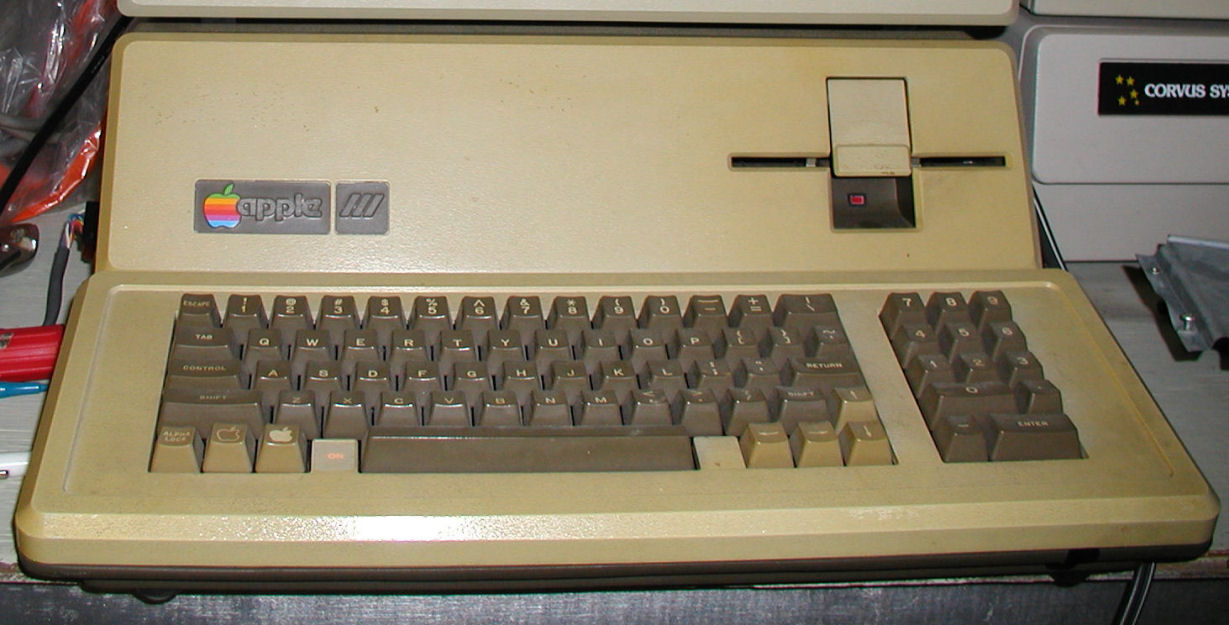
http://vintagecomputer.net/apple/appleIII/apple_III_num2/Apple_III-unit.JPG
+ |
= \
Bill Degnan
I recently came upon a Dysan PAT-2+ Performance Alignment Tester and I
already had an alignment disk for it - an 8" 48TPI 360 RPM 2 Sided drive -
disk 360/2A.
Does anyone have a source for additional format disks? Each drive type has
its own disk. What's on these disks anyway? My PAT-2 does not power up at
the moment, I have to open it up and take a look to see what's the problem.
Hopefully it's just a voltage regulator. I checked the web, too many
Dyson vaccum cleaner links and non-relevant stuff.
Bill Degnan
Hello Chuck,
Do you still have those NSC800 chips?
I would like to buy them all!
Robbert Stam
> /Mon Jan 23 19:11:42 CST 2006/
> while back I posted a WTB for some NSC 800 CPU chips and didn't turn
> up anyone having any for sale. Calls to the usual surplus places came
> up empty. I did finally manage to snag a bunch of these--more than I
> need. These are the 3 MHz ceramic 40 pin DIP packages with a date code
> in late 1986. Supposedly NOS (they certainly don't appear to be
> pulls). In case you're not familiar with these, they're basically CMOS
> Z80 CPUs with 8085 timings. They have the same half-interrupt pins
> that the 8085 does, but NMI traps to 0066H and there's no RIM or SIM.
> Interface signals are prety much 8085-compatible with the 8085-style
> multipexed data/address lines. These are NOT pin-compatible with
> either the 8085 or the Z80, but my need for them is to replace an 8085
> with the assistance of a little glue (mostly flipping a few signals).
> You can find the data sheet on the web at
> http://www.alldatasheet.com/datasheet-pdf/pdf/NSC/NSC800.html. At any
> rate, I've got about 15 of these to spare and will part with them for
> $2 each+postage I'll give preference to those buying more than one.
> Cheers, Chuck
I obtained an Intel SDK-85 eval board some time ago and decided to try
to bring it back to life today. It had been part of a Philips logic
analyzer demo system apparently. They had cut off the prototyping area
on the left side and put their own board there instead... which had a
2716 EPROM on it and some hardware to generate glitches as part of the
logic analyzer demo I guess.
In any case, I undid all of their mods (except of course, putting the
sawed off prototype section back on!) and the unit sort of works.
What I have discovered is that the 8355 ROM+IO chip is flakey. It won't
work unless I freeze it with component cooler. Once I have done that,
then it starts working and stays working for hours as long as power is
not removed. If it gets powered down, then I have to freeze it again
before the device will respond with valid fetches.
I don't suppose anyone has a spare 8355 with SDK-85 monitor burned in
it do they?
I'm guessing that's probably unobtainium so, failing that, wondering if
there's a .HEX of the ROM image floating around so that I don't have to
type it all in. If I have the bits, I can burn a 8755 that drops into
the same location.
Any guesses as to what the failure mode might be of the 8355? It is sort
of curious that once it gets started from frozen, it keeps working nicely.
I already did my time at ETA, cooling chips in liquid nitrogen so that's
kind of behind me now ;-)
Chris
--
Chris Elmquist
I'm looking for the 6 keytop from the numeric keypad for an Apple ///. I've already replaced the broken-off keyswitch, but, of course the keytop is long gone.
-Ian
I think we are beyond the beginning. The end of floppies began several years
ago when notebook manufacturers no longer built them in. Netbooks the same.
Another technology has bitten the dust! It appears if I will have to
transfer the data on 100s of floppies unto usb thumb drives. Hopefully they
will be around for some time to come.<fingers crossed>
Murray--
I have an AlphaServer 1000A 4/266 that is not booting. When I power it
up, nothing shows up on the control panel LCD and there are no beep
codes. I know that the motherboard is receiving power because the "link
active" light on the Ethernet adapter comes on. Is there anything that I
can do to fix it, or should I just try to find another Alpha (I don't
seem to have much luck with Alphas - I have a DEC 3000/300X with a bad
RAM slot).
I'm trying to find Thomas Foote, the author of DroidQuest. You may
remember a game for the Apple 2 called "Robot Odyssey". DroidQuest is
that game reimplemented in Java. The last trace I've seen of him was when
he posted to his DroidQuest mailing list on Yahoo two years ago. I
emailed him again a few days ago with no reply. I have several
enhancements and bugfixed I'd like to discuss.
--
David Griffith
dgriffi at cs.csubak.edu
A: Because it fouls the order in which people normally read text.
Q: Why is top-posting such a bad thing?
A: Top-posting.
Q: What is the most annoying thing in e-mail?
In the latest IEEE Spectrum magazine there is an article on page 24,
'Hands On - Why stop at breadboarding when custom PCBs are easy to
design and cheap to get made?', by James Turner.
Summary of this: He used Eagle to design/layout the board (which
seemed to be free), you have to do the trace routing manually, and
your pcb is 'batched' with others to keep the price way down.
At 02:52 PM 4/23/2010, you wrote:
>On 4/22/10, Andrew Lynch <lynchaj at yahoo.com> wrote:
> > Hi! It pains me to ask this, what vendors are hobbyists using
> for low cost,
> > low quantity prototype PCBs?
>
>I had a run recently done by Gold Phoenix
>(http://www.goldphoenixpcb.biz/) - 2 layer board, approx 3"x3.5", 100%
>through-hole design, no fancy features (it was an 80C52 design that is
>now sporting an ATmega8515). I sent them Gerber files from EagleCAD
>and they panellized for free - their work size is 155 sq in, so I got
>16 boards for $99. For the application at hand, it was a good deal
>and I was happy with the results.
>
>Gold Phoenix was recommended to me by the Makerbot guys. I've done
>one run and was entirely satisfied. We will probably do a "Rev 2"
>through them as well.
>
>-ethan
Has anyone on the list seen or work with one of these? I received a
Morrow M-20 8-inch hard disk along with my N* Horizon and found the
Memorex 102 disk mechanism inside (what a beast!).
At initial power-up, a 10-ohm 5W resistor near the power connector let out
a puff of smoke (the drive was in the process of spinning up). I killed
power and started checking components carefully. There were no ominous
readings across the 5V logic power rails and I traced things out enough to
determine that this resistor was between the +24V power input and whatever
lies downstream (probably motor servo).
The platters move freely, so the motor certainly wasn't bound up. When I
checked power supply voltages (it's an analog supply), I discovered that
the +24V rail was delivering +44V (!) and the -12V rail was -15V. The 5V
rail was right on spec.
For a quick reality check, I plugged the supply into my bench variac and
adjusted input voltage to yield +24V at the motor supply. Both other
rails were within spec at this point.
When I tried again to spin the drive up at the correct voltage, the series
resistor became extremely hot although, again, the drive was on its way to
full rotational speed at the time. I measured 20V across the 10-ohm
resistor, which calculates to 2A and a dissipation of 10W. The latter
number explains the heat. Not wanting to tempt fate, I shut things down
quickly.
So, opinions and suggestions please? A two-amp draw does not seem
excessive to me, although clearly it's outside the design parameters given
the rating of the dropping resistor. The power supply is certainly
reparable, and before anyone asks it is delivering clean DC - ripple is on
the order of 10mv. Why it's doubling its output is yet to be determined,
but I did find a diagram at bitsavers.
One thought that occured to me is that the +24V rail is probably powering
the voice-coil positioner in addition to the motor. I felt around
extensively, and none of the power devices involved with head motion or
servo is excessively warm. None of them appear shorted or open.
Not sure where to go from here.
Steve
--
Al wrote:
>Tim wrote:
>>> 10MB for only US$3398 (plus shipping?):
>>> http://gizmodo.com/5524908/the-hard-disk-youve-been-waiting-for
>
>> Who is the actual maker of the XCOMP physical drive in the picture? I'm not familiar with the unit.
>
>> Corvus sold the IMI (International Memories Incorporated) drive in ?1980? and there was the Seagate ST-506 in 1980 and the Shugart SA1000 in I think 1979. So I'm thinking the XCOMP ad must be the same era.
>
>> Tim.
> The earliest copy of the ad appears in the Jul 81 issue of Byte.
> Manufacturers of 10meg drives in 1981 included Miniscribe, RMS, Rodime, Tandon, and TI but
> most used similar bezels to the Seagate drives.
> The drive is interesting because it integrated the stepper inside with the actuator.
I didn't know that TI made small hard drives of that era, interesting.
Thinking of old hard drive manufacturers...
Was CMI actually making drives back in 1981? They were in Southern California like XCOMP.
By the time I saw CMI drives (1983? 1984? PC-AT days) they were being made in the far
East in large numbers, and the stepper was on the outside of the housing, but maybe
CMI made some drives domestically before that.
Tim.
I asked the creator of the mini-Altair 8800 PC about the possibility of a kit and he emailed to ask how much people would be willing to pay for one. There's no commitment, he just wants to know if it would be worth it for him to offer a kit (you would supply the modern motherboard, CPU, RAM, etc.). Interested and, if so, how much would you pay?
Mini Altair 8800 PC
http://galacticstudios.org/component/content/article/2-electronics/14-minia…
> > As he didn't mutilate an actual Altair, I will say
> > that is pretty cool
>
> I agree.
> I like the fact that he has this interfaced to Rich Cini's
> Altair32 emulator so you can operate it directly via the front panel
> switches instead of a mouse.
I was hoping he could create and sell a case/interface kit without the modern motherboard, but since the case was part of an old function generator(?) he purchased on eBay, a similar case would have to be mass produced which I suspect would be prohibitively expensive in small quantities even if produced in China. If a case kit like this was in fact made available at something approaching a reasonable price, I'd buy one in a _heartbeat_. Typical "case mods" hold no attraction for me whatsoever. One like this definitely would.
A while ago I posted about an RD53 I have which had the problem with the
sticking heads. I have now got to the point where the heads no longer stick
on the bumper, but the disk still does not work correctly. I opened it up
and watched what it did with the cover off. Once it gains speed it moves the
heads out all the way and then they just stay there with the disk spinning.
There is a whine coming from the drive, not sure of the source of this
though. Is this the right head behaviour? Below is what I got when it was
installed in a MicroVAX 2000:
>>> test 50
KA410-A V1.2
ID 08-00-2B-07-98-90
? CLK 0000.0005
NVR 0000.0001
? DZ 0000.4001
00004001 00000001 00000001 00000001 00000000 00000000
MEM 0006.0001
00600000
MM 0000.0001
FP 0000.0001
IT 0000.0001
? HDC 7730.7731
00022000 00000000 00000000
? TPC 0000.4001
FFFFFF03 FFFFFF05 FFFFFF05 FFFFFF05 FFFFFF05 FFFFFF05
FFFFFF05 FFFFFF05
SYS 0000.0001
?? NI 0000.7004 V1.3
>>>
I tried using the verifier thus:
>>> test 71
KA410-A RDver
VSmsv_QUE_unitno (0-1) ? 0
VSmsv_STS_Siz . RD53
VSmsv_QUE_RUsure (DUA0 1/0) ? 1
VSmsv_STS_RDing .
But the verifier just stuck on there and did not show any progress for a
good 20 minutes or so, I believe an RD53 should verify in about 8 minutes.
Any suggestions?
Thanks
Rob
> 10MB for only US$3398 (plus shipping?):
> http://gizmodo.com/5524908/the-hard-disk-youve-been-waiting-for
Who is the actual maker of the XCOMP physical drive in the picture? I'm not familiar with the unit.
Corvus sold the IMI (International Memories Incorporated) drive in ?1980? and there was the Seagate ST-506 in 1980 and the Shugart SA1000 in I think 1979. So I'm thinking the XCOMP ad must be the same era.
Tim.
Hi Cameron,
> I'd sort of independently determined this, although I settled on mfrtcu
> which is spr4-5, IIRC. I'm not sure if it's high enough resolution for this
> task, but as you point out, rdtsc() in the PPC nanojit is a function, so
> it may not be a significant problem. mfrtcu/mfrtcl *should* work on the 603
> and up, right?
I'm not so sure. I had a look at the rtc. Although I think there's
user-level access for both the 603 and 601 etc, the problem I see with
using it is that rtcl counts MOD 10^9 and I'd guess that the use of rdtsc
assumes MOD 2^64.
-cheers from julz @P
Hi Cameron,
> Anyone know of an equivalent for 601 that will still
> work on 603+? Or am I as dead in the water as I suspect?
The rdtsc function has its origin in the rdtsc instruction on an x86
CPU, it returns a 64-bit value, the number of cycles since power on.
I can see from the rdtsc function for PowerPC that it is implemented
using a routine, so it's exact performance isn't critical I would presume.
The nearest instruction on a 601 is mfspr rd,6 which loads the
decrementer. This is a user-level instruction on the 601 (not on the 603
or later). So, -DEC roughly the tb.
According to the Ppc601 user manual, dec uses the 7.8125MHz RTC clock
as its time base (pg H-3), but on page B-8 it says the power architecure
decrements dec every nanosecond.
So, we could do something like:
static __inline__ unsigned long long rdtsc(void)
{
asm { mfspr regUpper,6 };
return (long long)-regUpper<<32;
}
In this case, the effective frequency of the clock is 7.8125MHz*2^32.
For the PowerPc601. On initialisation I would probably read the
processor version register (PVR) to determine the processor;
and if it was a 601 I'd substitute the PowerPC 601 code and
then flush the code and data caches.
-cheers from julz @P
Hi folks,
I'm currently dealing with some RK8E Omnibus RK05 controller board sets.
I was unable to assemble even one stable RK8E from the stuff. I assume a
high failure rate. But I also assume that I have board revision
problems. I've been told that several revisions existed. And that there
were compatibility issues and some kind of paper (which I do not have)
telling what fits what.
I don't even know if the revisions are PCB revisions like "M7104 B2"
written in the etch or if there are also FCOs or alike that make boards
with same etch incompatible to other boards.
My personal RK8E passes all tests. It consists of:
M7104 B2
M7105 B1
M7106 C
But I have other boards flying around here as well.
Do stamps like "310 D" on the backside of the boards have any meaning
with respect to board revision or FCO level?
Another question is how to get different board revisions associated with
the right schematics.
I strongly appreciate any piece of enlightenment since I'm currently
getting depressed by that stuff. Even if I have bad boards - it won't
make sense to try to repair something if the whole is inconsistent in
itself.
Many thanks,
Philipp
Does anyone have a need for DDS2 tapes any more? I gave away my last
drive to a list member, meaning I have tons of blank tapes lying
around - many new, shrinkwrapped, some in boxes of 5 or more.
Free for the postage or you can collect. They're in London, England.
--
Liam Proven ? Profile: http://www.linkedin.com/in/liamproven
Email: lproven at cix.co.uk ? GMail/GoogleTalk/Orkut: lproven at gmail.com
Tel: +44 20-8685-0498 ? Cell: +44 7939-087884 ? Fax: + 44 870-9151419
AOL/AIM/iChat/Yahoo/Skype: liamproven ? LiveJournal/Twitter: lproven
MSN: lproven at hotmail.com ? ICQ: 73187508
Has anyone digitized The Computer Journal[1]? I have a collection of
issues from 15-21, 23-26, 30-41, 51, 53, 56-59, 61, 62, 65-72, 74-80.
[1] Not the one by the Oxford University Press, but the one published by
someone in Citrus Heights California.
--
David Griffith
dgriffi at cs.csubak.edu
A: Because it fouls the order in which people normally read text.
Q: Why is top-posting such a bad thing?
A: Top-posting.
Q: What is the most annoying thing in e-mail?
The HiPAS site in Fairbanks that did aurora research for ~30 years is
shut down and being auctioned off...besides the office supplies and
coffee makers, there is a lot of test equipment and such. Not much
strictly classiccmp, although there is a VT100 :)
http://www.proxibid.com/asp/Catalog.asp?aid=27290
Okay, old PPC hands, here's today's challenge.
I finished porting SpiderMonkey (the pure C JavaScript reference
implementation) to Classilla, which is the web browser I maintain for
classic Power Macintoshes in OS 8.6 and 9, and it works great. So, for an
encore, I decided to see how feasible porting TraceMonkey would be, which
precompiles selected portions into assembly using a "nanojit."
I started working on translating the inline assembly into CodeWarrior,
but CodeWarrior did not like my conversion of their "rdtsc" function,
which uses the mftb/mftbu instructions. The reason is that I'm compiling
for 601, and CodeWarrior will only assemble those instructions for 603 and
higher.
Anyone know of an equivalent for 601 that will still work on 603+? Or am
I as dead in the water as I suspect?
Mind you, I don't even know if the rest of this will work on 603s or 604s,
so this might just be the first of a whole mess of problems. I wasn't sure
if it would work in the first place, and SpiderMonkey already cut Classilla's
JavaScript execution time in half, so it's not like this is a catastrophe.
Still, I'd love to get JIT compilation working if I can.
--
------------------------------------ personal: http://www.cameronkaiser.com/ --
Cameron Kaiser * Floodgap Systems * www.floodgap.com * ckaiser at floodgap.com
-- If the dictionary misspells a word, how would you know? -- Steven Wright ---
Hi folks,
today I slaughtered a pdp8/e computer. The guts will go into further use
and repair of other machines, but the chassis underside is still there.
As I have no use for it I'm offering it as free for everyone. It's just
the lower part of the chassis. There's no Omnibus, not PSU, no nothing
with it. And it's really really rusty. That's the reason why I decided
to dismantle the system.
If anyone is interested, let me know. The chassis could be brought back
to life via sanding and repainting. Local pickup (northern Germany)
preferred, shipping possible (but seems to be quite useless).
Regards,
Philipp
As with past years, this first week in May I will be in the SF Bay
Area, and would certainly be interested in meeting fellow collectors
and seeing their neat-o machines. So far I am meeting a few people,
mostly for deliveries of things from far away, but can probably
squeeze in a few more visits.
Any takers?
Please contact me off list.
--
Will
http://classiccmp.org/pipermail/cctalk/2010-April/285344.html
[snip]
>Can you relate your issues with Advanced Circuits, just so others who
>might want to use them might be able to take it into account?
>
>Jim
Hi Jim! Please don't get me wrong, I *like* Advanced Circuits and they've
been great. I wish I was wealthy enough to do all my boards with them and
surely would were I in business. Of course, the N8VEM project and the S-100
boards with John from S100Computers.com are basically self funded hobby
projects and on "shoe string" budget. I really can't afford AC's premium
quality boards though I wish I could.
The trouble is with my ability to order boards from the AC website. Their
special deals are internet only which is fair but when I try to upload my
files to the AC website I get errors and cannot complete the order. The
people at Advanced Circuits have been great and I have no complaints but for
the last few orders I've had to call them and basically "finesse" my orders
into the system using phone calls and email. I can see that is going to get
old quickly and soon AC will run out of patience with me. Then I am screwed
and need a new way to get prototype PCBs.
I've worked with their IT people and the local sales rep to figure out the
problem. They say the file upload connection is timing out someplace like
there is a bad link between my network and theirs. The weird thing is that
I can upload files to freeDFM.com which is also an AC free service as much
as I want and it works reliably. Frankly, the whole problem makes no sense
to me.
Thanks and have a nice day!
Andrew Lynch
Rob Jarratt [robert.jarratt at ntlworld.com] wrote:
> I sniffed the packets a few days ago and posted this in my first post:
Sorry, must have been before I started to follow the trhead.
I have this lot lying around:
KRAKAR::SYSTEM> dir sys$manager:*ucx*.log
Directory SYS$SYSROOT:[SYSMGR]
UCX$FTPSERVER.LOG;130 UCX$FTPSERVER.LOG;129
UCX$FTPSERVER.LOG;128 UCX$FTPSERVER.LOG;127
UCX$FTPSERVER.LOG;126 UCX$FTPSERVER.LOG;125
UCX$FTPSERVER.LOG;124 UCX$FTPSERVER.LOG;123
UCX$FTPSERVER.LOG;122
Total of 9 files.
Assuming your UCX keeps its logs in a similar place, have a look and
see what you get. (Mine are all quite boring ... it works for me :-)).
(And I'm sorry if you've done this already too ...)
Antonio
I have a set of 8MB memory modules. Installing any two of these the Model 40
will recognise 16MB. If I install a second set in the second set of slots it
only recognises 24MB, but I am sure that one point it recognised them as
32MB. Is it possible that my memory is not serving me correctly, do the
second and third pairs of slots only support 4MB modules?
Thanks
Rob
Picked up an old terminal today (even though I'm *supposed* to be
slimming down my collection... sigh). Just couldn't resist.
Its only identifying marks either internally or externally are the name
"Infoton". There does not appear to be a model designation.
I've put up some pictures at http://yahozna.dyndns.org/scratch/infoton/
(warning: large images)
Logic appears to be TTL, there is no CPU as far as I can tell. Date
codes on ICs are from '72-'73, and one of the boards and the keyboard
PCB have labels indicating "12/73" so I assume this particular model is
>from late 1973. It appears to talk current loop and RS-232 but I have
no idea what the wiring for the connector is (or even what *kind* of
connector it is -- see the pictures above).
I haven't had a chance to clean it up yet, but after a bit of contact
cleaner on the power switch, it appears to work fine, at least in local
mode. Seems to do 80x24 chars, uppercase only with underlining. Infoton
shows up in termcap/terminfo entries, so that's a good start...
Anyone know anything else about this beast (history, tech specs, etc?) I
believe, from my research thus far, that Infoton later became General
Terminal. (General Terminal is rather hard to search for on the 'net
due to it being a fairly common phrase... so I'm not sure how helpful
that's going to be...)
Thanks as always,
Josh
Your Omnikey post is still floating around the net. I paid $200 for my
spare and
couln't compute without it. Standard keyboards have empty spots where
their should
be keys. I can't see the keyboard when I type and this is the only one
which essentially
can be operated by feel.
enjoy.
p
At 9:51 PM +0100 4/23/10, Rob Jarratt wrote:
>And if anyone has a MicroVAX II badge they would be prepared to part with, I
>would be interested in that.
Well... I have one I'd like to trade for a Micro-PDP-11/73, since
right now my souped up /73 is masquerading as a MicroVAX II. :-)
Zane
--
| Zane H. Healy | UNIX Systems Administrator |
| healyzh at aracnet.com | OpenVMS Enthusiast |
| | Classic Computer Collector |
+----------------------------------+----------------------------+
| Empire of the Petal Throne and Traveller Role Playing, |
| PDP-10 Emulation and Zane's Computer Museum. |
| http://www.aracnet.com/~healyzh/ |
Rob Jarratt [robert.jarratt at ntlworld.com] wrote:
> Very interesting now. I booted up another VAX, also running
> 7.3, and I was able to FTP to that one no problem at all. I
> can telnet to the "bad" VAX no problem. Pinging is fine. I
> can use DECnet fine between both VAXen. I can ping between both VAXen.
So basic connectivity is OK, you just have an FTP problem.
> When you say run a packet capture on the VMS end do you mean
> run a sniffer program actually on the VAX? If so I don't know
> of any software for that, do you have a recommendation? I can
> run a sniffer on the PC, which is connected to the same
> switch (not a hub), as this is all on single segment.
I'm running UCX 4.0 and my UCX experience is limited, but on
my box "HELP TCPIPTRACE" is the place to start. For today's
problem, however, it's unlikely to help as you'll see an
attempted connection and a failure (SYN from PC, RST from VAX
at a wild guess). It might be worth a shot as it might
show that the initial connection works and something goes
wrong later on.
> If I try to run UCX FTP on the good VAX to connect to the bad
> VAX this is what I get:
>
>> conn 192.168.0.106
> %TCPIP-E-FTP_NETERR, I/O error on network device
> -SYSTEM-F-REJECT, connect to network object rejected
That sounds like nothing is listening for FTP.
Try:
$ UCX
UCX> SHOW SERVICE
Does that list FTP?
Antonio
I'm looking for the badge for a MicroPDP-11/83 that goes on the Front
Control Panel of a BA23-A enclosure. I don't know that "badge" is
the correct term, but it looks something like:
<http://dundas-mac.caltech.edu/%7Edundas/retro/83badge.tif>
Alternatively, the entire Front Control Panel assembly, with the
MicroPDP-11/83 badge, would be of interest.
If you have one for sale or trade, please contact me.
Thanks,
John
Rob Jarratt [robert.jarratt at ntlworld.com] wrote:
> FileZilla can't do it either:
>
> Status: Connecting to 192.168.0.106:21...
> Status: Connection established, waiting for welcome message...
> Error: Connection timed out Error: Could not connect to
server
>
> Also Telnet to the port does not elicit any response.
Try running a packet capture on the VMS end.
Can you oing from windows to VMS?
Can you telnet (not to the FTP port) to the VMS end?
Antonio
On Mon, Apr 19, 2010 at 2:07 PM, Rob Jarratt
<robert.jarratt at ntlworld.com> wrote:
> I am trying to run the ftp command on Windows (7) against an FTP server on
> VMS 7.3 (the UCX version of TCP/IP). I am sure this has worked in the past,
> but now when I try it connects successfully but VMS never sends back the
> login prompt. I tried running FTP on the VMS system back to itself and the
> prompt came straight back.
>
I recently had the exact same problem trying to get some files
transferred to a VMS 7.3 system from a Windows 7 system so that I
could then MOP boot another system from the VMS 7.3 system.
I ended up downloading and using the open source GUI FileZilla FTP
client as the quickest way to get the file transfer task done at the
time. http://filezilla-project.org/
-Glen
>
>I am trying to run the ftp command on Windows (7) against an FTP server on
>VMS 7.3 (the UCX version of TCP/IP). I am sure this has worked in the past,
>but now when I try it connects successfully but VMS never sends back the
>login prompt. I tried running FTP on the VMS system back to itself and the
>prompt came straight back.
>
>Sniffing the packets I see a SYN from Windows, SYN-ACK from VMS and then ACK
>back to VMS. 60 seconds later Windows resets the connection.
>
Are you sure the windows firewall is not fouling things up? Can you FTP
>from the same windows machine to any other FTP server?
I vaguely remember a problem with the VMS TCPIP wanting to do a reverse dns
lookup of the client making the connection and this holding things up for
a while if it did not complete due to lack of access to dns servers etc.
However, I don't recall it causing the connection to fail.
>
> ISTR, isn't there an option for command line FTP to disable/enable
>local echo, or something to that effect? Have you tried a GUI FTP client?
>
I would stick with the command line FTP client. Many of the GUI FTP clients
for windows assume a unix or windows filesystem on the server and
completely fail to cope with the syntax of VMS filenames. Even the ones
that claim to understand VMS can still run into difficulties. I think part
of the problem is that the RFC describing FTP says that filenames should
be in the servers format rather than in a platform independant format and
the GUI FTP client producers tend to do what they think should work rather
than follow the RFCs to the letter.
Regards,
Peter Coghlan
> Regrettably that did not help either, I think it is something more
> fundamental than that. Does the following tell you anything?
>
> TCPIP> sh service ftp /fu
>
> Service: FTP
> State: Enabled
> Port: 21 Protocol: TCP Address: 0.0.0.0
> Inactivity: 5 User_name: TCPIP$FTP Process: TCPIP$FTP
> Limit: 10 Active: 1 Peak: 3
>
> File: TCPIP$SYSTEM:TCPIP$FTP_RUN.COM
> Flags: None
>
> Socket Opts: Rcheck Scheck
> Receive: 0 Send: 0
>
> Log Opts: Acpt Actv Dactv Conn Error Exit Logi Logo Mdfy Rjct TimO Addr
> File: SYS$SYSDEVICE:[TCPIP$FTP]TCPIP$FTP_RUN.LOG
>
> Security
> Reject msg: not defined
> Accept host: 0.0.0.0
> Accept netw: 0.0.0.0
My VMSfu is rusty, but that looks reasonable. What happens when you telnet
to port 21 from another host? You should get a message like
220 blah.foo.invalid FTP server ready
--
------------------------------------ personal: http://www.cameronkaiser.com/ --
Cameron Kaiser * Floodgap Systems * www.floodgap.com * ckaiser at floodgap.com
-- What use is magic if it can't save a unicorn? -- Beagle, "The Last Unicorn"
I'm having difficulty trying to locate this CP/M files, XLT80.COM and
XLT80.ASM , this is a Z80/8080 translator.
I found the file listed on this archive index
http://ftp.gaby.de/pub/cpm/znode51/fog/
I did a site search for this without any luck on
www.bitsavers.org/bits/Users_Groups/FOG/
It seems most of the files on there are disk images only.
Also did a site search for this without any luck on this Walnut Creek
archive http://www.retroarchive.org/cpm/cdrom/
Would somebody know of more archives that have original files instead of
disk images ?
thanks !
=Dan
Today as I was looking through the warehouse in one of the boxes were
several digital manuals. One was a 1990 October-December Systems and
Options Catalog on Vax Systems/Decsystems. It's a great read full of
lots detail about each system.
JK
> REPLY/ENA did not show me any messages (I already had the console open in
> any case).
>
> Tried using Internet Explorer ftp://blah, after a while this comes up on the
> console:
>
> %%%%%%%%%%% OPCOM 21-APR-2010 20:03:59.18 %%%%%%%%%%%
> Message from user AUDIT$SERVER on VAX3
> Security alarm (SECURITY) and security audit (SECURITY) on VAX3, system id:
> 1031
> Auditable event: Network login failure
> Event time: 21-APR-2010 20:03:59.14
> PID: 2020021B
> Process name: TCPIP$FTPC00005
> Username: anonymous
> Remote nodename: 192.168.0.15
> Remote node id: 3232235535 (0.15)
> Remote username: FTP_C0A8000F
> Status: %LOGIN-F-NOSUCHUSER, no such user
Sounds like you don't have anonymous access configured on your server. Try
ftp://user:pass at blah
--
------------------------------------ personal: http://www.cameronkaiser.com/ --
Cameron Kaiser * Floodgap Systems * www.floodgap.com * ckaiser at floodgap.com
-- FORTUNE: Travel is important today. The IRS will arrive tomorrow. ----------
ISTR, isn't there an option for command line FTP to disable/enable
local echo, or something to that effect? Have you tried a GUI FTP client?
Microsoft Windows [Version 6.1.7600]
Copyright (c) 2009 Microsoft Corporation. All rights reserved.
C:\Program Files\Windows Resource Kits\Tools>ftp /?
Transfers files to and from a computer running an FTP server service
(sometimes called a daemon). Ftp can be used interactively.
FTP [-v] [-d] [-i] [-n] [-g] [-s:filename] [-a] [-A] [-x:sendbuffer]
[-r:recvbuf
fer] [-b:asyncbuffers] [-w:windowsize] [host]
-v Suppresses display of remote server responses.
-n Suppresses auto-login upon initial connection.
-i Turns off interactive prompting during multiple file
transfers.
-d Enables debugging.
-g Disables filename globbing (see GLOB command).
-s:filename Specifies a text file containing FTP commands; the
commands will automatically run after FTP starts.
-a Use any local interface when binding data connection.
-A login as anonymous.
-x:send sockbuf Overrides the default SO_SNDBUF size of 8192.
-r:recv sockbuf Overrides the default SO_RCVBUF size of 8192.
-b:async count Overrides the default async count of 3
-w:windowsize Overrides the default transfer buffer size of 65535.
host Specifies the host name or IP address of the remote
host to connect to.
Notes:
- mget and mput commands take y/n/q for yes/no/quit.
- Use Control-C to abort commands.
C:\Program Files\Windows Resource Kits\Tools>
Message: 11
Date: Wed, 21 Apr 2010 09:39:43 -0400
From: Jason McBrien <jbmcb1 at gmail.com>
Subject: Re: FTP from Windows to VMS
To: "General Discussion: On-Topic and Off-Topic Posts"
<cctalk at classiccmp.org>
Message-ID:
<j2h5f7d1b0e1004210639pb6087183z688f9a2e47d900d4 at mail.gmail.com>
Content-Type: text/plain; charset=ISO-8859-1
Wild guess - try passive mode? Run FTP, type LITERAL PASV, then OPEN
ftp.vaxy.whatever
On Mon, Apr 19, 2010 at 5:07 PM, Rob Jarratt
<robert.jarratt at ntlworld.com>wrote:
> > I am trying to run the ftp command on Windows (7) against an FTP
server on
> > VMS 7.3 (the UCX version of TCP/IP). I am sure this has worked in
the past,
> > but now when I try it connects successfully but VMS never sends
back the
> > login prompt. I tried running FTP on the VMS system back to itself
and the
> > prompt came straight back.
> >
> > Sniffing the packets I see a SYN from Windows, SYN-ACK from VMS and
then
> > ACK
> > back to VMS. 60 seconds later Windows resets the connection.
> >
> > Has anyone else seen this and know the solution?
> >
> > Thanks
> >
> > Rob
> >
--
--- Dave Woyciesjes
--- ICQ# 905818
--- AIM - woyciesjes
--- CompTIA A+ Certified IT Tech - http://certification.comptia.org/
--- HDI Certified Support Center Analyst - http://www.ThinkHDI.com/
Registered Linux user number 464583
"From there to here,
From here to there,
Funny things
are everywhere."
--- Dr. Seuss
> On 4/20/10 10:47 AM, H?lscher wrote:
>> Has anyone got manuals for the DEC DMP-11 synchronous serial interface?
>> It was a common interface for multipoint DDCMP DECnet connections in the
>> era before Ethernet became well-established.
>>
> On Tue, 20 Apr 2010 12:03:45, Al Kossow wrote:
> The documents for the DMR-11, which uses the same board set, is on bitsavers
> under pdp11/unibus.
> I don't know what the difference is between the DMP and DMR
AA-H803C-TE DECnet-VAX System Manager's Guide says on page 2-45:
"DECnet-VAX supports four DDCMP line devices:
the DMC-11, the DMR-11, the DMP-11, and the DMF-32 synchronous line.
The DMC-11 and the DMR-11 are point-to-point line devices and are
considered identical. The DMP-11 is either a multipoint control,
or multipoint tributary line device.
The DMF-32 synchronous line is a point-to-point or multipoint tributary line device."
The boards are identical at the module number level seemingly, but there are most
probably different subtypes of the M8207 DMx microprocessor and/or M8203 line units
I think the M8207-RA is for the DMR11 and the M8207-YA/YB/YC is for the DMP11.
Anyone to confirm or doubt that?
Regards,
Ulli
Wild guess - try passive mode? Run FTP, type LITERAL PASV, then OPEN
ftp.vaxy.whatever
On Mon, Apr 19, 2010 at 5:07 PM, Rob Jarratt <robert.jarratt at ntlworld.com>wrote:
> I am trying to run the ftp command on Windows (7) against an FTP server on
> VMS 7.3 (the UCX version of TCP/IP). I am sure this has worked in the past,
> but now when I try it connects successfully but VMS never sends back the
> login prompt. I tried running FTP on the VMS system back to itself and the
> prompt came straight back.
>
> Sniffing the packets I see a SYN from Windows, SYN-ACK from VMS and then
> ACK
> back to VMS. 60 seconds later Windows resets the connection.
>
> Has anyone else seen this and know the solution?
>
> Thanks
>
> Rob
>
Has anyone got manuals for the DEC DMP-11 synchronous serial interface?
It was a common interface for multipoint DDCMP DECnet connections in the
era before Ethernet became well-established.
Any hints welcome!
Regards,
Ulli
OK, another question :
a cheap source for the hp-ib, gpib connectors ?
What I found so far is in the $ 20 range.
(through hole, right angle, receptacle, ...)
Cheers & Thanks
Time for some early spring cleaning. I've got a pile of stuff I'm never
going to use again (I've decided to give up on my SparcStation
collection, for example :))...
Here goes. This is all located in the Seattle area, the smaller stuff I
can ship but I'd of course prefer local pickup. Make me an offer...
Anything not claimed will be put on Craigslist at the end of the week
and the remainder goes to RE-PC after that.
- DEC RL02 : not working, but is complete (minus front panel bulbs).
Very beat up looking, but clean inside.
- Acorn A5000 : works, but faceplate is beat up (got mangled in the mail
due to bad packing). Needs new battery (removed old leaky one before it
could do any serious damage). No keyboard/mouse -- not PS/2 compatible.
- IBM PS/2 Model 70 (386). 4mb ram, no hard drive but sled is present.
Boots just fine.
- Blue & White G3 Mac with 450Mhz G4 upgrade. Runs fine, no hard drive,
somewhere around 256mb of RAM.
- HP Apollo Series 700. Small pizzabox. Worked the last time I powered
it up.
- Amstrad PC1640 SD : just the main unit, no monitor (which supplies the
power). Missing one of the drives.
- Beehive "Super Bee" terminal : No keyboard, needs repair. In solid
shape. Heavy.
- 2x IBM PC Convertibles : One has a backlit screen, one without. Two
carrying cases. One AC adapter. Serial and Printer expansions.
- Sun Ultra Enterprise 2 : Dual UltraSparc IIi, 512mb ram. No drives,
but I have sleds somewhere.
- SparcStation 2
- 2x SparcStation IPX
- SparcStation IPC
- 2x Macintosh Portables - good for parts, no working hard drives
between the two, alas.
(None of the SparcStations have working NVRAM batteries.)
- Piles of old IDE disks (500mb or less). Unknown condition, many were
working at one point but time and stiction make fools of us all.
Inquire if you want details, I'm too lazy to list them all here right
now :).
- IBM P260 21" CRT monitor. Nice flat trinitron CRT, works pretty
well. Large, as these monitors tend to be. Does SOG.
Thanks,
Josh
I am trying to run the ftp command on Windows (7) against an FTP server on
VMS 7.3 (the UCX version of TCP/IP). I am sure this has worked in the past,
but now when I try it connects successfully but VMS never sends back the
login prompt. I tried running FTP on the VMS system back to itself and the
prompt came straight back.
Sniffing the packets I see a SYN from Windows, SYN-ACK from VMS and then ACK
back to VMS. 60 seconds later Windows resets the connection.
Has anyone else seen this and know the solution?
Thanks
Rob
This is what I'm attempting to get rid of from my warehouse. I would
like to get something for the machines, but mostly want to make sure
that the stuff doesn't get scrapped. Everything is assumed to work, but
I have no guarantees that it does, and it hasn't been turned on in quite
a while, but it has been stored in a climate-controlled warehouse. I'm
open to some trades, and negotiable on prices for most stuff. I'm not
willing to ship anything myself, but may be willing to drop it off
somewhere to be shipped - I mostly don't have time to pack this stuff.
Email me for more info on any of this stuff.
For the most part, this stuff needs to be gone by May 14th- when I leave
for Dayton Hamvention. I may be able to bring smaller (desktop box)
stuff with me, but larger stuff I won't be able to transport to the show
with everything else I'm bringing. Some of the stuff will start
disappearing at the end of next week via scrap or eBay if I don't hear
anything by then.
+ VAX 8700 w/ TU-81+ and SA482. Haven't had a chance to power up, and
will keep this if I don't get a good offer. Want around $500 for it.
+ DG Nova 2 w/ PERTEC 9-track tape drive and dual 8" floppy.
Asking $750, this will go to eBay if I don't get any takers.
+ DG Nova 4. Have 3 or 4, some missing the front-panel. 3rd party
Disk/QIC tape rackmount box that goes with them.
+ BA-11 10.5" tall UNIBUS expansion boxes. $25 each
+ SGI Onyx prototype machine. The same size and chassis as a Challenge
XL. $100
+ PDP-11/23 w/RL02s in corporate cab. $200
+ RM-02 drives. I have 4, want to keep at least one. Never had much
luck getting them to work with my RH-11 on my 11/84, but I don't think
there's anything wrong with the drives themselves. $200 each
+ VAX 4000/200. I have two or 3 of these. $100 each
+ DEC CMR53. 2 of these. A pdp-11/53 system with some special
communications cards in them. $100 each
+ AlphaServer 4100. $20
+ Various VAXstation 3100s for whatever I can get for them
+ 4 tape drives from IBM 3480-B22 tape units. I've considered saving
this for spares, but I'm not sure I care enough.
+ IBM S/390 G5 coupling facility. I'd really like to find the
replacement software for the SE to make it into a "standard" CPU, so
that I can at least run Linux on it, but I'm not sure that's likely.
$200.
+ Encore Mulitmax UNIX box. 32 x NS32332 processors and 128MB ram, and a
2nd rack with a 9-track tape drive and some 8" hard disks. $250.
+ General Automation SPC16/40 and 16/45. Missing the front panel for
one of the two, have an I/O box, and PSUs. needs some repair work. One
of the PSUs needs new capacitors. Will keep unless I can get $500 or so
for the both of them.
+ HP 1000 E-series, I think. Two of these. $200 each?
+ IBM RS/6000 SP. I've got one frame with quad-375MHz POWER3-II thin
nodes, and one high node (16GB ram, 16 x 375MHz). $200
+ DEC VT240 terminals. Probably 10. $5 each
+ IBM 9343-C02 DASD box. I have someone interested, but haven't heard
>from them in a while, and am not sure how interested they really are ...
I'd like to get $100 for it.
+ Two Amiga 2000 Video Toaster boxes. I may end up keeping one. $100.
+ Various IBM UNIX desktop systems, desktop VAXes, etc. $5 each.
+ Altos 8000 and 8600 systems. $10 each.
+ Tektronix 4010 terminal. $100.
+ Tullamore/Victoreen SCIPP 1600 1600-channel pulse-height analyzer.
Powers up, but not tested much more than that. Looks cool, and has CORE
memory inside. $50. Some pics I took a while ago:
http://www.flickr.com/photos/vax-o-matic/sets/72157622536984302/
That's all I can recall for now.
Pat
--
Purdue University Research Computing --- http://www.rcac.purdue.edu/
The Computer Refuge --- http://computer-refuge.org
So I got back from Notacon7 in Cleveland, OH, yesterday, and wanted to
mention that there was a classic computer presence there.
Robert & Jim from Fresno Commodore User Group were there and had setup a
variety of old machines including 64's, VIC-20's, 1541's, and even an
A500(Yay!) with a couple boxes of disks.
There was also a demo in the BlockParty demo competition from a guy who
used the Coleco as his platform of choice. His demo was mostly written
in Z80 assembly with help from some FORTH tools. There was a preference
for running these demos on the old hardware. Plenty of Amiga "trackers"
used during the music-only portion of the competition.
http://www.demoparty.us/
and
http://www.notacon.org/
has more info if you are interested.
Keith
It appears that there has been a lot of interest in the Tek 4010
terminal. As I don't want to pick anyone myself, I think that I'll end
up putting it up for sale on eBay and let everyone settle who gets it
that way.
I'll see if I can get it listed early this week.
Pat
--
Purdue University Research Computing --- http://www.rcac.purdue.edu/
The Computer Refuge --- http://computer-refuge.org
I'm wondering if anyone here has any experience buying health insurance
through the ACM. My career has taken some very interesting twists and
turns and it looks like I'll be running a consulting firm for a while.
--
David Griffith
dgriffi at cs.csubak.edu
A: Because it fouls the order in which people normally read text.
Q: Why is top-posting such a bad thing?
A: Top-posting.
Q: What is the most annoying thing in e-mail?
I've been reading the HP Integral service manual that Al kindly put on
Bitsavers [1], It's a strange manual in that it includes schematics of
the main logic boards. Why, I don't know, other comtemporary HP computer
service manuals didn't. Not that I'm complaining...
Anyway, various thoughts occured to me as I remember some
thignn about that machine
1) Did HP ever produce the CS/80, SS/80 or Amigo drive exerciser software
to run on the Integral? It seems it would be the ideal machine for use as
a drive tester since it's so easily portable.
2) The later version of the OS ROM module has a space for an option ROM
PCB. It seems like this would be trivial to recreate (schematics of the
ROM Mmodule, inclding the pinouts of the option board connectors are
certainly in 'my' Integral schematics). If enough people are interesd,
it might be worth laying out a PCB...
3) The manual mentions that the Integral expansion bus was an
implementation of some other HP standard bus, but only rows A and C. What
other machine(s) used a similar bus? I can't think of any.
[1] I've also been reading the HP9000/200 Pascal 3.0 system
docuementation. A wonderful mine of information, but oh so annoying to
read on a screen...
-tony
I, too, have not heard back from John.
I am interested in the Atari ST
and one of the Pinnacle systems.
If the Pinnacle can run both
UCSD Pascal and CP/M-68K then that
would be a bonus.
--
Paul R. Santa-Maria
Maumee, Ohio USA
http://boston.craigslist.org/sob/zip/1696634349.html
<http://boston.craigslist.org/sob/zip/1696634349.html> * OFFER- working DEC
PDP-11 CAD System w/accessories (Quincy)
------------------------------
Date: 2010-04-17, 12:11PM EDT
Reply to: sale-kxyzt-1696634349 at craigslist.org<sale-kxyzt-1696634349 at craigslist.org?subject=OFFER-%20working%20DEC%20PDP-11%20CAD%20System%20w%2Faccessories%20(Quincy)&body=%0A%0Ahttp%3A%2F%2Fboston.craigslist.org%2Fsob%2Fzip%2F1696634349.html%0A>
------------------------------
This is a working PDP-11/23+, in a BA-11 box. This is a fuly functional
PDP-11 running RT-11, has bootable floppies and hard drive. The reason I
have this is this system is the hardware basis for a CAD software package
called Pro-Draft / Producer. by what became Baush & Lomb.
Comes w/~40 8" floppies (yes, really!), detailed schematics of BA-11 box,
and all Pro-Draft software and documentation. You can fire this up and do C,
FORTRAN, and assembly programming, or CAD development, or have a very
unusually shaped space heater.
Please give this machine a new lease on life!
*--
Stephane
http://DECpicted.blogspot.com
I have 3x5" circuit board from IMS International marked "PYXIS BD". On a
narrow edge is a 50-pin header. On the rear are two edge slots that
appear to mate with the connectors of an MFM drive. It's in an apparently
unopened bag and visible at http://frotz.homeunix.org/images/pyxis/. Does
anyone here know what it might be for?
--
David Griffith
dgriffi at cs.csubak.edu
A: Because it fouls the order in which people normally read text.
Q: Why is top-posting such a bad thing?
A: Top-posting.
Q: What is the most annoying thing in e-mail?
Does anyone here have an interest in carboard boxes that once held S100
cards? I have a banker's box full of them free for shipping. One of them
has "Cables for Golem" written on it by Jerry Pournelle. The cables were
recently sold.
--
David Griffith
dgriffi at cs.csubak.edu
A: Because it fouls the order in which people normally read text.
Q: Why is top-posting such a bad thing?
A: Top-posting.
Q: What is the most annoying thing in e-mail?
If anyone can help me obtain a Tally model 420 paper tape punch I would be immensely grateful !
I am restoring a old telemetry console and the Tally puncher is missing.
Once again, many thanks for any help/leads.
Walter Silva
wlsilva at sbcglobal.net
I've been contacted by a former software developer with extensive experience
with the UCSD p-System on several platforms. He'd like to dispose of most
of his equipment and documentation.
I'd like to help him find a new home for it all. I'm not quite sure
how to do that, but it might depend on who else is interested.
Please contact me if you are. He is located in southern Illinois, USA.
I am located in southern Wisconsin, about six hours away.
I'd like his spare Terak 8510 system and a Cipher 9 track.
There are two PDQ-3 systems. I am tempted to take one, as it is closely
related to the Terak. These are LSI-11 with Western Digital microcode to
run the p-System directly. They include 10 or 20 meg hard drives. They
are circa 1982. I think they're rare. The only mention I find is on
a UC-Irvine web page, although I've emailed with someone who worked at
the company that made them (Advanced Computer Design?). One of the hard
drives might contain some source code from ACD. He used these for software
development. I've found references that say these systems were used
to develop in Modula 2 and FORTRAN. They competed with the Sage.
There's an Atari 1040 ST running the p-System.
There are four or five 68000-based multitasking multiuser Pinnacle Systems
(later Logic Process) systems. These drove 8 to 16 users on Wyse 50
terminals. They are circa 1983. One is the bigger unit with more
horsepower and an internal tape drive.
There's two Corvus Omninet drives, with various junction boxes, cabling
and interface cards - perhaps for PC, Apple II and maybe Q-bus.
There's a bunch of p-System books, newsletters, etc. as well as
software. He was a USUS member.
There's a VT 220 and several Wyse 50 terminals. I might want the 220.
It sounds like there's lots of software going all the way back to a
copy of Wirth's CDC compiler.
- John
Hi,
I saw your add of things you are looking to get rid of. I am very interested
in your ONXY prototype. Can you tell me what the specs are? Do you have any
photos of it?
Robert Herget
Dear List,
Some bits of equpment that I have get hauled out only rarely and I
often waste a lot of time identifying them then trying to remember
where the heck I put the paper that describes their operation--and
then locating the disk with the related driver information.
I've been considering archiving the information on mini (200MB) CD-R
and taping said CD-R somewhere nside the equipment. Mini, mostly
because their physical size is convenient and I rarely have more than
200MB of information on any peripheral.
Does anyone else do something like this? I have little experience
with mini CDR--are they reliable?
Best reagards,
Chuck
Anyone need a handful? I have several sets of dead bicycle lights that
I want to get rid of, which have something like half a dozen to a
dozen each of greens, reds and whites. Happy to post anywhere for
cost of postage alone, if anyone has any use for them...
--
Liam Proven ? Profile: http://www.linkedin.com/in/liamproven
Email: lproven at cix.co.uk ? GMail/GoogleTalk/Orkut: lproven at gmail.com
Tel: +44 20-8685-0498 ? Cell: +44 7939-087884 ? Fax: + 44 870-9151419
AOL/AIM/iChat/Yahoo/Skype: liamproven ? LiveJournal/Twitter: lproven
MSN: lproven at hotmail.com ? ICQ: 73187508
For the cost of shipping, a set of docs for the Dec RV20 Optical
subsystem.
Included is
EK-ORV20-IN-002 : Installation Guide (stapled spine)
EK-ORV20-OM-002 : Owners Manual (stapled spine)
EK-ORV20-SV-002 : Service Guide (spiral bound, but now loose leaf)
Item in in the Netherlands, weight is approx 0,6 Kg
Ed
--
Dit is een HTML vrije email / This is an HTML free email.
> -----Original Message-----
> From: cctalk-bounces at classiccmp.org
> [mailto:cctalk-bounces at classiccmp.org] On Behalf Of Alexandre Souza -
> Listas
> Sent: Tuesday, April 13, 2010 12:50 PM
> To: General Discussion: On-Topic and Off-Topic Posts
> Subject: Re: New old products :)
>
> >> Next time, use kicad, diptrace or something useful. Eagle sux.
> > I'm not going to defend Eagle, but I'm unfamiliar with diptrace - what
> > makes it better?
>
> Ethan, it is a matter of using the tool, I could say wonders about
> diptrace, but I do believe nothing will be compared with you getting the
>
> tool and taking a look.
>
> > I use Eagle because it works on any computer I'm likely to be sitting
> > and and because there are lots of examples and user-contributed parts.
> > I'm not opposed to switching tools, but I'd rather not switch tools
> > just to spend all my time creating libraries for classic computer
> > components. If another tool has better libraries and is easier to
> > use, then I'm all for it.
>
> I use Altium Designer, but I admit it is too expensive for (legal)
> hobby
> use :o)
>
> I do believe in Diptrace. But KICAD is getting better and better
> everyday. More libraries and a very active development. Maybe you'll
> want to
> take a look at it :)
[AJL>]
Hi! I use KiCAD quite a bit and have designed several PCBs with it. It
works fine and is completely unrestricted. I think it is a fine product and
recommend it whole heartedly. It has improved dramatically over the last
couple years. Also, all of the N8VEM PCBs are posted on the wiki in the
KiCAD format.
Thanks and have a nice day!
Andrew Lynch
> -----Original Message-----
> From: cctalk-bounces at classiccmp.org
> [mailto:cctalk-bounces at classiccmp.org] On Behalf Of Shawn Rutledge
> Sent: Monday, April 12, 2010 1:26 AM
> To: cctalk at classiccmp.org
> Subject: Xedex Baby Blue CPU Plus ISA card
>
> I just found one of these in my pile if anyone wants it.
[AJL>]
Hi! I just obtained one of these boards and would like to get some
documentation for it. Does anyone have documentation available they can
scan, mail, or post somewhere?
Any help much appreciated. Thanks and have a nice day!
Andrew Lynch
ard at p850ug1.demon.co.uk (Tony Duell) wrote:
>> Oh, that bad RK8E controller just confronts me with "Data break error" :-(
>
> IIRC a ;'data break' is a bit like DMA. I do haev the prints and some
> technical desription, so I could help you debug this sometime...
Just for reference: databreak is exactly just DMA. It's just another
name for it. The "fun" part of the PDP-8 is that you have 1-cycle data
break and 3-cycle data break devices... :-)
You never see the 3-cycle version on any modern DMA devices...
Johnny
Hey all -
Picked up a Burroughs C3360 calculator this week. It's a programmable
4-function+square root and 10-register memory with a nice 16-nixie
display. (See http://oldcalculatormuseum.com/bc3660.html)
I cleaned it out, and it's working fine in calculator mode, but in
programming mode the program step counter is usually (but not always)
stuck at zero. Sometimes it increments properly for a few seconds after
power-up. Seems like a fairly simple fault to trace down, if I had any
idea where to begin... anyone have a schematic for this thing (or the
Sharp Compet 363P, which this machine is a rebranded version of)?
Hopefully the fault isn't in one of the LSI chips in this thing, I'm
guessing those are going to be hard to find.
Thanks as always,
Josh
A friend of mine is selling a number of computer brochures and
sales leaflets from the 1960s and 1970s. Looks like they'd
be of interest to some collectors here. They're on eBay
as follows:
http://shop.ebay.co.uk/kate_elliott/m.html
--
John Honniball
coredump at gifford.co.uk
Hi
Does any have the original paper tape of MAINDEC-08-D5FA and/or a scan
of it's source listing?
It's an RF08 diagnostic for the PDP-8
The archived copies of the paper tape have a checksum error. I could
reconstruct it, but I'd rather
have a pdf of the source listing. I've looked and didn't find one anywhere.
I'd also like to see a scan of the source to MAINDEC-08-D5EB if anyone
has one.
-brad
-----------
Brad Parker
Heeltoe Consulting
http://www.heeltoe.com
781-483-3101
Hi folks,
here are some videos and pictures I took when operating an RK05f completely open with the exposed.
Hope you like it!
http://pdp8.hachti.de/?gallery/rk05f
And keep in mind: I did this for curiosity and the whole thing only lasted a few minutes. The disk
is back in the plastic shroud and nothing has been ruined. In fact the drive was still not 100%
perfectly adjusted while I shot the stuff on the page. In the clips the drive performs part of the
DEC maindec drive control test. I had a lot of trouble finding out the servo system's weakest
part.... Now I managed the drive to run reliable and to be able to retract the heads properly (seems
to be not so uncommon problem!).
Best wishes,
Philipp
--
http://www.hachti.de
List,
Just for the "FYI" file, Terak (UCSD Pascal) floppies appear to be
either SSSD 3740 format (FM 77 tracks * 26 sectors * 128 bytes) or
SSDD (Track 0, FM 26 sectors * 128 bytes, not used) 76 tracks * MFM
15 sectors * 512 bytes. The double-density format is definitely
standard MFM, not DEC RX02 (FM headers, "tweaked MFM data).
The MFM format is interleaved 2 to 1 with a one-sector skew per
cylinder.
The FM format is also interleaved 2 to 1 with a 6 sector skew per
cylinder.
For whatever it's worth,
Chuck
(P.S. I wouldn't mind owning a Terak, judging from some of the
program code I've seen).
I?ve gotten back into my Atari systems again and since I had a couple Indus
GT drives, I found a schematic for the RAM upgrade board for the drives, and
had PCB?s made :) my first professionally produced PCB?s in 20+ years. I?m
quite pleased since it was a first effort with new software when I hadn?t
touched EDA software in 20 years or so.
Lessons learned were:
Increase PAD size :) these are solderable, but are just a touch too small
by the software default.
Validate that pin one indicators REALLY render out to the gerbers. I have to
refer back to my PCB design for pin one since it didn?t render.
Quadruple check that all wires and nets are present. I discovered that a
trace between 2 pins on the connector(s) disappeared on me at some point
during editing, it is entirely possible I deleted it like an ID10T. So for
this run of boards, wire-wrap wire will be my friend to jumper the 2 pins at
the PCB.
Hi,
I already asked this in thesimh mailinglist, without replies, so maybe
this list is more appropriate to get a response.
I am working on a SIMH emulator for the Sage&Stride 68k machines
(Sage-II/IV). There is a lot of docs available at
sageandstride.org, which is the base for the development. One thing I
haven't found yet is a more recent boot ROM
than the available 1.2 version; docs mention 2.0 and 2.1. These versions
have, besides presumably a number of bug
fixes, support for the winchester disk card.
Does anyone have a rom dump (any format) of such a BIOS (16k)? I already
tried to contact David Erhart, the owner of the above
site, but twice didn't get any response.
Thanks in advance
Holger
P.S. The code is not yet ready to release (still some bugs in the FDC
part, some missing instructions, and the HDC support),
but I'll report in the simh developers list when it is.
Hi,
I happened to catch the last 20 minutes or so of the programme Electric Dreams, which appears to be on for the next few days on BBC2, starting at 7pm. A family have volunteered to see what life was like in the previous decades (70's, 80's, 90's). That is to say old modern tech in the house and home has been replaced by old tech - so no X360 or PS3 for the kids!
Tonight's episode was about the 70's and included a short scene with Sir Clive Sinclair, a Sinclair calculator, an old Sinclair TV advert and a Commodore PET - the father was trying (and failing) to do his day-to-day work on the PET!
Here's a link to the BBC site for those that can access it:
http://www.bbc.co.uk/electricdreams/
Tomorrows episode is going to be about the 80's, and will include a BBC Micro among the 80's tech.
Regards,
Andrew B
aliensrcooluk at yahoo.co.uk
Did someone have a hack for 8" or 5-1/4" drives using a Flash drive ?
I like to build one to troubleshoot floppy controllers without risking
damage to the original drive.
There's one from Germany for about $300 but it's too big for my wallet.
http://www.ipcas.com/products/usb-floppy-emulator-fdd-to-udd.html
I'm trying to fiddle with my google search terms but nothing points to a
homebrew version yet.
=Dan
A little tidbit for you owners of Weller WTCPT irons with TC201
handsets that take the EC234 heaters.
If your old heater was made before 2002, be sure to also buy a new
BA60 sleeve and nut. The newer EC234 is slightly wider and won't fit
the old BA60.
Just something I discovered to file away for a rainy day.
Cheers,
Chuck
On 4/13/10, Alexandre Souza - Listas <pu1bzz.listas at gmail.com> wrote:
>>> Next time, use kicad, diptrace or something useful. Eagle sux.
>> I'm not going to defend Eagle, but I'm unfamiliar with diptrace - what
>> makes it better?
>
> Ethan, it is a matter of using the tool, I could say wonders about
> diptrace, but I do believe nothing will be compared with you getting the
> tool and taking a look.
I don't see a Linux or Mac version, so it's a non-starter. I'm not
going to dork around with Wine to use an EDA tool; I'll just stick
with tools that work natively.
>> I use Eagle because it works on any computer I'm likely to be sitting...
I stand by that - Eagle works on Macs, Linux boxes and Windows boxes.
I don't have to worry about the platform in front of me - there's an
Eagle for each one.
> I do believe in Diptrace. But KICAD is getting better and better
> everyday. More libraries and a very active development. Maybe you'll want to
> take a look at it :)
I've heard of KICAD, but the last time I looked at it, it didn't look
polished enough for me to spend much time on it. Perhaps it's
advanced enough for a second look.
-ethan
> Message: 27
> Date: Mon, 12 Apr 2010 22:01:07 -0400 (EDT)
> From: Steven Hirsch <snhirsch at gmail.com>
> Subject: Re: Memorex 102 20MB Hard disk
> To: "General Discussion: On-Topic Posts Only" <cctech at classiccmp.org>
> Message-ID: <alpine.DEB.2.00.1004122154580.3802 at duo>
> Content-Type: TEXT/PLAIN; charset=US-ASCII; format=flowed
>
> On Mon, 12 Apr 2010, Tony Duell wrote:
>
> >>
> >> Has anyone on the list seen or work with one of these? I received a
> >> Morrow M-20 8-inch hard disk along with my N* Horizon and found the
> >> Memorex 102 disk mechanism inside (what a beast!).
<snip>
> The drive is not particularly small, BTW. This is a beast of an 8" drive
> mechanism with five platters and a voice-coil positioned.
The Memorex 102 had four platters and a stepper motor.
A 10 ohm resistor would limit the inrush to 2.4 Amps with zero spindle motor
resistance. Given the 112 has an inrush of 4.5 Amps, this further suggests
this is not a 102.
I have a disassembled 101 in my garage if that would help and I can find it
Tom
I was examining some old Vectrex cartridges and I noticed on one that the
gold on the edge fingers has worn down to the copper below. What's the
proper way to rehab things like this? Wipe with some solder and blow off
the excess with an air compressor?
--
David Griffith
dgriffi at cs.csubak.edu
A: Because it fouls the order in which people normally read text.
Q: Why is top-posting such a bad thing?
A: Top-posting.
Q: What is the most annoying thing in e-mail?
On 4/13/10, Ben <bfranchuk at jetnet.ab.ca> wrote:
> Alexandre Souza - Listas wrote:
>
>> I do believe in Diptrace....
>
> I have the older version of diptrace. I am not so happy with it.
> No PLCC sockets of any kind. No support for TUBES of any kind.
> All the new libraries have more surface mount junk. Manual routing
> is a pain. Auto routing does work no more than 3 chips for a two
> layer board.
Hmm... that would have killed my last project - a PLCC-44 89C52 (that
we later swapped out for an ATmega8515 with no board changes required)
and 5 ICs total ('541, 2x ULN2003, '14, MCU).
Went fine with Eagle except for the holes for the power jack and my
goof on the Port D bus. Autorouting worked for 75% of the project,
and manual routing is not tricky.
The first test program ever loaded into the board ran the first time
(blink LEDs on two port bits). I'd call that a success.
-ethan
Hi folks,
Looks like cctech's missed this one, but there's still several hours to go!
There's a pdp-11/35 being auctioned on Ebay uk:
http://cgi.ebay.co.uk/DEC-PDP-11-35-with-EIS-and-Core-Memory-PDP-11-PDP11_W…
It's in Halifax; a mere 50Km from where I live! Unfortunately, I can't
afford it :-( But I thought you might like to see what's going down
oop North ;-)
-cheers from Julz @P
Hi there,
I'm owner of a Professional IRIS 4D/50G made by Silicon Graphics some
time around 1987. The machine has apparently some kind of trouble
related to the CPU board. I'll include some details further below, I'm
open to any good idea.
Because of that problem I'm in search for a suitable CPU board. The
failing board is a IP4 CPU board (part nr. 030-0121-001 Rev A). I
presume that any kind of CPU board from a Professional IRIS line
machine would help (mainly IP4 and IP4.5).
Please drop me a note if you have a spare or can point me in a
promising direction.
As promised some details. The machine used to work fine once I had set
it up quite a while ago. Recently it refused to boot and upon
inspection I got the following error:
---- snip ----
EXCEPTION: <vector=NORMAL>
Exception pc: 0xbfc108a0
Cause register: 0x30001008<CE=3,IP5,EXC=RMISS>
Status register: 0x80000<CM,IPL=8>
Bad Vaddress: 0xc0000000
Error Addr register: 0x17b40
Local I/O interrupt register: 0xff <>
Parity error register: 0x0
Registers (in hex):
arg: c98cf600 ffffffff 15180 0
tmp: 0 0 0 0 0 0 0 0
sve: a0017b93 bfc268c8 bfc268ca 1 54 0 1 800
t8 ff00 t9 502e8000 at 1 v0 c0000000 v1 f65da k1 bfc04234
gp 0 fp bfc04bd0 sp a0017b64 ra bfc10744
exit(-1) called
---- snip ----
This happens just after POST (I think) when the machine is either
about to start IRIX or to show the PROM menu. Of course nothing
further happens except that the error is repeated without end.
I did strip the machine down to a bare minimum of boards (IP4 and
Ethernet) and I also swapped the memory sticks. The only things I
could reasonably pull in a last attempt would be the VME Ethernet
board and the system disk.
Regards,
Gerhard
--
http://www,sgistuff.net/
Hello,
I have a 128k Plessey Data General Nova 3 Memory Board exhibiting errors. If you have the schematics for this board, a copy would be much appreciated.
Regards,
Tommie Mademark
My Data General blog http://www.foxdata.com/blog/