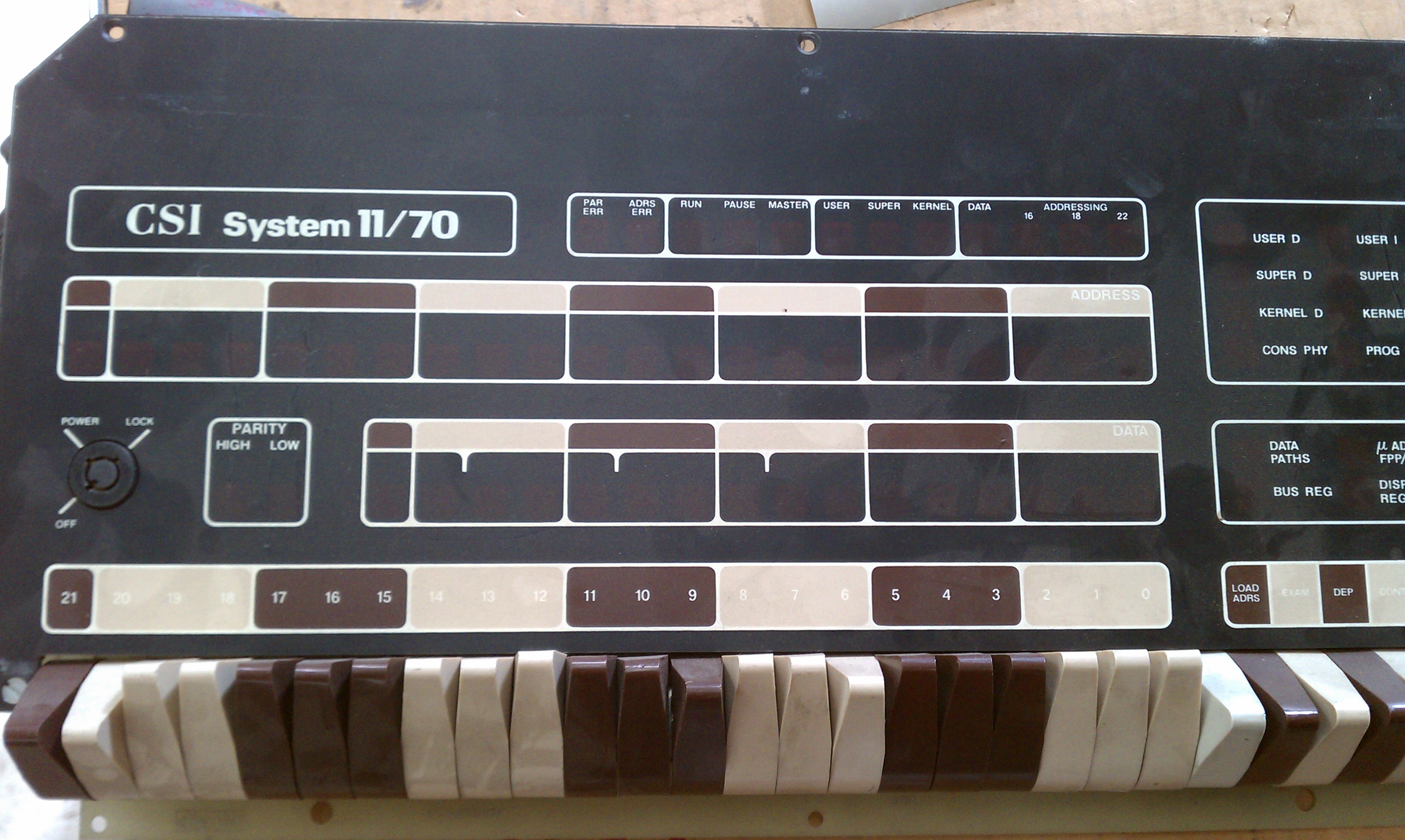
Hi,
I am preparing to get some S-100 6502 CPU board PCBs manufactured for the N8VEM and S100computers.com builders. These are CPU bus master only (no TMI circuitry) and include provisions for a 4K boot ROM. There is no onboard SRAM or other IO. The board includes a large prototyping area for builder customization.
Assuming we can get 20 solid board builder commitments, I will place a PCB manufacturing order in the next few weeks. Please contact me by email if you are interested in participating. This is a hobbyist board built by hobbyists for hobbyists. The PCBs will be $20 each plus $3 shipping in the US and $6 elsewhere.
http://n8vem-sbc.pbworks.com/w/browse/#view=ViewFolder¶m=S-100%206502%2…http://www.youtube.com/watch?v=tgFUeJdO7-E
Thanks and have a nice day!
Andrew Lynch
I'm looking for any documentation that might be around for
APC
Automation Products Company
Microprocessor, PCB ASSY 0002-3768-151
which is a Motorola EXORBUS CPU board with the following goodies on it,
6808 CPU (w/ 4.000 MHz xtal)
(2) 6821 PIA
(4) 2716 EPROM
M58725 2Kx8 SRAM
6840 timer
6850 ACIA
there's a bipolar PROM too which is probably used as an address decoder
of some sort.
These appear to have been offered as an OEM product for integration into
customer's designs rather than being some custom board for a specific
purpose. Most parts are dated '83, '84.
I have several of them.
Any info about jumpers, address decoding or certainly schematics would be
greatly appreciated!
Chris
--
Chris Elmquist
Now that we've all recovered from Turkey Coma and are thinking about
the next holiday(s) to come, perhaps the geek in your life (that's ok
if that's you) would like a rare, soon-to-be-collectable, highly
fashionable souvenir T-shirt from the bygone Vintage Computer Festival
Midwest 6! Here's the current list of sizes still available and links
to some pics (should be updated fairly regularly:)
http://chiclassiccomp.org/vcfshirts.html
Shirts are $15 including shipping within the continental US. Contact
me for international rates.
Thanks and we hope to see you in person next year!
A friend said that he has a collection of NOS 4000 series CMOS ICs.
If there is any interest I will get them so they don't go in the trash.
--
Michael Thompson
Query which got bounced via the NMoC mailing list - some journalist is
looking for somewhere to play on a Pong cab in the UK.
Does anyone keep tabs on surviving examples? I don't remember ever seeing
one there over the years, but it's hard to believe that there are none left.
The message just said cabinet; I'm assuming they're after an upright, but
maybe the cocktail version would be acceptable too. Perhaps even a faithful
replica of either would do the job as well.
cheers
Jules
Here's a quandary that I've posted a few places, with varying success. I have a CMD CQD-220TM SCSI board (QBUS MSCP SCSI, drive and tape) which was working fine when I got it. It's now only partially functional with a few odd symptoms on my 11/23+.
The basic problem is that the CPU (it's actually an embedded 8086 system) seems unstable, but in a somewhat deterministic way. I can have it copy the PDP-11 online utility into RAM and execute that, and I can perform a few operations on that before it bugs out (basically the CSR stops responding to requests and the utility hangs waiting for a confirmation code). The most interesting is when I try to run the "other utilities"; it starts up, but then crashes when trying to display the serial number.
I should also mention that the UART doesn't seem to work, and I've tried both wirings (NULL modem and non) with no success. It's wired up like a standard DEC serial port (the header on the board has the same Rx/Tx and GND pins, which are all that are connected in my adaptors), so I just attached one of my adaptors to it.
Here's the really interesting bit. After running over both the PDP and the 8086 side for a while with IDA Pro (which has been a lifesaver on many projects), it looks like the "other utilities" section actually talks directly to the 8086; the software on the board redirects the character output to one of the CSRs and the PDP and the 8086 converse that way. You get the same output as the UART. This is only true for the "other utilities" section, though; the rest of it executes natively on the PDP.
Has anyone experienced this sort of problem with this (or a similar) card? I'm not really keen on building up a trace module to figure out what the 8086 is doing (though I have a few FPGA eval boards which would work just fine if I use SignalTap; I just don't want to go through the trouble of building it if the answer is simple).
I'm honestly puzzled by this; it was working fine when I got it, and then I plugged it in after a move and no dice. I'm still banging on it with IDA pro. I hope it's not a busted PAL/GAL/PLA (of which there are about 20 on the board), because for the most part there's no way of redoing any of those without spending weeks on the assembly trying to figure out what they're supposed to do. The SCSI chip (a 53C90A) is a socketed PLCC, and they're not impossible to find second-hand, so if it turns out to be a problem there, I should be able to fix that by just throwing some money at it.
- Dave
I have opened up my Canon VP-3000. It has an 8088. I need docs and warez.
I have a boxed up set of docs for the AT & T 7300 UNIX PC. I don't want them. They're free for shippage. Let me know.
Many thanks to whomever unclogged the backlog that, until recently,
kept me from accessing cctalk or cctech. Now I can post these
announcements myself! And there was much rejoicing, etc.
--------
Come one, come all, to the Seattle Retro-Computing Society's monthly
meeting, on Saturday, November 26th, 2011! You don't want to miss this
one -- it's our last meeting until January 2012.
Do you do any of the following with old computers near Seattle?
+ Use, collect, and/or restore them
+ Play games on them
+ Write programs for them
+ Develop new hardware for them
+ Help other people do any of the above
If your answer was "yes," as I expect it will be if you're reading this
near Seattle, then the SRCS is for you! We exist so you can show off
your awesome stuff, bounce ideas off of fellow enthusiasts, and be
inspired by one another's achievements, plans and aspirations.
No idea is too big or too small, and we're not picky about what flavor
of vintage machine you prefer! Come on down and tell us about it!
Please note that, as it would fall on Christmas Eve and no one would
attend, we will not be meeting in December. If you miss this meeting,
you won't get to see everyone (and their nifty stuff) again until
January.
The meetings are graciously hosted by the Living Computer Museum, which
is gradually fitting out a computer museum in Seattle's SODO
neighborhood. There will be refreshments, a Buy-Sell-Free-Trade table,
and enough table space & power to set up anything you may want to show
off!
For further details, please see our web page at
http://www.seattleretrocomputing.com/ and our mailing list at
http://groups.google.com/group/seattle-retrocomp . Hope to see you
there!
Gordon "gsteemso" Steemson
SRCS agitator-in-chief
--
The Seattle Retro-Computing Society
http://www.seattleretrocomputing.com/
I have a DEC TS05 (re-badged F880 without high-density mode; otherwise same PCB and everything) which is poorly behaved. Before I go diving in with the maintenance manual, is there anyone on here with experience repairing F880s?
Symptoms:
- It occasionally just resets (especially once it gets warmer). I'm willing to bet this is a flaky regulator somewhere, but I don't have a digital scope to see the transients very well.
- When loading (and occasionally during operation, if it ever gets that far), it bugs out with either a compliance arm or tachometer error. Both of the superficial diagnostics for the compliance arm and the tachometer indicate no problems, so I'm assuming it's a problem somewhere in the logic. It only successfully loads maybe one time out of 20, even when I load it pre-threaded (1 out of 3 when it's cold, but it doesn't stay that way for long), which makes the first problem all the more irritating.
- Dave
Disolving my collection of old computer stuff.
Only for personal pickup in Ljubljana, Slovenia.
If you want the computer badly, the shipping
wont be less than 40 EUR/piece inside Europe, for USA
or Asia shipping, you better forget it !
Stuff must be picked up latest until the new year.
I accept any reasonable offers above 20 eur/computer
to my E-mail address.
The equipment consist of
1 x Hewlett Packard 9000 E35
2 x SUN Sparcstation 4
1 x Digital DEC 2000 Alpha
3 x Hewlett Packard Appollo 9000 712/60
1 x Hewlett Packard PC 9000 PC-308 (XT)
1 x Digital DEC 3000
1 x Power Macintosh 7500/100
Please for any queries contact me directly to my E-mail
address janprunk at gmail.com I don't follow the mailing list.
Regards,
Jan
...especially coming from people so far removed from them that they have no information to draw on but their own assumptions.
Homework is done in Word. Papers are done in LaTeX.
-Dave
William Donzelli <wdonzelli at gmail.com> wrote:
>> While its true that WYSIWYG has replaced markup for most academic
>> publishing, TeX (or more properly the macro packages on top of TeX)
>> are still superior in the area where it was created: typesetting
>> mathematics.
>
>Yes, and that is what, 1% of all academic publications? Maybe 0.1%,
>for stuff that Word can not handle?
>
>"Standard" is a funny word.
>
>--
>Will
8-)
Cameron Kaiser <spectre at floodgap.com> wrote:
>> > Dave, what did you settle on?
>>
>> DSpace from MIT.
>
>And here I was hoping for WAIS' triumphant return. :)
>
>--
>------------------------------------ personal: http://www.cameronkaiser.com/ --
> Cameron Kaiser * Floodgap Systems * www.floodgap.com * ckaiser at floodgap.com
>-- "Another day, another dangling modifier" -----------------------------------
Got any data to back that up? Been to any universities lately?
Read many research papers? I do all the time, and most are done in LaTeX.
Like it or not.
-Dave
William Donzelli <wdonzelli at gmail.com> wrote:
>>> these don't seem to have impaired their reliability,
>>> performance, or sheer longevity: Being the 30-year de facto standard in
>>> academic publishing.
>
>TeX is, well, sort of the "de facto standard". For the past ten years,
>Word has done all the heavy lifting in academics, like it or not.
>
>--
>Will
> > A while back, when I was restoring my HP 9825B, I found a great site
with lots
> of beautiful pictures of HP classic computers in various states of
disassembly. I
> believe it was called "Computer Asylum" at www.bohemiae.com. Now the site
> seems to have disappeared. Did it get relocated, or hidden intentionally
by the
> "warden" of the asylum, or is the site just gone? It would be a shame if
so. Did
> anybody happen to archive some of those images and pages?
> >
> > Thanks for any info,
> >
> > Dave
>
> I found remnants of the website (last crawled on July 8th) at
> http://www.archive.org/web/web.php - not sure what happened to it, though,
> there also did not seem to be any reference to computer asylum in the
pages
> that are archived there.
It's related to the UK firm Bohemiae house owned by Jiri Picka
The site can be found at : http://www.computerasylum.co.uk/
The company site which also leads to the asylum :
http://www.bohemiahouse.co.uk/index.html
-Rik
Someone mentioned something about a Xeltek algorithm generator a while back. Any idea how that one works? The NMC9306 algorithm seems to be non-functional even for a tube of 9306s that seem to work fine in their target device (the aforementioned CQD-220). Looking at it in a hex editor, the algorithms appear to be PE (either executables or libraries), and IDA brings them in OK, but I'm not in the mood to reverse engineer more 8086 code to fix this stupid ROM burner.
Worst case, maybe I'll build a quick and dirty 9306 communicator on my DE1. :-) I already have a perfectly functional UART peek/poke unit.
- Dave
Joe P.,
thanks for the pointer to digital image recovery! I'll find a
Windows machine and try it if I can't work the problem with my Mac.
-----
John F,
DigitalForensics will also get a shot when/if I start seeing
bits of files recovered. That's not looking so likely, though.
-----
At 19:31 -0600 11/17/11, Ian wrote:
>Not that I've ever accidentally deleted files from a camera card. No. Never.
You have my sympathy and thanks! What was on my card would
have been all .jpg compressed images, so Photorec looks perfect.
------
At 19:31 -0600 11/17/11, Ian and Mouse pretty much chorused:
>You need to specify the device itself, not the mountpoint. Type
>mount to get a list of all the devices that are currently mounted,
>and see which one corresponds to the /Volumes/Untitled mountpoint.
>Unmount it from the command line, then use dd to copy it to a file.
Ah!
mtapley-3:~ mtapley$ mount
...
/dev/disk1s1 on /Volumes/Untitled (local, nodev, nosuid)
mtapley-3:~ mtapley$ su root
...
mtapley-3:/Users/mtapley root# umount /dev/disk1s1
mtapley-3:/Users/mtapley root# dd if=/dev/disk1s1
of=PhotosToSort/LostCard/ddClone128M.dd conv=noerror,sync
255953+0 records in
255953+0 records out
131047936 bytes transferred in 153.810460 secs (852009 bytes/sec)
The naive shortcut to /Volumes just got me a symlink or
something? I'm embarrassed to admit I had to hit more man pages to
remember that unmount is spelled umount. Anyway the dd command
chugged for several minutes....
...at the end of which, I got another image which was
composed almost entirely of "FF" pairs, according to OxED. Near the
start, there is, as in the other images, "FAT16", some stuff that
says "DCIM" and "Trashes", "100OLYMP", a "Mac OS X" string, a "This
resource fork intentionally left blank " string, and a few other
short (10's of bytes) bits of stuff in mostly 00 areas. After that,
just an ocean of FF pairs.
Not surprisingly, Photorec finds nothing. Likewise for Exif-U.
0 files saved in /Users/mtapley/Applications/testdisk-6.13/recup_dir directory.
Recovery completed.
Although I'm willing to go on and try other tools if people
want, I've become a tad discouraged at this point. Am I right to be
so? It looks to me like the camera re-initialized the card and wrote
all FF, ready to be recorded on, and if Mouse is correct that's
pretty much that. Even for the cool Yellowstone photos, I'm not
willing to pay for an AFM image of the flash memory. Cheaper to round
up the family and go back to Yellowstone.
Any further suggestions? Expecting none, I still want to
offer most heartfelt thanks to everyone for their pointers and tips.
If *this* group can't help me, it's a testament to how well and truly
I managed to screw myself.
--
- Mark 210-379-4635
-----------------------------------------------------------------------
Large Asteroids headed toward planets
inhabited by beings that don't have
technology adequate to stop them:
Think of it as Evolution in Fast-Forward.
I just picked up a couple of Intel MDS units last week and now I'm not quite sure what to do with them. I have an MDS-225 with an MDS-230 keyboard. The unit is dated 7/80. I also have an MDS-120 with an MDS-120 keyboard. This unit also includes an ICE 86A BB Intellec module which is attached. I have no documentation to go with these items and as far as I can tell, they were taken out of operation many years ago and just stored. I have no way of verifying if they are working or not. Is there a market for these units? They are pretty heavy. I can strip them myself if need be, but if there is someone who can put these to good use, I'd rather see them go there. Any ideas, thoughts will be appreciated.
Bill Machacek
Colo. Springs, CO
I guess everybody already knows about this:
http://research.microsoft.com/en-us/um/people/gbell/Digital/DECMuseum.htm
Since I haven't used or seen DEC gear since the 1970s I found many things
of interest on the page, specifically "Digital at Work" in PDF.
Unfortunately many of the pictures are almost illegible. Still a good read.
--
+------------------------------------------------------------------------+
| Vintage Coder America Online ivagntrpbqre at nby.pbz <ROT13> |
| |
| Collecting: DOS assemblers, compilers, & books (Z80, M68K, 6502, 808X) |
| Software & doc for IBM S/360 through OS/390 |
| |
| Wants: Ada 95 compilers for MVS/ESA & Solaris SPARC |
| PL/I X Optimizing Compiler for MVS, APL/SV for MVS |
| Stony Brook Modula-2 for Solaris SPARC |
|---------------------------------------+--------------------------------|
| Powered by Slackware 64 Intel and Solaris 10 SPARC |
|=======================================+================================|
| PGP Key 4096R 0x1CB84BEFC73ACB32 Encrypted email preferred |
| PGP Fingerprint 5C1C 3AEB A7B2 E6F7 34A0 2870 1CB8 4BEF C73A CB32 |
+------------------------------------------------------------------------+
A while back, when I was restoring my HP 9825B, I found a great site with lots of beautiful pictures of HP classic computers in various states of disassembly.? I believe it was called "Computer Asylum" at www.bohemiae.com.? Now the site seems to have disappeared.? Did it get relocated, or hidden intentionally by the "warden" of the asylum, or is the site just gone?? It would be a shame if so.? Did anybody happen to archive some of those images and pages?
Thanks for any info,
Dave
At 12:00 -0600 11/17/11, David R. wrote:
>I guess it's possible... does SmartMedia format as FAT[12|16|32]?
Questions that prompted some more research. Disk Utility (see
below) thinks MS-DOS File System (FAT16).
>Probably a good idea to make a backup image of the card before you
>do any experiments, though. If you have access to a UNIX-y machine
>that can access the card, dd should do the job. I don't know what
>to use on Windows.
(Thanks also to Liam and Ian, both also suggesting the same thing.)
My normal process was to read the card using a SmartMedia to
PCMCIA adapter on a PowerBook G4. Stage 1 of the disaster happened
when I got impatient as OS X.4's driver was re-writing the directory,
and manually ejected the PCMCIA adapter. At that point, the
SmartMedia became un-mountable either on the camera or on the
Mac/adapter. Stage 2 happened when I asked the camera to use its
little hammer-icon process on the card, hoping that would allow me to
edit - no such luck. It reformatted.
I did make a .dmg clone of the SmartMedia after re-formatting
it, using a freeware called "Exif Untrasher". There are some odd
things about that (like, parts of very very old images still left on
the card, and images that I'm surprised were ever on that card).
Also, the 128MB card was mostly full, but the Exif-U .dmg is only
62.5 MB. I'm thinking maybe I copied the wrong card?
Just now, I repeated that process and came up with a 125 MB
file (more what I expected). I also made a copy using DiskUtility,
also 125 MB.
What's the correct incantation for a dd command under OS X.4
Tiger? The naive
dd if=/Volumes/Untitled/ of=clone128M.bin conv=noerror
gets only 8k bytes.
On the resulting files, Exif Untrasher finds nothing. That
makes some sense, as examining the files (both the Exif-U generated
and the Disk Utility generated) shows mostly 00's, with the
occasional block of FF, and a few random things at the start like
"DOS FAT 16" and "this resource fork intentionally left blank"
(probably written when I put the card into my OS9 Powerbook 3400's PC
slot).
I think the camera's format was a real "format" format, ie
rewrote all the flash memory to 0.
I'm hoping for something that will read residual charge left
in the flash even after a format/reset ... and hoping the bill for
that isn't something that only a three-letter agency would be
interested in.
--
- Mark 210-379-4635
-----------------------------------------------------------------------
Large Asteroids headed toward planets
inhabited by beings that don't have
technology adequate to stop them:
Think of it as Evolution in Fast-Forward.
Does anyone have any information on the Philips / Mullard (/
Signetics?) SAA5070 ('Lucy') chip)? It's a 40 pin DIL package that
contains much of the elctronics of a 1200/75 baud modem and I believe
some other I/O ports.
The usual data sheet sites don't seem to have it, my old databook has the
other ICs in the familiy (like the SAA5050 character generator), but not
this one. I am pretty sure I saw a data sheet on it years ago, so I
think the data was published
A full data sheet would be ideal, but even just a pinout would be a great
help.
Thanks in advnace for any help
-tony
> I have a 128 MB Smart Media card from my camera which I
>inadvertently formatted, erasing a whole pile of really good photos
>from Yellowstone Park, in mid-June 2009. It recently re-surfaced in
>my pile of things to do.
>
>1) Is there any hope at all that the original images are recoverable?
>
>2) Any recommendations on where to go to get that done?
Yes, I think you stand a good chance of getting something back.?
Assuming you're on a unix-like system:? First take
an image of the card with dd or something similar.? Then compile this
program:? http://www.digitalforensicssolutions.com/Scalpel/
If your photos are jpegs, edit the config file to enable jpeg and then run it
against the disk image.? If they're some less common format, you might have
to open a sample file in a hex editor and see if it has a recognizable header,
and add that header to the config file.
The program does a string search through the image and pulls out anything
which starts with a particular header.? Obviously this makes it useless for
recovering files that don't start with a recognizable sequence of bytes, and
also for fragmented files. Please feel free to email me off list if you need a hand.
I think the chkdsk-like tools others have suggested could work too, but what's
neat about this method is that it is filesystem agnostic (although susceptible to
fragmentation).
John Finigan
I noticed that there is no copy of the Processor_Technology 8KRA assembly
and test instructions manual online (includes jumpers, schematic, test
code), so I made a scan and posted a copy. Feel free to download/mirror
elsewhere. Note my copy is Rev C.
http://vintagecomputer.net/processor_tech/Processor_Technology_8KRA_revC.pdf
Bill Degnan
All,
I have a 128 MB Smart Media card from my camera which I
inadvertently formatted, erasing a whole pile of really good photos
>from Yellowstone Park, in mid-June 2009. It recently re-surfaced in
my pile of things to do.
1) Is there any hope at all that the original images are recoverable?
2) Any recommendations on where to go to get that done?
OT-ness is that it applies to a (now) 10-year-old camera,
which is a pretty tenuous thread. However, I think I dimly recall a
discussion on this topic here recently, so if anyone can help me,
please do! Private email is fine, if the topic is not deemed of
general interest.
--
- Mark 210-379-4635
-----------------------------------------------------------------------
Large Asteroids headed toward planets
inhabited by beings that don't have
technology adequate to stop them:
Think of it as Evolution in Fast-Forward.
Does anyone here have DECstation 5000 memory that they would be
willing to part with? I'd prefer 32mb modules, of course, but I'll
take 8mb modules.
The best price that I can find, through resellers, is ~?55 + shipping
_per module_ for the 32mb modules. I'd hope to do better than that.
For shipping purposes, I'm located in Queenstown, MD, USA, zip 21658.
Thanks!
- Alex
At 16:47 -0600 11/15/11, Eric wrote:
>In that timeframe I was using a single Motorola DSP56001 to do
>Mandelbrot set computations, and it was *much* faster than an array of
>8051s. ... Originally I did this with a
>386 PC, but later hooked it up to a Macintosh, and Dave Platt added
>plugin support to MandelZot so I could use it without writing an entire
>custom Macintosh application....
MandelZot - one of my favorite-ever applications, and Dave
Platt is one of my favorite-ever software authors (just for that
program). If you still talk to him, please send my regards and thanks!
I saw once, but don't have, a NeXTStep application which did
a side-by-side comparison of Mandelbrot set calculations on the 68030
(on the original Cube) and on the DSP56000 audio co-processor. The
DSP56000 was faster.
That application dropped off the NeXT radar when the newer
machines came out with the 68040, since that CPU was faster than the
DSP56000.
Personally, I think it would be awesome to resurrect that
code and get Distributed.net running on my NeXT's '040 and 56000
simultaneously, but have not managed to squeeze time into my schedule
to (learn how to and then) do that.
At 16:47 -0600 11/15/11, Ethan wrote:
>...ISTR there's an expiry mechanism in the SETI at Home client that
>if you request a work unit and don't return it in a few days or weeks,
>it's discarded. ... essentially it put a de facto lower bound on the
>amount of CPU you could throw at the problem ...
AFAIK, Distributed.net doesn't have that feature since the
only problems they (currently) work on are very massively parallel:
http://www.distributed.net/
for details. Current clients for AmigaOS/68k and NeXTStep/68k (I'm
running it) exist, so that may give a de facto lower boundary for the
effective compute power an 1802 array would have to contribute, but
I'll go out on a limb and suggest you probably can contribute with
anything you can make run. Their *earliest* projected completion date
for any active project is 22-Jul-2015.
--
- Mark 210-379-4635
-----------------------------------------------------------------------
Large Asteroids headed toward planets
inhabited by beings that don't have
technology adequate to stop them:
Think of it as Evolution in Fast-Forward.
Or at least my BeBox does: the Time control panel won't let me enter the
year 2011. I set it to 2005 since that was the calendar match.
I can't find anywhere that addresses this for R5 -- anyone know? The epoch
seems to start in 1965, so assuming it is a 32-bit time counter, internally
it should still be able to handle that.
--
------------------------------------ personal: http://www.cameronkaiser.com/ --
Cameron Kaiser * Floodgap Systems * www.floodgap.com * ckaiser at floodgap.com
-- "I'd love to go out with you, but I'm taking punk totem pole carving." -----
Hi guys,
I've just uploaded a new version of my AT&T 3B1 emulator:
http://hg.philpem.me.uk/3b1emu/
Andrew Warkentin sent me two patches this morning which fix a
long-standing CPU emulation bug and an issue with the polarity of the
UDS and LDS bits in the BSR0 register.
The end result of this is that the current TIP build will run the full
battery of PVTEST CPU diagnostics, with the exception of the hard disk
controller test (which is hardly surprising seeing as I haven't
implemented the HDC). For reference -- this is either the Simple Mode
CPU test, or the Expert mode (s4test) Test 12,0 (group 12, ALL subtests).
Still to do:
- Hard disc controller emulation
- Fix the floppy controller implementation (this still fails PVTEST
with a Read Timeout error, but boots the Test disk correctly...)
- Add support for emulating the different motherboard revisions
- Add some form of status bar along the bottom (disc status,
heartbeat/status LEDs and so on)
- Add some form of UI to allow disc images to be swapped in and out
- Serial I/O and modem emulation (or at least enough of a facsimile
to fake out the I/O tests).
- Add some way of triggering the extended keys (a PC keyboard doesn't
have enough keys to emulate the entire 3B1 keyboard).
- Try and reduce the CPU load. It currently runs my 1.6GHz AMD
MV40-based laptop at near 100% CPU...
Comments, criticisms and patches are, as always welcome
Thanks,
--
Phil.
classiccmp at philpem.me.uk
http://www.philpem.me.uk/
> As far as I know, there is no reasonable logic design
> using transmission gates that can't be restructured to use something
> else instead.
Probably true but some designs using transmission gates are so incredibly elegant. Look up Caldwell
and Keister-Ritchie-Washburn and you will find that there are some classes of problems that are handled very nicely with transmission gates (AKA relays) but are cumbersome with more modern symbology. This class of problem is broadly called "iterative networks". And these are real world problems important to designers of low to high complexity systems in that era. Interestingly, since the modern tools no longer make these problems feasible, hardly anyone tries to solve them with the same efficiency anymore. (Some of the combinatoric problems that are easy with iterative networks happen to overlap closely with classic cryptography BTW.)
> Transmission gates are really a hardware optimization,
> and not part of pure digital design.
Maybe, if you definition of pure digital design limits you to NANDS for example. But all the logic design handbooks/textbooks up until the 60's were inclusive of transmission gates as basic elements.
Tim.
Hi guys,
I've just uploaded a new version of my AT&T 3B1 emulator:
http://hg.philpem.me.uk/3b1emu/
Andrew Warkentin sent me two patches this morning which fix a
long-standing CPU emulation bug and an issue with the polarity of the
UDS and LDS bits in the BSR0 register.
The end result of this is that the current TIP build will run the full
battery of PVTEST CPU diagnostics, with the exception of the hard disk
controller test (which is hardly surprising seeing as I haven't
implemented the HDC). For reference -- this is either the Simple Mode
CPU test, or the Expert mode (s4test) Test 12,0 (group 12, ALL subtests).
Still to do:
- Hard disc controller emulation
- Fix the floppy controller implementation (this still fails PVTEST
with a Read Timeout error, but boots the Test disk correctly...)
- Add support for emulating the different motherboard revisions
- Add some form of status bar along the bottom (disc status,
heartbeat/status LEDs and so on)
- Add some form of UI to allow disc images to be swapped in and out
- Serial I/O and modem emulation (or at least enough of a facsimile
to fake out the I/O tests).
- Add some way of triggering the extended keys (a PC keyboard doesn't
have enough keys to emulate the entire 3B1 keyboard).
- Try and reduce the CPU load. It currently runs my 1.6GHz AMD
MV40-based laptop at near 100% CPU...
Comments, criticisms and patches are, as always welcome :)
Thanks,
--
Phil.
philpem at philpem.me.uk
http://www.philpem.me.uk/
From: Kevin Bowling <kevin.bowling at kev009.com>
> Also, the link is not working for me :(
I'm not sure why, sorry about that.
The book is now on the front page of Darryl's blog. Hopefully this link
will work:
http://blogs.oracle.com/d
> I know the M8417 AA is 16k, and the BB is 32k, but I have a BE and a BF.
> Anyone have a list with these numbers on it?
With very few exceptions on DEC solid state memory boards over a long era, first letter is the size, second letter is the chip manufacturer.
Often for the first letter, each letter up means a doubling in capacity but not always true (because there were 3/4 populated boards for example.)
The mapping of last letter to manufacturer depends on rest of part number.
M8417-BB is 32Kx12 Mostek 4027 chips
M8417-BE is 32Kx12 Fujitsu 8227 chips
M8417-BF is 32Kx12 Intel 2104A chips
The "Edited Option Module List" is your friend. Hardly pocket sized though :-)
I have a Xilinx ML605 Dev kit I would be willing to attempt this with if someone thinks its valuable, but I am a newcomer when it comes to FPGA. I do have the full toolsuite.
Kevin
A book containing blog entries and articles from Darryl Gove, one of Sun's
compiler guys, has been made available as a free download on Oracle.
http://blogs.oracle.com/d/tags/sparc
Look for "The Developer's Edge" on the right margin and click to
download the book as a PDF.
Lots of good stuff in there including much SPARC info I haven't seen
elsewhere. Get it while quantities last!
--
+------------------------------------------------------------------------+
| Vintage Coder America Online ivagntrpbqre at nby.pbz <ROT13> |
| |
| Collecting: DOS assemblers, compilers, & books (Z80, M68K, 6502, 808X) |
| Software & doc for IBM S/360 through OS/390 |
| |
| Wants: Ada 95 compilers for MVS/ESA & Solaris SPARC |
| PL/I X Optimizing Compiler for MVS, APL/SV for MVS |
| Stony Brook Modula-2 for Solaris SPARC |
|---------------------------------------+--------------------------------|
| Powered by Slackware 64 Intel and Solaris 10 SPARC |
|=======================================+================================|
| PGP Key 4096R 0x1CB84BEFC73ACB32 Encrypted email preferred |
| PGP Fingerprint 5C1C 3AEB A7B2 E6F7 34A0 2870 1CB8 4BEF C73A CB32 |
+------------------------------------------------------------------------+
I know the M8417 AA is 16k, and the BB is 32k, but I have a BE and a BF.
Anyone have a list with these numbers on it?
Thom
Thomas Restivo
Technical Assurance Resources, Inc.
PH/Fax: (321)768-0006
Cell: (321)537-2384
Signetics started using the term Field Programmable Gate Array in 1977 or
1978 to describe their 82S102 (open collector) and 82S103 (tri-state)
bipolar devices. They had 16 inputs and 9 outputs with a programmable AND
array. The name was mostly a marketing ploy because they were small devices
similar to MMI's PALs. Gate Arrays were the popular large scale mask
programmable logic device at the time. Signetics introduced the
82S100/82S101, the Field Programmable Logic Array, in 1975.
The term FPGA became popular with larger devices such as the Xilinx LCA
(1985) and the Actel ACT devices (1988). Both of these had many small logic
elements as opposed to the wide AND gates of the early Altera devices. You
also designed these devices by creating a schematic using a standard macro
cell library, just like a real Gate Array. Actel even mimicked the LSI
Logic Gate Array library. In a few years, hardware description languages
started making inroads into FPGA designs.
I worked at Data I/O from 1981 to 1997 developing commercial software for
designing with programmable logic. The PLD language, ABEL, was one of
projects I worked on.
Michael Holley
>From: Liam Proven <lproven at gmail.com>
>...
>This is a new one on me. I don't know enough to judge, but it seems to
>be more of a /de novo/ implementation than anything directly
>compatible with a classic Symbolics or LSI Lisp Machine.
>
>http://www.aviduratas.de/lisp/lispmfpga/index.html
Yes, it's a fun project but not related to any prior lispm hardware.
On a similar note, I'm still plugging away on my MIT CADR fpga. It
boots fine in simulation,
but crashes on real FPGA hardware. It does show the debugger on a VGA
screen with keyboard input,
which is mildly interesting. You can even get emacs to run briefly.
I don't know of any Symbolics compatible lispm-fpga work. I keep
looking for a CAD files for
the Ivory but no luck yet.
-brad
Mike -- I believe I have this at home somewhere. Contact me off-list and I'll send it to you.
------Original Message------
From: Michael B. Brutman
Sender: cctalk-bounces at classiccmp.org
To: CCTalk
ReplyTo: CCTalk
Subject: Needed: Diskette for "Dissecting DOS: A Code-Level Look at the DOS Operating System"
Sent: Nov 14, 2011 8:53 AM
I purchased this new from Amazon with the expectation that there would
be a diskette in it. Perhaps not readable, but still present. To my
amazement there is no diskette at all and no provision for even holding
one in the book despite the prominent "DISK Included" on the front cover.
Rather than return it and try for a used one, does anybody have the
diskette? I'd like a raw image of it, but even just a Zip of the files
would be fine.
On a slightly related note, I have enough older books like this where
I'm thinking it's time to start an online archive. The books are still
good without the disks, but the disks often have code that the book
didn't bother to print.
Thanks,
Mike
Sent from my Verizon Wireless BlackBerry
I purchased this new from Amazon with the expectation that there would
be a diskette in it. Perhaps not readable, but still present. To my
amazement there is no diskette at all and no provision for even holding
one in the book despite the prominent "DISK Included" on the front cover.
Rather than return it and try for a used one, does anybody have the
diskette? I'd like a raw image of it, but even just a Zip of the files
would be fine.
On a slightly related note, I have enough older books like this where
I'm thinking it's time to start an online archive. The books are still
good without the disks, but the disks often have code that the book
didn't bother to print.
Thanks,
Mike
This is a new one on me. I don't know enough to judge, but it seems to
be more of a /de novo/ implementation than anything directly
compatible with a classic Symbolics or LSI Lisp Machine.
http://www.aviduratas.de/lisp/lispmfpga/index.html
--
Liam Proven ? Info & profile: http://www.google.com/profiles/lproven
Email: lproven at cix.co.uk ? GMail/GoogleTalk/Orkut: lproven at gmail.com
Tel: +44 20-8685-0498 ? Cell: +44 7939-087884 ? Fax: + 44 870-9151419
AIM/Yahoo/Skype: liamproven ? MSN: lproven at hotmail.com ? ICQ: 73187508
Hi folks,
get some question here, so is somebody out there who can give a good answer
(because he was part of the team at this time??)
Citate starts here:
Hi, found this website via your comment on Sytse's site.
One remark on the PDP-11 history table: wasn't the 11/40 an earlier model
than the 11/45?
Regards,
Hans Submitted By: Hans Vlems
Thanks for helping
With best regards
Gerhard
Are there any temperature concerns when storing LCD Monitors? I'm
concerned as this winter looks like it will probably be very cold,
and it could get below freezing in our garage.
Zane
--
| Zane H. Healy | UNIX Systems Administrator |
| healyzh at aracnet.com | OpenVMS Enthusiast |
| | Photographer |
+----------------------------------+----------------------------+
| My flickr Photostream |
| http://www.flickr.com/photos/33848088 at N03/ |
It's Saturday afternoon and it is raining here in Arizona. So I'm sitting around inside sorting parts with the boob tube on. Futurama comes on (Season 2, Episode 4). The professor pulls out his new "F" ray and scans Bender (the robot) to find why he's sick and lo and behold he's running on a 6502!
<http://www.watchcartoononline.com/futurama-episode-113-fry-and-the-slurm-fa…> @ 4 minutes
- > CRC
> Why do you all assume, it has to be on the FPGA. 512KB memory
> not on the FPGA. Quickly looking at Digikey Canada -- Altera Flex 6000
> seems
> to fit my needs, but no development board. The DE0 board for now looks to
> be a valid base development board for now. Looks like I'll order it
> early next year.
> Ben.
DE0 sure is a very nice board. But, it only has dram - which is a bit more difficult to interface than sram. DE1 gives you both. Then again, DE1 comes with an older generation FPGA, that is bigger than the one on as well. It calls for a comparison table, really - or, you might just order both? The boards are really not that expensive. And, both can run a PDP11 - and without needing a PC attached after the flash is programmed, by the way.
> NEC during the 1980s was very big in dataflow work--there's a ton of
> published work by NEC and by many others on the subject.
It's easy to look backwards by a quarter century plus, on "Fifth generation computing" as a failure, but a lot of interesting and durable stuff came out of it (if not the "fifth generation computer").
The Japanese large-system peripherals of the late 80's and early 90's really cleaned the clocks of any competitors, not just the reliability of the electromechanical transports, but in large part because of signal processing done in NEC/Fujitsu/Hitachi/Toshiba signal processing chains.
Tim.
from:
COURYHOUSE at aol.com
> Burroughs clearing house bound set. for trade- gotta be something great!
> Actually we are more in the mood for TV studio stuff... but will listen
> to anything
> here are the guidelines...
> respond off list
> send photos and details
> Thanks,
>
> Ed Sharpe, Archivist for SMECC
>
> See the Museum's Web Site at www.smecc.org <http://www.smecc.org/>
>> The only interfaces seem to be serial lines.
What there is now is basically a KL11 type serial controller - the simplest version of a rs232 controller, without the option to set baud rates, byte lengths, parity, without modem control, and without any error detection capability. ie. What you would connect a terminal or hardcopy console to.
>> I take it that any DEC peripheral that is connected via a serial line could
>> possibly be supported.
More specifically: any device connected to a KL11 - or whatever variant of that that would be accepted by the software that interfaces to the controller.
>> Other than the serial lines are there any plans to produce an interface to
>> any of the standard DEC PDP-11 busses ie Uni and Q22?
If you mean, do I have any plans to make it possible to connect original "real" Uni/Q controller boards to the FPGA? No, I don't - firstly, because I don't have any of those boards; secondly, because it would likely be more appropriate to recreate the functionality in VHDL as well. And maybe easier - because, interfacing would mean that the timing and electrical behavior of a 'real' Uni/Q bus would have to work with the timing and electrics of the 'logical' bus inside the FPGA. That would not be a trivial challenge.
>> An Ethernet port (co-ax or UTP) would be nice.
I agree :-)
I do have some thoughts on adding one of the Ethernet controllers, but that is a nontrivial job - it will probably take me at least a couple of months to get it working. And, unlike RS232 ports, Ethernet hardware differs across FPGA boards - some have a phy, some have a complete controller including dma to memory, some have wire/transformer only, most have nothing at all. So there too is a bit of a challenge - which situation to build the VHDL for?
> Well, that depends on what counts as "hard". From one point of view,
> it's really easy to damage them electrically - just connect straight
> to
> mains power; few RS232 ports will withstand that, even over here
> where
> mains pwoer is only half the voltage it is on your side of the pond.
> But it _is_ true that it's hard for someone not totally boneheaded to
> damage them accidentally.
>
> /~\ The ASCII Mouse
> \ / Ribbon Campaign
> X Against HTML mouse at rodents-montreal.org
> / \ Email! 7D C8 61 52 5D E7 2D 39 4E F1 31 3E E8 B3 27 4B
>
>
If you are hell-bent on killing something, mains power applied between
appropriate terminals will usually do the job, even for otherwise robust
devices such as 2N3055s or big speakers. Unless of course it's a washing
machine, in which case a hand grenade or dynamite would be more useful.
Or 10kV from the local substation.
/Jonas
Does anyone have a scan of the Dr Dobbs V1 #10 article on the NIBL for the sc/mp?
Or can anyone point me to a link of the article or mag?
Thanks
Rob
Robert Borsuk
rborsuk at colourfull.com
Colourfull Creations
http://www.colourfull.com
Rik,
Back in 2009, you had posted on this thread that you could make HP-UX 9.10 (HP 9000 series 300) ISO's available, but the thread, basically ended there. I have been looking on and off for this software for some time for an HP 360 that I have.
Thanks,
Chris
Hi guys,
Does anyone have a full datasheet for the AMD Am95C60 graphics
controller LSI? (also known as the Quad Pixel Dataflow Manager, or QPDM)
I'm trying to reverse engineer the firmware in a piece of
test-and-measurement gear, and the most I've been able to find for this
chip is an abridged preliminary datasheet, which is pretty useless
(lists the registers, but not what the various bits do, and contains no
command list for the processor core).
Basically, the box has some hidden features which I need to access to do
a re-calibration. The manufacturer has binned all the documentation
(quote from their tech guy: "Omigod, we last made those in, like,
1992... I can't believe those things are still around!") so no help
there... :(
Thanks,
--
Phil.
classiccmp at philpem.me.uk
http://www.philpem.me.uk/
I have a quantity of these which probably have the imfamous sticky
rubber bumper. If anyone wishes to mank an offer, please contact me
off list.
Shipping from 61853, Champaign, IL area.
Thanks, Paul
Does anyone have a need for some HP terminal keyboards? Part number
C3340-60201 for a 700 series terminal. I have a few that I need to get
rid of. They seem to be "new in box". Location, Madison, WI 53714.
-Jon
I just bought a few LSI/Symbios/NCR 53CF94-2 chips, and I'm having a spot of trouble finding their datasheets. The web is replete with datasheets for AMD's AM53CF94, which looks to be the 10 MB/S version of the 53C94. However, that datasheet mentions that there is a 3.3v variant available. Does anyone know if the 53CF94-2 is the same as what AMD calls a 53CF94? It's used for the SCSI controllers in the higher-end DEC AXP 3000 machines, if that's any help, so I assume it's the same, but I'd rather not cook one finding out.
- Dave
My 11/23+ is currently in a small 4-slot backplane. Said backplane came to me missing 2 of the plastic rail guides on the card cage to get the cards in properly. This isn't a terrible problem during operation for the quad-wide card I've got in there, because the insertion/extraction clamps and the backplane itself hold the card in place just fine once it's installed, but it does make the insertion/removal problem a pain in the ass.
Does anyone know the part number of the rails? I've had a devil of a time finding that in the service manuals available. I'd really rather just have a better backplane, but that costs more money than I'm interested in spending at the moment.
In a related note, does anyone have a BA23 enclosure they're looking to get rid of?
- Dave
I was wondering if anyone had softcopies of Ross Ortman's R-E articles,
probably from '86 or so.
He owns Dakota Digital here in town, and lamented that he never saved a
copy of the articles he wrote.
I thought maybe someone might have copies electronic, or otherwise.
Jim
--
Jim Brain
brain at jbrain.comwww.jbrain.com
I'm looking for a good action, high quality keyboard of the same action/type as an IBM Model M or the really great Cherry keyboards of 'the day' to use on modern machines to code with and work at a terminal. My Logitech G110 is fine for general work (it's a decent keyboard in it's own right) but the 12 macro keys on the end confuse the b-jebus out of me and also the key-spacing is designed for gamers no typists.
I don't want to fudge an older PS/2 keyboard via a USB adapter as it generally doesn't work 100% right and I occasionally get keys dropped or doouble-typed. I also need the 'Windows' keys that a lot of older decent keyboards lack.
I'm willing to drop decent money to get one, so anyone got any ideas?
--
Mark Benson
http://DECtec.info
Twitter: @DECtecInfo
HECnet: STAR69::MARK
Online Resource & Mailing List for DEC Enthusiasts.
At 10:09 AM 11/8/2011, you wrote:
>On Tue, Nov 8, 2011 at 4:08 PM, John Many Jars
><john at yoyodyne-propulsion.net> wrote:
OT:
I just filled in a gap in my 16-year-old son's
education by watching Buckaroo Banzai with him.
-John Worfin
987 . Everything that can be invented has been
invented. -- Charles H. Duell, Commissioner, U.S. Office of Patents, 1899
NEW: a50mhzham at gmail.com ? N9QQB (amateur radio)
"HEY YOU" (loud shouting) ? Second Tops (Set Dancing) ? FIND ME ON FACEBOOK
43? 7' 17.2" N by 88? 6' 28.9" W ? Elevation 815' ? Grid Square EN53wc
LAN/Telecom Analyst ? Open-source Dude ? Musician
? Registered Linux User 385531
I recently acquired a machine that contains an Emulex CU02. I suspect it is
a Qbus SCSI controller, but I am not sure. I have not been able to find any
information on this card, all my searches find is dealers selling them, but
no description. Does anyone have any pointers to information on this card?
Thanks
Rob
So... Who won the lisp machine on ebay? See
http://www.ebay.com/itm/320784929577
--
David Griffith
dgriffi at cs.csubak.edu
A: Because it fouls the order in which people normally read text.
Q: Why is top-posting such a bad thing?
A: Top-posting.
Q: What is the most annoying thing in e-mail?
Dammit. I've been trolled once again.
I have very little tolerance for (what I perceive as) cluelessness
backed up by arrogance, and something in my personal makeup just can't
let misinformation stand. I try very hard to know the difference
between facts and opinions, and I think I do that much better than many
people, so I tend to be (and try very hard to be) pretty certain of my
facts. That part isn't the problem...feeling the overwhelming urge to
"correct" people is.
I don't do this out of arrogance. I hate to see people laboring
under bad information or false assumptions that may bite them in the
future, so I try to help. I've done this stuff, and nothing else, all
my life and I've been fortunate to have learned a lot from some very
smart people and a whole lot of varied experience. There are people
here with both a lot less and a lot more experience than I have; I like
to get information from the latter and give information to the former.
This backfires when people with too much time on their hands and a
desire to push buttons decide they want to rile me up. I don't have
time for this. I'm a busy guy, and this is a distraction that just ends
up with me in a bad mood and falling behind on my work.
So...Once again, I Have Been Trolled, and I apologize. I promise to
try to be better about it in the future, for my own sake as well as the
sake of others.
-Dave
--
Dave McGuire
New Kensington, PA
In the early 2ks I had gotten my hands on several VAXen (VAX Stations,
MicroVAXen and QBUS Rack and Pedestals). Lacking the space and having a
money crisis I had to give up all of them. Now I want another one so I can
fire up NetBSD :)
Anyone have a spare VAX Station or other small VAX sitting around they want
to part with? Or even a larger one if you're close to Omaha. ;)
-Matt
I never really dealt with Fortran in university, and if I had, it probably would have been in a Unix context. Anyone have some pointers to me on how to process command-line switches in VMS from Fortran (I'm specifically tinkering with f77, but I suppose f90 should do; it's a matter of environment)?
I guess it would be good to point out that I'm essentially a total neophyte when it comes to working with systems that are not UNIX (or bare metal, or classic Mac OS). Best I can tell is that I need to call either a SYS$ or CLI$ library function, but I'm a bit lost in the giant manual and Google doesn't seem to be helping me find sample code. The "standard" (which probably means UNIX-standard) iargc() and getarg() functions don't seem to work, at least not without some external library linked in, so I assume those aren't the way to go.
- Dave
Hi,
I am breaking out some old computers I have and need a couple parts to get them working. The computers in question are an Alpha ES40 and an HP ZX6000 workstation.
Anyone out in list land happen to have any spare memory for an ES40? Any size will do, just need at least 4 pieces to work. I want to run some OpenVMS on this guy so any help would be great.
Also, I need some Itanium 2 processors for the zx6000. Not worried about speed but the faster the better I guess. And would love to get two if possible.
If ya have anything like the stuff I'm looking for laying around, let me know what you want for it.
Thanks!
I am looking for ek-mic11-sg-001, it is listed on Manx, but the link there
does not work since the original site disappeared. I have the archive tar of
Manx but it isn't in there either. Does anyone have a copy?
Thanks
Rob
A couple weeks ago people expressed interest in my salvaged MacSSH source
and I finally got a round tuit. It's very pretty, all symmetric and frilly,
and perfectly circular.
I make no guarantees. If you get it working, I want your changes. :) However,
I have salvaged as many of the resource forks as I can and manually massaged
the files. I have not tried to build it. CW6 or better strongly advised. I
threw the .sit into
gopher://gopher.floodgap.com/1/archive/by-request/source-code
--
------------------------------------ personal: http://www.cameronkaiser.com/ --
Cameron Kaiser * Floodgap Systems * www.floodgap.com * ckaiser at floodgap.com
-- You're only as good as the last problem someone had. -- Ballmer on security
ben bfranchuk at jetnet.ab.ca wrote:
> Does one have to go with ebay? Can I just send you the $$$?
Yes that would be fine. You don't need to use eBay but for some reason many builders seem to prefer it even though it is more expensive. I don't understand why but I guess that's their choice. It is one of life's many mysteries.
Thanks!
Andrew Lynch
Mouse wrote:
> I sent them mail saying "I would want documentatino on how to talk to
> the hardware, because your GUI will not be suitable for me" (any UI
> that's suitable to most of pretty much any market has an excellent
> chance of being somewhere between unpleasant and unsable for me).
Well, since I wrote the user interface for KryoFlux, I'd be very
interested in what would work for you, even if you don't intend to use
whatever changes we might make.
The GUI was designed to be extremely easy to use, even for
non-technical people such as those in libraries and archives. There
are advanced features, but they are mostly hidden unless specifically
wanted. I think it turned out pretty well, if I do say so myself. Some
examples:
http://www.softpres.org/kryoflux:ui:stream-plothttp://forum.kryoflux.com/viewtopic.php?f=2&t=262
As it happens, even though I wrote the graphical user interface, I
didn't need to know anything about how to talk to the hardware. The
GUI just uses the existing software supplied. Anyone could have done
it really.
> Document it enough I can write my own software to drive it, and I might
> be interested in the hardware. I will not be interested in
> undocumented hardware and, as mentioned above, I will not be interested
> in the software (unless it's open sourced, and then only insofar as it
> forms documentation on how to talk to the hardware).
That is fair enough. If it is not suitable for you, it's just not. We
do have the stream file/protocol documented, which is the main
complicated part: http://www.softpres.org/kryoflux:stream
It would be nice to document completely as you want, but we have very
limited resources, and unless there is much demand for something, we
would find it hard to prioritise it. I think you might agree that your
requirement is a little unusual... :)
Kieron
like this
http://pckeyboards.stores.yahoo.net/customizer.html
On Sat, Nov 5, 2011 at 11:56 AM, Zane H. Healy <healyzh at aracnet.com> wrote:
> I wish I had a good idea. I'm typing this on an Apple Extended II ADB
> keyboard plugged into a USB-to-ADB converter so I can use it on my Mac Pro.
> On the PC I tend to use a no-name keyboard I got 20 years ago, but really
> like the SGI PS/2 keyboard that came with my O2. I really wish someone
> would make a good replica of the Apple keyboard, but as a USB keyboard. In
> part because I love the shelf behind the function keys. This is also why I
> like the IBM Model M keyboards.
>
> I seem to remember someone is making a keyboard like you're looking for,
> but it isn't cheap.
>
> Zane
>
>
>
>
> At 6:46 PM +0000 11/5/11, Mark Benson wrote:
>
>> I'm looking for a good action, high quality keyboard of the same
>> action/type as an IBM Model M or the really great Cherry keyboards of 'the
>> day' to use on modern machines to code with and work at a terminal. My
>> Logitech G110 is fine for general work (it's a decent keyboard in it's own
>> right) but the 12 macro keys on the end confuse the b-jebus out of me and
>> also the key-spacing is designed for gamers no typists.
>>
>> I don't want to fudge an older PS/2 keyboard via a USB adapter as it
>> generally doesn't work 100% right and I occasionally get keys dropped or
>> doouble-typed. I also need the 'Windows' keys that a lot of older decent
>> keyboards lack.
>>
>> I'm willing to drop decent money to get one, so anyone got any ideas?
>>
>> --
>>
>> Mark Benson
>>
>> http://DECtec.info <http://dectec.info/>
>> Twitter: @DECtecInfo
>> HECnet: STAR69::MARK
>>
>> Online Resource & Mailing List for DEC Enthusiasts.
>>
>
>
> --
> | Zane H. Healy | UNIX Systems Administrator |
> | healyzh at aracnet.com | OpenVMS Enthusiast |
> | | Photographer |
> +-----------------------------**-----+------------------------**----+
> | My flickr Photostream |
> | http://www.flickr.com/photos/**33848088 at N03/<http://www.flickr.com/photos/33848088 at N03/> |
>
Four Ubuntu 11.11 machines in the past week, thanks, and that's even when it isn't my job. Please don't assume knowing something about VMS implies NOT knowing something about UNIX.
-Dave
--
Dave McGuire
New Kensington, PA
leaknoil <leaknoil at gmail.com> wrote:
>On 11/4/2011 5:07 PM, Gene Buckle wrote:
>>
>> Hell, I'd offer up that VMS 5 was more secure than your average unix
>> variant right out of the box.
>>
>> g.
>>
>
>I get the feeling you guys haven't installed a current linux distro in a
>very long time. Tell me how debian is less secure out of the box ? Oh
>you can't. Right sorry.
> Here's a variation of the pdp 11/70 with a chocolate-brown and white color
> scheme: http://661.org/images/csis1170.jpg
CSI was a computer typesetting company. Pretty much cradle-to-grave in terms of end user support.
"Composition Systems Incorporated" I think.
There was at least one other company that specialized in typesetting for classified ads that used PDP-11's for typesetting. Their name is not coming to mind at the moment but they were surprisingly common at metropolitan newspapers. I remember them using the 3270-like capabilities of VT-oh-something terminals.
Tim.
When running OS8 on a PDP8/a system I get an error message that reads "ahain
error". Has anyone ever seen or heard of this. I cannot find info anywhere
on this. One thought we have is that maybe the message should read "chain
error" and was mis-spelled in the program that generates it. Any thoughts?
Thom
I am sure that I represent a very small number of the members of this list,
the great majority of whom have more technical knowledge in their pinky
than I have in my whole body. But I may represent those of us at whom the
Kryo-Flux is at least partially aimed. I built my Sol-20 from a kit
because I wanted a personal computer, could program in BASIC, FORTRAN, a
little COBOL, a little C, and I knew which end of a soldering iron to hold
on to. I am still a Heathkit/Dynaco kind of a hardware guy. I have a
general understanding of maybe half of the technical concepts discussed on
the list and can't contribute much beyond my 'power user' knowledge of
S-100 machines and CP/M and what I remember from Sol Libes' S-100
Microcomputing, PC Tech Journal, BYTE, Interface Age, etc. I could patch a
BIOS if necessary but my longest assembly language routine was about 13
bytes long. But I lurk here because I still have my Sol, some NorthStar
drives, and even an 8" drive (which I once had Steve Ciarcia help me get
working on my IBM AT!).
My interest in the KryoFlux and the DiscFerret is both personal and
potentially of use to the wider micro community in that I still have
hundreds of 5.25" and 8" disks, many of them original, many more not. I
simply enjoy tinkering with my machine and old software. I publicly give
loud thanks to Jim Battle, Dave Dunfield, and others who have provided
emulators, but I lack the determination (and space) (and my skills are VERY
rusty) to set up my PC and Sol with both 5.25" and 8" drives under both
NS-DOS and CP/M to read (and write?)and transfer the variety of hard and
soft-sectored formatted software I have (with Kryo-Flux and DiscFerret in
their present states). And I want to be able to preserve this software.
Most of the big-name commercial software I have has already been preserved
(but I may have a missing version). I was a software junkie back then and
have more stuff than I can even recall. I am more than willing, nay, I am
eager to save this stuff. I can offer my time and effort but I don't have
the skills at the currently necessary levels to further the general effort.
But what I need is a more semi-'turnkey' solution. I want something like
Grumpy Ol' Fred's Xeno-Disk running under Windows or OSX or linux talking
to a Kryoflux or DiscFerret attached to my still operating (for now) 5.25",
8" and plain vanilla 3.5" drives (and one at a time is fine). I want to be
able to save my old programs in a format that can be used by the emulators
available. I will send copies (and what documentation I have or can
create) to any preservation society that wants it. This may not be much of
a contribution but it is what I can do. And I suspect that there may be a
whole lot more of 'me' out there. Whether we do it for fun, for nostalgia
or for giving back to the micro community, it has got to be a 'plug 'n'
play' type solution. I don't have and never expect to see some of the more
exotic formats that some on this list deal with regularly. OTOH, I believe
that I represent a mainstream portion of 'old geeks' who were the early
adopters in the '70's and '80's and can still contribute something now if
we have the tools.
Maybe what I want will eventually happen. Maybe publicity efforts by
libraries, preservation societies, etc. can make people aware that their
cache of old disks has value and that they can contribute them directly or
they can buy a device that easily connects their current computer to older
drives so they can do it themselves. I don't mind paying $150 for the
hardware AND software to do this. I hope that there are others (hopefully
many others) like me out there. Are there? I don't know, but if you are
reading this, please chime in.
I applaud the people involved in these efforts. I have sent N* formatted
disks and some technical docs to Phil (and have offered the same to
KryoFlux). But that's about all I can do now. I'll just keep 'lurking'
and hope that a solution which fits me will get here before I 'shuffle off
this mortal coil.'
Bob Stek
Saver of lost Sols
Hi all,
I wanted to give a little update on our progress making our universal
floppy controller KryoFlux even better.
For those that have not heard of it - what does it do?
- Reads all kinds of floppy disks with a "standard" PC drive (e.g. 3",
3.5", 5.25", 8")
- Reads custom formats used by vintage computers like Acorn Electron,
Apple, Amstrad CPC, Archimedes, Atari 8-bit, Atari ST, BBC, Commodore
64, Commodore Amiga, MSX, IBM PC, PC-8801, Sam Coupe, Spectrum, E-MU
Emulator & Emulator II, DEC RX01 & RX02
- Stores _all_ data present on disk, including custom formats and copy
protection (e.g. for preservation / long term storage of original game
disks)
- Connects comfortably via USB
- Track data visualisation built right into the GUI:
http://softpres.org/kryoflux:ui:stream-plot
- Host software available for Windows, Linux and Mac OS X.It's free for
private use!
- Hardware schematics are public as well and can be freely used in an
private, non-commercial environment. That means the hardware is free as
well, you don't have to buy anything to use it.
- Pre-built hardware (only EUR 90.-) available for those that can't or
don't want to build something on their own.
- Already used by hundreds of users as well as archives, museums and
libraries all around the globe:
http://www.wired.co.uk/news/archive/2011-05/10/british-library-digital-arch…
How did we make it better?
- Now also writes images back to disk. Writing IPF files creates
pristine clones of preserved disks long gone before. It also writes data
other controllers refuse to write.
- Now supports one-pass dumping of "flippy" disks with a modified 5.25"
drive. The problem dumping these is explained here:
http://forum.kryoflux.com/viewtopic.php?f=3&t=3#p1991
<http://forum.kryoflux.com/viewtopic.php?f=3&t=3#p1991> , comprehensive
video tutorial explains how drives can be modified:
http://forum.kryoflux.com/viewtopic.php?f=2&t=253#p2021
<http://forum.kryoflux.com/viewtopic.php?f=2&t=253#p2021>
- We released the full source code to our own format, IPF, introduced
over ten years ago, that stores original data as found on original
disks, e.g. custom formats and copy protection.
We spent over ten years on preserving games, now KryoFlux brings
extended floppy imaging to home users as well.
More information is available on our website: http://www.kryoflux.com
Or check the trailer if you like: http://www.youtube.com/watch?v=FOtwq5eqeuA
Can we do better? Please let us know!
Best,
Chris
At 01:38 PM 11/4/2011, THOM RESTIVO wrote:
>When running OS8 on a PDP8/a system I get an error message that reads
>"ahain
>error". Has anyone ever seen or heard of this. I cannot find info anywhere
>on this. One thought we have is that maybe the message should read "chain
>error" and was mis-spelled in the program that generates it. Any thoughts?
The OS/8 USR (User Service Routine) has a CHAIN function that allows a
program to exit and start up another program. For example, the FORTRAN
compiler has multiple phases and chains from one phase to the next.
CHAIN requires that the program being chained to be on the system boot
device (SYS:), otherwise you'll get a CHAIN ERROR message from USR.
What program are you using when you see this error? Are you running
that from the SYS device? If not, that's the fix.
As far as the "AHAIN" versus "CHAIN" - I don't know why it's spelled
incorrectly, but it wouldn't surprise me that it's someone's idea for
bumming a bit for some reason from an infrequent error message.
-Rick
> RCA had a bit-slice part in one of their 1970s COSMOS databooks, with an
> app note in the back, but I've never been able to find that particular
> COSMOS databook again
I think... it was in the back of one of their memory databooks.
I think that everybody except AMD really fell flat trying to fit bitslice parts into their marketing.
> A meta-comment: I've been watching the KryoFlux discussion and,
> whatever I may think of the hardware[1] or past management policies[2],
> I'm very positively impressed with the people who are representing
> KryoFlux[3] here.
>
[..]
>
> [1] What I've heard sounds good; I've never even seen it personally, so
> I can't say much authoritatively.[4]
>
>
> [4] Given that it hooks up to a stock drive (at least that's the
> impression I've gotten) and is largely open and getting opener, I'm
> tempted to get one against possible future need. (I'm not thrilled
> by USB, but I've got enough USB-capable machines, and will likely
> get more, that it's tolerable. And, while I currently have no real
> use for it, it is not unlikely that will change someday, and I'd
> hate to discover them gone when I do want their product.)
Chuck has passed the offer of trying the board for free (ok, return postage, as I can't print a US or Canadian label from here).
If you want to try it, please feel free to chime in. I just can't change the status of the software for now, so you would have to go with the binaries.
Cheers!
> I may be dense today, but after digging through the kryoflux.org site I'm
> not having any luck finding the schematic.
Don't be shy, download the software (Win32/64 is latest). It's free, no registration required, and schematics are included.
Cheers!
> Being a hardware geek myself, are current schematics available for the
> kryoflux? I had asked a year or so ago and got pointed to old schematics
> that were a couple revisions out of date.
Just download the latest software package, it has the schematics included.
Enjoy.
Cheers,
Chris
Heh. OpenBSD's original claim to fame was that it provided a certain arrogant ass with a way to thumb his nose at his peers. I'm glad enough grownups eventually joined in to make it a useful project.
-Dave
--
Dave McGuire
New Kensington, PA
leaknoil <leaknoil at gmail.com> wrote:
>On 11/4/2011 7:33 PM, Mouse wrote:
>>> What would you do to a current Debian distro to make it more secure ?
>> Boot the NetBSD install CD.
>We are heading into platform war territory here but, shouldn't that be
>OpenBSD ? Security was their claim to fame over NetBSD. Still it
>wouldn't be any more secure than a current linux install. I think we are
>talking about things as they were ten years ago. Today most OS are
>really pretty tight out of the box. Much more so then they were in 1988
>or 2010 for that matter.
2011/10/31 Eric Smith <eric at brouhaha.com>
> Benjamin S?lberg wrote:
> > So if you multiplex 8 leds you need 8 times the peak current to keep the
> > same luminance ?
>
> 8:1 multiplex requires 8 times the peak current to get the same average
> power. Years ago I saw some claims that with multiplexing you can use
> lower average power for the same perceptual brightness, due to retinal
> persistence. However, I've seen other people claim that this is not true.
> It would be entertaining to set up a double-blind test and find out.
>
>
I would expect a double-blind person would say that he couldn't see any
difference :-)
Joke-a-side.. If multiplexing really did save power then just pulsing a
single led would do the same..
It might be true... think bicycle lights ?
--
Med venlig hilsen / Best regards
Benjamin S?lberg
On 4 Nov 2011 at 0:26, Chuck Guzis wrote:
>>/Not only does it support raw imaging of flux transitions, we also /
>>/support output of sector image formats for pretty much all major home
/>>/platforms of the last 25 odd years (as well as a few strange ones). /
>That's a pretty bold claim. I'm not saying that you haven't, just
>that I've got several cabinets full of samples and some are very odd
>indeed.
>Suppose I were to send you a specimen copy of one without providing
>any details (pretty much what I'm given to work with). Do you think
>you could send me a duplicate and a sector-by-sector dump?
>
>I'd really be impressed.
Chuck,
how about the following: You just try this for yourself; it already
supports so many generic FM and MFM formats, chances are, a broad range
will work out of the box.
My offer would be as follows: I send you a board, you give it a try with
your various test disks. If your data does not read as expected, or
there is something we don't support yet, but should be supporting, you
make a STREAM dump and put it on our FTP. We'll take a look. I'd have to
ask for a EUR 50.- deposit, which I will gladly refund the moment you
send it back (are 60 days long enough to give it a try?). I am not
asking you to sign anything and it does not come with any obligations.
Plus: If you'd want to keep it, you keep it for EUR 50.-. Your only risk
would be the return postage... And I'd of course like to hear all
feedback you have, even if negative, here on the list.
What do you think?
--Chris
Had a IIe, a gs, and several Mac SEs and SE 30s take missing this past
weekend, along with some empty filing cabinets and a pedestal for a TI
DS-10 drive. DS-50 disappeared a while back. Anyone else having a problem?
jbdigriz
I figured it was about time I gave VMS a shot, but to get a hobbyist license I need to join Encompass US. encompassus.org seems to be down in a not-so-good way. Anyone have any insight on that?
- Dave
Hi,
Some time ago, I asked for some help locating documents for
the Percom LFD-400 disk system. A number of people kindly
helped out so I thought I would give a brief progress report
to the list.
1) I removed various hacks on the MP-C and MP-S boards to
return them to "factory" spec.
2) I implemented a switch on the MP-A CPU board to turn the
onboard RAM on and off. This made debugging much easier.
At this point, I was able to boot into SWTBUG with the
MP-A RAM turned on.
3) I debugged several problems with the GIMIX 16K static RAM
board. The original owner reported that this card always
caused problems. No schematics seem to be available for
it so the troubleshooting was slow going. The most
interesting problem was that one of the 5 volt regulators
(there are 4 on the board) was only providing 1.8 volts.
As well as powering one of the 4K banks, this regulator
was supplying power to some of the address decoding chips.
With the out of spec supply, these chips were interfering
with the correct operation of the address bus, preventing
the whole system from operating. Other problems included
some dead RAM chips, some bent pins on socketed chips and
39 undocumented dip switches. If somebody turns them up,
I would love to get the docs for this board. At present,
I have determined that 16 of the switches control the address
of the 4 4K banks of RAM. I have left the other 23 switches
as they were set when I acquired the system. Experiments as
simple as turning them all on or off result in a non-
functioning system.
4) I implemented the MP-B motherboard enhancement documented
in the September 1978 issue of Interface Age. Fortunately,
my MP-B was built with sockets, so the modifications can be
easily removed if it should be necessary to restore the
system to "factory" behavior.
5) I tied the MP-B mod into the address decoding on the 32K GIMIX
card and the system now has 48K less 32 bytes of RAM and boots
into SWTBUG with the MP-A RAM turned off.
6) I then proceeded to the Percom floppy interface board and
determined to my great pleasure that it was functioning perfectly.
I was able to jump into MINI-DOS+ with the SWTBUG 'Z' command,
format a disk and create some files. I did this initially with
a different 5 1/4 inch floppy drive as the original Percom (Shugart)
drive had some problems.
7) I corrected two issues with the Percom drive and it now functions
correctly. The first issue was shorted caps on the logic board.
These were easily identified as they were smoking. The second
problem puzzled me for a while. The drive worked fine as long as
I did not put the cover on it. MINI-DOS is, unfortunately, pretty
cryptic with its error reporting, only giving integer error codes.
The magazine articles that I got don't document them. I finally
figured out the problem when I noticed that the drive stopped working
when I leaned over it. Turned out that there was some dust partially
obscuring the index sensor. With the lid off and the overhead light
shining on the drive, there was enough index signal for the drive to
work. Put the cover on, or even shade the drive, and the internal LED
was not producing enough light to detect the index holes.
Interestingly, canned air was not enough to dislodge the dust. I had
to reach in with a small, soft, unused paint brush and poke around
to get it to the state where it works reliably with the cover on.
One neat thing about the drive is that it has two sets of index and
write-protect sensors. It is "flippy". It only has one read/write
head, but you can insert a double sided diskette in either side up
and use both sides.
So, now I need some software.
For those visually inclined, I put some pictures here:
http://wsudbrink.dyndns.org:8080/swtpc6800/
Pictures 1 to 11 are of the AC-30 cassette interface and CT-64 terminal
that I will be working on next.
Pictures 16 and 17 are of the 6800 cover (I'm missing the screws).
Pictures 18 to 21 show the output and listing of an SWTPC BASIC program I
wrote to solve last week's Car Talk puzzler.
Pictures 22 to 25 show SWTBUG working and using both serial interfaces.
Pictures 27 and 28 show booting from SWTBUG into MINI-DOS+, getting a file
listing and loading BASIC from a diskette.
Pictures 30 to 35 show the beast itself. The cards from front to back are
1) The GIMIX 32K RAM
2) The GIMIX 16K RAM
3) The Percom floppy interface
4) The SWTPC MP-A CPU
5) The I/O card to the left (slot 0) is the MP-C and the card to the right
(slot 1) is the MP-S.
Picture 34 also shows the Percom floppy drive.
Picture 35 is from the back. You can see the switch to control the MP-A
RAM and also the small brown card that is the MP-B addressing enhancement.
Bill
> From:?David Griffith <dgriffi at cs.csubak.edu>
>
> Here's a variation of the pdp 11/70 with a chocolate-brown and white color scheme: ?http://661.org/images/csis1170.jpg
>
> --
> David Griffith
> dgriffi at cs.csubak.edu
The Rhode Island Computer Museum has two 11/70 panels from CSI.
The CSI systems ran a regional newspaper.
--
Michael Thompson
Has anyone tried to read the data from the Mostek 3851 PSU (ROM, I/O)
used with the 3850? I am looking to replace these tiny computers with a
modern FPGA or similar...
Thanks,
John :-#)#