I know that there's a few people on this list who mess around with homebrew
GSM networks and OpenBTS, so I'll offer these here first.
I am getting rid of my two Telular Phonecell SX5 fixed GSM terminals. These
are 2G devices that present a phone line and a serial port. They have dial
tone emulation and can allow a regular phone handset to send and receive
calls. (There is some fax support but I've never used that functionality.) The
serial port is directly connected to the GSM modem so that you can also
use it for sending and receiving SMS text messages, which is the primary
purpose it served here (so I could ping the house sensor network if the server
line was down).
The reason I'm getting rid of them is because 2G is being sunsetted in the USA
and T-Mobile, the last 2G carrier, will dismantle its nationwide 2G network
by the end of this year. DO NOT BUY THIS IF YOU WANT TO USE IT FOR THAT PURPOSE
unless you are using a regional carrier you know will support it.
On the other hand, if you want a fixed box (or both of them) for your own
private GSM network, such as with an OpenBTS base station, then this will
serve you hopefully as well as it has served me. Both units were purchased
new and I have been their only owner. They include manuals, power supplies,
spike antennae and power cords in the original boxes. SIM cards are not
included and I have removed their old lead-acid battery backups for weight
and because those died long ago.
I'm asking $60 each, or $100 if you want them both, plus shipping. I'm open
to other offers. Please E-mail me off list.
--
------------------------------------ personal: http://www.cameronkaiser.com/ --
Cameron Kaiser * Floodgap Systems * www.floodgap.com * ckaiser at floodgap.com
-- FORTUNE: You're wise, but not wise enough not to read this sort of drivel. -
All,
Still trying to find a home for this system (re-post but with more information, testing)
For the visually oriented, here are pictures showing the machine running:
https://drive.google.com/drive/folders/11j__mCYOFuBAil58hAdhmSK5GMaqmcUL?us…
Things in the pictures but NOT included in the giveaway are:
1) ADB cable (Mini-DIN4) (the one in the photos was borrowed from another system for testing)
2) ?square? ADB mouse (also borrowed)
3) Power strip
You get everything else.
Mac Performa 6214CD, PowerPC CPU, 3.5? floppy and CD drive on front face
Apple Extended Keyboard II (NO ADB CABLE)
Apple Apple Desktop Bus Mouse II (round - not working)
Apple Multiple Scan 15 Display (matching, includes cable)
APS external SCSI hard drive enclosure and cable (Centronix on the hard drive end, DB-25 on the Mac end)
Epson Stylus Color 740 ink-jet printer with a spare (unopened) cartridge
UMAX Astra 1220S flat-bed SCSI scanner.
ZIP drive with SCSI interface
Cables
Pile of accompanying software including at least:
DeltaGraph
Now Up-To-Date and Contact
Sad Macs, Bombs and disasters
Retrospect Backup
Astra Scanner Driver
All Free to a Good Home.
You want this if:
a) you can afford shipping or pickup from San Antonio, TX, 78254, and
b) 15 years after ?Take this job and shove it? came out you finally acted on it, quit your job and set up your own home office and accounting business, and now you want to relive your glory days.
All items tested May 23, 2020. Everything worked, with the following exceptions:
1) The round ADB mouse included does not work. The keyboard does work and the square ADB mouse worked when plugged into it, so the fault is probably in the round mouse.
2) The printer doesn?t move any ink to the page. The ink is dried out, so I?m not at all surprised. I expect it to work with new cartridges, but did not test that. There is an unopened replacement cartridge included, so you can test at least the black printing if you open that.
Replacement cartridges available at: https://www.compandsave.com/Epson_Stylus_Color_740_Ink_Cartridges_s/1396.htm under $4 each.
Everything else about the printer seems to work. I hooked up to it via USB using my MacBook and software from http://gimp-print.sourceforge.net and it responds as expected for an ink-jet with dried-up ink but otherwise functional.
3) I have no ZIP cartridge to test the ZIP drive. It is recognized on the SCSI bus as a removable-media drive, power light comes on, etc, but I don?t know that it reads or writes.
4) The Mac OS 8.5 on the drive will not allow me to set the year to 2020.
5) Backup battery is dead, so the unit won?t remember dates between shutdown and startup again.
5) The door to the monitor?s controls is broken, and just taped back into place.
Things that do work include the floppy drive, the CD drive (plays audio CDs), all other aspects of the computer itself and the external drive, the keyboard, and the monitor.
Driver software and media for scanner and printer are included. The scanner works, I scanned an image with it and it came up clear. The glass could use cleaning, though.
Please, please, please take this as a group, I really don?t want to split it up. Shipping will be challenging; if you are out of driving range but want it, contact me and we can talk. If you are in driving range and want it, let me know and we can meet half-way. Not looking to make any money, I just don?t want to throw it away and don?t want to lose money giving it away.
- Mark
210-522-6025 office
210-379-4635 cell
Hi all!
More non-discussion, technical stuff: I'm starting to work on restoring
some of the old Evecon-6 servers that I used to lug to conventions 30
years ago. Right now I just dragged out my Plessy 20mb disk drive which
is a Diablo 44 Perkin Elmer monster. Yep, the one with the 10mb platter
on the bottom and 10mb removable platter on the top that looks like an
RL01 pack but of course is not.
First up is powerup, oddly enough it is powering up which is good.
Second is the filter: If the filter is plugged the heads will crash, and
this filter does not look great. It's a Cambridge Filter Corp CFC
1246159GO which maps to a Perkin Elmer part number of 302709-001
Google isn't helping, anyone know where I can get another filter or how
I can clean/purge this one (if possible)
Thanks!
C
I just received an email from the Living Computer Museum that they were
suspending operations. It wasn't clear from the email what that
actually means.
TTFN - Guy
I was interested in computers from grade 11; that would have been in 1967.
I got my first microcomputer in 1978, a Heathkit H8 - terribly priced here
in Canada. From there I went to the Coleco ADAM. It was essentially an
APPLE II clone, well the OS was. Not sure what has become of ADAM-user
groups and whether any computer history museum mentions it or not!
Happy computing!
Murray ?
> From: Bill Degnan
`
>> I think I have a spare set of boards for the controller.
> I might be interested if no one else wants this.
You'll need a backplane too - and that's non-trivial. (I'm in the process of
producing one for a KE11-A.) The RK611 is a 9-slot (although several slots
are just SPC, and can be ignored).
Hence the plaint on my 'PDP-11 Models' page:
http://ana-3.lcs.mit.edu/~jnc/tech/pdp11/PDP-11_Models.html
"DO NOT just keep the boards, and discard the box, bulkhead panels, cables,
etc. Everyone does that, as a result of which we are now over-supplied with
boards - but the cables, boxes etc are now rare (un-obtainium in some cases
..) These are all now worth a lot more than the cards are!"
Noel
As a past occasional maintainer of SAIL, I'll add my version of history:
I believe the compiler originated as a class assignment for Jerry Feldman's
compiler writing class. As noted, Dan Swinehart was one of the principal
contributors. The addition of LEAP to SAIL was a direct result of
Feldman's past work at Lincoln Labs.
SAIL was used by everyone for everything at the AI Lab because of it's
"kitchen sink" philosophy including the link to assembly language inside
the language.
Eventually, a source language debugger called BAIL was written by John
Reiser. With the slow and steady decline of the PDP-10 and the ascent of
Unix, SAIL went off into the sunset.
[MWK,AIL]
Follow up to the Living Computer Museum discussion...
I can understand why CHM does not allow access to the hardware,
But what about the software?
It should all be downloadable.
Randy
On May 27, 2020, Lars Brinkhoff <lars at nocrew.org> wrote:
> Al Kossow wrote:
>>> Algol W was from Eroupe?
>> Algol W was from Stanford, written by Wirth when he was there
>
> I wonder if there's any connection to Stanford's SAIL language?
Good question. I believe the answer is ?Wirth was initially involved with both?. Here?s a bit of history in the Preface to a SAIL manual:
HISTORY OF THE LANGUAGE
The GOGOL III compiler, developed principally by Dan Swinehart at the
Stanford Artificial Intelligence Project, was the basis for the non-LEAP
portions of SAIL. Robert Sproull joined Swinehart in incorporating the
features of LEAP The first version of the language was released in November,
1969. SAIL's intermediate development was the responsibility of Russell
Taylor, Jim Low, and Hanan Samet, who introduced processes, procedure
variables, interrupts, contexts, matching procedures, a new macro system,
and other features. Most recently John Reiser, Robert Smith, and Russell
Taylor maintained and extended SAIL. They added a high-level debugger,
conversion to TENEX, a print statement, and records and references.
http://pdp-10.trailing-edge.com/decuslib20-01/01/decus/20-0002/sail.man.html
And here?s a 1964 Stanford TimeSharing Project Memo by McKeeman and Wirth on Gogol:
Gogol is a simple, integer arithmetic language used under the PDP-1 time sharing system at Stanford. This memorandum includes the syntactical definition of the language and a number of sample programs as well as a brief description of the operational characteristics of the compiler. Gogol was designed to permit fast compilation of efficient machine code directly into memory. The speed of compilation together with the accessibility of the text editor make program de- bugging relatively rapid. The examples presented here plus the availability of the compiler should form an adequate basis for learning to use the language. More detailed information depends heavily on a knowledge of PDP-1 hardware.
https://stacks.stanford.edu/file/druid:jy391jj5758/jy391jj5758.pdf
Thanks for the suggestions. I currently have Rescue Tape brand self adhesive silicone tape on the cable, but it looks like it is causing corrosion of the spiral-wound metal shield wires. The wrap around heat shrink might cost more than just buying a new adapter! It looks like there is an 1/8" split wire loom that could work, or perhaps Plasti Dip spray would make a reasonable coating.
At 09:25 AM 5/28/2020, Bill Gunshannon via cctalk wrote:
>Nothing like asking people to jump thru hoops before you let them
>do you a favor. :-)
Much of the effort of running a thrift store is disposal of
donated material that has no rapid resale value.
- John
Ok, so to get back to technology I have been working on fixing the
TK50's I have here along with attempting to look at some old tapes from
Bob's basement. It's been interesting.
So far one of the units works well with one of my tapes (stored indoors
for about 20 or so years) after a good cleaning with 95% isopropyl
alcohol. From RT11 I was able to initialize the tape, write 40mb of .DSK
image files, and consistently read the files back (to a VM: memory
drive) and diff/bin them to make sure they are the same. Good.
First test: A second TK50 drive I had banging around. This one will read
the tape, but fail about half way through. May still be a bit dirty,
will clean and check.
Second test: Checking some of the tapes from Bob's basement. In addition
to getting the PERQ tapes out of there I had a few TK50 tapes mixed in,
most with degaussed stickers on them from long ago. These tapes appear
to have been Vax 8650 load tapes of some sort, no idea if there is any
value to the data but one was labelled Micro-pdp11 diagnostics and since
I know those are backed up I started with that one.
It loads, but fails with a DUP IO output error. It also messes up the
tape head so I have to clean it after testing. Most of the dirt is at
the bottom of the head. After cleaning the drive can load and read the
"control" tape which has all of those image files on it, so it doesn't
damage the drive. Still I see why taking the cage top off the TK50 is a
good idea. :-)
Took the cartridge apart and here is what I see:
https://i.imgur.com/xHhiBAW.jpg
This is... not good. Dirt or something on the bottom of the tape. Now
these did spend the last 20 years in a pretty dank basement with an oil
fired house heater so there is probably that. Still I used a Q tip on
the tape with isopropyl alcohol and it came up dirty inside the cart and
out:
https://i.imgur.com/TB91gGx.jpg
Also odd that the tape is wrapped in two different "levels" on the
spindle. Maybe that's normal. So a question:
Can one clean tape with isopropyl alcohol? In theory if I could get the
controller to slowly run the tape onto the take-up real to the EOT
marker I could soak some cotton swabs and use them to clean the tape
before it hits the heads (to minimize head wear). Or I could just chuck
these tapes and see how a couple I am buying from Ebay hold up.
This is mostly an academic exercise: It gives me something to do. But I
am wondering if the tapes were crudded by the environment or if this is
just natural tape degradation. I do have one final tape that was in a
closed tape holder so it might be better (it's clean on the outside).
Will see....
C
You can use cable lacing.
It does not make it pretty(er), but usable.
If You don't want to remove the connectors or cut the cable
You cannot add any new sheath?
There may be some fabric/wowen expandable sheaths
which have been used on power cables earlier but I have no precise knowledge.
Something like when You push it, it bulges.
BR Matti
Hello, everyone,
As I'm sure all of you are aware, the COVID-19 pandemic has led to a crisis with devastating effects on many cultural organizations, and more especially on those which rely on public gatherings and special events to achieve their mission. Since before we opened to the public in 2012, our philosophy has been a simple one: To understand computing technology of any period, you need to experience that technology at first hand.
The current global situation has made it difficult for us to serve our mission, and given so much uncertainty we have made the difficult decision to suspend all operations of LCM+L for now. We will spend the months ahead reassessing if, how, and when to reopen. Because that will not happen in any short time frame, the staff, including me, have been laid off.
On a personal note, the last 17 years, since July 2003, have been a time of growth, excitement, and backbreaking labor which I would not trade for anything. The friendships I have formed, in the community at large (and it is international in scope) as well as among my colleagues here, are a comfort to me. I'll be subscribed from a personal address once that is moderator-approved.
Thank you all for your interest in and support for Living Computers: Museum + Labs, and our previous incarnations. It means a great deal to us as we wind down the current implementation.
Rich
Rich Alderson
Sr. Systems Engineer/Curator emeritus
Living Computers: Museum + Labs
2245 1st Ave S
Seattle, WA 98134
Cell: (206) 465-2916
Desk: (206) 342-2239
http://www.LivingComputers.org/
Hi folks,
I've recently acquired an Apollo DN100 I'd like to restore to former glory.
Sadly, there are no schematics anywhere that I can find.
I have seen this alluded to, but do not have a part number- anyone got a
lead?
Even better would be to find anything describing the PALs in the system.
Separately, there is a 14" Priam DISKOS hard drive in here- not with the
Priam interface used by the later SAU2 Apollos (DN300, etc.) but something
else- perhaps the early ANSI interface option provided by Priam.
If anyone has leads on -
1) The failure modes of these drives and
2) A replacement
? advice would be much appreciated.
Thanks,
- Ian
Does anyone know of an effective technique to replace the sheath of a cable without needing to reterminate the ends? On all of the Apple power adapter cables I've used the plastic sheath starts to fall apart, but the adapter itself and the cable conductors are still useable. Something that results in a reasonably flexible coating that doesn't look like a horrible accident happened to the cable? :-)
Ok, so we banged the MSV11-P revision B/C memory issues into the ground
(looks like the problem is burst mode DMA on Q Bus can cause random
failures that corrupt disks) however does anyone know if the bug will
affect the board if you use it as a normal Q bus memory board?
In other words, if you put the board *below* an 11/73 or 11/83 so it
reports as a non-PMI memory will it still have the same problem? I'd
like to run my system with a full 4mb of memory, using my normal parity
2mb board and a 2mb MSV11-P board that was from an 11/83?
Inquiring minds want to know :-)
C
> On May 26, 2020, Al Kossow <aek at bitsavers.org> wrote:
>
> On 5/26/20 6:39 PM, Al Kossow via cctalk wrote:
>>
>>
>>> Algol W was from Eroupe?
>>
>> Algol W was from Stanford, written by Wirth when he was there
>
> Actually, by Dick Sites
>
> http://bitsavers.org/pdf/stanford/cs_techReports/STAN-CS-71-230_Algol_W_Ref… <http://bitsavers.org/pdf/stanford/cs_techReports/STAN-CS-71-230_Algol_W_Ref…>
Dick must have done a lot of work on that version, but an earlier manual by Henry R. Bauer, Sheldon Becker, and Susan L . Graham says:
The project was initiated and directed by Professor Niklaus Wirth, who proposed many of the ideas incorporated in the compiler and suggested ways to bring them about. Joseph W. Wells, Jr. and Edwin H. Satterthwaite, Jr. wrote the PL/360 System in which the compiler is embedded, the linkages to the compiler, and the loader. Although the authors did the bulk of the programming for the compiler, valuable contributions were made by Larry L, Bumgarner, Jean-Paul Rossiensky, Joyce B. Keckler, Patricia V. Koenig, John Perine, and Elizabeth Fong.
http://i.stanford.edu/pub/cstr/reports/cs/tr/68/98/CS-TR-68-98.pdf
And Ed Satthertwaite wrote a source-level debugger for the system. More on Algol W here:
http://www.softwarepreservation.org/projects/ALGOL/algol60impl/#ALGOL_W
and more on the designs that led up to it here (search for the names Wirth and Hoare):
http://www.softwarepreservation.org/projects/ALGOL/standards/
in particular:
N. Wirth and C. A. R. Hoare. A contribution to the development of ALGOL. Communications of the ACM, Volume 9, Number 6 (June 1966), pages 413-432. ACM Digital Library <https://doi.org/10.1145/365696.365702>
"Euler caught the attention of the IFIP Working Group that was engaged in planning the future of ALGOL. The language ALGOL 60, designed by and for numerical mathematicians, had a systematic structure and a concise definition that were appreciated by mathematically trained people but lacked compilers and support by industry. To gain acceptance, its range of application had to be widened. The Working Group assumed the task of proposing a successor and soon split into two camps. On one side were the ambitious who wanted to erect another milestone in language design, and, on the other, those who felt that time was pressing and that an adequately extended ALGOL 60 would be a productive endeavor. I belonged to this second party and submitted a proposal that lost the election. Thereafter, the proposal was improved with contributions from Tony Hoare (a member of the same group) and implemented on Stanford University's first IBM 360. The language later became known as ALGOL W and was used in several universities for teaching purposes." [Wirth 1985 <http://www.softwarepreservation.org/projects/ALGOL/standards/history/#Wirth…>]
Fred writes:
..."MS-DOS 3.3 did not even come with a
disk cache."
and discusses problems with SMARTDRV (in MS DOS 4.01 and later).
I'm not sure if it was technically a form of caching, but the AmigaDOS
delayed floppy write (well before MS-DOS cache) caused enormous problems
for Amiga users. (It may well have contributed significantly to the lack
of market success.)
Basic problem: you save something to a floppy, and pull it out. You now
have a corrupted floppy. You needed to wait a few seconds for the OS to
decide "well, looks like I better flush the last few dirty sectors out to
that floppy".
(I contend it was a form of write caching, designed to speed writing to
floppies where writing tended to occur in nearby places.)
Stan
I?ve received a Logical Machine Corporation (Lomac) DAVID system, which appears to be successor to the Lomac ADAM.
The system consists of the main box with an 8? floppy drive (labeled ?DAVID PROCESSOR?), a keyboard/monitor box (labeled ?DAVID DISPLAY?), and a printer.
I am looking for both documentation and software for this system. The first thing I need to sort out is how to connect the display and processor. The display has a single cable with a male DB-25 connector; the processor has a connector labeled ?DISPLAY?, but it?s a female DC-37 connector. If anyone ever had or worked with one of these, perhaps they remember if there was some kind of adapter in between.
Camiel
Hi everybody
I'm the proud owner of a PDP11/05 system with a couple of 8" floppy
drives. I believe they are likely to be RX01s.
Does anybody on the list have some boot media that they could provide. I
understand that the controller can't format the disks so I'm in a
frustrating state where I don't know where to start.
Doug Jackson
Canberra Australia.
You may want to have a peek at the sync separator I built for my 9000-340. The schematics are available over
at VintHp
I am also in the process of building a PS/2 and USB to HIL adapter: http://www.dalton.ax/hpkbd/hil/
As for disks. This is one option: http://www.dalton.ax/hpdisk/ Ansgar's HPDrive is another:
https://www.hp9845.net/9845/projects/hpdrive/
--
Med v?nlig h?lsning
Anders Gustafsson, ingenj?r
anders.gustafsson at pedago.fi | Support +358 18 12060 | Direkt +358 9 315 45 121 | Mobil +358 40506 7099
Pedago interaktiv ab, Nygatan 6 (kontor), Nygatan 7 B (kurslokal), AX-22100 MARIEHAMN, ?LAND, FINLAND
>>> <cctalk-request at classiccmp.org> 2020-05-26 20:00 >>>
Should I look at buying a monitor that can support the composite video sync and get an HIL keyboard (or build
an adapter)? Does the machine not support using a terminal over the serial port as a console at boot?
Hello!
I have an HP 9817 and its accompanying 9133D disk drive unit.
The disk drive seems like a rather large can of worms, so I've been ignoring it. I re-capped the 9817's power supply. It powers up and it passes all of its diagnostics according to the LEDs on the motherboard. I can see that it is outputting a picture on the composite video connector, but I don't have any displays that will accept the weird sync frequency that it uses. I also do not have an HIL keyboard to use with the machine.
I traced out the RS-232 TX and RX on the 50-pin serial connector on the back, and verified that it matched up with the hand-drawn schematics on the HP Museum website. Using that information, I build a serial cable. Unfortunately the machine does not appear to use this serial port as a "console" at power-up. I tried messing around with the DIPS switches according to the manual but none of the settings I tried resulted in the machine using the serial port at boot.
I noticed that one of the DIP switches will enable/disable a "remote keyboard" feature. Enabling it causes the machine to fail the power-on test with a "device not found" error code. I didn't write down the exact error code.
Should I look at buying a monitor that can support the composite video sync and get an HIL keyboard (or build an adapter)? Does the machine not support using a terminal over the serial port as a console at boot?
Thanks
The gcc VAX backend is in danger of being dropped if it doesn't get
converted from the older cc0 to the newer MODE_CC implementation.
John Paul Adrian Glaubitz <glaubitz at physik.fu-berlin.de> has started a
bountysource entry
https://www.bountysource.com/issues/91495157-vax-convert-the-backend-to-mod…
and asked for people to post it anywhere it might be found
interesting, in case anyone would like to add to the bounty, or
collect it :)
(I find it quite amusing to it mixed in between entries like "Optimize
NumPy SIMD algorithms for Power VSX")
You could easily argue that modern gcc is too big to be practical to
run on a VAX anyway, but making practical a requirement for
classiccmp.org would rule out _so_ much fun stuff :)
Thanks
David
Came in through vintagecomputer.net that I am passing along.
Anyone out there near Fairfield, IA and looking for three Apple Stylewriter
printers let me know and I will put you in contact with the woman who has
them. I was told that there was a few other things, but no computers.
They're pick up only. The woman asked that she be told
1) phone number
2) your location
Please contact me ONLY through https://www.vintagecomputer.net/contact.cfm
because this is the most reliable means of contacting me. I find Gmail
sends a lot of group posts and replies straight to the spam folder.
I do not know the donor nor do I know about the hardware. I don't know
the deadline for retrieving them. I do not know nuthin.
I will bundle together the persons who inquire and forward to her to decide
whom to contact.
Bill
On Sat, 23 May 2020, Boris Gimbarzevsky wrote:
> Thanks for that really detailed review of microprocessor history! A post to
> save.
But, read carefully the corrections that others made!
Such as Noel pointing out that I was mistaken in assuming that there was a
direct progression in 4004 -> 8008 -> 8080,
and Liam's discussion of the Commodore BASIC.
I never had a Commodore 64. But, I had an MSD drive for a C64 connected
to an IEEE-488 board in a PC.
> After your detailed discussion of the bizarre variety of early Intel
> microprocessors I now recall why I refused to have anything to do with PC's
> in late 1980's.
Well, there were advantages and disadvantages.
The Motorola approach produced a better product.
BUT, it meant that software was delayed for new products. It took a while
before the good third party software showed up for the Mac.
OTOH, the Intel processors were a series of little steps, so it was
usually almost trivial to upgrade code to a new series of processors. It
took Micropro less than a week to port their 8080 CP/M Wordstar to the
8088 PC. It then took them much longer than that to prepare new manuals.
Some internal structures had patches on top of patches. Such as
Segment:Offset memory addressing, and figuring out that the PC FDC could
not do a DMA that straddled a physical (not Segment:Offset) 64K boundary,
although Int13h didn't realize it and have a suitable error message - some
later versions of DOS had occasional mysterious problems with FORMAT that
were easily solved by adding or removing TSRs to move the location of its
TPA.
> I've never liked M$ software as it seems whenever they produce a good
> product, they dump it and come up with something far worse and stop
> supporting the old one.
"Oh, but it is DANGEROUS to use a product past its [arbitrary, marketing
chosen] SELL-BY date."
>> All of my knowledge of the following is third hand, and probably mostly
>> WRONG. If you are lucky, maybe some of the folk here who actually KNOW
>> this stuff will step in and give the right information.
>> Sequence is only approximate.
And, the REAL history is much more interesting AND WEIRDER than the
fictional variants.
--
Grumpy Ol' Fred cisin at xenosoft.com
On Sunday, May 24, 2020 11:23 AM Fred Cisin via cctalk wrote in part:
<snip>
>> On Sun, 24 May 2020, Tom Gardner via cctalk wrote:
>>The final media size was determined by Shugart Engineering led by Al
>> Chou from the size of the 8-track tape drive that the 5?-inch FDD was
>> to replace in Wang and other systems. As near as I can tell it was
>> not the same size as a ?standard? cocktail napkin.
>"standard"??!?
>"I believe in standards. Everyone should have [a unique] one [of their
own]." - George Morrow I have seen napkins that are about 5.25".
I did attempt to see if there is a "standard" cocktail napkin size and as
best I can tell it is today 5-inches square not 5?-inches square.
A friend who is a veteran of the paper products industry provided me an
actual cocktail napkin circa 1980 (a promotional give away for his business)
that he recalls was procured to the then standard size which I measured as
5-inches square. Apparently cocktail napkins have not deflated over the
intervening 40 years :-)
This supports Adkisson's recollection that the customer wanted something
about the size of a cocktail napkin and Chou's description of the
development process that tried to maximize the size of the disk that could
be received in a drive which in turn was designed to fit into the then
existing 8-track tape drive slot.
Tom
> On May 25, 2020, at 10:00 AM, cctalk-request at classiccmp.org wrote:
>
>
> The topic for my talk next week. Unix had virtualization in 74. The second
> Unix port ran under OS/360's VM in 78.
_Ahem_.
It ran under VM/370. Most (all?) models of the IBM 370 had virtual memory, as had the (not widely-available) 360/67.
OS/360 is one of several operating systems for the IBM 360 and successors.
I grabbed the Princeton v7-to-370 port sources, and I have a VM/370 r6 machine set up on Hercules, but I have not yet made the attempt to combine the two.
Many years after that, also at Princeton, I sysadminned PenguinVM, which as far as I know was the first publicly-available Linux/390 machine.
Adam
According to a manual a friend has, the DECstation 220 outputs a diagnostic
code on the parallel port. If I have interpreted it correctly the code being
output by my machine is "Test for shutdown return". Does anyone know what
that might mean?
Regards
Rob
GWBASIC- (Gee-Whiz BASIC) is a Microsoft product, designed much along the
line of IBM?s BASICA, that did not need a ROM BASIC and was interpreted.
Not necessarily basic in design or purpose as defined by Oxford English
Dictionary & Wikipedia and Computer Desktop Encyclopedia, some(purists) say
the latter two shouldn?t be used with the former, GWBASIC nevertheless was
an important development in the early years of our hobby. Little has been
mentioned about the source code:
https://devblogs.microsoft.com/commandline/microsoft-open-sources-gw-basic/
It?s available on GitHub for download and use in WIN 7 to 10 as far as I
know!
At that time(1983) in micro-computing history it did what was intended,
help microcomputer owners/users with limited processor and memory
capabilities. Serving this purpose, was there a better BASIC? No doubt. I
used ADAM-BASIC, much like APPLE BASIC, to write silly-little programs or
more-sophisticated ones. Hobbyists, experimenters and early microcomputer
lovers had another tool to master. It?s success may be attributed more to
marketing than anything else but early microcomputer users were happy to
get their hands on something new. And, Microsoft knew marketing, not as
well as APPLE, but the game was capitalism and getting software out the
door! Being first or second was not necessarily the primary reason for
rising to the top. And today: Is LOGO or Python any better teaching tools
than GWBASIC for beginners? I hardly doubt that.
Happy computing.
Murray ?
Anyone here know of a SVGA-to-HDMI (or DisplayPort) adapter that a 13W3-to-SVGA adapter so I can connect my Sun frame buffers to a HDMI display? I am hoping someone here has already figured this one out.
alan
Hi all
I acquired a "few" VME boards over the years, and I finally have time to
deal with some of the less cooperative ones.
I'm looking for the following VME board manuals (any information is
welcome, especially pinouts for the front panel or P2 connectors, jumpers,
how to re-create the nvram contents etc. ).
* Themis Sparc 10MP (not 20MP which is an entirely different board with a
different front panel)
* Force SPARC CPU 10
* MVME3600 (user's or installation manual, I can only find the programmer's
manual)
also looking for manuals for some HP VXI boards (more for completeness than
because they're necessary, the boards are pretty self-explanatory unless
you need to recreate the cables):
* HP E1499A (V/382)
* HP E1498A (V/743)
* HP E1480A (V/362)
Also anything about the Mercury RACE MCH6 or MCV6 system that's more than a
marketing brochure (actually, I'd even take a marketing brochure). I have
some i860 and PowerPC boards but absolutely no idea where to start. And of
course I'm also looking for software, but I'm not holding my breath...
thanks!
Rico
I have a DECstation 220 (an Olivetti M250E under the covers) that needs repair. I have a pocket service guide, but I have not found any other documentation. Is there any?
Thanks
Rob
As it looks like I am not going to be able to repair the monitor board for
my VAXmate I am wondering if I can do anything with the outputs from the I/O
board to drive an external monitor instead.
The connector to the monitor board has RGB+Intensity outputs at TTL levels.
The horizontal sync has a frequency of 26.6KHz, active low with the high
voltage 3.7V, Vertical sync is 60Hz. I don't believe that corresponds to any
known standard, does it?
I had a go at building this
http://www.dasarodesigns.com/wp-content/uploads/2014/03/pet-composite-video-
adapter.jpg feeding its output to a composite to VGA device to see if it
would convert it to VGA, but no luck.
Any ideas?
Thanks
Rob
Just bought an Extron RGB-HDMI 300 (A) that handles VGA and other RGB type signals and has HDMI output. I've connected it to my VAXstation 4000/60 (very successfully), and my IIgs (reasonable but this is at the low end of what the unit can manage). Output on either my Sony 46" TV or Apple 1600x1050 monitor. Found one (pull from service) at surpluscrestron.com for $53 shipped. It didn't come with the power supply (12 V @ 1 A) and needed this connector (https://www.digikey.com/product-detail/en/molex/0395000002/WM7732-ND/1280583) to attach the power supply.
>
> Date: Sat, 23 May 2020 07:07:52 -0700
> From: Al Kossow <aek at bitsavers.org>
> Subject: Early Nubus history
>
> Did anyone ever do any research into the early history of Nubus, wrt
> Western Digital, TI or Steve Ward/MIT/Numachine?
>
I was a member of the IEEE-1196 committee that wrote the NuBus standard and
IEEE-1101 committee that wrote the mechanical standard for the NuBus. Eike
Waltz and I did a lot of the mechanical standards work.
The members of the IEEE-1196 committee were George White (Chairman) R.
Gordon Cook, Mark Garetz(CompuPro and IEEE-696), Richard Greenblatt(MIT AI
Lab, LMI Founder), Ron Hochsprung(Apple), Richard Kalish, Rikki Kirzner(
Dataquest), Gerry Laws(TI), Rae Mclellan(Bell Labs), Gregory
Papadopoulos(MIT), Dan Schneider, Dave Stewart, Michael Thompson(me), Jim
Truchard(Founder National Instruments), Eike Waltz, *Steve Ward*(MIT), and
Fritz Whittington.
George White went from MIT->Computer Automation->Western
Digital->TI->Corollary->Intel. Corollary's cache technology was licensed by
DEC and many others.
My memories of this committee are a little vague after 40 years, other than
being very impressed with the other members. I will see if I kept any notes
>from the meetings.
--
Michael Thompson
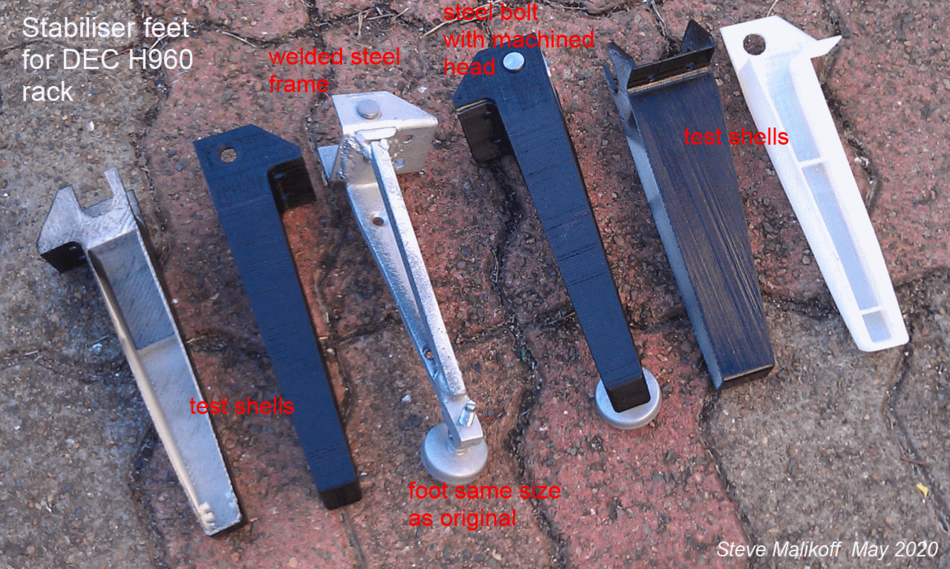
Here's my conclusion to the H960 stabiliser feet thread from a while ago where I was after measurements of
the originals. And thanks for all the help from cctalk (especially Noel) who supplied dimensions and photos.
I finished these last year but moved on to other projects and hadn't returned to the list to discuss them,
so I am doing that now. I made a pair each for my two H960's.
The feet consist of welded steel load-bearing frames with a C-profile that fits snugly onto the H960
base, a lower leg from a shelf bracket and a support strut. The leg is located by a steel bolt. The
bolt has the head machined to a disc, I was going to turn the taper and machine the slot but I lost
the photo of the original bolt that a listmember had posted so I left them at that. They could do with
nickel electroplating sometime. The frame is super strong, although I have not physically loaded them
to any great extent.
The outer end has a threaded adjustable pad the same size (AFAIK) as the originals, which are still
available. I found some correct size el-cheapo ones at the hardware store that did the job just fine.
The frame is threaded for the pad post and a nut on the pad then locks the pad from turning.
The outside aesthetics are taken care of with a 3D printed hollow shell modelled from the measurements
of the original casting. It slides onto the leg and is secured by the bolt. The shell CAD model still
needs some work to get the fit and front holes right, and a few other things but overall they look
fine and obey the 6 foot rule. A few coats of satin black enamel helps hide the print layering a bit.
Photo showing the frame (spray finished in silver epoxy primer, what I had at hand), the other frame
inside a shell, and some of the test shells:
http://www.surfacezero.com/g503/data/500/Stabiliser_feet_01.png
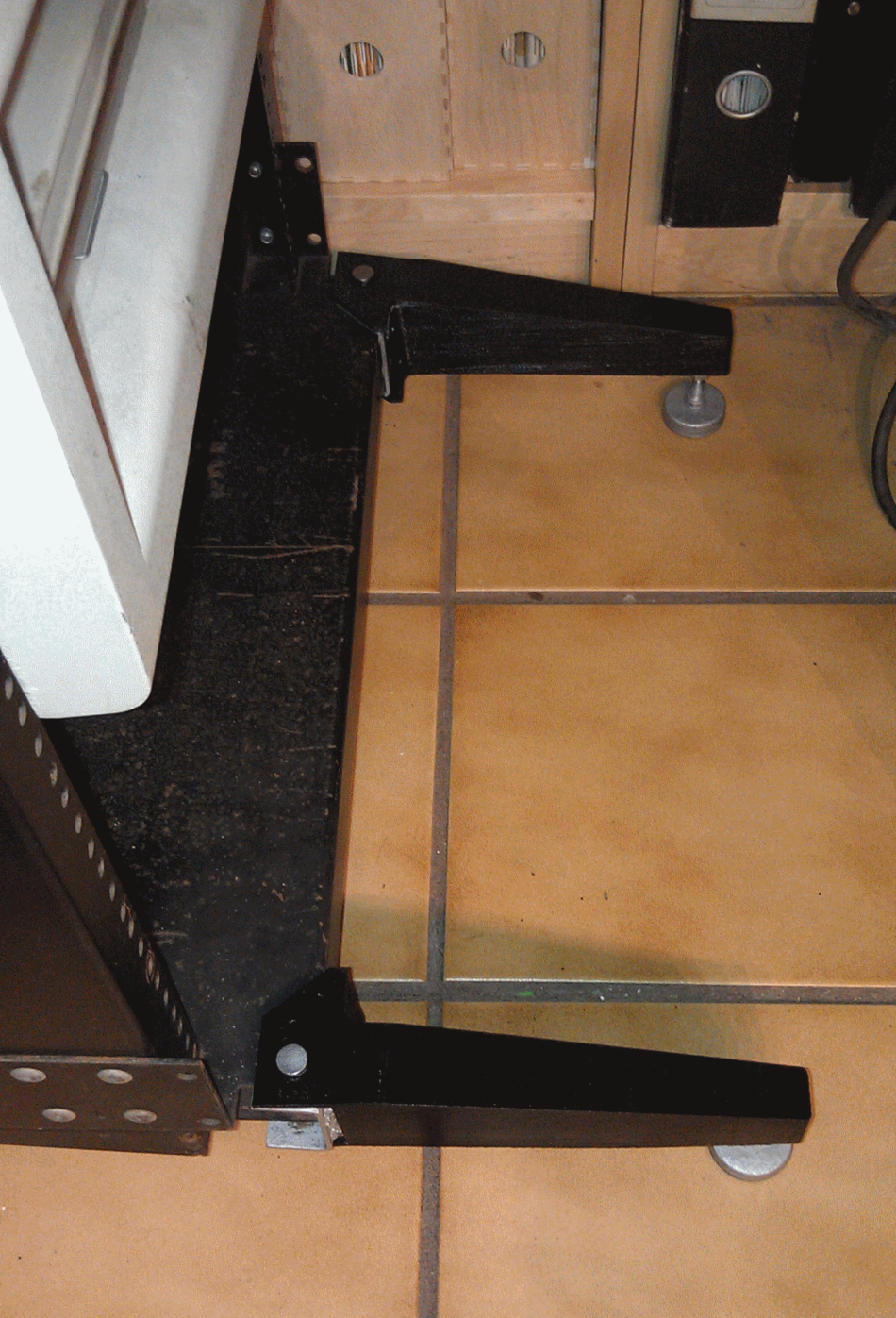
As attached to one of the H960s. (I have yet to do the kick panel, may laser cut that sometime):
http://www.surfacezero.com/g503/data/500/Stabiliser_feet_02.png
Steve.
With the 11/83 running pretty well I decided it was time to derack it
and try putting in a TK50 tape drive. I have two and a TQK70 controller
(which should work with a TK50) so I popped it in and started to test.
On the first unit the tape was already loaded and "stuck". Cleaned the
head by lifting it up, cleaning with isopropyl alcohol on clean no-lint
swabs and it unloaded properly. Now loads and unloads with no issues on
two tapes.
Second unit was a bit more interesting, even with a clean head it would
not unload. It would spin the tape, get to the point where the leader
was on the way through the head system then it would blink endlessly.
Took it out and moved the tape with a screwdriver through the hole and
found the problem:
The leader tongue had bent backwards a bit and as a result it was
getting caught in the head slot when rewinding. The TK50 controller must
be smart enough to detect the increased torque and stopped before
ripping the tongue through. I took it off, bent it back to straight, put
it in and now the tape loads and unloads properly.
I wonder if later model LTO tape units have the same tongue and leader
and can be swapped into a TK50.
Another question: Under RT11 what device is a TK50? Is it MQ or
something else? And is there a utility to allow a TK50 to be written
>from a SIMh image to real tape like PDP11GUI?
Thanks!
Chris
As I wrote in my last post, but write here for use as a separate thread:
I'd be interesting in hearing from folks what toolsets they have used
for HDL (VHDL in particular). I started with Xilinx ISE and then
graduated to Vivado for later chipsets - unfortunately, Vivado seems to
be something of a dog, in terms of time to compile HDL and synthesize logic.
JRJ
> From: Fred Cisin
> we can start by considering the 4004. 1971. ... Then came the 8008,
> with EIGHT bit data bus, and 14 bit address bus (16K of RAM) ... It is
> important to note that each Intel chip consisted of "minor" modifications to
> the previous one.
I know you didn't _say_ the 8008 was based on the 4004, but your text
can give that impression.
"The [8008] was commissioned by Computer Terminal Corporation (CTC) to
implement an instruction set of their design for their Datapoint 2200
programmable terminal. As the chip was delayed and did not meet CTC's
performance goals, the 2200 ended up using CTC's own TTL-based CPU instead."
The 8008 was started before the 4004, but wound up coming out after it. (See
Lamont Wood, "Datapoint", pg. 73.) This is confirmed by its original name,
1201 - the 4004 was going to be named the 1202, until Faggin convinced
Intel to name it the 4004.
Noel
Hi,
Every now and again I have a bit of time to mess with old computers - and usually for whatever reason - its Sun machines for me.
I?ve had loads over the years, played with them and passed them on.
Does anyone have anything old Sun wise available in the UK? I?d love to find an old VME bus machine but anything old or interesting. I can travel
to pick stuff up etc, social distancing observed of course :D
Anyway - PM me if you have anything that?s restorable :)
Cheers
Ian
https://www.vecmar.com/products/search.asp
Type in keyboard
The first result allows a terminal keyboard to be used on a PS/2 port.
The second result allows a PS/2 keyboard to be used on a terminal.
Not affiliated with seller, etc.
Cindy Croxton
Electronics Plus
1613 Water Street
Kerrville, TX 78028
830-370-3239 cell
sales at elecplus.com
--
This email has been checked for viruses by Avast antivirus software.
https://www.avast.com/antivirus
As some here probably know, I have been working the last couple of years
working towards an FGPA gate-authentic replica of the IBM 1410 - the
larger cousin to the IBM 1401.
In 2018 I developed an application for gathering information of of ALDs
and stuffing it into a MySQL database, then spent the rest of the year
entering the information from the ALDs into the system, but I did not
share that application or the data.
Then I took a year off - it had been a grind.
This year I took up the torch again. I put the application up on
github, gave it the requisite GPL attributions, and started tracking my
bugs, fixes and enhancements there, even though I am working alone. I
fixed some of the warts, generalized it some, fixed a few bugs, added
some database checking reports and data checking reports, and so on.
I also spent quite a bit of time generalizing it, so that it will
hopefully be usable (perhaps with some more fixes / enhancements /
generalizing for most any SMS machine (IBM 1620, IBM 709x, IBM 1401 etc.
etc. etc.)
The application is available on github at:
https://github.com/cube1us/IBM1410SMS
The actual "root" source control is on my system at home using
subversion. I use "git svn" to keep a git version in sync, and then
push that to github.
The application was/is developed in C# under Visual Studio 2017 to run
under Windows, primarily because I was interested in trying out C#. I
would expect it to build in VS 2019 with little or no change, but have
not tried it. I could have used a more basic tool setup (say, C or C++
and a non-windows presentation layer), but I figured not all that many
people would be interested in the thing, and the VS environment eased
development quite a bit. I suspect it would work OK under WINE, but I
have not tried doing so.
There are also a couple of tools, one in Perl for generating database
related classes from the database, and one in Python for checking for
database referential integrity. ( was curious about Python, and this
seemed a good candidate for an evaluation of it. It did, however
reinforce my dislike for many things about Python.
The application is comprised of two Visual Studio projects, one for the
data gather app itself, the other a very very light weight database
interface, that ought to make it not too hard to port it to a different
DBMS.
github also has a copy of the database, the MySQL Workbench data model
(and a PDF print) and documentation in MS Word (and a PDF print).
The code is not good. There, I said it. It is not truly OO at all. I
didn't do much refactoring even when I saw common code or saw
considerable potential to consolidate code. The downside of that is
that there is lots of duplicate code. The upside is that you don't have
to go umpteen layers deep in OO design to figure out what the darn thing
does. Doesn't even use database views, though they probably would have
been helpful. Just a bunch of tables. Lots of tables in a close but
not fully relational model.
The data gathered by the application in the database comprises about:
917 ALD (Automated Logic Diagram) 11" x 17" pages
10596 Logic Blocks on those pages (so average of 11.5 per page)
1281 DOT functions (Wired OR / AND)
14021 Inter-sheet signals (which appear on multiple sheets)
4222 Distinct inter-sheet signals
32746 Connections between the above items
That connection number makes me shake my head - I had to enter each and
every one of the darn things. Yeesh.
Capturing all of that was between something like 600 and 1000 hours,
maybe more (but not 2000 hours), after maybe 200 hours on the initial
version of the application.
My next phase is working hard on the part of the project that generates
HDL for FPGA synthesis. I expect that to take many months as I
synthesize, simulate with the tool set and figure stuff out.
I'd be interesting in hearing from folks what toolsets they have used
for HDL (VHDL in particular). I started with Xilinx ISE and then
graduated to Vivado for later chipsets - unfortunately, Vivado seems to
be something of a dog, in terms of time to compile HDL and synthesize logic.
If folks find this interesting, and especially if they want to use it,
I'd love to know about it. I intend to keep this a single-person
effort, git-wise, but folks can feel free to fork (if anyone wants to
bother ;) ), and let me know if they find anything seriously wrong.
For what it's worth, my IBM 1410 cycle-level simulator for the IBM 1410
is also available, at: https://github.com/cube1us/1410
Hi,
I've installed the recent release of 2.11bsd on my pdp11/73 and
recompiled the kernel to fit. But for some reason I can't resolve hosts
>from my /etc/hosts file now; only DNS names.. I'm not running BIND. Is
there a setting that will allow me to find /etc/hosts entries first and
then DNS in this operating system? I can't even resolve localhost!
thx
jake
Hi all --
I'm restoring a Xerox Alto and I started going over the system's Diablo 30
drive. The heads are in bad shape; the bottom one is actually missing both
parts of the erase poles (so the black portion of the head no longer makes
a "t", it's just a black line). This means the head (in addition to not
being able to erase) also won't float due to the head having small cavities
in them. The upper head looks a little better but I'd love to find a set
of upper and lower heads if anyone has spares.
Then I get to learn how to align these things.
Thanks!
- Josh
Lets have another go (but this time I have some pictures)
Decstation 5000/125 ? also houses a CD drive.
Two expansion storage boxes ? one has a tape drive and the other one has
a floppy drive.
Two very large and heavy RGB Digital monitors ? one has both Digital and
Sony branding on the back of it. I haven?t dug the other one out as its
in a corner and is dam heavy but it looks the same as the other one.
Box of spares (RAM, CPU's, HDDs etc.)
I?ve never powered it up ? it was a rescue ? I believe it was a server
in a TAFE college in Adelaide. This is all I got from the rescue bar the
box of spares. The original owner had tossed all the documentation and
software.
Please note that the stand is not included in my offer and its located
in south western Victoria (Australia).
Photos:
http://koken.advancedimaging.com.au/index.php?/albums/decstation/
Kevin Parker
Tai-Ho (Taiwan) was the OEM supplier for flyback transformers used by Apple in the early Macintosh computers (1984+).
Russell Industries (New York, USA) produced replacement flyback transformers for monitors and TVs, these appear on eBay and remaining TV repair supply houses.
As noted, while the circular pin-out is often standardized, the voltages need to be double-checked.
greg
chicago
==
From: "Rob Jarratt" <robert.jarratt at ntlworld.com>
To: "General Discussion: On-Topic and Off-Topic Posts"
Subject: Replacing the Flyback Transformer From My VAXmate
I am about as certain as I can be that the flyback transformer from my
VAXmate monitor board has failed. I know this is probably impossible, but I
am wondering if there is a way to find a more modern equivalent? How
standardised are these things? I do see a lot that appear to have the same
circular arrangement of the pins.
The VAXmate one is a Tai-Ho TH-1802B and according the Technical Description
has a primary voltage of +28V and produces auxiliary voltages as follows:
+13.1kV @85uA max
+950V @200uA
+45V @75mA max
-100V @1.2mA
Regards
Rob
Does anyone have, or know of low level documentation for Evans &
Sutherland Picture System 2 hardware?
I walk past a PS-2 monitor all the time and some of us started talking
about bringing it back to life.? I'm not sure if more of the system
exists, but it might.? I plan to check.
I looked on bitsavers and there's nothing I could find on the picture
system.? Other E&S hardware, but not PS.
Anyone know if any systems still exist?? I'd have to think the CHM has
at least one.?? Back in the day they were sort of required for anyone
doing commercial animation (or at least, that's what I could
claim/recall but it was a long time ago)
Brad
Preferably OS/VS2 TCAM System Programmer's Guide TCAM Level 10. GC30-2051
but I think it is similar to OS/VS2 TCAM Programmer's Guide, GC30-2041.
I get a hit for the former one:
http://www.computinghistory.org.uk/det/9844/OS-VS-TCAM-Progarmmer-s-Guide-T…
But it is not online.
Any one has a scanned copy of this document? Anyone that has a copy that
they could scan, sell or lend so that I can scan it?
/Mattis
I am about as certain as I can be that the flyback transformer from my
VAXmate monitor board has failed. I know this is probably impossible, but I
am wondering if there is a way to find a more modern equivalent? How
standardised are these things? I do see a lot that appear to have the same
circular arrangement of the pins.
The VAXmate one is a Tai-Ho TH-1802B and according the Technical Description
has a primary voltage of +28V and produces auxiliary voltages as follows:
+13.1kV @85uA max
+950V @200uA
+45V @75mA max
-100V @1.2mA
Regards
Rob
I had to repair the RAM board in my VS3200/KA650 again, so I took video
of the whole process (less about a whole day I lost troubleshooting a
trace I nicked).
Maybe some of you will find it interesting to watch.
https://youtu.be/3LxTJIzow2k (tip: get through youtube videos faster by
setting to double speed, etc. :)
So I'm working on fixing some old code here. Found my balticon gaming
system disks from 1990 (yes, I used to drag a pdp11 and 4 terminals to
Balticon and other cons for computer gaming) and dungeon works on the
4.0 RSX version I was using but when I try to run it on 4.2 I get an
Error 4 at PC 162570.
I tried recompiling: RSXCMP works fine and compiles all the modules
however when I run TKB with the rsxbld I get a bunch of *DIAG* Segment
(root3, rooms, etc) has address overflow: allocation deleted.
What am I doing wrong today? The task builder file is:
dungeon/cp/fp=d.odl/mp
stack=384
libr=fcsres:ro
asg=sy:1:2:3:4,TI:5,CO:6
Reading the docs I see:
The Fortran-IV-Plus object time library must be merged into
the system library (SYSLIB.OLB). Further, the library must
be set up to invoke the short error text module ($SHORT) as
the default. Task building with a separate object time library
produces numerous errors; task building with a resident library
or the normal error text module produces an oversize task image.
This might be the problem, anyone remember how to put the short error
text module into syslib.olb? Hm. Maybe it is. Hm....
C
I'm trying to bring a pdp-11/83 back to working order. Challenge right now
is storage - I have RQDX3 and RD54 but the RD54 appears to be unserviceable
(never goes ready) and TQK50 with a TK50 which never gets to a stage of
allowing me to operate the handle to load a cartridge - the green LED
doesn't come on, the red LED is solid for a short time after power applied
but then flashes rapidly. I plan to go with an MFM emulator in place of the
disk, but would like to get a TK50 working as I have a lot of old stuff I'd
like to try reading off cartridges.
I have a spare TK50 drive, which behaves exactly the same. The TQK50 LEDs
suggest it passes diagnostics, and the boot menu recognises it and will
attempt to boot from it before saying there is no such drive. I don't have a
spare controller.
There is a lot of very detailed documentation for the TQK50/TK50 as far as
the electronics and interfacing is concerned but I haven't found much in the
way of information about the mechanical side. Are there common failure modes
for these drives when they've been stored for a long time? Last time they
were powered up is probably close to 20 years ago. Without much in the way
of test kit (I have multimeter but no scope) is there anything I might be
able to check easily?
Thanks,
Martin
Well, I put the VT52 back together, tightened all the bolts, plugged it
in, turned it on and enjoyed the silence. I can just barely hear the
transformer hum but that's about it.
Hooked it up to my PDT11/150, booted up RT11 and the display is
perfectly crisp and clear. Ran space invaders to check it out, no bugs
or errors and the screen updates perfectly.
Glad I got this working again. I'll take a look at that transistor, I'm
almost 100% positive the switching transistor is either leaking or going
bad. Either way I'll order a transistor when I have some time and put it
in eventually to see if it works. But to be honest the new regulator is
a thousand times better than the original discrete logic system.
So moral: If your VT52 goes nutty and the screen becomes a blur try
checking all of the voltages. An errant -12v will make the screen
unreadable at -15v and I'm guessing oddness on the other voltage levels
will do similar things as well. And don't leave it on for days, that's
probably what pushed the transistor over the edge, but I'm guessing it
has been crummy for awhile which is why I heard all that noise in the
high voltage circuit.
I feel like I accomplished something today. Thanks everyone for the help
and thoughts in getting this old girl to work again...
CZ
In fixing my PSU I managed to break the leads to the LED on the front of the
PSU, probably through metal fatigue.
I seem to remember people saying it is quite difficult to replace these,
mainly because you can't get them out without breaking the holder. Is that
right? Has anyone done this successfully and have any tips?
Are there any recommendations for a replacement? If I remember correctly the
LEDs used in those days were not as bright as modern ones and a modern one
would end up being much brighter because of the higher voltage maybe?
Thanks
Rob
A friend recently reminesced about the Monrobot, which we have discussed a
little bit lately, . . .
[Note: Unrelated to the Marilyn Monroebot on Futurama]
---------- Forwarded message ----------
Date: Wed, 13 May 2020 16:38:22 +0000 (UTC)
Subject: A trip down memory lane in the world of computers (I probably have
shared this with you in the past) from an email to another friend...
My high school... Erasmus Hall High School in Brooklyn...?? ?
listed as THE LARGEST PUBLIC HIGH SCHOOL IN THE WESTERN WORLD (I guess
they were trying to exclude China and India at the time) was the first in
NY City to get its own computer... in 1965.?? ??IT was a Monrobot XI 2000.
Regarding that Monrobot XI?? 2000...?? ?? ??made by the Monroe desktop
calculator company of that era...
Its main memory was a rotating magnetic drum, with 2K??
16 bit words of fast electronic storage.??
Cycle op time was 11 milliseconds.??
It used 16 bit words, and one wrote its machine language
using what was NOT called "Hexadecimal", but instead "Sexadecimal"
(Latin, not Greek prefix was used)?? numbers, and NOT 1-9 then A-F, but
rather 1-9 and then T-X.??
Storage was on punched paper tape.
I learned to program it so that I could optimize access to the rotating
drum memory and get three accesses (the max possible) per revolution of
the drum, as much as tripling memory access speed.
11 milliseconds means?? 100 cycles per second.?? ??Modern desktop PCs
operate at around 3,000,000,000 cycles per second.Compared to the 2,000
words of main system memory of the Monrobot XI, today's desktop PCs have
around 8 to 32 billion words of memory.
I programmed it?? (at age 14, in 1965) in machine language (the computer
teacher didn't know how to do that)?? ... wrote a program for it to allow
me to input and it to output to its printer a sequence of 3 strip tease
images I got from a printout at Columbia University where I was then going
to the Science Honors Program for high school kids, there. on weekends.
---------- Forwarded message ----------
I may be wrong about Erasmus Hall High School of
Brooklyn being THE first high school in NY City to get its own
computer. There is a reference elsewhere to Bronx High
School of Science kids being taught IBM 650 language in 1959
or so.
I suppose, if so, I could start splitting hairs and say that,
while the Monrobot XI and the IBM 650 were similar in many
ways, the Monrobot XI was a much more modern generation in
that it used solid state, where the IBM 650 used vacuum tubes.
I vaguely recall there may have been a Monrobot XI and a
Monrobot XI 2000, the latter having twice the system memory
(rotating magnetic drum) as the earlier model.
Those were the days. I recall boot-strapping in programs in
machine language from the front panel!
I loved that machine. I remember the delicious smell of the
high quality oiled paper tape! [Some paper tape was oil
impregnated, some was not).
The thing came with a Fortran compiler. You loaded your
source tape on one tape reader, then loaded in part 1 of the
compiler, and an intermediate tape was output. Then you
loaded that intermediate tape and part 2 of the compiler on
the tape reader, and a compiled program paper tape was
output. THEN you input the compiled program, and (if you
were very very lucky), it ran.
Everyone else including the teacher used Fortran ONLY. I did
most of my programming on it in machine (not assembly... I
hand assembled my programs) ... machine language.
15 years later I programmed a prototype "Bio-medical micro
computer" that incorporated the JUST MONTHS EARLIER released
Intel 8080 processor to examine electrocardiograms in real
time (interrupt driven) and identify abnormal beats. I
programmed it in machine language, too. Storing programs in
1702 EPROMs. Input was via 3 buttons cycling 7 segment LEDs,
and a LOAD and RUN button. And an analog input for the EKG
signal. Output was to EPROM programmer and to EKG strip
chart.
Damn thing actually worked, pretty much. As well as most
other efforts back in 1975, anwyay.
---marty
Wonderful: A few weeks ago I forgot to turn off my VT52 and left it
running for a day or two. Now the screen is filled with snow and it
looks like the text is all over the place horozontally.
Any tips or thoughts on where to start looking to fix? The keyboard
seems to be working as does the RS232 input (the snow on the screen
changes when the pdp11 talks to it)
Thanks!
Chris
Turns out the "The Director" tape reader I purchased last week was
defective and I got a refund. So I thought I'd try my hand at the FANUC
TAPE READER A860. I may need to make a serial cable (?) to connect from
the internal connector don't know yet. Or maybe the internal 50-pin port
>from the photos is for the punch. Don't know yet, thus the need for the
manual.
I checked bitsavers.org but there was no manual there, anyone here have a
PDF or URL of the PDF for the FACIT tape reader A860-0056-T020?
Thanks in advance.
Bill Degnan
>
> From: Bryan Longram <Driverless at protonmail.com>
> Subject: Wanting some help with a PDP-8/a
>
> I acquired a non-functional PDP-8/A several months ago and in that time
> I've replaced all the outwardly damaged parts and have gotten the machine
> to power on with no issues. However the problem I've been having now that I
> can't quite seem to pin down is that every time I power the machine the
> address field is displayed as 07777 and the value field is displayed as
> 7777. Attempting to change addresses or the value of the address doesn't
> work as I can enter the value just fine but upon entering the Load Address
> button it defaults back to being all sevens.
I am in the process of repairing three 8/a Programmer's Panels. Two panels
had bad ribbon cables. A good panel exhibited the same behavior as yours
when used with the bad cables. I was able to cut the keying peg off two IDE
disk cables to try as replacement cables. They IDE cables don't fit well,
but do work. I will make new replacement cables for all three panels.
--
Michael Thompson
I have a DS20E Alpha machine. It's pretty fully configured, with two 666
MHz CPUs, 4GB RAM and 4x10K SCSI drives. In other words, it's a real power
hog. It has three power supply modules installed, and if I understand the
configuration rules then at least two should be required to run the machine
and the third is a hot spare.
But, when do SHOW POWER at the SRM prompt, I get
P00>show power
Status
Power Supply 0 * BAD *
Power Supply 1 not present
Power Supply 2 not present
System Fan 0 good
System Fan 1 * BAD *
CPU Fans good
Temperature good
What? If I believe that then I have no functioning power supplies
installed?!? At this point I should mention that the machine boots VMS and
runs just fine.
Obviously something is not telling me the truth. Does anybody know what
would cause this? BTW, what do the red LEDs on the front of the power
supply modules mean? Is LED ON a good thing (i.e. power OK) or a bad thing
(i.e. fault)? FWIW, none of the LEDs on my three power supplies is on.
Oh, and it's right about System fan #1 - one of the fans is not running.
I don't know if it's seized up, or if it's related to the power supply
issue.
Thanks,
Bob
Nice how machines from that era were well made enough to still work.
Remember that Lunar Lander game from about 1970. Version I played
was written in FOCAL and run on a TSS-8. Should try it out on some
kids who think they're great gamers and see how fast they catch on -
once we were able to land without crashing we'd see who could come
down at lowest speed or have most fuel left over after a successful landing.
>https://youtu.be/L743MjJthHY
>
>I recently got my SEL 810A working. I hope you guys enjoy the video :).
>
>-Eric
I acquired a non-functional PDP-8/A several months ago and in that time I've replaced all the outwardly damaged parts and have gotten the machine to power on with no issues. However the problem I've been having now that I can't quite seem to pin down is that every time I power the machine the address field is displayed as 07777 and the value field is displayed as 7777. Attempting to change addresses or the value of the address doesn't work as I can enter the value just fine but upon entering the Load Address button it defaults back to being all sevens. I've made sure the pins on the CPU board are set so it should start at address 0, the advanced options are also all turned off and as far as I can tell there's nothing out of the ordinary with the pin settings on the IO board.
I'm fairly certain at this point that the issue is with the Programmer's Panel but I'm not 100% sure.
I've done some further testing using advice I got from users over at the Vintage Computer Forum and SR and LSR work as intended, I can enter a value into SR and then view it at a later time. Something interesting I did find was while checking over the CPU I was looking at the switches on it and while S1-1 was set as expected S1-7 was also on which is the CPU autostart disabled feature.
Upon powering the computer back on after turning S1-7 off both the ADDRS and DISP displays show a single 0. I thought I was on the right track though now the panel doesn't work as if the panel lock was toggle even though it's not, not even the read functions and SR are working. Switching S1-7 back on reverts the problem back to what it was before and far as I know all the voltages on the power supply are correct. Any help would be appreciated, even if it's just a push in the right direction.
Looking for a pair of DEC RL02 drives, working or otherwise, for a PDP-11 restoration destined for a local computer museum in Boulder, Colorado. It's fine if it's not working - I'm happy to try and get it up and running. Thanks!
Here's a link to the restoration blog:
http://headspinlabs.wordpress.com
Someone asked for one of these a long time ago. I have one tested and
working; needs a good cleaning. Make offer; local pickup only.
Cindy Croxton
Electronics Plus
1613 Water Street
Kerrville, TX 78028
830-370-3239 cell
sales at elecplus.com
--
This email has been checked for viruses by Avast antivirus software.
https://www.avast.com/antivirus
I have never seen one mentioned but is there anyone here
with an interest in these? I found a still sealed copy of
the Software Development Set Ver. 2.0. What's it worth?
bill
> From: Stephen Buck
> Looking for a pair of DEC RL02 drives, working or otherwise, for a
> PDP-11 restoration destined for a local computer museum
Well, there's this:
https://www.ebay.com/itm/264277971437
It's an RL01, not an RL02 as you were enquiring after, but RL02's are quite
rare now - and the price isn't bad.
Noel
Hi Chris,
I?m located in Boulder, Colorado. I?m fine with an RL02 that doesn?t work. If it can?t be fixed it can always occupy space in the rack. This is going into a museum and I might end up using an emulated drive behind the scenes for day-to-day use.
Steve
?
Hi,
> It it possible to get parts for a Digicomp? Mine needs some springs and
> the thing that connects the clock to the whatever.
I used rubber bands instead of springs.
The article about 3D print DIY
https://www.thingiverse.com/thing:1477209
contains instructions how to bend the wire crank.
regards,
Joerg
?> >/I added a motor drive to my DIGI-COMP I, and wrote 4 web pages about /> >/that device. /> >//> >/See http://www.retrocmp.com/articles/digi-comp-1/ /> >//> >/or just the video https://youtu.be/D6GgxXRJXnw /> >//
If I said 'EPT' anywhere I apologize; I'm talking about PPT (Punched Paper Tape) and EPCs (Edge Punched Cards).
Here's a description of a series 'L' system, the successor to the 'E' series, containing
"The reader could be used for loading programs faster. It could also be used for accessing user data from punched paper tape or from edge-punched cards."
http://www.picklesnet.com/burroughs/descriptions/bltc.htm
And pictures of the PPT/EPC perforator and reader (unfortunately the perf picture seems to link to the reader so you don't get a full-sized picture) :
http://www.picklesnet.com/burroughs/gallery/bpgltc.htm-
A great (downloadable) book full of pictures and specifications of computers of that era is "A Third Survey of Domestic Electronic Digital Computing Systems" (one of a series):
https://books.google.ca/books?id=fZg8yAEACAAJ&dq=a+third+survey&hl=en&sa=X&…
See P.179 for a well tricked out E101.
Unfortunately people tend to dismiss this class of systems as 'only' accounting machines, largely because of their integrated keyboards and printer carriages based on the earlier electro-mechanical machines for operator familiarity, so there's little information and discussion about them.
But they are definitely 'true' computers using the same technology as contemporary general-purpose systems, core memory, disk drives, etc., and as technology advanced IC memory, high-speed dot-matrix printers etc., and, in the latest models, multiple high-speed cassette drive systems used the same way as the big brother tape drives and almost as much fun to watch in action.
Sorry for going a little OT; I'll do some digging for those cards...
mike
----- Original Message -----
From: "Peter Van Peborgh" <peter at vanpeborgh.eu>
To: "'Mike Stein'" <mhs.stein at gmail.com>
Sent: Saturday, May 09, 2020 6:27 AM
Subject: RE: Odd punched cards
> M,
>
> An intriguing email. Also leaves me with more questions... And longings!
>
> My [PVP: ] comments are in your email below.
>
> Vintage computers forever! Many thanks,
>
> P
>
> -----Original Message-----
> From: Mike Stein <mhs.stein at gmail.com>
> Sent: 08 May 2020 16:45
> To: Peter Van Peborgh <peter at vanpeborgh.eu>
> Subject: Re: Odd punched cards
>
> The systems that I'm familiar with that used EPCs were Burroughs 'E' series
> accounting computers; the readers and perforators handled both PPT and EPCs
> and the cards were a sort of random-access PPT.
>
> [PVP: ] I am having problems finding info on these two types of cards: EPT
> and EPC. Can you point me in the right direction?
>
> If you were preparing an invoice, for example, you might have a set of cards
> for the customer name and address and another (possibly different colour)
> set for the line items; you'd enter the quantities and it would be printed
> and punched out on PPT for the accounting functions.
>
> Still have some cards and the perfs and readers somewhere; must play with
> them one day...
>
> [PVP: ] This is cruelty to animals! Is there ANY way you could dig up some
> of these EPC and EPT cards for my collection/display? Talk to me about
> postage, etc...
>
>
> m
>
> ----- Original Message -----
> From: "Peter Van Peborgh" <peter at vanpeborgh.eu>
> To: "'Mike Stein'" <mhs.stein at gmail.com>
> Sent: Thursday, April 23, 2020 3:45 PM
> Subject: RE: Odd punched cards
>
>
>> Mike,
>>
>> 96-column cards I have, thank you.
>>
>> I used edge-punched cards to record scientific papers' details when I was
>> doing research. Did any get used with computers, do you know?
>>
>> Many thanks,
>>
>> peter
>>
>> -----Original Message-----
>> From: Mike Stein <mhs.stein at gmail.com>
>> Sent: 23 April 2020 19:17
>> To: Peter Van Peborgh <peter at vanpeborgh.eu>; General Discussion: On-Topic
>> Posts <cctech at classiccmp.org>
>> Subject: Re: Odd punched cards
>>
>> How about 96 column and EPC (Edge Punched) Cards?
>>
>> ----- Original Message -----
>> From: "Peter Van Peborgh via cctech" <cctech at classiccmp.org>
>> To: <cctech at classiccmp.org>
>> Sent: Thursday, April 23, 2020 2:03 PM
>> Subject: Odd punched cards
>>
>>
>>> Guys,
>>>
>>> I got a positive response about the Port-A-Punch cards so no longer any
>> need
>>> to respond to this one. Very encouraging.
>>>
>>> Still looking for Jacquard cards and original Hollerith cards. Hope
>> springs
>>> eternal.
>>>
>>> peter
>>>
>>> || | | | | | | | |
>>> Peter Van Peborgh
>>> 62 St Mary's Rise
>>> Writhlington Radstock
>>> Somerset BA3 3PD
>>> UK
>>> 01761 439 234
>>>
>>> "Our times are in God's wise and loving hands"
>>>
>>> || | | | | | | | |
>>>
>>>
>>
>
> From: Dwight Kelvey
> There was a fellow that made a relay logic that could play tic tac toe
What's with these new-fangled devices using _electricity_ anyway? :-)
In high school, my math teacher (I think it was) used a couple of matchboxes
and some beads to create a TTT device; he 'programmed' it by playing against
it, and when the device lost a game, he pulled out the bead that indicated
the device's previous move, so it could never make that losing move again.
Pretty impressive, I thought...
Noel
Hello,
I have recently been trying to improve the ripple on the output of my
MicroVAX 3100 Model 95 PSU because occasionally it would fry a memory
module. I replaced a bunch of capacitors, some of which had started to leak.
However, the ripple does not seem much better. There is a scope trace here:
https://rjarratt.files.wordpress.com/2020/05/microvax-3100-model-95-psu-ripp
le-after-re-capping.png
Ch1 is the 12V output and Ch2 is the 5V output. I had an old RD53 connected
as a dummy load. It is possible that the memory was breaking because of
occasional spikes that are worse, but I don't know. Does that seem OK?
Thanks
Rob
>From time to time there are posts here about the Facit N4000 paper
tape punch/reader unit. The one that looks like a Facit 4070 with a
tape reader on the front (in fact the punch mechanism is much the same
as that in the 4070).
I have reverse-engineered mine and traced out the schematics. Of
course it's one of my hand-drawn ones but I think it's mostly legible.
If anyone wants it I am happy to send out a copy (but as ever I'd
rather send it out once and have somebody else pass it on)
-tony
So, I've come across an odd book that might interest some here: "Achieving
Accuray: A Legacy of Computers and Missiles", by Marshall William McMurray.
The first couple of chapters merely re-tell the story of earliest computers
(pre-elecronic and electronic), up through the IBM 701, Elliott 401, NCR 304,
SAGE, CDC 6600, IBM 7090, etc. Competent, but nothing special. Then it
gets interesting, though.
Chapter 4 is "Small Magnetic Drum Computers of the 1950s", and it covers a
bunch of machines I'd never heard of: JAINCOMP B-1 (!), MONROBOT III (!!),
CADAC 101, 102 (!!!) and on and on.
Chapter 5 is "Real-Time Control Computers", and it covers a long group of
machines: ALWAC I, II, III; Univac Athena; Autonetics Verdan D9A-L; Librascope
C-141 to name but a few. Pure gold, this chapter and the one before - retrieved
a lot of machines from the memory hole.
Chapter 6 is "NASA Control Computers", and it covers the usual suspects: IBM
ASC 15, IBM LVDC, IBM GDC, Librascope Centaur, AGC, IBM 4Pi. Some of these
are covered elseshere, but it's nice to have them all in one place.
Chapter 7 is "Late-Model High Speed Supercomputers", with quite a range:
starting with Cray 1, Sun, SGI, then the various ASCI array multi-processor
systems at LLNL, etc.
It then moved over to missiles, and goes through a similar progression,
starting early, with some details of WWII era stuff (e.g.Hs 293's), then a
chapter on V-1's amd V-2's and their derivatives.
More chapters on "Early US Missile Programs", NAA's inertialguidance work and
its applications up through Polaris, Titans, etc. Then more on later US
missiles and their guidance systems, such as Minuteman, Trident and MX.
A lengthy Chapter 13 is "Soviet and Russian Land-Based Missile Systems", which
doesn't have quite the detail of the US chapters (in which the authot was
personally involved), but is still novel. Another chapter then finishes with
Soiet/Russian naval missiles.
A very unusual and off-beat work.
Noel
>
> From: Joerg Hoppe <j_hoppe at t-online.de>
> Subject: DIGI-COMP 1 enhanced
>
> Guys,
>
> I added a motor drive to my DIGI-COMP I, and wrote 4 web pages about
> that device.
>
> See http://www.retrocmp.com/articles/digi-comp-1/
> or just the video https://youtu.be/D6GgxXRJXnw
>
> best regards,
> Joerg
>
That is very cool!
The RICM has a DIGI-COMP, but we have not done much with it other than put
it on display.
--
Michael Thompson
Per my post from last week, after checking out the Decitek readers I ended
up getting a used by warrantied EECO "The Director" MT-82 tape reader with
a short-height spool for a good price.
Here is the manual.
http://www.bitsavers.org/pdf/eeco/DOC10006_EECO_MT-82_MTS-82_Mar82.pdf
Anyone use this unit? I saw some youtube video display how the servos
appear to treat the tape kindly, that was a selling point. Not as
interested in speed as that's not the point, eh?
Bill
dwight wrote on Thu May 7 08:45:07 CDT 2020:
> There are only a few winning and tying patterns for tic tac toe. There
> was a fellow that made a relay logic that could play tic tac toe and
> would win against a human of at least tie but never lose.
Here's my version of tic tac toe in TTL logic: J/K flip flops and a ROM:
https://github.com/DoctorWkt/TTL_TicTacToe
Cheers, Warren
> From: Aaron Taylor
> I can confirm that the DEC MSV11-R is a PMI card. I own two and have
> used them with my KDJ11-B. ... the board is recognized as PMI by my KDJ11-B.
Also, in a fairly amazing bit of sleuthing, Jerry Weiss found (in some of the
early PR versions of the -11/84 TM) a diagram which actually shows an
MSV11R-R connected to the PMI bus (on pg 3-63, or thereabouts).
Thanks, guys!
Now, to try and round up enough energy to get my Q/CD machine running, to
confirm that I didn't fry mine. (I don't remember any smoke, but I'm pretty
sure I tried it, to check it, after I bought it.)
Noel
Hi, I'm looking for documentation on the MSV11-R; there's next to nothing
online. (An -11/84 manual gives config, but that's all I cam find.) There is
an 'MSV11-R User Guide' (EK-MSV1R-UG), but it's not online; I don't suppose
anyone out there has one?
I'm trying to confirm an online report that it's a PMI card; if so, I want to
put a warning on the CHWiki page for it, to warn people not to plug it into a
Q/Q backplane. (I have one, and did try it back when I first got it, but I
don't recall if I knew it might be a PMI card at the time! I'm too
lazy/low-energy to get my Q/CD machine running so I can plug it in and see if
it still works. :-)
Given the size of the card, and the amount of non-memory logic, compared to
the MSV11-M and MSV11-Q, I would tend to suspect it is a PMI card, but it
would be good to find some DEC docs to confirm it.
Noel
Hi - COVID project.... I have been attempting to read some old Honeywell
DDP-516 papertapes using the OP-80A or Teletype reader but it's inefficient
and I don't want to damage the tapes. Does anyone have a reliable
papertape reader for sale, or recommend one currently out there on Ebay,
for the purpose of archiving papertapes of any kind safely and reliably. I
have a reasonable budget. I have a lot of tapes that need to be archived,
so I'd want one that I can interface with to capture into TAP files or what
I would call a raw dump listing of the data in 8-bit Hex. MITS, SWTPc,
Z80 stuf, PDP 8, PDP 11, Honeywell, etc.
End goal is to load tapes into simH, PDPGUI, Altair/S-100, textfiles to
display tapes. I want to be able to view the tape as it would be in Intel
or Motorola format, etc. What does everyone else do?
For example:
S1131C102C20DEBD19217E167DBD185FD6259626A3
S1131C209B27C900D70297037E167DBD1999DE282C
S1131C30DF2C9C022742D6029603902DD22C2A1C1C
S1131C40D62C962DBD015ADF2CD6029603BD015A1F
S1131C509C2C2724A600BD02270820F4D602960354
S1131C60BD015ADF2ED62C962DBD015A9C2E270875
S1131C70A600BD02270820F47E167DDEDBDF027E8F
S1071C80167D0000C9
S9030000FC
Thanks for any advice.
Bill
> From: jnc at mercury.lcs.mit.edu (Noel Chiappa)
> To: cctalk at classiccmp.org
> Cc: jnc at mercury.lcs.mit.edu
> Subject: Odd book
> Message-ID: <20200506152915.23EA118C0AA at mercury.lcs.mit.edu>
>
> So, I've come across an odd book that might interest some here: "Achieving
> Accuray: A Legacy of Computers and Missiles", by Marshall William McMurray.
>
> The first couple of chapters merely re-tell the story of earliest computers
> (pre-elecronic and electronic), up through the IBM 701, Elliott 401, NCR 304,
> SAGE, CDC 6600, IBM 7090, etc. Competent, but nothing special. Then it
> gets interesting, though.
?.
> A very unusual and off-beat work.
>
> Noel
Noel,
Thanks for the book recommendation above. I was happy to see that it was available in a reasonably priced Kindle version.
One of my favorite computer history books is Stan Augarten's 1984 book, Bit by Bit: An Illustrated History of Computers.
I did manage to find a copy and really enjoyed reading it and looking at the great photos in it. I was curious to know
a bit more about the author and in ?DuckDuckGoing? him I ran across an online college course by Haverford University:
http://ds-wordpress.haverford.edu/bitbybit/bit-by-bit-contents/front-matter… <http://ds-wordpress.haverford.edu/bitbybit/bit-by-bit-contents/front-matter…>
that has the entire text and the photos from Stan Augarten?s book. It is a great way to read an otherwise hard to find
book. It also has some .pdfs of the lecture slides from the professors who put this great web site together.
Mark