Liam Proven wrote:
> Hey, John, welcome! Have you just joined or been here lurking all along?
Just joined.
> In CP/M, isn't the BIOS just a file on disk anyway?
It is, but adding functionality to it without the loadable driver
facility would be nowhere near as straightforward. You'd need to work
out how to allocate memory to your additional feature, how to hook it
into the various BIOS data structures, and then how to get the .EMS
self-unpacker to relocate it to the right place. And since it would be
infringement of copyright to distribute the patched file, you'd have to
distribute a program that did that patching.
Chuck Guzis wrote:
> Suppose I wanted to use 1.44M 3.5" floppies. The hardware (with a
> bit of tweaking) is capable of it. No way to get to the boot
> software, however. Suppose I wanted to boot from a home-built CF
> card...
In theory you could replace the boot ROM (desolder the 8041, read its
contents, and burn an 8741 with the new boot image. Or even an 8742, if
you wanted more than 256 bytes of boot program). In the 9512 it would be
even easier, because the corresponding microcontroller used an external ROM.
It was also possible for peripherals plugged into the expansion port to
provide their own boot ROMs; Cirtech's external hard drives did so, for
example, and they advertised a similar device that booted from flash.
--
John Elliott
Spammer!
Does anyone trim the list?
On 08/23/2012 04:39 AM, dennis.yurichev at gmail.com wrote:
> Hi!
>
> Your email was taken from classiccmp/cctalk mailing list.
> (So it's kind of SPAM).
> I'm writing you because I'm looking for job and you'll see now why I do it in that way.
> I'm good on reverse engineering of ancient software like those for MS-DOS, ancient Unices and/or for exotic platforms.
> I'm
[snip]
> >> I'd love to find one of those add-on boards that would allow IDE or
> >> CF to be used - the HD in my 10 isn't going to last forever. :(
> >
> > GIDE works in the Kaypros I think.
> >
> Is anyone selling them?
>
[snip]
Hi
The GIDE is a neat circuit but finding one is difficult. They are long out
of production and are hard to replicate since it uses GALs. At least the
equations for the GALs are known. It also uses obscure obsolete RTC chip
that is hard to find.
How about instead of just replicating the GIDE convert the XT-IDE V2
circuitry to use a Z80 socket rather than an 8 bit ISA slot.
The XT-IDE V2 provides a 16 bit IDE interface, an optional boot ROM, and an
optional UART for remote booting capability. All of those would be useful
things on Kaypro or any other Z80 computer. It would use the same "shim
socket" approach as the GIDE and would be easy for anyone to use and/or
replicate.
Thanks and have a nice day!
Andrew Lynch
I'm a bit surprised that there hasn't been more discussion about S-100
machines. In particular I would point out the Morrow Decision 1. It's
DJ-DMA floppy controller could handle 8" SSSD thru DSDD, and both
soft-sectored and hard-sectored (NorthStar) 5.25" formats and a separate
hard drive controller was also available of course. Later variations even
had a switching power supply.
Not strictly a CP/M machine (though probably 90+% used CP/M or variation
thereof) and CP/M came standard with the machine. Morrow even provided a
UNIX-like OS, the name of which escapes me at the moment (Micronix maybe?).
With the addition of an 8086 S-100 board it would certainly run a plain
vanilla CP/M-86 system.
Other S-100 systems like CompuPro and Cromemco and even NorthStar were all
versatile and well-built CP/M machines which could aspire to be called 'the
best CP/M machine ever.' In general I would even proclaim the category of
S-100 micros as the holder of that title.
Bob Stek
Saver of Lost Sols
> Personally, I'm partial to the Amstrad PCW line.While it was marketed
> as a dedicated word processor in much of the world, it had gobs of RAM
> (at least 256KB), high-resolution monochrome graphics (720x256) and
> shipped with a very nice CP/M Plus implementation which included a
> better-than-average BASIC as well as DRI LOGO and the GSX graphics
> libraries. The non-standard 3 inch floppies are a bit of a drag, but
> it was fairly easy to add 3.5 inch drives and even hard drives were
> available.
Second-generation PCWs corrected that; they had 3.5" drives. And later
iterations of the BIOS supported loadable device drivers, with all sorts of
possibilities for mischief.
--
John Elliott
I haven't yet tried it but at tapeheads.net you can learn about the use of
a 50-50 mixture of Nu-Finish car polish and naptha as a treatment for
flaking/shedding reel-to-reel tape. (Honest)
>
>
>[Snip]
>Sorry if it was offensive!
>And thanks in advance for your attention.
>
And as some of you have stated, the market these days is MUCH
more difficult than it was a few years ago.
I have been waiting to observe if anyone else mentioned the
following two points:
When you consider that probably every other response has used
more bytes than the original request (including this one - and there
have been at least 20), it certainly seems reasonable to have sent
the request.
In addition, no links were activated when the body of the e-mail
was displayed. On the rare occasions I receive spam these
days, most of the time a link attempts to activate itself - which
is almost always impossible since I try to remember to disconnect
the cable to the router before I start to read any e-mail. If such
a link had been included, that would have been unacceptable!!!!!
Jerome Fine
Has anyone had any success at all recently in recovering data from
Wabash-branded floppies?
I haven't. The binder on these things has gone to Hades and the
oxide will flake off if you so much as touch it with a drive.
Yesterday, I thought I'd try again after swearing off of the things,
as the disks in question were 10-sector rather than soft-sector. I
wondered if 10-sector being rarer than the soft-sector variety might
not be different.
No soap. That grinding sound, accompanied by dirty heads tells me
that *no* Wabash disk is worth touching.
Anyone got any secrets for these?
Cheers,
--Chuck
Hi Rich! Thanks! I really appreciate the support! Here is a little
background information in case anyone was wondering about building your own
home brew CP/M computer.
At the N8VEM home brew computer project there are several boards to assemble
your own home brew CP/M computer.
The original is the SBC V2 which is a Z80 based Eurocard system. It can be
stand alone or act as an ECB bus controller for IO expansion.
Next is the Zeta which is an SBC without bus expansion but several built in
peripherals such as a floppy drive controller, IDE, serial, RTC, etc.
Finally there is the N8 which is a Z8S180 based all-in-one computer with
complete IO suite (FDC, IDE, serial, parallel, video, audio, etc). It is a
bit like the P112 with built in video, sound, and some other peripherals
along with hobbyist friendly components.
All of the N8VEM CP/M computers share a common ROM BIOS (RomWBW) or you can
use your own or someone else's custom BIOS (MSX CBIOS).
What is really neat is a sizable robust community has grown up around the
N8VEM computers and builders are even making their own systems (like the
Zeta) for the group. We don't always agree on things but manage to get
along pretty well. There are many points of view and not everyone sees
things the same way. That's OK -- its healthy.
There is also a fairly complete suite (25+ types) of S-100 boards with
backplanes, serial IO, drive controllers, video controllers, RAM boards, CPU
boards, etc. Really too many to mention here.
All the hardware and software design information is free (as in speech and
beer) and publicly posted.
There is a mailing list and wiki available for information and support if
you want it. You are free to use what's there even if you never participate
in the N8VEM home brew computer project. Several other projects have
branched off N8VEM and are now making their own CP/M computers, S-100
boards, etc.
http://groups.google.com/group/n8vemhttp://n8vem-sbc.pbworks.com
Most boards have parts lists in addition to full schematic and PCB layout.
Complete KiCAD EDA files with custom libraries are included as well as full
source code listings, tools, etc.
I try to emphasize the use of free/open source tool sets so literally
*anyone* can build their own systems including making their own home made
PCBs. The PCBs are available through group buys which is a sort of informal
process. I try to keep the cost as low as possible and it more or less
works.
Active community participation is encouraged and expected but not required
since everyone is a *builder*. There are no bosses, management, users,
stockholders, clients, or customers!
So if you have the inclination or ever desired to build your own home brew
computer this is your chance. It is pretty easy to do and a lot of fun!
Please consider this your personal invitation to come to the N8VEM home brew
computer project. You are all most certainly welcome!
Thanks and have a nice day!
Andrew Lynch
PS, if you have questions feel free to contact me at LYNCHAJ at YAHOO.COM
> -----Original Message-----
> From: cctalk-bounces at classiccmp.org [mailto:cctalk-
> bounces at classiccmp.org] On Behalf Of Rich Cini
> Sent: Thursday, August 23, 2012 9:19 AM
> To: General Discussion: On-Topic and Off-Topic Posts
> Subject: Re: The best CP/M machine ever? was Re: Kaypro II
>
> Do you mean hobbyist or COTS? There are several hobby SBCs that can do it,
> including the P112 and N8VEM. There are 68k and 8086 boards as well.
>
>
>
> Rich Cini
> Sent from my iPhone
>
>
> On Aug 23, 2012, at 8:56 AM, microcode at zoho.com wrote:
>
> > Are there any modern ready-to-go SBCs capable of running CP/M?
> >
> >
I could not help but become part of the conversation even if people have
already written more 'diligent and competent than me.
My site is http://elazzerini.interfree.it
Originally my disposal clone a Ferguson Bigboard I that I was able to start
charging even CP / M 2.2 to 3.5" diskettes.
Obviously I could not help but come into possession of his descendants: the
Xerox 820-I and the Kaypro-II whose reviews I entered the site and are still
working.
The only board xerox 820-I has been assembled by me in a PC case for making
all the corrections have composite video, and use PS2 interface-parallel
drive with 3.5 ".
The Kaypro II was full of his case but with a full size 5.25" drive out of
service and when buying a separate drive full size 5.25 " is fully
operational.
I'm happy to have just these two machines, but fully functional. I could not
afford them to buy them with the original prices of the 80's.
To assess the selling rate of your Kaypro-II if the goal is to gain much
more money I suggest whether it is fully functional and free of scratches,
it is best to sell it to pieces, only one drive fullsize 5.25 " fully
functional sold separately makes it almost more 'all over the computer
alone.
Probably be able to sell the first pair of drive 5.25 ", then the mainboard
and then the keyboard or the power supply while you remain the case and the
monitor.
I do not think could you sell it in bulk to achieve a fair return if the
product Kaypro-II at that time very popular. At least every three days you
find it for sale on epay.
I am currently looking for other boards like the Ferguson Bigboard II or the
Ampro Little Board based on the Z80 or Z80 based mainboard in general other.
Greetings
Enrico - Pisa (Italy)
>Message: 20
>Date: Thu, 23 Aug 2012 15:31:40 -0400
>From: Allison < ajp166 at verizon.net > >
>
>On 08/23/2012 01:06 PM, Fred Cisin wrote:
<snip>
>> Why didn't the Otrona catch on?
>> Charlie Chaplin [clone] carrying a table with computer down stairs wasn't
>> enough?
>>
>Osborne was first, smaller and had a 5" screen.
>
>Kaypro was later, had better screen, keyboard, more IO, and generally
>better.
>I'd agree the Darth Vader lunch box look as less than kool but it was
>durable.
>
>Allison
Regarding why the Otrona did not catch on (other than in some circles, such as the JPL):
1. Price. Much more expensive than either the Osborne or Kaypro. I think I paid over $3500 for my 8:16, with a substantial educational discount.
2. Screen size: 5".
3. Late arrival. The O1 and Kaypro were already established. I saw my first Otrona at a Chicago FOG meeting.
I heard the Osborne described as a Buick, the Kaypro as a Chevrolet and the Otrona as a BMW.
BTW, I still have my 8:16, which I had aftermarket upgraded to 512KB RAM .
Bob
Check out the photos:
https://picasaweb.google.com/NeXTprototype/Sun1Computer?authkey=Gv1sRgCIbH_…
Still need a way to get the Sun Series 2 Keyboard and Mouse working on
the Sun 100u. Is my best bet trying to connect it to the SUN2 CPU
series conectors, or the bwtwo prime mono video board serial
connectors? Anyone have pinouts for the keyboard?
Thanks a million!
Nick
I have a HP 9000/300 68000 with an extra processor card.
I was surprised when I pulled the processor card from the machine and
discovered a 68030 CPU.
I was shocked I didn't remember that card.
Looking for software, I checked bitsavers, but only located a Pascal
compiler.
Does this machine have any interesting (O/S) software freely available?
Are their any list members playing with this machine?
Is it possible to boot from the GPIB?
I'm behind a dial-up wall and I was hoping to save some bandwidth before
downloading the manuals.
Thanks,
- Jim.
The Atlanta Historical Computing Society has decided to host the first
ever Vintage Computer Festival Southeast. It is tentatively scheduled for
Saturday, February 9th, from 10 AM - 7 PM. We're also planning a Friday
night dinner / hang-out, plus an after-show / cleanup dinner too.
Lonnie Mimms, a local commercial property manager (and owner of perhaps
the single largest personal computer collection in the SE) has agreed to
furnish us a venue! Hopefully, he will also setup some computers for
display and give at least one tour of his collection. There are lots of
details to work out and we're just getting started.
In any case, I'm excited and I wanted to start spreading the word. This
will be great!
Best,
David Greelish, Computer Historian
- Author, "The Complete Historically Brewed"
- Founder, Atlanta Historical Computing Society
- "Classic Computing Show" podcast
- "Stan Veit's History of the Personal Computer" audiobook podcast
- "Retro Computing Roundtable" podcast
ClassicComputing.com | atlhcs.org
At 0:06 -0500 8/15/12, Chuck wrote:
>So, does anyone know of any publicly-owned hearing aid manufacturers?
>Looks like a growth industry...
>
>--Chuck
>(with some ringing in his ears)
Unpopular suggestion of the day:
http://en.wikipedia.org/wiki/Tinnitus
Avoidance of caffeine, nicotine, or salt can reduce symptoms,
Anecdotally, it works for me (and I'm cutting out caffeine most days)
and for a friend of mine (who cut out complaining about his "horrible
Tinnitus" once I told him the cure (but only after verifying it via a
3-day coffee detox period)).
Usually at this point I would say "hope this helps" but in this case ... ?
--
- Mark 210-379-4635
-----------------------------------------------------------------------
Large Asteroids headed toward planets
inhabited by beings that don't have
technology adequate to stop them:
Think of it as Evolution in Fast-Forward.
Anyone out there have any expertise/experience with Helios on PC
hardware? I've got a fairly small Transputer setup going; it's a
standard PC + an ISA TRAM motherboard holding 10 1mb TRAMs. (I also
have a 4mb TRAM coming in the mail, I'm so excited...) The PC's running
DOS + Win98 at the moment and I've been playing around with Helios.
Thus far I've been using the DOS I/O "server" executable to run Helios
but I'd like to do something graphical with it (fractals of course, what
else do you do with 10 transputers?). I have a Windows-based server
(winsrvr3, v3.201) but I have no idea what its capabilities are or how
to use them (graphics in particular). I've been unable to find any
useful documentation for this server.
Any tips here?
Thanks!
Josh
> There's a lot to that report. It is also only dealing with semiconductor devices. While semiconductors are a crucial component, they are not the only one.
Yes, but it is basically the first thing I found (and being tired
after going to the Kagan memorial, I was not about to make a big
project about it). The point is that Ian wanted a citation, so I gave
him one, in less than a minute's worth of Google.
There are similar studies on other components and materials,
certainly. Even the paint industry has its own bushel of studies about
paint aging. I will leave the discovery of those to you guys.
> The problem is that none of these documents are studies on conservation. The way I see it, this is still in its larval form. Only 70 years ago these machines hadn't even been invented yet, that is within the life span of quite a few people who are still around. We just don't know how best to preserve a computer. The world needs data.
Very, true, but we can make some very good guesses on how to preserve
these machines. At least with the modern materials found in computers
- materials that "normal" museums do not have to deal with -
conservators can look to the bushels of engineering reliability
studies, like that Panasonic one I pointed out, for some guidance. It
is not shooting in the dark.
> The only way to get data is to do our best, and try different strategies. There are many very clever people on this list and elsewhere. With enough effort, anything can be made and replaced. It's going to be a crapshoot either way until we've had more experience with this stuff.
Yes, we need more data on this. But, one way to certainly taint that
data is to keep using the materials (keep running the machines).
> It's not necessary to convey the experience exactly. But an approximation can give people the feel of what it was like.
Yes, and this is why simulations and living museums, like the Living
Computer Museum, are good as well. For the time being, until we can
have our perfect virtual reality simulators, having a running machine
in a raised floor room is the best we can do, but it uses the artifact
and changes what it is (I am not sure I want to get into a "historic
fabric" fight with anyone at this point). Those changes can not be
reversed, no matter what anyone says.
This is why it is good to have machines that are in museums, preserved
and not run at all. Everyone, please do not hate on the museums that
preserve the machines by not running them - they have a point for
doing so.
--
Will
Picked up my first additions in some time today. Three new systems plus two
packed boxes of software, documentation, books and magazines. All from the same
original owner. Feel like a kid on Christmas morning. Going to take some time
to document and record what all is in this collection but the three systems are:
Compucolor II
Osborne 1
Sharp PC-4501
So much stuff, so little time. Alas now I have to leave it at home and go into
work.
David Williams
http://www.trailingedge.com
Could the chap who wanted scehamtics, etc for the HHC please get in touch
with me. It turns out it's been scanned and can be quite easily sent to
you. I've lost your address...
-tony
Hello,
I came across this thread
(http://www.classiccmp.org/pipermail/cctech/2006-May/020758.html) as I was
searching for the subjected Heurikon VME modules. Do you still have the
boards that you mentioned you had? If so, are you interested in making them
available for sale? I am looking to purchase a total quantity of 3 boards
(HK68/V4F) in working conditions with a 90-day warranty.
Thank you for reviewing my inquiry. I look forward to hearing from you
soon.
Best Regards,
Winnie Hsiung
CentraTech Corporation
Thanks everyone (especially Bear) for the wonderful help in reviving my
Sun 1 Computer (100u to be exact).
After extensive CRT repairs, a EPROM reprogram (from Rev N to V100), my
Sun is now booting via the Sun2 CPU card and the bwone video board.
Will upload screenshots tomorrow!
Next step is to acquire a keyboard and mouse. Anyone have a series 1
Parallel Keyboard and mouse? Or have any ideas on what type of keyboard
or mouse would be compatible (if I was able to rewire to DB25). It
appears to be a serial protocol, are the old RJ45 keyboards of the same
format? Other ideas?
Thanks a million, you are the best!
-Nick
Message: 18
Date: Fri, 17 Aug 2012 22:01:09 -0400
From: Paul Anderson <wackyvorlon at me.com>
To: "General Discussion: On-Topic and Off-Topic Posts"
<cctalk at classiccmp.org>
Subject: Re: Can a Selectric from 1961 converted in one Terminal
Typewriter
Message-ID: <60923E11-6481-4A2C-91FA-FCCFDAF18AA0 at me.com>
Content-Type: text/plain; CHARSET=US-ASCII
I'd keep it as a typewriter. They're great machines.
Seconded. The Selectric (Correcting Selectric II) is my favorite typewriter. A bit too heavy to be considered
portable, but solid and great feel.
You'd need to recreate all of the drive and decode mechanism - it wouldn't be worth it unless you were
very interested in recreating a Selectric Terminal Typewriter rather than just having a printing terminal.
I'm still searching for a pdp-11/70 front panel bezel. Does anyone have a
spare? Does anyone know what the part number is for this thing? That
would be very helpful.
--
David Griffith
dgriffi at cs.csubak.edu
A: Because it fouls the order in which people normally read text.
Q: Why is top-posting such a bad thing?
A: Top-posting.
Q: What is the most annoying thing in e-mail?
Hi. I've reviewed one VT220, one DEC Letterwriter and my PDP8-E. Status:
- VT220 terminal - dead (in appeareance, the tube).
- Letterwriter: PS or/and some circuitry,
- PDP-8E: working. I should like to get one Teletype for it.
If someone has some ot these items to get rid or trade, let me know
off-list. Destination, south of Europe (Spain).
Regards
Sergio
Looks like the 50pin connection (J1) on the SUN2 CPU has 2 serial
ports, found a pinout:
The two serial ports on J1 are usually labelled SIO-A and SIO-B
on the back of the machine and appear as /dev/ttya and /dev/ttyb
under SunOS. The documented maximum output speed is 19200 bps.
All ports are wired DTE and are compatible with both RS-232C and
RS-423, using Zilog Z8530A dual UART chips. The pinout of J1 is:
3 TxD-A 14 DTR-A 33 DD-B
4 DB-A 15 DCD-A 34 CTS-B
5 RxD-A 22 DA-A 36 DSR-B
7 RTS-A 24 BSY-A 38 GND-B
8 DD-A 28 TxD-B 39 DTR-B
9 CTS-A 29 DB-B 40 DCD-B
11 DSR-A 30 RxD-B 47 DA-B
13 GND-A 32 RTS-B 49 BSY-B
Is the Sun 2 Keyboard a serial keyboard? If not, any ideas on where to
get a serial keyboard.
Thanks everyone!
-Nick
This little device seems to be the cheapest FTDI-based USB-serial
adapter I could find. Not sure what level converter chip it uses since
I haven't torn it down, but it seems to work with everything I've used
it with so far.
http://www.amazon.com/gp/product/B003TYCHIC/ref=cm_cr_rev_prod_title
--Dave
Guys,
We have decided that the 7090 artifacts should go to the National Museum of Computing at Bletchley Park, England.
Partly for patriotic reasons: the use the computer was put to in the UK. Also, we decided it is what the owner, a British pioneer of medical computing, would have wanted. Lastly, TNMOC assured me that they would be prepared to make copies availble of anything requested by outside museums and collectors. The items should be with them by the start of October 2012.
It was good to discover that two complete 7090s with support documentation is available in the US and Australia. That also weighed on the decision. I do hope they will one day be reactivated, when I will be delighted to come and have a look around!
Kind regards,
peter vp
|| | | | | | | | |
Peter Van Peborgh
62 St Mary's Rise
Writhlington Radstock
Somerset BA3 3PD
UK
01761 439 234
|| | | | | | | | |
Hello.
I have a Telenex Interview 8200.
After the self tests, it asks for the system disk and then to press any key. There is hard drive activity, but it seems that the system software is not present.
Is it possible to obtain the software for this unit?
Thank you.
Dan.
[Forwarded by lawrence at ljw.me.uk]
From: Tothwolf <tothwolf at concentric.net>
To: General Discussion: On-Topic and Off-Topic Posts
<cctalk at classiccmp.org>
Subject: Re: Apple 1 insanity continues
Date: Wed, 8 Aug 2012 17:37:48 -0500 (CDT)
[3rd attempt to send this to the list.]
On Tue, 24 Jul 2012, Al Kossow wrote:
> http://www.ebay.com/itm/251115805166
>
> down to cloning the Christies box
>
> gee.. I wonder where he got the scan of the manual from
I came across this link today:
http://www.applefritter.com/content/seems-another-apple-1-replica-newton-1-…
According to posts there, the guy building them goes by the name "Mike
Newton" and also has photos on Google+ at
https://plus.google.com/u/1/photos/109866693740649982432/albums
What I found odd in the Applefritter thread is that another person going
by 'michael0623' started that thread, and then 'Mike Newton' shows up and
mentions "michael0623 has helped to advertise a bit and he went further by
helping me to list one set of Newton 1 on Ebay". This sure looks like
spamming to me, but maybe someone else will spot something I missed.
While 'Mike Newton' claims he didn't copy Mike Willegal's Apple I
reproduction boards, it sure looks to me like he did.
http://willegal.net/appleii/apple1.htm
Supposedly this guy has made some sales, however I'm not buying his story.
Anyone can do a buy-it-now on their own items, which is actually allowed
per eBay policy, (although /bidding/ on one's own items is /not/ allowed).
http://cgi.ebay.com/ws/eBayISAPI.dll?ViewItem&item=251109274976
I call shenanigans.
> On 19 August 2012 04:55, Nick Allen <nick.allen at comcast.net> wrote:
>> Thanks everyone (especially Bear) for the wonderful help in reviving my Sun
>> 1 Computer (100u to be exact).
>>
>> After extensive CRT repairs, a EPROM reprogram (from Rev N to V100), my Sun
>> is now booting via the Sun2 CPU card and the bwone video board.
>>
>> Will upload screenshots tomorrow!
>
> Excellent stuff! Looking forward to more pictures :)
>
> Out of curiosity how much memory do you have for the system (just
> wondering about different OS options :)
>
>> Next step is to acquire a keyboard and mouse. Anyone have a series 1
>> Parallel Keyboard and mouse? Or have any ideas on what type of keyboard or
>> mouse would be compatible (if I was able to rewire to DB25). It appears to
>> be a serial protocol, are the old RJ45 keyboards of the same format? Other
>> ideas?
>
> As its a sun2 board with modified firmware maybe it might be possible
> to get it talking to a sun2 serial keyboard?
My 2/120 has six serial ports, a monochrome connector, and two RJ11
connectors on the back.
One RJ11 is for the keyboard and one is for the mouse. I believe that
two of the serial ports
are on the CPU and four are on the SCSI controller. The keyboard and
mouse serial ports
are on the monochrome video board.
Picture here: https://sites.google.com/site/mthompsonorg/Home/sun-microsystems/sun-2
--
Michael Thompson
Not sure of the memory, will need to look that up. I do have a sun 2 keyboard, I wonder if it is a possibility to connect it to the bwtwo video board exclusively for the keyboard use, while maintaining the bwone video board at the same time for video use.
------Original Message------
From: David Brownlee
To: nick.allen at comcast.net
Subject: Re: Sun 1 Computer LIVES!!!
Sent: Aug 19, 2012 1:11 PM
On 19 August 2012 04:55, Nick Allen <nick.allen at comcast.net> wrote:
> Thanks everyone (especially Bear) for the wonderful help in reviving my Sun
> 1 Computer (100u to be exact).
>
> After extensive CRT repairs, a EPROM reprogram (from Rev N to V100), my Sun
> is now booting via the Sun2 CPU card and the bwone video board.
>
> Will upload screenshots tomorrow!
Excellent stuff! Looking forward to more pictures :)
Out of curiosity how much memory do you have for the system (just
wondering about different OS options :)
> Next step is to acquire a keyboard and mouse. Anyone have a series 1
> Parallel Keyboard and mouse? Or have any ideas on what type of keyboard or
> mouse would be compatible (if I was able to rewire to DB25). It appears to
> be a serial protocol, are the old RJ45 keyboards of the same format? Other
> ideas?
As its a sun2 board with modified firmware maybe it might be possible
to get it talking to a sun2 serial keyboard?
Sent via BlackBerry by AT&T
Hi Everyone,
I have an original box with 7 DEClaser 2000 ROM cartridges:
1 x LNXXU-PS : PostScript Program/Fonts
3 x LNXX-CA : C.G. Times
3 x DEClaser 2150/2250 NVR Enable Card
1 x User guide for the PostScript card.
If you want it, you can have it for the cost of shipping it from the
Netherlands. Please claim it before the end of the week, or it'll go
in the bin.
Camiel.
On Wed, 15 Aug 2012 19:23:24 +0100 (BST), ard at p850ug1.demon.co.uk (Tony
Duell) wrote:
> Now, goign back to classic computing, most people can run the emulators
> at home if they so wish. And the emulators do, undoubtedly, provide
> soemthign for hte 'feel' of the real machine. But if you go to the museum
> you should get soemthign rather more, something you can't get at home.
> And that probably means the msueum should run the real hardware.
I completely agree. Seeing and hearing a Spitfire flying around above
you adds a whole new dimension to seeing a stationary Spitfire in a
museum. Recently I went with two of my sons to see the exhibition "Three
tons of minicomputers - 40 years with computers in the service of
Uppsala University". Both of them are very good programmers and
interested in computing, and they found the exhibition very interesting.
However, if the exhibits had been running, and they could have heard a
line printer or an ASR-33 printing, seen and heard a disk pack seeking,
seen the blinkenlights etc, it would have given them a much better idea
of what computing was like 40 years ago. That wasn't possible as the
exhibition was only a temporary one, but had it been permanent, I
definitely agree that they should have been shown running.
/Jonas
I know of someone in Jackson, Mississippi looking for someone to service
and repair the external hard drives for some Tandy 6000 computers.
Anyone interested?
Kelly at catcorner.org
Hi there, I saw your post some where and I thought I would reply. What I
am doing is "scanning" in all my electronic magazines, and saving them as
*.pdf files on my hard drive. I do remember seeing a 6802 project some
where, I skipped it as I am more concerned with 6502 CPU based systems. My
mags are from 1977 up to 1992 and this is ETI (UK), PE and EPE. I am now
coming to the end of the ETI mags. If you want that article on the 6802
CPU, I can scan it and forward it. I am not sure what sort of copy right
trouble this will invite, but as no money will exchange hands, I cant see
them getting upset or anything
Cheers Trevor
Hi everybody,
the recent talk about FTDI USB/RS232 chips reminded me of this...
Sometime ago, I bought a numeric USB keypad with a two-line dot matrix LCD on top on a flea market. This piece of hardware is designated
DATACOMP Electronics co., Ltd.
Model No.: DLK18U_100AL
and has a marking referring to "alphyra" (which seems to have been a now-defunct/absorbed e-payment outfit) above the display. It has 18 keys (4 blank, ESC (red key body), numeric keypad "0"-"9",".", backspace (left arrow), and Enter (green key body)) and shows, IIRC, "Version 1.0" on the display when powered.
The .tw-based manufacturer is alive and even has a driver download for it, which seems to be nothing more than an FTDI serial port driver providing a new COM port on my computer. The FTDI chip inside the keypad is attached to an EN78P447xxx device, which I found out to be an OTP microcontroller.
What I unfortunately wasn't able to find yet was any description how to talk to/what to expect from this port. Listening on the COM port at various speeds with the usual 8n1 parameters and pressing keys on the keypad yielded nothing, so there's probably some sort of initialization necessary.
A long shot again I know, but if somebody has experience or documentation regarding this keypad that may be shared, then please contact me.
Yours truly,
Arno Kletzander
I thought this might interest ClassicCmpers...
--
Liam Proven ? Profile: http://lproven.livejournal.com/profile
Email: lproven at cix.co.uk ? GMail/G+/Twitter/Flickr/Facebook: lproven
MSN: lproven at hotmail.com ? Skype/AIM/Yahoo/LinkedIn: liamproven
Tel: +44 20-8685-0498 ? Cell: +44 7939-087884
---------- Forwarded message ----------
From: John Elliott <jce at seasip.demon.co.uk>
Date: 18 August 2012 00:01
Subject: [GEM Development] LongGEM is looooooong
To: gem-dev at simpits.org
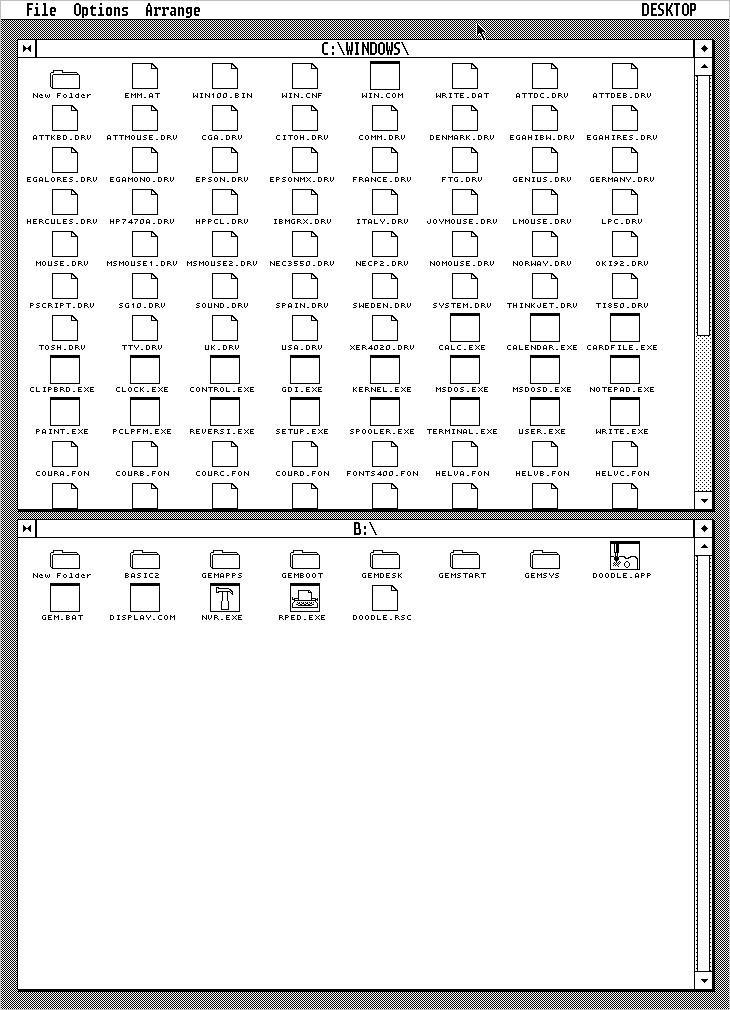
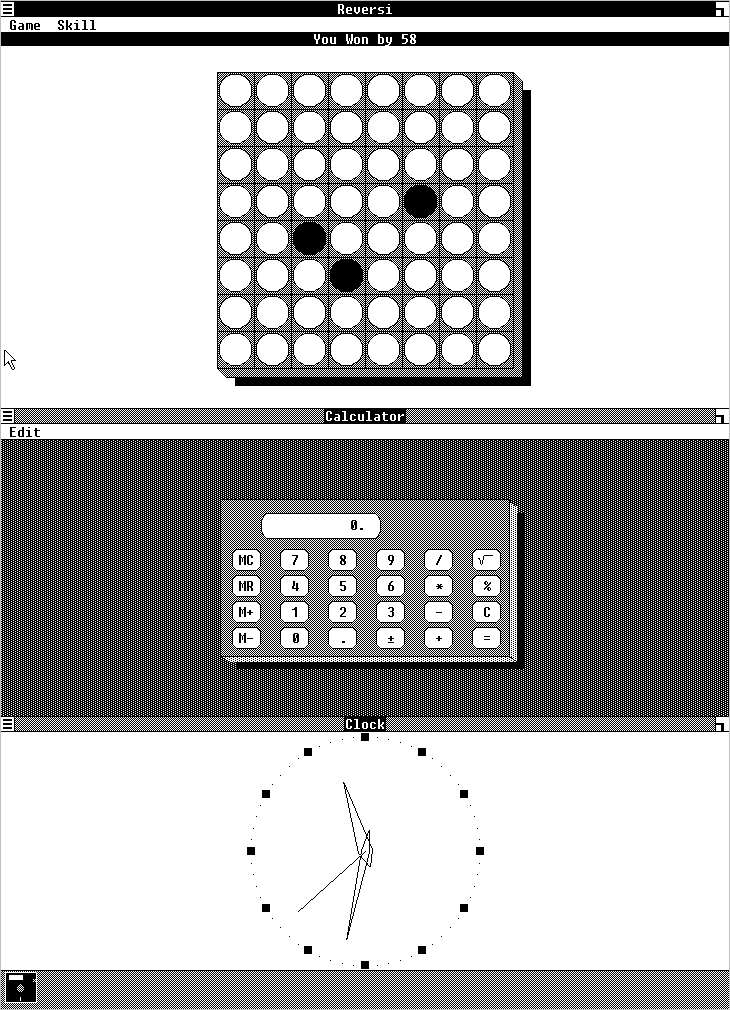
One of the drivers in GEM that I've never been able to test is for an
'MDSI Genius' card. Tonight I tried patching support for this card into
a PC emulator, and running GEM (and Windows 1) with the results.
<http://www.seasip.info/Gem/History/longgem.png> - GEM/2 desktop
<http://www.seasip.info/Gem/History/longwin1.png> - Windows 1.04
According to reviews, the card could also do other tricks; it could
superimpose MDA-style text on the graphics output, and do a dual-head sort of
display with MDA text in the top half of the monitor and CGA graphics in the
bottom. But without any documentation or its DOS driver (VHRBIOS.SYS), how
it did those will remain a mystery. Such information as I have managed to
glean is at <http://www.seasip.info/VintagePC/mdsi_genius.html>.
--
John Elliott
_______________________________________________
gem-dev mailing list
gem-dev at simpits.orghttp://www.simpits.org/mailman/listinfo/gem-dev
I have an AlphaStation 200 4/233 which was given to me without a video
board or floppy drive. I stuck an old Teac FD-235HF in the floppy bay to
fill the hole (no data cable), but have no idea what I really need for a
video board.
I'm planning to use this machine as a low end testbed machine for Debian
Linux since the Alpha port needs to be brought back up, so I know I
probably need a board that can handle more than 256 colors. I think this
eliminates the ZLXp-E1 (TGA 8-plane), but at the same time it may be a
good idea to be able to test with a TGA board as well since there are
going to be quite a few of these machines out there which have a TGA
board.
I will probably also want to run ULTRIX or OSF/1 on the machine at some
point, assuming I can find installation media.
Based on the datasheet I found online, these appear to have been (some?)
of the video boards offered as options for this system:
ZLXp-E1 8-plane PBXGA-AA PBXGA-AN [NT]
ZLXp-E2 24-plane PBXGA-BA PBXGA-BN [NT]
ZLXp-E3 24-plane PBXGA-CA PBXGA-CN [NT]
ZLXp-L1 24-plane PBXGC-AA
ZLXp-L2 24-plane PBXGC-BA
Does anyone have an extra video board laying around that they would be
willing to part with for postage costs? This machine has been sitting
unused for far too long and I'd really like to put it to work.
Guys,
I am sending this to all who have registered an interest in the IBM 7090 and museums. Sorry if I got some people wrong!
This computer started life at AWRE in the UK (nuclear weapons design?!) and finished in the Medical Computing department at Manchester Uni in 1970, where it ran for 10-20 years.
It had 4 channels, 32K memory, card reader, card punch, 300 LPM barrel printer and ?20 mag tapes. It also had an IBM 1401 for printer I/O.
I have now surveyed the stuff available. There is no hardware. It is a lot of (probably complete) hardware documentation, cicuit diagrams, s/w documentation (IBSYS, etc) also. Also a lot of mag tapes of mixed content and some card trays of mixed content.
Are any of you out there interested? It is all quite heavy so transport will be a challenge, but surmountable!
The stuff will be available in the first week of September. Any sensible offers will be considered. It might go on eBay but I will wait until you guys respond first.
Kind regards,
peter vp
|| | | | | | | | |
Peter Van Peborgh
62 St Mary's Rise
Writhlington Radstock
Somerset BA3 3PD
UK
01761 439 234
|| | | | | | | | |
Anyone have about 3 or 4 or so IBM 00K4151, FRU 10L6081 9.1GB disk drives in PC Server hot swap trays (76H7287)'s (preferably with non-broken locking levers) that they'd like to part with for ~$5-$10 each?
I need a few more to get my P/390 fully stocked... :)
Thanks in advance!
Hi. One friend told me yesterday that he has one Selectric in working
state available for me. Can this machine be converted in one Terminal
Typewriter ? Thanks.
Regads
Serhio
On Aug 17, 2012 at 12:47, David Riley wrote:
> On Aug 17, 2012, at 12:40 PM, Chuck Guzis wrote:
>
> > On 17 Aug 2012 at 9:15, Fred Cisin wrote:
> >
> >> It shouldn't be so hard, with XP and a Winmodem, but it'll be a few
> >> days before I can get back to a decent connectin.
> >
> > I could download and write the article to a 9-track tape and mail it
> > to you....
>
> I'd really prefer a stack of 80-column cards, please. My tape drive
> is on the fritz.
Could you please provide me a copy on ASR-33 paper tape?
:)
-Charles
Hi
Does anyone know of an X Window server implementation for the NEC 7220 GDC?
The chip has several names including the Intel 82720, NEC 7220A, NEC 7220D,
uPD7220, uPD72020, etc. Essentially this graphics chip was the main rival
to the MC6845 prior to the domination of the IBM PC architecture for
microcomputers.
The NEC 7220A is most notably known for the NEC APC and Epson QX-10 however
was used in a number of other systems. Typically it was used for CAD type
graphics and/or business graphics as its main strength was drawing
primitives like lines, circles, rectangles, etc rather than BITBLT
operations.
I would imagine an X Window server for the NEC 7220 would suffer in
comparison to today's graphics boards. However I think it would be
comparable to non-accelerated VGA and/or VESA modes which both have X Window
server implementations.
Thanks and have a nice day!
Andrew Lynch, 73 de N8VEM
Did you ever get your info on this series? I was a Rockwell rep and
have it plus I bought a few Mattel games for my kids too!
Original Woodworks
4631 Lake Ave., White Bear Lake, MN 55110
By appointment only!
(651) 429-2222
www.originalwoodworks.com
orgwood at iaxs.net
Is there anyone here who understands 16-bit DOS coding well enough to help
me make some 32-bit code work in 16-bit DOS?
--
David Griffith
dgriffi at cs.csubak.edu
A: Because it fouls the order in which people normally read text.
Q: Why is top-posting such a bad thing?
A: Top-posting.
Q: What is the most annoying thing in e-mail?
Hi folks,
I'm a little concerned about the load that my PDP-11 cabinet (rack mount,
dual RL02 drives) is putting on the floor in my daylight basement. Also,
I'm thinking that recovering the space might be nice, so I was considering
moving the PDP-11 system back to the garage.
If any of you have a PDP or other big-iron systems in the garage, how do
you deal with temperature extremes (hot in summer, cold in winter)? Do you
simply not operate the computer when it's too hot or cold? Do you think
it's a risk to even store the system in the garage?
My location is Portland, Oregon, so it doesn't really get super cold in the
winter. I think the coldest I've measured in the garage is 50F. But
summer can get pretty warm. It's scheduled to get 85F today, and we had
100F a week or two ago. Of course the garage doesn't get as hot as outside
temps, but it can get up there.
I realize heat can be a big enemy of computers/electronics. Also, since
the RL02 drives are mechanical and precision devices, they might not take
well to temperature shifts.
Thoughts?
- Earl
Hi
The last couple weeks have been pretty good. I can see the bottom of the
stack of S-100 board PCBs and will be ordering some more new boards and
additional reorders soon.
There are two S-100 Serial IO board and five S-100 8088 CPU board PCBs left.
They are $20 each plus $3 shipping in the US and $6 elsewhere. Please send
a PayPal to LYNCHAJ at YAHOO.COM and I will send your boards right away!
Thanks to John Monahan for all his dedication in making these PCBs possible
for the S-100 hobbyist community. Both the S-100 Serial IO and S-100 8088
CPU board PCBs have been built and tested repeatedly and are known working
units.
Thanks and have a nice day!
Andrew Lynch
<Message: 6
<Date: Tue, 14 Aug 2012 17:47:43 -0700
<From: "Chuck Guzis" < cclist at sydex.com >
<
<snip>
<So, does anyone know of any publicly-owned hearing aid manufacturers?
<Looks like a growth industry...
<
<--Chuck
<(with some ringing in his ears)
The best manufacturers are German or Swiss: Phonak, ReSound and Siemens.
I recently got hearing aids and find them both amazing and annoying. Amazing in how small they are (less than a cm^3 in volume, including the battery). The best now have digital equalizers that can adjust the amplification across a dozen or more frequency ranges and can automatically adjust to filter out background noise. They can also be controlled wirelessly -- mine even have an "airplane" mode the shuts off the wireless when you are flying in an airplane and electronic devices are banned. Annoying in that they are far from perfect and require a new set of batteries after every 75 hours or so of use.
For any of you who live in the US, the least expensive place to get good hearing aids is Costco. Most insurance plans do not cover them, so my cost was $2600 for the pair, which is 30%-50% less than anywhere else charges for a similar model.
Bob
>
>Every time I'be both seem an emulator of a chassic machine (runinng on a
>friend's machine, obvious) and also run the rela hardware myself, I feel
>the emultor doens't come close to the experinece of actually running the
>classic computer.
>
Before I came across Hercules, I tended to dismiss emulators in the same terms.
However, I find the experience of using Hercules or Simh remarkably close to
the experience of using the actual machine in question. Many users of certain
classic computers never saw or heard the actual machine they used and only
interacted with it through a terminal (or even a terminal emulator).
There are also other factors which prevent both emulators and real preserved
hardware from recreating the original experience. Factors such as not having a
real world workload to process and not having a realistic number of users
working the machine hard (as opposed to a few museum visitors at a time trying
to figure out valid commands).
(I don't know why I am adding to this thread which looks destined to go
on and on and achieve little except to demonstrate that different people
have different ideas on how things should be preserved and that most are
not going to change their minds.)
Regards,
Peter Coghlan.
Hi,
a friend of mine sent me an DEC Server 300 which he saved from the
dumpster. There is a triangle in the bottom that some sharp metall edge
must have made. This hit broke a 300mil 24pin DIL chip in the inside that
must be related to the BNC network. The Chip is located next to the 20MHz
Crystalnext to the poushbutton Switch, it is broken in two halves and the
ceramic top plate of the chip is missing. It seems that the pcb survivied,
so here comes the question:
What was this for an (Network-)chip? Can please someone help?
Kind Regards,
Holm
--
Technik Service u. Handel Tiffe, www.tsht.de, Holm Tiffe,
Freiberger Stra?e 42, 09600 Obersch?na, USt-Id: DE253710583
www.tsht.de, info at tsht.de, Fax +49 3731 74200, Mobil: 0172 8790 741
I used to worry about things like racks and half racks and floor load limits, but consider the following:
Think about how heavy a rack is. Probably about 500lbs or so for most of our stuff (I'm not talking
maxed-out S/390s or VAX 9000 installations), and there's probably one or two in a room. For the area
of the rack, the load/sqft is similar to a 250lb person, which the floor is hopefully specced for.
A small piece of 3/4" plywood underneath to keep the carpet happy is nice, bigger one if you're
going to be pulling the rack in and out for connections to the rear.
n.b. I do put my heavy stuff near the bearing walls so things are more straightforward.
> Message: 2
> Date: Tue, 14 Aug 2012 11:20:58 -0700
> From: Earl Evans <earl at retrobits.com>
> To: "General Discussion: On-Topic Posts Only" <cctech at classiccmp.org>
> Subject: PDPs in the garage
> Message-ID:
> <CAMDAk4d3sfqET1Rj3Yw45ctgg+2BLHr=aSvyVqBxnGurveNhHA at mail.gmail.com>
>
> Content-Type: text/plain; charset=ISO-8859-1
>
> Hi folks,
>
> I'm a little concerned about the load that my PDP-11 cabinet (rack mount,
> dual RL02 drives) is putting on the floor in my daylight basement. Also,
> I'm thinking that recovering the space might be nice, so I was considering
> moving the PDP-11 system back to the garage.
>
> If any of you have a PDP or other big-iron systems in the garage, how do
> you deal with temperature extremes (hot in summer, cold in winter)? Do you
> simply not operate the computer when it's too hot or cold? Do you think
> it's a risk to even store the system in the garage?
>
> My location is Portland, Oregon, so it doesn't really get super cold in the
> winter. I think the coldest I've measured in the garage is 50F. But
> summer can get pretty warm. It's scheduled to get 85F today, and we had
> 100F a week or two ago. Of course the garage doesn't get as hot as outside
> temps, but it can get up there.
>
> I realize heat can be a big enemy of computers/electronics. Also, since
> the RL02 drives are mechanical and precision devices, they might not take
> well to temperature shifts.
>
> Thoughts?
>
> - Earl
I could tell you a story about an 11/780 at Fort Monmouth that ran
without air conditioning and with the windows upen for 3 months.
Serious intermittant problems sprung up. The humidity had rust on the
TU45 tape drive motors.
The problem isn't heat -- it's the rate of change. You get serious
expansion cracks in the boards when the etches expand and contract.
The faster the rate of change in temporature when running (both up and
down) the worse the issue.
The machine was flaky as hell. The thing would crash VAX/VMS about 5
times daily.
I actually would boot the machine and hit each one with my little
brass hammer. If it crashed... the board was replaced. Swapped
about 6 boards in the data path and cache sections and the box was
then stable for over three years.
The 11/34's a lot lower in power draw and slower. It's probably less
sensitive with some larger etches.
I'd worry more about the peripherals. Disk drives with rusty parts in
them are probably a bad thing.
I know the tape drives would have a problem. The RL02's might even
have a different flying height depending upon the temperature which
could end in head crashes.
If you kept the internal temp under 100 degrees you're probably ok...
but if the outside temp's above 100...
The real trick is to keep the temp as steady as possible. Perhaps
strategic fan placement to keep it from getting too hot in certain
places.
Bill
--
d|i|g|i|t|a|l had it THEN. Don't you wish you could still buy it now!
pechter-at-gmail.com
I got a call from a man who has been in the development business since the 70s. We got to talking about a whole lot of stuff (actually it was more listening on my part then anything else). On the topic of eyestrain (?) he said that different colors (primary?) have different focal depths, so at least for some people strain is caused when looking at a color monitor w/fine dot pitch. I have to at least take him at his word on that, but when I mentioned that staring at green phosphors for an extended length of time (>30 minutes say) caused white to appear pink. For instance the numbers on a cars speedometer. He said he never experienced that. Can anyone explain the reasons for that? It stands to reason that causing your eyes to focus on something small? and multichromatic would cause strain (you're forcing your eyes to focus on a single point that in essence appears to be at varying distances. I don't understand the pink eye effect though.
And I will add...
> That is why simulators are so important. You can get most of the feel
> of the machine from the comfort of your own home.
...and no vintage machines are harmed.
--
Will
On Thu, 09 Aug 2012 13:33:41 MDT,
Richard <legalize at xmission.com> wrote:
> In article <50240091.9060108 at bitsavers.org>,
> Al Kossow <aek at bitsavers.org> writes:
>
> > On 8/9/12 10:21 AM, Richard wrote:
> >
> > > I have been attempting to find details on the Apollo DOMAIN/OS
> > > windowing environment before they started running X11, but so far
> > > haven't been able to find much of anything.
> > >
> >
> > There wasn't anything in the Apollo documents on bitsavers?
>
> Looks like it was pre-2009 that I last looked, when you added a bunch
> of stuff. I will have to dig into that pile!
"Programming with Domain Graphics Primitives" (005808-01)[1] makes
reference to "Programming with General System Calls" (005506) which
explains pad calls that allow you to create pads and frames. If this
manual could be made available, that would be a helpful addition.
[1] <http://bitsavers.org/pdf/apollo/005808-01_Programming_With_Domain_Graphics_…>
--
"The Direct3D Graphics Pipeline" free book <http://tinyurl.com/d3d-pipeline>
The Computer Graphics Museum <http://computergraphicsmuseum.org>
The Terminals Wiki <http://terminals.classiccmp.org>
Legalize Adulthood! (my blog) <http://legalizeadulthood.wordpress.com>
From: Dave McGuire
Sent: Tuesday, August 14, 2012 1:33 AM
On 08/14/2012 04:06 AM, TeoZ wrote:
>> There was a brief hop to just differential SCSI (higher voltage then
>> LVD which is how LVD got its name). HVD and SE/LVD don't like each
>> other while the other SCSI standards did with some tweeking.
> This overlapped entirely with SE SCSI to the end, though. HVD was
> used in very high-end machines (Tandem and Cray come to mind) for the
> better noise immunity for longer cable runs. It really wasn't a hop
> from SE to HVD then to LVD.
Also the XKL Toad-1 System (4 x differential FASTWIDE SCSI-2 ports).
An absolute bear to find drives for.
Rich Alderson
Vintage Computing Sr. Systems Engineer
Vulcan, Inc.
505 5th Avenue S, Suite 900
Seattle, WA 98104
mailto:RichA at vulcan.com
mailto:RichA at LivingComputerMuseum.orghttp://www.LivingComputerMuseum.org/
> Date: Mon, 13 Aug 2012 22:33:52 -0500
> Subject: Re: HP3000 Marketing Collateral
> On Sun, Aug 12, 2012 at 2:13 PM, Lee Courtney
> <charlesleecourtney at yahoo.com> wrote:
>> I posted some 1980's vintage HP3000 marketing shots at Flicker: http://flic.kr/s/aHsjBmrAyC
>>
>> Enjoy!
The Rhode Island Computer Museum has an HP3000 Series 70, just like in
one of your pictures.
Too bad we don't have that many disk drives to go with it.
https://sites.google.com/a/ricomputermuseum.org/home/Home/equipment/hp3000-…
--
Michael Thompson
I thought this could be interesting for members on the list.
Too bad it's too far away for me.
/G?ran
-------- Ursprungligt meddelande --------
?mne: [DatapointComputers] Datapoint 1560
Datum: Tue, 14 Aug 2012 18:21:24 -0000
Fr?n: techiegabe <gabehabib at rogers.com>
Svar till: DatapointComputers at yahoogroups.com
Till: DatapointComputers at yahoogroups.com
I finally got around to unpacking a Datapoint 1560 system that has been lying around in my basement crawl space since the late 80's gathering dust.
After a good cleaning and resetting of boards and connectors it looks in great shape, BUT the Monitor "Sparked and Smoked" when I turned it on. I haven't turned on the disk subsubsystem yet.
Anyways, I am able to take it with me when we head down to Wickenburg AZ, for the winter, and wondering if that Computer Museum (or anyone else) may want to give it a new home? I'm still looking for the Diskettes and Manuals.
I also have a MINX Monitor.
Gabe
x-Datapoint Canada Inc.
I'm trying to retrieve some old printer manuals from a 1999 CD-ROM,
and they are supposedly DynaText. The problem I'm running into is that
DynaText 4.1 doesn't recognize a valid collection. The installer on
the CD looks for dynatext.ini and books.ini (which doesn't seem to
exist anywhere, including on the CD). It wants these files to come
>from Xerox\ODOC\ .The installer fails without both of those files
present. If I point it to a valid dynatext.ini, and fake a books.ini
or give it an empty file, the installer completes "successfully"
having done nothing.
The 'books' directory contains a subdirectory with the book name
(41354635 in this case). This directory then contains four more
directories, EBT, INDEX, STYLES, and FIGURES, as well as a Setup.ini
file with a few lines of information on the collection. 'Figures' is
a collection of TIFF's. 'Index' contains index.dat and vocab.dat. The
EBT directory contains 5 files: 41354635, 41354635.edr, 41354635.tag,
search.tdr, toc.tdr. Google turns up almost nothing on these file
extensions. The 'Styles' directory has several .v and .rev files,
carrying copyright information bearing the name Electronic Book
Technologies (thus EBT). EBT as a company is long gone.
Most of the various book files are encoded (that is, not plain
text), though each has an ASCII header. 'EDIR DATA' 'EDIR EDIR' 'EDIR
TDIR' and 'EDIR TAGS' (this file is plain text).
Anyone have any clues on how to read these files? So far, I've
tried so far: Adobe FrameMaker (trial), Adobe Acrobat Pro 9, Altova
StyleVision (trial), DynaText 4.1.
Thanks!
--Shaun
On Mon, 13 Aug 2012 20:01:41 +0100 (BST), ard at p850ug1.demon.co.uk (Tony
Duell) wrote:
> I am going to define 'London' as the area I can get to with a London bus
> Pas (I do not mean the 'City of London', I mean an area about 30 miles by
> 30 miles. In 'London' I know of preceisely_one_ shop tht sells a
> reasoanble range of electronic components [1]. I know of no shops that
> will sell me small-ish qunatiites of common engineering metals (say 1m of
> 1/2" diamaeter CZ121 bras rodd, or similar free-machining mild steel). I
> know of no shop that sells 'engineering' tools (lathe and mil lcutting
> tools, individual sockets, spanenrs, etc).
That sucks. I can get all of that in a town less than 1/10 the size of
London (admittedly it is the second largest town in this country). The
largest distributor in Sweden has a shop where you can get the most
frequently ordered items from their catalogue over the counter, and the
rest of what they have in stock next day. Not far from there, there is a
shop that sells any machine tool or part you may want. None of them are
cheap, but you can get what you need.
Jonas
I never plugged it in. Really don't want to (but I could be coaxed, no pun intended though it would be a poor, spurious one). Judging by the prices I've seen these things go for on ePay, I would think anything is worth 100$, but I *may* decide to cut someone a break, especially if they picked it up. This unit is in rough shape, don't even know if it works. Some of the metal side and rear paneling has accumulated rust, one piece a lot of, but nothing a proper restoration couldn't remedy I don't think. The front bezel is all funky, a noticeable crack, though not too large, very brown. I have pictures somewhere. There appears to be a baby opossum living in mom's garage, so I was apprehensive about dragging the unit out for yet more pictures today.
?If I have to ship it, I'm going to tack something on (many thousands of dollars likely).
?Your thoughts are welcome :)
Hey folks! Would anyone happen to have a PCB footprint for a TO-263
package? I'm designing a circuit that will use an LM2577 switching
regulator. I've checked on gedasymbols.org to no avail. I'm kinda
surprised it's not in the standard library.
Thanks,
-Dave
--
Dave McGuire, AK4HZ
New Kensington, PA
Last night I pulled out an old Wangtek 5000 series QIC tape drive
(uses DC300XL carts) and discovered that the rubber capstan had
totally degraded and fell to pieces.
After looking at bits of rubber and vinyl hose as possible
replacements, I hit on using a plain old vinyl grommet that fit
snugly on the bare shaft and, for good measure, added a nitrile O-
ring to fill the "slot" in the grommet.
Worked like a champ. Maybe this will be useful to others.
--Chuck
Hello Tony,
That would be great!
If somebody don't may you scan it and send by e-mail, please?
Thank You!
Ricardo
> >
> > Hello,=0A=
> > =0A=
> > I'm trying to understand the intriguing Panasonic HHC.=0A=
> > Does somebody have additional technical information beside the contents of =
> > the User's Manual?=0A=
> > I'm particularlly searching for the SnapFORTH ROM image and manual, any har=
> > dware schematics, and the expansion connector pinout.=0A=
> I haev my own had-drawn schematics for the machine and the
> printer/cassette interface. Of course they don't give any information for
> the interals of the ASICs, but they might be a start.
>
> I can't remember if I have already sent them to somebody (Eric?) who
> might have scanned them. If not, I can make a photocopy and post them out.
>
> -tony
>
> If the compatability goes far enough that either kind of
> device works
> with either kind of interface, then I agree, but then
I don't know quite how far it goes, but the controller
cards we use in our products all speak both SATA and
SAS.? So the drives border on interchangable.? There
are differences in the command messaging and in the
drive characteristics, but it's pretty easy to support
both.
As to the question of SATA vs IDE, I agree with
your concerns over forced obsolescence.? But as
far as classic machines go, I'm more concerned by
the dearth of 50-pin SCSI I drives, and I haven't
had very good luck with using adapters to put newer
drives on older machines.
As to FC, I will have to admit to a bit of bias.
Competing with FC pays the bills.? But even with
that bias, for communicating between a host and
a storage shelf, I have a hard time imagining a
good reason to do anything other than a light
weight storage protocol directly over Ethernet.
(And to avoid any confusion, my definition of
light weight does not include FCoE or iSCSI.)
BLS
On Fri, Aug 10, 2012 at 11:56 PM, JP Hindin <jplist2008 at kiwigeek.com> wrote:
> IBM 5324 w/keyboard and monitor
> I've never powered this on and the drive knobs were snapped off prior to
> my receiving it. My understanding is this is a binary compatible System/34
> in baby shoes, but I might be full of it.
>
my search-fu is weak or that is a tough machine to find much about, anyone
have any further details? is it part of the IBM Datamaster family?
I found pictures here:
http://www.retrocomputing.net/parts/ibm/5324/
and JP's video pans past the console terminal here:
http://www.youtube.com/watch?v=KgECJPIU1AI#t=5m40s
and an overall view here (lower right under the bench):
http://www.youtube.com/watch?v=KgECJPIU1AI#t=9m47s
...in a closet here. They used to have a bunch of these were I used
to work, as a CAD system.
This one has AIX on it... it fails bootup and drops you to some sort
of prompt right after it plays it's tune (with the little speaker
icon).
You can type ls at the prompt and gets what looks like a list of devices.
Should I bit it, or is it worth trying to fix? Anyone point me in the
right direction?
I only dug it out because of the CDE thread, so it's "all your fault!"
--
Yoyodyne Propulsion Systems: "The Future Begins Tomorrow"
Visit us at: http://www.yoyodyne-propulsion.net
--------
"I'd like to hold off judgement on a thing like that, sir, until all
the facts are in. "
General "Buck" Turgidson
> Actually I have been learning more about HDLC, X.25, 3270 chitchat,
> etc., in order to try and get these Westinghouse airline terminals to
> talk.
You will probably need a fair amount of beer, too.
> However, as we discussed during your last visit when we were at the
> Hole, I need to focus on graphics and not become exclusively a
> terminal museum. Get some twinax/bisync *graphics* terminals my way
> and I'll get a lot more interested. However, I just haven't found
> them.
The 5080 family of terminals is probably up your alley. But, they seem
to be rare. I used one many years ago, at an open house at EMD. Fun
stuff. And then their is the 7361 FastDraft system - it is an IBM S/1
controlling some sort of third party graphics engine. RCS has one, and
we can not figure the thing out. If you watch a bad Cameron Diaz movie
>from a few years back, you can see it on the big screen (stuffed and
mounted, anyway. No, not Ms. Diaz.).
--
Will
> Date: Sun, 12 Aug 2012 09:39:31 -0600
> From: Richard <legalize at xmission.com>
> To: cctalk <cctalk at classiccmp.org>
> Subject: Re: PXG/PXG+/PXG Turbo/PXG Turbo+ boards for DECstation 5000
> Message-ID: <E1T0aGJ-0000zS-R7 at shell.xmission.com>
>
>
> In article <20120812105727.2a3ad798.jkunz at unixag-kl.fh-kl.de>,
> Jochen Kunz <jkunz at unixag-kl.fh-kl.de> writes:
>
> > On Sat, 11 Aug 2012 14:53:46 -0600
> > Richard <legalize at xmission.com> wrote:
> >
> > > Does anyone have one of these boards?
> > Yes, at least one PXG+ and IIRC a PXG that's the RAM modules missing.
>
> I'd like to see some high resolution close-up pictures if possible!
> --
> "The Direct3D Graphics Pipeline" free book
<http://tinyurl.com/d3d-pipeline>
> The Computer Graphics Museum <http://computergraphicsmuseum.org>
> The Terminals Wiki <http://terminals.classiccmp.org>
> Legalize Adulthood! (my blog) <http://legalizeadulthood.wordpress.com>
I have one of the PXG models in a Decstation 5000/200 up at the cottage, I
can try to get a picture
of the next time I'm at the cottage. The PXG uses an i860 for 3D geometry
and a pixel planes chip
for 2D raster fill.
A pixel planes chip is relatively easy to design, even with primitive VLSI
tools. I built one in the
mid 1980s using a gate array technology that we had free access to. Once
you have the cell
for a single pixel it's just a matter of duplication and adding some
interface logic around the
edge of the chip.
Just curious if anyone has printouts (or scans) of the PDP-11/44 memory
management diagnostics KKTA/KKTB
KKTA 11/44 MEM MGMT PRT A
KKTB 11/44 MEM MGMT PRT B
KKTAB1.BIC xx-xxx-xx 3369 27 3395 0
KKTBD0.BIC xx-xxx-xx 3396 30 3425 0
I have the binaries from xxdp images but no listing...
-brad
I finally got hold of that PSU-less C64 that I mentioned on the list a few
weeks ago, followed by a 9VAC PSU to test it with. Other than needing the
VIC-II and associated ICs re-seating I've not encountered any problems
(I've not tested the 1541 yet though due to lack of a cable).
Anyway, I'd like to sort out a better PSU for the machine itself until I
can get a genuine one from somewhere - does anyone know what a reasonable
max current draw on the 9VAC lines might be? (This is an original
'breadbox' machine)
The wall-wart 9VAC PSU that I found for testing is only rated for 400mA,
which I suspect might be on the low side; I've seen claims of needing 1A or
more, and http://www.hardwarebook.info/C64/128_User_Port only states 100mA
max for the user port, suggesting that the machine itself might require
quite a lot under certain conditions.
cheers
Jules
not sure the 2nd 7220 in the APC is for more colors or not. They are on separate boards. My rather uneducated guess was a 2nd was needed to implement the virtual screen.
I picked up the last of Fred's stuff yesterday, and I have a couple of
cards I can't find much information on:
1. UNIBUS card made by ComDesign
Picture at http://flic.kr/p/cQ6PYd. Marked "Epsilon US 2000 Board" and
"Assy no. 010231". It's got a 80186, 1 2910, 2 2901's and an 82586
(IEEE802.3 coprocessor). I therefore figure this is a UNIBUS Ethernet
NIC (like a DELUA). Is anything known about these cards? DIP switch
configuration would be good to know, as would the function of the 5
on/off toggle switches on top.
2. Q-BUS card, probably made by Plessey
Picture at http://flic.kr/p/cQ6Rtf. Marked "P/N 703365-100D". Has a
COM8017 UART. Nothing else known...
Thanks,
Camiel
Anyone have an MXV11-B (M7195) going spare? I'd like to be able to use
TU58 emulation to get my "tiny" (SB-11) 11/23 system bootstrapped, plus
right now the only dual-height memory board I have is a mere 32K; the
MXV11-B seems like a perfect fit for this system (128K, dual SLU, LTC,
etc) if I can just find one...
Thanks as always,
Josh
Hello all,
I'm afraid I'm more of a long-time appreciator than a regular poster here, but I wanted to share a link to an archive of episodes and clips from the TVOntario show, 'Bits and Bytes' ? partly because there probably are a few people who saw this show when it originally aired and might enjoy a trip down memory lane, partly because it features many of the microcomputers that were popular in North America back then, and partly because its explanation of many of the key concepts are still relevant today. (Plus, for those who haven't seen it, it's also quite entertaining.)
The channel is over at http://www.youtube.com/user/bitsandbytestvo, and I've included a modified blurb from that page below for people's information. Hope this brings back a few memories, and even educates a few of the people who are too young to have caught it first time 'round. This is the show that got me into computing and programming (my first computer was the Commodore 64), and I know that the episode on computer music, and the clip about compilers and interpreters have both been used to explain concepts in current computer science and computer music classes (as in, since the show became available again on YouTube).
Cheers and (hopefully) enjoy!
Peter
P.S. And for those who are concerned about such things, from what I've been able to ascertain, this show is no longer available for purchase from TVO and, for that matter, they no longer have the full set of episodes in their own archives.
-----
Bits and Bytes is a classic, and still foundational, Canadian television series about microcomputers and the key concepts behind them. It was produced by TVOntario in 1983, and stars Luba Goy as the instructor, and Billy Van as the student.
The show consisted of 12 episodes and featured many of the classic 80s microcomputers including the Apple ][, Commodore PET, VIC 20 and 64, Atari 800, TRS-80, TI 99 and the IBM PC. The subjects were:
Program 1: Getting Started
Program 2: Ready-Made Programs
Program 3: How Programs Work?
Program 4: File & Data Management
Program 5: Communication Between Computers
Program 6: Computer Languages
Program 7: Computer-Assisted Instruction
Program 8: Games & Simulations
Program 9: Computer Graphics
Program 10: Computer Music
Program 11: Computers at Work
Program 12: What Next?
On 2012-08-09 22:10, Al Kossow <aek at bitsavers.org> wrote:
> On 8/9/12 10:21 AM, Richard wrote:
>> >I have been attempting to find details on the Apollo DOMAIN/OS
>> >windowing environment before they started running X11, but so far
>> >haven't been able to find much of anything.
>> >
> There wasn't anything in the Apollo documents on bitsavers?
>
> In the queue are about 100 ESDI Apollo disks with what HP had left of Apollo's
> development environment. I'm hoping they're still readable.
Gah! It's over 20 years now since I used the window system on Domain OS,
but I still shudder at the memory. It was not fun.
From what small details I can still remember it made no difference
between the mouse pointer and the text cursor. Move one, and you moved
both. Input for a window was normally done in a special sub-window one
line high, at the bottom of the window.
In general it was weird and somewhat unintuitive, and we *longed* for a
switch to X11, but since X11 took much more resources, it took a few
years before we actually switched.
There were some cool concepts in Domain/OS, but for the most part, it
was just weird and horrible.
Johnny
Original Message:
Date: Fri, 10 Aug 2012 13:53:41 -0400
From: "Andrew Lynch" <LYNCHAJ at yahoo.com>
....
The NEC uPD7220 readily adapts itself to the S-100 bus and provides a nice
VGA monitor compatible bitmap. However it is completely non-VGA compatible
and really is as different from the MC6845 derivative as can possibly exist.
It uses a totally different approach down to the philosophical theory of
design!
If you or anyone else has some insight on how to implement a register
compatible SVGA on the S-100 bus I am very willing to listen! Thanks and
have a nice day!
Andrew Lynch
-------Reply:-------
Isn't it always the way... a couple of weeks ago I finally threw out about
4" worth of detailed OEM documentation about designing for and implementing
PCChips VGA chips, among others...
The NCR Decision Mate (for one) used the 7220 and I even still have some of
the guts of one including the video board if it's any use to anyone. IIRC
there were some drivers etc. to make them semi-compatible with the PC; maybe
you can find something useful among the NCR crowd?
> From: Jochen Kunz <jkunz at unixag-kl.fh-kl.de>
> Date: Fri, 10 Aug 2012 16:42:31 +0200
> Subject: Re: Found a rs6000 43p
> John Many Jars <john at yoyodyne-propulsion.net> wrote:
>
>> This one has AIX on it... it fails bootup and drops you to some sort
>> of prompt right after it plays it's tune (with the little speaker
>> icon).
>>
>> You can type ls at the prompt and gets what looks like a list of devices.
>>
>> Should I bit it, or is it worth trying to fix? Anyone point me in the
>> right direction?
> There are several different variants of 43P. This one seems to be a
> 43P-150 because you can type "ls" and get a divice tree. This sounds
> like the OpenFirmWare of a CHRP machine. The enclosure of the machine
> should be black?
>
> You have a quite capable PPC machine there. You could reinstall AIX.
> Instalation media should be obtainable. An other option is to install
> NetBSD. Maybe it drops to OFW just because autoboot is disabled. Try to
> type "boot" at the OFW prompt and see..
>
> \end{Jochen}
It should also run Solaris 2.5.1. I think I have the install CD.
--
Michael Thompson
Someone I know on this list has an ASR33 Teletype which has a tractor feed.
I am sure that all the ones I used at the time were friction feed. Was
tractor feed a common thing on these terminals?
Regards
Rob
On 2012-08-08 23:17, ard at p850ug1.demon.co.uk (Tony Duell) wrote:
>> >
>> >From: "Tony Duell"<ard at p850ug1.demon.co.uk>
>> >Sent: Tuesday, August 07, 2012 9:16 PM
>> >To:<cctalk at classiccmp.org>
>> >Subject: Re: Odd PDP-11/84 Unibus behaviour
>> >
>>>> > >>
>>>> > >>I'm noticing something on my PDP-11/84 that I can't explain. I've
>>> > >
>>> > >I';ll try a one-word explamation : 'Grants'.
>>> > >
>>> > >[... snip excellent explanation from Tony ...]
>> >
>> >I remember working on grants in the 11/84.
>> >The 11/84 is very user-friendly, because there is a board next to
>> >the CPU that has several DIP switches. Each DIP switch opens
>> >or closes the NPR of one slot. So there is no need to count pins
>> >on the backplane to find CA1-CB1. Just open/close the switch
>> >for the appropriate slot.
> Right. That I did not know. TO be honest, the J11-based machiens are too
> mdoern for my taste:-)
It is rather convenient. But it should be pointed out that DIP switches
for the NPG signal only exists for the first eight Unibus slots, which
are in the first backplane. If you put in any more Unibus backplanes,
it's the same standard story of the jumpers on the pins as always.
(I *think* it is eight slots on the first backplane in the 11/84, but I
might remember that detail wrong, but I hope people understand the idea
even if I happened to get the actual number wrong.)
> However, I would adcvise against flipping said switches unless you know
> what you are doing (for example you'bve got a switch open correspodning
> to an empty slot). It is better, IMHO, to actuall trace the fault and be
> sure it is an NPG problem before changing anything. Otherwise you will
> get in a muddle very quickly.
Right. Random flipping of switches is no way to troubleshooting.
Johnny
Hi all --
Anyone know anything about the DEC SB-11 enclosure? It's a small
(13"x12"x3.5" or so) chassis containing a power supply and a 4-slot
dual-height q-bus backplane. Very cute, and I want to put together a
small 11/23 system in it. Anyone know the original intended usage for
these little things?
In particular, a power supply schematic would be helpful as the one in
mine is giving me trouble at the moment. (Just blows fuses when powered
up.) I can't find anything useful about it on the 'net. The full model
designation on this one is "OSB11-EA."
Thanks as always,
Josh
On 2012-08-10 00:17, p.gebhardt at ymail.com wrote:
>
> I'd like to ask the list, what kind of tools/porgrams do you use in order to dump especially older device types as we can find it in older computer equipment?
> A couple of years back, I was lucky to use an old system at University in order to dump PAL and EPROM contents of my Onyx C8000 and from a DEC DELUA board.
> But since then, I've never had accessibility to such tools and I'l like to obtain/purchase one in order to go on with programmable device content saving.
>
> Any suggestions? Hints? Experiences?
A while ago I started deveoping something around an Arduino like
platform to read PALs and EPROMs. See
http://fjkraan.home.xs4all.nl/comp/divcomp/ppread/. So far I developed
sketches (programs in Arduino lingo) to read out devices. I still have
to make something to analyse the output. This is trival for (EP)ROMs and
PALs without registers and tristate pins, tricky for those with...
This assuming the security fuses are blown.
>
> Kind regards,
> Pierre
Greetings,
Fred Jan
Hi there,
I'm looking for contact information for the company that is the current
license holder for the DEC-developed PDP-11 operating systems (e.g., RT-11,
RSX, RSTS). If you have that info and could send it to me off-list, it
would be much appreciated!
Thanks,
- Earl
I have two 25 foot lockers of mostly DEC items I would like to sell
within the next few months. I can ship by the box, pallet, gaylord,or
truckload.
I do not have a complete inventory listing, but feel free to inquire
off list. The following is a limited sample:
LA36's, and parts
LA120's and parts
Vav3100's- a dozen or so
3000's
5000's
11/780, 785 boards
6000 boards
8000 unibus options and several thousand boards
8A, E, F, M boxes and about 1000 boards
Various table top LAxx printers and parts
VT's, monitors and parts
tons (literally) more
I am not selling any H960's (still need a few) , Unibus
systems,RK05's, RL's, RX's (except a few replacement drives) or any
media for the listed drives. I might be looking for a VT05, LA180, and
a TU10.
Please feel free to contact me off list with any questions.
Thanks, Paul
From: feldman.r at comcast.net
Sent: Thursday, August 09, 2012 1:38 PM
>>Date: Thu, 09 Aug 2012 14:12:38 -0400
>>From: Dave McGuire <mcguire at neurotica.com>>
> <snip>
>> I heard about CDE the other day too. That could be interesting. Many
>>people hated CDE, but I thought it was ok. (not great, but ok) I will
>>probably try to build it soon.
> http://www.theregister.co.uk/2012/08/09/cde_goes_opensource/
Like Dave, I came to like it (as VUE) on HP-UX, and will probably put it
on a Linux box at some point.
But I mostly wanted to point out that the Register article was written by
our own Liam Proven!
Thanks,
Rich
Rich Alderson
Vintage Computing Sr. Systems Engineer
Vulcan, Inc.
505 5th Avenue S, Suite 900
Seattle, WA 98104
mailto:RichA at vulcan.com
mailto:RichA at LivingComputerMuseum.orghttp://www.LivingComputerMuseum.org/