Just finished reading a 9 track tape made with IBM CMS in its dumpfile
format.
Why on earth--or might I say, what idiot--designed this format? First
the file data in a series of records, *then* the file name and other
metadata.
Anyone know of a DOS/Windows/Unix utility to unravel one of these
things? I don't feel too much like coding for a single tape.
--Chuck
Has anyone dumped the contents of the bipolar PROMs of the M7859, KY11-LB,
programmer's console form the 11/34 and 11/04? Dump for both the program
PROMS (512x4 4 pieces) and the decoding PROM (32x8 one piece) are sought
after.
It has a 8008 chip onboard but my logic analyzer trace is not matching very
well with the listing in the manual. Maybe the revisions have changed from
the manual. And I cannot find the PROM contents in the engineering drawing.
/Mattis
> - intention was to rip all this out and convert it to a full I/O serial terminal, using an Arduino-based setup
> that Lawrence Wilkinson has already built and tested:
> https://www.flickr.com/photos/ljw/sets/72157632841492802/with/9201494189/
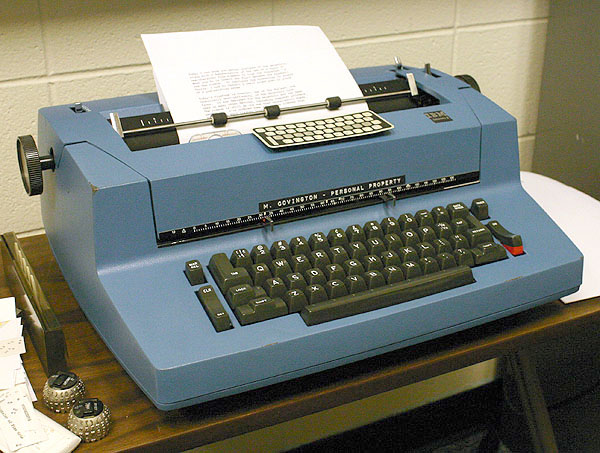
Looks very nice! Is there documentation for it somewhere? I also have a Selectric (unfortunately it's located distant from me at the moment so I can't provide particulars) that I worked on interfacing to a micro in the mid-70's. I was using a MC6800 in my recollection, but I don't believe that I ever achieved operational status. Presumably I was working from an article in one of the hobbyist magazines of the era. I would have guessed Byte, but that doesn't seem to be the case based on recent search. Any hints from folks on what magazine/article that might have been?
The Selectric wasn't one of the curvy(ier) office models; I recall it being a rather boxy affair with plenty of right-angles on the housing and a medium shade of blue -- presumably "IBM Blue". Rather utilitarian in design. Even *more* utilitarian than this one:
http://www.covingtoninnovations.com/selectric/100112-Selectric-in-situ.jpg
It included a full keyboard. I'm not sure anymore whether it operated in local-mode or was set up as two separate devices and therefore needed to be connected up to a remote controller to get local copy. It might have been a rehoused Selectric mechanism in a third-party enclosure and the IBM-like color a red herring. My recollection is that it was longer front-to-back; presumably the rearward extension housed the additional electronics. I have absolutely no idea how I acquired it. No luck finding a matching photo online as yet.
I believe that the Selectric came configured for remote operation, but presumably using an EBCDIC-based data stream. I vaguely recall a DB-50 connector, but it's been an awfully long time ...
Does this description sound familiar to anyone?
-----
paul
> I'm trying to get a sense of how much demand there would be for the
> indicator panel option (for parts ordering; I have a chance to buy some
> discontinued stuff, and I want to know how much to stock up on). If you
> would be interested in one or more indicator panels, could you let me
> know? (Please don't reply to the list, just to me personally.)
I should have mentioned that we'll likely do a UNIBUS version of the card
(ENABLE+, and it should be easy to guess why that name :-) as soon as we're
done with the QBUS one; the same indicator panels would be supported by both
(so they count to the parts pool).
So if you have a UNIBUS machine, and would be interested in adding an ENABLE+
_with indicator panels_, I would be interested to hear about those too.
Thanks!
Noel
Sorry for that BAD stuff in the Subject line - my e-mail provider
stuffs that in much of the time and I forget to remove it when I reply.
If anyone needs a clean copy, I can send it again!
Jerome Fine
>Tapley, Mark wrote:
>>On Dec 16, 2015, at 9:22 AM, Jerome H. Fine <jhfinedp3k at compsys.to> wrote:
>
>>Note that for many CPUs, adding values (a push) results in the
>>stack pointer becoming numerically smaller (unsigned of course).
>>Internally, the code would handle the actual arithmetic.
>>
>(Warning: assembly language noob talking, please disregard if I see to be making no sense.)
>
>1) Does the debugger enhancement trigger a stop on overall size of stack pointer or on cumulative changes? Or could it be selectable (maybe via a negative argument?)
>
>Here?s what I?m thinking: suppose a routine is expected to remove things from the stack sequentially, then branch at some point to a subroutine. I want the debugger to halt execution when it branches. So I want the stop to occur when the stack pointer first increases, even if it has already decreased several times and its new value (on branching) is lower than where it was when the debug command was issued.
>
>2) Some machines (6809, which is the only one I?m familiar with) have a rapid-response branching mechanism for real-time control applications (on the 6809 it?s a Fast Interrupt input). Fewer registers are pushed onto the stack so the service routine can execute sooner. Is there a way to handle this situation? Say I expect two levels of subroutine calls, each stacking a full set of registers, but instead I get for the second subroutine a Fast Interrupt and don?t stack enough registers to trigger the debug counter to halt execution.
>
> Hope this is useful.
>
> - Mark
>
Yes, it is useful since it helps to be aware of what other
systems do. So thank you.
For those of you who might not have known, this is the
Y01.16 Symbolic Debugger from RT-11 and in particular
the SDHX.SYS variant. From the point of view of
interrupts, when stopped at a breakpoint, the complete
system is FROZEN - including RT-11 itself which is the
operating system that is being used on the PDP-11.
As for the user's stack, that is not even a factor since the
Symbolic Debugger has its own stack and executes in
Kernel mode. In fact, one of the other enhancements was
to ass code to monitor the size of the stack for the Symbolic
Debugger - which also allowed that stack to decrease. That
was especially helpful since the stack must be in Low Memory
in order to handle interrupts and subroutine calls.
And as for the user's program stack, there is no effect at all.
What the Symbolic Debugger does is save all of the user's
registers, including the stack pointer of course. The enhanced
code would then compare the original value of the Stack
Pointer (actually as noted after the current instruction had
been executed) with any subsequent value to determine if the
conditions had been met to stop the execution of additional
instructions, assuming that the value of the Stack Pointer
was included (via value2 and / or value3) in the command
to execute more instructions.
Jerome Fine
I have been investigating the possibility of adding an enhanced
feature to a debug program. There does not seem to be anything
specific about the concept, so it should be applicable to every
current CPU in addition to most old CPUs.
The current syntax for many debuggers uses the letter "S" along
with an optional value to specify a Single Step (or ONE instruction
to be executed when the value is omitted) or a number of Single
Steps (a number of instructions) equal to the optional value. Of
the two different debuggers for the CPU, operating system and
code which I use most of the time, both debuggers display the
same information for each of the Single Steps, specifically the
actual instruction that will executed and the values of the registers
immediately before the instruction is executed. So if a total of
5 instructions are executed, the display is updated 5 times.
For the debugger that I wish to enhance, the actual syntax is:
value1,value2,value3;S
and at present, value2 and value3 are ignored.
My question concerns using value2 and value3 to specify the
limits by which the stack pointer may change, specifically by
adding data (also called a push) and subtracting data (also
called a pop) to the stack in whatever manner the program
uses to alter the value of the stack pointer register, respectively.
Note that for many CPUs, adding values (a push) results in the
stack pointer becoming numerically smaller (unsigned of course).
Internally, the code would handle the actual arithmetic.
For example, if the user specifies:
45,4,2;S then:
(a) Up to 45 instructions are executed
(b) If the stack has 4 or more pushes, instructions stop
(c) If the stack has 2 or more pops, instructions stop
Additional information:
(a) Scroll / NoScroll is enabled, so the user can
pause / resume at any time
(b) Any single character by the user stops instructions
(c) All pushes and pops are noted AFTER the current
instruction is executed - which allows subroutine calls
to be automatically handled as per the examples
Defaults:
(a) If no values are supplied (ONLY ";S"), then "1;S"
is assumed and ONE instruction is executed
(b) The debugger supports <ESC> in place of ";S" which
supports Single Stepping with a single key
(c) If any value is omitted, that limitation does not apply
More Examples:
,,1;S instructions are executed until the code returns
from the subroutine - IF the current instruction
calls a subroutine
,,1;S instructions are executed until the code returns
to the previous subroutine - IF the current
instruction does NOT call a subroutine
,,1;S instructions are executed until the code restores
the stack pointer - IF the current instruction
does a push or creates space on the stack
,1,2;S instructions are executed until the code calls a
second subroutine OR the code returns to the
previous subroutine - IF the current code calls
a subroutine
55,1,1;S 55 instructions are executed OR until the code
calls a second subroutine OR the code returns
to the current subroutine - IF the current
instruction calls a subroutine
55,1,1;S 55 instructions are executed OR until the code
calls a subroutine OR the code returns the the
previous subroutine - IF the current instruction
does NOT call a subroutine
Many more examples could be considered, but that seems to
be about the concept that I have. Please advise and comment.
Please make any suggestions that would be any improvement
and, most important, point out any problems that I have not
considered.
Jerome Fine
So I've mention that Dave Bridgham and I are working on a new QBUS board (the
'QSIC', for lack of a more imaginative name) that will emulate a variety of
older DEC disk controllers/drives using a micro-controller/FPGA and SD cards.
(We currently have one prototype [for Dave] mostly constructed, and another
[for me] half-way done.)
Since Dave and I are both blinkenlitz addicts, we're doing an indicator panel
option, emulating exactly the look of the old DEC indictor panels (4x36
lights, with 'inlays' to customize a panel to particular controller, mounted
in a 5-1/4 panel for a 19" rack). (These panels are specific to the QSIC, and
don't work with the original controllers.) A QSIC will be able to drive up to
4 (or so) indicator panels - I plan to have 3 on my machine: RK11, RP11, and a
fixed-head disk.
So I'm trying to get a sense of how much demand there would be for the
indicator panel option (for parts ordering; I have a chance to buy some
discontinued stuff, and I want to know how much to stock up on). If you would
be interested in one or more indicator panels, could you let me know? (Please
don't reply to the list, just to me personally.)
Thanks.
Noel
On 13 December 2015 at 13:46, Chuck Guzis <cclist at sydex.com> wrote:
> At CDC Sunnyvale ops back in the 1970s, we had a blind programmer working.
> His job output came as punched cards and he had no problem reading them by
> feel. I remember him and his beautiful guide dog.
>
Hmm, that kinda makes sense. It would be kinda/sorta like braille. (I
guess that would also work for punched tape as well.) I couldn't tell
you how good it would be though, I might be vision impaired, but not
enough that I've learnt braille. I wonder if any minis or mainframes
(or micros) could actually produce output as braille...
> In the same sort of spirit, I recall that one of the secretaries used a
> monitor-cum-camera affair to enlarge her work documents so that she could
> read them.
>
CCTV readers. They're still a thing. The tests and exams centre at my
university has a bunch of them (one each per exam room, and a bunch of
old analogue ones still sitting about). I find the older analogue ones
are better than the newer digital ones. If only because the text zoom
is more "fluid" (my preferred size of "embiggened" (what, it's a
perfectly cromulent word) text is right between two of the settings on
the machines we have which is mildly annoying); they also have less
artefacts when using non-standard video modes (reverse video, or high
contrast modes).
> It's sad that early corporate efforts to accommodate all people, no matter
> the impairment, aren't better documented.
>
I'd buy a book on that in a heartbeat; necause that is very much of
interest to myself. I know DEC had their DECtalk speech synthesizers
(isn't the eminent Dr. Hawking's voice an old DECtalk?) and they could
be connected to serial lines.
Regards,
Christian
--
Christian M. Gauger-Cosgrove
STCKON08DS0
Contact information available upon request.
From: Fred Cisin
Sent: Tuesday, December 15, 2015 9:12 AM
> My father claimed that the use of round holes on divergent cards was due
> to an attempt by IBM to patent the shape of the hole in the cards.
http://www-03.ibm.com/ibm/history/ibm100/us/en/icons/punchcard/
Prior to 1928, the holes in IBM's cards were round, too. The use of round
holes by Univac was an avoidance of paying royalties to IBM, which held a
patent on 80-column rectangularly punched cards.
Rich
Rich Alderson
Vintage Computing Sr. Systems Engineer
Living Computer Museum
2245 1st Avenue S
Seattle, WA 98134
mailto:RichA at LivingComputerMuseum.orghttp://www.LivingComputerMuseum.org/