I?ve recently acquired a rare complete set of 10 TRS-XENIX 1.0 Development System floppy disks. I?ve done quite a bit of 8? disk imaging so I'm fairly comfortable using ImageDisk, cleaning disk heads, etc. I?ve run into a scenario with these disks that I have not had to deal with before. Since this is the only complete set of this software I?ve ever seen, I need to be really careful with how I proceed. The media itself looks pretty good. No scratches, no blotches. However, on a number of disks the sleeves have warped. I am afraid that this will damage the media when I spin them up. I?m thinking of cutting open the sleeves and placing the media in new 8? floppy sleeves. I?ve also heard about baking the media, although I?ve never tried this and not sure of its value.
What are your thoughts on how to proceed?
Hi folks,
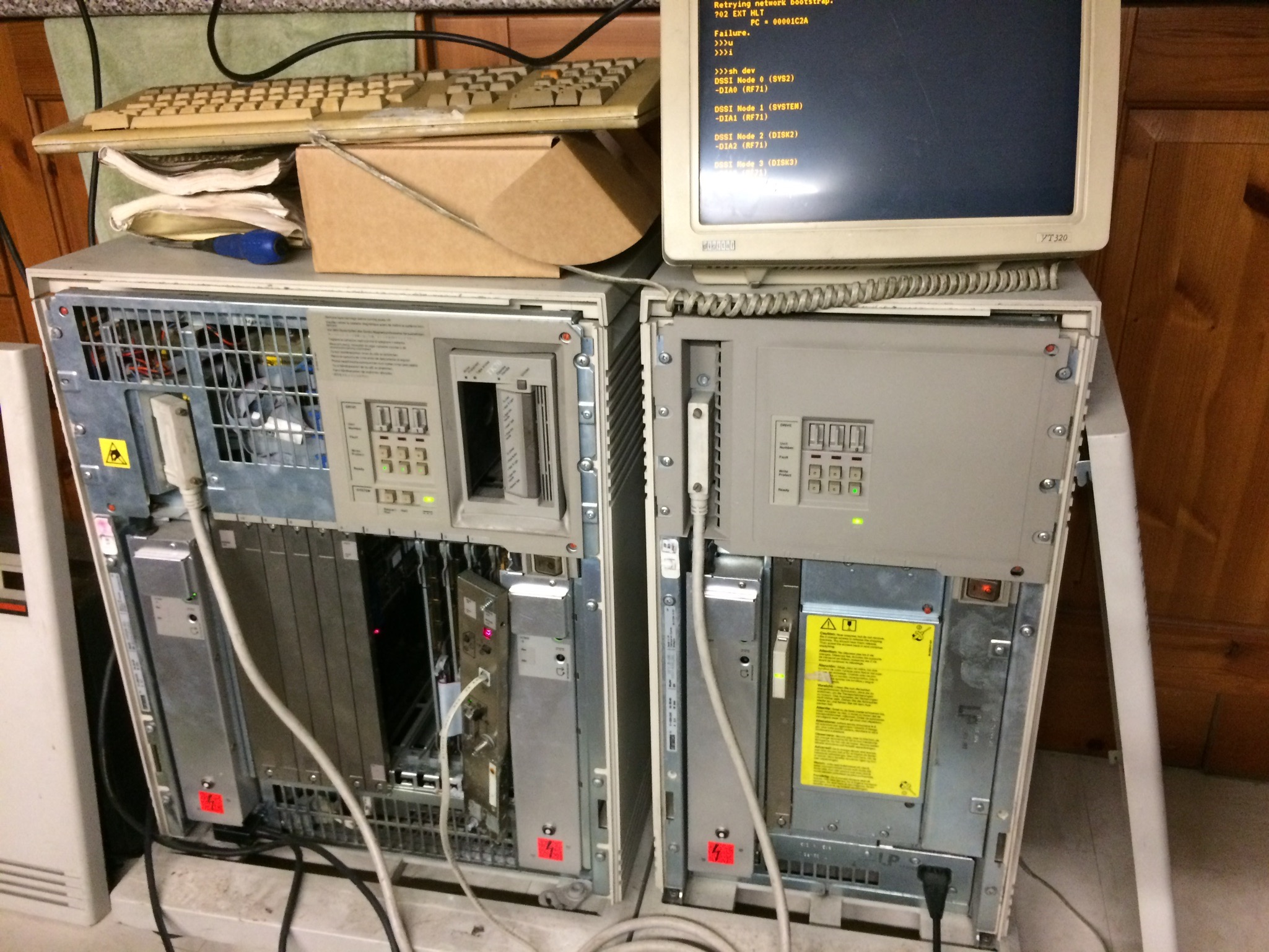
I've got my VAX3800 resuscitated after many years in limbo and two of the
four RF71s in there have gone bad. Has anyone tried swapping the controller
boards between drives? Is it just a matter of letting the drive
auto-calibrate or do I need to SET HOST onto the controller and tell it it's
on a different HDA...
Here it is in a happier mood shortly after first powerup:
http://www.binarydinosaurs.co.uk/VAX3800.jpg
(not my best LK201 keyboard but it was the closest :) )
--
Adrian/Witchy
Binary Dinosaurs creator/curator
Www.binarydinosaurs.co.uk - the UK's biggest private home computer
collection?
I don't see these manuals online at either bitsavers.org or hpmuseum.net.
Does anyone have copies of them available?
12044-90001 HDLC Direct Connect Interface Hardware Reference Manual
(12044A for A/L-Series)
12825-90001 HDLC Direct Connect Interface Hardware Reference Manual
(12825A for M/E/F-Series)
I have more than one HP-1000 CPU. Just curious what it would take to
connect some of them together running 91750A DS/1000-IV software.
So, I'm winding up to boot Unix V6 from an RX02 floppy. So I need two things:
- Details of how DEC ROM bootstraps boot from RX02's. I vaguely recall seeing
documentation of this somewhere (e.g. which sectors it loads, etc), but now I
can't find it. Don North has dumps of the RX02 ROM's, but I'm too lazy to read
through the code and figure out how they work. Is there some documentation
which covers it? I did a quick Google search, but if there is anything out
there, my Google-fu was inadequate.
- Did anyone ever do an RX02 driver for the V6 disk bootstrap? (Well, I guess
a V7 driver would work, too.) Note: what I need is _not_ either i) the Unix OS
driver for the RX02 (I found one of those already), or ii) a driver for the v7
standalone second-stage bootstrap (which would probably be in C). The thing
I'm looking for would be called rx.s, or something like that. Yes, I could
write it, but again, I'm lazy! :-)
Noel
I have uploaded a set of disk images from My Compupro system with an 8085
and 8086 card, plus regular z80. The thread starts a number of years ago,
but today I just updated, at the bottom, to include images of the disks I
have for the system.
Some interesting concurrent CPM and DOS stuff, not sure if this is really
MS DOS 1.25 or not, never got it to work on my system. I'd love to see
someone else make it work.
Thread:
http://vintagecomputer.net/browse_thread.cfm?id=265
Just get the IMD images:
http://vintagecomputer.net/disk_images/COMPUPRO/
As always, thanks Dave Dunfield, please use the images with the proper
licenses, etc.
Bill
SEEKING GOOD ILLUSTRATIVE MATERIAL ON IBM ADD ON BOXES GOT A STACK..
So need hi res scans of catalogs brochures etc showing them all
stacked and what when with what.
We had an early IBM pc for a while....but never this many add on boxes!
I am lost... Remember back in the 80s I sold HP stuff... any
help and guidance appreciated to make this all come together into
something nice visually!
thanks Ed Sharpe archivist for SMECC couryhouse at aol.com
Re: DEC bus transceivers
> From: allison
> Actually since about 1987 I've used about 1200 pieces of the 8641 alone
> repairing boards at the commercial level.
Well, that's over almost 30 years - and your total from that period is about
4% of the remaining stock (and in a commercial operation, to boot, not
hobbyist)...
> If you going to build a board or three maybe even 20 its not a big deal
> but its not a reliable source of predictable quality.
Sure, but try looking at it from our perspective: we either use an
out-of-production part, or have to design something (almost certainly from
discretes) that meets those specs; and we actually looked at the latter (viz.
Dave B's design). However, after some pondering, and taking everything
(including all the below) into account, we decided to go with the original
chips, since they were still sorta available.
Which is why both we and Guy have stocked up on them, at the start of the
process: we don't want to crank out boards designed for a certain part, and
then not be able to get the out-of-production parts the boards were designed
to use.
If we were designing something for serious production, that wouldn't be an
option, but for limited-volume hobbyist use, it is. The choice of an
out-of-production part does have a down-side, but it's minor (and mostly
alleviated by the pre-buying), and the other options were (in overall sum)
worse.
> If you get to the bridge your talking redesign in reality or an
> expensive buy from unreliable source then testing them in bulk.
But, but... I'm _already_ buying them from unreliable sources, then testing
them! :-)
But to be serious - if the demand for QSIC's, etc, runs the well of DS8641's
dry, yes, we'll probably have to re-design. In other words, we'd be right
where we'd be today if we decided not to use out-out-production parts.
Noel
Hi all --
Just wanted to let you guys know that a new version of the Xerox Alto emulator I've been working on at the LCM+L has been released; V1.1 of ContrAlto can be downloaded from: http://www.livingcomputers.org/Join/Online-Systems.aspx. At this point, the vast majority of software appears to be working properly, if you do run into any issues please let me know!
ContrAlto is open source, so if you want to hack on it the source is available on our GitHub site at https://github.com/livingcomputermuseum/ContrAlto.
Thanks!
- Josh
Many of us maintain large collections of bits that we'd like to preserve over a long time, and distribute, replicate, and migrate via unreliable storage media and networks. As disk sizes (and archive sizes) have increased, the probability of corruption undetected or uncorrected by the mechanisms normally built into disk drives, network protocols, and filesystems has increased to a level that warrants great concern.
I would be interested to know if there exists an archive format that has the following desirable properties:
1) It is well-documented, and relatively simple, to facilitate its implementation on many platforms present and future.
2) It supports some degree of incremental updating, but need not be particularly efficient about it. An explicit compaction operation is preferable to an overly complex format. It is adequate to use append-only strategies appropriate for write-once media.
3) Insertion and extraction of files, copying of the archives, and other archive-manipulation utilities support end-to-end verification that identical bits have been stably recorded to the media, bypassing or defeating platform-level or hardware-level caching mechanisms. Where this is not possible, the limits must be carefully delineated, with some basis for determining the properties of the platform and certifying reliability
properties where possible.
4) The format should provide for superior error detection capability, designed to avoid common failure modes with mechanisms typically used in hardware. For example, use a document-level cryptographic checksum rather than a block-level CRC.
5) The format should include a high degree of internal redundancy and recoverability, say, along the lines of a virtual RAID-array.
Just as biological organisms constantly correct DNA transcription errors,
the idea is to have a format that is robust across long-term exposure to
imperfect copying and transmission channels.
Does anything like this exist?
--Bill
I too have been searching for documentation/schematics for the Cambridge
Memories, Inc. Expandacore18 4k core memory boards. I have an old
Diversified Numeric Applications Med PL/185 machine which is a clone of the
Raytheon 703. This machine has 16k of core with 4 of these boards.
--
THE BLUES IS THE TRUTH. IF IT'S NOT THE TRUTH, IT'S NOT THE BLUES. (Willie
Dixon)