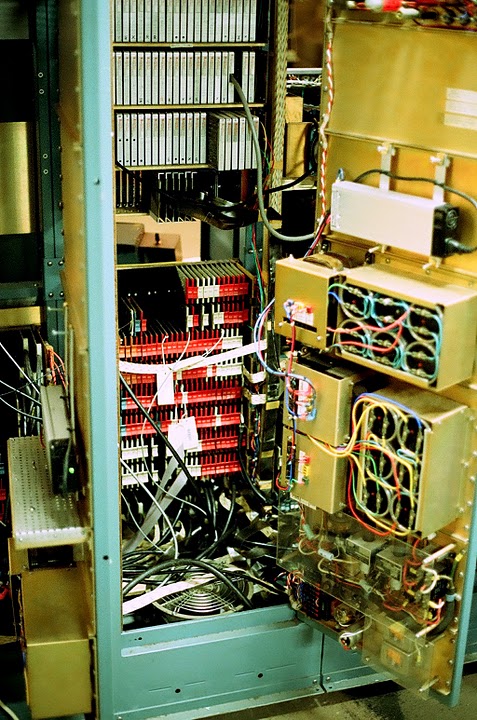
Chuck! Many thanks!
Update on? 422 UNIVAC? docs . .? some kind? ?people have mailed in? docs and? ?things? they have? found related to this? 422 UNIVAC ...? things are? shaping up! Many? thanks? ?to? all? these? folks-
I? fear ever putting power to this? thing... so? may? parts to go? POP... I have a nice large? Variac.....? ?suggestions?
Ed
In a message dated 1/5/2019 11:18:00 AM US Mountain Standard Time, cctalk at classiccmp.org writes:
Since it was a 53-year old high-school project, I doubt that you're
going to find much on it.? However, see the post by Steve Schweda here:
https://community.hpe.com/t5/Operating-System-OpenVMS/Left-shift-by-more-th…
He may actually have some familiarity with ELTRAN and know where some
documentation exists.
--Chuck
On 1/5/19 10:10 AM, Chuck Guzis via cctalk wrote:
> Okay, I think I found the reference to it.
>
> It turns out that it was a high-school student's project entered in the
> "Fourth Annual Computer Programming Contest for Grades 7 to 12'.? To quote:
(COME ON SOCRATES ...? DO YOUR? THING!)
In a message dated 1/5/2019 1:49:38 AM US Mountain Standard Time, cctalk at classiccmp.org writes:
no is compiler a small one only 2 do loops allowed...ed#
Sent from AOL Mobile MailOn Friday, January 4, 2019 Chuck Guzis via cctalk <cclist at sydex.com; cctalk at classiccmp.org> wrote:On 1/4/19 8:42 PM, Fred Cisin via cctalk wrote:> Would be? interesting when you find it.> Not necessarily "tiny"> Remember WATFOR??? (very impressive!)
I guesss not too many numerical methods types hwere, but ELTRAN is asubroutine in the EISPACK linear programming set.? Yes, it's all FORTRAN:
>From the subroutine:
cc? ? this subroutine is a translation of the algol procedure elmtrans,c? ? num. math. 16, 181-204(1970) by peters and wilkinson.c? ? handbook for auto. comp., vol.ii-linear algebra, 372-395(1971).cc? ? this subroutine accumulates the stabilized elementaryc? ? similarity transformations used in the reduction of ac? ? real general matrix to upper hessenberg form by? elmhes.
--Chuck
no is compiler a small one only 2 do loops allowed...ed#
Sent from AOL Mobile Mail
On Friday, January 4, 2019 Chuck Guzis via cctalk <cclist at sydex.com; cctalk at classiccmp.org> wrote:
On 1/4/19 8:42 PM, Fred Cisin via cctalk wrote:
> Would be? interesting when you find it.
> Not necessarily "tiny"
> Remember WATFOR??? (very impressive!)
I guesss not too many numerical methods types hwere, but ELTRAN is a
subroutine in the EISPACK linear programming set.? Yes, it's all FORTRAN:
>From the subroutine:
c
c? ? this subroutine is a translation of the algol procedure elmtrans,
c? ? num. math. 16, 181-204(1970) by peters and wilkinson.
c? ? handbook for auto. comp., vol.ii-linear algebra, 372-395(1971).
c
c? ? this subroutine accumulates the stabilized elementary
c? ? similarity transformations used in the reduction of a
c? ? real general matrix to upper hessenberg form by? elmhes.
--Chuck
> From: Paul Koning
>> On Dec 31, 2018, at 6:32 PM, Henk Gooijen via cctalk <cctalk at classiccmp.org> wrote:
>> ...
>> There are one or two bits in a register of the RK11 that have a
>> different meaning/function, depending on the controller being a -C or
>> -D.
> If someone can point me to the description of the differences I should
> be able to say what RSTS will do with them.
AFAIK, the only difference (in programming terms) between the -C and -D is
that the -D has dropped the maintainance register.
Although I cheerfully admit I haven't sat down with -C and -D manuals and
done a bit-by-bit compare. I just did that (I used the "RK11-C Moving Head
Disk Drive Controller Manual", DEC-11-HRKA-D, and the 1976 "Peripherals
Handbook"), and found in the following:
In the RKDS: bit 7 has changed the definition slightly ("Drive Ready" to
"R/W/S Ready"), but seems to be basically the same. In the RKCS, bit 9 is
"Read/Write All" in the -C, and unused in the -D; bit 12 is "Maint" in the
-C, unused in the -D.
In other words, a -D driver should work just fine with a -C, IMO.
Noel
>-----Original Message-----
>From: cctalk [mailto:cctalk-bounces at classiccmp.org] On Behalf Of Carlo Pisani via cctalk
>Sent: Tuesday, January 01, 2019 5:35 PM
>To: ben; General Discussion: On-Topic and Off-Topic Posts
>Subject: Re: Motorola M88K books & user manuals (looking for)
>
>> I was never a fan of RISC architecture as does not fit the standard high
>> level language model. Everybody wants a 1 pass compiler, thus the RISC
>> model. If you are doing your own RISC model, you might consider a model
>> that supports Effective addressing better since we have got the point
>> where fetching the data is taking longer than processing it.
>
>yup. I am a 68k programmer so I know what you mean.
>the 68k is more comfortable to be programmed in assembly, and even the
>EA modes (especially in the 68020 and CPU32) help a lot.
>
>unfortunately, the 68K is very complex to be designed, and the first
>68020 used microcode, which is a no-go for modern designs.
>
>...
I'm curious as to why you make this claim that microcode is no-go in "modern" designs. Could you please elaborate on this point? I don't see why the alternative random control logic would be a better proposition.
Thanks,
paul
So after some intensive transcribing work I finally got all files into
source files ready for assembling using PAL11-S.
Assembling under PAL11-S rooted out a bunch of errors and then when side by
side comparing the output listing with the PDF I found a bunch of more
errors.
The next step involved linking and during the first run a number of errors
surfaced again.
On the last run I only had two undefined: $ICO and $ICI. It makes sense
since these two are part of the FPMP-11 package and used for number
conversion. However adding the FPMP-11 object as an extra input in the link
does not resolve these two undefined symbols.
Does anyone have a clue on how to get a proper link with FPMP-11 for these
two symbols?
Here is the repo with PDF files, source PAL files, LST files and OBJ files
as generated by PAL11-S:
https://github.com/MattisLind/SPACEWAR
/Mattis
> From: Mattis Lind
> I cannot figure out which early machine it comes from.
They're called 'System Modules':
http://gunkies.org/wiki/System_Module
and they were used from the PDP-1 through (I think) the PDP-7; at least, this
PDP-7 internals image:
https://www.soemtron.org/images/jpgs/decimages/sn113robertjohnson85680004.j…
seems to show System Modules at the top, and FLIP CHIPs at the bottom. (I'm
pretty sure even the first PDP-8 - the 'straight 8' - uses only early FLIP
CHIPs - transistorized ones.)
The DEC brochure for it (P5141) is a little puzzling; it says (p. 2) that
"INTEGRATED CIRCUITS are basic elements of the low cost, newly designed
silicon FLIP CHIP modules used throughout PDP-7", but AFAIK, the first FLIP
CHIPs (R-series, B-series, etc) were all transistors; the later M-series were
the first ones to have ICs. Maybe this is some old meaning of "integrated
circuits"?
Noel
wanted back issues IEEE ANNALS OF THE HISTORY OF COMPUTING? bound or unbound... dtop us a line off list please.... ed#? SMECC
Sent from AOL Mobile Mail