I see that my RS232 lore needs a bit of brushing up!
As much work as I've done with serial data thingys, ya think I'dve
remembered something fundamental like that.
And I was so pompously positive, too..
Let the Lashing begin! ;{}
Cheers
John
PS: this certainly goes to the value of this List as educational tool -
>On my VT220, as connected to a VAXStation 3100, depressing the 'BREAK'
>key on the LK401 causes an immediate processor halt and the display of a
>monitor prompt... >>> . Since I have it hooked up using the RS232
>port, and since there is no such thing as a real interrupting 'break' in
>RS232 - it must be some other code... or, is it? The VT220 Programmer
>Pocket Guide just says that he first 5 top-row keys are "local function
>keys and do not generate codes."
>
> But it still doesn't tell me what the hardware does when pressing
>'BREAK'. IF no one knows, I'll have to get out the break-out box and
>see if I can trap it.
BREAK on typical RS-232 terminal simply sets the line to the SPACE condition
for a number of character intervals. This causes a framing error at the
receiver (no stop bit) and many system will time this and if it persists
long enough will interpret it as a system attention function.
Better terminals will generate a timed pulse when break is depressed, some
terminals simply send a space condition for as long as the key is held down.
Regards,
Dave Dunfield
--------------------------------------------------------------------
mail2web - Check your email from the web at
http://mail2web.com/ .
<< I had a Portable I. It had 256KB on the motherboard, but could be expanded to 640KB with an ISA memory card like (almost) any other XT. From memory there was a Portable Plus, a Portable I with a 10MB HDD. >>
Thanks to everyone for the discussion and answers; I will forward along the information to the woman. I actually did forward her e-mail to the list, but I guess the list server does not allow that and only submitted my e-mail "shell." Best, David, classiccomputing.com
I have 2 VT100 terminals plus a vt100 plastic shell that I'm parting out.
They are VERY yellowed cases, obviously a smoking environment. Definitely
some screen burnin too. On at least one of them the fasteners that hold the
top of the case to the bottom of the case are broken. I don't think they are
worth much more than the junk heap. They all power up and go into setup mode
just fine. They are all true VT100's, not 102's, etc. Some or all of the
keyboards are missing some keycaps. I think one keyboard may have all it's
keys.
In addition, I have a vt102 without the top or bottom case. It is in perfect
working order, clean, and no burnin with one major flaw. The metal band
around the front of the tube has slipped, meaning two of the L brackets that
are held down by that band have slipped back so the monitor is about 1/2
inch forward of where it should be. Thus it won't fit into a plastic case
quite right. The band is too tight to push the L brackets back into place,
and I'm not comfortable cutting that band and trying to put a new one in
place (something about working with a large glass object under pressure
scares me a bit).
So far my plan is to keep the vt102 chassis as spares, and ditch the 2.1
vt100's. If anyone wants me to scavenge parts (logic board, power supply
board, flyback, transformer, keycaps, crt tube, etc.) I would be happy to do
that. Total price for each shipment will be shipping cost + 5 bucks (unless
you just want a keycap or something)...negotiable. The only stipulation is
you must let me know in a day or two, I'm itching to get them out of the
house and gone.
Jay West
---
[This E-mail scanned for viruses by Declude Virus]
I finally heard back from the gentleman who responds to requests from the
e-mail address at Basicon's former site... he sent me scans of some paper
docs... JPGs, but quite legible. It fits the final pieces of the puzzle
together for me, including fixing an ambiguity I had with one of the
power/comms connector pins, and giving programming examples for talking
to the MM58154A clock/calendar chip.
If you ever happen to run across a 3"x4" board with an INS8073 and an 8255,
embedded in something, nab it - it's a cool little piece of the early 1980s.
Thanks to all for your input and help figuring this thing out.
-ethan
--
Ethan Dicks, A-130-S Current South Pole Weather at 04-May-2004 13:20 Z
South Pole Station
PSC 468 Box 400 Temp -87.2 F (-66.3 C) Windchill -145.1 F (-98.40 C)
APO AP 96598 Wind 12 kts Grid 024 Barometer 673.1 mb (10888. ft)
Ethan.Dicks(a)amanda.spole.gov http://penguincentral.com/penguincentral.html
At 23:57 03/05/2004 -0500, you wrote:
>> Hi everyone,
>> Can someone please help me find an RS232 serial interface converter for
>> the 64?
>> Cheers
>> Stu
>>
>Good luck, they weren't too common. You might have to bash together some
>1488-1489 chips and a 555 negative voltage circuit to get what you need.
Is this the RS-232 module valled "VIC 1011A" which connects to the C64 "User
port"? If so, I found one in a box of Commodore stuff I picked up this
weekend... (Sorry, I don't think I want to part with it just yet, and it
would be a long way to send it anyway).
If anyone has some info on this device, it would be appreciated.
I tried to look inside, however after removing the single screw from the bottom,
it still seemed to be glued together, and I didn't want to break it.
I'm guessing that it's just level converters for a "bit bash" serial port... If
so, it should not be hard to cook something up yourself. Here is a page giving
some information on rolling your own C64 serial port:
http://www.funet.fi/pub/cbm/documents/projects/rs232/
Regards,
--
dave04a (at) Dave Dunfield
dunfield (dot) Firmware development services & tools: www.dunfield.com
com Vintage computing equipment collector.
http://www.parse.com/~ddunfield/museum/index.html
Glen,
I found this link
http://www.classiccmp.org/pipermail/cctech/2002-September/002328.html
while searching for this manual. Do you still have a copy of it? And would you be willing to share? I have an HP 7946 tape drive I need to access and the manual is nowhere to be found.
Karen Reid
Sr. Test Engineer
DRS Optronics, Inc.
100 N. Babcock St.
Melbourne, FL 32935
321.309.1865
>I'm pretty sure the Compaq Portable III that I sold in February was an 8088 machine.
>Orange plasma display, small lunchbox configuration, etc. I just went back to the
>sales-photos for it and indeed it was badged a III. It had the standard 640K of RAM
>and no expansion slots. Did they possibly make this machine with different processor >configurations? Is it possible yours has a 3rd party processor upgrade? I definitely
>didn't have to run a Setup program to get it going and it had sat idle for a long time
>before I powered it up, so I'm fairly certain the one I had didn't have a setup
>battery or CMOS setup storage.
Lunchbox, Plasma, 640k and no-expansion all sound right, however it's definately
a 286, and according to the Compaq literature as well as several web sites I've just
checked, that's what's supposed to be in there...
Here's a guy on Ebay trying to sell one for $500 ... any takers? :-)
http://cgi.ebay.com/ws/eBayISAPI.dll?ViewItem&category=4193&item=4127904926
[I'd even let mine go at that price - found at garage sale for $5]
The setup software was a bootable diskette (like the original IBM-AT)... It definately
has a CMOS RAM and battery, because mine is dead and doesn't hold a charge, causing
the machine to fail it's startup disgnostics if you leave it for more than a day or
two.
Regards,
--
dave04a (at) Dave Dunfield
dunfield (dot) Firmware development services & tools: www.dunfield.com
com Vintage computing equipment collector.
http://www.parse.com/~ddunfield/museum/index.html
>> If anyone has the original setup disk for the Portable III, I would love to
>> get an image of it - the "generic" AT setup disks work in that you can configure
>> the drives and get it to boot, however Compaq apparently "rolled their own"
>> checksum algorithm, as once configured with any of the generic disks, it gets a
>> CMOS Checksum error.
>
>http://www.compaq.com/support/files/obsolete_diagnostics.html
>I THINK that it includes what you need, along with some other junk.
Thanks! - that was exactly what I wanted - works perfectly!
Regards,
--
dave04a (at) Dave Dunfield
dunfield (dot) Firmware development services & tools: www.dunfield.com
com Vintage computing equipment collector.
http://www.parse.com/~ddunfield/museum/index.html
Available for free (pick up only, I can't think of a viable way to ship
these) in the SE suburbs or Melbourne.
2 x PDP-11/04s
4 x RL01 drives
Misc. RL01 disk packs, cables, etc.
No racks
They're in rough condition. They've been sitting on the back verandah of
my house for some time now. Out of the rain, but exposed to the elements.
I removed them from a building that was being vandalized and eventually
demolished. A planned move that would have seen them more appropriately
housed fell through. I haven't attempted to power them up.
They used to be the character generator and animation system for a large
scoreboard. One of the RL01s is damaged. There are dents and scratches
>from where someone has hit it with something. The VT100s there didn't fare
so well. I doubt any of the disk packs will be salvageable, they've been
thrown around (I found this lot after tripping over a disk pack while I was
walking through the long grass).
Getting this stuff down from the 5th floor was hard work on my own. I was
hoping to get it up and running again one day, but probably should have
passed it on to someone else long ago.
I recall offering these to someone on this list sometime ago, but I lost
contact (my apologies, not his fault).
Thirdly, could anybody add more to the limited amount of technical info
available on the HP250 machines?
--
check out www.bitsavers.org/pdf/hp/250
I should have more information on the 300 soon.
AFAIK the 300 and 3000/S33 were pretty much the same hardware except for microcode.
I am almost certain it is basically an 11/35, or 11/40.
The /35 was the OEM version of the /40, hence they both
have the same 5-card CPU set with optional cards for
FIS, EIS and MMU. The MMU also required a small extra
board called stack limit register.
For more info on the /35 see www.pdp-11.nl
- Henk, PA8PDP.
> -----Original Message-----
> From: Joe R. [mailto:rigdonj@cfl.rr.com]
> Sent: maandag 3 mei 2004 23:29
> To: cctalk(a)classiccmp.org
> Subject: Tektronix CP-1160/DEC something
>
>
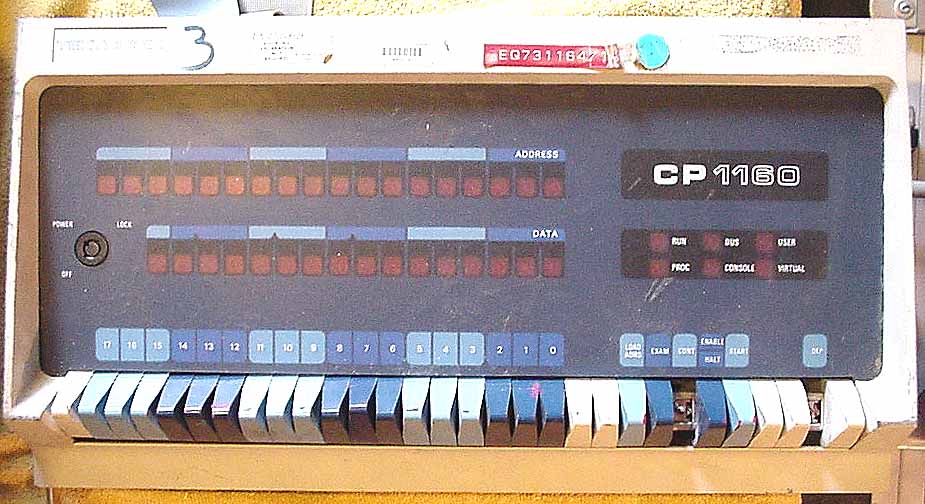
> A couple of months ago I found a DEC computer with a front
> panel. Then I
> found a second one a few weeks ago. The panels are painted in
> two tone blue
> Tekronix colors. I finally got around to photograghing one of
> the front
> panels today. I'm posting a picture of it at
> <http://www.classiccmp.org/hp/dec-k/cp1160.jpg>. Sorry but I haven't
> cleaned it up. It's also missing two switch handles. The first one was
> marked as being a 11/35FC but I don't remember seeing a model
> number on the
> 2nd one.
>
> Joe
>
I've got a set of DEC diagnostic floppies (RX50) and I don't have the
decoding scheme at hand to figure out the part number and therefore their
usage. I don't know which machine these run on -- Micro PDP-11 or MicroVAX.
I sort of suspect they *may* be for my uVAX II because they came with a
heap of other goodies, including a working uPDP-11/73, at the same time I
got said uVAX II.
Given the part numbers listed below could anyone tell me about them (other
than the obvious ;-) )?
BL-T540B-M1 CZUFDB1 USER TESTS
BL-T541B-M1 CZXD1B1 FIELD SERVICE TESTS 1
BL-T542B-MC CZXD2B0 FIELD SERVICE TESTS 2
BL-T565B-MC CZXD3B0 FIELD SERVICE TESTS 3
BL-T583B-MC CZXD4B0 FIELD SERVICE TESTS 4
Thanks for your help.
(BTW, should these be added to an archive or two (bitsavers for instance)?)
-Chris F.
NNNN
Christian Fandt, Electronic/Electrical Historian
Jamestown, NY USA cfandt(a)netsync.net
Member of Antique Wireless Association
URL: http://www.antiquewireless.org/
I have a small Apple grayscale tube (about 12"), probably from the Apple
IIc or IIgs days. Basically, baseband video. in fact, I was using it as a
video monitor until recently.
Pretty good shape. Anyone want this for $5.00? Shipping is from 10512. The
junkyard calls...
Reply off list.
William Donzelli
aw288(a)osfn.org
I have been recovering HP64000 files from floppies written by a 64000 that
no longer boots.
===
A scan of the 64000 floppy ref man that describes the LIF implemenation
can now be found at www.bitsavers.org/hp/64000/64941-90906_flpRef_Jan84.pdf
"McFadden, Mike" <mmcfadden(a)cmh.edu> wrote:
> VAX 6000-610
> VAX 6000-410
I'm salivating but just don't have a place to house a 6000 in a full cabinet
(unless it's the smaller version for space-constrained people, a smallish
rackmount XMI card cage, but those were rarer than hen's teeth), let alone two
of them.
Is it the kind of thing that's headed for death in a melter if no one takes it?
If someone else (with a warehouse for his computers) can take them, great, but
if no one does and they head for scrap, can you please take out all boards (I'm
interested in all XMI and all VAXBI boards, the TU58, and any other boards/parts
that may be there other than the huge cabinet that I unfortunately can't handle)
and let me (or other interested people) have them?
MS
these will probably go relal cheap as in > $5.00. The one on the left is a sun 390 upgradable to 690 SMP. The tall boy ob the lest is a sun 3/280. The later one may go for more just because the 7' rack is in nice condition.
http:w3.arizona.edu/~pacs/surplus/public/sale/pics/0504024.JPG
I have pulled several Intel Aboveboards out of Compaq Portable 1s & IIs. They
work well for memory expansion on the ISA 8 and 16 bit busses.
Paxton
Astoria
Dear Rich,
do you still have the Shugart 851 one? Or at least the user manual for it?
Thanks,
Zdravko Stefanov
--
_____________________________________________________________
Web-based SMS services available at http://www.operamail.com.
>From your mailbox to local or overseas cell phones.
Powered by Outblaze
Hi everyone
I'm looking for some kind soul to identify this machine for me
http://www.applefritter.com/node/view/1711
I see someone has replied on Applefritter and is talking about it being
some kind of giant transciever, but any extra details would be
appreciated.
-Michael Fincham
www.mfp.co.nz
Hello all,
Verne has some very early PC magazines available in Greenville, SC for
pickup or for shipping at your expense.
Please contact him directly at vern99t(a)charter.net to save these from a
landfill.
The usual disclaimers apply.
Best regards,
Erik Klein
www.vintage-computer.com <http://www.vintage-computer.com/>
www.vintage-computer.com/vcforum
The Vintage Computer Forum
---------------------------- Original Message
----------------------------
Subject: Old Computer Magazines
From: "Verne" <vern99t(a)charter.net>
Date: Fri, April 30, 2004 2:01 pm
To: webmasterNOSPAM(a)vintage-computer.com
------------------------------------------------------------------------
--
I'm about to trash an old collection of PC Mag, PC World, PC Tech
Journal
About 4 Boxes in very good condition ranging from 1984 to 1988
Any Interest ?? The boxes weigh a ton.. Unless they have some value
The shipping cost will be prohibitive
Greenville, SC
Verne
> Everything on it is TTL except for one LSI IC marked
> MCH-01. Anyone know what that might be?
Probably a character ROM.
Lee.
________________________________________________________________________
This e-mail has been scanned for all viruses by Star Internet. The
service is powered by MessageLabs. For more information on a proactive
anti-virus service working around the clock, around the globe, visit:
http://www.star.net.uk
________________________________________________________________________
>TCF (NJ annual Computer flea) http://www.tcf-nj.org report
Damn it!!!
I was just thinking about this the other day and meant to put it on my
calendar. I wanted to go, and today would have been better for me (now I
have to see if I can get there tomorrow or not).
DAMN!
-chris
<http://www.mythtech.net>
>I have a couple as well, and I thought it was quite descriptive of the
>processor's capabilities. I wonder what kind of neat logo we could come up
>with for the Hitachi 63C09... ;-)
You could make the circles '?'marks - for all the undocumented opcodes!
>>In hindsight, the 6809 while the best 8 processer it only has 64k of
>>memory space.
>
>So? Most (all?) 8-bit CPUs have that "limitation" -> which can be easily
>overcome with bankswitching and other techniques...
I agree that standard 16 bit 64k addressing should not have kept the processor
>from becoming more widespread than it did - look at the Z80 and 6502 - both
less capable processors, both with "only" 64k and both received much more
acceptance than the 6809.
I do think that a natural progression in the 6809 family (had it continued)
would have been an integrated segmented or bank switched memory manager -
this could have been worked quite nicely into the 09 architecture.
>> Also since the only
>>common 6809 system was by Radio Shack as games machine you never got the
>>good I/O like lower case letters and a real serial and floppy drives.
>>Ben.
>
>Game machine? Hardly... the Commodore & Atari were *much* better with games
>than the CoCo ever was. Floppy drives? RS drives were the best available
>for that class of market at the time.
I 1/2 agree (with each of you) - the original CoCo (and even the CoCo2) were
somewhat limited, and more importantly packaged (CoCo1) and marketed as a cheap
home console computer. Not so much a game console (although the cartridge slot
does suggest this), but as a cheap "toy" computer (that happened to play a bunch
of cartridge games). The CoCo3 was a marked improvement, however it was too
little/too late, and as no one else had really picked up the CPU, it got the
reputation as an "oddball".
I do agree on the RS drive - the drive cartridge used a standard floppy controller
chip (and you could use standard off-the-shelf drives) and interfaced directly to
the 09 bus through the cartridge slot - much better/faster then the custom serial
drive offerings by the "other guys". But, I also think that having to use a
cartridge for the drive seems a bit goofy - why not have implemented a drive
interface native to the machine?
I designed and built my own 6809 based workstations - both the homebrew ones shown
on my web page, and a couple of custom bus/racked limited production designs for a
couple of "big" companies as in-house test platforms - These "serious" systems were
remarkably powerful for their time, and gave a truer impression of the 6809's
potential than the CoCo which hid that power beneath a flimsy and toyish looking
case, an inadaquate keyboard (CoCo1) and artifically limiting system software (for
example, the CoCo ROM's required DP to be "Page Zero" - and hogged most of it).
>How does [[ Crappy graphics, crappy sound, great I/O speeds & Unix-class
>multitasking OSs ]] == "Game Machine"???
Speaking of multitasking, there's a really nice feature of the 6809 that is
often ignored, however I used this in a number of 6809 based products that
I designed to implement very fast simple multitasking.
This feature is the "Direct Page" register! - Unlike other CPU's which use
"zero page", the 6809 has DP which means that you can place your "zero page"
at any 256 byte boundary. This register is also saved and restored during a
full interrupt, meaning that in a multitasking system, each task can have it
own "zero page". This makes for compact code (many tasks never need to use
extended addressing for memory references).
Here's an example of a ultra simple task swapper in only 5 instruction, in
which each task runs in round-robin fashion, requiring only 3 bytes in each
tasks "page" - there is no system task control blocks/tables:
; Interrupt saves all registers (can be SWI for volentary swap)
INTHND: STS <MYSP ; Save current task stack pointer
LDA <TLINK ; Get next tasks DP
TFR A,DP ; Switch to new DP :-( can't load DP directly)
LDS <MYSP ; Restore new task SP
RTI ; Load new task registers & launch
Ah - such memories!
Regards,
Dave
--
dave04a (at) Dave Dunfield
dunfield (dot) Firmware development services & tools: www.dunfield.com
com Vintage computing equipment collector.
http://www.parse.com/~ddunfield/museum/index.html
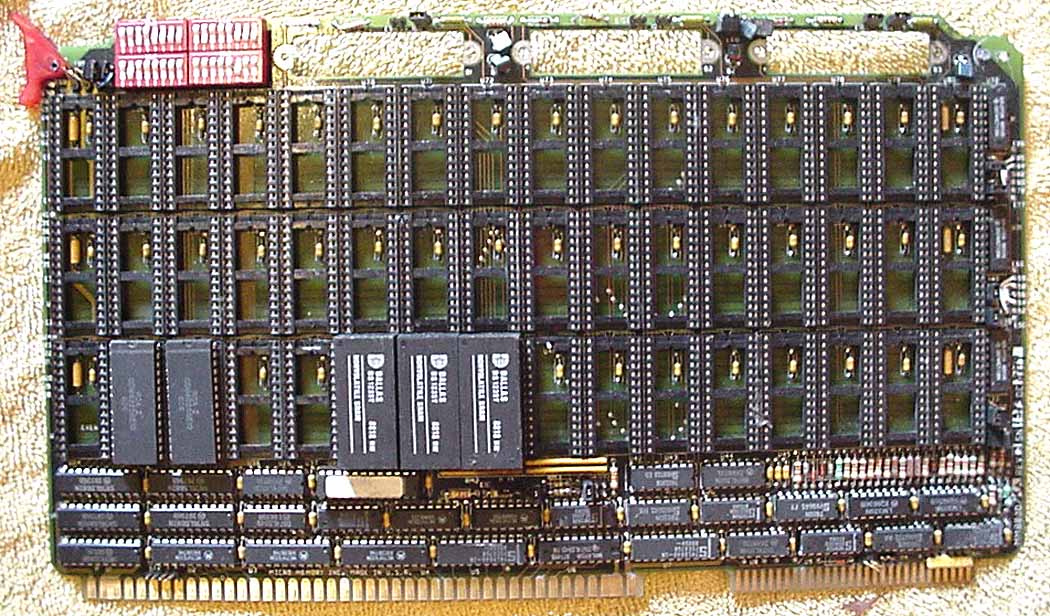
I found two "new" Multibus cards in the last couple of weeks. The first
was made by Monolithic Memories and appears to be a RAM/PROM card. The
intersting thing about it is that it has three Dallas battery backed NV
RAMs and two RCA 62256 SRAMS. Another oddity is that it has cutouts along
the top edge, probably for some type of I/O connectors.
<http://www.classiccmp.org/hp/multibus/mmi%20mm8800.jpg>
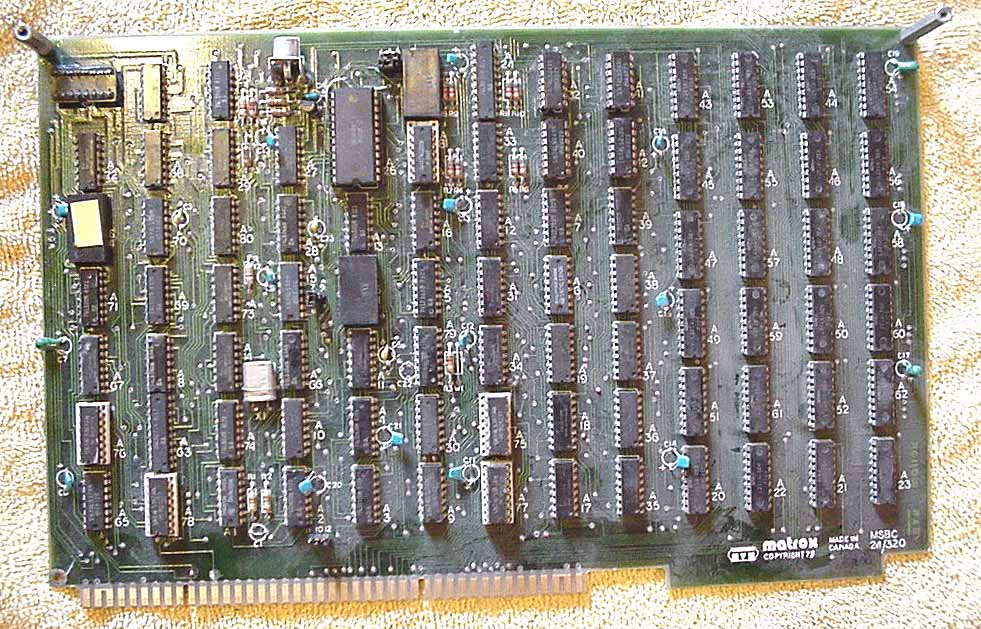
The other card is a video card made by Matrox. Everything on it is TTL
except for one LSI IC marked MCH-01. Anyone know what that might be? There
are four other blocks on it that appear to be LSI ICs but it turns out that
they're really DIP switches with covers on them. There is one in the top LH
corner with not cover.
<http://www.classiccmp.org/hp/multibus/matrox%20msbc%2024-320.jpg>
Does anyone have docs for either of these?
Joe
On May 1, 12:17, Joe R. wrote:
> At 10:02 AM 5/1/04 -0500, Pat wrote:
> >On Saturday 01 May 2004 03:50, Bert Thomas wrote:
> >> "Joe R." wrote:
> >> Fred, can I use that MFM controller in my 11/750?
> >
> >No. You need UNIBUS cards for an 11/750. That's an RQDX3, a QBUS
card.
> >
> >You can find out what cards are using module numbers with Megan
Gentry's
> >field guide:
> >
> >http://world.std.com/~mbg/pdp11-field-guide.txt
>
> That won't tell any more than the listings will since that's where
> the descriptions came from.
The third column contains "Q" for Qbus or "U" for Unibus.
--
Pete Peter Turnbull
Network Manager
University of York
I worked with many systems back in the middle to late 80s when the 386 was in vogue. I don't recall any of them using an older 287 math coprocessor though. Here is a link to a page full of mbs and DTK did indeed make a discrete chip 386 motherboard back then. The co-processor was a 387 though.
http://www.redhill.net.au/b-92.html
best regards, Steve Thatcher
-----Original Message-----
From: SHAUN RIPLEY <vax3900(a)yahoo.com>
Sent: Apr 30, 2004 6:15 AM
To: cctalk(a)classiccmp.org
Subject: 386 motherboard with discrete logic chips only?
I talked with my friend the other day and he claimed
that 386 motherboards all used this or that chip sets;
But I vaguely remember I might once have such a 386.
It had a 287 math coprocessor and some memory chips on
board. What I can remember is that it had many logic
chips on board but I can't recall whether it had chip
sets or not. Unluckly I dumped it years ago... Could
somebody give me an answer?
vax, 3900
__________________________________
Do you Yahoo!?
Win a $20,000 Career Makeover at Yahoo! HotJobs
http://hotjobs.sweepstakes.yahoo.com/careermakeover
I need two items to complete my omnibot 2000 robot. Missing are the tray and
the home base. I have searched google and eBay with no luck. The sites that
sell parts only have manuals, batteries, and chargers (from Radio Shack). It
took me a year to get a remote control for it. Anyone with an extra tray?
Thanks for your time.
Hi All,
While going through the *pile* of mail here at the office, I also
found a box filled with DEC cards. It was shipped by someone in
Wichita, KS, but no name.
I *do* remember buying this, but can't find a record of who I
bought it from. If this is you... please respond off-list, since
I can't remember whether I *paid* for it or not...
Thanks for the OT-ing,
Fred
--
Fred N. van Kempen, DEC (Digital Equipment Corporation) Collector/Archivist
Visit the VAXlab Project at http://VAXlab.pdp11.nl/
Visit the Archives at http://www.pdp11.nl/
Email: waltje(a)pdp11.nl BUSSUM, THE NETHERLANDS / Mountain View, CA, USA
>No signs of life from the PSU but there normally isn't until powerup and the
>LED lights up.
Usually the vent fan will start spinning right away. If the fan doesn't
even jerk, then the PS may not be doing anything. I've used that to track
problems in some macs before (Mac PSs tend to be "short resistant", at
least that is what I've found. If there is a short somewhere, the PS will
power itself back off rather than fry itself... in those cases, the fan
usually jerks as the PS comes on and cycles right back off)
It is starting to sound like the PS is dead.
There are no additional troubleshooting steps listed in the Apple tech
manual for the IIfx (actually, there are no troubleshooting steps at ALL
in that manual).
-chris
<http://www.mythtech.net>
I talked with my friend the other day and he claimed
that 386 motherboards all used this or that chip sets;
But I vaguely remember I might once have such a 386.
It had a 287 math coprocessor and some memory chips on
board. What I can remember is that it had many logic
chips on board but I can't recall whether it had chip
sets or not. Unluckly I dumped it years ago... Could
somebody give me an answer?
vax, 3900
__________________________________
Do you Yahoo!?
Win a $20,000 Career Makeover at Yahoo! HotJobs
http://hotjobs.sweepstakes.yahoo.com/careermakeover
>Well, if you're swapping in an identical unit, you'll not cure the
>problem. The replacement is just as marginal...
Yup... that's probably why I did LOTS of PSU swapping in the A2's :-)
-chris
<http://www.mythtech.net>
Hi everyone,
I have one of the newer plasma displays used in the IBM P70, labeled
MD480T640PG4.
I've found the pinout for the data connector, but i can't seem to find the
pinout of the power connector anywhere.
It's an 8 pins connector, with the center 3 pins missing.
Picture: http://twl.student.utwente.nl/display.jpg
As most of the caps around the connector are rated for 250V, I presume it
needs some high voltage.
There is also a small connector in the bottom left part of the board. Maybe
used for driving an indicator light?
Cheers,
Thomas
One of our number was kind enough to provide me with a copy of aztec C,
and now I and trying to
get it working. It was provided on 4 5.5" floppies, and I only have the
One 5.5" drive in
my apple, but I do have 2 3.25" drives (that each hold a little more)
Aztech seems to be stored on PRODOS volumes, so I am now trying to copy
>from all it's 5.5's to
3.25s
Is there a collection of Aztech C wisdom out on the net?
Can anyone provide a proper directory setup ?
Is it possible to compile the source C and have aztec save the assembly
it generates?
Thanks for the help.
ron.
>You mean 'at least 3rd time around'. The Apple ][ PSU is marginal, or at
>least mine was. The 5V line was rated (IIRC) at 2.5A. A mainboard,
>language card, disk controller, and 1 drive (i.e. not a very full
>machine) exceeded that on my meter. Perhaps I was just unlucky and had
>parts that took more current than normal, but I had a lot of trouble with
>the Apple ]['s PSU...
Yeah, come to think of it, I do seem to recall swapping a number of A2
PSU's back then. That was before I was willing to try component repairs,
so it was simple swaps of bad for good.
-chris
<http://www.mythtech.net>
Anyone know if Mike Green and/or Steve Porter are still alive and reachable?
I was hoping to approach them about jotting down some history of HP2000
TimeShared BASIC.
Any leads appreciated!
Jay West
---
[This E-mail scanned for viruses by Declude Virus]
Guys,
In case you haven't heard, this weekend VCF/Europe will be held in
Munich for the 5th year. If you live in Europe and have the chance to
go, I recommend it!
http://www.vcfe.org/E/
Spare Time Gizmos will be there with our "Build your own PDP-8 from a
kit!" kit, the SBC6120
http://sbc6120.SpareTimeGizmos.com
and in honor of VCF/Europe we'll be giving free shipping to anybody,
anywhere in the world, who orders any SBC6120 parts or kits this
weekend. Just place your order thru our online store,
http://store.SpareTimeGizmos.com
anytime Saturday or Sunday (May 1st/2nd) and pay via PayPal and you
won't be charged for shipping.
And be sure to send your thanks to Hans Franke and the other helpers
at VCF/Europe for putting on another great show.
Bob Armstrong
What I can remember is that it had many logic
chips on board but I can't recall whether it had chip
sets or not. Unluckly I dumped it years ago... Could
somebody give me an answer?
==
The earliest 386 designs were modifications to existing 286 ones
that did not use chip sets. Chips and Technologies was one of the
first companies to integrate the functions onto ASICs.
The design I remember was sold by Everex and also used by Novell
and was all DIP ICs which had the memory on a separate plugin
board with a very wide edge connector (DIPs, later SIMMs).
Has anyone got the original Windows 3.0 install disks? I have the
original package and everything but the disks are missing :(
Willing to pay a reasonable price plus shipping.
Thanks!
--
Sellam Ismail Vintage Computer Festival
------------------------------------------------------------------------------
International Man of Intrigue and Danger http://www.vintage.org
[ Old computing resources for business || Buy/Sell/Trade Vintage Computers ]
[ and academia at www.VintageTech.com || at http://marketplace.vintage.org ]
Hi,
I picked up a Microway Number Smasher-860 processing board (v1.1). I have
the Portland Group's i860 ANSI C Compiler (came with the transtech i860
vector processing tram), but no other i860 software. Would any of you guys
have any software/manual/drivers for this board. I wanted to get this board
for a looooong time ever since I saw those ads in Byte. I drooled over this
for years, but couldn't afford the hefty price for one....
Thanks,
Ram
I've got a spare board for a DEC LN03S laser printer,
condition unknown. You can see a couple of photos at
www.decodesystems.com/dec-ln03s.html
Drop me a note off-line if you're looking for one.
Cheers,
Dan
All,
I recently ran across a cool old video form 1978. It shows a concept for
using an internet based phone (VoIP???). It starts with some video of a
PDP11. It features cool 1978 fashions and haircuts. I found this video
rather fun to watch, the H/W in it really takes me back to the 70s and early
80s. It's a 60meg download from my home web server (250KBS uplink) so it
will take 30 minutes plus to get a copy. If someone wants to repost it
someplace with better bandwidth please feel free.
Hopefully everyone won't hit the server at once. :)
http://24.17.121.14/Movies/VoIP_1978.ZIP
-Neil
I just found this fairly detailed history of HP computing products and
operating systems. It filled in a LOT of gaps I was unaware of. Extremely
interesting reading for HP fans. Don't let the title fool you, it's not just
RTE, it's everything computing related :) There were a few "firsts" HP had
in the minicomputer market that I wasn't aware of some of them. VERY good
info! Example - I had no idea the 21MX/F was discontinued well before the
21MX/E.
http://www.interex.org/tech/csl/RTE/archive/poyner1.htm
Regards,
Jay West
>Date: Thu, 29 Apr 2004 22:40:20 -0400
>From: "Charles H. Dickman" <chd_1(a)nktelco.net>
>>
>Is there a source for new 8in floppy disks? New old stock is fine. I
>just would like a box of unused blank disks.
>
>Two reasons, first I have a STD bus computer with a Z80 CPU and dual 8in
>drives (one that does not work) that I might like to play with. Second I
>have an IBM S/34 that has an 8in drive and I need a box of disk for
>someone to copy some disks for me...
>
>-chuck
>
>
>
Hi Chuck
Look at comp.os.cpm. There is a fellow there that just
posted some for sale.
Dwight
On Apr 29, 13:01, Mark Tapley wrote:
> I have forgotten, did we ever have a discussion about whether
> scanners/photocopiers/etc. have enough UV content in their lights to
> erase UV-EPROMs, if the sticker has come off? I sort-of recall we
> did, but don't remember the outcome.
I don't remember that exact discussion, but if we had it, my input
would have been along the following lines.
Firstly, most scanners and photocopier use visible light and have very
little if any UV output. Secondly, EPROMs are only susceptible to
short wavelength UV, which doesn't go through glass very well. Lastly,
it takes about 20 minutes to erase an EPROM an inch away from a normal
eraser's tube, and a few minutes to begin to do much harm, so the
second or so it would be exposed in a scanner is inconsequential.
In other words, don't worry about it :-)
--
Pete Peter Turnbull
Network Manager
University of York
Terry,
I contacted Michel Bissonette regarding his post: his MS-DOS utility could
duplicate HP64000 floppies, but made no effort at extracting content. Since
I wanted to port the data to DOS, it wasn't what I needed.
I have been recovering HP64000 files from floppies written by a 64000 that
no longer boots. To save myself from too much low-level programming, I've
been using a Kaypro 4/84 to do the first stage: it has MFDISK, a
multi-format utility that reads HP-125 CP/M disks, which happen to have the
same track/sector/low level layout as the 64000 format.
With a quasi-compatible link to the low level, I use DUU (V8.7), a CP/M
utility that allows read/write/view access to the tracks and sectors. This
allows me to access the directory (completely incompatible with CP/M or
DOS), locate the files' start- and end-points, and trace their content along
the disk.
HP64000 data are in 2044-byte sectors, with an additional two byte pointer
to the previous sector at the start, and another two bytes at the end
pointing to the next sector (total 2048). DUU just copies sectors verbatim
to a native Kaypro CP/M disk via a RAM buffer (files bigger than 32K come
out in chunks due to the fact that DUU, CP/M and the buffer all share one
64K RAM space).
Kaypro CP/M disk files port to MS-DOS using the 22DSK utility
(incidentally, 22DSK's HP-125 emulation doesn't help on HP64000 disks,
because the first thing it looks for is the CP/M directory). I have
quick-and-dirty Turbo Pascal conversion programs that extract ASCII-format
text from editor files, and binary images from assembler objects: each
editor record ("line") of a file starts with a byte indicating the length of
the PREVIOUS record and a second byte indicating the length of the CURRENT
one.
Line lengths are measured in 16-bit words - the editor pads odd-length
lines with a space character. Lengths of zero mark beginning-of-file in the
previous-length byte, and end-of-file for the current-length byte. This
clever technique allows an editor to move quickly back and forth through a
file line-by-line, but would get seriously messed up if it lost
synchronization.
I have technical details of where I found directory entries, what I've
decoded and how the operating system refers to individual sectors and can
provide you with that, probably best if I do that off-list (unless somebody
REALLY wants it posted!). Now that I've detailed my less-than-direct
solution, I'm waiting for some enterprising person who's willing to do the
low-level floppy operations on a PC so one machine can do the whole thing in
a step...
Bob Maxwell
> -----Original Message-----
>
> From: Terry Barnaby <terry(a)beam.ltd.uk>
> Subject: Re. HP64000, aka offering help to duplicate HP64K disquettes
>
> Hi,
>
> I noticed a post you made some time ago about recovering files from
> old HP64000 5.25inch floppy disks.
> I have the same problem, some old HP64000 floppies which I would
> like to get the contents off.
> I would be gratefull for any information on the HP64000 disk format
> and any tools you found to do this.
>
> Cheers
>
> Terry
> --
> Dr Terry Barnaby BEAM Ltd
> Phone: +44 1454 324512 Northavon Business
> Center, Dean Rd
> Fax: +44 1454 313172 Yate, Bristol, BS37 5NH, UK
> Email: terry(a)beam.ltd.uk Web: www.beam.ltd.uk
> BEAM for: Visually Impaired X-Terminals, Parallel Processing, Software
> "Tandems are twice the fun !"
>
>
> ------------------------------