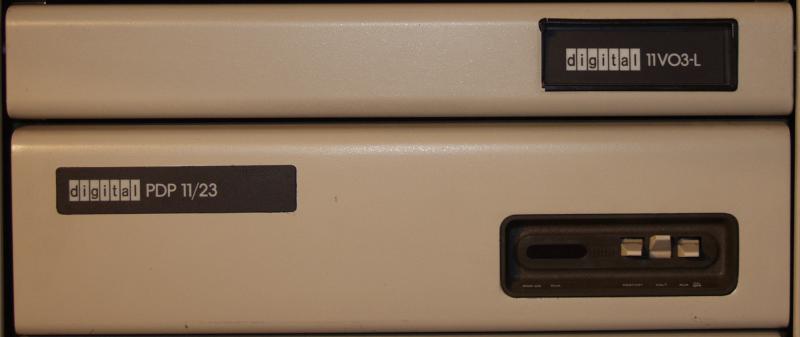
Nice find Joe. Somewhere in my container I have a 330 and a 380 and the
operating systems on 8" disk.
It probably won't be this year that I get to them though.
Paxton,
Astoria, OR
Also, I know that the "identify yourself" page is probably annoying, but
this
was my tracking mechanism for keeping track of my buddies using the web
site.
----- Original Message -----
From: "Ashley Carder" <wacarder(a)usit.net>
To: "General Discussion: On-Topic and Off-Topic Posts"
<cctalk(a)classiccmp.org>
Sent: Wednesday, September 15, 2004 1:18 PM
Subject: Re: rewriting legacy OS for new iron
> I see that my www.woffordwitch.com site is getting a little traffic today.
> Can you folks let me know if you have any difficulty with the site, or any
> problems with pages rendering properly? I think that it's only been
> tested using Internet Explorer on Windows, so this will be a good
> shakedown with the variety of operating systems and browsers that
> are used by the group here. I suppose I should update the site to
> include some info on the *REAL* PDP-11 installation. I haven't made
> any site updates since I moved the system from the simh simulator to
> the real hardware.
>
> Thanks,
> Ashley
>
> ----- Original Message -----
> From: "Ashley Carder" <wacarder(a)usit.net>
> To: "General Discussion: On-Topic and Off-Topic Posts"
> <cctalk(a)classiccmp.org>
> Sent: Wednesday, September 15, 2004 12:25 AM
> Subject: RE: rewriting legacy OS for new iron
>
>
> > > -----Original Message-----
> > > From: cctalk-bounces(a)classiccmp.org
> > > [mailto:cctalk-bounces@classiccmp.org]On Behalf Of Vintage Computer
> > > Festival
> > > Sent: Wednesday, September 15, 2004 12:08 AM
> > > To: General Discussion: On-Topic and Off-Topic Posts
> > > Subject: RE: rewriting legacy OS for new iron
> > >
> > >
> > > On Tue, 14 Sep 2004, Ashley Carder wrote:
> > >
> > > > I have a RSTS/E system on the internet running under simh. It's
late
> > > > 1970s vintage, RSTS/E V7. Do you have a preference of an account
> > > > number that you would like me to set up for you? (no, don't ask for
a
> > > > privileged account yet!) Mine is a recreation of the Wofford
College
> > > > system of 1977-79. For more info, go to
http://www.woffordwitch.com.
> > > > I also have this system SYSGENed on RL02 packs and running on a real
> > > > PDP-11/34.
> > >
> > > Ashley,
> > >
> > > That is a very cool website!
> >
> > Thanks. It was originally put together just for my old college buddies
> > and retired professor, but I'll share it with the rest of you folks. I
> > need to update it to include some info and pictures of my real PDP-11
> > computer center that is now growing and coming along quite nicely.
> >
> > Ashley
> >
> > > --
> > >
> > > Sellam Ismail Vintage
> > > Computer Festival
> > > ------------------------------------------------------------------
> > > ------------
> > > International Man of Intrigue and Danger
> > > http://www.vintage.org
> > >
> > > [ Old computing resources for business || Buy/Sell/Trade Vintage
> > > Computers ]
> > > [ and academia at www.VintageTech.com || at
> > > http://marketplace.vintage.org ]
> > >
> > >
> >
>
I remember a file that can be put in the user's login directory that is
run as a part of the login,
like LOGIN.COM in a vax or the .profile under unix. What is the name
of the file?
On Sep 16 2004, 21:22, David Betz wrote:
> Thanks everyone for your advice on using a KDJ11-B in a PDP-11/23.
> Unfortunately, I lost (by a mile!) the eBay auction where I was
bidding
> on the KDJ11-B so I guess I won't be doing this upgrade anytime soon.
> Would it be better to look for a KDJ11-A instead?
Maybe. It doesn't have the on-board SLUs, LTC, or bootstrap, of
course, so you'll need some other serial port for your console (as you
have at present, on your MXV11) and bootstrap (ditto). You'd also need
a line time clock signal for some OSs (RT-11 won't mind but others
will).
> I assume that would
> work as-is with my backplane. Would I need a new bootstrap though?
I'm
> currently using a MXV11 (M8047-CA) to boot an RX02 drive. Will that
> work with the KDJ11-A CPU?
It'll work fine, but you might want a different bootstrap, for which
that MXV11-A won't really do. None of the standard KDJ11 bootstraps
will fit (the ROM space on it is too small, and the mapping is wrong)
and the memory is only 18-bit. You can disable the memory, and/or the
bootstrap, but that doesn't leave much!
If you could find an MXV11-B (M7195) instead, that would do nicely, but
you don't actually need one.
--
Pete Peter Turnbull
Network Manager
University of York
"For those who own Atari TT030 workstations, I have finally gotten a
hard
disk with Atari's version of Unix System V on it running along with a
diskette with setboot.prg utility that sets the nvram in the TT030's to
recognize and boot from the Unix Hard Disk.
If anyone is interested, I can make ghost images of the 300MB SCSI hard
disk
for you. One word of caution, according the Atari engineer who wrote
Atari
Unix, it does not work on all TT030's. Some of the units had bugs and
issues, most came back into Atari's service center where the -33 68030's
were replaced with slower 16mhz CPU's, so while I will guarantee that
the
image works, I cannot guarantee if your TT will have a problem or not.
So
far I've tried it out with 3 TT's and they all work. Also Atari Unix
will
recognize Riebl VME ethernet cards and set them as /dev/en0 so you can
hook
the TT up to the internet directly. I personally am going to see if I
can
get Apache to work on the TT as it would be great to run a website for
Atari's on an actual Atari computer.
If you want a copy, I need a 300mb SCSI HD to Ghost the image to and
you pay
shipping to and from me.
Curt
"
Hi
my friend and i have been looking for this for a while...
is there a way to create a ghost image that is downloadable?
this way we can ghost it into our own drive ourselves?
there are two tt's we are trying to get going...
thanks for any info
- luke
Just what the subject line says... I'm looking for the smallest possible
(working) PS/2-style keyboard that exists... all the junk at my local CompUSA
is either USB, or has function keys and trackballs and infrared, etc.... I
don't want any of that stuff.
Can anyone help me?
- Evan K.
I've found a tan LSI AMD3A+ OEM'd by Zilog (has the Zilog name/logo on the
front faceplate). Never seen one of these before. What did it go to? Any
info?
__________________________________
Do you Yahoo!?
New and Improved Yahoo! Mail - 100MB free storage!
http://promotions.yahoo.com/new_mail
Did you have any luck in getting this running ??
As the article made it sound like you were shooting for an Apple did you
happen to have the DEC card with it ??
I'm siting on one waiting for the M843 card.
Hi Chandra!
I have a "newer" model CompuColor II, the style that has the monitor
and keyboard in the same case.
Yes, the screen buffer was used during floppy I/O! The floppies held a
whopping 40K per diskette. However there is
*NO* truth to the rumor that the CCII is so old that the disk drive
uses a hand crank (grin).
I have the original manual, a third-party user's guide. I also have the
ROM listings for 1978 and 1979 ROMs. I may be a bit
off with the years, but it has been a while and my memory has faded.
If there is something you need me to look up, let me know. The books
and ROM listings are too big to easily photocopy, sorry!
--- John Bell
These machines have a peculiar (to me) memory format, it's not really
obvious, so I worked it out and wrote it up here
http://wps.com/projects/LGP-21/Documentation/arithmetic.html
simh adds to the confusion, somewhat, because it displays memory by
default in "normal" mode. e -m address does the right thing for
instructions, but it's missing a -option to display numerical data; for
example a "2" stored in LGP memory shows as "4" in simh because of the
spacer bit.
Memory is 31 bits wide, the accumulator is 32 bits...
On Sep 16 2004, 12:39, David Betz wrote:
> I have a PDP-11/23 with an H9270 backplane and am thinking of
upgrading
> to a J11 processor. I would like to use the KDJ11-B quad size board
> (M8190-YB). Is that going to require me to use a different backplane?
Yes.
> If so, is there one that will fit in the same space as the H9270
No.
> and use the same power supply?
Yes.
The H9270 is a serpentine backplane, with QBus on A+B slots and also on
C+D. The quad KDJ11s use C+D for other things (PMI memory, mainly) so
you can't put them in a serpentine backplane slot; they have to go in
one that has straight QBus on A+B and the CD interconnect on C+D.
The only standard DEC 4 x 4 backplane is that H9270, though some of the
Plessey or other third-party backplanes might be the right size.
Either you need to modify that backplane to isolate the C and D part
of the first slot (and then jumper the QBus signals to the C and D
parts of the next slot -- one way to achieve this might be to just
remove the connectors), or you need to modify (with a saw!) some other
backplane to fit, or you need a different chassis, or you need a
KDJ11-A (dual height). If you only need 4 slots you might be able to
adapt an H9281-A, which is 2 x 4, to fit.
The PSU should do (providing you don't exceed the current ratings) -- I
assume it's an H780? Is it in an BA11-M chassis? If so, it's
originally been a PDP-11/03, and someone has upgraded it.
The other thing is that the H9270 is only 18-bit (as are the H9281-x
series, unless they have a "Q" in the part number). That in itself
shouldn't stop a 22-bit processor working (your 11/23 is 22-bit) but it
wouldn't be able to use more than 256KB (128K words) of adddress space.
It would behave as if the top 4 address bits were always 0. You could
upgrade it to 22-bit by jumpering BC1, BD1, BE1, BF1 from each slot to
the next. If you do that, check what you're using for termination --
it's probably only 18-bit as well (if it's a BDV11, there's a fairly
easy FCO for it).
The normal backplanes for a KDJ11-B are H9276 (22-bit, 4 x 8, straight)
which is used in a BA11-S; H9278 (22-bit, 4 x 8, first 3 slots
straight, rest serpentine) which is in a BA23; BA123 backplane (22-bit,
4 x 13, first 4 straight, next 8 serpentine, and the last slot is
power-only) which doesn't have an "H" number. However, BA11-N systems
with an H9273 backplane were sometimes field-upgraded and may or may
not have had the extra four address lines wired.
--
Pete Peter Turnbull
Network Manager
University of York
>From: ard(a)p850ug1.demon.co.uk
>
>This is a really trivial question, but I wasn't really a BBC micro hacker
>in the old days,
>
>I am planning some upgrdes to a BBC Model B+ (the fact that this
>particular B+ lives in the bottom of an Acorn Cambridge shouldn't
>matter...). One of them is to combine some of the ROMs (the B+ can take
>27256 32K byte EPROMs), thus freeing up some ROM sockets and put a RAM
>chip in one of them. I then have to fiddle the write-enable line [1] (should
>be easy) and I have 32K of sideways RAM.
>
>The hardware doens't worry me (I have schematics...). But how do I load a
>ROM image into the sideways RAM? Is there some loader program I need (and
>where do I get it)? Anything I should know about the image file on disk
>(anything about the start/end/entry addreeses in the direxctory, for
>example)?
Hi Tony
It depends on the form of the image. There are no standards for these
things. One can create wave files to send audio as though there
were a cassette player. I've been involved in creating a number of
methods to bootstrap old computers. Having a built in cassette load
is something that I've not tried. Most cases, I have access to a
monitor program on the target machine and I'm able to enter a small
bootstrapping program.
In most cases, information about load/end and start address are
missing from many images. One is suppose to know this to use the image.
Often doing some disassembly of the image can recover information
as to where in memory it should exist. Most programs start at the
beginning but not all.
What kinds of images are we talking about? Are these machine language,
BASIC text or something?
Of course, I'm not familiar with the term sideways RAM. Do you mean
shadow RAM or just parallel RAM? Could you explain a little?
I would guess that you may have to write your own loader. At the
simplest, it is rarely more than a few lines of code.
>
>
>[1] I believe it's a good idea to be able to write-protect the sideways
>RAM, but I don't want to drill holes in my Cambridge. Has anoyne ever
>used the cassette motor line for this? Seems like an obvious thing to use.
This makes sense. Also look for a unused data port bits on I/O chips.
Most of these smaller machines had unused port bits someplace. These
usually had a default value written to them by the machines code
so that you could use the opposite value as a write enable.
Dwight
>
>-tony
>
>
Hello, all:
OK, here's where my lack of intimate knowledge of C shows. I'm
working on a graphics board add-in for the Altair32 Emulator. I have 16 of
the following declarations, one for each color supported by the board:
const COLORREF colGray = RGB(128,128,128) ; // 8
The RGB macro converts an RGB color value to a different datatype (a
DWORD) for use with various Windows APIs, such as the one I'm using to draw
color boxes. The colors are in order per the video board docs, so I create
an array of COLORREFs:
static COLORREF colColors[] = {colGray, colMaroon, colNavy,
colPurple,
colGreen, colOlive, colTeal,
colSilver,
colBlack, colRed, colBlue,
colMagenta,
colLime, colYellow, colCyan,
colWhite} ;
This array is used with a nybble from system memory to create the
drawing brush for the FillRect call:
firstbyte = HINYBBLE(screenbyte) ;
hbr=(HBRUSH)CreateSolidBrush(colColors[firstbyte]) ;
FillRect(hdc, &rc, hbr) ; // hdc and rc declared earlier
Now, here's the problem. I get compiler error C2099 on the
declaration of colColors. C2099 translates to "initializer is not a
constant". I'm sure that the solution is something obvious to the
trained eye, but I'm not seeing it. Can someone identify what I'm missing?
Thanks.
Rich
Rich Cini
Collector of classic computers
Build Master for the Altair32 Emulation Project
Web site: http://highgate.comm.sfu.ca/~rcini/classiccmp/
/************************************************************/
On Sep 5 2004, 22:37, Wai-Sun Chia wrote:
> Check these out then:
>
> BA11-M (11/03) DEC/PDP logo in glorious DEC maroon:
> http://hampage.hu/pdp-11/kepek/pdp1103.jpg
That doesn't look original to me.
> BA11-S (11/23) DEC/PDP logo in a either a darkgrey or VT100 brown
> background and DEC bricks and PDP font in white:
> http://www.shiresoft.com/pdp-11/11-23/11-23-front-panel.jpg
That's simply the result of a colour cast in a badly lit/badly exposed
photo, probably taken under tungsten lighting. It looks just like mine
except for the cast; mine is plain DEC grey with a black and white
sticker.
> BA11-S (11/23PLUS) same as above:
> http://hampage.hu/pdp-11/kepek/1123PLUS.JPG
Where's the colour in that? It's a standard 11T23 system, identical to
the one in the next room to me -- and I can assure you that the only
colour is the yellow and red on the RL02 lamps.
> I love the one in DEC maroon background! :-)
I think someone has adulterated it. I'm sure that's not original.
--
Pete Peter Turnbull
Network Manager
University of York
Well I guess the hurricane gods don't like Intel computers (or DECs!).
I left plenty of them outside through THREE hurricanes now and they didn't
take a single one of them. And now they're leaving Intels for me! Melbourne
got CLOBBERED by Frances. They've been completely shutdown and didn't even
get power back until last night. However today I went went down there and
found SEVEN Intel 86/330 computers! I found five of these in the same area
a couple of years ago but they were missing the hard drive and there was no
hope of finding the OS for them so I eventually scrapped them for the
boards and 8" FDs. However these are complete including the hard drives.
They even have the IO cables rolled up and stuck inside to them and they
have intel Multibus BUBBLE memory boards. Wahoo!
Joe
How about dd'ing it to a file, transferring it to another computer and
pressing a CD?
>From: luke <etyrnal(a)ameritech.net>
>Reply-To: "General Discussion: On-Topic and Off-Topic
>Posts"<cctalk(a)classiccmp.org>
>To: cctech(a)classiccmp.org
>Subject: Atari Unix
>Date: Sat, 11 Sep 2004 22:48:34 -0500
>
>"For those who own Atari TT030 workstations, I have finally gotten a hard
>disk with Atari's version of Unix System V on it running along with a
>diskette with setboot.prg utility that sets the nvram in the TT030's to
>recognize and boot from the Unix Hard Disk.
>
>If anyone is interested, I can make ghost images of the 300MB SCSI hard
>disk
>for you. One word of caution, according the Atari engineer who wrote
>Atari
>Unix, it does not work on all TT030's. Some of the units had bugs and
>issues, most came back into Atari's service center where the -33 68030's
>were replaced with slower 16mhz CPU's, so while I will guarantee that the
>image works, I cannot guarantee if your TT will have a problem or not. So
>far I've tried it out with 3 TT's and they all work. Also Atari Unix will
>recognize Riebl VME ethernet cards and set them as /dev/en0 so you can hook
>the TT up to the internet directly. I personally am going to see if I can
>get Apache to work on the TT as it would be great to run a website for
>Atari's on an actual Atari computer.
>
>If you want a copy, I need a 300mb SCSI HD to Ghost the image to and you
>pay
>shipping to and from me.
>
>
>Curt
>"
>
>Hi
>
>my friend and i have been looking for this for a while...
>
>is there a way to create a ghost image that is downloadable?
>
>this way we can ghost it into our own drive ourselves?
>
>there are two tt's we are trying to get going...
>
>thanks for any info
>
>- luke
>
_________________________________________________________________
Get ready for school! Find articles, homework help and more in the Back to
School Guide! http://special.msn.com/network/04backtoschool.armx
Hey, I just realized, I have (here at work) an old HP 1650B, with 96 (!)
channels, I think it is, too many to count ("one... two... three... ...
many!") but certainly >> 48.
It claims to be dig-it-all (but we know what that means) and has a
variable threshold (and I'd need level changers to deal with -20V logic,
or wherever I pick off the signal).
I don't have an operating manual, though I've puzzled out basic
operation, but does anyone know how to extract sampled data from this
thing?
Here's a hypothesis: the sniggle I'll get off the heads will be the same
as, or less than, the specified (in the hardw. man.) signal. The voltage
won't increase off the head!
If true, I set the 1650B thresholds such that it mimics the LGP-21's
memory. Take N samples of the disk (all at once!). Check that each
sample is self-consistent, eg. every sample is the same.
If subsequent samples are not all the same, see what's changing. If one
or few bits/track are flapping, it could be setup or weak signal.
Repeat taking sample sets, with the 1650B thresh lowered 2 - 5%, say. At
some point the differences between sets should radically alter.
(I would in fact take a few sample sets with threshold > LGP's setting,
for completeness.)
In an ideal setup, each sample within a set would be self-consistent,
and each sample set (with varying threshold) would be the same until the
thresh crosses into the ambigious zone between LGP-21 "0" and "1", at
which point it would deteriorate into garbage.
The LGP-21 hardw. man. comes not only with complete memory alignment
data and techniques, but photos of scope screens. Too bad all machines
don't come with their own historical recovery documentation!
If the 1650B can "print" to a port I can capture then this nicely
formatted data could be scripted into something canonical.
Back in March 2001 I posted about a cache of 20,046 pages
of scanned docs I received from someone on the net.
See the TOC below, followed by his explanation of how
he did it.
It consumed several CD-Rs, compressed. I now have a DVD burner
as well, so I'd be glad to make copies on new or old media.
(It is actually all available on a hidden web page that
I disclose if someone sends me a pointed email, but I'd
hate to stress my little T-1.)
Anyone care to upgrade it to OCR'd PDF or whatever would be
considered a next-best method of preservation and search-ability?
I know it's possible with a handful of Linux, but my to-do list
is already too long.
- John
I've made contact with a guy who's scanned 20,046 pages of the
docs listed below, at 300 to 400 DPI. He first told me about the
UCSD p-System docs he'd scanned. Below the list is his description
of the process he followed.
I'm planning to get a copy of what he has and burn it to CD-R.
Does anyone else have an interest in these docs, or have any
ideas about distribution without massive copyright violation?
- John
6502
MOS 6502 datasheet
6502 Assembly Language Subroutines (Leventhal)
AMD
AMD 29000 Memory Design Handbook
Am29027 Arithmetic Accelerator
Am29C327 Floating Point Processor
Data General
C Language Reference Manual
GATE User's Manual
AOS/VS Internals Manual
AOS/VS Programmer's Manual, volume 1
AOS/VS System Calls Dictionary
CEO User's Manual
Eclipse 32-bit Principles of Operation
Eclipse 32-bit System Functional Characteristics
Fortran-77 Environment Manual
Fortran-77 Reference Manual
Fairchild
Clipper User's Manual
IDT
RISC System Programmer's Guide
R3000 Assembly Language Programmer's Guide
R3000 Hardware User Manuals
R3000 Language Programmer's Guide
High-speed CMOS databook
Motorola
68000 Family Reference
68020 User's Manual
68851 User's Manual
88100 User's Manual
88200 User's Manual
Linear Interface Integrated Circuits
NCR
53C90A/B Advanced SCSI Controller (2 different manuals)
53C94/5/6 databook
53CF94/96-2 Fast SCSI Controller
Disk Array Controller Firmware
Disk Array Controller Hardware
Disk Array Controller Software
Floppy Disk Controller (SCSI-to-FD)
National Semiconductor
NS32532 Datasheet
Series 32000 Programmer's Reference Manual
DP8490 Enhanced Asynchronous SCSI Interface
NS32CG16 Programmer's Reference Supplement
Graphics Handbook
Series 32000 Databook
DRAM Management databook
Embedded Controller Databook
Ohio Scientific
C4P User's Manual (2 different manuals)
65V Programmer's manual
Schematics for:
502 CPU board
505 CPU board
527 24K memory board
540 Video board
542 Polled Keyboard
Pinnacle Systems
2 User's manuals for their 68k machine (My P-system machine)
P-system manuals IV.12
Operating System Reference
Program Development Reference
Application Development Guide
Fortran 77 Reference
Assembler Reference
Weitek
WTL4167 Floating-Point Coprocessor datasheet
Most of these are from about 1988 to 1992, with the exception of the OSI
documentation, of course, which is from 1979.
---
> What sort of process did you follow? What sort of devices?
As far as the process, I scanned a manual in and checked to make sure
all the pages were there. If they weren't, I'd scan the pages that
didn't make it, and go through all the pages again. I'll admit this is a
little anal, but better safe than sorry. (When you're using a lot of
shell scripts, you never know if you accidently deleted a page with an
"mv" command.) When all the pages where there, I'd go through the manual
one more time to check for general quality (no folded corners, no torn
pages, etc.) If all was good, the manual would be moved to the directory
that would be the root directory of my CD-ROM. That's pretty much it.
The big manuals of more than 1000 pages really sucked, because I'd
generally have to make 3 or more passes to get those completely correct.
If I was going to do it again, I'd probably break the larger manuals
into smaller chunks to avoid this problem.
One thing that made the whole process a lot easier was the netpbm
utilities. I wrote a script to convert the manuals from ~2500x3300 TIFs
to ~500x600 GIFs. My machine takes about 2 seconds to process a 300-400
DPI TIF, but only a fraction of a second for a 75 DPI GIF. I'd run my
script, then do something else for a while. When it was done, I could
flip through the GIFs with GQview and inspect about 2-4 pages per
second. That saved a lot of time.
I assume that, by "devices", you mean what type of scanners I used. I
started with an HP 6350cse (with ADF) that I bought for this very
purpose. However, having never owned a scanner before, I was a little
disappointed with how slow the "fast" scanners are. Fortunately, imaging
is an integral part of the software my company sells and, as luck would
have it, we were demoing a new scanner from Fujitsu. This thing
literally does 60 pages/min at 300 dpi - *both* sides. It's about half
that fast at 400 dpi, which I had to use for the IC databooks to get the
fine print. Needless to say, I did most of my scanning on that.
By the way, to date, I've processed 20046 pages. I'm kinda burned out,
though, so it'll be a while before I do any more.
I have a PDP-11/23 with an H9270 backplane and am thinking of upgrading
to a J11 processor. I would like to use the KDJ11-B quad size board
(M8190-YB). Is that going to require me to use a different backplane?
If so, is there one that will fit in the same space as the H9270 and
use the same power supply?
>From: Innfogra(a)aol.com
>
>I think it is important to report all Fraud to the internet providors.
Hi
I get maybe 4 to 6 of these offers a week. It'd take a while to
track down the real provider and send them the info.
>
>Paxton
>Astoria
>
>PS I was concerned that I got two fraud offers directly related to my posting
>of the HP110 on the HP Museum Classified ads. It shows that thre are many
>people out there trolling collectable computer and calculator sales with the
>intent to defraud.
>
They track any place that sells things, any place. There
is nothing special about your adds compare to anyone else's.
They are just looking for fresh territory. Hoping that that
particular group is not yet wise to the scams. The smaller the
market group the better their chances.
Dwight
Hi Guys,
I recently acquired a PET 8032 which has a couple of interesting
add-on's ...
1) MICROTECH PETDISK II
This is an 8" disk system for the PET! - the controller card installs
in the "edit" ROM socket (the EDIT ROM moves to the card), it also has
it's own ROM, and is "hotwired" into several other PET signals via
"flying leads"...
I don't have any documentation for this system other than a single
handwritten sheet which shows the connections (they match the way it's
installed), an address of 59904 to start the system (this works)
and a few commands such as !SYS to get a menu, and !LIST to display
the directory (these also work).
The two original MICROTECH diskettes both exhibit disk errors - looking
at them, it appeasr that they have both sat in the continuously running
8" drive long enough to wear visible groves at track 0 (really visible).
I did find two other "backup" disks, which boot (SYS 59904) and enable
the above commands.
Lots of details I have not been able to figure out - can anyone provide
more information on this disk system? Anyone have documentation?
2) Madison Computer Z-RAM
This one I have full docs for - it's a Z-80 / expansion RAM board which
fits under the monitor and connects to the PET via the 6502 socket (the
6502 moves to the Z-RAM board).
What I don't have is any software for it - it apparently runs CP/M, and
should have come with a double sided CP/M disk (one side for 2031&4040,
one side for 8050 drive) ...
Anyone got the software or other material for this board?
++ Among the 8" diskettes that came with the machine are some which are
labled as CP/M format - and I can't read a sensible directory using the
PETDISK software - Perhaps someone ported CP/M to the PETDISK II / ZRAM
combination? - If so, any idea how I would boot it? - anyone have this
particular combination operating?
You can see pictures of the machine and these devices on my site (just
updated this afternoon).
Regards,
Dave
--
dave04a (at) Dave Dunfield
dunfield (dot) Firmware development services & tools: www.dunfield.com
com Vintage computing equipment collector.
http://www.parse.com/~ddunfield/museum/index.html
At a recent hamfest I picked up two volumes of
Digital Equipment Corporation's Consultant's Reference
Guide.
I now have Volumes 1 and 2 ("Organization and Policies"
and "Products and Services"), however the index indicates
that there are several more volumes.
Does anyone have a full set of these?
By the way, Volume 1 has a section with DEC's history,
"DEC Nineteen Fifty-Seven to the Present"
which runs 88 pages and covers up through 1977.
Interesting reading and some nice photos.
Cheers,
Dan
No sooner had the discussion on the cashier's check scam ended than I
received not one but two fraud attempts from these numbskulls in Nigeria.
The latest is this one, which is stunning in its hilarity:
Hello sales,
I am highly interest in purchase the product in your store listed
below
Level 01: VCF Pin & T-shirt ............................1000pices
then i will liKe you to calculate the total cost of the goods with
handling
via ups 3-5days express shipment so that i can send you my cheque account
and
ship to the above adress
11 oshifuye street off
palmavenue road
mushin
olorunshogo
lagos 23401
nigeria
Looking forawrd to hear from you soonest
Best Regard
STEVE
--
This guy wants to order 1000 donations to the VCF. He must be some
overachiever in Fraud 101 trying to impress his instructor or something.
Anyway, I'm already stringing along the first guy, but this is going to
become a regular thing I don't have time for it.
Any ideas?
--
Sellam Ismail Vintage Computer Festival
------------------------------------------------------------------------------
International Man of Intrigue and Danger http://www.vintage.org
[ Old computing resources for business || Buy/Sell/Trade Vintage Computers ]
[ and academia at www.VintageTech.com || at http://marketplace.vintage.org ]
>From: ard(a)p850ug1.demon.co.uk
>
>>
>> Jack,
>>
>> Thanks for the info on the power cords. I looked up the two cords and they
>> both look very close. I will contact Newark on Monday to verify the
distance
>> between pins. The 17952 has a note that states it is made with non-standard
>> polarization. Do you or anyone else on cctech know how I can tell if it's
>> the correct polarity for the Intellec? The 17280's notes state that the
>> polarity is as mandated by CSA electrical bulletin 895b. Anyone know what
that
>> means? I'd hate to plug in the cord and fry my machine.
>
>I think this has to do with which of the outside pins is live ('hot') and
>which is neutral. Getting it wrong won't fry the machine, but it might
>fry you if there's an electrical fault (the fuse should always be in the
>live side of the mains, as should any single-pole switches).
>
>What you need to do is open up the Intellec and see which pin on the
>chassis-mounted mains plug goes to the fuseholder. I think the switch
>comes after the fuse in these machines, but my Intellec, an MCS8i, is
>non-standard in that I replaced the input connector with a IEC 'kettle
>plug' type of connector, and also I have a non-standard power switch
>(replaced by a previous owner).
>
>Then you need to see which of the 2 available cables puts the fuse on the
>live side.
>
>-tony
>
Hi
When you check this, also check to see that ur wall socket is
wired correctly. You'd be surprised how many are not right.
Dwight
Anyone here got a spare laptop hard drive (2-4GB) and / or a pair of
16MB 72-Pin Laptop DIMMs they might be willing to sell or trade away?
I have an old TI Extensa 450 that I've been tinkering with, set up with
both Damn Small Linux and Doss 6.22/WfW 3.11. Since she is dual boot,
drive space is getting pretty tight (540MB hard drive, with 150MB of
that dedicated to DOS, 64MB for the Linux swap partition, and the rest
a single Linux ext2 partition). I really need to get a larger hard
drive. I tend to avoid shopping eBay for computer parts, primarily
because most sellers for this stuff like to severely gouge on shipping.
And, I have not been able to find what I need locally.
As for the RAM, I definitely need a pair of 72-Pin 16MB laptop DIMMs,
which would max out the system's memory. She currently only has 12MB,
in the form of an 8MB and a 4MB DIMM.
So, if anyone has any of these items available for a reasonable price,
please send an email my way. I am also willing to do some trading
instead. Currently, I have available for trade, a Databook PCMCIA card
reader. It has 2 16 Bit card slots, fits in a 3.5" drive bay, and
comes with its 16-Bit ISA controller card and controller cable. I know
I can probably dig up other old computer bits to trade off as well. I
can also trade a couple of Google GMail invites.
Hello guys,
it's been a while I told you about this lovely machine.
Someone told me to backup the contents of the PROMs and EPROMs: that's done.
The capstan roller of the DEI - streamer is fixed (I changed it), the power supply is in working condition, the voltages are fine.
Now the bad news:
The IMI 7020 hard drive is dead and cannot be fixed:
The damn coil of the motor causes a short circuit :(
That's why the power supply turns off when the disk drive is attached...
Even if somebody had a replacement motor (24V) , who could probably ajust the platters and the heads to find track 0 ??
I've never seen another IMI drive, they seem pretty special, with their connectors and all.
Ok, anyway, I'll concentrate in bringing the machine back to life without a hard drive but I haven't been very lucky yet.
Al asked me to scan in the boards, but my scanner (low cost, low end) has problems with depth perception, you can barely see something on the images.
I'll have to find another scanner which can do the job.
So far, nothing appears on the console terminal when turning the machine on.
The voltages on the test points have been checked, there're ok. sometimes, the 5V voltage test point "shows" 4.2 V on the board this the terminal connectors but this semms to be a problem of conductivity.
An important question:
The (10 or something) SRAM-modules on the CPU-board which are Motorola MCM2125AC-70 chips
reach a high temperature. 15 minutes after turning on the machine, the measured temperature comes to 50 ?C (122?F), the chips been supplied with typical 5V (measured).
Is this normal ? It's a bit to high, isn't it ?
By the way: Last time, I had the wrong model number in mind: C8002. Actually, it's a C8000, sorry for that.
Sincerely yours !
Pierre
________________________________________________________________
Verschicken Sie romantische, coole und witzige Bilder per SMS!
Jetzt neu bei WEB.DE FreeMail: http://freemail.web.de/?mc=021193
Hi Guys,
Continuing to play with PET's ...
So far, all the PET 8032s I've seen (including my SuperPET) use a board which is
identical to the 4032 board, except that the 4032 has some buffers and RAM unpopulated
(the locations are there), has the jumpers by the video circuitry set differently,
and has a different EDIT ROM - I assume this is the "universal" board that they talk
about on funet.
I recently was given a dead 8032 board (which I have fixed - bad 7805 and also a bad
2114 video RAM - ***another one***).
This board is different - it does not have the jumpers near the video circuitry, and
the monitor connection is located near the keyboard connector (on the other board the
monitor connection is near the edge at the front of the machine). Since there are no
jumpers, this board does not appear to be usable at 40 columns.
Another odd thing about this board, is that all DRAMs, ROMs, and 40 pin 65xx chips
are factory socketed - my other boards had only EDIT rom and 6502 socketed (a few
more have been since I repaired them). Aside from the sockets, lack of jumpers and
moved video connector, it looks nearly identical to the other board.
What board is this? Is this the "early 8032" board that is mentioned on funet?
Both boards say "Copyright 1080".
Is it electrically different from a "universal" board that is configured for 80
columns?
Regards,
Dave--
dave04a (at) Dave Dunfield
dunfield (dot) Firmware development services & tools: www.dunfield.com
com Vintage computing equipment collector.
http://www.parse.com/~ddunfield/museum/index.html
Hello,
I've got an old HP system that I rescued from ebay. I've asked in
german newsgroups but that and googling did turn up next to nothing.
It's a beige machine of the stackable kind and I think I've seen
Series 300 machines with Motorola CPUs in a similar enclosure.
What I've got along with some HP-IB cables and a 700/92 HP terminal
is:
* 7957 Harddisk. This spins up and the light on the front turns
green.
* 9144 Tape Drive. I get some status codes on the display on the
back but as long as I don't get the system up that doesn't matter
very much I guess.
* The main unit is labelled "HP Series 40 260" on the front. It
seems to have a 5 slot backplane of some kind. 2 Slots ar occupied
by the mainboard which has little else than two serial connectors.
Then there is a HP-IB interface and a serial card with 3 "normal"
ports and a fourth that looks somewhat like the DIN headphone
connectors on audio equipment. The uppermost (fifth) slot is
empty. There is a small info card in the back that informs me that
the system is model "45072A".
So what is this? Is this a "260" as in "successor to the 250"? The
first followup question to that would be asking what the appropriate
terminal settings are for connecting to that iron. I do get something
on "PORT-1" of the main logic board, but no setting (from 9600 8N1 to
obscure guesses as 1200 6N2) nothing yields useable results.
Gerhard
> >The IMI 7020 hard drive is dead and cannot be fixed:
> >The damn coil of the motor causes a short circuit :(
>
> I'm sure you checked, but possibly could it be motor braking electronics or
> the good old reversed diode across the windings that have shorted, and not
> the motor coil itself?
This reversed diode sits on a small PCB outside the motor.
I disconnected it, having the two wires of the 24V DC Motor in my hands.
There's almost no measurable resistor between these wires... this leads me to the assumption that the coil produces a short circuit.
Connecting the motor wires directly to the 24V connectors of the power supply leads to a shutdown when beeing turned on.
I've got lots of hard drives (approx. 350) in any size and age you can imagine but I've never seen one with a dead motor which causes a short circuit.
It's quite rare, isn't it ?
Pierre
_________________________________________________________
Mit WEB.DE FreePhone? mit h?chster Qualit?t ab 0 Ct./Min.
weltweit telefonieren! http://freephone.web.de/?mc=021201
I just saw a Sept. 1 post on FuckedCompany.com:
>>> Rumor has it after 17 years of making video games, Acclaim just filed
Chapter 7 bankruptcy and laid off all 600 employees. <<<
- Evan K.
I have a two disk set (5 1/4" floppies) of "The Deluxe Computer Edition
SCRABBLE" these are originals, not copies. I don't know if they are
good or not. I don't even have a working 5 1/4" floppy to test them on.
But for postage they go to the first one who wants them. ($3.58 will
cover Priority Mail anywhere in the lower 48)
Jack,
Thanks for the info on the power cords. I looked up the two cords and they
both look very close. I will contact Newark on Monday to verify the distance
between pins. The 17952 has a note that states it is made with non-standard
polarization. Do you or anyone else on cctech know how I can tell if it's
the correct polarity for the Intellec? The 17280's notes state that the
polarity is as mandated by CSA electrical bulletin 895b. Anyone know what that
means? I'd hate to plug in the cord and fry my machine.
Thanks,
Jeff
Which Tarbell Controller?
There were 4 revisions of the single density board, A thru D, and way too
many revisions of the double density board (A thru H, but A thru D did not
work reliably; the revision "E" board was really the first version of the
double density board that was reliable). The single density Tarbell board
was a mess, it wasn't much more than a disk controller "prototype" board,
you basically had to jumper-wire the entire board yourself by hand based on
the type of drives that you had, it is just awful (typically, you ended up
installing something like 50 jumper wires). HOWEVER, if you got the board
jumpered right (and, of course, if the parts were all good and if it was
assembled right), it actually worked really well. The double density boards
ran way to hot, the voltage regulator was way over-stressed, and I always
put a low-value 2-watt resistor across the voltage regulator on the back of
the board (something like 10 ohms) to relieve a bit of the stress on the
regulator.
The single density board was an "early" item, before the drive interfaces
became relatively standard. Because of the jumper options, it could be
modified to take ANY drive.
The double density board basically requires either a Shugart type drive (or
one very compatible with it), or a Persci drive. There were only a
relatively few jumper options.
Manuals for both boards are on Howard's site.
--- cc(a)w140.com wrote:
> Date: Wed, 15 Sep 2004 11:03:51 -0400 (EDT)
> From: cc(a)w140.com
> To: undisclosed-recipients:;
> Subject: pdp-11 hardware and documentation - free
>
> Dear World,
>
> We have here at CCNY some hardware and documentation
> for a DEC PDP-11/73
> system. If these pieces are not taken in the next
> day or two, they will
> be discarded. The documentation can wait a little
> longer.
>
> Items:
>
> - DEC RX-02 dual floppy drive
> - Grinnell GMR270 Image Processing System
> - Kennedy 9-track tape drive with Western Peripheral
> interface
>
> Please email me soon at cc(a)w140.com if you are
> interested. The items
> are free. CCNY is in /USA/NYC/Harlem. thanks,
> -kurt
>
> PS: I will be posting another message soon with a
> list of the manuals
> that we are giving away as well.
>
__________________________________
Do you Yahoo!?
New and Improved Yahoo! Mail - 100MB free storage!
http://promotions.yahoo.com/new_mail
Anyone care to give a thumbnail sketch of what sampling rates
would be necessary to digitize the signals on recording media
(3 1/2", 5 1/4", 8" floppy, hard disks, drums, disk packs, etc.)
at sufficient rates to preserve the encoding for post-processing
in other tools?
--
Paul Pierce is using this technique to recover data from 7 track
tape.
The only problem I see is people on this list underestimate the
costs involved in putting something together that works.
For the most part, analog level recovery isn't necessary. Modern
digital data separators will recover most media, which reduces the
data rates substantially.
http://www.piercefuller.com/collect/proj.html
In a message dated 9/15/04 10:46:24 AM Pacific Daylight Time,
rich_bramante(a)yahoo.com writes:
I've found a tan LSI AMD3A+ OEM'd by Zilog (has the Zilog name/logo on the
front faceplate). Never seen one of these before. What did it go to? Any
info?
Probably a Zilog Development system of the late 70s or early 80s. We got
several with Intel labels in the 90s in Portland. I think ADM OEM them to anyone
who wanted their own colors.
You might look in the EPROMs, they might be custom or not..... I don't think
the Intels were any different other than the color.
Paxton
Astoria, OR
Hello world,
I have two AIM-65 black plastic cases for give-away.
You pay shipping only. And also a Snickers bar.
Steve
located near Santa Ana CA.
__________________________________
Do you Yahoo!?
New and Improved Yahoo! Mail - 100MB free storage!
http://promotions.yahoo.com/new_mail
Today was a good day for me, I picked up 2 RK drives, a RK06 and a RK07.
The airfilter of the RK06 was changed in 2000, so it seems that this
drive has been in use not that long ago. The RK07 has a filter a little
older, but looks also clean (as are the drives internally).
Ed
--
edward(a)groenenberg.net | Collector of PDP-11's.
http://www.groenenberg.net | Politici zijn vieze oplichters.
Unix Lives! M$ Windows is crap.
'97 TL1000S
Specifically a print cylinder and a new pad for the print hammer. Does
anyone know of a source for these two items?
The pad on the print hammer has disintegrated and the underlying metal
has been pounding on the print cylinder. This has caused some of the
letters images to be deformed so that only the top half of the letter
prints. A new print cylinder would be virtually impossible to fabricate,
so I need to find a new or used one.
I can try to replace the pad with something I have, because I don't want
to damage the cylinder any more than it already is. What was the
original material: rubber, leather? Anyone tried this before?
Ribbons are still commonly available though, I bought one at Staples for
US$2.97 this afternoon.
-chuck
So, I gather it's some PDP 11/23 like thing. Are these worthwhile to
gather up?
--
I have the service manual on line. There are differing variants of processor
and disc (5" or 8")
Documentation and esp the diagnostic floppy would be a GOOD THING if
they could be found. The earlier 8550 and DOS50 on floppy would also
be useful.
Most of our displays here at the museum are pretty static.....
we are looking for ideas on introducing some interactive component... ideas
folks?
Thanks Ed Sharpe archivist for SMECC
Please check our web site at
http://www.smecc.org
to see other engineering fields, communications and computation stuff we
buy, and by all means when in Arizona drop in and see us.
address:
coury house / smecc
5802 w palmaire ave
glendale az 85301
Thomas> Tom, Will look but I don't think we have brakets, but I had a
Thomas> come question for you. Do you have an operating manual for
Thomas> the TU 10? Do you know where I might find one?
--
I have TU10 docs scanned. Will work on getting them up on bitsavers.
trying to find a home for the
following DEC bits:
DEC microPDP-11/23 (Fully working)
512 kWord memory, 2 x RX50 floppy, 1 x 40 MB hard disk
Boots RSX-11M, with full set of RSX-11M manuals
DEC Rainbow 100+ (Fully working)
512 kB RAM, 2 x RX50 floppy, 1 x 10 MB hard disk
(RAM & graphics expansion board fitted.)
DEC colour monitor, 2 keyboards.
Boots CP/M & MSDOS,
DEC VT240 terminal (Not working - reason unknown)
With manuals, keyboards & small green screen monitor
We are currently looking to dispose of these because we no longer have space
for them. If you know of anyone who may be interested in the kit AND is
prepared to arrange for collection from the North West of the United Kingdom
we would be glad to hear from them.
---
[This E-mail scanned for viruses by Declude Virus]
>What ever happened to asking people what software they need to run and
>recommending a platform that runs that software? A Mac laptop is a nice
>machine, unless you need to run something windows based. If you need to run
>Final Cut Pro don't get a DELL.
That should be the correct course of action.
I am a Mac Zealot, and I recommend PC's all the time. Why? Because people
come to me and say they want to get a computer for their kids to use for
school work, email, AIM, and games. As soon as they say games, I tell
them to get a Windows PC.
Then a year later, when they ask me what the best way is to deal with all
the popups, spyware, viri and other junk... I tell them to buy a Mac! :-)
-chris
<http://www.mythtech.net>
The following lead crossed my desk....
"Within the next month, I am going to decommission two PDP11s (11/23 Plus
and 11/84).... Are you interested in any of our hardware?"
If anyone is interested, please contact me off-list. The equipment is
apparently in the Franklin (minneapolis), Minnesota area.
---
[This E-mail scanned for viruses by Declude Virus]
Tom,
Will look but I don't think we have brakets, but I had a come question for
you. Do you have an operating manual for the TU 10? Do you know where I
might find one?
Thanks
Will let you know about the brackets.
Thomas D. Burford, PMP
Sandia National Laboratories
1515 Eubank Ave. MS 0634
Albuquerque, NM 87185-0634
Phone: 505 845-9893
Fax: 505 844-4797
Pager: 505 530-8261
Email: tdburfo(a)sandia.gov
>Games? I'd say buy a PS2 or gamecube.
>
>Or, to be a bit more classic, a Saturn, NeoGeo, or TG16.
>
>Why screw up your computer choice for games when a seperate game box is
>only $50-$150 (depending on which one and how you feel about
>referbished).
Agreed, but there are also a large number of games that aren't available
for those platforms. Many of those are network based multiplayer games.
And when I'm asked computer choice questions, often the "games" idea that
comes up is because the kid's friends are all playing some windows game
and they feel left out.
Usually when I mention buying a PS2 or GameCube, I'm told they already
own one.
What it all boils down to when I give a recommendation is... a computer
is just another tool to get a job done. So you have to decide what job
you need done, and from there you get the right tool for the job. There
are many places where Windows is the only, or better choice. There are
many where a Mac is the only or better choice. And ones that neither are
the right choice.
-chris
<http://www.mythtech.net>