the serial port and parallel ports are being replaced by USB ports...
>Now if you were to say that the serial port is disappearing ... well
>then I would be concerned.
On Sep 19 2004, 21:14, Jerome H. Fine wrote:
> As far as I understand, some backplanes that handle the PDP-11/03
> can't handle the 11/23 or the 11/73. But some might be able to
> handle all 3 CPU types. Are you aware of this problem and which
> backplanes are in which category?
All I can think of is the obvious -- that you couldn't put some of the
quad-height devices in a serpentine backplane, but that isn't an 11/03
vs. 11/23 issue. There are backplanes (H9273-A and H9275-A) where you
are supposed to change jumpers. Unless someone has meant that the
11/03 is 16-bit and the others are 22-bit, but they still work in
18-bit backplanes.
--
Pete Peter Turnbull
Network Manager
University of York
On Sep 19 2004, 17:22, Zane H. Healy wrote:
> Ouch! I knew there was something I was forgetting. That's what the
> remaining slot would have to be filled with, a RAM board. Is the
> MXV11-B only dual-height? I thought all boards like that are
> quad-height, but then I don't own any.
No, both the QBus multifunction modules are dual-height (MXV11-A and
MXV11-B).
I've seen a small machine built this way: KDF11-A, MXV11-A, and a
Plessey RXV21, uncased but in a small frame, used with a single boxed
portable 8" floppy drive.
--
Pete Peter Turnbull
Network Manager
University of York
For those that have asked, I've put up some
photos of the Honeywell training materials
I have. You can see them at
www.decodesystems.com/honeywell-training.html
I haven't set a price or anything, but I am
happy to take offers.
Cheers,
Dan
>What board is this? Is this the "early 8032" board that is mentioned on funet?
>Both boards say "Copyright 1080".
Obviously that should read "Copyright 1980" (Otherwise I would have a REALLY
vintage computer).
Dave
--
dave04a (at) Dave Dunfield
dunfield (dot) Firmware development services & tools: www.dunfield.com
com Vintage computing equipment collector.
http://www.parse.com/~ddunfield/museum/index.html
I had a couple of SMS boxes in my warehouse that had hard drive and a floppy
drive and I think a 4 slot qbus backplane. One had 8 inch drives and the other
5 1/4 inch drives. When I got them I think they had 11/23+ CPUs. They were
19" rackmount and about 5 inches tall. Fairly deep as thery were designed for 8
inch drives in front with the cardcage in back. I think you could put an 11/73
card in one.
Zane, did you buy those from me years ago? They sold in one of my final
warehouse sales.
Paxton
Astoria, OR
So, after forgetting to bid on the 11/780 that was on eBay, ending on
Sunday (I slept in 15 minutes too late), I decided to drop the guy a
message and see if he had another 11/780.
Much to my amazement he did, and when I asked if he had any other DEC
equipment, he replied that he had an 11/750 (which it turned out he had
two, but I only took one of), and that I should "bring the largest truck
I could find, and he'd get me loaded up.
So, I spent Sunday night looking at options for rental or borrowed
trucks, and times, and decided that it was cheap enough to get a 15'
Budget Truck (which was a lot cheaper than what Penske or UHaul wanted
for a similar size), and after finding out he'd be leaving Friday for a
month, I decided I needed to go get the stuff now. So, I reserved the
truck for Tuesday.
Having done this "move computer that weighs a lot" thing a few times
before, I put together some tools Monday night, 10 or 12 ratchet straps,
hard packing foam to keep stuff from scratching too badly, tape for
marking things, along with some cardboard boxes, ziploc bags, masking
tape and a sharpie and 2 friends (well one was my roommate).
We left here at 8am on Tuesday morning, picked up the Truck in Waukesa,
WI, around 12:15, and got to the place before 12:30, avoiding too much
bad traffic driving through Chicago a bit after morning rush hour.
The building the machines have been stored in for the last decade (or
more) is an old limestone building in downtown Waukesa, which according
to the guy who was trying to clear out the stuff used to be a brewery -
fitting for an old building near Milwaukee. : ) Anyhow, the guy is a
landlord, and some company was using the building as storage. He said
that there used to be a lot more machines there before - some had been
scrapped, and he had been able to sell some things using eBay.
So, after getting there we loaded up the 11/750, and UNIBUS expansion
rack that appeared to go with it, and headed to the "large pile" to look
through more things. In that pile were the two 11/780s, another 11/750,
a Systems Industries disk rack with some sort of controller, which I'm
guessing goes with the VAXen, a 5ft DEC rack with a Cipher tape drive in
the top and a UNIBUS box at the bottom.
Aparently, attached to all the VAX hardware was some Intergraph and
Synercom CAD "workstations", which consisted of an approx. 4x2x3ft
(WxDxH) box that contained the "main electronics" with a 4x2 ft
digitizing tablet, and two monitors which were 20-24" on top of the
main 4x2x3ft box. The Intergraph ones were somewhat plain, with the two
monitors in one enclosure, but the Synercom ones had a very "Bat-Cave"
feel to them, and were separate monitors on swivel posts. If I had room
for one, I would have grabbed one of them. I didn't get a chance to
look too closely, or take a picture either, which I do somewhat regret.
In the back corner behind that stuff was a CDC 14" disc cartridge drive
of some sort (which was rated 1phase, 208VAC.. I didn't have room for
it, or disk carts), a Sun 3/180 with a pair of 800MB-ish Fujitsu SMD
drives and a Sun-branded 9-track tape drive.
The final item I found there was a Data General Eclips MV/4000. It had
two 19" rack mount disk drives, which appeared to possibly be SCSI (?),
a 9-track drive, and the CPU.
So, I managed to bring home one of the 11/750s, its expansion cabinet,
one 11/780, the Systems Industries disk rack, the DEC rack with the
Cipher drive and UNIBUS box, the Sun 3/180 rack, and the DG Eclipse.
All in all, I'd say I made out fairly well. The truck was probably a bit
overloaded (I'm certain we had more than 3500lbs of stuff in the truck,
which what it's "suggested capacity" was, as the leaf springs on the
back tires were arcing upwards slightly, instead of downwards... I'm
glad it's a rental. : ) The ride home brought us right through
rush-hour traffic on Chicago's loop (I-90/94), and we got back here
around 10pm; we left for home around 5pm after some lunch.
I spent the next day (Wednesday) working all day, and then came home and
unloaded the truck with some help from friends. We removed as much
weight as we could from the racks before taking them down the ramp,
which was actually wide enough to be of some help, and was strong enough
to hold up to the mostly-intact 11/780.
I've got a picture of the 11/780 up, with the front doors removed:
http://computer-refuge.org/compcollect/dec/vax/11780/vax11780-front-open.jpg
I don't yet have pictures of anything else, nor do I have most of it
reassembled yet. I spent this afternoon testing the 11/780's power
supplies with a dummy load - they all appear to work - and then running
a 30A 220V line from where there used to be an electric range in this
house to the garage so I can try to power it up.
I noticed when I was working on the VAX (I had to look at what cards are
in it!) that it has a full complement of 32MB of ram (8 x 4MB boards),
made by EMC Corp, along with a memory backplane power supply by EMC and
a battery-backup power supply box for the memory, which was the same as
what the 11/750 used for its memory backup (the 11/750 I got also had a
memory backup battery power supply). I took the batteries out of those,
along with the TODC power supply, as I'm quite certain that they need to
be replaced. If I can remember, tomorrow I'll be fetching a new battery
for the TODC power supply in the 11/780 and fitting that.
Tomorrow I'll be finishing that up, wiring up an adaptor so I can plug in
the 11/780's PDU (I "fixed" it a bit - moved plugs around - so I can use
it with 1-phase 220 instead of 3-phase 208), and potentially re-racking
some of the rest of what I have. I hope to have the 11/780 cleaned up
and ready to try powering up before the end of the weekend. After that
will be the Eclipse, the 11/750, and the Sun 3/180 (in no particular
order). As I set up my 11/780, I'm gonna try to put together a page on
it like the 11/750 page I have on my site right now, I'll probably do
something similar for the Eclipse too once I get that far.
One thing I noticed after getting home is that I should have engaged the
shipping locks on the disk drives... so I don't know how well they
faired, but that'll be something I can worry about later, as it's too
late to do anything about it now. In one of the UNIBUS boxes
(presumably for the 11/780) I got, there was a Emulex UC18 UNIBUS SCSI
card, so if all else fails, I should be able to put some low-power disk
drives (even FH 5.25" drives are low power for it! :) on that thing, and
I *think* (but am not yet sure because I haven't checked it out) that
the Eclipse also uses SCSI disks. I realize how much the UC18 is
probably worth, and would consider selling it if I had another form of
mass-storage for the 11/780, but I'm not sure I do.... that's something
I still have to look into.
Since the stuff I got is now blocking my roommate from parking in the
garage, I'm gonna have to start purging some of the smaller / less
interesting things I've got laying around here, so look out for postings
of stuff available from me soon. As well, if you're interested in the
Intergraph or Synercom stuff, or those disk drives (sorry I didn't look
closely enough for a part #), you might want to look the guy up via the
11/780 auction and send the guy a message. Just remember that someone
already has the other 11/780 and 11/750 going to him. :)
Pat
--
Purdue University ITAP/RCS --- http://www.itap.purdue.edu/rcs/
The Computer Refuge --- http://computer-refuge.org
In view of the recent discussion about which backplane(s) go with which
CPU(s) and some similar discussion on alt.sys.pdp11, I've collected
together some of my data on backplanes and chassis. They're in a text
file at
http://www.dunnington.u-net.com/public/PDP-11/QBus_chassis
If anyone wishes to add to that, feel free to send me information :-)
--
Pete Peter Turnbull
Network Manager
University of York
Do go to the IBM website! All the drivers are there in support and I think
the manuals are in the tech database. It is kept up to date. You can search by
your model number.
Paxton
Astoria, OR
On Sep 19 2004, 15:03, Zane H. Healy wrote:
> To the best of my knowledge the smallest possible PDP-11 made out of
> real hardware would be a 4-slot dual-height backplane, with a
> dual-height CPU (ideally a PDP-11/73), DLV-11J (providing console
> port), 3rd party disk controller w/bootstrap (preferably SCSI). That
> would leave room for one additional dual-height board.
What about memory? All the dual-height CPUs including the KDJ11-A are
CPU-only.
You'd be better using an MXV11-B (you can disable the bootstrap)
instead of the DLV11-J.
Smallest of all would be a Falcon or one of the other KXT11 series.
Everything on one card, and you could add a disk controller if you
wanted.
--
Pete Peter Turnbull
Network Manager
University of York
According to the HP Service Guide a 50 message is:
50 Error/Service (Fuser Malfunction)
1. Temporary Error
Power off for 20 minutes to clear temporary 50 error
2. Low/unstable power (brownout)
Locate/verify stable power source
I hope that can help you
-Ken V.
-----Original Message-----
From: cctalk-bounces(a)classiccmp.org
[mailto:cctalk-bounces@classiccmp.org]
Sent: Thursday, September 16, 2004 11:36 AM
To: On-Topic and Off-Topic Posts
Subject: Re: Atari Unix
I am trying to resurect some ancient HP laserjets. Two Laserjet II's
and one Laserjet 4v. Prior to failure they were all three running fine
and giving nice output. Then each just stoped and began to give the same
error message, "50 Service". Just what does this mean? Is it a
counter that has to be reset or is there really something wrong with
them. If the latter I am going to pull the ink cartridges and set them
out by the curb. If the former, can someone shed some light on the
correct procedure to get them going again.
Jason McBrien wrote:
> How about dd'ing it to a file, transferring it to another computer and
> pressing a CD?
>
>
>> From: luke <etyrnal(a)ameritech.net>
>> Reply-To: "General Discussion: On-Topic and Off-Topic
>> Posts"<cctalk(a)classiccmp.org>
>> To: cctech(a)classiccmp.org
>> Subject: Atari Unix
>> Date: Sat, 11 Sep 2004 22:48:34 -0500
>>
>> "For those who own Atari TT030 workstations, I have finally gotten a
>> hard
>> disk with Atari's version of Unix System V on it running along with a
>> diskette with setboot.prg utility that sets the nvram in the TT030's to
>> recognize and boot from the Unix Hard Disk.
>>
>> If anyone is interested, I can make ghost images of the 300MB SCSI
>> hard disk
>> for you. One word of caution, according the Atari engineer who
>> wrote Atari
>> Unix, it does not work on all TT030's. Some of the units had bugs and
>> issues, most came back into Atari's service center where the -33 68030's
>> were replaced with slower 16mhz CPU's, so while I will guarantee that
>> the
>> image works, I cannot guarantee if your TT will have a problem or
>> not. So
>> far I've tried it out with 3 TT's and they all work. Also Atari
>> Unix will
>> recognize Riebl VME ethernet cards and set them as /dev/en0 so you
>> can hook
>> the TT up to the internet directly. I personally am going to see if
>> I can
>> get Apache to work on the TT as it would be great to run a website for
>> Atari's on an actual Atari computer.
>>
>> If you want a copy, I need a 300mb SCSI HD to Ghost the image to and
>> you pay
>> shipping to and from me.
>>
>>
>> Curt
>> "
>>
>> Hi
>>
>> my friend and i have been looking for this for a while...
>>
>> is there a way to create a ghost image that is downloadable?
>>
>> this way we can ghost it into our own drive ourselves?
>>
>> there are two tt's we are trying to get going...
>>
>> thanks for any info
>>
>> - luke
>>
>
> _________________________________________________________________
> Get ready for school! Find articles, homework help and more in the
> Back to School Guide! http://special.msn.com/network/04backtoschool.armx
>
>
Ok,
I have repeated it again... and typed out all the files before I
rebooted - they disappeared again.
I ran option:RES Clean then booted again. They were still gone.
It's funny that all the files I touched disappeared..
Perhaps this is a clue... What is SY0: as contrast to SY: and DL0:
(all the same drive?)
Just got an Emulex UC08 SCSI <--> QBus.
Has the S handles on it and all I have is BA23.
So, I'm waiting for drill to charge so I can drill out the 4 rivets that
hold on the S handle stuff.
Not having any experience with SCSI, I have a question.
Could I use a BA356, with 8 bit personality module, with RZ29B-VW 4gb
drives, with the UC08?
From what I can find, the drives are 50 pin, wide SCSI, but I'm guessing
that's what the personality module would handle.
The UC08 has 2 HPDB50M connectors.
It has 2 SCSI ports, typically one TMSCP, the other MSCP.
If the BA356 and those drives should work, anyone know what the connector
is on the BA356 going to the host adaptor?
Ed K.
On Sep 19 2004, 5:24, Ed Kelleher wrote:
> At 01:04 PM 9/18/2004, you wrote:
> >In view of the recent discussion about which backplane(s) go with
which
> >CPU(s) and some similar discussion on alt.sys.pdp11, I've collected
> >together some of my data on backplanes and chassis.
> Bravo! What an excellent piece of work.
> Thank you.
Thanks! It's not complete, though. For example, I don't know what's
in a BA212/BA213 (I believe it's a 12-slot straight Q/CD, but I don't
know the number), BA215 (6 slot?) or BA440 (same as BA213?), or in a
PDP-11/93 (I assume it's the same as an 11/83). And wasn't there a
very small backplane in one of the PDTs or Pros, or am I
misremembering?
--
Pete Peter Turnbull
Network Manager
University of York
ard(a)p850ug1.demon.co.uk (Tony Duell) wrote:
> I am suprised a sound sampler used the printer port -- there's only 2
> bit of input (the ACK line). Why not use the user port?
My memory is really starting to fade. Now I think about it more, it
was an ARCHIE peripheral! :-/
> It's brought off-board. It's linked to a 24 pin Blue Ribbon connector
> (looks like a GPIB connecotr, but isn't the same wiring, of course) on
> the back. I will certainly make a cable to link it to a printer...
I may have the proper cable. I have an ACW but I think I finally
scrapped the printer I was using with it. (One of those crummy Olivetti
inkjets - really not worth repairing)
> > By the way I'm borrowing Joe Rigdon's US Beeb so I can recover the code
> > on my BBC 5.25" floppies, which is where the sideways RAM loading code
> > you were looking for is stored. Unfortunately I did't have any copies
>
> Ah, so there is a loader program. I will dig about on the 'BBC Lives'
> website, I can't believe there's nothing suitable there.
There are *many* loader programs and they're easy to write. This
particular one was one of mine and I don't think the source ever
made it anywhere public. Fortunately I have at least 20 floppies
containing the source and one of them is surely still readable!
As well as a small stand-alone utility I wrote myself, a friend I
was working with wrote a clone of the Master rom extensions,
including SRLOAD etc, that I supplied with my Rom/Ram board.
> If you want to transfer individual files, there is a kermit for the beeb
> (and for that matter for the ACW's 32016 side...). Kermit may not be
> efficient, but it's available for anything....
I know, look in the sources of ACW kermit and see who ported it :-)
I was amazed (and depressed) that the ARM port of Kermit was simply
my ACW port with another layer added to fake out the ACW routines,
which themselves were just a veneer over BBC OSBytes! What a mess!
But my experience has been that sucking off the entire disk as an image
is not only faster, its more reliable in terms of disk errors, plus you
find interesting deleted files that way :-)
G
AARRGG
I am logged in as 1,2
I try TECO TTY.CMD
I edit it and then try to save it
*EX$$
it then gives me a protection violation
TTY.CMD in directory [1,2] has a protection code of <60>
I am the owner [1,2] I should be able to edit it. I was able to
edit it once.
There is also a file TECF06.TMP <60> that I can't UNSAVE
I also can't UNSAVE TTY.CMD -protection violation.
hrmm
What do I do?
Hi All,
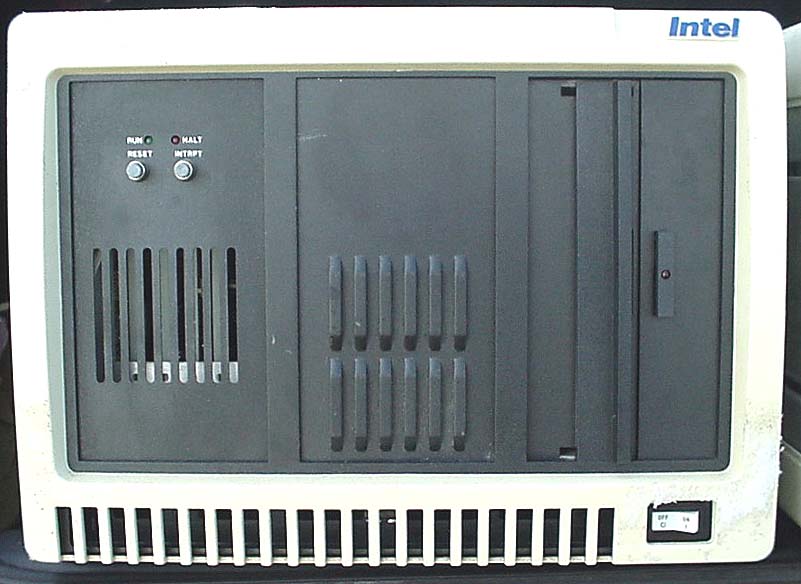
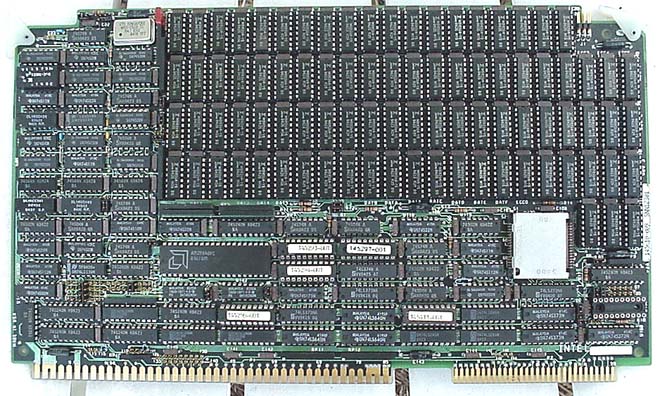
I brought home two of the Intel 86/330 computers that I recently bought.
(The things are BIG and I could only get two in the car at one time). I was
told that they all contained bubble memory cards and the one that I checked
had one but neither of the ones that I brought home had one :-( Anyway I
took a few pictures of the two that I brought home. Here are some links;
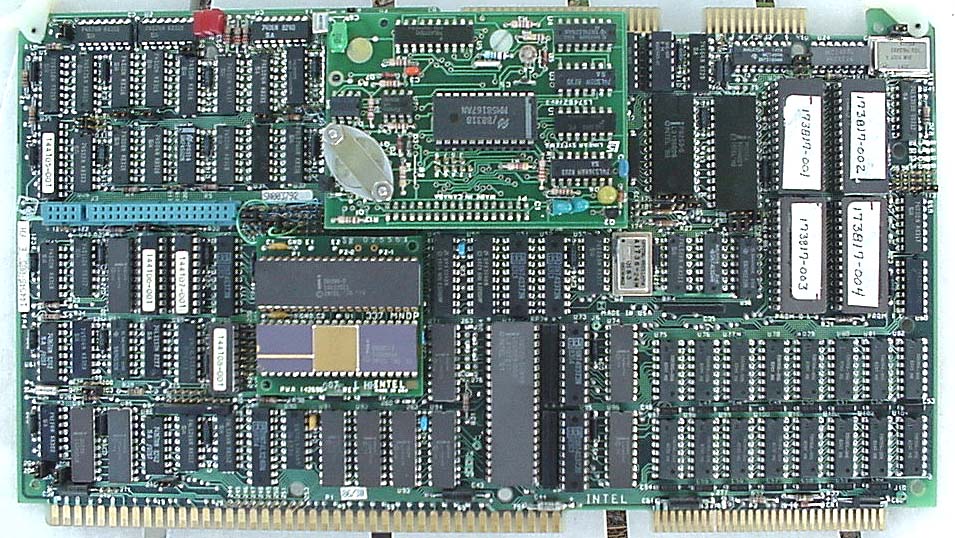
Front <http://www.classiccmp.org/hp/Intel%2086-330/front.jpg>, Back
<http://www.classiccmp.org/hp/Intel%2086-330/-back.jpg>, One of these has
the iSBC86/30 CPU card with a iSBC337 NDP daughterboard and a Real Time
Clock daughterboard made by Linear Systems
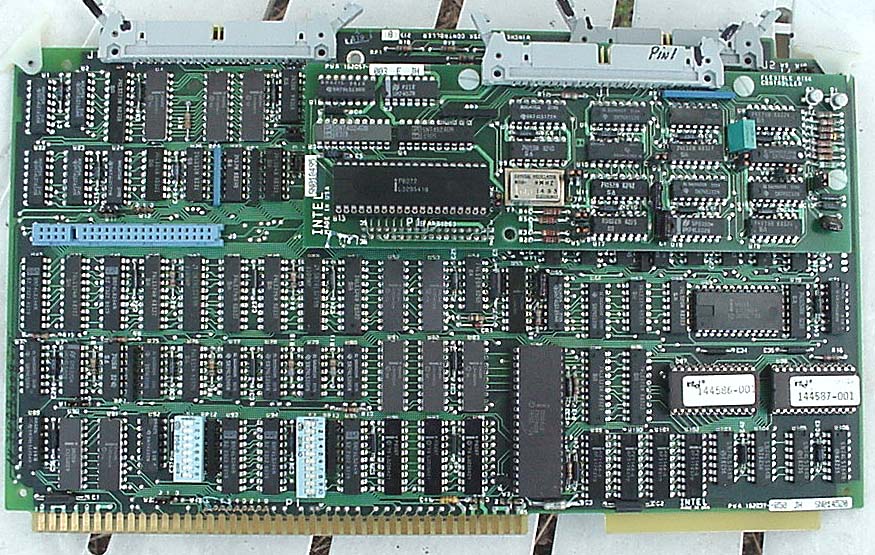
<http://www.classiccmp.org/hp/Intel%2086-330/86-330w-rtc.jpg>, they both
contained iSBC215 Winchester Hard Disk Controller cards with iSBC215 Floppy
Disk Controller daughterboards
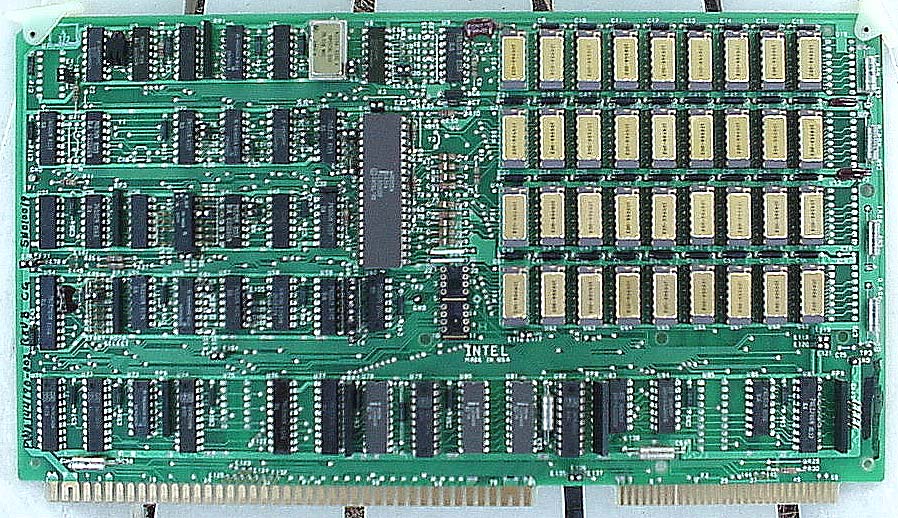
<http://www.classiccmp.org/hp/Intel%2086-330/WDC.jpg>, one system contains
an iSBC028 RAM card
<http://www.classiccmp.org/hp/Intel%2086-330/iSBC028.jpg>, the other
contains an iSBC012CX RAM card
<http://www.classiccmp.org/hp/Intel%2086-330/isbc012cx.jpg>, both systems
contain iSBC86/30 CPU cards
<http://www.classiccmp.org/hp/Intel%2086-330/isbc86-30.jpg>. One system
contains an iSBC88/45 Advanced Data Communications board. This is the
first iSBC 88/45 that I've seen. According to a site on the net, it has 3
HDLC/SDLC half/full duplex communication channels, optional ASNCH/SYNC on 2
channels, Supports RS232C, CCITT V.24, or RS422A/449, has a 8088 8 MHz
microprocessor, On-Board DMA supports 800KB baud operations, Self-clocking
NRZI SDLC loop data link interface point-to-point multidrop, 16KB static
RAM, Software programmable baud rate generation.
More later,
Joe
Question:
Would the mismatch in mains frequency affect the performance of the
rated ferro-resonant transformer (i.e. regulation)?
> A PDP8A chassis is listed on eBay, in the USA
>
>
http://cgi.ebay.com/ws/eBayISAPI.dll?ViewItem&category=1247&item=5124686380…
>
> Wonder what someone will think when they find out it's 50Hz only.
> It's in the pictures, but not in the writeup.
>
> Ed K.
>
>
That should not really matter that much, it is still 115 volts.
The block of iron in the transformer is a little overspec-ed for 60Hz.
Ed G.
Ethan won the "out-of-the-way-corners-of-the-earth contest" on Velonews
(competitive cycling magazine following the Tour de France).
and, if they decide to start an "insane readers" contest, they assure
him he's in the running as well.
Congratulations!
OK, I'm very close to needing to suck the data off the main memory of
this LGP-21 before I reform caps and all that electronicky stuff.
It would be nice to have a 16-bit MHz A/D system, but I don't. Any
*practical* suggestions for someone with an extremely limited budget? I
also don't have time to build one, though it's within my skills.
(The LGP-21 I have has a rotating magnetic main memory; bit-serial 80KHz
clock, 64 physical tracks (128 logical), 4096 31 (32) bit words, NRZ or
NRZI. I figure A/D sampling of the raw head signal at 8 to 10 times the
original clock rate will allow offline data recovery, should I smash
data on later CPU powerup.)
The platter is driven by an AC motor. It powers up completely
independently of the rest of the computer, so I can easily do all this
before I begin the restoration. I planned on rigging up a fast opamp
buffer/amp, clip-leading it onto each head in turn (the heads are low-Z;
I do know about ground, common-mode, etc), and taking 2, 4 or a dozen
snapshots of each track. I'll make the track snapshots available to
anyone who wants them.
If there's anything there, it would be really nice to see
41-year-old-data.
Practical suggestions appreciated...
> About the best I could do is to snail-mail the ROM to
> you. -or- I'll be in San Diego tomorrow - Monday.
That's a very generous offer, but there are two problems ... first I'm
presently in San Bernardino :( and won't be back in San Diego until Sunday,
and only Sunday at that.
The bigger problem, though, is actually getting the capsule out to read it.
I opened up my HHC-4 and dug out the NYL capsules, which I hadn't examined
too closely before. They *seem* to be regular 24-pin EPROMs (with an NYL
sticker conveniently covering the UV window; they're 4K TMS 2532s, for those
interested). The problem is not the chip, which seems to be a regular old
ROM. The problem is that the DIP legs are wrapped *around* the capsule
carrier, and digging the DIP out is probably going to damage the chip. I
could try wiring it into my Jason-Ranheim Promenade, but I don't see much I
could attach the wires to on the capsule side, and soldering leads directly
on to the DIP legs is right out because I'm very worried I would ruin this
first example of this capsule I've ever seen!
Is the BASIC ROM similarly "wrapped" on yours? If it is, perhaps there's
another way of doing this -- some way of reading out the contents of the ROM
using the HHC itself. If you've got the printer, maybe if we could scrabble
some way of printing out a hex dump, assuming this BASIC is halfway sane and
has PEEK and POKE or a moral equivalent. We'd just have to figure out where
in memory, but this is easier than it looks because it would have to start
on a 4K page boundary, meaning we'd only have to glance at 16 possible areas.
If one of them has BASIC keywords, we've found it.
All this to say I would be *very* antsy about damaging a *very* rare ROM
with my relatively novice EE skills, despite the fact I want it *very* much!
--
---------------------------------- personal: http://www.armory.com/~spectre/ --
Cameron Kaiser, Floodgap Systems Ltd * So. Calif., USA * ckaiser(a)floodgap.com
-- Five is a sufficiently close approximation to infinity. -- Robert Firth ----
Don's passing is a great loss to all collectors. May he rest in peace.
At risk of sounding selfish already, did anyone ever archive his disk images?
I had coincidentally been awaiting some from him these last few weeks, and
to my knowledge there were no archives of the floppy images he'd amassed.
-scott
Yup, the drive is pretty much toast. No telling how long it's going to
stay up this time. I'm headed back home from the datacenter to start
copying stuff off the drive.
Loosely translated, anyone who wants to chip in for a new hard drive
for the classiccmp server, let me know. If the servr is down,
I can be reached at jwest(a)ezwind.net
Thanks.
Jay
More info..
I can edit files if I am logged in as 100,1 but if I change files in
1,2 they disappear at running $shutup. I visited the computer history
museum today and showed someone there the problem, and they
suggested I "crash" the system instead of running shutup... tty.cmd
remained afterward. It seems
like shutup is doing somthing to try to protect the system by deleteing
an edited system file.
Other History...
> Ron> There is a problem when I am logged to my RSTS/E(simh) in as
> Ron> [1,2].
>
> Ron> I recently have been trying to edit my tty.cmd file, I am using
> Ron> teco, I edit the file making a change, I save the file with the
> Ron> teco command ex$$, ($=escape). Once out of teco I type tty.cmd
> Ron> to verify my changes. I then use pip to copy tty.cmd to tty.bak
> Ron> and tty.old .
>
> Ron> Then I shutdown RSTS/E and restart - to make sure my changes
> Ron> work.
>
> Ron> On reboot RSTS can't run tty.cmd - claims it can't even find it.
> Ron> Of course the startup procedure stops at that point so a lot of
> Ron> other things don't get done (loading error managers, spool
> Ron> managers, batch manager and defining CCL are the main things)
>
> Ron> While in this state directory (run $direct) cant find tty.* none
> Ron> of the tty files I copied remain..
>
> Ron> I even tried saving a file named cmd.tty and it vanished too.
>
> Ron> I type a new tty.cmd from scratch (using teco or pip) and reboot
> Ron> and now **all** of them are back.
>
> Ron> 8^P What's up?
>
> Sounds like a corrupt file structure.
>
> Try the "clean" option in INIT (Refresh command) at boot.
>
I did try this, it does not seem to help.
> paul
>
Begin forwarded message:
> From: Ron Hudson <ron.hudson(a)sbcglobal.net>
> Date: September 17, 2004 10:01:06 PM PDT
> To: Classic Computers <cctalk(a)classiccmp.org>
> Subject: RSTS strange problem
> Reply-To: "General Discussion: On-Topic and Off-Topic Posts"
> <cctalk(a)classiccmp.org>
>
> Ok,
>
> I have repeated it again... and typed out all the files before I
> rebooted - they disappeared again.
>
> I ran option:RES Clean then booted again. They were still gone.
>
> It's funny that all the files I touched disappeared..
>
> Perhaps this is a clue... What is SY0: as contrast to SY: and DL0:
> (all the same drive?)
>
Hello all,
I recently became the new owner of a Tek 321A scope, but it needs some
repairs. Also, I have no manuals, so if anyone could loan me an operator's
manual or service manual so I could make a copy, I'd appreciate it....
The main issue is the display. There is what I can only describe as a
"cloud" that runs vertically along the center of the display. Varying the
intensity and focus does vary this cloud, but it is still present. Also,
the trace line is visible, but very out of focus. Wider at the edges, and
narrower in the middle. I can take a picture if this makes no sense...
I don't know the working condition of the scope, but it was put in a large
bin for disposal. It's possible that it was just tosseed in, so it may have
been banged around a bit.
It seems a shame to toss this unit, as it is in pristine physical condition.
The battery holders are very clean, and the unit has no dust or dirt that I
can see....
If this is a common problem, or if it seems fixable, let me know what to
try....
Rich B.
Well, with the help from members of this list I finally got one Series
II running and one not tested but saved back and two that were FUBAR.
So, because I cannot bear to throw anything away all at once, kind of
like the story of the three legged pig, i decided to scavenge what I
could of the two Series II before pitching them. I just pitched the
Series I, the 3, and the 4.
I saved anything that had a wire connected to it and put all the
plastic, sheet metal and gear trains into the trash on the theory that
the gear trains looked tough enough to not be a failure point. I saved
about half the weight and half the storage space.
The fuser bulbs looked to be in good shape so I don't think they were
the cause of the "50 Service" error I was getting. At least the
filaments were not broken. I am assuming that this is like a halogen
bulb and you don't want to touch the glass surface of the bulb.
Is there a recommended cleaning procedure???
Too bad the fans are 24 volt not 115 volt. I could have used some 115
volt fans for my Kilowatt Linear I am building.
Are there any parts I missed? Are there some parts I should have dumped?
So, I've got power run now, and am trying to get the machine up and
running. After I figured out what baud rate it wanted (and reset it
down to 1200 baud from 1800 baud), I've been trying to figure out a
problem...
So, when I connect a terminal to the console port, all I can get is an
address: 173002, followed by an "@" (the ODT prompt). Trying to examine
the addresses using ODT fails. So, it looks like the bootstrap PROMs
are not accessible for some reason. From what I see, it appears that
they are actually contained on the CIB (Console Interface Board) in the
KA780 CPU.
Can anyone verify this, or have any suggestions what I should check? The
power supply bricks all have their "POWER NORMAL" lighs on, and seemed
to have a good 5V output from testing with a dummy load and DMM.
Any ideas? I'm a bit stuck here.
Pat
--
Purdue University ITAP/RCS --- http://www.itap.purdue.edu/rcs/
The Computer Refuge --- http://computer-refuge.org
Anybody know what has happened to the Classiccmp website? I checked some
of my webpages there yesterday and the files are still there but most of
them are now blank! The files are NOT missing and they still have the right
file size but they're blank. I just tried to access the site a few minutes
agoo but now I can't even get a connection to it. I e-mailed Jay yesterday
and asked him about the problems but haven't gotten a reply.
Joe
I found this in a book sale at a local organisation, and rescued it in
case anyone's interested.
If you want it, you get to pay me the 50 English pence it cost me, plus
shipping from UK.
It's by Bill Merrow, pub. McGraw Hill, (C) 1993. Has a flash "Includes
VSE/ESA Version 1.3" on the cover.
Ed.
At a recent hamfest I picked up two sets of
what appears to be Honeywell training material.
Each set consists of a slide projector tray,
cassette tapes, and a manual all in a
fold-open case.
The first set is labeled "Digital Computers
and Software" and is dated 1979. It has
80 slides in the tray and comes with two
cassette tapes and a booklet.
The second set is labeled "Delta 1000
Control Interpreter Language" and is dated
1980. There are 46 slides in the tray and
there is one cassette tape, along with
a booklet.
All of this stuff is marked "Honeywell
Proprietary."
I'm generally much more interested in HP stuff,
but this looked unusual enough to pick up.
Contact me off-list if you'd like more information.
Cheers,
Dan
www.decodesystems.com/wanted.html
To answer a few questions that have been asked about the Osborne 1:
-I'm not asking anything for it, but neither will I spring for shipping
and packing. I expect this could be expensive. I am not willing to deal
with international shipping at all.
-I'm in Gloucester, MA. Pickup would of course be best.
-It worked last I played with it, but that was 15+ years ago.
-The latches are on the sides.
And to answer some questions that have not been asked:
-The original user's manual is included.
-There are a number of disks, but no originals.
-I believe it has the double density controller.
Has anyone information on decoding the model number suffix on a Panasonic
3.5" floppy drive? The number is JU-257-14PF.
I was told it was a 720K drive when I bought it some time ago but it seems
to act like a 1.44MB unit. Need to confirm as I want a 720K for an
industrial OS-9/68K system I'm thinking of dragging out of storage.
Controller only talks 720K. Controllers in PC's use connector pin two,
IIRC, to select lo/hi density. Is my drive selectable by internal jumpers
for 720k only/1.44MB only (and is there such a drive available in general)?
I don't care to hack the hardware on my nice OS-9 system just to make
something work.
I can find 900+ hits on Google at this moment for the JU-257. Several
different suffixes are shown and many indicate 1.44MB capacity. There's but
only one with the -14PF suffix which appears in the search under the
inventory of Searchlight Tech.com site. No descriptive help there. Methinks
this is in fact a HD drive instead of the desired 720K and I was,
basically, ripped off.
Neither Matsushita nor Panasonic website searches yield anything on even
"JU-257". Long obsolete, evidently.
Thanks for your help.
-Chris F.
NNNN
Christian Fandt, Electronic/Electrical Historian
Jamestown, NY USA cfandt(a)netsync.net
Member of Antique Wireless Association
URL: http://www.antiquewireless.org/
at least it was CMOS versions of TTL logic...
-----Original Message-----
From: Tom Jennings <tomj(a)wps.com>
Sent: Sep 17, 2004 5:20 PM
To: "General Discussion: On-Topic Posts Only" <cctech(a)classiccmp.org>
Cc: "General Discussion: On-Topic and Off-Topic Posts" <cctalk(a)classiccmp.org>
Subject: RE: 2114 Static RAMs...
On Wed, 2004-09-15 at 11:16, Ed Kelleher wrote:
> At 05:00 PM 9/13/2004, you wrote:
> >When I was designing I/O boards for spaceborne computers I once saw
> >what happens when most inputs are left floating on CMOS designs. This
> >was a design full of (~30) 54HCxx ICs.
> gak! 54xx IC's -- No wonder the space program cost so much!
And running TTL off batteries! Ouch!
I will be happy to pass on the SW when I get to it, and to all also.. ISIS
should run on the 330, too. The 330s origianlly were 8086 SBC with separate disk
controllers for the HD and 8" Floppy. The 330 had a Priam 3450 *" HD (30 meg)
and a DSDD 8" floppy and a 6 slot backplane.
My 380 has a 286 SBC with a 14 slot backplane in one box and the HD, floppy
and a tape drive in a second same size box.Twin 50 pin cables interconnect.
The combo HD, Floppy and tape card is the 214 I think. There is usually a
console port on the SBC. Other serial IO was on other cards.
The hard drives have a manual parking lever. If it is not set do it
immediatly.
I would love to hear what the configuration of them is. The SBC board numbers
had a slash number. 86/30, 286/10.
The 320 is multibus II isn't it? A VME type connector (but not the same pin
configuration).
Paxton
>> [If it is a 2114, it will be the second one I've found dead in PET hardware
>> over the past month - other was was video RAM in a 4032]
>
>FWIW, I've had _lots_ of 2114s fail. I had to replace all of them in my
>8050 (IIRC, if you hvave multiple RAM errors, you get the flash code for
>the lowest bank first, then when you've replaced those you get the code
>for the next bank, and so on...). I had to replace the video RAMs in my
>TRS-80 Model 3. And the RAM in my HP82163 video interface. And more...
>
>In my experiece the 2114 is one of the least reliable chips ever...
I've seen a few other ones fail as well - funny, I used a LOT of 2114s in
my early building (at 4 bits each - way less wire-wrapping than 2102s).
Never had any trouble with them at the time, however they do not seem to
age well...
Btw, it is an 8050, and replacing those two chips did fix it. [Naturally,
the one I pulled first was not the defective one]
Regards,
--
dave04a (at) Dave Dunfield
dunfield (dot) Firmware development services & tools: www.dunfield.com
com Vintage computing equipment collector.
http://www.parse.com/~ddunfield/museum/index.html
This is a new variation of a scam. I have gotten two on my posting of my HP
110 outfit on the HP Museum classified ads that I mentioned earlier.
Both wanted me to name a price, they did not care what it was. One wanted to
send me a certified check for over the amount with me rebating them the
overage. This is the letter I mentioned on the list.
The other wanted to buy anything else I had and would pay me with a credit
card. All they were going to provide was the credit card number and the
expriation date. There was a strong implication they would pay an inflated price. It
was an open invitation to Fraud and I reported it to Yahoo where the offer came
from.
It was interesting that they would make arrangements for the equipment to be
picked up.
A news story on the local TV told a story of a T Shirt company that got an
offer similar to purchase the 9000 T shirts and paid with two credit cards. One
went through but the other bounced and the owner of the business found out it
was fraud before he shipped it, overseas.
However. The people that ordered, when they did not get their T-Shirts,
threatened violence against the owner if he did not ship, several times.
I think it best not to respond to such offers, and report them to their
apparent (but usually not real) source.
I think it is important to report all Fraud to the internet providors.
Paxton
Astoria
PS I was concerned that I got two fraud offers directly related to my posting
of the HP110 on the HP Museum Classified ads. It shows that thre are many
people out there trolling collectable computer and calculator sales with the
intent to defraud.
>For some reason I just don't trust Disney any more as the
>company is too $%^! much like M$ now days.
I'm curious if that will change when Eisner leaves (2006, he formally
announced he will be leaving when his contract expires).
-chris
<http://www.mythtech.net>
I am in Port Charlotte with the American Red Cross and the damage around
here is unbelievable. I went last weekend to visit the In-laws in
Boca Raton on the east coast of Florida and there is quite a bit of damage
there as well. Red Cross is scrambling for volunteers and is trying
to shuffle equipment around. It is beyond comprehension for me on
just how Red Cross can possibly keep up. Yes, Florida is getting slammed
this year.
Joe Heck
>The
>question is not so much is this year anomolus in terms of history, but
>rather the start of a long term trend [think of the impact on the economy
>down there if it is.....]
Humm... you mean Disney might actually have to make Walt's EPCOT dream a
reality and have a fully enclosed theme park?
-chris
<http://www.mythtech.net>
><< Humm... you mean Disney might actually have to make Walt's EPCOT dream
>a reality and have a fully enclosed theme park? >>
>
>In 1967, Walt Disney (after his death) presented on TV his original
>concept of what EPCOT (Experimental Prototype Community of Tomorrow) was
>to be and it in no way resembled what EPCOT is today. It was not to be a
>theme park, or more accurately a permanent World's Fair. Instead, it was
>actually a city with approximately 20,000 citizens. The central
>core/shopping/office district was to be inclosed by a dome, and the rest
>of the "city" extended away from it in a wagon wheel style of monorails
>and streets. I have this presentation on DVD from Disney's Treasures
>collection.
>
>For more, see: http://xroads.virginia.edu/~MA98/hogan/celebration/epcot.htm
Yeah we learned all about this in Disney Brainwashing... er... um,
"Traditions" (the intro to Disney class they put all the college interns
thru).
>From what I understood (last time I asked friends that still work for
Disney, which was a while back), Celebration is (was?) a borderline
cesspool of high crime and bad neighbors. So I guess that would make it a
successful failure?
-chris
<http://www.mythtech.net>
Date: Fri, 17 Sep 2004 12:40:43 -0400
From: chris <cb(a)mythtech.net>
<< Humm... you mean Disney might actually have to make Walt's EPCOT dream a reality and have a fully enclosed theme park? >>
In 1967, Walt Disney (after his death) presented on TV his original concept of what EPCOT (Experimental Prototype Community of Tomorrow) was to be and it in no way resembled what EPCOT is today. It was not to be a theme park, or more accurately a permanent World's Fair. Instead, it was actually a city with approximately 20,000 citizens. The central core/shopping/office district was to be inclosed by a dome, and the rest of the "city" extended away from it in a wagon wheel style of monorails and streets. I have this presentation on DVD from Disney's Treasures collection.
For more, see: http://xroads.virginia.edu/~MA98/hogan/celebration/epcot.htm
Best, David
The ride home brought us right through
rush-hour traffic on Chicago's loop (I-90/94)
--
For future reference to people heading west from Wisconsin...
DO NOT go through Chicago!
Take I 43 down to I-90 east, then I-39 to I-88 (the old East-West
Tollway) which connects to I-80 at the IL-IA boarder.
--al (who's made the trip TOO many times)
Hi Joe
Yes. It is telling you to leave Florida to the gators and bugs.
Dwight
>From: "Joe R." <rigdonj(a)cfl.rr.com>
>
> Damm! We took a direct hit with hurricane Charlie. Then a NEAR miss
>with hurricane Frances. (It took 4 1/2 > DAYS < to pass through!) Then
>another narrow miss with hurricane Ivan. I just looked at the weather
>forecast and now there's another one headed this way! Hurricane Jeanne is
>expected to hit the east coast of Florida around Monday. Is somebody trying
>to tell us something?
>
> Joe
>
> Damm! We took a direct hit with hurricane Charlie. Then a NEAR miss
>with hurricane Frances. (It took 4 1/2 > DAYS < to pass through!) Then
>another narrow miss with hurricane Ivan. I just looked at the weather
>forecast and now there's another one headed this way! Hurricane Jeanne is
>expected to hit the east coast of Florida around Monday. Is somebody trying
>to tell us something?
One of the reports I was reading claimed that this is supposed to be the
norm for the Florida area, and that you have just been lucky for the last
few decades and haven't really had as many storms as you should have.
But then, who trusts anything the weather service has to say :-)
-chris
<http://www.mythtech.net>
ooh no it's that Hudson fellow again. Someone take his PDP 11 away, he
don't know how to use it..
There is a problem when I am logged to my RSTS/E(simh) in as [1,2].
I recently have been trying to edit my tty.cmd file, I am using teco, I
edit the file making a change, I save the file with the teco command
ex$$, ($=escape). Once out of teco I type tty.cmd to verify my changes.
I then use pip to copy tty.cmd to tty.bak and tty.old .
Then I shutdown RSTS/E and restart - to make sure my changes work.
On reboot RSTS can't run tty.cmd - claims it can't even find it. Of
course the startup procedure stops at that point so a lot of other
things don't get done (loading error managers, spool managers, batch
manager and defining CCL are the main things)
While in this state directory (run $direct) cant find tty.* none of the
tty files I copied remain..
I even tried saving a file named cmd.tty and it vanished too.
I type a new tty.cmd from scratch (using teco or pip) and reboot and
now **all** of them are back.
8^P What's up?
I think I need a nice RSTS/E boot camp.
I found five of these in the same area
a couple of years ago but they were missing the hard drive and there was no
hope of finding the OS for them so I eventually scrapped them
--
Was this before I found the copy of iRMX86 on eBay?